Blog

  • The Best Chama App in Kenya: How it Bringing Joy, Trust, and Growth to Kenyan Investment Groups

    Best chama app in Kenya is now one of the most searched phrases in the country’s thriving savings and investment culture. The excitement behind those searches is easy to understand. Kenyans have long known a powerful truth: when people pull their resources together, they achieve what none could achieve alone.

    Chamas buy plots in Kitengela and Joska. They put up rental blocks in Ruiru and Ruaka, finance matatus, stock dukas, and pay school fees. They also stand with members through hospital bills and funerals, making them one of the most trusted institutions in daily Kenyan life.

    Financial inclusion studies consistently describe Kenya’s informal groups as one of the most dynamic wealth-creation engines in Africa. These groups move hundreds of billions of shillings every single year. Yet for decades, their working tools were a hard-cover exercise book, the treasurer’s memory, and blind trust.

    Far too many promising groups collapsed under the weight of that fragile combination. Today, a quiet and joyful revolution is sweeping through monthly meetings across the country. At the heart of this transformation is the best chama app in Kenya, which records every contribution, tracks every loan, calculates every fine, and produces transparent reports that every member can see.

    Treasurers are retiring their ledgers, and chairpersons are sending digital invoices instead of chasing members across estates. Members receive instant M-Pesa receipts the moment they contribute. Groups that once spent their meetings arguing about “who paid for March” now spend them planning their next plot purchase.

    The results speak for themselves in living rooms and boardrooms alike. Arrears shrink, disputes dissolve, and meetings end early with everyone smiling. Better still, the group’s money story becomes visible at a glance to every single member.

    This guide is written for every kind of group. The five-member welfare table in Buruburu, the thirty-member investment chama in Eldoret, the youth group in Kisii, and the diaspora chama in Boston all deserve the same clarity. In the sections ahead, you will discover exactly what the best chama app in Kenya does, the features that matter most, the benefits for every official and member, and how to choose and implement the right platform with confidence.

    What Is the Best Chama App in Kenya?

    A chama app is a digital platform, usually cloud-based and mobile-friendly, that centralizes the entire life of an investment group. It manages member registers, contribution schedules, share capital, loans, fines, meetings, minutes, voting, and financial reports in one place. Instead of critical records living in one treasurer’s notebook, everything is stored securely and made visible to authorized officials at any time — which is why groups describe adopting the best chama app in Kenya as the moment their group finally “grew up” financially.

    What separates a purpose-built local platform from generic international tools is local depth. The finest platforms speak M-Pesa fluently, reconciling Paybill and Send Money payments to the right member, the right month, and the right purpose automatically. They also understand share capital, the beloved Kenyan culture of fining latecomers, reducing-balance interest, and the quarterly reports officials must present — the full standard that the best chama app in Kenya is judged against.

    They work on the phones members actually own. They send SMS reminders to those without smartphones. They offer friendly local support in English and Kiswahili, because Kenyan groups richly deserve nothing less.

    Because everything lives in one secure place, the group is no longer hostage to one person’s memory or notebook. Officials can hand over duties without drama, and audits become a formality instead of a crisis. That continuity is what allows a group to plan in years instead of weeks.

    Why Kenyan Chamas Are Trading Notebooks for the Best Chama App in Kenya

    The motivations behind digitization are both painful and hopeful. On the painful side sit disputes over unrecorded payments, ghost borrowers, uncollected fines, and the heartbreaking collapse of groups that saved faithfully together for a decade. On the hopeful side, mobile money penetration is among the highest in the world, and a new generation expects the same digital convenience from its chama that it enjoys everywhere else — which is exactly what the best chama app in Kenya delivers.

    When a group adopts the best chama app in Kenya, it converts trust from a personality trait into a system. Systems endure, scale, and keep every member smiling long after the founding officials have moved on. That shift is why adoption keeps accelerating in every county, from Mombasa to Malaba.

    There is also the diaspora effect. Some of the most successful groups have members in Dubai, London, Toronto, and Melbourne who want to contribute, borrow, vote, and follow projects without waiting for a monthly phone call. With the best chama app in Kenya, the chama becomes borderless: a member in Qatar receives the same invoice, pays the same Paybill, and sees the same statement as a member in Kawangware.

    That inclusiveness strengthens groups both financially and emotionally. Families scattered across the globe keep building one common dream at home. It is one of the most heartwarming outcomes reported by groups that have gone digital.

    There is also the generational handover to consider. Younger members join groups expecting apps, statements, and instant receipts, and they judge a group’s seriousness by its systems. Groups that digitize attract and keep the very members who will lead them for the next twenty years.

    Key Features of the Best Chama App in Kenya

    Not every platform deserves your group’s money. The difference between a transformative tool and an expensive frustration comes down to features. The best chama app in Kenya is separated from a fancy spreadsheet by the capabilities below.

    Each feature below earns its place by solving a real problem that Kenyan groups face every month. Read them as a practical shopping list rather than a technical specification. A platform that covers all six will repay your attention many times over.

    1. Automated Contributions and M-Pesa Reconciliation

    The platform should invoice each member automatically according to your constitution, covering monthly contributions, share capital top-ups, and welfare quotas. It should reconcile M-Pesa payments the instant they land. The treasurer’s long evening of “confirming who sent what” becomes a thirty-second glance at a dashboard, which is the everyday relief the best chama app in Kenya is designed to deliver.

    2. Loan Management That Actually Balances

    From application to approval to disbursement to the final instalment, loans should be tracked with configurable interest. Flat or reducing-balance calculations, automatic late-repayment penalties, guarantor records, and a clear ledger per member should all come standard. The loan book is where many chamas bleed money and friendships, and it is where the best chama app in Kenya pays for itself fastest.

    3. Fines, Penalties, and Welfare Tracking

    Was a member late for the meeting, or did a contribution miss its date? Fines should post automatically according to your group’s rules, appear on the member’s own statement, and clear exactly like any other balance. Automatic enforcement removes the awkwardness of officials playing “kangaroo court” every month — a small mercy that members of the best chama app in Kenya appreciate more than they ever expected.

    4. Meetings, Minutes, and Digital Voting

    The platform should schedule meetings, send invitations, record attendance, and store minutes in one place. For the big decisions — like buying that half-acre in Makutano — it should conduct digital votes with a permanent record of who voted and how. Decision-making becomes faster, calmer, and dispute-free, which is a signature outcome for groups on the best chama app in Kenya.

    5. Reports Every Official Will Love

    Member statements, contribution summaries, loan portfolios, arrears aging, and AGM-ready annual reports should export in seconds. They should never need to be assembled over lost weekends. Strong reporting is the single most persuasive feature of the best chama app in Kenya during committee elections, because the treasurer’s job suddenly looks peaceful enough that people actually volunteer for it.

    6. Security, Roles, and Transparency

    Role-based access for the chairperson, treasurer, secretary, and ordinary members keeps power balanced. Encrypted data, automatic backups, and a complete audit trail protect every entry. Members trust what they can verify, and verification is precisely what the security architecture of the best chama app in Kenya makes possible — openness with control in one elegant package.

    The Life-Changing Benefits of the Best Chama App in Kenya

    For the treasurer, the transformation is close to miraculous. The official who once spent three evenings a month chasing figures now closes the books in under an hour, because the best chama app in Kenya does the matching, the totting, and the reminding automatically. Burnout — the quiet killer of chama officials — becomes a thing of the past.

    Treasurers who once dreaded re-election now accept it with a smile. For members, the benefit is confidence: every shilling contributed is receipted, every loan is documented, and every fine is justified. Trust stops depending on who shouts loudest in the meeting and starts resting on records that never forget — the daily promise of the best chama app in Kenya.

    For the chairperson and secretary, it means dignified meetings with less time litigating the past and more time building the future. For the group as a whole, it means momentum. Groups running the best chama app in Kenya typically report higher contribution discipline, faster loan turnaround, and the collective courage to take on bigger investments, from matatu ventures to apartment blocks.

    There is also a quieter benefit that officials rarely mention aloud. Digital records protect honest officials from suspicion, because every figure can be traced and verified. In a space where reputations are everything, that protection is priceless.

    Chamas, Real Estate, and the Best Chama App in Kenya

    Property is the dream investment for many Kenyan groups — a plot today, a rental block tomorrow, and rental income for decades. Owning property adds a second layer of administration: tenants, rent collection, deposits, repairs, and landlord statements. This is where the ecosystem around the best chama app in Kenya matters most.

    A group can run its contributions, loans, and fines on the best chama app in Kenya. It can then manage the property side on a dedicated rental platform. Investment groups that own apartments, for example, increasingly administer their units and tenants through Tas.co.ke, which handles rent invoicing, M-Pesa collection, maintenance records, and owner statements.

    The combination is powerful. The chama platform tells every member what they owe the group, while the property platform tells the group what its tenants owe the chama. Groups that connect the two worlds — group finance on the best chama app in Kenya and property operations on Tas.co.ke — enjoy a level of clarity that used to require an accountant on retainer.

    Rental income also gives the group a steady monthly cash flow between contribution cycles. With statements generated automatically, the AGM becomes a celebration of numbers everyone can trust. That confidence is what encourages members to increase their contributions year after year.

    Table Banking, Merry-Go-Rounds, and the Best Chama App in Kenya

    Not every group is chasing land. Table banking groups rotate lump sums, merry-go-rounds cycle the “pot” from member to member every month, and welfare societies keep emergency funds ready for hospital bills and funerals. The best chama app in Kenya handles all these formats gracefully.

    It records who received the payout in which cycle and schedules the next payout automatically. It tracks welfare subscriptions and keeps the entire history transparent for every member to see. No one ever again asks “so who is taking it this month?” with suspicion in their voice — a small joy that the best chama app in Kenya delivers every single month.

    Funeral welfare groups and church fellowship funds benefit enormously too. The underlying principles are identical: clear records, automatic reminders, and dignified accountability. When money flows through transparent systems, harmony follows — the daily experience of groups using the best chama app in Kenya.

    Small formats, big feelings — these groups run on trust and rhythm. Digital reminders keep the rotation moving on schedule, month after month. The group’s energy goes into helping one another instead of chasing one another.

    How to Choose the Best Chama App in Kenya

    Growing demand has brought growing supply. Your group deserves a deliberate choice rather than a leap of faith. Work through this checklist before committing to anything.

    Bring two or three officials to every demo and take notes as a team. Ask each provider to show your own group’s structure, not a polished sample. Ten minutes of honest testing reveals more than ten pages of marketing.

    1. M-Pesa integration: If the platform cannot reconcile Paybill and Send Money payments automatically, keep looking. Payment confirmation should be an event of seconds, not an evening’s debate. The best chama app in Kenya treats speed and accuracy as non-negotiable.

    2. Simplicity for every member: Your youngest member and your most senior member must both be able to use it comfortably. If a live demo confuses anyone in the room, walk away, however impressive the marketing. The best chama app in Kenya is the one that works for the whole table.

    3. SMS support: Members without smartphones still deserve invoices, reminders, and confirmations. Groups that prioritize inclusivity choose platforms with robust SMS built in. The best chama app in Kenya never leaves a member behind because of the phone they own.

    4. Local support: When contribution day hits a technical snag, you need a real, reachable Kenyan support team. An overseas email ticket answered in five business days does not count. Responsive human support is a defining trait of the best chama app in Kenya.

    5. Transparent pricing: Understand the subscription, per-SMS charges, member limits, and onboarding costs before signing anything. Honest, upfront pricing should be stated in plain language. That transparency is the hallmark of the best chama app in Kenya.

    6. Data ownership and export: Your group’s history belongs to the group, not to the vendor. Confirm before signing that you can export every record, at any time, in a usable format. Confidence in the product is exactly why the providers of the best chama app in Kenya make leaving easy.

    Implementing the Best Chama App in Kenya: A Step-by-Step Roadmap

    Choosing the platform is the easy part. Adopting it happily is where groups win. Follow this simple roadmap.

    Step 1: Agree as a group. Pass a formal resolution, update the constitution to recognize digital records and payments, and appoint one enthusiastic champion. The smoothest adoption always begins with a unanimous minute in the old book. That minute is the last important thing the notebook will ever record before the best chama app in Kenya takes over.

    Step 2: Clean your data. Reconcile the old ledger, list every outstanding loan and fine, and confirm share capital balances member by member. Most groups discover discrepancies during this exercise. Resolving them early — before the best chama app in Kenya goes live — prevents years of quiet resentment.

    Step 3: Onboard every member at once. Hold a live demonstration during a monthly meeting, share a simple one-page guide, and pin the announcement on the WhatsApp group. Groups that train everyone together succeed far faster than those that train one by one. With the best chama app in Kenya, near-total adoption typically happens within a single cycle, and no member feels left behind.

    Step 4: Run one cycle in parallel. Keep the old book and the new system side by side for the first month. Reconcile the two at month-end. Celebrate the match — it is the moment the group officially trusts the best chama app in Kenya as its digital future.

    Step 5: Review after ninety days. Study the collection rate, loan performance, and fines captured, then share the wins at the next meeting. Seeing the improvement in black and white converts early skeptics remarkably quickly. The loudest ambassadors of the best chama app in Kenya are almost always former doubters.

    Real Stories from Groups Using the Best Chama App in Kenya

    The Nakuru merry-go-round. A twelve-member women’s group had rotated savings for nine years while constantly at odds over late contributions. Within three months of adopting the best chama app in Kenya, automatic reminders and instant receipts had reduced arrears to nearly zero. The treasurer, who had threatened to resign twice, cheerfully stood for another term.

    “For the first time,” she said, “our records are cleaner than the bank’s.” That is the everyday magic groups feel once the old notebook is finally retired. Happiness, it turns out, is a balanced ledger.

    The Kitengela landlords. A thirty-member investment chama in Nairobi bought a quarter-acre in Kitengela and put up eight rental units. It ran contributions, loans, and fines on the best chama app in Kenya. It managed tenants and rent through Tas.co.ke at the same time.

    At the last AGM, the officials produced complete group statements and property statements in under twenty minutes. Members now discuss the “second building” with the confidence of people who can actually see their numbers. Professional management, they say, turned a part-time headache into a genuine asset.

    The Eldoret boda fleet. A youth group saving toward a boda-boda fleet struggled with chronic lateness. Automated fines restored discipline gently, impartially, and without a single shouted argument. Six months later, the savings rate had jumped dramatically, and the group credits the best chama app in Kenya with turning their dream from a slogan into a savings schedule.

    Across the country, the pattern repeats in different accents and different counties. Groups do not just save faster on digital platforms — they dream bigger. And bigger dreams, tracked transparently, tend to come true.

    How Much Does the Best Chama App in Kenya Cost?

    Pricing models generally fall into three families: a flat monthly subscription, per-member pricing that scales as you grow, and tiered packages bundling features at different price points. Add-ons such as bulk SMS or premium support may be billed separately. Whatever the model, the providers of the best chama app in Kenya should always state the total first-year cost plainly.

    If a provider cannot give you that number without hesitation, treat it as an answer in itself. Set the costs against the measurable returns: recovered fines, eliminated arrears, saved treasurer hours, and avoided disputes. Split across a committee, the best chama app in Kenya often costs less per member per month than a single soda after the meeting.

    Unlike the soda, it compounds in value every month the group grows. The return grows with the portfolio, the loan book, and the ambitions of the members. Few investments offer a payback that reliable.

    Remember to weigh the cost of not switching as well. A single unresolved dispute or a collapsed loan book can wipe out years of savings. Prevention, in group finance as anywhere else, is dramatically cheaper than cure.

    Common Mistakes to Avoid After Choosing the Best Chama App in Kenya

    Skipping the constitutional update. Digital records and digital payments must be formally recognized in your constitution. Without that step, a future dispute could render them technically unenforceable. Groups that thrive on the best chama app in Kenya pass the enabling resolution before the first invoice goes out.

    Over-engineering the rules. Resist the temptation to invent new fine and interest structures just because the software can support them. The best chama app in Kenya should enforce your rules, not replace them. Keep the system configured to mirror the constitution the members actually voted for.

    Ignoring the reports. The dashboards are not decoration — they are the group’s early-warning system. Officials who review them monthly catch arrears and loan problems while they are still small. That discipline is precisely what the best chama app in Kenya was built to encourage.

    The Future of the Best Chama App in Kenya

    Artificial intelligence is moving from buzzword to feature. Predictive scoring will flag members likely to fall behind before they do, and smart suggestions will set loan limits from contribution history. Early versions of these capabilities are already appearing in the best chama app in Kenya, and they will soon be standard expectations rather than luxuries.

    Deeper financial integration is coming too. Richer connections between platforms, banks, M-Pesa, and credit reference systems mean a group’s clean digital records could directly support its creditworthiness. Imagine a chama whose three-year history, tracked on the best chama app in Kenya, becomes the evidence that qualifies it for a construction loan.

    That future is closer than most groups realize. As groups mature into genuine investment companies, the pairing of group finance with specialized asset management will define the winners. Groups that run their savings on the best chama app in Kenya and their rentals on platforms like Tas.co.ke will operate like boutique investment firms with the warmth of a family.

    That combination of trust and professionalism is a beautiful thing to watch. It is exactly where the market is headed, and early adopters will enjoy the strongest head start. The best chama app in Kenya is not just a tool for today — it is the foundation the next decade of group wealth will be built on.

    Frequently Asked Questions About the Best Chama App in Kenya

    Is it worth it for a very small group of five members? Yes — even tiny groups suffer disputes and arrears, and the cost per member is negligible. Most groups find the value appears immediately, in saved time and eliminated arguments. The clarity alone is worth many times the subscription.

    Is our financial data safe on a cloud platform? Reputable providers encrypt data in transit and at rest, maintain backups, and restrict access through role-based permissions. In practice, digital records are far safer than a single exercise book that can be lost, stolen, or contested. Choosing an established provider with a proven track record is the best security decision a group can make.

    What about members without smartphones? Well-designed platforms send invoices, reminders, and confirmations by SMS, so every member stays in the loop. Inclusivity is a core design principle of serious chama platforms, not an afterthought. No one should be excluded because of the phone they own.

    Can one platform handle both a merry-go-round and loans? Yes — modern systems track rotating payouts and a full loan book simultaneously, with separate ledgers for each. The two sides of group finance stay perfectly balanced. That capability is what separates a serious platform from a basic reminder app.

    Can our diaspora members participate fully? Absolutely — they receive the same invoices, pay through the same channels, vote in digital polls, and view the same statements as members at home. Distance stops mattering the day the group goes digital. It is one of the most celebrated outcomes of modern group platforms.

    What if the app’s rules conflict with our constitution? The software should be configured to mirror your constitution, never the reverse. If a platform forces you into rigid rules that contradict your document, it is the wrong fit. Your constitution is supreme, and the technology must submit to it.

    How much does it cost per member? Depending on the pricing model and group size, it typically works out to a small monthly amount per member, often less than a soft drink. Tha is an easy case to make at any AGM. The returns — time, trust, and discipline — arrive from the very first cycle.

    Can we switch mid-year, in the middle of a loan cycle? Yes, provided the provider supports full data import and export. Balances, arrears, and loan schedules can be migrated cleanly at any point in the year. Confirm the data policy before signing, and switching becomes routine rather than risky.

    What happens when our treasurer changes? Nothing breaks, because the records live in the system rather than in one person’s head or handbag. New officials log in and find everything exactly where it should be. That continuity is one of the greatest protections a group can give itself.

    We own rental units — can the group manage them too? Yes, and the smartest groups pair their group-finance platform with a dedicated property system. Contributions and loans run on the chama platform, while tenants, rent collection, and landlord statements run on Tas.co.ke. One clean, connected ecosystem for everything the group owns.

  • Chama Investment Management in Kenya: A Practical Guide for Smarter Group Investing

    Chama Investment Management Software Kenya
    Chama Investment Management in Kenya: A Practical Guide for Smarter Group Investing

    Introduction

    For investment chamas, keeping track of contributions, portfolios, projects, dividends, member balances, and investment decisions can become difficult when records are spread across notebooks, spreadsheets, bank statements, and WhatsApp messages. Chama Investment Management Software Kenya gives chama officials a structured way to organize investment information, improve financial visibility, and keep members informed. This guide is written for chama officials, treasurers, investment committees, accountants, and members who want to understand how digital investment management can support better record keeping and more disciplined group investing.

    A chama may begin with a simple monthly contribution arrangement, but its financial activity can become much more complex as the group grows. Members may contribute different amounts, the group may hold several investments, and the committee may need to track loans, property projects, securities, savings products, business interests, or other assets. Without a consistent system, it becomes harder to answer basic questions such as how much has been invested, what each member owns, which payments are outstanding, what returns have been received, and what decisions were approved.

    A good investment management system brings those records into one organized environment. It does not replace the chama’s investment committee or make decisions for members. Instead, it gives the group better information for meetings, reporting, reconciliation, planning, and accountability.

    This article explains the practical role of digital investment management for Kenyan chamas, the features to look for, how the system can support different investment activities, and how a group can prepare for implementation.

    What Is Chama Investment Management Software?

    Chama Investment Management Software Kenya is a digital solution designed to help investment groups record, organize, monitor, and report on financial and investment activities. Instead of maintaining separate files for contributions, assets, income, expenses, and member balances, a chama can use a central system to keep relevant information connected.

    The purpose is not simply to replace paper. A useful system should make information easier to retrieve and understand. When a treasurer records a contribution, for example, the system should help connect that transaction with the correct member and reporting period. When an investment generates income, the group should be able to record the income against the appropriate investment and later include it in reports.

    For a chama with several investment activities, this structure can be especially valuable. Members can have a clearer view of how pooled funds are being used, while officials can spend less time searching through disconnected records.

    Why investment records need structure

    Investment decisions depend on reliable records. A group may need to know:

    • Total contributions received.
    • Amount invested in each asset or project.
    • Income generated by each investment.
    • Investment-related expenses.
    • Current member balances.
    • Outstanding member obligations.
    • Cash available for future investment.
    • Historical performance of projects.
    • Decisions approved at previous meetings.
    • Documents supporting transactions.

    When these details are stored consistently, the committee can prepare for meetings more efficiently and members can ask questions using the same underlying records.

    Why Kenyan Chamas Are Moving Toward Digital Records

    Many Kenyan chamas are built around trust, regular contributions, and collective decision-making. Those strengths remain important, but growing financial activity creates administrative pressure.

    A group with ten members and one savings account may manage records manually without much difficulty. A larger chama with several investments, multiple accounts, regular income, expenses, and changing membership has a different administrative burden.

    Chama Investment Management Software Kenya can help create a central record for those activities. The main benefit is visibility: officials can work from organized information instead of repeatedly reconstructing financial history from individual documents.

    Digital records can also improve continuity. If a treasurer changes, the next treasurer should not have to rebuild the chama’s records from memory. A structured system gives the incoming official a starting point.

    Common administrative challenges

    Chamas may experience issues such as:

    1. Missing contribution entries.
    2. Duplicate records.
    3. Delayed reconciliation.
    4. Difficulty tracking investment income.
    5. Unclear member balances.
    6. Lost supporting documents.
    7. Slow preparation of meeting reports.
    8. Disagreements caused by inconsistent figures.
    9. Difficulty comparing investments.
    10. Limited visibility into historical transactions.

    These problems do not necessarily mean that officials are careless. They often result from growth, limited administrative time, or reliance on tools that were not designed for group investment management.

    Core Features to Look For

    A chama should assess software according to its actual activities rather than choosing a system based only on the number of features listed on a website.

    Chama Investment Management Software Kenya should ideally support the complete information cycle: recording money received, documenting money invested, monitoring returns, recording expenses, maintaining member information, and producing useful reports.

    1. Member management

    Member management provides the foundation for investment records. The system should allow the chama to maintain relevant member information and connect each person’s financial activity to their profile.

    Useful member records may include:

    • Name and contact information.
    • Membership status.
    • Joining date.
    • Contribution history.
    • Investment participation.
    • Allocated returns.
    • Outstanding balances.
    • Relevant documents.

    A well-organized member record reduces the need to search across multiple spreadsheets.

    2. Contribution tracking

    Contributions are often the primary source of pooled investment capital. The system should make it easy to record regular contributions and identify missed or incomplete payments.

    Chama Investment Management Software Kenya can support contribution tracking by connecting transactions to members and periods. This gives officials a clearer view of expected versus received funds.

    For example, suppose a chama expects each of 20 members to contribute KSh 5,000 monthly. The expected monthly pool is KSh 100,000. If only KSh 90,000 is received, the committee should be able to identify the outstanding KSh 10,000 without manually checking every member’s record.

    3. Investment portfolio records

    A group may have more than one investment. Its portfolio could include a property project, a business venture, a savings product, or another approved investment.

    A digital portfolio record can show:

    Investment information Why it matters
    Investment name Identifies the asset or project
    Date started Establishes the investment timeline
    Amount invested Shows capital committed
    Income received Tracks cash generated
    Expenses Captures related costs
    Current status Shows whether the investment is active
    Supporting documents Provides evidence for records

    The precise fields should reflect the chama’s investment policy and accounting practices.

    4. Income tracking

    Investment income needs to be recorded separately from ordinary member contributions. Income may arise from different activities, and mixing these amounts can make reports confusing.

    Chama Investment Management Software Kenya can help a group categorize income so officials can see where money came from and how it relates to the chama’s activities.

    Possible income categories include:

    • Investment proceeds.
    • Rental income from a group-owned property.
    • Business profits allocated to the chama.
    • Interest income.
    • Other approved investment receipts.

    The group should establish consistent categories before using them in reports.

    5. Expense management

    Investments also create expenses. Property projects may involve maintenance or professional services. Businesses may incur operating costs. Administrative activities may generate transaction charges.

    Recording expenses alongside investment income helps the committee understand the financial position of each activity. It also gives members a clearer picture of why gross income and net returns may differ.

    6. Document management

    Important documents should not depend on one official’s phone or personal email account. A structured digital record can help the chama organize relevant documents such as agreements, receipts, approvals, statements, valuation records, meeting minutes, and investment correspondence.

    Chama Investment Management Software Kenya can be particularly useful when a chama needs to connect documents to financial records. The exact document capabilities depend on the chosen platform, so committees should confirm storage, permissions, backup, and export options before implementation.

    Supporting M-Pesa and Other Payment Records

    M-Pesa is widely used for everyday payments in Kenya, and many groups receive member contributions through mobile money. That makes payment reconciliation an important part of chama administration.

    A useful digital workflow should make it possible to match incoming payments with the correct member and contribution period. The group should also have a clear process for handling payments that cannot immediately be identified.

    Chama Investment Management Software Kenya can form part of that workflow by providing an organized destination for payment records, provided the chosen system supports the relevant payment and reconciliation processes.

    Why reconciliation matters

    Suppose five members send contributions on the same day. If the treasurer records only the total amount, it may be difficult later to establish who paid what. If each payment is recorded against the appropriate member, the chama has a stronger audit trail.

    A practical reconciliation routine can include:

    1. Collecting the payment records.
    2. Matching each payment to a member.
    3. Checking the expected amount.
    4. Investigating unidentified transactions.
    5. Confirming the total against the bank or mobile money statement.
    6. Recording adjustments with an explanation.
    7. Keeping supporting evidence.

    This process becomes easier when transactions are stored consistently.

    Managing Different Types of Chama Investments

    Not every chama invests in the same way. The software should therefore be flexible enough to accommodate the group’s approved investment activities.

    Chama Investment Management Software Kenya can support a more structured approach when a group needs to monitor several investments from one place, subject to the platform’s actual capabilities.

    Property investments

    A chama may pool funds to acquire land, develop property, purchase rental units, or participate in another real estate project.

    Property-related records may include:

    • Purchase costs.
    • Development expenditure.
    • Rental income.
    • Maintenance costs.
    • Professional fees.
    • Ownership documentation.
    • Property-related taxes and charges.
    • Valuation records.

    Separating these records from ordinary member contributions makes reporting easier.

    Business investments

    A group may invest in an existing business or establish a business venture. In that situation, officials need to distinguish capital contributed to the business from profits, operating expenses, and withdrawals.

    The chama should also document how investment decisions are approved and how returns are distributed or reinvested.

    Financial investments

    Some groups may hold approved financial assets or savings products. These records can include purchase dates, amounts, income received, charges, and relevant statements.

    Because investment products differ, a committee should define the fields and reporting categories it needs before configuring the system.

    Investment Tracking and Member Ownership

    One of the most important questions in a chama is how group investment activity relates to individual members.

    A member may want to know:

    • How much have I contributed?
    • What is my current balance?
    • What share of the group’s investment activity is attributable to my contributions?
    • What returns have been allocated to me?
    • Are there outstanding obligations?
    • What records support the reported amount?

    Chama Investment Management Software Kenya can help organize these records when the system is configured around the chama’s agreed rules.

    The software should not be used to invent ownership rules. Those rules should come from the chama’s constitution, investment policy, resolutions, agreements, and applicable legal or accounting guidance.

    Contribution-based allocation

    Some groups may allocate benefits based on contribution levels. Others may have different arrangements. The important point is that the method should be documented and applied consistently.

    For example, if a group decides that a particular investment return will be allocated according to member units, the system should record the units and the approved allocation method. Officials should be able to explain the resulting figures to members.

    Financial Reporting for Chama Committees

    A good report should answer practical questions without forcing members to interpret raw transaction data.

    Chama Investment Management Software Kenya can make reporting more structured by bringing relevant financial records together.

    Useful reports may include:

    • Member contribution report.
    • Investment register.
    • Investment income report.
    • Expense report.
    • Cash position.
    • Outstanding contributions.
    • Member statement.
    • Investment activity history.
    • Periodic financial summary.
    • Transaction report.

    Reports for monthly meetings

    Before a monthly meeting, the treasurer may need to present:

    • Opening cash position.
    • Contributions received.
    • Outstanding contributions.
    • Investment transactions.
    • Income received.
    • Expenses paid.
    • Closing position.
    • Proposed investment actions.

    If the data is already organized, preparing the meeting pack becomes less dependent on manual calculations.

    Reports for annual reviews

    Annual reviews require a broader perspective. Members may want to understand how the group’s finances changed during the year, what investments were made, what income was generated, and what major expenses occurred.

    Chama Investment Management Software Kenya can support this process by keeping historical information available for reporting and review.

    Transparency and Member Communication

    Investment groups rely heavily on member confidence. Clear records can support transparency because officials can provide consistent information when members ask questions.

    Transparency does not mean every member should have unrestricted access to every administrative record. Access should be designed around roles and the chama’s governance rules.

    For example:

    • Members may receive their own statements.
    • Treasurers may manage financial entries.
    • Investment committee members may review portfolio information.
    • Administrators may manage member records.
    • Authorized officials may approve certain transactions.

    Chama Investment Management Software Kenya can be evaluated partly on whether it supports appropriate user roles and permissions.

    Reducing disputes

    Many financial disputes begin with different versions of the same information. One spreadsheet may show one balance while a notebook shows another.

    A centralized record creates a common reference point. It also makes it easier to investigate a disputed transaction by checking its date, amount, member, category, and supporting documentation.

    Investment Decision-Making and Meeting Records

    Software should support decision-making without replacing the people responsible for decisions.

    A chama investment committee can use historical records to prepare questions such as:

    • How much cash is currently available?
    • What commitments are already outstanding?
    • Which investments require additional funding?
    • What income has each investment generated?
    • What expenses have been incurred?
    • What projects are under review?
    • What documents need committee approval?

    Chama Investment Management Software Kenya can provide the information layer that supports those discussions, depending on the selected platform.

    The actual decision should still follow the group’s governance process.

    Recording resolutions

    Investment decisions should be documented. A strong administrative process can connect an approved resolution with the transaction that follows.

    For example, if members approve an investment of KSh 500,000, the chama should retain the meeting record or resolution and then record the eventual payment against the relevant investment.

    This creates a useful chain:

    Decision → Approval → Payment → Investment record → Supporting documents → Reporting

    Security and Access Control

    Financial information should be handled carefully. When choosing software, a chama should ask practical questions about account security, passwords, user permissions, backups, data export, and access removal.

    Chama Investment Management Software Kenya should be assessed not only for convenience but also for how it protects sensitive records.

    Questions to ask a provider

    Before implementation, ask:

    1. Who can access member financial information?
    2. Can user permissions be customized?
    3. What happens when an official leaves the committee?
    4. Are records backed up?
    5. Can data be exported?
    6. How are password resets handled?
    7. Is activity logged?
    8. How are documents protected?
    9. What support is available when records need correction?
    10. What happens if the subscription ends?

    These questions help the committee evaluate operational risk before committing to a system.

    Data Accuracy and Audit Trails

    Digital software does not automatically create accurate records. The quality of the output depends on the quality of the information entered.

    A chama should establish basic controls such as:

    • Clear transaction categories.
    • Consistent naming conventions.
    • Regular reconciliation.
    • Approval requirements for significant entries.
    • Review of unusual transactions.
    • Document attachment where appropriate.
    • Periodic backups or exports.
    • Controlled access.

    Chama Investment Management Software Kenya can be useful as part of a controlled workflow, but officials should still review records regularly.

    Correcting mistakes

    A good accounting or investment record should preserve enough history to explain corrections. Instead of deleting an unexplained transaction, the group may need a documented adjustment or reversal, depending on its procedures.

    The exact correction process should be defined by the chama’s financial controls and the software’s capabilities.

    How Software Can Save Administrative Time

    Manual record keeping often creates repeated work. A treasurer may calculate balances in a spreadsheet, copy totals into a report, then prepare another summary for a meeting.

    Chama Investment Management Software Kenya can reduce some of that duplication by keeping information in a structured system and producing reports from recorded transactions.

    The time saving can be especially useful for volunteer officials who manage chama responsibilities alongside work or business.

    Example workflow

    Consider a chama with 30 members:

    1. Members make monthly contributions.
    2. Payments are recorded against member accounts.
    3. The treasurer reconciles the received amount.
    4. The committee reviews available funds.
    5. An approved investment is recorded.
    6. The investment payment is linked to supporting documents.
    7. Income is recorded when received.
    8. Expenses are entered under the relevant category.
    9. Member and investment reports are generated for the next meeting.

    The value is not the automation of every decision. It is the reduction of repetitive administrative work around those decisions.

    Choosing the Right Chama Investment System

    The right system depends on the chama’s size, investment activities, reporting requirements, governance structure, budget, and technical comfort.

    Chama Investment Management Software Kenya should be assessed against real workflows rather than a generic feature checklist.

    Create a requirements list

    Before comparing providers, write down what the chama actually needs.

    For example:

    Requirement Priority
    Member records High
    Contribution tracking High
    Investment register High
    Financial reporting High
    Expense tracking High
    Document storage Medium
    Mobile access Medium
    User permissions High
    Data export High
    Payment reconciliation High

    This makes vendor discussions more focused.

    Consider ease of use

    A sophisticated system is less useful if officials struggle to use it. Ask for a demonstration and test common tasks.

    Can a treasurer:

    • Add a member?
    • Record a contribution?
    • Find a member statement?
    • Record an investment?
    • Enter income?
    • Record an expense?
    • Produce a report?
    • Correct an error?

    If these tasks require excessive effort, adoption may become difficult.

    Cost Considerations

    The cheapest software is not automatically the lowest-cost option, and an expensive system is not automatically better suited to a chama.

    Chama Investment Management Software Kenya should be evaluated according to total value, including subscription costs, setup, training, support, migration, and the administrative time saved.

    A committee should ask for clarity on:

    • Subscription fees.
    • Number of users.
    • Number of members supported.
    • Setup charges.
    • Training costs.
    • Data migration fees.
    • Support arrangements.
    • Additional modules.
    • Payment-related charges.
    • Contract terms.

    The group should compare these costs with the current administrative burden and the importance of reliable records.

    Implementing Software Without Disrupting the Chama

    Implementation should be planned. Switching systems in the middle of a financial period without preparation can create confusion.

    Chama Investment Management Software Kenya can be introduced in stages so officials have time to learn the workflow and validate records.

    Step 1: Define the current process

    Document how the chama currently handles:

    • Contributions.
    • Banking.
    • Investments.
    • Expenses.
    • Reporting.
    • Approvals.
    • Member communication.

    Step 2: Clean existing records

    Before importing information, identify duplicate members, missing transactions, inconsistent names, and unexplained balances.

    Step 3: Set roles

    Decide who can create, review, approve, and view different records.

    Step 4: Train officials

    Training should focus on real chama tasks rather than only explaining menus.

    Step 5: Test reports

    Generate sample reports and compare them with the chama’s existing records.

    Step 6: Go live

    Once officials are comfortable, establish a date from which the system becomes the primary record.

    Step 7: Review

    After the first few reporting cycles, collect feedback and correct workflow problems.

    Common Mistakes to Avoid

    Buying software without changing the underlying process can limit its value.

    Chama Investment Management Software Kenya can support organized administration, but the chama still needs clear policies and disciplined data entry.

    Mistake 1: Choosing based only on price

    A low subscription cost may not address important needs such as reporting, permissions, reconciliation, or support.

    Mistake 2: Entering incomplete historical data

    If historical balances are wrong, future reports will also be unreliable.

    Mistake 3: Giving everyone the same access

    Different roles should have appropriate permissions.

    Mistake 4: Ignoring reconciliation

    A system cannot compensate for unreconciled payment records.

    Mistake 5: Failing to document approvals

    Investment transactions should be traceable to the relevant decision or authorization.

    Mistake 6: Not training new officials

    Chama leadership changes over time. Training should therefore be part of the handover process.

    Chama Investment Management Software Kenya for Growing Groups

    Growth changes the administration of a chama. More members, more money, and more investments create more records.

    Chama Investment Management Software Kenya can help a growing group maintain structure as transaction volume increases.

    A small group may initially need only contribution tracking. Later it may need investment registers, detailed reports, document management, expense categorization, and role-based access.

    This is why scalability matters. The system should accommodate a realistic growth path without forcing the chama to rebuild its records every time its activities expand.

    Using Historical Data for Better Planning

    Historical information can be useful when the committee prepares future budgets and investment plans.

    Chama Investment Management Software Kenya can help organize historical records that show contribution patterns, investment income, recurring expenses, and previous transactions, depending on the system’s reporting capabilities.

    Historical data can help officials ask better planning questions:

    • How consistent have contributions been?
    • Which expenses recur?
    • How much cash is normally available after obligations?
    • Which investments require ongoing funding?
    • What income patterns have been observed?
    • Which records need closer monitoring?

    The data should inform discussion rather than be treated as a guarantee of future performance.

    Managing Investment Documents

    Investment administration involves more than numbers. Agreements, certificates, receipts, statements, approvals, correspondence, and other records may need to be retained.

    Chama Investment Management Software Kenya can be considered where document organization is part of the group’s workflow.

    A sensible document structure might separate:

    • Member documents.
    • Contribution evidence.
    • Investment agreements.
    • Property documents.
    • Financial statements.
    • Meeting resolutions.
    • Expense receipts.
    • Tax or compliance documents.
    • Investment correspondence.

    Clear naming and consistent storage make retrieval easier during reviews.

    Preparing for Audits and Financial Reviews

    Whether the chama undergoes a formal audit or an internal review, organized records make the process easier.

    Chama Investment Management Software Kenya can help maintain a consistent history of transactions and reports when the system supports the required controls.

    A review may require officials to explain:

    • Where funds came from.
    • Where funds went.
    • Which investments were approved.
    • How income was recorded.
    • How expenses were classified.
    • How member balances were calculated.
    • Which documents support major transactions.

    The goal is traceability. A reviewer should be able to move from a reported figure back to the relevant transactions and supporting evidence.

    The Role of the Treasurer

    The treasurer often carries a significant administrative responsibility within a chama. Software can make that role more structured, but it does not remove the need for review and accountability.

    Chama Investment Management Software Kenya can help the treasurer maintain consistent records, generate reports, and identify outstanding items.

    A practical treasurer routine may include:

    Daily or as transactions occur

    • Record payments.
    • File supporting documents.
    • Review unusual transactions.

    Weekly

    • Reconcile available payment records.
    • Check pending entries.
    • Follow up on unresolved transactions.

    Monthly

    • Prepare contribution reports.
    • Review investment activity.
    • Reconcile accounts.
    • Prepare meeting reports.

    Annually

    • Review historical records.
    • Confirm investment documentation.
    • Support annual reporting.
    • Prepare handover information where leadership changes.

    The Role of the Investment Committee

    The investment committee focuses on decisions and oversight rather than merely data entry.

    Chama Investment Management Software Kenya can provide committee members with structured information for discussions about investment activity, available funds, income, expenses, and historical performance.

    Before approving a transaction, the committee may review:

    1. Available funds.
    2. Existing commitments.
    3. Investment objective.
    4. Expected costs.
    5. Relevant documentation.
    6. Risk considerations.
    7. Member approval requirements.
    8. Reporting implications.

    The software is an administrative tool; the committee remains responsible for following the chama’s agreed governance process.

    Supporting Member Statements

    Members often want a simple answer to the question: “What is my position in the chama?”

    A useful statement can show contributions, adjustments, allocations, and other relevant entries in a way that is easier to understand than a raw transaction spreadsheet.

    Chama Investment Management Software Kenya can support member reporting when configured with the chama’s approved rules.

    A member statement should use clear labels and dates. If an amount represents an allocation, adjustment, or deduction, the description should be understandable.

    How to Improve Data Quality

    The value of a digital system depends heavily on accurate input.

    Chama Investment Management Software Kenya can be supported by simple internal controls.

    Use consistent names

    Avoid recording the same member under different spellings. Standardized member records make reports more reliable.

    Record transactions promptly

    Delayed entries increase the chance of forgotten or duplicated transactions.

    Attach evidence

    Where appropriate, retain receipts, statements, approvals, or other supporting records.

    Review before meetings

    Officials should check major figures before presenting them to members.

    Restrict editing rights

    Not every user needs permission to change financial records.

    Questions to Ask Before Buying

    A committee should treat software selection as an operational decision.

    Chama Investment Management Software Kenya should be tested against the group’s actual requirements.

    Ask the provider:

    • Does the system support chama member records?
    • Can it track contributions?
    • Can it separate investment income from contributions?
    • Can it track expenses?
    • Can it produce member statements?
    • Can it maintain investment records?
    • Can officials export data?
    • What user roles are available?
    • How is data backed up?
    • What training is provided?
    • What support is available?
    • Can the system scale as membership grows?
    • Can existing records be migrated?
    • What happens if the chama changes administrators?

    A demonstration using realistic sample data is often more useful than a generic product presentation.

    Chama Investment Management Software Kenya and Governance

    Good technology works best when paired with clear governance.

    Chama Investment Management Software Kenya should support, rather than replace, the chama’s constitution, investment policy, approval procedures, and reporting practices.

    A group should define:

    • Who can authorize investments.
    • Who can release funds.
    • Who records transactions.
    • Who reviews reports.
    • How conflicts are disclosed.
    • How member questions are handled.
    • How records are handed over.
    • How major decisions are documented.

    These controls create a framework within which software can be useful.

    Practical Example: A 25-Member Investment Chama

    Consider a hypothetical chama with 25 members contributing KSh 4,000 per month. If every member contributes the full amount, the group expects KSh 100,000 for that month.

    The group has an existing property investment and is considering another project. During the month, members make their contributions, the treasurer reconciles receipts, and the committee reviews the cash position.

    Chama Investment Management Software Kenya can organize the records into member contributions, investment activity, income, expenses, and available balances.

    The committee can then prepare a meeting report showing:

    • Expected contributions: KSh 100,000.
    • Actual contributions received.
    • Outstanding member amounts.
    • Property-related income or expenses.
    • Other approved expenses.
    • Cash available after commitments.
    • Investment amounts already committed.

    The figures in this example are illustrative rather than a recommendation for how a real chama should invest.

    Practical Example: Managing an Investment Project

    Suppose a chama approves a project that requires staged payments.

    Instead of recording only the final amount, officials can maintain a project record showing each approved payment, date, amount, purpose, and supporting document.

    Chama Investment Management Software Kenya can help organize those records if the selected system supports project or investment tracking.

    A staged workflow might look like:

    Approval → First payment → Supporting document → Progress review → Second payment → Updated project record → Periodic report

    This makes it easier for the committee to understand how committed capital has been used.

    What Good Reporting Looks Like

    Good reports are not necessarily the longest reports. They are reports that answer the questions members and officials actually have.

    Chama Investment Management Software Kenya should make important figures easy to locate.

    A monthly investment report might include:

    Area Information
    Contributions Amount expected and received
    Investments Amount committed and paid
    Income Income received by category
    Expenses Investment and administrative costs
    Cash Available balance
    Members Outstanding contributions
    Documents Key supporting records
    Decisions Approved investment actions

    The exact report format should be adapted to the chama’s governance and accounting requirements.

    Mobile-Friendly Administration

    Chama officials may not always work from a desktop computer. A system that is accessible through suitable devices can make routine administration more convenient.

    Chama Investment Management Software Kenya can be considered alongside practical questions about device compatibility, connectivity, user experience, and data security.

    Mobile access is useful when officials need to:

    • Check a member record.
    • Review a recent transaction.
    • Confirm a meeting figure.
    • Access a report.
    • Follow up on an outstanding item.

    Convenience should not come at the expense of access controls.

    Training Members and Officials

    Implementation should include training for the people who will actually use the system.

    Chama Investment Management Software Kenya is more likely to deliver value when officials understand both the software and the chama’s data procedures.

    Training can be divided into roles.

    Treasurer training

    Focus on transactions, reconciliation, reporting, and corrections.

    Secretary training

    Focus on member records, meetings, documents, and administrative information.

    Investment committee training

    Focus on portfolio records, investment reporting, approvals, and review.

    Member orientation

    Explain how statements are generated, how information is presented, and whom members should contact when a figure appears incorrect.

    Measuring Whether the System Is Working

    After implementation, the chama should review whether the software is actually improving administration.

    Chama Investment Management Software Kenya can be evaluated against measurable operational improvements.

    Useful indicators include:

    • Time required to prepare monthly reports.
    • Number of unresolved transactions.
    • Time required to find supporting documents.
    • Frequency of reconciliation differences.
    • Accuracy of member statements.
    • Percentage of transactions recorded promptly.
    • Number of manual spreadsheets still required.

    If the chama is still maintaining several disconnected records after implementation, it may need to simplify its workflow.

    Chama Investment Management Software Kenya for Long-Term Record Keeping

    Investment groups can operate for many years. Records should therefore be treated as an institutional asset rather than the personal property of the current treasurer.

    Chama Investment Management Software Kenya can support continuity by keeping information organized beyond one official’s term.

    When leadership changes, the handover should cover:

    • Current member register.
    • Contribution balances.
    • Investment portfolio.
    • Outstanding obligations.
    • Bank and payment records.
    • Important documents.
    • Recent reports.
    • Pending decisions.
    • User access and permissions.

    A structured handover reduces the risk of institutional memory disappearing when an official leaves.

    Integrating Investment Management With Broader Chama Administration

    Investment activity does not exist in isolation. A chama may also manage meetings, budgets, member communications, savings, loans, and other activities.

    Chama Investment Management Software Kenya becomes more useful when the investment records fit into the broader administrative workflow.

    For example, a meeting may approve a new investment. The resolution is recorded, the treasury team processes the payment, the investment register is updated, and the transaction appears in the next report.

    The closer these steps are connected, the less manual duplication is required.

    Handling Sensitive Member Information

    Member information should be collected and handled responsibly.

    Chama Investment Management Software Kenya should be reviewed for access controls and data handling practices that match the chama’s needs.

    Officials should avoid unnecessary sharing of member financial information through informal channels. Where reports are shared electronically, recipients and permissions should be considered carefully.

    The chama should also maintain a clear process for removing access when a committee member leaves office.

    Preparing a Chama Software Policy

    A short internal policy can make software use more consistent.

    Chama Investment Management Software Kenya can be paired with rules covering:

    • Who creates member records.
    • Who records contributions.
    • Who approves corrections.
    • Who can view financial reports.
    • How often accounts are reconciled.
    • How documents are retained.
    • How user access is reviewed.
    • How leadership handovers are handled.
    • How data is exported or backed up.

    The policy does not need to be complicated. Its purpose is to remove uncertainty.

    Future-Proofing the Chama’s Digital Records

    A group should consider what it may need in two or three years, not only what it needs today.

    Chama Investment Management Software Kenya should be assessed for scalability, reporting flexibility, data portability, and support.

    Potential future needs may include:

    • More members.
    • More investment projects.
    • More detailed reports.
    • Additional administrators.
    • New payment workflows.
    • More documents.
    • Stronger approval controls.
    • More frequent financial reviews.

    Choosing a system that can accommodate reasonable growth reduces the need for another disruptive migration.

    Chama Investment Management Software Kenya: A Practical Selection Checklist

    Before signing up, the committee can use the following checklist.

    Chama Investment Management Software Kenya should:

    • Support member management.
    • Track contributions.
    • Organize investment records.
    • Record income and expenses.
    • Provide useful reports.
    • Support appropriate user permissions.
    • Make records easy to retrieve.
    • Allow suitable data export.
    • Provide a clear support process.
    • Fit the chama’s budget.
    • Work with the devices officials use.
    • Support an orderly leadership handover.

    The committee should test the most important workflows rather than relying entirely on promotional descriptions.

    Building a Reliable Investment Record From Day One

    A strong record begins with a clear structure. Chama Investment Management Software Kenya should be configured around the information the group actually uses, rather than forcing officials to maintain parallel systems indefinitely.

    Start by defining the master records:

    • Members and membership status.
    • Contribution categories.
    • Investment categories.
    • Income categories.
    • Expense categories.
    • Bank and payment accounts.
    • Documents and resolutions.
    • Reporting periods.

    Once these foundations are agreed, transactions can be entered consistently. This is particularly useful when several officials share administrative responsibilities.

    Budgeting for Future Investment Activities

    Investment planning requires more than recording what has already happened. A chama may need to estimate how much money will be available for a future project after regular contributions, existing commitments, and operating expenses have been considered.

    Chama Investment Management Software Kenya can provide historical figures that help officials prepare budgets and cash-flow discussions. The group can compare expected contributions with known obligations and identify funds that may be available for approved activities.

    A practical budget can separate:

    1. Expected member contributions.
    2. Existing investment commitments.
    3. Recurring administrative expenses.
    4. Expected investment income.
    5. Planned capital requirements.
    6. Emergency or reserve amounts where the group’s policy provides for them.

    Budget figures should remain clearly identified as estimates until actual transactions are recorded.

    Reviewing Investment Performance

    A chama may want to review how an investment has performed over time. The review should consider more than a single income figure.

    Chama Investment Management Software Kenya can help assemble information such as capital committed, income received, expenses incurred, and relevant historical transactions. This gives the committee a more complete record for its review.

    For each investment, officials can consider:

    • Original amount committed.
    • Additional capital contributed.
    • Income received.
    • Direct expenses.
    • Outstanding commitments.
    • Current status.
    • Supporting documents.
    • Approved next steps.

    The appropriate performance measures will depend on the type of investment and the group’s accounting and governance practices.

    Keeping the Chama Ready for Leadership Changes

    Leadership changes are normal in member-based organizations. A new treasurer or investment committee should be able to understand the group’s records without depending on informal explanations from former officials.

    Chama Investment Management Software Kenya can support continuity when records are kept consistently throughout the year.

    A useful handover pack can contain:

    • Current member list.
    • Latest contribution report.
    • Investment register.
    • Recent financial reports.
    • Outstanding items.
    • Important resolutions.
    • Key investment documents.
    • User access information.
    • Current reporting calendar.

    This process turns financial administration into an organizational record rather than a personal file belonging to one official.

    A Simple Monthly Investment Review

    A monthly review does not need to be complicated. Chama Investment Management Software Kenya can be used to organize the figures before a committee meeting, after which officials can discuss the information and agree on actions through the chama’s normal governance process.

    A simple agenda could cover:

    1. Contributions received.
    2. Unpaid or unidentified contributions.
    3. Investment transactions.
    4. Income received.
    5. Expenses paid.
    6. Current commitments.
    7. Documents requiring attention.
    8. Decisions pending member approval.
    9. Actions assigned to officials.

    Consistent monthly reviews make it easier to identify small record-keeping problems before they become difficult to resolve.

    Connecting Financial Records to Member Confidence

    Members are more likely to understand collective investments when financial information is presented clearly. Chama Investment Management Software Kenya can help officials produce structured statements and summaries that explain where contributions have been recorded and how investment activity is reflected in group reports.

    The objective is not to overwhelm members with raw data. A useful communication approach highlights relevant figures, dates, categories, and supporting information while keeping detailed records available for authorized review.

    When a Spreadsheet May No Longer Be Enough

    Spreadsheets can be useful for small groups, especially during early stages. Problems can arise when the number of members, investments, transactions, and documents increases.

    Chama Investment Management Software Kenya becomes more relevant when officials spend significant time copying figures between sheets, reconciling separate records, or preparing reports manually.

    Signs that a group may need a more structured system include:

    • Multiple spreadsheets serving different purposes.
    • Repeated manual calculations.
    • Difficulty identifying the latest version of a record.
    • Long delays in preparing reports.
    • Frequent reconciliation differences.
    • Missing supporting documents.
    • Dependence on one official to explain historical records.

    A software system should simplify these problems rather than add another layer of administration.

    A Practical First-Year Implementation Plan

    For a chama adopting a new system, the first year can be divided into manageable stages. Chama Investment Management Software Kenya can be introduced with a clear implementation calendar rather than attempting to digitize every historical record at once.

    During the first month, define requirements and clean the member register. During the second month, establish contribution and transaction workflows. During the third month, organize investment records and documents. Later months can focus on reporting improvements, user training, and periodic reviews.

    At each stage, compare the new records with trusted source documents before treating the system as the primary administrative record.

    Frequently Asked Questions

    1. What is Chama Investment Management Software Kenya?

    Chama Investment Management Software Kenya refers to software designed to organize the financial and investment activities of a chama. Depending on the platform, it may include member management, contribution tracking, investment records, income and expense tracking, reporting, document management, and access controls.

    2. Can software track chama member contributions?

    Yes. A suitable system can record contributions against individual member accounts and periods. It can also help identify outstanding amounts and generate contribution reports.

    3. Can a chama use software to manage multiple investments?

    Chama Investment Management Software Kenya can support multiple investment records when the chosen platform provides portfolio or investment tracking features. Each investment can be organized with its relevant transactions, income, expenses, documents, and status.

    4. Can the system help with M-Pesa reconciliation?

    Some platforms support payment reconciliation workflows. A chama should confirm exactly which M-Pesa or payment features are supported before selecting a provider and establish a process for matching incoming transactions to members.

    5. Is chama software suitable for small investment groups?

    Yes, provided the system matches the group’s needs and budget. A small chama can benefit from consistent records even before its investment activity becomes complex.

    6. How does software improve financial transparency?

    Chama Investment Management Software Kenya can centralize transaction and member information, making it easier to generate consistent reports and trace figures back to recorded transactions. Transparency still depends on appropriate access, accurate data entry, and proper governance.

    7. What reports should a chama expect?

    Useful reports may include contribution summaries, member statements, investment registers, income reports, expense reports, cash summaries, outstanding contribution reports, and historical transaction reports.

    8. How should a chama choose investment management software?

    Start with the group’s actual workflows and requirements. Compare member management, contributions, investments, reporting, security, support, usability, scalability, data export, and total cost. A live demonstration using realistic scenarios can help the committee assess suitability.

    9. Does software replace the chama’s investment committee?

    No. Software is an administrative and reporting tool. The committee and members remain responsible for decisions according to the chama’s constitution, investment policy, and applicable requirements.

    10. What should happen when a treasurer leaves?

    The chama should complete a documented handover covering member records, balances, investments, documents, reports, pending transactions, and user access. A centralized system can make that handover more structured.

    Getting Started With Digital Investment Management

    The move from notebooks and scattered spreadsheets to a structured system does not need to happen all at once. A chama can begin by mapping its current processes, cleaning its records, defining user roles, selecting the information that must be tracked, and testing the most important workflows.

    Chama Investment Management Software Kenya can form part of that transition when the selected platform matches the group’s requirements.

    Start with the records that matter most: members, contributions, investments, income, expenses, documents, and reports. Once those foundations are reliable, the chama can improve more advanced workflows.

    The strongest implementation is usually the one that makes everyday administration easier without making governance unnecessarily complicated. A treasurer should be able to reconcile transactions. An investment committee should be able to review the portfolio. Members should be able to understand their statements. Incoming officials should be able to continue from accurate historical records.

    For Kenyan investment groups, that combination of organized records, practical reporting, disciplined reconciliation, and clear responsibility can provide a stronger administrative foundation for managing pooled funds and long-term chama activities.

    Chama Investment Management Software Kenya
    Chama Investment Management Software Kenya
    Chama Investment Management Software Kenya
    Chama Investment Management Software Kenya
    Chama Investment Management Software Kenya
    Chama Investment Management Software Kenya
    Chama Investment Management Software Kenya
    Chama Investment Management Software Kenya
    Chama Investment Management Software Kenya

  • Chama Accounting Checklist: A Month-End Workflow for Clear Group Records

    Chama accounting checklist: use this workflow to close a reporting period with records your officials can explain. Instead of preparing a meeting summary from memory, the treasurer follows a sequence: collect evidence, check transactions, reconcile balances, review exceptions and present the results. The objective is a dependable month-end process that another authorised person can understand and repeat.

    This practical guide focuses on internal record preparation for Kenyan chamas. It includes a worked example, a review timetable and questions to ask when evaluating chama accounting software. It is not a substitute for professional accounting or advice about your group’s specific reporting obligations, but it gives officials a clearer way to organise the information they need.

    Chama Accounting Checklist illustration of officials reviewing month-end records, with 0725345345
    Illustrative artwork for TAS. Call 0725345345.

    chama accounting checklist: start with the reporting period and responsibilities

    Write down the period being closed and the date by which the report should be ready. Identify who prepares the records, who reviews them and who approves the summary. If one person performs several duties, arrange an appropriate independent review within the group’s available structure. Clear responsibility is more useful than a checklist that everybody assumes somebody else will complete.

    Set a cut-off for the first reporting draft and explain how later information will be handled. A receipt discovered after the draft is prepared may require a correction or an identified follow-up. Do not silently change an approved report without recording the reason and the affected version. Members need to know which figures they reviewed.

    Chama accounting checklist: source documents

    Gather account statements, cash receipts, expenditure evidence, approved decisions and relevant loan or welfare records. Check that the documents cover the intended period. Missing pages or inconsistent dates can create apparent differences that are difficult to resolve later. Keep a simple inventory showing which sources are complete and which are still outstanding.

    Organise records so that a reviewer can move from a reported amount to its supporting evidence. Use consistent references and a sensible folder structure rather than relying on an official’s personal message history. A report is stronger when another person can investigate an entry without needing the original preparer to remember the circumstances.

    Review contributions by member, category and period

    Check that each verified contribution is linked to the correct member and purpose. Separate the payment date from the period covered. A payment received in October can settle a September obligation, and the report should make that clear. Review combined receipts carefully so that savings, welfare and other categories add up to the amount actually received.

    Distinguish unpaid amounts from claims awaiting verification. Members may have submitted evidence that still needs checking. Show unresolved items separately and assign someone to follow up. The TAS guide on tracking chama contributions provides background for building the underlying register and keeping allocation decisions understandable.

    Chama accounting checklist: account reconciliation

    Compare the cashbook with each relevant bank or payment account for the same cut-off. Where physical cash is held, follow the group’s cash-count procedure and retain the record of the count. Explain any difference rather than entering an adjustment solely to make the figures agree. A discrepancy is information that needs investigation.

    If the group transfers money between its own accounts, match both sides and avoid counting the transfer as new income or a second contribution. Record actual account charges from the source evidence. Timing differences should be identified and reviewed in the next period rather than carried forward indefinitely without explanation.

    Use a worked cash-movement example

    Imagine a fictional chama beginning the month with KSh 40,000 across its recorded cash and bank balances. It receives KSh 24,000 in member contributions and KSh 8,000 in loan principal repayments. It pays KSh 10,000 in new loan disbursements, KSh 5,000 in welfare support, KSh 2,000 in expenses and KSh 200 in account charges.

    With no other movements, the closing total is KSh 54,800. This calculation explains cash movement; it does not establish profit, members’ ownership balances or a full financial statement. Loan principal repayments and new disbursements affect cash, but their wider accounting treatment must follow the group’s appropriate accounting approach and professional guidance where needed.

    Cash movement in the example Amount
    Opening balance KSh 40,000
    Contributions received + KSh 24,000
    Loan principal received + KSh 8,000
    New loans paid out − KSh 10,000
    Welfare payouts − KSh 5,000
    Expenses − KSh 2,000
    Account charges − KSh 200
    Closing balance KSh 54,800

    Review loans without confusing balances and collections

    For each loan, compare the opening principal balance, actual disbursements, principal repayments and any approved adjustments. Keep interest and other agreed charges distinguishable from principal where the group’s records require it. A single repayment total may not explain how the remaining balance was calculated. Check the allocation against the documented agreement.

    Review amounts due separately from amounts not yet due. A member can have a substantial remaining balance while following the agreed schedule. Conversely, a small balance can include an overdue instalment. Use the existing TAS loan repayment guide when checking the trail from the original decision to later transactions.

    Check welfare collections, commitments and payouts

    Prepare a separate welfare movement summary where the group maintains a welfare fund. Identify contributions, completed payouts and approved support that remains unpaid. An approval is not the same as an outgoing transaction. Showing commitments alongside cash records helps officials understand upcoming responsibilities without pretending the money has already left the account.

    Review the supporting approval for each payout and link it to the payment evidence. General reports should explain the fund’s activity while keeping private supporting details appropriately restricted. The TAS welfare fund guide provides a useful example of separating closing balances from commitments and tracing contributions to the correct purpose.

    Review expenses against decisions and budgets

    For each material expense, identify its purpose, evidence and relevant approval. Check that the amount recorded matches the payment and that any reimbursement is not counted twice. Where an expense covers more than one activity, use a documented allocation approach rather than changing categories merely to make a budget report look better.

    Compare actual expenditure with the approved budget and explain significant differences in plain language. A variance is not automatically a mistake: an activity may have been delayed or a revised decision approved. Record the explanation and any required action. The report should help members understand what changed, not simply display red and green numbers.

    Keep investments and operating businesses distinguishable

    If the group owns assets or business interests, maintain the relevant records separately from routine contributions. Cash received from an investment should be supported by the appropriate statement or decision. Do not treat an informal estimate of an asset’s value as verified cash available for distribution. Ask an appropriately qualified adviser where valuation or accounting treatment is uncertain.

    Our related PMS platform describes property-management records, and Vega POS covers retail operations. Where those activities apply, reconcile the business records before recording an approved transfer into the chama’s accounts. These are separate operational tools; this article does not claim they automatically integrate with TAS or replace professional accounting work.

    Prepare an exceptions list that people can act on

    Every unresolved issue should have a reference, amount where relevant, explanation, owner and next step. Examples include an unidentified receipt, a missing expenditure document or a disputed member allocation. State whether the issue affects a balance or only the supporting documentation. This helps the committee understand the significance without guessing from a vague note.

    Review older items first. If an issue remains unresolved across several meetings, explain why and decide whether it needs escalation through the group’s procedures. Do not repeatedly label it “pending” without progress. The list should support decisions and follow-up, not become a permanent appendix that nobody reads.

    Produce a concise meeting pack

    Start with the reporting period, opening and closing balances, major movements and unresolved matters. Add the supporting schedules members need to interpret those figures. Keep detailed personal records available through an appropriate access process instead of attaching everything to a general circulation email or message. More pages do not necessarily create more transparency.

    Explain the difference between cash held, member contribution records, loan balances and commitments. These figures answer different questions and should not be presented as interchangeable totals. Use consistent labels from month to month. When a label or method changes, explain the change so that readers do not mistake a presentation difference for a financial movement.

    Chama accounting checklist: independent review

    A review should do more than check that the arithmetic adds up. Select transactions and trace them to their source records, verify unusual changes and read the unresolved-items list. Compare the report with the previous period and ask about unexplained differences. Document what was reviewed and any corrections requested.

    The reviewer does not need to repeat every task to make the process useful, but the scope should be clear. Avoid describing a routine committee review as a professional audit. Where the group requires an audit or specialised reporting, arrange the appropriate service and supply the organised records needed for that work.

    Chama accounting checklist: preserve final records

    Once the report is approved, preserve an identifiable version with its date and approval reference. Keep later corrections traceable. Decide who can amend underlying records and how affected members are informed. Uncontrolled overwriting can make it impossible to reproduce the figures that were discussed at a meeting.

    Review where personal information is stored and who can access it. The Office of the Data Protection Commissioner provides official Kenyan resources on personal-data handling. For a practical continuity check, consult the TAS treasurer handover checklist and ask whether a new official could locate the same evidence next month.

    Build a realistic month-end timetable

    An illustrative timetable might collect source documents on the first working day after month-end, complete transaction checks over the next two days and reserve another day for review. Circulate the meeting pack only after the review findings are addressed or clearly disclosed. Adjust the timing to your group’s transaction volume and availability.

    Assign responsibility for each stage rather than relying on reminders sent at the last moment. If a source document is delayed, identify the effect on the report and communicate the revised plan. A dependable process can acknowledge an incomplete item; it becomes unreliable when incompleteness is hidden to meet an arbitrary deadline.

    Evaluate chama accounting software with this checklist

    Ask a provider to demonstrate how an official moves from a report total to the underlying entries. Test categories, date filters, corrections and exports using a sample period. Check whether the output answers your committee’s questions and whether it can be reproduced after another authorised user signs in. A dashboard total alone is not enough.

    TAS lists budgets, expenses and reporting among its publicly described features. Confirm the exact reports and accounting capabilities your group needs. Do not assume that a general reporting feature includes every financial statement, statutory return or accounting method. The demonstration should establish the scope before the group relies on it.

    Keep special-event costs visible

    If the month includes a meeting trip or an inspection visit, record the purpose, approval and supporting evidence for the associated transport. Our related Dereva marketplace lists professional-driver options, but any service arrangement should be reviewed separately. The accounting task is to explain the actual authorised cost, regardless of which supplier the group selects.

    Similarly, keep event collections distinguishable from normal savings. Record transfers and reimbursements consistently so that a successful event does not create unclear member balances. A separate reference for the activity helps officials gather the relevant receipts and decisions without searching through unrelated monthly records.

    For separate business needs, explore rental records management with RentalDesk, retail point-of-sale software from Vega, and salon, spa and barber management with Prim. Explore websites and business systems from Zama, while Starlink kits and installation from Spacekits can address separate connectivity needs.

    Our other websites include the Saseni academic-services marketplace, and Awasam. These serve separate needs; this listing does not imply integration with TAS. For chama management and a discussion of your requirements, visit TAS or call 0725345345.

    Frequently asked questions

    Is a cashbook the same as a complete set of accounts?

    No. A cashbook records cash movements, while fuller accounting may also need other records and treatments appropriate to the group. Use the cashbook as an important source, but obtain qualified advice where the group’s reporting obligations or transactions require it. Avoid describing a simple cash summary as a complete financial statement.

    Should unresolved differences stop every report?

    The group needs a process for deciding what can be reported with clear limitations and what requires further work first. Identify the difference, its possible effect and the action being taken. Do not present a balance as fully verified when supporting checks remain incomplete. Escalate significant issues through the approved review process.

    Can software replace the monthly review?

    Software can organise information and support checks, but officials still need to verify sources, review exceptions and approve decisions. A useful system makes that work easier to perform and trace. The group should define who reviews the output and what evidence is required rather than assuming that a generated report is automatically correct.

    Make month-end a repeatable routine

    A chama accounting checklist is valuable when it creates a clear path from source documents to an understandable report. Use consistent references, separate different kinds of balances and retain the review trail. To discuss your group’s reporting needs, visit TAS or call 0725345345 and bring a sample of the reports your committee needs.

  • Free Chama Management Software: When to Use It and When to Upgrade

    Free chama management software can be an attractive starting point for a group that wants better records without immediately taking on a subscription. However, “free” can mean a permanent limited plan, a temporary trial, a demonstration account or software that still requires hosting and administration. Understanding that distinction is the first step towards a useful comparison.

    This guide explains how Kenyan chamas can evaluate free and paid tools against the work they actually need to complete. It covers practical limits, hidden effort, trial testing and a fair cost comparison. TAS is included as an option to evaluate, but its advertised trial should not be confused with a promise of permanently free access.

    Free Chama Management Software comparison illustration with TAS contact number 0725345345
    Illustrative artwork for TAS. Call 0725345345.

    free chama management software: understand the different meanings of free

    A permanent free tier may allow ongoing use within specified limits. A trial usually provides access for a defined evaluation period. A demonstration may use sample information and reset regularly. Open-source software may be available without a licence fee while still requiring someone to manage installation, updates, backups and support. These arrangements solve different problems.

    Before entering member records, ask which arrangement applies and what happens when a limit is reached. Check whether access stops, particular features become unavailable or an upgrade becomes necessary. Read the current terms and request clarification where the wording is unclear. A useful evaluation begins with realistic expectations about the service being offered.

    Start with the work your group needs done

    List your essential activities: maintaining member details, recording contributions, reviewing balances, documenting decisions and preparing the reports your committee uses. Add loan or welfare administration only where those activities apply. Avoid building a purchase checklist around every feature you see advertised; that can make a simple group believe it needs a more complicated system than it does.

    Define the minimum acceptable result for each activity. For example, a contribution record should identify the member, amount, period, category and supporting reference. A report should be understandable to another official. This turns the comparison from “which platform has more features?” into “which option reliably completes our required work?”

    Free chama management software: when it may be enough

    A group with a simple contribution structure and a manageable number of transactions may find that a well-organised free tool meets its current needs. The important condition is that officials understand its limits and maintain a consistent process. A small membership count alone does not establish simplicity; a few members with complicated loans and several funds can still create demanding records.

    Review how often officials correct errors, chase missing information or recreate reports. If the process remains clear and the tool provides acceptable access and exports, an immediate upgrade may not be necessary. Revisit the decision when the group’s activities change rather than treating the first software choice as permanent.

    When free becomes expensive in practice

    Time spent fixing records has a cost even when volunteers are not paid. Consider a fictional group whose treasurer spends six hours each month combining files and investigating duplicated entries. If the committee uses KSh 300 per hour as an internal planning value, that effort represents KSh 1,800 monthly. This is an illustration of workload, not a market wage or a promised saving.

    A paid system may reduce some of that work, but only if its process fits the group and users adopt it successfully. Do not assume that every subscription eliminates manual review. Compare the actual tasks before and after a pilot, including training and exception handling. The useful measure is dependable work completed, not a theoretical automation claim.

    Free chama management software: plan limits

    Ask how the provider counts users. Some services distinguish members from administrators, while others charge or restrict both. Confirm whether inactive members count towards the limit and what happens to their historical records. A group should not have to remove useful history merely to remain below an unclear threshold.

    Review transaction limits and the meaning of a transaction. One combined payment might generate several allocations, and different services may count them differently. Ask whether limits apply monthly, annually or across the lifetime of the account. Write down the answer so that the committee can forecast usage without guessing.

    Look beyond the subscription fee

    Check charges for setup, imports, messages, payment services, customisation, additional storage, support and exports. Ask which services are optional and which are necessary for your planned workflow. Where usage-based charges apply, request an example using your expected activity. A clear quotation is more useful than a headline price with several undefined exclusions.

    Also account for the group’s own responsibilities. Who cleans the initial member list? Who checks opening balances? Who trains new officials? Those tasks still exist when software is free. A provider may offer assistance, but the committee should confirm the scope rather than assuming every administrative problem is included in a subscription.

    Compare a full year using the same assumptions

    Consider another fictional example. A free tool requires a paid backup service costing KSh 300 monthly and estimated administrative effort valued at KSh 1,200 monthly. Its planning total is KSh 18,000 for twelve months. A subscription costing KSh 1,000 monthly plus KSh 3,000 setup totals KSh 15,000 before any remaining labour or usage charges.

    These numbers do not show that paid tools are always cheaper. They show why the comparison needs the same scope. Add the actual remaining work and applicable charges for each option, and separate cash expenditure from estimated volunteer time. This makes the decision transparent and prevents an illustrative calculation from being mistaken for a supplier quotation.

    Cost category Free option Paid option
    Subscription or licence Confirm ongoing limits Confirm package and billing period
    Setup and migration Identify group effort Confirm included assistance
    Messages and payments Check usage charges Check usage charges
    Support Identify available channels Confirm service scope
    Exports and exit Test access to records Test access to records

    Free chama management software: trial checks

    A trial is most valuable when the group has a test plan before it begins. Select representative tasks and assign people to perform them. Include an ordinary member, the treasurer and someone responsible for reviewing reports. Ask each person to record what worked, what needed help and what remained unclear.

    Use fictional or appropriately authorised sample records first. Test a partial contribution, a combined receipt and a correction. Check whether the results appear consistently in the member view and group summary. If the group administers loans, test its actual approved terms rather than relying on the provider’s simplest example.

    Read the trial conditions carefully

    Confirm the trial duration, whether payment details are required and what happens at the end. Ask how to retrieve test records and whether any automatic billing applies. A committee should not discover the expiry conditions after relying on the trial for a live reporting deadline. Keep the relevant terms with the evaluation notes.

    TAS advertises a 14-day trial on its public website. Review the current offer and confirm the package that would follow it. The TAS pricing section is the appropriate starting point for current published charges; a trial is an evaluation opportunity, not a statement that normal paid access is unnecessary.

    Free chama management software: reports and exports

    Do not leave export testing until the group decides to move elsewhere. Ask for a sample containing member identifiers, dates, categories, amounts and references, then check whether another official can understand it outside the application. A file that opens successfully may still omit fields needed to explain the balances.

    Review document exports separately from transaction exports. Minutes, approvals and supporting evidence may be stored differently. Ask what remains available after cancellation and whether any extraction fees apply. Your group’s continuity depends on useful records, not merely on having a button labelled “download.”

    Review access controls on every plan

    Free and paid services should both be evaluated for appropriate access. Ask whether ordinary members and officials can have distinct roles, how account recovery works and how permissions change after elections. Do not assume a paid subscription automatically includes every security feature, or that a free service necessarily lacks suitable controls.

    Read the privacy information and confirm the provider’s support route for questions about personal data. The Office of the Data Protection Commissioner provides official Kenyan resources. Your group should also review its own handling of statements, contact details and supporting documents; the choice of software does not replace those responsibilities.

    Avoid building an unmanageable collection of tools

    A free spreadsheet, a separate member list, a messaging group and a document folder may work initially. The arrangement becomes harder to manage when the same information must be updated in several places. Identify which record is authoritative and who maintains it. Without that agreement, changing software may simply reproduce the confusion in a different interface.

    Read the TAS guide on digitising a chama before transferring records. A planned migration can be gradual, but it should not create two competing live histories. Decide the cut-off, preserve source files and reconcile the opening position before the new process becomes authoritative.

    Keep separate businesses out of the feature comparison

    Some members may run salons or retail shops, but those businesses do not automatically make their specialised software a requirement for the chama. Our related PRIM salon reporting guide concerns salon operations, while Vega POS describes retail sales and inventory tools. Consider them only where there is a genuine business need.

    If the group itself operates such a business, define its records separately and document approved transfers into the chama’s accounts. Do not bundle several subscriptions simply because they are available from related websites. The best purchase is the one that addresses a defined workflow with clear ownership, costs and reporting responsibilities.

    Recognise signs that an upgrade deserves review

    An upgrade may be worth evaluating when officials repeatedly rebuild reports, access depends on one person or the current tool cannot represent the group’s agreed categories. Another trigger is difficulty retrieving records during a handover. These are practical problems that can be investigated with sample tasks and measured effort.

    Growth alone should not dictate the decision. A larger group with simple routines may operate efficiently, while a smaller group with complicated records may need more support. Explain the reason for the proposed upgrade in terms of work, risk and member experience. This helps members understand what the additional cost is intended to achieve.

    Make the decision transparent to members

    Present the options, costs and test results in a short committee paper. Distinguish confirmed capabilities from promises awaiting clarification. Include the proposed implementation date, training responsibilities and arrangements for retaining old records. Record the approval according to the group’s own procedures, including any spending limit or conditions.

    Schedule a review after the first full reporting cycle. Compare the outcomes with the problems that justified the purchase. If the expected improvement has not appeared, investigate whether the cause is training, missing data or a feature limitation. A subscription should be reviewed as a service the group uses, not defended simply because it has already been purchased.

    For separate business needs, explore rental records management with RentalDesk, retail point-of-sale software from Vega, and salon, spa and barber management with Prim. Explore websites and business systems from Zama, while Starlink kits and installation from Spacekits can address separate connectivity needs.

    Our other websites include the Saseni academic-services marketplace, and Awasam. These serve separate needs; this listing does not imply integration with TAS. For chama management and a discussion of your requirements, visit TAS or call 0725345345.

    Frequently asked questions

    Is TAS permanently free?

    The public TAS website advertises a trial and paid plans. Confirm the current offer directly before signing up. A trial lets the group evaluate suitability, but it should not be described as a permanent free subscription. Use the trial period to test your required records and reporting process.

    Can a spreadsheet count as a free chama tool?

    Yes, a spreadsheet can support a simple, carefully controlled process. Its suitability depends on how access, corrections, backups and reporting are managed. Evaluate the actual workload and continuity needs. The important distinction is between a reliable process and an unreliable one, not simply between spreadsheets and applications.

    Does paying guarantee accurate reports?

    No. Reports depend on the quality of entered information, configuration, verification and review. Ask a provider to demonstrate how errors are identified and corrected, then maintain the group’s own checks. A subscription can support the process, but it cannot make incomplete source records automatically correct.

    Choose value that your group can explain

    Free chama management software is useful when its limits fit the group’s work and responsibilities remain clear. Compare full costs, test exports and use trials deliberately. To discuss your requirements and current TAS options, visit tas.co.ke or call 0725345345 with your membership size and a short list of essential tasks.

  • Chama Financial Management Software Kenya: Complete Guide for Savings Groups

    Chama Financial Management Software Kenya

    Chama Financial Management Software Kenya: Complete Guide for Savings Groups

    Chamas play an important role in Kenya’s savings, investment, lending, and community development activities. As groups grow, managing member contributions, welfare funds, loans, investments, expenses, and financial reports with notebooks or scattered spreadsheets becomes difficult. Chama Financial Management Software Kenya gives groups a structured way to record transactions, monitor member balances, organize financial information, and make routine administration easier. Groups comparing digital options can use Chama Financial Management Software Kenya as a reference point when reviewing features, workflows, and reporting needs. This guide explains what the software does, the problems it can solve, the features a chama should look for, how digital records can improve accountability, and practical considerations for choosing a solution that fits a Kenyan group.

    Understanding chama financial management

    A chama is more than a savings table. Depending on its structure, a group may collect regular contributions, issue member loans, charge interest, maintain a welfare fund, purchase assets, invest collectively, and distribute returns. Each activity creates records that need to agree with one another.

    Financial management therefore involves much more than entering amounts into a spreadsheet. A useful system should connect member information with contributions, receipts, loans, repayments, expenses, and reports. When the records are connected, a treasurer can answer common questions without rebuilding calculations every time.

    For example, suppose a group has thirty members who contribute KSh 5,000 each month. The group may receive KSh 150,000 before considering penalties, welfare contributions, loan repayments, or other transactions. If a few members pay late and several have outstanding loans, a simple cash total does not show the full position of the group. Good financial records separate these transactions and make it easier to understand what has actually happened.

    Chama Financial Management Software Kenya can support this process by keeping financial information in one organized environment. A practical implementation of Chama Financial Management Software Kenya should reflect the group’s constitution, transaction rules, and committee responsibilities.

    Why manual chama records become difficult

    Many groups begin with a notebook because it is inexpensive and familiar. That approach can work when membership and transaction volume are small. The challenge appears when the group adds more activities.

    Common difficulties include:

    • Missing contribution entries.
    • Repeated calculations.
    • Difficulty tracing old transactions.
    • Confusion about loan balances.
    • Delayed preparation of financial statements.
    • Unclear expense approvals.
    • Duplicate member records.
    • Errors when transferring figures between notebooks and spreadsheets.
    • Difficulty identifying arrears.
    • Limited visibility for committee members.

    Spreadsheets improve flexibility, but they can still create problems when several people edit copies of the same file. A formula may be overwritten, a row may be deleted, or an older version may be used during a meeting.

    A digital system can reduce these operational risks by using structured records and predefined workflows. The objective is not to make chama administration complicated. It is to make routine work more consistent.

    Chama Financial Management Software Kenya is particularly useful when a group has moved beyond simple savings and needs to manage several related financial activities. During a software review, Chama Financial Management Software Kenya should be assessed against the actual financial tasks performed by the chama.

    Core features a chama should consider

    A good chama platform should match the group’s actual activities rather than offer features that look impressive but are rarely used. Before selecting software, committee members should map the group’s regular financial processes.

    Member contribution management

    Contribution tracking should show what each member was expected to contribute, what has been received, and whether a balance remains outstanding. The system should make it possible to view individual and group-level contribution information.

    This is useful during monthly meetings because the treasurer can work from current records rather than reconstructing the position from receipts and handwritten notes.

    A contribution module may also support different contribution categories. For example, a chama can maintain ordinary savings separately from welfare contributions or a special investment fund.

    Chama Financial Management Software Kenya can bring contributions and loans into the same member record, reducing the need to maintain separate lists. Reliable records are one of the main reasons groups consider Chama Financial Management Software Kenya when replacing manual registers.

    Loan management

    Many chamas lend money to members. A loan feature should record the application, approved amount, interest terms, repayment schedule, payments received, and remaining balance.

    The system should make it easy to distinguish principal from interest and to identify overdue repayments. Clear loan records also help committees discuss requests using documented information.

    Chama Financial Management Software Kenya can bring contributions and loans into the same member record, reducing the need to maintain separate lists. For a growing savings group, Chama Financial Management Software Kenya can bring related financial records into a more structured workflow.

    Expense management

    Chamas incur expenses for meetings, administration, bank charges, events, investment activities, and other approved purposes. Recording expenses consistently helps the group understand where money is going.

    An expense workflow can capture the date, amount, category, description, supporting documentation, and person responsible for the transaction. Where approval controls are available, the system can also separate a request from a completed payment.

    This creates a clearer audit trail than simply entering a final amount into a monthly spreadsheet.

    Income and cashbook records

    A digital cashbook should provide a chronological record of money received and money paid out. It can help the treasurer reconcile the group’s financial position and identify unexplained differences.

    The cashbook is especially important when a group uses more than one account or holds money in different forms. A structured record makes it easier to understand which funds belong to which account or activity.

    Financial reporting

    Committee members need reports that answer practical questions. Examples include:

    • How much has each member contributed?
    • Which loans are outstanding?
    • How much interest has been earned?
    • What expenses were incurred this month?
    • What is the current cash position?
    • Which members have arrears?
    • How much is held in a particular investment fund?

    Chama Financial Management Software Kenya can generate structured reports from transaction data, reducing the amount of manual calculation required before meetings. Clear contribution records are a central requirement when implementing Chama Financial Management Software Kenya for a Kenyan savings group.

    Member records and financial accountability

    Strong financial management starts with accurate member records. A chama system should provide a clear profile for every member, including relevant membership details and their financial activity.

    A useful member profile may show contributions, loans, repayments, penalties, welfare payments, dividends, and other balances. The exact fields should depend on the group’s constitution and operating rules.

    This information supports accountability in two ways. First, members can understand how their individual transactions affect their balances. Second, the committee has a consistent record for managing the group as a whole.

    Clear records are especially valuable when committee officials change. A new treasurer should not have to depend entirely on explanations from the previous office holder. Properly organized historical data gives the incoming committee a starting point.

    Chama Financial Management Software Kenya can make handovers easier because records can be organized around members and transactions instead of being scattered across notebooks, personal phones, and different spreadsheet versions. Well-organized member records make Chama Financial Management Software Kenya more useful because financial activity can be reviewed in context.

    Managing savings and contributions more efficiently

    Savings are at the heart of many chamas, so contribution management deserves careful attention. The software should make it easy to define contribution rules and record payments accurately.

    For example, a group may require monthly savings of KSh 3,000 and a separate welfare contribution of KSh 500. If a member pays KSh 3,500, the system should be able to classify the amount correctly rather than treating it as one unexplained deposit.

    Some groups have flexible contribution arrangements. Others have fixed monthly dates, penalties, or special contributions for projects. The software should be configurable enough to reflect those rules without forcing the group into an unsuitable structure.

    Automated calculations can also reduce arithmetic errors. When a payment is entered, the member balance can be updated according to the configured transaction type.

    Chama Financial Management Software Kenya helps groups turn individual payment entries into a consistent contribution history that can be reviewed at member or group level. Consistent contribution records are a central requirement when implementing Chama Financial Management Software Kenya for a Kenyan savings group.

    Loan tracking and repayment monitoring

    Loan administration is one of the areas where a chama can quickly outgrow manual records. A loan register must often account for multiple active loans, different interest rates, partial repayments, late payments, and changing balances.

    A useful loan workflow begins with an application. The committee can record the amount requested, relevant member information, supporting details, approval decision, and agreed repayment terms. Once approved, the loan becomes a financial obligation that should be tracked until it is fully settled.

    Repayment tracking should show the amount paid and the balance remaining. If interest is calculated according to a defined rule, the system should clearly show how the figures are derived.

    The committee can also use arrears reports to identify accounts that need attention. Instead of waiting until the next meeting to discover that a repayment is overdue, the responsible official can review the outstanding items earlier.

    Chama Financial Management Software Kenya can make loan administration more transparent by keeping the application, approval, repayment, and balance history connected. Clear repayment histories make Chama Financial Management Software Kenya particularly relevant to chamas that manage several active member loans.

    M-Pesa and digital payment considerations in Kenya

    Mobile money is widely used by Kenyan groups, making payment reconciliation an important consideration when selecting financial software. A chama may receive contributions through mobile money, bank transfers, cash, or a combination of methods.

    The system should help officials identify the source and purpose of each transaction. Where integrations are available, they should be evaluated carefully for compatibility, security, reconciliation workflows, and the group’s actual payment process.

    An important principle is that a payment should not be considered reconciled merely because money arrived. The group also needs to know who paid, what the payment was for, when it was received, and whether the amount matches the expected transaction.

    A good reconciliation workflow reduces the time spent comparing mobile money messages with member registers.

    Chama Financial Management Software Kenya can support digital payment reconciliation when its transaction structure matches the group’s payment channels and operating procedures. Payment reconciliation should be tested carefully when a provider demonstrates Chama Financial Management Software Kenya to a Kenyan chama.

    Budgeting for chama activities

    Budgeting gives members a forward-looking view of how the group intends to use its money. A budget can cover administration, meetings, welfare activities, investments, loan operations, and planned projects.

    The value of a budget increases when actual transactions can be compared against planned amounts. If a group planned to spend KSh 30,000 on an activity but has already spent KSh 26,000, the committee can see how much remains before approving another expense.

    Budget categories should reflect the group’s constitution and financial policy. Avoid creating so many categories that ordinary users cannot maintain them consistently.

    A digital budgeting feature can also support periodic reporting. Committee members can review planned versus actual spending before making new commitments.

    Chama Financial Management Software Kenya can connect budgeting information with actual financial records, helping committees monitor how plans translate into transactions. Budget monitoring can help a committee get more value from Chama Financial Management Software Kenya because planned and actual spending can be compared.

    Investment tracking for growing chamas

    Some chamas eventually use pooled savings to acquire assets, invest in businesses, purchase property, or place funds in financial instruments. These activities create records beyond ordinary contributions and loans.

    Investment tracking should capture the amount committed, date, investment type, returns where applicable, expenses, and current value according to the group’s chosen accounting approach.

    The system should not replace professional financial or investment advice. Instead, it should provide an organized record of what the group has decided to do and the transactions that followed.

    For asset purchases, the chama may also need supporting documents, ownership information, acquisition costs, and ongoing expenses. Keeping those details connected to the financial record makes later reporting easier.

    Chama Financial Management Software Kenya can help organize investment-related transactions alongside everyday group finances, giving authorized officials a more complete record. Investment records can extend the usefulness of Chama Financial Management Software Kenya as a chama moves beyond basic monthly savings.

    Welfare funds and special-purpose accounts

    Welfare contributions are often treated differently from ordinary savings because they serve a specific purpose. A group may use a welfare fund for emergencies, bereavement support, medical assistance, or other activities defined by its rules.

    Separating welfare transactions prevents confusion between money intended for general savings and money reserved for welfare purposes.

    A system should allow the group to create appropriate transaction categories or funds. Each payment into or out of a fund should be traceable.

    This also helps during financial reviews. Members can see how much was collected for a particular purpose and what has been disbursed, subject to the group’s privacy and reporting policies.

    Chama Financial Management Software Kenya can support fund-level organization where the platform allows separate categories, accounts, or ledgers. Fund-level records can make Chama Financial Management Software Kenya more suitable for groups that maintain welfare or project-specific balances.

    Reports that help committees make informed decisions

    Reports are useful only when they answer questions clearly. A chama should identify the reports its committee actually needs before choosing software.

    Useful reports may include:

    1. Member contribution statements.
    2. Loan balances and repayment schedules.
    3. Arrears reports.
    4. Income and expense summaries.
    5. Cashbook reports.
    6. Budget-versus-actual reports.
    7. Fund balances.
    8. Investment transaction summaries.
    9. Member activity histories.
    10. Periodic financial statements.

    Reports should also be easy to export or share with authorized users when necessary. A report that requires technical expertise every time it is generated may become a burden.

    Chama Financial Management Software Kenya can make reporting more practical when reports are generated from the same transaction records used for daily operations. Committee members should review sample reports before deciding whether Chama Financial Management Software Kenya meets their reporting requirements.

    Security and access control

    Financial records require careful protection. A chama should consider who can view, add, edit, approve, or export information.

    Not every user needs the same permissions. For example, a treasurer may need broader transaction access than an ordinary member, while a chairperson may need approval visibility without changing accounting entries.

    Strong access controls can reduce accidental changes and help establish responsibility for important actions. Where audit logs are available, the committee should understand what they record and how long those records are retained.

    The group should also ask about backups, password policies, account recovery, data storage, and security updates before adopting a platform.

    Chama Financial Management Software Kenya should therefore be evaluated as a financial information system, not simply as a digital spreadsheet. Access controls are an important part of evaluating Chama Financial Management Software Kenya because financial information should be available according to role.

    How software improves transparency

    Transparency does not mean giving every person unrestricted access to every record. It means having clear rules for what members should be able to see and reliable records that explain financial activity.

    For example, a group may decide that members receive individual statements while committee officials access administrative reports. Another group may provide monthly summaries during meetings.

    The software should support the group’s governance arrangements rather than determine them. The constitution, policies, and resolutions of the chama remain important.

    A consistent digital record can make discussions more evidence-based. Instead of arguing over whether a contribution was received, the committee can check the transaction history and supporting records.

    Chama Financial Management Software Kenya can contribute to this transparency when the group combines accurate data entry with clear financial policies and appropriate access controls. Transparency depends on good processes, and Chama Financial Management Software Kenya can support those processes when permissions and reporting rules are clearly defined.

    Choosing software for a Kenyan chama

    The right platform depends on the size and complexity of the group. A small chama may need contribution tracking, member records, loans, expenses, and basic reports. A larger organization may require multiple funds, stronger permissions, detailed reporting, integrations, and more advanced workflows.

    Before choosing a solution, prepare a checklist.

    1. List current financial activities

    Write down every recurring activity: contributions, loans, repayments, penalties, welfare payments, investments, expenses, and distributions.

    2. Identify current pain points

    Ask what takes the most time today. Is it reconciling payments, calculating loan balances, preparing reports, or tracking arrears?

    3. Define user roles

    Determine who will enter transactions, approve requests, review reports, and manage member information.

    4. Check reporting needs

    Ask for demonstrations of the exact reports the chama uses instead of accepting generic claims about reporting.

    5. Review mobile access

    Committee officials may need to check information outside the office or during meetings. Confirm that the system works well on the devices the group actually uses.

    Chama Financial Management Software Kenya should be selected based on real workflows, not simply on the number of features listed on a sales page. Choosing Chama Financial Management Software Kenya should start with the chama’s current activities rather than a generic list of software features.

    Questions to ask a software provider

    A demonstration should be practical. Ask the provider to show how the platform handles common scenarios.

    For example:

    • How is a new member added?
    • How is a monthly contribution recorded?
    • How is an incorrect transaction corrected?
    • How is a loan approved?
    • How is interest calculated?
    • How are partial repayments handled?
    • How are arrears identified?
    • How are expenses categorized?
    • How are reports generated?
    • Can authorized users export records?
    • What happens if a user forgets a password?
    • How are backups handled?
    • What support is available?

    Also ask whether the displayed price covers all essential functionality. If there are charges for additional users, reports, integrations, setup, training, or support, request clear details before making a decision.

    Chama Financial Management Software Kenya should be assessed against these practical questions so the committee understands how the platform will work after implementation. A live demonstration of Chama Financial Management Software Kenya should use realistic contribution, loan, expense, and reporting scenarios.

    Implementation: moving from notebooks to software

    Changing financial systems is a process. A chama should avoid entering years of information without first deciding which historical records are necessary.

    Start by cleaning the current data. Confirm member names, membership numbers, contribution balances, outstanding loans, and cash or bank balances. Resolve obvious discrepancies before importing or entering information.

    Next, define opening balances. These figures become the starting point for the digital system, so the committee should approve them and keep supporting documentation.

    Then configure transaction categories and user roles. Train the officials who will use the platform regularly.

    A sensible rollout can follow this sequence:

    1. Clean existing records.
    2. Confirm opening balances.
    3. Configure users and permissions.
    4. Enter or import member information.
    5. Set contribution rules.
    6. Set up loan rules.
    7. Test transactions.
    8. Generate sample reports.
    9. Reconcile the system with existing records.
    10. Begin live use after the committee is satisfied with the results.

    Chama Financial Management Software Kenya becomes more useful when implementation is treated as a governance and data-quality project rather than simply a software installation. Successful migration to Chama Financial Management Software Kenya requires careful preparation of opening balances and historical records.

    Training committee members

    A system is only as useful as the people operating it. Treasurers, secretaries, chairpersons, and other authorized users should understand the workflows relevant to their roles.

    Training should cover everyday tasks first. Users should know how to add or update member information, record transactions, review balances, correct errors according to policy, and generate reports.

    The group should also document basic procedures. For example, it can specify who records a payment, who verifies it, when reconciliation happens, and who reviews the monthly report.

    This reduces dependence on one technically confident person. If that person leaves the committee, the next team can follow the documented process.

    Chama Financial Management Software Kenya can support continuity when training, permissions, and procedures are maintained alongside the technology. Training helps ensure that Chama Financial Management Software Kenya remains useful when committee responsibilities change.

    Common mistakes to avoid

    Buying software does not automatically solve weak financial processes. Several mistakes can reduce the value of a digital system.

    Entering incomplete data

    If member balances are wrong at the beginning, later reports may also be wrong. Verify opening figures carefully.

    Giving everyone administrative access

    Broad access can increase the risk of accidental changes. Assign permissions according to responsibilities.

    Ignoring reconciliation

    A digital entry is still an entry. The group should compare records with bank, mobile money, or other source records according to its procedures.

    Failing to define correction procedures

    Mistakes happen. The group should decide how incorrect transactions are reversed or corrected so that the history remains understandable.

    Choosing features over usability

    A system with dozens of features may still be unsuitable if ordinary committee members find it difficult to use.

    Neglecting data backups

    Ask how backups are handled and whether users can recover important information.

    Chama Financial Management Software Kenya should simplify administration, so the implementation process should be designed around clarity and consistency. Good procedures matter as much as the technology when a chama introduces Chama Financial Management Software Kenya.

    Pricing and total cost considerations

    Cost should be evaluated beyond the advertised subscription. A chama should consider the total cost of ownership over the period it expects to use the platform.

    Potential cost areas include:

    • Subscription fees.
    • Setup or onboarding.
    • Training.
    • Additional users.
    • Payment integrations.
    • Data migration.
    • Premium reports.
    • Support.
    • Hardware or connectivity where relevant.

    The cheapest option is not necessarily the least expensive over time if it requires extensive manual work or additional services. Conversely, a feature-rich system may be unnecessary for a small group.

    A simple cost-benefit exercise can help. Estimate how many hours officials spend each month on contribution calculations, loan tracking, reconciliation, report preparation, and correcting errors. Then compare that workload with the cost and expected benefits of the software.

    Chama Financial Management Software Kenya should fit the group’s budget while providing the financial controls and workflows it genuinely needs. Pricing for Chama Financial Management Software Kenya should be considered alongside implementation, support, integrations, and user requirements.

    Supporting remote and distributed committees

    Chamas may have members who live in different locations or committee members who cannot always meet in one place. Online access can make it easier for authorized officials to review records and complete routine tasks.

    Mobile-friendly interfaces are particularly relevant in Kenya because committee work often happens outside traditional offices. A treasurer may need to confirm a balance during a meeting or review a repayment while away from a computer.

    Remote access should still be balanced with security. Users should protect their credentials and avoid sharing accounts. Where possible, each official should have an individual account with permissions appropriate to their role.

    Chama Financial Management Software Kenya can support distributed administration when it provides secure access and a user experience suitable for the devices the group relies on. Mobile access can make Chama Financial Management Software Kenya more practical for committee members who manage chama affairs away from a computer.

    Using data for better financial planning

    Once financial records are organized, the committee can examine trends instead of relying only on memory.

    For example, contribution reports can show whether savings are consistent. Loan reports can show how much capital is currently tied up in member lending. Expense reports can reveal recurring administrative costs. Investment records can help the committee understand the history of a project.

    These observations do not replace decisions by members. They give the group better information for discussions and planning.

    A monthly review can be structured around a small set of questions:

    • What came in?
    • What went out?
    • What remains outstanding?
    • What changed from the previous period?
    • Which items require committee attention?
    • Are actual results consistent with the approved plan?

    Chama Financial Management Software Kenya can make this review process faster because the information is organized in one place. Organized data allows Chama Financial Management Software Kenya to support more informed financial reviews without replacing member decision-making.

    Data quality and record-keeping discipline

    Digital tools reduce some types of errors, but they cannot correct poor information automatically. The chama should establish simple rules for entering transactions.

    Use consistent member names and identifiers. Avoid creating duplicate profiles. Enter transactions promptly rather than waiting several weeks. Attach or reference supporting documents where the system allows it.

    Reconciliation should happen on a defined schedule. Monthly reconciliation may be appropriate for many groups, while higher-volume organizations may need more frequent checks.

    The committee should also review unusual transactions and unresolved balances. A report that shows an unexpected difference should trigger investigation rather than being ignored.

    Chama Financial Management Software Kenya is most reliable when users maintain disciplined data-entry and reconciliation practices. Consistent data-entry rules improve the reliability of information stored in Chama Financial Management Software Kenya.

    Financial governance and committee roles

    Software should complement the chama’s governance structure. The constitution and resolutions should determine who has authority to approve spending, issue loans, change member records, or access sensitive reports.

    A useful division of duties can reduce the risk of one person controlling every stage of a transaction. For example, one official may record a payment while another verifies the reconciliation.

    Meeting minutes can also reference financial reports used during decisions. This creates a stronger connection between the transaction record and the group’s governance process.

    When officials change, access should be reviewed promptly. Former committee members should no longer retain permissions they no longer need.

    Chama Financial Management Software Kenya can provide the tools for these controls, but the group must decide how those controls are used. Clear separation of duties can make the controls available through Chama Financial Management Software Kenya more effective.

    Frequently asked questions

    What is chama financial management software?

    It is a digital system designed to organize financial and membership activities for savings groups or chamas. Depending on the platform, it may cover contributions, loans, repayments, expenses, funds, investments, reporting, and member records.

    Can a chama use software to track member contributions?

    Yes. Contribution tracking is one of the common uses of financial management software. The system can record payments, update member balances, and produce contribution reports when those features are available.

    Can software manage chama loans?

    Many platforms include loan management features. These can record applications, approvals, repayment schedules, interest, payments, outstanding balances, and arrears.

    Is M-Pesa support important for a Kenyan chama?

    It can be important when the group receives contributions or repayments through mobile money. The exact integration and reconciliation capabilities should be checked with the provider.

    How can a chama improve financial transparency?

    Start with accurate records, clear approval rules, regular reconciliation, appropriate user permissions, and periodic reporting. Software can support these practices by organizing transactions and making reports easier to produce.

    Should every chama use the same financial software?

    No. Groups differ in membership size, financial activities, governance rules, and reporting needs. A small savings group may need a simpler system than a large investment-oriented organization.

    How much does chama financial software cost in Kenya?

    Pricing varies by provider, features, number of users, integrations, support, and other factors. A group should request current pricing and clarify what is included before subscribing.

    Can software replace a chama treasurer?

    Software does not replace the responsibilities of elected officials. It can reduce repetitive administrative work and improve record organization, while the treasurer and committee remain responsible for oversight and decisions.

    What should be checked before buying a chama system?

    Review contribution tracking, loan management, expense recording, reports, security, permissions, backups, support, usability, payment integration, data migration, and total cost.

    How should a chama start using financial software?

    Begin by documenting current processes, cleaning existing records, confirming opening balances, assigning user roles, configuring the system, testing common transactions, and training committee members before going live.

    Chama Financial Management Software Kenya should support, rather than replace, the governance rules of the chama. Before subscribing, the committee should confirm that Chama Financial Management Software Kenya supports the payment channels it actually uses.

  • M-Pesa Reconciliation for Chamas: Match Payments and Resolve Differences

    M-Pesa reconciliation for chamas is the process of comparing payment activity with the group’s own records so that each receipt, allocation and balance can be explained. A member’s message may help identify a payment, but the receiving account and the contribution register still need to agree. Without that comparison, small errors can remain hidden until a meeting or leadership handover.

    This guide explains a practical reconciliation workflow for Kenyan savings groups. It covers payment references, combined contributions, unidentified receipts, duplicate records and month-end checks. The examples are fictional and illustrate record keeping rather than a particular product interface. Use them to improve your current process or to test a prospective chama management system.

    M-Pesa Reconciliation for Chamas illustration of a treasurer matching receipts, with 0725345345
    Illustrative artwork for TAS. Call 0725345345.

    M-Pesa reconciliation for chamas: understand what reconciliation must prove

    There are two related questions. First, does the cashbook explain the movement in the receiving account? Second, has each relevant receipt been allocated to the correct member, fund and period? Passing one test does not guarantee the other. A group can have the correct overall receipt total while crediting the wrong members.

    For example, two members might each owe KSh 2,000. If the first member pays and the receipt is posted to the second member, the group total may still look correct. The member records are nevertheless wrong. Reconciliation therefore needs both an account-level comparison and a review of how transactions affect individual records.

    M-Pesa reconciliation for chamas: source records

    Choose the reporting period and obtain the relevant account statement through an authorised official. Preserve the original statement and record the date it was obtained. Use the transaction date consistently, and document how late information is handled. A report covering September should not silently include October activity just because the statement was downloaded later.

    Collect the supporting cashbook, member contribution register and any payment claims awaiting review. Keep them organised by period. Avoid relying solely on screenshots forwarded through several conversations, because their context may be incomplete. A clear record of where information came from makes it easier for another official to repeat the checks.

    Define the minimum fields for each transaction

    Use a stable transaction reference wherever one is available. Record the date, amount, receiving channel, member identifier, contribution category, period covered and verification status. Include a note or link for supporting evidence when your process requires it. Names alone can be ambiguous, especially when relatives pay on behalf of members.

    Keep the payment date separate from the contribution period. A payment received today might settle last month’s outstanding amount. If those fields are combined, the group may mistakenly show one month as unpaid and another as overpaid. For the underlying contribution process, see TAS’s contribution-record guide.

    Match exact references before using assumptions

    Start with a reference and amount match between the statement and the recorded receipt. Then confirm the member and intended allocation. Where the reference is incomplete, collect clarification through the agreed channel. A similar amount or familiar sender name can be a clue, but it should not be treated as sufficient evidence on its own.

    Record the result as matched, awaiting clarification or requiring correction. Give unresolved entries an owner and a review date. This prevents pending transactions from disappearing into a general total. It also helps the treasurer explain why a member’s claim has not yet appeared as a confirmed contribution.

    M-Pesa reconciliation for chamas: a worked example

    Suppose a member sends KSh 3,000 intended to cover KSh 2,000 savings, KSh 500 welfare and KSh 500 against an earlier shortfall. The statement records one incoming payment. The member ledger needs three clear allocations linked to that same receipt. The total allocation should equal the verified receipt without creating three separate incoming payments in the cashbook.

    If the member has not explained the purpose, request clarification rather than choosing the categories silently. Follow any approved allocation rules your group already has. Record the decision so that a later reviewer can understand why the receipt was divided that way. Clear allocations reduce disputes when members compare savings and welfare balances.

    Record Amount Treatment in this example
    Verified incoming receipt KSh 3,000 One payment in the receiving account
    Current savings allocation KSh 2,000 Linked to that receipt
    Welfare allocation KSh 500 Linked to that receipt
    Previous shortfall allocation KSh 500 Linked to that receipt

    M-Pesa reconciliation for chamas: unidentified receipts

    An unidentified receipt is real money received without enough information to allocate it confidently. Record it in the group’s approved pending or suspense process and retain the original reference. Do not credit whichever member has an outstanding amount that happens to match. That shortcut can create a second dispute when the actual payer comes forward.

    Review pending receipts at a fixed interval. Ask the responsible official to document the clarification and move the amount to the correct record through a traceable process. Your report should explain whether unidentified receipts are included in the account balance and excluded from allocated member totals, so readers understand why the figures differ.

    Detect duplicate recording and repeated submissions

    A member may send the same payment message twice, or two officials may independently record it. Compare references, amounts and dates to identify possible duplicates. Ask whether your software prevents duplicate references or merely warns the user. A warning is useful only if officials understand how to resolve it consistently.

    Never delete a suspected duplicate solely because two amounts match. Members can make separate payments of the same value. Confirm the source evidence, then use the approved correction method and retain an explanation. A reliable process distinguishes repeated reporting of one transaction from two genuine transactions.

    Handle reversals, refunds and failed attempts carefully

    A payment attempt, a completed receipt and a later reversal are different events. Check the evidence available for each stage and record the actual outcome. If a receipt was credited to a member and later reversed, the member allocation may also need correction. Keep the connection between those records so that the final position is understandable.

    For a refund, retain the authorisation, outgoing reference and reason. Avoid recording an outgoing refund as an unexplained negative contribution. The reporting method should show what happened without making the original receipt disappear. Ask your provider how these exceptions are represented and test them with sample records before relying on automation.

    Account for charges and transfers separately

    Account charges can explain differences between a simple contribution total and the closing account balance. Record actual charges shown in the source records rather than using an assumed percentage. Current payment fees depend on the arrangement and transaction type, so confirm them through the relevant provider instead of copying a figure from an old article.

    Transfers between the group’s own payment account and bank account also require care. They move money between locations but do not create a second member contribution. Match both sides with a transfer reference and investigate timing differences. Counting the same money again after a transfer can significantly overstate collections.

    M-Pesa reconciliation for chamas: account totals

    Consider an illustrative account with KSh 10,000 opening balance, KSh 25,000 incoming receipts, KSh 15,000 transferred to the group’s bank account, KSh 3,000 in other verified outgoing payments and KSh 200 in charges. With no other movements, the expected closing balance is KSh 16,800. Compare that figure with the statement balance for the same cut-off.

    If the statement differs, list the difference and investigate it. Possible causes include omitted entries, duplicated records, timing differences or an incorrect opening figure. Do not add an unexplained adjustment to force agreement. Reconciliation is a process for explaining differences, not a presentation exercise that requires the report to appear perfect.

    Distinguish integration from a complete control process

    An integration may help bring payment information into software, but it does not automatically settle every allocation question. A payment can still arrive with an unclear account reference or cover several purposes. Ask what is automated, what requires official review and what happens when a message is delayed or a connection is interrupted.

    Safaricom’s Daraja portal is the official starting point for its M-Pesa API information. A provider’s reference to Daraja should be followed by questions about your actual setup and demonstrated behaviour. It is not, by itself, proof that every transaction type or exception is supported in the package being offered.

    Test a provider using your exceptions

    Build a small demonstration pack with an exact payment, a combined contribution, an unidentified receipt, a duplicate submission and a reversal. Ask the provider to walk through each case. Then inspect the account summary and individual member history. The result should be understandable without needing the person who performed the demonstration to explain every number verbally.

    TAS describes contribution and payment records on its product overview. Confirm the specific M-Pesa arrangement and reconciliation workflow you need directly with the team. This guide does not claim that TAS automatically imports, allocates or reverses all M-Pesa transactions; those capabilities should be confirmed for your setup.

    Keep business collections distinct from chama contributions

    Where a chama owns rental property or operates a paid WiFi service, business collections are not automatically member contributions. Our related RentalDesk platform focuses on rental records, while Pawa describes WiFi billing. Their operational totals should be reconciled within the relevant business before any approved transfer is recorded in the chama’s books.

    For specialised integration requirements, our related Zama Web Experts describes custom systems and payment workflows. Define the source account, record ownership and reconciliation responsibilities before requesting development. Do not assume that different systems integrate simply because they share an owner or mention the same payment channel.

    Review access to statements and payment evidence

    Statements may contain personal details that are unnecessary for general circulation. Decide who needs the full source document and who needs only a summary or their own records. Store supporting files through the group’s authorised process and avoid posting unredacted statements in public forums or unrestricted links.

    For official guidance on personal-data handling in Kenya, use the Office of the Data Protection Commissioner. Keep privacy considerations practical: identify the purpose of collection, restrict access appropriately and define how records will be retained. A reconciliation process can be transparent about totals without exposing every private detail to every reader.

    Establish a repeatable review calendar

    Record and verify transactions frequently enough that unresolved items remain manageable. Before each reporting meeting, complete the reconciliation, prepare the exceptions list and have another authorised official review it. Keep the approved summary with the underlying evidence. A consistent schedule is usually more dependable than a large reconstruction exercise immediately before an annual meeting.

    Track unresolved-item age as well as the total amount. A small unidentified receipt that remains open for months may indicate a weak follow-up process. Explain changes between reporting periods so that members can see whether the outstanding list is shrinking and why. The objective is accountable records, not simply a dashboard with fewer warning colours.

    For separate business needs, explore rental records management with RentalDesk, retail point-of-sale software from Vega, and salon, spa and barber management with Prim. Explore websites and business systems from Zama, while Starlink kits and installation from Spacekits can address separate connectivity needs.

    Our other websites include the Saseni academic-services marketplace, and Awasam. These serve separate needs; this listing does not imply integration with TAS. For chama management and a discussion of your requirements, visit TAS or call 0725345345.

    Frequently asked questions

    Is an M-Pesa message enough to confirm a contribution?

    It can help identify a claim, but the group should verify receipt through the authorised receiving-account records and confirm the intended allocation. Distinguish what a member submitted from what an official verified. This makes disputes easier to resolve and prevents screenshots or copied messages from being treated as the whole reconciliation process.

    What if one person pays for several members?

    Record the single receipt and obtain a clear allocation to the relevant members and periods. Ensure that the allocations add up to the receipt and remain linked to it. Follow the group’s agreed rules for accepting payments on another person’s behalf and retain the necessary explanation.

    How do we handle a difference we cannot resolve today?

    Document it, identify the evidence still needed and assign follow-up responsibility. Explain its effect on the report instead of hiding it in an adjustment. Escalate through your group’s approved process where necessary. A clearly disclosed unresolved item is more useful than a balance presented as verified without supporting evidence.

    Build a clearer payment trail

    M-Pesa reconciliation for chamas becomes easier when references, allocations and review responsibilities are consistent. Start with source records, investigate exceptions and connect the account balance to member histories. To discuss your requirements, visit TAS or call 0725345345 and ask the team to demonstrate your most difficult payment examples.

  • Chama App Kenya: How to Choose a Mobile Tool Members Will Use

    Chama app Kenya: the right mobile tool should make everyday questions easier to answer: what have I contributed, which payment is still being checked and where can I find the latest group decision? If members must contact the treasurer for every update, moving records onto a screen has not yet delivered a useful member experience.

    Choosing a mobile tool therefore starts with the people using it, not the number of icons on its homepage. This guide explains how to test a chama app on real phones, organise member onboarding, review payment records and prepare for common access problems. It also shows how to evaluate TAS without assuming that every digital platform offers the same mobile capabilities.

    Chama App Kenya illustration of members reviewing a phone, with contact number 0725345345
    Illustrative artwork for TAS. Call 0725345345.

    chama app Kenya: what does a chama app actually mean?

    The term can describe several different experiences. A native application is installed on a supported phone. A web application opens in a browser. Some services also provide an installable web experience, USSD or messaging-based interactions. These options are not interchangeable, and a provider’s use of the word “app” does not establish which channels are available.

    Ask the provider to show the exact member journey your group will receive. Confirm supported operating systems, browser requirements and whether members need an email address. If officials expect offline access, ask precisely which actions work without a connection and how later updates are handled. Do not assume an application stores information locally merely because it opens on a phone.

    Begin with the member’s three main tasks

    List the tasks members perform most often. For many groups, these include checking contribution history, understanding a recorded balance and finding a meeting update. Other groups need access to loan records or welfare information. Keep the initial list short enough to test carefully. A system that performs these tasks clearly is a better starting point than one that overwhelms users with unrelated functions.

    Give each test participant a specific instruction, such as “find the receipt recorded for your August contribution.” Watch whether they can complete it without being told which menu to open. Record where they hesitate, which labels they misunderstand and whether the information answers the question. These observations are more useful than asking only whether the interface looks modern.

    Chama app Kenya: test members’ phones

    A demonstration on a large laptop cannot establish how comfortable the app feels on a smaller screen. Test on a representative set of member devices, including older phones where available. Check text size, button spacing, navigation and the readability of statements. Long tables should remain understandable without requiring repeated horizontal scrolling.

    Try the normal connection available at a meeting venue rather than relying only on the provider’s office WiFi. Ask what users see when a request takes longer than expected. A clear pending message can prevent someone from submitting the same action repeatedly. Record any limitations so the group can plan a practical fallback instead of discovering them during a busy meeting.

    Separate a payment claim from a verified receipt

    A member may submit a payment reference or a screenshot, but the group still needs a process for checking it against the receiving account. The app should make the status understandable. Members should know whether the record is awaiting review, confirmed or returned for clarification. Otherwise they may interpret a submitted claim as proof that the group has received the money.

    Use an illustrative test: a member contributes KSh 2,500, with KSh 2,000 intended for savings and KSh 500 for welfare. Ask where that allocation appears and who verifies it. Then inspect the member history and both fund summaries. Your group needs a clear explanation of the transaction, even if the provider’s workflow uses different terminology.

    The existing TAS guide on tracking chama contributions explains the underlying record problem. A mobile interface should support that process rather than conceal unresolved allocations behind a single green tick or a total that nobody can explain.

    Chama app Kenya: practical onboarding

    Start with a clean member list. Confirm names and identifiers through the group’s authorised process, identify duplicates and record who needs help signing in. Assign a responsible official to coordinate invitations and answer questions. Do not send a full membership list through public channels simply because it is convenient during setup.

    Introduce the app in stages. First show members how to access their records. Then explain the meaning of payment statuses and where to ask for corrections. Finally introduce additional tasks that the group actually needs. A brief demonstration followed by supervised practice is often more useful than a long presentation covering every available menu.

    Give officials and members different responsibilities

    The treasurer may need to record or verify transactions, while an ordinary member may only need to view relevant information and submit a query. The secretary may manage meeting documents. Document these responsibilities before configuring accounts. An access role should reflect a real duty rather than simply copying the permissions held by the most experienced user.

    Ask the provider to demonstrate what happens when a member attempts an action outside their role. Also test how permissions change when an official leaves office. Shared credentials make this difficult because several people can appear as one user. Individual accounts and an agreed access review give the committee a clearer basis for accountability.

    Make privacy part of everyday use

    A phone can be shared, misplaced or left unlocked. Explain to members why they should protect access and avoid sharing account credentials. Discuss how the group will distribute statements without exposing unnecessary personal information to everyone. A convenient mobile experience should still respect the different reasons people need access to particular records.

    Review the provider’s privacy information and ask where support requests involving personal data should be sent. The Office of the Data Protection Commissioner provides official Kenyan resources for understanding personal-data responsibilities. An app should be evaluated as one part of the group’s handling process, alongside its own practices for collecting, sharing and retaining information.

    Check meeting information and notifications

    Members need to distinguish an agenda, a draft decision and approved minutes. Ask how those documents are labelled and where the current version appears. A notification should point to a useful record, not become a replacement for it. If the app supports reminders, confirm the channel, who receives them and whether additional charges apply.

    Avoid promising members that every update will arrive instantly unless the service and connection support that expectation. Agree on a fallback for important meeting announcements and identify which record is authoritative when messages differ. The TAS article on meeting minutes and decisions offers a practical structure for the information members should be able to find.

    Chama app Kenya: access recovery

    Losing access during a reporting deadline can frustrate members and officials. Ask what happens when someone forgets a password, changes their phone or loses access to a recovery contact. The recovery process should verify the right person without encouraging officials to collect and store everyone’s credentials in a shared document.

    Test a routine recovery scenario using authorised sample accounts. Record the steps, expected support route and anything the member must prepare. Keep a short help sheet in language your members understand. Do not rely on a single technically confident member to remember the entire process indefinitely.

    Use a practical mobile-app scorecard

    Give each task a simple result: completed independently, completed with help or not completed. Add notes explaining the difficulty. The purpose is to identify obstacles, not to embarrass users or produce an impressive average. Invite feedback from people who usually remain quiet during committee discussions; they may reveal the most important usability problems.

    Test Evidence to record
    Sign in on a normal phone Whether the member completes the process independently
    Find a contribution Whether date, amount and status are understood
    Read a statement Whether balances and categories are legible
    Find meeting information Whether the current version is clear
    Request a correction Whether the route and response expectations are understood
    Recover access Whether the authorised recovery process works

    Chama app Kenya: costs and usage

    Ask whether pricing depends on member numbers, officials, messages or transactions. Confirm onboarding and training costs and what happens when the group grows. A free trial is useful for evaluation but should not be confused with an indefinitely free service. Request the normal charges that apply after the trial ends.

    TAS publishes its current options on the TAS pricing section. Before purchase, confirm the package for your group and ask whether any requested channel or custom workflow changes the quotation. Cost comparisons should use the same number of members and the same expected usage, otherwise apparently similar offers may cover different work.

    What to ask when evaluating TAS

    TAS describes access across devices and role-based views on its public website. Treat those statements as a starting point for a demonstration. Ask the team to show an ordinary member using a phone, then an official reviewing the corresponding record. Confirm the exact mobile experience available rather than assuming there is a separately installed TAS application.

    Prepare a short test pack containing fictional members and representative transactions. Include a combined contribution, a correction request and a meeting document. Review the result with the same scorecard you use for other providers. This produces a more useful decision than asking whether TAS has “all the features” without defining what the group needs.

    Plan connectivity and special events separately

    Where a fixed meeting venue has persistent connection problems, investigate the cause before changing software. Our related Spacekits service describes Starlink installation and support options. Compare availability, installation needs and total costs with other suitable connectivity choices. Buying a new connection is not a prerequisite for evaluating TAS and should follow an identified need.

    If your group also organises ticketed events or separate contribution campaigns, our related Wito platform covers those activities. Keep event records distinct from regular member savings and reconcile any transfers. Do not assume a shared brand relationship means automatic integration or that the same login works across the platforms.

    Run a pilot before the full switch

    Choose a small, representative set of participants and define what success means. For example, members should independently find a verified contribution and the latest approved meeting document. Officials should resolve a sample query and prepare the required report. Use sample records or a carefully controlled process so that the pilot does not create duplicate live balances.

    At the review meeting, list the problems discovered and their proposed solutions. Decide which must be resolved before rollout and which can be managed through training. Keep one authoritative record during the transition. A pilot is valuable because it exposes uncertainty early, not because every participant is expected to declare the system perfect.

    Support members after the launch

    Publish a simple contact route for questions and distinguish access issues from disputes about financial records. A technical support person may fix a login problem, but the group still needs an authorised official to resolve a disputed allocation. Set realistic response expectations so members know when to follow up.

    Review recurring questions after the first month. If several people misunderstand the same screen, improve the explanation or ask the provider about the design. Track the issue rather than blaming members for needing help. A usable chama app should become easier to operate as the group learns, with less dependence on one person for routine tasks.

    For separate business needs, explore rental records management with RentalDesk, retail point-of-sale software from Vega, and salon, spa and barber management with Prim. Explore websites and business systems from Zama, while Starlink kits and installation from Spacekits can address separate connectivity needs.

    Our other websites include the Saseni academic-services marketplace, and Awasam. These serve separate needs; this listing does not imply integration with TAS. For chama management and a discussion of your requirements, visit TAS or call 0725345345.

    Frequently asked questions

    Does every chama app work without internet?

    No. Ask the provider which functions require a connection and whether any offline capability is available. Test the exact behaviour on a sample account. Even where some information remains visible, new transactions may need a connection before they are shared or verified. Agree on a temporary recording process for outages.

    Must every member have a smartphone?

    That depends on the selected service and your group’s arrangements. Ask about supported alternatives and plan assistance for members who cannot use the normal route. Keep their records accurate and access appropriate. Do not claim that a platform provides USSD, messaging access or printed statements unless the relevant capability has been confirmed.

    Can we use WhatsApp alongside a chama app?

    Yes, a group can use messaging for coordination while maintaining an agreed source of truth for records. Explain which information belongs in the management system and how corrections are approved. Avoid treating an informal message as a substitute for a verified transaction or an approved decision.

    Find a mobile experience that fits your members

    A good chama app Kenya comparison ends with evidence from real tasks and representative phones. Prioritise clear records, workable access, member understanding and dependable support. To discuss your group’s mobile requirements, visit TAS or call 0725345345 and ask for a demonstration using your own checklist.

  • Chamasoft Alternatives Kenya: A Practical Comparison for Your Chama

    Chamasoft alternatives Kenya searches usually begin with a practical concern: a group wants software that fits its contribution rules, reporting needs and members’ everyday habits. The right comparison goes beyond a long feature list. It asks whether your treasurer can explain a balance, whether members can find their records and whether the group can keep working when an official changes.

    This guide helps Kenyan chamas compare options using evidence from a demonstration rather than broad marketing promises. You will find a comparison framework, realistic test cases, questions about costs and an orderly migration plan. TAS is one option to evaluate, while the best fit depends on your group’s actual requirements and the capabilities each provider demonstrates.

    Chamasoft Alternatives Kenya comparison illustration with TAS contact number 0725345345
    Illustrative artwork for TAS. Call 0725345345.

    Chamasoft alternatives Kenya: why consider Chamasoft alternatives in Kenya?

    Groups consider changing systems for different reasons. Some have outgrown an informal spreadsheet. Others need clearer member access, a different support arrangement or records that are easier to export. A difficult month does not automatically mean the software must be replaced. First identify whether the problem comes from the system, incomplete information or an agreed process that officials are not following.

    Write a short problem statement before requesting demonstrations. For example: “We cannot distinguish verified contributions from payment claims awaiting review.” That is more useful than “we need better automation.” A specific problem can be tested. It also prevents your committee from choosing the most attractive presentation while leaving the original difficulty unresolved.

    Chamasoft alternatives Kenya: compare requirements

    Prepare one requirements sheet and use it for every demonstration. Include your membership size, contribution categories, payment channels, loan arrangements, reporting cycle and access needs. Add any exceptional cases, such as members paying on behalf of relatives or one receipt covering savings and welfare. These details often reveal differences that a standard sales demonstration does not show.

    Give each requirement a priority. A feature is essential when the group cannot operate acceptably without it. A useful feature improves the experience but has a workable alternative. An optional feature can wait. This distinction helps committees avoid paying for impressive extras while overlooking basic record accuracy, support and continuity.

    For a broader selection framework, read the existing TAS guide on how to choose chama management software. Use this comparison alongside that guide when preparing your questions, rather than treating a search ranking or a software award as proof of suitability.

    What the public product pages actually describe

    The following is a starting shortlist, not a laboratory test or a declaration that one provider is best. Public descriptions were checked on 21 September 2026. Features, eligibility and pricing can change, so ask each provider to confirm the exact package and demonstrate the relevant workflow before committing.

    Platform Publicly described emphasis What to confirm in a demonstration
    TAS Contributions, loans, meetings, budgets, reports and role-based access Your categories, exceptions, exports and officer access
    Chamasoft Group financial administration and contribution-account tracking Package limits, reporting process and support arrangements
    Chamabox Savings, loans, member portals and M-Pesa-related workflows Your payment setup, transaction handling and total costs
    eChama Contributions, loans, meetings and group reporting Approval steps, device usability and migration requirements

    Read the providers’ own pages at Chamasoft, Chamabox and eChama to check their current positioning. TAS publishes its overview on the TAS website. This article is published for TAS, so the comparison should be treated as a buyer’s checklist rather than an independent product endorsement.

    Chamasoft alternatives Kenya: contribution tests

    A useful demonstration should show more than a member paying the exact amount on time. Ask the provider to record a partial payment, a late payment settling an earlier month and one combined receipt covering two contribution categories. Then inspect the individual statement and the group summary. Both should explain the same underlying activity.

    Next submit the same payment reference twice. Ask how the system prevents or identifies duplicate recording and what an official must do when the wrong member is selected. The correction process should leave enough explanation for another authorised person to understand the change. A neat dashboard is less valuable if its totals cannot be traced to supporting records.

    Follow a loan from decision to repayment

    For groups that administer member loans, bring an anonymised example using your approved terms. Ask how the provider distinguishes an application, an approval and an actual disbursement. These are different events. A loan should not appear as paid out merely because the committee approved it, and a repayment should reduce the correct loan record.

    Test a partial instalment and an agreed schedule change. Ask who can make the change, where the reason is recorded and which report shows the effect. Confirm any calculations against your documented agreement. Do not infer that a system supports a particular interest method, guarantor arrangement or reminder channel unless the provider demonstrates it.

    Look at the member experience on a real phone

    Ask an ordinary member to complete three tasks without coaching: sign in, find their contribution history and identify the next action required. Watch where they hesitate. Small text, confusing labels or a difficult recovery process can create repeated support requests, even when officials find the desktop dashboard convenient.

    Include members with different levels of digital confidence. A successful rollout depends on whether the people who use the records can understand them. Ask about supported devices, browser requirements and assistance for members who cannot use the normal digital route. Never assume a mobile-friendly website also provides an Android application, offline access or USSD service.

    Check permissions and record ownership

    List who needs to view, create, approve, correct and export each type of record. A member, treasurer, secretary and chairperson may need different access. Ask the provider to demonstrate those roles with separate accounts. A promise of “secure access” becomes more useful when you can see what each person can actually do.

    Ask how the group retrieves its records if the subscription ends or an official leaves. Review export formats, document access and any retention conditions. For official information on handling personal data in Kenya, consult the Office of the Data Protection Commissioner. Software features alone do not settle all of a group’s privacy responsibilities.

    Chamasoft alternatives Kenya: annual costs

    Subscription price is only one part of the budget. Request a written breakdown covering setup, data preparation, training, member limits, messages, payment-related charges, custom work and ongoing support. Mark each item as included, optional or usage-based. This makes providers with different pricing structures easier to compare fairly.

    Consider an illustrative comparison, not a TAS quotation. Package A costs KSh 1,000 monthly plus KSh 4,000 for onboarding. Its first-year subscription and onboarding total is KSh 16,000 before other charges. Package B costs KSh 1,400 monthly with onboarding included, totalling KSh 16,800. The headline monthly difference exaggerates the first-year gap; actual service scope still matters.

    Use a simple weighted evaluation

    Choose weights before the demonstrations so that the criteria do not change to favour a persuasive salesperson. Your committee might allocate 30 points to record accuracy, 20 to member usability, 20 to reporting and exports, 15 to support and 15 to total cost. These are suggested priorities, not an industry standard or a scoring model that every group must adopt.

    For each criterion, record the evidence behind the score. “Handled a combined payment correctly in our sample” is stronger than “looked easy.” Treat an untested feature as unverified rather than awarding full marks. If a critical requirement fails, discuss that failure directly instead of allowing a high total score to hide it.

    Chamasoft alternatives Kenya: migration planning

    Agree on a cut-off date and prepare an inventory of members, contributions, loans, fund balances, supporting documents and unresolved items. Reconcile the old records first. Moving uncertain figures into a new platform can make them look more authoritative without making them more accurate. Preserve the source files so that later questions can be investigated.

    Pilot with a limited, authorised sample. Compare opening balances and selected transaction histories, then ask another official to review the results. Keep a migration issues log with an owner and resolution for every mismatch. Decide when the old system becomes read-only and who approves the final transition. Avoid two uncontrolled sets of live records.

    The TAS article on digitising a chama without losing historical records provides useful background for this stage. Even if another provider ultimately fits your group better, a documented migration plan remains essential for continuity and member confidence.

    Separate specialist business systems from chama records

    Some investment groups also operate rental property, retail outlets or other businesses. Those operations can need specialist records beyond the group’s contribution and member administration. Our related PMS property management platform addresses property workflows, while Zama Web Experts describes custom business-system development. Discuss separate requirements and costs where they apply.

    Do not assume these platforms automatically integrate with TAS or that buying several products is necessary. First identify the record each system owns and how approved transfers or reports would be reconciled. A simpler arrangement with clear responsibilities can be more dependable than several applications whose totals nobody compares.

    Run a committee decision meeting

    After the demonstrations, circulate the same summary to all decision-makers. Include the shortlisted options, tested requirements, unresolved questions, full cost assumptions and recommended next step. Record any conditions that must be met before purchase, such as receiving a sample export or confirming the support contact and response process.

    Allow members to ask practical questions about access and training. A purchase decision made entirely by one enthusiastic official may face resistance later if members do not understand the change. Keep the decision reference with the project documents so that future leaders can see why the platform was selected and what was agreed.

    Set expectations for the first month

    Choose a few measurable outcomes for the rollout. Examples include completing the monthly reconciliation by an agreed date, reducing unresolved payment allocations or ensuring members can find their statements. Record the starting position honestly. Do not invent a percentage improvement or use a provider’s customer testimonial as a forecast for your own chama.

    Review these outcomes after one reporting cycle. Where the result falls short, distinguish training problems from missing functionality and incomplete records. Give each action an owner. A structured review makes the software purchase part of a continuing management process rather than an event that is considered finished as soon as accounts are created.

    For separate business needs, explore rental records management with RentalDesk, retail point-of-sale software from Vega, and salon, spa and barber management with Prim. Explore websites and business systems from Zama, while Starlink kits and installation from Spacekits can address separate connectivity needs.

    Our other websites include the Saseni academic-services marketplace, and Awasam. These serve separate needs; this listing does not imply integration with TAS. For chama management and a discussion of your requirements, visit TAS or call 0725345345.

    Frequently asked questions

    Is TAS automatically better than Chamasoft?

    No universal comparison can establish that for every group. The useful question is which system meets your documented needs with acceptable cost, support and usability. Test TAS and any shortlisted alternatives using the same examples. Ask for evidence where a capability matters, and avoid deciding solely from slogans or the number of features listed.

    Should our chama choose the cheapest option?

    The lowest price can be appropriate when it covers the required work and the group understands its limits. Compare the cost of administration, support and migration alongside subscription charges. An expensive platform is not automatically more suitable, and a free tool is not automatically inadequate. Suitability depends on the process and people involved.

    Can we keep our old records after switching?

    Confirm this with the outgoing provider before the transition. Obtain usable exports and relevant supporting documents through authorised processes. Check the files while access remains available. Your migration plan should identify what is retained, where it is stored and who is responsible for keeping it accessible and appropriately protected.

    How do we start evaluating TAS?

    Prepare your requirements, anonymised sample transactions and questions about exceptions. Then explore TAS and ask for a demonstration that follows your group’s work. Bring the treasurer and at least one ordinary member so that both administrative and member needs are tested.

    Choose with evidence and a clear next step

    Comparing Chamasoft alternatives in Kenya is most useful when it produces a decision your committee can explain. Start with a defined problem, test the difficult transactions, check exports and permissions, and document the cost. For a conversation about your chama’s requirements, call 0725345345 or visit tas.co.ke.


  • Chama Financial Reporting Software Kenya: A Complete Guide to Better Group Financial Management


    Chama Financial Reporting Software Kenya

    Chama Financial Reporting Software Kenya: A Complete Guide to Better Chama Financial Management

    Managing a chama requires more than collecting contributions and keeping money in a bank or mobile wallet. Members need to know how much has been contributed, what has been spent, what the group owns, what it owes, and how its funds are performing. Chama Financial Reporting Software Kenya gives groups a structured way to organize this information, prepare financial reports, maintain accurate records, and make important decisions using reliable financial data.

    For many Kenyan chamas, financial management begins with notebooks, spreadsheets, WhatsApp messages, receipt books, bank statements, and M-Pesa transaction records. These tools can work for a small group for a while, but they become difficult to manage as membership grows and transactions increase.

    A modern financial reporting system can bring these records into one organized environment. Instead of spending hours checking different files before a meeting, committee members can access financial information from a central system and generate reports when needed.

    This guide explains how financial reporting software can support Kenyan chamas, the reports groups should consider, important features to look for, common implementation challenges, and practical ways to improve financial transparency.

    Why Financial Reporting Matters in a Chama

    Financial reporting is one of the most important responsibilities of a chama committee. Members contribute their money with the expectation that the funds will be properly recorded and managed.

    Chama Financial Reporting Software Kenya can help structure financial information so that transactions are easier to review. Instead of relying entirely on manual calculations, the group can maintain organized records that can be used when preparing reports.

    A financial report can answer questions such as:

    • How much money has the group collected?
    • How much has been spent?
    • Which members have outstanding contributions?
    • How much is available for investment?
    • What loans have been issued?
    • What loan repayments have been received?
    • What expenses were recorded during a particular period?
    • What assets does the group have?
    • How much money is held in different accounts?
    • What is the group’s current financial position?

    These questions are particularly important during regular chama meetings.

    When financial information is organized, committee members can spend less meeting time searching for figures and more time discussing investments, projects, member welfare, savings targets, and future plans.

    What Is Chama Financial Reporting Software?

    Chama Financial Reporting Software Kenya refers to software designed to help chama administrators organize financial transactions and turn those records into useful reports.

    The system may bring together information relating to contributions, expenses, loans, repayments, income, investments, balances, members, and other financial activities.

    Rather than preparing every report manually, administrators can record transactions throughout the month and use the stored data when preparing financial summaries.

    For example, imagine a chama with 30 members. Each member contributes KSh 5,000 every month. The group may also issue loans, collect repayment amounts, pay administrative expenses, and invest part of its savings.

    Without an organized system, the treasurer might maintain several spreadsheets and notebooks. At the end of the month, these records must be reconciled manually.

    With Chama Financial Reporting Software Kenya, transactions can be structured in a way that makes reporting easier. The exact features depend on the system selected, but the general objective is to make financial information more accessible and organized.

    The Challenges of Manual Chama Financial Reporting

    Manual reporting is not automatically wrong. Many successful groups have operated for years using paper records and spreadsheets. The challenge is that manual processes become increasingly difficult as financial activity grows.

    1. Calculation Errors

    A spreadsheet formula can be changed accidentally. A number can be entered in the wrong column. A transaction can also be forgotten.

    When many transactions are involved, even a small error can make the final report difficult to reconcile.

    Chama Financial Reporting Software Kenya can reduce dependence on manual calculations by using structured transaction records and automated calculations where supported.

    2. Difficult Record Retrieval

    A member may ask for a contribution history from several months ago. If the information is stored in different books or spreadsheets, finding the relevant entries can take time.

    Centralized digital records make it easier to retrieve historical information.

    3. Delayed Reports

    A treasurer may need several hours to prepare a monthly report before a chama meeting. If the report requires information from different sources, preparation can take even longer.

    Reporting software can help administrators generate summaries from information already entered into the system.

    4. Duplicate Data Entry

    When the same transaction has to be entered into multiple spreadsheets, there is a higher risk of inconsistent information.

    A structured system can reduce unnecessary duplication by keeping related records together.

    5. Limited Visibility

    Committee members may not always have immediate access to the information they need. This can make it harder to review financial performance between meetings.

    A suitable reporting platform can give authorized users better access to relevant financial information.

    Core Reports a Chama Should Track

    Chama Financial Reporting Software Kenya becomes especially useful when the group has several financial activities that need to be monitored.

    The following reports are commonly useful for organized chama management.

    Contribution Report

    A contribution report shows how much each member was expected to contribute and how much has actually been received.

    It can help identify:

    • Paid contributions
    • Outstanding contributions
    • Contribution dates
    • Member contribution history
    • Total group contributions

    This is useful when a group has regular monthly or weekly savings requirements.

    Income and Expense Report

    This report provides an overview of money coming into and leaving the group.

    Income may include contributions, interest, investment returns, penalties, or other approved sources.

    Expenses may include meeting costs, administration, bank charges, project expenses, or approved welfare payments.

    Chama Financial Reporting Software Kenya can help present these figures in an organized format.

    Cash Flow Report

    Cash flow reporting helps the committee understand how money moves through the group.

    A chama may have a healthy balance but still need to monitor when money enters and leaves the account.

    For example, a group may collect contributions throughout the month but make a large investment at the end of the month. Understanding the timing of these transactions helps the committee plan appropriately.

    Loan Report

    Many chamas provide loans to members. A loan report can show:

    • Amount issued
    • Member receiving the loan
    • Loan date
    • Repayment schedule
    • Amount repaid
    • Outstanding balance
    • Interest where applicable
    • Loan status

    This information is important for both financial reporting and member accountability.

    Investment Report

    A chama that invests its savings needs to know how much has been invested, where funds have been allocated, and what returns have been received.

    An investment report can help the committee maintain a clear record of these activities.

    Member Financial Statement

    A member statement can summarize the individual’s financial activity within the group.

    Depending on the system, this could include contributions, loans, repayments, penalties, welfare transactions, dividends, or other relevant records.

    Chama Financial Reporting Software Kenya can make it easier to organize this information for authorized review.

    How Reporting Software Supports Chama Transparency

    Transparency is closely connected to good record keeping.

    Members are more likely to understand the group’s financial position when financial information is clearly documented and presented.

    Transparency does not mean every member should automatically have access to every administrative function. Instead, the group can define appropriate access levels.

    For example:

    • The treasurer may record and review transactions.
    • The secretary may manage member records.
    • Committee members may review selected reports.
    • Ordinary members may receive statements or summaries.
    • An authorized auditor or reviewer may access records needed for verification.

    Chama Financial Reporting Software Kenya can support this type of structured approach when the selected system includes appropriate user access controls.

    Clear records also make it easier to explain decisions during meetings.

    If the group approves an expense, the transaction can be recorded. If a loan is issued, its details can be documented. If an investment is made, the amount and relevant information can be captured.

    M-Pesa and Digital Payment Records

    M-Pesa is an important part of financial activity for many Kenyan groups.

    Chama members may send contributions through mobile money, while groups may also use mobile payments for expenses, loan repayments, or other transactions.

    One challenge is matching payment information to the correct member and transaction.

    Chama Financial Reporting Software Kenya can be useful when financial data from different payment activities needs to be organized.

    A good process should include:

    1. Recording the transaction.
    2. Identifying the member or source.
    3. Confirming the amount.
    4. Recording the transaction date.
    5. Assigning the correct transaction category.
    6. Reconciling the entry with the available payment record.
    7. Including the transaction in relevant reports.

    The software should support the group’s actual workflow rather than forcing the committee into a complicated process.

    Contribution Tracking and Financial Reporting

    Contribution records are the foundation of many chama financial reports.

    Suppose 20 members are required to contribute KSh 3,000 every month. The expected monthly contribution is KSh 60,000.

    If only KSh 54,000 is received, the committee needs to know which members have not completed their contributions.

    Chama Financial Reporting Software Kenya can help connect contribution records with financial reporting so the committee can see both individual and group-level information.

    This becomes even more useful when contribution amounts vary.

    For example, a group could have:

    • Monthly savings
    • Emergency contributions
    • Welfare contributions
    • Project contributions
    • Investment contributions
    • Special event contributions

    Keeping these categories separate can make financial reports easier to understand.

    Expense Management and Reporting

    Expenses should be documented carefully because they affect the group’s available funds.

    A simple expense record can include:

    Information Example
    Date 15 September
    Category Meeting expenses
    Amount KSh 4,500
    Description Venue and refreshments
    Approved by Committee
    Payment method Bank/M-Pesa
    Supporting document Receipt

    Chama Financial Reporting Software Kenya can help organize expense information so that it can later be included in financial reports.

    Expense categories should be agreed upon by the chama. This prevents similar expenses from being recorded under unrelated descriptions.

    For example, meeting expenses, transport expenses, bank charges, project costs, and administrative expenses can have separate categories.

    Loan Reporting for Chamas

    Loans introduce additional complexity into financial management.

    A loan is not simply an expense. It is money advanced to a member that is expected to return to the group under agreed terms.

    A useful loan report should therefore distinguish between:

    • Loans issued
    • Principal repaid
    • Interest received
    • Outstanding principal
    • Overdue amounts
    • Completed loans

    Chama Financial Reporting Software Kenya can help present loan information alongside the group’s broader financial records.

    Consider a member who receives a KSh 100,000 loan and repays KSh 10,000 every month. The committee needs to know how much has been repaid and what remains outstanding.

    If the calculations are performed manually across several spreadsheets, mistakes can occur. A structured system can make the process easier to monitor.

    Investment Reporting

    Many chamas eventually move beyond savings and begin investing.

    Investment activities may include approved property projects, business activities, financial products, or other investments permitted by the group’s rules and applicable requirements.

    Each investment should have clear records.

    The group may need to track:

    • Investment name
    • Amount invested
    • Date of investment
    • Ownership information
    • Income received
    • Expenses associated with the investment
    • Current status
    • Relevant supporting documents

    Chama Financial Reporting Software Kenya can help keep investment records connected to the group’s overall financial information.

    The purpose is not simply to show that an investment exists. Members also need meaningful information about the financial activity associated with it.

    Preparing for Chama Meetings

    Financial reporting software can be particularly helpful before regular chama meetings.

    Instead of beginning the meeting by manually calculating balances, the committee can prepare relevant reports beforehand.

    A meeting reporting pack might include:

    1. Opening balance.
    2. Contributions received.
    3. Outstanding contributions.
    4. Loans issued.
    5. Loan repayments.
    6. Outstanding loans.
    7. Expenses.
    8. Investment transactions.
    9. Closing balance.
    10. Other approved financial activities.

    Chama Financial Reporting Software Kenya can support this reporting workflow when the appropriate features are available.

    The exact reports should depend on the group’s activities and constitution.

    Using Reports to Support Better Decisions

    Financial reports are not useful only because they satisfy record-keeping requirements. They also help members understand the group’s position.

    For example, suppose the committee wants to determine whether the group can afford a new project.

    A simple review might consider:

    • Available cash
    • Expected contributions
    • Outstanding loans
    • Upcoming expenses
    • Existing investment commitments
    • Emergency reserves
    • Other financial obligations

    Chama Financial Reporting Software Kenya can make it easier to gather the relevant information before such discussions.

    The software should not make the decision for the members. Instead, it should provide organized information that members can use during their discussions.

    Benefits of Digital Financial Reporting

    There are several practical benefits to moving from manual reporting to a structured digital system.

    Faster Report Preparation

    When transactions are already recorded, reports can be prepared more efficiently.

    Better Organization

    Financial records can be grouped by member, transaction type, period, account, or activity.

    Easier Historical Review

    Previous transactions can be retrieved without searching through multiple physical books.

    Reduced Manual Work

    Automated calculations and report generation can reduce repetitive administrative tasks.

    Improved Accountability

    Documented transactions create a clearer record of financial activity.

    Better Meeting Preparation

    Committees can prepare reports before meetings instead of calculating everything during the meeting.

    Chama Financial Reporting Software Kenya can form part of a broader digital approach to chama administration and financial management.

    What Features Should You Look For?

    Not every reporting platform is the same. A chama should consider its actual requirements before selecting software.

    Member Management

    The system should make it easy to maintain accurate member records.

    Contribution Management

    It should support the group’s contribution structure and provide useful contribution reports.

    Expense Tracking

    Expenses should be categorized and recorded consistently.

    Loan Management

    If the chama issues loans, the system should support loan records and repayment tracking.

    Investment Records

    Groups with investments should have a way to record relevant investment transactions.

    Financial Reports

    Reporting should be one of the central functions rather than an afterthought.

    Chama Financial Reporting Software Kenya should ideally make important financial information accessible without requiring complicated manual calculations.

    Search and Filtering

    Administrators should be able to find transactions by relevant criteria such as member, date, category, or transaction type.

    Export Options

    Exporting reports can be useful for sharing records, reviewing information, or maintaining additional documentation.

    Why Data Accuracy Matters

    Software does not automatically make incorrect information correct.

    If the treasurer enters the wrong amount, the resulting report may still contain that incorrect amount.

    That is why a chama should establish clear data-entry procedures.

    For example, every transaction can be checked for:

    • Correct member
    • Correct amount
    • Correct date
    • Correct category
    • Correct payment method
    • Supporting evidence
    • Approval where required

    Chama Financial Reporting Software Kenya works best when the group combines technology with clear internal procedures.

    Regular reconciliation is also important.

    The treasurer can compare recorded transactions against bank statements, M-Pesa records, receipts, or other relevant financial documents.

    Financial Reporting for Small and Large Chamas

    A small chama may have relatively few transactions each month. It may initially appear that software is unnecessary.

    However, even small groups can benefit from organized records when they have long-term savings objectives.

    A larger chama has a different challenge. With more members and transactions, manual administration can become increasingly time-consuming.

    Chama Financial Reporting Software Kenya can be considered by groups that want a structured approach to handling growing financial records.

    The right level of functionality depends on the group.

    A system should be neither unnecessarily complicated nor too limited for the group’s needs.

    Reporting Frequency

    A chama should decide how frequently financial reports are reviewed.

    Possible reporting periods include:

    • Weekly
    • Monthly
    • Quarterly
    • Annually
    • At special committee meetings
    • Before major investment decisions

    Monthly reporting is often useful because it gives the committee a regular view of financial activity.

    Quarterly and annual reports can provide a broader picture.

    Chama Financial Reporting Software Kenya can help generate reports for different periods when the system supports flexible date ranges.

    The group should agree on its reporting schedule and ensure that reports are reviewed consistently.

    Financial Reporting and Accountability

    Accountability begins with knowing what happened to group funds.

    If a transaction cannot be explained, it becomes difficult for members to understand the group’s financial position.

    A well-maintained record can show:

    • What happened
    • When it happened
    • How much was involved
    • Who was involved
    • Why it was recorded
    • What supporting evidence exists

    Chama Financial Reporting Software Kenya can help create a structured record of financial activities when used alongside the group’s approval and documentation procedures.

    This can be particularly useful when committee members change.

    A new treasurer should not have to rely entirely on verbal explanations from the previous treasurer. Proper historical records provide continuity.

    Data Security and Access Control

    Financial information should be treated carefully.

    When choosing a system, a chama should ask how user access is managed and what safeguards are available.

    Important considerations include:

    • User accounts
    • Password protection
    • Role-based permissions
    • Data backups
    • Activity records
    • Secure access
    • Recovery procedures

    Chama Financial Reporting Software Kenya should be evaluated not only on the reports it generates but also on how it handles financial information.

    Access should be given according to responsibilities.

    A user who only needs to view reports may not need the same permissions as the person recording transactions.

    Moving From Spreadsheets to Software

    Changing from spreadsheets to software requires planning.

    The first step is to understand the current process.

    List:

    1. Where member information is stored.
    2. Where contribution records are stored.
    3. Where expenses are recorded.
    4. How loans are tracked.
    5. How repayments are recorded.
    6. How investments are documented.
    7. How reports are prepared.
    8. Who currently manages each process.

    Once the existing workflow is understood, the group can determine which processes should move into the new system.

    Chama Financial Reporting Software Kenya can then be incorporated into a broader transition plan.

    Historical data should be handled carefully. Before importing information, the committee should review it for duplicate members, incorrect balances, missing transactions, and inconsistent categories.

    Training the Chama Committee

    Technology is only useful when people know how to use it.

    The treasurer and other responsible users should understand the system before it becomes the main source of financial reporting.

    Training can cover:

    • Adding members
    • Recording contributions
    • Entering expenses
    • Recording loans
    • Entering repayments
    • Generating reports
    • Checking balances
    • Correcting permitted errors
    • Managing user access
    • Exporting reports

    Chama Financial Reporting Software Kenya should be accompanied by a clear internal process so that users understand both the software and their responsibilities.

    A short written procedure can also help new committee members learn the system when leadership changes.

    Common Mistakes Chamas Should Avoid

    Recording Transactions Late

    Delaying data entry can make records harder to reconcile.

    Mixing Transaction Categories

    If all payments are recorded under one category, financial reports may become less informative.

    Sharing User Credentials

    Users should generally have their own authorized access rather than sharing one account.

    Ignoring Reconciliation

    Records should be compared with available financial evidence regularly.

    Failing to Back Up Information

    Important records should be protected against accidental loss.

    Choosing Software Based Only on Price

    The cheapest option may not provide the reporting functionality the group needs.

    Buying More Features Than Necessary

    At the same time, a small group may not need a complicated platform with functions it will never use.

    How to Evaluate Chama Financial Reporting Software

    Before adopting a system, create a checklist based on the group’s needs.

    Consider asking:

    • Does it support our contribution structure?
    • Can we track individual members?
    • Can we record expenses?
    • Can we manage loans?
    • Can we track repayments?
    • Can we record investments?
    • Can we generate financial statements?
    • Can we filter reports by date?
    • Can authorized users access reports?
    • Can we export information?
    • How is data backed up?
    • What support is available?
    • Is the interface easy for our committee to understand?

    Chama Financial Reporting Software Kenya can be assessed using these practical questions rather than relying only on promotional descriptions.

    A demonstration can also help the committee understand whether the software matches its workflow.

    Cost Considerations

    Software costs vary depending on the provider, features, number of users, implementation requirements, and pricing structure.

    A chama should avoid assuming that a particular price applies universally.

    Instead, identify the total requirements and compare the available options.

    Potential costs to consider include:

    • Subscription fees
    • Setup costs
    • Training
    • Data migration
    • Support
    • Additional users
    • Optional modules
    • Reporting or integration features

    Chama Financial Reporting Software Kenya should be evaluated against the administrative time and reporting needs of the group.

    The objective should be to find a solution that provides appropriate functionality without creating unnecessary financial or administrative burden.

    Practical Example: A Monthly Chama Reporting Process

    Consider a chama that has 25 members.

    Each member contributes a fixed monthly amount. The group also issues member loans and pays occasional administrative expenses.

    A practical monthly process could look like this:

    Step 1: Record Contributions

    Each contribution is entered against the correct member.

    Step 2: Verify Payments

    The treasurer checks the available payment records.

    Step 3: Record Expenses

    Approved expenses are entered with their categories and supporting details.

    Step 4: Update Loans

    New loans and repayments are recorded.

    Step 5: Reconcile Accounts

    Recorded transactions are compared with bank or mobile-money records.

    Step 6: Generate Reports

    The committee generates contribution, expense, loan, and balance reports.

    Step 7: Review Before the Meeting

    The treasurer checks unusual entries and outstanding items.

    Step 8: Present to Members

    Relevant financial summaries are presented during the chama meeting.

    Chama Financial Reporting Software Kenya can support this kind of workflow by keeping financial records organized throughout the reporting period.

    How Reports Can Improve Member Communication

    Financial reports are also communication tools.

    A member may not understand a complex spreadsheet filled with transactions. A clear summary can make the information easier to interpret.

    For example, a monthly summary might show:

    Area Current Period
    Contributions KSh 125,000
    Loan repayments KSh 80,000
    Other income KSh 5,000
    Expenses KSh 20,000
    New loans KSh 90,000
    Closing cash balance Based on recorded transactions

    The actual figures will vary from group to group. What matters is that the report provides a clear picture of the period.

    Chama Financial Reporting Software Kenya can help structure these summaries when its reporting functionality matches the group’s requirements.

    Using Historical Reports

    Historical reports allow committees to examine financial activity over time.

    For example, the group could compare monthly contribution collections to identify patterns in payment completion.

    It could also review loan balances over several months or examine how expenses changed.

    Historical reporting is particularly valuable when the group has long-term goals.

    Chama Financial Reporting Software Kenya can help maintain organized historical information rather than forcing administrators to reconstruct old records manually.

    The quality of historical analysis depends on the quality and consistency of the underlying records.

    The Role of the Treasurer

    The treasurer remains important even when software automates many administrative tasks.

    The system does not replace financial oversight.

    The treasurer may still be responsible for:

    • Checking transactions
    • Reviewing supporting documents
    • Reconciling accounts
    • Preparing reports
    • Identifying discrepancies
    • Presenting financial information
    • Following the group’s financial procedures

    Chama Financial Reporting Software Kenya should therefore be viewed as a tool that supports the treasurer rather than a replacement for financial responsibility.

    The Role of the Chama Committee

    Financial reporting should not be treated as the responsibility of one person alone.

    A committee can establish procedures for:

    • Approving expenses
    • Reviewing reports
    • Authorizing loans
    • Monitoring investments
    • Checking reconciliations
    • Reviewing member balances
    • Managing user permissions

    Chama Financial Reporting Software Kenya can help the committee access structured information for these responsibilities where the relevant features are available.

    Clear roles reduce confusion and make it easier to identify who should perform each task.

    Preparing Annual Financial Summaries

    An annual report provides a broader view of the group’s financial activities.

    It may include:

    • Total contributions
    • Total income
    • Total expenses
    • Loans issued
    • Loan repayments
    • Outstanding loans
    • Investments
    • Assets
    • Liabilities
    • Closing balances

    Chama Financial Reporting Software Kenya can help compile information across the financial year if transactions have been consistently recorded.

    Annual reporting is also an opportunity to review whether the group’s procedures are working effectively.

    Improving Financial Discipline

    Good reporting can encourage better financial discipline because transactions become easier to track.

    When members know that contributions and repayments are systematically recorded, expectations become clearer.

    Similarly, when expenses require documentation and approval, the group can maintain stronger financial controls.

    Chama Financial Reporting Software Kenya can support this structured environment by making records easier to organize and review.

    Technology alone cannot guarantee accountability. The group still needs rules, responsible users, approvals, and regular reviews.

    Frequently Asked Questions

    1. What is Chama Financial Reporting Software Kenya?

    Chama Financial Reporting Software Kenya is software used to organize chama financial information and support reporting activities such as contributions, expenses, loans, repayments, balances, and other transactions.

    2. Can financial reporting software track chama contributions?

    Yes, systems designed for chama management may provide contribution tracking features that allow administrators to record individual payments and prepare contribution summaries.

    3. Can a chama use software to track loans?

    Yes. A suitable system can record loan amounts, repayments, balances, dates, and other relevant information depending on the available functionality.

    4. Can the software help with M-Pesa-related records?

    Some systems may support workflows for recording or reconciling mobile-money transactions. The specific integration capabilities should be confirmed with the software provider before purchase.

    5. Is software suitable for a small chama?

    It can be, particularly if the group wants consistent records as it grows. The important consideration is choosing a system that matches the group’s size and requirements.

    6. Can members receive financial statements?

    This depends on the software’s features and the access permissions established by the chama. A system may support member statements or financial summaries where those functions are available.

    7. How often should chama financial reports be prepared?

    The appropriate frequency depends on the group’s activities. Monthly reporting can provide regular visibility, while quarterly and annual reports can support broader reviews.

    8. Does software eliminate the need for financial reconciliation?

    No. Reconciliation remains an important control. Software can make records easier to organize, but users should still compare recorded transactions with relevant financial evidence.

    9. What should a chama consider before buying reporting software?

    The group should consider member management, contribution tracking, expense recording, loan management, investment records, reports, security, usability, support, scalability, and total cost.

    10. Can software improve financial transparency?

    A structured system can make financial records easier to organize, retrieve, review, and present. Transparency also depends on the group’s policies, access controls, documentation, and governance practices.

    Final Considerations for Kenyan Chamas

    A chama’s financial records are more than a collection of numbers. They provide evidence of how members’ contributions have been handled and help the group understand its current financial position.

    For groups still relying heavily on notebooks and scattered spreadsheets, moving toward structured digital reporting can simplify several administrative tasks.

    Chama Financial Reporting Software Kenya can support organized financial management by bringing relevant records into a more structured reporting environment.

    The most important step is to identify the group’s actual needs before selecting a system. A chama that mainly handles monthly contributions may have different requirements from a group that manages loans, investments, welfare activities, projects, and multiple accounts.

    Building a Reliable Reporting Process

    A successful reporting process combines three elements: accurate records, clear procedures, and appropriate technology.

    The software provides the platform. The committee provides oversight. Members provide the contributions and participate in decisions.

    Chama Financial Reporting Software Kenya can support this process when the system’s functionality matches the group’s requirements.

    A practical reporting policy can specify:

    • Who records transactions
    • Who verifies payments
    • Who approves expenses
    • Who authorizes loans
    • When accounts are reconciled
    • When reports are prepared
    • Who reviews reports
    • How corrections are handled
    • How financial records are retained

    These procedures help prevent confusion even when committee members change.

    Preparing for Growth

    A chama that has 10 members today may have considerably more members in the future.

    As the group grows, transaction volume can increase. Members may introduce new savings categories, projects, loans, welfare activities, or investments.

    Chama Financial Reporting Software Kenya can become part of a scalable administration strategy if it can accommodate the group’s changing requirements.

    Before selecting software, therefore, think beyond the current month.

    Ask what the group expects to manage over the next few years.

    The goal is not to purchase every possible feature. It is to choose a platform that can support realistic future requirements without making everyday administration unnecessarily difficult.

    Making Financial Meetings More Productive

    A well-prepared financial report can change the structure of a chama meeting.

    Instead of spending most of the meeting calculating figures, members can review prepared information and focus on questions.

    For example:

    • Why did expenses increase this month?
    • Which contributions remain outstanding?
    • How much capital is currently tied up in loans?
    • What investments are active?
    • Which loans are approaching their repayment deadlines?
    • What amount is available for the next approved activity?

    Chama Financial Reporting Software Kenya can help provide the underlying information for these discussions.

    The software does not determine the group’s decisions. It simply helps members work from organized financial information.

    Why Accurate Records Matter During Leadership Changes

    Chama leadership can change periodically.

    A new treasurer may inherit records from a previous committee member. If those records are fragmented, understanding the group’s financial history can be difficult.

    A centralized digital record can provide continuity.

    Chama Financial Reporting Software Kenya can help maintain a consistent record that new authorized administrators can review, subject to the system’s access controls.

    This can reduce dependence on individual knowledge.

    Instead of financial information remaining primarily in one person’s notebooks or computer files, the group’s records can be managed as organizational information.

    A Practical Implementation Checklist

    Before going live with a new reporting system, a chama can work through this checklist:

    Before Setup

    • Confirm the group’s financial procedures.
    • Clean existing member records.
    • Review outstanding loans.
    • Confirm contribution balances.
    • Organize expense records.
    • Review investment records.
    • Identify authorized users.

    During Setup

    • Add members.
    • Configure contribution categories.
    • Configure financial categories.
    • Enter opening balances carefully.
    • Set user permissions.
    • Test report generation.
    • Train committee members.

    After Setup

    • Record transactions consistently.
    • Reconcile accounts regularly.
    • Review reports.
    • Correct errors through proper procedures.
    • Back up information where applicable.
    • Review user access periodically.

    Chama Financial Reporting Software Kenya can be incorporated into this process according to the software’s available functionality.

    Measuring the Value of Better Reporting

    The value of financial reporting software is not simply the number of reports it can generate.

    A chama should consider whether the system helps reduce administrative effort and improve access to reliable information.

    Useful indicators might include:

    • Time required to prepare monthly reports
    • Number of manual calculations
    • Frequency of reconciliation differences
    • Time required to retrieve historical records
    • Ease of tracking outstanding contributions
    • Ease of monitoring loans
    • Availability of financial summaries during meetings

    Chama Financial Reporting Software Kenya can be assessed against these practical measures.

    This approach allows the committee to evaluate whether the system is solving actual administrative problems rather than simply adding another digital tool.

    Strong financial reporting gives a chama a clearer view of its money, obligations, contributions, loans, expenses, and investments. As financial activity becomes more complex, organized digital records can make administration easier and improve the way information is prepared for members and committee discussions.

    Chama Financial Reporting Software Kenya can support this process by helping groups organize financial transactions and generate useful reports, depending on the features provided by the selected system.

    For a Kenyan chama considering digital financial management, the starting point should be a clear understanding of its current workflow. Identify where records are stored, where errors occur, which reports members need, and which processes take the most administrative time.

    From there, the group can evaluate software based on contribution tracking, expense management, loan reporting, investment records, reconciliation, financial statements, security, usability, and scalability.

    The objective is simple: maintain accurate financial information that authorized members can understand and use.

    Chama Financial Reporting Software Kenya can be part of that journey when its capabilities align with the group’s reporting requirements.

    A good financial reporting process should make it easier to answer basic questions about the group’s finances without searching through multiple notebooks, spreadsheets, receipts, and messages.

    When transactions are consistently recorded and reports are regularly reviewed, a chama can build a stronger foundation for financial administration and long-term planning.

    Chama Financial Reporting Software Kenya therefore fits into a broader approach to digital chama management where financial records, member information, contributions, loans, expenses, and other activities can be organized systematically.

    The technology is only one part of the process. Clear rules, responsible administration, accurate data entry, regular reconciliation, and member oversight remain essential.

    For chamas in Kenya that are growing beyond simple manual record keeping, structured financial reporting can provide a practical way to improve organization while giving members clearer information about the group’s financial activities.

    Chama Financial Reporting Software Kenya can help support that objective when selected and implemented according to the group’s needs.

    Ultimately, the best reporting system for any chama is one that its committee can use consistently, whose records can be reviewed easily, and whose reports answer the financial questions that matter to the members.

    Chama Financial Reporting Software Kenya provides a relevant starting point for groups researching digital tools for organized financial reporting and chama administration.

    The transition from manual records to digital reporting does not have to happen all at once. A group can begin by identifying its most important financial processes, establishing consistent categories, cleaning historical records, training responsible users, and then gradually improving its reporting workflow.

    Chama Financial Reporting Software Kenya can be considered alongside these operational requirements when a chama evaluates available digital solutions.

    With an organized process in place, monthly financial reviews can become clearer, historical records easier to access, and financial discussions more focused on the information presented rather than on manual calculations.

    Chama Financial Reporting Software Kenya can support such a structured approach where its functionality meets the group’s requirements.

    The key is consistency. A reporting system becomes valuable when transactions are entered accurately, reports are reviewed regularly, and financial information is used responsibly.

    Chama Financial Reporting Software Kenya can form part of this process by giving chama administrators a digital environment for managing and reporting financial information.

    As Kenyan chamas continue to manage savings, loans, investments, welfare activities, and group projects, having organized financial records becomes increasingly important for day-to-day administration.

    Chama Financial Reporting Software Kenya offers a useful search category for groups exploring software-based approaches to financial reporting and record management.

    The final selection should always be based on the actual needs of the group, the features offered, the implementation process, user access requirements, support arrangements, and the overall cost.

    Chama Financial Reporting Software Kenya can be evaluated using the same practical checklist outlined throughout this guide.

    When technology and sound financial procedures work together, a chama can spend less time searching for information and more time using accurate financial records to understand its activities and plan responsibly.

    Chama Financial Reporting Software Kenya can support that broader goal when appropriately implemented.

    For groups looking to modernize their financial administration, the important question is not simply whether software is available. It is whether the selected system can fit naturally into the group’s contribution, expense, loan, investment, reconciliation, and reporting processes.

    Chama Financial Reporting Software Kenya is therefore best considered as part of a complete financial management workflow rather than as an isolated reporting feature.

    A well-organized chama can then build a reporting routine in which financial information is captured consistently, checked regularly, and presented clearly to authorized users and members.

    Chama Financial Reporting Software Kenya can be incorporated into such a routine where appropriate.

    That approach can make financial administration more systematic while supporting the group’s need for transparency, accountability, and reliable records.

    Chama Financial Reporting Software Kenya remains relevant for chamas researching digital solutions that can bring their financial reporting activities into a structured environment.

    The final step is implementation. Once the group has selected a suitable system, the committee should establish clear responsibilities, train users, enter accurate opening information, and review reports regularly.

    Chama Financial Reporting Software Kenya can be part of this implementation strategy when its features match the group’s operational needs.

    With those foundations in place, digital reporting can become a regular part of chama administration rather than a separate task performed only when a meeting approaches.

    Chama Financial Reporting Software Kenya can support this ongoing reporting approach where the selected platform provides the necessary functionality.

    For Kenyan chamas seeking more organized financial administration, the combination of accurate data, clear procedures, regular reconciliation, and suitable software provides a practical framework for improving financial record keeping.

    Chama Financial Reporting Software Kenya can be researched as one option within that broader digital management process.

    The ultimate purpose of financial reporting is to make the group’s financial position easier to understand. When members and authorized committee members can access clear records, financial discussions can be based on documented information rather than estimates or incomplete records.

    Chama Financial Reporting Software Kenya can help facilitate this type of structured reporting when aligned with the group’s needs.

    A carefully implemented system can therefore become a central part of the chama’s administrative workflow, supporting contribution records, expense tracking, loan monitoring, investment reporting, and periodic financial summaries.

    Chama Financial Reporting Software Kenya can be considered by groups that are exploring ways to organize these activities digitally.

    The most important principle is to keep the reporting process accurate, consistent, understandable, and easy for authorized users to maintain.

    Chama Financial Reporting Software Kenya can contribute to that objective when the platform provides the required financial reporting functions.

    For a chama ready to move beyond fragmented financial records, a structured reporting solution can provide a foundation for more organized administration and clearer financial communication.

    Chama Financial Reporting Software Kenya is a relevant keyword and solution category for groups researching this transition.

    By combining good governance practices with appropriate technology, Kenyan chamas can build financial records that remain useful not only for today’s committee but also for future leaders and members.

    Chama Financial Reporting Software Kenya can support that long-term record-management objective where its functionality meets the group’s requirements.

    The result should be a reporting process that is practical enough for everyday use and detailed enough to answer the financial questions that arise during regular chama activities.

    Chama Financial Reporting Software Kenya can be evaluated within this wider context.

    In the end, digital financial reporting should make financial administration clearer, more organized, and easier to review.

    Chama Financial Reporting Software Kenya gives Kenyan chamas a useful starting point when researching technology for this purpose.

    The right system, combined with responsible financial procedures, can help a chama maintain better records as it grows and its financial activities become more diverse.

    Chama Financial Reporting Software Kenya can form part of that broader digital transformation.

    For committees evaluating their next step, the practical approach is to document current processes, identify reporting gaps, compare relevant features, train users, and establish a consistent reporting routine.

    Chama Financial Reporting Software Kenya can then be assessed according to whether it supports those identified requirements.

    Good financial reporting is ultimately about reliable information. When the numbers are accurate and accessible, members can better understand the group’s activities and committees can carry out their responsibilities with clearer records.

    Chama Financial Reporting Software Kenya can be considered as part of a structured approach to achieving that goal.

    The transition to digital financial management is therefore not simply about replacing paper with software. It is about creating a repeatable process for recording, checking, organizing, and reporting financial information.

    Chama Financial Reporting Software Kenya can support that process where the system is appropriate for the group’s size and financial activities.

    As a chama develops, its financial reporting needs may also develop. A system that can support changing requirements can help the group maintain continuity while reducing unnecessary administrative work.

    Chama Financial Reporting Software Kenya can be part of the evaluation process for groups considering a more structured financial reporting environment.

    The most effective implementation will be one where the committee understands the software, members understand how financial information is presented, and the group maintains clear rules for handling transactions and approvals.

    Chama Financial Reporting Software Kenya can support that workflow when implemented with appropriate procedures.

    For Kenyan chamas looking for a more organized way to manage financial records, digital reporting provides a practical avenue to explore.

    Chama Financial Reporting Software Kenya can be considered alongside the group’s requirements for contributions, expenses, loans, investments, reconciliation, and financial statements.

    With accurate records and consistent reporting, the chama can maintain a clearer picture of its finances throughout the year rather than waiting until the end of a reporting period to reconstruct its activities.

    Chama Financial Reporting Software Kenya can help support that ongoing approach where its available features meet the group’s needs.

    A strong reporting system should ultimately save administrative effort while improving access to useful financial information.

    Chama Financial Reporting Software Kenya can be part of that solution for groups researching software-based financial reporting.

    The committee can then focus its meetings on reviewing information, discussing priorities, monitoring obligations, and planning future activities rather than spending excessive time reconstructing basic financial figures.

    Chama Financial Reporting Software Kenya can support this objective when appropriately configured and used.

    For any chama considering software, careful evaluation remains important. The group should verify the features, understand the implementation process, assess security and support arrangements, and ensure the system can accommodate its reporting requirements.

    Chama Financial Reporting Software Kenya is therefore one part of a broader decision-making process around digital financial management.

    When those considerations are addressed, financial reporting software can become a practical tool for improving organization, supporting accountability, and maintaining accessible financial records.

    Chama Financial Reporting Software Kenya can help chamas explore this approach.

    A consistent digital reporting process can also make it easier to preserve institutional knowledge when committee members change.

    Chama Financial Reporting Software Kenya can contribute to that continuity by helping maintain structured records.

    Finally, financial reporting should remain a shared governance responsibility. Technology can make information easier to manage, but the chama’s rules, approvals, oversight, and commitment to accurate records remain essential.

    Chama Financial Reporting Software Kenya can support those practices when used as part of a clear financial management process.

    For Kenyan chamas ready to improve the way they organize and report financial information, the combination of suitable software and disciplined record keeping offers a practical path toward more efficient administration.

    Chama Financial Reporting Software Kenya can be explored as part of that process.

    The focus should always remain on accurate information, clear reports, responsible access, and records that members can understand.

    Chama Financial Reporting Software Kenya provides a useful search term for groups researching digital financial reporting solutions.

    A chama that maintains reliable financial records is better positioned to understand its savings, obligations, loans, expenses, and investments over time.

    Chama Financial Reporting Software Kenya can help support that record-management objective where its capabilities match the group’s needs.

    As the group grows, maintaining this discipline becomes even more important.

    Chama Financial Reporting Software Kenya can be evaluated as part of a long-term approach to digital chama administration.

    Ultimately, successful financial reporting comes from combining accurate transaction records with regular review and clear responsibility.

    Chama Financial Reporting Software Kenya can support the technology side of that process.

    For groups that want to modernize their reporting workflow, the next practical step is to identify their current challenges and evaluate systems against those specific needs.

    Chama Financial Reporting Software Kenya can then be considered within a structured software evaluation.

    That approach ensures that technology serves the chama’s financial management process instead of creating another complicated administrative task.

    Chama Financial Reporting Software Kenya can support this objective where its functions align with the group’s requirements.

    Better reporting begins with better records, and better records begin with consistent processes.

    Chama Financial Reporting Software Kenya can be part of that foundation for Kenyan groups exploring digital financial management.

    By maintaining organized records throughout the year, the chama can make monthly reporting, annual summaries, member statements, loan reviews, and financial discussions easier to manage.

    Chama Financial Reporting Software Kenya can help support this structured reporting workflow where appropriate.

    The final choice should always reflect the group’s actual operations, membership structure, transaction volume, reporting requirements, and budget.

    Chama Financial Reporting Software Kenya can be assessed against those criteria.

    A well-selected and properly implemented reporting system can then become a dependable part of the chama’s day-to-day administration.

    Chama Financial Reporting Software Kenya can support this goal when the software meets the group’s needs.

    With accurate information available when it is needed, financial meetings can become more focused, records can become easier to maintain, and members can have clearer visibility into documented group activities.

    Chama Financial Reporting Software Kenya can be considered as part of this wider approach.

    That is the central value of organized digital financial reporting: turning scattered transactions into structured information that can be reviewed, understood, and used responsibly.

    Chama Financial Reporting Software Kenya can be part of that journey for Kenyan chamas seeking a more systematic approach to financial administration.

    A strong system does not replace good governance. Instead, it gives good governance a better information foundation.

    Chama Financial Reporting Software Kenya can help support that foundation when its functionality fits the group’s reporting requirements.
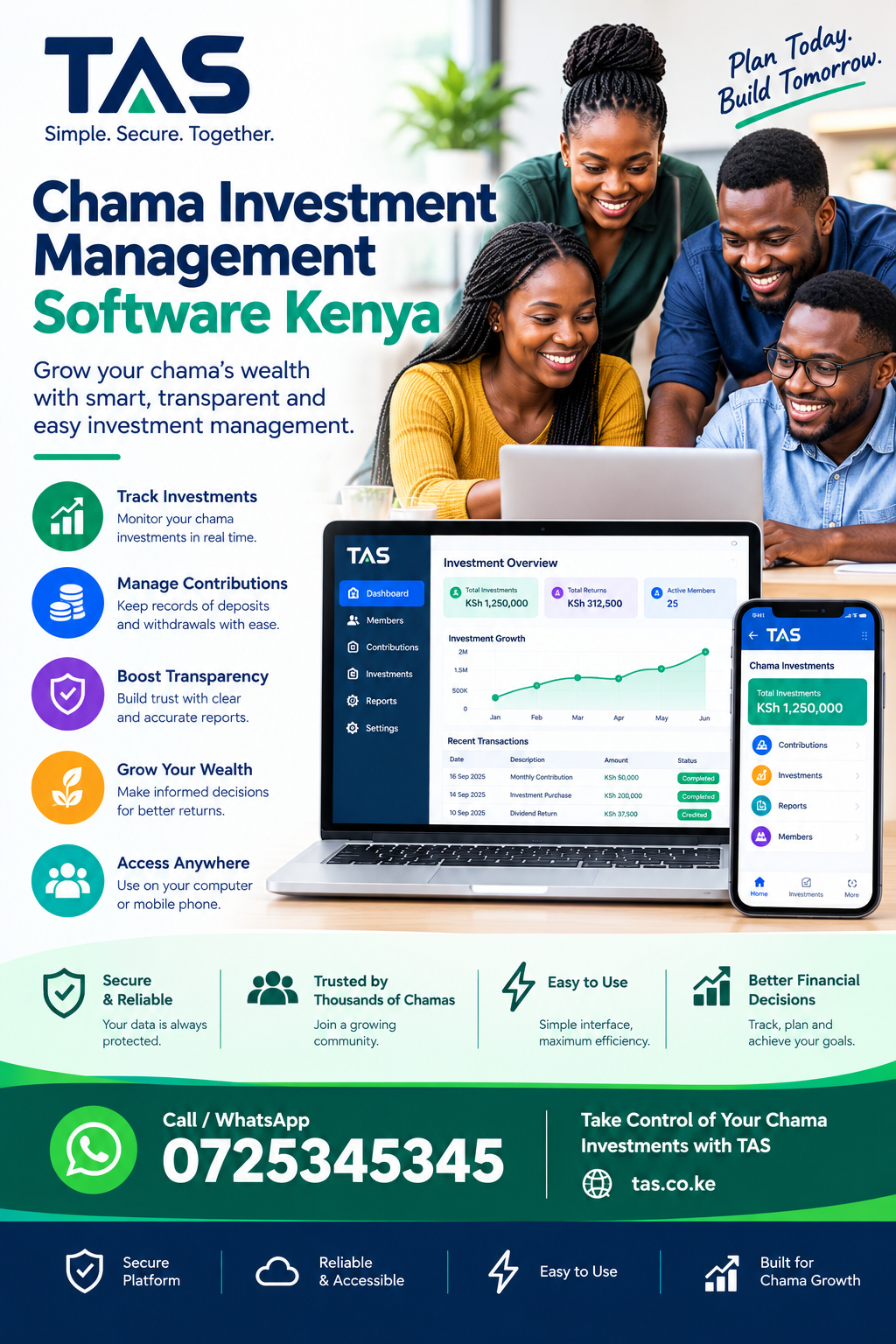

  • Chama Investment Management Software Kenya: A Complete Guide to Smarter Investment Management

    Chama Investment Management Software Kenya

    Chama Investment Management Software Kenya: A Complete Guide to Smarter Investment Management

    Managing a chama investment portfolio requires more than collecting money and recording contributions in a notebook. Groups need to know how much has been invested, where funds have gone, what assets they own, what returns have been generated, and how individual members are participating. Chama Investment Management Software Kenya gives chama officials a structured way to organize these activities while reducing dependence on scattered spreadsheets, notebooks, receipts, and manual calculations. This guide explains how investment-focused chama groups can use software to improve records, monitor investments, manage member contributions, prepare reports, and make financial administration easier.

    What Is Chama Investment Management Software?

    A chama is often built around a simple idea: members contribute money regularly and collectively use those funds for savings, lending, investments, or other agreed financial activities. As the group grows, however, managing the finances becomes increasingly complex.

    A small group may initially rely on a notebook and a spreadsheet. The treasurer records contributions, the secretary keeps meeting notes, and another member may maintain a list of investments. This approach can work for a limited period, but it creates challenges when transactions increase.

    Chama Investment Management Software Kenya is designed to centralize information relating to group investments and financial activities. Instead of keeping separate records in different places, a chama can maintain organized information about members, contributions, investments, transactions, balances, and reports.

    The software can support investment groups that purchase property, invest in businesses, hold financial assets, provide member loans, or pursue several investment strategies at the same time.

    The main objective is not simply to digitize paperwork. It is to make financial information easier to record, retrieve, review, and understand.

    Why Investment Management Needs Special Attention

    Investment activities are different from ordinary monthly contributions. A contribution is usually a straightforward transaction: a member pays an agreed amount and the group records it.

    An investment may involve several stages:

    1. Members approve an investment.
    2. The group allocates funds.
    3. Money is transferred to the investment.
    4. Supporting documents are collected.
    5. The investment is monitored.
    6. Income or returns are recorded.
    7. Expenses are deducted where applicable.
    8. The group reviews the performance.
    9. Members receive reports.

    Each stage creates information that needs to be retained.

    Chama Investment Management Software Kenya can help organize this information so that officials are not forced to reconstruct the history of an investment whenever members ask questions.

    Why Chamas in Kenya Are Moving Toward Digital Investment Records

    Many Kenyan chamas begin with informal administration. Members know each other, meetings are held regularly, and financial decisions are discussed face to face.

    The challenge usually appears when the group accumulates more money or begins investing in several areas.

    A chama may have:

    • Dozens of members
    • Monthly contributions
    • Emergency contributions
    • Member loans
    • Property investments
    • Business investments
    • Bank accounts
    • M-Pesa transactions
    • Investment expenses
    • Dividends or other income
    • Outstanding balances
    • Multiple years of historical records

    Managing all of these activities manually increases the amount of administrative work.

    Chama Investment Management Software Kenya provides a digital environment where these records can be brought together. This makes it easier for officials to establish a consistent process for recording financial activity.

    Digital records can also make meetings more productive. Instead of spending most of the meeting checking old records, officials can focus on reviewing current figures and discussing future decisions.

    Centralizing Chama Investment Information

    One of the most important advantages of a dedicated management system is centralization.

    Without software, investment information may be divided between:

    • Treasurer’s notebooks
    • Excel spreadsheets
    • Bank statements
    • M-Pesa messages
    • Email attachments
    • Printed receipts
    • Meeting minutes
    • Member records
    • Separate accounting documents

    This creates a fragmented information environment.

    Chama Investment Management Software Kenya can provide one organized place for important financial information. The precise features available will depend on the software configuration, but the broader objective is to reduce fragmentation.

    When information is centralized, authorized officials can more easily trace transactions and review the financial history of the group.

    A Single Source of Financial Information

    Suppose a member asks how much the chama has invested in a particular project.

    With manual records, the treasurer may need to search through several files. With a centralized system, the relevant transaction history can be easier to locate.

    This becomes particularly useful during annual reviews, leadership transitions, audits, or meetings where members want detailed explanations.

    Chama Investment Management Software Kenya can therefore support better record organization by bringing related financial information into a structured system.

    Managing Member Contributions

    Investment capacity depends heavily on the contributions made by members.

    A group needs to know whether members are contributing according to the agreed schedule and how much each person has accumulated over time.

    A digital system can organize contribution records by member, date, amount, payment type, and other relevant categories.

    Chama Investment Management Software Kenya can help investment groups connect contribution records with the wider financial position of the chama.

    This is useful when determining how much money is available for investment and when preparing member statements.

    Contribution Tracking Example

    Consider a chama with 30 members contributing KSh 5,000 each month.

    The expected monthly contribution is KSh 150,000.

    If the group wants to invest KSh 1.2 million during the year, officials need accurate records of how much money has actually been collected.

    Manual records can make this process time-consuming. A structured system can make it easier to review expected and received contributions and identify outstanding amounts.

    Chama Investment Management Software Kenya can support this type of organized financial administration.

    Tracking Different Types of Investments

    Chamas do not necessarily invest in one type of asset.

    Depending on their constitution and investment strategy, groups may consider areas such as:

    • Property
    • Land
    • Rental buildings
    • Agriculture
    • Small businesses
    • Government securities
    • Shares
    • Collective investments
    • Equipment
    • Other approved investments

    Each investment has different records and monitoring requirements.

    Chama Investment Management Software Kenya can help a group maintain structured records across multiple investment categories.

    For example, a property investment may require information about purchase costs, development expenses, rental income, maintenance expenses, and current status.

    A business investment may require capital contributions, income records, operating expenses, and periodic performance reviews.

    Keeping these records organized gives officials a clearer picture of where the group’s money is being used.

    Recording Investment Transactions

    Every investment has financial movements that should be recorded carefully.

    These may include:

    • Initial investment amounts
    • Additional capital
    • Transfer fees
    • Legal costs
    • Professional fees
    • Maintenance expenses
    • Management costs
    • Income received
    • Withdrawals
    • Sale proceeds
    • Reinvestment amounts

    Chama Investment Management Software Kenya can make transaction recording more structured by giving officials a defined process for capturing financial activity.

    Accurate transaction records also make reporting easier because reports can be based on information already entered into the system.

    Why Transaction History Matters

    A current balance tells only part of the story.

    Suppose a chama has KSh 3 million associated with an investment. Members may still want to know:

    • When was the money invested?
    • Who authorized the transaction?
    • Were additional amounts invested later?
    • What expenses were incurred?
    • Has the investment generated income?
    • Has any amount been withdrawn?

    A detailed transaction history helps answer these questions.

    Chama Investment Management Software Kenya can support better financial traceability when transactions are recorded consistently.

    Monitoring Investment Performance

    Investment management is not complete when money is transferred into an asset.

    The group also needs to monitor what happens afterward.

    Performance monitoring may involve comparing:

    • Initial capital
    • Additional investment
    • Income generated
    • Expenses
    • Current value
    • Net returns
    • Outstanding obligations

    Chama Investment Management Software Kenya can help officials organize these records and use them when preparing investment reviews.

    The software itself does not determine whether an investment is suitable. That remains a decision for the chama members and their authorized leadership. Its role is to provide better-organized information for those decisions.

    Separating Investment Facts From Assumptions

    Good financial administration requires a distinction between actual results and expectations.

    For example, a proposed project might be expected to generate a particular amount of income. That expectation should not automatically be recorded as actual income.

    Chama Investment Management Software Kenya can support clearer records by allowing actual transactions and financial information to be maintained separately from future plans.

    This distinction becomes important when members review investment performance.

    Managing Investment Budgets

    Before committing money to an investment, a chama may create a budget.

    A property development project, for example, might have projected costs for:

    • Land
    • Construction
    • Professional services
    • Permits
    • Materials
    • Labour
    • Utilities
    • Marketing
    • Maintenance

    A budget provides a reference point against which actual spending can be reviewed.

    Chama Investment Management Software Kenya can help organize budget-related information and make it easier to compare planned expenditure with recorded transactions.

    Budget Variance

    Suppose a project budget is KSh 5 million but actual expenses reach KSh 5.5 million.

    The difference should be investigated.

    Possible reasons might include additional work, price changes, unexpected repairs, or incorrect initial estimates.

    A digital record can make it easier to identify where the additional expenditure occurred.

    Chama Investment Management Software Kenya can support this process by helping officials maintain organized expense records.

    Managing Investment Expenses

    Investment expenses can easily become overlooked when financial records are scattered.

    A chama may pay for professional services, transaction charges, maintenance, transport, legal services, or other project-related costs.

    Each expense can affect the overall investment position.

    Chama Investment Management Software Kenya can help keep these transactions associated with the broader financial records of the group.

    Expense records should ideally include useful information such as:

    • Date
    • Amount
    • Description
    • Investment category
    • Payment method
    • Supporting documentation
    • Person responsible for authorization

    The exact fields depend on the system being used.

    Linking Investment Records With Chama Accounting

    Investment records should not exist in isolation from the wider finances of the chama.

    The group also needs to understand:

    • Cash balances
    • Member contributions
    • Loans
    • Receivables
    • Payables
    • Investment income
    • Operating expenses

    Chama Investment Management Software Kenya can form part of a broader financial management approach where investment activities are considered alongside other chama transactions.

    This gives officials a more complete view of the group’s financial position.

    Supporting M-Pesa and Digital Payments

    M-Pesa is an important payment channel for many Kenyan groups and businesses.

    Chama members may use mobile payments to make contributions, settle obligations, or participate in other group transactions.

    Digital payment records can therefore become an important part of chama administration.

    Chama Investment Management Software Kenya can support an organized process for recording investment-related financial transactions, including those originating from digital payment channels where the relevant system supports them.

    The key objective is reconciliation: ensuring that recorded transactions correspond with actual payments received or made.

    Reconciling Chama Transactions

    Reconciliation involves comparing records from different sources to identify differences.

    For example, officials may compare:

    • Internal transaction records
    • Bank statements
    • M-Pesa statements
    • Receipts
    • Payment confirmations

    Chama Investment Management Software Kenya can help make reconciliation part of a regular financial workflow.

    Regular reconciliation is useful because errors are generally easier to investigate when they are identified soon after the transaction.

    A difference of KSh 10,000 discovered immediately may be easier to trace than the same difference discovered several years later.

    Improving Financial Transparency

    Transparency is an important part of group financial administration.

    Members contribute their money based on agreed rules and expect financial activities to be documented appropriately.

    Chama Investment Management Software Kenya can support transparency by organizing records that authorized officials can use when preparing statements and reports.

    Transparency does not mean that every user should necessarily have unrestricted access to every administrative function. Access should be managed according to the chama’s governance structure and the capabilities of the selected system.

    Member Statements

    A member may want to know:

    • Total contributions
    • Outstanding obligations
    • Loan balance
    • Investment participation
    • Other relevant transactions

    Chama Investment Management Software Kenya can help officials maintain the underlying records required to prepare such information.

    Clear member records can also reduce disagreements caused by forgotten payments or incomplete manual records.

    Generating Chama Financial Reports

    Reports turn raw transactions into information that members can review.

    Useful reports may include:

    • Contribution reports
    • Investment reports
    • Expense reports
    • Income reports
    • Cash flow reports
    • Member statements
    • Loan reports
    • Outstanding balance reports
    • Transaction histories

    Chama Investment Management Software Kenya can help make reporting more systematic where these reporting capabilities are included.

    Reports for Chama Meetings

    Monthly or quarterly meetings often require financial updates.

    Instead of manually calculating figures before each meeting, officials can work from records maintained throughout the period.

    Chama Investment Management Software Kenya can support the principle of maintaining information continuously rather than reconstructing financial activity shortly before a meeting.

    This can reduce administrative pressure on treasurers and other officials.

    Supporting Investment Decision-Making

    Software should provide information rather than make financial decisions on behalf of members.

    For example, members may be considering whether to allocate funds toward a new investment.

    Relevant information may include:

    • Available cash
    • Existing commitments
    • Current investment exposure
    • Historical income
    • Outstanding loans
    • Planned expenses
    • Expected capital requirements

    Chama Investment Management Software Kenya can help organize the financial data that officials may need before discussions take place.

    Members can then apply their own rules, objectives, risk considerations, and approval procedures.

    Keeping Investment Documents Organized

    Financial transactions often have supporting documents.

    Examples include:

    • Agreements
    • Receipts
    • Invoices
    • Statements
    • Certificates
    • Valuation documents
    • Meeting approvals
    • Payment confirmations

    Chama Investment Management Software Kenya can complement document-management processes by helping officials connect relevant financial records with supporting information where the software provides such functionality.

    Keeping documentation organized is particularly useful when leadership changes.

    A new treasurer should not have to depend entirely on verbal explanations from the previous treasurer.

    Reducing Dependence on Spreadsheets

    Spreadsheets remain useful for many financial tasks, but they can become difficult to manage as data grows.

    Potential problems include:

    • Accidental deletion
    • Incorrect formulas
    • Duplicate entries
    • Multiple versions
    • Missing information
    • Poor access control
    • Difficult collaboration

    Chama Investment Management Software Kenya can provide a more structured alternative for chamas that have outgrown basic spreadsheets.

    This does not mean every chama must abandon spreadsheets immediately. The appropriate approach depends on the group’s size, transaction volume, administrative processes, and software requirements.

    Managing Roles and Responsibilities

    A chama usually has different officials with different responsibilities.

    For example:

    • Chairperson
    • Treasurer
    • Secretary
    • Investment committee
    • Committee members
    • Ordinary members

    A digital system can be configured, depending on its capabilities, to support role-based responsibilities.

    Chama Investment Management Software Kenya can contribute to a more structured administrative environment by reducing the need for everyone to manage the same information manually.

    Role-Based Access

    Financial information should be handled responsibly.

    A good system should provide appropriate user access controls where supported.

    For example, a treasurer may need greater transaction-management privileges than an ordinary member.

    Chama Investment Management Software Kenya can be considered alongside access-control requirements when a chama evaluates software.

    The group should ask vendors how user permissions, passwords, backups, and administrative access are handled before implementation.

    Improving Accountability During Leadership Changes

    Chama leadership can change over time.

    A treasurer may leave office, a new committee may be elected, or responsibilities may be reassigned.

    Manual systems can make these transitions difficult because important knowledge may exist primarily with individuals.

    Chama Investment Management Software Kenya can help institutionalize financial records by keeping information within the group’s management process rather than depending entirely on one official’s personal files.

    This can improve continuity.

    The new treasurer can work from historical records instead of starting from scratch.

    Supporting Long-Term Investment Planning

    Investment groups often have long-term objectives.

    These could include:

    • Buying land
    • Developing rental property
    • Expanding a business
    • Building an investment portfolio
    • Creating a retirement asset
    • Growing group savings
    • Financing a major future project

    Chama Investment Management Software Kenya can support the record-keeping side of these objectives.

    Long-term planning becomes easier when the group knows its historical contributions, existing investments, expenses, obligations, and current financial position.

    Chama Investment Software for Property Investments

    Property is a common area of interest for investment groups.

    A chama may buy land, develop rental units, purchase commercial property, or participate in another real-estate project.

    Such investments can involve significant documentation and recurring expenses.

    Chama Investment Management Software Kenya can help organize the financial records associated with investment activities.

    For a property project, officials may need to monitor:

    • Acquisition costs
    • Development costs
    • Rental income
    • Repairs
    • Maintenance
    • Taxes and charges
    • Professional expenses
    • Financing obligations

    The exact accounting treatment should be handled according to the group’s accounting practices and professional advice where necessary.

    Chama Investment Software for Business Investments

    Some chamas invest directly in businesses or provide capital to business ventures.

    Business investments can generate different kinds of financial information.

    The group may need to track:

    • Capital contributed
    • Income received
    • Business expenses
    • Additional funding
    • Dividends or distributions
    • Ownership information
    • Performance reports

    Chama Investment Management Software Kenya can help centralize the information that the group maintains about its investment activities.

    This is particularly useful when a chama has several investments and wants to separate their records.

    Managing Multiple Investment Projects

    As a chama expands, it may own more than one investment.

    For example, the group could have a property project and a business investment at the same time.

    Combining all transactions without clear categories makes reporting difficult.

    Chama Investment Management Software Kenya can support organized categorization so that officials can distinguish between different investment activities.

    Each project can then be reviewed independently while still forming part of the group’s overall financial picture.

    Using Data for Better Chama Meetings

    A productive meeting needs accurate information.

    If financial figures are incomplete, discussions may focus on correcting records instead of evaluating projects and planning future activities.

    Chama Investment Management Software Kenya can help officials prepare relevant financial information before meetings.

    A typical investment review agenda could include:

    1. Previous action items
    2. Contribution status
    3. Current cash position
    4. Investment transactions
    5. Investment income
    6. Expenses
    7. Project updates
    8. Outstanding obligations
    9. New investment proposals
    10. Decisions and approvals

    The software supports the information process; the members remain responsible for decisions.

    Common Problems With Manual Chama Investment Management

    Before selecting software, it helps to understand the problems the group is trying to solve.

    Missing Records

    Receipts can be lost and notebooks can become damaged.

    Chama Investment Management Software Kenya can reduce dependence on paper records by providing a digital record-keeping environment.

    Calculation Errors

    Manual calculations can produce incorrect balances.

    Automated calculations, where supported, can reduce repetitive arithmetic.

    Chama Investment Management Software Kenya can therefore be useful for groups that regularly calculate contributions, balances, expenses, or investment figures.

    Delayed Reporting

    Preparing reports manually can take considerable time.

    Chama Investment Management Software Kenya can help streamline reporting where automated reports are available.

    Scattered Information

    When information is stored in different places, officials may struggle to establish a complete picture.

    Chama Investment Management Software Kenya can help centralize information within a defined management workflow.

    How to Choose Chama Investment Management Software

    A chama should not choose software based only on the number of features listed on a sales page.

    The system should match the group’s actual requirements.

    Important questions include:

    • Can it manage member records?
    • Can it record contributions?
    • Can it track investments?
    • Can it generate reports?
    • Can it manage expenses?
    • Does it support payment reconciliation?
    • Can multiple authorized users access it?
    • How are backups handled?
    • Can historical data be imported?
    • Is training available?
    • What support is provided?
    • Does it work well on the devices used by officials?

    Chama Investment Management Software Kenya should be evaluated in the context of these practical requirements rather than as a standalone technology purchase.

    Mobile Accessibility

    Chama officials may not always work from the same office.

    Treasurers and committee members may need access to information while attending meetings, reviewing payments, or working from different locations.

    Chama Investment Management Software Kenya can be assessed for accessibility based on how the software works across computers and mobile devices.

    A responsive interface can be particularly useful where officials frequently use smartphones.

    Data Security Considerations

    Financial records contain sensitive information.

    A chama should therefore ask how a software provider protects stored data.

    Areas worth discussing include:

    • User authentication
    • Password management
    • Access permissions
    • Data backups
    • Server security
    • Audit logs
    • Recovery procedures
    • Data export
    • Account management

    Chama Investment Management Software Kenya should be evaluated alongside these security considerations before implementation.

    The exact security controls vary by provider, so chamas should request clear information about the system they intend to use.

    Backup and Data Recovery

    A financial system is only useful if important records can be recovered when something goes wrong.

    Hardware failure, accidental deletion, compromised accounts, or other technical problems can affect digital information.

    Chama Investment Management Software Kenya can be part of a broader data-protection strategy, but the group should understand the provider’s backup and recovery policies before relying on the platform.

    Ask questions such as:

    • How often is data backed up?
    • Where are backups stored?
    • How long are backups retained?
    • Can data be restored?
    • Who can request restoration?
    • Can the group export its records?

    Training Chama Officials

    Introducing software without training can create unnecessary problems.

    The treasurer and other officials should understand the correct process for entering transactions, correcting errors, generating reports, and managing users.

    Chama Investment Management Software Kenya can deliver value more effectively when users understand how to use the system properly.

    Training should cover everyday tasks first.

    For example:

    1. Logging in
    2. Adding members
    3. Recording contributions
    4. Recording expenses
    5. Entering investments
    6. Reviewing transactions
    7. Generating reports
    8. Reconciling payments
    9. Managing users
    10. Backing up or exporting information where available

    Creating Standard Operating Procedures

    Software works best when the group has clear financial procedures.

    A chama can define who is responsible for each activity.

    For example:

    Activity Responsible Role
    Member registration Secretary
    Contribution recording Treasurer
    Payment reconciliation Treasurer
    Investment approval Committee/Members
    Investment record updates Authorized official
    Monthly reporting Treasurer
    Financial review Committee
    Annual review Authorized members

    Chama Investment Management Software Kenya can support these procedures by giving each role a structured digital workflow where the system allows it.

    Implementing Software in a Chama

    Implementation does not need to happen all at once.

    A practical approach is to begin with the group’s most important records.

    Step 1: Review Existing Records

    Collect notebooks, spreadsheets, statements, receipts, and other relevant records.

    Step 2: Clean the Data

    Identify duplicate members, missing transactions, incorrect balances, and incomplete information.

    Step 3: Define the Investment Categories

    List the group’s current investments and establish consistent names or categories.

    Step 4: Enter Opening Balances

    The group should establish the correct starting position before entering new transactions.

    Step 5: Train Users

    Officials should understand their responsibilities.

    Step 6: Test Reports

    Generate sample reports and compare them with existing records.

    Step 7: Start Regular Use

    Once the system has been verified, use it consistently for new transactions.

    Chama Investment Management Software Kenya can be introduced as part of this structured transition from manual administration to digital record management.

    What a Chama Should Avoid

    Buying software does not automatically solve financial-management problems.

    A group should avoid several common mistakes.

    Entering Inaccurate Data

    If incorrect figures are entered, reports based on those figures will also be incorrect.

    Sharing Passwords

    Users should have individual accounts where supported.

    Ignoring Reconciliation

    Transactions should be compared with external records regularly.

    Failing to Document Decisions

    Investment decisions should still follow the chama’s governance procedures.

    Using Software Without Training

    Users who do not understand the system may create errors.

    Chama Investment Management Software Kenya is most useful when combined with disciplined financial processes.

    The Role of the Treasurer

    The treasurer often has significant responsibility for chama finances.

    Digital software can help the treasurer manage:

    • Contributions
    • Transactions
    • Expenses
    • Investments
    • Reports
    • Reconciliation
    • Member balances

    Chama Investment Management Software Kenya can reduce repetitive administrative work when these functions are available within the platform.

    However, software should complement internal controls rather than replace them.

    Transactions should still be properly authorized, reviewed, and documented.

    The Role of the Investment Committee

    An investment committee may evaluate opportunities, monitor existing projects, and present recommendations to members.

    The committee can use organized financial information to understand the group’s existing exposure and available resources.

    Chama Investment Management Software Kenya can support this information-management process by keeping investment records accessible to authorized users.

    The committee should still apply the chama’s investment policy and approval requirements.

    The Importance of Financial Reports

    Reports allow members to move beyond individual transactions and understand broader financial patterns.

    For example, a report may show whether contributions have increased, whether expenses are rising, or how much capital is tied up in specific investments.

    Chama Investment Management Software Kenya can support structured reporting and help officials present information more consistently during meetings.

    Reports can also make historical comparisons easier.

    A chama can compare one period with another rather than relying solely on memory.

    Chama Investment Management Software and Accountability

    Accountability depends on clear records, defined responsibilities, and appropriate oversight.

    A system can support these areas by creating structured transaction records and limiting access according to user roles.

    Chama Investment Management Software Kenya can therefore be considered as part of a broader accountability framework.

    The group should also establish procedures for reviewing unusual transactions and correcting errors.

    Cost Considerations

    The cost of software is only one part of the decision.

    A chama should also consider:

    • Setup costs
    • Subscription fees
    • Training
    • Data migration
    • Support
    • Internet requirements
    • Additional users
    • Reporting requirements
    • Integration requirements

    Chama Investment Management Software Kenya should be evaluated against the administrative workload and financial complexity of the group.

    A very small group may require fewer capabilities than a large investment chama with many transactions and several projects.

    Measuring the Value of Software

    A chama can evaluate its software implementation using practical measures.

    For example:

    • How long does monthly reporting take?
    • How quickly can a member statement be produced?
    • How easy is it to trace a transaction?
    • How often are reconciliation differences discovered?
    • How quickly can officials prepare for meetings?
    • How easily can new officials understand historical records?

    Chama Investment Management Software Kenya can be considered successful when it contributes to more organized administration and easier access to reliable records.

    Chama Investment Management Software for Growing Groups

    A group with ten members may have very different needs from one with 100 members.

    As membership grows, the number of transactions usually increases as well.

    More members can mean:

    • More contributions
    • More statements
    • More payment records
    • More questions
    • More reporting
    • More administrative responsibilities

    Chama Investment Management Software Kenya can provide a scalable administrative framework for groups whose financial operations are becoming more complex.

    The group should confirm the provider’s actual user and transaction limits before purchasing.

    Preparing for Annual Financial Reviews

    Annual reviews require historical information.

    Officials may need to summarize:

    • Contributions
    • Expenses
    • Investment activity
    • Income
    • Loans
    • Cash balances
    • Assets
    • Liabilities

    Chama Investment Management Software Kenya can make this information easier to organize when records have been maintained consistently throughout the year.

    This is another reason why timely data entry matters.

    Waiting until the end of the year to update records creates unnecessary pressure and increases the risk of missing information.

    Using Historical Data

    A chama’s historical records can provide useful context.

    Members may want to understand how the group’s investments and contributions have changed over several years.

    Chama Investment Management Software Kenya can help preserve structured historical transaction information where the system supports long-term data retention.

    Historical information can also assist new officials who need to understand previous transactions.

    Frequently Asked Questions

    What is Chama Investment Management Software Kenya?

    Chama Investment Management Software Kenya refers to software designed to help investment-focused chamas organize member information, contributions, investment transactions, expenses, reports, and related financial records.

    Why should a chama use investment management software?

    A digital system can reduce reliance on notebooks and scattered spreadsheets. Chama Investment Management Software Kenya can help centralize information and make financial records easier to manage, review, and report.

    Can software track member contributions?

    Yes, contribution tracking is a common requirement for chama management systems. Chama Investment Management Software Kenya can support organized contribution records where the platform provides this functionality.

    Can chama software manage multiple investments?

    A suitable platform may allow groups to categorize and monitor multiple investments. Chama Investment Management Software Kenya can help keep investment information organized across different projects where those capabilities are available.

    Can the system support M-Pesa transactions?

    Some systems support payment-related workflows or integrations. Chama Investment Management Software Kenya should be evaluated based on the specific M-Pesa and reconciliation capabilities provided by the vendor.

    Can members receive financial reports?

    Reporting capabilities vary between systems. Chama Investment Management Software Kenya can support financial reporting where the selected platform includes member statements, transaction reports, investment reports, or related functionality.

    Is investment software suitable for small chamas?

    It can be useful, but the appropriate solution depends on the group’s size, transaction volume, investment activities, and administrative requirements. Chama Investment Management Software Kenya should be selected according to actual needs rather than simply the number of available features.

    How can a chama protect its financial data?

    A chama should evaluate authentication, user permissions, backups, data recovery, and other security controls before adopting a platform. Chama Investment Management Software Kenya should be assessed together with the provider’s documented security and data-management practices.

    Does software make investment decisions for the chama?

    No. Software provides records and information that can support administration and analysis. Chama Investment Management Software Kenya does not replace the group’s governance procedures, investment policies, or member approval processes.

    How should a chama begin implementing software?

    Start by reviewing existing records, cleaning the data, defining investment categories, establishing opening balances, training officials, and testing reports. Chama Investment Management Software Kenya can then become part of the group’s regular financial-management workflow.

    Final Thoughts

    Investment management becomes increasingly demanding as a chama grows. More members, more transactions, and more investment projects create a need for reliable records and consistent financial processes.

    Chama Investment Management Software Kenya can help groups organize contributions, investments, expenses, payment records, member information, and financial reports within a structured digital environment.

    The real value of software comes from combining technology with sound administration. A chama should establish clear approval procedures, reconcile transactions regularly, protect financial information, train officials, and maintain accurate records.

    Chama Investment Management Software Kenya can support these activities by reducing repetitive manual work and making important information easier to retrieve.

    For groups investing in property, businesses, financial assets, or other approved opportunities, organized records can make it easier to understand where funds have been allocated and how transactions have developed over time.

    Chama Investment Management Software Kenya also provides a foundation for more consistent reporting, allowing officials to prepare information for meetings without rebuilding the group’s financial history from scattered documents.

    A chama should ultimately choose software based on its specific requirements. Before implementation, officials should identify the records they need to maintain, the reports members expect, the number of users involved, the payment channels they use, and the investment activities they undertake.

    Chama Investment Management Software Kenya can be one component of a wider financial-management framework that combines digital records, internal controls, responsible governance, and regular financial reviews.

    As financial activities become more complex, structured information becomes increasingly valuable. Chama Investment Management Software Kenya gives investment groups a way to approach that complexity through organized digital record keeping rather than depending entirely on manual processes.

    For Kenyan chamas seeking to improve the administration of their investments, the key question is not simply whether software can replace a spreadsheet. The more useful question is whether the selected system can provide the records, workflows, reports, controls, and accessibility the group needs.

    Chama Investment Management Software Kenya can support that transition when implemented alongside clear financial procedures and properly trained users.

    The goal is straightforward: maintain accurate records, make financial information easier to understand, reduce avoidable administrative work, and give authorized chama officials better information for carrying out their responsibilities.

    Chama Investment Management Software Kenya can therefore form part of a practical digital strategy for investment groups that want to manage their financial records in a more organized way.

    Chama Investment Management Software Kenya is particularly relevant where a group has moved beyond simple contribution collection and now needs to monitor several interconnected financial activities.

    Chama Investment Management Software Kenya can help bring these activities into a consistent record-keeping process, subject to the features and configuration of the selected platform.

    Chama Investment Management Software Kenya can also support continuity when officials change, because properly maintained digital records can remain with the organization rather than being dependent on one person’s notebook or computer.

    Chama Investment Management Software Kenya provides another way to think about digital investment administration: as an organizational tool that supports records, accountability, reporting, and continuity.

    Chama Investment Management Software Kenya can be evaluated alongside the group’s requirements for investment tracking, contribution management, financial reporting, and transaction records.

    Chama Investment Management Software Kenya can support a structured approach to managing information where its available features match the group’s needs.

    Chama Investment Management Software Kenya should ultimately be viewed as a tool within the chama’s broader governance structure, not as a replacement for responsible financial management.

    Chama Investment Management Software Kenya can help make financial administration more systematic when users enter accurate information, follow established procedures, and review records regularly.

    Chama Investment Management Software Kenya can also support better organization as the volume of transactions increases.

    Chama Investment Management Software Kenya may be particularly valuable to groups that want to move from fragmented records toward a centralized digital approach.

    Chama Investment Management Software Kenya can be considered as part of that transition, especially when the chama has identified specific reporting and investment-management requirements.

    Chama Investment Management Software Kenya can help support the administrative side of investment management where the selected software provides the necessary functions.

    Chama Investment Management Software Kenya can also contribute to a more consistent approach to recording financial activity across the group’s operations.

    The most important consideration is consistency. A digital platform produces useful information only when transactions are recorded accurately and processes are followed.

    For that reason, Chama Investment Management Software Kenya should be introduced together with clear responsibilities, regular reconciliation, proper authorization, and routine reporting.

    When these elements work together, a chama can spend less time searching for financial information and more time using organized information to administer its collective investments responsibly.