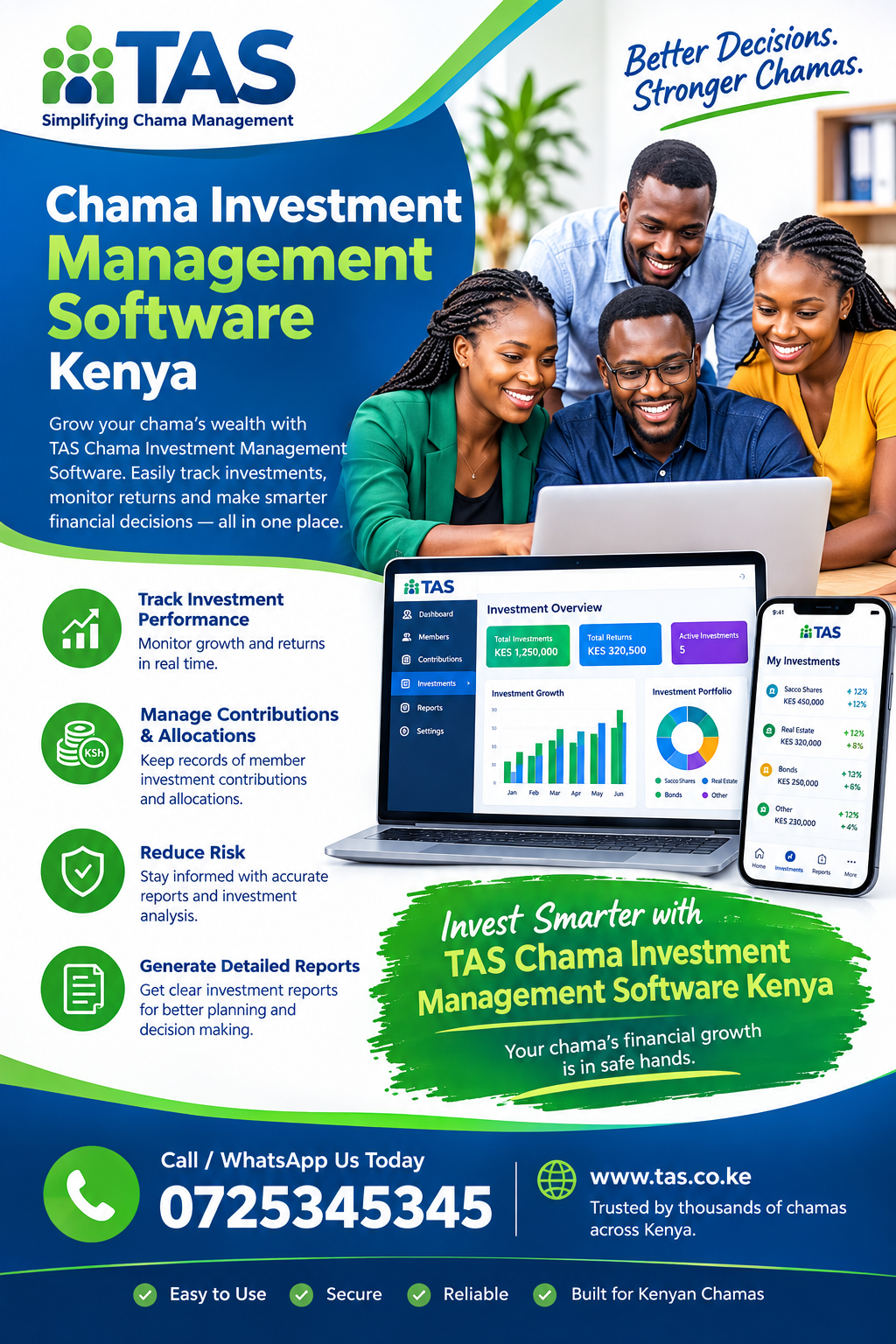
Chama Investment Management Software Kenya: A Complete Guide to Smarter Investment Management
Managing a chama investment portfolio requires more than collecting money and recording contributions in a notebook. Groups need to know how much has been invested, where funds have gone, what assets they own, what returns have been generated, and how individual members are participating. Chama Investment Management Software Kenya gives chama officials a structured way to organize these activities while reducing dependence on scattered spreadsheets, notebooks, receipts, and manual calculations. This guide explains how investment-focused chama groups can use software to improve records, monitor investments, manage member contributions, prepare reports, and make financial administration easier.
What Is Chama Investment Management Software?
A chama is often built around a simple idea: members contribute money regularly and collectively use those funds for savings, lending, investments, or other agreed financial activities. As the group grows, however, managing the finances becomes increasingly complex.
A small group may initially rely on a notebook and a spreadsheet. The treasurer records contributions, the secretary keeps meeting notes, and another member may maintain a list of investments. This approach can work for a limited period, but it creates challenges when transactions increase.
Chama Investment Management Software Kenya is designed to centralize information relating to group investments and financial activities. Instead of keeping separate records in different places, a chama can maintain organized information about members, contributions, investments, transactions, balances, and reports.
The software can support investment groups that purchase property, invest in businesses, hold financial assets, provide member loans, or pursue several investment strategies at the same time.
The main objective is not simply to digitize paperwork. It is to make financial information easier to record, retrieve, review, and understand.
Why Investment Management Needs Special Attention
Investment activities are different from ordinary monthly contributions. A contribution is usually a straightforward transaction: a member pays an agreed amount and the group records it.
An investment may involve several stages:
- Members approve an investment.
- The group allocates funds.
- Money is transferred to the investment.
- Supporting documents are collected.
- The investment is monitored.
- Income or returns are recorded.
- Expenses are deducted where applicable.
- The group reviews the performance.
- Members receive reports.
Each stage creates information that needs to be retained.
Chama Investment Management Software Kenya can help organize this information so that officials are not forced to reconstruct the history of an investment whenever members ask questions.
Why Chamas in Kenya Are Moving Toward Digital Investment Records
Many Kenyan chamas begin with informal administration. Members know each other, meetings are held regularly, and financial decisions are discussed face to face.
The challenge usually appears when the group accumulates more money or begins investing in several areas.
A chama may have:
- Dozens of members
- Monthly contributions
- Emergency contributions
- Member loans
- Property investments
- Business investments
- Bank accounts
- M-Pesa transactions
- Investment expenses
- Dividends or other income
- Outstanding balances
- Multiple years of historical records
Managing all of these activities manually increases the amount of administrative work.
Chama Investment Management Software Kenya provides a digital environment where these records can be brought together. This makes it easier for officials to establish a consistent process for recording financial activity.
Digital records can also make meetings more productive. Instead of spending most of the meeting checking old records, officials can focus on reviewing current figures and discussing future decisions.
Centralizing Chama Investment Information
One of the most important advantages of a dedicated management system is centralization.
Without software, investment information may be divided between:
- Treasurer’s notebooks
- Excel spreadsheets
- Bank statements
- M-Pesa messages
- Email attachments
- Printed receipts
- Meeting minutes
- Member records
- Separate accounting documents
This creates a fragmented information environment.
Chama Investment Management Software Kenya can provide one organized place for important financial information. The precise features available will depend on the software configuration, but the broader objective is to reduce fragmentation.
When information is centralized, authorized officials can more easily trace transactions and review the financial history of the group.
A Single Source of Financial Information
Suppose a member asks how much the chama has invested in a particular project.
With manual records, the treasurer may need to search through several files. With a centralized system, the relevant transaction history can be easier to locate.
This becomes particularly useful during annual reviews, leadership transitions, audits, or meetings where members want detailed explanations.
Chama Investment Management Software Kenya can therefore support better record organization by bringing related financial information into a structured system.
Managing Member Contributions
Investment capacity depends heavily on the contributions made by members.
A group needs to know whether members are contributing according to the agreed schedule and how much each person has accumulated over time.
A digital system can organize contribution records by member, date, amount, payment type, and other relevant categories.
Chama Investment Management Software Kenya can help investment groups connect contribution records with the wider financial position of the chama.
This is useful when determining how much money is available for investment and when preparing member statements.
Contribution Tracking Example
Consider a chama with 30 members contributing KSh 5,000 each month.
The expected monthly contribution is KSh 150,000.
If the group wants to invest KSh 1.2 million during the year, officials need accurate records of how much money has actually been collected.
Manual records can make this process time-consuming. A structured system can make it easier to review expected and received contributions and identify outstanding amounts.
Chama Investment Management Software Kenya can support this type of organized financial administration.
Tracking Different Types of Investments
Chamas do not necessarily invest in one type of asset.
Depending on their constitution and investment strategy, groups may consider areas such as:
- Property
- Land
- Rental buildings
- Agriculture
- Small businesses
- Government securities
- Shares
- Collective investments
- Equipment
- Other approved investments
Each investment has different records and monitoring requirements.
Chama Investment Management Software Kenya can help a group maintain structured records across multiple investment categories.
For example, a property investment may require information about purchase costs, development expenses, rental income, maintenance expenses, and current status.
A business investment may require capital contributions, income records, operating expenses, and periodic performance reviews.
Keeping these records organized gives officials a clearer picture of where the group’s money is being used.
Recording Investment Transactions
Every investment has financial movements that should be recorded carefully.
These may include:
- Initial investment amounts
- Additional capital
- Transfer fees
- Legal costs
- Professional fees
- Maintenance expenses
- Management costs
- Income received
- Withdrawals
- Sale proceeds
- Reinvestment amounts
Chama Investment Management Software Kenya can make transaction recording more structured by giving officials a defined process for capturing financial activity.
Accurate transaction records also make reporting easier because reports can be based on information already entered into the system.
Why Transaction History Matters
A current balance tells only part of the story.
Suppose a chama has KSh 3 million associated with an investment. Members may still want to know:
- When was the money invested?
- Who authorized the transaction?
- Were additional amounts invested later?
- What expenses were incurred?
- Has the investment generated income?
- Has any amount been withdrawn?
A detailed transaction history helps answer these questions.
Chama Investment Management Software Kenya can support better financial traceability when transactions are recorded consistently.
Monitoring Investment Performance
Investment management is not complete when money is transferred into an asset.
The group also needs to monitor what happens afterward.
Performance monitoring may involve comparing:
- Initial capital
- Additional investment
- Income generated
- Expenses
- Current value
- Net returns
- Outstanding obligations
Chama Investment Management Software Kenya can help officials organize these records and use them when preparing investment reviews.
The software itself does not determine whether an investment is suitable. That remains a decision for the chama members and their authorized leadership. Its role is to provide better-organized information for those decisions.
Separating Investment Facts From Assumptions
Good financial administration requires a distinction between actual results and expectations.
For example, a proposed project might be expected to generate a particular amount of income. That expectation should not automatically be recorded as actual income.
Chama Investment Management Software Kenya can support clearer records by allowing actual transactions and financial information to be maintained separately from future plans.
This distinction becomes important when members review investment performance.
Managing Investment Budgets
Before committing money to an investment, a chama may create a budget.
A property development project, for example, might have projected costs for:
- Land
- Construction
- Professional services
- Permits
- Materials
- Labour
- Utilities
- Marketing
- Maintenance
A budget provides a reference point against which actual spending can be reviewed.
Chama Investment Management Software Kenya can help organize budget-related information and make it easier to compare planned expenditure with recorded transactions.
Budget Variance
Suppose a project budget is KSh 5 million but actual expenses reach KSh 5.5 million.
The difference should be investigated.
Possible reasons might include additional work, price changes, unexpected repairs, or incorrect initial estimates.
A digital record can make it easier to identify where the additional expenditure occurred.
Chama Investment Management Software Kenya can support this process by helping officials maintain organized expense records.
Managing Investment Expenses
Investment expenses can easily become overlooked when financial records are scattered.
A chama may pay for professional services, transaction charges, maintenance, transport, legal services, or other project-related costs.
Each expense can affect the overall investment position.
Chama Investment Management Software Kenya can help keep these transactions associated with the broader financial records of the group.
Expense records should ideally include useful information such as:
- Date
- Amount
- Description
- Investment category
- Payment method
- Supporting documentation
- Person responsible for authorization
The exact fields depend on the system being used.
Linking Investment Records With Chama Accounting
Investment records should not exist in isolation from the wider finances of the chama.
The group also needs to understand:
- Cash balances
- Member contributions
- Loans
- Receivables
- Payables
- Investment income
- Operating expenses
Chama Investment Management Software Kenya can form part of a broader financial management approach where investment activities are considered alongside other chama transactions.
This gives officials a more complete view of the group’s financial position.
Supporting M-Pesa and Digital Payments
M-Pesa is an important payment channel for many Kenyan groups and businesses.
Chama members may use mobile payments to make contributions, settle obligations, or participate in other group transactions.
Digital payment records can therefore become an important part of chama administration.
Chama Investment Management Software Kenya can support an organized process for recording investment-related financial transactions, including those originating from digital payment channels where the relevant system supports them.
The key objective is reconciliation: ensuring that recorded transactions correspond with actual payments received or made.
Reconciling Chama Transactions
Reconciliation involves comparing records from different sources to identify differences.
For example, officials may compare:
- Internal transaction records
- Bank statements
- M-Pesa statements
- Receipts
- Payment confirmations
Chama Investment Management Software Kenya can help make reconciliation part of a regular financial workflow.
Regular reconciliation is useful because errors are generally easier to investigate when they are identified soon after the transaction.
A difference of KSh 10,000 discovered immediately may be easier to trace than the same difference discovered several years later.
Improving Financial Transparency
Transparency is an important part of group financial administration.
Members contribute their money based on agreed rules and expect financial activities to be documented appropriately.
Chama Investment Management Software Kenya can support transparency by organizing records that authorized officials can use when preparing statements and reports.
Transparency does not mean that every user should necessarily have unrestricted access to every administrative function. Access should be managed according to the chama’s governance structure and the capabilities of the selected system.
Member Statements
A member may want to know:
- Total contributions
- Outstanding obligations
- Loan balance
- Investment participation
- Other relevant transactions
Chama Investment Management Software Kenya can help officials maintain the underlying records required to prepare such information.
Clear member records can also reduce disagreements caused by forgotten payments or incomplete manual records.
Generating Chama Financial Reports
Reports turn raw transactions into information that members can review.
Useful reports may include:
- Contribution reports
- Investment reports
- Expense reports
- Income reports
- Cash flow reports
- Member statements
- Loan reports
- Outstanding balance reports
- Transaction histories
Chama Investment Management Software Kenya can help make reporting more systematic where these reporting capabilities are included.
Reports for Chama Meetings
Monthly or quarterly meetings often require financial updates.
Instead of manually calculating figures before each meeting, officials can work from records maintained throughout the period.
Chama Investment Management Software Kenya can support the principle of maintaining information continuously rather than reconstructing financial activity shortly before a meeting.
This can reduce administrative pressure on treasurers and other officials.
Supporting Investment Decision-Making
Software should provide information rather than make financial decisions on behalf of members.
For example, members may be considering whether to allocate funds toward a new investment.
Relevant information may include:
- Available cash
- Existing commitments
- Current investment exposure
- Historical income
- Outstanding loans
- Planned expenses
- Expected capital requirements
Chama Investment Management Software Kenya can help organize the financial data that officials may need before discussions take place.
Members can then apply their own rules, objectives, risk considerations, and approval procedures.
Keeping Investment Documents Organized
Financial transactions often have supporting documents.
Examples include:
- Agreements
- Receipts
- Invoices
- Statements
- Certificates
- Valuation documents
- Meeting approvals
- Payment confirmations
Chama Investment Management Software Kenya can complement document-management processes by helping officials connect relevant financial records with supporting information where the software provides such functionality.
Keeping documentation organized is particularly useful when leadership changes.
A new treasurer should not have to depend entirely on verbal explanations from the previous treasurer.
Reducing Dependence on Spreadsheets
Spreadsheets remain useful for many financial tasks, but they can become difficult to manage as data grows.
Potential problems include:
- Accidental deletion
- Incorrect formulas
- Duplicate entries
- Multiple versions
- Missing information
- Poor access control
- Difficult collaboration
Chama Investment Management Software Kenya can provide a more structured alternative for chamas that have outgrown basic spreadsheets.
This does not mean every chama must abandon spreadsheets immediately. The appropriate approach depends on the group’s size, transaction volume, administrative processes, and software requirements.
Managing Roles and Responsibilities
A chama usually has different officials with different responsibilities.
For example:
- Chairperson
- Treasurer
- Secretary
- Investment committee
- Committee members
- Ordinary members
A digital system can be configured, depending on its capabilities, to support role-based responsibilities.
Chama Investment Management Software Kenya can contribute to a more structured administrative environment by reducing the need for everyone to manage the same information manually.
Role-Based Access
Financial information should be handled responsibly.
A good system should provide appropriate user access controls where supported.
For example, a treasurer may need greater transaction-management privileges than an ordinary member.
Chama Investment Management Software Kenya can be considered alongside access-control requirements when a chama evaluates software.
The group should ask vendors how user permissions, passwords, backups, and administrative access are handled before implementation.
Improving Accountability During Leadership Changes
Chama leadership can change over time.
A treasurer may leave office, a new committee may be elected, or responsibilities may be reassigned.
Manual systems can make these transitions difficult because important knowledge may exist primarily with individuals.
Chama Investment Management Software Kenya can help institutionalize financial records by keeping information within the group’s management process rather than depending entirely on one official’s personal files.
This can improve continuity.
The new treasurer can work from historical records instead of starting from scratch.
Supporting Long-Term Investment Planning
Investment groups often have long-term objectives.
These could include:
- Buying land
- Developing rental property
- Expanding a business
- Building an investment portfolio
- Creating a retirement asset
- Growing group savings
- Financing a major future project
Chama Investment Management Software Kenya can support the record-keeping side of these objectives.
Long-term planning becomes easier when the group knows its historical contributions, existing investments, expenses, obligations, and current financial position.
Chama Investment Software for Property Investments
Property is a common area of interest for investment groups.
A chama may buy land, develop rental units, purchase commercial property, or participate in another real-estate project.
Such investments can involve significant documentation and recurring expenses.
Chama Investment Management Software Kenya can help organize the financial records associated with investment activities.
For a property project, officials may need to monitor:
- Acquisition costs
- Development costs
- Rental income
- Repairs
- Maintenance
- Taxes and charges
- Professional expenses
- Financing obligations
The exact accounting treatment should be handled according to the group’s accounting practices and professional advice where necessary.
Chama Investment Software for Business Investments
Some chamas invest directly in businesses or provide capital to business ventures.
Business investments can generate different kinds of financial information.
The group may need to track:
- Capital contributed
- Income received
- Business expenses
- Additional funding
- Dividends or distributions
- Ownership information
- Performance reports
Chama Investment Management Software Kenya can help centralize the information that the group maintains about its investment activities.
This is particularly useful when a chama has several investments and wants to separate their records.
Managing Multiple Investment Projects
As a chama expands, it may own more than one investment.
For example, the group could have a property project and a business investment at the same time.
Combining all transactions without clear categories makes reporting difficult.
Chama Investment Management Software Kenya can support organized categorization so that officials can distinguish between different investment activities.
Each project can then be reviewed independently while still forming part of the group’s overall financial picture.
Using Data for Better Chama Meetings
A productive meeting needs accurate information.
If financial figures are incomplete, discussions may focus on correcting records instead of evaluating projects and planning future activities.
Chama Investment Management Software Kenya can help officials prepare relevant financial information before meetings.
A typical investment review agenda could include:
- Previous action items
- Contribution status
- Current cash position
- Investment transactions
- Investment income
- Expenses
- Project updates
- Outstanding obligations
- New investment proposals
- Decisions and approvals
The software supports the information process; the members remain responsible for decisions.
Common Problems With Manual Chama Investment Management
Before selecting software, it helps to understand the problems the group is trying to solve.
Missing Records
Receipts can be lost and notebooks can become damaged.
Chama Investment Management Software Kenya can reduce dependence on paper records by providing a digital record-keeping environment.
Calculation Errors
Manual calculations can produce incorrect balances.
Automated calculations, where supported, can reduce repetitive arithmetic.
Chama Investment Management Software Kenya can therefore be useful for groups that regularly calculate contributions, balances, expenses, or investment figures.
Delayed Reporting
Preparing reports manually can take considerable time.
Chama Investment Management Software Kenya can help streamline reporting where automated reports are available.
Scattered Information
When information is stored in different places, officials may struggle to establish a complete picture.
Chama Investment Management Software Kenya can help centralize information within a defined management workflow.
How to Choose Chama Investment Management Software
A chama should not choose software based only on the number of features listed on a sales page.
The system should match the group’s actual requirements.
Important questions include:
- Can it manage member records?
- Can it record contributions?
- Can it track investments?
- Can it generate reports?
- Can it manage expenses?
- Does it support payment reconciliation?
- Can multiple authorized users access it?
- How are backups handled?
- Can historical data be imported?
- Is training available?
- What support is provided?
- Does it work well on the devices used by officials?
Chama Investment Management Software Kenya should be evaluated in the context of these practical requirements rather than as a standalone technology purchase.
Mobile Accessibility
Chama officials may not always work from the same office.
Treasurers and committee members may need access to information while attending meetings, reviewing payments, or working from different locations.
Chama Investment Management Software Kenya can be assessed for accessibility based on how the software works across computers and mobile devices.
A responsive interface can be particularly useful where officials frequently use smartphones.
Data Security Considerations
Financial records contain sensitive information.
A chama should therefore ask how a software provider protects stored data.
Areas worth discussing include:
- User authentication
- Password management
- Access permissions
- Data backups
- Server security
- Audit logs
- Recovery procedures
- Data export
- Account management
Chama Investment Management Software Kenya should be evaluated alongside these security considerations before implementation.
The exact security controls vary by provider, so chamas should request clear information about the system they intend to use.
Backup and Data Recovery
A financial system is only useful if important records can be recovered when something goes wrong.
Hardware failure, accidental deletion, compromised accounts, or other technical problems can affect digital information.
Chama Investment Management Software Kenya can be part of a broader data-protection strategy, but the group should understand the provider’s backup and recovery policies before relying on the platform.
Ask questions such as:
- How often is data backed up?
- Where are backups stored?
- How long are backups retained?
- Can data be restored?
- Who can request restoration?
- Can the group export its records?
Training Chama Officials
Introducing software without training can create unnecessary problems.
The treasurer and other officials should understand the correct process for entering transactions, correcting errors, generating reports, and managing users.
Chama Investment Management Software Kenya can deliver value more effectively when users understand how to use the system properly.
Training should cover everyday tasks first.
For example:
- Logging in
- Adding members
- Recording contributions
- Recording expenses
- Entering investments
- Reviewing transactions
- Generating reports
- Reconciling payments
- Managing users
- Backing up or exporting information where available
Creating Standard Operating Procedures
Software works best when the group has clear financial procedures.
A chama can define who is responsible for each activity.
For example:
| Activity | Responsible Role |
|---|---|
| Member registration | Secretary |
| Contribution recording | Treasurer |
| Payment reconciliation | Treasurer |
| Investment approval | Committee/Members |
| Investment record updates | Authorized official |
| Monthly reporting | Treasurer |
| Financial review | Committee |
| Annual review | Authorized members |
Chama Investment Management Software Kenya can support these procedures by giving each role a structured digital workflow where the system allows it.
Implementing Software in a Chama
Implementation does not need to happen all at once.
A practical approach is to begin with the group’s most important records.
Step 1: Review Existing Records
Collect notebooks, spreadsheets, statements, receipts, and other relevant records.
Step 2: Clean the Data
Identify duplicate members, missing transactions, incorrect balances, and incomplete information.
Step 3: Define the Investment Categories
List the group’s current investments and establish consistent names or categories.
Step 4: Enter Opening Balances
The group should establish the correct starting position before entering new transactions.
Step 5: Train Users
Officials should understand their responsibilities.
Step 6: Test Reports
Generate sample reports and compare them with existing records.
Step 7: Start Regular Use
Once the system has been verified, use it consistently for new transactions.
Chama Investment Management Software Kenya can be introduced as part of this structured transition from manual administration to digital record management.
What a Chama Should Avoid
Buying software does not automatically solve financial-management problems.
A group should avoid several common mistakes.
Entering Inaccurate Data
If incorrect figures are entered, reports based on those figures will also be incorrect.
Sharing Passwords
Users should have individual accounts where supported.
Ignoring Reconciliation
Transactions should be compared with external records regularly.
Failing to Document Decisions
Investment decisions should still follow the chama’s governance procedures.
Using Software Without Training
Users who do not understand the system may create errors.
Chama Investment Management Software Kenya is most useful when combined with disciplined financial processes.
The Role of the Treasurer
The treasurer often has significant responsibility for chama finances.
Digital software can help the treasurer manage:
- Contributions
- Transactions
- Expenses
- Investments
- Reports
- Reconciliation
- Member balances
Chama Investment Management Software Kenya can reduce repetitive administrative work when these functions are available within the platform.
However, software should complement internal controls rather than replace them.
Transactions should still be properly authorized, reviewed, and documented.
The Role of the Investment Committee
An investment committee may evaluate opportunities, monitor existing projects, and present recommendations to members.
The committee can use organized financial information to understand the group’s existing exposure and available resources.
Chama Investment Management Software Kenya can support this information-management process by keeping investment records accessible to authorized users.
The committee should still apply the chama’s investment policy and approval requirements.
The Importance of Financial Reports
Reports allow members to move beyond individual transactions and understand broader financial patterns.
For example, a report may show whether contributions have increased, whether expenses are rising, or how much capital is tied up in specific investments.
Chama Investment Management Software Kenya can support structured reporting and help officials present information more consistently during meetings.
Reports can also make historical comparisons easier.
A chama can compare one period with another rather than relying solely on memory.
Chama Investment Management Software and Accountability
Accountability depends on clear records, defined responsibilities, and appropriate oversight.
A system can support these areas by creating structured transaction records and limiting access according to user roles.
Chama Investment Management Software Kenya can therefore be considered as part of a broader accountability framework.
The group should also establish procedures for reviewing unusual transactions and correcting errors.
Cost Considerations
The cost of software is only one part of the decision.
A chama should also consider:
- Setup costs
- Subscription fees
- Training
- Data migration
- Support
- Internet requirements
- Additional users
- Reporting requirements
- Integration requirements
Chama Investment Management Software Kenya should be evaluated against the administrative workload and financial complexity of the group.
A very small group may require fewer capabilities than a large investment chama with many transactions and several projects.
Measuring the Value of Software
A chama can evaluate its software implementation using practical measures.
For example:
- How long does monthly reporting take?
- How quickly can a member statement be produced?
- How easy is it to trace a transaction?
- How often are reconciliation differences discovered?
- How quickly can officials prepare for meetings?
- How easily can new officials understand historical records?
Chama Investment Management Software Kenya can be considered successful when it contributes to more organized administration and easier access to reliable records.
Chama Investment Management Software for Growing Groups
A group with ten members may have very different needs from one with 100 members.
As membership grows, the number of transactions usually increases as well.
More members can mean:
- More contributions
- More statements
- More payment records
- More questions
- More reporting
- More administrative responsibilities
Chama Investment Management Software Kenya can provide a scalable administrative framework for groups whose financial operations are becoming more complex.
The group should confirm the provider’s actual user and transaction limits before purchasing.
Preparing for Annual Financial Reviews
Annual reviews require historical information.
Officials may need to summarize:
- Contributions
- Expenses
- Investment activity
- Income
- Loans
- Cash balances
- Assets
- Liabilities
Chama Investment Management Software Kenya can make this information easier to organize when records have been maintained consistently throughout the year.
This is another reason why timely data entry matters.
Waiting until the end of the year to update records creates unnecessary pressure and increases the risk of missing information.
Using Historical Data
A chama’s historical records can provide useful context.
Members may want to understand how the group’s investments and contributions have changed over several years.
Chama Investment Management Software Kenya can help preserve structured historical transaction information where the system supports long-term data retention.
Historical information can also assist new officials who need to understand previous transactions.
Frequently Asked Questions
What is Chama Investment Management Software Kenya?
Chama Investment Management Software Kenya refers to software designed to help investment-focused chamas organize member information, contributions, investment transactions, expenses, reports, and related financial records.
Why should a chama use investment management software?
A digital system can reduce reliance on notebooks and scattered spreadsheets. Chama Investment Management Software Kenya can help centralize information and make financial records easier to manage, review, and report.
Can software track member contributions?
Yes, contribution tracking is a common requirement for chama management systems. Chama Investment Management Software Kenya can support organized contribution records where the platform provides this functionality.
Can chama software manage multiple investments?
A suitable platform may allow groups to categorize and monitor multiple investments. Chama Investment Management Software Kenya can help keep investment information organized across different projects where those capabilities are available.
Can the system support M-Pesa transactions?
Some systems support payment-related workflows or integrations. Chama Investment Management Software Kenya should be evaluated based on the specific M-Pesa and reconciliation capabilities provided by the vendor.
Can members receive financial reports?
Reporting capabilities vary between systems. Chama Investment Management Software Kenya can support financial reporting where the selected platform includes member statements, transaction reports, investment reports, or related functionality.
Is investment software suitable for small chamas?
It can be useful, but the appropriate solution depends on the group’s size, transaction volume, investment activities, and administrative requirements. Chama Investment Management Software Kenya should be selected according to actual needs rather than simply the number of available features.
How can a chama protect its financial data?
A chama should evaluate authentication, user permissions, backups, data recovery, and other security controls before adopting a platform. Chama Investment Management Software Kenya should be assessed together with the provider’s documented security and data-management practices.
Does software make investment decisions for the chama?
No. Software provides records and information that can support administration and analysis. Chama Investment Management Software Kenya does not replace the group’s governance procedures, investment policies, or member approval processes.
How should a chama begin implementing software?
Start by reviewing existing records, cleaning the data, defining investment categories, establishing opening balances, training officials, and testing reports. Chama Investment Management Software Kenya can then become part of the group’s regular financial-management workflow.
Final Thoughts
Investment management becomes increasingly demanding as a chama grows. More members, more transactions, and more investment projects create a need for reliable records and consistent financial processes.
Chama Investment Management Software Kenya can help groups organize contributions, investments, expenses, payment records, member information, and financial reports within a structured digital environment.
The real value of software comes from combining technology with sound administration. A chama should establish clear approval procedures, reconcile transactions regularly, protect financial information, train officials, and maintain accurate records.
Chama Investment Management Software Kenya can support these activities by reducing repetitive manual work and making important information easier to retrieve.
For groups investing in property, businesses, financial assets, or other approved opportunities, organized records can make it easier to understand where funds have been allocated and how transactions have developed over time.
Chama Investment Management Software Kenya also provides a foundation for more consistent reporting, allowing officials to prepare information for meetings without rebuilding the group’s financial history from scattered documents.
A chama should ultimately choose software based on its specific requirements. Before implementation, officials should identify the records they need to maintain, the reports members expect, the number of users involved, the payment channels they use, and the investment activities they undertake.
Chama Investment Management Software Kenya can be one component of a wider financial-management framework that combines digital records, internal controls, responsible governance, and regular financial reviews.
As financial activities become more complex, structured information becomes increasingly valuable. Chama Investment Management Software Kenya gives investment groups a way to approach that complexity through organized digital record keeping rather than depending entirely on manual processes.
For Kenyan chamas seeking to improve the administration of their investments, the key question is not simply whether software can replace a spreadsheet. The more useful question is whether the selected system can provide the records, workflows, reports, controls, and accessibility the group needs.
Chama Investment Management Software Kenya can support that transition when implemented alongside clear financial procedures and properly trained users.
The goal is straightforward: maintain accurate records, make financial information easier to understand, reduce avoidable administrative work, and give authorized chama officials better information for carrying out their responsibilities.
Chama Investment Management Software Kenya can therefore form part of a practical digital strategy for investment groups that want to manage their financial records in a more organized way.
Chama Investment Management Software Kenya is particularly relevant where a group has moved beyond simple contribution collection and now needs to monitor several interconnected financial activities.
Chama Investment Management Software Kenya can help bring these activities into a consistent record-keeping process, subject to the features and configuration of the selected platform.
Chama Investment Management Software Kenya can also support continuity when officials change, because properly maintained digital records can remain with the organization rather than being dependent on one person’s notebook or computer.
Chama Investment Management Software Kenya provides another way to think about digital investment administration: as an organizational tool that supports records, accountability, reporting, and continuity.
Chama Investment Management Software Kenya can be evaluated alongside the group’s requirements for investment tracking, contribution management, financial reporting, and transaction records.
Chama Investment Management Software Kenya can support a structured approach to managing information where its available features match the group’s needs.
Chama Investment Management Software Kenya should ultimately be viewed as a tool within the chama’s broader governance structure, not as a replacement for responsible financial management.
Chama Investment Management Software Kenya can help make financial administration more systematic when users enter accurate information, follow established procedures, and review records regularly.
Chama Investment Management Software Kenya can also support better organization as the volume of transactions increases.
Chama Investment Management Software Kenya may be particularly valuable to groups that want to move from fragmented records toward a centralized digital approach.
Chama Investment Management Software Kenya can be considered as part of that transition, especially when the chama has identified specific reporting and investment-management requirements.
Chama Investment Management Software Kenya can help support the administrative side of investment management where the selected software provides the necessary functions.
Chama Investment Management Software Kenya can also contribute to a more consistent approach to recording financial activity across the group’s operations.
The most important consideration is consistency. A digital platform produces useful information only when transactions are recorded accurately and processes are followed.
For that reason, Chama Investment Management Software Kenya should be introduced together with clear responsibilities, regular reconciliation, proper authorization, and routine reporting.
When these elements work together, a chama can spend less time searching for financial information and more time using organized information to administer its collective investments responsibly.