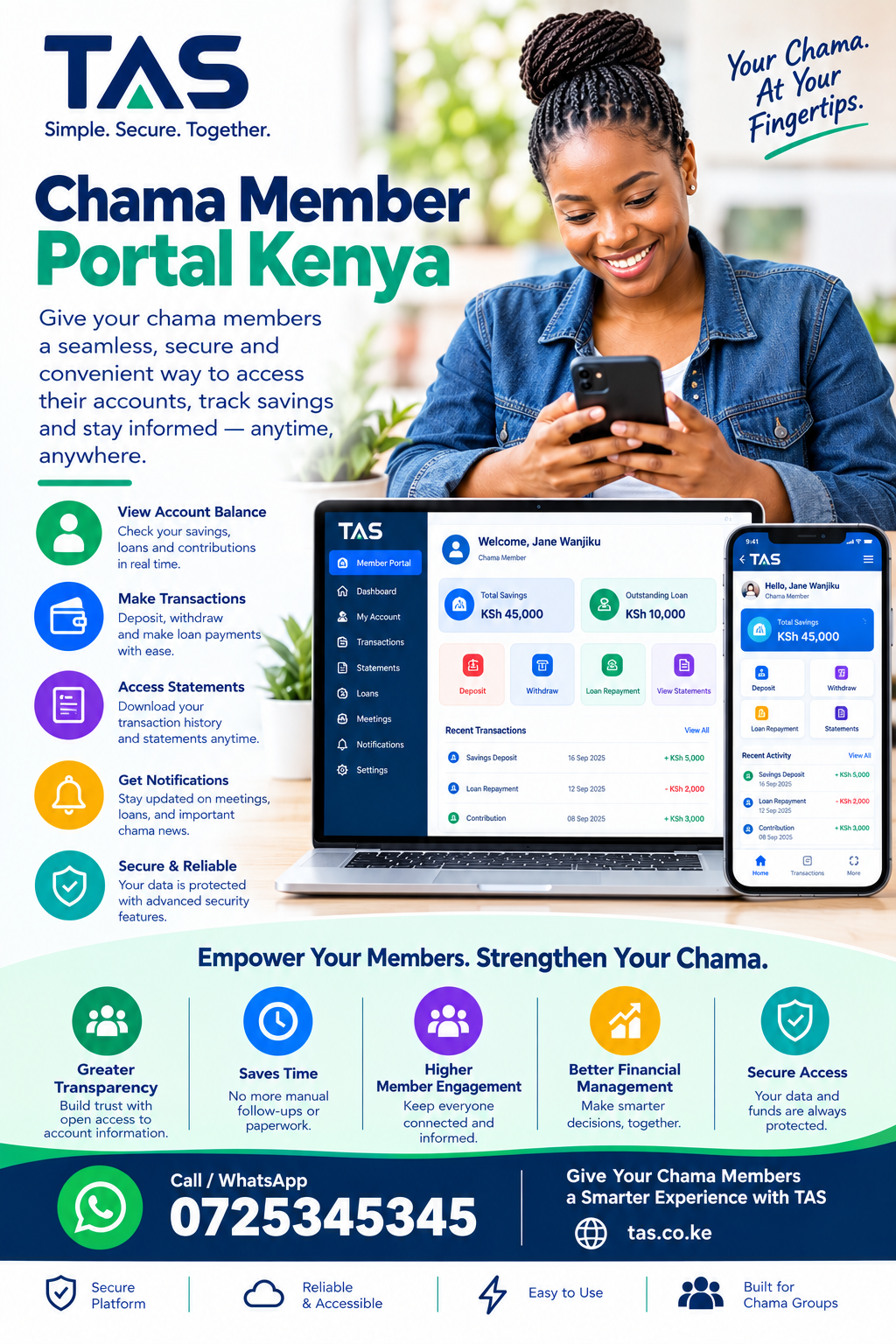
Chama Arrears Tracking Software Kenya: A Practical Guide for Better Chama Financial Management
Managing unpaid contributions can become one of the most difficult responsibilities for a chama, investment group, welfare association, table banking group, or community savings organisation. When members pay different amounts at different times, keeping track of who has paid, who is late, and how much each person owes can quickly become confusing. Chama Arrears Tracking Software Kenya gives groups a structured way to monitor outstanding contributions, maintain accurate member records, and improve financial follow-up. This guide explains how arrears tracking works, why it matters, which features to consider, and how Kenyan chamas can use technology to create better contribution management processes.
A well-managed chama needs more than a notebook and occasional financial updates. Members need confidence that their contributions are recorded correctly and that outstanding amounts can be identified without arguments or guesswork. Chama Arrears Tracking Software Kenya can help committees organise contribution information in one central system instead of relying on scattered spreadsheets, notebooks, WhatsApp messages, or memory.
The purpose of arrears tracking is not simply to identify members who have not paid. It is also about creating a reliable financial record. Chama Arrears Tracking Software Kenya can support a more organised process where contribution schedules, payment records, outstanding balances, member information, and follow-up activities are easier to manage.
For many Kenyan groups, contribution arrears arise for ordinary reasons. A member may forget a deadline, experience a temporary cash-flow problem, miss a meeting, send an incorrect amount, or make a payment that has not yet been reconciled. Chama Arrears Tracking Software Kenya helps separate these situations from genuine long-term arrears by giving the group better visibility into its records.
What Are Chama Contribution Arrears?
Chama contribution arrears are amounts that a member was expected to contribute by a particular deadline but has not fully paid. The arrears may relate to regular monthly contributions, welfare payments, investment contributions, loan obligations, penalties, or another agreed financial commitment.
For example, imagine a chama requiring every member to contribute KSh 5,000 each month. If one member pays KSh 3,000, the member has an outstanding contribution of KSh 2,000. If another member makes no payment, that member has an outstanding balance of KSh 5,000.
A good tracking process needs to distinguish between these two situations. Chama Arrears Tracking Software Kenya can help record the amount expected, amount received, date of payment, and remaining balance for each member.
This becomes particularly important when a chama has grown from a small informal group into an organisation with dozens or hundreds of members. Manual records that worked when there were ten members may become difficult to maintain when the membership expands.
Why Arrears Tracking Matters for Kenyan Chamas
Unpaid contributions can affect the financial plans of a chama. If members fail to contribute on schedule, the group may have less money available for investments, welfare assistance, projects, loans, or other activities.
Chama Arrears Tracking Software Kenya gives a committee a clearer picture of the group’s expected contributions compared with actual collections. This information can help members understand their financial position and allow leaders to identify outstanding amounts before they become difficult to recover.
1. It Improves Financial Visibility
A chama committee should be able to answer basic questions quickly:
- How much was expected this month?
- How much has been collected?
- Which members have outstanding balances?
- How long have the balances remained unpaid?
- Are partial payments being made?
- What amount is currently outstanding?
- Which members need follow-up?
Chama Arrears Tracking Software Kenya can make these questions easier to answer because member contribution information can be organised in a structured format.
2. It Reduces Manual Calculation
Manual calculations create room for mistakes. A treasurer may accidentally record a payment twice, forget a previous partial payment, or calculate a balance incorrectly.
With Chama Arrears Tracking Software Kenya, contribution balances can be managed systematically. The system can use recorded payment information to establish what remains outstanding, reducing the need for repeated manual calculations.
3. It Supports Accountability
Financial transparency is important in any group handling members’ money. When contribution records are well organised, members can better understand how their payments have been recorded.
Chama Arrears Tracking Software Kenya can help create an auditable trail of expected contributions and payments. This can make financial discussions more factual and reduce disagreements caused by incomplete records.
Common Causes of Chama Arrears
Understanding why arrears happen is important because different causes require different approaches.
Missed Payment Deadlines
A member may simply forget a contribution deadline. Regular reminders can help reduce this type of arrears.
Partial Payments
Some members may pay what they can afford and settle the remainder later. This creates a balance that needs to remain visible until fully cleared.
Irregular Income
Many Kenyan households and small-business owners have income that changes from month to month. A member may experience a temporary financial challenge and delay payment.
Poor Record Keeping
Sometimes an apparent arrear is actually a record-keeping problem. A member may have paid, but the payment may not have been entered correctly.
Unclear Contribution Rules
If members are uncertain about payment deadlines, penalties, or contribution amounts, arrears can become more common.
Chama Arrears Tracking Software Kenya can help the committee establish clearer records so that members and administrators are working from the same information.
Key Features to Look For in Arrears Tracking Software
Not every financial management system provides the same functionality. A chama should identify the features that directly support its contribution process.
Chama Arrears Tracking Software Kenya should ideally support accurate member records, contribution schedules, payment entries, outstanding balances, reporting, and follow-up.
Member Records
Each member should have a clear profile containing relevant information. Depending on the group’s requirements, this may include membership details, contribution obligations, payment history, and outstanding balances.
A central member record makes it easier to understand a member’s financial activity without searching through several notebooks or spreadsheets.
Contribution Schedules
A chama needs to know what each member is expected to contribute. The amount may be fixed or may differ depending on the type of contribution.
Chama Arrears Tracking Software Kenya can help organise contribution schedules so administrators can compare expected payments with actual payments.
Payment Recording
Every payment should be recorded accurately. Important details can include the member, amount, payment date, payment type, and relevant reference information.
This is particularly useful when members use different payment channels or when contributions are collected at different times.
Outstanding Balance Tracking
The central purpose of arrears management is to know what remains unpaid.
Chama Arrears Tracking Software Kenya can help committees identify outstanding amounts without calculating every member’s balance manually.
Payment History
A complete payment history can help answer questions when members dispute balances. Instead of relying on memory, the committee can review recorded transactions.
Reports
Reports help turn individual payment records into useful financial information. A treasurer might need a monthly arrears report, a member statement, a contribution summary, or an outstanding balance report.
Chama Arrears Tracking Software Kenya can be particularly useful when committee members need financial information for meetings and decision-making.
How Arrears Tracking Can Work
A practical arrears workflow can be divided into several stages.
Step 1: Define Contribution Requirements
The chama first establishes the amount each member is expected to pay and the deadline.
For example:
| Contribution | Amount | Frequency | Deadline |
|---|---|---|---|
| Monthly savings | KSh 5,000 | Monthly | 5th |
| Welfare contribution | KSh 500 | Monthly | 5th |
| Investment contribution | Variable | As agreed | Group deadline |
Clear requirements make arrears easier to identify.
Step 2: Record Expected Contributions
The system should record what members are expected to pay before comparing that amount with actual payments.
Step 3: Record Payments
As members pay, the treasurer records each transaction. Chama Arrears Tracking Software Kenya can support a more organised process by keeping payment information connected to the appropriate member.
Step 4: Calculate Outstanding Amounts
The difference between expected and received contributions becomes the outstanding amount.
For example:
Expected contribution: KSh 5,000
Payment received: KSh 3,500
Outstanding balance: KSh 1,500
Step 5: Follow Up
Members with outstanding balances can be contacted according to the group’s agreed procedures.
Step 6: Update the Record
Once the member clears the balance, the payment should be entered so that the outstanding amount is updated.
Chama Arrears Tracking Software Kenya helps make this process more systematic and easier to review.
Managing Partial Payments
Partial payments deserve special attention because they can easily create confusion in manual systems.
Suppose a member owes KSh 10,000 and pays KSh 4,000. The member has not completely failed to contribute. The correct outstanding amount is KSh 6,000.
A good system should preserve both the original obligation and the payment already made. Chama Arrears Tracking Software Kenya can help groups maintain this distinction.
Partial payment records can also be useful when members pay at different times. For instance, a member might pay KSh 2,000 on Monday, KSh 3,000 on Friday, and the remaining KSh 5,000 the following week.
Instead of replacing the original balance, each transaction should contribute to a transparent payment history.
M-Pesa and Chama Contribution Tracking
M-Pesa is widely used for payments in Kenya, making digital payment records particularly relevant to chama management. A group may receive contributions through a designated number or another agreed payment arrangement.
However, receiving money electronically does not automatically create a complete accounting record. The group still needs to match payments with members and contribution obligations.
Chama Arrears Tracking Software Kenya can support a workflow where payment information is connected to member records and contribution requirements.
When using M-Pesa or another payment method, committees should establish clear procedures for:
- Payment identification
- Transaction references
- Payment confirmation
- Recording partial payments
- Handling incorrect payments
- Reconciling transactions
- Updating member balances
The goal is to ensure that a payment received is accurately reflected in the member’s account.
Arrears Reports for Chama Committees
Reports can help committees understand the group’s financial position without reviewing every transaction individually.
Chama Arrears Tracking Software Kenya can be used as part of a structured reporting approach where administrators review outstanding balances and payment activity.
A useful arrears report might contain:
| Member | Expected | Paid | Outstanding | Status |
|---|---|---|---|---|
| Member A | KSh 5,000 | KSh 5,000 | KSh 0 | Cleared |
| Member B | KSh 5,000 | KSh 3,000 | KSh 2,000 | Partial |
| Member C | KSh 5,000 | KSh 0 | KSh 5,000 | Outstanding |
This format gives the committee a simple overview of contribution performance.
Using Arrears Information During Chama Meetings
Financial meetings become more productive when members have clear information before discussions begin.
Instead of spending most of the meeting trying to establish who owes what, the treasurer can present a prepared report.
Chama Arrears Tracking Software Kenya can help provide structured information that supports discussions about collections, financial planning, and outstanding contributions.
A meeting may review:
- Total expected contributions.
- Total contributions received.
- Total outstanding balances.
- Members with partial payments.
- Long-standing arrears.
- Contribution trends.
- Agreed follow-up actions.
The committee can then focus on decisions rather than reconstructing financial records.
Improving Member Communication
Arrears management should not become a source of unnecessary conflict. Communication matters.
A member who misses a payment should receive a clear message showing:
- The contribution expected.
- The amount already received.
- The outstanding balance.
- The applicable deadline.
- The agreed payment instructions.
Chama Arrears Tracking Software Kenya can help administrators work from accurate records when communicating with members.
Clear communication also gives members an opportunity to identify genuine errors. If a member says a payment was made, the treasurer can check the transaction record rather than relying on memory.
Setting Clear Arrears Policies
Software cannot solve unclear financial rules. Before implementing a tracking system, the chama should agree on its contribution policy.
The policy should address:
- Contribution amounts
- Payment deadlines
- Grace periods
- Partial payments
- Late-payment penalties, if applicable
- Communication procedures
- Dispute handling
- Record correction procedures
- Approval responsibilities
Once the rules are clear, Chama Arrears Tracking Software Kenya can help the group apply those rules consistently through organised records.
Benefits for Treasurers
Treasurers often carry significant responsibility for chama financial records. Manual work can consume considerable time, particularly when the membership is large.
With Chama Arrears Tracking Software Kenya, a treasurer can have a central place to review contributions, payment history, and outstanding amounts.
This can reduce repetitive work such as:
- Adding figures from multiple notebooks.
- Recalculating member balances.
- Searching for old payment entries.
- Preparing reports manually.
- Comparing different spreadsheets.
- Checking whether partial payments were included.
The treasurer can instead spend more time on financial planning, reconciliation, reporting, and member support.
Benefits for Chama Chairpersons
The chairperson needs a clear understanding of the group’s financial position without necessarily handling every transaction.
Chama Arrears Tracking Software Kenya can give leadership access to organised information that supports oversight.
This can be useful when discussing:
- Investment plans
- Welfare support
- Member obligations
- Cash availability
- Collection challenges
- Financial targets
The chairperson can ask informed questions based on records rather than assumptions.
Benefits for Ordinary Members
Arrears tracking is not only about helping committee members. Ordinary members also benefit from accurate records.
A member should be able to understand how much they were expected to contribute and how their payments have been recorded.
Chama Arrears Tracking Software Kenya can contribute to greater transparency when financial information is organised properly.
Accurate records can also help prevent situations where a member pays an amount but later discovers that the payment was not correctly reflected in the group’s books.
How Software Can Reduce Human Error
Human error is one of the challenges associated with manual financial management.
Common mistakes include:
- Entering the wrong amount.
- Recording the same payment twice.
- Forgetting a payment.
- Assigning a payment to the wrong member.
- Miscalculating an outstanding balance.
- Losing an old record.
- Using outdated spreadsheets.
Chama Arrears Tracking Software Kenya can reduce dependence on manual calculations by keeping financial information in a structured system.
This does not mean errors become impossible. Data still needs to be entered correctly, and committees should review important records regularly.
Choosing Software for a Small Chama
A small chama may not need dozens of advanced functions. The priority should be simplicity and accurate financial records.
When comparing options, ask:
- Is it easy to record members?
- Can the system track expected contributions?
- Can it record partial payments?
- Can it calculate outstanding balances?
- Can members’ payment histories be reviewed?
- Can reports be generated?
- Is the system accessible to authorised committee members?
- Can the system support the chama’s existing workflow?
Chama Arrears Tracking Software Kenya should be evaluated according to the group’s actual requirements rather than simply the number of features advertised.
Choosing Software for a Large Chama
Larger groups usually have more complex requirements.
A large chama may need:
- Multiple contribution categories
- Detailed member profiles
- Automated calculations
- Financial reports
- Role-based access
- Payment reconciliation
- Arrears monitoring
- Historical records
- Investment tracking
- Loan management
- Welfare management
Chama Arrears Tracking Software Kenya becomes more valuable when the volume of financial activity makes manual tracking difficult.
The larger the membership, the more important it becomes to establish consistent data-entry and approval procedures.
Security and Access Control
Financial information should be handled carefully. Chama records may contain member names, payment histories, balances, contact information, and other sensitive business information.
Chama Arrears Tracking Software Kenya should therefore be assessed with security and access control in mind.
A chama should consider:
- Who can enter transactions?
- Who can edit records?
- Who can view financial reports?
- Who approves corrections?
- How are accounts protected?
- How are backups handled?
- What happens when a committee member leaves?
Access should be given according to responsibilities rather than automatically giving every user full control.
Data Accuracy and Reconciliation
Even with software, reconciliation remains important.
A chama may compare recorded transactions against bank statements, M-Pesa records, receipts, or other approved financial documents.
Chama Arrears Tracking Software Kenya can form part of a broader financial control process, but committees should continue reviewing records.
A useful reconciliation process might be performed weekly or monthly depending on the volume of transactions.
The process can identify:
- Missing transactions
- Duplicate entries
- Incorrect amounts
- Unidentified payments
- Wrong member allocations
- Outstanding transactions
Arrears Aging
Not every outstanding balance carries the same history.
A KSh 2,000 balance that is three days overdue is different from a KSh 20,000 balance that has remained unpaid for six months.
Chama Arrears Tracking Software Kenya can support an arrears management approach that considers how long balances have remained outstanding.
An arrears aging structure might use categories such as:
| Age | Suggested Review |
|---|---|
| 1–7 days | Friendly reminder |
| 8–30 days | Direct follow-up |
| 31–60 days | Committee review |
| 61–90 days | Formal follow-up |
| Over 90 days | Review according to group policy |
These categories should be adapted to the chama’s own rules rather than treated as universal requirements.
Using Data to Identify Contribution Trends
Arrears data can reveal patterns.
For example, if many members consistently delay contributions near the same time each month, the group may need to reconsider its payment deadline.
Chama Arrears Tracking Software Kenya can help the committee review historical records and identify recurring collection issues.
Other useful observations may include:
- Increasing outstanding balances
- Improving payment rates
- Frequent partial payments
- Seasonal delays
- Recurring payment errors
- Members who consistently pay early
The purpose of this analysis should be to improve administration, not to embarrass members.
Avoiding Public Shaming
Financial accountability and member dignity can exist together.
A chama should establish appropriate communication channels for arrears. Publishing individual debts in an inappropriate public forum can create unnecessary conflict.
Chama Arrears Tracking Software Kenya can help administrators access the information needed for private and structured follow-up.
The committee should define who can view individual financial information and how arrears communication should be handled.
Using Automated Reminders
Reminders can help members remember deadlines. A software system may support reminder workflows depending on its functionality.
Chama Arrears Tracking Software Kenya can support an organised process where outstanding balances are identified before follow-up messages are sent.
A simple reminder might state:
“Your monthly contribution of KSh 5,000 was due on the agreed date. Our records show that KSh 3,000 has been received, leaving an outstanding balance of KSh 2,000. Please confirm or settle the balance according to the chama’s contribution policy.”
The message is factual and gives the member an opportunity to respond if the record is incorrect.
Connecting Arrears Tracking With Other Chama Functions
Arrears should not be viewed separately from the rest of financial management.
A member’s contribution history may affect investment contributions, welfare eligibility, loan obligations, or other activities depending on the group’s rules.
Chama Arrears Tracking Software Kenya can become part of a broader chama management process where different financial activities are connected.
This reduces the need to maintain separate records for every financial function.
Chama Loans and Arrears
Some chamas operate loan schemes alongside regular contributions. In such cases, administrators need to distinguish between contribution arrears and loan repayment arrears.
They are different obligations.
A member may have fully paid monthly contributions but still have an outstanding loan balance. Another member may have no loan but may owe contributions.
Chama Arrears Tracking Software Kenya can help maintain clearer financial categories so that different obligations are not mixed together.
Welfare Contributions
Welfare funds often operate according to specific contribution rules. Members may contribute a fixed amount each month or contribute when particular events occur.
If welfare contributions become overdue, the group needs a clear record of what was expected and what has been received.
Chama Arrears Tracking Software Kenya can help maintain contribution records that support welfare administration.
The exact rules should always follow the group’s constitution or agreed procedures.
Investment Chamas
Investment groups may have larger contribution amounts and more complex financial plans.
If members are expected to contribute towards a land purchase, property investment, business project, securities investment, or another group objective, delayed contributions may affect the group’s ability to meet its plans.
Chama Arrears Tracking Software Kenya can help the group maintain clearer records of investment-related contribution obligations.
The committee can then compare expected contributions with actual collections and review outstanding balances during financial meetings.
Creating a Culture of Timely Payments
Software alone cannot create disciplined financial behaviour. The chama also needs clear communication and consistent procedures.
Chama Arrears Tracking Software Kenya can provide the information needed to support those procedures.
A healthy contribution culture can be supported by:
- Clear deadlines
- Consistent reminders
- Transparent records
- Easy payment instructions
- Fairly applied policies
- Accurate member statements
- Regular financial reporting
Members are more likely to understand their responsibilities when the rules and records are clear.
Common Mistakes Chamas Should Avoid
Several mistakes can reduce the effectiveness of arrears tracking.
Relying Only on WhatsApp
WhatsApp can be useful for communication but is not necessarily a substitute for a structured financial record.
Keeping Multiple Uncontrolled Spreadsheets
Different committee members may end up working from different versions of the same file.
Updating Records Too Late
Delayed data entry can make the reported balances inaccurate.
Ignoring Partial Payments
A member’s payment history should reflect every relevant transaction.
Failing to Reconcile Payments
Electronic payment records should still be matched against the group’s accounting records.
Giving Everyone Full Access
Financial systems should use appropriate access controls.
Chama Arrears Tracking Software Kenya can help reduce these administrative weaknesses when properly implemented.
A Practical Implementation Plan
A chama moving from manual records to digital arrears tracking can use a gradual approach.
Week One: Review Existing Records
Collect current membership records, contribution schedules, payment histories, and outstanding balances.
Week Two: Clean the Data
Check for duplicate members, missing payments, incorrect balances, and incomplete records.
Week Three: Configure the System
Set up members, contribution categories, schedules, and relevant financial rules.
Chama Arrears Tracking Software Kenya can support the transition to a more structured process.
Week Four: Test the Workflow
Enter sample transactions and confirm that balances and reports behave as expected.
Ongoing: Review and Improve
The committee should review the system periodically and update procedures where necessary.
Measuring Arrears Performance
A chama can establish internal measures to understand whether its collection process is improving.
Useful measures may include:
- Total outstanding contributions
- Number of members with arrears
- Average outstanding balance
- Amount collected during a period
- Number of partial payments
- Age of outstanding balances
- Number of corrected transactions
Chama Arrears Tracking Software Kenya can support these reviews by making contribution records easier to organise and analyse.
The group should choose measurements that actually help its financial decisions rather than collecting unnecessary information.
What Makes a Good Chama Arrears Process?
A strong process has several characteristics.
First, the rules are clear. Members understand what they are expected to contribute and when.
Second, records are accurate. Payments are entered consistently and reviewed.
Third, balances are visible. Members and authorised administrators can determine what remains outstanding.
Fourth, follow-up is structured. Arrears are handled according to agreed procedures rather than personal preferences.
Fifth, reporting is regular. The committee does not wait until the end of the year to discover that outstanding contributions have accumulated.
Chama Arrears Tracking Software Kenya can support these principles by providing a structured environment for contribution records.
How to Compare Chama Software Providers
Before selecting a solution, prepare a checklist based on actual requirements.
Consider asking providers:
- Does the system support contribution tracking?
- Can it manage outstanding balances?
- Can it handle partial payments?
- Can it generate member statements?
- Can it produce arrears reports?
- Can it support M-Pesa-related workflows?
- Can authorised users access records remotely?
- What security controls are available?
- Is training provided?
- How are support requests handled?
- Can the system grow with the chama?
Chama Arrears Tracking Software Kenya should be assessed based on the features, workflow, usability, and support that the particular group needs.
Cost Considerations
The cheapest option is not necessarily the most appropriate for every chama, but cost should still be considered carefully.
A group should understand the full cost of using a system. This may include subscription charges, implementation, training, support, integrations, or additional users depending on the provider.
Chama Arrears Tracking Software Kenya should be evaluated against the administrative time and risks associated with the group’s current process.
Before committing, the committee can calculate how much time is spent every month maintaining contribution records and preparing reports.
Training Committee Members
A new system works best when users understand how to use it.
Training should cover:
- Adding and updating member records.
- Recording contributions.
- Correcting errors.
- Reviewing outstanding balances.
- Generating reports.
- Handling partial payments.
- Reconciling transactions.
- Protecting login credentials.
Chama Arrears Tracking Software Kenya can be introduced gradually so committee members become comfortable with the workflow.
Maintaining Good Financial Records
Digital tools should be supported by good governance.
A chama should define who is responsible for financial data, who approves changes, and how records are reviewed.
Chama Arrears Tracking Software Kenya can help organise information, but the committee remains responsible for establishing sound financial procedures.
Regular reviews can identify mistakes before they become major problems.
Frequently Asked Questions
1. What is Chama Arrears Tracking Software?
It is software designed to help a chama record expected contributions, payments, outstanding balances, member histories, and related financial information. Chama Arrears Tracking Software Kenya can be used to organise this information in a central system.
2. Can software track partial chama contributions?
Yes, a suitable system can record partial payments and show the remaining balance. Chama Arrears Tracking Software Kenya can support a structured approach to monitoring what has been paid and what remains outstanding.
3. Can a chama track M-Pesa payments?
A chama can use software to organise M-Pesa-related payment records depending on the capabilities and integrations offered by its chosen system. Chama Arrears Tracking Software Kenya can form part of a digital contribution management process.
4. Why should a chama track arrears?
Tracking arrears helps the group understand outstanding obligations, improve follow-up, prepare financial reports, and maintain accurate member records. Chama Arrears Tracking Software Kenya provides a structured way to manage this information.
5. Can arrears software generate reports?
Many financial management systems provide reporting functionality, although the available reports differ between providers. Chama Arrears Tracking Software Kenya can help groups organise contribution information for financial review.
6. How can a chama prevent contribution arrears?
Clear deadlines, regular communication, convenient payment procedures, accurate records, and consistent follow-up can all help reduce arrears. Chama Arrears Tracking Software Kenya can support the record-keeping side of this process.
7. Can small chamas use digital arrears tracking?
Yes. A small group can benefit from organised contribution records even when its membership is limited. Chama Arrears Tracking Software Kenya can be considered alongside the group’s size, budget, and administrative needs.
8. What should a chama check before choosing software?
The group should consider contribution tracking, payment records, outstanding balances, reporting, security, usability, support, and integration requirements. Chama Arrears Tracking Software Kenya should be assessed according to the chama’s actual workflow.
Final Thoughts
Managing contribution arrears becomes increasingly difficult when a chama depends on notebooks, scattered spreadsheets, memory, and informal communication. A structured digital process can give the treasurer and committee a clearer view of expected contributions, received payments, partial payments, and outstanding balances.
Chama Arrears Tracking Software Kenya can help bring these records together and make routine financial administration more organised. The value comes from combining accurate technology with clear contribution rules, consistent reconciliation, responsible access, and respectful member communication.
For a chama considering digital transformation, the starting point should be understanding its current process. Identify where payment records are created, where mistakes occur, how arrears are currently followed up, and which reports the committee needs most often. Chama Arrears Tracking Software Kenya can then be evaluated as part of a broader financial management workflow.
The objective is not simply to create a list of members who owe money. A useful arrears management system should help the group understand its financial position, maintain accurate histories, communicate clearly with members, and make better-informed administrative decisions.
Chama Arrears Tracking Software Kenya can be particularly useful when a chama wants to move from reactive record keeping to a more consistent contribution management process. With the right procedures in place, committees can spend less time searching through records and more time managing the group’s financial activities.
As membership grows, financial transactions increase, and chamas take on more investment or welfare responsibilities, organised records become increasingly important. Chama Arrears Tracking Software Kenya provides a practical area to consider when reviewing how a chama manages contribution obligations.
A well-implemented system should make it easier to answer simple but important questions: what was expected, what was received, what remains outstanding, and what action should happen next?
Chama Arrears Tracking Software Kenya can support that visibility while giving the chama a stronger foundation for accurate financial administration.
Ultimately, technology should serve the group’s agreed financial processes. The committee should define its rules, protect member information, verify payment records, and review financial reports regularly.
Chama Arrears Tracking Software Kenya can then become one part of a broader approach to improving contribution management, accountability, and financial organisation.
For Kenyan chamas seeking a more systematic way to manage outstanding contributions, digital arrears tracking offers a practical alternative to fragmented manual records. Chama Arrears Tracking Software Kenya can help bring contribution information into a central workflow where payments and outstanding balances are easier to review.
A strong system should also support growth. As a chama adds members, contribution categories, welfare activities, investment projects, or other financial responsibilities, its record-keeping process should remain manageable.
Chama Arrears Tracking Software Kenya can therefore be considered not just as an arrears tool, but as part of a wider strategy for improving chama financial management.
Before choosing a solution, committees should document their requirements, review the available features, confirm how payment records will be handled, and train the people responsible for financial administration.
Chama Arrears Tracking Software Kenya can support the move towards more organised records when combined with clear policies and disciplined financial processes.
The most important outcome is reliable information. When a treasurer can quickly determine what each member was expected to contribute, what has been paid, and what remains outstanding, financial discussions become easier to manage.
Chama Arrears Tracking Software Kenya can help create that structured visibility and reduce unnecessary reliance on manual calculations.
For growing Kenyan chamas, better arrears management can also contribute to better planning. The committee can understand how much money is actually available, identify outstanding obligations, and prepare more realistic financial plans.
Chama Arrears Tracking Software Kenya gives groups another option for organising this information within a digital financial management process.
The transition should be gradual and carefully managed. Existing records should be reviewed before migration, errors should be corrected, and committee members should understand their responsibilities.
Chama Arrears Tracking Software Kenya can be evaluated alongside these implementation requirements when a group is comparing digital management options.
A chama that maintains accurate contribution records is better positioned to explain its financial position to members. Clear records can also reduce disputes because financial conversations can be based on documented transactions rather than conflicting memories.
Chama Arrears Tracking Software Kenya can support this objective by helping groups organise contribution and arrears information.
The process should always remain fair and respectful. Arrears information should be used to improve financial management, not to embarrass individual members. Private communication and consistent application of group rules are important parts of responsible arrears administration.
Chama Arrears Tracking Software Kenya can provide the record-keeping foundation for that approach.
Finally, software should be viewed as a tool rather than a replacement for good financial governance. A chama still needs clear rules, responsible leadership, accurate payment information, proper reconciliation, and regular reporting.
Chama Arrears Tracking Software Kenya can help turn those processes into a more organised digital workflow.
When contribution records are accurate and accessible to authorised users, a chama can spend less time resolving basic record-keeping problems and more time focusing on savings, investments, welfare, and other objectives agreed by its members.
Chama Arrears Tracking Software Kenya can be part of that transition towards more organised and transparent chama financial management.