Blog

  • Chama Software Trial Checklist: 8 Tasks to Test Before Choosing

    A chama software trial checklist gives your committee a practical way to evaluate a platform before making a commitment. A demonstration may look impressive while leaving your everyday questions unanswered. The useful test is whether your officials can complete the work your Kenyan group repeats each week or month.

    Write down your required tasks before starting, and use clearly labelled sample information wherever possible. Record what you completed, where you needed help and which questions remain open. The eight checks below provide a repeatable way to compare your experience with your actual administrative needs.

    chama software trial checklist: members reviewing group records together

    1. Set Up a Small Sample Group

    Begin with a few test members and an agreed example reporting period. Include realistic variations, such as similar member names, different contribution categories and a correction request. Keep the sample small enough that you know the expected result before using the software.

    A clear sample prevents a misleading test. If nobody knows what the final balances should be, a polished report may look correct even when the underlying entries are wrong.

    2. Record and Find a Contribution

    Ask the person who will maintain contributions to enter a sample payment. Then ask another official to find it using the member name, reference or reporting period. Check whether the information displayed answers the group’s usual questions.

    Test a correction as well. Find out how an incorrect entry is handled and what record of the change remains. Do not assume that deleting and re-entering a payment is the intended process.

    3. Review Member Access

    If separate roles are available, ask the provider to demonstrate them. Compare what an ordinary member, treasurer and administrator can view or change. Use sample accounts and verify the actual screens rather than relying only on a feature description.

    Record any permission question that needs clarification. For example, can a member see another member’s records, and who can amend a confirmed entry? The arrangement should fit your group’s approved responsibilities.

    4. Follow One Loan Record

    If your group needs loan administration, trace one example from its starting record through a repayment. Check whether the displayed amounts and status match the sample you prepared. Ask how the platform represents your group’s existing terms.

    This is a workflow test, not a reason to introduce new lending rules. List gaps or unclear behaviour and discuss them with the provider before deciding whether the tool fits.

    5. Prepare a Meeting Record

    Create a short agenda and record one sample decision if those functions are offered. Try finding the record again as another authorised official. Check whether the location and wording would be understandable during a future handover.

    Test with the person who normally prepares meeting notes. Their experience matters more than whether somebody familiar with the platform can complete the same task quickly. Use our meeting action tracker guide to plan the follow-up information you need.

    6. Inspect a Report and Ask About Export

    Compare a report with your sample entries. Check the date range, labels and totals. Ask how records can be exported, which formats are provided and what happens to your information if the subscription ends.

    A readable report and a usable export serve different purposes. The first helps members understand activity; the second may help the group retain its records or move information to another process.

    7. Try the Devices Members Actually Use

    Complete the core tasks on an available phone and computer. Check whether text is readable, buttons are easy to select and important information remains visible. Ask what happens when a connection drops during an entry.

    Record the conditions of the test. A successful trial on one device or connection does not establish that every member will have the same experience.

    8. Confirm Costs, Support and the Decision

    Ask for the relevant member limits, billing period, support arrangements and any additional charges. Send a normal setup question through the advertised support channel and note whether the answer resolves it.

    Use a simple scorecard: task, expected result, actual result, assistance required and decision. Discuss unresolved essentials before choosing. A strong result is a clear fit with your needs, not the longest list of features.

    Chama Software Trial Checklist: Final Review

    • Can the intended officials complete essential tasks?
    • Do sample reports match the expected entries?
    • Are permissions and correction procedures understood?
    • Are costs, support and export arrangements clear?
    • Has the committee recorded unanswered questions?

    Build a Chama Software Trial Checklist Scorecard

    Use the same sample data and success criteria when testing different tools. A chama software trial checklist is most useful when the committee agrees what a pass means before the demonstration. For each task, write the expected result in plain language and record whether it was achieved independently, achieved with help or left unresolved.

    Task Expected result Evidence to keep
    Find a member The correct record opens using the agreed reference A note of the search steps
    Review a contribution The amount, date and period match the sample The sample report and reviewer note
    Correct an entry The correction is visible and explainable A description of the change process
    Retrieve a meeting decision Another official can locate the record The document location and access role

    A Chama Software Trial Checklist for Your Second Session

    Repeat the most important tasks after the first guided session. The person who watched the demonstration should now try the steps without the presenter completing them. This reveals whether the workflow is understandable in normal use. Note any instructions you needed to look up and whether those instructions were easy to find.

    During this second session, give the chama software trial checklist to an official who will mainly read reports. Ask them to identify the period, locate one sample entry and explain what a label means. Their questions may reveal an issue that the person entering data did not notice.

    Keep a separate list of provider questions. Ask for clarification where a feature works differently from your existing process, and record the answer beside the relevant test. Do not mark an essential task as passed simply because it may be available in a future release.

    Record the Chama Software Trial Checklist Decision

    Bring the completed chama software trial checklist to the committee discussion. Separate essential gaps from optional preferences. A missing workflow that officials need every week deserves a different response from a preferred colour or layout.

    Record the selected next step, the reasons for it and the person responsible. The decision may be to proceed, repeat a test or request clarification. Keep the chama software trial checklist with the meeting record so future officials can understand how the group assessed the tool.

    Before entering live information, confirm who will prepare the register, review imported details and manage access. Your chama software trial checklist should end with an agreed setup plan rather than an assumption that every existing file is ready to use.

    Chama Software Trial Checklist: Plan the First Week

    After the trial decision, write a short plan for the first week of use. Identify the person who will prepare the member list, the person who will review it and the official who will answer questions. Choose a small, clearly defined starting point so the group can check the process before adding more information.

    Use the chama software trial checklist to identify which instructions need to be written down. If the treasurer needed help finding a date filter during the trial, include that step in the setup notes. If the secretary could not locate a meeting record, clarify the document location before the next meeting.

    Decide how the group will handle entries during the transition. Officials should know which system is the current working record and when that changes. Avoid a situation where two people maintain different versions without an agreed review. Keep any earlier records available to the authorised reviewer until the transition checks are complete.

    Check the result after initial use

    Arrange a short follow-up with the people who completed the first real tasks. Compare their experience with the trial notes. Ask what worked as expected, what took longer and whether any important question remains unanswered. A chama software trial checklist should provide a reference for this discussion rather than being forgotten once a choice is made.

    Record any agreed changes to the setup and who will make them. Confirm the current support contact and explain how members should report a problem. Where a task cannot be completed, describe the exact step and expected outcome so the provider can understand the issue.

    Close the setup review only when the committee understands the remaining work. A successful start does not mean that nobody asks questions; it means there is a clear way to answer them, review records and improve the group’s routine.

    Frequently Asked Questions

    Who should participate in the trial?

    Include officials who will maintain records and at least one person who will mainly read them. Different roles reveal different usability problems.

    Must every feature be tested?

    Prioritise the tasks your group needs. Test optional features after the essential workflows are understood.

    Resources for Members with Business Projects

    For separate business needs, explore Zama Web Experts for web and business systems, Vega POS for retail operations, JAAT for business listings, Dereva for driver services, and Saseni for writing-order management. You can also visit Prim and Awasa to check their current offerings. Review each service against your own requirements.

    Put Your Process into Practice with TAS

    Explore TAS Kenya and our chama management software guide for the wider recordkeeping process. To discuss your group’s needs, create a TAS workspace or call 0725345345.

  • Chama Document Naming: A Simple System for Group Files

    A chama document naming system makes it easier to find the right minutes, report or supporting record when somebody needs it. Files called “final,” “new final” and “latest copy” quickly become difficult to distinguish. A consistent approach helps Kenyan chama officials understand a document before they even open it.

    Start with a few rules the entire committee can follow: use the same date format, name the document type and show its status. Keep the system simple enough to maintain during a busy month. This guide provides practical examples you can adapt to your group’s existing filing process.

    chama document naming: members reviewing group records together

    Choose a Chama Document Naming Pattern

    A practical pattern is date, document type, subject, version and status. For example, 2026-10-05_Minutes_MonthlyMeeting_v01_Draft tells an official when the meeting happened and whether the document is ready to rely on. Add the normal file extension when saving.

    Using the year first helps files sort into a useful date order. Choose either underscores or hyphens as separators and use them consistently. Avoid long names that repeat the group’s full name, every attendee and the entire agenda.

    Distinguish Document Date from Reporting Period

    A September report may be prepared in October. Those dates answer different questions. Decide whether the first date in the filename represents the reporting period or the creation date, then document the rule.

    For recurring reports, a name such as 2026-09_ContributionSummary_v02_Reviewed makes the period clear. Put the preparation date inside the report. For meeting minutes, use the meeting date. Another official should be able to understand the convention without guessing.

    Separate Draft, Reviewed and Approved Versions

    A tidy filename does not prove that a document has been approved. Use status labels only after the relevant step has happened. Record who reviewed or approved the document in its contents or the associated decision record.

    Increase the version number when making a substantive change. If an approved document needs correction, retain the earlier version and explain the amendment. Do not silently replace it with a different document that has the same name and no correction note.

    Use a Small, Predictable Folder Structure

    Create folders around the work your group actually does. Organise each by year if the volume makes that helpful. A manageable starting structure could include:

    • Meeting records: Agendas, draft minutes and approved minutes.
    • Member administration: The current register and approved updates.
    • Periodic reports: Clearly labelled monthly or quarterly reports.
    • Supporting documents: Records linked to the relevant entry or decision.
    • Archive: Superseded versions retained under the group’s record policy.

    Folder access should reflect the information inside it. A folder name is not an access control. Check the permissions in the storage tool so that sensitive records are available only to the people who need them.

    Create an Index for Important Records

    A short index helps when documents are stored in more than one location. List the document name, period, owner, status and location. Use links where the storage tool supports them, and check those links when a file is moved.

    For example, an approved meeting minute may reference a quotation saved elsewhere. The index should let the next secretary locate both without searching an old chat conversation. Include it in your official handover preparation.

    Introduce the Rules Gradually

    Start with new documents and the current reporting period. Agree which older records should be renamed first, then update any references that would break. Renaming the whole archive at once can create more confusion than it resolves.

    Write a one-page naming guide with three examples from your group. Ask another official to find a document using only the guide. If they struggle, simplify the rule before extending it to every record.

    Chama Document Naming Examples You Can Adapt

    A chama document naming guide becomes easier to follow when it includes examples from daily work. Keep these examples beside the folder index and explain what each component means. The names below are illustrative; use your group’s agreed dates, document types and status labels.

    Document Example filename Meaning
    Meeting agenda 2026-10-05_Agenda_MonthlyMeeting_v01_Draft.pdf An agenda still awaiting review
    Approved minutes 2026-10-05_Minutes_MonthlyMeeting_v02_Approved.pdf The approved second version
    Monthly report 2026-09_ContributionSummary_v01_Reviewed.pdf A reviewed report for September

    Test Your Chama Document Naming Rules

    Ask someone who did not prepare the files to find the latest approved minutes and the report for a specific month. Give them the naming guide, but do not tell them which file to open. If they choose a draft, identify which label or folder location caused confusion.

    Next, check the same files on a phone. Long names may be shortened on small screens, so the beginning of the name should carry useful information. A clear chama document naming pattern puts the date and document type before optional details.

    Handle Corrections Without Losing the Record

    When a document changes after approval, follow the group’s correction process first. Chama document naming supports that process by making the amended version distinguishable. It does not give the person renaming a file authority to change an approved decision.

    Keep a correction note that identifies the previous version, the change and the person who reviewed it. Update the index so it points to the current record, and label the earlier version as superseded if that matches your group’s policy. Avoid deleting the history merely to make a folder look tidy.

    Introduce Chama Document Naming at Handover

    During a committee handover, ask the incoming official to save a sample document using the guide. Check the chosen date, type, version and status together. This brief exercise shows whether the chama document naming rules are clear enough to use without relying on the outgoing official’s memory.

    Keep the guide short and give one person responsibility for explaining approved changes. If every official creates a new abbreviation, consistency quickly disappears. Review the chama document naming examples when a new document type becomes common, then share the updated guide with everyone who prepares files.

    Finally, distinguish naming from access. Good chama document naming helps people identify a file, while storage permissions control who may open or edit it. Review both when responsibilities change.

    Chama Document Naming: A Small Archive Cleanup Exercise

    Choose one recent meeting folder for a practice cleanup. List the files before changing anything and identify which document is approved, which is a draft and which supports a decision. Ask the person responsible for the record to confirm those statuses. A filename alone should not be treated as evidence that approval happened.

    Write the proposed new names in a simple old-name and new-name list. This gives another official a way to review the changes before they are applied. If a document appears in a meeting index or another report, identify the reference that will need to be updated as well.

    Apply the agreed chama document naming pattern to the small sample. Open the renamed documents to confirm that they are still readable, then check the index links from the location members normally use. Where links no longer work, update them before telling the committee that the folder is ready.

    What to do with an unclear file

    If the content does not establish its date or status, mark the file for review rather than inventing a confident name. Record who may be able to identify it and what information is missing. Keep it in an agreed review location with appropriate access, so it does not become mixed with the approved set.

    Do not use the cleanup exercise to discard records without following the group’s retention process. Renaming and deciding what to keep are different tasks. The person checking names should be able to explain where each reviewed document now sits.

    Check that the guide remains usable

    Ask the next official to explain the naming pattern using one of the sample files. If they need a long explanation for every abbreviation, replace those abbreviations with clearer words. Effective chama document naming should reduce the amount of background knowledge needed to find a record.

    Keep the successful examples in the one-page guide. As more folders are reviewed, use the same small-batch process and track outstanding questions. Consistency grows from a rule people can follow repeatedly, not from making every historical filename perfect in one afternoon.

    Frequently Asked Questions

    Must every file follow exactly the same pattern?

    Use a common structure, with documented variations for meeting records and periodic reports. Consistency matters more than a complicated format.

    Should personal details appear in filenames?

    Use the minimum identifying information needed. A member reference may be enough, especially where filenames are visible to a wider audience.

    Resources for Members with Business Projects

    For separate business needs, explore Zama Web Experts for web and business systems, Vega POS for retail operations, JAAT for business listings, Dereva for driver services, and Saseni for writing-order management. You can also visit Prim and Awasa to check their current offerings. Review each service against your own requirements.

    Put Your Process into Practice with TAS

    Explore TAS Kenya and our chama management software guide for the wider recordkeeping process. To discuss your group’s needs, create a TAS workspace or call 0725345345.

  • Managing Chama Contributions on WhatsApp: The Ultimate Fix That Brings Kenyan Groups Peace of Mind

    Managing chama contributions on WhatsApp problems

    Managing chama contributions on WhatsApp problems have quietly become the hidden tax every Kenyan group pays for convenience. The app brought members together like nothing before it, and nobody can honestly deny that. Yet the same tool now loses payments, breeds disputes, and exhausts treasurers from Mombasa to Kitale.

    The story repeats itself in almost every group that relies on chat alone. Members send M-Pesa payments, screenshots fly across the screen, and the treasurer promises to reconcile everything “over the weekend.” Weekends pass, balances drift, and the frustrations of managing chama contributions on WhatsApp problems grow into open arguments.

    This guide confronts the situation honestly, without pretending the app is useless. WhatsApp remains a brilliant communication tool — the trouble begins when it is asked to be a financial system. We will map every failure point in managing chama contributions on WhatsApp problems and show the proven fix.

    The article is written for treasurers drowning in screenshots, chairpersons fielding complaints, and members who no longer trust the numbers. It is also written for groups that have not yet hit the wall but quietly suspect it is coming. By the end, you will know exactly how to escape managing chama contributions on WhatsApp problems before they cost real friendships.

    One truth deserves saying upfront. The difficulties of managing chama contributions on WhatsApp problems are not a sign that your group is failing. They are a sign that your group has simply grown beyond the tool it started with.

    There is genuine good news hiding in that diagnosis. Every single issue on the managing chama contributions on WhatsApp problems list has a tested, affordable, digital solution. Groups that make the switch report calmer meetings, faster collections, and deeper trust within one billing cycle.

    So read this guide with your officials beside you. Discuss each problem section honestly and ask where your own group recognizes itself. The cheapest time to solve managing chama contributions on WhatsApp problems is today — long before the next disputed payment.

    Why WhatsApp Became the Default in the First Place

    To fix a habit, you must first respect why it formed. Managing chama contributions on WhatsApp problems exist precisely because the app solved the original problem so well. Before smartphones, contributions were announced by word of mouth and recorded in notebooks that vanished without trace.

    WhatsApp arrived and suddenly every member was reachable in one place. Announcements, reminders, and payment confirmations could all flow through a single free channel. For a young group with no budget, that felt like a complete financial system.

    The app also matched Kenyan life perfectly. M-Pesa was already in every pocket, and the chat became its natural noticeboard. That pairing made everything look like it was working — which is why managing chama contributions on WhatsApp problems stayed invisible at first.

    The trouble remained hidden in the early months because volumes were small. Ten members paying five thousand shillings are easy to track from memory. Difficulties multiply when amounts grow, members join, and the months stack into years.

    Then the first lost receipt arrives, and the treasurer scrolls through hundreds of messages hunting for one confirmation. That first lost receipt is the opening chapter of managing chama contributions on WhatsApp problems. Scrolling is not reconciliation, and memory is not a ledger.

    The sections that follow name each failure point plainly, because unnamed problems cannot be solved. As you read, tick mentally which ones your own group has already experienced. Most groups recognize themselves in at least five of the ten headings ahead.

    Problem 1: Screenshots, Lost Payments, and the Scroll of Doom

    The most familiar chapter of managing chama contributions on WhatsApp problems starts with a screenshot. A member sends a payment confirmation image, the chat moves fast, and within hours the message is buried under a hundred others. At month-end nobody can find it, and the member insists the group is ignoring their money.

    Screenshots are not receipts in any accounting sense. They can be cropped, edited, or sent twice by accident, and they match no ledger automatically. Building a financial system on images is the root cause of managing chama contributions on WhatsApp problems in most groups.

    Some treasurers fight back by saving every screenshot into a phone folder. But folders multiply, phones change, and one cracked screen can erase the entire archive — that fragility sits at the heart of managing chama contributions on WhatsApp problems. Members sense the fragility too, which is why “send it again” becomes the most repeated sentence in the group.

    The deeper damage is emotional rather than technical. A member whose payment cannot be found feels accused, even when nobody is blaming anyone. Repeated often enough, that feeling becomes the quiet exit door of once-loyal members.

    Problem 2: No Automatic Reminders, Ever

    The second chapter of managing chama contributions on WhatsApp problems is the reminder burden. Every month the treasurer must remember who to remind, compose each message, and send them one by one or in a risky bulk blast. Miss a few members, and the arrears report for that month is already written.

    Reminders sent through chat also feel personal in the wrong way. Members read a public nudge as scolding, and a private nudge as nagging. Either way, the treasurer ends the month with fewer friends and no better numbers.

    Automated reminders are the single most requested fix in every conversation about managing chama contributions on WhatsApp problems. Groups want reminders that leave before the due date, address each member by name, and require zero human effort. That one capability transforms collection rates within a single billing cycle.

    Problem 3: No Reconciliation with M-Pesa

    The third failure point is reconciliation — or rather, the total absence of it. On a proper platform, a member pays through the group Paybill and the payment matches itself to the right member automatically. In chat-based collections, a human must read each confirmation and copy the entry elsewhere by hand.

    That manual copying is where managing chama contributions on WhatsApp problems multiply fastest. A transposed digit credits the wrong member, a missed message leaves a payment invisible, and a busy week pushes reconciliation into next month. Each small slip erodes confidence in the numbers a little further.

    Banks and SACCOs employ professional bookkeepers for reconciliation precisely because the task demands focus and structure. Volunteer treasurers giving free evenings deserve better than a job designed for paid specialists. Recognizing that truth is a turning point in most groups’ journeys.

    Problem 4: Disputes and the Slow Erosion of Trust

    Every unresolved discrepancy becomes tomorrow’s argument, which is why disputes dominate the emotional cost of managing chama contributions on WhatsApp problems. One member’s “I paid” meets another member’s “show me,” and the chat takes sides before the facts surface. Friendships that survived school fees and funerals begin to strain over two thousand shillings.

    Trust is the only real asset of any chama, and managing chama contributions on WhatsApp problems spend that asset daily. Once members begin double-checking each other, every future transaction carries suspicion as its opening balance. Groups rarely collapse from poverty — they collapse from doubt.

    The cruelest part is that most disputes are honest misunderstandings. Nobody stole anything; the system simply cannot prove what happened. Proof, not personality, is what quarrels actually need — and a chat thread cannot supply it.

    Problem 5: Treasurer Burnout and the Admin Nightmare

    Behind every struggling chat-group sits one exhausted volunteer, which is why burnout is the human cost of managing chama contributions on WhatsApp problems. The treasurer tracks payments in a notebook, reconciles screenshots at midnight, sends reminders manually, and fields balance questions at all hours. No salary compensates for that workload, and no constitution prevents the resentment it breeds.

    Groups lose their best officials to managing chama contributions on WhatsApp problems every single year. The most capable, conscientious member burns out first, because they care enough to do the work properly. Their resignation letter often reads politely, but the untranslated message is always the same: the system broke me.

    Burnout also creates succession crises. Nobody volunteers to inherit a system everyone has watched exhaust the last person. The admin burden, left unaddressed, eventually becomes an empty chair at the officials’ table.

    Problem 6: No Reports, No Statements, No AGM Numbers

    Every AGM exposes the reporting gap at the center of managing chama contributions on WhatsApp problems. Members ask reasonable questions — total collected, total outstanding, who is behind — and the treasurer has no document to answer with. The meeting that should celebrate progress becomes an interrogation without exhibits.

    Chat history cannot be audited, summarized, or signed off. There is no arrears aging report, no collection rate, and no year-on-year comparison anywhere in a chat thread. That absence is the structural difference between managing chama contributions on WhatsApp problems and running a real financial system.

    Poor reporting also blocks growth opportunities. Banks, SACCO partners, and land sellers all ask for documented statements before taking a group seriously. A group without reports negotiates on reputation alone — and reputation has never funded a rental block.

    Problem 7: Chat Clutter and the Message That Drowns

    Chat clutter deserves its own heading among managing chama contributions on WhatsApp problems. Birthdays, memes, funeral announcements, and contribution reminders share one scrolling stream with no structure whatsoever. The one payment message that matters disappears between a forwarded video and a debate about the venue.

    Important announcements repeat endlessly, because members genuinely miss them — and repetition is the daily tax of managing chama contributions on WhatsApp problems. “What was the deadline again?” appears every month, asked by different members and answered wearily each time. The group’s official memory lives nowhere, so every question restarts from zero.

    There is also the mute problem. Members silenced by notification fatigue miss the very messages that need action. The loudest tool in the room becomes the least heard — an irony every chat-based group eventually lives through.

    Problem 8: One Phone, One Admin, One Point of Failure

    Single-admin risk is the least discussed but most dangerous entry in the managing chama contributions on WhatsApp problems list. If the admin who holds the group, the records folder, and the informal ledger loses their phone, the group loses its memory overnight. Phone theft, software failure, or a simple account switch can vaporize years of history in one afternoon.

    Succession amplifies the same exposure. When the admin leaves the group or the country, transferring control is possible — but transferring what they alone remember is not. That hidden dependency is the quiet time bomb inside managing chama contributions on WhatsApp problems.

    Proper systems solve this by design rather than by luck. Multiple officials hold verified access, records live in encrypted cloud storage, and handovers take minutes. The group’s memory belongs to the group, not to one handset in one pocket.

    Problem 9: Privacy and Exposed Financial Details

    Privacy is the uncomfortable heading most groups skip when listing managing chama contributions on WhatsApp problems. Screenshots of payments reveal phone numbers, balances, and borrowing patterns to every member — and to anyone a member forwards them to. Financial information deserves walls, and a chat room has none.

    Members in sensitive occupations feel this exposure most. Teachers, civil servants, and businesspeople quietly resent seeing their contribution habits broadcast to thirty acquaintances. Unspoken discomfort with managing chama contributions on WhatsApp problems has ended memberships that no meeting ever formally discussed.

    Respectable systems give each member a private view of their own account. Officials see what their roles require, and nobody scrolls anyone else’s balances. Dignity, like trust, is easier to keep than to rebuild.

    Problem 10: Arrears You Cannot See Until They Are Old

    Arrears aging is the final structural entry among managing chama contributions on WhatsApp problems. In a chat system, a missed payment is invisible until someone goes looking — and looking means scrolling. By the time the absence is noticed, the debt is two months old and the conversation is already awkward.

    Platforms present arrears the moment they form, aged by days and sorted by member. Officials act in week one, when a friendly reminder solves everything. That early-warning capability is the definitive answer to managing chama contributions on WhatsApp problems at the collection stage.

    The Hidden Costs Nobody Adds Up

    Beyond each named failure, the cumulative price of managing chama contributions on WhatsApp problems deserves its own arithmetic. Add the arrears that never surface, the hours the treasurer donates monthly, and the members who quietly resign over doubts. The total, even for a modest group, runs into tens of thousands of shillings a year.

    There is also an opportunity cost hiding inside managing chama contributions on WhatsApp problems. Meetings that should debate the next plot are spent reconciling last month’s screenshots. Ambition, not arithmetic, is supposed to consume a chama’s energy.

    And there is the reputational cost with outsiders. A group that cannot produce its own statements is not taken seriously by banks, land sellers, or partners. Externally visible disorder always begins as invisible internal chaos.

    The Workarounds Groups Try — and Why They Fall Short

    Confronted with managing chama contributions on WhatsApp problems, inventive groups bolt workarounds onto the chat. Pinned messages hold the contribution schedule, polls collect votes, and a linked Google Sheet pretends to be a ledger. Each patch helps a little and hides a lot.

    The pinned message is forgotten the week after someone posts fifty messages beneath it. The poll counts votes but cannot enforce a constitution. The spreadsheet still carries every silent-formula and single-admin risk — which is how managing chama contributions on WhatsApp problems survive their own remedies.

    Google Sheets deserve special honesty, because they are the most popular patch of all. A spreadsheet beside the chat adds arithmetic but adds none of the automation, access control, or audit trails that finance requires. Doubling the tools simply doubles the places for managing chama contributions on WhatsApp problems to hide.

    The pattern to notice is simple: every workaround moves the problem rather than solving it. The chat remains the source of truth, and everything else remains a shadow of it. Shadow systems cannot protect a treasury.

    The Signs You Have Outgrown the Chat

    Certain signals announce that managing chama contributions on WhatsApp problems have outgrown the group’s tolerance. The first is the repeated question — “has anyone seen my payment?” — appearing more than once a month. The second is a treasurer who warns, half-joking, that they will not be standing for re-election.

    The third sign is hesitation among new members asked to contribute. People join groups expecting modern systems, and they sense managing chama contributions on WhatsApp problems within their very first week. The fourth sign is the one you are holding right now: reading an article exactly like this one.

    Two or more signals together mean the window for a calm transition is open. Waiting until a crisis forces the switch costs more money and more friendships. Groups that move while things are still good never regret the timing.

    The Proven Fix: Give the Chat a System Behind It

    The answer to managing chama contributions on WhatsApp problems is not abandoning the chat — it is giving the chat a proper system behind it. A dedicated chama platform becomes the single source of truth, while WhatsApp returns to what it does best: conversation. The two tools finally stop competing for the same job.

    On the system side, members receive automatic invoices before every due date and pay through M-Pesa into a group Paybill. Payments reconcile to the right member and month within seconds, with instant receipts nobody can dispute. Every capability the chat lacked becomes standard equipment — the complete cure for managing chama contributions on WhatsApp problems.

    Officials gain dashboards they can actually act on. Arrears age visibly, collection rates trend monthly, and AGM statements export in minutes instead of weekends. Reports keep giving long after managing chama contributions on WhatsApp problems have been retired.

    Members gain dignity and clarity at the same time. Each person sees their own balance privately, receives reminders on time, and never sends a screenshot again. The chat fills with plans and laughter instead of payment archaeology.

    Best of all, the system never sleeps and never forgets. Records survive phone theft, admin changes, and the passage of years. That permanence is the final defeat of managing chama contributions on WhatsApp problems.

    Making the Switch: A Gentle Migration Plan

    Migration from the chat is easier than most groups fear, and it follows four gentle steps. Start by reconciling the current balances completely, because clean data makes everything that follows painless. This single exercise is where most groups finally close the book on managing chama contributions on WhatsApp problems from years past.

    Second, export those reconciled records and import them into the platform during onboarding, with two officials verifying every figure. Third, run one full billing cycle in parallel — chat and platform side by side. When the month-end totals match, celebrate loudly, because that match is the group’s graduation from managing chama contributions on WhatsApp problems for good.

    Fourth, keep the chat but change its job description. Announcements still live there, now pointing to statements that are always current. The app is finally promoted from overloaded bookkeeper back to beloved messenger.

    One practical tip makes everything smoother: onboard every member together in a single live demonstration. Collective training achieves near-total adoption within one cycle, and nobody feels left behind. That single meeting is usually the last time anyone seriously discusses managing chama contributions on WhatsApp problems as an unsolved issue.

    Real Stories from Groups That Made the Switch

    The Nakuru welfare table ran entirely on chat for four years before managing chama contributions on WhatsApp problems nearly split them apart. Two disputed screenshots in a single quarter triggered a special meeting that lasted three hours. The group adopted a platform the following week, and within three months arrears had fallen by more than eighty percent.

    The Kitengela landlords’ chama collected contributions on WhatsApp while managing its eight rental units separately. After migrating contributions to a dedicated system and moving tenants to Tas.co.ke, their AGM produced both sets of statements in twenty minutes. Members approved a second building that same afternoon — the decisive victory in their private war with managing chama contributions on WhatsApp problems.

    The Eldoret boda fleet tells the youngest story of all. Their treasurer resigned in month eleven of managing chama contributions on WhatsApp problems, citing midnight reconciliation sessions. Her successor requested a platform demo, and the group voted yes before the demonstration even ended.

    Across the country, the pattern is remarkably consistent. Groups do not leave WhatsApp because they stopped loving it — they leave because their money outgrew the tool. The switch feels like finally giving the treasurer a professional team.

    Frequently Asked Questions

    Is WhatsApp completely useless for chama finances? Not at all — managing chama contributions on WhatsApp problems arise when the chat is asked to be a financial system. As a communication layer beside a real platform, WhatsApp remains wonderful. The fix is role clarity, not deletion.

    Can we just be more careful with screenshots and manual recording? Discipline helps, but it cannot change the structure of managing chama contributions on WhatsApp problems. One tired month undoes a year of careful habits. Systems outlast willpower because they do not depend on it.

    What does a dedicated platform cost compared to free WhatsApp? The subscription typically works out to a few hundred shillings per member per year — less than a single unresolved dispute costs the group. Set the fee against recovered arrears and saved treasurer hours before judging it. Honest arithmetic dissolves the price objection, which is exactly how groups finally escape managing chama contributions on WhatsApp problems.

    Will our payments actually reconcile automatically? Yes — payments made through the group Paybill match to the right member, month, and purpose within seconds. Receipts issue instantly, and the member’s ledger updates without human hands. Automatic reconciliation is the single biggest upgrade a group gains when it leaves managing chama contributions on WhatsApp problems behind.

    How do we move our history off WhatsApp? Reconcile current balances first, export the records, and import them during onboarding with two officials verifying the figures. Run one parallel month and celebrate the match at the meeting. A tidy handover is the final chapter of managing chama contributions on WhatsApp problems.

    Will older members cope with a new system? Yes — inclusive platforms send SMS reminders and receipts to any phone, not just smartphones. The live demo meeting converts skeptics faster than any memo ever could. Age has never been the barrier; managing chama contributions on WhatsApp problems have.

    What happens to the WhatsApp group after we switch? It thrives, because it returns to being a social space instead of a filing cabinet. Announcements can link to statements that are always current, and debates can flow without burying payments. The healthiest end state for any group is a happy chat beside a silent, accurate ledger — with managing chama contributions on WhatsApp problems becoming a story the veterans tell the new members.

    We also own rental units — does the same advice apply? Absolutely, because tenants and rent deserve the same structure that managing chama contributions on WhatsApp problems taught your group to want. Run group finance on the chama platform and property operations on Tas.co.ke. One connected ecosystem keeps every shilling visible on both fronts.

    How quickly will we see a difference? Most groups report faster collections and fewer disputes within the very first billing cycle. The treasurer usually notices the change first, in reclaimed evenings and a quieter phone. Peace of mind arrives quickly once managing chama contributions on WhatsApp problems are finally behind the group.

    Is our group’s data safe on a dedicated platform? Reputable providers encrypt data, maintain backups, and restrict access through role-based permissions. Records on a proper platform are far safer than screenshots scattered across thirty personal phones. Security is one more reason groups never regret moving past managing chama contributions on WhatsApp problems.

    What is the single most important first step? Reconcile everything today, while memories are fresh and receipts are still findable. Then book a demo with your real numbers and ask to see your own structure on screen. That honest test is how every smart group begins its exit from managing chama contributions on WhatsApp problems.

    Can the platform also handle loans, fines, and welfare? Yes, with separate ledgers for each so nothing is ever mixed. Loans, guarantors, penalties, and welfare payouts all live in the same secure system. That completeness is the final assurance for any group still weighing managing chama contributions on WhatsApp problems against the cost of change.

  • Chama Member Data Cleanup: 7 Checks for Reliable Records

    Chama member data cleanup is the process of checking your membership records for duplicates, missing details and outdated information. For Kenyan groups moving from notebooks or spreadsheets, it is a useful first step before introducing a new system. A neat-looking member list can still contain errors that make everyday administration confusing.

    The aim is to establish which record belongs to each member and who has checked it. Keep unresolved questions visible instead of filling gaps with guesses. Our TAS chama management guide explains how member records fit alongside contributions, meetings and other group information.

    chama member data cleanup: members reviewing group records together

    1. Preserve the Starting Version

    Keep a dated copy of the original list before making corrections. Give the working copy a clear name and record the person responsible for the cleanup. This lets the committee explain changes later and return to the starting information if somebody questions an edit.

    Do not overwrite every existing copy immediately. Agree which copy is the working version, complete the review and then tell officials where the approved register will be maintained. Otherwise, somebody may continue updating an older file while the cleanup is underway.

    2. Give Each Member a Stable Reference

    Use an existing member number if the group already has one. Where no reference exists, agree a simple numbering approach before assigning new entries. A stable reference helps distinguish members with similar names and continues to work if somebody changes their phone number.

    Avoid using a phone number as the only identifier. Numbers can change or be shared. A member reference should identify the record, while contact details explain how to reach the person.

    3. Investigate Possible Duplicates

    Similar names are a reason to investigate, not proof that two records represent the same person. Compare the available details and ask the responsible official or member to confirm. Keep a small review list showing the suspected duplicate and the evidence needed.

    For example, “A. Wanjiku” and “Anne Wanjiku” might be one member entered twice or two different members. This hypothetical example illustrates why automatic deletion is risky. Confirm identity before combining records, and preserve the connection to any associated transactions.

    4. Confirm Contact Details Directly

    Ask each member to verify the contact details the group needs for its work. Record when the check took place and who performed it. If a number cannot be confirmed, label it for follow-up rather than treating silence as confirmation.

    Share corrections through an agreed private channel. Members should not need to expose unrelated personal information to the whole group to fix a contact entry. Collect information for a defined purpose and make that purpose clear.

    5. Separate Membership Status from Payment Status

    An active member can have an unresolved contribution entry. A former member may still appear in historical records. Avoid using one label to represent membership, attendance and payment status at the same time.

    Agree what labels such as active, pending verification or former member mean. Record the relevant date and source of the change. A missed meeting alone should not silently change somebody’s membership status.

    6. Check Links to Existing Records

    Before approving a corrected member list, check that contributions and other entries still point to the intended person. Changing a spelling should not create a second financial identity. Ask the treasurer to review records affected by duplicate handling or member-reference changes.

    If a balance is disputed, record that as a separate issue. Cleaning a name or phone number does not establish whether a transaction is correct. Keep the membership review and the balance investigation traceable.

    7. Approve the Register and Keep It Current

    Ask a second official to review the changes, then record the version accepted by the group. Retain a change log with the old value, corrected value, reason and reviewer. Decide how future changes will be requested and checked.

    Build this routine into your official handover preparation. A register stays useful when the next person knows how it is maintained.

    Use a Chama Member Data Cleanup Review Log

    A chama member data cleanup log should show what needs attention without exposing unnecessary personal details. Use a member reference, issue type, reviewer and status. Keep the supporting evidence in the approved private location and link to it only where the intended reviewer has access.

    Issue Check Safe next step
    Possible duplicate Do the records belong to the same person? Verify before combining anything
    Old contact number Has the member confirmed a replacement? Mark it for follow-up until verified
    Missing reference Does an existing number appear elsewhere? Check earlier records before assigning one
    Unclear status Which decision supports the label? Ask the responsible official to review it

    Pilot Chama Member Data Cleanup with a Small Sample

    Start with a handful of records representing different issues. The purpose is to test your review procedure, not to assume the sample represents the whole register. Ask a second official to follow the notes and explain why each proposed change is justified.

    If the reviewer cannot follow the evidence, improve the log before working through more records. A chama member data cleanup process should make corrections explainable to someone who was not present when the question first arose.

    Keep Unresolved Chama Member Data Cleanup Questions Visible

    Give each unresolved item a next action and a review date. “Awaiting member confirmation” is more informative than an empty cell. Record the attempted contact through your agreed process without treating an unanswered message as approval to change the record.

    Do not allow the chama member data cleanup exercise to become a reason for collecting every possible detail about a person. Focus on the information the group needs for its stated administration tasks. Explain why a correction is requested and how it will be used.

    Close the Chama Member Data Cleanup Cycle

    When the review ends, count the records checked, issues corrected and questions still open. These figures describe the work completed; they do not prove that every detail is correct. Keep the scope and date of the review visible beside the accepted register.

    Tell officials where future updates belong and which earlier working copies should no longer be used for new entries. A chama member data cleanup can be undone quickly if people continue maintaining separate unofficial lists.

    Schedule the next review around an event the committee already tracks, such as a handover or reporting cycle. Between those reviews, handle confirmed changes as they arise. Chama member data cleanup works best as a maintained routine with clear responsibility.

    Chama Member Data Cleanup: Prepare for a Register Import

    If the reviewed register will move into a new tool, compare its fields with the import template before copying information. A member reference, contact number and status should each have a clear destination. Ask the provider how blank fields, duplicate references and inactive members are handled rather than assuming the import will interpret them correctly.

    Keep the accepted source register unchanged while preparing an import copy. Note any formatting changes separately from corrections to the underlying information. Changing a phone-number format is not the same as confirming that the number still belongs to the member.

    Use the chama member data cleanup log to identify records that are not ready to move. The committee should decide how unresolved items will be handled. Do not remove difficult rows simply to make the import appear successful, because those members may still need to remain visible in the group’s records.

    Check what arrived in the new tool

    After a permitted test import, compare the number of records with the expected sample. Open several individual records, including one with a previously corrected name and one with a status label. Confirm that the references and labels still mean what the committee intended.

    Record any mismatch and investigate it before adding more records. A chama member data cleanup is only useful if its verified details remain intact through the next process. If the system reports rejected rows, keep that report with the test notes and assign someone to resolve each issue.

    Explain the change to officials

    Tell the people maintaining the register where approved updates should now be made. Provide a short example showing how to request a correction and who reviews it. An updated system does not remove the need for a consistent confirmation process.

    Finally, retain the source version and review notes in the agreed restricted location. The next authorised official should be able to understand when the register was checked, which records moved and which questions remain open.

    Frequently Asked Questions

    Should incomplete records be deleted?

    Not automatically. Mark the missing information, assign someone to verify it and retain the record while its status is clarified.

    How often should the group check its register?

    Review changes as they arise and schedule a broader check at an interval the committee can maintain.

    Resources for Members with Business Projects

    For separate business needs, explore Zama Web Experts for web and business systems, Vega POS for retail operations, JAAT for business listings, Dereva for driver services, and Saseni for writing-order management. You can also visit Prim and Awasa to check their current offerings. These websites serve separate needs; review each service before choosing it.

    Put the Checklist into Practice

    Choose one working register and begin by listing the records that need verification. Explore TAS Kenya, create a TAS workspace, or call 0725345345 for enquiries.

  • Chama Meeting Action Tracker: Turn Decisions into Progress

    A chama meeting action tracker helps a Kenyan group turn agreed decisions into work that actually gets completed. Minutes explain what happened at a meeting; an action tracker makes the next steps visible. Without that follow-up, members can discuss the same unfinished task month after month without knowing who should move it forward.

    Begin with a short list of commitments, one named owner for each task and an agreed review date. This guide shows how to structure the list, handle delays and close completed work. For the wider recordkeeping process, read our guide to organising your chama with TAS.

    chama meeting action tracker: members reviewing group records together

    What Belongs in a Chama Meeting Action Tracker?

    Record tasks that require somebody to act after the meeting. Examples include collecting quotations, checking an unexplained entry, circulating approved minutes or arranging a training session. A discussion point without an agreed next step belongs in the minutes until the group decides what should happen.

    Use these fields for every action:

    • Reference: A short identifier linked to the meeting date.
    • Decision: The exact task the group approved.
    • Owner: One person responsible for coordinating completion.
    • Due date: An agreed date that reflects the work required.
    • Status: Open, in progress, blocked or complete.
    • Evidence: A document, confirmation or note showing the result.

    Write an Action Someone Can Finish

    “Look into training” is difficult to review because nobody knows what completion means. “Secretary to collect two training proposals and circulate the costs before 10 October” is clearer. The owner, output and deadline are all visible.

    Keep complex projects separate from individual tasks. Organising a workshop may involve booking a room, confirming attendance and preparing materials. Give each step its own entry if different people own it. One large item marked “ongoing” can hide several unresolved dependencies.

    A Simple Worked Example

    Imagine a group agrees to improve how members read their statements. This is an illustrative example, not a customer result. The secretary receives action reference SEP-03: arrange a thirty-minute statement walkthrough before the next meeting. Completion requires an agreed date, an invitation and a short attendance note.

    If the treasurer must prepare a sample statement first, record that dependency. The secretary should not be blamed for a delay that the tracker never made visible. A useful update explains what has happened, what is missing and who can remove the obstacle.

    Review Progress Before the Next Meeting

    Ask owners for short updates before circulating the agenda. At the meeting, discuss overdue or blocked actions first, then confirm completed items. Read out only the details members need to make a decision. The tracker should shorten repeated discussion rather than become another lengthy report.

    When a deadline changes, retain the original date and record the revised date with a reason. Quietly replacing dates makes a delayed task appear on time and removes useful context. Agree whether the task needs more support, a smaller scope or a new owner.

    Close Actions with Evidence

    An owner saying “done” is a useful update, but it may not show whether the agreed output exists. Link the circulated minutes, approved quotation or completed checklist. Ask the relevant reviewer to confirm closure where the group’s process requires it.

    Keep closed items available so incoming officials can understand previous decisions. For changes in leadership, use the TAS treasurer handover checklist alongside the current action list.

    A Chama Meeting Action Tracker Template

    Use this small example to discuss the fields your group needs. A chama meeting action tracker should be short enough for owners to update and detailed enough for another official to understand the work. The sample below contains invented tasks for illustration.

    Reference Action and owner Due date Completion evidence
    OCT-01 Secretary: circulate approved minutes 8 October Shared document and circulation note
    OCT-02 Treasurer: explain one statement query 12 October Response recorded through the agreed channel
    OCT-03 Chairperson: confirm training date 15 October Confirmed date and invitation

    Agree Chama Meeting Action Tracker Status Labels

    Define a small set of labels before using them. Open means the task has been agreed but work has not started. In progress means the owner has begun. Blocked means a specific dependency prevents the next step. Complete means the agreed output exists and any required reviewer has accepted it.

    The chama meeting action tracker should also show when a task is cancelled or replaced. Record the decision that changed the requirement instead of making the row disappear. This helps members understand why an earlier commitment is no longer being pursued.

    Use a Short Chama Meeting Action Tracker Update

    Ask owners to report three things: work completed, next step and help needed. For example: “One proposal received; waiting for the second; chairperson to confirm the contact by Friday.” This gives the committee a concrete decision instead of the vague label “ongoing.”

    Put the date beside each update. A chama meeting action tracker can appear current while carrying a note from several weeks ago. Preserve important changes so a new coordinator can see how the task developed.

    Review the Chama Meeting Action Tracker at Handover

    Give the incoming coordinator the current open list, the meaning of each status and the location of supporting documents. Review blocked work together and confirm the next contact for each dependency. Avoid transferring a long list without explaining which items need attention first.

    Ask the incoming official to locate one completed action and one open task. If they cannot find the evidence or identify the owner, improve those entries before the handover is closed. A useful chama meeting action tracker supports continuity even when the people maintaining it change.

    At the next meeting, check whether the process reduced repeated discussion and made outstanding work easier to assign. Adjust the fields if necessary, but keep the chama meeting action tracker focused on actions the group has actually agreed.

    Run a Ten-Minute Chama Meeting Action Tracker Review

    Before the next meeting, ask the coordinator to identify tasks that need a decision. Put completed work in a short confirmation section, group blocked items by the help required and highlight deadlines that fall before the following meeting. This preparation keeps the discussion focused on decisions rather than reading every row aloud.

    Start by confirming completed actions and their evidence. Then discuss the blocked tasks, one at a time. Ask the owner what is preventing the next step and what the committee can decide today. A specific request for a contact, document or revised scope is easier to act on than a general statement that progress is slow.

    For overdue work, check whether the task is still required. If it is, agree a realistic next step, owner and revised date. If the group changes or cancels the task, record the decision and its reason. Preserve the earlier context so a later reader can understand what happened.

    Separate updates from new decisions

    An owner’s update may reveal a new question that the group has not discussed. Put that question into the appropriate decision process instead of quietly expanding the task. Collecting two quotations, for example, does not automatically authorise the owner to choose a supplier or make a payment.

    Use the minutes to record any new authority the group agrees. Link the resulting action to that decision so the owner knows the limits of the task. The chama meeting action tracker should make responsibility clearer, including when a further decision is needed.

    Finish with a shared understanding

    Before closing the review, read back the changes to owners and dates. Confirm where the updated list will be available and when owners should provide their next update. Give absent owners a clear follow-up through the group’s usual channel.

    At the next review, compare progress with these agreed steps. Keep the format stable enough that members recognise it, while removing fields that nobody uses. The best action list is one the group actually maintains between meetings.

    Frequently Asked Questions

    Does the tracker replace meeting minutes?

    No. Minutes preserve the discussion and decisions. The tracker follows the tasks that arise from them, with a reference connecting both records.

    Who should maintain the tracker?

    Choose one coordinator, often the secretary, while task owners provide updates. Agree on who may change deadlines or mark items complete.

    How often should actions be reviewed?

    Match the review to the task. A time-sensitive booking may need a weekly check; a longer project may suit the regular meeting cycle.

    Resources for Members with Business Projects

    For separate business needs, explore Zama Web Experts for web and business systems, Vega POS for retail operations, JAAT for business listings, Dereva for driver services, and Saseni for writing-order management. You can also visit Prim and Awasa to check their current offerings. These websites serve separate needs; review each service before choosing it.

    Put the Checklist into Practice

    Start with the actions from your latest meeting and give every open item an owner and a review date. Explore TAS Kenya, create a TAS workspace, or call 0725345345 for enquiries.

  • Chama vs SACCO vs Table Banking: The Ultimate Head-to-Head Guide Every Kenyan Saver Needs

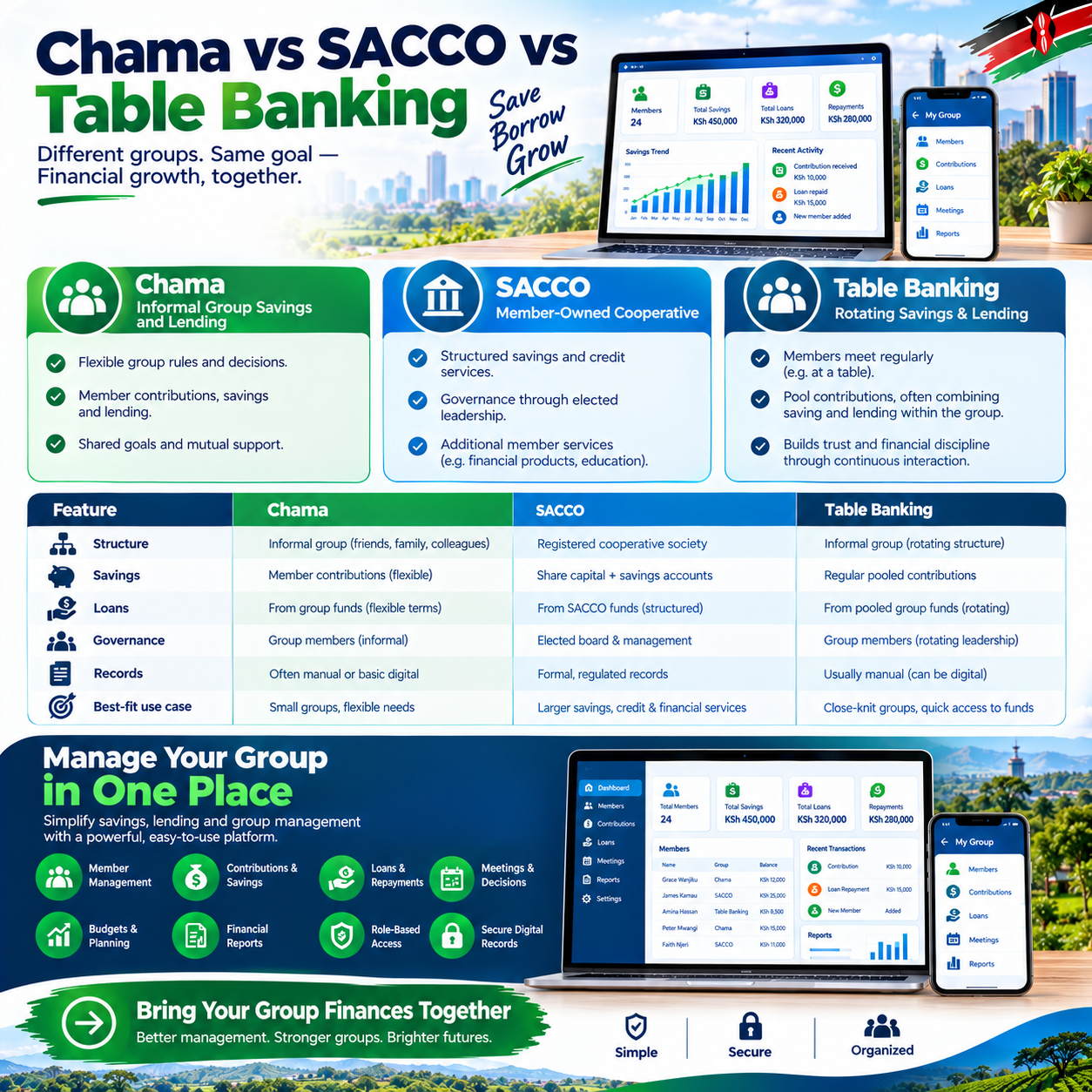
    chama vs SACCO vs table banking

    Chama vs SACCO vs table banking is the money conversation happening in living rooms, staffrooms, and church halls across Kenya right now. Millions of Kenyans pool their hard-earned shillings together every month, yet the rules, risks, and rewards differ dramatically between the three formats. Choosing wisely shapes everything from your returns to your friendships — and this guide settles the debate with total honesty.

    Each model has created genuine wealth, funded apartment blocks, and paid school fees for generations of Kenyan families. Each has also collapsed painfully when run without discipline, records, or clear written rules. Understanding chama vs SACCO vs table banking properly is therefore one of the highest-value financial lessons any Kenyan can learn.

    This guide compares the three formats side by side, honestly and completely. We examine their origins, membership, contributions, loans, returns, regulation, risk, and digital tools. By the final section, the puzzle of chama vs SACCO vs table banking will feel less like a mystery and more like a menu.

    A word of encouragement before we begin. No format is embarrassing to belong to — table banking circles have funded dukas, chamas have raised towers, and SACCOs have put thousands through university. What matters is not which badge you carry but how well your chosen system is run.

    One truth deserves to be said upfront: there is no single winner. The right answer in chama vs SACCO vs table banking depends on your goals, your group’s size, and your appetite for structure. Many of Kenya’s savviest investors eventually use all three formats at once.

    The timing for this conversation has never been better. Kenya’s group-finance culture is going digital at remarkable speed, and purpose-built platforms now serve every format. That technology shift is quietly rewriting the answer to chama vs SACCO vs table banking for a whole new generation.

    So bring your officials, your ambitions, and an open mind. The sections ahead give you every fact you need to decide with total confidence. Let the great national debate of chama vs SACCO vs table banking be settled — for your group — today.

    By the time you finish reading, you will think about group money differently. You will know exactly which format fits your next five years, and which fits your next twenty. That clarity is the real gift hiding inside chama vs SACCO vs table banking.

    What Is a Chama?

    A chama is an informal investment group where friends, colleagues, or relatives pool money regularly toward shared goals. Most chamas meet monthly, contribute a fixed amount, lend to members, and invest collectively in land, rentals, or businesses. In the contest of chama vs SACCO vs table banking, the chama is the most flexible and personal of the three.

    Chamas are governed by a constitution the members write and amend themselves. Elected officials — a chairperson, treasurer, and secretary — run daily affairs, while the big decisions go to a member vote. That self-governance is both the charm and the challenge when weighing chama vs SACCO vs table banking.

    Kenyan chamas have funded some of the most impressive property portfolios in the country. Groups of teachers, nurses, and boda riders own rental blocks stretching from Kitengela to Kisumu. No honest analysis of chama vs SACCO vs table banking is complete without deep respect for that track record.

    The best chamas share identifiable habits worth copying. They meet on time, record everything, lend cautiously, and review their investments at least once a year. Borrow those four habits and your group will already outperform most of the competition.

    What Is a SACCO?

    A SACCO — a savings and credit cooperative — is a formally registered financial institution owned entirely by its members. Members save shares and deposits, borrow at regulated rates, and earn annual dividends on their shareholding. In the matchup of chama vs SACCO vs table banking, the SACCO is the most formal and heavily regulated format.

    Kenya’s cooperative movement is among the strongest in Africa, with deposit-taking SACCOs supervised by SASRA. Giant societies serve teachers, police officers, farmers, and investors with banking-grade products. That institutional muscle is a major factor in chama vs SACCO vs table banking.

    SACCOs employ professional staff, keep audited books, and operate under cooperative law. Members receive ATM cards, FOSA accounts, and mobile banking much like ordinary bank customers. Professionalism, in short, is the SACCO’s defining weapon in chama vs SACCO vs table banking.

    Joining a SACCO is also remarkably straightforward. Registration requires your ID, a small share purchase, and a membership form completed at any branch or online. Within weeks, most new members are saving and already qualifying for their first modest loan.

    What Is Table Banking?

    Table banking is the simplest format of all: members meet, pool money on the table, and lend it out immediately. One member typically takes the lump sum each month at an agreed interest, and the pot returns the following month. Within chama vs SACCO vs table banking, table banking is the fastest and most immediate format.

    The format is beloved by women’s groups, market traders, and village welfare circles across the country. There are no lengthy applications — the group decides on the spot, face to face. Speed and simplicity are table banking’s signature strengths in chama vs SACCO vs table banking.

    But the same simplicity carries real risks, as later sections will show. Cash handling, instant decisions, and rotating sums demand extraordinary honesty from everyone present. Every serious treatment of chama vs SACCO vs table banking must weigh that trade-off honestly.

    Modern table banking is quietly upgrading itself too. Many circles now collect through M-Pesa, record rotations on phones, and photograph the day’s ledger before anyone leaves. The tradition remains, but the bookkeeping has entered the smartphone era.

    Where the Three Formats Came From

    All three formats grew from the same Kenyan root: the harambee spirit of communal effort and saving. Table banking is the oldest, echoing generations of village rotation circles where trust was the only contract. Knowing the shared origin adds real depth to chama vs SACCO vs table banking.

    Chamas emerged as urban workers formalized village habits into serious investment clubs with written constitutions. SACCOs grew out of cooperative law into licensed institutions across five decades of steady expansion. History shows all three answering one need differently — the essential story of chama vs SACCO vs table banking.

    Today the three formats coexist and even intermarry. A chama may keep its accounts at a SACCO, while a table banking circle serves as the chama’s welfare wing. Modern Kenya rarely forces a strict either-or choice between them.

    Membership: Who Joins What

    Membership is the first battleground in chama vs SACCO vs table banking. Chamas are closed clubs of trusted friends, usually numbering five to thirty members. Table banking groups are similar in size but often more open to neighbors and community acquaintances.

    SACCOs welcome thousands of members, usually united by an employer, a profession, or a region. You can join a SACCO without knowing a single existing member personally. That scale difference is fundamental to chama vs SACCO vs table banking.

    Group size also shapes the experience in practical ways. Small groups decide quickly but carry concentrated risk when one member struggles. Large institutions spread risk widely but move more slowly and formally.

    Trust works differently in each format, and it matters more than most people expect. In chamas and table banking circles, trust is personal; in SACCOs, trust is institutional. Ask yourself which kind of trust you prefer when deciding chama vs SACCO vs table banking.

    Contributions: How the Money Flows

    Contributions set the rhythm of every group’s financial life. Chamas fix their own amounts and can raise them by vote as ambitions grow. That flexibility is a genuine chama advantage in chama vs SACCO vs table banking.

    Table banking contributions are usually smaller and tied directly to the monthly pot. The sum collected is the sum available — no reserves, no long-term capital building. That immediacy shapes everything else in chama vs SACCO vs table banking.

    SACCOs build permanent capital through non-withdrawable deposits and share capital. Savings there are designed to compound for years, powering large loans and annual dividends. Long-horizon wealth building is the SACCO’s edge in chama vs SACCO vs table banking.

    Whatever the format, the golden rule is the same: contribute what you can sustain. A contribution you can maintain for five years beats an ambitious one you abandon in month three. Consistency, not size, is what builds serious group capital.

    Loans: Who Borrows What

    Lending is where the three formats diverge most sharply. Chamas lend member savings at agreed interest, with guarantors and constitutions governing every term. Loan sizes scale with group savings — a key consideration in chama vs SACCO vs table banking.

    Table banking lends the monthly pot immediately, often on the very day it is collected. Interest is typically higher, and the repayment window is short. Speed over size is the classic table banking trade-off in chama vs SACCO vs table banking.

    SACCOs lend multiples of a member’s deposits — often three times the savings or more. A teacher saving steadily for two years can borrow hundreds of thousands for land or a car. Borrowing power at scale is the decisive SACCO advantage in chama vs SACCO vs table banking.

    Guarantors deserve special mention across all three formats. In chamas and table banking, guarantors are friends vouching with their own savings; in SACCOs, guarantees are documented against deposits. Either way, never guarantee more than you could comfortably repay yourself.

    Returns: What You Actually Earn

    Returns are the real scorecard in chama vs SACCO vs table banking. Chama members earn from loan interest and from asset appreciation — plots bought early can multiply several times over. The returns are uneven but occasionally spectacular.

    Table banking returns are the interest members pay into the pot, either shared out or rotated forward. They are modest and immediate, rewarding discipline more than strategy. In the contest of chama vs SACCO vs table banking, table banking wins on speed rather than compounding.

    SACCOs pay declared dividends on shares and interest on deposits every financial year. Well-run societies have historically paid double-digit dividends in strong years. Predictable, audited returns are the SACCO’s quiet contribution to chama vs SACCO vs table banking.

    Remember that returns always mirror risk in group finance. The fastest returns usually carry the highest default risk, while the safest returns compound more slowly. Honest groups discuss this trade-off openly before the first shilling moves.

    Regulation and Safety

    Regulation is the starkest contrast in chama vs SACCO vs table banking. Chamas and table banking groups are self-regulated through their constitutions and member vigilance. Freedom and risk arrive together in the informal formats.

    Deposit-taking SACCOs answer to SASRA, with capital rules, external audits, and strict reporting duties. Member savings enjoy protections that informal groups simply cannot offer. Safety-conscious savers weigh this heavily in chama vs SACCO vs table banking.

    But regulation is not everything, and it does not guarantee good governance. A disciplined chama with clean records can outperform a sloppy SACCO on both trust and returns. Governance quality cuts across all three formats in chama vs SACCO vs table banking.

    Registration is worth considering for successful informal groups. Registering as a self-help group, CBO, or cooperative unlocks bank accounts, contracts, and credibility. Many thriving chamas formalized precisely to buy land and sign leases in the group’s own name.

    Risk: What Can Go Wrong

    A clear-eyed risk review completes the safety picture in chama vs SACCO vs table banking. Chama risks include member default, fraud by officials, and collapse through unresolved disputes. Most can be prevented with records, transparency, and a firm constitution.

    Table banking adds cash-handling risk, since sums move physically at every meeting. A stolen pot or a vanished collector can wipe out a cycle’s savings instantly. Digital payment adoption is steadily retiring that oldest risk in chama vs SACCO vs table banking.

    SACCO risks are institutional: weak lending, mismanagement, or regulatory sanctions. They are rarer, but they affect thousands of members at once when they strike. Diversified savers often participate in both worlds after studying chama vs SACCO vs table banking.

    The deepest protection in any format is culture. Groups that reward honesty, document decisions, and confront problems early rarely suffer catastrophic losses. Culture, once lost, is the hardest asset of all to rebuild.

    Record Keeping: The Common Denominator

    Records separate thriving groups from collapsing ones in every single format. Chamas need constitutions, minutes, contribution ledgers, and loan books kept faithfully. That discipline is the common thread running through chama vs SACCO vs table banking.

    Table banking historically ran on memory and notebooks, which explains so many old disputes. Modern groups now track rotations, payouts, and welfare digitally. Clean records have transformed outcomes across chama vs SACCO vs table banking.

    SACCOs maintain professional books with external audits and member statements. Members can verify their balances at any time, from anywhere. That assurance is part of what members gain in chama vs SACCO vs table banking.

    Whichever format you join, inspect the records before contributing. Ask to see the ledger, the minutes, and the bank or M-Pesa statements. A group that hides its books from a prospective member is telling you everything you need to know.

    Decision Time: Which One Is Right for You?

    Now for the practical verdict in chama vs SACCO vs table banking. Choose a chama if your goal is collective investment — land, rentals, businesses — with friends who share your ambition. The chama rewards vision, patience, and strong governance above all.

    Choose table banking if your priority is fast, small, rotating access to lump sums. Market traders, hustlers, and welfare circles thrive on its immediacy and face-to-face simplicity. Its niche is crystal clear within chama vs SACCO vs table banking.

    Choose a SACCO if you want large personal loans, audited safety, and professional banking services. Salaried members building homes, buying cars, or educating children fit SACCOs perfectly. The institutional path holds obvious appeal in chama vs SACCO vs table banking.

    One more lens helps: your own personality. If you love building with a team, the chama will feel like home; if you value structure, the SACCO will; if you live month to month, table banking will. Choose the format that matches your temperament, not just your calculator.

    The Side-by-Side Verdict in Plain Words

    Here is the entire comparison painted in plain words, format by format. A chama is a closed circle of trusted friends building permanent wealth together, flexible in contributions and bound only by its own constitution. It is the format for collective property dreams, patient saving, and compounding ambition — the richest long-term answer to chama vs SACCO vs table banking.

    A SACCO is a professional institution where thousands save side by side, borrowing large multiples of their deposits under audited, regulated oversight. It is the format for salaried members who want banking-grade services, predictable dividends, and personal loans big enough to change a life. Structure and scale are its defining gifts within chama vs SACCO vs table banking.

    Table banking is the immediate one: small sums pooled and rotated on the spot, serving welfare and working capital without paperwork or delay. It rewards month-to-month discipline rather than decade-long strategy. Its genius is speed, and its duty is careful records — the twin truths of chama vs SACCO vs table banking.

    Read the three portraits together and the decision becomes almost intuitive. Match the format to the goal, the goal to the horizon, and the horizon to the people in the room. That simple matching exercise is the final art of chama vs SACCO vs table banking.

    The Digital Revolution Across All Three

    Technology is redrawing the entire map of chama vs SACCO vs table banking. Chamas now run on platforms with M-Pesa reconciliation, loan ledgers, and AGM-ready reports. Table banking groups track rotations digitally, while SACCOs offer full mobile banking.

    For chamas, a dedicated system centralizes contributions, fines, loans, minutes, and statements. Members check balances on their phones and receive instant receipts for every payment. Digital discipline has become the modern edge in chama vs SACCO vs table banking.

    Investment groups that own rental property go one step further. They run group finance on a chama platform while managing tenants, rent collection, and statements on Tas.co.ke. That pairing keeps every shilling visible, whatever your verdict in chama vs SACCO vs table banking.

    Whichever platform a group chooses, demand three things before signing up. M-Pesa reconciliation that happens automatically, reports your members can read, and support that answers when contribution day goes wrong. Those three tests separate serious providers from pretty brochures.

    Common Mistakes in Each Format

    Every format has classic failure modes worth naming plainly. Chamas fail through weak constitutions, hidden records, and selective enforcement of rules. Prevention is cheaper than cure anywhere in chama vs SACCO vs table banking.

    Table banking fails through cash losses and undocumented rotations. One missing notebook can erase nine months of accumulated trust. Digitization is the proven remedy across chama vs SACCO vs table banking.

    SACCOs fail through member overborrowing and weak board oversight. Borrowing against future income is the personal risk every member must manage responsibly. Prudent borrowing completes the practical lessons of chama vs SACCO vs table banking.

    Real Stories from Kenyan Groups

    Stories make any comparison real, so here are three. A Nakuru teachers’ chama bought two plots, built eight rentals, and still meets monthly with clean digital records. Their verdict on chama vs SACCO vs table banking: the chama, powered by discipline, built their wealth.

    A Kisumu market traders’ table banking circle rotated lump sums for a decade without losing a single pot. Their secret was digital records and same-day M-Pesa confirmation for every transaction. They prove the table banking branch of chama vs SACCO vs table banking can run with professional rigor.

    A Machakos farmer borrowed against four years of SACCO deposits and put up a dairy unit. The loan was large, the rate was fair, and her dividend still arrives every year. Her story anchors the SACCO side of chama vs SACCO vs table banking.

    The Smartest Move: Combining All Three

    The most sophisticated Kenyan investors refuse to choose sides in chama vs SACCO vs table banking. They save in a SACCO for personal loans, invest through a chama for property, and keep a table banking circle for welfare. Each format does what it does best, and none competes with the others.

    The combination works because the formats serve different time horizons. Table banking serves this month, SACCOs serve this decade, and chamas serve generations. Matching horizon to format is the deepest lesson of all.

    Getting Started the Right Way

    Whichever format you choose, begin with written rules. A constitution, elected officials, and transparent records cost little and prevent nearly everything. Strong foundations matter in every branch of chama vs SACCO vs table banking.

    Digitize from day one rather than after the first dispute. Automated reminders, instant receipts, and arrears dashboards keep groups peaceful year after year. Purpose-built tools now exist for every format and every budget.

    Then review the group’s health every quarter. Collection rates, loan performance, and member satisfaction reveal problems while they are still small. Regular reviews are the maintenance schedule of lasting group wealth.

    Frequently Asked Questions

    Which format makes the most money? History suggests chamas investing in land and rentals have produced the largest individual gains. SACCO dividends plus large, affordable loans have funded more ordinary family milestones. The definition of “most money” depends on your goals in chama vs SACCO vs table banking.

    Which is safest for my savings? Deposit-taking SACCOs carry regulatory oversight, external audits, and protections informal groups cannot match. That said, a disciplined chama with transparent records is far safer than a poorly run institution anywhere. Safety follows governance more than format — the deeper truth of chama vs SACCO vs table banking.

    Can I belong to all three at once? Absolutely, and thousands of Kenyans do exactly that. A SACCO for personal loans, a chama for property, and a table banking circle for welfare work beautifully together. Just budget honestly so no commitment is neglected — then chama vs SACCO vs table banking stops being a debate and becomes a strategy.

    Which is best for beginners? A small table banking circle or a modest chama is the gentlest entry into group finance. You learn contributions, records, and lending with small sums before scaling upward. Start small, stay disciplined, and graduate when ready.

    Can a chama grow into a SACCO? Yes — established chamas sometimes register formally as cooperatives as their savings and ambitions scale. The transition brings regulation, audits, and professional management. It is a natural evolution many successful groups have taken.

    Is any of the three formats dying out? None of the three is dying — all are going digital instead. Records, reminders, and payments have moved to phones, while the human trust at the core remains untouched. The future belongs to whichever format your group runs with discipline and clean records.

  • How to Handle Chama Defaulters: The Ultimate Fair and Firm Playbook for Kenyan Groups

    How to handle chama defaulters is one of the most delicate questions every Kenyan investment group eventually faces. Money and friendship meet in that exact moment, and the wrong move can cost the group both. The right approach, applied with fairness and courage, can actually leave the chama stronger than before.

    Every group that lends or runs welfare funds will meet a defaulter eventually. It is not a sign of failure; it is a sign that the group is doing real business. What separates thriving chamas from collapsed ones is not the absence of arrears but the wisdom of how to handle chama defaulters.

    The stakes could not be higher. Unmanaged arrears poison meetings, break decades-old friendships, and quietly drain the capital the group depends on. That is why mastering how to handle chama defaulters is a survival skill, not an optional courtesy.

    This guide is written for chairpersons, treasurers, secretaries, and ordinary members alike. It walks the full journey: understanding why members default, preventing arrears before they start, and following a fair, firm, step-by-step process when they do. Along the way, you will learn the constitutional grounding, the human psychology, and the digital tools that make how to handle chama defaulters genuinely manageable.

    One truth will be unmistakable by the end. The best groups do not avoid the question of how to handle chama defaulters — they prepare for it in advance, with written rules and steady hearts. Preparation turns a crisis into a procedure.

    There is good news hiding inside this uncomfortable topic. Groups that manage arrears well report deeper trust, not less of it, because members see that the rules protect everyone equally. Learning how to handle chama defaulters properly is, in truth, an investment in the group’s long-term peace.

    So read this guide before you need it. Share it with your officials, discuss it at a meeting, and adapt it to your constitution. The calmest way to learn how to handle chama defaulters is on paper, long before emotions are ever in the room.

    Why Members Default: Understanding Before Reacting

    Before any strategy makes sense, you must understand why members stop paying. Default is rarely born of malice; it is usually born of circumstance. The first lesson in how to handle chama defaulters is therefore empathy backed by evidence.

    The most common cause is income shock. A member loses a job, a business slows down, a medical bill lands, or a family emergency swallows the monthly budget. Any framework for how to handle chama defaulters that ignores these realities will fail in practice.

    The second cause is poor record visibility. Sometimes a member is not truly defaulting — they cannot see their balance, forgot the due date, or paid into the wrong channel. A surprising share of arrears cases dissolve the moment how to handle chama defaulters begins with a simple, respectful conversation.

    The third cause is disagreement. A member may feel a fine was unfair, a loan was misallocated, or a promise made by officials was broken. Groups that skip this diagnosis in how to handle chama defaulters often discover the real problem only after trust has already bled away.

    The fourth cause is deliberate exploitation, and it must be named honestly. A small minority of borrowers test whether the group’s rules have teeth. Any serious approach to how to handle chama defaulters must therefore distinguish misfortune from misconduct — and respond to each differently.

    The final cause is group culture itself. If officials lend outside the rules, if records are hidden, or if favorites are quietly forgiven, members learn that payments are negotiable. Culture, not character, is often the deepest answer to how to handle chama defaulters.

    Diagnosis, in short, comes before treatment. Spend one honest week classifying your current arrears into these five causes. Your entire strategy for how to handle chama defaulters becomes sharper the moment you know which cause you are actually fighting.

    Prevention: The Best Handling Happens Before Default

    The most effective form of how to handle chama defaulters is prevention, because an arrears problem that never starts needs no solution. Prevention rests on three pillars: clear rules, visible records, and consistent enforcement. Build all three before the first shilling is ever lent.

    Start with the constitution. Every loan product, interest rate, grace period, penalty, and consequence should be written, approved, and shared with every member. A group that has documented its approach to how to handle chama defaulters never argues from memory in the heat of the moment.

    Second, make records visible to everyone entitled to see them. When members can check their own balances anytime, surprises — the fuel of disputes — simply disappear. Transparency is the cheapest prevention tool in the entire practice of how to handle chama defaulters.

    Third, enforce the small things consistently. A fine that is waived “just this once” teaches twenty other members that deadlines are suggestions. Gentle but absolute consistency is the secret of how to handle chama defaulters as practiced by long-lasting groups.

    Screen before you lend, too. Check contribution history, outstanding exposure, and guarantor willingness before approving any facility. Careful screening reduces the future workload of how to handle chama defaulters more than any collection tactic ever will.

    Keep loan sizes proportionate as well. A member borrowing three times their monthly contribution is being set up to fail, no matter how good their intentions. Prudent limits are the quiet foundation of how to handle chama defaulters done well.

    Prevention also means communicating the calendar. Remind members before due dates, not after, through the channel each member actually reads. Groups that remind early rarely need to learn the harder chapters of how to handle chama defaulters.

    The Golden Rules: Principles Before Procedures

    Procedures fail without principles, so anchor your approach to how to handle chama defaulters in five golden rules.

    First: never let arrears age in silence, because silence reads as permission.

    Second: always speak to the member before speaking about the member.

    Third: separate the person from the problem. The group is recovering money, not attacking character, and every communication should make that distinction obvious. Respect is the thread that runs through every successful story of how to handle chama defaulters.

    Fourth: follow the constitution exactly, even when feelings run high. Rules applied selectively are rules destroyed, and members remember every exception forever. Fairness, applied identically to everyone, is what makes how to handle chama defaulters credible.

    Fifth: document everything, from the first reminder to the final settlement. Memories argue, but records end arguments. Documentation is the professional backbone of how to handle chama defaulters.

    Hold these five rules like a compass. Every step in the process below is simply the rules applied in sequence. That is the entire philosophy of how to handle chama defaulters distilled into practice.

    The Step-by-Step Process: From First Miss to Final Resolution

    Here is the process experienced groups follow, stage by stage. It moves from gentle to firm in clear steps, giving the member every chance to recover while protecting the group’s capital. Follow it in order, and you will rarely need the harsher stages — which is the whole point of how to handle chama defaulters.

    Step 1: The friendly reminder. Most arrears are honest oversights, so begin with a warm, private message stating the amount, the due date, and the payment channels. Ninety percent of cases end here, which is why every guide on how to handle chama defaulters starts with kindness.

    Step 2: The private conversation. If the reminder goes unanswered, the treasurer or chairperson calls the member privately — never in the group chat. The goal is to listen first, because the real reason for non-payment shapes every later stage of how to handle chama defaulters.

    Ask open questions and take notes. Is the member facing a temporary setback, a dispute about the records, or a choice not to pay? The honest answer determines whether how to handle chama defaulters continues as support or escalates toward enforcement.

    Step 3: The written notice. If the conversation does not produce a payment plan, send a polite written notice stating the balance, the deadline, and the next step. Written notices change the tone from chat to record, which is a deliberate feature of how to handle chama defaulters.

    Step 4: The restructuring conversation. For members facing genuine hardship, offer a documented restructuring — smaller instalments, a short payment holiday, or an extended schedule. Compassion with paperwork is mercy everyone can trust, and it is the most humane form of how to handle chama defaulters.

    Record the new schedule, the reasons, and the approvals in the minutes. A restructured loan that lives only in conversation will be re-litigated at every future meeting. Documentation is what separates structured compassion from improvisation in how to handle chama defaulters.

    Step 5: Activate the guarantors. If the loan was guaranteed, inform the guarantors officially and give them a clear deadline to prevail on the borrower or begin covering. Guarantor activation is the strongest tool in how to handle chama defaulters, because peer pressure between friends is often more effective than official pressure.

    Give guarantors complete information: the balance, the arrears history, and their own exposure. Guarantors who feel ambushed become enemies, while guarantors kept informed become allies. Communication discipline is the essence of how to handle chama defaulters at this delicate stage.

    Step 6: Apply the penalties. Fines and interest on arrears should apply automatically, exactly as the constitution prescribes, without fresh debate at each meeting. Automatic penalties are impartial, and impartiality is what gives how to handle chama defaulters its moral authority.

    Step 7: Suspend privileges. Most constitutions allow suspending a defaulter’s borrowing rights, voting rights, or welfare benefits until accounts are settled. Suspension is not punishment for its own sake; it is the natural consequence structure of how to handle chama defaulters.

    Step 8: Recover from deposits or shares. If the constitution permits, offset the arrears against the member’s deposits or share capital, following the documented procedure precisely. This is the most decisive step in how to handle chama defaulters, so it must be executed exactly as written.

    Step 9: The final notice. Before any permanent action, issue a final written notice stating the amount, the deadline, and the exact consequence of continued silence. No member should ever be surprised by the outcome of how to handle chama defaulters, because surprises are what breed bitterness.

    Step 10: Expulsion or legal action — the last resort. Expulsion, recovery through guarantors, or the small claims court should follow only after every earlier stage is exhausted and documented. Even the final chapter of how to handle chama defaulters should be conducted with dignity, because today’s defaulter may be tomorrow’s returning friend.

    Two habits make this entire process work. Move through the stages on a fixed timeline — for example, seven days between each — so the process never stalls. And record the date every stage was completed, because the audit trail is what makes how to handle chama defaulters defensible months later.

    Special Cases That Need Extra Care

    Not every default fits the standard process, and wise groups prepare for the exceptions. Death, disappearance, disaster, and diaspora all demand modified handling. Here is how seasoned officials extend how to handle chama defaulters into the hardest situations.

    When a member passes away, compassion comes first, always. Suspend all penalties immediately, involve the family respectfully, and recover any balance from welfare funds, insurance, or guarantees — exactly as the constitution provides. Handling bereavement with grace is the most profound test of how to handle chama defaulters a group will ever face.

    When a member simply disappears — phones off, house emptied — move quickly to guarantors and documented recovery. Every week of delay shrinks the chances of recovery, so treat absence as an escalation trigger, not a mystery. Speed, within the rules, is the guardian of how to handle chama defaulters in abscondment cases.

    Diaspora defaulters need extra patience and extra documentation. Time zones, exchange rates, and distance complicate every conversation, so put everything in writing and set explicit deadlines. Clear written trails are the lifeline of how to handle chama defaulters across borders.

    Welfare fund defaulters deserve a gentler hand than loan defaulters. Welfare exists for the worst days of members’ lives, so pair suspension of benefits with active help to catch up. Many groups find that this softer branch of how to handle chama defaulters produces the fastest recoveries of all.

    When the defaulter is an official or a founder, the constitution must speak louder than any personality. Hand the case to the remaining officeholders, apply every stage identically, and document twice as carefully. Equality at the top is the ultimate credibility test of how to handle chama defaulters.

    What to Actually Say: Scripts for Each Stage

    Words carry this entire process, so borrow these proven phrasings. Adjust the tone to your group, but keep the structure. Good scripts are the daily tools of how to handle chama defaulters done kindly.

    For the first reminder: “Habari, this is a friendly reminder that your contribution of [amount] was due on [date]. If you have already paid, kindly share the confirmation and I will reconcile it today. Thank you for keeping your record clean.”

    For the private call: “We have noticed your account is behind, and we are calling to listen, not to judge. Is everything okay, and is there something the group should understand? We want to find a fair way forward together.”

    For the written notice: “This notice confirms that your outstanding balance is [amount], payable by [date]. If we do not hear from you by then, the constitution requires us to proceed to [next step]. We would much rather resolve this with you directly.”

    For restructuring: “The group has agreed to a new schedule of [amount] per month beginning [date]. This arrangement is recorded in the minutes of [meeting date] and will be reviewed after three months. We are glad to walk this road with you.”

    For guarantor notification: “As guarantor for [member’s] loan, you are formally informed of the arrears of [amount]. By [date], kindly help the member settle, or the constitution requires recovery as provided. Your own exposure currently stands at [amount].”

    Each script does three things: states facts, shows respect, and names the next step. That structure keeps conversations short and dignified. Master these, and the hardest part of how to handle chama defaulters becomes calm routine.

    The Constitutional and Legal Grounding

    Every stage above draws its power from one source: your constitution. The document should define default, deadlines, penalties, guarantor obligations, suspension, and expulsion in plain language. A group that has constitutionalized its approach to how to handle chama defaulters never improvises under pressure.

    Update the constitution before problems arrive, not after. Pass the provisions calmly at an AGM with every member’s voice heard, then apply them without exception. Rules written in peacetime are the shield that makes how to handle chama defaulters fair in wartime.

    Kenyan law also matters. The Small Claims Court handles genuine documented debts efficiently and affordably, giving groups a real enforcement path. Knowing this option exists strengthens every earlier stage of how to handle chama defaulters, because everyone understands the process has a true end point.

    Be careful, though, about what the law cannot do. Courts enforce documented agreements, not verbal promises, so your signed loan forms, notices, and minutes are everything. Legal readiness is the final layer of professional how to handle chama defaulters.

    The Human Side: Recovering Money Without Losing People

    Here is the paradox at the heart of how to handle chama defaulters: the goal is to recover money while preserving the relationships that make the group worth belonging to. Money without friendship is a bank, and friendship without money is a welfare table. A chama is precious precisely because it holds both, which is why how to handle chama defaulters must be done with firmness and warmth together.

    Communicate in private, always. Public shaming feels satisfying for a moment and costs the group members for years. Discretion is the hallmark of groups that master how to handle chama defaulters.

    Celebrate recovery as loudly as you documented the default. When a struggling member clears their balance, mark it warmly at the meeting and restore their standing visibly. Redemption arcs are the most powerful culture-building tool in how to handle chama defaulters.

    Watch the group’s tone, too. If officials become collectors who only call with bad news, members begin avoiding them entirely. Aim to be the group where how to handle chama defaulters is known for fairness, not fear.

    How Digital Platforms Transform the Whole Process

    Technology changes the entire emotional experience of how to handle chama defaulters. Automatic reminders replace awkward personal phone calls, and instant receipts eliminate the “I paid” disputes that start most conflicts. The system becomes the neutral messenger, which protects everyone’s dignity.

    Arrears dashboards show every overdue balance, aged by days, so officials act on facts rather than feelings. Members can see their own standing anytime, which removes the embarrassment of asking the treasurer. That transparency is the quiet revolution behind modern how to handle chama defaulters.

    Platforms also enforce consequences automatically. Penalties post themselves, privileges suspend themselves, and guarantors are notified without anyone playing the villain. Automation brings consistency, and consistency is the soul of fair how to handle chama defaulters.

    Choose a platform with strong arrears features: aging reports, automated reminders, guarantor tracking, and complete audit trails. Demo it with your own numbers before you commit. The right system turns how to handle chama defaulters from a monthly dread into a routine glance.

    And when the group owns rental property, connect the two ecosystems. Many groups run their group finance on a chama platform while managing tenants, rent collection, and landlord statements on Tas.co.ke. Clean books on both sides make every difficult conversation in how to handle chama defaulters shorter, calmer, and evidence-based.

    Common Mistakes That Make Defaults Worse

    The first classic mistake is silence. Officials hope the problem resolves itself, and six polite months later the arrears have doubled and the friendship has soured. Delay is the enemy of how to handle chama defaulters.

    The second mistake is public humiliation. Announcing names in the meeting before a private conversation humiliates one member and terrifies everyone else. Groups that understand how to handle chama defaulters confront privately and restore publicly.

    The third mistake is selective enforcement. Forgiving a friend while prosecuting a rival dissolves the constitution faster than any defaulter ever could. Impartiality, not severity, is what makes how to handle chama defaulters work.

    The fourth mistake is lending more to a struggling borrower. Top-ups feel kind and usually deepen the hole. Discipline about new credit is the hardest and wisest lesson in how to handle chama defaulters.

    Every one of these mistakes is avoidable. A written process, followed calmly, prevents all four. That is the quiet power of knowing how to handle chama defaulters before the first difficult meeting.

    Real Stories from Kenyan Groups

    The Nakuru welfare table had a member fall behind after a long hospitalization. The treasurer followed the steps — private call, written plan, restructured schedule — with warmth at every stage. Within five months the member had cleared everything and became the group’s most loyal ambassador, a living advert for how to handle chama defaulters.

    The Kitengela landlords faced a chronic defaulter with three guaranteed loans. They activated the guarantors with full documentation and recovered from the guarantors’ deposits exactly as the constitution allowed. The whole group learned that how to handle chama defaulters has teeth — and arrears across the board fell for years afterward.

    The Eldoret boda fleet watched their star member default, and emotions ran high. Because their platform records showed an honest income shock, the group chose restructuring over expulsion. The member repaid in full — the proudest outcome in their short history of how to handle chama defaulters.

    Across the country, the pattern repeats. Groups that follow fair processes do not just recover money — they keep their people. That double victory is the true promise of learning how to handle chama defaulters properly.

    Frequently Asked Questions

    Should we report a defaulter to the whole group immediately? No — begin privately, and only report to the meeting after the documented stages have been followed. Privacy first is the founding principle of how to handle chama defaulters.

    What if the defaulter is an official or founder? The constitution applies identically to everyone, and many groups add a rule that officials’ cases are handled by the remaining officeholders. Equality at the top is the ultimate credibility test of how to handle chama defaulters.

    Can we charge interest or fines on arrears? Yes, if the constitution provides for it and members approved it in advance. Pre-approved penalties are the enforceable backbone of how to handle chama defaulters.

    How long should we wait before escalating? Most groups allow seven to fourteen days per stage, so the full journey from reminder to final notice takes about three months. A fixed timeline is what keeps how to handle chama defaulters consistent and defensible.

    Can we take a defaulter to court in Kenya? Yes — the Small Claims Court handles documented debts up to its jurisdictional limit quickly and affordably. Court action is the final step of how to handle chama defaulters, and it only works when your paperwork is complete.

    What if the member denies owing the money? Produce the records — signed forms, reconciliation history, and notices — and offer a joint review meeting. Facts on the table are the fastest resolution path in how to handle chama defaulters.

    Should guarantors always pay when a member defaults? Only if the constitution and the signed guarantee say so, and only after the documented process is followed. Clear guarantee terms are what make how to handle chama defaulters predictable for everyone.

    Can we recover from a member’s deposits or share capital? Yes, if the constitution explicitly allows offsetting, and the procedure is followed precisely with everything recorded. This decisive tool is the strongest single instrument in how to handle chama defaulters.

    What if the default was caused by a genuine emergency? Restructure rather than punish — smaller instalments, a payment holiday, or an extended schedule, all documented. Compassion with paperwork is the most humane expression of how to handle chama defaulters.

    How do we prevent the next defaulter? Keep records visible, remind before due dates, screen loans carefully, and enforce the small rules without exception. Prevention, as this entire guide shows, is the wisest answer to how to handle chama defaulters.

    Can a digital platform really make a difference? Absolutely — automated reminders, arrears dashboards, and audit trails remove both the awkwardness and the disputes. That is why modern groups run how to handle chama defaulters on systems rather than on memory.

    We also own rental units — does any of this change? The principles are identical, and the smartest groups pair their chama platform with a dedicated property system. Contributions and loans run on the group platform, while tenants, rent collection, and statements run on Tas.co.ke — one clean, connected ecosystem for how to handle chama defaulters on every front.

  • Chama Spreadsheet Template: The Smart Way to Track Group Money

    Chama record keeping in Excel has quietly powered thousands of successful Kenyan investment groups over the past two decades.

    Long before dedicated apps existed, treasurers opened a blank spreadsheet, created a few columns, and ran entire chamas on formulas and faith.

    Even today, the humble workbook remains the first tool most groups reach for when they get serious about their money.

    There is real wisdom in that instinct. A well-built chama spreadsheet template brings structure, automatic arithmetic, and one version of the truth to group finances.

    It is a genuine upgrade from the hard-cover notebook, and it costs nothing but a little time.

    But every treasurer eventually discovers the limits. Formulas break silently, versions multiply, and one careless deletion can erase a year of history.

    This guide walks the complete journey: mastering chama record keeping in Excel, building the perfect workbook, and knowing exactly when to graduate to a dedicated platform like Tas.co.ke.

    This article is written for every kind of group. The five-member welfare table, the thirty-member investment chama, and the diaspora group saving across three continents all deserve clean records.

    Wherever your group stands, a proper chama spreadsheet template is a worthy first step toward financial order.

    Why Chamas Still Love Spreadsheets

    It is worth starting with respect, because the spreadsheet earned its place. It is free, familiar, flexible, and works offline on virtually any laptop, tablet, or phone.

    Those qualities explain why so many treasurers credit chama record keeping in Excel with teaching them group finance from first principles.

    Flexibility is the final advantage. When the group invents a new fine, a new fund, or a new project, the workbook simply grows a new column.

    That freedom to evolve is the quiet genius behind every chama spreadsheet template that has served a group for years.

    The Golden Rules Before You Start

    Before building anything, agree on three golden rules as a group.

    First, one master copy lives in one agreed place, controlled by named officials.

    Second, every entry happens only after a payment is verified, never before.

    Third, history is never overwritten — corrections are appended with dates and reasons. Groups that ignore these rules discover why discipline matters more than software. Discipline is what turns chama record keeping in Excel into a system rather than a habit.

    Write your rules on the first sheet of the workbook itself. Anyone who opens the file sees the constitution of the records before the numbers. That single habit elevates any chama spreadsheet template from personal notes into institutional memory.

    Build the Perfect Workbook: Sheet by Sheet

    Here is the blueprint experienced treasurers build, sheet by sheet. Copy it directly into your own workbook and you will have a professional foundation within an hour. This structure is the distilled wisdom of years of chama record keeping in Excel across Kenyan groups.

    Sheet 1: The Member Register

    Start with one row per member and columns for full name, phone number, ID number, and next of kin. Add the joining date, share capital balance, and a unique member number you never reuse.

    A clean register is the anchor of every chama spreadsheet template, because all other sheets reference it.

    Assign member numbers in sequence and never delete a row, even when a member exits. Mark departed members as inactive so their history remains intact for audits.

    Careful register design is what separates durable workbooks from ones that collapse in year two.

    Sheet 2: The Contributions Ledger

    Create one row per payment with columns for date, member number, amount, contribution type, and payment channel.

    Add a column for the month a payment covers, which is often different from the month it was actually paid.

    That single distinction is the secret of accurate chama record keeping in Excel that professionals never skip.

    Record the M-Pesa confirmation code for every payment, however tedious it feels.

    Confirmation codes turn disagreements into thirty-second searches instead of month-long disputes.

    Detail at entry time is the cheapest insurance in any chama spreadsheet template.

    Sheet 3: The Loan Book

    Give every loan its own row: member, date disbursed, principal, interest rate, instalment, and outstanding balance. Add guarantor names and a status column so the health of the book is visible at a glance.

    Lending is where groups lose money, so the loan sheet is the beating heart of serious chama record keeping in Excel.

    Calculate the outstanding balance with a formula, never by typing the figure by hand. Hand-typed balances drift from reality within weeks, and nobody notices until a dispute erupts.

    Letting formulas own the arithmetic is the first commandment of any chama spreadsheet template that involves lending.

    Sheet 4: Fines and Welfare

    Track fines separately with columns for date, member, reason, amount, and whether the fine has been cleared. Welfare subscriptions and payouts deserve their own sheet, so the emergency fund is always visible.

    Separate ledgers prevent the mixing of monies that ruins so much chama record keeping in Excel.

    Record the reason for every fine in plain language, because reasons prevent resentment. A fine without an explanation is a grievance waiting for the next meeting.

    Transparent records are the peacekeeping force of a well-kept chama spreadsheet template.

    Sheet 5: The Cashbook and Summary

    The cashbook records every shilling in and out, with dates, descriptions, and a running balance. The summary sheet then pulls totals from every other sheet into one dashboard the whole committee can read.

    That dashboard is the crown jewel of chama record keeping in Excel.

    Design the summary sheet last, once you know exactly what the committee asks about most. Common questions deserve prominent cells: total collected, total lent, arrears, and the bank balance.

    A dashboard built around real questions is what makes a chama spreadsheet template genuinely useful.

    Essential Formulas Every Treasurer Should Know

    You do not need to be an accountant to run impressive numbers.

    Five tools carry almost all of chama record keeping in Excel: SUM, SUMIF, COUNTIF, VLOOKUP, and conditional formatting. Learn them once, and your workbook will do the heavy lifting for years.

    Use SUMIF to total each member’s contributions by referencing their member number. Use COUNTIF to count late payments, and VLOOKUP to pull any member’s balance onto another sheet. With those three in place, your chama spreadsheet template becomes genuinely powerful.

    Conditional formatting paints arrears red the moment a balance goes overdue. The color arrives automatically, without anyone compiling a list or making awkward announcements. Problems that announce themselves get solved faster — the quiet magic of chama record keeping in Excel.

    Data validation dropdowns keep entry uniform, offering only your approved contribution types and channels. Uniform entries are what make summaries, filters, and pivot tables actually work. Consistency is the hidden engine of every reliable chama spreadsheet template.

    Protect your formulas with sheet protection so a curious click cannot break them. Save a dated copy after every meeting, and keep one backup somewhere completely different. Backups are the unglamorous heroes of disciplined bookkeeping.

    Do not fear the learning curve. Thousands of Kenyan treasurers with no technical background run sophisticated workbooks today. An afternoon of practice on a copy file is usually all it takes.

    Loan Interest Calculations Made Simple

    Interest is where group lending gets technical, so let us make it simple. For a flat-rate loan, multiply the principal by the rate and the period, then divide by the months. That arithmetic fits comfortably inside chama record keeping in Excel with a single formula.

    For a reducing-balance loan, build a small amortization schedule with one row per month. Excel’s PMT function calculates the fixed instalment, while IPMT and PPMT split it into interest and principal. Those functions turn the lending pages of a chama spreadsheet template into copy-and-paste simplicity.

    Always show the member their full schedule before disbursement, printed straight from the sheet. A schedule everyone has seen prevents the disputes nobody wants. Clarity before lending is the highest virtue of chama record keeping in Excel.

    Test every formula with a tiny loan you can verify by hand. If the sheet says three thousand and your calculator agrees, trust the sheet forever. Verified formulas are the confidence behind professional lending records.

    Your First Month: A Step-by-Step Setup Guide

    Week one belongs to structure. Create the five sheets from the blueprint, name your columns carefully, and enter every current member. A careful skeleton is what makes any chama spreadsheet template dependable for years.

    Week two belongs to history. Enter outstanding balances, active loans, and uncleared fines, reconciling each against the old notebook as you go. Most groups find small discrepancies here, and resolving them is chama record keeping in Excel at its most valuable.

    Week three belongs to formulas. Add the SUMIF summaries, the conditional formatting, and the dashboard cells the committee actually asks about. Test everything on a copy file before touching the master.

    Week four belongs to the routine. Record the month’s payments, reconcile against M-Pesa and bank statements, and circulate the summary at the meeting. That first clean cycle is when the group begins to trust its chama spreadsheet template.

    Advanced Features for Growing Groups

    Once the basics run smoothly, a few advanced touches will serve growing groups. Pivot tables summarize contributions by member, by month, and by type in two clicks. That reporting speed is the difference between basic chama record keeping in Excel and genuine analysis.

    Add a filter view for arrears so the treasurer sees only overdue members during follow-up week. Create a simple chart of monthly collections on the dashboard. The line rising — or dipping — tells the group’s story more honestly than any speech, which is the motivational heart of a good chama spreadsheet template.

    Add an assets sheet once the group owns anything: plots, equipment, or vehicles. Record what was bought, when, at what price, and where the document lives. Groups that track assets carefully are practicing chama record keeping in Excel at an institutional level.

    Finally, add a decisions log sheet — date, decision, proposer, and vote result. When memories differ a year later, the log settles the matter in seconds. Governance recorded is governance protected.

    Backing Up and Securing Your Records

    Backups deserve their own discussion because failures are never convenient. Follow the 3-2-1 rule: three copies, on two different types of storage, with one stored elsewhere. That rule is the professional standard behind serious chama spreadsheet template management.

    Cloud storage solves the “elsewhere” automatically. Upload the master file after every meeting to Google Drive or OneDrive, and enable version history. Version history shows who changed what, when — a quiet superpower for chama record keeping in Excel.

    Protect the file with a strong password shared only with named officials. Use sheet protection to lock formulas, and cell locking to guard the register. Once a year, archive a read-only copy labeled with the year as your group’s financial autobiography.

    Excel Versus Google Sheets

    Both tools work beautifully, and the choice is less important than the discipline. Excel offers the most powerful features and works fully offline. Google Sheets offers free collaboration, automatic cloud saving, and access from any phone — advantages worth weighing in any chama spreadsheet template decision.

    Groups whose officials share one laptop often prefer Excel. Groups with officials in different towns — or different countries — thrive on Sheets. Either way, the design principles of good chama record keeping in Excel remain identical.

    Many groups run a hybrid: Excel on the treasurer’s laptop, exported to Sheets for viewing. Just remember that a hybrid is two systems, and two systems must be reconciled. Hybrids are workable, but only with discipline.

    Templates for Different Group Types

    Not all groups are shaped alike, and your workbook should match your format. Merry-go-rounds need a rotation sheet showing who received the pot in which cycle. A clear rotation log is the core of that chama spreadsheet template.

    Table banking groups need columns for the lump sum, the borrower of the month, and the interest earned. Interest earned belongs to the group, so it needs its own visible row. Careful separation is what keeps table banking chama record keeping in Excel honest.

    Investment chamas need the full five-sheet blueprint plus a projects sheet. The projects sheet tracks each investment — plot, building, matatu — from budget to completion. Ambition needs structure, and structure is what a serious chama spreadsheet template provides.

    Welfare groups need subscription tracking and a payout register with dates and beneficiaries. Sensitivity matters here, because welfare records touch the hardest moments in members’ lives. Handle those pages of chama record keeping in Excel with extra care and privacy.

    Diaspora groups need everything above plus currency clarity. Record the currency of every transaction and the exchange rate used on that day. Currency discipline is the make-or-break detail of cross-border group finance.

    Whatever your format, resist adding sheets you will not maintain. An unused sheet is a broken window in the workbook — it signals that standards have slipped. Keep your workbook lean enough that every sheet stays alive.

    The Hidden Risks of Spreadsheet Bookkeeping

    Now for the honest part, because the risks are real. Formulas fail silently when someone inserts a row in the wrong place, and the error can hide for months. No formula on earth warns you that your chama spreadsheet template has quietly drifted from the truth.

    Version chaos is the second risk. The treasurer’s copy, the chairperson’s copy, and the copy emailed before the meeting all disagree within weeks. Reconciling them consumes the very evenings that chama record keeping in Excel was supposed to save.

    Access is the third risk. A workbook usually lives on one person’s device, guarded by one person’s password, and remembered by one person’s memory. When that person travels, falls ill, or steps down, the chama spreadsheet template can go dark overnight.

    There is also no automation. Spreadsheets never send reminders, never reconcile M-Pesa, and never notify a member of their balance. Every alert must be sent by hand, which is why groups eventually outgrow manual records.

    None of these risks is hypothetical. Ask any group official over tea and you will hear a story of vanished files and mystery formulas. Respect the risks, and you will enjoy the benefits safely.

    Excel Versus a Dedicated Chama App

    An honest comparison helps groups decide with open eyes. Excel wins on cost, familiarity, and total flexibility; a dedicated app wins on automation, security, and access. The best path usually runs from one to the other, so treat chama record keeping in Excel as a beginning rather than a destination.

    With a spreadsheet, M-Pesa reconciliation is manual, with someone copying each transaction across by hand. With a dedicated platform, payments reconcile the moment they land, and receipts go out automatically. With a chama spreadsheet template, member self-service is impossible, so every balance enquiry lands on the treasurer’s phone.

    Think of it like transport. A spreadsheet is the trusty boda-boda: cheap, nimble, and perfect for short journeys. A dedicated platform is the matatu fleet that carries the whole group’s ambitions — and every skill built through chama record keeping in Excel transfers directly to it.

    The comparison is not an insult to spreadsheets. Every treasurer who masters a workbook is training for digital group finance. Solid spreadsheet experience is, in truth, the best possible preparation.

    When Should Your Group Upgrade?

    Watch for the signals, because they arrive in a predictable order. The first is arithmetic anxiety: the treasurer begins double-checking everything because the workbook feels fragile. The second is growth past roughly twenty members, when manual reconciliation starts consuming real evenings — a ceiling every chama spreadsheet template eventually hits.

    The third signal is lending, because loans and guarantors push a workbook to its structural limits. The fourth and loudest signal is disputes, when members begin questioning balances. When two or more signals appear together, your chama record keeping in Excel has served its purpose beautifully — and it is time.

    One caution: do not upgrade in panic. Decisions made mid-crisis are rarely the best ones. Move deliberately, with the group’s blessing, and the transition will feel like progress.

    A Monthly Workflow That Keeps Records Honest

    Discipline turns a good workbook into a great one. Within three days of every meeting, post all payments, update balances, and save a dated copy. A fixed rhythm is what keeps any chama spreadsheet template trustworthy month after month.

    Once a month, reconcile the workbook against the bank and M-Pesa statements line by line. Investigate every difference immediately, while memories are fresh and receipts are findable. Monthly reconciliation is the professional standard of chama record keeping in Excel.

    Once a quarter, export a PDF snapshot of the summary sheet for the committee file. Paper snapshots protect the group’s history even if digital copies fail. That habit turns a humble chama spreadsheet template into an archive worth keeping.

    End the year with a full audit afternoon: every sheet checked, every balance signed off by two officials. That sign-off closes the financial year with authority. Few habits protect officials better than this one.

    Migrating Without Losing a Single Shilling of Data

    Migration is easier than most groups fear, because spreadsheets are excellent preparation. The columns you built become the data you import, and your member numbers become the keys that tie everything together. Start by cleaning your chama record keeping in Excel: remove blank rows, standardize names, and confirm every balance.

    Export each sheet as a CSV file and have two officials sign off on the closing figures. That sign-off becomes the bridge from spreadsheet to platform, and the last word on any old discrepancies. Treat it as the graduation day of your chama spreadsheet template.

    Then run both systems in parallel for one full cycle. Compare month-end totals, investigate any difference, and celebrate loudly when the numbers match. Keep the old workbook afterward, archived and read-only, as your group’s founding record.

    If your group owns rentals, prepare those records separately before migrating anything. Many groups move group finance to a dedicated platform while running tenants, rent, and statements on Tas.co.ke. Clean books on both sides make any handover or audit painless.

    Common Mistakes to Avoid

    The first classic mistake is one giant sheet holding everything. Contributions, loans, and fines mixed together become impossible to audit or fix. Separate sheets are the first commandment of every reliable chama record keeping in Excel.

    The second mistake is recording the payer’s name as text in ten different spellings. “Mama Njeri,” “Njeri’s mum,” and “Grace Njeri” will wreck every formula that references them. Consistent member numbers are what make any chama spreadsheet template work at all.

    The third mistake is editing history without a trace. When old figures can be silently changed, every past disagreement becomes contestable again. Lock past months, append corrections, and your records gain something like integrity.

    Compliance and Reporting

    Clean records also serve purposes beyond the meeting. Groups registering formally, opening bank accounts, or declaring income need organized histories at short notice. A well-kept workbook built on chama record keeping in Excel produces those documents in minutes.

    Keep annual summaries showing total contributions, loan performance, and closing balances. Sign each year’s summary at the AGM so the figures become officially adopted records. Signed summaries are what elevate a chama spreadsheet template from private notes into institutional memory.

    If the group owns rental property, keep those records separate but equally disciplined. Many groups manage tenants, rent collection, and landlord statements on Tas.co.ke while their group finance lives elsewhere. Good records also smooth external relationships, because banks and partners respond very differently to organized groups.

    Pro Tips for Power Users

    A few professional touches will lift your workbook from good to exceptional. Store the master file in a shared cloud folder with version history enabled, and build one pivot table the committee loves. Above all, remember that the best chama record keeping in Excel is the one every official can open, understand, and update.

    Simplicity, consistently applied, is the most advanced feature of all. Tools serve people, not the reverse. A workbook everyone trusts is worth more than a clever one nobody understands.

    Real Stories from the Spreadsheet Journey

    The Nakuru welfare table ran its merry-go-round for six years on a single beloved workbook. It worked beautifully until the treasurer’s laptop failed with no backup. Three weeks of reconstruction followed, two members quietly left, and the group rebuilt on a proper platform while keeping a chama spreadsheet template as an offline mirror.

    The Kitengela landlords tracked contributions in Excel while their eight rental units were managed separately. They moved group finance onto a dedicated platform and handed tenant management to Tas.co.ke. At the next AGM, both sets of statements reconciled perfectly, and members approved a second building — proof of how far chama record keeping in Excel can carry a group before its graduation day.

    The Eldoret boda fleet ran its savings on a shared spreadsheet updated faithfully every Sunday. When they finally digitized, they imported three years of history in a single afternoon. Clean spreadsheets, it turns out, are the best gift a group can give its digital future.

    Frequently Asked Questions

    Is Excel still acceptable for group records today? Absolutely, especially for new and small groups, provided records are backed up and reconciled monthly. Disciplined spreadsheet work is far better than informal memory-keeping in any era. Start with a solid chama spreadsheet template and review it together every month.

    Where can we find a ready-made workbook? You can build one in under an hour using the sheet-by-sheet blueprint in this guide. Most chama software providers, including Tas.co.ke, share a starter workbook during a demo. Building your own is the fastest way to learn group bookkeeping for good.

    How many sheets should a good workbook have? Five is the sweet spot: member register, contributions, loans, fines and welfare, and a summary dashboard. More complexity than that usually signals it is time to graduate to a dedicated platform. Resist the urge to turn your workbook into a second accounting job.

    What is the biggest risk with spreadsheets? Silent formula errors and single-device storage top the list. One broken reference can hide for months, and one failed laptop can erase everything. Backups and monthly reconciliations are the seatbelts of every workbook.

    When should a group definitely upgrade? When lending begins, when membership passes twenty, or when disputes start appearing. Those milestones demand automation and transparency a workbook cannot provide. Treat that moment as a natural graduation, not a defeat.

    We own rental units — can the workbook manage those too? It can track rent informally, but tenants, deposits, repairs, and landlord statements deserve professional tools. The smartest groups run property operations on Tas.co.ke while their savings history stays organized elsewhere. That pairing outperforms any attempt to stretch a spreadsheet into property management.

  • Chama Budget Management Software Kenya: A Complete Guide for Smarter Chama Finances

    Chama Budget Management Software Kenya

    Chama Budget Management Software Kenya: A Complete Guide for Smarter Chama Finances

    Managing money is one of the most important responsibilities in any chama. Members contribute their hard-earned money expecting the group to use it carefully, keep accurate records, and achieve agreed financial goals. Chama Budget Management Software Kenya provides a structured way for chama officials to plan budgets, monitor income and expenses, track financial performance, and maintain clearer records without relying entirely on notebooks, spreadsheets, or scattered WhatsApp messages.

    For many Kenyan chamas, budgeting becomes difficult as membership grows and financial activities become more complex. A group may collect monthly contributions, make welfare payments, issue loans, invest in projects, purchase assets, and pay administrative expenses. Chama Budget Management Software Kenya can help bring these activities into one organized financial workflow. This guide explains how budgeting software works, the features to consider, the benefits for chama officials and members, common implementation mistakes, and practical ways to choose a solution that fits your group.

    What Is Chama Budget Management Software?

    At its simplest, Chama Budget Management Software Kenya is a digital system designed to help groups organize and control their budgets. Instead of maintaining separate notebooks for contributions, expenditure, loans, and investments, a chama can use software to centralize financial information and make it easier to understand.

    A well-designed Chama Budget Management Software Kenya solution should support the actual activities of Kenyan groups. That means it should accommodate recurring member contributions, different expense categories, approved budgets, financial transactions, reporting, and accountability. The software should also make information easier to retrieve when officials need to prepare meetings or members want to understand how group funds have been used.

    The purpose is not simply to replace a paper ledger with a computer screen. Chama Budget Management Software Kenya should improve the entire budgeting process by helping officials move from recording transactions after they happen to planning, monitoring, and reviewing financial activity continuously.

    For a growing group, Chama Budget Management Software Kenya can also provide a clearer connection between the money coming into the chama and the money going out. This helps officials understand whether spending is following the approved plan and whether available funds are sufficient for upcoming activities.

    Why Chamas Need Better Budget Management

    Many chamas start with simple financial arrangements. A few members agree to contribute a fixed amount every month, keep records in a notebook, and discuss spending during meetings. This can work for a small group with limited transactions, but challenges often appear as the chama becomes more active.

    Using Chama Budget Management Software Kenya can help groups manage this growth without allowing financial records to become unnecessarily complicated. A digital system can organize transactions according to categories, periods, members, projects, and other information that officials need when reviewing performance.

    Another reason groups consider Chama Budget Management Software Kenya is accountability. Members want to know that contributions are being recorded correctly and that expenditure follows decisions made by the group. Clear records make it easier to explain financial activity during meetings and reduce disagreements caused by missing or unclear information.

    With Chama Budget Management Software Kenya, officials can also spend less time searching through old notebooks, receipts, spreadsheets, and messages. When financial information is stored systematically, authorized users can find relevant records more efficiently and prepare reports without reconstructing the group’s financial history from scratch.

    Budget Planning for Kenyan Chamas

    Budget planning starts with identifying what the chama expects to receive and what it expects to spend. Contributions may be relatively predictable, while expenses can vary depending on projects, welfare needs, administration, investments, or loan-related activities. Chama Budget Management Software Kenya can help officials organize these expectations into a structured budget.

    A typical chama budget may contain categories such as:

    • Member contributions
    • Registration or joining fees
    • Welfare allocations
    • Meeting expenses
    • Administrative costs
    • Investment contributions
    • Loan-related activities
    • Project expenses
    • Asset purchases
    • Emergency allocations
    • Savings targets

    Using Chama Budget Management Software Kenya, officials can assign planned amounts to relevant categories and then compare actual transactions with the approved budget. This gives the committee a practical way to monitor whether spending remains within agreed limits.

    A useful Chama Budget Management Software Kenya system should make budget planning understandable even for users who are not accountants. Financial information should be presented in clear categories, with straightforward summaries that help committee members make informed decisions during meetings.

    Setting Realistic Chama Budgets

    A budget is useful only when it reflects realistic expectations. One common mistake is to create an ambitious spending plan based on money the chama hopes to receive rather than funds it can reasonably expect to collect.

    Chama Budget Management Software Kenya can help officials base planning on historical information. For example, if the group usually collects 95 percent of expected monthly contributions, its committee can consider that pattern when forecasting available funds rather than assuming every member will always pay on time.

    Historical information becomes particularly useful when Chama Budget Management Software Kenya allows officials to compare different financial periods. A committee can review previous income, expenses, project costs, and contribution patterns before approving a new budget.

    When using Chama Budget Management Software Kenya, the committee should also separate essential expenses from discretionary spending. This makes it easier to protect important obligations when income is lower than expected.

    Tracking Income and Contributions

    Member contributions are usually one of the most important sources of funds for a chama. Accurate contribution records help officials understand how much money should have been collected, how much has actually been received, and which payments remain outstanding.

    With Chama Budget Management Software Kenya, contribution information can be organized by member, date, amount, contribution type, and financial period. This reduces the need to manually compare multiple records when preparing a financial update.

    The value of Chama Budget Management Software Kenya becomes clearer when the group has different contribution requirements. For example, members may contribute regular savings, welfare funds, investment amounts, or special project contributions. Keeping these categories separate helps officials understand the purpose of each amount collected.

    A reliable Chama Budget Management Software Kenya platform can also make contribution reporting easier. Instead of presenting members with a long list of individual transactions, officials can prepare summaries showing totals, outstanding amounts, and performance against the budget.

    Managing Chama Expenses

    Expense management is another major part of budgeting. Chamas may spend money on meetings, welfare support, transport, project materials, professional services, events, equipment, or other approved activities.

    Chama Budget Management Software Kenya can help categorize expenses so that officials can see where group funds are being used. Categorization is important because a single total expenditure figure does not explain whether spending was mainly administrative, investment-related, welfare-related, or project-related.

    When Chama Budget Management Software Kenya is used to compare planned and actual expenses, committee members can identify categories where spending is higher than expected. This does not automatically mean the expenditure was wrong; circumstances may have changed. However, the difference becomes visible and can be discussed.

    A good Chama Budget Management Software Kenya workflow should also make it easier to document expenses. Where appropriate, officials can record transaction dates, descriptions, categories, amounts, responsible persons, and supporting information.

    Budget Versus Actual Spending

    One of the most practical budgeting features is the ability to compare the approved budget with actual financial activity.

    Chama Budget Management Software Kenya can help present this comparison in a format that committee members can understand quickly. For example, if a chama budgeted KSh 50,000 for an activity and has spent KSh 35,000, the remaining budget can be identified without manually calculating every transaction.

    This becomes even more useful with Chama Budget Management Software Kenya when the chama has several projects running simultaneously. Each project can be reviewed against its own financial plan, allowing officials to distinguish between normal spending and unexpected costs.

    Using Chama Budget Management Software Kenya, committees can also review budget variances during regular meetings. A variance does not necessarily indicate a problem. It can simply highlight an area that needs explanation, adjustment, or additional approval.

    Why M-Pesa Matters to Kenyan Chamas

    Mobile money plays an important role in everyday financial activity in Kenya. Many groups receive member contributions and make payments electronically, making transaction reconciliation an important part of financial management.

    A Chama Budget Management Software Kenya solution should therefore fit into the way Kenyan groups actually handle payments. Where supported, digital transaction records can make it easier to match received funds with member accounts and financial categories.

    The usefulness of Chama Budget Management Software Kenya increases when payment records and budget records can be reconciled consistently. Officials can identify whether an expected contribution has been received and whether a payment belongs to the correct member or purpose.

    For committees handling many transactions, Chama Budget Management Software Kenya can reduce the administrative workload associated with checking individual payment records. The exact integration capabilities will vary by software provider, so the group should confirm what payment methods and reconciliation features are supported before implementation.

    Chama Financial Reporting

    Financial reports give members a clearer picture of how their group is performing. A good report should do more than display a list of transactions. It should help people understand income, expenditure, balances, budget performance, and important financial movements.

    Chama Budget Management Software Kenya can support the preparation of regular financial reports for committee meetings and member updates. Depending on the system, reports may be filtered by date, category, project, member, or transaction type.

    For larger groups, Chama Budget Management Software Kenya can reduce the time required to prepare reports manually. Officials can work from organized transaction records rather than gathering information from several separate documents.

    A well-structured Chama Budget Management Software Kenya reporting system can also support transparency. When members can receive consistent financial summaries, discussions can focus more on decisions and less on trying to reconstruct what happened financially.

    Managing Financial Accountability

    Accountability begins with clear responsibility. Chamas should establish who can approve spending, who can record transactions, who can access reports, and who reviews financial information.

    Chama Budget Management Software Kenya can support these processes by organizing financial responsibilities within a controlled system. Access levels can be important because not every member necessarily needs the same permissions.

    A Chama Budget Management Software Kenya platform may also provide transaction histories that make it easier to review financial activity. Where audit trails are available, authorized officials can see when records were created or changed, depending on the system’s design.

    Using Chama Budget Management Software Kenya does not remove the need for governance rules. Technology works best when combined with clear financial policies, approved budgets, proper authorization, and regular reporting to members.

    Managing Different Chama Projects

    Many Kenyan chamas use pooled funds for projects such as land purchases, farming, construction, business ventures, equipment acquisition, or other investments. Project-based budgeting helps members understand how much money is being allocated to each initiative.

    With Chama Budget Management Software Kenya, a group can structure project budgets separately from routine operating expenses. This helps prevent everyday costs from being mixed with long-term investment spending.

    A Chama Budget Management Software Kenya solution can also help officials track project expenditure against approved allocations. If a project requires more funds than originally expected, the committee has clearer information for discussing the change with members.

    For groups managing several initiatives, Chama Budget Management Software Kenya can make financial information easier to segment. This is useful when members want to know not just how much money the chama has, but how much is committed to a specific project.

    Chama Welfare Budgeting

    Welfare activities require careful planning because needs may arise unexpectedly. A chama may have agreed rules for supporting members during particular circumstances, and the budget needs to reflect these commitments.

    Chama Budget Management Software Kenya can help separate welfare funds from general operating money. This makes it easier for officials to monitor how much has been allocated, how much has been spent, and what remains available.

    When Chama Budget Management Software Kenya supports categorized transactions, welfare payments can be recorded according to the relevant purpose. This can make future reporting easier and reduce confusion between welfare expenditure and other group expenses.

    A clear Chama Budget Management Software Kenya structure can also help the committee plan recurring welfare allocations. Instead of discovering at the end of the year that welfare spending has exceeded expectations, officials can review the category throughout the year.

    Loan and Savings Activities

    Some chamas combine savings with member lending. Loans introduce additional financial records because officials may need to track principal amounts, repayments, outstanding balances, and applicable charges according to the group’s rules.

    Chama Budget Management Software Kenya can complement loan management by helping the committee understand how lending activities affect available funds. The exact loan features depend on the software selected, so groups should assess whether they need integrated loan tracking or a separate module.

    A Chama Budget Management Software Kenya platform can also help distinguish savings from money that has been lent out. This distinction is important because a chama may have a strong overall balance while having less immediately available cash because part of its funds are tied up in member loans.

    With Chama Budget Management Software Kenya, officials can also use financial reports to review repayment patterns and understand how loan activity affects cash availability, provided the software supports these functions.

    Cash Flow Planning

    Profit or accumulated savings alone do not tell a chama whether it can meet upcoming obligations. Cash flow planning looks at when money is expected to enter and leave the group.

    Using Chama Budget Management Software Kenya, officials can organize expected income and planned payments by period. This can help identify months when cash availability may be tighter than usual.

    A Chama Budget Management Software Kenya system can also support better preparation for major expenses. If the chama knows that a large project payment is due in several months, officials can monitor contributions and other inflows well in advance.

    For a committee, Chama Budget Management Software Kenya can make cash flow discussions more practical. Instead of relying only on the current account balance, members can consider upcoming commitments and expected receipts before approving additional spending.

    Features to Look for in Chama Budgeting Software

    Not every financial management platform is designed specifically for chamas. Before selecting a system, committees should identify the features that matter most to their operations.

    Important capabilities may include:

    • Budget creation and approval
    • Income tracking
    • Expense management
    • Member contribution tracking
    • Financial reports
    • Budget-versus-actual analysis
    • Project budgeting
    • Cash flow monitoring
    • User permissions
    • Transaction histories
    • Data export
    • Mobile accessibility
    • Payment reconciliation
    • Backup and security controls

    A Chama Budget Management Software Kenya solution should be assessed against the group’s actual requirements rather than a long list of features that may never be used.

    The best Chama Budget Management Software Kenya setup for one group may differ from another. A small welfare chama may prioritize simple contribution and expense tracking, while an investment-focused group may need detailed project and cash flow reporting.

    Ease of Use Matters

    Financial software can have many features, but those features are only useful if officials can use them confidently. Chama committees often include members with different levels of technical experience.

    Chama Budget Management Software Kenya should therefore offer an interface that makes common tasks straightforward. Recording a contribution, entering an expense, viewing a balance, or generating a report should not require extensive technical knowledge.

    When evaluating Chama Budget Management Software Kenya, committees should consider how quickly a new treasurer can learn the system. A solution that requires complicated processes for routine tasks may create resistance and lead users back to manual records.

    A practical Chama Budget Management Software Kenya platform should also provide clear navigation, useful dashboards, understandable reports, and appropriate support materials. Simplicity is especially valuable when financial duties change between committee terms.

    Data Security and Access Control

    Financial information is sensitive. A chama’s records may contain member names, contribution histories, payment information, loan details, and other private information.

    Chama Budget Management Software Kenya should therefore be evaluated for access controls and security practices. The committee should understand who can view information, who can edit records, and how user accounts are protected.

    When using Chama Budget Management Software Kenya, officials should also ask about backups and data recovery. A financial record is valuable only if it remains available when needed and can be recovered after accidental deletion, device failure, or another technical problem.

    A responsible Chama Budget Management Software Kenya implementation should also include good user practices. Strong passwords, controlled access, regular reviews of user permissions, and careful handling of exported reports can all contribute to better information security.

    Moving From Spreadsheets to Software

    Spreadsheets can be useful when a group is starting out. They allow officials to create simple tables for members, contributions, expenses, and balances. However, as transaction volumes increase, spreadsheets can become harder to maintain.

    Chama Budget Management Software Kenya offers a more structured alternative by putting financial processes into a system designed for recurring management activities.

    The transition to Chama Budget Management Software Kenya should be planned carefully. The committee should first review existing records, remove obvious duplicates, confirm balances, and agree on categories before importing information into a new system.

    With Chama Budget Management Software Kenya, the goal should be to improve the quality of financial management rather than simply transfer messy records into a new digital environment. Clean opening balances and agreed procedures create a stronger foundation.

    Common Budget Management Mistakes

    Even good software cannot solve every financial management problem. Some challenges arise from unclear procedures rather than technology.

    One common issue is failing to update records consistently. Chama Budget Management Software Kenya works best when transactions are recorded promptly and accurately.

    Another problem is approving expenditure without checking the budget. A system such as Chama Budget Management Software Kenya can show available budget information, but officials still need to follow the chama’s approval procedures.

    Groups should also avoid giving excessive access to financial records. Chama Budget Management Software Kenya can support better control when permissions are assigned according to responsibilities rather than convenience.

    Finally, officials should not assume that software automatically guarantees accurate information. Chama Budget Management Software Kenya is only as reliable as the data and processes maintained by its users.

    How to Implement Chama Budgeting Software

    A structured implementation can make adoption easier. The first step is to define what the chama wants the system to accomplish.

    For example, Chama Budget Management Software Kenya may be introduced to improve contribution tracking, reduce manual reporting, monitor expenses, and give members better financial visibility.

    The second step is to organize existing records before entering them into the system. Chama Budget Management Software Kenya should begin with verified member information, opening balances, current contribution requirements, budget categories, and outstanding financial commitments.

    The third step is user training. With Chama Budget Management Software Kenya, officials should understand how to record transactions, correct errors, generate reports, and handle routine administrative tasks before relying on the system for official reporting.

    Choosing Software Based on Group Size

    A small chama does not necessarily need the same system as a large investment group. The number of members, transaction volume, financial activities, and reporting requirements should influence the selection.

    For a small group, Chama Budget Management Software Kenya may primarily need to simplify contributions and expense tracking. The priority may be ease of use and affordable access.

    For a larger group, Chama Budget Management Software Kenya may need stronger reporting, user permissions, project management, loan tracking, and detailed financial controls.

    Before committing to Chama Budget Management Software Kenya, committees should create a list of must-have features and optional features. This makes vendor comparisons more objective and reduces the risk of paying for functionality the chama does not actually require.

    Cost Considerations

    Price is naturally an important consideration when selecting financial software. However, committees should look beyond the subscription fee and consider the overall value of the system.

    Chama Budget Management Software Kenya should be assessed based on the time it can save, the reporting capabilities it provides, the number of users supported, and the administrative problems it helps address.

    When comparing Chama Budget Management Software Kenya options, ask whether pricing is monthly, annual, user-based, transaction-based, or structured in another way. Also confirm whether setup, training, support, integrations, and future upgrades are included.

    A clear Chama Budget Management Software Kenya pricing model helps the committee prepare a realistic technology budget. The group should understand the recurring cost before making a long-term commitment.

    Questions to Ask a Software Provider

    Before selecting a platform, the committee should ask practical questions rather than relying only on a product demonstration.

    Important questions include:

    1. Can the system manage recurring member contributions?
    2. Can users create and monitor budgets?
    3. Can actual spending be compared with planned spending?
    4. Does the system support expense categories?
    5. Can financial reports be generated easily?
    6. Are user permissions available?
    7. How is data backed up?
    8. What support is available when users experience problems?
    9. Does the platform work well on mobile devices?
    10. Can the system support the chama as it grows?

    Asking these questions about Chama Budget Management Software Kenya helps the committee assess practical suitability instead of choosing software based solely on appearance.

    The same approach should be used when evaluating Chama Budget Management Software Kenya. A demonstration should ideally use realistic examples that reflect the chama’s actual financial activities.

    Benefits for Chama Treasurers

    The treasurer often carries much of the responsibility for maintaining financial records. Manual work can consume significant time, particularly when preparing reports for meetings.

    Chama Budget Management Software Kenya can help organize repetitive financial tasks and make information easier to retrieve.

    For example, instead of manually adding transactions across multiple sheets, a Chama Budget Management Software Kenya system can organize records within defined categories and reporting periods, depending on its functionality.

    This can make the treasurer’s role more manageable. With Chama Budget Management Software Kenya, the treasurer can spend more time reviewing financial performance and less time searching for missing figures or rebuilding reports from separate records.

    Benefits for Chama Members

    Members are the owners and contributors behind many chama activities, so they also benefit from better financial organization.

    Chama Budget Management Software Kenya can make financial information easier for officials to summarize and communicate. Clear reporting can help members understand contribution performance, expenditure, project allocations, and other relevant financial information.

    A Chama Budget Management Software Kenya system can also help reduce misunderstandings caused by incomplete or inconsistent records. When financial information is recorded systematically, discussions can be based on the same set of records.

    For members, Chama Budget Management Software Kenya can therefore support greater visibility into group finances, provided the chama has appropriate policies for sharing reports and protecting confidential information.

    Improving Chama Meetings

    Financial discussions can take up a large portion of chama meetings when records are difficult to prepare. Officials may spend valuable time checking balances, resolving discrepancies, or reading through handwritten records.

    Using Chama Budget Management Software Kenya can help meetings focus more on decisions. Reports can be prepared before the meeting so members have time to review important figures.

    A Chama Budget Management Software Kenya system can also make recurring financial reviews easier. The committee can discuss budget performance, outstanding contributions, expenses, projects, and upcoming obligations using consistent reports.

    Over time, Chama Budget Management Software Kenya can help establish a more organized meeting routine in which financial information is prepared systematically rather than assembled at the last minute.

    Creating a Strong Budgeting Routine

    Software should become part of the chama’s regular financial routine. A useful monthly process might begin with recording all contributions and other income, followed by updating expenses and reviewing budget performance.

    Chama Budget Management Software Kenya can support this process by keeping information in one structured environment.

    At the end of each month, officials can use Chama Budget Management Software Kenya to review planned versus actual spending, outstanding income, cash availability, and significant transactions.

    Quarterly or annual reviews can then use Chama Budget Management Software Kenya to identify trends and inform future budgeting decisions. The objective is to make budgeting an ongoing management activity rather than something completed once a year and forgotten.

    Practical Example of a Chama Budget

    Consider a chama with 30 members. Each member contributes KSh 5,000 every month, creating an expected monthly contribution of KSh 150,000. The group may allocate part of this amount to savings, welfare, administration, and an investment project.

    Chama Budget Management Software Kenya can help organize those categories and record actual receipts.

    Suppose only 27 members pay on time during one month. With Chama Budget Management Software Kenya, the committee can identify the difference between expected and received contributions and consider how the shortfall affects planned expenditure.

    If the chama also spends more than expected on a project, Chama Budget Management Software Kenya can help show the budget variance. The committee can then decide whether to reduce another expense, delay an activity, or approve an adjustment according to its rules.

    Supporting Long-Term Financial Goals

    Chamas often have goals that extend beyond a single financial year. These may include purchasing land, starting a business, building an asset, investing, or creating a larger emergency fund.

    Chama Budget Management Software Kenya can help connect routine financial activity with those longer-term objectives by allowing officials to monitor allocations and progress.

    When using Chama Budget Management Software Kenya, the group can review how much has been set aside for major goals and whether actual contributions are keeping pace with expectations.

    A structured Chama Budget Management Software Kenya approach also makes it easier to explain financial priorities to members. Instead of simply stating that the group is saving, officials can show how much has been allocated, accumulated, spent, or committed.

    What Makes a Good Chama Budgeting System?

    A good system should fit the group’s workflow rather than forcing officials to create complicated workarounds.

    Chama Budget Management Software Kenya should make common activities easier, including recording income, tracking expenditure, reviewing budgets, and preparing reports.

    It should also support consistency. With Chama Budget Management Software Kenya, different officials should be able to follow the same categories and processes rather than creating their own separate methods of recording financial information.

    The system should be scalable as well. A Chama Budget Management Software Kenya solution that works for 20 members should ideally provide a practical path for growth if the group later has 50 or 100 members, subject to the provider’s capabilities and pricing.

    Preparing for Future Growth

    Growth changes the financial needs of a chama. More members mean more contributions, more transactions, more records, and potentially more projects.

    Chama Budget Management Software Kenya can help the group prepare for this growth by creating standardized processes before financial administration becomes difficult.

    When selecting Chama Budget Management Software Kenya, committees should consider whether the system can support additional users, financial categories, projects, and reporting requirements.

    Growth is also a reason to establish clear procedures early. Chama Budget Management Software Kenya becomes more valuable when the group already has defined approval rules, contribution schedules, expense categories, and reporting responsibilities.

    Frequently Asked Questions

    1. What is chama budget management software?

    Chama Budget Management Software Kenya is a digital solution that helps a chama plan budgets, record income and expenses, monitor financial performance, and prepare financial reports. Depending on the platform, it may also support member contributions, projects, loans, payment reconciliation, and other group activities.

    2. Why should a chama use budgeting software?

    Chama Budget Management Software Kenya can reduce reliance on manual records and make financial information easier to organize and review. It can help officials monitor budgets, categorize expenses, track contributions, and prepare reports for members.

    3. Can budgeting software help track M-Pesa payments?

    Some systems may support mobile-money integration or reconciliation, while others may require manual transaction entry or importing. Before selecting Chama Budget Management Software Kenya, a chama should confirm exactly which M-Pesa-related features are available.

    4. Is budgeting software suitable for a small chama?

    Yes. A small chama can use Chama Budget Management Software Kenya to establish organized financial processes from an early stage. The important consideration is choosing a solution whose features and cost match the group’s size and needs.

    5. Can software track expenses against a budget?

    Budget-versus-actual tracking is a common budgeting requirement. A system such as Chama Budget Management Software Kenya can help users compare planned amounts with recorded expenditure when that feature is supported.

    6. How does budgeting software improve financial reporting?

    Chama Budget Management Software Kenya can organize transactions into categories and reporting periods, making it easier to generate summaries. The exact reports available depend on the software platform.

    7. What should a chama consider before buying software?

    A committee should evaluate ease of use, budgeting features, contribution tracking, expense management, reporting, security, user access, payment capabilities, support, scalability, and pricing. Comparing these factors is important when choosing Chama Budget Management Software Kenya.

    8. Can budgeting software replace chama financial policies?

    No. Chama Budget Management Software Kenya supports financial administration, but the chama still needs clear rules for approvals, contributions, spending, reporting, access, and accountability. Technology should support good governance rather than replace it.

    Final Thoughts

    Effective budgeting gives a chama a clearer financial direction. It helps members understand what the group expects to collect, what it plans to spend, what it is saving for, and whether actual financial activity is following approved plans. For groups moving beyond notebooks and basic spreadsheets, Chama Budget Management Software Kenya can provide a more organized way to manage these responsibilities.

    The most useful system is not necessarily the one with the largest number of features. It is the one that matches the chama’s activities, is easy for officials to use, provides the reports members need, protects financial information, and can support the group as its activities expand. When evaluating Chama Budget Management Software Kenya, committees should therefore focus on practical requirements and long-term usability.

    A successful budgeting process also depends on discipline. Even with Chama Budget Management Software Kenya, officials need to record transactions accurately, review financial information regularly, follow approval procedures, and communicate relevant results to members. The software provides structure, while the committee provides the governance and accountability behind that structure.

    For Kenyan chamas dealing with growing contributions, expenses, projects, welfare obligations, investments, and financial reporting, Chama Budget Management Software Kenya can form an important part of a more organized financial management approach. The right solution can help reduce manual administration and give officials better visibility into the group’s financial position.

    Ultimately, Chama Budget Management Software Kenya should support the fundamental purpose of budgeting: making sure available resources are planned carefully and used according to agreed priorities. By combining appropriate software with clear financial rules and consistent record keeping, a chama can create a stronger foundation for responsible financial management.

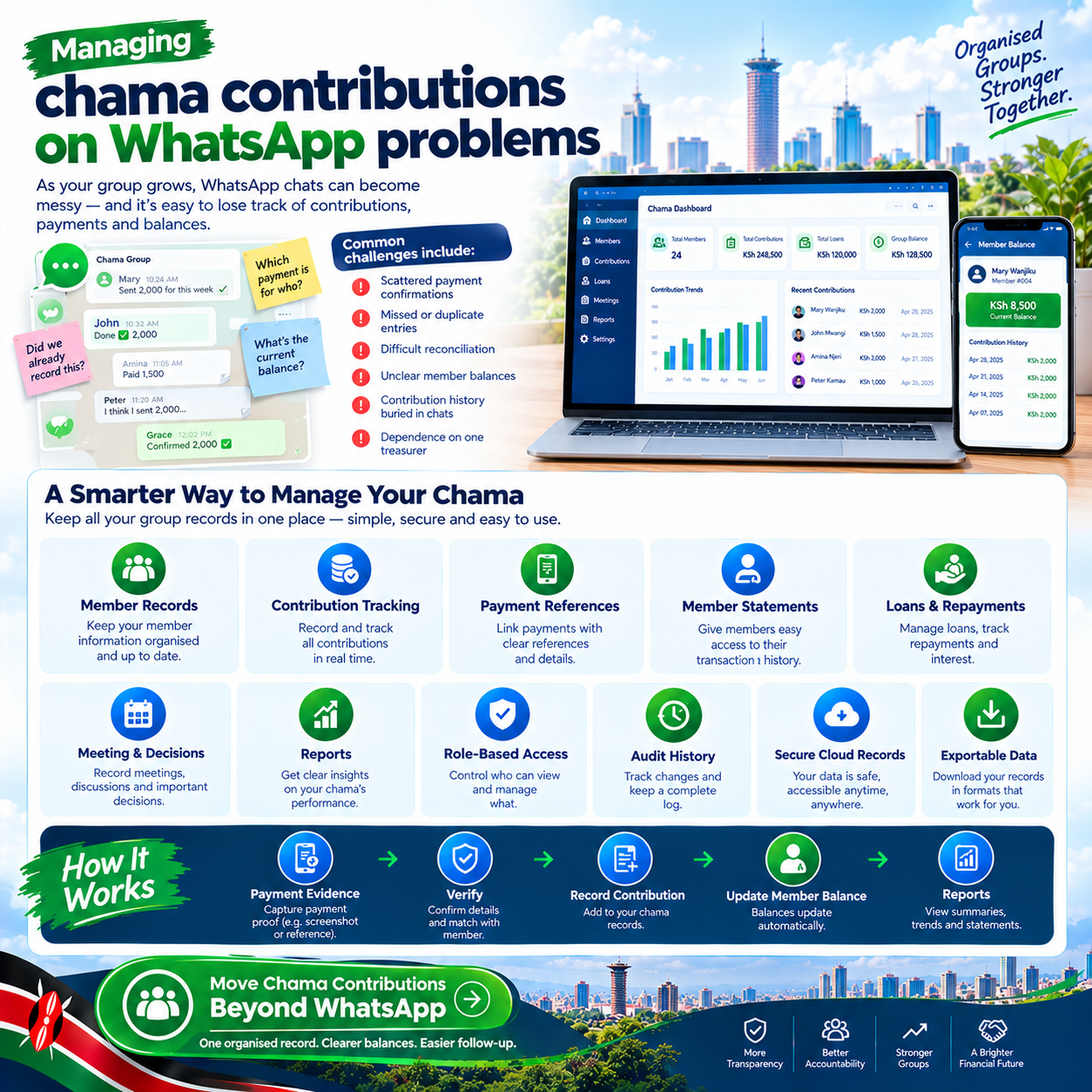
  • Chama Investment Tracking Software Kenya: A Complete Guide to Managing Chama Investments

    Chama Investment Tracking Software Kenya


    Chama Investment Tracking Software Kenya: A Complete Guide to Managing Chama Investments

    Chamas in Kenya are increasingly moving from informal record keeping to structured financial management, especially when members pool money for property, financial assets, businesses, or other long-term projects. Chama Investment Tracking Software Kenya gives a chama a practical way to record investments, monitor capital, follow income and expenses, and prepare clearer reports for members. This guide explains how investment tracking works, why it matters, which records a chama should maintain, how Kenyan payment workflows fit into the process, and what to look for when choosing software. It is written for chama officials, treasurers, investment committees, and members who want better visibility over pooled funds.

    What chama investment tracking means

    Investment tracking is the disciplined process of recording money committed to projects, monitoring what has been purchased or invested, following returns, and keeping members informed about the position of the group. For a chama, this matters because investment money is shared money. Members need a clear trail from contribution to decision, transaction, asset, income, and eventual distribution. A practical system should make that trail easy to understand rather than leaving the treasurer to reconstruct it from notebooks, WhatsApp messages, spreadsheets, and mobile money statements. Chama Investment Tracking Software Kenya gives a chama a structured way to organise investment information in one place. Instead of asking several committee members for different figures, the group can work from consistent records. That makes meetings more productive and helps members understand how capital is being used. Chama Investment Tracking Software Kenya can also support routine reviews so investment performance becomes part of normal chama management rather than an activity done only when annual accounts are prepared.

    Why investment records matter

    A chama can make sensible investment decisions only when its records are accurate enough to show what the group owns, what it has spent, what it has earned, and what remains available. Poor records can hide duplicated payments, forgotten receivables, unrecorded income, or investments that have not produced the expected result. Chama Investment Tracking Software Kenya helps organise these details so the committee can review them before making another commitment. The value is not simply having a digital screen; it is having a dependable record of decisions and transactions. A well-maintained investment register can show the date of purchase, amount invested, source of funds, expected return, actual income, and current status. Chama Investment Tracking Software Kenya therefore supports accountability between meetings. Members do not have to rely entirely on memory when asking how an investment is progressing. The records provide a starting point for discussion and make follow-up responsibilities easier to assign.

    Common investment challenges for Kenyan chamas

    Kenyan chamas often operate with volunteer officials who have limited time. Investment activity can include land, rental property, shares, fixed-income products, livestock, equipment, or a business operated by the group. Each category has different records and review dates. Without a consistent process, information can become scattered across notebooks, spreadsheets, receipts, bank statements, and mobile money messages. Chama Investment Tracking Software Kenya can bring the relevant investment information into a structured workflow. For example, a committee can record a new investment when it is approved, attach supporting details, and then update income or expenses as they occur. Chama Investment Tracking Software Kenya also makes it easier to distinguish investment capital from ordinary welfare or operating funds. That distinction is important because members should be able to see whether a payment came from investment proceeds, contributions, or another source. Clear categorisation reduces confusion when the group prepares reports or discusses future projects.

    Moving beyond spreadsheets

    Spreadsheets can be useful when a chama is small and transactions are simple, but they can become difficult to control as records grow. A file may have multiple versions, formulas may be overwritten, and access may depend on one person’s computer or phone. Chama Investment Tracking Software Kenya offers a more structured approach by treating investment information as part of a broader management process. Instead of relying on manually maintained totals, the group can record transactions consistently and review reports generated from the same underlying data. This does not mean spreadsheets have no place. They can still be useful for analysis or exporting information. The difference is that Chama Investment Tracking Software Kenya can provide a central record from which routine investment information is managed. For committees, that can reduce time spent checking separate files and make it easier to prepare information before monthly or quarterly meetings.

    Investment registers and asset records

    An investment register is one of the most useful records a chama can maintain. It should identify the investment, acquisition date, amount committed, ownership information, supporting documents, expected income, and current status. Chama Investment Tracking Software Kenya can help keep those details organised and easier to review. For a property investment, the record might include the purchase amount, related costs, rental income, repairs, and outstanding issues. For shares or another financial asset, the record may focus on units, acquisition cost, income received, and statements. Chama Investment Tracking Software Kenya can also help a committee avoid treating every investment as a single unexplained figure. Breaking information into identifiable records gives members a clearer picture of where the group’s capital sits. When an asset is sold, transferred, or fully realised, the group can update its status and retain the history instead of deleting the original record.

    Tracking investment contributions

    Investment decisions depend on knowing how much capital the chama can actually commit. Contributions may arrive through scheduled member payments, special calls, retained income, or proceeds from previous projects. Chama Investment Tracking Software Kenya can help connect contribution records with the funds available for investment. This is useful when a committee wants to determine whether a proposed project is affordable without disturbing welfare or emergency reserves. Chama Investment Tracking Software Kenya can also support clearer discussions about committed versus available funds. A member may have paid their monthly contribution, but that does not automatically mean the full amount is available for a new project if some of it is already committed elsewhere. Good records therefore help the chama separate cash on hand, outstanding member balances, investment capital, and restricted funds.

    Tracking capital deployed

    Once members approve an investment, the group needs to know exactly how much money left the chama and what it was used for. Chama Investment Tracking Software Kenya can support a transaction trail showing the approved amount, actual amount paid, date, recipient or investment vehicle, and supporting documentation. This becomes particularly useful when an investment involves several payments, such as a property purchase with professional fees, taxes, deposits, or improvement costs. Chama Investment Tracking Software Kenya can also help the committee compare approved budgets with actual spending. If an investment was expected to cost a certain amount but additional expenses arise, the difference can be recorded rather than absorbed into a vague total. Over time, these records create a useful history for future decisions and make it easier to explain investment costs during member meetings.

    Monitoring returns and income

    An investment is not complete when money has been spent. The chama must monitor what the investment produces. Depending on the asset, returns could come from rent, dividends, interest, business profits, sale proceeds, or another agreed source. Chama Investment Tracking Software Kenya helps the group record income against the relevant investment so performance can be reviewed with context. Instead of looking at total income alone, members can ask which investment generated it and whether the result matches expectations. Chama Investment Tracking Software Kenya can also support periodic reporting, allowing the committee to compare income received during different periods. The goal is not to promise a particular return. Investment outcomes depend on the asset, market conditions, costs, timing, and management. The benefit of organised tracking is that the group can see actual results and use documented information when discussing whether to continue, change, or exit an investment.

    Recording investment expenses

    Investment performance can be misunderstood when only income is tracked. A property may produce rent but also incur maintenance, insurance, professional fees, taxes, utilities, or other costs. A business investment can have operating expenses that reduce the amount available to members. Chama Investment Tracking Software Kenya can help record expenses against the correct investment, giving the committee a more complete picture of performance. Chama Investment Tracking Software Kenya is particularly useful when several assets are held at the same time because it can reduce the risk of mixing expenses from one project with another. A clear expense trail also helps during financial reviews. Committee members can identify unusual costs, investigate missing documentation, and ask whether recurring expenses are still justified. For a chama focused on growing wealth over several years, knowing the cost of maintaining an investment is just as important as knowing the income it produces.

    M-Pesa and bank transaction visibility

    Mobile money and bank transfers are central to many Kenyan financial workflows. Chamas may use mobile money for member contributions and bank accounts for larger payments or investment transactions. Chama Investment Tracking Software Kenya can support a process where investment-related payments are recorded consistently with their source and purpose. The key is reconciliation: the amount in the investment record should agree with the amount shown in the relevant financial account or statement. Chama Investment Tracking Software Kenya can help make these checks part of routine administration rather than an end-of-year exercise. Where the system supports integrations or imported transaction data, committees should still review records before relying on them. Automation can reduce manual work, but it does not remove the need for oversight. A simple rule is useful: every investment payment should have a clear description, supporting evidence, and a connection to an approved activity.

    Investment approvals and governance

    Good investment tracking begins before money moves. A chama should have a clear approval process covering the proposal, expected costs, risks, funding source, responsible officials, and required member consent. Chama Investment Tracking Software Kenya can help preserve the records that follow that process, including investment details and transaction history. This creates a useful connection between governance and accounting. Chama Investment Tracking Software Kenya should not replace the group’s constitution, investment policy, or agreed approval thresholds. Instead, it can help the committee execute those rules consistently. For example, if a chama requires a resolution before investing, the relevant resolution reference can be stored with the investment record. This makes later reviews easier because members can connect a transaction with the decision that authorised it. Strong governance is especially important when investments involve large amounts or long-term commitments.

    Budgeting for chama investments

    Investment planning works better when the group has a realistic budget. A committee can estimate how much money will be available, identify expected costs, maintain a reserve, and decide how much can be committed without creating cash pressure. Chama Investment Tracking Software Kenya can support this process by providing organised historical information on contributions, investment spending, and income. The records can help members compare plans with actual results. Chama Investment Tracking Software Kenya can also help identify recurring investment expenses that should be included in future budgets. A good budget should not assume that every shilling available today can be invested. Chamas need liquidity for approved obligations and unexpected needs. Separating available cash from committed capital makes the discussion more practical. The objective is to build a plan that the group can actually fund while preserving enough flexibility to respond to changes.

    Portfolio visibility

    As a chama grows, it may own several investments at once. A portfolio view can help members understand how capital is distributed across assets and projects. Chama Investment Tracking Software Kenya can organise records so the committee can review individual investments as well as the broader portfolio. For example, the group may compare how much capital is tied up in property, financial assets, equipment, or a member-run business. Chama Investment Tracking Software Kenya can also make it easier to identify investments that require attention, such as assets with overdue income, unexpected expenses, incomplete documentation, or a pending decision. A portfolio view should not be treated as a guarantee of diversification or safety. It is simply a clearer way to see what the group owns and where its money is committed. That visibility can improve the quality of conversations during investment planning sessions.

    Investment performance reports

    Reports turn transaction records into information members can use. A useful investment report may show opening balance, additional capital, income, expenses, transfers, realised gains or losses where applicable, and closing position. Chama Investment Tracking Software Kenya can support consistent reporting by keeping the underlying records organised. Instead of preparing a fresh report manually each time, the committee can work from information that has been updated throughout the period. Chama Investment Tracking Software Kenya can also make reports easier to discuss because figures can be connected to specific investments. When presenting results, officials should explain the reporting period and the basis used for calculations. A report should distinguish cash received from an increase in asset value, where relevant. This avoids giving members an incomplete impression of performance. Clear reporting builds understanding and helps the group focus meetings on decisions rather than reconstructing old transactions.

    Member transparency

    Members contribute because they expect the chama to manage shared funds responsibly. Transparency does not require exposing every administrative detail in every meeting, but members should be able to understand how investment capital is being used. Chama Investment Tracking Software Kenya can help officials maintain organised records that support member updates. Chama Investment Tracking Software Kenya can also reduce dependence on verbal explanations by providing documented information about investments, income, expenses, and outstanding actions. When members ask questions, the committee can refer to records rather than relying on memory. This is especially valuable when officials change. A new treasurer or investment committee member can understand the history without starting from zero. Transparency also means communicating limitations. If an investment has not yet generated income, the report should say so. Honest reporting is more useful than presenting every investment as successful simply because capital has been deployed.

    Reducing errors and duplication

    Manual investment administration can create small errors that become significant over time. A transaction may be entered twice, an expense may be assigned to the wrong asset, or an income payment may be forgotten. Chama Investment Tracking Software Kenya can help standardise how investment records are entered and reviewed. Chama Investment Tracking Software Kenya is most effective when the chama also establishes simple controls, such as approval requirements, regular reconciliations, defined user roles, and periodic reviews. Software cannot correct information that was never entered or entered incorrectly. The aim is to make the correct process easier to follow. For example, using consistent investment names and categories can reduce confusion when generating reports. Recording dates and references at the time of the transaction also prevents officials from having to reconstruct details months later. Small administrative improvements can save substantial time when the portfolio becomes larger.

    Managing documents and evidence

    Investment records should be supported by evidence. Depending on the transaction, that may include agreements, receipts, invoices, statements, valuation documents, payment confirmations, meeting resolutions, or correspondence. Chama Investment Tracking Software Kenya can provide a structured place to associate investment information with supporting records where document functionality is available. Chama Investment Tracking Software Kenya also helps the committee think in terms of a complete transaction trail rather than a single amount. If an investment is questioned later, officials should be able to explain what was approved, what was paid, and what happened afterward. Document organisation is especially important when a chama has leadership changes. A record that exists only in one official’s email or phone can become difficult to retrieve when responsibilities change. Centralised documentation improves continuity and reduces dependence on individual memory.

    Role-based access and accountability

    Not every chama official needs the same level of access. The treasurer may handle financial records, the investment committee may review portfolio information, and ordinary members may receive approved reports. Chama Investment Tracking Software Kenya can fit into a role-based administration approach when the platform provides suitable permissions. The purpose is not to make the system complicated. It is to reduce the chance that sensitive records are changed without appropriate authority. Chama Investment Tracking Software Kenya can also support accountability by making responsibilities clearer. A committee should define who can create investments, who approves payments, who reviews reconciliations, and who receives reports. Access controls work best alongside clear internal procedures. Chamas should also use strong passwords, keep devices secure, and remove access promptly when an official leaves their role. Digital records need both technical and organisational safeguards.

    Investment review meetings

    Regular review meetings are an opportunity to turn records into decisions. Instead of spending most of the meeting asking where figures came from, officials can use Chama Investment Tracking Software Kenya to prepare the information in advance. A review agenda might cover current portfolio position, income received, expenses incurred, overdue items, changes in asset values where relevant, upcoming obligations, and proposed actions. Chama Investment Tracking Software Kenya can support this routine by keeping investment information current between meetings. A good meeting should end with clear actions: who will follow up, what document is needed, which payment requires approval, or which investment needs further analysis. Minutes should capture decisions and responsibilities. Software does not replace good meetings; it gives the meeting a more reliable factual foundation. Over time, regular reviews help the chama identify issues before they become difficult to resolve.

    Land and property investments

    Property is a common area of interest for groups seeking long-term assets, but it requires careful records. A property investment may involve acquisition costs, legal fees, registration expenses, development costs, repairs, rental income, and ongoing management. Chama Investment Tracking Software Kenya can help the chama keep these transactions connected to the relevant property record. Chama Investment Tracking Software Kenya can also make it easier to distinguish the original investment amount from later improvement spending. That distinction matters when the group reviews how much capital has actually been committed. Property records should include appropriate documentation and should not rely solely on a single purchase figure. If rental income is expected, the group should separately track collections, vacancies, maintenance, and other relevant costs. The software is a record-keeping tool; legal ownership, valuation, taxation, and regulatory matters should still be handled using qualified professionals where necessary.

    Financial investments

    Chamas may also consider financial investments such as shares, fixed-income instruments, collective investment products, or other regulated options. Each product has its own risks, costs, liquidity characteristics, and reporting requirements. Chama Investment Tracking Software Kenya can help maintain records of what the group purchased, when it purchased it, how much was committed, and what income or statements have been received. Chama Investment Tracking Software Kenya should not be treated as an investment recommendation. The group should evaluate products using reliable information and follow applicable rules and its own investment policy. Good software simply makes it easier to maintain a history of decisions and transactions. When financial assets are reviewed, the committee should distinguish between cash income and changes in market value where relevant. Keeping these concepts separate can make reports clearer for members who are not investment professionals.

    Business investments

    Some chamas invest directly in businesses, either by starting a venture or providing capital to an existing operation. These investments can involve more moving parts than a simple financial asset. Chama Investment Tracking Software Kenya can help record the capital provided, additional funding, income received, expenses attributed to the investment, and relevant supporting information. Chama Investment Tracking Software Kenya can also help the committee review whether the investment is meeting the objectives set when it was approved. The group should agree in advance on how business performance will be reported and who is responsible for providing information. If the business is managed separately, the chama should still maintain its own investment records rather than depending entirely on the operator’s books. Clear separation between the chama’s investment records and the operating business accounts can make oversight easier.

    Tracking obligations and deadlines

    Investments often create deadlines. A chama may need to renew documents, make scheduled payments, collect expected income, review a contract, or prepare for an exit decision. Chama Investment Tracking Software Kenya can help organise these follow-up activities where task or reminder functionality is available. Chama Investment Tracking Software Kenya is particularly useful when the investment portfolio contains several projects with different timelines. A committee can assign responsibilities and review outstanding items during regular meetings. This prevents important actions from remaining only in someone’s notebook or memory. Deadlines should still be monitored actively, especially when they involve legal, contractual, tax, or regulatory obligations. Software can support reminders and records, but responsible officials should confirm requirements with the appropriate professional or authority. The practical goal is simple: every investment should have a known status and a clear next action when action is required.

    Preparing for audits and reviews

    A well-organised investment record can make an internal or external review much easier. Reviewers may need to understand how funds were received, approved, invested, spent, and reported. Chama Investment Tracking Software Kenya can help bring those records together into a consistent history. Chama Investment Tracking Software Kenya can also support reconciliation by making it easier to compare system records with bank statements, mobile money records, invoices, and other evidence. Before a review, the committee should check for missing documents, unexplained balances, duplicate entries, and transactions without approval references. The aim is not to create paperwork for its own sake. It is to ensure that the group’s financial story can be followed from source to outcome. Where a formal audit is required, the chama should provide the auditor with the records and access they need rather than relying solely on software-generated summaries.

    Choosing software for a chama

    When comparing software, a chama should start with its workflow rather than a long list of features. Ask what information must be captured, who will use it, how members receive reports, and which transactions need reconciliation. Chama Investment Tracking Software Kenya is relevant when investment tracking is a central requirement, but the wider system should also support contribution management, reporting, member records, expenses, and other processes the group actually uses. Check whether the platform is easy enough for committee members to learn and whether records can be exported when needed. Chama Investment Tracking Software Kenya should also fit the group’s budget and administrative capacity. Before making a decision, request a demonstration and test common scenarios using sample data. A useful system is one that officials will consistently use. A feature-rich platform that feels confusing can be less useful than a straightforward system that matches the chama’s daily workflow.

    Implementation steps

    Introducing a new system works best as a controlled process. Start by listing current investments, outstanding balances, income records, expenses, supporting documents, and member information that affects investment funding. Then decide which information must be migrated and how categories should be named. Chama Investment Tracking Software Kenya can become the central record after the initial data has been checked. Chama Investment Tracking Software Kenya should not be populated with unverified figures simply because the group wants to start quickly. Assign someone to review opening balances and confirm important documents. Train officials using real examples, such as recording a contribution, approving an investment, posting an expense, and recording income. After launch, schedule a review after the first month to identify gaps. Small adjustments at this stage can prevent bad habits from becoming part of the group’s normal process.

    Cost and value considerations

    The cost of software should be considered alongside the administrative time it can save and the quality of records it can support. A chama should look beyond the subscription price and consider setup, training, data migration, support, user access, integrations, and any additional charges. Chama Investment Tracking Software Kenya can provide value when it reduces repetitive work and makes information easier to retrieve, but the group should assess that value against its actual needs. Chama Investment Tracking Software Kenya may be particularly useful for a growing chama whose portfolio has become difficult to manage manually. Avoid choosing software solely because it has the largest feature list. Compare the tasks the committee performs each month with the features that solve those tasks. A practical cost assessment should also consider the potential cost of poor records, missed follow-ups, duplicated work, and unclear reporting.

    Building a long-term investment culture

    Software is only one part of good investment management. A chama also needs agreed objectives, clear roles, documented decisions, realistic budgets, regular reporting, and a willingness to review results honestly. Chama Investment Tracking Software Kenya can provide the record-keeping foundation that supports those habits. Chama Investment Tracking Software Kenya becomes more valuable as the group maintains accurate information consistently over several years. Historical records can help members understand how previous decisions performed and what lessons should inform future plans. The group should avoid judging an investment only by a short-term result. Some projects are designed for income, others for long-term appreciation, and others for strategic ownership. The right measurement depends on the original objective. With organised records, the chama can discuss those objectives using evidence rather than assumptions.

    Practical monthly checklist

    A monthly investment review can be simple. Confirm opening balances, record new capital, reconcile payments, post investment income, record expenses, check outstanding obligations, update investment status, and prepare a short member report. Chama Investment Tracking Software Kenya can support this checklist by keeping the required information in a consistent workflow. At the end of the month, the committee should ask whether every transaction has supporting evidence and whether any investment needs a specific follow-up. Chama Investment Tracking Software Kenya can also make it easier to carry unfinished actions into the next review rather than losing them in meeting notes. If the chama has several investments, use a standard reporting format so members can compare results over time. Consistency matters more than complexity. A simple monthly process that is followed every time will usually provide more useful information than an elaborate process that is used only occasionally.

    Benefits for growing chamas

    As membership and investment activity increase, the cost of informal administration tends to rise. More members mean more questions, more transactions create more reconciliation work, and more assets require more records. Chama Investment Tracking Software Kenya can help a growing chama maintain a single, structured view of its investment activity. Chama Investment Tracking Software Kenya can also improve continuity when committee roles change because information is attached to the group rather than remaining with one individual. Growth should not mean losing visibility. The committee can use reports to monitor capital allocation, income, expenses, outstanding actions, and investment status without manually combining multiple files. This is especially useful when members live in different parts of Kenya and rely on digital communication to stay informed. Good systems help the group scale its administration without making every new investment a separate paperwork project.

    Common mistakes to avoid

    Several mistakes can weaken investment tracking. One is recording only the amount invested and ignoring related expenses or income. Another is failing to reconcile records with bank and mobile money statements. A third is allowing one person to control all records without review. Chama Investment Tracking Software Kenya can reduce the administrative burden, but the chama still needs clear controls. Chama Investment Tracking Software Kenya should be used alongside documented approvals, regular reconciliations, secure access, and periodic member reporting. Another mistake is treating estimated values as cash. If an asset’s value changes, the reporting method should be clear so members understand whether the figure represents a realised amount or an estimate. Finally, do not delay record keeping until year-end. Transactions are easiest to record when the details and supporting evidence are still available.

    The role of committee members

    A good system works when responsibilities are clear. The chairperson can oversee governance, the treasurer can maintain financial records, the investment committee can monitor portfolio activity, and members can review approved reports according to the chama’s rules. Chama Investment Tracking Software Kenya can support these responsibilities by giving officials a shared record to work from. Each committee member should understand which information they are expected to review and how often. New officials should receive a handover that includes system access, current investment records, pending actions, and important documents. This reduces disruption when leadership changes. A chama that treats investment tracking as a shared responsibility is less dependent on one person’s memory and better prepared to continue its work over the long term.

    Why local context matters

    A system used by Kenyan chamas should fit the way local groups actually collect contributions, communicate, make payments, and manage committees. Mobile money is important for many groups, while bank transactions remain relevant for larger investments. Members may also participate remotely when they work in different counties or live outside Nairobi. Chama Investment Tracking Software Kenya can support a digital workflow that reflects these realities. Chama Investment Tracking Software Kenya can also help a chama keep records ready for meetings where members expect clear explanations of how their pooled money is being used. Local context does not mean every chama has the same needs. A small welfare-focused group may require a different process from a large investment chama. The right approach is to configure the system around the group’s constitution, objectives, transaction volume, and reporting needs rather than copying another group’s workflow.

    Final takeaway

    Effective investment tracking is about more than storing numbers. It is about creating a reliable connection between member contributions, investment decisions, transactions, income, expenses, documents, reviews, and reports. Chama Investment Tracking Software Kenya can help chamas create that connection and reduce the administrative friction that comes with managing shared capital. The system is most useful when the group combines it with clear approvals, regular reconciliations, secure access, and honest reporting. Before selecting a system, map the chama’s current investment workflow and identify the tasks that consume the most time or create the most uncertainty. Then test whether the software handles those tasks simply. For Kenyan chamas that are moving beyond basic notebooks and scattered spreadsheets, structured investment tracking can provide a stronger foundation for accountability and long-term planning.

    Frequently Asked Questions

    1. What should an investment record contain?

    At minimum, record the investment name, approval date, amount committed, actual amount paid, source of funds, transaction dates, income received, related expenses, supporting documents, current status, and any outstanding actions. The exact fields can vary depending on the type of investment.

    2. Can a chama track property investments with software?

    Yes. A suitable system can organise property acquisition costs, development or improvement expenses, rental income, related payments, documents, and ongoing review information. Legal ownership, valuation, tax, and regulatory matters should still be handled using the appropriate professionals and authorities.

    3. How does investment tracking help the treasurer?

    It reduces the need to reconstruct transactions from different notebooks, spreadsheets, messages, and statements. A central record can make reconciliation, reporting, follow-up, and handovers more consistent.

    4. Should investment income be recorded separately from contributions?

    Yes. Contributions represent money members put into the chama, while investment income is generated by an asset or project. Keeping the categories separate helps members understand the source of funds and the performance of investments.

    5. Can M-Pesa transactions be included in investment records?

    They can be recorded as part of the chama’s financial trail where the payment relates to an investment. The group should reconcile recorded amounts against the relevant mobile money or bank records and retain appropriate transaction evidence.

    6. How often should a chama review its investments?

    A monthly review is a useful starting point for active chamas, while some groups may choose a different schedule based on transaction volume. The important point is to review records regularly rather than waiting until the end of the financial year.

    7. What should a chama check before buying software?

    Check ease of use, investment records, member management, contribution tracking, expenses, reporting, permissions, document handling, reconciliation workflows, support, data export, security, and total cost. Test the system using realistic sample transactions before making a decision.

    8. Does software guarantee better investment returns?

    No. Software can improve record keeping, visibility, reporting, and follow-up, but it cannot guarantee investment performance. Returns depend on the underlying investment, costs, timing, market conditions, management, and other factors.

    9. Who should have access to investment records?

    Access should follow the chama’s agreed roles and constitution. Officials who need to enter or approve transactions can have appropriate permissions, while members can receive reports or information through the group’s established governance process.

    10. What is the biggest benefit of structured investment tracking?

    The main benefit is visibility. Members and officials can see where capital has gone, what each investment has produced, what it has cost, and what action is still required. That information supports more organised administration and clearer discussions.

    Conclusion

    A chama’s investment portfolio deserves the same discipline as any other important financial activity. Accurate records help members understand how pooled funds are being used, while regular reviews help officials identify income, expenses, outstanding actions, and documentation gaps. The objective is not to create complicated administration. It is to make the group’s financial information easier to maintain, check, explain, and hand over.

    For a Kenyan chama, the most useful approach is to connect contribution records, investment approvals, payments, income, expenses, supporting documents, and member reporting in one consistent workflow. Choose software that matches the group’s actual processes, train the officials who will use it, reconcile transactions regularly, and keep governance responsibilities clear. When these practices are followed consistently, investment tracking becomes a normal part of good chama management rather than a last-minute exercise before a meeting or annual review.