Blog

  • Chama Investment Tracking Software Kenya: How to Manage Group Investments More Effectively

    Chama Investment Tracking Software Kenya

    Chama Investment Tracking Software Kenya: How to Manage Group Investments More Effectively

    Managing a chama requires more than collecting contributions and keeping money in a bank account. As a group grows, members expect accurate records, transparent reporting, timely updates, and a clear understanding of how their collective funds are being invested. This is where Chama Investment Tracking Software Kenya becomes particularly useful. It gives chama officials a structured way to organize investment information, monitor contributions, follow financial activity, and prepare reports that members can understand.

    For many Kenyan savings and investment groups, financial records begin with notebooks, spreadsheets, receipts, mobile-money messages, bank statements, and conversations between committee members. These methods may work when the group is small, but they can become difficult to manage when membership increases or the chama begins handling several investments. Chama Investment Tracking Software Kenya provides a useful framework for groups looking for a more organized way to manage investment information.

    A modern chama may invest in property, businesses, financial instruments, agricultural projects, or other opportunities that fit its objectives and governance structure. Each investment creates records that need to be maintained. Chama Investment Tracking Software Kenya can help groups establish a central approach to recording these activities instead of relying on disconnected files.

    The purpose of investment tracking is not simply to create more paperwork. It is to make financial information easier to understand and use. When committee members can quickly determine how much has been contributed, how much has been invested, what income has been generated, and what expenses have been incurred, they can spend more time making informed decisions. Chama Investment Tracking Software Kenya can support that objective when properly implemented.

    This guide explains what chama investment tracking involves, why it matters in Kenya, which features groups should consider, how software can improve accountability, and what to look for when selecting a digital solution.

    What Is Chama Investment Tracking?

    Chama investment tracking is the process of recording, organizing, monitoring, and reporting all financial activity connected to a group’s investments. It connects member contributions with investment decisions and helps the group maintain a history of how funds move from collection to investment and eventually to returns or other outcomes.

    At a basic level, a chama needs to know how much money has been received from members. It also needs to know how much has been committed to different investments. Chama Investment Tracking Software Kenya can help create a structured record of these figures and make it easier to compare expected activity with actual transactions.

    Investment tracking should also distinguish between capital and returns. If a chama invests KSh 1 million and later receives KSh 100,000 in investment income, those amounts should not simply be treated as one unexplained balance. Chama Investment Tracking Software Kenya can help organize investment records so officials can understand what different transactions represent.

    A useful tracking process can include:

    • Member registration
    • Contribution schedules
    • Contribution payments
    • Investment allocations
    • Investment purchases
    • Investment income
    • Investment-related expenses
    • Cash movements
    • Supporting documents
    • Approvals
    • Reconciliations
    • Financial reports
    • Historical records

    The exact requirements depend on the chama’s structure and investment strategy. Chama Investment Tracking Software Kenya should therefore be selected according to actual operational needs rather than simply choosing a system because it has a large number of features.

    Why Chamas in Kenya Need Better Investment Records

    Many chamas rely heavily on trust. Members contribute money because they believe the committee will manage it responsibly. However, trust becomes stronger when it is supported by clear records.

    A treasurer should be able to explain the group’s financial position without spending days searching through notebooks or different spreadsheets. Chama Investment Tracking Software Kenya can help create a central record that makes this information easier to retrieve.

    Another reason is the growing complexity of group investments. A chama may begin with one investment and later diversify into several opportunities. Each investment can have different dates, values, income streams, expenses, documents, and review periods. Chama Investment Tracking Software Kenya can provide a structured way to keep these records separate while maintaining an overall view.

    Committee changes are another consideration. Treasurers and other officials may serve for defined periods before responsibilities are handed over. If financial knowledge exists only in one person’s notebook or computer, the transition can be difficult. Chama Investment Tracking Software Kenya helps establish records that can be accessed and understood by authorized officials over time.

    Better records can also make member meetings more productive. Instead of spending the entire meeting reconstructing contribution and investment figures, officials can present organized reports and focus discussion on performance, risks, opportunities, and future plans. Chama Investment Tracking Software Kenya can support this type of reporting process.

    Problems Caused by Manual Investment Tracking

    Manual systems are not automatically ineffective. A small chama with very few transactions may manage adequately using a spreadsheet. Problems usually emerge when the volume and complexity of financial activity increase.

    One common problem is duplicated data. A contribution may be recorded in a notebook, entered into a spreadsheet, and later copied into another report. Every additional copy creates another opportunity for inconsistency. Chama Investment Tracking Software Kenya can reduce dependence on repeated manual entry when the system is configured correctly.

    Another problem is missing information. A transaction may show an amount but not the reason for the payment, the investment it relates to, or the supporting reference. Chama Investment Tracking Software Kenya can help groups create standardized records that capture important information consistently.

    Manual records can also make reconciliation difficult. The treasurer may have to compare a bank statement with a spreadsheet and then check mobile-money messages to determine which transactions have already been entered. Chama Investment Tracking Software Kenya can support a more organized reconciliation workflow.

    Common manual-tracking challenges include:

    • Lost receipts
    • Duplicate entries
    • Incorrect member balances
    • Unclear investment balances
    • Missing transaction references
    • Delayed reporting
    • Difficult handovers
    • Poor document organization
    • Inconsistent calculations
    • Limited visibility into historical activity

    These problems can consume valuable committee time. Chama Investment Tracking Software Kenya can be considered as part of a broader strategy for reducing unnecessary administrative work.

    Tracking Member Contributions

    Member contributions are the foundation of most chama investment activities. Before a group can make investments, it needs to collect and account for the money members have committed.

    A good system should make it easy to identify who has contributed, how much they have contributed, when the payment was made, and which contribution period it covers. Chama Investment Tracking Software Kenya can support this type of member-level financial record keeping.

    Contribution tracking should also distinguish between amounts due and amounts received. If a member is expected to contribute KSh 10,000 but has paid KSh 5,000, the system should not treat the entire KSh 10,000 as available investment capital. Chama Investment Tracking Software Kenya can help create clearer distinctions between expected and completed contributions.

    This becomes increasingly important as membership grows. A chama with ten members may manually check individual payments relatively easily. A group with hundreds of members needs a much more structured process.

    Contribution records can help answer questions such as:

    • Which members have paid?
    • Who has outstanding contributions?
    • How much has the chama collected this month?
    • How much is expected?
    • What was collected during a particular period?
    • How much capital is available for investment?

    A reliable contribution history also creates a foundation for financial reporting. Chama Investment Tracking Software Kenya can support this connection between member activity and group-level financial information.

    Monitoring Different Types of Investments

    Chamas do not all invest in the same way. Some groups may concentrate on property, while others may prefer financial investments, businesses, agriculture, or diversified portfolios.

    Property investments may require information about purchase costs, legal documentation, development expenses, rental income, valuations, and eventual sale proceeds. Chama Investment Tracking Software Kenya can help a group structure the information surrounding such investments.

    Financial investments may require different records, such as principal amounts, transaction dates, income received, maturity dates, statements, and current values where applicable. Chama Investment Tracking Software Kenya can be useful when designing a system that accommodates different categories.

    Business investments may require another set of records. The chama could need to record the amount invested, ownership arrangements, distributions, expenses, and periodic performance information. Chama Investment Tracking Software Kenya can be considered when evaluating whether a system can handle multiple investment categories.

    The important principle is consistency. Every investment should have enough information attached to it for officials to understand what it is, how much money has been committed, what has happened since the investment was made, and what documentation supports the transaction.

    Tracking Investment Returns

    Investment returns are among the most important figures for a chama because they show what the group’s capital has generated.

    However, returns should be recorded carefully. A projected gain is not the same as cash actually received. Similarly, an increase in an asset’s estimated value may not mean that the chama has cash available for distribution.

    Chama Investment Tracking Software Kenya can help groups organize return information and distinguish between different types of financial outcomes.

    Depending on the investment, returns might include:

    • Interest
    • Dividends
    • Rental income
    • Business distributions
    • Sale proceeds
    • Other investment income

    The group should also consider related costs. An investment may generate income while simultaneously creating expenses. Chama Investment Tracking Software Kenya can be part of a broader system for understanding both income and expenditure.

    A useful report should therefore provide context rather than presenting a single large number as “profit.”

    Managing Investment Expenses

    Expenses can significantly affect the financial outcome of an investment. If a chama records income but fails to record relevant expenses, members may receive an inaccurate impression of performance.

    Examples of expenses may include transaction costs, professional services, administration, maintenance, management fees, or other legitimate costs associated with a particular investment.

    Chama Investment Tracking Software Kenya can help committees include expense tracking within the investment management process.

    Each expense should ideally have a date, amount, category, description, and supporting evidence where appropriate. Chama Investment Tracking Software Kenya can support the requirement for organized financial documentation.

    When expenses are properly recorded, the chama can calculate more meaningful net results. It can also compare investments using consistent information.

    Investment Reports for Chama Members

    One of the strongest benefits of digital tracking is improved reporting.

    Members usually want answers to straightforward questions:

    • How much money has the group collected?
    • How much has been invested?
    • Where is the money invested?
    • What income has been generated?
    • What expenses have been incurred?
    • How much cash is available?
    • What investments are currently active?
    • What decisions require member attention?

    Chama Investment Tracking Software Kenya can help structure the information needed to answer these questions.

    A report can summarize the group’s position while allowing authorized officials to investigate the transactions behind the figures. Chama Investment Tracking Software Kenya can be considered when selecting a system that combines summary reporting with detailed records.

    Reports can also be prepared for different audiences. Committee members may require detailed transaction information, while ordinary members may prefer concise summaries showing contributions, investments, income, expenses, and overall progress. Chama Investment Tracking Software Kenya can support this distinction where the system provides appropriate reporting options.

    Improving Financial Transparency

    Transparency is essential for collective financial organizations.

    When members cannot easily understand what is happening to their money, questions and disagreements can arise. Clear records do not eliminate every disagreement, but they provide evidence that can help resolve questions.

    Chama Investment Tracking Software Kenya can contribute to transparency by giving authorized users a structured record of transactions and investment activity.

    Transparency should not mean giving every user unrestricted access to sensitive information. Instead, access should be based on responsibilities. Chama Investment Tracking Software Kenya can be evaluated for role-based permissions and other access-control capabilities.

    For example, a treasurer may need to enter transactions, while an ordinary member may only need access to approved reports. An administrator may need additional permissions for managing users and settings.

    Reconciliation and Financial Accuracy

    Reconciliation is one of the most important controls for any organization handling money.

    A reconciliation compares records in the management system with external evidence such as bank statements, mobile-money records, receipts, or investment statements.

    Chama Investment Tracking Software Kenya can help groups establish a consistent process for reviewing whether recorded transactions match actual financial activity.

    Suppose a chama’s records show that members contributed KSh 200,000 during a month, but the bank or mobile-money records show only KSh 190,000 received. The difference needs to be investigated.

    It could result from:

    • A payment that was not recorded
    • A duplicate entry
    • A transaction recorded in the wrong period
    • A reversed payment
    • A bank charge
    • An incorrect amount

    Chama Investment Tracking Software Kenya can support more organized investigation when transaction records are centralized.

    Supporting Better Investment Decisions

    Software should not make investment decisions for a chama. Its role is to provide reliable information that helps the people responsible for decisions understand the group’s position.

    A committee can use historical information to evaluate what happened with previous investments. Chama Investment Tracking Software Kenya can help preserve that history.

    For example, before committing new capital, officials might want to know how much cash is currently available, how much is already committed, what income existing investments generate, and which obligations are approaching.

    Chama Investment Tracking Software Kenya can support this kind of information gathering.

    A diversified group can also compare investment categories. Instead of looking at the entire portfolio as one number, the committee can examine each investment separately and then consider the overall position.

    Using M-Pesa and Digital Payments

    Mobile payments are an important consideration for Kenyan chamas. Many groups use mobile-money services or bank transfers to collect member contributions.

    The exact integration available depends on the selected software. Therefore, a chama should verify whether a platform can directly connect with the payment services it uses or whether transactions must be imported or reconciled manually.

    Chama Investment Tracking Software Kenya can be considered when assessing payment-related requirements.

    The objective should be accurate reconciliation rather than simply having an integration because it sounds convenient. Chama Investment Tracking Software Kenya can support the evaluation of whether payment records can be matched to members and contribution periods.

    Document Management for Investments

    Financial transactions rarely exist without documentation.

    A property investment might have agreements, receipts, approvals, or valuation documents. A financial investment may have statements and transaction confirmations. A business investment may involve agreements and supporting reports.

    Chama Investment Tracking Software Kenya can be useful when assessing whether investment records can be connected with relevant documents.

    Centralized documentation can make audits and committee handovers easier. Instead of searching through email attachments or messaging applications, authorized officials can locate documents alongside the financial records they support.

    Security and Access Control

    Chama financial records should be treated as sensitive information.

    The system should provide appropriate controls over who can access, create, modify, approve, and view different types of information.

    Chama Investment Tracking Software Kenya can be evaluated according to the security controls available within the platform.

    Strong passwords, controlled permissions, user management, backups, and audit histories can all contribute to better record protection.

    A chama should also establish internal policies. Technology works best when combined with clear rules about who is allowed to approve transactions and how financial information is shared.

    Audit Trails and Accountability

    An audit trail can show what happened to a record over time. This is valuable when an amount is corrected or when officials need to understand how a transaction was entered.

    Chama Investment Tracking Software Kenya can be assessed for the availability of transaction histories and activity records.

    Accountability becomes stronger when important actions can be traced to authorized users. If a record is changed, the group should ideally be able to determine what changed and when.

    This does not mean that every system will provide the same level of audit functionality. The committee should test the specific software before making a purchasing decision.

    Choosing the Right Chama Investment Software

    The best system is not necessarily the one with the longest feature list. It is the one that solves the group’s actual problems.

    Begin by documenting current processes. Identify how contributions are collected, how investments are approved, how records are maintained, how reports are prepared, and where errors commonly occur.

    Chama Investment Tracking Software Kenya can be used as a starting point when defining the type of digital solution the chama needs.

    The committee should then create a shortlist based on practical requirements.

    Important considerations include:

    1. Ease of use
    2. Member management
    3. Contribution tracking
    4. Investment tracking
    5. Income tracking
    6. Expense tracking
    7. Reporting
    8. Reconciliation
    9. Document management
    10. User permissions
    11. Security
    12. Support
    13. Data export
    14. Scalability
    15. Overall cost

    A product demonstration can be more useful than simply reading a feature list. Ask the vendor to demonstrate a real workflow.

    Questions to Ask Before Buying

    Before selecting a platform, chama officials should ask detailed questions.

    Can the system handle the number of members currently in the group? Can it accommodate expected growth? Can it track several investment categories? Can it produce the reports members need?

    Chama Investment Tracking Software Kenya can be assessed against these practical requirements.

    Officials should also ask about data migration. If the chama already has several years of records, moving those records into a new system may require cleaning and organizing the information first.

    Chama Investment Tracking Software Kenya can be considered when comparing platforms that support the transition from manual records to digital management.

    Support is another important question. Users should understand how technical issues are handled and whether training is available.

    Chama Investment Tracking Software Kenya can be evaluated alongside questions about onboarding, documentation, user assistance, and ongoing support.

    Implementing a Digital Chama System

    Implementation should be planned rather than rushed.

    Start by cleaning existing records. Remove duplicate entries, verify member information, reconcile balances, and organize historical investment information.

    Chama Investment Tracking Software Kenya can become much more effective when the information entered into it is accurate from the beginning.

    Next, establish responsibilities. Decide who enters transactions, who checks them, who approves important activities, and who prepares reports.

    Chama Investment Tracking Software Kenya can support a structured workflow where responsibilities are clearly defined.

    Training should then be provided to the people who will use the system regularly. The training should cover everyday tasks rather than only demonstrating advanced features.

    Creating a Consistent Reporting Routine

    A chama can benefit from establishing a fixed reporting calendar.

    For example, the committee may prepare monthly contribution reports and periodic investment summaries. The exact schedule should match the group’s constitution, investment activity, and governance practices.

    Chama Investment Tracking Software Kenya can support a repeatable reporting workflow.

    Consistency is more important than producing complicated reports. A simple report that is prepared accurately every month is more useful than an impressive report that appears only once or twice a year.

    Common Mistakes Chamas Should Avoid

    One mistake is selecting software before identifying the actual problem. A chama may purchase a complicated platform when its biggest need is simply contribution and investment tracking.

    Another mistake is failing to clean old records. Importing inaccurate information into a new system can create problems that are harder to identify later.

    A third mistake is giving too many users unrestricted access.

    Chama Investment Tracking Software Kenya should be implemented alongside appropriate governance and access policies.

    Another common mistake is abandoning reconciliation after automation. Digital software reduces manual work, but officials should still compare records with supporting financial evidence.

    Benefits for Treasurers

    Treasurers often carry much of the administrative responsibility for a chama.

    They may be responsible for receiving contributions, recording payments, maintaining statements, preparing reports, and answering questions from members.

    Chama Investment Tracking Software Kenya can reduce some of the repetitive work associated with maintaining these records.

    A structured system can also help a treasurer prepare information for meetings without rebuilding calculations every time.

    Benefits for Chama Members

    Members benefit when they can trust the information provided by their group.

    Clear reports can help members understand how their contributions are being used and how the group’s investments are progressing.

    Chama Investment Tracking Software Kenya can contribute to this transparency by supporting consistent financial reporting.

    Members can also benefit from faster answers to questions. Instead of waiting for a treasurer to search through several files, authorized officials can retrieve information from a centralized record.

    Benefits for Investment Committees

    Investment committees need information to evaluate opportunities and monitor existing positions.

    A centralized system can provide historical data, current records, and supporting documentation in a structured manner.

    Chama Investment Tracking Software Kenya can be considered when evaluating technology for investment committee workflows.

    However, software should support due diligence rather than replace it. A committee should still assess investment risks, terms, documentation, expected outcomes, and compliance with its own governance requirements.

    Planning for Future Growth

    A chama that has twenty members today may have many more in the future. Its investment portfolio may also expand.

    Choosing a system that can scale can prevent the group from having to migrate again after a short period.

    Chama Investment Tracking Software Kenya can be included in a technology evaluation focused on both current needs and future growth.

    Scalability does not necessarily mean purchasing the most advanced package immediately. Instead, the group should understand how the platform handles additional users, investments, records, and reporting requirements.

    The Role of Data in Chama Management

    Good decisions depend on good information.

    If member balances are inaccurate, investment reports can become unreliable. If expenses are missing, returns may be overstated. If transactions are duplicated, the financial position may appear stronger than it actually is.

    Chama Investment Tracking Software Kenya can support data organization, but the chama still needs procedures for reviewing information.

    Data quality should therefore be treated as an ongoing responsibility.

    Practical Example

    Consider a chama with 50 members. Each member contributes KSh 10,000 every month. The group collects KSh 500,000 in expected monthly contributions.

    The committee invests part of the funds in different opportunities while keeping some money available for other obligations.

    Without an organized system, the treasurer may need to check payment messages, spreadsheets, bank statements, and investment records separately.

    Chama Investment Tracking Software Kenya can provide a more centralized structure for recording this information.

    Suppose five members have not completed their contributions. The system should help the committee identify the outstanding amount rather than assuming that all expected money has been received.

    Chama Investment Tracking Software Kenya can support the distinction between expected and actual contributions.

    If the group then invests KSh 300,000, the investment should be recorded separately from the remaining cash.

    Chama Investment Tracking Software Kenya can help maintain this distinction.

    If the investment later generates income, that income should also be recorded separately.

    Chama Investment Tracking Software Kenya can help the committee track the resulting financial activity.

    The example illustrates why investment tracking is about more than recording one final balance. It is about maintaining a complete history of the group’s financial activity.

    Frequently Asked Questions

    What is chama investment tracking software?

    Chama investment tracking software is a digital system designed to help savings and investment groups manage information about members, contributions, investments, income, expenses, transactions, and reports.

    Why should a Kenyan chama use investment tracking software?

    A digital system can help reduce fragmented records, improve visibility, simplify reporting, support reconciliation, and make it easier for authorized officials to manage investment information.

    Can software track member contributions?

    Yes, suitable systems can record member contributions, payment dates, amounts, balances, and contribution histories. The exact features depend on the platform.

    Can a chama track multiple investments?

    A suitable platform should allow the group to organize different investment categories and maintain relevant information for each investment.

    Can M-Pesa payments be included?

    This depends on the specific platform and integration available. A chama should verify whether its preferred software supports direct integration, importing, or reconciliation of mobile-money transactions.

    Does software replace a treasurer?

    No. Software is a management tool. The treasurer and other authorized officials remain responsible for financial oversight, approvals, reconciliation, and governance.

    How often should investment records be updated?

    Records should be updated consistently and as close to the time of the transaction as practical. Delayed entry increases the risk of missing or duplicated information.

    Should every member have access to financial records?

    Access should depend on the chama’s governance rules and the software’s permissions. Members may receive approved reports without necessarily receiving administrative access.

    Can historical chama records be transferred into software?

    This depends on the platform. Before migration, the chama should review and clean historical data to reduce errors.

    What should a chama look for when choosing software?

    The group should consider usability, contribution tracking, investment records, reporting, reconciliation, security, permissions, support, scalability, documentation, and cost.

    Conclusion

    Investment management becomes more difficult when a chama depends on scattered spreadsheets, notebooks, receipts, payment messages, and individual knowledge. As membership and investment activity increase, organized digital records can provide the visibility needed to manage collective finances more effectively.

    Chama Investment Tracking Software Kenya can help chamas think beyond basic bookkeeping and consider a complete investment-management workflow that connects contributions, investments, returns, expenses, documents, reporting, and accountability.

    The right solution should make information easier to access without creating unnecessary complexity. It should support the way the chama actually operates and provide appropriate controls for the people responsible for financial management.

    For Kenyan chamas looking to improve their financial organization, Chama Investment Tracking Software Kenya can be evaluated as part of a broader digital transformation strategy.

    A successful implementation ultimately depends on three things: accurate data, consistent processes, and responsible governance. Software can provide the structure, but the committee must still maintain good financial practices.

    When these elements work together, a chama can spend less time searching for records and more time evaluating its investments, planning for growth, and communicating clearly with members.

    Chama Investment Tracking Software Kenya is therefore not simply a technology choice. For a growing investment group, it can become part of the system used to maintain financial visibility, strengthen accountability, and support better-informed decisions.


  • Chama Treasurer Handover Checklist: Transfer Records with Confidence

    A chama treasurer handover checklist helps a new official take responsibility for records without having to reconstruct months of transactions. The handover should explain the balances, show the evidence behind them and identify work that remains unfinished.

    Chama Treasurer Handover Checklist: Practical Steps

    This chama treasurer handover checklist guide gives officials a clear process for maintaining accurate records, approvals and accountability.

    Table of Contents

    • Key records and preparation
    • Step-by-step controls
    • Review and reporting

    Passing on a spreadsheet is only one part of the process. The outgoing and incoming treasurers also need to agree on a reporting cut-off, review supporting documents and arrange appropriate access changes. Use this checklist to organise that discussion.

    chama treasurer handover checklist
    A documented handover keeps group records usable when officials change.

    1. Agree on a cut-off date

    Choose the date and time covered by the handover balances. List transactions after that point separately so that both officials know who is responsible for entering and reviewing them. Without a cut-off, a difference may be caused by timing rather than a missing payment.

    Record which statement dates are available and whether any recent transactions are still awaiting confirmation. The handover should describe the actual state of the records rather than presenting an unfinished month as fully reconciled.

    2. Reconcile each account and fund

    Compare recorded balances with bank statements, mobile-money records and any physical cash count. List outstanding items, fees, duplicate entries and unexplained differences. Assign each unresolved item an owner and a target date.

    For illustration, if the ledger shows KSh 84,000 but the statement shows KSh 83,500, record the KSh 500 difference and investigate it. Do not insert an unexplained adjustment merely to make the totals agree. Retain evidence supporting the eventual correction.

    3. Transfer a complete records inventory

    • Member register and contribution balances by reporting period.
    • Loan register, agreements, repayment history and outstanding items.
    • Welfare fund records and approved payments still awaiting completion.
    • Bank and payment statements, receipts and reconciliation files.
    • Approved budgets, expenditure records and unpaid commitments.
    • Relevant minutes, resolutions and previous financial reports.

    For each category, identify where the records are stored, the latest complete period and any missing documents. A short inventory makes future searches easier and prevents important files from remaining on an outgoing official’s personal device.

    4. Review access and ownership

    Arrange individual access for the new official through the relevant system administrator. Review the outgoing official’s permissions according to their new role. Avoid handing over a shared password as the whole access plan.

    Check that recovery contacts and document ownership remain under appropriate group control. Keep sensitive member files accessible only to authorised people. The Office of the Data Protection Commissioner provides official information for reviewing personal-data practices.

    5. Record acceptance and unresolved matters

    Prepare a handover note with the cut-off date, balances reviewed, document inventory, access actions and open issues. Follow the group’s approval process and have the responsible officials acknowledge what was received. Acceptance should not hide unresolved discrepancies.

    Schedule a follow-up review after the new treasurer completes the first reporting cycle. That is an opportunity to resolve missing context and confirm that the records can be maintained without depending on the previous official.

    Keep continuity in your management system

    TAS describes role-based access for group records. Ask how officer changes and record exports work for your group. Test the relevant process before the handover date and confirm which administrator will make the changes.

    Include records from group-owned operations

    If the chama also operates rental property or a paid WiFi business, add those records and access responsibilities to the inventory. Our related platforms PMS property management and Pawa WiFi billing address those separate operations. Reconcile any transfers into chama accounts and document who will administer each system after the handover.

    What if some records are missing?

    List the gaps explicitly, preserve the evidence available and assign follow-up responsibility. Do not label the handover complete without explaining those limitations.

    Prepare for your next leadership transition with TAS chama management. Call 0725345345 to discuss record organisation and access.

    Chama Treasurer Handover Checklist: Final Review

    Use this chama treasurer handover checklist during every reporting cycle. Also review our chama meeting minutes template guide to connect related decisions and financial records.

  • Chama Welfare Fund Management: Track Contributions and Payouts

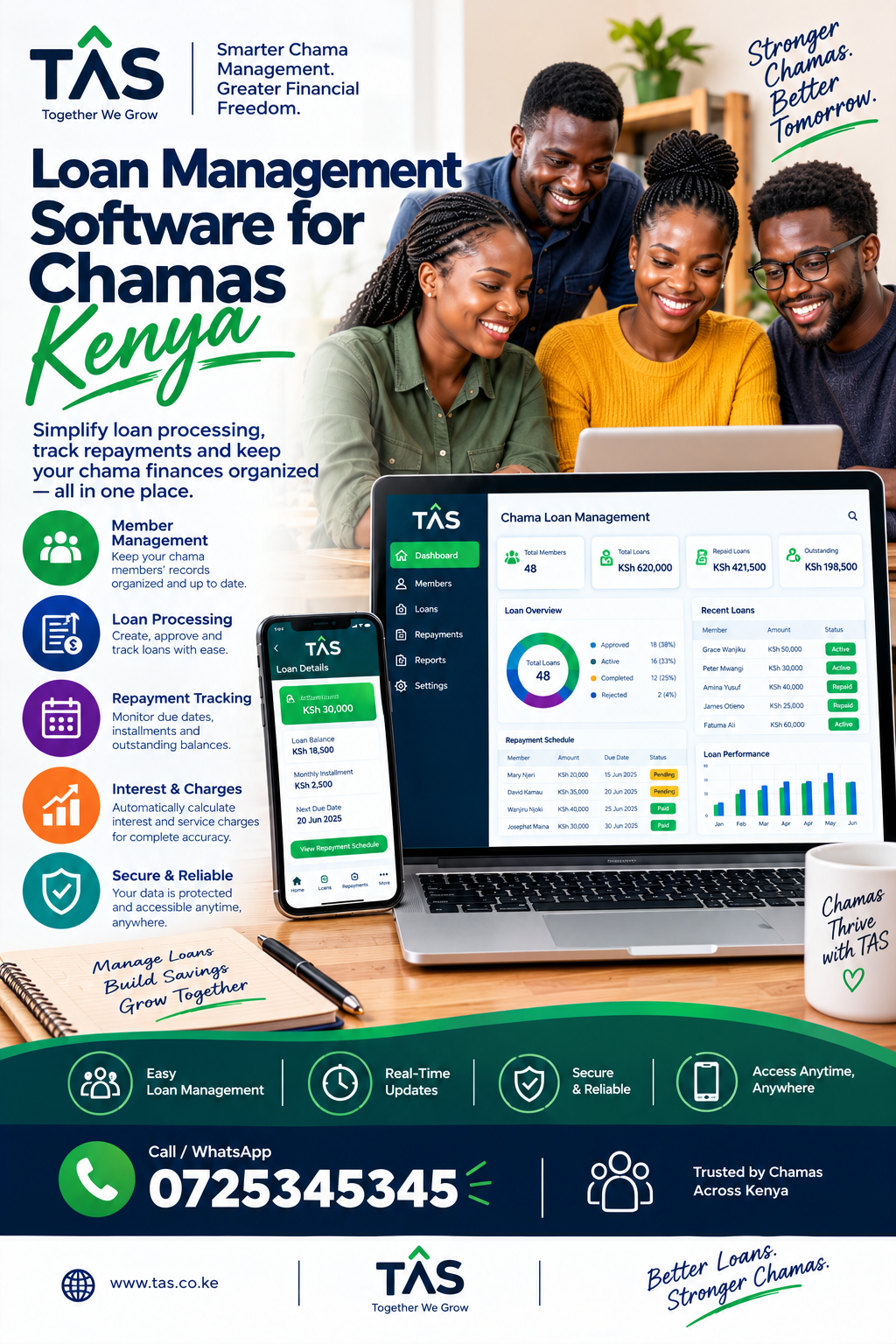
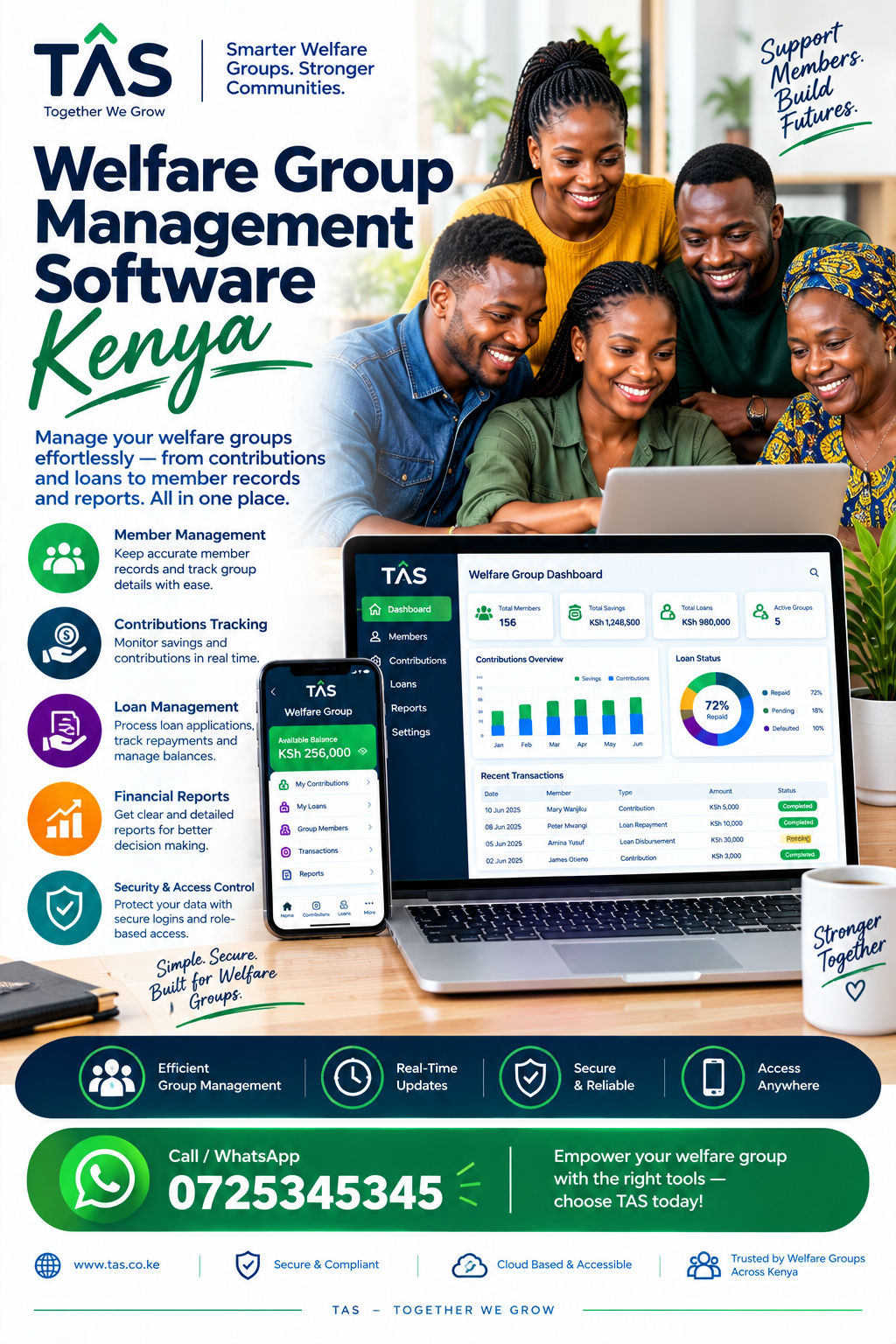
    Chama welfare fund management works best when members can see how contributions support the group’s agreed purpose. Confusion arises when welfare money is mixed with savings, a payout lacks an approval reference or the balance depends on one official’s memory.

    Chama Welfare Fund Management: Practical Steps

    This chama welfare fund management guide gives officials a clear process for maintaining accurate records, approvals and accountability.

    Table of Contents

    • Key records and preparation
    • Step-by-step controls
    • Review and reporting

    A clear record connects each contribution and payout to the welfare fund while keeping private member circumstances appropriately restricted. The following workflow helps officials prepare a fund summary that members can understand and another official can verify.

    chama welfare fund management
    Clear welfare records help members understand collections and support payments.

    Define what belongs in the welfare fund

    Start with the group’s approved welfare rules. Record the contribution amount and timing, qualifying purposes, decision process and required evidence. Where a special collection is approved, distinguish it from the regular contribution so members know what they are paying towards.

    Use a separate welfare category in the records. If several funds share one payment account, keep their ledger balances distinct and reconcile the combined ledger to the actual account balance. A separate category alone does not prove that cash is available.

    Record each contribution against the correct period

    Capture the member, amount, contribution period, date received and payment reference. For a combined payment covering savings and welfare, record the agreed allocation rather than placing the entire receipt in one category.

    List unidentified receipts for investigation. Do not allocate them to whichever member has the nearest matching outstanding balance. A correct total with incorrect member allocations still creates unreliable records.

    Connect every payout to its approval

    Give each support request a reference and connect it to the approval record. Keep the authorised amount, decision date, approving officials and any conditions with the case. When payment occurs, add its date, amount and transaction evidence.

    Keep approved-but-unpaid support separate from completed payouts. Both matter to planning, but they represent different stages. A summary should let officials distinguish what has left the account from what the group has already committed to pay.

    Prepare a simple monthly fund summary

    This illustrative example assumes all receipts and payments have been verified and there are no other transactions:

    Entry Amount
    Opening welfare balance KSh 20,000
    Contributions received + KSh 10,000
    Support payouts completed − KSh 8,000
    Closing welfare balance KSh 22,000

    If a further KSh 5,000 payout is approved but unpaid, show it as a commitment alongside the KSh 22,000 closing balance. In this simplified example, KSh 17,000 remains uncommitted. Include actual fees, transfers and corrections when preparing your real report.

    Be transparent about funds and careful with personal details

    Members need appropriate information about collections, decisions and payouts. That does not mean every member needs access to private supporting documents. Use case references in general summaries where suitable and refer to the ODPC’s official resources for personal-data handling guidance.

    Explore a consistent record-keeping process

    TAS identifies welfare groups among the organisations it supports and includes welfare contributions within its records. Review TAS for member-based groups and ask the team to demonstrate your proposed welfare workflow before adopting it.

    Distinguish special collections from routine welfare payments

    When a group runs a separate event or contribution campaign, give it its own reference and reconciliation. Our related platform Wito covers events, tickets and contributions. Confirm its suitability for the planned activity, then document any resulting transfer to the welfare fund without counting the same receipt twice.

    Can welfare and savings appear in one report?

    Yes, provided each fund is clearly separated and the totals remain traceable. Members should be able to distinguish welfare activity from savings activity.

    Discuss clearer welfare records with TAS. Call 0725345345 to explain how your group collects and distributes support.

    Chama Welfare Fund Management: Final Review

    Use this chama welfare fund management during every reporting cycle. Also review our chama loan repayment tracking guide to connect related decisions and financial records.

  • Chama Meeting Minutes Template Kenya: Record Decisions Clearly

    A useful chama meeting minutes template in Kenya helps members answer three questions after a meeting: what was agreed, who is responsible and when will the action be completed? A list of discussion topics cannot answer those questions on its own.

    Chama Meeting Minutes Template Kenya: Practical Steps

    This chama meeting minutes template Kenya guide gives officials a clear process for maintaining accurate records, approvals and accountability.

    Table of Contents

    • Key records and preparation
    • Step-by-step controls
    • Review and reporting

    Your minutes should preserve the decisions that affect contributions, spending and group administration without becoming a transcript of every conversation. Use the structure below as a practical starting point, adapted to your chama’s constitution and meeting procedures.

    chama meeting minutes template Kenya
    Turn meeting discussions into decisions members can follow.

    Prepare the agenda before the meeting

    Give each agenda item a clear purpose. “Discuss accounts” is broad; “review the August contribution reconciliation and resolve two unmatched payments” tells members what needs attention. Share supporting summaries early enough for officials to review them.

    Separate items that need a decision from updates that are only for information. This makes it easier for the secretary to capture the outcome and for the chairperson to confirm that the meeting has actually reached a resolution.

    A reusable chama meeting minutes template

    Section Information to record
    Meeting details Group name, date, start time, venue or online channel
    Attendance Members present, apologies and quorum assessment under group rules
    Previous minutes Approval, corrections and outstanding actions
    Financial report Reporting period, document reference, totals reviewed and unresolved differences
    Agenda decisions Resolution, relevant amount, approval outcome and conditions
    Actions Task, responsible person and deadline
    Close Next meeting details, closing time and approval process

    Write resolutions that stand on their own

    Weak wording such as “members discussed outstanding payments” leaves future readers unsure what happened. A clearer illustrative entry would be: “The treasurer will check the two unmatched August receipts against the statement and share the reconciliation result with the committee by 18 September.”

    For a spending decision, record the approved purpose, amount or limit, responsible official and any conditions. Link to the supporting document so that the payment can later be checked against the decision that authorised it.

    Keep an action register between meetings

    Copy each agreed task into a short register with an owner, due date and status. At the next meeting, review unfinished actions before creating new ones. Mark an item complete only when its outcome or supporting evidence is available.

    This prevents recurring discussions where the group remembers agreeing to do something but nobody knows who was expected to act. It also makes leadership changes easier because unfinished work stays visible.

    Review and share the appropriate version

    Follow your group’s approval process and identify draft minutes clearly. Keep version changes traceable. Personal information attached to welfare or loan discussions should be handled carefully; a general circulation copy need not reproduce every private supporting detail. The Office of the Data Protection Commissioner is an official reference for personal-data guidance.

    Organise meetings with TAS

    TAS meeting tools cover agendas, minutes and group decisions. Ask how approved minutes and related records would be organised for your chama. You can also explore the TAS blog for more group-management topics.

    Document practical arrangements too

    If an online meeting needs a better connection, assign someone to compare availability and costs; our related Spacekits installation service provides information about Starlink setups. For a meeting that includes a group site visit, Dereva’s driver marketplace is a related resource for finding driver options. Record any approved service cost and the person arranging it.

    Should minutes include every comment?

    Usually, the useful record is the decision, necessary context and resulting action. Follow any specific recording requirements in your group’s own rules.

    Make decisions easier to find and follow. Visit TAS or call 0725345345 to discuss meeting management.

    Chama Meeting Minutes Template Kenya: Final Review

    Use this chama meeting minutes template Kenya during every reporting cycle. Also review our chama contribution tracking in Kenya guide to connect related decisions and financial records.

  • Chama Loan Repayment Tracking: How to Keep Clear Member Records

    Chama loan repayment tracking becomes difficult when approvals sit in meeting minutes, disbursements appear on a statement and repayments are recorded in a separate notebook. A member may have paid, yet the group still struggles to explain the outstanding balance.

    Chama Loan Repayment Tracking: Practical Steps

    This chama loan repayment tracking guide gives officials a clear process for maintaining accurate records, approvals and accountability.

    Table of Contents

    • Key records and preparation
    • Step-by-step controls
    • Review and reporting

    The solution starts with a complete record for each loan. Connect its approval, actual disbursement, agreed repayment schedule and subsequent transactions. This guide focuses on record keeping; your group’s approved terms determine how each loan is calculated and administered.

    chama loan repayment tracking
    Connect the loan decision to the records that follow it.

    Assign every loan a unique reference

    A member identifier alone is insufficient when someone has more than one loan. Create a separate loan reference and use it consistently on approval records, disbursements and repayments. This helps prevent a payment from reducing the wrong balance.

    For each loan, record the member, approved amount, approval date, decision reference, disbursement date and amount, agreed charges, instalment schedule and current status. Keep any later changes with their supporting approval rather than replacing the original agreement.

    Distinguish approval from disbursement

    An approved loan has not necessarily been paid out. If KSh 30,000 is approved but no transfer has occurred, the record should show that distinction. Once funds are released, link the disbursement to its payment evidence and apply the agreed terms to the actual transaction.

    Where disbursements occur in stages, record each separately. A single summary entry can hide timing differences that matter when reviewing the repayment schedule.

    Allocate each repayment clearly

    Use separate fields for principal, interest and any other agreed charge. The allocation should follow the loan agreement. Do not assume the whole payment reduces principal or apply an allocation rule that members never approved.

    For illustration only, suppose a loan has KSh 30,000 of principal outstanding and a verified payment is allocated as KSh 4,000 principal and KSh 500 interest. The remaining principal is KSh 26,000. The total amount still payable depends on the agreement and any other applicable amounts; it cannot be inferred from principal alone.

    Review the schedule, not just the final balance

    A balance tells officials what remains recorded. A schedule shows whether the required amount has been received by the agreed date. At each review, compare instalments due with payments allocated, flag unresolved differences and document any formally agreed rescheduling.

    • Is the repayment linked to the correct loan?
    • Has the receipt been verified?
    • Does the allocation match the approved terms?
    • Are overdue and future amounts shown separately?
    • Can another official reproduce the balance from the transaction history?

    Protect the supporting documents

    Loan files can contain sensitive personal details. Limit access to people who need them for their duties and avoid posting full applications in general group chats. Consult the ODPC’s official resources when reviewing personal-data handling.

    Evaluate TAS with a realistic example

    TAS lists loan applications, approvals, repayments and balances among its workflows. Ask for a demonstration using your group’s terms and a sample partial payment. Confirm calculation methods and any required controls before moving live records.

    Separate business activity from the loan account

    A member’s business sales are different from repayments received by the chama. For members operating salons, our related PRIM salon reporting guide covers business performance records. A business report can support a discussion, but only a verified repayment should be posted to the chama loan record.

    What if a member disputes a loan balance?

    Review the agreement, disbursement evidence, repayment references and allocation history together. Document the resolution and retain the reason for any correction.

    Bring clearer records to your loan administration. Visit TAS or call 0725345345 to discuss your requirements.

    Chama Loan Repayment Tracking: Final Review

    Use this chama loan repayment tracking during every reporting cycle. Also review our chama welfare fund management guide to connect related decisions and financial records.

    Implementation Checklist for Reliable Loan Records

    Start by agreeing on one source of truth for every active loan. The register should show the approved amount, disbursement evidence, repayment frequency, amount due, amount received and current balance. Assign a responsible official to review new entries and a second official to verify exceptions. This separation reduces avoidable mistakes and makes it easier to explain each balance during meetings.

    Set a consistent monthly review date. Before the meeting, compare payment references with bank or mobile-money statements and list payments that have not been allocated. Investigate duplicate references, reversed transactions and unidentified deposits before changing a member balance. When a correction is necessary, retain the original entry and record who approved the adjustment, when it was made and why.

    Create a simple arrears workflow. Contact the member using the group’s approved process, confirm the amount and due date, and document any response. If the chama permits restructuring, link the new schedule to the resolution that authorised it. Avoid silently replacing the original schedule because this removes the history needed for accountability and dispute resolution.

    Reports should help both officials and members understand the same figures. Provide an opening balance, transactions during the period, charges applied, repayments received and closing balance. Totals in the member statement should agree with the general loan register and the related cash or bank records. Review differences promptly instead of carrying unexplained balances into the next period.

    Finally, test the chama loan repayment tracking process using a complete sample loan before migrating all records. Confirm that partial payments, early payments, penalties, reversals and corrections behave according to the chama’s rules. Train more than one official, document the monthly review steps and keep secure backups so that record keeping continues when committee responsibilities change.

  • Chama Management Software Kenya: Complete Guide for Chamas and Investment Groups

    Chama Management Software Kenya: Complete Digital ERP Guide

    Chama Savings Tracking Software Kenya helps savings groups manage member contributions, savings records, and transactions efficiently.

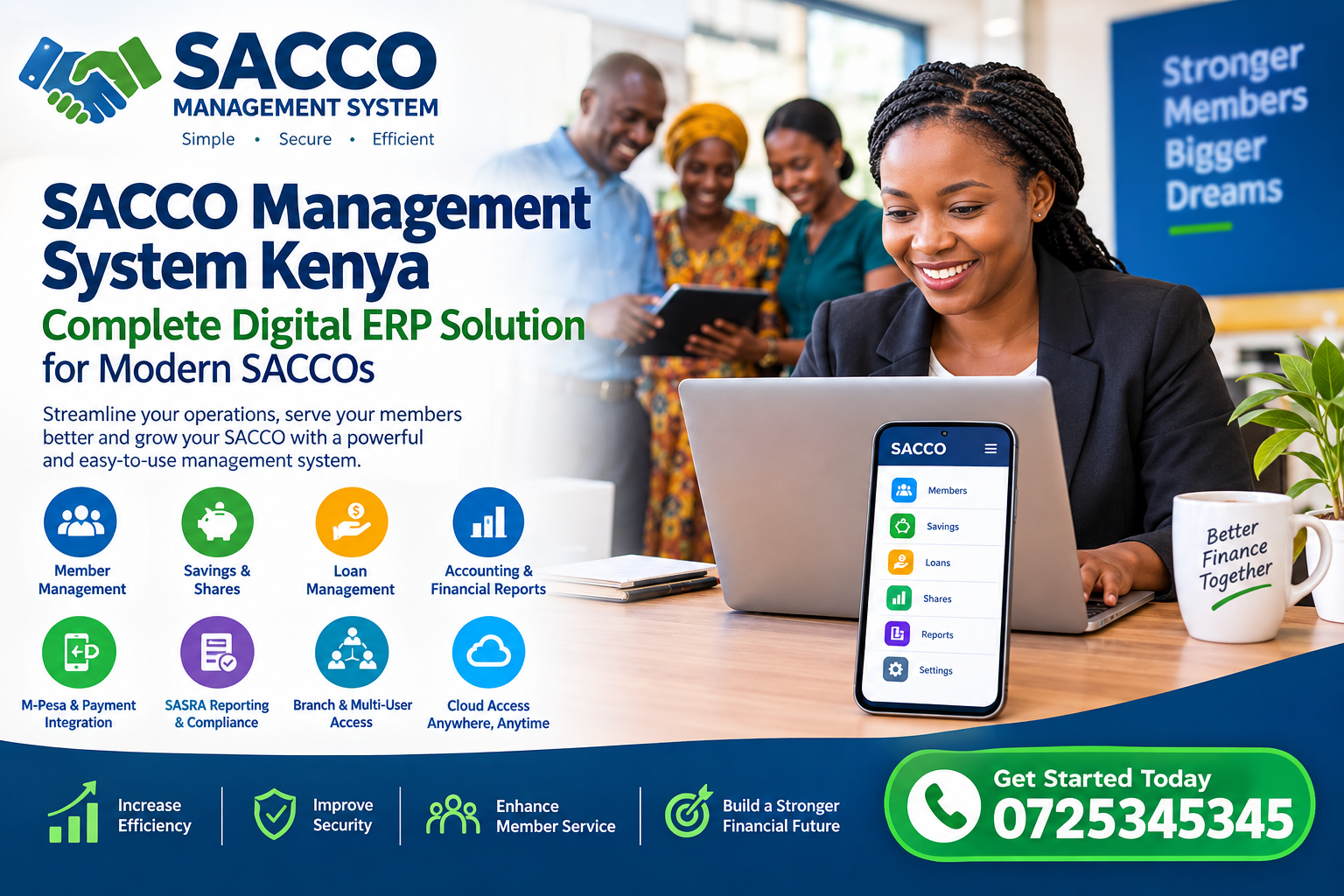
    Running a Savings and Credit Cooperative Organization (SACCO) involves much more than recording member contributions and processing loans. Modern SACCOs need accurate financial records, efficient member management, automated loan processing, reliable reporting, secure data, and convenient digital services.

    A SACCO Management System in Kenya brings these operations together in one digital platform. Instead of depending on spreadsheets, paper records, disconnected applications, and manual calculations, SACCOs can use integrated software to manage members, savings, shares, loans, accounting, payments, reporting, and other daily operations.

    The demand for digital SACCO solutions continues to grow as cooperatives look for better efficiency, transparency, security, and member experiences. Existing solutions in Kenya commonly combine member management, savings, loan processing, financial reporting, integrations, and self-service capabilities.Chama Savings Tracking Software Kenya helps chama groups record member contributions, monitor savings, track transactions, and maintain accurate financial records in one place.With Chama Savings Tracking Software Kenya, groups can easily monitor individual member savings and identify missed or delayed contributions.

    SACCO Management System KenyaWhat Is aChama Management Software Kenya

    ?

    Using Chama Savings Tracking Software Kenya makes it easier to monitor member savings and contribution history.A SACCO Management System is software designed to help Savings and Credit Cooperative Organizations manage their financial and administrative operations digitally.

    A comprehensive system can centralize:

    • Member registration and management
    • Member contributions
    • Savings and deposits
    • Share capital
    • Loan applications
    • Loan approvals
    • Loan disbursements
    • Loan repayments
    • Guarantor management
    • Accounting
    • Financial reporting
    • Dividends
    • Payments
    • SMS and email communication
    • User access controls
    • Audit trails
    • Compliance reporting

    Instead of maintaining separate records for each department, an integrated SACCO ERP connects these processes through one centralized database.

    Why SACCOs in Kenya Need Management Software

    Traditional SACCO administration can involve paper forms, spreadsheets and manual reconciliation. These processes become increasingly difficult as membership and transaction volumes grow.

    A digital SACCO management system can help reduce repetitive administrative work while improving the availability and accuracy of information.

    Modern SACCO platforms in Kenya increasingly emphasize cloud access, automated processing, reporting, security, member self-service and payment integrations.

    1. Reduce Manual Data Entry

    Staff can capture member information, transactions and loan records digitally instead of repeatedly entering information into different files.

    This reduces duplication and creates a more organized information system.

    2. Improve Member Management

    A SACCO can maintain centralized member profiles containing relevant registration information, savings, shares, loans, beneficiaries and transaction history.

    Staff can retrieve member information faster and provide better service.

    3. Automate Loan Processing

    Loan management is one of the most important components of SACCO software.

    A good system can support:

    • Online loan applications
    • Loan appraisal
    • Guarantor management
    • Approval workflows
    • Interest calculations
    • Repayment schedules
    • Loan disbursement
    • Repayment tracking
    • Arrears monitoring
    • Loan statements

    Automating these processes can reduce calculation errors and shorten processing times.

    4. Improve Financial Control

    Integrated accounting features allow financial transactions to flow into the organization’s financial records.

    Depending on the system, SACCO management can monitor income, expenses, assets, liabilities, cash flow and other financial information from a centralized platform.

    Key Features of a SACCO Management System

    When choosing SACCO management software in Kenya, organizations should evaluate the complete feature set rather than focusing on one module.

    Member Management

    Member management forms the foundation of a SACCO system.

    Important capabilities include:

    • Digital member registration
    • Member profiles
    • KYC information
    • Beneficiary records
    • Next-of-kin information
    • Member status
    • Share records
    • Contribution history
    • Account statements
    • Member search

    Centralizing member information makes it easier for authorized staff to access accurate records.

    Savings and Contributions Management

    A modern SACCO management system should make it easier to track member savings and contributions.

    The platform can help manage:

    • Regular savings
    • Deposits
    • Share capital
    • Welfare contributions
    • Special contributions
    • Member balances
    • Transaction histories

    Automated records can also make reconciliation easier.

    Loan Management

    Loan management should cover the complete loan lifecycle.

    The system can support:

    1. Loan application
    2. Loan appraisal
    3. Guarantor verification
    4. Approval
    5. Disbursement
    6. Repayment scheduling
    7. Payment posting
    8. Arrears tracking
    9. Loan closure

    Some modern platforms also provide automated deductions, configurable loan products and digital applications.

    Accounting and Financial Management

    A SACCO ERP software solution should connect operational transactions with financial management.

    Useful accounting capabilities include:

    • General ledger
    • Income and expenditure
    • Cash management
    • Bank reconciliation
    • Accounts payable
    • Accounts receivable
    • Financial statements
    • Budget management
    • Transaction tracking

    This creates a stronger connection between SACCO operations and financial reporting.

    M-Pesa and Payment Integration

    Digital payments are important to Kenyan SACCOs.

    A modern SACCO management system can integrate with mobile money and banking channels to simplify collections, repayments and reconciliation.

    M-Pesa integration can support processes such as:

    • Member contributions
    • Loan repayments
    • Deposits
    • Payment notifications
    • Automated transaction matching
    • Digital receipts

    Some current SACCO platforms specifically offer M-Pesa integration and automated reconciliation.

    Reporting and Analytics

    Management needs reliable information to make decisions.

    A SACCO system can provide reports covering:

    • Member growth
    • Savings
    • Shares
    • Loans
    • Loan arrears
    • Repayments
    • Income
    • Expenses
    • Liquidity
    • Financial performance
    • Management statistics

    Automated reporting can save staff significant time compared with preparing reports manually.

    Member Self-Service

    Members increasingly expect to access their financial information without visiting a SACCO office.

    Depending on the platform, members may be able to:

    • Check balances
    • View statements
    • Apply for loans
    • Monitor loan status
    • Receive notifications
    • View contributions
    • Access account information

    Member self-service can reduce pressure on customer service teams while improving convenience.

    What Is SACCO ERP Software?

    SACCO ERP software is an integrated enterprise resource planning solution specifically configured for SACCO operations.

    Instead of using separate software for membership, loans, accounting and reporting, an ERP approach connects these functions.

    For example, when a member makes a contribution, the transaction can update the member’s account and relevant financial records.

    When a loan repayment is received, the system can update the loan balance and transaction history.

    This interconnected approach helps create a single source of operational information.A reliable Chama Savings Tracking Software Kenya solution also reduces manual paperwork and makes it easier to access accurate savings reports.

    Cloud-Based SACCO Management System

    A cloud-based SACCO management system stores and processes information through online infrastructure rather than relying entirely on a local computer.

    This can provide advantages such as:

    • Remote accessibility
    • Centralized data
    • Easier system updates
    • Scalability
    • Reduced local infrastructure requirements
    • Multi-user access
    • Online reporting

    Several SACCO software providers in Kenya now position their platforms as cloud-based systems accessible through web browsers and mobile devices.

    However, SACCOs should still evaluate security, backups, availability, access controls and data protection before selecting a provider.

    SACCO Management System and SASRA Compliance

    Compliance is an important consideration when selecting SACCO software in Kenya.

    SACCOs should choose systems that support their applicable regulatory and reporting requirements rather than assuming that every software package automatically guarantees compliance.

    Some current platforms specifically advertise SASRA-oriented reporting and compliance functionality.

    Before purchasing software, management should ask:

    • Which regulatory reports are supported?
    • How frequently are reports updated?
    • Can reports be exported?
    • Is an audit trail available?
    • How are user permissions controlled?
    • How are backups handled?
    • How is sensitive member information protected?

    Benefits of aChama Management Software Kenya

    Better Efficiency

    Automation reduces repetitive administrative tasks and allows employees to concentrate on higher-value activities.

    Greater Accuracy

    Automated calculations and centralized records can reduce errors associated with manual data entry and spreadsheet calculations.

    Improved Transparency

    A proper audit trail can help management track transactions and user activities.

    Faster Loan Processing

    Digital workflows can move applications from submission to approval more efficiently.

    Better Member Experience

    Members can receive faster service and, where supported, access information through digital channels.

    Improved Decision-Making

    Real-time or regularly updated reports give management better visibility into the SACCO’s performance.

    Scalability

    A digital platform can provide a foundation for supporting increasing numbers of members and transactions.

    How to Choose theChama Management Software Kenya

    A reliable Chama Savings Tracking Software Kenya solution can reduce manual record keeping and improve financial accuracy.Choosing software requires more than searching for the cheapest solution.

    Use the following checklist.

    1. Check the Core Modules

    Confirm that the platform supports the functions your SACCO actually needs.

    2. Evaluate Security

    Ask about:

    • Encryption
    • User permissions
    • Authentication
    • Backups
    • Audit trails
    • Data recovery

    3. Check Integrations

    If your SACCO relies on M-Pesa, banks, SMS, USSD or mobile applications, confirm that the required integrations are available.

    4. Ask About Reporting

    Request demonstrations of the reports your management and regulatory teams require.

    5. Consider Scalability

    The system should support future growth rather than only your current membership.

    6. Evaluate Support and Training

    Implementation does not end when the software is installed.

    Ask whether the provider offers:

    • Staff training
    • Technical support
    • System updates
    • Data migration
    • Troubleshooting
    • Customization

    7. Request a Demonstration

    A live demonstration allows management to test real workflows before making a purchasing decision.

    Chama Management Software Kenya vs Spreadsheets

    Spreadsheets may work for very small operations, but they can become difficult to manage as transaction volumes increase.

    Area Spreadsheets SACCO Management System
    Member management Manual Centralized
    Loan processing Manual calculations Automated workflows
    Reporting Time-consuming Automated reports
    Access control Basic Role-based controls
    Audit trail Limited System-based tracking
    Member self-service Limited Can be integrated
    Payment integration Requires additional work Can be integrated
    Scalability Limited Designed for growth

    The right technology depends on the size, structure and requirements of each SACCO.

    Who Can Use aChama Management Software Kenya

    A digital SACCO platform can support different types of cooperative organizations, including:

    • Deposit-taking SACCOs
    • Non-deposit-taking SACCOs
    • Employee SACCOs
    • Teachers’ SACCOs
    • Farmers’ SACCOs
    • Transport SACCOs
    • Community SACCOs
    • Investment cooperatives
    • Credit cooperatives

    The exact modules required will depend on the SACCO’s operating model.

    The Future of SACCO Management in Kenya

    SACCO technology is moving toward more integrated digital services.

    Modern platforms increasingly combine core SACCO operations with mobile applications, USSD, digital payments, online member portals, analytics and automated reporting.

    The objective is no longer simply to replace paper records. The goal is to create a connected digital financial environment where members, staff and management can access the information and services they need efficiently.

    Frequently Asked Questions

    What is the best SACCO management system in Kenya?

    The best SACCO management system depends on the organization’s size, regulatory requirements, budget, integrations and operational needs. Compare features, security, support, scalability and reporting before choosing a provider.

    How much does SACCO management software cost in Kenya?

    Pricing varies depending on the number of members, modules, integrations, hosting model, customization, implementation and support requirements. Request a quotation based on your SACCO’s specific requirements rather than relying on a generic price.

    Can SACCO software integrate with M-Pesa?

    Yes. Some SACCO platforms provide M-Pesa and other payment integrations. Confirm whether the specific transaction types and reconciliation workflows your SACCO needs are supported.

    Can SACCO software manage loans?

    Yes. Loan management is a core component of many SACCO platforms. Features can include applications, appraisal, guarantors, approvals, repayment schedules, disbursements and arrears tracking.

    Is cloud-based SACCO software secure?

    Cloud software can provide strong security, but security depends on the provider’s architecture and controls. Before selecting a platform, investigate authentication, encryption, backups, access control, audit logging and disaster recovery.

    Can members access their accounts online?

    Choosing the right Chama Savings Tracking Software Kenya can help savings groups manage member contributions, track savings, maintain accurate records, and improve financial transparency. With the right software, chama leaders can reduce manual work and manage their group more efficiently.

    With Chama Savings Tracking Software Kenya, chama leaders can access organized records and generate useful financial reports.Choosing the right Chama Savings Tracking Software Kenya can improve transparency, accountability, and day-to-day financial management.Many modern SACCO platforms provide member portals, mobile applications, USSD or other digital self-service channels. Availability depends on the selected system.

    A SACCO Management System Kenya solution can transform how a cooperative manages members, savings, shares, loans, accounting, payments and reporting.

    Instead of depending on disconnected spreadsheets and manual processes, SACCOs can centralize their operations through an integrated digital platform.

    When evaluating SACCO management software in Kenya, prioritize functionality, security, scalability, integrations, reporting, regulatory support, usability and after-sales support.For modern savings groups, Chama Savings Tracking Software Kenya provides a simple way to manage contributions, members, transactions, and financial reports efficiently.

    The right SACCO ERP should not simply store information. It should help the organization operate more efficiently, improve financial control, serve members faster and build a stronger foundation for long-term growth.

    For SACCOs planning their digital transformation, the best starting point is to document their current processes, identify operational gaps and then compare management systems against those specific requirements.Choosing the right Chama Savings Tracking Software Kenya can help your group improve transparency, accuracy, and savings management.

  • Understanding Chama Management System: Complete Guide for Kenyan Chamas

    Understanding Chama Management SystemUnderstanding Chama Management System

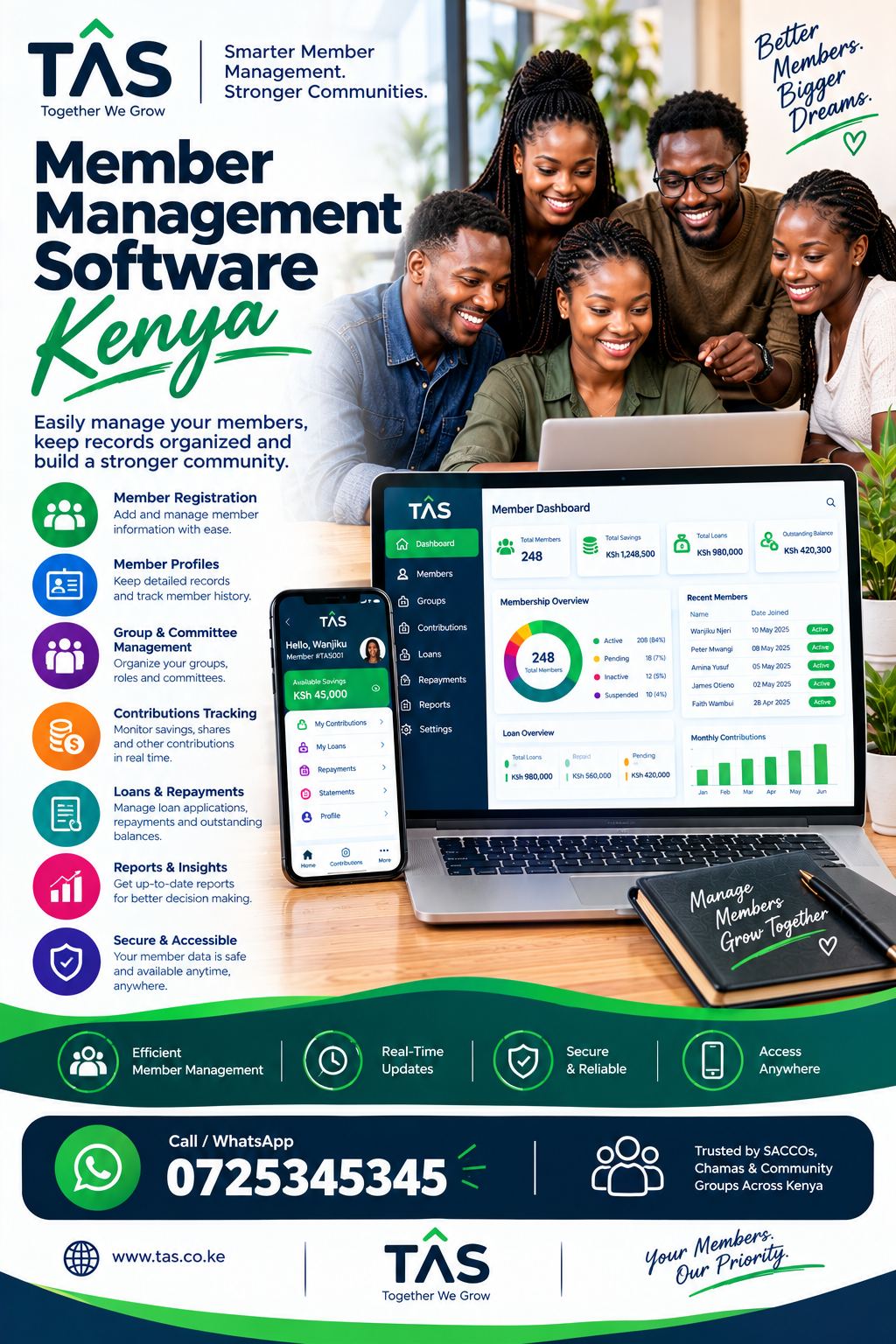
    A chama management system is a digital platform designed to help savings groups, investment groups, table-banking groups, merry-go-rounds, welfare groups, and other member-based organizations manage their activities in one place.

    Traditionally, many chamas depend on notebooks, spreadsheets, WhatsApp conversations and manually prepared financial statements. While these methods may work for a small group, they can become difficult to manage as membership, contributions, loans and investments increase.

    A modern chama management system in Kenya brings important information together, including member records, contributions, savings, loans, repayments, meetings, expenses and financial reports.

    This makes it easier for officials and members to understand what is happening within the group.

    Modern Kenyan chama platforms increasingly provide features such as contribution tracking, loan management, member management, reporting and payment integrations.


    What Is a Chama Management System?

    A chama management system is software that automates and organizes the administrative and financial activities of a chama.

    Instead of maintaining separate records for every activity, the group can use one centralized system.

    For example, a chama may need to keep track of:

    • Member registration
    • Monthly contributions
    • Weekly savings
    • Welfare contributions
    • Loans
    • Loan repayments
    • Interest
    • Fines and penalties
    • Group expenses
    • Investments
    • Meeting attendance
    • Meeting minutes
    • Member statements
    • Financial reports

    A well-designed system can make these records easier to maintain and retrieve.

    The main objective is not simply to replace a notebook with software. The objective is to make chama management more organized, transparent and efficient.


    Why Chamas Are Moving From Manual Records to Digital Systems

    Many groups start with simple record-keeping methods.

    The treasurer may record contributions in a notebook while the secretary keeps member information and meeting minutes. Another member may maintain an Excel spreadsheet containing loan balances.

    This can create several problems.

    1. Records can become difficult to reconcile

    When information exists in different notebooks and spreadsheets, comparing records can take considerable time.

    2. Human errors can occur

    Manual calculations can result in incorrect balances, duplicated entries or missing transactions.

    3. Financial transparency can become difficult

    Members want to understand their contributions, savings, loans and group finances.

    Digital records can make information easier to retrieve and review.

    4. Reporting takes longer

    Preparing monthly or annual reports manually can require significant administrative work.

    5. Growing groups need better organization

    A system that works for 10 members may not be convenient when a chama has dozens or hundreds of members.

    This is one reason purpose-built chama software has become increasingly common in Kenya. Existing platforms now market features such as digital ledgers, M-Pesa reconciliation, loan workflows, reports and member dashboards.


    Key Features of a Chama Management System

    The best chama management system should support the actual activities of the group rather than simply providing generic accounting tools.

    1. Member Management

    Member management is one of the most important parts of chama software.

    The system should allow authorized officials to maintain organized member records.

    Depending on the platform, information may include:

    • Member name
    • Contact information
    • Membership status
    • Joining date
    • Contribution history
    • Savings balance
    • Loan balance
    • Guarantor information
    • Member statements

    A centralized member database also makes it easier for new officials to take over administrative responsibilities.


    2. Contribution Tracking

    Contributions are at the heart of many savings and investment groups.

    A chama management system can help track:

    • Monthly contributions
    • Weekly contributions
    • Welfare contributions
    • Special contributions
    • Investment contributions
    • Missed contributions
    • Fines
    • Member balances

    Instead of manually searching through several pages of records, officials can retrieve contribution information from the system.

    Some modern platforms also support automated payment workflows and reconciliation through M-Pesa.


    3. M-Pesa Integration

    For Kenyan chamas, payment integration can be an important consideration.

    A system with M-Pesa support may allow groups to simplify contribution collection and payment reconciliation.

    Depending on the software, functionality can include:

    • Contribution payment requests
    • Payment confirmation
    • Automated transaction matching
    • Loan repayment tracking
    • Digital receipts
    • Member account updates

    This can reduce the amount of manual transaction entry required by the treasurer.

    However, groups should verify exactly which M-Pesa functionality is included before selecting a platform.


    4. Chama Loan Management

    Many chamas provide loans to members.

    Managing these loans manually can become complicated when there are multiple borrowers, interest rates, repayment schedules and outstanding balances.

    A chama management system can help manage the complete loan lifecycle.

    This may include:

    1. Loan application
    2. Loan review
    3. Approval
    4. Disbursement
    5. Repayment schedule
    6. Interest calculation
    7. Penalties
    8. Outstanding balance
    9. Loan clearance

    A good system should allow officials to see the status of loans without calculating every balance manually.


    5. Savings and Investment Management

    Investment-focused chamas need more than contribution tracking.

    They may invest pooled funds in different assets or financial products according to their group’s rules.

    A digital system can help maintain records of:

    • Investment contributions
    • Investment amounts
    • Investment income
    • Group expenses
    • Member ownership or shares
    • Investment balances
    • Financial performance

    The exact investment functionality varies between platforms, so a group should confirm whether the system supports its particular investment structure.


    6. Financial Reports

    Reports are essential for accountability.

    A chama management system can generate reports showing the group’s financial activity over a selected period.

    Useful reports may include:

    • Contribution reports
    • Member statements
    • Loan reports
    • Repayment reports
    • Income reports
    • Expense reports
    • Savings reports
    • Investment reports
    • Outstanding balances
    • Financial summaries

    Reports can also make meetings easier because officials can present organized information to members.


    7. Member Statements

    Members often want to know:

    How much have I contributed?

    How much do I owe?

    What is my current savings balance?

    What loan repayments have I made?

    A digital member statement can bring this information together.

    Member access should also be controlled so that members only see information they are authorized to access.


    8. Meeting Management

    Chamas are not only financial organizations.

    They also rely on meetings and group decisions.

    Some chama management systems provide tools for:

    • Meeting scheduling
    • Attendance
    • Agendas
    • Minutes
    • Decisions
    • Action items
    • Member notifications

    Keeping meeting records digitally can make it easier to refer back to previous decisions.


    9. Security and User Permissions

    Financial information should be protected carefully.

    A chama software platform should provide appropriate access controls.

    For example, the chairperson, secretary and treasurer may have different responsibilities.

    Useful security features can include:

    • User accounts
    • Password protection
    • Role-based permissions
    • Activity logs
    • Secure data storage
    • Backups
    • Controlled financial access

    Security should be considered just as important as convenience when selecting software.


    10. Automated Notifications

    Notifications can help members remember important activities.

    Depending on the system, notifications may be used for:

    • Contribution reminders
    • Loan repayment reminders
    • Meeting announcements
    • Payment confirmations
    • Loan updates
    • Important group notices

    Automated reminders can reduce the amount of repetitive communication required from officials.


    Chama Management System vs Excel

    Excel can be useful for simple record keeping, especially for very small groups.

    However, dedicated chama software can provide functionality that is difficult to reproduce manually.

    Feature Excel Chama Management System
    Member records Yes Yes
    Contribution tracking Yes Yes
    Loan management Manual Automated/workflow-based
    M-Pesa integration Usually manual May be integrated
    Member statements Manual Automated
    Reports Manual setup Built-in/custom
    User permissions Limited Role-based
    Notifications Limited Often automated
    Audit trail Requires setup Often built in
    Mobile access Depends on setup Usually designed for mobile

    The right choice depends on the size and complexity of the group.


    Benefits of Using a Chama Management System in Kenya

    Better Financial Transparency

    Members can have clearer access to relevant financial information.

    Reduced Administrative Work

    Automating repetitive calculations and reporting can save officials time.

    Fewer Manual Errors

    Automated calculations and structured records can reduce common data-entry mistakes.

    Easier Loan Management

    Officials can monitor applications, repayments and outstanding balances from one system.

    Faster Reporting

    Financial reports can be generated without rebuilding spreadsheets every month.

    Better Member Communication

    Notifications and digital statements can keep members informed.

    Easier Record Keeping

    Important information can be stored in an organized digital environment instead of scattered across notebooks and phones.


    How Does a Chama Management System Work?

    A typical implementation can follow these steps.

    Step 1: Create the Chama

    The administrator creates an account and enters basic information about the group.

    Step 2: Add Members

    Members are registered and assigned the appropriate roles.

    Step 3: Configure Group Rules

    The administrator enters contribution amounts, payment schedules, loan rules, interest rates and other applicable rules.

    Step 4: Start Recording Transactions

    Contributions, loans, repayments and expenses are entered into the system.

    Step 5: Generate Reports

    The system organizes the information into statements and financial reports.

    Step 6: Monitor Group Performance

    Officials can use dashboards and reports to understand the group’s financial position.

    Some newer platforms also aim to automate much of this process through mobile, WhatsApp, USSD and payment integrations.


    How to Choose the Best Chama Management System

    Choosing software should not be based only on how attractive the dashboard looks.

    Before making a decision, ask the following questions.

    Does It Support Your Chama Structure?

    Different groups operate differently.

    A merry-go-round may need rotation management, while an investment group may need investment and share tracking.

    Does It Support M-Pesa?

    For Kenyan groups, payment integration can be particularly useful.

    Confirm whether the system supports the payment workflow your group actually uses.

    Can Members Access Their Records?

    Member self-service can reduce the workload on officials.

    Are Reports Available?

    Check whether the system produces the reports required for monthly meetings, AGMs and internal accountability.

    Is the System Mobile Friendly?

    Members and officials should be able to access important information from smartphones where appropriate.

    Are Permissions Available?

    The treasurer should not necessarily have the same access as every ordinary member.

    Can Data Be Exported?

    Ask whether the group can export its information if it needs to change systems.

    What Does It Cost?

    Do not look only at the advertised subscription.

    Consider:

    • Setup costs
    • Monthly or annual fees
    • Transaction charges
    • Support costs
    • Additional users
    • Additional modules

    Chama Management System for Small and Large Groups

    A small chama may only require:

    • Member management
    • Contribution tracking
    • Basic reports
    • Meeting records

    A larger investment group may need:

    • Advanced member management
    • M-Pesa integration
    • Loan management
    • Investment tracking
    • Automated reports
    • Role-based access
    • Notifications
    • Audit trails
    • Data export

    Therefore, the best chama management system is not necessarily the one with the most features.

    It is the one that fits the group’s actual needs and budget.


    Chama Management Software Kenya: What Should You Look For?

    If you search for chama management software Kenya, you will find several platforms offering overlapping functionality.

    Current providers highlight features such as contribution management, loans, welfare, member records, reporting, payment integration and security.

    Before selecting one, create a simple checklist:

    Financial management

    • Contributions
    • Savings
    • Loans
    • Repayments
    • Expenses
    • Investments

    Administration

    • Members
    • Roles
    • Meetings
    • Attendance
    • Documents

    Technology

    • Mobile access
    • Cloud access
    • Backups
    • Security
    • Notifications

    Payments

    • M-Pesa
    • Payment reconciliation
    • Receipts

    Reporting

    • Member statements
    • Financial reports
    • Loan reports
    • Contribution reports

    This approach makes software comparisons much more objective.


    Common Mistakes When Choosing Chama Software

    Choosing Based Only on Price

    Cheap software may not provide the functionality your group actually requires.

    Ignoring Data Security

    Financial records should not be treated like ordinary documents.

    Not Testing the System

    A demo or trial can help officials determine whether the system is easy to use.

    Forgetting About Data Export

    Always understand how your group can retrieve its data.

    Choosing Too Many Features

    More features do not automatically mean better software.

    Not Involving Members

    The officials may select software that members find difficult to use.


    Frequently Asked Questions About Chama Management Systems

    What is a chama management system?

    A chama management system is software that helps savings and investment groups manage members, contributions, loans, payments, meetings, reports and other administrative activities.

    Why use chama management software?

    It can reduce manual administration, organize financial records, improve reporting and make group information easier to manage.

    Can a chama management system track M-Pesa payments?

    Some systems provide M-Pesa integration or reconciliation. However, functionality varies by provider, so confirm the exact payment features before purchasing.

    Can chama software manage loans?

    Yes. Many dedicated systems include loan applications, approvals, repayment tracking, interest calculations and outstanding balances.

    Is chama management software suitable for investment groups?

    Yes. Some platforms support investment groups in addition to ordinary savings groups, although the available investment features differ between providers.

    Can members access their own statements?

    Many modern platforms provide member dashboards or statements. Confirm the exact member-access functionality offered by your chosen provider.

    Is chama software better than Excel?

    For a simple group, Excel may be sufficient. As a group becomes larger or more complex, dedicated software can provide specialized features, permissions, automation and reporting that are harder to manage manually.


    Final Thoughts

    A chama management system can transform how a savings or investment group organizes its daily operations.

    Instead of relying entirely on notebooks, spreadsheets and manually reconciled payment records, a digital platform can bring member management, contributions, loans, payments, reporting and administration together.

    The most important consideration is not simply finding software with the longest feature list. Your chama should select a system that is secure, easy to use, transparent, affordable and suitable for the group’s actual rules and financial activities.

    For Kenyan chamas, particular attention should be given to M-Pesa support, contribution tracking, loan management, member statements, reporting, security and mobile accessibility.

    A properly implemented system can give chama officials better control over records while giving members greater visibility into their group’s activities.

  • Welfare Groups in Kenya: A Practical Guide to Better Member and Financial Management

    Welfare Group Management Software Kenya
    Welfare Groups in Kenya: A Practical Guide to Better Member and Financial Management

    Welfare groups play an important role in helping members support one another during emergencies, family events, medical situations, education needs and other circumstances agreed upon by the group. Some welfare groups are informal, while others have developed into structured organisations with regular contributions, meetings, savings and financial support programmes.

    As a welfare group grows, managing information can become increasingly difficult. Member details may be stored in notebooks, contribution records may be kept in spreadsheets, and meeting decisions may remain in handwritten minutes. When different records are kept separately, it can take considerable time to find accurate information.

    Digital management can help welfare groups organise their records and simplify routine administration. The right system can bring member information, contributions, welfare funds, meetings, reports and other activities into a more structured environment.

    Understanding Welfare Group Management

    Welfare group management involves much more than collecting monthly contributions. Officials may need to register members, track their contributions, record welfare payments, manage group expenses, maintain meeting records and prepare financial reports.

    A good system should support the group’s existing rules instead of making the organisation unnecessarily complicated. It should help officials perform routine tasks accurately while giving members confidence that their records are being maintained properly.

    For groups that are expanding, moving from completely manual administration to a digital system can be an important step towards better organisation.

    60 Important Areas for Welfare Groups

    1. Centralising Member Information

    Using Welfare Group Management Software Kenya can give a welfare group a central place to organise member information. Instead of maintaining separate lists for names, contacts, contributions and welfare participation, authorised officials can work from structured member records. This can make it easier to identify active members, update details and prepare reports. A central register also provides continuity when a new secretary or treasurer takes over.

    2. Registering New Members

    Welfare Group Management Software Kenya can make the process of registering new members more organised. A welfare group can establish the information it needs before accepting a member into its records. Depending on its rules, this could include a name, contact information, membership number and joining date. A consistent registration process helps prevent incomplete records and ensures that new members are properly included in future contribution and welfare activities.

    3. Maintaining Accurate Member Records

    With Welfare Group Management Software Kenya, officials can maintain member records in a more consistent way. Member details can change over time, particularly phone numbers and other contact information. Having an organised record makes it easier to update information when a member provides new details. Accurate records are important because contribution and welfare transactions need to be associated with the correct people.

    4. Tracking Membership Status

    Welfare Group Management Software Kenya can help a welfare organisation keep track of membership status. Groups may have active members, inactive members or former members depending on their policies. Recording these changes helps ensure that reports reflect the current membership position. It can also prevent former members from accidentally being included in current contribution calculations or welfare participation records.

    5. Managing Monthly Contributions

    Using Welfare Group Management Software Kenya can make regular contribution tracking more organised. Many welfare groups depend on members contributing a fixed amount at agreed intervals. Recording each payment against the correct member makes it easier to determine who has contributed and what amount the group has received. This also provides a useful history when members ask about their previous payments.

    6. Recording Different Types of Contributions

    Welfare Group Management Software Kenya can help groups distinguish between different types of financial contributions where their structure requires it. A welfare group may collect regular welfare contributions as well as additional amounts for a particular activity or emergency. Keeping these records separate can make financial reporting clearer and help officials explain how group funds have been collected and used.

    7. Monitoring Outstanding Contributions

    Using Welfare Group Management Software Kenya can help officials identify outstanding contributions. If members are expected to contribute monthly, the group needs a reliable way to determine which payments have been received and which remain outstanding. This information can support appropriate follow-up. It can also help the treasurer prepare accurate reports without manually comparing several pages of records.

    8. Managing Welfare Fund Balances

    Welfare Group Management Software Kenya can support better visibility into the group’s welfare fund. Officials need to understand how much money has been collected, how much has been paid out and what remains available. Keeping these transactions organised makes it easier to monitor the group’s financial position. It can also help the committee avoid making commitments without understanding the funds currently available.

    9. Recording Welfare Payments

    A welfare group can use Welfare Group Management Software Kenya to maintain records of welfare payments made to members. Payments may be associated with emergencies or other events covered by the group’s rules. Recording the amount, recipient and relevant details creates a reference that can be reviewed later. This is particularly important when the group needs to prepare financial reports for members.

    10. Managing Welfare Requests

    Welfare Group Management Software Kenya can help organise requests for welfare assistance. A member may need support because of an event or situation covered by the group’s welfare policy. Recording the request and its outcome gives officials a clearer administrative trail. The software does not replace the committee’s decision-making process; it simply helps document the information surrounding the request.

    11. Supporting Approval Processes

    Using Welfare Group Management Software Kenya can make approval processes easier to document. Depending on the group’s constitution, welfare requests may require approval from officials or members. Recording the decision helps ensure that payments are made based on an authorised process. It also gives the treasurer a reference before releasing group funds.

    12. Recording Group Expenses

    Welfare Group Management Software Kenya can help welfare groups organise expenses in addition to member contributions. Groups may incur administrative costs, meeting expenses or other approved expenditures. Recording these transactions alongside income provides a more complete picture of the group’s finances. Regularly updating expenses also makes financial reports more useful during meetings.

    13. Managing Group Budgets

    Using Welfare Group Management Software Kenya can support budget planning for welfare activities. A group may want to estimate expected contributions and planned expenses before the start of a particular period. Having previous financial information available can help officials prepare more realistic budgets. The final decisions should always follow the group’s approved financial procedures.

    14. Tracking Financial Transactions

    Welfare Group Management Software Kenya can give officials a structured place to record financial transactions. This is important because a welfare group’s financial position depends on both money coming in and money going out. When transactions are recorded consistently, officials can review the group’s activity without relying entirely on memory or several independent notebooks.

    15. Preparing Member Statements

    Using Welfare Group Management Software Kenya can make it easier to provide members with clearer statements where the selected system supports this feature. A statement can show relevant contributions and other recorded activities. This can be useful when a member wants to confirm their financial history. Clear statements can also reduce disagreements caused by missing or unclear records.

    16. Improving Financial Transparency

    Welfare Group Management Software Kenya can support transparency by making financial records more organised and easier for authorised officials to review. Transparency is particularly important in welfare groups because members contribute money with the expectation that it will be managed responsibly. Digital records can complement regular meetings, financial reports and other accountability procedures established by the organisation.

    17. Supporting the Treasurer

    The treasurer can benefit from Welfare Group Management Software Kenya when managing contributions, welfare payments, expenses and reports. Instead of repeatedly calculating figures manually, the treasurer can work from structured transactions. This can reduce repetitive administrative work and make it easier to prepare information before meetings. The treasurer should still reconcile records and follow the group’s financial controls.

    18. Supporting the Secretary

    Welfare Group Management Software Kenya can also assist the secretary with membership administration. Secretaries may be responsible for maintaining member lists, meeting information and communications. Having member records organised in one place can reduce the need to update multiple documents. It can also make leadership handovers easier because important information remains accessible to authorised officials.

    19. Maintaining Meeting Records

    Using Welfare Group Management Software Kenya can complement a welfare group’s meeting administration. Meetings may be used to discuss contributions, welfare requests, expenses and other organisational matters. Keeping relevant records together can help officials understand which decisions were made and ensure that approved actions are followed up after the meeting.

    20. Tracking Meeting Attendance

    Welfare Group Management Software Kenya can support attendance tracking where this is part of the group’s administrative requirements. Some welfare groups may want to know whether members regularly participate in meetings. Attendance information can be useful for internal reporting or for applying rules that the group has formally adopted. It should only be collected and used for legitimate organisational purposes.

    21. Managing Member Communication

    Using Welfare Group Management Software Kenya can help officials maintain accurate member information needed for communication. Groups may need to notify members about meetings, contribution deadlines, welfare decisions or other activities. Having current contact details can make these communications more reliable. The group should still follow responsible practices when handling members’ personal information.

    22. Supporting Member Engagement

    Welfare Group Management Software Kenya can help a welfare group understand its membership activity. Regular participation is important for many groups because the organisation depends on members contributing and attending meetings. Organised records can help officials identify participation patterns and communicate with members more effectively when appropriate.

    23. Managing Emergency Support

    Welfare groups often exist partly to help members during difficult circumstances. Using Welfare Group Management Software Kenya can help officials maintain records of emergency support provided to members. The group can document relevant payments and maintain a history of assistance. This can help with future reporting and ensure that welfare funds are being managed according to the group’s rules.

    24. Recording Welfare Categories

    Welfare Group Management Software Kenya can help groups organise welfare activities into categories where necessary. A group may have separate arrangements for medical support, bereavement, education, family emergencies or other approved situations. Categorising records can make reporting easier and help officials understand how welfare funds are being used.

    25. Monitoring Welfare Spending

    Using Welfare Group Management Software Kenya can make it easier to monitor spending from the welfare fund. Officials can review payments and expenses over a selected period and compare them with available funds. This information can help committees understand whether the group’s current contribution structure is sufficient to support its welfare activities.

    26. Maintaining a Transaction History

    Welfare Group Management Software Kenya can provide a structured history of financial activity. Historical records are useful when questions arise about a previous payment or contribution. Instead of searching through several notebooks, authorised officials can review the available transaction history. This can save time and provide better evidence when resolving financial queries.

    27. Reducing Duplicate Records

    Using Welfare Group Management Software Kenya can help reduce duplicate member records when the group follows a consistent registration process. Duplicate profiles can cause financial records to be split between two versions of the same person. Before creating a new profile, officials should check whether the member already exists. This simple practice can improve data accuracy.

    28. Improving Data Accuracy

    Welfare Group Management Software Kenya can support more consistent data entry. Structured forms can encourage officials to record information in the same way each time. This can reduce common problems such as incomplete names, missing membership numbers or inconsistent categories. Regular review remains necessary because digital systems cannot correct incorrect information that users enter.

    29. Managing Member Changes

    Members may change their phone numbers, addresses or other information during their time in the organisation. With Welfare Group Management Software Kenya, authorised officials can maintain updated records when changes are reported. Keeping information current makes communication easier and reduces the chance that important notices will be sent using outdated contact details.

    30. Managing Former Members

    Welfare Group Management Software Kenya can help distinguish former members from current participants. A member who leaves may still have historical contribution or welfare information that the group needs to retain according to its policies. Keeping appropriate historical records avoids losing important information while ensuring that former members are not incorrectly treated as active participants.

    31. Role-Based Access

    Using Welfare Group Management Software Kenya can help organisations manage access according to official responsibilities. The treasurer may require financial access, while the secretary may primarily manage member information. Limiting access can help protect personal and financial records. Groups should review permissions whenever officials change roles or leave the committee.

    32. Protecting Member Information

    Welfare Group Management Software Kenya should be considered alongside appropriate privacy and security practices. Welfare records can contain personal and financial information that should not be available to everyone. Officials should understand who can access records, how passwords are managed and what security measures are available within the selected system.

    33. Creating Better Handover Processes

    Using Welfare Group Management Software Kenya can make leadership handovers more organised. When a new treasurer or secretary takes over, they need access to current member and financial information. A central system can reduce dependence on a previous official’s personal notebook or computer. This helps the organisation preserve continuity when committee positions change.

    34. Supporting Growing Groups

    As membership increases, Welfare Group Management Software Kenya can become more valuable. A welfare group with a small number of members may manage information manually without much difficulty. As membership and transaction volumes grow, however, searching through paper records can become time-consuming. Digital management provides greater structure for growing organisations.

    35. Supporting Large Membership Registers

    Welfare Group Management Software Kenya can help groups manage larger member registers. Search and filtering functions can make it easier to locate a particular person without scanning an entire document. This becomes particularly useful during meetings when officials need information quickly and do not want to spend several minutes searching through paper files.

    36. Connecting Members to Contributions

    Using Welfare Group Management Software Kenya can help connect individual members with their contribution history. This allows officials to see how much has been recorded against a particular member. A connected record also makes it easier to prepare individual statements and group reports because the information is already associated with the correct member.

    37. Supporting Welfare Eligibility

    Welfare Group Management Software Kenya can help officials access membership information relevant to welfare eligibility. Some groups have rules requiring a member to meet certain conditions before receiving assistance. Having accurate membership and contribution records can help officials apply those rules consistently. The system should support the group’s policies rather than make independent decisions.

    38. Managing Welfare Claims

    Using Welfare Group Management Software Kenya can help a welfare group organise claims or requests for assistance. Each request can be reviewed according to the group’s procedures, and the eventual outcome can be recorded. Maintaining this information can help officials track how welfare resources are being distributed and prepare accurate reports.

    39. Recording Approved Assistance

    Welfare Group Management Software Kenya can help officials record assistance that has been approved for a member. A clear record can include the relevant member, amount and date where appropriate. This provides a reference for the treasurer and committee and can make later financial reconciliation easier.

    40. Tracking Group Income

    Using Welfare Group Management Software Kenya can help welfare groups organise income from member contributions and other approved sources. Understanding total income is necessary when assessing the group’s financial position. Recording income promptly can also make reports more accurate and reduce the need for officials to reconstruct financial information later.

    41. Tracking Group Expenses

    Welfare Group Management Software Kenya can help officials record approved group expenses. Expenses may include welfare payments, meetings, administration or other costs recognised by the organisation. Recording them consistently helps show how group funds have been used. It also allows members to review financial information through the reporting processes established by the group.

    42. Preparing Monthly Reports

    Using Welfare Group Management Software Kenya can support monthly financial and membership reporting. Regular reports can show contributions received, welfare payments made, expenses and current balances. Monthly reporting gives officials an opportunity to identify discrepancies early instead of waiting until the end of the year to review the group’s entire financial history.

    43. Preparing Annual Reports

    Welfare Group Management Software Kenya can also assist with annual reporting where the system provides suitable reports. An annual review can help the group understand membership changes, total contributions, welfare spending and other financial activity. Having transactions recorded throughout the year makes this process more manageable than attempting to reconstruct twelve months of activity at once.

    44. Supporting Financial Reviews

    Using Welfare Group Management Software Kenya can make internal financial reviews more organised. Officials can compare recorded contributions and payments with available supporting records. Regular reviews can identify missing entries, duplicate transactions or other discrepancies. Finding problems early gives the group an opportunity to investigate and correct them using its established procedures.

    45. Supporting Accountability

    Welfare Group Management Software Kenya can support accountability by creating clearer records of financial activity and membership administration. Members need confidence that their contributions are being managed responsibly. Digital records can provide useful evidence when combined with proper approvals, regular reporting and oversight by the relevant committee.

    46. Making Meetings More Efficient

    Using Welfare Group Management Software Kenya can reduce the time spent searching for information during meetings. Officials can prepare relevant reports before members meet. This means discussions can focus more on decisions and less on trying to determine basic figures. Better preparation can also make meetings more structured and productive.

    47. Improving Member Statements

    Welfare Group Management Software Kenya can support clearer member statements where the platform provides this functionality. Members may want to confirm their contributions or understand how their recorded participation has changed over time. A well-organised statement provides a useful reference and can reduce misunderstandings between members and officials.

    48. Supporting Better Communication

    Using Welfare Group Management Software Kenya can help officials work with more accurate information when communicating with members. Whether the group is reminding members about contributions or sharing meeting information, current records are important. Communication should still be handled carefully, especially when the information being discussed relates to an individual’s finances or welfare situation.

    49. Managing Multiple Welfare Activities

    Welfare Group Management Software Kenya can help groups organise several welfare activities within one administrative structure. A group may have regular welfare contributions, emergency assistance, social activities and other member services. Separating these activities appropriately can make reports easier to understand and prevent different types of transactions from being mixed together.

    50. Supporting Community-Based Groups

    Using Welfare Group Management Software Kenya can benefit community-based welfare organisations that want to improve their administrative processes. These groups may operate through regular meetings and member contributions. Digital records can provide a more organised alternative to multiple notebooks while still allowing the group to maintain its existing structure and decision-making practices.

    51. Supporting Workplace Welfare Groups

    Welfare Group Management Software Kenya can also be useful for workplace welfare groups. Colleagues may contribute regularly and provide support to one another when members experience qualifying events. A central record can make it easier to manage contributions and communicate with members, especially when the organisation has grown beyond a small informal group.

    52. Supporting Family Welfare Groups

    Using Welfare Group Management Software Kenya can help family-based welfare groups organise their membership and financial records. Family groups may have unique rules concerning contributions and assistance. Digital management can still provide value by giving members a clear record of transactions while allowing the group to maintain its own policies.

    53. Supporting Church or Social Groups

    Welfare Group Management Software Kenya can help social and community groups maintain structured member records where appropriate. Such organisations may combine welfare activities with meetings and regular contributions. Keeping information organised can make it easier for officials to manage the group’s activities without relying on several disconnected documents.

    54. Supporting Long-Term Record Keeping

    Using Welfare Group Management Software Kenya can help preserve a group’s administrative history. Welfare groups can operate for many years, and their records may become valuable when reviewing previous contributions, payments and membership changes. A structured system can make historical information easier to locate than a collection of old notebooks.

    55. Making Leadership Transitions Easier

    Welfare Group Management Software Kenya can make it easier for incoming officials to understand the group’s current position. A new treasurer needs to know contribution balances, welfare payments and outstanding issues. A new secretary needs access to current membership information. Organised records make these transitions less dependent on verbal explanations.

    56. Reducing Administrative Work

    Using Welfare Group Management Software Kenya can reduce some repetitive administrative tasks. Officials can spend considerable time calculating totals, updating registers and preparing reports when everything is done manually. A structured system can automate or simplify some of these activities, allowing officials to focus more on managing the group and supporting members.

    57. Choosing Suitable Features

    When comparing Welfare Group Management Software Kenya, welfare groups should focus on features that solve their actual problems. Important areas may include member registration, contribution tracking, welfare payments, expenses, meetings, reports, statements, permissions and data security. A long list of features is not necessarily useful if the system is difficult for officials to use.

    58. Considering Data Security

    Before choosing Welfare Group Management Software Kenya, officials should understand how member information is protected. Questions about passwords, user permissions, backups and access management should be considered. The group should also have a process for removing or changing access when an official leaves a leadership position.

    59. Training Welfare Officials

    A successful transition to Welfare Group Management Software Kenya requires officials to understand the system. Training should focus on the tasks they actually perform, such as adding members, recording contributions, entering welfare payments and preparing reports. Simple practical training can help reduce errors and increase confidence among users.

    60. Building a Sustainable Administrative System

    Using Welfare Group Management Software Kenya can help a welfare group build a more sustainable approach to member and financial administration. The objective should be to create consistent processes for registration, contributions, welfare requests, payments, reporting, access control and leadership handovers. When technology is combined with clear rules and responsible management, it can become a useful part of the group’s everyday operations.

    Key Features Welfare Groups Should Look For

    A welfare group considering digital management should evaluate the features according to its own activities. Useful capabilities may include:

    • Member registration
    • Membership status tracking
    • Contribution management
    • Welfare fund tracking
    • Welfare request records
    • Payment records
    • Expense management
    • Meeting management
    • Member statements
    • Financial reports
    • Search and filtering
    • User roles and permissions
    • Data backups
    • Historical transaction records

    The group does not necessarily need every possible feature. The priority should be functionality that makes its existing processes easier and more reliable.

    Managing Welfare Contributions Properly

    Contributions are usually the foundation of a welfare group’s financial activities. Members may contribute weekly, monthly or according to another schedule established by the organisation.

    A reliable contribution process should identify the member, amount, date and relevant contribution category. Officials should also be able to determine the total amount received during a particular period.

    Regular reconciliation is important. If the group’s records show one figure while the actual financial account shows another, officials should investigate the difference rather than allowing the discrepancy to continue.

    Managing Welfare Assistance

    Welfare assistance should be governed by clear rules. Members should understand what circumstances qualify for support and how decisions are made.

    A digital record can document the request, decision and payment, but it should not replace the committee’s responsibility to apply the organisation’s policies.

    Clear records can also help the group understand how much of its welfare fund is being used and whether its current contribution structure remains appropriate.

    Why Accurate Member Records Matter

    Every financial transaction should be associated with the correct member where appropriate. If a contribution is recorded under the wrong person, that member’s statement may become inaccurate.

    The same issue can occur with welfare payments. A payment recorded against the wrong member can create unnecessary disputes.

    For this reason, groups should establish a simple process for checking member details before entering important transactions.

    Digital Management and Transparency

    Transparency is one of the most important considerations for any organisation handling members’ money.

    Members should have confidence that contributions are being recorded, welfare payments are authorised and group expenses are properly documented.

    Digital systems can support this by creating structured records and reports. However, transparency still requires responsible leadership, regular meetings, appropriate approvals and communication with members.

    Digital Management and Leadership

    Committee members have different responsibilities, and a good administrative process should reflect those responsibilities.

    The treasurer may be responsible for financial records. The secretary may maintain member information and meeting records. Other committee members may review reports or approve welfare requests.

    Using appropriate user roles can help prevent unnecessary access while allowing officials to perform their duties.

    Moving From Paper Records

    A welfare group does not have to abandon all paper records immediately.

    The transition can begin by reviewing existing member lists, checking contribution balances and identifying active welfare commitments. Officials can then determine which information should be entered into the new system.

    It is important to clean the information before migration. Moving incorrect or duplicate records into a digital system simply transfers the problem rather than solving it.

    Moving From Spreadsheets

    Spreadsheets can be useful for small groups, but problems may appear when several people maintain different files.

    One spreadsheet may contain the newest member information while another contains the latest contribution figures. If officials do not coordinate changes, the records can quickly become inconsistent.

    A dedicated system can provide a central environment where authorised users work with the same information.

    Questions to Ask Before Choosing a System

    Before adopting a digital welfare management platform, officials can ask:

    • Is member registration easy?
    • Can member information be updated?
    • Can contributions be tracked?
    • Can welfare payments be recorded?
    • Can expenses be managed?
    • Can the system generate reports?
    • Can members receive statements?
    • Are different user roles available?
    • Are records backed up?
    • Can historical transactions be searched?
    • Can data be exported?
    • Is the system easy for officials to learn?
    • Does the cost fit the group’s budget?
    • Can it support the group as membership grows?

    These questions can help a welfare group choose based on practical requirements rather than simply selecting the platform with the largest feature list.

    Frequently Asked Questions

    What is welfare group management software?

    It is a digital system designed to help welfare or member-based groups organise activities such as membership administration, contributions, welfare payments, expenses, meetings and reporting.

    Can a small welfare group use digital management?

    Yes. A small group can use digital tools if they provide practical value. The system should be simple, affordable and suitable for the group’s actual activities.

    Can welfare contributions be tracked?

    Many group-management platforms provide contribution tracking. Officials should confirm the specific functionality available before selecting a platform.

    Can welfare payments be recorded?

    A suitable system can provide records for welfare assistance, including information such as the member involved, payment amount and date, depending on the platform’s functionality.

    Why are member records important?

    Member records provide the foundation for many other activities. Contributions, welfare assistance, communication and reports all depend on knowing who the members are and maintaining accurate information about them.

    How can software improve accountability?

    Structured records can make financial activity easier to review. When combined with approvals, regular reporting and proper oversight, they can support stronger accountability.

    Should every official have full access?

    Not necessarily. Access should correspond to responsibilities. Limiting permissions can help protect member and financial information.

    How often should records be updated?

    Records should ideally be updated as transactions and legitimate member changes occur. Delaying entries can make reports less accurate.

    Can digital records help during leadership changes?

    Yes. A central record can make it easier for incoming officials to understand the group’s current membership and financial position.

    What should a welfare group do before moving online?

    The group should review its existing records, identify active members, verify important balances, remove obvious duplicates and establish clear responsibilities for system users.

    A Simple Welfare Group Management Workflow

    A practical workflow can begin with member registration. Once members are properly recorded, their contributions can be entered against the relevant profiles. Welfare requests can then be recorded and reviewed according to the group’s rules.

    When assistance is approved, the payment should be entered into the financial records. Expenses should also be recorded promptly. At regular intervals, officials can prepare reports showing contributions, welfare payments, expenses and balances.

    This creates a continuous record from membership through financial activity and reporting.

    Building Better Welfare Administration

    Good welfare administration depends on accurate information, consistent procedures and responsible leadership. Technology can make these processes easier, but the group still needs clear rules.

    Officials should know who is responsible for each task. Members should understand contribution requirements and welfare procedures. Financial information should be reviewed regularly.

    A digital system is most useful when it becomes part of these established processes rather than being treated as a separate activity.

    Practical Checklist for Welfare Group Officials

    Before implementing a digital system, officials can review the following:

    • Confirm the current membership list.
    • Verify member contact details.
    • Check outstanding contributions.
    • Confirm current welfare fund balances.
    • Review recent welfare payments.
    • Record approved expenses.
    • Identify duplicate member records.
    • Establish user responsibilities.
    • Set appropriate access permissions.
    • Train committee members.
    • Establish a regular reporting schedule.
    • Review records periodically.
    • Maintain appropriate backups.
    • Update information when members provide legitimate changes.
    • Prepare a clear handover procedure for future officials.

    This checklist can help a welfare group move towards more organised administration while maintaining the procedures that members have already agreed upon.

    The Role of Technology in Growing Welfare Groups

    As welfare groups grow, administration becomes more demanding. More members create more contributions, more records and potentially more welfare requests.

    A digital approach can provide the structure needed to handle this increased activity. It can make information easier to search, reports easier to prepare and records easier to maintain.

    The important thing is to choose a system that matches the group’s current needs while providing enough flexibility for future growth.

    Getting Members Comfortable With Digital Records

    Technology adoption works better when officials explain why the group is changing its record-keeping process.

    Members may initially be comfortable with notebooks because they have used them for years. Showing how digital records can make statements, contribution tracking and reporting easier can help demonstrate the practical value.

    Officials should also explain who will have access to information and how member records will be handled. Clear communication can help members feel more comfortable with the transition.

    Keeping the System Useful Over Time

    Introducing software is only the beginning. The system needs to remain updated to provide useful information.

    Officials should avoid entering transactions in batches months later. Member changes should be recorded promptly. Reports should be reviewed regularly. User access should be updated when committee positions change.

    These habits help ensure that the information displayed by the system reflects the group’s actual position.

    What Makes a Good Welfare Management Process?

    A good process should be:

    Accurate — records should reflect actual transactions and membership information.

    Consistent — officials should follow the same procedures.

    Accessible — authorised users should be able to find relevant information when needed.

    Secure — personal and financial information should be appropriately protected.

    Transparent — members should have confidence in the group’s financial administration.

    Scalable — the process should continue working as membership and activity increase.

    Practical — officials should be able to use it without unnecessary complexity.

    For Kenyan welfare groups, these principles can provide a useful foundation when evaluating digital management options and improving everyday administration.

  • Member Management in Kenya: A Practical Guide for Chamas and Member-Based Groups

    Member Management Software Kenya
    Member Management in Kenya: A Practical Guide for Chamas and Member-Based Groups

    Managing members is one of the most important responsibilities in any chama, savings group, welfare association, investment group, table-banking group or other member-based organisation. As the number of members grows, keeping accurate information becomes more difficult when records are spread across notebooks, spreadsheets, WhatsApp conversations and individual files.

    A reliable member management process should make it easy to know who belongs to the group, when they joined, their membership status, their contributions and other information that the organisation is authorised to maintain. It should also make it easier for officials to update records when members join, leave or change their details.

    For Kenyan groups that are becoming more organised and handling more financial activity, digital member administration can reduce repetitive work and make important information easier to access.

    What Member Management Means for Kenyan Groups

    Member management is not simply keeping a list of names. It involves maintaining an organised record of the people who belong to an organisation and connecting their membership information with activities such as contributions, savings, loans, meetings and statements.

    For a small group, a paper register may initially be enough. However, as membership increases, the number of records increases as well. A group with 20 members has very different administrative requirements from a group with 100 or 200 members.

    A digital system can provide a central place for authorised officials to maintain member information and connect it with the group’s other activities.

    Why Member Records Matter

    A reliable member register forms the foundation of many group activities. Contributions need to be assigned to the correct people. Loans need to be associated with the correct borrowers. Meeting attendance may need to be tracked. Reports may need to show information by member.

    When member information is incomplete or duplicated, other records can also become difficult to manage. A spelling difference, duplicate profile or outdated phone number can cause unnecessary confusion.

    This is why groups should treat member information as an important administrative asset rather than as a simple list stored in an old notebook.

    60 Practical Areas to Consider

    1. Creating a Central Member Register

    Using Member Management Software Kenya can give a chama or group a central place to maintain its member register. Instead of keeping names in one notebook and contact details in another spreadsheet, authorised officials can work from a more organised record.

    A central register can make everyday administration easier because officials know where to look when they need member information. It can also provide better continuity when leadership changes and a new secretary or treasurer takes over responsibilities.

    2. Recording Basic Member Information

    Member Management Software Kenya can help organisations maintain basic information about their members. Depending on the group’s needs and privacy practices, records may include names, contact details, membership numbers, joining dates and membership status.

    The group should only collect information that is necessary and appropriate for its activities. Keeping records organised is useful, but good administration also means treating member information responsibly.

    3. Recording Membership Numbers

    A unique membership number can make it easier to distinguish members with similar names. With Member Management Software Kenya, a group can organise member records around identifiers that help officials find the correct person.

    This becomes increasingly useful as the membership grows. Instead of relying only on names, officials can use a member number when entering transactions or reviewing records, reducing the risk of confusing two people with similar names.

    4. Tracking Joining Dates

    Member Management Software Kenya can help officials record when members joined the organisation. Joining dates can be useful when the group has rules connected to membership duration.

    For example, some groups may require a person to remain a member for a particular period before accessing certain benefits or services. Having a reliable joining date makes it easier for officials to review such requirements without searching through old documents.

    5. Monitoring Membership Status

    With Member Management Software Kenya, groups can maintain clearer records of whether members are active or have another status defined by the organisation.

    Membership status can change over time. A person may join, become inactive, resign or leave the group. Updating the record ensures that current reports do not continue treating former members as active participants.

    6. Managing New Members

    Member Management Software Kenya can help make the process of adding new members more organised. Instead of writing a person’s information in several places, officials can establish one member record and use it as the starting point for future activities.

    A consistent onboarding process also helps ensure that important information is not forgotten. The group can decide which fields are required before a new member becomes fully active.

    7. Reducing Duplicate Member Records

    Using Member Management Software Kenya can help reduce duplicate records when the group follows a consistent registration process.

    Duplicate profiles can cause serious administrative problems. A member’s contributions could be divided between two records, making their total savings appear incorrect. Checking for existing records before creating new ones can help prevent this problem.

    8. Keeping Contact Details Updated

    Member Management Software Kenya can help officials maintain updated contact information where the group is authorised to collect it.

    Phone numbers and other contact details can change over time. A good administrative process should provide a simple way for authorised officials to update records when members provide new information.

    9. Recording Membership Changes

    Groups using Member Management Software Kenya can maintain a clearer history of changes to membership information.

    A member may change their contact details, status or other approved information. Keeping records updated means officials are less likely to rely on outdated spreadsheets or old paper forms when communicating with members.

    10. Connecting Members to Contributions

    Member Management Software Kenya can connect member records with contribution activity. This is important because a contribution only becomes useful information when the group knows which member made it and what type of contribution it represents.

    A centralised approach can make it easier to review individual contribution histories and prepare reports for group meetings.

    11. Tracking Savings

    With Member Management Software Kenya, savings information can be organised alongside the relevant member record where the group’s system supports it.

    This can give officials a clearer picture of individual and group savings activity. Members may also benefit from having their history maintained consistently instead of relying on several disconnected records.

    12. Managing Welfare Contributions

    Member Management Software Kenya can help groups maintain member information alongside welfare-related contributions where applicable.

    Welfare groups and chamas may collect money for emergencies, support or other purposes agreed by members. Keeping the member record connected to the relevant financial activity can make administration easier and improve the clarity of reports.

    13. Connecting Members to Loans

    A group can use Member Management Software Kenya to associate loans with the correct member records. This makes it easier to identify which member has an active loan and review information related to that borrowing.

    When member and loan information are disconnected, officials may have to search several documents before answering a simple question. A connected record can reduce that administrative burden.

    14. Recording Guarantor Information

    Member Management Software Kenya can support organisations that need to associate guarantor information with member or loan records.

    Guarantors are common in some group lending arrangements. Keeping the relevant information organised helps officials understand who is connected to a particular loan without depending on loose paper forms.

    15. Member Contribution History

    Using Member Management Software Kenya can make it easier to review a member’s contribution history.

    Historical information can help officials answer questions about previous payments, outstanding contributions and participation over time. It can also be useful when preparing reports or reviewing eligibility according to the group’s own rules.

    16. Member Statements

    Member Management Software Kenya can help organisations prepare clearer member statements where the selected system provides that functionality.

    A statement can bring together relevant information such as contributions, savings, loans and repayments. Giving members access to understandable records can reduce confusion and make financial discussions more straightforward.

    17. Supporting Transparency

    Using Member Management Software Kenya can support transparency by giving authorised officials a consistent source of member information.

    Transparency does not mean that every member should have unrestricted access to everybody else’s personal details. Instead, it means that the organisation maintains reliable records and applies clear access rules so members can understand the information relevant to them.

    18. Improving Accountability

    Member Management Software Kenya can support accountability by creating a more structured environment for maintaining member records.

    When records are organised, officials can more easily identify who entered information, what information is current and where questions need to be investigated. This can be useful when responsibilities move from one committee to another.

    19. Supporting the Secretary

    A group secretary often has responsibility for maintaining member information. Using Member Management Software Kenya can reduce the amount of time spent maintaining several separate registers.

    Instead of updating multiple documents whenever a member changes their information, the secretary can maintain the appropriate central record and use it for other administrative tasks.

    20. Supporting the Treasurer

    Member Management Software Kenya can also help the treasurer because financial transactions are often connected to members.

    When recording contributions, loans or repayments, the treasurer needs to identify the correct member. A reliable member register can make these tasks easier and reduce the risk of entering transactions under the wrong person.

    21. Supporting Committee Members

    Using Member Management Software Kenya can give authorised committee members better access to information needed for group decisions.

    Committee members may need to review membership numbers, contribution activity, loan information or other records before making decisions. Access should be based on responsibilities so sensitive information remains appropriately protected.

    22. Making Leadership Handover Easier

    Member Management Software Kenya can make leadership transitions more organised. When a new treasurer or secretary takes over, they need access to accurate records.

    A central digital record can reduce dependence on one person’s personal spreadsheet or notebook. This can improve continuity and make it easier for new officials to understand the organisation’s current membership.

    23. Managing Growing Membership

    As a group grows, Member Management Software Kenya can become increasingly useful because the amount of member information grows with it.

    A process that works well for 15 people may become difficult with 100 members. Digital records can provide more structure as the organisation expands, especially when member activity is connected to contributions, loans and meetings.

    24. Searching Member Records

    Member Management Software Kenya can make it easier to search for a specific member when officials need information quickly.

    Instead of manually going through pages of a register, an authorised user can search for the appropriate record. This can save time during meetings, reporting periods and routine administration.

    25. Filtering Member Information

    Using Member Management Software Kenya can help officials organise member information using relevant filters where available.

    For example, officials may need to distinguish active members from former members or review a particular category of members. Filtering can reduce the amount of information that officials need to examine at once.

    26. Improving Data Accuracy

    Member Management Software Kenya can support better data accuracy when officials follow consistent procedures.

    Accurate information is especially important when member records are connected to financial transactions. A mistake in a member profile can affect contribution records, loan information and reports.

    27. Supporting Contribution Reports

    Using Member Management Software Kenya can help officials prepare reports based on member and contribution information.

    Reports can help a committee understand how much has been contributed, which members have outstanding obligations and how contribution activity has changed over time. The exact reports available depend on the selected system.

    28. Supporting Loan Reports

    Member Management Software Kenya can connect member information with loan reporting.

    A group may need to know which members have active loans, outstanding balances or repayment obligations. Connecting these records can make loan administration more organised and reduce manual cross-checking.

    29. Recording Member Attendance

    Some groups may want to track meeting participation. Where supported, Member Management Software Kenya can help associate attendance or meeting information with member records.

    Attendance can be useful for groups whose own rules consider participation in meetings. It can also help officials understand member engagement without maintaining a completely separate attendance register.

    30. Managing Meeting Information

    Member Management Software Kenya can be useful when member records are connected to meetings, agendas or minutes.

    Meetings are an important part of many chamas because members make financial and organisational decisions collectively. Keeping related records organised can make it easier to understand what decisions were made and when.

    31. Recording Member Actions

    Using Member Management Software Kenya can support better tracking of actions associated with members or group decisions where the system provides such functionality.

    For example, a committee may agree that a particular administrative matter needs follow-up. Recording the action and its status can reduce the risk of decisions being forgotten after the meeting.

    32. Managing Member Communication

    Member Management Software Kenya can help officials maintain accurate information needed for communication.

    A group may need to contact members about meetings, payments, changes or other approved matters. Up-to-date records make it easier to reach the appropriate people without repeatedly asking members for the same information.

    33. Supporting Member Onboarding

    A clear onboarding process supported by Member Management Software Kenya can help new members understand how the group operates.

    Officials can ensure that required information is captured, membership rules are communicated and the new member is properly recorded. A structured process also reduces the possibility of incomplete records.

    34. Managing Former Members

    Member Management Software Kenya can help a group distinguish former members from current members.

    Former members may still have historical transactions that the organisation needs to retain. Instead of deleting all information without considering its importance, the group can follow its own record-retention policies and maintain appropriate historical information.

    35. Protecting Member Privacy

    Using Member Management Software Kenya should go together with responsible handling of personal information.

    Member records can contain contact information and financial history, so access should be limited to people who need the information for their responsibilities. Passwords, permissions and secure access should be considered when selecting a system.

    36. Role-Based Access

    Member Management Software Kenya can be particularly useful when different officials require different levels of access.

    For example, a treasurer may need access to financial information while another official may only need to manage basic member records. Role-based access helps ensure that users see the information appropriate to their responsibilities.

    37. Maintaining Audit History

    Where supported, Member Management Software Kenya can provide a clearer history of activity around member records.

    An audit history can help an organisation understand changes made within the system. This can be useful when investigating discrepancies or reviewing how administrative responsibilities have been handled.

    38. Reducing Paperwork

    Using Member Management Software Kenya can reduce dependence on paper registers and forms for routine member administration.

    Paper can still have a place in an organisation, particularly for formal documents and records required by its policies. However, digital records can make everyday searching, updating and reporting considerably easier.

    39. Moving Away From Scattered Spreadsheets

    Member Management Software Kenya can provide an alternative when a group has multiple spreadsheets for different administrative tasks.

    Several files can create version-control problems. One official may have an updated member list while another is using an older copy. A central system can reduce this confusion by providing one primary working record.

    40. Improving Record Continuity

    Using Member Management Software Kenya can help preserve continuity when officials change.

    Chamas often operate for many years, while committee positions may change regularly. A structured record allows important membership information to remain with the organisation rather than with an individual official.

    41. Connecting Member and Financial Records

    Member Management Software Kenya can connect membership information with financial activities such as contributions and loans.

    This connection can be valuable because officials often need to answer questions involving more than one type of record. A member’s financial history becomes easier to review when related information is organised together.

    42. Supporting Member Eligibility

    Using Member Management Software Kenya can help officials access information needed when applying the group’s eligibility rules.

    Eligibility might depend on membership duration, contributions or other conditions established by the organisation. Software should not make decisions independently; rather, it should give authorised officials accurate information to use when applying the group’s rules.

    43. Monitoring Membership Growth

    Member Management Software Kenya can help officials understand how membership is changing over time.

    Knowing whether the organisation is gaining or losing members can support planning. More members may require additional administrative capacity, while changes in membership may affect contribution expectations and group activities.

    44. Supporting Financial Planning

    With Member Management Software Kenya, membership information can contribute to wider financial planning.

    For example, officials may need to estimate expected contributions based on active membership. Accurate member records can make such calculations more reliable, although financial decisions should always consider the group’s actual rules and circumstances.

    45. Preparing Member Reports

    Member Management Software Kenya can help officials generate member-related reports where such reports are available.

    Reports may show active members, membership changes, contribution activity or other information. The exact content depends on the platform and the information the organisation chooses to maintain.

    46. Supporting Member Statements

    Using Member Management Software Kenya can help organisations provide members with clearer records of their activities.

    A member statement can be particularly useful when someone wants to confirm their contributions, savings, loans or repayments. It gives the member something concrete to review rather than relying on verbal figures.

    47. Making Meetings More Efficient

    Member Management Software Kenya can reduce time spent searching for member information during meetings.

    Before a meeting, officials can prepare relevant reports and records. This allows members to focus on decisions and discussions instead of spending most of the meeting reconstructing information from different documents.

    48. Supporting Group Accountability

    Using Member Management Software Kenya can strengthen administrative accountability when combined with proper group procedures.

    A digital record is not a substitute for responsible leadership. Officials still need to follow approval processes, reconcile financial information and communicate important decisions to members.

    49. Managing Member Categories

    Member Management Software Kenya can help organisations organise members according to categories that are relevant to their operations.

    For example, a group may distinguish active and inactive members or organise records based on approved membership categories. Categories should reflect the organisation’s actual rules rather than being created simply because the software allows them.

    50. Supporting Different Types of Groups

    A flexible approach to Member Management Software Kenya can benefit different kinds of member-based organisations.

    Savings chamas, investment groups, welfare groups, table-banking organisations, business groups and cooperatives can all have different requirements. The most suitable system is one that can support the group’s actual workflow rather than forcing every organisation into exactly the same process.

    51. Supporting Welfare Groups

    Member Management Software Kenya can help welfare groups maintain member records alongside welfare contributions and other approved activities.

    Because welfare groups often rely on regular member participation, accurate membership information can make it easier to determine who is active and maintain relevant financial records.

    52. Supporting Investment Groups

    Using Member Management Software Kenya can help investment groups maintain member information alongside contributions and other group activities.

    Investment groups may need to track participation, contributions and financial decisions over longer periods. A central member record can support continuity as the group grows.

    53. Supporting Table-Banking Groups

    Member Management Software Kenya can be useful for table-banking groups because member information is often closely connected to contributions, savings and loans.

    A central system can help officials connect these activities and make it easier to understand each member’s position within the group’s financial records.

    54. Supporting Savings Chamas

    Using Member Management Software Kenya can help savings chamas organise member records alongside regular contributions.

    As monthly transactions accumulate, a clear member history becomes increasingly valuable. Officials can review records without depending entirely on individual notebooks or separate spreadsheets.

    55. Supporting Saccos and Cooperatives

    Member Management Software Kenya can also be relevant when considering member administration for larger member-based organisations.

    Saccos and cooperatives may have more complex structures and requirements than small chamas, so officials should evaluate software carefully against their specific operational and regulatory needs.

    56. Choosing the Right System

    When comparing Member Management Software Kenya, organisations should look beyond a list of advertised features.

    Important questions include whether the system is easy to use, whether member records can be searched, whether financial information can be connected to members, whether permissions are available and whether records can be exported or backed up.

    57. Checking Data Security

    Before adopting Member Management Software Kenya, officials should understand how member information is protected.

    Questions about authentication, user permissions, backups and data access should be part of the evaluation process. A group should know who can view or change information and what happens when an official leaves their role.

    58. Planning the Migration

    Moving existing records into Member Management Software Kenya requires preparation.

    Officials should review current spreadsheets, notebooks and member lists before transferring information. Active members, former members, duplicate records and incomplete information should be identified so that the new database begins with reliable information.

    59. Training Group Officials

    A successful implementation of Member Management Software Kenya depends partly on the people who use it.

    Officials should understand how to add and update members, record transactions, search information and generate relevant reports. Training does not have to be complicated. It should focus on the actual tasks officials perform regularly.

    60. Building a Long-Term Record System

    Using Member Management Software Kenya can help a group build a more organised long-term approach to member administration.

    The objective should be more than replacing a notebook with a computer screen. The organisation should create consistent procedures for registration, updates, access, reporting, backups and leadership handovers so that member information remains useful as the group develops.

    What Information Should a Member Record Contain?

    The exact information collected should depend on the group’s purpose and approved policies. Common fields can include:

    • Full name
    • Membership number
    • Contact information
    • Date of joining
    • Membership status
    • Contribution history
    • Savings information
    • Loan information
    • Guarantor information where applicable
    • Meeting participation where required
    • Other information approved by the organisation

    Groups should avoid collecting unnecessary personal information simply because a system has a field available. Good record keeping is about having useful information that serves a legitimate administrative purpose.

    How Member Records Connect to Group Activities

    One advantage of a centralised system is the ability to connect member information with other activities.

    A typical workflow might look like:

    Member → Contribution → Savings → Loan → Repayment → Meeting → Report

    For example, when a member makes a contribution, the transaction should be associated with the correct member. If that member later takes a loan, the loan should also be connected to the same record. When repayment is made, the payment should affect the appropriate loan.

    This connected approach reduces the need to repeatedly identify the same person across several independent files.

    Why Manual Records Become Difficult

    Manual records are not automatically bad. Many successful groups have used notebooks for years. The challenge appears when the amount of information becomes too large to manage comfortably.

    Imagine a group with 100 members, each making monthly contributions. That can create 1,200 contribution records in a year before adding loans, repayments, welfare payments, expenses and other transactions.

    If several spreadsheets are being used at the same time, officials may also have to deal with different versions of the same information.

    Digital systems can help by providing a more structured environment for these records.

    Member Management and Financial Accountability

    Member administration and financial accountability are closely connected. When officials know exactly who belongs to the organisation, it becomes easier to connect financial activity to the correct people.

    This is especially important for contributions and loans. A financial transaction without a clear member association can be difficult to verify later.

    A good system should therefore make it straightforward to identify the member connected to each relevant transaction while also protecting sensitive information through appropriate permissions.

    Managing Access to Member Information

    Not every official needs access to every type of information.

    A treasurer may need access to financial transactions. A secretary may need to manage membership information and meeting records. A committee member may mainly need access to reports.

    Role-based access can help organisations create these distinctions. The exact permissions available depend on the software selected, but the principle is straightforward: users should have the access necessary for their responsibilities and no more than is appropriate.

    Member Records During Leadership Changes

    Leadership changes are normal in many groups. The problem occurs when important records are stored mainly with an individual official.

    A treasurer may have a spreadsheet on a personal computer. A secretary may have the most recent member register. Another official may have copies of meeting records.

    When these people leave their roles, the group may struggle to reconstruct its history.

    A central record can make handover easier because important information remains associated with the organisation.

    How to Introduce a Digital Member Register

    A group moving from paper or spreadsheets can start with a simple process.

    Step 1: Review existing records

    Identify all current member lists and compare them.

    Step 2: Remove obvious duplicates

    Check whether the same person appears more than once.

    Step 3: Confirm active members

    Separate current members from people who have already left according to the group’s policies.

    Step 4: Check important information

    Confirm names, contact information and membership details.

    Step 5: Establish responsibilities

    Decide who can add, update, review and report on member information.

    Step 6: Train officials

    Make sure users understand the daily process.

    Step 7: Review regularly

    Member information should be updated whenever legitimate changes are reported.

    Questions to Ask Before Choosing Software

    Before adopting a digital member administration platform, a group should ask:

    • Can we create and update member records easily?
    • Can we search for members quickly?
    • Can members be assigned unique identifiers?
    • Can membership status be maintained?
    • Can contribution records connect to members?
    • Can loan records connect to members?
    • Can authorised users have different permissions?
    • Are reports available?
    • Can information be exported?
    • Are backups provided?
    • How is data protected?
    • What support is available?
    • Does the pricing fit our group?
    • Can the system handle our expected membership growth?

    These questions help the group evaluate the actual usefulness of a system instead of choosing one based solely on marketing claims.

    Frequently Asked Questions

    What is digital member management?

    Digital member management involves maintaining member records using software instead of relying entirely on paper registers or disconnected spreadsheets. It can include registration, membership status, contact information, contributions and other approved activities.

    Why is a member register important?

    The member register is the foundation for many group activities. Contributions, loans, meeting participation and reports often need to be connected to individual members.

    Can a small Chama use digital member management?

    Yes. A small group can use digital records if they provide value and fit the group’s budget and administrative needs. The system should be simple enough for the officials who will use it.

    What happens when membership grows?

    As membership grows, the number of records and transactions usually increases. A structured digital system can make searching, updating and reporting easier than maintaining several paper or spreadsheet files.

    Can member records be connected to loans?

    Many group management systems connect members to loans, repayments and other financial activities. This makes it easier to review an individual’s financial history in one place.

    Can member records be connected to contributions?

    Yes, contribution tracking is commonly connected to member records. This allows officials to review the contribution history associated with the correct member.

    Should former members be deleted?

    Not necessarily. The appropriate approach depends on the group’s record-retention practices and applicable requirements. Historical information may still be useful for understanding previous transactions.

    Who should have access to member information?

    Access should be based on the person’s responsibilities. Officials should only have access to information necessary for their role, especially when records contain personal or financial information.

    How often should member information be updated?

    It should be updated whenever legitimate changes are reported. Groups can also conduct periodic reviews to identify outdated contact details or other information that needs attention.

    Can digital member management improve transparency?

    It can support transparency by creating consistent records and making authorised information easier to review. However, transparency also depends on good governance, clear rules and responsible leadership.

    Member Management for Growing Chamas

    Growth is one of the strongest reasons to review record-keeping processes. A group may start with a few friends or colleagues and eventually grow into a much larger organisation.

    At the beginning, everyone may know each other personally. As the group grows, officials cannot rely on memory alone.

    A central member register becomes more valuable because it provides a consistent reference point. This can support contributions, loans, meeting administration and financial reporting.

    Member Management for Welfare Groups

    Welfare groups often depend on active membership and regular contributions. Members may contribute toward emergency support or other benefits defined by the group.

    Accurate member records help officials understand who is currently participating and connect relevant contributions to the correct person.

    Because welfare activities can involve sensitive circumstances, groups should also be careful about who can access information and how records are stored.

    Member Management for Investment Groups

    Investment groups may need to maintain records over many years. Members can contribute funds, participate in investment decisions and receive information about the group’s financial activities.

    A structured member record can help preserve continuity as the group changes leadership. It can also make it easier to connect contributions and other financial activity to the appropriate members.

    Member Management for Table Banking Groups

    Table banking depends heavily on member participation. Members contribute money and may borrow from the pooled funds according to the group’s rules.

    A central record can connect members with contributions, savings, loans, repayments and other relevant transactions. This gives officials a clearer view of individual and group financial activity.

    Member Management and Meetings

    Meetings are where many groups make important decisions. Member information can support meeting preparation by helping officials understand membership numbers, contribution activity and other relevant records.

    Instead of spending the meeting searching for basic information, officials can prepare reports beforehand. This allows members to spend more time discussing decisions and less time reconstructing records.

    Member Management and Reporting

    Reports are most useful when the underlying member information is accurate.

    A report showing contribution totals is only meaningful if the contributions are associated with the correct members. Similarly, a loan report needs accurate borrower information.

    This is why member management should not be treated as a separate administrative task. It supports the accuracy of many other records within the organisation.

    Building Better Administrative Habits

    Technology can make administration easier, but the group still needs good habits.

    Officials should update records promptly rather than waiting several weeks. Important transactions should be reviewed. Changes should be made by authorised users. Reports should be checked regularly.

    These habits help ensure that the digital system reflects what is actually happening within the group.

    A Practical Member Management Checklist

    A group can periodically review the following:

    • Are all active members recorded?
    • Are duplicate records removed or resolved?
    • Are membership numbers accurate?
    • Are contact details current?
    • Are former members handled according to group policy?
    • Are contributions linked to the correct members?
    • Are loans linked to the correct borrowers?
    • Are guarantors recorded where necessary?
    • Are user permissions appropriate?
    • Are reports reviewed regularly?
    • Are backups available?
    • Can records be exported if necessary?
    • Are new officials trained?
    • Is there a clear handover process?

    Regular checks can help prevent small record-keeping problems from becoming major administrative issues.

    Final Practical Considerations

    For a Kenyan chama or member-based organisation, good member administration starts with a reliable register and continues through every stage of the member’s relationship with the group. The record should remain useful when the member contributes, borrows, attends meetings, changes details or eventually leaves.

    The most useful system is not necessarily the one with the longest feature list. It is the one that fits the group’s actual operations, is easy for officials to use and provides appropriate controls around information.

    Groups should therefore evaluate software using their real workflows. Test adding a member. Test updating information. Test recording a contribution. Test checking a member’s history. Test generating a report. Test changing user permissions. Test exporting information.

    This practical approach can help a group determine whether a digital member administration system will genuinely improve its daily work rather than simply adding another tool to manage.

  • Loan Management for Chamas in Kenya: A Practical Guide to Better Lending Records

    Loan Management Software for Chamas Kenya
    Loan Management for Chamas in Kenya: A Practical Guide to Better Lending Records

    Chamas are built around trust, regular contributions and shared financial decisions. Loans are often one of the most important services a group provides to its members, whether the money is used for a business, education, emergencies, farming, household needs or another agreed purpose. As lending activity increases, however, managing applications and repayments manually can become difficult.

    A good loan administration process should make it easy to know who borrowed, how much was approved, when the money was released, what repayment terms were agreed, how much has been paid and what remains outstanding. It should also make it easier for officials to prepare reports and explain figures during group meetings.

    This guide looks at practical ways Kenyan Chamas can improve loan administration, what features matter in a digital system, how better records can support accountability, and what a group should consider before changing from manual processes.

    The changing needs of Chamas

    Many groups begin with simple records because the number of members is manageable. A notebook may contain contribution information while a separate book records loans. Some groups later move to spreadsheets or combine several tools. These approaches can work for a while, but they become more difficult when there are many borrowers, frequent repayments, different loan terms and changes in leadership.

    A digital approach is most useful when it simplifies the work rather than adding unnecessary complexity. The system should fit the Chama’s existing rules and make common tasks easier. Officials should be able to see accurate records, while members should receive clear information about their own financial activity.

    What a Chama should be able to track

    Loan administration is more than recording the original amount borrowed. A complete record can include the application date, requested amount, approved amount, interest terms, repayment frequency, guarantors, disbursement date, payments made, penalties where applicable, outstanding balance and status.

    It is also useful to connect lending information with member records and group contributions. This gives officials a wider picture when making decisions. Instead of checking several books, they can review the information associated with a member and understand the history behind a particular loan.

    60 practical areas to consider

    Why Chamas Need Better Loan Records

    Using Loan Management Software for Chamas Kenya can give a Chama a clearer way to handle lending information without depending on scattered notebooks, phone messages or several spreadsheet files. A digital record can bring applications, approvals, disbursements, repayments, balances, interest and related notes into a more organised process. That matters because even a small mistake in a loan record can create confusion during a meeting or when a member asks for a statement.

    The goal is not simply to make the Chama look more modern. The useful part is having information that officials can find, update and review consistently. When records follow the same process, the treasurer, secretary and loan committee can work from the same information instead of keeping separate versions of important figures.

    Centralising Member Loan Information

    Using Loan Management Software for Chamas Kenya can help bring member lending information into a central record. Instead of checking a contribution book, a loan notebook and separate payment records, officials can have a structured place for the information they need. This is especially useful when a Chama has grown beyond a small circle of members.

    Centralisation also supports better continuity. When the treasurer changes, the incoming official can work from established records rather than relying entirely on explanations from the previous treasurer. A consistent record can make financial handovers easier and reduce the possibility of important information being lost.

    Managing Loan Applications

    With Loan Management Software for Chamas Kenya, a Chama can create a clearer process for handling loan requests. Applications can be reviewed against the group’s rules before money is approved. The group can consider factors such as membership status, savings history, previous borrowing and any other eligibility conditions contained in its policies.

    A structured application process also reduces informal approvals. Rather than relying on messages or verbal discussions, the group can keep a record of what was requested and what was eventually approved. This creates a useful reference for the treasurer and loan committee.

    Setting Clear Loan Terms

    Loan Management Software for Chamas Kenya can support the recording of agreed loan terms. These may include the approved amount, repayment period, interest arrangement, payment frequency and applicable charges. Recording these details clearly helps ensure that officials and members are working from the same information.

    Clear terms are particularly important when a Chama offers different types of loans. An emergency loan may have different conditions from a business loan, for example. Keeping the terms attached to each loan makes later calculations and discussions easier.

    Tracking Approved Loans

    A system based on Loan Management Software for Chamas Kenya can help officials distinguish between requested loans and loans that have actually been approved. This distinction is important because not every application will necessarily receive the amount requested by the member.

    The record should show the decision made by the group or authorised committee. This allows the treasurer to know exactly what amount should be prepared for disbursement and gives the group a reference if questions arise later.

    Recording Disbursements

    Loan Management Software for Chamas Kenya can make loan disbursement records easier to organise. Once a loan has been approved and released, the Chama needs to know when the money was disbursed and how much was actually given to the member.

    Accurate disbursement records provide an important starting point for repayment tracking. If the original amount is recorded incorrectly, future balances can also become incorrect. For that reason, disbursement information should be entered carefully and checked against the authorised approval.

    Monitoring Repayments

    Using Loan Management Software for Chamas Kenya can make it easier to follow repayments after money has been disbursed. Officials can monitor payments against the agreed schedule and identify balances that remain outstanding.

    This helps move the group away from waiting until a meeting to discover that a repayment has been missed. Regular monitoring gives officials an opportunity to follow up according to the Chama’s rules and keep the records current.

    Handling Different Repayment Schedules

    Loan Management Software for Chamas Kenya can be useful when members have different repayment arrangements. One borrower might repay weekly while another repays monthly. Some loans may also have different durations or interest structures.

    Keeping these schedules organised helps the treasurer know what should be expected from each borrower. It also makes it easier to distinguish a normal outstanding balance from a payment that is actually overdue.

    Calculating Outstanding Balances

    A Chama using Loan Management Software for Chamas Kenya can have a more organised way of reviewing outstanding loan balances. Instead of manually subtracting every payment from the original amount, officials can work from transaction records that are updated as repayments are entered.

    Accurate balances are important during meetings and when members request statements. A member should not have to argue over figures simply because the group has several different records showing different balances.

    Managing Interest

    Loan Management Software for Chamas Kenya can help a group keep interest information connected to the relevant loan. The Chama’s own rules should determine whether interest is charged, how it is calculated and when it becomes payable.

    Recording the agreed arrangement clearly helps avoid misunderstandings. It also allows officials to distinguish the principal amount from interest and other applicable charges when preparing financial reports.

    Recording Penalties

    When Loan Management Software for Chamas Kenya is used to organise loan records, penalties can be recorded alongside the relevant repayment information where the Chama’s rules provide for them. This can be useful when members miss agreed payment dates.

    The group should always apply penalties consistently and according to its approved policies. A digital record should support the rules rather than create new rules without member approval.

    Guarantor Management

    Loan Management Software for Chamas Kenya can help Chamas maintain information about guarantors associated with loans. Guarantor arrangements are an important part of lending for many groups because they provide an additional layer of responsibility around borrowing.

    Keeping guarantor details connected to the loan means officials do not have to search through separate documents when reviewing an account. It also creates a clearer history of the arrangements that were in place when the loan was approved.

    Member Eligibility

    Using Loan Management Software for Chamas Kenya can make it easier for officials to review information relevant to member eligibility. Depending on the Chama’s rules, eligibility may be connected to membership status, contribution history, previous loans or other requirements.

    The software should not replace the committee’s judgement. Instead, it should help officials access the information they need before making a decision. This can make the process more consistent and easier to document.

    Loan Approval Workflows

    Loan Management Software for Chamas Kenya can support a more organised loan approval workflow. A request can move from application to review, decision and eventual disbursement rather than being handled through disconnected conversations.

    A clear workflow is particularly useful when several officials are involved. The person reviewing the request can understand what has already happened, while the treasurer can see which loans have received the necessary approval before releasing funds.

    Committee Decision Records

    With Loan Management Software for Chamas Kenya, a Chama can maintain better records around lending decisions. Loan committees often discuss applications during meetings, and recording the outcome provides a useful reference for future administration.

    The purpose is not to replace meeting minutes or the group’s constitution. Rather, the loan record can complement those documents by showing the financial details connected to a particular decision.

    Reducing Manual Errors

    Loan Management Software for Chamas Kenya can reduce some of the errors that happen when officials repeatedly calculate figures by hand. Manual calculations can lead to incorrect balances, duplicated entries or missed payments.

    Digital records still require careful data entry, but a structured system can make calculations and transaction tracking more consistent. Officials can spend less time searching for numbers and more time reviewing whether those numbers make sense.

    Improving Member Statements

    A Chama can use Loan Management Software for Chamas Kenya to make member loan statements easier to prepare. A useful statement can show the original loan, payments made, applicable interest or charges and the remaining balance.

    Clear statements can improve communication between officials and members. When a question comes up, both parties can refer to the same transaction history rather than relying on memory.

    Keeping Contribution and Loan Records Together

    Loan Management Software for Chamas Kenya can help connect lending information with the wider financial records of a group. Contributions and loans are often closely connected because a member’s savings may influence eligibility or borrowing limits.

    Keeping related information organised allows officials to understand a member’s financial activity within the Chama more easily. It can also reduce the need to maintain duplicate records in different places.

    Cash Flow Visibility

    Using Loan Management Software for Chamas Kenya can give officials a clearer picture of money moving in and out through lending activities. The group needs to know not only how much it has lent but also how much it is receiving through repayments.

    This information can support better financial planning. If a large amount of group money is tied up in outstanding loans, officials need to understand that before making new commitments.

    Arrears Monitoring

    Loan Management Software for Chamas Kenya can help officials identify accounts that have fallen behind their expected repayment schedules. Arrears monitoring is important because late payments can affect the group’s ability to lend to other members.

    A clear arrears record can support timely follow-up. Officials can contact members according to the agreed procedure rather than discovering several missed payments much later.

    Follow-Up on Late Payments

    Using Loan Management Software for Chamas Kenya can make late-payment follow-up more organised. When a repayment is missed, the relevant information can be reviewed before the official contacts the member.

    This can help the group maintain a professional approach to collections. Members can be reminded based on actual records instead of assumptions, while officials can document actions taken when necessary.

    Monthly Reporting

    Loan Management Software for Chamas Kenya can support monthly reporting for Chamas that want regular visibility into their lending activity. A monthly report may show loans issued, repayments received, outstanding balances and overdue accounts.

    Regular reporting can help the committee notice changes early. It is easier to respond to a growing problem when officials see it in one month rather than after several months of incomplete records.

    Year-End Reporting

    A Chama using Loan Management Software for Chamas Kenya can have an easier time preparing year-end financial information. At the end of a financial period, officials may need to review the group’s loans, repayments, income and outstanding amounts.

    Having transactions organised throughout the year reduces the pressure of trying to reconstruct everything at the last minute. It also gives members a clearer picture of how the group’s lending activities performed.

    Member Communication

    Loan Management Software for Chamas Kenya can improve the information available when communicating with borrowers. Members may want to know their balance, repayment status or details of a previous transaction.

    Clear records help officials answer these questions more confidently. Good communication is especially important in Chamas because financial disagreements can affect relationships and trust among members.

    Meeting-Based Loan Decisions

    Loan Management Software for Chamas Kenya can support loan discussions during regular Chama meetings. Instead of spending excessive time gathering information from different records, officials can prepare the relevant figures beforehand.

    This can make meetings more focused. Members can spend more time discussing applications and financial decisions and less time trying to determine what the group’s existing records actually show.

    Transparency Among Members

    Using Loan Management Software for Chamas Kenya can contribute to better financial transparency when combined with clear group procedures. Transparency means members understand how lending decisions are made and how group money is being managed.

    It does not mean every member should automatically have access to every other member’s personal financial details. Appropriate permissions should protect individual information while allowing the group to maintain accountability.

    Accountability for Officials

    Loan Management Software for Chamas Kenya can strengthen accountability by creating clearer records of transactions and responsibilities. Officials who handle applications, approvals or repayments can work from documented information.

    This is particularly useful when questions arise about a transaction. Instead of depending entirely on memory, the Chama can refer to the available record and investigate discrepancies using the group’s established procedures.

    Role-Based Access

    A system based on Loan Management Software for Chamas Kenya can support different access levels for different officials. Not everyone who uses the system needs permission to change every type of record.

    For example, one official may mainly review reports while another enters financial transactions. Separating responsibilities can reduce accidental changes and provide stronger internal controls.

    Protecting Financial Records

    Loan Management Software for Chamas Kenya should be considered as part of a wider approach to protecting Chama financial records. Loan information contains details that should be handled responsibly.

    Officials should consider password security, user permissions, backups and access management when choosing a system. They should also remove or change access when someone leaves an official role.

    Backing Up Data

    Using Loan Management Software for Chamas Kenya can be more useful when the underlying records are properly backed up. Chamas can spend years building a history of contributions, loans and repayments, so losing that history could create serious administrative problems.

    Officials should understand how the system stores and backs up information. They should also know what happens if a device is damaged or a user accidentally loses access.

    Finding Historical Transactions

    Loan Management Software for Chamas Kenya can make historical transactions easier to locate. A Chama may need to check an old payment, previous loan, earlier balance or past decision.

    Searching structured records is generally more practical than going through several physical books page by page. Historical information can be especially useful during audits, leadership changes and member queries.

    Searching Member Records

    With Loan Management Software for Chamas Kenya, officials can have a more organised way to locate individual member information. Search functionality becomes increasingly useful as the membership grows.

    Instead of scanning through an entire register, an authorised official can locate the relevant member record and review the associated financial information. This saves administrative time and reduces the risk of using information belonging to the wrong member.

    Comparing Loan Performance

    Loan Management Software for Chamas Kenya can help officials compare lending activity over different periods. The committee may want to know whether repayments are improving, whether outstanding balances are increasing or whether loan demand is changing.

    This type of information can support better decisions. Rather than relying only on impressions from meetings, officials can review the group’s actual financial records.

    Tracking Multiple Loan Products

    A Chama using Loan Management Software for Chamas Kenya may be able to organise different loan categories according to its own lending structure. Some groups provide emergency loans, business loans, development loans or other products.

    Keeping categories separate makes reporting easier. Officials can see how much has been issued under each arrangement and whether different products are performing as expected.

    Emergency Loans

    Loan Management Software for Chamas Kenya can be particularly useful for tracking emergency borrowing because these loans may need quick processing. Even when a decision has to be made quickly, the group still needs accurate records.

    A structured record ensures that the loan does not disappear into informal notes after the emergency has passed. The amount, repayment terms and payments can remain part of the member’s financial history.

    Development Loans

    Using Loan Management Software for Chamas Kenya can help Chamas organise loans intended for longer-term development purposes. Such loans may have different repayment periods from emergency borrowing.

    The group can keep the terms attached to the individual loan and monitor performance over time. This makes it easier to understand whether longer-term lending is working within the group’s financial capacity.

    Business Loans

    Loan Management Software for Chamas Kenya can help members and officials maintain clearer records when Chama funds are borrowed for business purposes. Business loans can involve larger amounts and longer repayment periods, making accurate tracking particularly important.

    The group should continue to follow its normal approval procedures. Software can organise the information, but the committee remains responsible for applying the Chama’s rules when deciding whether to approve a request.

    Short-Term Loans

    Loan Management Software for Chamas Kenya can also support short-term borrowing arrangements. These loans may have frequent repayments, meaning officials need to update payment information regularly.

    A structured repayment schedule can make it easier to identify which payments are expected and which have been received. This reduces the chance of a short-term loan remaining unresolved simply because an entry was missed.

    Setting Maximum Loan Limits

    Using Loan Management Software for Chamas Kenya can support the administration of maximum borrowing limits established by the group. Limits may be based on contributions, membership status or other approved criteria.

    Having clear limits helps officials apply the same rules consistently. The system should reflect the Chama’s approved policies rather than allowing officials to bypass them simply because a larger amount was requested.

    Managing Repeat Borrowing

    Loan Management Software for Chamas Kenya can help officials review previous borrowing before considering a new application. A member may have more than one borrowing history, and understanding previous repayment behaviour can be important.

    The committee can use this information alongside the group’s rules when assessing a request. Historical records provide context that may be difficult to obtain from a single paper application.

    Avoiding Double Entries

    Using Loan Management Software for Chamas Kenya can reduce the risk of recording the same repayment or loan transaction more than once when the group follows a consistent data-entry process.

    Duplicate entries can distort balances and reports. Regular review and reconciliation remain important, but structured transaction records can make duplicate activity easier to identify.

    Improving Treasurer Work

    Loan Management Software for Chamas Kenya can make the treasurer’s administrative work more organised. Treasurers often have to deal with contributions, loan disbursements, repayments, expenses and financial reports.

    Having lending information in a structured system can reduce the amount of time spent searching for figures. It can also make routine reporting easier because transactions have already been recorded during normal operations.

    Supporting Secretaries

    A Chama secretary can benefit from Loan Management Software for Chamas Kenya when maintaining member and meeting-related information connected to financial activities. Although the secretary may not handle all transactions, accurate records can support communication and documentation.

    When officials share access appropriately, the secretary can help maintain consistency between meeting decisions and the records that follow those decisions.

    Supporting Loan Committees

    Loan Management Software for Chamas Kenya can give a loan committee better access to relevant information when reviewing applications. Committee members may need to consider a member’s existing loan, repayment status and other information required by the Chama’s rules.

    Having organised information does not remove the need for human judgement. It simply means the committee can make decisions using records that are easier to review.

    Preparing for Audits

    Using Loan Management Software for Chamas Kenya can make preparation for financial reviews or audits more organised. Officials may need to demonstrate how loans were issued, how repayments were recorded and how outstanding balances were calculated.

    Consistent transaction records make this process easier than reconstructing information from multiple sources. Regular reconciliation throughout the year can also reduce last-minute problems.

    Building Member Trust

    Loan Management Software for Chamas Kenya can support trust when members see that the group takes financial records seriously. Members want confidence that their contributions and loan repayments are being recorded correctly.

    Trust comes from more than software, however. It also depends on honest leadership, clear rules, open communication and responsible handling of group funds.

    Making Meetings More Efficient

    Loan Management Software for Chamas Kenya can help reduce the amount of meeting time spent looking for financial information. Officials can prepare reports before the meeting and use them to guide discussions.

    A well-prepared meeting can then focus on decisions instead of basic record reconstruction. This is especially valuable for groups whose members have limited time available for long administrative sessions.

    Using Reports for Decisions

    With Loan Management Software for Chamas Kenya, reports can become a practical decision-making tool rather than simply paperwork. Officials can review lending trends, repayments and outstanding amounts before approving new financial commitments.

    For example, a group may discover that a large percentage of its available funds is already tied up in loans. That information can influence how aggressively it accepts new applications.

    Planning Future Lending

    Loan Management Software for Chamas Kenya can support future lending plans by giving officials a clearer picture of current loan activity. Before increasing lending, the committee should understand the group’s available funds, repayment patterns and outstanding exposure.

    Historical data can help the group make more informed plans. It does not predict the future, but it provides useful evidence about how the lending programme has performed.

    Understanding Portfolio Risk

    Using Loan Management Software for Chamas Kenya can help officials monitor the overall loan portfolio. If many borrowers are overdue at the same time, the group may face pressure on its available funds.

    Regular monitoring gives the committee an opportunity to investigate trends and take action according to its policies. This is preferable to waiting until cash flow problems become obvious.

    Balancing Savings and Lending

    Loan Management Software for Chamas Kenya can help officials look at lending alongside savings and contributions. Chama funds have to be managed carefully because money issued as loans is expected to return according to agreed terms.

    Understanding this relationship can help the group make more responsible lending decisions. A strong lending programme should operate within the group’s broader financial capacity.

    Managing Loan Concentration

    Loan Management Software for Chamas Kenya can help identify when a large share of the group’s lending is concentrated among a small number of borrowers. Concentration can become a consideration when reviewing the overall lending position.

    The Chama can establish its own policies around exposure and borrowing limits. A system can then help officials monitor whether those policies are being followed.

    Tracking Repayment Trends

    Loan Management Software for Chamas Kenya can help officials observe repayment trends over time. They may notice that payments are usually made on schedule or that certain periods produce more late payments.

    These trends can encourage the committee to review communication, repayment dates or other administrative processes. Decisions should be based on the Chama’s actual experience and agreed rules.

    Handling Changes in Leadership

    When leadership changes, Loan Management Software for Chamas Kenya can make the handover of financial information more structured. New officials can review existing records instead of starting from scratch.

    Access should be updated whenever responsibilities change. Former officials should no longer retain permissions that are not required for their new role.

    Keeping Records Consistent

    Loan Management Software for Chamas Kenya can encourage consistent record keeping when all officials follow the same process. Consistency means transactions are entered using the same approach and important fields are not left incomplete.

    The group should establish simple internal procedures and ensure officials understand them. Technology works best when the people using it have agreed on how records should be maintained.

    Supporting Growing Chamas

    As a Chama grows, Loan Management Software for Chamas Kenya can become more valuable because the volume of information grows with membership. More members often mean more contributions, applications, loans and repayments to monitor.

    A process that works for ten members may become difficult with fifty or one hundred members. Planning for growth can help the group avoid replacing its record-keeping method every time activity increases.

    Moving Beyond Spreadsheets

    Loan Management Software for Chamas Kenya can provide a more structured alternative when spreadsheets begin to become difficult to maintain. Spreadsheets can be useful, but they can also become complicated when multiple people edit them or when several files represent different periods.

    A dedicated system can bring lending tasks into a workflow designed around the group’s activities. The choice should depend on the Chama’s size, needs, budget and preferred way of working.

    Digital Access for Committees

    Using Loan Management Software for Chamas Kenya can make relevant records easier for authorised committee members to access when they need them. Digital access can be useful when officials are not always in the same place.

    At the same time, access should be controlled. Convenience should not mean that financial information is available to unauthorised people.

    Practical Implementation

    Loan Management Software for Chamas Kenya should be introduced with a practical implementation plan. The group can begin by identifying its existing records, confirming active loans, checking member details and deciding which information needs to be migrated.

    Starting with clean information is important. Moving inaccurate records into a new system does not solve the underlying problem. Officials should review important figures before relying on them for future transactions.

    Training Members

    A Chama adopting Loan Management Software for Chamas Kenya should give officials enough training to perform their daily tasks confidently. Training does not have to be complicated.

    Treasurers should understand financial entries and reports, while secretaries and committee members should understand the functions relevant to their responsibilities. Simple guidance can improve adoption and reduce mistakes during the transition.

    Choosing the Right Features

    When comparing Loan Management Software for Chamas Kenya, officials should focus on features that solve actual problems. Important areas can include member management, loan applications, approvals, guarantors, repayments, balances, reporting, permissions and data security.

    A long feature list is not automatically better. The system should be easy to use and should support the way the Chama actually operates.

    Questions to Ask a Vendor

    Before selecting Loan Management Software for Chamas Kenya, a Chama should ask practical questions about pricing, support, security, backups, user access, reporting and data ownership.

    Officials should also ask whether the system can accommodate the group’s existing loan rules. Demonstrations can be useful because they allow users to see how common tasks are performed before making a decision.

    Cost Considerations

    The cost of Loan Management Software for Chamas Kenya should be assessed against the value it provides. A group should understand the full cost rather than looking only at an advertised starting price.

    The Chama can consider time saved, improved reporting, fewer record errors and easier administration alongside subscription or implementation costs. The right choice should fit the group’s budget.

    Data Migration

    Moving existing records into Loan Management Software for Chamas Kenya requires careful preparation. Officials should identify which records are current, which loans remain active and whether member information is complete.

    Old records should not simply be transferred without review. Checking balances and important transaction histories before migration can prevent old mistakes from becoming part of the new system.

    Daily Administration

    Loan Management Software for Chamas Kenya is most useful when it becomes part of everyday administration. New applications, approvals, disbursements and repayments should be recorded consistently rather than being entered weeks later.

    Timely updates keep reports useful. If officials delay entering transactions, the information displayed by the system may not reflect the actual financial position of the Chama.

    Common Mistakes to Avoid

    A Chama using Loan Management Software for Chamas Kenya should avoid treating software as a replacement for financial controls. Poor passwords, shared accounts, incomplete entries and failure to reconcile transactions can still create problems.

    The group should also avoid allowing one person to control every aspect of the lending process without appropriate oversight. Separation of duties can provide an additional layer of protection.

    A Practical Workflow

    A simple process using Loan Management Software for Chamas Kenya can begin with a member application, followed by eligibility checks, committee review, approval, disbursement, scheduled repayment tracking and regular reporting.

    The exact process should follow the Chama’s constitution and approved financial procedures. Software should make that process easier to follow and document rather than changing the group’s rules without proper approval.

    FAQ: Can small Chamas use software?

    Loan Management Software for Chamas Kenya can be useful even for a smaller group if the members want cleaner records and a consistent lending process. The important consideration is choosing a system that is simple enough for the group’s current activities.

    A small Chama should avoid paying for unnecessary complexity. It can prioritise member records, loans, repayments, reports and security before considering advanced features.

    FAQ: Can guarantors be recorded?

    Loan Management Software for Chamas Kenya can support guarantor records where the system includes that functionality. Recording guarantors can keep relevant information attached to the loan instead of leaving it in separate documents.

    The Chama should define its guarantor rules clearly and ensure that officials apply those rules consistently when reviewing applications and repayments.

    FAQ: Can reports be exported?

    Loan Management Software for Chamas Kenya may provide reporting and export functions depending on the system selected. Before adopting software, officials should confirm exactly which reports are available and whether information can be exported when required.

    Exports can be useful for reviews, meetings, backups or sharing authorised financial information with relevant parties.

    FAQ: How does it improve transparency?

    Loan Management Software for Chamas Kenya can support transparency by creating clearer records of loans, repayments, balances and financial activity. Members can have greater confidence when the group maintains consistent records and follows documented procedures.

    Transparency still depends on responsible leadership. The system should be combined with regular reporting, appropriate oversight and communication with members.

    FAQ: What should a Chama check before adoption?

    Before choosing Loan Management Software for Chamas Kenya, officials should review the system’s features, security, pricing, support, user permissions, reporting capabilities and backup arrangements.

    They should also test whether ordinary tasks are easy to complete. A system that looks impressive during a demonstration but is difficult to use every day may not be a good fit.

    A simple digital lending workflow

    A Chama can create a straightforward workflow that follows its constitution and agreed financial rules. First, a member submits a request. The relevant official or committee checks eligibility and supporting information. The group then records the decision and approved terms. Once the loan is disbursed, the repayment schedule becomes the main reference for future tracking.

    Payments should be recorded promptly and checked against the expected schedule. If a member pays late, the record should make the situation visible so the committee can follow the group’s agreed procedure. At any point, officials should be able to determine the amount already paid and the remaining balance.

    Features worth prioritising

    A useful system should make member management, loan records, repayments, reports and permissions straightforward. Search and filtering can save time when officials need to locate a particular member or transaction. Statements can help members understand their balances without relying on verbal explanations.

    Security also matters because financial information should not be available to everyone. Different users may need different levels of access. A secretary may need to maintain member information, while a treasurer may handle financial transactions and a committee member may mainly review reports.

    Backups and reliable data storage are equally important. A Chama can spend years building a financial history, so losing records because of a damaged notebook, misplaced file or computer problem can be costly.

    Reports that can help a Chama

    Reports turn individual transactions into information that can support decisions. A group may want to review total loans issued, repayments received, outstanding balances, overdue amounts, interest collected and the performance of different lending periods.

    Regular reports can also help the committee identify patterns. If repayments are consistently late, the group may need to review its lending terms or member communication. If borrowing is increasing quickly, officials may need to consider whether available savings can comfortably support the loan portfolio.

    Questions members may ask

    Members often want simple answers: How much have I borrowed? How much have I repaid? What is my current balance? When is my next payment due? Which amount was approved? Who guaranteed my loan? A well-organised record-keeping process should make these questions easier to answer.

    Transparency does not mean giving every member unrestricted access to everyone else’s financial information. It means having clear records, agreed procedures and appropriate access. Members should understand the rules while personal financial details remain properly controlled.

    Moving from manual records

    A Chama does not need to change everything in one day. A practical transition can begin by reviewing existing records, identifying active loans, confirming member details and agreeing on how future transactions will be entered.

    The group should also decide who is responsible for maintaining records and who reviews them. Training should be simple and practical. Officials need to understand the daily tasks they will perform, how corrections are handled and how reports are prepared.

    Choosing software for a Kenyan Chama

    Before adopting any system, a group should compare its needs with the available features. Important questions include whether the system supports member records, loan applications, approvals, guarantors, repayments, balances, reports and user permissions.

    The group should also consider ease of use. A technically powerful system is not helpful if officials struggle to navigate it. The best choice is one that supports the Chama’s real workflow and can be used consistently by the people responsible for administration.

    Cost should be considered alongside the time saved and the reduction in record-keeping problems. A group should understand what is included, whether there are additional charges, how data is backed up and what support is available.

    Frequently asked questions

    Can a small Chama use a digital loan system?

    Yes. Small groups can benefit when they want cleaner records and a consistent process. The important point is choosing a system that is simple enough for the group’s current needs while allowing it to grow.

    Why are repayment records important?

    Repayment records show how much has been received, what remains outstanding and whether payments are following the agreed schedule. They also reduce arguments caused by incomplete or conflicting records.

    Should guarantors be recorded?

    If the Chama uses guarantors as part of its lending rules, recording them is useful. It keeps the supporting information connected to the relevant loan and makes later review easier.

    How can reports help the loan committee?

    Reports can show outstanding balances, repayment activity, overdue accounts and overall lending performance. This gives the committee information it can use when reviewing applications and monitoring the health of the group’s lending activities.

    What should officials check before adopting software?

    Officials should check the features, ease of use, security, reporting options, user permissions, data backup arrangements, support and total cost. They should also make sure the system can reflect the Chama’s actual lending rules.

    Can digital records improve accountability?

    They can support accountability by creating clearer records of transactions and decisions. However, technology should work alongside proper group procedures, approvals, reviews and responsible financial management.

    What happens when Chama officials change?

    A structured digital record can make handover easier because the incoming officials can access an organised history instead of trying to interpret several notebooks or personal files. Access should be updated when responsibilities change.

    Is a spreadsheet always enough?

    A spreadsheet may be suitable for a very small group with simple activity. As transactions become more frequent or complicated, dedicated software can provide more structured workflows, permissions, reporting and record management.

    A practical checklist for Chama officials

    Before introducing or improving a lending system, officials can ask:

    • Are all active members recorded correctly?
    • Are existing loans and balances up to date?
    • Are approval rules clearly documented?
    • Are guarantors captured where required?
    • Are repayment schedules easy to understand?
    • Can officials identify overdue payments quickly?
    • Can members receive accurate statements?
    • Are reports available for regular meetings?
    • Are user permissions appropriate?
    • Are records backed up?
    • Can historical transactions be searched?
    • Is the system simple enough for daily use?
    • Does the cost fit the group’s budget?
    • Is support available when officials have questions?

    These checks help keep the focus on practical administration rather than software features that the Chama may never use.

    Making loan meetings more productive

    Loan discussions can take a large part of a Chama meeting when information has to be gathered manually. Officials may need to look through previous minutes, contribution books, repayment records and individual member files before a decision can be made.

    A central record can shorten this process. The committee can review the relevant information before the meeting, discuss the application and record the decision using the agreed procedure. This creates a cleaner connection between the group’s discussion and its financial records.

    The same principle applies after the meeting. Decisions should be reflected in the relevant records promptly so that the information remains current.

    Building a culture of accurate records

    Technology alone cannot solve poor record keeping. Officials still need to enter transactions carefully, review information and follow the group’s financial rules. Members also need to understand the importance of making payments through recognised channels and keeping evidence where appropriate.

    A useful habit is to reconcile records regularly. The treasurer can compare recorded payments with available financial evidence, while another authorised person can review important figures. Regular checking can identify mistakes before they become larger problems.

    Clear responsibilities also matter. Everyone should know who enters information, who approves transactions, who reviews reports and who can make corrections. This reduces confusion and creates stronger internal controls.