Chama Software Kenya: The Complete 2026 Guide for Groups
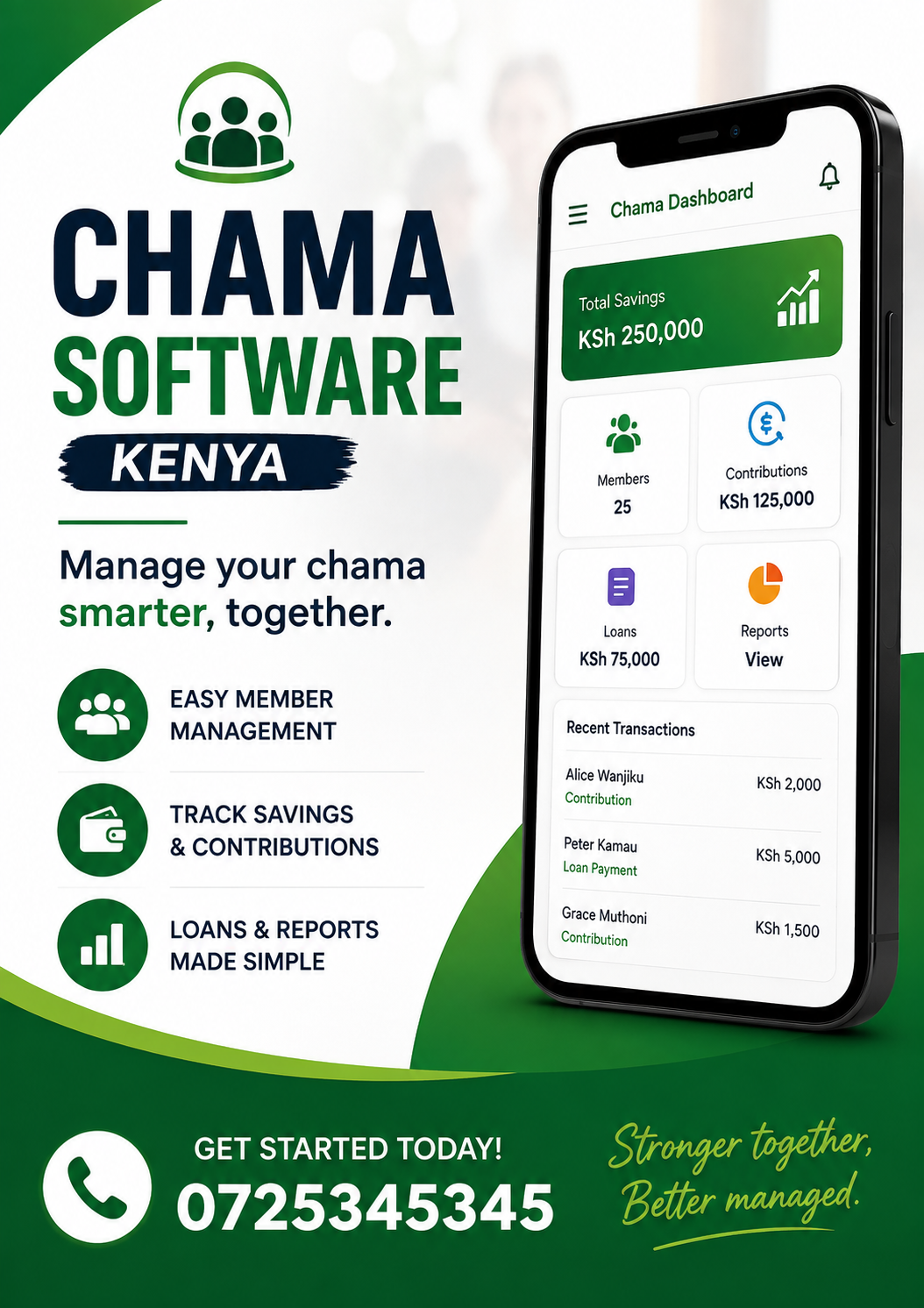
Chama Software Kenya: The Complete Guide to Running a Modern Group
Every Saturday afternoon, in living rooms in Kasarani, church halls in Kisii, hotel back rooms in Nakuru and WhatsApp groups spanning three continents, Kenyans sit down to do something their grandparents also did: pool money, lend it to one another, hold each other accountable and build something none of them could build alone. The chama is one of the most quietly powerful financial institutions in the country, and it has survived decades on nothing more than a hardcover exercise book, a treasurer with neat handwriting and a great deal of trust. But trust has limits, memory fades, books get lost in house moves, and the moment a group crosses about fifteen members or starts holding real money, the old system begins to creak. That is the point at which most groups start searching for chama software Kenya has actually built for local conditions — something that understands M-Pesa, understands merry-go-round rotations, understands fines for late arrival at meetings, and does not assume every member owns a laptop. This guide is a thorough, practical walk through everything you need to know before you choose a platform, set it up and bring your members on board.
Table of Contents
- What a chama is and why it eventually outgrows the exercise book
- The hidden costs of manual group administration
- What a digital group management system actually does
- Core features every platform should have
- Mobile money and M-Pesa integration explained
- Loan management, interest and repayment tracking
- Meetings, minutes and member communication
- Reports, statements and the audit trail
- Security, privacy and the Data Protection Act
- The different group types served
- Pricing and what you should expect to pay
- Free versus paid: the real trade-offs
- How to choose the right platform for your group
- Migrating from spreadsheets and cash books
- Onboarding members who are not tech-savvy
- Mistakes groups make during the switch
- Governance rules a system cannot replace
- Diaspora members and cross-border contributions
- Where the market is heading
- Frequently asked questions
- Final thoughts
What a chama is and why it eventually outgrows the exercise book
A chama is a member-owned savings and investment group. Members contribute an agreed amount on an agreed schedule, and the pooled money is either rotated to one member at a time, lent out at interest, or invested in land, shares, stock or a business.
The structure is beautifully simple, which is exactly why it scales badly. Five friends can hold the entire ledger in their heads; forty members contributing weekly cannot.
Groups usually pass through three stages. Stage one is cash and memory. Stage two is an exercise book plus a WhatsApp group. Stage three is the point at which someone quietly types “chama software Kenya” into Google at eleven o’clock at night after a disputed balance ruined a meeting.
That third stage is not a failure. It is a sign the group has grown enough to need infrastructure. The search for chama software Kenya groups can trust is simply a group formalising what it already does.
The trigger is rarely technology enthusiasm. It is almost always a specific painful event: a missing contribution, a treasurer who travelled with the book, a loan nobody can prove was repaid, or an audit that took four weekends.
Understanding that origin story matters, because it tells you what to look for. Good chama software Kenya groups adopt successfully is chosen to solve a named problem, not to look modern.
The hidden costs of manual group administration
Manual administration looks free. It is not — the costs are simply paid in time, goodwill and occasional lost money rather than in a monthly subscription.
Start with the treasurer’s time. Reconciling forty M-Pesa messages against a handwritten book takes hours every month, and that person is a volunteer with a job and a family.
Then there is the reconciliation gap. Mobile money statements arrive as raw transaction lists with names that do not always match member records, so matching payments to people is slow and error-prone.
There is also the dispute cost. When two members remember a figure differently and there is no timestamped record, the group spends meeting time arguing instead of deciding.
Continuity risk is the one that hurts most. If the only complete record lives in one person’s book, phone or head, illness, relocation or a fallout can paralyse the group.
And finally there is the growth ceiling. Groups that cannot produce a clean statement cannot easily open a corporate bank account, borrow institutionally or bring on serious new members. This is why chama software Kenya groups adopt early tends to repay itself in opportunity, not just in admin hours.
Set against those costs, the case for chama software Kenya groups can afford becomes straightforward arithmetic rather than a matter of taste.
What a digital group management system actually does
At its core, a group management platform is a shared ledger with roles, rules and reports attached. Everything else is refinement on that idea.
It records who paid what and when, calculates what each member owes, tracks money lent out and money coming back, and produces the same numbers for everyone who logs in. Every serious chama software Kenya product is built on that single idea.
The word “shared” is doing the heavy lifting. In an exercise book, one person holds the truth. In good chama software Kenya groups rely on, the record is visible to all, which changes the social dynamics of the group as much as the admin workload.
A capable system also enforces the group’s own constitution. Contribution amounts, due dates, fine rates and loan interest are configured once and then applied automatically and identically to everyone.
That automatic even-handedness is underrated. A system that fines the chairlady exactly as it fines a new member removes an entire category of awkward conversation.
Well-designed chama software Kenya administrators actually stick with will also reduce the number of decisions the treasurer makes manually each month, because most of them have already been encoded as rules.
Core features every platform should have
Feature lists on chama software Kenya websites tend to blur together. Here is what genuinely matters, roughly in order of importance for a typical Kenyan group.
Member register. Full names, phone numbers, national ID or passport reference, next of kin, join date, member number and status. This is the backbone of everything else, and any chama software Kenya platform that treats it as an afterthought will frustrate you within weeks.
Contribution tracking. Recurring contribution schedules, arrears calculation, partial payments, advance payments and per-member statements. Any serious chama software Kenya option handles arrears automatically rather than making the treasurer compute them.
Multiple contribution types. Real groups run several funds at once: savings, welfare, project, share capital, registration fee. One flat “contributions” field is not enough.
Loan management. Applications, guarantors, approval workflow, disbursement records, interest calculation, repayment schedules and outstanding balances.
Fines and penalties. Late contributions, meeting absence, late loan repayment. These should be rule-driven, not manually applied.
Meeting management. Agendas, attendance registers, minutes and resolutions stored with the financial record they relate to.
Budgets and expenses. Where the group’s money goes, not just where it comes from, including group expenses such as bank charges, refreshments and registration renewals.
Reporting. Member statements, contribution summaries, loan books, income and expenditure statements and period comparisons.
Role-based access. The chairperson, treasurer, secretary and ordinary members should each see an appropriate view. Any chama software Kenya group leaders trust must draw that line clearly.
Notifications. SMS or in-app reminders before due dates and confirmations after payment, because reminders are the single cheapest way to improve collection rates.
Data export. You should be able to leave with your data at any time, in a usable format.
If a chama software Kenya platform covers those eleven areas competently, it will serve the overwhelming majority of Kenyan groups. Anything beyond that is a bonus, not a requirement.
Mobile money and M-Pesa integration explained
Almost every conversation about chama software Kenya groups are evaluating arrives at the same question within ten minutes: does it work with M-Pesa? The honest answer is that “works with M-Pesa” means several different things.
Level one: manual entry. The treasurer reads the M-Pesa message and types the amount into the system. Simple, works everywhere, still leaves room for typing errors.
Level two: statement import. The group downloads its M-Pesa statement and uploads it; the platform matches transactions to members by phone number. Much faster, and reconciliation errors drop sharply.
Level three: live integration. The group has its own Paybill or Till number and payments post to the ledger automatically as they arrive, usually through Safaricom’s Daraja API.
Level three is the most convenient, but it is not free and not instant. A dedicated Paybill requires registration with Safaricom, supporting documents for the group, and usually a registered entity behind it. Not every chama software Kenya provider supports live posting, so ask directly.
For a group of twenty to fifty members, level two is often the sweet spot. It removes most of the manual work without the cost and paperwork of a dedicated shortcode.
One practical warning: phone numbers change. Whatever level of integration your chama software Kenya platform offers, keep member phone records current or automatic matching will quietly start failing.
Another warning worth stating plainly. If members send money to the treasurer’s personal number, no software on earth can fully separate group funds from personal funds. Get a group account, whether that is a bank account, a Paybill or a bank-linked collection number.
Loan management, interest and repayment tracking
Lending is where chamas either build wealth or fall apart, and it is where manual records fail hardest. Interest computed by hand across a dozen loans with different start dates is a recipe for disagreement.
Kenyan groups typically use one of three interest models, and your chama software Kenya platform should handle whichever one you have written into the constitution. Flat monthly interest on the original principal is the most common in smaller groups because it is easy to explain.
Reducing balance interest is fairer to borrowers and standard in formal lending, but almost nobody wants to calculate it manually. This is one of the strongest arguments for chama software Kenya groups adopt: the system does the arithmetic identically every time.
The third model is a fixed service fee, sometimes used for short “soft loans” repayable within a month. Whichever model you choose, the platform should support it natively rather than forcing you to fake it with adjustments.
Guarantorship matters too. Many groups require two guarantors whose own savings are pledged against a defaulting borrower, and the system should record and enforce that relationship.
Repayment tracking should show, for each loan, the original amount, interest accrued, amount repaid, outstanding balance and days overdue. If a member asks “how much do I still owe?”, the answer should take five seconds.
Good chama software Kenya groups use for lending will also flag the aggregate picture: how much of the group’s money is currently out on loan, how much is idle, and what the default exposure looks like.
That portfolio view is what turns a savings club into an investment operation. It is also the single feature most groups did not know they needed until they had it.
Meetings, minutes and member communication
Chamas are not only financial entities. They are social ones, and the meeting is where the group’s decisions are actually made.
Yet minutes are usually the worst-kept record in the group. They live in a secretary’s notebook, get typed up late or not at all, and become impossible to search after two years.
Storing agendas, attendance and minutes inside the same chama software Kenya system that holds the financial record is more useful than it first sounds. A resolution to raise contributions and the date contributions actually changed end up in the same place.
Attendance tracking also matters because so many constitutions attach fines to absence. If attendance is captured digitally, the fine applies itself.
Communication is the other half. Bulk SMS to all members, or targeted messages to those in arrears, consistently improves collection more than any amount of encouragement in the group chat.
The best chama software Kenya groups settle on treats communication as a first-class feature rather than an afterthought, because reminders are where subscription cost pays itself back fastest.
Reports, statements and the audit trail
A report is not just paperwork. It is the artefact that lets a group prove things — to its own members, to a bank, to a potential investment partner or to a court.
At a minimum, your chama software Kenya platform should produce individual member statements on demand. Every member should be able to see their own contribution history without asking the treasurer.
Group-level reports should cover total contributions by period, outstanding arrears, the full loan book, expenses and a simple income and expenditure summary.
Comparative reporting — this quarter against last quarter, this year against last — is what turns records into insight. It is how a group notices that collection rates always dip in January and plans around it.
The audit trail is the quiet hero. Every entry should record who made it and when, and edits should be logged rather than silently overwriting history.
Ask about this explicitly when evaluating chama software Kenya vendors, because an unlogged edit function is a governance hole. If the treasurer can change a figure and leave no trace, the shared ledger is not really shared.
Year-end matters too. Groups that can produce a clean annual statement can hold a proper AGM, declare dividends confidently and admit new members on fair terms.
Security, privacy and the Data Protection Act
Your group’s records contain member names, phone numbers, ID references and financial histories. That is personal data, and Kenyan law treats it as such.
The Data Protection Act of 2019 and the Office of the Data Protection Commissioner set expectations for how personal data is collected, stored and shared. Any chama software Kenya vendor should be able to explain how it meets them. Groups are not exempt simply because they are informal.
In practice this means a few concrete things. Collect only the data you need, tell members what it is used for, restrict who can see it and keep it secure.
When assessing chama software Kenya providers, ask where the data is hosted, whether it is encrypted in transit and at rest, how backups are handled and what happens to your data if you stop paying.
Ask about access control specifically. Can an ordinary member see another member’s ID number or loan balance? In most groups the answer should be no.
Password hygiene is the group’s own responsibility. Shared admin logins are the most common security failure in Kenyan groups, and they destroy the audit trail at the same time.
Two-factor authentication on officer accounts is worth enabling if offered. The officers are the accounts worth attacking.
Finally, consider the exit scenario. Reputable chama software Kenya platforms let you export your complete records at any time, which protects you against both vendor failure and vendor lock-in.
The different group types served
Not every group calls itself a chama, and platforms differ in how well they handle each structure. Match the chama software Kenya tool to your actual model.
Merry-go-round groups. A fixed contribution is collected and handed to one member per cycle in rotation. The system needs to track rotation order, who has received and who is still waiting.
Accumulating savings and lending groups. Contributions build a pool that is lent to members at interest, with profits shared periodically. This is the most common structure in serious chama software Kenya deployments.
Investment clubs. The group buys assets — land, shares, rental property, a business. Here the platform’s job extends to tracking asset value and each member’s proportional stake.
Welfare groups. Money is pooled to support members during bereavement, illness or celebration. Contributions are often irregular and claim-driven rather than schedule-driven.
Table banking groups. Common with women’s groups and rural savings movements, these combine regular savings with immediate small lending during the meeting itself.
Staff and workplace groups. Contributions come via payroll deduction, and the group often needs employer-facing reporting.
SACCOs and registered co-operatives. These are formally regulated, need share capital tracking and dividend calculation, and carry compliance obligations that informal groups do not.
Diaspora groups. Members contribute from abroad in foreign currency, often for a project back home. Payment rails and time zones become the central design problem.
Before shortlisting any chama software Kenya solution, write down which of those descriptions fits your group. Half the disappointment in this market comes from buying a tool built for a different structure.
Pricing and what you should expect to pay
Pricing for chama software Kenya subscriptions is usually per group rather than per member, which is good news for larger chamas and slightly less good for very small ones.
Typical subscriptions for Kenyan groups fall somewhere between KSh 500 and KSh 2,500 per month, with discounts for quarterly and annual commitment. Some platforms offer a free tier with limited features or member caps.
TAS, for example, prices at KSh 1,000 per month, KSh 3,000 per quarter or KSh 12,000 per year for groups of up to fifty members, with all features included on every plan and a fourteen-day trial before you pay anything.
Divide the cost across members and the picture becomes clearer. A KSh 1,000 monthly subscription across thirty members is roughly KSh 33 each — less than a single late-contribution fine in most constitutions.
Watch for costs that sit outside the headline price. SMS bundles, Paybill setup, data migration, custom reports and training are all sometimes billed separately. Ask your chama software Kenya vendor for a total first-year figure rather than a monthly one.
Ask directly what happens when you exceed the member limit, because growing past a plan tier is a good problem that should not come with an unpleasant surprise.
Also ask about the annual discount seriously. Most groups that adopt chama software Kenya platforms stay for years, so paying annually is usually the rational choice once the trial confirms fit.
A final budgeting note: put the subscription in the group’s budget as a line item and approve it in a meeting. Software paid for out of the treasurer’s pocket has a habit of quietly lapsing.
Free versus paid: the real trade-offs
Free tools are genuinely attractive when a group is small and the money involved is modest. There is no shame in starting with a well-built spreadsheet.
The trade-offs show up later. Free tiers commonly cap members, limit report types, omit SMS notifications or lack proper role separation.
Support is the bigger difference. When something goes wrong three days before an AGM, a paid plan usually comes with someone to call.
There is also a durability question. Free products change terms, get acquired or shut down, and a group’s financial history is not something you want stranded on an abandoned platform.
The pragmatic path many groups take is to trial a paid chama software Kenya platform during a normal contribution cycle, run it in parallel with the existing book, and decide with evidence rather than argument.
If the parallel month saves the treasurer several hours and settles at least one dispute, the subscription has already justified itself.
How to choose the right platform for your group
Treat your chama software Kenya purchase as a procurement decision, not a download. A short structured evaluation prevents most regrets.
Step one: write down your group’s rules. Contribution amounts, frequency, fine structure, loan interest model, guarantor requirements, meeting schedule. This document is your requirements list.
Step two: identify your top three pain points. Reconciliation? Loan tracking? Member transparency? Any chama software Kenya candidate that does not fix all three is not a candidate.
Step three: shortlist no more than three chama software Kenya platforms. More than that and the committee will never decide.
Step four: run a real trial. Load actual member data and a real month of transactions. Demonstrations are designed to look good; your data is designed to be awkward.
Step five: test the awkward cases. A partial payment, a member who pays twice, a loan repaid early, a member who leaves mid-year. This is where platforms separate.
Step six: check the exit. Export your data during the trial and open the file. If the export is unusable, walk away.
Step seven: ask about support. Response times, channels and whether help comes from people who understand Kenyan group structures.
Step eight: present to the group. Adoption fails when officers choose alone. Show the members what they will see and let them ask questions.
Groups that follow those eight steps generally end up satisfied with their chama software Kenya choice, largely because they chose against their own requirements rather than against a feature list.
Migrating from spreadsheets and cash books
Migration is the part everyone underestimates. It is also the part that determines whether the new system is trusted, so plan your chama software Kenya migration as carefully as you chose the platform.
Pick a clean cut-off date. The end of a financial year is ideal; the end of a quarter is acceptable. Migrating mid-cycle creates permanent confusion.
Reconcile before you migrate. Do not import a mess. Agree every member’s opening balance in a meeting and have it minuted before a single figure goes into the system.
Import opening balances, not full history, if history is unreliable. A clean starting point that everyone agrees on beats five years of contested detail.
Where history is solid, import it. Long contribution histories are valuable, particularly for groups planning to seek institutional credit.
Verify member data carefully. Phone numbers especially, since they drive both notifications and payment matching in most chama software Kenya systems.
Run parallel for one full cycle. Keep the book and the system side by side for a month, compare at the end, and investigate every difference before retiring the book.
Keep the old records. Store the cash books safely even after migration. They are your fallback and, in a dispute, your evidence.
Announce the switch formally. A minuted resolution adopting the system gives it authority, which matters when a member later challenges a figure.
Onboarding members who are not tech-savvy
This is the most common worry officers raise, and it is usually overstated — but it deserves a plan.
Start from what members already do. Almost everyone in a Kenyan chama uses M-Pesa and WhatsApp daily, which means they already handle digital money and digital messages competently.
Do a live walkthrough at a meeting. Project the screen or pass a phone around, and show two things only: how to see your own statement and how to record a payment. Those two screens are the whole of chama software Kenya for most members.
Do not teach the whole system. Members need two functions; officers need ten. Teaching everyone everything guarantees confusion.
Pair up. Ask two or three confident members to help others in the first month, which spreads the support load away from the treasurer.
Keep the manual channel open initially. A member who still sends the M-Pesa message to the treasurer should not be penalised while the group adjusts to its chama software Kenya rollout.
Use SMS rather than requiring logins for the least confident members. Receiving a confirmation message is participation enough at first.
Expect a small minority to never log in. That is fine, as long as their records are accurate and they can request a statement.
Mistakes groups make during the switch
Choosing on price alone. The cheapest chama software Kenya option that does not track loans properly costs more than the subscription it saves.
Letting one person own the system. If only the treasurer knows the login, you have digitised the old single-point-of-failure problem rather than solving it.
Sharing one admin account. This is the most damaging habit in Kenyan chama software Kenya deployments, because it destroys the audit trail entirely.
Skipping the constitution. Configuring fines and interest in software without agreed written rules just moves the argument to a new venue.
Migrating unreconciled balances. Importing disputed numbers means the new system inherits the old distrust on day one.
Not budgeting for the subscription. Approve it formally and pay it from group funds.
Ignoring member training. Members who cannot see their own records will not trust the system, no matter how accurate it is.
Abandoning the parallel run early. Two weeks is not enough. Complete a full contribution and repayment cycle.
Forgetting to update phone numbers. Silent matching failures accumulate for months before anyone notices.
Treating software as governance. No chama software Kenya platform will make a badly governed group well governed. It will simply document the problem more clearly.
Governance rules a system cannot replace
Chama software Kenya platforms enforce rules. They do not write them, and they will not settle a disagreement about what the rules ought to be.
Every group needs a written constitution covering contribution amounts and dates, fine structures, loan eligibility and limits, guarantor obligations, exit terms, dispute resolution and how the constitution itself can be amended.
Exit terms deserve special mention because they are the most common source of serious conflict. What exactly does a departing member receive, and when?
Signatory rules matter equally. At least two officers should be required to authorise any withdrawal, and no group should operate on a single signature.
Rotation of office is healthy. Long-serving treasurers are usually devoted rather than dishonest, but permanent tenure removes a natural check.
Registration is worth considering as groups grow. Registering with the Department of Social Development or as a limited company gives the group legal identity, the ability to own assets and to open a corporate account.
Once those foundations exist, chama software Kenya tools become genuinely powerful, because the system is enforcing rules the members actually agreed to.
Without them, the software is just a tidier way to record a dispute.
Diaspora members and cross-border contributions
A large share of Kenyan groups now include members in the Gulf, the UK, the US or elsewhere in Africa, and this changes the requirements meaningfully.
Time zones affect meetings. Groups with diaspora members typically move to hybrid meetings with a recorded agenda and minutes available afterwards.
Payment rails are the harder problem. Members abroad may send money by remittance service, card payment or bank transfer, and each arrives differently in the group’s records.
Currency conversion needs an agreed rule. Decide in advance whether a contribution counts at the rate on the date sent or the date received, and write it into the constitution.
Transparency matters more, not less, at distance. A member who cannot attend meetings relies entirely on the record, which is why chama software Kenya adoption is often driven by the diaspora members themselves.
Give overseas members full statement access and meeting minutes. It is the cheapest way to keep them contributing for years rather than drifting away.
Where the market is heading
The direction of travel is clear enough. Group finance in Kenya is moving from record-keeping toward services built on top of the record.
Credit scoring is the most obvious next step. A group with three years of clean, verifiable contribution and repayment history is a far better credit risk than one with a shoebox of receipts.
Integration with formal finance follows from that. Banks and microfinance institutions are increasingly willing to lend to groups that can produce structured data, which raises the strategic value of chama software Kenya adoption beyond convenience.
Investment tooling is expanding too, particularly around fractional asset ownership, government securities and unit trusts held at group level.
Automated bookkeeping is improving. Statement parsing and transaction matching now handle most reconciliation with minimal human input.
Mobile-first design keeps deepening, because the overwhelming majority of members will only ever use a phone. Any chama software Kenya platform that is desktop-first is building for the wrong user.
Regulatory attention is likely to increase as digital group lending grows. Groups with proper records and clear governance will find that shift easy; groups without them will not.
None of this replaces the fundamentals. The chama works because people know each other and hold each other accountable, and no platform substitutes for that.
Frequently asked questions
Is chama software Kenya groups use secure enough for real money?
Reputable platforms encrypt data, enforce role-based access and log every entry. The larger risk is usually shared passwords rather than the platform itself.
Do we need to register the group first?
Not necessarily to use software, but registration is strongly advisable before opening a group bank account, acquiring a Paybill or buying assets.
Can we use it without M-Pesa integration?
Yes. Manual entry or statement import works perfectly well, and many groups never move to a dedicated Paybill.
What happens to our data if we stop subscribing?
Ask before signing. Any chama software Kenya provider worth using will let you export complete records at any time.
How long does setup take?
For a group of thirty members with clean records, a weekend of data entry and one meeting for training is realistic. Most chama software Kenya providers include onboarding help.
Will older members cope?
Almost always, provided you teach two functions rather than twenty and keep SMS available for those who prefer it.
Can one platform handle contributions, loans and welfare together?
Yes, and it should. Groups that split these across separate tools lose the consolidated view that made them switch in the first place.
Is it worth it for a group of ten?
Often yes, particularly if the group lends. Ten members with active loans generate more reconciliation work than twenty who only save.
Can we customise the rules to match our constitution?
Configurable contribution types, fine rates and interest models are standard in serious chama software Kenya products. Test this during your trial.
How do we handle a member who leaves?
Follow your constitution, record the settlement in the system and mark the member inactive rather than deleting them, so history stays intact.
Do we still need a treasurer?
Absolutely. The role changes from arithmetic to oversight, which is a better use of a capable volunteer.
What about audits?
A complete digital record with a proper audit trail makes external review dramatically faster and cheaper.
Final thoughts
The chama is not a stopgap for people waiting to access formal finance. It is a durable institution that has moved serious money through Kenyan households and businesses for generations, and it deserves proper tools.
Choosing chama software Kenya groups can genuinely live with is less about features than about fit. Write down your rules, name your three biggest problems, trial properly with real data and bring your members along.
Do that, and the treasurer gets weekends back, disputes fall away, and the group’s record becomes an asset it can actually use — to borrow, to invest and to grow. That is what chama software Kenya is ultimately for.
TAS was built for exactly this: contributions, loans, meetings, budgets, reports and role-based access in one place, priced for Kenyan groups and free to try for fourteen days. If your group has reached the stage where the exercise book is no longer enough, that is the natural next step.