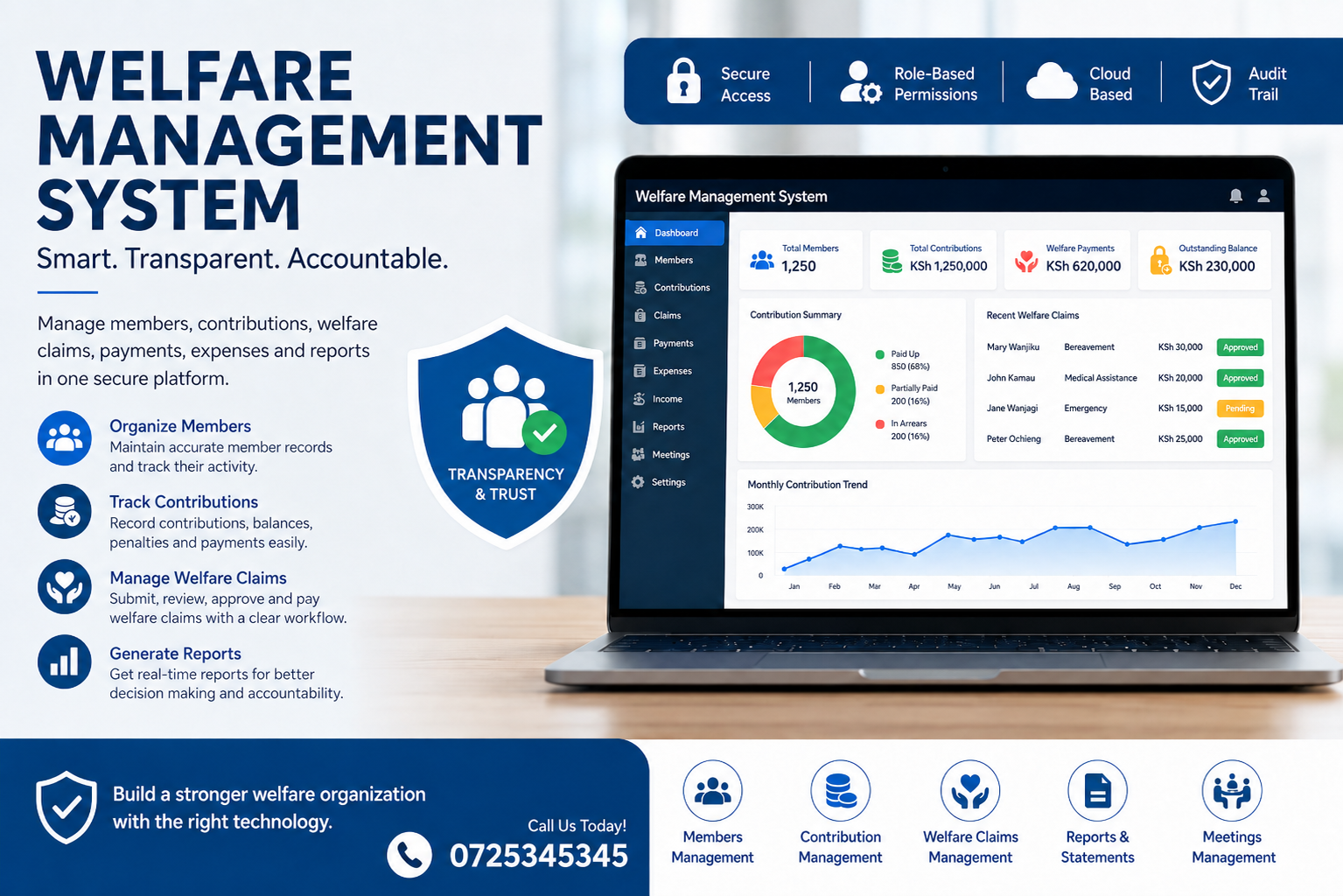
 Welfare Management System is becoming essential for welfare groups, employee associations, chamas, community organisations, churches, family welfare groups and other membership-based organisations that collect contributions and provide financial support to their members.
Many welfare groups in Kenya begin informally.
Members create a WhatsApp group, agree on a monthly contribution and appoint a chairperson, secretary and treasurer. Contributions may initially be recorded in a notebook, Excel spreadsheet or mobile phone.
This may work when there are only a few members.
However, when the group grows to 50, 100, 500 or even thousands of members, administration becomes much more complicated.
Officials must know:
- Who has paid?
- Who has not paid?
- How much has every member contributed?
- How much money is available in the welfare fund?
- Which member received a welfare benefit?
- Why was the benefit paid?
- Who approved the payment?
- Which claims are still pending?
- What expenses has the organisation incurred?
- What penalties are outstanding?
- What is each member’s current balance?
- Can previous transactions be verified?
- Can financial reports be prepared quickly?
A properly implemented Welfare Management System brings these activities into one organised digital platform.
Instead of depending on disconnected spreadsheets, notebooks, WhatsApp messages and individual officials, the organisation creates a central record that authorised users can manage and review.
What Is a Welfare Management System?
A Welfare Management System is software designed to help member-based organisations manage welfare contributions, members, claims, benefits, payments, expenses, financial records and reports.
The system provides administrators with a structured environment for recording the activities of the welfare organisation.
For example, assume an organisation has 200 members and every member contributes KSh 1,000 monthly.
The administrators need to track:
- 200 individual member accounts
- KSh 200,000 in expected monthly contributions
- Missed contributions
- Advance payments
- Penalties
- Welfare claims
- Approved benefits
- Expenses
- Payment references
- Member statements
- Financial reports
Doing this manually every month creates hundreds or thousands of records.
A digital Welfare Management System Kenya solution makes these records easier to organise, retrieve, verify and report.
Why Welfare Groups Need Management Software
Running a welfare organisation involves much more than collecting money.
A welfare group may support members during circumstances such as bereavement, illness, emergencies, family events or other situations defined within the group’s constitution.
Each organisation has its own rules.
Some groups contribute monthly.
Others contribute whenever a qualifying event occurs.
Some maintain multiple funds.
Others operate one general welfare fund.
As membership increases, officials need better systems for maintaining these records.
Problems with Manual Welfare Management
Manual administration commonly creates several difficulties.
1. Difficult Contribution Tracking
A treasurer may receive payments from dozens or hundreds of members.
Without a central system, identifying who has paid can require checking:
- M-Pesa messages
- Bank statements
- Excel sheets
- Receipt books
- WhatsApp messages
- Handwritten records
This becomes increasingly difficult as transactions accumulate.
2. Missing Member Records
Members can change phone numbers, employment locations, addresses or other details.
If records are scattered across different files, the organisation may not know which information is current.
3. Difficult Welfare Claim Management
When a member requests assistance, officials may need to establish:
- Whether the member is active
- Whether contributions are up to date
- Whether the event qualifies
- The amount the member is entitled to
- Supporting documents required
- Who should approve the request
Without a structured process, claims may be handled inconsistently.
4. Poor Accountability
Members naturally want to understand how their contributions are being used.
If financial records cannot easily be produced, misunderstandings can develop between members and officials.
A Welfare Fund Management System helps create an organised record of transactions.
5. Complicated Leadership Handover
Officials eventually change.
A new treasurer should not have to depend entirely on spreadsheets stored on the previous treasurer’s laptop.
A central welfare management platform creates continuity when responsibilities move from one committee to another.
Key Features of a Welfare Management System
Different organisations have different requirements, but a strong Welfare Management System should support the most important welfare administration processes.
1. Member Management
Everything starts with members.
The system should maintain an organised member register containing relevant information such as:
- Member name
- Membership number
- Contact information
- Date joined
- Membership status
- Contribution category
- Branch or department
- Next of kin where applicable
- Supporting membership information
Administrators should be able to search for members quickly rather than going through paper files.
A central member database also helps reduce duplicate records.
2. Welfare Contribution Management
Regular contributions are the financial foundation of many welfare groups.
A Welfare Contribution Management System should make it easy to record contributions against individual members.
For example:
| Member | Expected | Paid | Balance |
|---|---|---|---|
| Member A | KSh 1,000 | KSh 1,000 | KSh 0 |
| Member B | KSh 1,000 | KSh 500 | KSh 500 |
| Member C | KSh 1,000 | KSh 1,000 | KSh 0 |
| Member D | KSh 1,000 | KSh 0 | KSh 1,000 |
Instead of calculating these balances manually, the system can maintain contribution records connected to each member.
This makes it easier to identify:
- Fully paid members
- Partially paid members
- Members in arrears
- Advance contributions
- Historical contributions
- Contribution totals
3. Multiple Welfare Funds
Larger organisations may operate more than one fund.
For example:
- General welfare fund
- Bereavement fund
- Emergency fund
- Education support fund
- Medical assistance fund
- Development fund
- Special project fund
A suitable Welfare Management Software Kenya solution should allow the organisation to separate different financial activities where required.
This makes reporting clearer.
Instead of showing one unexplained total, officials can understand how money has been allocated across different welfare activities.
4. Welfare Claims Management
Claims are one of the most important parts of welfare administration.
When a member requests financial assistance, there should be a clear process.
A typical workflow may include:
Member request → Verification → Review → Approval → Payment → Reporting
The organisation may need to record:
- Member making the request
- Claim category
- Date submitted
- Description
- Supporting documentation
- Amount requested
- Amount approved
- Approval status
- Payment reference
- Date paid
- Officials involved
This creates a more accountable process than handling every request through informal messages.
Groups with more complex welfare processes should also review how a dedicated Welfare Claims Management Software Kenya workflow can support eligibility checks, approvals and payment records.
5. Approval Workflows
Financial decisions should not depend on one person.
Depending on the organisation’s constitution, welfare requests may require approval from:
- Chairperson
- Treasurer
- Secretary
- Welfare committee
- Finance committee
- Management
- Board members
A digital system can support defined responsibilities so that authorised officials participate in the process.
For example:
Claim submitted → Welfare Officer reviews → Treasurer verifies funds → Chairperson approves → Payment recorded
Having a clear process improves accountability.
6. Income and Expense Management
Welfare organisations receive money and spend money.
Therefore, administrators need more than a contribution register.
They also need to understand cash movement.
Income may include:
- Member contributions
- Registration fees
- Penalties
- Donations
- Fundraising income
- Investment income
- Special contributions
Expenses may include:
- Welfare payments
- Administrative expenses
- Bank charges
- Meeting expenses
- Communication costs
- Professional services
- Operational expenses
A Welfare Management System should make these records easier to categorise and report.
7. Member Statements
One of the easiest ways to improve transparency is to give members understandable statements.
A statement may show:
- Member details
- Contributions
- Penalties
- Payments
- Adjustments
- Welfare benefits
- Outstanding obligations
Instead of asking the treasurer to manually calculate a member’s history, the required information can be retrieved from the system.
8. Welfare Reports
Management decisions become easier when accurate reports are available.
Useful welfare reports may include:
Contribution Report
Shows contributions received during a selected period.
Outstanding Contribution Report
Identifies members who have unpaid balances.
Welfare Payment Report
Shows benefits or assistance paid to members.
Expense Report
Provides information about expenditure.
Member Statement
Displays transactions relating to an individual member.
Fund Summary
Shows activity within a particular welfare fund.
Income Report
Shows money received by the organisation.
Audit Report
Provides a history of important activities and changes where supported.
Reports help committees prepare for meetings, financial reviews and decision-making.
9. Role-Based Access
Not every official should have unlimited access.
A welfare organisation might have:
- Chairperson
- Secretary
- Treasurer
- Administrator
- Welfare officer
- Accountant
- Auditor
- Branch administrator
Each role may require different permissions.
For example, someone responsible for member registration may not need permission to approve financial payments.
Role-based access can help organisations apply clearer responsibility within the system.
10. Audit Trail
Accountability is especially important when managing members’ money.
A strong welfare management platform should preserve enough transaction history for authorised officials to understand important changes.
For example:
- Who entered a transaction?
- When was it entered?
- Was it changed?
- Who approved a transaction?
- What payment reference was used?
An audit history can be especially useful during leadership transitions and financial reviews.
11. Branch and Department Management
Some welfare organisations operate across multiple locations.
Examples include:
- Employee welfare schemes
- National associations
- Church organisations
- Professional associations
- Alumni organisations
- Community organisations
- Multi-branch companies
A Welfare Management System Kenya can be designed to organise members by branch, department, location or another suitable structure.
This makes it easier for central administrators to review overall activity while individual branches manage permitted operations.
12. Digital Records and Document Management
Welfare administration can involve supporting documents.
Depending on the organisation, these may include:
- Application forms
- Membership documents
- Claim evidence
- Approval records
- Payment documentation
- Meeting records
Digitising these processes can reduce dependence on physical paperwork and make authorised retrieval easier.
Sensitive documents should always be handled according to the organisation’s privacy, access and retention requirements.
13. Meeting Management
Many welfare groups make important decisions during meetings.
Officials may need to maintain:
- Meeting dates
- Attendance
- Agenda items
- Decisions
- Minutes
- Resolutions
Connecting meeting administration with the organisation’s broader management process creates a stronger institutional record.
For organisations that also handle savings, loans, guarantors and investments, a broader Chama Management System Kenya may provide additional functionality beyond welfare administration.
Types of Organisations That Can Use a Welfare Management System
A Welfare Management System can support many types of member-based organisations.
Employee Welfare Groups
Companies may establish employee welfare programmes where workers contribute periodically to support colleagues during qualifying events.
Software can help administrators organise members, contributions and benefits.
Chama Welfare Groups
Many Kenyan chamas maintain a welfare fund alongside savings and investments.
A digital platform can help separate welfare transactions from other group financial activity.
Church Welfare Groups
Churches may operate welfare programmes for members.
A structured system can assist committees with maintaining membership, contributions, approved assistance and reports.
Family Welfare Groups
Large extended families sometimes establish welfare funds where relatives contribute monthly.
As membership and transactions increase, digital administration becomes more practical.
Alumni Associations
School, college and university alumni associations frequently establish welfare programmes for members.
Management software can provide a central membership and financial record.
Professional Associations
Professional groups may collect membership contributions and provide welfare benefits to qualifying members.
Community Organisations
Community-based organisations may use welfare funds to support members during approved circumstances.
Sacco and Cooperative Welfare Programmes
Some larger member organisations maintain welfare programmes alongside their main operations.
A dedicated workflow can make welfare transactions easier to separate and review.
Benefits of Using a Welfare Management System
Digitising welfare administration provides several practical advantages.
Better Transparency
Members can understand how money is collected and used when accurate records are maintained.
Faster Reporting
Officials do not need to calculate every report manually.
Improved Accountability
Transactions can be associated with dates, members, categories and relevant references.
Reduced Administrative Work
Routine calculations and searches become easier when records are organised.
Easier Leadership Handover
New officials inherit structured records instead of disconnected personal files.
Better Member Experience
Questions about balances, payments and contributions can be answered more efficiently.
Easier Growth
The organisation can continue operating as membership and transaction volumes increase.
Welfare Management System vs Excel
Many welfare organisations initially use Excel.
Excel is useful and flexible, but larger member organisations may eventually require stronger workflow controls.
| Area | Excel/Manual Records | Welfare Management System |
|---|---|---|
| Member records | Separate sheets | Centralised |
| Contributions | Manual entries | Structured member records |
| Claims | Often separate | Connected workflow |
| Reports | Manual formulas | System-generated reports |
| User permissions | Limited | Role-based |
| Audit history | Difficult | Better traceability |
| Multi-user access | Can be difficult | Designed for authorised users |
| Leadership handover | File dependent | Central system |
| Member statements | Often manual | Easier to generate |
| Scaling | Increasingly difficult | Better suited to growth |
Excel does not automatically become unsuitable simply because an organisation grows.
However, when officials spend increasing amounts of time reconciling spreadsheets, searching WhatsApp messages and correcting inconsistent records, it may be time to consider a dedicated Welfare Management System.
Welfare Management System vs Chama Management System
These two systems are closely related but may serve different requirements.
A Welfare Management System focuses primarily on:
- Welfare members
- Welfare contributions
- Benefits
- Claims
- Approvals
- Welfare funds
- Expenses
- Reporting
A broader chama management platform may additionally include:
- Savings
- Loans
- Loan repayment schedules
- Guarantors
- Investments
- Meetings
- Budgets
- Financial administration
A welfare group that only collects contributions for member support may not require extensive loan functionality.
An investment chama with a welfare fund may benefit from a broader Chama Management System.
The correct choice depends on the organisation’s constitution and actual processes.
How to Choose the Best Welfare Management System in Kenya
Do not choose software simply because it has the longest feature list.
Start with your organisation’s real processes.
Check Member Capacity
How many members do you currently have?
How many do you expect within the next few years?
Choose software that can accommodate reasonable growth.
Review Contribution Rules
Determine whether the software can handle the way your organisation collects contributions.
Questions to ask include:
- Are contributions monthly?
- Are there different contribution categories?
- Can members pay in advance?
- What happens when someone misses a contribution?
- Are penalties applied?
- Are special contributions collected?
Test Your Welfare Workflow
Use a realistic example during a demonstration.
For example:
- Register a member.
- Record contributions.
- Submit a welfare request.
- Review the request.
- Approve it.
- Record payment.
- Generate the relevant reports.
If the process cannot reproduce how your organisation works, clarify the requirement before implementation.
Review Permissions
Determine which officials can:
- Add members
- Record contributions
- Edit transactions
- Approve welfare claims
- Record payments
- View financial reports
- Configure the organisation
Check Reporting
Do not accept the statement “the software has reports” without reviewing them.
Ask to see actual examples.
Review Data Export
Your organisation should understand how its information can be exported for authorised use.
Review Support
Ask what happens when administrators need assistance.
Test Before Full Implementation
A controlled pilot is often better than immediately migrating every historical record.
Test the important workflows first.
How to Implement a Welfare Management System Successfully
Software alone will not solve unclear administrative processes.
The welfare organisation should prepare before implementation.
Step 1: Document Your Welfare Rules
Clearly define:
- Contribution amounts
- Payment deadlines
- Penalties
- Membership eligibility
- Welfare categories
- Benefit limits
- Claim requirements
- Approval responsibilities
Step 2: Clean Your Member Records
Remove duplicates and confirm important member information.
Step 3: Confirm Opening Balances
Before moving to a new platform, ensure current balances are understood and approved.
Step 4: Configure User Roles
Give officials only the permissions required for their responsibilities.
Step 5: Test Sample Transactions
Run realistic transactions before launching fully.
Step 6: Reconcile Results
Compare system totals against approved records.
Step 7: Train Administrators
Officials should understand the workflow before relying on the system for daily administration.
Step 8: Roll Out to Members
Once administrators are comfortable, introduce relevant member-facing processes according to the organisation’s implementation plan.
Why Kenyan Welfare Organisations Are Moving Toward Digital Management
Member organisations are handling increasing amounts of information.
Members also expect greater transparency.
A treasurer should ideally be able to answer questions such as:
“How much did we collect last month?”
“How much is outstanding?”
“How much has been paid in welfare benefits?”
“Which transactions created this balance?”
“Which members have outstanding contributions?”
“What is the current position of the welfare fund?”
When records exist in multiple notebooks, spreadsheets and phones, answering these questions becomes difficult.
Digital welfare management creates one structured environment for authorised officials to maintain the records required to answer them.
How TAS Can Support Welfare Management
TAS is designed around the administration of Kenyan member-based organisations.
The platform brings important group processes into a structured digital environment, including areas such as:
- Member administration
- Contributions
- Financial records
- Income and expenses
- Meetings
- Reporting
- User permissions
- Audit history
- Data management
For organisations operating both welfare and chama activities, having connected member and financial records can reduce the need to maintain separate files for every process.
Groups should always test the system using their actual constitution and workflows before full deployment.
Recommended Internal Link
Use the anchor text Chama Management System Kenya to link to the existing TAS chama management guide.
Recommended Internal Link
Use the anchor text Welfare Claims Management Software Kenya to link to the TAS welfare claims guide.
Recommended Internal Link
Use the anchor text Chama Software Kenya to link to the relevant TAS chama software article.
These supporting pages create a useful topical cluster around welfare, contributions and group administration.
Frequently Asked Questions About Welfare Management Systems
What is a Welfare Management System?
A Welfare Management System is software used by member organisations to manage members, welfare contributions, claims, benefits, income, expenses and reports in one structured environment.
Which organisations can use Welfare Management Software?
Employee welfare groups, chamas, churches, family groups, alumni associations, professional associations, community groups and other member-based organisations can use welfare management software.
Can a Welfare Management System track member contributions?
Yes. Contribution tracking is one of the main functions expected from a welfare management platform. Contributions should be linked to individual member records.
Can welfare software show members who have not contributed?
A properly configured system can use expected and recorded contributions to help administrators identify outstanding member balances.
Can welfare claims be managed digitally?
Yes. Welfare claims can be organised using structured workflows covering submission, review, approval, payment and reporting.
Can welfare management software generate member statements?
Many systems provide member-level records or statements showing contributions and other relevant transactions.
Is a Welfare Management System suitable for employee welfare?
Yes. Employee welfare organisations can use software to maintain membership records, contributions, welfare requests, approvals and reporting.
Is a Welfare Management System suitable for churches?
Church welfare groups that collect contributions and provide member assistance can benefit from structured digital administration.
Can welfare management software support multiple branches?
Depending on the system and plan, organisations operating across different branches or locations can use branch-based administration.
How much does a Welfare Management System cost in Kenya?
Pricing varies depending on the number of members, administrators, modules, branches, integrations, implementation requirements and support level. Organisations should obtain a quotation based on their actual workflow instead of comparing price alone.
Can we move from Excel to a Welfare Management System?
Yes. Existing member and financial data can potentially be prepared for migration, but records should first be cleaned, reconciled and verified.
What is the difference between a welfare system and chama software?
A welfare system concentrates on welfare contributions, claims and member benefits. Chama software may additionally manage savings, loans, guarantors, repayments, investments and other group activities.
What is the best Welfare Management System in Kenya?
The best system is the one that accurately supports your organisation’s contribution rules, approval process, reporting requirements, user permissions and growth plans. Test your actual workflows before making a final decision.
Get a Welfare Management System for Your Organisation
Managing a growing welfare organisation using notebooks, spreadsheets and WhatsApp messages can eventually create unnecessary administrative work.
A modern Welfare Management System provides a more structured way to manage members, contributions, welfare transactions, income, expenses and reports.
The objective is not simply to replace paperwork with software.
The objective is to create a reliable administrative process where authorised officials can understand:
- Who contributed
- How much was contributed
- What remains outstanding
- Which welfare requests were processed
- What payments were made
- What expenses were incurred
- How current balances were produced
Whether you manage an employee welfare association, chama welfare fund, church welfare programme, family welfare group, alumni association or community organisation, digital management can provide a stronger foundation for accountability and sustainable growth.
TAS provides digital tools designed for modern Kenyan member-based organisations.
Request a demonstration and test your organisation’s real workflow—from member registration and contributions to welfare administration and reporting.
A Welfare Management System in Kenya can help organisations move away from fragmented spreadsheets, notebooks and manual administration toward a more organised digital workflow.
The most effective implementation combines good software with clear welfare rules, accurate member records, defined user permissions, reconciled opening balances and regular reporting.
As your membership grows, having structured records becomes increasingly important.
Start by documenting how your welfare organisation works today.
Then choose a platform that can support those processes while giving your organisation enough flexibility to grow.
For Kenyan welfare groups looking to digitise their operations, TAS offers a practical platform for managing members, contributions, financial records and other important group activities from one central environment.
Leave a Reply