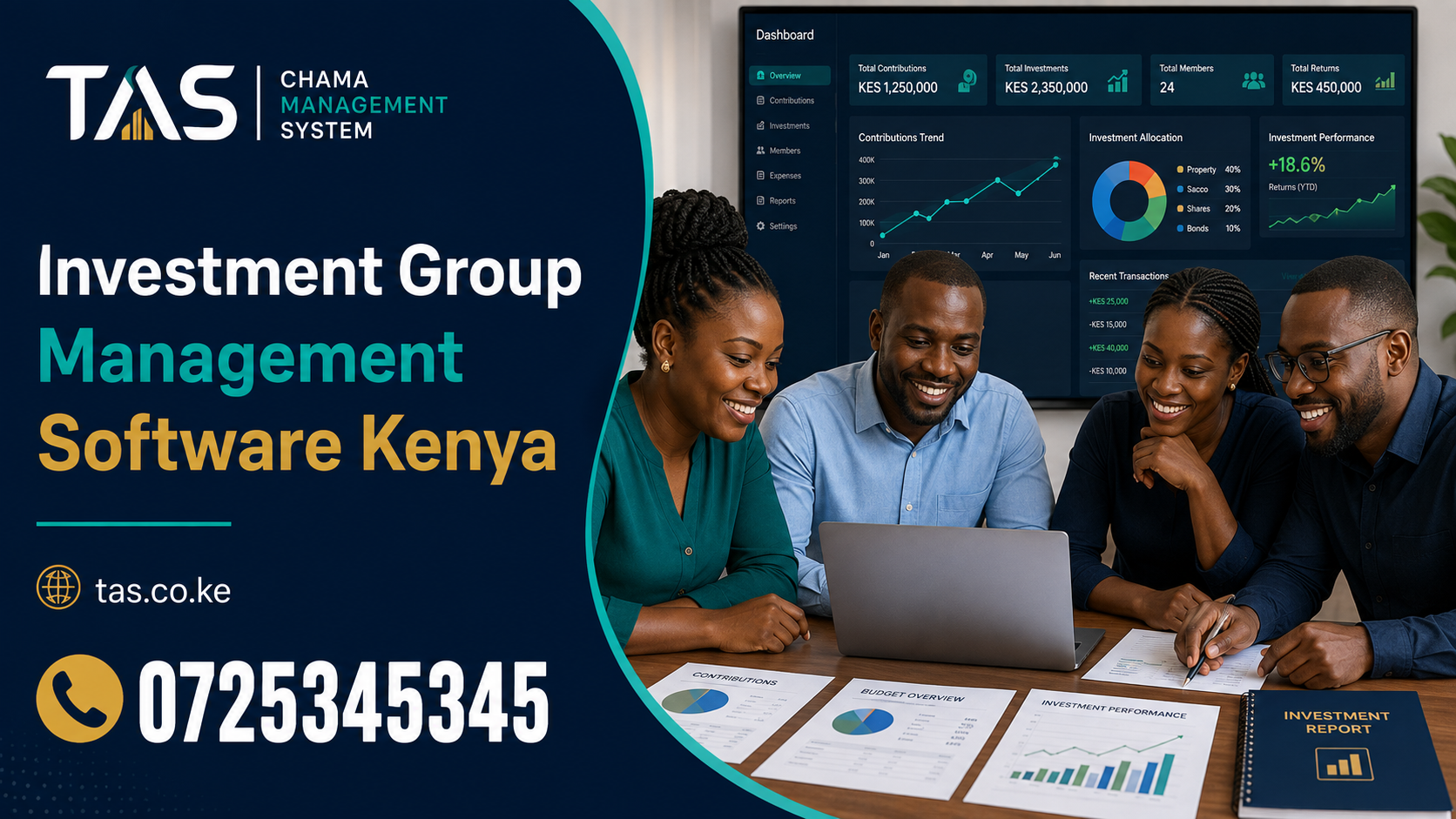
Investment Group Management Software Kenya: 10 Powerful Tools
September 2, 2026 · tasadmin
Investment Group Management Software Kenya powered by TAS Chama Management System.
Table of Contents
Table of Contents
Investment groups pool money to pursue goals such as property, farming, vehicles, shares or businesses. Good results require more than collecting money. Members need accurate records, documented decisions and clear reporting. A strong Investment Group Management Software Kenya supports those responsibilities.
What Is Investment Group Management Software Kenya?
Investment Group Management Software Kenya is a digital platform for administering a member-based investment organisation. It can record member profiles, contributions, budgets, income, expenses, meetings, decisions and financial reports. The software does not choose investments or guarantee returns. It provides a structured operational record so members can make decisions using clearer information.
Problems Caused by Scattered Records
Groups may keep member details in one file, contributions in another, receipts in a drawer and decisions in WhatsApp. This creates difficulty verifying balances, explaining expenses, following action items and completing leadership handovers.
10 Powerful TAS Tools for Investment Groups
1. Member register
TAS maintains searchable profiles with membership status, roles and relevant financial history.
2. Contribution categories
An Investment Group Management Software Kenya should separate regular contributions, share capital, development funds and special project payments.
3. Member balances
Officials can review what was expected, received and outstanding. Members receive clearer information about their own records.
4. Budget planning
TAS supports budgets so groups can approve spending limits and compare planned amounts with actual expenses.
5. Income and expenses
Record dates, categories, amounts, descriptions, payment methods and supporting references for every financial activity.
6. Meeting management
Investment decisions should be documented. TAS supports agendas, attendance, minutes, resolutions and action items.
7. Role-based access
A reliable Investment Group Management Software Kenya restricts sensitive functions according to responsibility. Not every member should edit financial transactions.
8. Loan management
If the group also lends to members, TAS connects applications, guarantors, schedules, repayments and balances.
9. Financial reports
Reports covering members, contributions, loans, attendance, income and expenses help committees prepare for meetings and reviews.
10. Data continuity
Cloud records remain within the group workspace when an official leaves, reducing dependence on personal devices.
How Software Supports Investment Governance
A group should define who proposes an investment, who performs due diligence, who votes, what approval threshold applies and who signs contracts. The system should preserve meeting evidence and approved budgets, but legal and financial professionals may still be required.
Records Every Investment Group Should Maintain
Member register
Contribution ledger
Approved budgets
Meeting minutes
Income and expense records
Contracts and ownership documents
Asset register
Bank and M-Pesa statements
Financial reports
TAS manages group administration and financial records. Confirm separately how legal documents and asset valuations will be stored and reviewed.
TAS Versus Manual Investment Group Management
Activity
Manual approach
TAS
Members
Books and spreadsheets
Central profiles
Contributions
Manual balances
Structured records
Budgets
Separate files
Connected planning
Decisions
Messages and minutes
Recorded meetings
Reports
Prepared manually
Generated from activity
How to Choose Investment Group Management Software Kenya
Ask whether the system supports your member structure, contribution categories, budgets, permissions, reports, backups and exports. Calculate the total cost of subscription, onboarding, training, integrations and support. Test the Investment Group Management Software Kenya using a complete workflow: create a member, record a contribution, approve a budget, record an expense, document a meeting and generate a report.
Security and Data Protection
Groups process personal and financial information. Use secure authentication, role-based permissions, backups and activity histories. Review guidance from Kenya’s Office of the Data Protection Commissioner.
Frequently Asked Questions
What is the best Investment Group Management Software Kenya?
The best fit supports your group’s members, contributions, budgets, meetings, permissions, financial reports and exports. TAS is a practical option to evaluate.
Does TAS make investment decisions?
No. TAS helps administer records and workflows. Members and qualified advisers remain responsible for investment decisions.
Can TAS record meetings?
Yes. TAS supports agendas, attendance, minutes, decisions and action items.
Investment Group Management Software Kenya can improve member administration, contribution tracking, budgeting, meeting records and reporting. TAS brings these activities into one secure workspace without replacing professional investment due diligence. Start your TAS trial and test your investment group’s real workflows.
Investment Group Management Software Kenya: Take the Next Step
Investment Group Management Software Kenya Planning Framework
Investment Group Management Software Kenya should begin with a written operating model rather than a rushed software purchase. The committee should document how contributions, opportunity review, approval, purchase, valuation and distribution currently moves from one person to another, where evidence is stored, who approves changes and how members receive updates. This exercise exposes duplicate steps, missing controls and rules that exist only in someone’s memory. TAS can then be evaluated against the documented process instead of vague expectations. Start by listing the essential member capital, investment proposals, approvals, asset registers, valuations, income, expenses and distributions. Define the required fields, responsible official, approval point, correction procedure and reporting frequency for every record. Agree which historical information must be imported and which records can remain archived. Clean source data before migration because software cannot automatically repair duplicate names, inconsistent telephone numbers, missing dates or unsupported balances.
Governance and Accountability
Technology strengthens governance only when responsibilities remain clear. The chairperson should oversee policy, the secretary should maintain authorised records, the treasurer should verify financial entries and an independent reviewer should periodically compare reports with supporting evidence. Avoid giving one administrator unrestricted power to create, approve and reverse transactions without oversight. Write a change-control procedure for corrections. It should explain who may request a correction, which evidence is required, who approves it and how members are informed. A dependable Investment Group Management Software Kenya should preserve an activity history so that a later reviewer can understand what changed and why. During a TAS demonstration, test these controls using realistic data rather than relying only on screenshots.
Data Quality Standards
Accurate reports depend on accurate inputs. Establish naming standards, unique member identifiers, transaction references, effective dates and document-retention rules. Reconcile opening balances before launch and ask each member to confirm their personal statement. Differences should be placed in a controlled exception list with an owner and resolution deadline. Schedule regular checks. Weekly reviews can identify incomplete entries, while monthly reconciliation can confirm that system totals agree with bank, mobile-money and authorised cash records. Quarterly reviews should examine inactive accounts, overdue actions, unusual adjustments and access rights. These routines make Investment Group Management Software Kenya useful long after implementation day.
Security and Privacy Checklist
Member capital, ownership percentages, investment values, voting records and distribution information should be treated as confidential group information. Use individual accounts, strong passwords, role-based permissions and prompt removal of access when an official leaves office. Avoid sharing administrator credentials through WhatsApp. Ask about backups, recovery procedures, hosting arrangements and the process used to export group data. Members should understand what information is collected, why it is needed and who can see it. Do not collect unnecessary identification documents. Where personal data is involved, committees should familiarise themselves with guidance from Kenya’s data-protection regulator and obtain professional advice when obligations are unclear.
Implementation in Four Practical Phases
Phase 1: discovery and configuration
Map the constitution, contribution rules, approval limits, meeting calendar, reporting needs and exceptions. Configure a test environment and identify the smallest complete workflow that can be demonstrated from beginning to end.
Phase 2: controlled data preparation
Prepare member records and opening balances in an agreed format. Remove duplicates, resolve unsupported figures and keep a signed migration summary. Import a small sample first, validate it and only then move the remaining records.
Phase 3: pilot operation
Run contributions, opportunity review, approval, purchase, valuation and distribution with a limited group of trained users. Compare system outputs with the committee’s expected results. Record questions, errors and configuration changes instead of correcting information informally.
Phase 4: full adoption and review
Approve the go-live date, communicate member responsibilities and stop parallel unofficial records after verification. Review adoption after thirty, sixty and ninety days. Confirm that officials can complete routine work without depending on one technical person.
Key Measures to Monitor
Measure outcomes, not just logins. Useful indicators include capital collected, investment performance, cash position, concentration exposure, overdue actions, reporting timeliness and distribution accuracy. Establish a baseline before implementation so the committee can see whether the system has reduced delays, errors and disputes. A high login count is not success if records remain incomplete or members still request manual statements. Prepare a short monthly dashboard for the committee and a simpler member summary. The report should highlight exceptions requiring action, not overwhelm readers with every available figure. Agree who investigates each exception and when it must be closed.
Common Mistakes to Avoid
Common implementation mistakes include mixing personal and group assets, recording valuations without evidence, ignoring concentration risk, approving investments informally and distributing returns before reconciliation. Another mistake is customising every screen before users understand the standard workflow. Begin with the essential controls, operate them consistently and add complexity only where it solves a documented problem. Do not judge Investment Group Management Software Kenya only by the word “free” or by the number of menu items. Compare data ownership, exports, support, security, user limits, training, reporting and long-term cost. Ask for written clarification of any feature that is important to the constitution.
Questions to Ask During a TAS Demonstration
Can the system reproduce our actual rules and approval limits?
Which actions are recorded in the audit history?
Can members view only the information authorised for them?
How are corrections, reversals and opening balances controlled?
Which reports can be exported and in what formats?
What happens if an official leaves or loses a device?
How are backups restored and tested?
Which services are included in support and which cost extra?
Use the answers to create a scored comparison sheet. Give higher weight to controls that protect funds, member confidence and continuity. The final decision should be recorded in committee minutes together with the agreed rollout plan.
Useful Kenyan Business Technology Resources
A chama does not operate in isolation. Its members may run companies, manage rental property, operate retail shops or coordinate field work, so the wider technology ecosystem matters when planning investment-group operations. Groups that require custom portals, integrations or workflow automation can review Investment Group Management Software Kenya. Members operating salons, spas or barbershops can explore Investment Group Management Software Kenya, while retail businesses can compare stock, sales and cashier workflows through Investment Group Management Software Kenya. Reliable connectivity and specialised platforms can also support group-owned projects. Investment Group Management Software Kenya may be relevant where an office, rural project or remote investment needs dependable internet access. Property-owning groups can study rent, tenant and collection workflows using Investment Group Management Software Kenya. Groups involved in transport or field operations can review the Investment Group Management Software Kenya. Members can also visit Investment Group Management Software Kenya when comparing other Kenyan digital businesses. These links are supporting resources; each committee should evaluate pricing, security, contracts and suitability independently. Additional Kenyan platforms that groups and members may review include Investment Group Management Software Kenya, Investment Group Management Software Kenya, Investment Group Management Software Kenya and Investment Group Management Software Kenya. Evaluate each service independently for relevance, pricing, security and support. For another practical TAS guide, read Investment Group Management Software Kenya and compare its recommendations with your group’s operating rules. For another practical TAS guide, read Investment Group Management Software Kenya and compare its recommendations with your group’s operating rules. For another practical TAS guide, read Investment Group Management Software Kenya and compare its recommendations with your group’s operating rules.
Investment Group Management Software Kenya Frequently Asked Questions
How long should implementation take?
The timeline depends on data quality, rule complexity and the availability of officials. A small organised group may configure and validate its core process quickly, while a group with years of inconsistent records should first complete a controlled cleanup.
Should every member receive administrator access?
No. Access should match responsibility. Members may need statements and notices, while officials require carefully separated operational permissions. Administrator access should remain limited and reviewable.
Can spreadsheets be retained?
Spreadsheets may be useful for controlled migration and independent checks, but maintaining competing live records creates confusion. After verification, agree which platform is the official source and define any approved export routine.
What proves that the rollout is successful?
Success means accurate records, timely reporting, fewer unresolved exceptions, clear accountability and stronger member confidence. Review these outcomes using the measures agreed before launch.
Put clearer records into practice.
Explore TAS for contributions, loans, member records and reports.