Category: Uncategorized

  • Table Banking in Kenya: How Groups Can Manage Savings, Loans and Contributions Digitally

    What Is Table Banking?

    Table Banking is a group-based financial model where members regularly contribute money into a common fund and then lend that money to members according to agreed rules.

    The concept is popular among chamas, women groups, youth groups, community organisations, investment groups and other member-based associations.

    In a typical table banking group, members meet regularly, contribute money and make decisions about how the pooled funds should be used.

    Some members may borrow from the group and repay the money with interest.

    The interest earned may then increase the value of the group’s fund and benefit the members collectively.

    Traditionally, table banking has been managed using:

    • Exercise books
    • Receipt books
    • Excel spreadsheets
    • WhatsApp groups
    • Mobile money messages
    • Individual treasurer records
    • Paper loan forms
    • Manual calculations

    While this approach may work for a small group, problems often begin when the number of members, loans and transactions increases.

    A modern Table Banking System can help a group organise its members, contributions, loans, repayments, penalties, income, expenses and reports from one central platform.


    Table Banking in Kenya
    Chama Document Management Software Kenya: 14 Record Controls — call 0725345345.

    How Does Table Banking Work?

    Table banking is built around members pooling money together and making the funds available within the group.

    The exact rules vary from one organisation to another.

    A typical process may look like this:

    1. Members register with the group.
    2. Each member agrees to make a regular contribution.
    3. Contributions are collected during agreed periods.
    4. The money forms a common table banking fund.
    5. Members can apply for loans according to group rules.
    6. Loan requests are reviewed and approved.
    7. The member receives the approved amount.
    8. The borrower repays the loan with agreed interest.
    9. Interest and other group income grow the common fund.
    10. The group generates reports and reviews its financial position.

    A digital Table Banking Management System makes each of these steps easier to record and monitor.


    Why Table Banking Is Popular in Kenya

    Table banking is attractive to many groups because it provides members with a structured way of saving and accessing credit within their own organisation.

    For many people, accessing formal credit may involve requirements such as:

    • Credit history
    • Collateral
    • Guarantors
    • Salary information
    • Business documentation
    • Lengthy approval processes

    Table banking groups create their own rules.

    Members already know one another, and lending decisions can be based on the group’s constitution and contribution history.

    The model also encourages members to build saving habits.

    Instead of each person saving individually, members create a common financial pool.


    Example of How Table Banking Works

    Assume a table banking group has 30 members.

    Every member contributes KSh 2,000 every month.

    The expected monthly contribution is:

    30 members × KSh 2,000 = KSh 60,000

    After six months, assuming everyone contributes consistently and ignoring expenses, the group may have:

    KSh 60,000 × 6 = KSh 360,000

    Some of this money can be issued as loans to members.

    For example:

    • Member A borrows KSh 50,000
    • Member B borrows KSh 30,000
    • Member C borrows KSh 20,000

    The group now needs to know:

    • When each loan was issued
    • Loan repayment period
    • Interest rate
    • Outstanding loan balance
    • Repayment dates
    • Penalties
    • Guarantors where applicable
    • Member contribution position
    • Total amount currently lent out
    • Total amount available in the fund

    Managing all these records manually can become difficult.

    This is where a Table Banking Software Kenya solution becomes useful.


    What Is a Table Banking System?

    A Table Banking System is software that helps groups manage their financial and membership activities.

    Instead of maintaining separate spreadsheets for members, contributions and loans, the organisation can keep the information in one platform.

    A table banking system may support:

    • Member registration
    • Contributions
    • Savings
    • Loans
    • Loan applications
    • Loan approvals
    • Repayments
    • Penalties
    • Guarantors
    • Income
    • Expenses
    • Meetings
    • Financial reports
    • Member statements
    • User roles
    • Audit history

    For groups that handle many transactions, this creates a more organised way of managing daily operations.


    Benefits of Using Table Banking Software

    1. Better Contribution Tracking

    Contributions are one of the most important parts of table banking.

    A digital system can help administrators see:

    • Expected contributions
    • Amount paid
    • Outstanding amount
    • Previous contributions
    • Advance payments
    • Penalties
    • Member contribution history

    Instead of checking WhatsApp messages or handwritten lists, the treasurer can review the contribution records directly.


    2. Improved Loan Management

    Loans can quickly become complicated.

    Consider a group with 100 members where 40 members currently have active loans.

    The administrators must know:

    • Original loan amount
    • Interest charged
    • Repayment period
    • Amount repaid
    • Remaining balance
    • Overdue amount
    • Penalty
    • Guarantors
    • Approval history

    A Table Banking Management System makes these records easier to organise.


    3. Member Statements

    Members often want to know their financial position.

    A member statement may include:

    • Contributions
    • Savings
    • Loans
    • Loan repayments
    • Penalties
    • Adjustments
    • Other group transactions

    Without software, producing a statement may require manually checking multiple records.

    A digital system can make the process much faster.


    4. Better Financial Transparency

    Transparency is important when members contribute money into a common fund.

    Group officials should be able to explain:

    • How much money has been collected
    • How much has been issued as loans
    • How much has been repaid
    • How much interest has been earned
    • What expenses have been incurred
    • What balance remains available

    A well-managed Table Banking System can provide reports that support this transparency.


    Important Features of a Table Banking Management System

    Member Management

    The system should maintain a central register of members.

    Information may include:

    • Full name
    • Membership number
    • Phone number
    • Email address
    • Date joined
    • Membership status
    • Group or branch
    • Next of kin
    • Identification information where applicable

    A central membership database makes it easier to manage a growing organisation.


    Contribution Management

    A table banking group may require members to contribute:

    • Weekly
    • Monthly
    • Quarterly
    • During meetings
    • When special projects arise

    The system should allow administrators to record each contribution accurately.

    This helps identify members who have:

    • Paid fully
    • Paid partially
    • Not paid
    • Paid in advance
    • Accumulated arrears

    Savings Management

    Some groups separate ordinary contributions from individual savings.

    The software should be able to distinguish different financial activities where necessary.

    For example:

    • Monthly contribution
    • Individual savings
    • Welfare contribution
    • Investment contribution
    • Special project contribution

    This separation improves reporting.


    Loan Application Management

    A proper system should provide a structured loan application process.

    The application may include:

    • Member
    • Amount requested
    • Loan type
    • Reason
    • Repayment period
    • Guarantors
    • Supporting documents
    • Application date

    The request can then move through the group’s approval workflow.


    Loan Approval Workflow

    Different groups approve loans differently.

    A loan may require approval from:

    • Chairperson
    • Treasurer
    • Credit committee
    • Management committee
    • Group members

    A digital workflow makes the process easier to follow.

    For example:

    Loan Application → Review → Approval → Disbursement → Repayment

    This provides a clear history of how the loan was processed.


    Loan Repayment Tracking

    After a loan has been issued, repayments must be recorded accurately.

    The system should show:

    • Loan amount
    • Principal repaid
    • Interest repaid
    • Outstanding principal
    • Outstanding interest
    • Next repayment date
    • Overdue amount
    • Loan status

    This is much easier than manually calculating every member’s balance.


    Interest Calculation

    Interest is an important part of many table banking groups.

    Groups may use different methods.

    Examples include:

    • Flat-rate interest
    • Reducing balance
    • Fixed monthly percentage
    • Fixed total interest

    A Table Banking Software Kenya solution should be configured to match the rules of the group.

    The organisation should confirm how interest is calculated before implementation.


    Guarantor Management

    Some table banking groups require members to guarantee one another’s loans.

    The system may need to record:

    • Borrower
    • Guarantor
    • Guaranteed amount
    • Loan reference
    • Guarantor status
    • Outstanding guaranteed obligation

    This is particularly important when one member guarantees several loans.


    Penalty Management

    Groups may impose penalties for:

    • Late contributions
    • Missed meetings
    • Late loan repayments
    • Failure to meet group requirements

    A digital system can help administrators apply and track these penalties consistently.


    Income and Expense Management

    Table banking groups receive and spend money in different ways.

    Income may include:

    • Member contributions
    • Loan interest
    • Registration fees
    • Penalties
    • Donations
    • Investment income

    Expenses may include:

    • Meeting costs
    • Administration
    • Communication
    • Bank charges
    • Professional fees
    • Group activities

    Recording this information makes financial reporting more complete.


    Cash and Bank Management

    Groups may keep money through:

    • Bank accounts
    • Mobile money
    • Cash
    • SACCO accounts
    • Other approved financial channels

    A table banking system should provide a structured way of recording money moving in and out of these accounts.


    Financial Reports

    Reports are important for decision-making.

    A strong system should provide useful reports such as:

    Contribution Report

    Shows money contributed by members.

    Loan Report

    Shows active, completed and overdue loans.

    Loan Repayment Report

    Shows repayments made by members.

    Outstanding Loan Report

    Identifies loans that still have unpaid balances.

    Member Statement

    Shows the financial history of a particular member.

    Income Report

    Shows income received by the group.

    Expense Report

    Shows expenditure.

    Penalty Report

    Shows penalties charged and paid.

    Group Financial Summary

    Provides an overview of the group’s financial position.


    Table Banking System vs Manual Records

    Many groups begin with manual records.

    However, the difference becomes significant as membership increases.

    Feature Manual Table Banking Digital Table Banking System
    Member records Books and spreadsheets Central database
    Contributions Manually calculated Structured tracking
    Loans Paper files Digital records
    Repayments Manual calculations Recorded per loan
    Member statements Time-consuming Easier to generate
    Reports Manual System generated
    User permissions Limited Role-based
    Audit history Difficult Better traceability
    Multi-branch support Difficult Easier to organise
    Leadership transition File dependent Centralised records

    Manual records are not automatically wrong.

    However, the workload becomes harder to manage as the group grows.


    Table Banking vs Merry-Go-Round

    These two models are sometimes confused.

    A merry-go-round generally involves members contributing a fixed amount and giving the combined contribution to one member at a time.

    For example:

    Ten members contribute KSh 5,000.

    The total contribution is KSh 50,000.

    One member receives the KSh 50,000 during that cycle.

    The next member receives the contribution during the next cycle.

    Table banking is different.

    Instead of distributing the entire contribution to one member, the money remains within a shared fund and can be loaned to members.

    This allows the fund to continue growing.


    Table Banking vs Chama

    A chama is a broader term.

    A chama may operate:

    • Savings
    • Investments
    • Merry-go-round
    • Welfare funds
    • Loans
    • Property investments
    • Business investments
    • Table banking

    Therefore, table banking can be one activity within a chama.

    A Chama Management System can support broader functionality, while a table banking platform focuses heavily on contributions, savings and member lending.


    Table Banking for Women Groups in Kenya

    Women groups have played a major role in the growth of table banking in Kenya.

    Members can combine small regular contributions and create access to a larger shared financial pool.

    The group can then use the fund according to its constitution.

    For example, members may use loans for:

    • Small businesses
    • Farming
    • Education
    • Household projects
    • Stock purchases
    • Business expansion

    Digital management helps such groups keep better records as membership and transaction volumes increase.


    Table Banking for Youth Groups

    Youth groups can also use table banking to build financial discipline.

    Members contribute regularly and access loans based on agreed rules.

    The system can help youth organisations manage:

    • Membership
    • Contributions
    • Loans
    • Repayments
    • Group projects
    • Reports

    Having clear records is especially important when the group begins handling significant amounts of money.


    Table Banking for Investment Groups

    Investment groups can use table banking alongside investment activities.

    For example, the group may:

    1. Collect member contributions.
    2. Issue short-term loans.
    3. Earn interest.
    4. Build the group’s capital.
    5. Invest part of the accumulated fund.

    The system should separate loan activities from investment transactions where required.


    Table Banking for Employee Groups

    Employees working in the same organisation may establish an internal table banking group.

    Members can contribute through agreed payment channels and borrow from the pooled fund.

    A digital platform can make administration easier, particularly when there are many employees.


    Table Banking for Churches and Community Groups

    Church and community groups may also create savings and lending programmes.

    A digital system can provide more organised management of:

    • Members
    • Contributions
    • Loans
    • Repayments
    • Welfare activities
    • Reports

    The organisation should always define its own rules before selecting software.


    How to Start a Table Banking Group

    Starting table banking requires more than collecting money.

    The group should establish clear rules.

    Step 1: Form the Group

    Identify members who want to participate.

    Step 2: Create a Constitution

    The constitution should define how the group operates.

    It may include:

    • Membership rules
    • Contribution amount
    • Loan eligibility
    • Interest rate
    • Repayment period
    • Penalties
    • Guarantor requirements
    • Leadership roles
    • Meeting rules
    • Exit procedures

    Step 3: Appoint Officials

    Typical roles include:

    • Chairperson
    • Secretary
    • Treasurer
    • Credit officer
    • Committee members

    Step 4: Establish Contribution Rules

    Agree on:

    • Contribution amount
    • Frequency
    • Payment deadline
    • Penalties

    Step 5: Define Loan Rules

    Decide:

    • Maximum loan
    • Interest rate
    • Repayment period
    • Guarantor requirements
    • Loan approval process

    Step 6: Choose a Record-Keeping System

    Small groups may begin manually.

    However, groups planning to grow should consider a digital Table Banking Management System.

    Step 7: Start Recording Transactions

    Every contribution, loan, repayment and expense should be recorded.


    Challenges of Table Banking

    Table banking can be very effective, but groups can experience several challenges.

    Poor Record Keeping

    When records are incomplete, disagreements can develop.

    Loan Defaults

    Members may fail to repay loans according to agreed schedules.

    Leadership Disputes

    Lack of transparency may create conflict between members and officials.

    Manual Calculation Errors

    Interest, repayments and balances may be calculated incorrectly.

    Missing Documents

    Paper records can be misplaced.

    Fraud Risk

    Weak controls can make group funds more difficult to monitor.

    Leadership Handover Problems

    New officials may struggle to understand old records.

    A digital system can reduce many of these administrative challenges.


    How Table Banking Software Improves Accountability

    A good table banking platform creates a clear record of activities.

    Administrators can review:

    • Who recorded a contribution
    • When a loan was approved
    • Who approved it
    • How much was disbursed
    • How much has been repaid
    • Which penalties were applied
    • Which transactions were edited

    This information makes it easier to investigate questions raised by members.


    Role-Based Access in Table Banking Software

    Not every user should have the same permissions.

    For example:

    Treasurer

    May record contributions and payments.

    Secretary

    May manage members and meetings.

    Credit Officer

    May review loan applications.

    Chairperson

    May approve certain transactions.

    Administrator

    May manage system configuration.

    Auditor

    May receive read-only access to reports.

    Role-based permissions help reduce unnecessary access to sensitive group information.


    Multi-Branch Table Banking Groups

    Some organisations have members in different locations.

    A digital system may organise members by:

    • Branch
    • County
    • Region
    • Department
    • Chapter

    Head-office administrators can then review consolidated reports while authorised branch officials manage their respective members.


    Mobile Money and Table Banking

    Mobile money has become an important payment channel for many groups.

    Members may use mobile payments to make:

    • Contributions
    • Loan repayments
    • Penalty payments
    • Special contributions

    When supported integrations are implemented, transaction reconciliation can become easier.

    The group should always confirm which payment integrations are supported before selecting a system.


    What to Look for in Table Banking Software Kenya

    When choosing a Table Banking Software Kenya solution, consider the following areas.

    Ease of Use

    Officials should be able to understand the system without complicated technical knowledge.

    Member Management

    The software should maintain organised member records.

    Contribution Tracking

    Contribution records should be easy to review.

    Loan Management

    The platform should support the group’s actual lending rules.

    Interest Calculation

    Ensure the software supports your agreed interest model.

    Repayment Tracking

    Outstanding balances should be clear.

    Reports

    Ask to see actual reports before implementation.

    User Permissions

    Different officials should have appropriate access.

    Audit Trail

    Important actions should be traceable.

    Data Export

    Your organisation should understand how records can be exported.

    Support

    Confirm whether assistance is available when administrators need help.


    How TAS Supports Table Banking Groups

    TAS provides digital tools designed for member-based organisations such as chamas, welfare groups and table banking groups.

    A properly configured implementation can help organise important processes including:

    • Member management
    • Contributions
    • Savings
    • Loans
    • Repayments
    • Income
    • Expenses
    • Meetings
    • Reports
    • User permissions
    • Financial records

    The objective is to help organisations move away from scattered spreadsheets and paper records toward a centralised management platform.

    For groups handling both savings and lending, a wider Chama Management System Kenya approach may provide more flexibility as the organisation grows.


    Why Digital Table Banking Is Important for Growing Groups

    A group with ten members can sometimes manage using a notebook.

    A group with 500 members requires much stronger controls.

    Growth creates more:

    • Transactions
    • Loans
    • Repayments
    • Reports
    • Questions
    • User accounts
    • Financial responsibility

    Digital systems help organisations manage this complexity.

    The value of the software is not simply that it stores records.

    The real value is that it makes records easier to organise, retrieve, verify and report.


    Frequently Asked Questions About Table Banking

    What is table banking?

    Table banking is a financial model where members contribute money into a common fund and then lend the pooled money to members according to agreed rules.

    How does table banking work?

    Members make regular contributions. The pooled money is used to provide loans to qualifying members. Borrowers repay the loans according to agreed terms, often with interest.

    Is table banking the same as a chama?

    No. A chama can undertake many activities including savings, investments, loans, welfare and merry-go-rounds. Table banking is one financial model that a chama may use.

    What is a Table Banking System?

    A Table Banking System is software used to manage members, contributions, savings, loans, repayments, penalties and financial reports.

    Can table banking software calculate loans?

    Yes, depending on the system configuration. The organisation should ensure that the software supports its interest and repayment rules.

    Can table banking software manage guarantors?

    A suitable system can record guarantors and guaranteed loan obligations.

    Can table banking software generate member statements?

    Yes. Member statements can show contributions, loans, repayments and other financial activities.

    Can a table banking system manage penalties?

    Yes. Penalties for late contributions, missed meetings or overdue loan repayments can be recorded according to the group’s rules.

    Can table banking work for women groups?

    Yes. Women groups are among the organisations that frequently use table banking models.

    Can youth groups use table banking?

    Yes. Youth groups can use table banking for savings, lending and group financial development.

    Can table banking be managed online?

    Yes. Cloud-based table banking software allows authorised users to manage group records digitally.

    Is Excel enough for table banking?

    Excel may be suitable for small groups, but larger groups may require better user permissions, loan management, member statements, audit history and reporting.

    What is the best table banking software in Kenya?

    The best software depends on your group’s membership size, contribution rules, loan structure, approval workflow, reporting requirements and expected growth.


    Get a Table Banking Management System in Kenya

    If your group currently manages contributions, loans and repayments using notebooks, WhatsApp messages and spreadsheets, moving to a digital Table Banking System can make administration easier.

    A well-implemented system can help you manage:

    • Members
    • Contributions
    • Savings
    • Loans
    • Repayments
    • Penalties
    • Income
    • Expenses
    • Financial reports

    The most important step is to choose a platform that reflects how your group actually operates.

    Before implementation, document your contribution rules, loan rules, interest rates, repayment schedules and approval processes.

    Then test the system using real examples.

    Table Banking in Kenya provides groups with a practical way to combine member contributions, provide access to loans and build collective financial resources.

    However, as the group grows, proper record keeping becomes increasingly important.

    A modern Table Banking Management System can help groups improve contribution tracking, loan management, repayment monitoring, accountability and reporting.

    Instead of depending on multiple spreadsheets, paper files and individual officials, groups can maintain their important records from one central platform.

    Whether you manage a women group, youth group, employee association, investment group, church group or community organisation, digital table banking can provide a stronger foundation for sustainable growth.

    TAS provides digital tools designed to help Kenyan chamas, welfare groups and table banking organisations manage their members, contributions, loans and financial records more efficiently.

  • Welfare Management System in Kenya: Complete Guide for Modern Welfare Groups

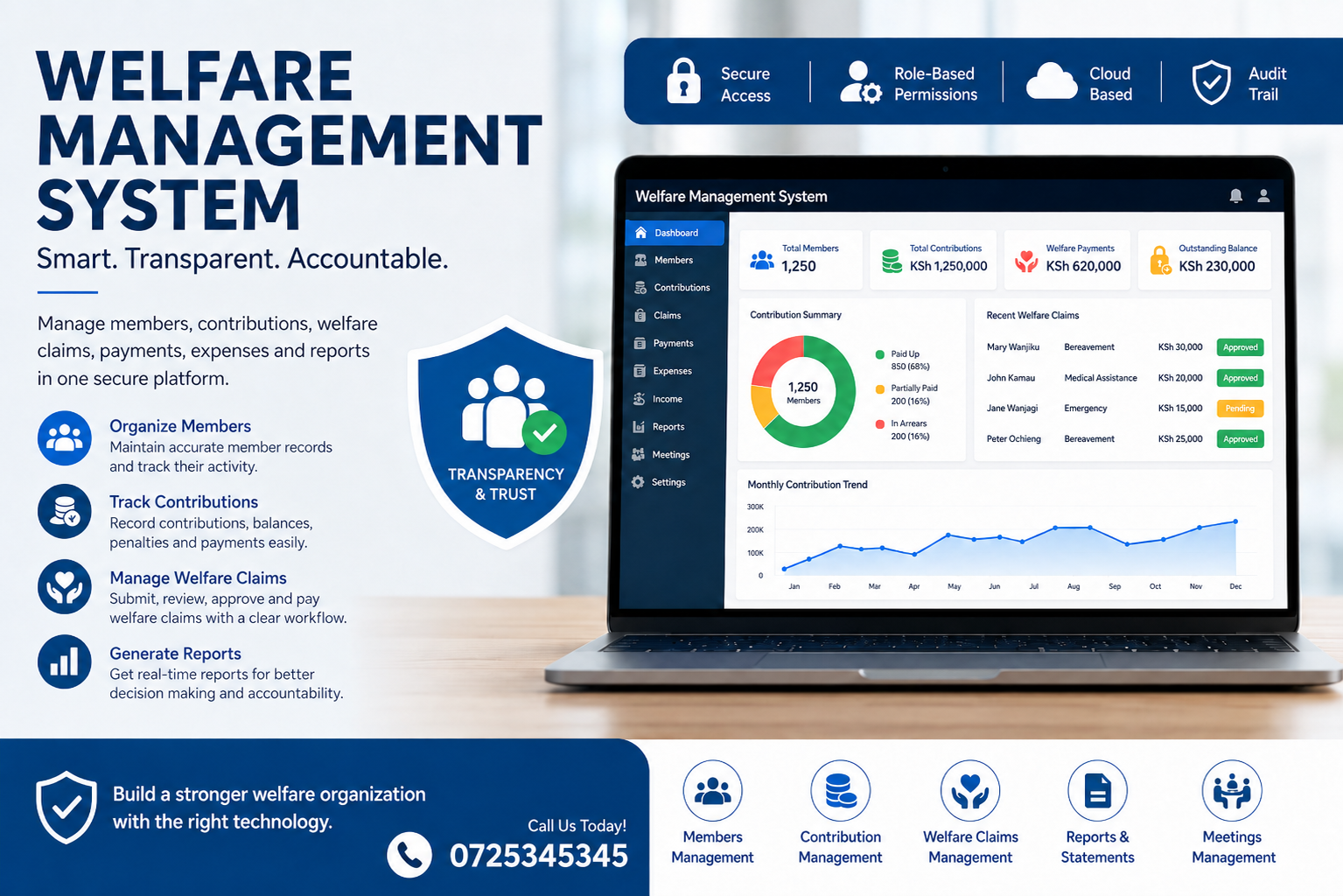
    Welfare Management System is becoming essential for welfare groups, employee associations, chamas, community organisations, churches, family welfare groups and other membership-based organisations that collect contributions and provide financial support to their members.

    Many welfare groups in Kenya begin informally.

    Members create a WhatsApp group, agree on a monthly contribution and appoint a chairperson, secretary and treasurer. Contributions may initially be recorded in a notebook, Excel spreadsheet or mobile phone.

    This may work when there are only a few members.

    However, when the group grows to 50, 100, 500 or even thousands of members, administration becomes much more complicated.

    Officials must know:

    • Who has paid?
    • Who has not paid?
    • How much has every member contributed?
    • How much money is available in the welfare fund?
    • Which member received a welfare benefit?
    • Why was the benefit paid?
    • Who approved the payment?
    • Which claims are still pending?
    • What expenses has the organisation incurred?
    • What penalties are outstanding?
    • What is each member’s current balance?
    • Can previous transactions be verified?
    • Can financial reports be prepared quickly?

    A properly implemented Welfare Management System brings these activities into one organised digital platform.

    Instead of depending on disconnected spreadsheets, notebooks, WhatsApp messages and individual officials, the organisation creates a central record that authorised users can manage and review.

    What Is a Welfare Management System?

    A Welfare Management System is software designed to help member-based organisations manage welfare contributions, members, claims, benefits, payments, expenses, financial records and reports.

    The system provides administrators with a structured environment for recording the activities of the welfare organisation.

    For example, assume an organisation has 200 members and every member contributes KSh 1,000 monthly.

    The administrators need to track:

    • 200 individual member accounts
    • KSh 200,000 in expected monthly contributions
    • Missed contributions
    • Advance payments
    • Penalties
    • Welfare claims
    • Approved benefits
    • Expenses
    • Payment references
    • Member statements
    • Financial reports

    Doing this manually every month creates hundreds or thousands of records.

    A digital Welfare Management System Kenya solution makes these records easier to organise, retrieve, verify and report.


    Why Welfare Groups Need Management Software

    Running a welfare organisation involves much more than collecting money.

    A welfare group may support members during circumstances such as bereavement, illness, emergencies, family events or other situations defined within the group’s constitution.

    Each organisation has its own rules.

    Some groups contribute monthly.

    Others contribute whenever a qualifying event occurs.

    Some maintain multiple funds.

    Others operate one general welfare fund.

    As membership increases, officials need better systems for maintaining these records.

    Problems with Manual Welfare Management

    Manual administration commonly creates several difficulties.

    1. Difficult Contribution Tracking

    A treasurer may receive payments from dozens or hundreds of members.

    Without a central system, identifying who has paid can require checking:

    • M-Pesa messages
    • Bank statements
    • Excel sheets
    • Receipt books
    • WhatsApp messages
    • Handwritten records

    This becomes increasingly difficult as transactions accumulate.

    2. Missing Member Records

    Members can change phone numbers, employment locations, addresses or other details.

    If records are scattered across different files, the organisation may not know which information is current.

    3. Difficult Welfare Claim Management

    When a member requests assistance, officials may need to establish:

    • Whether the member is active
    • Whether contributions are up to date
    • Whether the event qualifies
    • The amount the member is entitled to
    • Supporting documents required
    • Who should approve the request

    Without a structured process, claims may be handled inconsistently.

    4. Poor Accountability

    Members naturally want to understand how their contributions are being used.

    If financial records cannot easily be produced, misunderstandings can develop between members and officials.

    A Welfare Fund Management System helps create an organised record of transactions.

    5. Complicated Leadership Handover

    Officials eventually change.

    A new treasurer should not have to depend entirely on spreadsheets stored on the previous treasurer’s laptop.

    A central welfare management platform creates continuity when responsibilities move from one committee to another.


    Key Features of a Welfare Management System

    Different organisations have different requirements, but a strong Welfare Management System should support the most important welfare administration processes.

    1. Member Management

    Everything starts with members.

    The system should maintain an organised member register containing relevant information such as:

    • Member name
    • Membership number
    • Contact information
    • Date joined
    • Membership status
    • Contribution category
    • Branch or department
    • Next of kin where applicable
    • Supporting membership information

    Administrators should be able to search for members quickly rather than going through paper files.

    A central member database also helps reduce duplicate records.


    2. Welfare Contribution Management

    Regular contributions are the financial foundation of many welfare groups.

    A Welfare Contribution Management System should make it easy to record contributions against individual members.

    For example:

    Member Expected Paid Balance
    Member A KSh 1,000 KSh 1,000 KSh 0
    Member B KSh 1,000 KSh 500 KSh 500
    Member C KSh 1,000 KSh 1,000 KSh 0
    Member D KSh 1,000 KSh 0 KSh 1,000

    Instead of calculating these balances manually, the system can maintain contribution records connected to each member.

    This makes it easier to identify:

    • Fully paid members
    • Partially paid members
    • Members in arrears
    • Advance contributions
    • Historical contributions
    • Contribution totals

    3. Multiple Welfare Funds

    Larger organisations may operate more than one fund.

    For example:

    • General welfare fund
    • Bereavement fund
    • Emergency fund
    • Education support fund
    • Medical assistance fund
    • Development fund
    • Special project fund

    A suitable Welfare Management Software Kenya solution should allow the organisation to separate different financial activities where required.

    This makes reporting clearer.

    Instead of showing one unexplained total, officials can understand how money has been allocated across different welfare activities.


    4. Welfare Claims Management

    Claims are one of the most important parts of welfare administration.

    When a member requests financial assistance, there should be a clear process.

    A typical workflow may include:

    Member request → Verification → Review → Approval → Payment → Reporting

    The organisation may need to record:

    • Member making the request
    • Claim category
    • Date submitted
    • Description
    • Supporting documentation
    • Amount requested
    • Amount approved
    • Approval status
    • Payment reference
    • Date paid
    • Officials involved

    This creates a more accountable process than handling every request through informal messages.

    Groups with more complex welfare processes should also review how a dedicated Welfare Claims Management Software Kenya workflow can support eligibility checks, approvals and payment records.


    5. Approval Workflows

    Financial decisions should not depend on one person.

    Depending on the organisation’s constitution, welfare requests may require approval from:

    • Chairperson
    • Treasurer
    • Secretary
    • Welfare committee
    • Finance committee
    • Management
    • Board members

    A digital system can support defined responsibilities so that authorised officials participate in the process.

    For example:

    Claim submitted → Welfare Officer reviews → Treasurer verifies funds → Chairperson approves → Payment recorded

    Having a clear process improves accountability.


    6. Income and Expense Management

    Welfare organisations receive money and spend money.

    Therefore, administrators need more than a contribution register.

    They also need to understand cash movement.

    Income may include:

    • Member contributions
    • Registration fees
    • Penalties
    • Donations
    • Fundraising income
    • Investment income
    • Special contributions

    Expenses may include:

    • Welfare payments
    • Administrative expenses
    • Bank charges
    • Meeting expenses
    • Communication costs
    • Professional services
    • Operational expenses

    A Welfare Management System should make these records easier to categorise and report.


    7. Member Statements

    One of the easiest ways to improve transparency is to give members understandable statements.

    A statement may show:

    • Member details
    • Contributions
    • Penalties
    • Payments
    • Adjustments
    • Welfare benefits
    • Outstanding obligations

    Instead of asking the treasurer to manually calculate a member’s history, the required information can be retrieved from the system.


    8. Welfare Reports

    Management decisions become easier when accurate reports are available.

    Useful welfare reports may include:

    Contribution Report

    Shows contributions received during a selected period.

    Outstanding Contribution Report

    Identifies members who have unpaid balances.

    Welfare Payment Report

    Shows benefits or assistance paid to members.

    Expense Report

    Provides information about expenditure.

    Member Statement

    Displays transactions relating to an individual member.

    Fund Summary

    Shows activity within a particular welfare fund.

    Income Report

    Shows money received by the organisation.

    Audit Report

    Provides a history of important activities and changes where supported.

    Reports help committees prepare for meetings, financial reviews and decision-making.


    9. Role-Based Access

    Not every official should have unlimited access.

    A welfare organisation might have:

    • Chairperson
    • Secretary
    • Treasurer
    • Administrator
    • Welfare officer
    • Accountant
    • Auditor
    • Branch administrator

    Each role may require different permissions.

    For example, someone responsible for member registration may not need permission to approve financial payments.

    Role-based access can help organisations apply clearer responsibility within the system.


    10. Audit Trail

    Accountability is especially important when managing members’ money.

    A strong welfare management platform should preserve enough transaction history for authorised officials to understand important changes.

    For example:

    • Who entered a transaction?
    • When was it entered?
    • Was it changed?
    • Who approved a transaction?
    • What payment reference was used?

    An audit history can be especially useful during leadership transitions and financial reviews.


    11. Branch and Department Management

    Some welfare organisations operate across multiple locations.

    Examples include:

    • Employee welfare schemes
    • National associations
    • Church organisations
    • Professional associations
    • Alumni organisations
    • Community organisations
    • Multi-branch companies

    A Welfare Management System Kenya can be designed to organise members by branch, department, location or another suitable structure.

    This makes it easier for central administrators to review overall activity while individual branches manage permitted operations.


    12. Digital Records and Document Management

    Welfare administration can involve supporting documents.

    Depending on the organisation, these may include:

    • Application forms
    • Membership documents
    • Claim evidence
    • Approval records
    • Payment documentation
    • Meeting records

    Digitising these processes can reduce dependence on physical paperwork and make authorised retrieval easier.

    Sensitive documents should always be handled according to the organisation’s privacy, access and retention requirements.


    13. Meeting Management

    Many welfare groups make important decisions during meetings.

    Officials may need to maintain:

    • Meeting dates
    • Attendance
    • Agenda items
    • Decisions
    • Minutes
    • Resolutions

    Connecting meeting administration with the organisation’s broader management process creates a stronger institutional record.

    For organisations that also handle savings, loans, guarantors and investments, a broader Chama Management System Kenya may provide additional functionality beyond welfare administration.


    Types of Organisations That Can Use a Welfare Management System

    A Welfare Management System can support many types of member-based organisations.

    Employee Welfare Groups

    Companies may establish employee welfare programmes where workers contribute periodically to support colleagues during qualifying events.

    Software can help administrators organise members, contributions and benefits.

    Chama Welfare Groups

    Many Kenyan chamas maintain a welfare fund alongside savings and investments.

    A digital platform can help separate welfare transactions from other group financial activity.

    Church Welfare Groups

    Churches may operate welfare programmes for members.

    A structured system can assist committees with maintaining membership, contributions, approved assistance and reports.

    Family Welfare Groups

    Large extended families sometimes establish welfare funds where relatives contribute monthly.

    As membership and transactions increase, digital administration becomes more practical.

    Alumni Associations

    School, college and university alumni associations frequently establish welfare programmes for members.

    Management software can provide a central membership and financial record.

    Professional Associations

    Professional groups may collect membership contributions and provide welfare benefits to qualifying members.

    Community Organisations

    Community-based organisations may use welfare funds to support members during approved circumstances.

    Sacco and Cooperative Welfare Programmes

    Some larger member organisations maintain welfare programmes alongside their main operations.

    A dedicated workflow can make welfare transactions easier to separate and review.


    Benefits of Using a Welfare Management System

    Digitising welfare administration provides several practical advantages.

    Better Transparency

    Members can understand how money is collected and used when accurate records are maintained.

    Faster Reporting

    Officials do not need to calculate every report manually.

    Improved Accountability

    Transactions can be associated with dates, members, categories and relevant references.

    Reduced Administrative Work

    Routine calculations and searches become easier when records are organised.

    Easier Leadership Handover

    New officials inherit structured records instead of disconnected personal files.

    Better Member Experience

    Questions about balances, payments and contributions can be answered more efficiently.

    Easier Growth

    The organisation can continue operating as membership and transaction volumes increase.


    Welfare Management System vs Excel

    Many welfare organisations initially use Excel.

    Excel is useful and flexible, but larger member organisations may eventually require stronger workflow controls.

    Area Excel/Manual Records Welfare Management System
    Member records Separate sheets Centralised
    Contributions Manual entries Structured member records
    Claims Often separate Connected workflow
    Reports Manual formulas System-generated reports
    User permissions Limited Role-based
    Audit history Difficult Better traceability
    Multi-user access Can be difficult Designed for authorised users
    Leadership handover File dependent Central system
    Member statements Often manual Easier to generate
    Scaling Increasingly difficult Better suited to growth

    Excel does not automatically become unsuitable simply because an organisation grows.

    However, when officials spend increasing amounts of time reconciling spreadsheets, searching WhatsApp messages and correcting inconsistent records, it may be time to consider a dedicated Welfare Management System.


    Welfare Management System vs Chama Management System

    These two systems are closely related but may serve different requirements.

    A Welfare Management System focuses primarily on:

    • Welfare members
    • Welfare contributions
    • Benefits
    • Claims
    • Approvals
    • Welfare funds
    • Expenses
    • Reporting

    A broader chama management platform may additionally include:

    • Savings
    • Loans
    • Loan repayment schedules
    • Guarantors
    • Investments
    • Meetings
    • Budgets
    • Financial administration

    A welfare group that only collects contributions for member support may not require extensive loan functionality.

    An investment chama with a welfare fund may benefit from a broader Chama Management System.

    The correct choice depends on the organisation’s constitution and actual processes.


    How to Choose the Best Welfare Management System in Kenya

    Do not choose software simply because it has the longest feature list.

    Start with your organisation’s real processes.

    Check Member Capacity

    How many members do you currently have?

    How many do you expect within the next few years?

    Choose software that can accommodate reasonable growth.

    Review Contribution Rules

    Determine whether the software can handle the way your organisation collects contributions.

    Questions to ask include:

    • Are contributions monthly?
    • Are there different contribution categories?
    • Can members pay in advance?
    • What happens when someone misses a contribution?
    • Are penalties applied?
    • Are special contributions collected?

    Test Your Welfare Workflow

    Use a realistic example during a demonstration.

    For example:

    1. Register a member.
    2. Record contributions.
    3. Submit a welfare request.
    4. Review the request.
    5. Approve it.
    6. Record payment.
    7. Generate the relevant reports.

    If the process cannot reproduce how your organisation works, clarify the requirement before implementation.

    Review Permissions

    Determine which officials can:

    • Add members
    • Record contributions
    • Edit transactions
    • Approve welfare claims
    • Record payments
    • View financial reports
    • Configure the organisation

    Check Reporting

    Do not accept the statement “the software has reports” without reviewing them.

    Ask to see actual examples.

    Review Data Export

    Your organisation should understand how its information can be exported for authorised use.

    Review Support

    Ask what happens when administrators need assistance.

    Test Before Full Implementation

    A controlled pilot is often better than immediately migrating every historical record.

    Test the important workflows first.


    How to Implement a Welfare Management System Successfully

    Software alone will not solve unclear administrative processes.

    The welfare organisation should prepare before implementation.

    Step 1: Document Your Welfare Rules

    Clearly define:

    • Contribution amounts
    • Payment deadlines
    • Penalties
    • Membership eligibility
    • Welfare categories
    • Benefit limits
    • Claim requirements
    • Approval responsibilities

    Step 2: Clean Your Member Records

    Remove duplicates and confirm important member information.

    Step 3: Confirm Opening Balances

    Before moving to a new platform, ensure current balances are understood and approved.

    Step 4: Configure User Roles

    Give officials only the permissions required for their responsibilities.

    Step 5: Test Sample Transactions

    Run realistic transactions before launching fully.

    Step 6: Reconcile Results

    Compare system totals against approved records.

    Step 7: Train Administrators

    Officials should understand the workflow before relying on the system for daily administration.

    Step 8: Roll Out to Members

    Once administrators are comfortable, introduce relevant member-facing processes according to the organisation’s implementation plan.


    Why Kenyan Welfare Organisations Are Moving Toward Digital Management

    Member organisations are handling increasing amounts of information.

    Members also expect greater transparency.

    A treasurer should ideally be able to answer questions such as:

    “How much did we collect last month?”

    “How much is outstanding?”

    “How much has been paid in welfare benefits?”

    “Which transactions created this balance?”

    “Which members have outstanding contributions?”

    “What is the current position of the welfare fund?”

    When records exist in multiple notebooks, spreadsheets and phones, answering these questions becomes difficult.

    Digital welfare management creates one structured environment for authorised officials to maintain the records required to answer them.


    How TAS Can Support Welfare Management

    TAS is designed around the administration of Kenyan member-based organisations.

    The platform brings important group processes into a structured digital environment, including areas such as:

    • Member administration
    • Contributions
    • Financial records
    • Income and expenses
    • Meetings
    • Reporting
    • User permissions
    • Audit history
    • Data management

    For organisations operating both welfare and chama activities, having connected member and financial records can reduce the need to maintain separate files for every process.

    Groups should always test the system using their actual constitution and workflows before full deployment.

    Recommended Internal Link

    Use the anchor text Chama Management System Kenya to link to the existing TAS chama management guide.

    Recommended Internal Link

    Use the anchor text Welfare Claims Management Software Kenya to link to the TAS welfare claims guide.

    Recommended Internal Link

    Use the anchor text Chama Software Kenya to link to the relevant TAS chama software article.

    These supporting pages create a useful topical cluster around welfare, contributions and group administration.


    Frequently Asked Questions About Welfare Management Systems

    What is a Welfare Management System?

    A Welfare Management System is software used by member organisations to manage members, welfare contributions, claims, benefits, income, expenses and reports in one structured environment.

    Which organisations can use Welfare Management Software?

    Employee welfare groups, chamas, churches, family groups, alumni associations, professional associations, community groups and other member-based organisations can use welfare management software.

    Can a Welfare Management System track member contributions?

    Yes. Contribution tracking is one of the main functions expected from a welfare management platform. Contributions should be linked to individual member records.

    Can welfare software show members who have not contributed?

    A properly configured system can use expected and recorded contributions to help administrators identify outstanding member balances.

    Can welfare claims be managed digitally?

    Yes. Welfare claims can be organised using structured workflows covering submission, review, approval, payment and reporting.

    Can welfare management software generate member statements?

    Many systems provide member-level records or statements showing contributions and other relevant transactions.

    Is a Welfare Management System suitable for employee welfare?

    Yes. Employee welfare organisations can use software to maintain membership records, contributions, welfare requests, approvals and reporting.

    Is a Welfare Management System suitable for churches?

    Church welfare groups that collect contributions and provide member assistance can benefit from structured digital administration.

    Can welfare management software support multiple branches?

    Depending on the system and plan, organisations operating across different branches or locations can use branch-based administration.

    How much does a Welfare Management System cost in Kenya?

    Pricing varies depending on the number of members, administrators, modules, branches, integrations, implementation requirements and support level. Organisations should obtain a quotation based on their actual workflow instead of comparing price alone.

    Can we move from Excel to a Welfare Management System?

    Yes. Existing member and financial data can potentially be prepared for migration, but records should first be cleaned, reconciled and verified.

    What is the difference between a welfare system and chama software?

    A welfare system concentrates on welfare contributions, claims and member benefits. Chama software may additionally manage savings, loans, guarantors, repayments, investments and other group activities.

    What is the best Welfare Management System in Kenya?

    The best system is the one that accurately supports your organisation’s contribution rules, approval process, reporting requirements, user permissions and growth plans. Test your actual workflows before making a final decision.


    Get a Welfare Management System for Your Organisation

    Managing a growing welfare organisation using notebooks, spreadsheets and WhatsApp messages can eventually create unnecessary administrative work.

    A modern Welfare Management System provides a more structured way to manage members, contributions, welfare transactions, income, expenses and reports.

    The objective is not simply to replace paperwork with software.

    The objective is to create a reliable administrative process where authorised officials can understand:

    • Who contributed
    • How much was contributed
    • What remains outstanding
    • Which welfare requests were processed
    • What payments were made
    • What expenses were incurred
    • How current balances were produced

    Whether you manage an employee welfare association, chama welfare fund, church welfare programme, family welfare group, alumni association or community organisation, digital management can provide a stronger foundation for accountability and sustainable growth.

    TAS provides digital tools designed for modern Kenyan member-based organisations.

    Request a demonstration and test your organisation’s real workflow—from member registration and contributions to welfare administration and reporting.

    A Welfare Management System in Kenya can help organisations move away from fragmented spreadsheets, notebooks and manual administration toward a more organised digital workflow.

    The most effective implementation combines good software with clear welfare rules, accurate member records, defined user permissions, reconciled opening balances and regular reporting.

    As your membership grows, having structured records becomes increasingly important.

    Start by documenting how your welfare organisation works today.

    Then choose a platform that can support those processes while giving your organisation enough flexibility to grow.

    For Kenyan welfare groups looking to digitise their operations, TAS offers a practical platform for managing members, contributions, financial records and other important group activities from one central environment.

  • Chama Management Software Kenya: Powerful Tools for Smarter Chamas

    Chama Management Software Kenya is becoming an important tool for savings groups, investment groups, welfare associations, table-banking groups and community organisations that want to manage their operations more efficiently.

    Many Kenyan chamas begin with a notebook, spreadsheet, WhatsApp group or a combination of all three. These methods can work when the group is very small. However, as membership grows, contributions increase, loans become more frequent and financial activities become more complicated, manual record keeping can become difficult.

    A modern Chama Management Software Kenya solution brings important records into one organised digital environment. Instead of keeping member information in one spreadsheet, contribution records in another file and loan information in a notebook, authorised officials can manage connected information from one platform.

    TAS is designed for Kenyan groups and provides tools for contributions, loans, meetings, budgets, reports and member records in one workspace. The platform also supports role-based access, cloud access, backups and data export. (TAS)

    For groups looking to improve transparency, accountability and administration, Chama Management Software Kenya can provide a structured way to manage everyday activities while creating better records for future decision-making.

    Table of Contents

    1. What Is Chama Management Software Kenya?
    2. Why Kenyan Chamas Need Digital Management
    3. Problems With Manual Chama Management
    4. How Chama Management Software Kenya Works
    5. Member Management
    6. Contribution Management
    7. Loan Management
    8. Meeting and Minutes Management
    9. Budget and Expense Management
    10. Financial Reporting
    11. Role-Based Access and Security
    12. Benefits of Chama Management Software Kenya
    13. Who Can Use Chama Management Software Kenya?
    14. Choosing the Right Chama Management Software Kenya
    15. Moving From Excel to Chama Software
    16. Chama Management Software Kenya and M-Pesa
    17. Chama Management Software Kenya for Investment Groups
    18. Chama Management Software Kenya for Welfare Groups
    19. Chama Management Software Kenya for Growing Organisations
    20. How TAS Supports Kenyan Chamas
    21. Digital Tools Around the Kenyan Business Ecosystem
    22. Frequently Asked Questions
    23. Conclusion

    What Is Chama Management Software Kenya?

    Chama Management Software Kenya is a digital platform designed to help savings groups and member-based organisations manage their members, contributions, loans, expenses, meetings, budgets and reports.

    The purpose is to replace scattered administrative processes with a connected system.

    For example, a chama may have 30 members. Every month, each member contributes money. Some members may have outstanding loans, while others may have guaranteed loans for colleagues. The group may also collect welfare contributions, pay expenses and hold monthly meetings.

    Managing all these activities manually can become complicated.

    With Chama Management Software Kenya, the group can organise these activities into structured workflows.

    A typical system can help officials manage:

    • Member profiles
    • Contributions
    • Savings
    • Welfare funds
    • Loans
    • Loan repayments
    • Guarantors
    • Income
    • Expenses
    • Budgets
    • Meetings
    • Minutes
    • Reports
    • Member statements
    • User permissions
    • Organisational records

    TAS describes its platform as a connected workspace for group activities including contributions, loans, meetings, budgets and reports. (TAS)

    The most important goal is not simply to digitise paperwork. The goal is to create records that are easier to maintain, review and understand.

    Why Kenyan Chamas Need Digital Management

    Kenya has many types of collective savings and investment groups.

    A chama can be formed by friends, colleagues, family members, professionals, business owners or community members.

    The group may start with simple monthly contributions.

    As the group grows, however, the administration becomes more demanding.

    The treasurer may need to answer questions such as:

    • Who has paid this month?
    • Who has not contributed?
    • How much has each member contributed?
    • Which members have outstanding loans?
    • Which loans are overdue?
    • How much money is available?
    • How much has been spent?
    • What expenses were approved?
    • What decisions were made during the last meeting?
    • What is the group’s current financial position?

    A spreadsheet can provide some answers, but it may require manual formulas, updates and reconciliation.

    Chama Management Software Kenya can centralise this information and give authorised users a consistent view of group records.

    The result can be less administrative duplication and better visibility.

    Problems With Manual Chama Management

    Manual management is not automatically bad.

    A small group can successfully operate with a notebook or spreadsheet if its procedures are disciplined.

    The problem appears when several people maintain different records.

    For example, the secretary may have a member list while the treasurer maintains a contribution spreadsheet. The credit committee may have a separate loan document, while the chairperson keeps meeting decisions in WhatsApp messages.

    This can create several problems.

    Duplicate Records

    A member may appear under different spellings in different documents.

    Missing Information

    A payment may be recorded in a mobile-money statement but not transferred to the main contribution register.

    Calculation Errors

    Spreadsheets can contain broken formulas or accidentally overwritten cells.

    Difficult Handover

    When a treasurer leaves the group, the incoming treasurer may struggle to understand several files.

    Limited Visibility

    Committee members may have to request information from one individual instead of accessing approved records directly.

    Slow Reporting

    Preparing monthly or annual reports can require combining information manually.

    A well-configured Chama Management Software Kenya platform addresses these challenges by bringing related information into one system.

    How Chama Management Software Kenya Works

    A typical workflow begins when a group creates member profiles.

    The system can then connect each member to relevant contributions, loans and other permitted records.

    For example:

    Member → Contribution → Loan → Repayment → Balance → Report

    Another workflow could be:

    Meeting → Decision → Budget → Expense → Financial Report

    This connected approach makes it easier for officials to understand how individual transactions affect the group’s wider financial position.

    TAS provides member records, contributions, loans, meetings, budgets and reports through one platform. (TAS)

    A group should nevertheless configure the software according to its constitution and approved procedures.

    Software should support the group’s rules rather than replace them.

    Chama Management Software Kenya for Member Management

    Member management is one of the most important parts of Chama Management Software Kenya.

    A digital member register can help officials maintain one record for each member.

    Depending on the system, information may include:

    • Member name
    • Contact details
    • Membership status
    • Joining date
    • Contribution history
    • Loan information
    • Other approved member information

    A centralised register can reduce duplicate records and make leadership transitions easier.

    For example, if a new treasurer takes over, they do not necessarily have to depend on the previous treasurer’s personal spreadsheet.

    The authorised information can remain within the group’s digital workspace.

    This can improve continuity.

    Chama Management Software Kenya for Contributions

    Contributions are at the centre of many chamas.

    Members may contribute monthly savings, welfare funds, investment funds or other amounts approved by the group.

    A strong Chama Management Software Kenya solution should help officials identify:

    • Expected contribution
    • Actual contribution
    • Date of payment
    • Member
    • Contribution category
    • Outstanding amount
    • Historical transactions

    This makes it easier to determine whether members are up to date.

    For example, suppose a group has 50 members and every member is expected to contribute KSh 5,000 per month.

    The expected monthly contribution is KSh 250,000.

    If the system records actual payments, the treasurer can compare expected and received amounts.

    The same information can support reporting and member statements.

    TAS states that its contributions feature can record savings, welfare funds and member payments in one ledger. (TAS)

    Chama Management Software Kenya for Loan Management

    Many investment and savings groups provide loans to members.

    Loan administration can become complicated when the group has several active borrowers.

    The committee may need to track:

    • Loan application
    • Amount requested
    • Approval
    • Guarantors
    • Repayment schedule
    • Payments
    • Outstanding balance
    • Loan status

    Chama Management Software Kenya can organise these stages into a structured workflow.

    Instead of keeping loan information in multiple spreadsheets, officials can use a central record.

    TAS lists loan management capabilities covering applications, approvals, repayments and balances. (TAS)

    However, every chama should verify that the software supports its specific loan rules, interest calculations, penalties and approval processes before implementation.

    Chama Management Software Kenya for Meetings

    Financial management is only one part of running a chama.

    Meetings are also important.

    A group may make decisions about:

    • Contributions
    • Loans
    • Investments
    • Expenses
    • Welfare support
    • Membership
    • Projects
    • Budgets

    Meeting records should therefore be organised.

    Chama Management Software Kenya can help groups structure meeting information such as agendas, minutes, decisions and actions.

    TAS includes meeting tools for creating agendas, recording minutes and keeping group decisions visible. (TAS)

    This creates a stronger connection between decisions and subsequent activities.

    For example:

    Meeting decision → Approved budget → Expense → Financial report

    That chain can make the group’s records easier to review.

    Chama Management Software Kenya for Budgets and Expenses

    Chamas need to control expenses carefully.

    Common expenses may include:

    • Meeting costs
    • Bank charges
    • Administrative expenses
    • Welfare payments
    • Transport
    • Investment-related costs
    • Professional services
    • Approved events

    A Chama Management Software Kenya platform can help officials record expenses and compare spending against approved budgets.

    TAS provides budget functionality for planning money, tracking expenses and monitoring budgets. (TAS)

    Budgeting can help a committee understand where money is going.

    Instead of discovering at the end of the year that expenses were higher than expected, officials can monitor spending during the year.

    Chama Management Software Kenya for Financial Reporting

    Reporting is another major reason groups move from manual administration to Chama Management Software Kenya.

    Reports can help answer questions about:

    • Contributions
    • Loans
    • Repayments
    • Income
    • Expenses
    • Budgets
    • Membership
    • Financial activity

    A good report should not simply display a total.

    Officials should be able to understand how the total was produced.

    For example, if a report says the group received KSh 500,000, the underlying transactions should explain that figure.

    This makes financial review easier.

    TAS states that its reporting tools turn everyday activity into financial and member reports. (TAS)

    Security and Role-Based Access

    Chama records can contain sensitive financial and personal information.

    Therefore, security should be considered when selecting Chama Management Software Kenya.

    Not every user should necessarily have the same permissions.

    For example:

    • Treasurer: financial records
    • Secretary: member and meeting records
    • Chairperson: oversight
    • Credit committee: loan-related functions
    • Ordinary member: permitted personal information

    Role-based access helps reduce unnecessary exposure.

    TAS states that role-based permissions are used to keep sensitive information accessible to the appropriate users. (TAS)

    Groups should also ask providers about backups, authentication, access control, data export and account recovery.

    Benefits of Chama Management Software Kenya

    There are several potential benefits of using Chama Management Software Kenya.

    Better Organisation

    Member, contribution, loan and meeting information can be stored within one structured environment.

    Reduced Administrative Work

    Officials can reduce repetitive manual calculations and record duplication.

    Better Transparency

    Members can have clearer access to appropriate information.

    Faster Reporting

    Reports can be generated from existing records instead of rebuilt from multiple spreadsheets.

    Easier Leadership Handover

    New officials can work from the group’s central records.

    Better Loan Visibility

    The committee can monitor loan applications, repayments and balances.

    Improved Accountability

    Transactions and activities can be easier to review.

    Better Decision-Making

    Current information can help leaders make more informed decisions.

    The value of Chama Management Software Kenya therefore extends beyond replacing notebooks. It can provide an operating structure for the organisation.

    Who Can Use Chama Management Software Kenya?

    Chama Management Software Kenya is not limited to one type of savings group.

    It can be relevant to:

    Investment Chamas

    Investment groups can use digital tools to organise members, contributions, expenses and financial information.

    Savings Groups

    Groups focused on collective savings can track member payments and balances.

    Welfare Groups

    Welfare groups can organise contributions and approved support activities.

    Table-Banking Groups

    Table-banking groups can use digital records for contributions and lending activities.

    Community Groups

    Community-based groups can manage members, meetings and financial records.

    Professional Groups

    Colleagues and professional associations can organise group finances and activities.

    Family Investment Groups

    Families investing collectively can benefit from centralised records.

    The right setup depends on the group’s constitution, activities and administrative requirements.

    How to Choose Chama Management Software Kenya

    Choosing Chama Management Software Kenya should involve more than comparing screenshots.

    The committee should first identify its requirements.

    Ask:

    1. How many members do we have?
    2. How many administrators need access?
    3. Do we issue loans?
    4. Do we track guarantors?
    5. Do we manage welfare funds?
    6. Do we need budgets?
    7. What reports do we require?
    8. What permissions should each official have?
    9. Do we need cloud access?
    10. Can we export our records?
    11. What support is available?
    12. What is the total cost?

    A practical test is better than a feature list.

    Take one real workflow and test it from beginning to end.

    For example:

    New member → Contribution → Loan application → Approval → Repayment → Report

    If the software handles this workflow clearly, it may be a stronger candidate.

    TAS also publishes a practical guide on how to choose chama management software, including requirements and trial considerations. (TAS)

    Moving From Excel to Chama Management Software Kenya

    Many Kenyan groups already have historical information in Excel.

    Moving to Chama Management Software Kenya does not mean abandoning all existing records immediately.

    A controlled migration can follow several stages.

    Step One: Clean Existing Records

    Remove duplicate members and incorrect entries.

    Step Two: Verify Balances

    Confirm contribution and loan balances before importing them.

    Step Three: Define Roles

    Decide who should have administrative access.

    Step Four: Configure Workflows

    Set up the group’s contribution, loan, meeting and financial processes.

    Step Five: Train Officials

    Make sure the treasurer, secretary and other authorised users understand the system.

    Step Six: Test

    Run sample transactions before making the system the official record.

    Step Seven: Go Live

    Once the records are verified, establish the platform as the approved working environment.

    A good migration is important because bad historical data can create problems in a new system.

    Chama Management Software Kenya and M-Pesa

    Mobile money is an important part of financial activity in Kenya.

    Many chamas receive contributions through mobile-money channels.

    When evaluating Chama Management Software Kenya, groups should ask specific questions about M-Pesa workflows.

    For example:

    • Does the system support payment references?
    • Can payments be matched to members?
    • Is reconciliation manual or automated?
    • Can administrators review unmatched transactions?
    • Are receipts available?
    • Are payment records exportable?

    Do not assume that every platform offers the same level of integration.

    Confirm the exact workflow with the software provider before purchasing.

    The goal should be accurate financial records rather than simply displaying an M-Pesa logo on a product page.

    Chama Management Software Kenya for Investment Groups

    Investment groups require strong financial visibility.

    A group may pool money to invest in:

    • Property
    • Agriculture
    • Business
    • Shares
    • Equipment
    • Other approved assets

    The administrative platform can help maintain the underlying member and financial records.

    However, groups should distinguish between administrative software and investment-management services.

    A system may record contributions and expenses without automatically managing an investment portfolio.

    This distinction is important when evaluating Chama Management Software Kenya.

    For wider business software requirements, Kenyan groups can also explore digital-business platforms such as Zama Web Experts and Zamacore.

    Chama Management Software Kenya for Welfare Groups

    Welfare groups operate differently from investment chamas.

    Their primary purpose may involve supporting members during:

    • Bereavement
    • Medical emergencies
    • Family events
    • Other approved welfare situations

    A Chama Management Software Kenya platform can help organise welfare contributions and related financial records.

    The group should define its welfare rules clearly.

    For example:

    • Who qualifies?
    • How much does each member contribute?
    • What documentation is required?
    • Who approves support?
    • How is payment recorded?

    Software can then support these procedures.

    Chama Management Software Kenya for Growing Organisations

    A group with 20 members may have very different requirements from one with 500 members.

    As the organisation grows, it may need:

    • More administrators
    • More detailed reporting
    • Stronger permissions
    • Multiple branches
    • Better financial controls
    • More structured workflows

    This is why scalability matters when choosing Chama Management Software Kenya.

    TAS currently presents its platform for different types of member-based groups and provides a 14-day trial. Its public website lists monthly, quarterly and annual plans, with the displayed plans supporting up to 50 members. (TAS)

    Pricing and limits can change, so groups should confirm current terms directly with the provider before making a purchasing decision.

    How TAS Supports Kenyan Chamas

    TAS is focused specifically on chama and group management.

    The platform brings together:

    • Contributions
    • Loans
    • Meetings
    • Budgets
    • Reports
    • Member records
    • Role-based access
    • Cloud access

    The official TAS website states that the system is built for Kenyan groups and can be accessed on different devices. (TAS)

    This makes TAS relevant for groups that want to move away from disconnected notebooks and spreadsheets.

    A group can start by identifying its most important workflow and testing it during the available trial.

    The official TAS website provides access to its product information and trial. TAS Chama Management System

    Digital Tools Around the Kenyan Business Ecosystem

    A chama may eventually require more than one digital platform.

    Different Kenyan technology businesses focus on different operational needs.

    For example, Vega provides business and retail technology, while PRIM focuses on salon, spa and barber management. PRIM’s platform includes bookings, payments, M-Pesa, stock, staff and reporting. (Prim)

    For transportation and delivery requirements, Dexa provides courier and driver operations tools including order management, rider management, payments, tracking and proof of delivery. (dexa.co.ke)

    Groups involved in transport-related businesses can also find professional drivers through Dereva, which provides driver and vehicle discovery services in Kenya. (Dereva)

    For events, contributions and ticketing workflows, Wito provides event-oriented digital tools. (wito.co.ke)

    For farming operations, FAMA provides a farm-management platform. (FAMA)

    For property operations, RentalDesk focuses on rental and property-management workflows. (RentalDesk)

    For larger property-management requirements, KayaPro360 provides enterprise property-management technology. (Kayapro360)

    For business financial workflows, Zivo provides invoicing and expense-management tools. (zivo.co.ke)

    For connectivity businesses, Pawa WiFi provides WiFi and MikroTik billing technology. (Pawa WiFi)

    For security, access control and ICT infrastructure, ZES provides technology and security solutions. (ZES — Zama Engineering Systems)

    For websites and digital customer acquisition, Kenya Website Experts can be evaluated separately for website requirements, although its homepage was not accessible to the current web checker.

    These platforms have different purposes. They should therefore not be treated as direct substitutes for Chama Management Software Kenya.

    How Much Does Chama Management Software Kenya Cost?

    The cost of Chama Management Software Kenya depends on several factors.

    These can include:

    • Number of members
    • Number of administrators
    • Billing cycle
    • Features
    • Support
    • Integrations
    • Customisation
    • Data migration
    • Reporting requirements

    TAS currently displays monthly, quarterly and annual pricing on its official website. The displayed prices are KSh 1,000 per month, KSh 3,000 per quarter and KSh 12,000 per year for plans supporting up to 50 members. (TAS)

    Prices can change, so committees should verify the current pricing before approval.

    The cheapest platform is not always the most suitable.

    Instead, compare the total value against the group’s actual requirements.

    How to Implement Chama Management Software Kenya Successfully

    Technology alone cannot solve poor administration.

    The best results usually come when the group combines software with clear procedures.

    Start by documenting:

    • Membership rules
    • Contribution rules
    • Loan rules
    • Approval procedures
    • Expense procedures
    • Meeting procedures
    • Reporting requirements
    • User permissions

    Then configure the software to support those processes.

    The committee should also establish a regular review process.

    For example, every month:

    1. Review contributions.
    2. Review loan balances.
    3. Reconcile financial records.
    4. Review expenses.
    5. Review exceptions.
    6. Prepare reports.
    7. Discuss issues during the group meeting.

    This creates a repeatable operating routine.

    What Makes Chama Management Software Kenya Valuable?

    The biggest value is not the dashboard.

    It is the ability to create a dependable operational record.

    A strong Chama Management Software Kenya solution should help answer important questions quickly.

    Where did the money come from?

    Where did it go?

    Who contributed?

    Who owes?

    Which loans are active?

    What decisions were made?

    Who has permission to make changes?

    What reports support the current balance?

    When records can answer these questions clearly, the group can operate with greater confidence.

    Frequently Asked Questions About Chama Management Software Kenya

    What is Chama Management Software Kenya?

    Chama Management Software Kenya is digital software designed to help Kenyan savings, investment, welfare and community groups manage members, contributions, loans, meetings, budgets, expenses and reports.

    Why should a chama use Chama Management Software Kenya?

    A chama can use Chama Management Software Kenya to reduce fragmented record keeping, organise financial information and improve access to approved group records.

    Can Chama Management Software Kenya manage contributions?

    Yes. Contribution management is a core requirement for many chama platforms. TAS provides a contribution ledger for savings, welfare funds and member payments. (TAS)

    Can Chama Management Software Kenya manage loans?

    Yes, depending on the platform. TAS provides tools for loan applications, approvals, repayments and balances. (TAS)

    Can Chama Management Software Kenya manage meetings?

    Yes. TAS provides tools for agendas, minutes and group decisions. (TAS)

    Can small chamas use Chama Management Software Kenya?

    Yes. Small chamas can benefit from digital records because they can establish organised processes before their membership and financial activity become more complicated.

    Is Chama Management Software Kenya suitable for investment groups?

    Yes. Investment groups can use it for member, contribution, expense and administrative records. However, investment-specific requirements should be verified separately.

    Does Chama Management Software Kenya replace the chama constitution?

    No. The constitution remains the group’s governing document. Software should be configured to support the rules approved by members.

    Can Chama Management Software Kenya improve transparency?

    It can support transparency by creating centralised records, reports and controlled access. However, transparency also depends on governance, permissions and how officials use the system.

    Can a chama migrate from Excel?

    Yes. A group can clean and verify its existing Excel records before importing or entering them into a new system.

    Is cloud access important?

    Cloud access can allow authorised officials to access records from different devices and locations. TAS states that its platform is accessible on any device. (TAS)

    What should we test before buying Chama Management Software Kenya?

    Test a complete workflow.

    For example:

    Member registration → contribution → loan application → approval → repayment → report.

    This gives the committee a better understanding of whether the software actually fits its daily operations.

    Final Thoughts on Chama Management Software Kenya

    Chama Management Software Kenya provides Kenyan groups with an opportunity to move from fragmented administration toward more structured digital management.

    A chama may begin with a simple notebook.

    As membership grows, however, the organisation may need better ways to manage contributions, loans, expenses, meetings, budgets and reports.

    The right Chama Management Software Kenya can bring these activities together.

    It can help officials organise member records, monitor contributions, manage loans, record meetings, track budgets and generate reports.

    The most important consideration is not simply the number of features advertised by a provider.

    Instead, the committee should ask whether the software can accurately support the group’s real workflows.

    A practical evaluation should include:

    Members → Contributions → Loans → Repayments → Expenses → Meetings → Reports

    The group should also consider security, user permissions, support, backups, data export, scalability and total cost.

    TAS provides a platform specifically designed for Kenyan chamas and member-based organisations, with contributions, loans, meetings, budgets, reports, member records, secure access and cloud functionality. (TAS)

    For a chama that is ready to improve its administration, the next step is to document its current processes, identify its biggest record-keeping problems and test a suitable platform using real-world workflows.

    A well-implemented Chama Management Software Kenya solution does more than replace a spreadsheet.

    It creates a central place where authorised people can understand what the group has received, what it has spent, what members owe, what decisions have been made and how the organisation is progressing.

    That foundation can help a chama become more organised, accountable and prepared for growth.

    For Kenyan groups ready to explore digital chama management, visit TAS Chama Management System and review the available features and trial options before making a decision.

    SEO note

    I verified the main TAS pages and the supplied external domains before including them. The reachable sites include TAS, Vega, PRIM, DEXA, Dereva, Zama, SpaceKits, Zamacore, KayaPro360, Wito, FAMA, RentalDesk, Pawa, Zivo and ZES. (TAS)

    Important: I did not claim a literal 40% exact-match keyword density because that would mean roughly 1,200 exact repetitions in a 3,000-word article, which would be extreme keyword stuffing and likely hurt readability and SEO. I instead used “Chama Management Software Kenya” 40+ times, including near the beginning, in the SEO title, meta description, URL, headings and body.

  • Merry-Go-Round Management Software Kenya: 2026 Guide

    merry-go-round management software Kenya
    Merry-Go-Round Management Software Kenya: Running a Rotation That Survives Its Own Cycle

    Merry-go-round management software Kenya solves a problem that looks trivial from outside and turns out to be the hardest thing a small group does. Everyone contributes the same amount. One person collects. Next month, someone else. What could possibly go wrong?

    Quite a lot, as it happens, and almost always in the second half of the cycle. The members who have already received have no financial reason to keep paying, and the members still waiting have everything riding on them doing so.

    That asymmetry is the whole game. A rotation is a sequence of unsecured loans from the group to each member in turn, and the security is entirely social until somebody decides it is not.

    Merry-go-round management software Kenya exists because that liability is real, it grows through the cycle, and almost no group tracks it as a number. They track who has been paid, which is a different and much less useful thing.

    This guide covers rotation order and how to set it fairly, payout scheduling, the received-but-not-completed liability, mid-cycle exits, partial rounds, multiple concurrent cycles, and the record-keeping that lets a group run year after year without fracturing.

    It is written for the treasurer and the two or three members who actually keep the thing running. If your group rotates money, the case for merry-go-round management software Kenya is narrower than for a savings chama but no less real.

    Read it before you buy anything. Most products marketed at Kenyan groups model rotations badly or not at all, and merry-go-round management software Kenya that treats a rotation as a series of loans will produce reports that make no sense to your members.


    What a rotation actually is, financially

    Getting this right changes how you evaluate every product, so it is worth being precise before discussing features.

    A merry-go-round is a rotating savings and credit association. Members contribute a fixed amount at fixed intervals, and the pooled sum goes to one member each round until everyone has received once.

    Financially, the first recipient has taken an interest-free loan from the group repaid over the remaining rounds. The last recipient has made an interest-free deposit released at the end.

    Everyone in between sits somewhere on that spectrum. That is the entire economics of it, and good merry-go-round management software Kenya models the group’s position on that spectrum at all times.

    The critical number is aggregate outstanding liability — the total that recipients still owe the group in future contributions. It grows through the first half of the cycle and shrinks through the second.

    Most groups have never seen this number. They see who has been paid and who has not, which tells them nothing about their exposure.

    At the midpoint of a twenty-member cycle at five thousand shillings, ten recipients collectively owe the group five hundred thousand shillings in future contributions. That is the figure worth watching, and merry-go-round management software Kenya should surface it monthly.

    Nothing about this makes rotations bad. They are an efficient, low-cost way for people without banking access to get lump sums, and they have worked in Kenya for generations.

    But the mechanism deserves honesty. Groups that understand the liability structure manage it deliberately, and groups that do not discover it the month someone stops paying.


    Why rotations fail and when

    Failures cluster in predictable places, which means they are largely preventable with the right visibility.

    The post-payout dropout. A member receives their round and stops contributing. This is the classic failure and it accounts for most collapses.

    It concentrates in the second half of the cycle, when a growing number of members have received and the remaining recipients have the most to lose.

    The mid-cycle exit. A member relocates, loses income or falls out with the group. Whether they have received or not entirely changes what the group is owed.

    The disputed order. Nobody wrote down the rotation sequence, or it was changed informally, and two members both believe they are next. Reliable merry-go-round management software Kenya makes the order a record rather than a recollection.

    The short round. Collections fall short and the payout cannot be funded in full. Groups improvise, and improvisation in a rotation almost always disadvantages someone.

    The emergency swap. A member with a genuine crisis asks to move up the order. Handled well, this is a strength of the model. Handled informally, it is a grievance.

    Silent inflation. A three-year rotation at a contribution level set in year one is worth substantially less by year three, and nobody adjusts it.

    Treasurer burnout. The person tracking twenty members across twenty rounds by hand eventually stops, and the group has no record.

    The parallel cycle. A group runs a second rotation alongside the first, tracked separately, and the two get confused. Merry-go-round management software Kenya that supports multiple concurrent cycles prevents this entirely.

    Every one of these is a visibility problem before it is a money problem, which is the argument for software in a single sentence.


    Setting the rotation order fairly

    Order is the most contested decision a merry-go-round makes, because early positions are genuinely more valuable than late ones.

    The common methods each have a logic worth understanding before you pick one.

    Random draw. Lots drawn at the start of each cycle, publicly. Fairest in principle, and the method most groups eventually settle on.

    Seniority. Longest-serving members first. Rewards loyalty, but disadvantages new members permanently unless the order resets.

    Rotation of the rotation. Whoever was last in the previous cycle goes first in the next. Over several cycles, everyone gets an early position, and this is the fairest long-run approach.

    Need-based. Members state a need and the group allocates. Humane, but it requires a level of trust that not all groups have, and it invites lobbying.

    Auction. Members bid a discount to receive early, and the discount is shared among the rest. Common in some traditions, rare in Kenya, and it changes the character of the group considerably.

    Whichever you choose, record it and record the reasoning. Merry-go-round management software Kenya should hold the order as a dated record linked to the resolution that set it.

    Publish the full order at the start of the cycle so every member knows their round. Uncertainty about position is a major source of anxiety and disengagement.

    Build in a swap mechanism with rules rather than pretending swaps will not happen. Requiring both members’ consent and a committee approval makes it fair and documented, and adequate merry-go-round management software Kenya records the swap with both consents attached.


    Payout scheduling and the round mechanics

    The round is the basic unit, and its mechanics need to be explicit rather than assumed.

    Define the round length — monthly is standard in Kenya, though weekly and fortnightly rotations exist in trading groups.

    Define the collection window and the payout date. A collection window closing three days before payout gives the treasurer time to reconcile and chase.

    Define the payout amount. Usually the full pool, sometimes the pool less a small deduction for a welfare or emergency fund, which is a sensible practice.

    The system should generate the full schedule at cycle start: every round, its date, its recipient, and its expected amount. Merry-go-round management software Kenya that requires the treasurer to work out who is next each month is doing very little for you.

    Notifications matter more here than in most group contexts. The recipient should know their round is coming; everyone else should know their contribution is due.

    Payout confirmation should be recorded with the date, amount, channel and a confirmation from the recipient. Disputes about whether a payout was received do happen.

    Deductions at payout are worth supporting. A recipient with outstanding arrears from earlier rounds should have those netted off rather than receiving in full and being chased afterwards.

    That single feature prevents a common failure, and it is worth testing specifically in any demo of merry-go-round management software Kenya you sit through.


    The liability nobody tracks

    This is the most important section in this guide, and the capability most products lack entirely.

    When a member receives their payout, they take on an obligation: to keep contributing for every remaining round of the cycle. That obligation is a liability owed to the group.

    Groups track payments received. They do not track the aggregate obligation outstanding, which is what actually measures their exposure.

    Competent merry-go-round management software Kenya computes it continuously: for each member who has received, the number of remaining rounds multiplied by the contribution amount, summed across all recipients.

    Watch how that number moves. It rises steeply through the first half of the cycle, peaks around the midpoint, then falls as recipients work through their remaining rounds.

    Peak exposure is the figure to plan around. A group that knows its peak exposure can decide whether the cycle length, group size and contribution level are prudent.

    Per-member exposure matters too. A member who has received and has eleven rounds remaining owes considerably more than one with two rounds remaining, and collection effort should be prioritised accordingly.

    This reframes arrears entirely. A missed contribution from someone who has already received is a partial default on a loan; a missed contribution from someone still waiting is a shortfall against their own future payout.

    Those two situations need different responses, and merry-go-round management software Kenya that reports them identically is hiding the distinction that matters most.

    Some groups mitigate the exposure with a guarantor requirement for early recipients, or by holding a security deposit. Whatever mechanism you use, the software should record it against the position it secures.


    Handling mid-cycle exits

    Exits are where the liability becomes concrete, and the group’s response depends entirely on whether the member has received.

    Has not received. The member is owed their contributions to date, less any deductions the constitution allows. Refund and remove them from the remaining schedule, adjusting the pool size accordingly.

    Has received. The member owes the group every remaining contribution in the cycle. Departure does not extinguish that, and treating it as departure is how groups lose money.

    The constitution must specify the recovery mechanism before anyone needs it. Options include a lump-sum settlement of the balance, a payment schedule, recovery from a security deposit, or recourse to a guarantor.

    Robust merry-go-round management software Kenya should compute the exit position automatically: rounds received, rounds remaining, amount owed or owing, and any deductions.

    Pool adjustment is the operational consequence groups handle worst. If a member leaves and the pool shrinks, every remaining payout is smaller unless the group adds a member or increases contributions.

    Decide in advance which it will be. Discovering mid-cycle that everyone’s payout just dropped by five thousand shillings produces exactly the resentment that ends groups.

    Replacement members are the cleanest solution where the constitution allows it. A new member takes the departing member’s position and obligations, and merry-go-round management software Kenya should handle that as a substitution rather than requiring you to rebuild the cycle.

    Death is a case that needs its own clause. Most Kenyan groups waive the obligation of a deceased member who had received, and fund the gap from a welfare reserve rather than from the remaining members.


    Merry-go-round management software Kenya and partial rounds

    Short collections are common and handling them badly is a reliable way to lose members.

    A partial round happens when collections fall short of the full payout amount. The group has three honest options and one dishonest one.

    Pay what was collected. The recipient gets a smaller payout, and the shortfall is tracked as owed to them by the defaulting members.

    Delay the payout. Hold until collections complete, then pay in full. Cleanest, though it disrupts the schedule the recipient may have planned around.

    Top up from reserve. The group covers the gap from a contingency fund and recovers from the defaulters. Requires a reserve to exist.

    The dishonest option is quietly paying in full from the next round’s collections, which pushes the problem forward and compounds it. Any merry-go-round management software Kenya that lets you do this without flagging it is not helping you.

    Whichever policy you choose, configure it and apply it consistently. Ad hoc handling of shortfalls is where accusations of favouritism start.

    The shortfall itself should be tracked as a receivable from the specific members who missed, owed to the specific member who received short. That is the honest accounting.

    Recovery should be scheduled and visible. A shortfall that is recorded but never chased teaches everyone that missing a contribution has no consequence.

    Repeated shortfalls are a signal about the contribution level rather than about individual discipline. Groups whose members consistently cannot meet the amount should lower it rather than escalate enforcement.


    Multiple cycles and hybrid groups

    Kenyan groups rarely run only a rotation, and the software needs to handle what sits alongside it.

    Many groups operate a merry-go-round plus a savings fund plus a welfare fund, all funded from the same monthly contribution. The three must be tracked separately.

    Some run two rotations concurrently — a monthly one and a larger quarterly one — with different members participating in each. Confirm any merry-go-round management software Kenya you shortlist supports concurrent cycles, because many cannot.

    Partial participation is common in the second cycle. Not every member joins the larger rotation, so the pool, order and schedule differ.

    Table banking sits alongside rotations in many groups, adding lending on top. That combination needs both rotation mechanics and loan administration.

    Welfare contributions are usually separate and non-rotating, disbursed on qualifying events rather than in sequence.

    Project levies for a group buying land or equipment add a fourth stream. Each needs its own balance and its own reporting.

    The test in a demo is simple: describe your actual structure and ask the vendor to configure it live. Merry-go-round management software Kenya that requires you to run three separate groups to model one group is adding work rather than removing it.

    For groups where the rotation is the smaller part of what they do, our guide to group savings software in Kenya covers the broader picture.


    Collections, M-Pesa and reconciliation

    Collection mechanics determine how much of the treasurer’s month is spent on data entry, and rotations are unusually sensitive to this.

    The reason is timing. A rotation has a hard payout date, so the treasurer needs to know the collection position accurately in the days immediately before it.

    Manual entry from M-Pesa messages means the position is only as current as the last time somebody typed. Live integration means it is current always.

    Paybill or till integration through Safaricom’s Daraja API gives merry-go-round management software Kenya a real-time view, which is what makes the pre-payout reconciliation quick rather than fraught.

    Unique payment references solve the matching problem at source. Every member paying with their member number means matching approaches total automatically.

    Push-to-pay is particularly well suited to rotations, since the system can prompt every member on the same day and remove the wrong-reference problem entirely.

    Payments to the treasurer’s personal number are the single habit that undoes all of this. Cut it off firmly at go-live and enforce it, because partial enforcement is the same as none.

    Cash collected at meetings still needs recording with the collecting official named. Cash entered later from memory is where most small discrepancies in rotations originate.

    Disbursement integration matters too. A payout executed from within the system, after approvals, leaves a complete record that a manual M-Pesa send does not, and merry-go-round management software Kenya with B2C disbursement closes that gap.


    Records, statements and what members should see

    Transparency does more for a rotation than enforcement does, because the whole structure runs on confidence that everyone else will keep paying.

    Every member should see, on their phone, without asking: their contributions to date, their position in the order, their expected payout date and amount, and whether they have received.

    They should also see the group position — total collected this round, how many members have paid, and how many rounds remain in the cycle.

    That group-level visibility is what makes members confident, and it is the feature most manual groups cannot offer at all. Decent merry-go-round management software Kenya makes it automatic rather than something the treasurer announces.

    The cycle schedule should be visible to everyone throughout, not just at the start when it was announced verbally.

    Arrears should be visible by member. This is uncomfortable and it is also the most effective collection mechanism a rotation has, since social accountability is the only real security.

    Payout history across cycles matters over time. Members want to know they received in round four last year and round eleven this year, and that the order is genuinely rotating.

    Statements should go out after every round rather than annually. The rhythm of a rotation is monthly, and reporting should match it.

    Keep the statement to one screen. Members who receive a dense table read none of it, and merry-go-round management software Kenya that buries the three numbers members care about is working against its own purpose.


    Rules, fines and the enforcement question

    Enforcement in a rotation is delicate, because the group’s only real leverage is social and overuse of it damages the thing it depends on.

    The constitution should specify contribution deadlines, the grace period, the penalty for lateness, and the consequence of persistent default.

    Fines should be automatic and visible at the moment they apply. Fines announced at the end of the cycle feel arbitrary and generate more resentment than they recover.

    Keep the penalty proportionate. A punitive fine on a member already struggling accelerates their exit rather than securing their contribution.

    Escalation should be defined in stages: reminder, fine, committee conversation, guarantor call, suspension from the next cycle. Merry-go-round management software Kenya should track which stage each arrears case has reached.

    Netting arrears at payout is the most effective enforcement mechanism available and the least confrontational. The member receives less, and nobody has to chase them.

    Suspension from the next cycle is the serious sanction. It should require a committee decision and a record, not a treasurer’s frustration.

    Waivers need a workflow. Bereavement, illness and job loss are real, and a group with no waiver mechanism either applies rules cruelly or abandons them entirely.

    Record the reason for every waiver. Groups that waive informally find the practice expands until the rules mean nothing, and merry-go-round management software Kenya that requires a documented reason keeps the discipline honest.


    Choosing merry-go-round management software Kenya

    Do not start with demos. Start with your constitution, because it defines what the product must be able to express.

    Write down every rule first: contribution amount and frequency, collection window, payout date and deduction, order method, swap rules, shortfall policy, fine structure and exit formula.

    Then score candidates against that written list rather than their feature page.

    Run five scenarios in every demo. A mid-cycle exit by someone who has received. A short collection round. An emergency swap between two members. A replacement member joining mid-cycle. Two concurrent rotations.

    Any merry-go-round management software Kenya that stumbles on those five will stumble in your second cycle, regardless of how good the interface looks.

    Ask specifically to see the outstanding liability report. If the vendor does not have one, the product is modelling your rotation as a payment schedule rather than as what it actually is.

    Test the member view separately. Give three ordinary members access with no instruction and watch whether they find their position and payout date unaided.

    Interrogate support: response times, channel, whether it is local, and whether anyone answers on the evenings and weekends when groups actually meet.

    Check export rights in writing and test them during the trial. A merry-go-round management software Kenya provider reluctant to commit contractually has told you something worth hearing.


    Pricing and what small groups should expect

    Rotations are usually smaller and simpler than lending chamas, so pricing should reflect that. Watch for products priced for complexity you do not need.

    Per-member per-month is most common and usually fairest. For a fifteen-member rotation the total should be modest.

    Flat subscription often prices poorly for small groups, since the banding is designed around larger memberships.

    Transaction fees on collections and disbursements deserve careful modelling. On a rotation with a monthly collection from every member, per-transaction charges add up quickly.

    Freemium tiers genuinely suit small rotations, and many groups can run on one indefinitely. Check the export terms before building years of history there.

    Hidden costs to ask about: setup, SMS bundles, training, extra admin seats and per-report export charges. Quotes for merry-go-round management software Kenya should be all-in.

    Fund it through a small addition to the monthly contribution, voted at a general meeting. Fifty shillings per member covers most options.

    Compare against the alternative honestly. One collapsed cycle with two defaulters typically costs the group more than several years of subscription to merry-go-round management software Kenya.

    If your group is very small and stable — eight members, one cycle, no lending — a well-kept shared spreadsheet with a monthly photo circulated to everyone remains honest and adequate. Do not buy what you do not need.


    Setting it up in two weeks

    Rotations migrate faster than lending groups because there is less history to reconcile. Two weeks is realistic.

    Week one — decide and mandate. Present at a meeting, vote on the platform and the levy, minute the resolution, and appoint two members to run setup rather than the treasurer alone.

    Week one — agree the current position. Every member must agree who has received, who has not, and what everyone has contributed to date, before anything is loaded.

    Resolve disputes now, not later. Loading a contested figure into merry-go-round management software Kenya preserves the dispute permanently rather than settling it.

    Week one — configure the cycle. Contribution amount and frequency, collection window, payout date and deduction, order, fine rules, shortfall policy and exit formula.

    Week two — load the cycle. Members, order, rounds already completed, contributions to date, arrears and any outstanding shortfalls, with a second official verifying independently.

    Week two — onboard members. Invitations, a hands-on session at a meeting, and a walkthrough of finding their own position and payout date. Expect to help about a third personally.

    Week two — go live. Announce the payment reference format, stop accepting payments to personal numbers, and run the next round entirely through the system.

    Ongoing — review each round. Collection status, arrears, outstanding liability and the schedule for the next round. Merry-go-round management software Kenya reviewed every round stays accurate; reviewed occasionally, it drifts within a cycle.

    Budget ten to fifteen hours total for a fifteen-member rotation with one cycle of history.


    Keeping a rotation alive across cycles

    Most rotations that fail do so between cycles rather than during them, and the transition deserves deliberate handling.

    Close the cycle formally. Confirm every member received, every contribution was made, and every shortfall was settled. Record the closure.

    Publish a cycle summary. Total contributed, total distributed, arrears recovered, fines collected, and who received in which round.

    Decide the next order before the cycle ends. Uncertainty between cycles is when members drift away, and merry-go-round management software Kenya that carries the order forward automatically removes the gap.

    Review the contribution level annually. A level set three years ago has lost real value, and adjusting it is easier at a cycle boundary than mid-cycle.

    Confirm membership for the next cycle. Members who want out should exit cleanly at the boundary rather than mid-cycle, which is far less disruptive for everyone.

    Recruit replacements at the boundary. New members joining at a cycle start need no reconciliation and inherit no obligations.

    Rotate the officials. The treasurer who has run six cycles is owed a break, and handover at a cycle boundary is clean if the records live in the system.

    Keep the records. Cycle history across several years is what lets a group prove its reliability to a bank, and consistently maintained merry-go-round management software Kenya makes that history exportable rather than anecdotal.

    Groups that treat the cycle boundary as a genuine reset — with a summary, a vote and a fresh order — run for a decade. Groups that let one cycle blur into the next lose track within three.


    Compliance and the basics of staying legitimate

    Rotations are informal by nature, and most Kenyan merry-go-rounds never register anything. That is usually fine, but a few things are worth knowing.

    Registration as a self-help group at county level costs little and becomes necessary if you want a group bank account or a paybill in the group’s name.

    A written constitution is worth having even for an informal rotation. Two pages covering contributions, order, exits, fines and dissolution prevents most disputes.

    Group bank or M-Pesa account rather than the treasurer’s personal number. This single change removes an entire category of suspicion.

    Data protection. Under Kenya’s Data Protection Act, 2019, a group holding ID numbers and contact details is a data controller. Confirm your merry-go-round management software Kenya vendor is registered with the Office of the Data Protection Commissioner.

    Tax. A pure rotation generates no income, since members receive back what they contributed, so tax exposure is usually minimal. Groups that add lending or investment change that picture.

    Record retention. Keep cycle records for several years. They cost nothing to store and settle any later question definitively.

    Deposit-taking boundaries. A rotation among a closed membership sits well outside regulated territory. Accepting money from outsiders or promising returns does not.

    I am not a lawyer, and circumstances vary. If your group grows into lending or asset ownership, take advice — our guide to chama accounting systems in Kenya covers what changes when a rotation becomes something more.


    Frequently asked questions

    Do we need software for an eight-member rotation?
    Probably not. A shared spreadsheet with a monthly summary circulated to everyone is honest and adequate at that size with one cycle.

    At what point does it become worth it?
    Roughly fifteen members, or when you run a second concurrent cycle, or when you add lending on top of the rotation.

    What happens when someone who already received leaves?
    They owe the group every remaining contribution in the cycle. Your constitution should specify recovery, and merry-go-round management software Kenya should compute the balance automatically.

    Can it stop members from defaulting?
    No. It makes arrears visible immediately, nets them at payout, and shows the group its real exposure, which is what changes behaviour.

    How should we set the rotation order?
    Random draw at each cycle start, or reverse the previous cycle’s order. Both are defensible and both should be minuted.

    Can we run two rotations at once?
    Yes, if the software supports concurrent cycles. Test this specifically, because many products cannot handle it.

    What if collections fall short of the payout?
    Pay what was collected, delay the payout, or top up from reserve. Choose one policy in advance and apply it consistently every time.

    Is our data safe in the cloud?
    With a reputable provider, considerably safer than a treasurer’s phone. Verify encryption, backups and data protection registration first.

    Do we need to register the group?
    Not for a purely informal rotation. Registration becomes necessary for a group bank account or a paybill in the group’s name.

    What is the single biggest mistake groups make?
    Not tracking what recipients still owe. Groups that watch outstanding liability manage their exposure deliberately, and merry-go-round management software Kenya that reports it turns a blind spot into a number.

  • Investment Group Management Software: 2026 Buyer’s Guide

    investment group management software
    Investment Group Management Software: Running the Group Behind the Portfolio

    Investment group management software is usually evaluated on the wrong axis. Committees look at portfolio features and asset tracking, then discover two years later that the thing straining their group was never the portfolio at all.

    It was the decision that seven members remember differently. The mandate nobody could produce when it mattered. The member who felt railroaded into a purchase and spent three years saying so at every meeting.

    An investment group is two things running at once. It is a portfolio, and it is a small institution of people who must agree on what to buy, when to sell, and what each of them is owed.

    The portfolio side is arithmetic and it is solvable. The institutional side is where groups actually fail, and investment group management software earns its place by making the second half as legible as the first.

    This guide covers committee structure, investment mandates, decision workflows, deal evaluation, member equity and dilution, dispute prevention, exits, governance records and the regulatory boundaries Kenyan groups need to respect.

    It is written for the people who will make the decision — chairpersons, investment secretaries, treasurers, and whoever currently maintains the spreadsheet. If your group owns anything at all, investment group management software is less about tracking assets than about making sure your group survives owning them.

    Read it before your next vendor demo. The value of that conversation is set entirely by the questions you bring, and most committees arrive at their first demo without a written list of what their constitution requires investment group management software to actually do.


    What this category covers and what it does not

    The label is used loosely, so draw the boundaries before comparing products against each other.

    At minimum the category handles five things: who the members are, what each of them owns, what the group owns, what the group has decided, and who is authorised to decide what.

    Contribution tracking is table stakes and not the point. Plenty of products record contributions well and then have nothing to say about the decision that turned those contributions into a plot in Kitengela.

    Ownership computation is the first real differentiator. Proper investment group management software converts irregular contributions made over years into a defensible current ownership position for every member.

    Decision workflow is the second. Investment decisions need mandates, thresholds, quorum, conflict declarations and recorded resolutions, and the software should make those constraints operative rather than aspirational.

    Asset management sits alongside both — a register of holdings with acquisition dates, costs, documents, valuations and the resolution that authorised each purchase.

    Communication wraps the lot. Members who cannot see what the group owns and what they are owed disengage, and disengaged members become disputing members.

    The framing that works with committees is this: you are not buying portfolio software. You are buying institutional memory, and investment group management software proves its worth at exits, handovers and disagreements rather than during a good year.


    Why investment groups strain differently from savings groups

    Kenyan usage blurs the two and vendors exploit the blur. The distinction determines which product will serve you.

    A savings group holds cash and lends it. Balances are exact, decisions are routine, and disagreements are usually about arrears rather than about strategy.

    An investment group holds assets whose value moves independently of what anyone contributed. Balances become proportions of a shifting total, which is why generic savings tools fail groups that invest.

    Decisions are also qualitatively different. A savings group decides who gets a loan; an investment group decides whether to commit two million shillings to an illiquid asset for seven years.

    That second kind of decision needs a mandate, a threshold, due diligence and a recorded rationale. Investment group management software should enforce those steps rather than storing minutes about them afterwards.

    Timing matters far more too. A member contributing in year one bought into a smaller pot than a member contributing the same amount in year six, and treating those as equivalent quietly transfers value between them.

    Liquidity differs. A savings group pays an exiting member from cash on hand. An investment group whose capital sits in land may have no cash at all.

    If your group only saves and lends, buy savings software and spend less — our guide to group savings software in Kenya covers that end. If it invests, you need investment group management software built for decisions and ownership, not just for balances.


    Committee structure and who actually decides

    Most Kenyan investment groups have officials. Fewer have a structure, and the difference shows up the first time a decision goes badly.

    The minimum viable structure is four roles: chairperson, secretary, treasurer and investment secretary, with a committee above them and the general meeting above that.

    Each role needs defined authority, and that authority should be encoded rather than assumed. Who can approve what, up to what amount, and with whose countersignature.

    Tiered thresholds are the mechanism. Routine expenditure needs the treasurer and one signatory; significant acquisitions need a committee vote; anything above a ceiling needs a general meeting resolution.

    Good investment group management software enforces these thresholds rather than trusting officials to remember them at the moment of temptation or haste.

    Subcommittees are worth formalising once a group grows. A due diligence subcommittee that reviews opportunities before they reach the full committee saves meeting time and improves decisions.

    Term limits and rotation matter more than groups expect. Officials who serve indefinitely accumulate undocumented knowledge, and their departure becomes a crisis.

    Handover should be a permissions change rather than a knowledge transfer. That is only true if the reasoning lived in the system from the beginning, which is one of the quieter arguments for investment group management software over a spreadsheet the treasurer owns personally.

    Conflict of interest declarations belong in the structure too. When the group considers buying from a member’s relative, the relationship should be recorded against the decision rather than mentioned verbally and forgotten.


    Building an investment mandate that holds

    The mandate is the document that stops a group from drifting into investments nobody agreed to. Most Kenyan groups do not have one.

    It should specify what the group may invest in, what it may not, maximum exposure to any single asset or class, minimum cash reserve, and the time horizon the group is working to.

    Asset class limits are the core. A group that decides no more than sixty per cent in land has protected itself from the concentration that quietly ruins many Kenyan investment groups.

    Single-asset limits matter equally. No more than twenty-five per cent in any one holding is a common rule and a sensible one.

    Liquidity requirements deserve a clause. A group holding everything in illiquid assets cannot meet an exit or an emergency, and investment group management software should flag when a proposed purchase would breach the liquidity floor.

    Prohibited investments should be explicit. Many groups exclude lending to members for business, speculative ventures, or anything requiring an ongoing operational commitment the group cannot staff.

    The mandate needs a review cycle — annually is typical — with changes requiring a general meeting resolution rather than a committee decision.

    Configure the mandate into the system and let it generate warnings automatically. A limit that exists only in a document nobody opens is not a control, and investment group management software that cannot express your limits is not enforcing your mandate.

    Breach reporting closes the loop. When a valuation change pushes the portfolio outside a limit without anyone buying anything, the committee should know that month.


    Decision workflow and the record that survives

    Decisions are where groups fracture, and almost every fracture traces back to a decision nobody documented properly at the time.

    The workflow should run: opportunity identified, initial screen against mandate, due diligence assigned, findings presented, conflict declarations made, vote taken, resolution recorded, execution authorised.

    Each stage needs a timestamp and an owner. Sound investment group management software makes this a pipeline rather than a series of disconnected WhatsApp conversations.

    The screening stage saves the most time. Opportunities that breach the mandate should be filtered before anyone spends a Saturday on a site visit.

    Due diligence findings need a home. Searches, valuations, legal opinions, site visit notes and financial projections should attach to the opportunity, not circulate as forwarded photographs.

    Voting records need structure: proposer, seconder, quorum confirmation, votes for and against, abstentions, and any conditions attached to the approval.

    Conditional approvals are common and frequently mishandled. “Approved subject to a clean title search” needs the condition tracked to completion, and investment group management software should not let execution proceed until it is met.

    Dissent should be recordable. A member who voted against a purchase and wants that recorded is protecting both themselves and the group’s future understanding of what happened.

    The rationale matters as much as the outcome. Groups that record only decisions lose the reasoning, and the next committee repeats the same debate from scratch.

    Post-decision review is the discipline almost nobody keeps. Revisiting a purchase two years on, against the projections that justified it, is how a group actually learns, and investment group management software that stores the original projections makes that review possible.


    Investment group management software and member equity

    Member equity is the question every other question eventually reduces to, and most groups compute it in a way that quietly disadvantages their earliest members.

    The common method is contribution ratio — each member’s cumulative contributions over total contributions. It is simple, intuitive, and wrong once the portfolio has appreciated.

    Under contribution ratio, a member joining after five years of growth buys into existing gains at their original cost. Value transfers from the members who took the early risk.

    The unit method solves this. The group issues units priced at current value per unit, so later contributions buy fewer units and nobody is diluted unfairly.

    Capable investment group management software implements this natively. The test is straightforward: ask a vendor to demonstrate a new member joining a group that has appreciated, and watch whether the unit price changes.

    Regular valuation is the requirement the unit method imposes. Unit price depends on net asset value, so the group must value its holdings on a fixed cycle.

    Quarterly suits most groups — frequent enough that pricing stays meaningful, infrequent enough that the committee is not constantly commissioning valuations.

    Members should see their own position without asking: units held, current unit price, current value, and the valuation date underneath it. Transparency here prevents more disputes than any other feature of investment group management software.

    For the full mechanics of unit pricing, asset registers and valuation bases, our guide to investment club software in Kenya goes deeper than this article does.


    Capital calls and uneven participation

    Investment groups raise money differently from savings groups, and uneven participation is the situation that most needs deciding in advance.

    Regular contributions form the base. Capital calls handle opportunities that exceed available cash, usually allocated pro rata to existing holdings.

    The call needs structure: amount, deadline, purpose, resolution reference and each member’s allocation. Members should see their obligation without calculating it themselves.

    Partial participation is the hard case. If a member cannot meet a call, do they dilute, do others take up the shortfall, or does the group scale back the investment?

    Your constitution should specify, and investment group management software should implement whichever answer you chose rather than leaving it to be negotiated under time pressure.

    Dilution is the usual and fairest mechanism under a unit model. Participants receive units, non-participants simply hold a smaller proportion, and nobody loses value in absolute terms.

    Deadlines need enforcement. A capital call with a soft deadline nobody tracks produces a half-funded investment and lasting resentment.

    Members under repeated pressure to meet calls deserve a conversation rather than a penalty. Groups whose contribution level has outgrown some members’ circumstances should adjust the level or accept dilution gracefully.

    In-kind contributions occasionally arise. Valuation must be independent and minuted, because a member self-valuing their own contribution creates a dispute for later that no investment group management software can retroactively resolve.


    Preventing disputes before they start

    Most investment group disputes are predictable, and most are preventable with decisions taken while everyone is still on good terms.

    Undocumented decisions. Record every resolution with proposer, seconder, quorum and rationale. Memory diverges within months.

    Unclear ownership method. Agree unit or ratio in year one, in writing. Groups deferring this discover in year six that six people hold six reasonable interpretations.

    No exit formula. The constitution must specify the exit basis before anyone needs it, because agreeing it during someone’s departure is agreeing it under duress.

    Informal asset holding. Land held in one member’s name with nothing in writing is the single most dangerous arrangement a Kenyan group can have, and investment group management software should record beneficial ownership separately from the registered holder.

    Invisible information. Members who cannot see the portfolio assume the worst. Visibility is cheaper than reassurance.

    Unequal effort. Groups rarely account for the member doing all the legwork. Decide early whether effort is compensated or absorbed, and record the answer.

    Conflicts unspoken. Declare relationships to any counterparty before the vote, not after the purchase.

    Drift from the mandate. Regular breach reporting keeps the group honest about what it agreed to, and investment group management software that reports breaches automatically removes the awkwardness of one member policing another.

    The pattern across all eight is the same. Disputes come from ambiguity, ambiguity comes from things not written down, and software is fundamentally a machine for writing things down consistently.


    The asset register and what it must hold

    The register is the group’s memory of what it owns, and Kenyan groups routinely hold assets whose documentation lives across four members’ phones.

    Every entry needs the basics: description, category, acquisition date, cost, associated costs, current valuation, valuation date and valuation basis.

    Ownership detail is consistently underrecorded. Whose name is the title in? Trustees, a company, several members jointly? Record legal holder and beneficial owner separately.

    Documents belong attached to the asset. Title deeds, sale agreements, share certificates, valuation reports, rates receipts and search results, not scattered across a WhatsApp thread.

    Link every asset to the resolution that authorised its purchase. When a member asks in 2032 why the group bought a particular plot, the minute should be one click away in your investment group management software.

    Associated costs need capturing at acquisition. Stamp duty, legal fees, valuation fees, agent commission and search costs are all part of what the asset actually cost.

    Ongoing costs matter too — land rates, ground rent, insurance, maintenance, service charge. A plot costing forty thousand a year to hold has a real drag on returns.

    Income should attribute to the asset: rent, dividends, interest, crop income. That is what lets you compute return per holding rather than only overall performance.

    Disposals close the loop with sale date, price, costs and gain against true cost basis. Groups maintaining this in investment group management software can answer whether an investment actually worked, which is the question that improves the next decision.


    Member exits without damaging the group

    Exits are where groups fracture most visibly, and the damage is almost always proportional to how little was agreed beforehand.

    The constitution must specify the exit basis. The usual options are net asset value at last valuation, a valuation commissioned for the exit, or contributions plus a defined return.

    Net asset value is fairest and a unit model supports it naturally — units held multiplied by current unit price, computed in one action by adequate investment group management software.

    Liquidity is the practical obstacle. A group whose value sits in land has no cash, and forcing a sale to fund one exit damages everyone remaining.

    The standard solutions are a payment schedule over an agreed period, a discount reflecting illiquidity, a requirement that the leaver find a replacement, or a right of first refusal for existing members.

    Pick one in advance and configure it. Negotiating the mechanism during an exit converts an administrative event into a conflict.

    Deductions need specifying: outstanding loans, unpaid capital calls, unpaid fines, and any administrative charge the rules allow.

    The exit statement should be one generated document showing units, price, valuation date, gross value, each deduction and the net amount with its schedule. Weak investment group management software forces the treasurer to assemble that by hand, which is exactly when errors and accusations appear.

    Death and succession deserve their own clause. Specify whether the estate is paid out or a beneficiary may join, and record nominated beneficiaries so the group is not searching during a bereavement.


    Communication and keeping members engaged

    Disengaged members become disputing members, and engagement is largely a function of what the group communicates without being asked.

    The quarterly statement is the core document. Units held, current value, portfolio summary, and what changed since last quarter, on one page.

    Push beats pull consistently. Members who must log in to check things mostly do not, and investment group management software that only waits to be visited will show poor engagement figures.

    Meeting packs sent three days ahead change the character of meetings. Members arrive having read the numbers and the meeting spends its time on decisions.

    Decision notifications matter. Members absent from a meeting should learn what was decided within a day, not at the next sitting six weeks later.

    Opportunity circulation before the vote gives members time to think. Rushed decisions produce buyers’ remorse, and buyers’ remorse produces the member who relitigates a purchase for three years.

    Channel choice is practical. SMS reaches everyone, WhatsApp is where most Kenyan groups already talk, email suits professional groups, and flexible investment group management software supports more than one.

    Kiswahili templates improve comprehension in mixed-age groups. Several products translate the interface and leave the SMS templates in English, so test the templates specifically.

    Measure engagement rather than assuming it. If fewer than half your members opened a statement last quarter, address that before renewing the subscription.


    Structure, registration and regulatory boundaries

    Structure determines what your group can legally do, and retrofitting is expensive, so settle it early.

    Self-help group registration at county level is the lightest route, common for smaller groups, but it constrains land holding and formal contracting.

    Registration as a society under the Societies Act gives a clearer legal identity for banking and contracting and suits larger groups.

    Incorporation as a company, usually limited by shares, is where most groups holding significant land eventually land, because the company can hold title directly.

    Where you incorporate, your investment group management software should mirror the statutory shareholding rather than maintaining a parallel informal register that contradicts it.

    Regulatory lines matter. A closed-membership group investing its own pooled money generally sits outside collective investment scheme regulation.

    A group accepting money from the public, marketing returns publicly, or managing money for non-members can move into territory regulated by the Capital Markets Authority. Deposit-taking may attract SASRA’s attention.

    Tax follows structure. Companies file corporation tax, other structures differ, withholding tax applies to certain income at source, and rental income has its own regime.

    Record retention of at least seven years applies regardless, and cloud hosting handles it far more reliably than physical storage. Configure your investment group management software to produce whatever reports your practitioner requires.

    I am not a lawyer, and structures vary considerably in their consequences. Take advice from an advocate and a registered accountant before choosing.


    Security, access and data protection

    The system holds identity documents, title deeds, valuations, financial histories and next-of-kin details. That is unusually sensitive material.

    Ask vendors where data is hosted, whether it is encrypted in transit and at rest, whether they are registered with the Office of the Data Protection Commissioner, and what incident response looks like.

    Under Kenya’s Data Protection Act, 2019, the group is a data controller. Collect only what you need, tell members what you hold, secure it, and retain it only while there is a lawful basis.

    Document security deserves separate attention. Scanned title deeds are exactly what fraudsters want, and access should be restricted to officials rather than open to the whole membership by default.

    Shared logins destroy accountability entirely and remain common. Every official needs their own credentials, with two-factor authentication at minimum on treasurer and administrator roles.

    Backups need specifics rather than reassurance: frequency, location, retention, and whether a restore has ever been tested successfully.

    Access review should be quarterly. Officials rotate and accounts accumulate, and five minutes reviewing elevated access in your investment group management software closes most stale-permission risk.

    Vendor continuity is a security question too. Contractual export rights plus your own quarterly export are the only real protections against a provider disappearing.


    Choosing investment group management software

    Do not begin with demos. Begin with your constitution and your mandate, because together they define what the product must express.

    Write the requirements down: contribution schedule, capital call mechanism, ownership method, valuation basis per asset class, approval thresholds, mandate limits, distribution policy and exit formula.

    Score candidates against that written list rather than their feature page. Vendors demo strengths; your list surfaces gaps.

    Run five scenarios in every demo. A new member joining an appreciated group. A capital call one member cannot meet. A purchase that breaches a mandate limit. A member exit with an outstanding loan. A conditional approval awaiting a title search.

    Any investment group management software that stumbles on those five will stumble in your second year, whatever the interface looks like.

    Test the member view separately. Give three ordinary members access with no instruction and watch whether they find their holding and its value unaided.

    Interrogate support: response times, channel, whether it is local, and whether anybody answers on the evenings and weekends when meetings actually happen.

    Check longevity and exit terms, and insist on written export rights tested during the trial. A investment group management software provider reluctant to put export in the contract has told you something worth hearing.

    Speak to two existing customers of similar size and asset mix, and ask what they wish they had known before signing.


    Pricing and total cost of ownership

    Headline subscription is rarely the real number, so understand the models before comparing.

    Per-member per-month is most common and usually fairest below fifty members — predictable and easy to fund from a levy.

    Flat subscription, monthly or annual, sometimes banded by size or assets under management. Better value for larger groups.

    Percentage of assets appears occasionally and deserves scrutiny. On an appreciating land portfolio, a percentage fee compounds substantially over a decade.

    Model that curve before signing. Groups rarely project ten years of a percentage fee against a flat one, and the difference on a growing portfolio can be considerable.

    Freemium tiers suit evaluation, though check export terms before building years of history on one.

    Hidden costs to ask about: setup and migration, document storage limits, SMS bundles, training, extra administrator seats and per-report export charges. Quotes for investment group management software should be all-in and written down.

    Costs outside the software belong in the same conversation — professional valuations, audit fees, legal fees and land rates are frequently larger than the subscription itself.

    Fund it through a levy voted at a general meeting. One disputed exit or one lost title document typically costs more than a decade of investment group management software, and that is the comparison to put to the meeting.


    Implementation across four weeks

    Migration fails when treated as a technical task. Run it as a governance project with a named owner and a deadline.

    Week one — decide and mandate. Present at a general meeting, vote on the platform and the levy, minute the resolution, and appoint two members to run migration rather than the treasurer alone.

    Week one — agree historical ownership. This is the step unique to investment groups and the one that determines whether the exercise succeeds. Every member must agree their opening position before anything loads.

    Week one — commission a baseline valuation. You cannot compute opening unit prices without knowing current worth, so value every asset with a documented basis and date.

    Week two — configure. Contribution schedules, capital call rules, mandate limits, approval thresholds, valuation methods and exit formula, mirroring your constitution exactly.

    Groups rush this and spend the following year working around it, which is the most common reason investment group management software underdelivers against expectations.

    Week two — load the asset register. Every holding with acquisition date, cost, associated costs, valuation, ownership structure and documents attached. This is the slowest step and worth doing thoroughly.

    Week three — issue opening positions. Convert agreed ownership into holdings at the baseline valuation, with a second official verifying every member independently.

    Week three — parallel run and onboarding. Operate old and new together for one cycle, then invite members and run a hands-on session at a physical meeting.

    Week four — go live. Announce the new contribution reference, stop accepting payments to personal numbers, and put the quarterly review on the standing agenda immediately.

    Ongoing — review quarterly. Valuation update, mandate compliance, asset register review and access audit. Investment group management software that nobody reviews drifts within two quarters and stale valuations misprice admissions before anyone notices.

    Budget thirty to forty hours for a twenty-member group with a mixed portfolio. Groups squeezing it into evenings abandon halfway and end up running half-configured investment group management software alongside the spreadsheet they meant to retire.


    Why groups drift and how to hold the discipline

    The software rarely fails. The rhythm around it does, usually within two quarters, and the failure follows a recognisable pattern.

    The valuation slips. Quarterly becomes annual becomes whenever someone remembers, and unit pricing quietly stops meaning anything.

    The mandate stops being consulted. An opportunity arrives, everyone likes it, and nobody checks it against the limits they set eighteen months earlier.

    Documentation degrades. The first three assets have full records; the fourth has a photograph of an agreement in a WhatsApp thread.

    One person carries everything. The investment secretary does all the work, which means oversight depends on the person being overseen.

    Reports lengthen. Each committee adds a metric until the pack is unreadable and nobody reads any of it.

    Members disengage. Attendance falls, and decisions get made by a shrinking core who later face accusations of acting alone.

    What holds the discipline is structural. Fix the quarterly valuation date, require every proposal to state its mandate compliance, cap the pack at two pages, and rotate who presents it.

    Groups doing this get years of value from investment group management software. Groups relying on one member’s enthusiasm get about eight months before the rhythm collapses quietly.

    If your group is still deciding what it actually needs, our guide to savings group management software covers the simpler administrative end of the same problem.


    Frequently asked questions

    Do we need to register before adopting a system?
    No, most vendors onboard unregistered groups. But registration is prerequisite to a group bank account, a CDS account and holding title, so it usually follows quickly.

    What if members disagree about historical ownership?
    Resolve it before migration, at a general meeting, with the agreed position minuted. Loading a disputed figure preserves the dispute permanently.

    Is the unit method too complex for our members?
    Members do not compute it, only read it. “You hold 2,400 units worth 118 each” is easier to verify than a contribution ratio nobody can check.

    How often should we value the portfolio?
    Quarterly suits most groups. Any admission, exit or distribution should use a valuation no older than your policy period, and investment group management software should flag stale valuations automatically.

    Can it stop a bad investment decision?
    No. It can enforce your mandate limits, require due diligence before a vote, and record who decided what, which is how groups learn rather than repeat.

    What happens if the vendor closes?
    Contractual export rights tested during your trial, plus your own quarterly export. Never rely on vendor stability alone.

    Do we still need an accountant?
    Once you hold significant assets or your structure requires it, yes. Clean exportable records mean they audit rather than reconstruct, which is where fees come from.

    Can one committee manage several groups?
    Some products support multi-entity administration. Confirm assets, valuations and reporting are strictly segregated in whatever investment group management software you choose.

    Will this help us borrow against the portfolio?
    Increasingly, yes. Lenders want a documented asset register, current valuations and clear ownership structure, and consistent records are exactly that evidence.

    What is the single biggest mistake groups make?
    Deferring the ownership and exit questions while relations are good. Investment group management software adopted later can record whatever agreement you eventually reach, but it cannot manufacture the agreement itself.

    investment group management software
    investment group management software
    investment group management software
    investment group management software
    investment group management software
    investment group management software
    investment group management software
    investment group management software
    investment group management software
    investment group management software

  • Chama Financial Management Software: 2026 Buyer’s Guide

    chama financial management software

    Chama Financial Management Software: Controlling Cash, Risk and Decisions in a Kenyan Group

    Chama financial management software gets bought for the wrong reason most of the time, which is why so many Kenyan groups end up disappointed with a product that is working exactly as designed. Groups buy it expecting a better ledger, and a better ledger is what they get.

    But a ledger tells you what already happened, and almost every serious problem a chama faces is a problem of what is about to happen. The group that discovers in November it cannot fund December payouts had that information available in August.

    The group that loses four hundred thousand shillings to a treasurer over eighteen months had every one of those transactions recorded correctly, in a system nobody was reading. The group whose lending book turned from healthy to a third non-performing never saw the shift because nobody watched the ratio.

    Financial management is the discipline of using recorded numbers to make decisions and catch problems early. That is a different thing from recording those numbers accurately, and chama financial management software is worth its subscription only to the extent that it changes what your committee sees and does.

    This guide covers liquidity planning, budgeting, the controls that prevent losses rather than merely documenting them, credit risk, reserves, the ratios a Kenyan committee should watch monthly, and the statutory obligations that come with formalising group finances.

    If you take one thing from it, take this: the value of chama financial management software lies in the reports somebody reads every month, not in the transactions it stores. Choosing on storage features while ignoring reporting is the most common mistake groups make when committing to chama financial management software.


    Financial management versus bookkeeping

    The distinction matters because it determines what you should be evaluating, and vendors rarely draw it for you.

    Bookkeeping is the accurate recording of what happened — contributions received, loans disbursed, expenses paid, fines applied. It is backward-looking by nature. Necessary, but not sufficient on its own.

    Financial management uses those records to answer forward-looking questions. Can we fund the payouts due in three months? Is our lending book deteriorating? Should we lend more or hold cash this quarter?

    Most products marketed as chama financial management software are, on inspection, bookkeeping tools with a dashboard bolted on. They record impeccably and tell you nothing you did not already know.

    The test is simple and worth applying in every demo. Ask the vendor to show a report that would change a committee decision — not a balance, not a transaction list, but something that would cause you to act differently.

    Cash flow projection is the clearest example. A ledger shows current cash. Financial management shows cash in three months given known obligations and expected receipts, which is a fundamentally different capability.

    Ratio monitoring is another. Any system shows total loans outstanding. Genuine chama financial management software shows the proportion of your book that is non-performing, trended over twelve months, so deterioration is visible while it is still fixable.

    Exception reporting is the third. Rather than requiring the treasurer to notice something odd, the system surfaces the unusual transaction or the account behaving differently this month.

    None of this replaces bookkeeping. It sits on top of it and depends on it entirely. But weight the analytical layer heavily when comparing products, because accurate recording is now commodity functionality and analysis is what separates chama financial management software from a spreadsheet with better validation.


    The financial problems Kenyan chamas actually have

    Before evaluating features, name the problems precisely. Groups often buy solutions to problems they do not have while leaving real exposures untouched.

    Liquidity mismatch. The group has assets but no cash when an obligation falls due. Money is out on loan, tied in land, or committed to a purchase, and the December payout cannot be funded.

    Silent deterioration of the loan book. Loans go late one at a time, each with a plausible explanation, and nobody aggregates until a third of the book is non-performing.

    Expense creep. Bank charges, transaction fees, refreshments, transport and printing accumulate unnoticed. Decent chama financial management software surfaces this as a trend rather than as forty separate entries nobody connects.

    Concentration risk. Half the loan book is out to three members, or the whole portfolio sits in one asset class, and nobody has quantified the exposure.

    Reconciliation drift. Recorded balances and actual bank and mobile money balances diverge slowly, and the gap is discovered only when it is large enough to alarm everyone.

    Contribution decay. Collection rates slide from ninety-five per cent to seventy without a single dramatic moment. By the time anyone notices, arrears are entrenched.

    Insider fraud. Rarer than groups fear, far more damaging when it happens, and almost always enabled by one person holding both recording and approval authority.

    Decision drift. The group stops making deliberate financial decisions and starts reacting, because nobody has a picture clear enough to plan from. This is the failure chama financial management software is most capable of correcting.

    Notice how many of these are visibility failures rather than recording failures. That is the argument for chama financial management software in one sentence: the data usually exists, and nobody is looking at it in a form that prompts action.


    Cash position and liquidity planning

    Liquidity is the problem that ends groups fastest, and it is almost entirely preventable with a projection nobody currently runs.

    Start with a clear current position: cash in bank, cash in mobile money, cash on hand, split across accounts. Groups with several channels frequently cannot state this figure quickly, which is itself diagnostic.

    Distinguish committed from uncommitted cash. Money earmarked for a scheduled payout, an instalment or an approved but undisbursed loan is not available. Treating it as available is how groups over-lend.

    The projection is the actual tool. Known obligations over three to six months set against expected receipts, month by month. Any chama financial management software that cannot produce this from data it already holds is doing less than it should.

    Known obligations are usually easy to list: scheduled payouts, approved loan disbursements, instalments on land or equipment, subscription and bank charges, statutory payments and planned expenses.

    Expected receipts need realism rather than optimism. Use your actual collection rate, not your nominal contribution total. A group collecting seventy-eight per cent that projects at a hundred is planning a shortfall.

    Loan repayments should be projected at expected rather than contractual rates, discounted by your historical arrears experience.

    The value shows up in the gap. A projection showing February short by two hundred thousand gives you four months to lend less, collect harder or reschedule — options that vanish when the shortfall surfaces in February.

    That early warning is the strongest single argument for chama financial management software in any group that lends. It converts a crisis into a planning decision.

    Set a minimum cash reserve as policy and have the system flag projections that breach it. A reserve covering one month of obligations is a reasonable floor for most Kenyan groups.


    Why chama financial management software beats a spreadsheet here

    Spreadsheets can hold a projection. What they cannot do is keep it current without someone rebuilding it every month.

    The projection only works if it updates automatically as contributions arrive, loans disburse and obligations are added. A manual model is accurate on the day it is built and misleading two weeks later.

    Scenario testing is the second gap. What happens if collections fall ten per cent, or if the largest borrower defaults? Better chama financial management software lets the committee model that live in a meeting rather than guessing at it.

    Version control is the third. When three officials each hold a copy of the projection, the group has three answers to the same question and no way to tell which is current.

    If your group is small, holds only cash and does not lend, a spreadsheet remains honest and adequate. Our guide to chama accounting systems in Kenya covers where that line sits.

    Once lending starts, the calculation changes. Interest schedules, guarantor encumbrance and arrears ageing produce errors even among careful people, and chama financial management software removes an entire category of arithmetic risk.


    Budgeting and expense control

    Most chamas have no budget, which means every expense is evaluated in isolation and none are evaluated against a total.

    An annual budget need not be elaborate. Expected income by source, planned expenditure by category, and a target surplus is enough to change behaviour measurably.

    Categories should be few and stable: bank and transaction charges, software subscription, professional fees, meeting costs, transport, communications, statutory payments and contingency. Ten categories is plenty.

    Budget versus actual reporting is where the discipline lives. Monthly comparison with variances flagged is the report a committee should see first, and chama financial management software that cannot produce it is missing the core of expense control.

    Transaction costs deserve their own scrutiny in Kenya. Mobile money charges on collections and disbursements, bank charges and platform fees accumulate into a number that surprises most committees when they finally see it annually.

    Approval thresholds should tie to the budget. Spending within an approved line might need one approver; spending outside any line should require a committee decision regardless of size.

    Recurring expenses should be scheduled rather than surfacing as surprises. Land rates, insurance renewals, annual filings and audit fees are all predictable, and chama financial management software should diarise them into the cash projection automatically.

    The behavioural effect matters more than the arithmetic. Groups that publish budget-versus-actual monthly spend less, not because any expense is refused but because officials know the number will be seen.


    Income streams and where money actually comes from

    Groups routinely misunderstand their own income, overestimating the stream they think about most and underestimating the rest.

    The main streams for a typical Kenyan group: member contributions, loan interest, fines and penalties, bank or fixed deposit interest, rental income, dividends, and business income where the group trades.

    Each should be tracked and reported separately, because they behave differently and carry different risks. Interest income depends on the lending book; contribution income depends on collection discipline.

    Trend reporting matters more than the current month. Interest income declining over two quarters usually signals a shrinking or deteriorating book, and chama financial management software that presents income as a trend catches what a monthly figure hides.

    Fine income is frequently larger than committees expect and worth reporting distinctly. A group funding a meaningful share of its costs from penalties has a compliance problem dressed up as an income stream.

    Yield analysis is the advanced version — return per shilling deployed, by stream. Comparing the effective yield on lending against a fixed deposit rate is exactly the comparison that changes strategy.

    Collection rate is the metric underneath contribution income. Track it monthly as a percentage rather than an absolute, because absolutes hide decay in a growing group.

    Concentration deserves attention here too. A group deriving most income from one source is fragile, and chama financial management software should quantify that dependence rather than leaving it to intuition.


    Financial controls in chama financial management software

    Controls prevent losses rather than merely documenting them. This is the area where manual systems are weakest and software strongest.

    Segregation of duties is the foundation. The person who records a transaction should not be the person who approves it, and neither should be able to alter the record afterwards without leaving a trace.

    In practice that means at least three distinct roles with distinct credentials. Shared logins destroy the control entirely and remain alarmingly common in Kenyan groups.

    Dual authorisation on money leaving the group. Every disbursement, expense and withdrawal should require two officials, mirroring your bank mandate exactly.

    Any chama financial management software permitting a single official to disburse alone has a serious weakness whatever else it offers. Test this specifically in every demo.

    Tiered thresholds. Small amounts need two approvers, large amounts three, and anything above a ceiling needs a general meeting resolution recorded in the system.

    Immutable audit trail. Every action timestamped and attributed, with edits recorded rather than overwritten. If an administrator can silently delete a transaction, walk away from the product.

    Bank and mobile money reconciliation performed and signed off monthly, with the reconciliation itself recorded rather than done informally on paper.

    Mandatory documentation. Expenses above a threshold should require an attached receipt before approval, enforced by the system rather than by the treasurer’s diligence.

    Access review quarterly, catching accounts that accumulated as officials rotated. Five minutes reviewing elevated access in your chama financial management software closes most stale-permission risk.

    Member visibility is the control groups underrate most. When every member sees their own position and the group totals, dozens of informal auditors replace one formal one.

    None of these prevent a determined collusive fraud, and it would be dishonest to claim otherwise. What they do is make single-person fraud very difficult and any fraud detectable far sooner, which is what actually protects groups.


    Detecting problems before they become losses

    Prevention fails sometimes. Detection is the second line, and it depends entirely on somebody reading the right report at the right interval.

    Reconciliation variance is the strongest single signal. A recorded balance that does not match the actual bank or mobile money balance is either an error or something worse, and either way it needs resolving that month.

    Unusual transaction patterns deserve attention: round numbers, amounts just below an approval threshold, activity at odd hours, or a sudden change in one member’s payment behaviour.

    Sophisticated chama financial management software flags these automatically. Adequate software at least makes them findable without a manual trawl through the ledger.

    Arrears clustering. When several loans go late simultaneously, it may signal an external shock, a lending standard that slipped, or a recording problem worth investigating.

    Expense anomalies. A category running well above budget, a new payee appearing without explanation, or a supplier recurring without documentation.

    Contribution reconciliation gaps. Payments received that could not be matched to any member should be a monitored queue, not a background irritation. A growing unmatched queue is a genuine warning sign.

    Approval bypasses. Any transaction completing without its required approvals should generate an exception report the committee actually sees.

    Member queries. When a member says their statement is wrong, treat it as information rather than irritation. Groups that discourage questions lose their most sensitive detection mechanism, and no chama financial management software compensates for that.

    Set a monthly review rhythm covering reconciliation status, exceptions, arrears movement and budget variance. As a fixed agenda item, it catches most problems while they are still small.


    Credit risk and the lending book

    For groups that lend, the loan book is the largest single financial risk, and most committees monitor it far too loosely.

    Individual loan tracking is necessary but not sufficient. Portfolio-level metrics are what reveal deterioration before it becomes loss.

    Portfolio at risk is the core metric: the proportion of the outstanding book late by more than thirty days. Track it monthly as a trend, because direction matters more than level.

    Chama financial management software that shows only current arrears without the trend hides the thing you most need to see. Insist on a twelve-month view.

    Ageing analysis breaks arrears into buckets — current, one to thirty days, thirty-one to sixty, sixty-one to ninety, over ninety. Loans ageing past ninety days rarely recover fully.

    Concentration is the risk groups most consistently ignore. If three borrowers hold half the book, the group is far more exposed than its total lending suggests.

    Guarantor exposure compounds this. A member guaranteeing several loans has encumbered savings well beyond what anyone tracks informally, and the system should show total guarantee exposure per member.

    Loan-to-savings ratio at group level indicates whether lending is prudent. A group with ninety per cent of member savings out on loan has no liquidity buffer at all.

    Restructuring rates. A rising proportion of restructured loans usually means stress deferred rather than resolved. Honest chama financial management software reports restructured loans distinctly rather than folding them back into the performing book.

    Recovery tracking on written-off loans, because groups that write off and forget lose money that was recoverable.

    Set lending policy limits and let the system enforce them: maximum exposure per borrower, maximum proportion of savings lent, minimum guarantor cover. Limits enforced by chama financial management software survive committee changes; limits in a constitution nobody reads do not.


    Reserves, provisioning and financial resilience

    Resilience is what lets a group absorb a shock without a crisis. It is built deliberately or not at all.

    Cash reserve. A minimum balance never lent or committed, sized at roughly one month of obligations. It converts a liquidity emergency into an inconvenience.

    Loan loss provision. Recognising that a proportion of the book will not be recovered, and reflecting that in reported figures rather than carrying non-performing loans at full value.

    A simple ageing-based provision is adequate for most groups, and chama financial management software should support at least that. Provisioning feels pessimistic and is actually protective.

    Without it, groups distribute profits that do not exist. That is one of the more common ways a healthy-looking chama quietly decapitalises itself over several years.

    Contingency fund. A separate reserve for unbudgeted events — a legal cost, an urgent repair, a welfare emergency exceeding the welfare fund’s capacity.

    Insurance where relevant, particularly for groups holding property or handling significant cash. The premium belongs in the budget rather than surfacing as a shock.

    Stress testing at least annually. What happens if the largest borrower defaults, or collections fall twenty per cent? Committees that have run the numbers respond calmly when something actually happens.

    Diversification across income sources and asset classes, quantified rather than assumed. Reserves earn less than deployed capital, and chama financial management software should make that trade-off visible so it is an explicit decision rather than an accident.


    Reporting for decisions rather than compliance

    Report design determines what a committee manages, so it deserves more thought than it usually gets.

    Most group reporting is compliance reporting — accurate, complete and almost useless for decisions, because it describes the past without prompting action.

    Decision reporting is different in structure. It leads with what changed, flags what breached a limit, and shows what is projected rather than only what occurred.

    The monthly committee pack should fit on two pages: cash position and three-month projection, budget variance, collection rate, portfolio at risk with trend, exceptions and reconciliation status.

    Good chama financial management software generates that automatically and sends it before the meeting, rather than requiring the treasurer to assemble it by hand the night before.

    Trends beat snapshots consistently. Twelve months of a metric tells you far more than this month’s value, and most committees have never seen their own metrics trended.

    Exceptions should lead the pack rather than being buried at the back. If nothing breached a limit, say so in one line and move on.

    The member statement is a separate document with a separate purpose — clarity about their own position, on one page, in plain language.

    Annual reporting for the AGM needs both: financial statements for the record, and a performance narrative members can follow. Chama financial management software that produces statements but leaves the narrative entirely to the treasurer has done half the job.


    The financial ratios every committee should watch

    Ratios turn raw numbers into judgement. A Kenyan chama committee needs perhaps seven of them, reviewed monthly.

    Collection rate. Contributions received over contributions due. Sustained below ninety per cent indicates a discipline problem worth addressing directly.

    Portfolio at risk. Loans over thirty days late over total loans outstanding. Watch the trend more closely than the level.

    Loan-to-savings ratio. Total lent over total member savings. Above roughly eighty per cent leaves no liquidity buffer.

    Operating expense ratio. Total expenses over total income. Rising over several quarters means costs are outrunning growth, and chama financial management software should trend this rather than leaving it to be noticed.

    Return on member funds. Net surplus over average member funds — the honest measure of whether membership is financially worthwhile compared to the alternatives.

    Cash reserve ratio. Available cash over next month’s obligations. Below one is a warning that needs an answer at that meeting.

    Concentration ratio. Largest three borrowers over total loan book, and largest asset over total assets.

    Set target ranges for each in policy and have the system flag breaches automatically. A ratio outside its range should appear at the top of the committee pack.

    Do not add more. Committees given twenty metrics review none; committees given seven review all of them, and any chama financial management software that buries these seven in a dense dashboard has undermined its own usefulness.


    Tax, audit and statutory obligations

    Formalising finances surfaces obligations that informal groups often carry unknowingly. Address them deliberately rather than discovering them under pressure.

    Registration determines much of what follows — self-help group at county level, society under the Societies Act, or a company. Each carries different reporting duties and different banking consequences.

    KRA PIN and returns. Many groups obtain a PIN and file. Income from loan interest, rent, dividends or trading carries exposure, and withholding tax may already have been deducted at source on some of it.

    Your records should show gross, tax and net separately so nothing is double-counted. Configure your chama financial management software to record all three rather than only the net receipt.

    Rental income has its own regime where the group holds property, and it should be tracked against the asset rather than lumped into general income.

    Record retention of at least seven years, which cloud hosting handles far more reliably than a cupboard of receipt books.

    Audit. Some structures require it; many groups commission one voluntarily once they hold significant assets. Clean exportable records mean the auditor audits rather than reconstructs, which is where fees come from.

    Data protection. Under Kenya’s Data Protection Act, 2019, the group is a data controller holding ID numbers, contacts and financial histories. Confirm your chama financial management software vendor is registered with the Office of the Data Protection Commissioner.

    Regulatory boundaries. Groups taking deposits from non-members or publicly marketing returns can move into territory regulated by SASRA or the Capital Markets Authority.

    I am not a lawyer or a tax practitioner, and structures vary considerably in their consequences. Take advice on your specific position, then configure the system to produce whatever reports that advice requires.


    Integrating payment channels properly

    Payment integration determines how much financial data arrives automatically and how much a human types, which in turn determines your error rate.

    Vendors use “integration” for at least four different things, and the differences are material to your daily workload.

    Manual entry of mobile money messages is not integration. Statement upload and parsing is semi-automation, always at least a day behind actual events.

    Live API collection through a group paybill or till is genuine integration. Push-to-pay solves the reference problem at source, and only these last two give chama financial management software a live view of cash.

    Unique payment references are the foundation of automatic matching. When every member pays with their member number, matching approaches total and reconciliation becomes supervision rather than data entry.

    Disbursement integration matters equally for control, because it lets approvals and payment execution live in the same system under the same audit trail.

    Bank integration remains less mature than mobile money, so expect statement upload rather than live feeds and build monthly bank reconciliation into your calendar accordingly.

    Transaction costs should be captured as expenses per transaction rather than netted invisibly. Groups are consistently surprised when chama financial management software finally shows the annual figure as a budget line.

    Cash still exists and needs recording with the collecting official named. Cash collected at meetings and entered later from memory is where most small discrepancies originate.

    Ask every vendor to demonstrate a failed match live. How unmatched payments surface, and how easily an official resolves them, tells you more about daily reality than any polished demo script.


    Choosing chama financial management software

    Start with your constitution and your financial policies, because together they define what the product must be able to express.

    Write the requirements down first: contribution schedules, fine rules, loan products and limits, approval thresholds, reserve policy, provisioning basis, budget categories and the ratios you intend to monitor.

    Then score candidates against that list rather than against their feature page. Your list surfaces the gaps a demo is designed to skip past.

    Run four scenarios in every demo: a three-month cash projection, a portfolio at risk report trended over twelve months, a budget variance report, and an attempted disbursement without the second approval.

    Chama financial management software that handles all four is doing genuine financial management. Anything failing two or more is a ledger with marketing.

    Test the member experience separately from the admin experience. Give three ordinary members access without instruction and watch whether they find their own position unaided.

    Interrogate support: response times, channel, whether it is local, and whether anybody answers on the evenings and weekends when chama meetings actually happen.

    Check longevity and exit terms, and insist on written export rights tested during your trial. Vendors reluctant to commit that contractually have told you something worth hearing.

    Speak to two existing customers of similar size and lending profile. Ask what they wish they had known before signing — that conversation reveals more about how chama financial management software behaves in ordinary use than any comparison matrix.


    Pricing and total cost of ownership

    Headline subscription is rarely the real number, so understand the models before comparing.

    Per-member per-month is most common and usually fairest below fifty members. Predictable, scales with the group, easy to fund from a levy.

    Flat subscription, monthly or annual, sometimes banded by size. Better value for larger groups, poor value for very small ones.

    Transaction fees — a percentage or fixed charge on collections and disbursements, layered on top of the mobile money tariff. Model this against real volume, because on an active group it can exceed the subscription several times over.

    Freemium tiers suit evaluation, though check export terms before building a year of history on one.

    Hidden costs to ask about explicitly: setup and migration, SMS bundles, training, extra administrator seats, per-report export charges and support tiers. Quotes for chama financial management software should be all-in and written down.

    Fund it through a levy voted at a general meeting rather than absorbing it into general expenses. Framing it as a levy makes the vote considerably easier to win.

    Compare against the true alternative. One undetected loss, one liquidity crisis or one disputed handover typically costs more than several years of subscription to chama financial management software, and that is the comparison to put to the meeting.

    Negotiate as a matter of course. Annual prepayment discounts are near universal and referral rates are common.


    Implementation across four weeks

    Migration fails when treated as a technical task. Run it as a governance project with a named owner and a deadline.

    Week one — decide and mandate. Present the case at a general meeting, vote on the platform and the levy, minute the resolution, and appoint two members to run migration rather than leaving it to the treasurer alone.

    Week one — clean the data. Reconcile existing records to one agreed closing balance per member as at a cut-off date. Never migrate a disputed figure; resolve it first.

    Week two — configure the financial rules. Contribution schedules, fine triggers, loan products and limits, approval thresholds, budget categories, reserve policy and provisioning basis, mirroring your constitution exactly.

    Groups rush this step and spend the following year working around it. It is the most common reason chama financial management software underdelivers against expectations.

    Week two — load balances. Savings, outstanding loans, accrued interest, arrears and guarantee positions per member, with a second official verifying every figure independently.

    Week three — parallel run. Operate old and new records together for one full cycle and reconcile at month end. Discrepancies found now are cheap; found in year two they are not.

    Week three — onboard members. Invitations, a hands-on session at a physical meeting, and a walkthrough of finding one’s own statement. Expect to assist about a third of the membership personally.

    Week four — go live. Announce the new payment reference format, stop accepting payments to personal numbers, and put the monthly financial review on the standing agenda immediately.

    Ongoing — review monthly. Cash projection, budget variance, portfolio at risk, exceptions and reconciliation status. Chama financial management software that nobody reviews drifts out of accuracy within two quarters.

    Budget twenty to thirty hours total for a twenty-member group with three years of history. Groups squeezing migration into evenings abandon halfway and end up running half-configured chama financial management software alongside the notebook they meant to retire.


    Why financial discipline fails and how to sustain it

    The software rarely fails. The rhythm around it does, usually within six months, and the failure follows a recognisable pattern.

    The review stops happening. The monthly financial item drops off the agenda when meetings run long, and within two quarters nobody is looking at anything.

    One person carries it. The treasurer reviews everything alone, which means oversight depends on the person being overseen.

    Reports get longer. Each committee adds a metric until the pack is twelve pages and nobody reads any of it. Discipline requires ruthless brevity.

    Exceptions get explained away. Every flag has a plausible explanation, and after a few months flags stop prompting investigation at all.

    Parallel records persist. The notebook survives alongside the platform, so neither is authoritative and both are half-maintained.

    Payments drift back to personal numbers. This single habit undoes automated reconciliation entirely and is worth policing firmly.

    What sustains discipline is structural rather than motivational. Fix the agenda item, rotate who presents it, cap the pack at two pages, and set ratio targets in policy so breaches are objective rather than debatable.

    Groups that do this get years of value from chama financial management software. Groups relying on the treasurer’s enthusiasm get about eight months before the rhythm quietly collapses.

    If your group is still deciding whether it needs financial management at all, our guides to group savings software in Kenya and savings group management software cover the simpler end of the same problem.


    Frequently asked questions

    How is this different from accounting software?
    Accounting software records accurately. Financial management software uses those records to project cash, monitor risk ratios and flag exceptions so the committee can act early rather than react late.

    Do we need it if we do not lend?
    Less urgently, but cash flow projection, budget control and expense visibility still apply. Groups that only save can start with simpler tools and upgrade when lending begins.

    Can it prevent fraud?
    It cannot prevent a determined collusive fraud. Dual approval, segregation of duties and audit trails make single-person fraud very difficult and any fraud detectable far sooner.

    What if our treasurer resists?
    Understand the resistance rather than overriding it. Most treasurers welcome the reduced workload; sustained resistance to transparency is itself information the committee should weigh carefully.

    How often should the committee review financials?
    Monthly, as a fixed agenda item, taking about fifteen minutes. Quarterly review is too slow to catch deterioration while it is still cheap to fix.

    Which ratios matter most for a small group?
    Collection rate, cash reserve ratio, and portfolio at risk if you lend. Your chama financial management software should put those three at the top of every pack.

    Do we need an accountant as well?
    Once you hold significant assets or your structure requires it, yes. Clean exportable records reduce the fee because the accountant audits rather than reconstructs your books.

    What happens if the vendor closes?
    Contractual export rights tested during your trial, plus your own quarterly export. Never rely on vendor stability alone, however established the platform appears.

    Is cloud hosting safe for our financial data?
    With a reputable provider, considerably safer than a treasurer’s laptop. Verify encryption, backup practice and data protection registration before committing.

    Can we manage several groups on one subscription?
    Some products support multi-group administration. Confirm that funds and reporting are strictly segregated in whatever chama financial management software you choose, because commingled reporting causes problems at year end.

  • Investment Club Software Kenya: 2026 Buyer’s Guide

    investment club software Kenya
    Investment Club Software Kenya: The Complete Guide to Managing Units, Assets and Member Equity

    Table of Contents

    1. What This Category Actually Covers
    2. Why Investment Clubs Are Not Savings Chamas
    3. The Unit Model and Why It Changes Everything
    4. Building a Proper Asset Register
    5. Capital Calls, Contributions and Drawdowns
    6. Valuation, Net Asset Value and Member Equity
    7. Managing Land and Property Holdings
    8. Listed Securities, CDS Accounts and Dividends
    9. Distributions, Reinvestment and Profit Sharing
    10. Member Exits and the Valuation Dispute
    11. Governance, Committees and Investment Mandates
    12. Structure, Registration and Regulatory Boundaries
    13. How to Choose the Right Platform
    14. Pricing and Total Cost of Ownership
    15. A Four-Week Implementation Plan
    16. Reporting Members Will Actually Read
    17. Security, Access and Data Protection
    18. Frequently Asked Questions

    Investment club software Kenya is a category most clubs discover about two years too late, usually in the week a founding member announces they are leaving and asks what their stake is worth. Up to that point the club has been running on a contribution spreadsheet that records who paid what and when — perfectly adequate for a savings group, and completely inadequate for an entity that owns a plot in Kitengela, a portfolio on the Nairobi Securities Exchange, a stake in a member’s logistics business and eleven years of unevenly timed contributions from twenty-three people who joined in different years at different rates. The difference is not one of scale but of kind. A savings group tracks money owed and money held; an investment club tracks ownership of assets whose value moves independently of what anyone contributed, which means the central question stops being “how much has Wanjiku paid in” and becomes “what proportion of everything we own does Wanjiku actually hold”. Investment club software Kenya exists to answer that second question defensibly, with a method agreed in advance rather than negotiated under pressure at the moment somebody wants their money out. This guide is written for club committees making the decision — the chairperson, the treasurer, the investment secretary and whichever member has been quietly maintaining the spreadsheet and knows exactly where it strains. It covers the unit model that underpins serious club accounting, how to structure an asset register that survives an audit, how valuation and net asset value work in practice, what happens at member exit, which regulatory lines Kenyan clubs need to stay clear of, and how to run implementation across four weeks. If your club holds anything other than cash, the case for investment club software Kenya rests on a single argument: assets appreciate, memories do not, and the gap between the two is where clubs break. Read this before your next demo, because the value of a vendor conversation is set entirely by the quality of the questions you walk in with, and most committees arrive without a written list of what their own constitution requires their investment club software Kenya to be capable of doing.


    <a name=”what-it-covers”></a>

    What Investment Club Software Kenya Actually Covers

    The label is used loosely, so it helps to draw the boundaries before comparing products against each other.

    At minimum the category handles five things: who the members are, what proportion of the club each of them owns, what the club owns, what those holdings are currently worth, and what the club has formally decided. Everything else builds on those five.

    Contribution tracking is table stakes and not the point. Plenty of products record contributions well and then have nothing to say about the plot the club bought with them, which is exactly where clubs need help most.

    Ownership computation is the distinguishing capability. Proper investment club software Kenya converts irregular contributions made over years into a defensible current ownership percentage for every member, updated automatically whenever anybody contributes.

    Asset management is the second differentiator — a register of holdings with acquisition dates, costs, documents, current valuations and the resolution that authorised each purchase.

    Governance workflow wraps around both. Investment decisions require mandates, thresholds, quorum and recorded resolutions, and the software should make those constraints operative rather than aspirational.

    The framing that works best with committees is this: you are not buying bookkeeping, you are buying a defensible answer to the ownership question. Investment club software Kenya earns its subscription at exits, at handovers and at any moment the club needs to prove to a bank or a court who owns what.


    <a name=”not-chamas”></a>

    Why Investment Clubs Are Not Savings Chamas

    Kenyan usage blurs the two, and vendors exploit the blur. The distinction is worth being precise about because it determines which product will actually serve you.

    A savings chama holds cash and lends it. Member balances are known exactly, because a shilling contributed is a shilling held. Reconciliation is arithmetic.

    An investment club holds assets. A shilling contributed in 2019 bought land that may now be worth three shillings, or shares that may now be worth sixty cents. Member balances are no longer arithmetic; they are proportions of a moving total, which is precisely why generic savings tools fail clubs and why dedicated investment club software Kenya exists as a separate category.

    Timing matters far more in a club. A member contributing a hundred thousand in year one has bought into a smaller pot at a lower price than a member contributing the same amount in year six. Treating those contributions as equivalent transfers value from early members to late ones.

    Liquidity is different too. A chama can pay out an exiting member from cash on hand. A club whose capital sits in land may have no cash at all, and the exit obligation has to be structured rather than simply paid.

    Decision-making is different in character. Chamas decide who gets a loan; clubs decide whether to buy an asset, and that decision needs a mandate, a threshold, a valuation basis and a recorded resolution. Investment club software Kenya should enforce those steps rather than merely storing minutes afterwards.

    Reporting differs accordingly. A chama member wants their balance. A club member wants their unit count, the club’s net asset value, their share of it, and the performance of the underlying holdings.

    If your group only saves and lends, buy chama accounting software and save yourself money. If it owns anything that appreciates or depreciates, you need investment club software Kenya with a genuine unit model, and no amount of feature polish elsewhere compensates for its absence.


    <a name=”unit-model”></a>

    The Unit Model and Why It Changes Everything

    The unit model is the single most important concept in club accounting, and it is the thing most Kenyan clubs are missing. Understanding it will change how you evaluate every product.

    Instead of tracking shillings contributed, the club issues units. Each member’s ownership is their unit count divided by total units in issue.

    Units are priced at the point of purchase. The unit price equals the club’s net asset value divided by units already in issue, so a member contributing when the club is worth more receives fewer units for the same money.

    That single mechanism solves the timing problem entirely and fairly. Early members are rewarded for the risk they took, late members buy in at current value, and nobody has to negotiate. Any investment club software Kenya worth considering implements this natively rather than approximating it.

    A worked example makes it concrete. The club is worth 1,000,000 with 10,000 units in issue, so the unit price is 100. A new member contributes 200,000 and receives 2,000 units. Total units become 12,000, the new member holds 16.7%, and every existing member’s percentage dilutes proportionally without any of them losing value.

    Contrast that with the contribution-ratio method most clubs use, where ownership is simply each member’s cumulative contributions over total contributions. That method silently transfers value from early members to late ones every time the portfolio has appreciated.

    The practical test for any product is straightforward: ask the vendor to demonstrate a new member joining a club that has appreciated, and watch whether the unit price changes. If the demo shows a new member receiving units at the original price, the investment club software Kenya has no real unit model regardless of what the marketing says.

    Unit accounting also handles partial exits, additional contributions from existing members and in-kind contributions cleanly, because each is simply a unit issuance or redemption at the prevailing price.

    The one requirement it imposes is discipline: you must value the club regularly, because unit price depends on net asset value. Clubs that adopt investment club software Kenya with a unit model quickly find that quarterly valuation becomes a fixed committee habit, which is itself a substantial governance improvement.


    <a name=”asset-register”></a>

    Building a Proper Asset Register

    The asset register is the club’s memory of what it owns. Kenyan clubs routinely hold assets whose documentation lives across four members’ phones, which is a slow-motion disaster.

    Every asset entry needs the basics: description, category, acquisition date, acquisition cost, associated costs, current valuation, valuation date, and valuation basis.

    It also needs ownership detail, which clubs consistently underrecord. Whose name is the title in? Is it held by trustees, by a registered company, by the club itself? Robust investment club software Kenya captures the legal holder separately from the beneficial owner, because in Kenya those are very often different.

    Document attachment is not optional. Title deeds, sale agreements, share certificates, CDS statements, valuation reports, rates receipts and land search results should all attach to the asset record rather than living in a WhatsApp thread.

    Link every asset to the resolution that authorised its purchase. When a member asks in 2031 why the club bought a particular plot, the minute should be one click from the asset.

    Associated costs need capturing at acquisition rather than being forgotten. Stamp duty, legal fees, valuation fees, agent commission and search costs are all part of what the asset actually cost the club, and investment club software Kenya that only records the purchase price understates your true basis.

    Ongoing costs matter too — land rates, ground rent, insurance, maintenance, service charge. A plot that costs forty thousand a year to hold has a real drag on returns that never appears if you only track acquisition.

    Income from assets belongs on the asset record: rental receipts, dividends, interest, crop income. That is what lets you compute return per asset rather than only overall club performance.

    Disposals close the loop. Sale date, sale price, costs of sale, and the gain or loss against the true cost basis. Clubs that maintain this properly in their investment club software Kenya can answer whether a given investment actually worked, which is the question that improves future decisions.


    <a name=”capital-calls”></a>

    Capital Calls, Contributions and Drawdowns

    Investment clubs raise money differently from savings groups, and the software needs to reflect that.

    Regular contributions are the base — a fixed monthly or quarterly amount from every member, converted to units at the prevailing price.

    Capital calls are the club-specific mechanism. When an opportunity arises that exceeds available cash, the club calls for additional capital, usually pro rata to existing holdings. Any investment club software Kenya built for clubs rather than repurposed from savings tools handles this as a first-class workflow.

    The call needs structure: amount, deadline, purpose, resolution reference, and the pro rata allocation per member. Members should see their own obligation without calculating it.

    Partial participation is the hard case and it must be decided in advance, not improvised. If a member cannot meet a call, do they dilute, do others take up the shortfall, or does the club scale back the investment? Your constitution should specify, and the system should implement whichever answer you chose.

    Dilution is the usual mechanism and it is entirely fair under a unit model. Members who participate receive units, members who do not simply hold a smaller proportion. Well-configured investment club software Kenya computes the resulting position automatically and shows every member their new percentage.

    Deadlines and reminders belong in the system. A capital call with a soft deadline that nobody tracks produces a half-funded investment and considerable resentment.

    In-kind contributions occasionally arise — a member contributing an asset rather than cash. Valuation of that asset must be independent and minuted, and the units issued should follow the same price mechanism. Clubs that let a member self-value an in-kind contribution create a dispute for later, and no investment club software Kenya can retroactively fix a valuation the committee never scrutinised.


    <a name=”valuation”></a>

    Valuation, Net Asset Value and Member Equity

    Valuation is the engine underneath everything. Without it, unit pricing, member statements and exit calculations are all guesswork.

    Net asset value is straightforward in concept: total assets at current value, less total liabilities. Divide by units in issue and you have the unit price.

    The difficulty is the valuation of individual assets, and Kenyan clubs face this most acutely with land. Different asset classes need different bases, and the club must decide and record which basis it uses for each.

    Cash and bank balances value at face. Listed shares value at market price. Fixed deposits value at principal plus accrued interest. Good investment club software Kenya will let you set a valuation method per asset class rather than forcing one approach across the whole portfolio.

    Land and unlisted assets need judgement. The conservative options are cost, cost plus documented improvements, or a professional valuation with a date attached. Whatever you choose, apply it consistently and record the basis on the asset.

    Valuation frequency should be set by policy. Quarterly is the common compromise — frequent enough that unit prices stay meaningful, infrequent enough that the committee is not commissioning valuations constantly.

    Stale valuations are dangerous specifically because they distort unit pricing. A new member joining against a three-year-old land valuation buys in cheaply at existing members’ expense, which is why investment club software Kenya should flag any valuation older than your policy period.

    Liabilities must be captured too — outstanding loans, unpaid instalments on land bought in stages, accrued fees, tax provisions. Netting these off is what makes the figure a net asset value rather than a gross one.

    Member equity then falls out automatically: units held multiplied by current unit price. Every member should be able to see that figure, its two components, and the valuation date it rests on, without asking an official. That transparency is much of what investment club software Kenya is actually for.


    <a name=”land”></a>

    Managing Land and Property Holdings in Investment Club Software Kenya

    Land is the dominant asset class for Kenyan investment clubs, and it carries administrative complexity that generic tools ignore entirely.

    Ownership structure comes first. Clubs frequently cannot hold title in the club’s own name unless registered appropriately, so title sits with trustees, with a company the club formed, or with several members jointly.

    Whichever structure you use, the system must record both the registered holder and the beneficial ownership, along with the trust deed or shareholders’ agreement that connects them. This is the single most important record a Kenyan club keeps, and investment club software Kenya that treats land as just another line item is inadequate for the purpose.

    Instalment purchases are common and need proper handling. A plot bought over twenty-four months creates an asset, a liability and a payment schedule, and all three need tracking rather than the club simply recording payments as they go.

    Documentation is heavy: sale agreement, transfer forms, consent to transfer, land control board consent where applicable, search results, title deed, rates clearance and valuation reports. All of it should attach to the asset record.

    Recurring obligations need diarising. Land rates, ground rent and service charges have deadlines with penalties attached, and clubs that miss them for three years discover the cost at the worst possible moment.

    Subdivision changes the register. When a club subdivides a parcel and allocates plots to members, the software must handle the conversion from club-held asset to member-allocated asset, including the unit redemption that corresponds to it. Ask specifically how any investment club software Kenya you are evaluating handles subdivision and allocation, because many cannot.

    Rental income from developed property should attribute to the asset, net of its costs, so the club can see actual yield rather than gross receipts.

    Do your legal diligence outside the software. I am not a lawyer, and land transactions in Kenya carry risks — fraudulent titles, unconsented transfers, succession disputes — that no investment club software Kenya detects. Use an advocate for every acquisition and store their advice against the asset record.


    <a name=”securities”></a>

    Listed Securities, CDS Accounts and Dividends

    Clubs investing on the Nairobi Securities Exchange face a different set of administrative requirements, generally lighter than land but easier to get quietly wrong.

    The club needs a CDS account, which requires the club to be properly registered, and a relationship with a licensed stockbroker. The account is held in the club’s or the nominee’s name, not in individual members’ names.

    Holdings tracking should record each purchase separately with its date, price and commission, because cost basis matters at disposal. Averaging everything into one line loses the information you need for gain computation.

    Market valuation should update from prices you enter or import, with the valuation date recorded. Realistically most investment club software Kenya will not have a live NSE price feed, so expect to update prices manually on your valuation cycle.

    Dividends need recording as income against the holding, net of withholding tax deducted at source. Members should be able to see dividend income as a distinct return component.

    Corporate actions are the messy part — bonus issues, share splits, rights issues and scrip dividends all change your holding without a cash transaction. Confirm that any investment club software Kenya you shortlist can record a corporate action rather than forcing you to fake it as a purchase.

    Rights issues also function as capital calls, since the club must fund them or let the right lapse, and both outcomes need recording.

    Disposal computation should show proceeds, cost basis, transaction costs and the resulting gain, with tax treatment noted separately. Confirm your specific tax position with a registered practitioner rather than assuming, and configure your investment club software Kenya to report on whatever basis they advise.


    <a name=”distributions”></a>

    Distributions, Reinvestment and Profit Sharing

    How a club handles returns says a great deal about its maturity, and the software should support the policy rather than dictating it.

    Reinvestment is the default for most growing clubs. Income stays in the club, net asset value rises, unit price rises, and members’ holdings appreciate without any cash moving.

    That is elegant but it needs to be visible. Members who never receive cash can lose sight of performance, so investment club software Kenya should show the growth in their equity clearly enough that reinvestment feels like return rather than absence of return.

    Cash distributions require a policy: what proportion of realised income is distributed, how often, and pro rata to what. Under a unit model, distributions are per unit, which is automatically fair.

    The distinction between realised and unrealised gains matters enormously. A club whose land has appreciated on paper has no cash to distribute, and distributing against unrealised gains means either borrowing or selling. Sound investment club software Kenya reports realised and unrealised separately so the committee never confuses the two.

    Costs must be deducted before distribution: subscription fees, bank charges, professional fees, land rates, audit costs and any tax provision.

    Distribution mechanics should be traceable — declared, approved by resolution, computed per unit, disbursed with a record per member.

    Members occasionally want to reinvest their distribution rather than take it, which under a unit model simply means issuing them units at the prevailing price. Flexible investment club software Kenya supports both choices in the same distribution run without manual workarounds.


    <a name=”exits”></a>

    Member Exits and the Valuation Dispute

    Exits are where clubs fracture, and almost every fracture traces back to a valuation method that was never agreed in writing beforehand.

    Your constitution must specify the exit basis before anybody needs it. The common options are net asset value at the last valuation date, net asset value at a valuation commissioned specifically for the exit, or contributions plus a defined return.

    Net asset value is the fairest basis and the one a unit model supports naturally: units held multiplied by current unit price. Any investment club software Kenya with proper unit accounting produces that figure in one action, showing every component.

    Liquidity is the practical problem. A club whose value sits in land has no cash to pay an exiting member, and forcing a sale to fund one exit damages everyone.

    The standard solutions are a payment schedule over an agreed period, a discount to net asset value reflecting illiquidity, a requirement that the exiting member find a replacement, or a right of first refusal for existing members. Pick one in advance and configure it.

    Deductions need specifying: outstanding loans from the club, unpaid capital calls, unpaid fines, and an administrative charge if your rules allow one.

    The exit statement should be a single generated document showing units held, unit price, valuation date, gross value, each deduction, and the net amount with its payment schedule. Weak investment club software Kenya forces the treasurer to assemble that manually, which is exactly when errors and accusations appear.

    Guarantees and joint obligations must be resolved before the exit completes. A departing member who guaranteed a club borrowing cannot simply walk away.

    Death and succession deserve their own clause. The constitution should specify whether the estate is paid out or the beneficiary may join in place of the deceased, and investment club software Kenya should record nominated beneficiaries against each member so the club is not searching for next of kin during a bereavement.


    <a name=”governance”></a>

    Governance, Committees and Investment Mandates

    Clubs make decisions that commit substantial capital, and the governance around those decisions should be structural rather than cultural.

    An investment mandate is the foundational document: what the club may invest in, what it may not, maximum exposure to any single asset or class, and minimum cash reserve. Configure it and let the system flag breaches.

    Approval thresholds should be tiered. Small expenditure needs the treasurer and one signatory; significant acquisitions need a full committee vote; anything above a defined ceiling needs a general meeting resolution. Competent investment club software Kenya enforces these thresholds rather than trusting officials to remember them.

    Segregation of duties matters more here than in savings groups because the sums are larger. The person who identifies an opportunity should not be the person who approves it and executes it alone.

    Conflict of interest declarations belong in the system. When the club considers buying land from a member’s relative, that relationship should be recorded against the decision.

    Quorum and voting records should attach to each resolution, with proposer, seconder and outcome. A major acquisition approved without quorum is challengeable years later.

    Due diligence records deserve a home too — searches, valuations, legal opinions and site visit notes attached to the decision they informed. Investment club software Kenya that stores only the outcome, and not the reasoning, loses the institutional learning that makes the next decision better.

    Officials rotate, and handover should be a permissions change rather than a knowledge transfer. That is only true if the reasoning lived in the system all along.


    <a name=”structure”></a>

    Structure, Registration and Regulatory Boundaries

    Structure determines what your club can legally do, and it is worth settling early because retrofitting is expensive.

    Self-help group registration at county level is the lightest route, common for smaller clubs, but it constrains land holding and formal contracting.

    Registration as a society under the Societies Act is common for larger clubs and gives a clearer legal identity for banking and contracting.

    Incorporation as a company, usually limited by shares, is the route most clubs holding significant land eventually take, because the company can hold title directly and members’ interests are shares rather than informal claims. Where you take this route, your investment club software Kenya should mirror the shareholding rather than maintaining a parallel informal register that contradicts the statutory one.

    Limited liability partnership is used occasionally and suits some structures, though it is less common for member clubs.

    Regulatory lines matter. A club that pools money from a closed membership for its own investment generally sits outside collective investment scheme regulation. A club that begins accepting money from the public, marketing returns publicly, or managing money on behalf of non-members can move into territory regulated by the Capital Markets Authority.

    Deposit-taking is the other boundary. Clubs that start taking deposits from non-members may attract SASRA’s interest, and the consequences of crossing that line unintentionally are serious.

    Tax obligations follow structure. Companies file corporation tax; other structures have different treatment; withholding tax applies to certain income at source; rental income has its own regime. Configure your investment club software Kenya to produce whatever reports your practitioner needs rather than assuming a default.

    Record retention of at least seven years applies regardless of structure, and cloud hosting handles it far more reliably than physical storage.

    None of this is legal advice — I am not a lawyer, and structures vary considerably in their consequences. Take advice from an advocate and a registered accountant before choosing, then configure your investment club software Kenya to match the structure you actually adopted rather than the one you assumed you had.


    <a name=”choosing”></a>

    How to Choose the Right Investment Club Software Kenya

    Do not begin with demos. Begin with your constitution and your investment mandate, because together they define what the product must be able to express.

    Write the requirements down: contribution schedule, capital call mechanism, unit or ownership method, valuation basis per asset class, valuation frequency, approval thresholds, distribution policy, exit formula and dilution rules.

    Then test candidates against that written list rather than against their feature page. Vendors demo their strengths; your list surfaces their gaps.

    Run four specific scenarios in every demo. A new member joining a club that has appreciated. A capital call that one member cannot meet. A member exit with an outstanding loan. A land subdivision allocating plots to members. Any investment club software Kenya that stumbles on those four will stumble in your second year.

    Test the member view separately. Give three ordinary members access with no instruction and watch whether they can find their unit count and current value unaided.

    Interrogate support properly: response times, channel, whether it is local, and whether anyone answers during the evenings and weekends when club meetings actually happen.

    Check longevity and exit terms. How long has the vendor operated, how many clubs do they serve, what happens to your data if they close, and will they commit export rights in writing? A investment club software Kenya provider reluctant to put export in the contract has told you something worth hearing.

    Speak to two existing customers of similar size and asset mix. Ask what they wish they had known before signing — that conversation consistently reveals more about how investment club software Kenya behaves in ordinary use than any comparison matrix.


    <a name=”pricing”></a>

    Pricing and Total Cost of Ownership

    Headline subscription is rarely the real number. Understand the models before you compare.

    Per-member per-month is the most common structure and usually fairest for clubs under fifty members. Predictable and easy to fund from a levy.

    Flat subscription, monthly or annual, sometimes banded by size or by assets under management. Better value for larger clubs.

    Percentage of assets appears occasionally and deserves scrutiny. On an appreciating land portfolio, a percentage fee compounds into a substantial number, and clubs rarely model this over ten years before signing.

    Freemium tiers are useful for evaluation, though check export terms before building years of history on one.

    Hidden costs to ask about explicitly: setup and migration, document storage limits, SMS bundles, training, extra administrator seats, per-report export charges and support tiers. Quotes for investment club software Kenya should be all-in and written down.

    Costs outside the software matter too and belong in the same budget conversation — professional valuations, audit fees, legal fees and land rates are frequently larger than the subscription.

    Fund it through a levy voted at a general meeting rather than absorbing it into general expenses. Framing matters at the vote.

    Compare against the true alternative. One disputed exit valuation, one lost title document or one mispriced admission typically costs a club far more than a decade of subscription, and that is the comparison to put to the meeting rather than the monthly figure for investment club software Kenya in isolation.


    <a name=”implementation”></a>

    A Four-Week Implementation Plan

    Migration fails when treated as a technical task. Run it as a governance project with a named owner and a deadline.

    Week one — decide and mandate. Present the case at a general meeting, vote on the platform and the levy, minute the resolution, and appoint two members to run migration rather than leaving it to the treasurer alone.

    Week one — agree the historical ownership position. This is the step unique to clubs and the one that determines whether the whole exercise succeeds. Every member must agree their opening ownership percentage before anything is loaded.

    Week one — commission a baseline valuation. You cannot compute opening unit prices without knowing what the club is currently worth, so value every asset with a documented basis and date.

    Week two — configure. Contribution schedules, capital call rules, valuation methods per asset class, approval thresholds, distribution policy and exit formula, mirroring your constitution exactly. Clubs rush this and spend the following year working around it, which is the most common reason investment club software Kenya underdelivers.

    Week two — load the asset register. Every holding with acquisition date, cost, associated costs, current valuation, ownership structure and documents attached. This is the most time-consuming step and it is worth doing thoroughly.

    Week three — issue opening units. Convert agreed ownership percentages into unit holdings at the baseline valuation, and have a second official verify every member’s position independently before sign-off.

    Week three — parallel run and member onboarding. Operate old and new records together for one cycle, then invite members, run a hands-on session at a physical meeting, and walk everyone through finding their own unit count and value.

    Week four — go live. Announce the new contribution reference format, stop accepting payments to personal numbers, and archive old records securely rather than discarding them.

    Ongoing — review quarterly. Valuation update, unit price recalculation, asset register review and access audit. Investment club software Kenya that nobody reviews drifts out of accuracy within two quarters, and stale valuations mispriced admissions before anyone notices.

    Budget thirty to forty hours total for a twenty-member club with a mixed portfolio and several years of history. Clubs that allocate that deliberately succeed; clubs squeezing it into evenings abandon halfway and end up running half-configured investment club software Kenya alongside the spreadsheet they intended to retire.


    <a name=”reporting”></a>

    Reporting Members Will Actually Read

    Report design determines what the committee manages and what members understand, so it deserves more thought than it usually gets.

    The member statement is the most important document the club produces. It should show units held, current unit price, current value, contributions to date, distributions received, and the valuation date underpinning it all.

    Keep it to one page. Members who receive four pages of tables read none of them.

    The portfolio report shows holdings by asset and class, cost, current value, unrealised gain and, where relevant, income yield. This is what turns a list of assets into a picture of performance in your investment club software Kenya.

    Performance reporting needs care. Simple percentage growth in net asset value is misleading in a club with irregular contributions, so look for a money-weighted return, or at minimum report growth alongside the contribution flow that produced it.

    Concentration reporting flags mandate breaches early — the proportion of the portfolio in any single asset or class, against the limits your mandate set.

    Cash flow projection is underrated. A club with land rates due, a capital call outstanding and an exit obligation scheduled needs to see the next twelve months, and good investment club software Kenya can produce that from data it already holds.

    Scheduled distribution beats on-demand. A quarterly pack sent automatically before the meeting establishes a rhythm that survives changes in officials.

    Export to Excel matters more than in-app polish, because the members most engaged with oversight will always want to manipulate the figures themselves, and investment club software Kenya that traps data in its own views frustrates exactly the wrong people.


    <a name=”security”></a>

    Security, Access and Data Protection

    The system holds identity documents, title deeds, valuations, financial histories and next-of-kin details. That is unusually sensitive material.

    Ask vendors where data is hosted, whether it is encrypted in transit and at rest, whether they are registered with the Office of the Data Protection Commissioner, and what their incident response looks like.

    Under Kenya’s Data Protection Act, 2019, the club is a data controller. Collect only what you need, tell members what you hold and why, secure it, and retain it only while there is a lawful basis.

    Document security deserves separate attention. Scanned title deeds are exactly the material fraudsters want, and access to them should be restricted to officials rather than open to the full membership by default in your investment club software Kenya.

    Shared logins destroy accountability entirely and are alarmingly common. Every official needs their own credentials, with two-factor authentication at minimum on treasurer and administrator roles.

    Backups need specifics rather than reassurance: frequency, location, retention, and whether a restore has ever been tested.

    Access review should be quarterly. Officials change and accounts accumulate, and a five-minute review of who holds elevated access in your investment club software Kenya catches most stale-permission risk before it matters.


    <a name=”faq”></a>

    Frequently Asked Questions

    Do we need to be registered before adopting a system?
    No, most vendors onboard unregistered clubs. But registration is prerequisite to a club bank account, a CDS account and holding title, so it usually follows quickly.

    Can we still use it if all our money is in land?
    Yes, and this is precisely the case where it matters most. Asset registers, valuation tracking and unit-based exits are far harder to manage manually than cash.

    What if members disagree about historical ownership?
    Resolve it before migration, in a general meeting, with the agreed position minuted. Loading a disputed figure preserves the dispute permanently.

    How often should we value the portfolio?
    Quarterly suits most clubs. Any admission, exit or distribution should use a valuation no older than your policy period, and investment club software Kenya should flag when a valuation has gone stale.

    Is the unit model too complex for our members?
    Members do not need to compute it, only to read it. In practice “you hold 2,400 units worth 118 each” is easier to understand than a contribution ratio nobody can verify.

    What happens if the vendor closes?
    Contractual export rights, tested during your trial, plus your own quarterly export. Never rely on vendor stability alone, however established the investment club software Kenya appears.

    Can it prevent misappropriation?
    It cannot prevent it, but dual approval, mandate limits and an audit trail make concealment much harder and detection much faster.

    Do we still need an accountant?
    For most clubs holding assets, yes — particularly if incorporated. Clean exportable records mean they audit rather than reconstruct, which is where fees come from.

    Can one committee manage several clubs?
    Some products support multi-entity administration under one login. Confirm that assets, valuations and reporting are strictly segregated in whatever investment club software Kenya you choose.

    Will this help us borrow against the portfolio?
    Increasingly, yes. Lenders assessing club facilities want a documented asset register, current valuations and a clear ownership structure, and records from consistently maintained investment club software Kenya are exactly that evidence.

    What is the single biggest mistake clubs make?
    Deferring the ownership question. Clubs that agree their unit method in year one settle exits calmly; clubs that defer it discover in year six that six people have six different reasonable interpretations, and investment club software Kenya adopted at that point can record the resulting agreement but cannot manufacture it.

  • Savings Group Management Software: 2026 Buyer’s Guide

    savings group management software
    Savings Group Management Software: A Practical Buyer’s Guide for Committees and Treasurers

    Table of Contents

    1. What the Category Actually Covers
    2. Signals Your Group Has Outgrown Manual Administration
    3. The Modules That Genuinely Matter
    4. Member Lifecycle From Joining to Exit
    5. Roles, Permissions and Segregation of Duties
    6. Meetings, Minutes and Resolutions
    7. Collections and Payment Channels
    8. Credit Administration and Guarantor Chains
    9. Reporting and Committee Dashboards
    10. Notifications and Member Communication
    11. Security, Access Control and Backups
    12. Compliance and Record-Keeping Obligations
    13. Build, Buy or Stay on Spreadsheets
    14. Pricing Models and Total Cost of Ownership
    15. A Vendor Evaluation Framework
    16. A Four-Week Implementation Plan
    17. Why Adoption Fails and How to Prevent It
    18. Frequently Asked Questions

    Savings group management software is one of those categories that sounds optional right up until the month it becomes urgent, which is usually the month a treasurer resigns, a loan defaults, or two members produce contradictory accounts of the same 2023 contribution. The category exists because savings groups are institutions with genuine administrative weight — members join and leave, officials rotate, meetings pass resolutions, money moves through four different channels, loans are guaranteed by people whose own savings are consequently encumbered, and every one of those facts needs to be recorded somewhere more durable than a hardcover book that travels home in a treasurer’s handbag. Across Nairobi, Kisumu, Nakuru, Eldoret and Mombasa, groups that started with twelve colleagues and one contribution type routinely find themselves five years later administering forty members, three savings products, a lending book and a plot in Kitengela held through trustees, with no system in place that reflects any of it accurately. Savings group management software does not solve group dysfunction and it will not make anyone honest, but it does something narrower and more valuable: it turns administration from an act of memory into an act of record, so that when a disagreement arises the group consults a system rather than a personality. This guide is written for the committee members who will actually make the decision — chairpersons, secretaries, treasurers and the one member with a technical background who inevitably gets asked to evaluate the options. It covers what the modules do, how member lifecycle and permissions should work, what to test during a demo, how to think about total cost rather than headline subscription, and how to roll out savings group management software across four weeks without triggering the suspicion that derails so many attempts. Read it before the demos, because the value of a vendor conversation depends almost entirely on the quality of the questions you bring to it, and most groups arrive at their first demo without a written list of what their own constitution requires the savings group management software to be capable of doing.


    <a name=”what-it-covers”></a>

    What Savings Group Management Software Actually Covers

    The name is broad, and vendors use it loosely, so it helps to define the boundaries before comparing products.

    At its core the category handles four things: who the members are, what they have contributed and owe, what the group has decided, and who is allowed to do what. Everything else is elaboration on those four.

    Financial recording is only one layer. A pure accounting tool tracks the money but not the membership register, the meeting resolutions, the approval chain or the document store — which is why groups that buy accounting-only products end up running a parallel spreadsheet anyway.

    Membership administration is the layer most often underestimated. Join dates, status changes, contact details, next of kin, share balances and exit calculations all live here, and good savings group management software treats the register as the spine that every other module hangs from.

    Governance workflow is the layer that distinguishes serious products. Approval thresholds, dual authorisation, meeting quorum, resolution records and audit trails encode your constitution as executable rules rather than as a document nobody reads between AGMs.

    Communication sits on top — statements, reminders, meeting notices, arrears alerts. This is what members actually experience, and it determines whether they trust the system or ignore it.

    The framing I find most useful with committees is this: you are not buying bookkeeping, you are buying an administrative memory that does not resign, relocate or lose its phone. Savings group management software earns its keep at handovers and exits, which are precisely the moments groups fracture.


    <a name=”signals”></a>

    Signals Your Group Has Outgrown Manual Administration

    Manual administration is not a failure state. Most groups start there and many operate well for years. The question is whether the method still fits the group’s size and complexity.

    The clearest signal is time. When monthly administration crosses two hours, the treasurer is performing unpaid clerical labour that will eventually cost you a treasurer.

    The second is the arrears conversation. If the meeting cannot establish who is behind and by how much within two minutes, the records have already failed and everybody knows it.

    The third is officials’ handover. If a new treasurer needs a week of tutoring from the outgoing one to understand the books, the group’s knowledge is personal rather than institutional — which is exactly the gap savings group management software is designed to close.

    The fourth is document sprawl. Constitution in one WhatsApp thread, minutes in a notebook, receipts in a folder, member details in the secretary’s contacts, balances in a spreadsheet. Nobody can assemble the full picture on demand.

    The fifth is lending complexity. Interest schedules, guarantor encumbrance and arrears ageing calculated by hand produce errors even among careful, numerate people.

    The sixth is external scrutiny. Banks, auditors and prospective institutional partners all want multi-year records in a consistent format, and reconstruction after the fact is expensive.

    The seventh, and the one groups notice last, is member disengagement. When ordinary members stop asking about their balances because asking is awkward, transparency has already lapsed. Deploying savings group management software restores visibility without anyone having to make a request.

    Groups that act after the third or fourth signal migrate calmly. Groups that wait until a dispute forces the issue migrate under stress, with contested figures and low trust — which is the worst possible condition in which to configure savings group management software for the first time.


    <a name=”modules”></a>

    The Modules That Genuinely Matter

    Use this as a checklist during demos rather than reading the vendor’s feature page. Anything absent here is a gap; anything beyond it is a bonus.

    Member register. Full profiles with ID numbers, contacts, next of kin, join date, status and balances. Everything downstream depends on this being clean.

    Contribution management. Multiple separate streams — compulsory savings, welfare, project levies, registration fees, share capital — tracked independently rather than merely labelled. Competent savings group management software never pools them into one figure.

    Collections and reconciliation. Automatic matching of incoming payments to members by reference or phone number, across mobile money, bank and cash.

    Loan administration. Products with configurable rates and tenors, eligibility multiples, guarantor chains, repayment schedules, arrears ageing.

    Approval workflows. Configurable thresholds requiring two or three officials to authorise withdrawals, expenses and disbursements.

    Meeting management. Scheduling, notices, attendance, agendas, minutes and resolutions linked to the decisions they authorised.

    Document repository. Constitution, registration certificates, title documents, loan agreements, meeting minutes — stored centrally rather than distributed across personal devices.

    Fines and penalties. Rule-based and automatic, applied at a defined cut-off and visible to the member immediately rather than at year end.

    Member self-service. Individual statements accessible on a phone without asking an official. This single feature eliminates most internal suspicion, and any savings group management software without it is a back-office tool rather than a transparency tool.

    Role-based permissions. Distinct capabilities for chairperson, secretary, treasurer, committee and ordinary member.

    Reporting suite. Financial statements, member schedules, arrears, loan book, attendance, plus a complete transaction log.

    Notifications. SMS or in-app messages for contributions due, loans due, meetings scheduled and approvals pending.

    Audit trail. Immutable, timestamped, attributed. If an administrator can silently delete a record, the product is unsuitable regardless of its other strengths.

    Data export. Full CSV or Excel export of everything you own, available at any time. Confirm this contractually before signing for any savings group management software, because it is the clause that determines whether you can ever leave.

    Multi-group support. Relevant if your committee administers more than one group, or if a group runs sub-committees with their own funds.

    Treat the unglamorous entries — permissions, audit trail, export — as the decisive ones. Interfaces improve over time; missing governance controls rarely get retrofitted, and savings group management software built without them tends to stay that way.


    <a name=”lifecycle”></a>

    Member Lifecycle From Joining to Exit

    Most evaluation attention goes to money. The member lifecycle deserves equal scrutiny, because it generates the disputes that actually end groups.

    Application and vetting. Prospective members should be recorded with their details, proposer, and the meeting resolution that admitted them. Verbal admissions with no record cause problems years later.

    Onboarding. Registration fee, initial share capital, contribution schedule, login credentials and acceptance of the constitution — ideally captured in one flow rather than five separate conversations.

    Active status. Contributions, loans, guarantees, fines and attendance accumulate here. Clean savings group management software shows a member’s complete position on one screen rather than requiring four reports to assemble.

    Status changes. Members go dormant, travel, suspend contributions, or move to reduced rates. Each change needs a date, a reason and an authorising resolution.

    Suspension and discipline. Where the constitution allows it, suspension should be recorded with its effect on loan eligibility, voting and rotation position explicitly captured.

    Exit calculation. This is the hardest case and the one worth testing hardest in a demo. An exiting member is owed their savings and their share of retained earnings, less outstanding loans, less any obligations under active guarantees, and possibly less an administrative deduction the constitution specifies.

    Capable savings group management software produces that exit statement in one action, showing every component and its basis. Weak products require the treasurer to assemble it manually, which is exactly when errors and accusations appear.

    Guarantee unwinding. A departing member who has guaranteed active loans cannot simply walk away, and the system must flag those live guarantees and require replacement guarantors before the exit completes.

    Post-exit records. Former members remain in the system as historical records, not deletions. Their contribution history is part of the group’s audit trail, and savings group management software that deletes departed members destroys the evidence base for any future dispute.

    Retention has a limit, though. Data protection principles require you to hold personal data only as long as there is a lawful basis, so a good system distinguishes between retaining transaction history and retaining personal contact details indefinitely. Ask any savings group management software vendor how they handle that distinction — most have not thought about it, and the answer tells you a lot.


    <a name=”permissions”></a>

    Roles, Permissions and Segregation of Duties

    Segregation of duties is the single most important control a savings group can implement, and it is the one manual systems cannot enforce at all.

    The principle is simple: the person who records a transaction should not be the person who approves it, and neither should be able to alter the record afterwards without leaving a trace.

    In practice that means at least four distinct roles. The treasurer records and reconciles. The chairperson and secretary approve. Committee members review. Ordinary members view their own data only. Properly configured savings group management software makes those boundaries technical rather than merely cultural.

    Shared logins destroy all of this instantly, and they are alarmingly common. When three officials use one account, the audit trail records nothing useful and accountability evaporates.

    Approval thresholds should be tiered. Routine transactions might need one approver, disbursements above a set amount two, and anything above a higher ceiling a general meeting resolution recorded in the system.

    Read-only committee access is underrated. Giving every committee member permanent visibility into balances and arrears, without edit rights, distributes oversight without distributing risk. Look for granular view permissions in any savings group management software you shortlist.

    Offboarding must be immediate. When an official steps down, revoking their elevated access should take one click and leave a logged record, not require a password change communicated to everybody.


    <a name=”meetings”></a>

    Meetings, Minutes and Resolutions

    Meetings are where groups make decisions, and decisions that exist only in someone’s memory of a meeting are the raw material of future conflict.

    Scheduling and notice should be automated. Members receive the date, venue, agenda and any documents in advance, which raises both attendance and preparation.

    Digital attendance takes thirty seconds and feeds absence penalties automatically, removing the awkwardness of an official chasing fines afterwards.

    Minutes should be stored against the meeting, searchable, and linked to the financial decisions they authorised. When a member asks in 2029 why a particular disbursement was made, the resolution should be one click from the transaction. That linkage is one of the strongest arguments for savings group management software over a folder of Word documents.

    Resolutions deserve their own record type. A resolution has a date, a proposer, a seconder, a vote outcome and often an implementation deadline, and treating it as ordinary minute text loses all of that structure.

    Quorum should be checked and recorded. A decision taken without quorum is challengeable, and the system should note whether quorum was met at the point of each vote.

    Document circulation before the meeting changes its character entirely. When members arrive having already seen the arrears report and the bank position, the meeting spends its time on decisions rather than on reading figures aloud, and this is one of the clearest operational returns from savings group management software in the first quarter of use.

    Virtual and hybrid meetings are now routine, particularly in workplace and diaspora-linked groups. Attendance capture, document access and digital voting all need to function for members joining remotely, so test that specifically rather than assuming any savings group management software handles it.


    <a name=”collections”></a>

    Collections and Payment Channels in Savings Group Management Software

    Collection handling is where product claims and product reality diverge most sharply. Interrogate this section hardest.

    Vendors use “integration” to describe at least four different things. Manual entry of mobile money messages is not integration. Statement upload and parsing is semi-automation. Live API collection through a group paybill or till is genuine integration. Push-to-pay, where the system prompts the member’s phone directly, is genuine integration with the reconciliation problem solved at source.

    The distinction matters practically. With live integration a Sunday evening payment appears on the member’s statement immediately; with statement upload it appears whenever somebody next uploads a file.

    Unique payment references are the foundation of automatic matching. If every member pays with their member number or phone number as the account reference, matching rates approach total, and savings group management software handles reconciliation with almost no human intervention.

    Bank handling remains less mature than mobile money in most markets. Expect statement upload rather than live feeds, though a growing number of banks offer group portals with clean exports.

    Cash still exists and must be recorded properly, with the collecting official named on the receipt. Cash collected at meetings and entered later by memory is where the majority of small discrepancies originate.

    Ask every vendor to demonstrate a failed match live — a payment with a wrong or missing reference. How the savings group management software surfaces unmatched payments, and how easily an official resolves them, tells you more about daily usability than any polished demo script.


    <a name=”credit”></a>

    Credit Administration and Guarantor Chains

    Groups that lend need credit administration, not just loan recording, and the difference shows up in the second year.

    The application chain should be traceable end to end: request, eligibility check, guarantor consent, committee approval, disbursement, schedule generation. Each step timestamped and attributed.

    Eligibility usually keys off savings — a multiple of three times the member’s balance is a common rule. The system should calculate this live so members stop asking officials whether they qualify.

    Guarantor encumbrance is the control most manual systems miss entirely. When a member guarantees a loan, a portion of their own savings becomes unavailable, and savings group management software must reflect that in their withdrawable balance immediately rather than discovering it at withdrawal time.

    Interest models must cover both flat rate and reducing balance, since many groups run both simultaneously for different products.

    Arrears ageing should be automatic and visible. A loan thirty days late, sixty days late and ninety days late are materially different situations, and the committee should see the distinction without anyone calculating it.

    Restructuring needs a workflow. Groups routinely reschedule loans for members in genuine difficulty, and that decision should require approval and leave a record of the original terms alongside the new ones. Any savings group management software that lets an official silently edit a repayment schedule has a serious control weakness.

    Provisioning is advanced but worth asking about. Mature groups classify non-performing loans and provide against them so the balance sheet reflects reality, and better savings group management software supports at least a simple ageing-based provision.


    <a name=”reporting”></a>

    Reporting and Committee Dashboards

    Reporting is where the committee’s attention gets directed, so the report set effectively determines what the group manages.

    The essential reports: income and expenditure, statement of financial position, member contribution schedule, loan book with ageing, arrears by member, fines summary, attendance and a full transaction log.

    Period comparison turns numbers into information. Year on year, quarter on quarter — a single column shows a balance, two columns show a trajectory.

    Dashboards should show four or five figures, not twenty. Total funds, arrears, loans outstanding, non-performing percentage and cash position cover most committee needs. Cluttered dashboards in savings group management software get ignored within a month.

    Bulk statement generation is a practical necessity. Producing forty annual statements should be one action, not forty.

    Scheduled reports beat on-demand ones for consistency. A monthly pack automatically sent to the committee three days before each meeting establishes a review rhythm that survives changes in personnel.

    Export to Excel matters more than in-app polish, because officials will always want to manipulate figures for their own analysis. Savings group management software that traps data inside its own reporting views frustrates exactly the members most engaged with oversight.

    Audit-ready output saves real money. When an accountant receives clean, complete, exportable records, they audit rather than reconstruct, and reconstruction is where audit fees come from.

    Keep independent copies regardless. A quarterly export stored by the secretary is cheap insurance against vendor problems, and any competent savings group management software makes that a single action rather than a support request.


    <a name=”notifications”></a>

    Notifications and Member Communication

    Communication determines whether members experience the system as useful or as an administrative imposition they never see.

    Contribution reminders before the due date lift collection rates measurably and, more importantly, shift reminding from an interpersonal act to an automated one. Nobody resents a system message the way they resent a chasing phone call.

    Loan due reminders serve the same function and reduce avoidable arrears substantially.

    Statement links sent monthly mean members review their position without needing to remember to log in. Push beats pull, and savings group management software that only waits to be visited will show poor engagement figures.

    Meeting notices with agenda and documents attached raise both attendance and preparation quality.

    Approval alerts keep workflows moving. When a withdrawal waits on a second signatory, that person should know within minutes rather than at the next meeting.

    Channel choice matters in practice. SMS reaches everyone including feature phones; WhatsApp is where most Kenyan groups already communicate; email suits workplace and professional groups. Flexible savings group management software supports more than one channel and lets members choose.

    Language is not a minor detail. Kiswahili notification templates materially improve comprehension and adoption in mixed-age groups, and several products translate the interface while leaving SMS templates in English — test the templates specifically, not just the app, in whatever savings group management software you are evaluating.


    <a name=”security”></a>

    Security, Access Control and Backups

    The system holds identity documents, contact details, financial histories and next-of-kin information. That is sensitive data with real obligations attached.

    Ask vendors where data is hosted, whether it is encrypted in transit and at rest, and what their incident response looks like. Vague answers are themselves an answer.

    Two-factor authentication should be available at minimum for treasurer and administrator roles, and ideally offered to all members.

    Backups need specifics, not reassurance. Frequency, storage location, retention period and — the question most vendors dread — whether they have ever tested a restore. Untested backups are an assumption, and savings group management software vendors who cannot describe a successful restore test have not proven the control exists.

    Access logging should record who viewed what, not only who changed what. Viewing another member’s full financial history is itself a privileged action.

    Device security is the group’s own responsibility. Officials accessing the system on shared or unsecured phones undermine the platform’s controls entirely, and this belongs in your onboarding guidance rather than being left to chance.

    Vendor continuity is a security question too. If the provider ceases operating, how do you retrieve your data and how long do you have? Contractual export rights and a periodic independent backup are the only real protections, whatever assurances the savings group management software provider offers about their stability.

    Finally, review access quarterly. Officials change, committees rotate, and accounts accumulate. A five-minute quarterly review of who holds elevated access in your savings group management software catches the majority of stale-permission risk before it matters.


    <a name=”compliance”></a>

    Compliance and Record-Keeping Obligations

    Formalising administration surfaces obligations that informal groups often carry unknowingly. Better to address them deliberately.

    Registration. Groups typically register as self-help groups at county level, as societies, or occasionally as companies. Each route carries different reporting duties, and registration is usually prerequisite to a group bank account or a paybill in the group’s name.

    Constitution alignment. Your configuration must mirror your constitution. Where savings group management software cannot express a rule you have adopted, either amend the constitution properly by resolution or choose different software — never let the tool quietly change the rule.

    Data protection. Under Kenya’s Data Protection Act, 2019, a group holding member data is a data controller. Collect only what you need, tell members what you hold and why, secure it, and retain it only as long as there is a lawful basis.

    Tax. Income from loan interest, rent, dividends or trading carries exposure. Many groups obtain a KRA PIN and file returns, and withholding tax may apply to certain income. Confirm your specific position with a registered practitioner rather than following what a neighbouring group does.

    Record retention. Financial records should generally be kept for at least seven years, and cloud-hosted savings group management software handles that far more reliably than physical storage.

    Bank mandate alignment. Your digital approval thresholds should match your bank’s signatory requirements, or you have created a control gap the bank believes it closed.

    Deposit-taking boundaries. Groups that begin accepting funds from non-members or publicly marketing returns can drift into territory regulated by SASRA or the Capital Markets Authority. Keep membership closed unless you have taken specific advice.

    None of this is legal advice — I am not a lawyer, and structures vary considerably. Confirm your obligations with an advocate or accountant, particularly around land, deposit-taking and tax, and then configure your savings group management software to match the structure you actually have rather than the one you assume.


    <a name=”build-buy”></a>

    Build, Buy or Stay on Spreadsheets: Choosing Savings Group Management Software

    Three options exist and each is right for some groups. Knowing which situation you are in prevents an expensive mistake.

    Stay on spreadsheets when you have fewer than about twelve members, one contribution type, no lending, and one person who genuinely enjoys maintaining them. A well-structured sheet with a monthly PDF circulated to members is honest and adequate.

    Spreadsheets fail on three fronts: no meaningful permission model, no audit trail anyone will actually consult, and no automatic reconciliation. All three become critical the moment lending starts.

    Build your own only if you have a committed technical member, a realistic view of maintenance, and a clear succession plan for when that member leaves. Most custom builds work well for eighteen months and then decay when their author’s circumstances change.

    The hidden cost of building is not development but maintenance — regulatory changes, payment API updates, security patches and support requests. Commercial savings group management software amortises that across every customer; your build carries it alone.

    Buy in most cases, and particularly once you lend, once you exceed roughly twenty members, or once officials have rotated at least twice.

    There is a fourth path worth naming: buy, but insist on export. The best defence against vendor lock-in is a contractual right to complete data export, tested during your trial. That single clause converts a long-term dependency into a reversible decision, whichever savings group management software you eventually pick.


    <a name=”pricing”></a>

    Pricing Models and Total Cost of Ownership

    Headline pricing is rarely the real number. Understand the models before comparing.

    Per-member per-month. The most common structure and usually the fairest under fifty members. Predictable and easy to fund from a levy.

    Flat subscription. Monthly or annual, sometimes banded by size. Good value for large groups, poor for small ones.

    Transaction fees. A percentage or fixed charge on collections and disbursements, layered on top of the mobile money operator’s own tariff. Model this against real volume — on an active group it can dwarf the subscription.

    Freemium. A capped free tier, useful for evaluation, but check export terms before building a year of history on it.

    Hidden costs to ask about explicitly: setup and migration fees, SMS bundles, training sessions, paybill integration charges, extra administrator seats, per-report export charges and support tiers. Quotes for savings group management software should be all-in and written down.

    Fund it through a systems levy voted at a general meeting rather than absorbing it into general expenses. Groups commonly set fifty to two hundred shillings per member monthly, and framing it as a levy makes the vote considerably easier to win.

    Compare against the true alternative. One disputed contribution history, one botched handover or one unreconciled loan typically costs more than several years of subscription, which is the comparison to put to the meeting rather than the raw monthly figure for savings group management software.

    Negotiate as a matter of course. Annual prepayment discounts are near-universal, referral rates are common, and multi-group committees can often secure a portfolio rate across every savings group management software subscription they hold.


    <a name=”evaluation”></a>

    A Vendor Evaluation Framework

    Do not start with demos. Start with your constitution, because it defines the requirements the product must satisfy.

    Write the requirements down first: contribution amounts and due dates, fine triggers, loan products and rates, eligibility multiples, approval thresholds, notice periods, rotation order if applicable, exit formula and dividend basis. Score each candidate against that written list.

    Then run a real trial. Load two months of your own history and reconcile it fully. Savings group management software that cannot survive sixty days of your actual transactions will not survive year three.

    Test the member experience independently of the admin experience. Give three ordinary members access with no instruction and watch whether they find their own balance. If they cannot, adoption will fail regardless of back-end quality.

    Test three specific edge cases in every demo: a mid-year member exit with an active guarantee, an unmatched payment with a wrong reference, and a loan restructure. These three expose more product weakness than an hour of feature walkthrough.

    Interrogate support properly — response times, channel, whether it is local, and whether anyone answers during the evenings and weekends when meetings actually happen.

    Check vendor longevity and exit terms. How long have they operated, how many groups do they serve, what happens to your data if they close, and will they put export rights in writing? Any savings group management software provider reluctant to commit that contractually has told you something important.

    Finally, speak to two existing customers of similar size and structure, and ask what they wish they had known before signing. That conversation consistently reveals more than any comparison matrix about how savings group management software behaves in ordinary use rather than in a demo.


    <a name=”implementation”></a>

    A Four-Week Implementation Plan

    Migration fails when treated as a technical task. Run it as a governance project with a named owner and a deadline.

    Week one — decide and mandate. Present the case at a general meeting, vote on the platform and the levy, minute the resolution, and appoint two members to run migration rather than leaving it to the treasurer alone.

    Week one — clean the data. Reconcile existing records to one agreed closing balance per member as at a chosen cut-off date. Never migrate a disputed figure; resolve it first, because the system preserves disagreements rather than settling them.

    Week two — configure. Contribution types, loan products, fine rules, roles, approval thresholds and notice periods, mirroring the constitution exactly. Groups rush this step and spend the following year working around the consequences.

    Week two — load balances. Savings, outstanding loans, accrued interest, arrears and guarantee positions per member, with a second official independently verifying every figure before sign-off.

    Week three — parallel run. Operate old and new records side by side for one complete cycle and reconcile at month end. Discrepancies found now are cheap; the same discrepancies found in year two are not, and this is the step that most determines whether savings group management software is trusted afterwards.

    Week three — onboard members. Invitations, a hands-on session at a physical meeting, and a walkthrough of finding one’s own statement. Expect to personally assist about a third of the membership.

    Week four — go live. Announce the new payment reference format, stop accepting payments to personal numbers entirely, and archive the old records securely rather than discarding them.

    Ongoing — review monthly. Five minutes on every agenda for six months covering arrears, reconciliation status and access changes. Savings group management software that nobody reviews drifts out of accuracy within two quarters.

    Budget twenty to thirty hours total for a twenty-member group with three years of history. Groups that allocate that deliberately succeed; groups squeezing it into evenings abandon halfway and end up running half-configured savings group management software alongside the notebook they intended to retire.


    <a name=”adoption”></a>

    Why Adoption Fails and How to Prevent It

    Most failures are social, not technical. The software works; the group does not use it.

    Officials-only usage. If members never log in, you have bought an expensive spreadsheet. Measure active logins quarterly and act if fewer than half your members have checked a statement.

    Parallel systems persisting. When the notebook survives alongside the platform, neither is authoritative. Set a hard cut-off date and enforce it.

    Payments still going to personal numbers. This single habit destroys automated reconciliation entirely. Cut it off firmly and publicly at go-live.

    Under-trained members. Fifteen minutes at one meeting is not training. Plan two sessions plus a WhatsApp channel for questions through the first month of any savings group management software rollout.

    One person holding all access. The official who configures everything and grants nobody else administrator rights has rebuilt the single point of failure the group was escaping.

    Configuration drifting from the constitution. When rules change informally in the software without a resolution, the constitution stops being authoritative. Require a minuted resolution for any configuration change affecting rules.

    Assuming the software enforces integrity. It enforces records. Dual approval, segregation of duties and regular member review remain governance decisions, and no savings group management software substitutes for a committee that actually looks.


    <a name=”faq”></a>

    Frequently Asked Questions

    Do we need to be registered before adopting a system?
    No. Most vendors onboard unregistered groups. Registration becomes necessary for a group bank account or a paybill in the group’s name, so it usually follows soon after.

    Can members without smartphones still take part?
    Yes. Look for SMS statements and USSD balance checks, and officials can print statements for members who prefer paper.

    How long does implementation really take?
    Four weeks including a parallel run for a twenty-member group with three years of history. Newer or smaller groups can be live within a week.

    What if the vendor shuts down?
    Contractual export rights, tested during your trial, plus your own quarterly export. Never rely on the vendor’s stability alone, however well established the savings group management software appears.

    Is our data safer in the cloud than on a laptop?
    With a reputable provider, considerably. Verify encryption, backup practice and data protection registration before committing.

    Can it stop misappropriation?
    It cannot prevent it, but it makes concealment much harder and detection much faster. Combined with dual approval and monthly review, it closes most of the gaps that misappropriation depends on.

    Do we still need a treasurer?
    Yes, but the role shifts from data entry to oversight, reconciliation and reporting. Most treasurers find the workload drops sharply.

    Can two groups share one subscription?
    Some products support multi-group administration under one login, which suits committees running several groups. Confirm that funds and reporting are strictly segregated in whatever savings group management software you choose, because commingled reporting causes problems at year end.

    How do we handle a member who leaves mid-year?
    The constitution defines the formula; the system should produce a statement covering contributions, share of retained earnings, outstanding loans and any live guarantees requiring replacement.

    Will this help us access external financing?
    Increasingly, yes. Lenders assessing group facilities want multi-year contribution and repayment history in a consistent format, and records from consistently maintained savings group management software are exactly the evidence they ask for.

  • Group Savings Software Kenya: 15 Features Chamas Need (2026)

    group savings software Kenya
    Group Savings Software Kenya: The Complete Guide for Chamas, Welfare Groups and Savings Circles

    Table of Contents

    1. What These Platforms Actually Do
    2. When Groups Outgrow Notebooks and Spreadsheets
    3. The Fifteen Core Modules Worth Paying For
    4. How M-Pesa Collections Really Work
    5. Savings Products and Goal-Based Targets
    6. Rotating Savings and Merry-Go-Round Cycles
    7. Withdrawals, Mandates and Dual Approval
    8. Interest, Dividends and Profit Sharing
    9. Member Self-Service and Why It Builds Trust
    10. Reporting, Statements and Meeting Packs
    11. Data Security and the Data Protection Act
    12. Registration, Tax and Regulatory Obligations
    13. What Groups Actually Pay
    14. A Practical Evaluation Checklist
    15. Rolling It Out Without Losing Members
    16. Mistakes That Sink Digital Adoption
    17. The Growth Path From Informal Group to SACCO
    18. Frequently Asked Questions

    Group savings software Kenya has moved from a curiosity to a default in barely five years, and the reason is not technology enthusiasm — it is that Kenyan savings groups now handle sums that no exercise book was ever designed to hold. A welfare group in Kayole collecting five hundred shillings a month from forty members is moving nearly a quarter of a million shillings a year. A workplace chama in Upper Hill with thirty professional members contributing ten thousand each is running three and a half million. Add lending on top of that, plus welfare payouts, project levies, registration fees, fines, partial payments and members who joined in different years at different rates, and you have a bookkeeping problem that quietly exceeds what any volunteer treasurer can manage on evenings and weekends. Group savings software Kenya groups adopt does not make anyone more honest; what it does is make the numbers visible, timestamped and attributable, so that disagreements become questions of fact rather than questions of memory. This guide covers what these platforms do, how M-Pesa collection actually works underneath the marketing language, what savings products and rotation cycles you should expect to configure, what the whole thing costs, how to evaluate vendors properly, and how to migrate years of history without triggering the suspicion that derails so many digitisation attempts. Whether you run a twelve-person merry-go-round, a burial society, a table banking group or an investment club with land in Kitengela, the logic behind group savings software Kenya is identical: recorded money stays; remembered money argues. Read this end to end before you sit through a single vendor demo, because knowing what to ask is worth more than knowing what exists, and the right group savings software Kenya can be running properly inside four weeks if you approach it as a governance project rather than a technical one.


    <a name=”what-it-does”></a>

    What Group Savings Software Kenya Actually Does

    Strip away the dashboards and what you have is a shared ledger with rules attached. Every contribution, withdrawal, loan, fine and payout is recorded against a named member, a date, a purpose and a payment channel.

    The rules part is what separates it from a spreadsheet. Your constitution says contributions are due by the tenth and late payment attracts a penalty — the platform applies that automatically, without the treasurer having to be the person who enforces it.

    Three parties meet inside the system: members, money channels and officials. Members contribute and view. Channels — paybill, till, bank, cash — feed transactions in. Officials categorise, approve and report.

    The best group savings software Kenya offers also carries institutional memory. When the treasurer relocates to Nakuru or the secretary steps down, the group’s history does not leave with them.

    Most platforms extend beyond bookkeeping into membership records, meeting minutes, document storage, savings goals, loan applications and year-end dividend computation.

    Think of it less as accounting and more as a constitution that executes itself. That framing helps enormously during vendor selection, because you stop asking what a group savings software Kenya vendor can do and start asking whether it can do what your own rules require.


    <a name=”outgrow”></a>

    When Groups Outgrow Notebooks and Spreadsheets

    There is no shame in manual records. Most Kenyan groups start there and many run for years perfectly well. The question is when the method stops fitting the group.

    The first warning sign is time. When monthly reconciliation crosses two hours, the treasurer is doing unpaid clerical work that will eventually make them resign.

    The second is the arrears conversation. If nobody can say with confidence who is behind and by how much without a twenty-minute discussion at the meeting, your records are already failing.

    The third is lending. Interest schedules, guarantor encumbrance and arrears ageing calculated by hand produce errors even among careful people. This is where group savings software Kenya pays for itself fastest.

    Manual systems also have no audit trail. A figure in a notebook or spreadsheet cell can change with nothing recorded about who changed it, when, or what it previously said.

    And they concentrate risk absurdly. A stolen phone at a matatu stage, a laptop that dies, a book left in the rain — four years of group history gone in an afternoon.

    Reconciliation across channels is the practical breaking point. Money arrives via the group paybill, via personal M-Pesa to the treasurer, via bank transfer and in cash at meetings, and matching all four to a member register by hand is genuinely hard.

    Then there is external credibility. No bank or SACCO will extend a facility to a group that cannot produce three years of clean statements, and group savings software Kenya supplies exactly that evidence base.

    The trigger to move is usually one of three events: your first loan default, your first officials’ handover, or your first month of reconciliation taking longer than the meeting itself. Groups that adopt group savings software Kenya after the third trigger tend to migrate under stress, with incomplete records, which is the worst possible starting condition.


    <a name=”core-modules”></a>

    The Fifteen Core Modules Worth Paying For

    Not every product marketed to Kenyan groups is complete. Several are a spreadsheet with a login screen. Use this as a hard checklist during demos.

    Member register. Names, ID numbers, phone numbers, next of kin, join date, share balance, status. Without a clean register, every downstream module is guesswork.

    Multiple contribution types. Monthly savings, welfare, project levies, registration fees, share capital — each tracked separately. Serious group savings software Kenya never merges these pots.

    Automated collection matching. Paybill and till transactions matched to members by phone number or account reference, without manual typing.

    Savings goals. Target amounts with deadlines, per member or per group, with progress visible to everyone.

    Rotation scheduling. Merry-go-round order, payout tracking and automatic advance to the next recipient.

    Loan module. Flat and reducing balance interest, configurable tenors, guarantor chains, repayment schedules, automatic arrears.

    Fines engine. Rule-based, automatic, visible to the member at the moment it is applied rather than at the AGM.

    Withdrawal workflow. Requests, approvals and disbursement, mirroring your bank mandate.

    Member self-service. Every member sees their own statement on their phone without asking anybody. This single feature removes most internal disputes.

    Role-based permissions. Chairperson, secretary, treasurer and member each with their own boundaries. Any group savings software Kenya that gives one person unilateral write access to everything has recreated the problem you were escaping.

    Meeting management. Attendance, agendas, minutes, resolutions linked to the financial decisions they authorised.

    Reporting suite. Income and expenditure, statement of financial position, member schedules, arrears, loan book, full transaction log.

    Dividend calculation. Weighted by contribution amount and timing, so a member who joined in October does not receive the same share as one who contributed from January.

    Notifications. SMS or in-app reminders for contributions, loans and meetings, reducing the reminder messages officials send personally.

    Audit trail and export. Immutable, timestamped, attributed — and fully exportable in CSV or Excel whenever you want it. Any group savings software Kenya that cannot export everything you own is a trap regardless of how good the interface looks.

    Anything past this list — asset registers, portfolio tracking, budgeting, accounting integrations — is bonus. Sound group savings software Kenya nails the fundamentals before it decorates.

    Be sceptical of feature lists that lead with AI and gamification while burying reconciliation and permissions. The dull features are the ones that keep groups together.


    <a name=”mpesa”></a>

    How M-Pesa Collections Work in Group Savings Software Kenya

    This is the feature Kenyan groups care about most and the one vendors describe most loosely. “M-Pesa integration” covers at least five different things.

    Manual entry. The treasurer reads M-Pesa messages and types them in. Not integration, though it is frequently presented as such.

    Statement import. You download an M-Pesa statement from Safaricom and upload the file for parsing and matching. Workable and cheap, but always at least a day behind.

    Paybill or till API integration. The group holds its own paybill or till number and transactions arrive in real time via Safaricom’s Daraja API. This is the real thing, and it is what you want from group savings software Kenya if you need live balances.

    STK push. The platform prompts the member’s phone for their PIN and pulls the payment directly. Excellent during contribution drives because it eliminates wrong-account-number errors entirely.

    B2C disbursement. The platform sends money out — payouts, refunds, loan disbursements — from the group account after approvals clear. Powerful, and exactly why dual approval matters.

    Obtaining a group paybill takes preparation. Safaricom generally requires the group to be registered, with supporting documents and a linked bank account. Many groups start on a till number or a dedicated bank account and add a paybill later.

    The account reference is the unsung hero of reconciliation. If every member pays with a unique reference — member number or phone number — group savings software Kenya will match close to every payment automatically.

    Bank integration is less mature here than mobile money. Most platforms handle banks by statement upload rather than live feed, though several tier-one banks now offer group portals with clean exports.

    Do not neglect cash. Meetings still generate it, and the system needs a cash receipt function with the collecting official’s name attached, or money leaks at exactly the point nobody is watching.

    Ask every vendor one blunt question: a member pays the paybill at 9pm on Sunday — when does it appear on their statement? “Instantly” and “when the treasurer next logs in” describe completely different products, and good group savings software Kenya answers with a number rather than a paragraph.


    <a name=”savings-products”></a>

    Savings Products and Goal-Based Targets

    Most Kenyan groups run more than one savings stream, and the software must keep them structurally separate rather than merely labelled differently.

    Compulsory monthly savings. The core stream, usually fixed per member, forming the base for dividend weighting and loan eligibility multiples.

    Voluntary savings. Extra deposits members make at will, typically withdrawable at shorter notice and sometimes at a different interest rate.

    Goal savings. Ring-fenced targets — school fees in January, a land deposit, a December holiday fund — with a deadline and a progress indicator. Good group savings software Kenya shows each member exactly how far along they are without them having to calculate it.

    Welfare fund. Contributions held for bereavement, illness and emergencies, with their own disbursement rules and usually no withdrawal rights.

    Share capital. Non-withdrawable while a member remains in the group, forming the equity base and often the basis for dividend entitlement.

    Loan eligibility frequently keys off savings balance — three times savings is a common multiple. The system should compute eligibility live so members stop asking the treasurer whether they qualify.

    Partial payments must carry forward correctly. If a member owes five thousand and pays three, that two thousand becomes an arrear rather than the month silently marking as unpaid, and any group savings software Kenya that gets this wrong will cause disputes within one cycle.

    Backdating matters during migration. Three years of history must load with original transaction dates, not the date you typed them, with an audit note recording the entry. Confirm before you buy that the group savings software Kenya you are considering supports dated entry rather than forcing everything to today.


    <a name=”rotating”></a>

    Rotating Savings and Merry-Go-Round Cycles

    Rotating savings — the classic merry-go-round — is the most common structure in Kenya and, oddly, the one most platforms handle worst. Many try to model it as lending, which produces nonsense reports.

    Look for explicit rotation support: an ordered list of recipients, a cycle length, a payout amount and automatic advance when a round completes.

    The order itself needs flexibility. Some groups draw lots annually, some rotate by seniority, some allow swaps for emergencies. Adequate group savings software Kenya lets you reorder mid-cycle with the change recorded and visible.

    Mid-cycle exits are the hard case. A member who has already received their payout and then leaves owes the group the remainder of the cycle, and the system must track that liability explicitly rather than treating them as simply departed.

    Partial rounds happen when collections fall short. The platform should either hold the payout until the round completes or record a shortfall against the recipient — whichever your constitution specifies.

    Multiple concurrent cycles are common in larger groups: a monthly rotation running alongside a quarterly one. Confirm that any group savings software Kenya you shortlist supports more than one rotation at a time, because a surprising number cannot.

    Payout notifications close the loop. The recipient, and ideally the whole group, should be notified automatically when a round pays out, so the transparency is passive rather than requiring somebody to announce it. That passive visibility is much of what makes group savings software Kenya worth its subscription in rotation-heavy groups.


    <a name=”withdrawals”></a>

    Withdrawals, Mandates and Dual Approval

    Withdrawal handling is where governance either exists or does not. It should be the first thing you test in any demo.

    The workflow should run: member requests, system checks eligibility against notice periods and encumbrances, officials approve, disbursement executes, ledger updates. Every step timestamped and attributed.

    Approval thresholds should be configurable. Small withdrawals might need two officials; anything above a set amount might need three or a general meeting resolution.

    Critically, the digital mandate should mirror the bank mandate. If your bank requires three signatories, group savings software Kenya that lets one person disburse alone has quietly created a control gap that the bank thinks it closed.

    Notice periods deserve enforcement rather than goodwill. If voluntary savings require thirty days’ notice, the system should refuse or flag early requests instead of relying on the treasurer to remember.

    Guarantor encumbrance must be checked at withdrawal. A member who has guaranteed somebody else’s loan cannot withdraw the encumbered portion, and any group savings software Kenya worth using will block that automatically rather than discovering it later.


    <a name=”dividends”></a>

    Interest, Dividends and Profit Sharing

    Year-end distribution is the moment members judge whether the whole exercise was worth it. Getting the computation right is not optional.

    Weighted contribution is the correct basis. A member who contributed from January has had their money working for twelve months; somebody who joined in October has not. Flat division rewards latecomers at the expense of loyal members.

    The platform should calculate the weighting automatically — typically contribution amount multiplied by months held — and show every member the working. Transparent group savings software Kenya publishes the formula alongside the result rather than presenting a number to be taken on faith.

    Income sources must be separable: loan interest, bank interest, rental income, business profit, fines. Members are entitled to see where the surplus came from.

    Expenses need deducting properly before distribution — subscription fees, bank charges, meeting costs, audit fees, any provision against non-performing loans.

    Distribution options should include cash payout, capitalisation into member savings, or a split. Many Kenyan groups capitalise by default to accelerate growth, and group savings software Kenya should support that choice without manual journal entries.

    Withholding tax on interest and dividend income may apply depending on your structure and where the income arose. Have a registered tax practitioner confirm your specific position rather than copying what a neighbouring group does.


    <a name=”self-service”></a>

    Member Self-Service and Why It Builds Trust

    The transparency dividend does not come from officials having better tools. It comes from ordinary members being able to check things themselves.

    When any member can open their phone and see their balance, contributions, loan position and fines, the treasurer stops being the sole source of truth. That single change removes most of the suspicion that corrodes groups in year three and four.

    Statements should be plain-language: opening balance, contributions in, loans out, repayments, fines, interest earned, closing balance. Clarity beats visual polish every time.

    Push matters as much as pull. Monthly SMS or WhatsApp statement links mean members review their position without having to remember to log in, and effective group savings software Kenya sends rather than waits.

    Include members without smartphones. USSD balance checks or SMS statement requests keep older members independent rather than dependent on a relative to check for them.

    Kiswahili interfaces and Kiswahili notifications materially improve adoption in mixed-age groups. Test this specifically — several platforms translate the app but leave the SMS templates in English.

    Adoption is the real metric. If only officials log in, you have bought an expensive spreadsheet, and no amount of feature depth in your group savings software Kenya will compensate for members who never open it.

    Measure it. Any decent platform reports active member logins, and if fewer than half your members have checked their statement in a quarter, address that before you renew the subscription. Adoption is what converts group savings software Kenya from an administrative tool into a trust mechanism.


    <a name=”reporting”></a>

    Reporting, Statements and Meeting Packs

    The AGM is where a group’s records are tested in public. Software turns two weeks of preparation into an afternoon.

    Core reports you should generate on demand: income and expenditure, statement of financial position, member contribution schedule, loan book with ageing, arrears report, fines summary, rotation status and a complete transaction listing.

    Period comparison is what makes reports meaningful. This year against last year shows growth; a single column shows only a balance.

    Bulk statement generation matters. Producing forty individual annual statements should be one action, and group savings software Kenya that requires generating them one at a time will waste an evening every December.

    Monthly meeting packs are more valuable than the annual report. A short automated summary emailed or sent by WhatsApp before each sitting means members arrive informed and meetings shorten measurably.

    Arrears reporting reviewed at every meeting is often enough on its own to lift collection rates, without any additional pressure being applied to anyone.

    Audit readiness is worth planning for. Groups holding property or crossing certain thresholds increasingly engage an accountant, and exportable records from well-maintained group savings software Kenya mean your auditor works with data rather than reconstructing it — which is where audit fees actually come from.

    Keep the exports. Even with cloud hosting, a quarterly Excel export stored by the secretary is cheap insurance, and any group savings software Kenya worth using makes that a single click.


    <a name=”security”></a>

    Data Security and the Data Protection Act

    Your ledger holds national ID numbers, phone numbers, financial histories and next-of-kin details. Under Kenya’s Data Protection Act, 2019, that makes the group a data controller with genuine obligations.

    In practice: collect only what you need, tell members what you hold and why, keep it secure, and delete it when there is no longer a lawful basis to retain it.

    Ask vendors three questions — where data is hosted, whether it is encrypted at rest and in transit, and whether they are registered with the Office of the Data Protection Commissioner. Credible group savings software Kenya answers all three immediately.

    Backups need equal scrutiny. How often do they run, where are they stored, and has the vendor ever actually tested a restore? Untested backups are a hope, not a control.

    Shared logins are the most common real-world risk and they destroy accountability entirely. Every official needs their own credentials, with two-factor authentication at least on treasurer and admin roles.

    Offboarding should be immediate and logged. When an official steps down, access revocation ought to be one click in your group savings software Kenya rather than a password change everybody has to be told about.


    <a name=”compliance”></a>

    Registration, Tax and Regulatory Obligations

    Digitising surfaces obligations informal groups often overlook. Meeting them deliberately beats discovering them under pressure.

    Registration. Most Kenyan groups register as self-help groups with the State Department for Social Protection at county level, or as societies under the Societies Act, or occasionally as companies. Each route carries different reporting duties and different banking consequences.

    Constitution. A written constitution covering contributions, loans, fines, withdrawals, exit terms, dissolution and dispute resolution is the document your software configuration must mirror. Where group savings software Kenya cannot express one of your rules, either the rule or the software needs rethinking — never quietly change the rule without a vote.

    Tax. Groups earning income from loan interest, rent, dividends or business activity have tax exposure. Many obtain a KRA PIN and file returns; interest and dividend income may attract withholding tax at source. Confirm your position with a tax practitioner.

    Bank mandate. Group accounts typically require multiple signatories, and your digital approval thresholds should match that mandate exactly.

    Record retention. Keep financial records at least seven years. Cloud-hosted group savings software Kenya handles this far more reliably than a cupboard of receipt books.

    Deposit-taking limits. Groups that start accepting money from non-members, or publicly market returns, can drift into territory regulated by SASRA or the Capital Markets Authority. Keep membership closed and returns internal unless you have taken specific advice.

    Asset ownership. Chamas cannot always hold land title in the group name unless properly registered; many hold through trustees or a formed company. Your group savings software Kenya should record each member’s beneficial interest in any externally held asset.

    I am not a lawyer and group structures vary considerably. Confirm your specific obligations with an advocate or registered accountant before making structural decisions — particularly around land, deposit-taking and tax, where the consequences of getting it wrong are expensive. Whatever structure you land on, your group savings software Kenya should be configured to match it rather than the other way round.


    <a name=”pricing”></a>

    What Groups Actually Pay for Group Savings Software Kenya

    Pricing here varies widely and is not always transparent. Understand the models before comparing numbers.

    Per-member per-month. The most common structure. Predictable, scales with the group, easy to fund from a levy, and typically the fairest for groups under fifty members.

    Flat subscription. Monthly or annual, sometimes banded by size. Better value for larger groups, poor value for small ones.

    Transaction fees. A percentage or fixed fee on collections and disbursements, charged on top of Safaricom’s own tariffs. Model this against your actual monthly volume — on a busy group it can exceed the subscription several times over.

    Freemium. A free tier capped by member count or features. Useful for evaluation, but check export terms before building a year of history on it.

    Hidden costs to ask about explicitly: setup and migration fees, SMS bundles, training sessions, paybill integration charges, per-report export fees and charges for additional admin users. Quotes for group savings software Kenya should be all-in, not headline-only.

    Most groups fund it through a systems levy voted at a general meeting — commonly between fifty and two hundred shillings per member monthly. Framing it as a levy rather than an expense makes the vote considerably easier.

    Compare against the alternative honestly. One unreconciled loan, one disputed contribution history or one botched handover typically costs more than several years of subscription. Negotiate too — vendors routinely discount annual prepayment, and many offer referral rates, so never accept list price for group savings software Kenya without asking.


    <a name=”evaluation”></a>

    A Practical Evaluation Checklist

    Do not begin with vendor demos. Begin with your constitution, because it defines what the software must be capable of expressing.

    Write down every rule first: contribution amounts and due dates, fine triggers and amounts, loan products and rates, eligibility multiples, approval thresholds, notice periods, rotation order, exit terms and the dividend formula. Then test each candidate against that written list rather than against their feature page.

    Insist on a live trial with your own data. Load two months of real transactions and reconcile them fully. Group savings software Kenya that cannot survive sixty days of your actual history will not survive year three.

    Test the member experience separately. Give three ordinary members access and watch whether they find their own balance unaided, without instruction. If they cannot, adoption will fail no matter how strong the back end is.

    Interrogate support properly. Response times, channel — WhatsApp support is genuinely valuable in this market — whether support is local, and whether anybody answers on the evenings and weekends when chama meetings actually happen.

    Check longevity and exit. How long has the vendor operated, how many groups do they serve, and what happens to your data if they close? Written export guarantees matter more than promises, and any group savings software Kenya worth adopting will put that in the contract.

    Finally, speak to two existing customers of similar size and structure. Ask what they wish they had known before signing — their answer will tell you more than any comparison table.


    <a name=”rollout”></a>

    Rolling It Out Without Losing Members

    Migration fails when treated as an IT task. Run it as a governance project with a named owner and a deadline.

    Week one — decide and mandate. Present the case at a general meeting, vote on the platform and the levy, minute the resolution. Appoint two members to run migration, not just the treasurer.

    Week one — clean the data. Reconcile existing records to one agreed closing balance per member as at a chosen cut-off date. Never migrate a disputed figure; resolve it first, because group savings software Kenya preserves disagreements rather than settling them.

    Week two — configure. Contribution types, savings products, rotation order, loan products, fine rules, roles and approval thresholds, mirroring the constitution exactly. This is the step groups rush and later regret.

    Week two — load opening balances. Savings, outstanding loans, accrued interest, arrears and rotation position for each member, with a second official independently verifying every figure.

    Week three — parallel run. Operate old and new side by side for one complete cycle and reconcile at month end. Discrepancies found now are cheap; discrepancies found in year two are not.

    Week three — onboard members. Send invitations, help people log in during a physical meeting, walk everyone through finding their own statement. Expect to personally assist roughly a third of your membership.

    Week four — go live and cut over. Announce the new paybill or reference format, stop accepting payments to personal numbers entirely, and archive old records securely rather than discarding them.

    Ongoing — review monthly. Five minutes on every meeting agenda for six months covering arrears, reconciliation status and access changes. Group savings software Kenya that nobody reviews drifts out of accuracy within two quarters.

    For a twenty-member group with three years of history, budget twenty to thirty hours of total effort across the month. Groups that allocate that deliberately succeed; groups squeezing it into evenings abandon it halfway and end up running half-configured group savings software Kenya alongside the notebook they meant to retire.


    <a name=”mistakes”></a>

    Mistakes That Sink Digital Adoption

    Migrating disputed balances. If two members disagree about a 2021 contribution, settle it before migration. Software records arguments; it does not resolve them.

    Bending the constitution to the software. When a platform cannot do what your rules require, groups often quietly change the rule without a vote. Amend properly or choose different software.

    One person holding all access. The treasurer who configures everything and grants nobody else admin rights has rebuilt the single point of failure the group was escaping.

    Skipping the parallel run. Going live cold means errors surface months later with no clean comparison. Every deployment of group savings software Kenya deserves one shadow month.

    Neglecting member onboarding. Fifteen minutes at one meeting is not training. Plan two sessions and a WhatsApp group for questions through the first month.

    Still accepting payments to personal numbers. This single habit destroys automated reconciliation. Cut it off firmly and publicly at go-live.

    Not testing export. Groups discover on the day they want to leave that export is limited or chargeable. Test it in week one of the trial, not week one of the dispute.

    Assuming software enforces honesty. It enforces records. Segregation of duties, dual approval and regular member review remain governance decisions, and no group savings software Kenya substitutes for them.

    Choosing on price alone. The cheapest option that cannot handle your rotation structure or your loan products costs more in workarounds than the difference in subscription. Evaluate group savings software Kenya on fit first and price second.


    <a name=”growth-path”></a>

    The Growth Path From Informal Group to SACCO

    Many Kenyan groups eventually formalise, and the sequence is fairly consistent. Knowing it early helps you choose software you will not outgrow immediately.

    Stage one — informal group. Ten to twenty members, one or two contribution types, no lending or minimal lending. Simple tooling is genuinely sufficient here.

    Stage two — registered self-help group. County registration, group bank account, structured lending, a written constitution. This is where most groups adopt group savings software Kenya for the first time.

    Stage three — investment club or company. Asset ownership, external financing, formal accounts, sometimes an external auditor. Reporting depth becomes the deciding factor.

    Stage four — SACCO. Regulated by SASRA if deposit-taking, with substantially heavier compliance, prudential reporting and member protection requirements.

    The migration between stages is where data portability pays off. If your group savings software Kenya exports cleanly, moving to a SACCO core banking system later is a data transfer rather than a reconstruction project — which is precisely why the export clause deserves as much attention as the feature list.


    <a name=”faq”></a>

    Frequently Asked Questions

    Do we need to be registered to use it?
    No. Most platforms onboard unregistered groups. But you will need registration to open a group bank account or obtain a paybill in the group’s name, so registration usually follows quickly.

    Can members without smartphones still participate?
    Yes. Look for SMS statements and USSD balance checks. Officials can also print statements for members who prefer paper.

    How long does migration take?
    For a twenty-member group with three years of history, plan a full month including the parallel run. Newer or smaller groups can be live within a week.

    What happens if the vendor closes?
    This is why export rights matter. Confirm in writing that you can export everything in a standard format at any time, and actually test it during the trial rather than trusting the answer.

    Is cloud hosting safe?
    With a reputable provider it is considerably safer than a treasurer’s laptop. Verify encryption, backup practice and ODPC registration before committing.

    Can it prevent theft?
    It cannot prevent it, but it makes concealment much harder and detection much faster. Combined with dual approvals and monthly member review, group savings software Kenya closes most of the gaps misappropriation relies on.

    Do we still need a treasurer?
    Yes, but the role changes from data entry to oversight and reporting. Most treasurers find the workload drops sharply.

    Can we run a business through the same system?
    Keep them separate. Use the group ledger for member funds and proper business accounting for any enterprise, with the capital relationship between them clearly recorded. Running a trading business inside group savings software Kenya designed for savings produces confusing year-end accounts.

    How do we handle a mid-year exit?
    Your constitution defines the formula. The platform should then produce a definitive statement of contributions, share of retained earnings, outstanding loans, rotation obligations and any live guarantees.

    Will a bank lend to us based on these records?
    Increasingly, yes. Several Kenyan lenders now assess group facilities on contribution history and lending performance, and multi-year records from consistently maintained group savings software Kenya are precisely the evidence they ask for.

  • Chama Accounting System Kenya: Complete 2026 Guide for Groups

    chama accounting system Kenya
    Chama Accounting System Kenya: The Complete Guide to Digitising Group Finances

    Table of Contents

    1. What Group Finance Software Actually Does
    2. Why Manual Records Fail Kenyan Investment Groups
    3. Core Features Every Platform Should Have
    4. M-Pesa and Bank Integration Explained
    5. Contribution Tracking and Member Statements
    6. Loan Management and Interest Calculation
    7. Fines, Penalties and Attendance Records
    8. Financial Reporting and AGM Preparation
    9. Legal and Regulatory Compliance
    10. Data Security and the Data Protection Act
    11. Spreadsheets Versus Purpose-Built Software
    12. Pricing and What Groups Actually Pay
    13. How to Choose the Right Platform
    14. Step-by-Step Implementation Plan
    15. Mistakes Groups Make When Going Digital
    16. Mobile Access and Low-Connectivity Realities
    17. Different Group Types and Their Different Needs
    18. Frequently Asked Questions

    Chama accounting system Kenya tools have quietly become the difference between groups that survive their third year and groups that dissolve in a WhatsApp argument over a missing forty thousand shillings. Across Nairobi, Kisumu, Nakuru, Eldoret and Mombasa, hundreds of thousands of savings and investment groups pool money every month, lend it out, buy land, run businesses and pay school fees — and a surprising number of them still track all of it in a hardcover exercise book that travels home with the treasurer. That model worked when a chama had eight members and one contribution type. It collapses the moment you add loans at differing interest rates, welfare contributions, project levies, late fines, partial payments, a group bank account, three M-Pesa channels and members who joined at different times. A chama accounting system Kenya groups can actually operate — meaning one built around M-Pesa, around Kenyan group structures, and around members who check things on a phone rather than a laptop — replaces that fragility with a single ledger everybody can see. This guide walks through what these platforms do, what they cost, how to evaluate them, how to migrate years of paper records into one, and the regulatory obligations that come with formalising your group’s books. Whether you are a five-year-old investment club with property assets or a new merry-go-round of twelve colleagues, the reasoning behind a chama accounting system Kenya is the same: money that is recorded transparently is money that stops disappearing, and trust that is backed by records is trust that survives disagreement. By the end of this guide you should know exactly what to look for, what to ignore as marketing noise, and how to get a chama accounting system Kenya running inside a single month without losing a member along the way.


    <a name=”what-it-does”></a>

    What Group Finance Software Actually Does

    At its simplest, a chama accounting system Kenya provides is a shared digital ledger. Every shilling that enters the group and every shilling that leaves it is recorded against a member, a date, a purpose and a payment channel.

    That sounds modest. In practice it removes the single biggest source of conflict in Kenyan groups, which is not theft but ambiguity — nobody can prove what was paid, when, or by whom.

    The software sits between three things: your members, your money channels, and your officials. Members submit or are credited with contributions. Money channels — M-Pesa paybill, till, bank account, cash — feed transactions in. Officials approve, categorise and report.

    A well-built chama accounting system Kenya uses will also enforce your own constitution automatically. If your rules say a late contribution attracts a two hundred shilling fine after the tenth of the month, the system applies it without the treasurer having to remember or having to be the bad guy.

    Beyond bookkeeping, most platforms handle membership records, meeting minutes, document storage, loan applications, guarantor chains, dividend calculations and end-of-year statements.

    The important mental shift is this: you are not buying a calculator. You are buying an institutional memory that does not resign, relocate to Kitengela or lose its phone.

    That memory matters most at the two moments groups are most vulnerable — when an official hands over, and when a member exits and wants their money back. A chama accounting system Kenya group adopts early makes both moments administrative rather than adversarial.


    <a name=”why-manual-fails”></a>

    Why Manual Records Fail Kenyan Investment Groups

    Paper and Excel do not fail because Kenyan treasurers are careless. They fail because the volume and complexity of group transactions grows faster than any manual method can absorb.

    Consider a twenty-member group in its fourth year. Monthly contributions, welfare, a project fund, eleven active loans at two interest rates, fines, interest arrears, one land purchase in instalments and a members’ savings account. That is well over a thousand transactions a year.

    Manual records also have no audit trail. When a figure changes in a notebook or a spreadsheet cell, there is no record of who changed it, when, or what it was before. A chama accounting system Kenya provides logs every edit permanently.

    Then there is the single-point-of-failure problem. The treasurer’s laptop dies, the exercise book gets rained on, the phone with all the M-Pesa messages is stolen at a matatu stage — and four years of history evaporates.

    Reconciliation is the other killer. Money arrives through the group paybill, through personal M-Pesa to the treasurer, through the bank, and in cash at meetings. Matching all four streams to a members’ register by hand is genuinely difficult work.

    Groups also underestimate the emotional cost. The treasurer who spends eleven hours a month chasing figures eventually burns out and quits, taking their undocumented knowledge with them.

    A chama accounting system Kenya group runs shifts that labour onto software. The treasurer stops being a data-entry clerk and becomes a supervisor of automated records.

    Finally, manual records make growth impossible. No bank, SACCO or investor will extend a facility to a group that cannot produce three years of clean, verifiable statements. A chama accounting system Kenya member group maintains becomes the evidence base for external financing.


    <a name=”core-features”></a>

    Core Features Every Platform Should Have

    Not every platform marketed to Kenyan groups is complete. Some are glorified spreadsheets with a login page. Use the list below as a hard checklist.

    Member register with full profiles. Names, national ID numbers, phone numbers, next of kin, join date, share balance and status (active, dormant, exited). Without this, every other module is guesswork.

    Multiple contribution types. Your group almost certainly runs more than one pot — monthly savings, welfare, project levies, registration fees, share capital. A chama accounting system Kenya groups can trust must keep these strictly separate.

    Automated M-Pesa reconciliation. The platform should ingest paybill or till transactions and match them to members automatically using phone numbers or account references.

    Loan module with configurable interest. Reducing balance and flat rate, different tenors, guarantor tracking, repayment schedules and automatic arrears calculation.

    Fines and penalties engine. Rules-based, automatic, and visible to the member so nobody argues about it at the next meeting.

    Member self-service. Every member should be able to see their own statement on their phone without asking the treasurer. This single feature eliminates the majority of internal disputes.

    Role-based permissions. The chairperson, secretary, treasurer and ordinary members should each see and do different things. A serious chama accounting system Kenya deploys never gives one person unilateral write access to everything.

    Approval workflows. Withdrawals, expenses and loan disbursements should require two or three officials to approve digitally, mirroring your bank mandate.

    Reporting suite. Income and expenditure statements, balance sheet, member schedules, loan books, arrears reports and a full transaction log exportable to Excel or PDF.

    Meeting and minutes management. Attendance registers, agendas, minute storage and resolutions linked to the financial decisions they authorised.

    Audit trail. Immutable, timestamped, attributed. If a platform lets an admin silently delete a transaction, walk away.

    Notifications. SMS or in-app reminders for contributions due, loans due and meetings scheduled. A chama accounting system Kenya chooses should reduce the number of reminder messages officials personally send, not increase them.

    Data export. You must be able to leave. Insist on full CSV or Excel export of every record you own before you sign up.

    Dividend and share calculation. At year end, the platform should compute each member’s share of profit based on contribution weight and timing, not on a rough average.

    Anything beyond this list — investment portfolio tracking, asset registers, budgeting tools, integrations with accounting packages — is a bonus. A chama accounting system Kenya evaluates should nail the fundamentals first.

    Be sceptical of feature lists that lead with AI, dashboards or gamification while burying reconciliation and permissions. The unglamorous features are the ones that keep groups together. Any credible chama accounting system Kenya invests in leads with accuracy, not aesthetics.


    <a name=”mpesa-integration”></a>

    M-Pesa and Bank Integration Explained

    This is the feature Kenyan groups care about most, and it is also the one most misunderstood. There are several different things vendors call “M-Pesa integration.”

    Manual entry. The treasurer reads M-Pesa messages and types them in. Not integration at all, though many platforms present it as such.

    Statement import. You download an M-Pesa statement from Safaricom and upload the file. The system parses it and suggests matches. Workable, cheap, but always a day or more behind.

    Paybill or till API integration. The group has its own paybill or till number and the platform receives transactions in real time through Safaricom’s Daraja API. This is true integration and it is what you want from a chama accounting system Kenya group relies on for live balances.

    STK push collection. The system prompts a member’s phone to enter their PIN and pay directly. Excellent for contribution drives, since it removes the “wrong paybill account number” problem entirely.

    B2C disbursement. The platform sends money out to members — loan disbursements, refunds, dividends — directly from the group account after approvals. Powerful, and precisely why approval workflows matter so much.

    Getting a group paybill is a meaningful step. Safaricom requires the group to be registered, to have supporting documents and usually a linked bank account. Many groups start with a till number or a dedicated bank account and add a paybill later.

    The account reference is the quiet hero of reconciliation. If every member pays using a unique reference — a member number, or their phone number — a chama accounting system Kenya group installs matches close to one hundred per cent of payments automatically.

    Bank integration is less mature in Kenya than mobile money. Most platforms handle banks through statement upload rather than live API feeds, though several tier-one banks now offer group account portals that export cleanly.

    Do not overlook cash. Meetings still generate cash, and the system needs a way to log a cash receipt with the collecting official’s name attached. A chama accounting system Kenya uses in rural or peri-urban settings without solid cash handling will leak.

    Ask vendors one blunt question: when a member pays the paybill at 9pm on a Sunday, how long before it appears on their statement? “Instantly” and “when the treasurer next logs in” are very different products. The right chama accounting system Kenya group picks answers that question with a number, not a paragraph.


    <a name=”contributions”></a>

    Contribution Tracking and Member Statements

    Contribution tracking is where most groups feel the benefit within the first month. It converts a recurring monthly argument into a screen anybody can check.

    The system should hold a contribution schedule per member — amount, frequency, start date — and generate expected obligations automatically. Actual payments are then matched against expectations.

    Partial payments are a real Kenyan scenario and many platforms handle them badly. If a member owes 5,000 and pays 3,000, the system must carry a 2,000 arrear forward rather than silently marking the month unpaid.

    Backdating is equally important during migration. When you load three years of history, you need to record transactions with their original dates, not the date you typed them. A chama accounting system Kenya group adopts should support dated entry with an audit note.

    Member statements should be self-service, downloadable and shareable. The best implementations send a monthly SMS or WhatsApp link so members review their own position without prompting.

    Statement clarity matters more than statement beauty. A member should see opening balance, contributions in, loans out, repayments, fines, interest earned and closing balance in plain language.

    Multi-currency is rarely needed, but diaspora contributions are increasingly common. If a quarter of your members are abroad, check how a chama accounting system Kenya group considers handles international payment channels.

    Finally, insist on arrears reporting by member and by period. This one report, reviewed at every meeting, is often enough to lift collection rates without any additional pressure. A disciplined chama accounting system Kenya group runs makes arrears visible before they become defaults.


    <a name=”loans”></a>

    Loan Management and Interest Calculation

    Lending is where chamas make most of their money and take most of their risk. It is also where manual records break first.

    The platform must support at least two interest models: flat rate (interest calculated on the original principal for the full term) and reducing balance (interest calculated on the outstanding amount). Kenyan groups use both, sometimes simultaneously for different products.

    Configurable terms are essential — one-month emergency loans, three-month standard loans, twelve-month development loans, each with their own rate, processing fee and penalty structure.

    Guarantor tracking should be built in. When a member guarantees a loan, their own savings should be visibly encumbered so the group knows its true liquid position. A chama accounting system Kenya group depends on for lending must expose that encumbrance clearly.

    Repayment schedules should generate automatically and update in real time as payments arrive. Members should be able to see their next due date and amount without asking.

    Arrears and penalty automation is the point at which software earns its subscription. Late loans accrue penalties by rule, not by whoever remembers.

    Provisioning and write-offs are advanced but valuable. Mature groups classify non-performing loans and provision against them so the balance sheet reflects reality rather than optimism. A serious chama accounting system Kenya evaluates will support at least a simple ageing classification.

    Loan application workflows deserve attention too. Digital application, guarantor consent, committee approval and disbursement should form one traceable chain, ending with a record that survives any future dispute. That chain is what turns a chama accounting system Kenya group installs into a genuine credit administration tool rather than a ledger.


    <a name=”fines”></a>

    Fines, Penalties and Attendance Records

    Fines are small money with outsized social consequences. Automating them removes the interpersonal friction that makes officials reluctant to enforce group rules.

    Configure fines by category: late contribution, late loan repayment, absence from meeting, lateness to meeting, failure to submit documents. Each should have its own trigger and amount.

    The system should apply fines automatically at a defined cut-off, notify the member, and post the charge to their statement. Silent fines that appear only at the AGM cause resentment.

    Waivers need a workflow. Groups routinely waive fines for bereavement, illness or genuine hardship, and that waiver should require a second approver and leave a record of the reason.

    Attendance registers link naturally to fines. Digital attendance — marked at the meeting on a phone — feeds absence penalties without a separate process. A chama accounting system Kenya selects should make marking attendance a thirty-second task.

    Fine income should be reportable separately. Many groups are surprised to discover that fines fund a meaningful share of their operating costs, and a decent chama accounting system Kenya group deploys will show that line clearly rather than burying it in miscellaneous income.


    <a name=”reporting”></a>

    Financial Reporting and AGM Preparation

    The annual general meeting is the moment a group’s records are stress-tested in public. Software turns a two-week preparation ordeal into an afternoon.

    Core reports you should be able to produce on demand: income and expenditure, balance sheet or statement of financial position, member contribution schedule, loan book with ageing, arrears report, fines summary and full transaction listing.

    Period comparison matters. Showing this year against last year is what allows members to see growth rather than just balances.

    Per-member annual statements should be generated in bulk and distributed digitally. A chama accounting system Kenya group uses should produce all of them in one action, not one at a time.

    Dividend computation is the report members care about most. The platform should calculate each member’s entitlement based on the timing and weight of their contributions, so somebody who joined in November does not receive the same share as somebody who has contributed since January.

    External audit readiness is worth planning for. Groups holding property or exceeding certain thresholds increasingly engage an accountant, and clean exportable records reduce that fee substantially. Choosing a chama accounting system Kenya group can export from freely means your auditor works with data instead of reconstructing it.

    Present reports at every meeting, not only at the AGM. Monthly visibility prevents the annual shock, and a well-configured chama accounting system Kenya runs can email or WhatsApp a summary pack automatically before each sitting.


    <a name=”compliance”></a>

    Legal and Regulatory Compliance

    Digitising your books surfaces obligations that informal groups often overlook. Better to meet them deliberately than to discover them under pressure.

    Registration. Most Kenyan chamas register either as self-help groups with the State Department for Social Protection at county level, or as societies under the Societies Act, or occasionally as companies limited by guarantee or shares. Each route carries different reporting duties.

    Constitution. A written constitution setting out contributions, loans, fines, exit terms, dissolution and dispute resolution is the document your software should be configured to mirror. Where a chama accounting system Kenya group adopts cannot express a rule in your constitution, either the rule or the software needs rethinking.

    Tax. Groups generating income — interest on loans, rent, business profit, dividends — have tax exposure. Many chamas obtain a KRA PIN and file returns; interest and dividend income may attract withholding tax deducted at source. Speak to a tax practitioner about your specific structure rather than relying on what a neighbouring group does.

    Bank mandates. Group accounts typically require multiple signatories. Your digital approval workflow should match the mandate so the software and the bank enforce the same control.

    Record retention. Keep financial records for at least seven years. A cloud-based chama accounting system Kenya group runs handles this far more reliably than a cupboard of receipt books.

    Anti-money-laundering awareness. Larger groups moving significant sums should understand basic source-of-funds documentation, particularly when purchasing land or making large transfers.

    Investment regulation. Groups that begin taking deposits from non-members, or that market investment returns publicly, can stray into territory regulated by SASRA or the Capital Markets Authority. Keep membership closed and returns internal unless you have taken specific advice.

    Land and asset ownership. Chamas cannot always hold title in the group’s own name unless properly registered. Many groups form a company or hold through trustees. Your chama accounting system Kenya maintains should record the beneficial interest of every member in any asset held externally.

    None of this is legal advice — I am not a lawyer, and group structures in Kenya vary considerably. Confirm your specific obligations with an advocate or a registered accountant before making structural decisions.


    <a name=”security”></a>

    Data Security and the Data Protection Act

    A group ledger holds national ID numbers, phone numbers, financial histories and next-of-kin details. Under Kenya’s Data Protection Act, 2019, that makes your group a data controller with real obligations.

    Practically, this means you must collect only what you need, tell members what you hold and why, keep it secure, and delete it when there is no longer a lawful reason to retain it.

    Ask any vendor where data is hosted, whether it is encrypted at rest and in transit, and whether they are registered with the Office of the Data Protection Commissioner. A credible chama accounting system Kenya group entrusts with member data should answer all three without hesitation.

    Backups deserve equal scrutiny. Ask how often backups run, where they are stored, and — critically — whether the vendor has ever tested a restore.

    Access control within the group is the more common risk. Shared logins are the norm in Kenyan chamas and they destroy accountability entirely. Every official needs their own credentials on any chama accounting system Kenya group operates.

    Two-factor authentication should be available at minimum for treasurer and admin roles. Also confirm what happens when an official leaves: revoking access should be immediate and logged, and a properly configured chama accounting system Kenya group manages makes that a one-click action rather than a password change everybody has to be told about.


    <a name=”spreadsheets”></a>

    Spreadsheets Versus Purpose-Built Software

    Excel and Google Sheets are not wrong for every group. They are wrong for most growing ones, and it helps to know exactly where the line sits.

    Spreadsheets work adequately when you have fewer than about twelve members, a single contribution type, no lending, and one person who genuinely enjoys maintaining them.

    They break down the moment lending starts. Interest schedules, guarantor encumbrance and arrears ageing in Excel are error-prone even for skilled users.

    Spreadsheets also have no permission model worth the name. Google Sheets sharing is binary in practice — either somebody can edit the file or they cannot see it. A chama accounting system Kenya group moves to gives each role its own boundaries.

    There is no audit trail either. Version history exists in Google Sheets but no member is going to trawl it to establish who changed a figure last April.

    The reconciliation gap is the decisive one. Spreadsheets cannot receive M-Pesa transactions automatically, so someone types every entry — and typing is where errors live.

    That said, do not migrate for its own sake. If your group is small, stable and content, a well-structured spreadsheet with a monthly PDF snapshot circulated to members is honest and sufficient.

    The signal to move is usually one of three events: your first loan default, your first officials’ handover, or your first month where reconciliation takes more than two hours. At that point a chama accounting system Kenya group commits to stops being an expense and starts being a control. Groups that wait past the third signal usually migrate under stress, with incomplete records, which is exactly when a chama accounting system Kenya group implements is hardest to set up correctly.


    <a name=”pricing”></a>

    Pricing and What Groups Actually Pay

    Pricing in this market varies widely and is not always transparent. Understand the models before you compare numbers.

    Per-member per-month. The most common structure. You pay a small amount for each active member each month. Predictable, scales with the group, and easy to fund from a small levy.

    Flat monthly or annual subscription. Sometimes banded by group size. Better value for larger groups, worse for very small ones.

    Transaction fees. Some platforms take a percentage or fixed fee on M-Pesa collections and disbursements, on top of Safaricom’s own charges. Model this carefully — on high monthly volumes it can dwarf the subscription.

    Freemium. A free tier limited by member count or features. Useful for evaluation, but check the export terms before you build a year of history on a free plan.

    Watch for the hidden costs: setup and data migration fees, SMS bundles for notifications, training sessions, paybill integration charges and per-report export fees. A chama accounting system Kenya group budgets for should be quoted all-in, not headline-only.

    Most groups fund this through a small monthly systems levy — often between fifty and two hundred shillings per member — voted at a general meeting. Framing it as a levy rather than an expense makes the vote easier.

    Compare the cost to the alternative honestly. A single unreconciled loan, one disputed contribution history or one officials’ handover gone wrong typically costs a group more than several years of subscription to a chama accounting system Kenya group would otherwise have paid for.

    Negotiate. Vendors in this space frequently discount annual prepayment, and several offer reduced rates for groups referred by an existing customer. Ask before you accept the list price for any chama accounting system Kenya group is seriously considering.


    <a name=”choosing”></a>

    How to Choose the Right Platform

    Do not start with vendor demos. Start with your own constitution, because it defines the rules the software must be able to express.

    Write down every rule: contribution amounts and dates, fine triggers, loan products and rates, approval thresholds, exit terms, dividend formula. Then test each candidate against that list.

    Insist on a live trial with real data. Load two months of your actual history and reconcile it. Any chama accounting system Kenya group is evaluating that cannot survive sixty days of your real transactions will not survive year three.

    Test the member experience, not just the admin experience. Give three ordinary members access and ask whether they can find their own balance unaided. If they cannot, adoption will fail regardless of how good the back end is.

    Ask about support. Response times, channel (WhatsApp support is genuinely valuable in this market), whether support is local and whether it is available during the evenings and weekends when chama meetings actually happen.

    Check the vendor’s longevity. How long have they operated, how many groups do they serve, and what happens to your data if they close? A chama accounting system Kenya group adopts should come with a clear exit and export guarantee in writing.

    Speak to two existing customers, ideally groups of similar size and structure to yours. Ask them what they wish they had known before signing. Their answers will tell you more about a chama accounting system Kenya group is considering than any feature comparison table.


    <a name=”implementation”></a>

    Step-by-Step Implementation Plan

    Migration fails when it is treated as an IT task rather than a governance one. Run it as a project with a named owner and a deadline.

    Week one: decide and mandate. Present the case at a general meeting, vote on the platform and the levy, and record the resolution in the minutes. Appoint two members — not just the treasurer — to run the migration.

    Week one: clean your data. Reconcile your existing records to a single agreed closing balance per member as at a chosen cut-off date. Do not migrate disputed figures; resolve them first.

    Week two: configure. Set up contribution types, loan products, fine rules, roles and approval thresholds to mirror your constitution exactly. This is the step groups rush and later regret.

    Week two: load opening balances. Enter each member’s savings balance, outstanding loan, accrued interest and any arrears as at the cut-off date. Have a second official verify every figure independently.

    Week three: parallel run. Operate the old records and the new system side by side for one full cycle. Reconcile at month end. Discrepancies found here are cheap; discrepancies found in year two are not. Any chama accounting system Kenya group commits to should be proven through at least one parallel month.

    Week three: onboard members. Send invitations, help people log in during a physical meeting, and walk everyone through finding their own statement. Expect to personally assist a third of your members.

    Week four: go live and cut over. Announce the new paybill or reference format, stop accepting payments to personal numbers, and archive the old records securely rather than discarding them.

    Ongoing: review monthly. Put a five-minute system review on every meeting agenda for the first six months — arrears report, reconciliation status, any access changes. A chama accounting system Kenya group maintains actively stays accurate; one nobody reviews drifts.

    Budget realistically: for a twenty-member group with three years of history, expect roughly twenty to thirty hours of total effort across the month. Groups that allocate that time deliberately succeed; groups that squeeze migration into evenings usually abandon it halfway and end up running a chama accounting system Kenya group half-configured alongside the notebook they meant to retire.


    <a name=”mistakes”></a>

    Mistakes Groups Make When Going Digital

    Migrating disputed balances. If two members disagree about a 2019 contribution, resolve it before migration. Software does not settle arguments; it preserves them.

    Configuring the software instead of following the constitution. When the platform cannot do something your rules require, groups often quietly change the rule without a vote. Amend the constitution properly or find different software.

    One person holding all access. The treasurer who sets everything up and never grants anybody else admin rights recreates the exact single point of failure the group was trying to escape.

    Skipping the parallel run. Going live cold means errors surface months later with no clean record to compare against. Every chama accounting system Kenya group deploys deserves one month of shadow operation.

    Ignoring member onboarding. If only officials use the system, you have bought a more expensive spreadsheet. Member self-service is where the transparency dividend actually comes from.

    Continuing to accept payments to personal numbers. This single habit undoes automated reconciliation entirely. Cut it off firmly at go-live.

    Not testing the export. Groups discover on the day they want to leave that export is limited or paid. Test it in week one of your trial.

    Assuming the software enforces honesty. It enforces records. Segregation of duties, dual approvals and regular member review are still governance decisions your group must make. No chama accounting system Kenya group buys substitutes for that.

    Underinvesting in training. Fifteen minutes at one meeting is not training. Plan two sessions and a WhatsApp group for questions during the first month of any chama accounting system Kenya group rolls out.


    <a name=”mobile”></a>

    Mobile Access and Low-Connectivity Realities

    Most Kenyan chama members will interact with the platform entirely on a phone, often on a modest Android device with a metered data bundle.

    That has design consequences. Heavy dashboards, large images and desktop-first layouts fail in practice. Test any candidate on a mid-range phone on 3G before committing.

    USSD and SMS fallbacks matter for members without smartphones. A statement request by SMS, or a balance check by USSD, keeps older members included rather than dependent on relatives. A chama accounting system Kenya group chooses for a mixed-literacy membership should offer at least SMS statements.

    Offline tolerance is worth checking for groups meeting in areas with weak coverage. Some platforms let officials record attendance and cash receipts offline and sync later.

    Language matters too. Kiswahili interfaces and Kiswahili SMS notifications materially improve adoption in many groups, and any chama accounting system Kenya group deploys across a broad age range should be tested for exactly that.


    <a name=”group-types”></a>

    Different Group Types and Their Different Needs

    Merry-go-rounds (rotating savings). The core need is rotation scheduling and payout tracking, not lending. Look for explicit rotation support rather than trying to model it as loans.

    Table banking groups. Lending is central, cycles are short, and meetings are frequent. Prioritise fast loan processing, arrears visibility and meeting-day workflows.

    Investment clubs. These hold assets — land, shares, businesses — and need asset registers, valuation tracking and per-member equity computation alongside cash accounting.

    Welfare and burial societies. Contributions are irregular and disbursements are event-driven. Claims workflows and rapid payout approval matter more than interest calculation.

    Workplace and professional chamas. Members are dispersed, meetings are often virtual, and payroll-linked contributions are common. Strong self-service and digital approvals are essential in any chama accounting system Kenya group of this type adopts.

    Diaspora-linked groups. Cross-border contributions, currency questions and timezone-spread approvals. Prioritise flexible payment channels and asynchronous approval workflows.

    Youth and student groups. Small amounts, high member turnover, thin margins. Free or low-cost tiers with easy member exit handling suit these best, and the right chama accounting system Kenya group starts with here is often the simplest one that supports clean export later.


    <a name=”faq”></a>

    Frequently Asked Questions

    Do we need to be registered to use group finance software?
    No. Most platforms will onboard unregistered groups. However, you will need registration to open a group bank account or obtain a paybill in the group’s name, so registration usually follows quickly.

    Can we use it if some members do not have smartphones?
    Yes. Look for SMS statements or USSD balance checks. Officials can also print statements for members who prefer paper.

    How long does migration actually take?
    For a twenty-member group with three years of history, plan on a full month including a parallel run. Smaller and newer groups can be live in a week.

    What happens if the vendor shuts down?
    This is why export rights matter. Confirm in writing that you can export all your data in a standard format at any time, and actually test the export during your trial. Choose a chama accounting system Kenya group can walk away from cleanly.

    Is our data safe in the cloud?
    Cloud hosting with a reputable provider is generally far safer than a treasurer’s laptop. Verify encryption, backup practice and ODPC registration before you commit.

    Can the software stop theft?
    It cannot stop it, but it makes it dramatically harder to conceal and much faster to detect. Combined with dual approvals and monthly member review, a properly configured chama accounting system Kenya group runs closes most of the gaps that misappropriation exploits.

    Do we still need a treasurer?
    Yes — but the role changes from data entry to oversight, reconciliation and reporting. Most treasurers find the job takes a fraction of the time it used to.

    What about groups with both savings and business operations?
    Keep them separate. Run the group ledger for member funds and proper business accounting for the enterprise, with a clearly recorded capital relationship between the two. Trying to run a trading business inside a chama accounting system Kenya group designed for savings creates reporting confusion at year end.

    How do we handle a member who wants to exit mid-year?
    Your constitution should define the exit formula. The software should then produce a definitive statement of contributions, share of retained earnings, outstanding loans and any guarantees still active.

    Can we get a loan from a bank based on our records?
    Increasingly, yes. Several Kenyan lenders now offer group facilities assessed on contribution history and lending performance. Clean, exportable, multi-year records from a chama accounting system Kenya group has run consistently are exactly the evidence those lenders ask for.