Author: Nafisa Feisal

  • App to Collect Group Contributions Automatically: The Ultimate Way to Never Chase a Payment Again

    app to collect group contributions automatically

    An app to collect group contributions automatically is now the most requested digital tool among Kenyan investment groups. Treasurers are tired of chasing payments, and members are tired of being chased. Both sides finally get relief when collection happens on its own.

    The old way of collecting contributions consumed the group’s best energy. Every month began with reminders, continued with screenshots, and ended with reconciliation disputes that soured the mood. An app to collect group contributions automatically ends that monthly ritual entirely.

    The promise sounds almost too good, which is why this guide exists. It explains exactly how automated collection works, what it costs, and which features matter most. By the end, choosing an app to collect group contributions automatically will feel like a decision you can make with total confidence.

    This article is written for treasurers drowning in follow-ups, chairpersons losing members to frustration, and founders who want clean systems from day one. It is equally written for members who want paying contributions to feel as easy as buying airtime. Everyone in the group wins when an app to collect group contributions automatically takes over the chasing.

    One truth deserves stating upfront. Late payments are rarely about unwilling members — they are about friction, forgetfulness, and unclear records. Removing all three is precisely what an app to collect group contributions automatically is engineered to do.

    The results reported by digitized groups are remarkable. Collection rates climb, arrears shrink, and treasurers reclaim whole evenings every month. That transformation is the everyday experience of groups using an app to collect group contributions automatically.

    The timing has never been better. M-Pesa reaches every pocket, smartphones fill every meeting, and purpose-built platforms now cost less than a soda per member. The tools behind an app to collect group contributions automatically have never been more accessible.

    So read this guide before your next collection cycle. Every section ahead turns a common frustration into a solved problem. By the final page, you will know exactly how an app to collect group contributions automatically can carry your group’s finances.

    What Is an App to Collect Group Contributions Automatically?

    An app to collect group contributions automatically is a digital platform that invoices members, receives their payments, and reconciles the money — all without manual effort. The system knows who owes what, sends the reminders, matches the M-Pesa payments, and updates every balance in real time. Nobody has to ask, remind, copy, or confirm by hand at any point in the cycle.

    The word “automatically” carries the full weight here. Automatic means the invoice leaves without anyone typing it, and the receipt lands without anyone sending it. That end-to-end hands-free quality is what defines a true app to collect group contributions automatically.

    Think of the app as a tireless digital treasurer’s assistant. It works nights, weekends, and holidays, never forgets a due date, and never gets tired of reminding. That reliability is the core promise of an app to collect group contributions automatically.

    The app also serves as the group’s single source of truth. Every payment, every balance, and every receipt lives in one place every authorized person can verify. Shared visibility is what distinguishes an app to collect group contributions automatically from a mere payment link.

    It is worth separating this category from generic payment tools. A paybill number receives money, but it cannot invoice, remind, match, or report — the group still does all of that by hand. Only a complete app to collect group contributions automatically covers the entire collection journey.

    The best platforms are built specifically for Kenyan groups. They understand monthly contributions, share capital, welfare quotas, and fines — not just generic “payments.” That local depth is what makes a purpose-built app to collect group contributions automatically feel tailor-made.

    Why Manual Collection Fails Every Group Eventually

    Manual collection begins reasonably and deteriorates predictably. In month one, five members pay on time with two gentle reminders. By month twelve, the treasurer is a full-time debt collector working for free — the universal experience an app to collect group contributions automatically was built to end.

    The first failure point is forgetfulness. Members genuinely intend to pay, but life intervenes and the due date slips past unnoticed. Automatic reminders are the cure, and they are standard in any app to collect group contributions automatically.

    The second failure point is friction. When paying requires asking for the number, confirming the amount, and waiting for manual confirmation, every step loses members along the way. One-tap simplicity is the design philosophy of an app to collect group contributions automatically.

    The third failure point is reconciliation. Someone must match every payment to the right member and month, and humans make errors under fatigue. Perfect machine matching is the arithmetic advantage of an app to collect group contributions automatically.

    The fourth failure point is visibility. Members cannot see their own balances, so they ask the treasurer, and the treasurer becomes a walking statement. Self-service dashboards are the answer built into every app to collect group contributions automatically.

    The fifth failure point is awkwardness. Chasing friends for money is one of the most uncomfortable jobs in group life. When an app to collect group contributions automatically sends the reminders, the treasurer stays everyone’s friend.

    The sixth failure point is cost. Untracked arrears, unclaimed fines, and reconciliation errors quietly drain thousands of shillings every year. Leak-proof records are the financial return of an app to collect group contributions automatically.

    The final failure point is burnout. Treasurers who chase payments by hand eventually resign, and groups lose their best people. Protecting officials is the human argument for an app to collect group contributions automatically.

    How Automatic Collection Actually Works

    The magic becomes clear when you see the flow step by step. First, the app generates invoices for every member according to the group’s schedule. That invoicing moment is the starting engine of an app to collect group contributions automatically.

    Second, reminders go out before the due date. Each member receives a message stating the amount, the deadline, and the exact payment channel. Timely nudges are the gentlest feature of an app to collect group contributions automatically.

    Third, the member pays through M-Pesa. The payment goes to the group’s Paybill, exactly as natural as sending money to family. Familiar payment rails are what make an app to collect group contributions automatically feel effortless for members.

    Fourth, the platform matches the payment instantly. The system reads the M-Pesa confirmation, identifies the member, the month, and the purpose, and posts the entry automatically. Machine-speed reconciliation is the technical heart of an app to collect group contributions automatically.

    Fifth, the receipt is issued without delay. The member receives confirmation within seconds, and their balance updates everywhere at once. Instant feedback is the satisfaction loop of an app to collect group contributions automatically.

    Sixth, the records update themselves. Dashboards, statements, and arrears reports refresh in real time with zero human intervention. Living records are the administrative reward of an app to collect group contributions automatically.

    Seventh, late payers receive graduated follow-ups. Polite reminders escalate gently according to the group’s rules, always without anyone pressing send. Impartial persistence is the collection muscle of an app to collect group contributions automatically.

    The complete loop runs every month without a single manual step. Officials review the results, members enjoy the convenience, and the money simply flows. That is the full promise of an app to collect group contributions automatically.

    Key Features That Make the Difference

    Not every collection tool deserves the word “automatic.” Use the checklist below to separate genuine platforms from glorified payment links. Each feature solves a specific failure described earlier.

    Feature 1: Scheduled Automatic Invoicing

    The app should generate invoices on its own according to your contribution cycle. Monthly, weekly, or custom schedules should all run without anyone remembering to press a button. Set-and-forget invoicing is the foundation of a true app to collect group contributions automatically.

    Feature 2: Multi-Channel Reminders

    Reminders should arrive by SMS and app notification, reaching every member on any phone. Timing should be configurable — three days before, on the day, and after the deadline. Flexible messaging is the communication engine of an app to collect group contributions automatically.

    Feature 3: Real-Time M-Pesa Reconciliation

    Payments must match themselves to the right member, month, and purpose within seconds. No copying, no manual marking, and no “the treasurer will confirm later.” Instant matching is the non-negotiable core of an app to collect group contributions automatically.

    Feature 4: Automatic Receipts

    Every payment should trigger an instant receipt to the member. The confirmation ends the classic dispute of “I paid but nobody recorded it.” Receipt-on-payment is the trust feature of an app to collect group contributions automatically.

    Feature 5: Member Self-Service

    Members should view their own balances, statements, and payment history anytime. Every question the treasurer no longer answers is an evening reclaimed. Self-service is the independence feature of an app to collect group contributions automatically.

    Feature 6: Partial Payment Handling

    Real life is messy, so the app should track half-payments gracefully. The balance carries forward, the next payment completes it, and the ledger stays perfect. Graceful arithmetic is the realism built into an app to collect group contributions automatically.

    Feature 7: Arrears Dashboards

    Officials should see every overdue amount, aged by days, sorted by member. Problems become visible the moment they form, while they are still easy to solve. Early warning is the protective layer of an app to collect group contributions automatically.

    Feature 8: Automated Penalties

    Late-payment fines should post themselves according to the constitution. Impartial enforcement without human awkwardness keeps the rules credible. Automatic discipline is the fairness feature of an app to collect group contributions automatically.

    Feature 9: Reports and Statements

    Collection rates, member statements, and AGM-ready summaries should export in seconds. The same data that collects money also reports on it. Reporting depth is the leadership value of an app to collect group contributions automatically.

    Feature 10: Offline Resilience

    The best apps keep working when the network does not. Records entered offline sync safely once signal returns. That resilience is the reliability mark of a serious app to collect group contributions automatically.

    Who Benefits Most from Automatic Collection

    Large groups feel the relief first. A forty-member chama means forty invoices, forty potential reminders, and forty reconciliations every month — work that vanishes with automation. Scale is the strongest argument for an app to collect group contributions automatically.

    Treasurers with day jobs benefit just as much. Volunteer officials cannot spend their lunch breaks chasing colleagues for contributions. Time liberation is the personal dividend of an app to collect group contributions automatically.

    Diaspora groups depend on automation almost entirely. Members across time zones need reminders, receipts, and records that work while Nairobi sleeps. Borderless operation is a defining strength of an app to collect group contributions automatically.

    Groups with irregular income members need flexible collection most. Traders, farmers, and gig workers pay when money lands, and partial payments are their normal. Adaptive tracking is what makes an app to collect group contributions automatically fair to every situation.

    New groups benefit from starting automated from day one. Clean records from the first shilling prevent the archaeology that haunts older groups. Fresh starts are the easiest place to adopt an app to collect group contributions automatically.

    Property-owning groups run two collection streams. Contributions collect automatically on the group platform while rent collects on a dedicated property system. Many such groups pair their chama app with Tas.co.ke, keeping both money streams equally effortless

    How to Choose the Right App

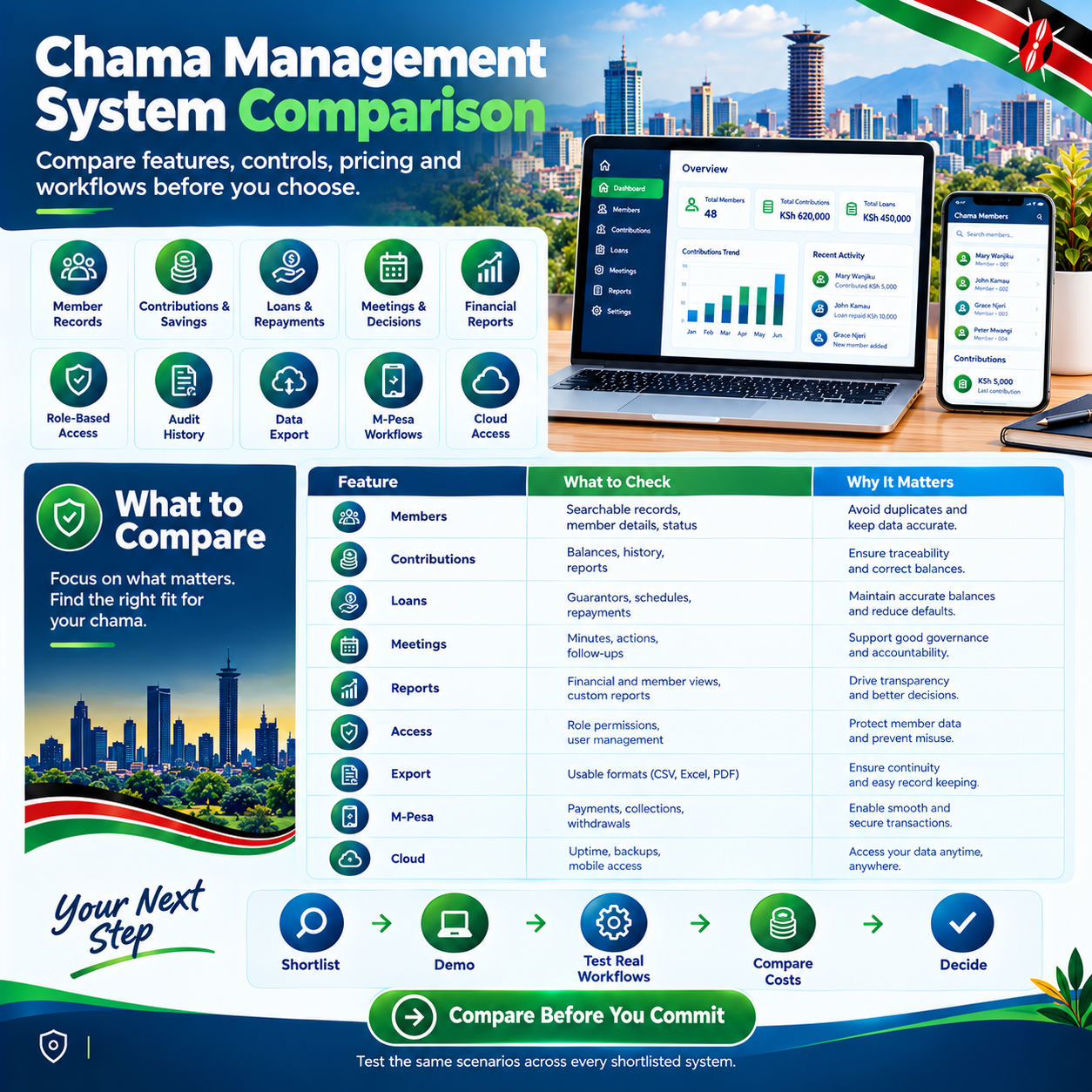
    Choose deliberately, because the wrong tool costs more than no tool at all. Work through the tests below with every candidate before committing. Each test maps to a real monthly workflow your group will depend on.

    Test one: the reconciliation demo. Ask the vendor to show one M-Pesa payment posting automatically to the right member. If the demonstration involves any manual step, the platform is not a true app to collect group contributions automatically.

    Test two: your real numbers. Provide ten members and three months of records before the session. A system that performs with your data will perform in real life. Data honesty is the first filter for any app to collect group contributions automatically.

    Test three: the reminder settings. Confirm you can control timing, wording, and channels for every reminder. Groups have different cultures, and rigid messages feel robotic. Customization is the respect feature of a mature app to collect group contributions automatically.

    Test four: the member experience. Have your least tech-savvy official pay a test contribution unaided. If they succeed in under a minute, the app passes the adoption test. Simplicity is the ultimate standard for an app to collect group contributions automatically.

    Test five: support availability. Ask who answers on collection day, in which language, and how fast. Real Kenyan support separates serious vendors from anonymous platforms. Responsiveness is the relationship test for any app to collect group contributions automatically.

    Test six: the total cost. Insist on the full first-year figure including SMS volumes and onboarding. Headline prices hide the true bill surprisingly often. Transparent quoting is the honesty marker of a trustworthy app to collect group contributions automatically.

    Test seven: data ownership. Confirm in writing that you can export every record at any time. Your group’s history must never be hostage to any vendor. Exit freedom is the long-term protection built into a fair app to collect group contributions automatically.

    Implementing the App: A Smooth Four-Week Plan

    Adoption succeeds when it is planned as a journey. Follow this four-week sequence and your group will switch without a single argument. Each week builds confidence for the next.

    Week one is preparation. Reconcile current balances completely, clean the member list, and export your records for import. Starting with accurate data is the golden rule of launching an app to collect group contributions automatically.

    Week two is setup and configuration. Load members, set contribution schedules, and configure reminders and penalties to mirror the constitution. Faithful configuration is what makes the app to collect group contributions automatically enforce your rules rather than invent new ones.

    Week three is the collective launch. Hold a live demonstration at a meeting, showing every member how to pay and check their balance. Groups that onboard together reach near-total adoption of an app to collect group contributions automatically within one cycle.

    Week four is the parallel run. Keep the old way and the new app side by side for one full billing period. When the totals match at month-end, celebrate loudly — that match is the graduation moment for your app to collect group contributions automatically.

    After the first cycle, retire the old methods completely. Running two systems forever doubles the work and halves the trust. Clean commitment is the final step of adopting an app to collect group contributions automatically.

    What It Costs and What It Returns

    Pricing models fall into three families. Flat monthly subscriptions, per-member charges, and tiered packages all serve groups of different sizes. Budget between one and three thousand shillings monthly for a typical group adopting an app to collect group contributions automatically.

    SMS charges are the usual add-on. Budget a few hundred shillings monthly for reminders and receipts at typical volumes. Ask for the total first-year figure when comparing any app to collect group contributions automatically.

    Now weigh the returns honestly. Recovered arrears, prevented disputes, and saved treasurer hours routinely exceed the subscription many times over. Positive returns from an app to collect group contributions automatically usually appear within the first quarter.

    Do the arithmetic with your own figures before the group votes. Show the annual cost beside one quarter of recovered payments on a single page. Groups that vote with the math visible almost always approve an app to collect group contributions automatically.

    Remember the unpriced returns too. Officials who sleep well, members who feel respected, and meetings that discuss plans instead of payments. Quality of life is the invisible dividend of an app to collect group contributions automatically.

    Common Mistakes to Avoid

    The first mistake is switching without reconciling history. Uncleaned balances imported into a new system become permanent disputes. Clean data is the prerequisite for any app to collect group contributions automatically.

    The second mistake is ignoring the constitution during configuration. The app must enforce your fines and schedules, not replace them with defaults. Faithful setup is the discipline behind an app to collect group contributions automatically.

    The third mistake is abandoning reminders because “the app sends them.” Officials should still personally reach out when the dashboard shows a member struggling. Human warmth alongside an app to collect group contributions automatically is the combination that works best.

    The fourth mistake is hiding the switch from members. Surprise system changes breed resistance that a simple explanation would have prevented. Transparent launches are the adoption secret of every successful app to collect group contributions automatically.

    Real Stories from Kenyan Groups

    The Nakuru welfare table spent its first year reminding twelve members one by one. After adopting automation, collection rates jumped from seventy to ninety-six percent within two cycles. Their treasurer describes the app to collect group contributions automatically as “a colleague who never sleeps.”

    The Kitengela landlords’ chama collects contributions from members in five countries. Reminders arrive on time everywhere, receipts confirm instantly, and the AGM statements generate themselves. Their diaspora members call the app to collect group contributions automatically the reason distance stopped mattering.

    The Eldoret boda fleet runs on weekly contributions from members with irregular incomes. Partial payments tracked automatically ended the shame of falling behind mid-week. Fairness, they say, is the unexpected gift of their app to collect group contributions automatically.

    A fourth group pairs the same discipline across its wealth. Contributions flow automatically through the chama platform while rent flows through Tas.co.ke on the property side. Two automated streams, one peaceful group — the complete picture of an app to collect group contributions automatically done right.

    Frequently Asked Questions

    Do members need smartphones for automatic collection?

    No — reminders and receipts reach any phone through SMS, while smartphone users get richer dashboards. Inclusivity is a design principle of every serious app to collect group contributions automatically.

    What happens when a member pays the wrong amount?

    The system records the actual payment, updates the balance, and flags the difference for gentle follow-up. Graceful handling of imperfect payments is standard in a well-built app to collect group contributions automatically.

    Can the app also collect fines and welfare?

    Yes — multiple contribution types run side by side with separate ledgers. Complete collection coverage is a hallmark of a mature app to collect group contributions automatically.

    How long does it take to see results?

    Most groups report higher collection rates within the very first billing cycle. Fast feedback is the immediate reward of an app to collect group contributions automatically.

    Is our money handled by the app itself?

    No — payments go directly to the group’s own Paybill or bank account, and the app only reconciles and records. Your money never sits with the vendor, which is the safety design of an app to collect group contributions automatically.

    What if the internet fails on collection day?

    Members can still pay through M-Pesa as usual, and the app reconciles everything the moment connectivity returns. Network interruptions never stop an app to collect group contributions automatically from doing its job.

    We also collect rent from tenants — does the same tool work?

    Property collections deserve a dedicated system, and the smartest groups run both side by side. Contributions flow through the app to collect group contributions automatically while tenants, rent invoicing, and owner statements run on Tas.co.ke — one connected ecosystem for everything the group collects.


  • Member Statement Template for Chamas: The Simple Format That Ends All Money Arguments

    member statement template chama

    A member statement template chama groups trust is the most requested document in Kenyan group finance today. Members no longer accept “trust me, your money is safe” — they want to see their own figures, dated and clear. The statement is where that trust becomes visible, line by line.

    Every treasurer knows the moment. A member quietly asks how much they have contributed since joining, or what their loan balance really is. The answer that satisfies is always the same: a clean member statement template chama document produced in seconds.

    The trouble is that most groups improvise their statements. Figures are read aloud from a notebook, totals differ from memory, and quiet doubts take root in the corridor. A proper member statement template chama replaces all of that with one standard format everyone understands.

    This guide is the complete playbook for that document. It covers what a statement must contain, how to build the template section by section, and how to deliver it to every member. By the end, producing a member statement template chama document will take minutes, not weekends.

    The article is written for treasurers preparing monthly reports, chairpersons facing an AGM, and officials inheriting messy records. It is equally written for members who simply want to know what a good statement looks like. Everyone touched by group money benefits from a shared member statement template chama standard.

    One truth deserves stating upfront. Statements are not paperwork — they are the group’s trust engine, printed on a page. That is why the format behind every member statement template chama matters more than the software producing it.

    The good news is that the format is simple. It needs only clear sections, honest figures, and consistent delivery month after month. Master those three, and your member statement template chama becomes the document members actually look forward to.

    Why Member Statements Matter So Much

    The first reason is dispute prevention. Most group arguments begin with two honest people remembering the same figures differently. A documented member statement template chama ends that argument before it starts.

    The second reason is transparency. Members who can see their own standing anytime stop suspecting officials of hiding anything. That confidence is the social dividend of every member statement template chama.

    The third reason is collection improvement. Members who receive regular statements pay on time more often, because arrears are visible the moment they form. Silence breeds delay, while a member statement template chama delivered monthly keeps everyone current.

    The fourth reason is official protection. Honest treasurers are shielded from suspicion when every figure they hold can be verified by the member it concerns. That armor is a quiet gift of a consistent member statement template chama.

    The fifth reason is credibility with outsiders. Banks, land sellers, and partners take groups far more seriously when statements exist and reconcile. Institutional respect follows every group that standardizes its member statement template chama.

    The sixth reason is engagement. Members who see their share capital growing year after year contribute with more pride and less persuasion. Motivation, not just accuracy, flows from a well-designed [member statement template chama](https Saseni.com)…

    Member Statement Template for Chamas: The Simple Format That Ends All Money Arguments

    Introduction

    A member statement template chama groups trust is the most requested document in Kenyan group finance today. Members no longer accept “trust me, your money is safe” — they want to see their own figures, dated and clear. The statement is where that trust becomes visible, line by line.

    Every treasurer knows the moment. A member quietly asks how much they have contributed since joining, or what their loan balance really is. The answer that satisfies is always the same: a clean member statement template chama document produced in seconds.

    The trouble is that most groups improvise their statements. Figures are read aloud from a notebook, totals differ from memory, and quiet doubts take root in the corridor. A proper member statement template chama replaces all of that with one standard format everyone understands.

    This guide is the complete playbook for that document. It covers what a statement must contain, how to build the template section by section, and how to deliver it to every member. By the end, producing a member statement template chama document will take minutes, not weekends.

    The article is written for treasurers preparing monthly reports, chairpersons facing an AGM, and officials inheriting messy records. It is equally written for members who simply want to know what a good statement looks like. Everyone touched by group money benefits from a shared member statement template chama standard.

    One truth deserves stating upfront. Statements are not paperwork — they are the group’s trust engine, printed on a page. That is why the format behind every member statement template chama matters more than the software producing it.

    The good news is that the format is simple. It needs only clear sections, honest figures, and consistent delivery month after month. Master those three, and your member statement template chama becomes the document members actually look forward to.

    Why Member Statements Matter So Much

    The first reason is dispute prevention. Most group arguments begin with two honest people remembering the same figures differently. A documented member statement template chama ends that argument before it starts.

    The second reason is transparency. Members who can see their own standing anytime stop suspecting officials of hiding anything. That confidence is the social dividend of every member statement template chama.

    The third reason is collection improvement. Members who receive regular statements pay on time more often, because arrears are visible the moment they form. Silence breeds delay, while a member statement template chama delivered monthly keeps everyone current.

    The fourth reason is official protection. Honest treasurers are shielded from suspicion when every figure they hold can be verified by the member it concerns. That armor is a quiet gift of a consistent member statement template chama

    The fifth reason is credibility with outsiders. Banks, land sellers, and partners take groups far more seriously when statements exist and reconcile. Institutional respect follows every group that standardizes its member statement template chama.

    The sixth reason is engagement. Members who see their share capital growing year after year contribute with more pride and less persuasion. Motivation, not just accuracy, flows from a well-designed member statement template chama.

    What Is a Member Statement?

    A member statement is a personalized financial report showing one member’s complete relationship with the group. It covers contributions made, loans taken, repayments, fines, welfare balances, and share capital in one place. That single-page truth is what every member statement template chama is designed to deliver.

    Think of it as a bank statement for group membership. Where a bank shows deposits and withdrawals, a chama statement shows what the member has put in, borrowed, and owes. The parallel is why a well-built member statement template chama feels instantly familiar to every member.

    Statements differ from group reports in one important way. A group report shows the whole picture to the committee, while a statement shows each member their own slice. That personal focus is the defining feature of any member statement template chama.

    What Goes into a Member Statement: Line by Line

    A complete statement has a fixed set of sections, and each one answers a question members actually ask. Use this list as the skeleton for your own member statement template chama. Every line earns its place by preventing a specific future argument.

    The header comes first, identifying the member and the period. It carries the member’s full name, member number, the statement period, and the date it was produced. A clear header is the opening discipline of every member statement template chama.

    Contribution records form the body of the statement. Each entry shows the date paid, the amount, the month it covers, and the channel used, with a running total beside them. Month covered versus month paid is the distinction professionals never skip in a member statement template chama.

    Share capital deserves its own clearly separated block. Members must see what they own permanently, distinct from what they owe monthly. That separation is a defining feature of a serious member statement template chama.

    Loan details follow for borrowing members. Principal, interest method, repayment schedule, installments paid, outstanding balance, and next due date all appear here. Precision in this block is the most scrutinized part of any member statement template chama.

    Guarantee exposure belongs on the statement too. Each member should see every loan they stand behind, with amounts and current status. That visibility is a protective hallmark of a complete member statement template chama.

    Fines and welfare balances complete the picture. Late-payment fines, welfare subscriptions, and any welfare payouts received are listed with dates and reasons. Sensitive but honest, this block is what rounds out a full member statement template chama.

    The summary section closes the statement. Total contributed, total borrowed, total repaid, current arrears, and net position appear in five bold lines. Members judge the whole document by the clarity of this final block in your member statement template chama.

    The Template Itself: Section by Section

    Here is the template laid out so any group can rebuild it in a word processor or spreadsheet tonight. Each section is short, labeled, and designed to be filled rather than interpreted. That fill-in simplicity is the design philosophy of a practical member statement template chama.

    Section One: The Header Block

    The header carries the group’s name and logo at the top, followed by the statement title and period. Beneath it sit the member’s name, member number, phone number, and join date. A professional header is the first impression your member statement template chama makes.

    Section Two: Contributions Ledger

    This section lists every contribution in date order with amount, month covered, and channel. A running cumulative total sits in the final column, ending with the grand total contributed. Clean arithmetic here is the heartbeat of any member statement template chama.

    Section Three: Share Capital Summary

    This block shows opening share capital, additions during the period, and the closing balance. One line explains what the shares entitle the member to at dividend time. Ownership made visible is the wealth-building feature of a member statement template chama.

    Section Four: Loan Position

    For borrowing members, this section shows each loan with its principal, interest method, and monthly installment. Payments made, outstanding balance, and the next due date complete the block. Nothing invites scrutiny like lending, so accuracy is the standard for this part of your member statement template chama.

    Section Five: Guarantees Held

    Every guarantee the member has signed appears here with the borrower’s name, amount, and loan status. A short note reminds the member what activation would mean under the constitution. Respectful clarity around guarantees is the maturity marker of a member statement template chama.

    Section Six: Fines and Welfare

    This block lists fines with dates, reasons, amounts, and whether each has been cleared. Welfare subscriptions paid and any payouts received appear beneath them, with the current welfare balance. Handled with dignity, this section completes the honesty of a full member statement template chama.

    Section Seven: The Summary Block

    Five bold lines close the statement: total contributed, share capital, loan balance, arrears, and net position. A one-line note invites the member to raise any query within seven days. The invitation to question is what gives a member statement template chama its credibility.

    Section Eight: Sign-Off

    The treasurer signs and dates the statement, with space for a second official’s countersignature. Dual sign-off turns a document into a verified record. That final formality is the trust seal of a complete member statement template chama.

    Types of Statements Your Group Should Issue

    The monthly statement is the workhorse. Issued within days of month-end, it shows the month’s contributions, payments, and running balances. Regular rhythm is what turns a member statement template chama into a habit members rely on.

    The quarterly statement adds trend lines. It shows three months side by side, so members see progress rather than isolated figures. Momentum becomes visible through a member statement template chama issued every quarter.

    The annual statement is the AGM companion. It summarizes the full year and feeds directly into dividend calculations and elections. Prepared well, it becomes the proudest page your member statement template chama ever produces.

    Exit statements deserve their own care. When a member leaves, a final statement documents everything owed to them and by them, signed by both sides. Clean endings are a specialty of a disciplined member statement template chama.

    Pre-AGM statements go out two weeks before the meeting. Members arrive with their figures already verified, so the AGM debates plans instead of arithmetic. That preparation window is the strategic use of a member statement template chama.

    How to Create the Template: Spreadsheet Versus Platform

    A spreadsheet can carry a respectable member statement template chama for small groups. Build one row per member with columns for contributions, loans, fines, and totals, then filter by member to print. Protect the formulas and save dated copies after every meeting.

    Use SUMIF to pull each member’s figures from the master ledger automatically. Hand-typed totals drift from reality within weeks, which is the first commandment of spreadsheet-based member statement template chama work.

    Add conditional formatting so arrears turn red automatically. The color announces itself before any meeting does, which keeps the records honest between sessions. Automation of warnings is the quiet discipline inside a member statement template chama.

    But dedicated platforms remove the fragility entirely. Statements generate themselves from reconciled M-Pesa data, with zero re-entry and zero formula risk. Automation is the modern standard for producing a member statement template chama at scale.

    When evaluating any platform, bring a real member’s history to the demo. Watch the statement generate with your figures, your loan, and your fines on screen. A system that passes that test will carry your member statement template chama faithfully for years.

    How to Deliver Statements So Members Actually Read Them

    PDF by WhatsApp is the most common delivery method in Kenya. It is fast and free, but statements buried under chat messages often go unread. Pair the channel with a fixed delivery date so members anticipate each member statement template chama release.

    SMS summaries reach every phone, smart or not. A short message with the balance, arrears, and next due date keeps members informed between full statements. Inclusivity is the strength of pairing SMS with your member statement template chama.

    Member portals change the game completely. Each member logs in and views their live statement anytime, without asking the treasurer for anything. Self-service is the defining upgrade a platform brings to a member statement template chama.

    Printed copies still matter at meetings. A statement handed across the table, read on the spot, and queried immediately resolves issues while everyone is present. The paper copy remains the most trusted form of a member statement template chama.

    Whatever the channel, keep delivery consistent. Same date, same format, same signature block, every single month. Consistency is what transforms a member statement template chama from a document into an institution.

    Adapting the Template to Different Group Types

    Lending-heavy groups should expand the loan section. Each loan deserves its own sub-block with schedule, arrears, and guarantee exposure shown in detail. Depth in lending detail is the specialty use of a member statement template chama.

    Welfare-focused circles should expand the welfare block instead. Subscriptions, payouts, and eligibility notes matter more than loan detail in those groups. Format follows function, which is the flexibility promise of a member statement template chama.

    Table banking circles need a rotation block. The statement shows which cycle the member received the pot and what is expected next month. Rotation visibility is the rhythm-keeper inside a member statement template chama.

    Property-owning groups add an income allocation line. Each member’s share of net rental income appears on the statement alongside their contributions. Many such groups manage that side on Tas.co.ke and feed reconciled figures into the group accounts. Connected ecosystems are the advanced expression of a member statement template chama.

    Diaspora groups need a currency note. Every figure should state its currency and the exchange rate used on the day recorded. Currency discipline is the cross-border refinement of a member statement template chama.

    The Query Window: Turning Statements into Dialogue

    Every statement should open a small, structured window for questions. State clearly that members may query figures within seven days of receipt. A defined window gives structure to the feedback loop built into your member statement template chama.

    Respond in writing to every query. A short written reply, with the underlying records attached, resolves most issues in minutes. Written responses are what make the member statement template chama credible.

    Log every query and its resolution. Over time, the log reveals recurring confusion points the template itself can fix. That feedback loop is how a member statement template chama improves year after year.

    Celebrate the resolved queries at meetings. Members see that questions are welcomed, not resented, and trust deepens visibly. A welcoming culture is the social harvest of a good member statement template chama.

    Common Statement Mistakes to Avoid

    The first classic mistake is issuing statements only when trouble brews. Statements produced mid-dispute look like ammunition instead of transparency. Regular rhythm is what gives a member statement template chama its neutral authority.

    The second mistake is mixing group totals into personal statements. Members want their own figures first, with the group context kept to a summary line. Personal focus is the entire point of a member statement template chama.

    The third mistake is hiding fines or guarantee exposure. Omissions discovered later destroy more trust than uncomfortable truths ever could. Full disclosure is the ethical core of every member statement template chama.

    The fourth mistake is producing statements the figures cannot support. Always reconcile the ledger against bank and M-Pesa records before anything is issued. Verified data is the foundation beneath every honest member statement template chama.

    The fifth mistake is inconsistent formats between months. Members notice when the layout changes, and they quietly wonder what else changed too. Stability is what turns a member statement template chama into a trusted institution.

    Real Stories from Kenyan Groups

    The Nakuru teachers’ chama replaced notebook read-alouds with printed statements two years ago. Queries at meetings dropped so sharply that officials gained almost a full hour per session. Their treasurer calls the member statement template chama the cheapest peace treaty the group ever signed.

    The Kitengela landlords’ group now generates statements directly from reconciled platform data. Contributions and rental income both appear on one page, with the property side managed through Tas.co.ke. At their last AGM, members approved a second building after just ten minutes of questions.

    The Eldoret youth group prints monthly statements and pins them on the noticeboard at their meeting hall. Members photograph their own page each month, and arrears have fallen by more than half. Public visibility, they say, is the hidden power of a member statement template chama.

    The Kisumu welfare circle added a query window to their statements last year. Every question received a written reply within the week, and two long-standing doubts were finally settled. That single change transformed their member statement template chama from paper into partnership.

    Across the country, the pattern never changes. Groups that standardize statements argue less, collect faster, and attract new members more easily. That compounding trust is the true product of a disciplined member statement template chama.

    Frequently Asked Questions

    How often should a chama issue member statements?

    Monthly is the ideal rhythm, with quarterly and annual summaries layered on top. Regularity matters more than depth, so start monthly and grow from there. A predictable cycle is what builds confidence around your member statement template chama.

    What if our figures do not reconcile before statement day?

    Delay the issue, fix the discrepancy privately with two officials, then release corrected statements with a dated note. Never issue figures you cannot defend, because one wrong statement undermines every member statement template chama that follows.

    Should statements show other members’ information?

    Never — each statement contains only that member’s own figures and guarantees. Privacy protects members in sensitive jobs and keeps the group dignified. Strict separation is a non-negotiable rule of any member statement template chama.

    Can we produce statements without buying software?

    Yes — a protected spreadsheet with SUMIF totals works well for groups under about twenty members. The moment lending and fines grow, a dedicated platform pays for itself quickly. Choose the tool that matches the size of your member statement template chama workload.

    What should a member do if their statement looks wrong?

    Raise it in writing within the query window, and the treasurer responds with the underlying records within seven days. Most discrepancies are honest entry errors resolved in minutes. That built-in review path is the fairness feature of a good member statement template chama.

    What details make a statement look professional?

    A clear header, consistent formatting, dual sign-off, and a dated production note at the bottom. Professional appearance invites professional treatment of the figures inside. Presentation is a quiet part of the credibility of a member statement template chama.

    How do we handle members abroad who need statements?

    Send PDFs by email or WhatsApp with the same rhythm as home members, stating currency clearly on every figure. Distance changes nothing about the discipline of a member statement template chama.

    Can the same template serve minutes and attendance too?

    Keep those as separate records, because mixing governance and money documents muddies both. A focused statement covering only finances is stronger and easier to audit. Single-purpose design is a strength of any member statement template chama.

    How does a platform change the statement process?

    Statements generate automatically from reconciled M-Pesa data, with members viewing their live figures anytime through a portal. The treasurer’s weekend disappears, and accuracy improves simultaneously. That combination is the signature benefit platforms bring to a member statement template chama.

    We also own rental units — should rental income appear on member statements?

    It can, as a summary line showing each member’s share of net property income. The smartest groups run tenants, rent collection, and owner statements on Tas.co.ke, then feed the reconciled figures into the group’s accounts. One connected ecosystem keeps every shilling visible through your member statement template chama.

  • Chama Guarantor Tracking: Know Who Owes What Before Problems Start

    chama guarantor tracking

    Chama guarantor tracking is the quiet discipline that separates lending groups that thrive from those that slowly bleed capital and friendships. In nearly every Kenyan chama, before a member borrows, trusted friends must stand behind the loan with their own savings. Managing those promises well is what this complete guide to chama guarantor tracking is all about.

    Every shilling a group lends is protected — or exposed — by the guarantees standing behind it. When a borrower struggles, the guarantor becomes the group’s safety net, and clarity about that role becomes priceless. That is precisely why serious groups invest in chama guarantor tracking from their very first loan.

    The trouble is that most groups treat guarantees as a formality. A name is scribbled on a loan form, filed away, and forgotten until the day it is needed. By then, the weaknesses of skipping chama guarantor tracking have already done their damage.

    This guide changes that entirely. It explains what guarantees really mean, how to monitor exposure across your whole portfolio, and how digital tools make the work effortless. By the end, chama guarantor tracking will feel like a natural habit rather than an administrative burden.

    The article is written for treasurers who keep the loan book, chairpersons who approve loans, and members who are asked to guarantee. It is equally written for borrowers who deserve to understand what they are truly asking of their friends. Everyone touched by chama guarantor tracking benefits from seeing the full picture.

    One truth deserves stating upfront. Guarantees are not signatures on paper — they are real commitments of real savings. Groups that honor that reality through chama guarantor tracking almost never suffer the guarantee disputes that tear others apart.

    The good news is that this discipline is simple. It needs only clear rules, visible records, and consistent review — none of which cost money. Modern platforms have made chama guarantor tracking as easy as checking a balance on a phone.

    So read this guide with your loan book open beside you. Tick the practices your group already follows, and note the ones worth adding. The calmest time to strengthen chama guarantor tracking is today, long before the next difficult conversation arrives.

    What Is a Guarantor in a Chama?

    A guarantor is a member who pledges their own savings, shares, or deposits to secure another member’s loan. If the borrower fails to repay, the guarantor’s pledged amount becomes the group’s recovery path. Understanding that chain of responsibility is the starting point of chama guarantor tracking.

    The role is deeply cultural as much as it is financial. In Kenyan groups, standing as a guarantor is a statement of trust between friends who have saved side by side for years. That human warmth is exactly why chama guarantor tracking must always be handled with care and dignity.

    Guarantees come in different shapes. Some are full guarantees covering the entire loan, while others are partial, with several members sharing the risk. Recording which type applies to each loan is a foundational task of chama guarantor tracking.

    There are also joint guarantors, where two or more members pledge together. When recovery becomes necessary, the group must know exactly who owes which share. Precision here is one of the core promises of chama guarantor tracking.

    Some groups also allow self-secured lending against a member’s own deposits. Technically that removes the guarantor, but the pledged deposits still need monitoring. A complete approach to chama guarantor tracking covers self-secured loans too.

    What a guarantor is not matters just as much. A guarantor is not a villain-in-waiting, and a borrower is not free to default because someone else stands behind them. Setting that respectful tone is part of the culture that chama guarantor tracking builds over time.

    Why Guarantor Tracking Matters So Much

    The first reason is protection of group capital. When guarantees are tracked, the group always knows how much of its loan book is genuinely secured. That visibility is the core financial value of chama guarantor tracking.

    The second reason is protection of guarantors themselves. A member can quietly accumulate five guarantees across different loans without realizing they have pledged more than their savings. Preventing that silent overcommitment is a central duty of chama guarantor tracking.

    The third reason is faster, fairer recovery. When a loan goes bad, a group with clear records moves within days instead of arguing for months. Speed backed by evidence is what chama guarantor tracking delivers at the worst possible moments.

    The fourth reason is better lending decisions. Officials who can see a borrower’s full guarantor history approve new loans with far richer information. Smarter approvals are a quiet dividend of chama guarantor tracking.

    The fifth reason is trust among members. Guarantors who can see their own exposure anytime feel respected rather than trapped. That confidence is the social reward of chama guarantor tracking.

    The sixth reason is dispute prevention. Most guarantee conflicts begin with two honest people remembering the same promise differently. Written, visible records are the antidote, and that is the everyday work of chama guarantor tracking.

    The seventh reason is portfolio health. Groups can spot dangerous concentrations — one popular member guaranteeing half the loan book — before they become crises. Risk mapping is the strategic layer of chama guarantor tracking.

    The eighth reason is succession. When treasurers change, guarantee records that live in the system transfer cleanly with everything else. Continuity like that is a lasting gift of chama guarantor tracking.

    The True Cost of Poor Guarantor Tracking

    Now for the honest part, because the costs of neglect are real. Groups that fail to monitor guarantees routinely discover phantom coverage — names on forms whose owners never truly agreed. Every phantom guarantee is a hole that chama guarantor tracking would have caught at signing.

    The second cost is overexposed members. When a crisis hits one borrower, three or four untracked guarantors can be dragged down together. Cascading losses are the signature disaster that chama guarantor tracking prevents by design.

    The third cost is slow recovery. Without records, recovery conversations start with archaeology instead of action. Months of delay are the price groups pay for skipping chama guarantor tracking.

    The fourth cost is human. Friendships strain when a guarantor learns of their obligation only at the recovery stage. Surprise, more than money, damages relationships — and surprise is exactly what chama guarantor tracking removes.

    The fifth cost is cultural. Once one member is burned by a forgotten guarantee, nobody volunteers to guarantee again. Frozen lending is the long-term wound that chama guarantor tracking avoids entirely.

    The sixth cost shows up at the AGM. Loan books presented without guarantee coverage invite hard questions that officials cannot answer. Credibility in front of the whole membership is another quiet return on chama guarantor tracking.

    Key Features of Effective Guarantor Tracking

    Effective tracking rests on a handful of capabilities. Use the checklist below to evaluate how your group manages guarantees today. Each feature addresses a failure mode described in the sections above.

    Feature 1: The Guarantor Register

    Every guarantee should live in a structured register, not on scattered loan forms. The register records who guaranteed whom, for how much, on which loan, and on what date. A living register is the foundation of all chama guarantor tracking.

    Feature 2: The Exposure Dashboard

    Officials should see total guarantee exposure per member at a glance. One screen should answer how much each member has pledged and how much remains active. That single view is the operational heart of chama guarantor tracking.

    Feature 3: Verified Consent

    No guarantee should exist without the guarantor’s confirmed, recorded agreement. Digital confirmations, witnessed signatures, or documented verbal approvals all leave permanent trails. Verified consent is the integrity layer of chama guarantor tracking.

    Feature 4: Automatic Notifications

    Guarantors should be told when their guarantee is activated, when repayments lag, and when the loan closes. Silence between signature and crisis is where most damage breeds. Timely alerts are the communication engine of chama guarantor tracking.

    Feature 5: Release Management

    As a borrower repays, the guarantor’s exposure should shrink automatically. When a loan closes, the guarantee should be formally released and visibly marked as done. Watching exposure fall is one of the most satisfying outcomes of chama guarantor tracking.

    Feature 6: Portfolio Reports

    Officials need quarterly views of total guarantees outstanding, coverage ratios, and concentration risks. Reports turn individual entries into strategic intelligence for the whole group. Portfolio-level insight is the leadership dimension of chama guarantor tracking.

    Feature 7: Member Self-Service

    Guarantors should see their own commitments on their phones, anytime, without asking the treasurer. Self-service visibility dissolves suspicion faster than any meeting explanation. Personal dashboards are the trust feature of chama guarantor tracking.

    Feature 8: Complete Audit Trails

    Every change to a guarantee — creation, adjustment, release, or activation — should be logged with dates and names. When memories differ a year later, the trail settles the matter in seconds. Permanent records are the legal backbone of chama guarantor tracking.

    How to Set Guarantor Rules in Your Constitution

    Rules are where tracking begins, so write them before the next loan is issued. Begin by defining who may act as a guarantor in your group. Clear eligibility is the first pillar of chama guarantor tracking.

    Most groups require guarantors to be fully paid-up members with savings equal to a set share of the loan. Some add tenure requirements, so only seasoned members can carry large guarantees. Whatever you choose, write it plainly into the framework of chama guarantor tracking.

    Second, set exposure limits. A common rule caps total active guarantees at the guarantor’s own savings, or at a fixed multiple of them. Enforced limits are the protective core of chama guarantor tracking.

    Third, require a consent ceremony for every guarantee. The guarantor confirms the amount, the loan purpose, and their obligation in front of an official or through the platform. That moment of informed agreement is the dignity standard of chama guarantor tracking.

    Fourth, define guarantor rights explicitly. Guarantors should be entitled to see the loan’s repayment status and to be notified of any arrears. Balanced rights and duties are what make chama guarantor tracking feel fair to everyone.

    Fifth, write the release conditions. State clearly when a guarantee ends — final repayment, loan restructuring, or committee approval — and how the release is recorded. Clean endings are the finishing discipline of chama guarantor tracking.

    Sixth, prepare the dispute path. If a guarantor contests an obligation, the constitution should define who hears the case and how it is resolved. A predetermined path is the safety net inside chama guarantor tracking.

    Finally, review the rules annually at the AGM. Lending volumes grow, savings levels change, and limits deserve recalibration from time to time. Living rules are what keep chama guarantor tracking effective year after year.

    The Guarantee Lifecycle: Stage by Stage

    Every guarantee travels through six stages, and each stage generates records worth keeping. Understanding the journey helps officials track guarantees as living commitments rather than static signatures. This lifecycle view is the practical engine of chama guarantor tracking.

    Stage 1: The Request

    The journey begins when a borrower asks a fellow member to guarantee. The request should state the amount, the term, and the repayment plan in writing. Clarity at the request stage is the first checkpoint of chama guarantor tracking.

    Stage 2: Verification and Consent

    Before any signature, the group verifies that the guarantor has the savings and the clean standing required. Consent is then recorded formally, with the amount and date captured in the register. Verified beginnings are what make later stages of chama guarantor tracking effortless.

    Stage 3: Active Monitoring

    While the loan runs, the guarantor’s exposure sits visible on the register and the dashboard. Repayment progress is tracked, and guarantors receive updates or alerts when instalments slip. Live visibility is the day-to-day heartbeat of chama guarantor tracking.

    Stage 4: Repayment Progress

    As instalments land, the outstanding balance falls and the guarantor’s exposure falls with it. Many groups share this progress with guarantors as encouragement that the end is in sight. Shrinking exposure is the rewarding middle phase of chama guarantor tracking.

    Stage 5: Release

    When the final instalment clears, the guarantee is formally released in the records. The guarantor’s capacity is restored automatically, ready for the next time a friend needs help. Clean releases are the closure milestone of chama guarantor tracking.

    Stage 6: Recovery — When Things Go Wrong

    If the borrower defaults, the documented guarantee becomes the group’s recovery path. Recovery follows the constitution exactly, with amounts, shares, and dates already on record. Orderly outcomes under pressure are the ultimate test of chama guarantor tracking.

    Tools: From Notebooks to Digital Platforms

    Paper registers served groups for generations, and they still beat nothing at all. A simple book can list each guarantee with amounts and dates, updated after every meeting. But paper is where most groups hit the limits of manual chama guarantor tracking.

    Spreadsheets improve the arithmetic but inherit familiar weaknesses. Formulas break silently, versions multiply, and one official’s laptop holds the group’s memory hostage. Those fragilities are precisely what push growing groups toward digital chama guarantor tracking.

    Dedicated platforms transform the entire experience. Exposure dashboards update in real time, guarantors receive automatic alerts, and releases post themselves as loans close. Automation at that level is the modern standard of chama guarantor tracking.

    When evaluating any platform, bring a real guarantee to the demo. Watch it record a consent, track repayments, shrink the exposure, and release the guarantee end to end. A system that performs that journey will carry your chama guarantor tracking faithfully for years.

    Common Mistakes to Avoid

    The first classic mistake is collecting signatures without verifying capacity. A guarantor with empty savings is a comfort blanket, not a guarantee. Capacity checks are the first discipline of chama guarantor tracking.

    The second mistake is letting one popular member carry too much. When half the loan book rests on one trusted soul, the group has built a single point of failure. Concentration limits are the protective wisdom of chama guarantor tracking.

    The third mistake is never telling guarantors anything. Silence between signature and crisis breeds both resentment and surprise. Communication discipline is the relationship-saving habit of chama guarantor tracking.

    Real Stories from Kenyan Groups

    The Nakuru teachers’ chama once discovered that three loan forms carried guarantor signatures nobody could verify. Rebuilding trust took months, and lending was suspended while the group sorted fact from memory. The rebuilt register now sits at the center of their chama guarantor tracking, and no loan moves without verified consent.

    The Kitengela landlords’ group faced a genuine default and recovered smoothly. Because their platform showed every guarantee’s amount, date, and share, recovery completed within weeks and without a single shouted argument. The committee credits their chama guarantor tracking with saving both the money and the friendships.

    Across the country, the pattern repeats with striking consistency. Groups with visible guarantee records lend more confidently, recover faster, and keep members volunteering to stand for one another. That quiet confidence is the true product of disciplined chama guarantor tracking practiced year after year.

    Frequently Asked Questions

    How much can one member safely guarantee?

    A common and prudent ceiling is the guarantor’s own savings, with some groups allowing up to double for long-standing members. Whatever you choose, enforce it in the system so limits apply automatically. That single rule carries most of the value in chama guarantor tracking.

    Should guarantors be notified when repayments fall behind?

    Yes, always — early awareness lets guarantors encourage the borrower while the problem is still small. Silence only manufactures the surprise that damages friendships. Prompt alerts are a defining habit of professional chama guarantor tracking.

    Can a guarantee be partial, shared among several members?

    Absolutely, and shared guarantees spread risk sensibly across the group. Just record each person’s exact share so recovery, if ever needed, follows the book. Clear shares are a core record inside chama guarantor tracking.

    What happens to a guarantee if the borrower repays early?

    The guarantee should be released immediately, restoring the guarantor’s full capacity. Early release recorded visibly is one of the happiest moments in chama guarantor tracking.

    Do guarantors earn anything for the risk they carry?

    Some groups credit guarantors with a small share of loan interest or formal recognition at the AGM. Others treat guaranteeing as a duty of membership, which is equally valid. Whichever culture you choose, make it visible through your chama guarantor tracking records.

    Can a member refuse a guarantee request without damaging friendships?

    Yes, and healthy groups normalize the polite no. A member near their exposure limit has every right — and often a duty — to decline. Respecting limits is precisely what chama guarantor tracking makes possible.

    How do we handle a guarantor who is also struggling financially?

    Treat it like any exposure review — restructure the underlying loan, adjust the guarantee, and document everything with committee approval. Compassion with paperwork is the mature expression of chama guarantor tracking.

    We also own rental units — should guarantees apply there too?

    Property lending deserves the same discipline, and the smartest groups keep the two ecosystems connected. Group loans and guarantees run on the chama platform, while tenants, rent collection, and owner statements run on Tas.co.ke. One clean, connected view of everything the group owns is the full promise of chama guarantor tracking.

  • The Ultimate Treasurer Handover Template: Pass the Books Flawlessly and Protect Every Friendship

    A treasurer handover template

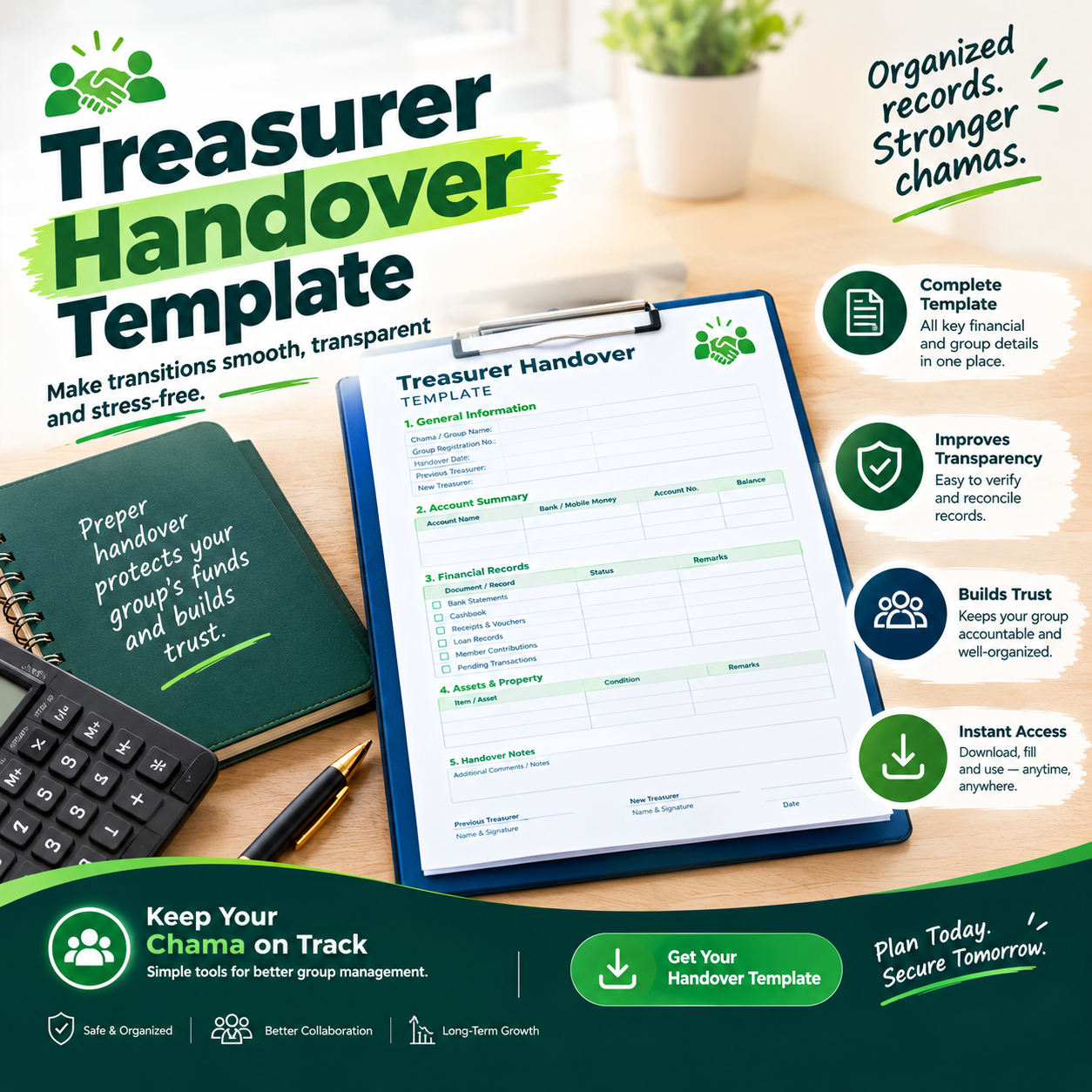
    A treasurer handover template is the single most valuable document a Kenyan investment group can prepare before its financial leadership changes hands. The moment arrives in every chama eventually — an official relocates, retires, or simply deserves a rest after years of faithful service. When it comes, the difference between a peaceful week and a month of chaos is preparation.

    Most groups discover too late that handovers fail for one reason: nothing was written down. Balances lived in one person’s memory, receipts lived in one person’s handbag, and passwords lived in one person’s head. A treasurer handover template replaces that fragile arrangement with a checklist anyone can follow.

    The stakes are genuinely high. A careless handover can leave a new treasurer defending numbers they never recorded and cannot prove. A disciplined one, anchored on a treasurer handover template, makes the incoming official confident from the very first day.

    Members benefit just as much as officials do. Clean transfers signal that the group’s money belongs to the group, not to any individual holding a post. That assurance is the deeper gift of a treasurer handover template.

    This guide is the complete playbook for that moment. It explains why handovers go wrong, what must be transferred, and exactly how to verify every figure before the old official steps away. By the end, your group will treat the treasurer handover template as standard equipment, right beside the constitution itself.

    The good news is that the process is simple, free, and takes about a week. No lawyer, no consultant, and no special software is strictly required to complete a proper transfer. What is required is honesty, patience, and two signatures in the right places.

    One truth deserves stating before anything else. Groups that hand over well hand over rarely — because transparency attracts volunteers while burnout drives them away. Mastering the treasurer handover template is therefore also a strategy for keeping good officials.

    Why Treasurer Handovers Go Wrong

    The first cause of failed handovers is informality. Money changes hands with a handshake, and six months later nobody agrees on what the handshake covered. The absence of a written record is what makes that possible.

    The second cause is timing. Handovers attempted during a crisis — a sudden resignation, a funeral, a scandal — happen under pressure where shortcuts flourish. A prepared document exists precisely for the unprepared moment.

    The third cause is incomplete scope. Groups transfer the cash and forget the records, or transfer the records and forget the bank mandates and platform logins. A thorough treasurer handover template covers everything the outgoing official actually controls.

    The fourth cause is no verification. The new treasurer receives a bag of papers and a verbal assurance that “everything is there.” Verification against a treasurer handover template is what converts assurance into evidence.

    The fifth cause is emotion. Handovers conducted amid suspicion turn into trials, while handovers conducted with structure turn into celebrations. Neutrality is the quiet power of a written treasurer handover template.

    The consequences of a failed handover reach far beyond the ledger. Members begin questioning figures, officials begin defending themselves, and the group’s finest asset — trust — quietly drains away. Every one of those costs is preventable with a completed treasurer handover template sitting in the group’s files.

    When a Handover Becomes Necessary

    Handovers cluster around predictable moments. The end of a term at the AGM is the classic and best moment, because accounts are freshly reviewed. Even then, structure keeps the process disciplined rather than casual.

    Mid-term departures are the second trigger. Relocation abroad, a new job, illness, or family demands can end a treasurer’s service without warning. The treasurer handover template shines brightest exactly when nobody had time to plan.

    The third trigger is succession planning by a growing group. As portfolios expand, groups deliberately rotate officials to spread skills and prevent fatigue. Rotation works smoothly only when the transfer is turnkey.

    Wise groups schedule a light handover even without a departure. An annual “handover to self,” where the treasurer reconciles and signs against the document alone, is the cheapest audit in existence. That habit keeps every future treasurer handover template effortless rather than forensic.

    What Must Be Transferred: The Complete Scope

    Before the template sections, understand the full territory. A treasurer controls five distinct things: physical items, financial records, digital access, institutional relationships, and unfinished business. Each item needs its own line in the treasurer handover template.

    Physical items include cash boxes, receipt books, stamps, and the group’s seal. Financial records include ledgers, bank statements, M-Pesa statements, and reconciliation files. Digital access covers banking tokens, platform logins, and the Paybill credentials.

    Institutional relationships are the quiet ones. The bank manager who knows your signatures, the platform support contact, and the landlord of the meeting hall all hold pieces of the treasurer’s role. A complete treasurer handover template names each relationship so the successor can re-introduce themselves.

    Unfinished business is the most dangerous category. A disputed fine, a loan under restructuring, a pending land payment — these carry context that lives nowhere else. Documenting them is what elevates the exercise from checklist to institutional memory.

    Groups that skip the scoping step always discover the missing piece late. The forgotten Paybill, the unreturned receipt book, the half-negotiated land deal — each surfaces at the worst possible time. Full scope at the start is the promise of a serious treasurer handover template.

    Preparing the Group for the Handover

    A great handover begins before the document is even opened. The committee should announce the upcoming transfer at a regular meeting, with the date and the incoming official named. Announced transitions feel professional; surprise transitions feel like crises.

    The group should also authorize the process formally. A simple resolution — “the handover shall be completed by [date] using the standard document” — gives both officials a mandate. That mandate is what turns a treasurer handover template from personal admin into official business.

    Set the ground rules at the same meeting. Both officials agree to full disclosure, the witness is appointed, and the verification meeting is scheduled publicly. Public structure is the best protection any treasurer handover template can receive.

    Finally, protect the outgoing official’s dignity. Frame the process as honoring service, not as auditing suspicion, and say so out loud in the meeting. Tone set early determines whether the treasurer handover template becomes a celebration or a trial.

    Step One: Reconcile Before You Hand Over Anything

    No handover should begin until the books are fully reconciled. The outgoing treasurer must prove that cash on hand, bank balances, M-Pesa balances, and the ledger all agree to the shilling. Reconciliation is the foundation the entire treasurer handover template is built on.

    Reconcile the bank account first, matching every entry to statements through the last completed month. Then reconcile the mobile money records, matching every confirmation to its ledger line. A treasurer handover template that skips this step is just a polite way of transferring confusion.

    Investigate every difference before the handover meeting, not during it. Small discrepancies found calmly are bookkeeping; the same discrepancies found publicly become accusations. That privacy-first principle is baked into a well-run treasurer handover template.

    Two officials should sign the reconciliation, and neither should be the treasurer alone. The chairperson or secretary co-signing the figures shares the burden of proof and protects everyone. Shared sign-off is the integrity feature of a treasurer handover template.

    Step Two: Assemble Every Document

    With the books proven, gathering becomes mechanical. Every ledger, statement, receipt book, minute reference, and contract goes into one labeled folder per year. Organization at this stage is what makes the treasurer handover template quick to complete.

    Include the documents people forget. Loan application forms with signatures, guarantee agreements, welfare payout records, and penalty waivers all belong in the bundle. The successor’s future self will bless the completeness of the treasurer handover template.

    Digital documents need the same care. Export platform reports, download cloud folders, and copy the spreadsheet files with their version history intact. Files without their history are only half the story a treasurer handover template should tell.

    Label everything in plain language, because the next reader will not share the old treasurer’s shorthand. “March 2024 — contributions ledger — reconciled” beats “final version FINAL v3” in every possible way. Clear labeling is the courtesy at the heart of a treasurer handover template.

    Step Three: Transfer Digital Access Safely

    Digital access is the modern handover’s hardest part. Banking app profiles, chama platform logins, the M-Pesa Paybill portal, and the group email all need deliberate transfer. Each credential gets its own line and its own moment in the treasurer handover template.

    Never share passwords by writing them in the group chat. Change credentials jointly, with the outgoing official present to demonstrate each system, then let the new treasurer set fresh passwords. That ceremony is the security core of a treasurer handover template.

    Transfer administrative rights, not just logins. On group platforms, admin roles, signatory visibility, and Paybill ownership must move formally through the provider’s official process. Platforms like Tas.co.ke handle this as a structured support request that completes within days, with every change recorded.

    Verify each transfer immediately. The new treasurer logs in, performs a harmless action, and confirms control while the old official watches. Immediate verification is the final step of a secure treasurer handover template.

    Step Four: The Joint Verification Meeting

    Now the two officials meet, with the chairperson present as witness. Every folder is opened, every balance is read aloud, and every access is demonstrated live. This meeting is where the treasurer handover template turns from paper into proof.

    Move through the document line by line, ticking as you go. Cash counted, bank confirmed, M-Pesa matched, records received, access transferred, relationships named, open items explained. A completed treasurer handover template with ticks and initials is powerful evidence.

    Both parties sign every page, and the secretary files the document with the minutes. If any figure cannot be verified, it is listed as an open item with a deadline and an owner. Honest handling of gaps is what gives a treasurer handover template its moral authority.

    The Treasurer Handover Template: Section by Section

    Here is the template itself, described section by section so any group can rebuild it in a word processor tonight. Each section is short, factual, and designed to be ticked rather than debated. That is the design philosophy of a practical treasurer handover template.

    Section One: Identification and Context

    The first section records who is handing over, who is receiving, and on what date. It names the witnesses, cites the authorizing minute from the meeting, and states the handover’s reason. Context at the top is what makes a treasurer handover template legally meaningful later.

    Section Two: Cash and Bank Balances

    The second section lists cash on hand, counted and written to the last shilling. It then lists each bank account and mobile money wallet with its balance as verified that day. Figures in this block are the heartbeat of the treasurer handover template.

    Section Three: Records Received

    The third section inventories every record transferred, from ledgers to receipt books. Each item gets a description, a condition note, and a tick column for both parties. Completeness here is what makes the treasurer handover template audit-proof.

    Section Four: Digital Access and Mandates

    The fourth section tracks every credential, signatory change, and administrative right transferred. Each line notes the date, the method, and confirmation that the successor tested the access. Security lives in this section of the treasurer handover template.

    Section Five: Open Items and Commitments

    The fifth section lists everything unresolved: pending loans, disputed fines, promised payments, and ongoing negotiations. Each item carries a short narrative, the relevant dates, and the next expected action. This narrative block is the memory bank of the treasurer handover template.

    Section Six: Relationships and Contacts

    The sixth section names the people and institutions the successor must now know. Bank contacts, platform support, landlords, and key suppliers each get a line with details. Relationship capital transfers formally through this part of the treasurer handover template.

    Section Seven: Signatures

    The final section holds the signatures of the outgoing treasurer, the incoming treasurer, and the witness. A date and a place accompany each signature, and the secretary files the completed document. Signatures are what turn a treasurer handover template into a binding institutional record.

    Using the Template in Real Time: A One-Week Plan

    A week is the ideal handover window, and it divides cleanly into days. Days one and two cover reconciliation and document assembly, working from the structure of the treasurer handover template. Day three belongs to digital access and the transfer of administrative rights.

    Day four is the joint verification meeting itself, scheduled when all three participants are unhurried. Day five handles relationship introductions — a bank visit, a support call, and any necessary introductions in person. Spread this way, the treasurer handover template never feels like a burden.

    Day six is the formal presentation to the group. The chairperson announces the completed transfer, and the members see the signed document at the meeting. Public closure is the final gift of a well-executed treasurer handover template.

    Day seven is buffer — deliberately empty. It absorbs whatever surprises surface during verification without derailing the schedule. Buffer days are the wisdom built into planning around a treasurer handover template.

    The New Treasurer’s First 30 Days

    The handover ends, but the successor’s journey is just beginning. The first thirty days determine whether the clean transfer becomes a clean tenure. A short plan keeps the momentum of the treasurer handover template alive.

    Week one is for orientation, not change. The new treasurer reads the open-items list, meets the named contacts, and observes one full collection cycle without altering anything. Understanding before changing is the first discipline the treasurer handover template teaches.

    Week two is for taking the controls. The new treasurer processes one month of contributions, issues reminders, and produces the first statement under their own hand. Any question at this stage goes back to the outgoing official while they are still reachable.

    Week three is for closing the open items. Each entry on the list gets resolved, updated, or formally carried forward with the committee’s blessing. Clearing the inherited list is what makes the treasurer handover template truly complete.

    Week four is for the first report to the group. The treasurer presents one clean month, the members see continuity, and confidence compounds from there. That first report is the harvest of a well-run treasurer handover template.

    Constitutional Provisions That Protect Handovers

    The strongest handovers are written into the constitution before they are needed. Add a short article covering term dates, handover deadlines, and the requirement of a signed transfer document. Constitutional grounding is what gives the treasurer handover template enforcement power.

    Include a default provision for refusal. If an outgoing official delays the handover beyond a set number of days, the committee may complete verification independently and report to the group. Knowing this clause exists keeps cooperation voluntary and cheerful.

    Add an annual review requirement as well. Each AGM confirms that the current treasurer’s records would pass a handover today. Groups with this clause never wake up to a crisis disguised as a treasurer handover template.

    Adapting the Document to Your Group

    No two groups are identical, and the handover pack should reflect your reality. Lending-heavy groups expand the open-items section with loan schedules and guarantor maps. Welfare circles add subscription summaries and payout histories to their version of the treasurer handover template.

    Property-owning groups add a second stream to the exercise. Rental records, tenant deposits, and maintenance histories deserve their own verification alongside the group’s cash. Many such groups manage that side permanently on Tas.co.ke, where role changes happen through formal support processes.

    Keep the document short enough that officials will actually complete it. A template that takes a month to fill will be abandoned by the second page. Brevity, applied faithfully, is the usability secret of a lasting treasurer handover template.

    Special Situations That Need Extra Care

    Not every handover is tidy, and wise groups prepare for the hard versions. Death, sudden disappearance, suspected dishonesty, and family emergencies all demand modified handling. Even then, the treasurer handover template remains the frame — only the tone changes.

    When a treasurer passes away, compassion comes first. The chairperson and secretary conduct the transfer with the family present, counting jointly and documenting everything twice. A gentle, witnessed treasurer handover template protects the family from suspicion and the group from loss.

    When dishonesty is suspected, the document becomes the investigation tool. Compare records to statements independently, list every gap as an open item, and involve the full committee before any accusation. Structured evidence-gathering keeps the process lawful and fair.

    When the handover happens abroad or across distance, digitize the meeting. A video call, a shared screen, and scanned documents let the process complete across continents. Distance is no barrier to a properly executed treasurer handover template.

    Common Handover Mistakes to Avoid

    The first classic mistake is the verbal handover. Cash passed with a smile and no paper becomes a dispute with no evidence within months. Every group that skipped a treasurer handover template has a story about this.

    The second mistake is partial transfer — records move, but the Paybill or bank mandate stays behind. The successor discovers the gap when the first payment fails or the first statement never arrives. Completeness is the entire point of the exercise.

    The third mistake is rushing the reconciliation. “Let’s just sign — I trust her” feels kind and later costs friendships when figures refuse to match. Trust is precisely why a treasurer handover template exists — it protects the trusting.

    The fourth mistake is losing the signed document. A transfer completed, signed, and then never filed is a shield left at home. Filing the finished treasurer handover template with the minutes completes the protection.

    How Digital Platforms Transform Handovers

    Modern platforms have quietly removed half the old handover pain. Balances live in the system rather than in one person’s notebook, so the new treasurer inherits truth, not claims. That inheritance is the deepest value of running a treasurer handover template on a digital platform.

    Admin transfers happen in minutes through the vendor’s official process. Platforms like Tas.co.ke move official roles, signatory visibility, and statement access with full audit trails behind every change. Each completed action documents itself, enriching the treasurer handover template with evidence nobody has to reconstruct.

    History remains searchable after the official leaves. Every transaction, fine, and repayment stays attached to the group rather than to the person who recorded it. Continuity like that is what a digital-native treasurer handover template guarantees.

    Reports regenerate on demand. The new treasurer can produce last year’s AGM pack in minutes, learning the group’s rhythms without archaeology. That shortcut up the learning curve is the practical magic inside a treasurer handover template.

    Real Stories from Kenyan Groups

    The Nakuru teachers’ chama once lost three months of records to a handover done “between friends.” Rebuilding from M-Pesa messages took a whole term and cost two members their confidence. The group now completes a treasurer handover template for every role change, without exception.

    The Kitengela landlords’ group rotates its treasurer every two years by design. Each rotation follows the document to the letter, and the newest official has run clean AGMs within a month of taking over. Members credit the treasurer handover template with making leadership feel safe to accept.

    The Eldoret youth group handled its hardest handover with grace. Their treasurer relocated mid-year, and the transfer completed over two video calls with the chairperson witnessing on screen. The signed, scanned treasurer handover template now sits in their cloud archive beside the constitution.

    A fourth group pairs the discipline across both sides of its wealth. Group finance transfers through the document while their rental portfolio was reassigned within days through Tas.co.ke’s support process. Clean transitions on both fronts, they say, began the day they adopted a treasurer handover template.

    Across the country, the pattern is remarkably consistent. Groups treat leadership changes as institutional events rather than personal favors, and they suffer fewer disputes of every kind. That cultural shift begins with a single completed treasurer handover template.

    Frequently Asked Questions

    What exactly is a treasurer handover template?

    It is a structured document listing every item, balance, record, and access the outgoing treasurer must transfer, with tick boxes and signature spaces. Both parties complete it together, line by line, so nothing transfers on trust alone. A finished treasurer handover template is the group’s proof that the transfer was clean.

    How long should a proper handover take?

    About a week for a typical group: two days reconciling, one day on documents, one day on digital access, and one verification meeting. Larger groups with lending books may need two weeks. The one-week plan keeps even the longest treasurer handover template on schedule.

    Who should witness the handover?

    The chairperson or secretary witnesses, and neither should be the outgoing treasurer. A second witness is wise for large balances or sensitive circumstances. Witnesses sign every page alongside both treasurers.

    What if the outgoing treasurer refuses to cooperate?

    Involve the full committee immediately, and compare records against bank and M-Pesa statements independently. The open-items section documents every gap without any accusation becoming necessary. Persistent refusal becomes a constitutional matter, not a bookkeeping one.

    Can the handover be done remotely?

    Yes — video calls, scanned documents, and platform-administered access transfers complete the process across any distance. Every line still gets ticked and every signature still gets collected, just digitally. Remote treasurer handover template completions are now routine for diaspora members returning home or moving abroad.

    Do we need a handover even when the treasurer is re-elected?

    Yes — an annual “handover to self” is the cheapest audit a group can run. The treasurer reconciles, lists, and signs the same document, proving continuity openly. Groups that do this never accumulate hidden messes behind their treasurer handover template.

    Where should the completed document be kept?

    With the group’s permanent records, alongside the constitution and the AGM minutes. One physical copy and one scanned cloud copy is the standard. Future auditors and officials will thank the group for the discipline.

    What is the most commonly forgotten item in a handover?

    Digital access — especially Paybill ownership and platform administrative rights. Records transfer eagerly while credentials linger with the old official for months. The access section of the treasurer handover template exists precisely to catch this.

    Can the template work for other officials too?

    Absolutely — the same structure transfers secretaries, chairpersons, and welfare officials with only the line items adjusted. Groups that standardize one document for all posts build remarkable institutional resilience. Leadership continuity, across every role, becomes the group’s default setting.

    How does a handover work if our records are on a digital platform?

    The physical items and open items still transfer, but balances and history inherit automatically through official access changes. Platforms like Tas.co.ke move administrative roles through structured support requests with full audit trails. That makes the treasurer handover template faster and the evidence stronger.

    Should the incoming treasurer count the cash alone?

    Never — cash must be counted with at least two people present, ideally including the witness. Solo counting invites both error and suspicion, whichever comes first. The joint count is the most protected moment in the treasurer handover template.

    What if discrepancies appear during the verification meeting?

    List them calmly as open items with deadlines and owners rather than debating them in the room. The meeting’s job is documentation, not prosecution. Gaps recorded honestly are what give the treasurer handover template its credibility.

    Do banks and platforms need formal notification of the change?

    Yes — signatory changes at the bank and administrative changes on platforms must go through their official processes. Most banks require minutes, IDs, and mandate forms completed in person or online. Build this notification step directly into your treasurer handover template.

    How often should the template itself be updated?

    Review it annually at the AGM, adding any new accounts, platforms, or processes the group has adopted. A living document stays useful; a frozen one goes stale. Groups that refresh their treasurer handover template yearly are never caught unprepared.

    What is the single most important rule of any handover?

    Nothing transfers on trust alone — every item is listed, verified jointly, and signed. That one rule prevents nearly every handover disaster Kenyan groups have ever suffered. It is the beating heart of the treasurer handover template.

    We also own rental units — does the handover cover property too?

    Keep the two transfers separate but simultaneous, because property carries its own records and access. The smartest groups run tenants, rent collection, and owner statements on Tas.co.ke, where role changes happen through formal support processes. One clean document for group finance and one clean process for property make every transition complete — the full promise of a treasurer handover template.

  • The Ultimate Online Chama for Friends in Different Towns: How Kenya’s Long-Distance Groups Build Wealth Together

    An online chama for friends in different towns

    An online chama for friends in different towns is the modern answer to an old Kenyan problem: your best investment partners no longer live down the road. University friends scattered between Nairobi, Mombasa, and Kisumu still dream of buying land together. Workmates transferred to different branches still want to keep saving side by side.

    For years, distance quietly killed those dreams. Meetings became impossible, contributions became irregular, and the group chat slowly turned into a graveyard of good intentions. The rise of the online chama for friends in different towns has changed that story completely.

    Today, friends in five towns can run one chama with more discipline than a neighborhood group ever managed. Video calls replace the physical meeting, M-Pesa replaces the cash pot, and digital ledgers replace the notebook. That transformation is the reason searches for an online chama for friends in different towns keep climbing across the country.

    This guide is written for every circle of friends whose ambitions outgrew their geography. The classmates planning a Kitengela plot, the cousins building a family rental in the village, and the colleagues spread across three branches all belong here. Each of them is one system away from running a genuine online chama for friends in different towns.

    The article walks the full journey in plain language. It covers why distance groups fail without structure, how to start one properly, and how to govern, pay, lend, and report across towns. By the end, you will know exactly how to run an online chama for friends in different towns that thrives for decades.

    One truth deserves stating before anything else. Distance was never the real enemy; the absence of systems was. Groups that understand this turn every online chama for friends in different towns into a stronger institution than its neighborhood cousins.

    There is genuinely good news ahead. The tools, the payment rails, and the governance patterns for dispersed groups are already proven across thousands of Kenyan groups. Everything you need to launch a successful online chama for friends in different towns is documented in the sections below.

    So gather your far-flung friends on a call, and read this guide together. The hour you invest today will shape the next twenty years of your shared wealth. The story of your online chama for friends in different towns starts with that single decision.

    What Is an Online Chama for Friends in Different Towns?

    An online chama for friends in different towns is an investment group whose members live in separate locations and whose operations run primarily through digital channels. Members contribute remotely, meet over video, vote online, and track every shilling in a shared digital ledger. The friendship is the same as any traditional chama — only the geography has changed.

    The format borrows the best of the traditional model and adds modern infrastructure. Constitutions, officials, and monthly meetings remain, but every ritual now has a digital equivalent. That hybrid design is what makes an online chama for friends in different towns both familiar and powerful.

    Membership in such groups typically ranges from five to thirty friends. Smaller circles move faster, while larger ones command serious purchasing power. Either size works perfectly inside a well-run online chama for friends in different towns.

    The investments look exactly like those of traditional chamas. Land in satellite towns, rental blocks, agribusiness ventures, and member loans dominate the portfolios. Nothing about the distance model limits what an online chama for friends in different towns can build.

    The defining difference is the operating system behind the group. Physical groups rely on presence, memory, and notebooks; dispersed groups rely on platforms, records, and rhythm. That reliance on structure is the secret strength of an online chama for friends in different towns.

    Why Friends in Different Towns Are Going Digital

    The first reason is that friendship circles have always been geographically scattered. People migrate for work, studies, and family, yet the bonds — and the investment ambitions — survive the moves. An online chama for friends in different towns finally lets those bonds do what they always wanted: build together.

    The second reason is purchasing power that no single town can provide. Five salaries from five different towns pool into one serious down payment. That aggregation effect is the economic engine of every online chama for friends in different towns.

    The third reason is accountability at a distance. Friends hold each other to standards that strangers in a SACCO never could. Peer commitment, digitized, is the special sauce of an online chama for friends in different towns.

    The fourth reason is the maturity of Kenya’s digital rails. M-Pesa, mobile banking, and video conferencing work flawlessly across every county. The infrastructure finally exists to support a serious online chama for friends in different towns.

    The fifth reason is the diaspora effect reaching inland. Members in Eldoret, Malindi, and Garissa now participate exactly like those in Nairobi. Inclusiveness across distance is a defining promise of the online chama for friends in different towns model.

    The sixth reason is simple momentum. Every successful dispersed group inspires three more, as friends witness what their peers are building. That social proof keeps accelerating the spread of the online chama for friends in different towns movement.

    The Real Challenges of Running a Chama Across Towns

    Honest guides name the difficulties, and distance groups have several. The first challenge is trust maintained without physical presence. Members cannot watch the treasurer count cash or inspect a plot casually — which is why radical transparency defines every successful online chama for friends in different towns.

    The second challenge is meeting coordination. Schedules clash across towns, workloads differ, and travel makes physical gatherings rare. Fixed virtual rhythms are the solution that keeps an online chama for friends in different towns decisive.

    The third challenge is record visibility. When nobody can lean over the treasurer’s shoulder, balances must be verifiable by every member from anywhere. Shared digital ledgers are the answer that sustains an online chama for friends in different towns.

    The fourth challenge is drift. Groups without regular contact slowly lose momentum, and missed months become missed years. Deliberate communication is the life support of any online chama for friends in different towns.

    The fifth challenge is decision-making speed. Waiting for consensus across five towns can stall an opportunity that needed action in five days. Pre-agreed thresholds and digital voting fix this inside an online chama for friends in different towns.

    The sixth challenge is on-the-ground presence. Someone still must visit the land, meet the agent, or check the construction site. Trusted local execution is the practical backbone of an online chama for friends in different towns.

    The seventh challenge is member exit and succession. Distance makes informal handovers harder, so rules must carry more weight than personality. Constitutional discipline is the long-term protection inside an online chama for friends in different towns.

    How to Start an Online Chama for Friends in Different Towns

    Starting properly is easier than most friends expect. The first step is the founding call, where everyone agrees on the mission in one sentence. That clarity of purpose is the seed of every lasting online chama for friends in different towns.

    The second step is writing the one-page founding minute. Record the contribution amount, the cycle, the first-year target, and the officials on a single shared document. That page becomes the birth certificate of your online chama for friends in different towns.

    The third step is electing officials with deliberate balance. Choose a chairperson, treasurer, and secretary spread across different towns, so no single location dominates. Geographic balance builds belonging into the leadership of an online chama for friends in different towns.

    The fourth step is opening formal financial channels. A group bank account or registered Paybill with dual signatories prevents single-person custody of funds. Financial architecture is the first trust test for an online chama for friends in different towns.

    The fifth step is adopting a full constitution. Cover contributions, penalties, exits, death of a member, dispute resolution, and decision thresholds in plain language. The constitution is the legal spine of an online chama for friends in different towns.

    The sixth step is deploying your digital platform from day one. Set up member profiles, contribution schedules, and the meeting calendar before the first shilling moves. Day-one digitization is the habit that separates thriving groups in the online chama for friends in different towns model.

    The seventh step is making the first investment small and clean. A modest, fully verified purchase builds the confidence that funds the bigger ventures later. Early wins compound into culture inside an online chama for friends in different towns.

    Governance Across Towns: Keeping One Group, Not Five

    Governance is how dispersed friends stay one group rather than five distant account holders. Hold a fixed video meeting every month, same day, same time, with attendance recorded. Rhythm is the heartbeat of an online chama for friends in different towns.

    Publish minutes within forty-eight hours of every meeting. Members who miss the call must be able to read exactly what was decided and why. Fast, written memory is the governance glue of an online chama for friends in different towns.

    Define decision thresholds in the constitution. Small expenses pass on the officials’ authority, while purchases above a set amount require a member vote. Clear thresholds prevent the power struggles that threaten any online chama for friends in different towns.

    Use digital voting for major decisions. Polls inside your platform or meeting create a permanent record of who voted and how. Documented voting is the fairest tool available to an online chama for friends in different towns.

    Rotate scrutiny deliberately. Each year, two members other than the treasurer review the accounts and sign off. Rotating oversight keeps every official accountable inside an online chama for friends in different towns.

    Plan at least one physical gathering per year. An annual meeting, a site visit, or a celebration trip recharges the trust that digital tools maintain. Face-to-face time is the renewable energy of an online chama for friends in different towns.

    Celebrate milestones publicly within the group. Received titles, finished buildings, and cleared loans deserve announcements that every member sees. Shared joy is the culture that sustains an online chama for friends in different towns.

    Moving Money Between Towns Safely

    Money movement across towns demands engineering, not improvisation. Route all contributions through one registered channel — a group Paybill or a dedicated bank account. A single, traceable pipeline is the bloodstream of an online chama for friends in different towns.

    Reconcile every payment the day it lands. A contribution that is not matched to a member within twenty-four hours is a future dispute being born. Daily reconciliation is the hygiene standard of a disciplined online chama for friends in different towns.

    Issue instant receipts automatically. Members in different towns should never have to ask whether their payment was seen. Automatic confirmation is the courtesy that defines a modern online chama for friends in different towns.

    Keep an emergency float policy in writing. Agree in advance how much cash stays accessible and who can authorize its use. Liquidity rules protect the cash flow of an online chama for friends in different towns.

    Separate operational money from investment money. Contributions for loans and welfare must never silently fund a land deposit without a vote. Clean separation is the discipline that keeps an online chama for friends in different towns honest.

    Budget for transaction costs transparently. Transfer fees and withdrawal charges are real, so track them as a visible expense line. Cost awareness preserves the returns of an online chama for friends in different towns.

    Lending, Records, and Transparency Across Distance

    Lending to friends in different towns works beautifully with structure. Applications, guarantor confirmations, approvals, and schedules should all live inside one shared system. Paperless credit is the norm inside a professional online chama for friends in different towns.

    Verify guarantors digitally before approval. Each guarantor confirms their commitment in writing, visible to the whole group. Documented guarantees protect every lender inside an online chama for friends in different towns.

    Show the full repayment schedule before disbursement. Borrowers see every instalment and due date in writing, no matter which town they call home. Clarity before lending is the highest virtue of an online chama for friends in different towns.

    Track arrears visibly and act early. An ageing report should flag missed instalments within days, not months. Early warnings are the collection advantage of an online chama for friends in different towns.

    Give every member private access to their own records. Balances, statements, and loan status should be checkable from any phone at any hour. Self-service transparency is the trust engine of an online chama for friends in different towns.

    Archive every document in one place. Constitutions, minutes, title scans, and receipts belong in a shared digital vault, not in one person’s drawer. Institutional memory is what makes an online chama for friends in different towns survive leadership changes.

    Choosing the Right Platform for a Dispersed Group

    Platform choice matters even more when nobody shares a room. Demand automatic M-Pesa reconciliation first, because manual matching across towns recreates the chaos you are escaping. That single capability is the foundation of a dependable online chama for friends in different towns.

    Second, demand member self-service. Each friend should view their own statement, check their balance, and download receipts without calling the treasurer. Self-service access is the daily convenience that defines a great online chama for friends in different towns.

    Third, demand reporting built for distance. Arrears ageing, collection trends, and AGM-ready summaries must export in seconds. Reporting depth is what keeps every member confident inside an online chama for friends in different towns.

    Fourth, demand SMS inclusiveness. Members without smartphones must still receive reminders and receipts. Nobody should be excluded by their device from an online chama for friends in different towns.

    Fifth, demand responsive local support. When contribution day hits a snag in one town, a reachable Kenyan team matters enormously. Support quality is the relationship behind every online chama for friends in different towns.

    Test every candidate with your real numbers before committing. Enter your actual members, amounts, and one live loan during a demo or trial. Real-data testing is the only honest preview of an online chama for friends in different towns.

    Real Stories from Dispersed Groups

    The university classmates of 2012 now span four counties. Their online chama for friends in different towns began with ten thousand shillings monthly and a video call every first Sunday. Four years later, they hold title to a quarter-acre in Joska.

    The cousins building a family rental in the village tell a similar story. Their online chama for friends in different towns funds construction in stages, with photos and receipts shared after every milestone. The house now stands roofed, with tenants already asking to move in.

    The workmates transferred to different branches nearly lost their group to silence. They rebuilt it as a structured online chama for friends in different towns, with fixed calls, digital ledgers, and automatic reminders. Their collection rate jumped from sixty percent to ninety-eight within two cycles.

    Frequently Asked Questions

    Can a chama really work without ever meeting in person?

    Yes, provided the group runs on fixed rhythms, transparent records, and written decisions. Thousands of dispersed groups now operate exactly this way. The annual physical gathering, when possible, simply recharges what the online chama for friends in different towns maintains all year.

    How much should friends in different towns contribute monthly?

    Choose an amount every member can sustain for years, typically between two and fifteen thousand shillings. Consistency across towns matters far more than the starting figure. That principle governs budgeting inside any online chama for friends in different towns.

    What if one member’s town has poor connectivity?

    Inclusive platforms send SMS reminders and receipts to any phone, and minutes are published in writing. No member should ever be excluded by network coverage. Accessibility is a core design feature of a fair online chama for friends in different towns.

    How do we handle a member who goes silent?

    Follow a gentle escalation: private message, personal call, then the constitutional process if silence continues. Written records make every step fair and defensible. Due process travels well inside an online chama for friends in different towns.

    Can we buy land while members live in different towns?

    Yes, after title searches, physical inspection by a trusted committee, and professional conveyancing. Register the asset in the group’s formal name, never an individual’s. Diligence is the shield of every online chama for friends in different towns.

    How do we lend to a member we cannot meet face to face?

    Run the full loan cycle digitally — application, guarantor confirmations, approval minute, and schedule. The records carry the same legal weight as any paper process when documented properly. Structured credit is the strength of an online chama for friends in different towns.

    We also plan to own rentals — can the group manage them remotely?

    Yes, and the smartest dispersed groups pair their group platform with a dedicated property system. Contributions and loans run on the chama platform, while tenants, rent collection, and owner statements run on Tas.co.ke. One connected ecosystem keeps every shilling visible for friends in every town.

  • The Ultimate Chama App That Works Offline: Keep Perfect Records Even Without Internet

    The Ultimate Chama App That Works Offline

    A chama app that works offline is the answer to the one question that has slowed group digitization across Kenya for years. “What happens when the network fails?” treasurers ask, and until recently the honest answer was uncomfortable. Now, a new generation of platforms has removed that final barrier entirely.

    The fear is easy to understand. Kenya’s group money moves in villages, markets, farms, and upcountry meetings where connectivity is never guaranteed. Officials worried that a digital system would abandon them at the exact moment they needed it most.

    That worry delayed thousands of groups from going digital. Notebooks stayed open, spreadsheets stayed fragile, and disputes kept simmering — all because nobody trusted the internet to always be there. The arrival of a true chama app that works offline has changed that equation completely.

    This guide is the complete exploration of offline-first group finance. It explains what “offline” genuinely means, how these apps work under the hood, and which features must keep functioning without a signal. By the end, you will know exactly how to evaluate any chama app that works offline before your group commits.

    The article is written for treasurers in network-weak areas, chairpersons planning rural investments, and diaspora members visiting home with patchy roaming. It is equally written for urban groups simply tired of “the network is down” becoming an excuse for missing records. Every group, in truth, eventually needs a chama app that works offline in its corner.

    One reassurance belongs at the very start. Offline capability does not mean outdated technology — it means the most resilient kind of modern engineering. The best platforms treat connectivity as a bonus, never as a dependency, which is the defining philosophy of a chama app that works offline.

    The timing of this shift could not be better. Data costs keep falling, devices keep improving, and local developers keep pushing the boundaries of what works without signal. Kenyan groups now enjoy choices in a chama app that works offline that simply did not exist five years ago.

    So read on with your worst network day in mind. Picture the meeting under the tree in Kitui, the market stall in Kisii, the farm in Uasin Gishu. A proper chama app that works offline performs flawlessly in every one of those places — and this guide shows you how to find it.

    Why Offline Capability Matters So Much in Kenya

    The first reason is geography. Kenya’s investment groups are not confined to Nairobi’s fiber-connected towers; they live everywhere the country lives. A chama app that works offline is the only kind that serves the whole nation equally.

    The second reason is the nature of group meetings themselves. Chamas gather in church halls, rented rooms, members’ homes, and open fields — venues chosen for convenience, not signal strength. Records made at the meeting, in the room, are what a chama app that works offline guarantees.

    The third reason is human habit. Officials will not use a system that fails them on the day it matters, and one bad network experience can send a group back to notebooks for a year. Reliability under pressure is precisely what a chama app that works offline is engineered to deliver.

    The fourth reason is the rhythm of collection. Contribution day often means walking door to door, collecting from market stalls and farm gates where coverage comes and goes. Field collection flows smoothly only with a chama app that works offline riding along in the treasurer’s pocket.

    The fifth reason is cost consciousness. Waiting for connectivity means buying bundles at awkward times or delaying records until someone reaches town. A chama app that works offline respects both the shilling and the schedule.

    The final reason is trust in the records themselves. Members forgive many things, but they never forgive “we will update the records when there is network.” Immediate, always-available recording is the credibility promise of a chama app that works offline.

    The Connectivity Reality Across Kenya

    Be honest about the map for a moment. Urban centers enjoy strong coverage, yet basements, high-rise stairwells, and concrete meeting rooms kill signal in the middle of the city. Even Nairobi groups need a chama app that works offline more often than they expect.

    Rural Kenya tells the bigger story. Investment opportunities — land, farms, quarry projects — sit precisely where towers are sparse and 2G is a good day. The chama app that works offline was born for exactly these frontiers.

    Weather and events disrupt coverage everywhere. Rain seasons, power outages at tower sites, and crowd congestion at markets create network gaps no provider fully controls. Resilience against all of them is built into a genuine chama app that works offline.

    Travel multiplies the exposure. Site inspections, land board visits, and project supervision happen along roads where coverage appears and vanishes mile by mile. Groups that inspect assets regularly come to rely on a chama app that works offline as standard equipment.

    The conclusion from all this geography is simple. Connectivity in Kenya is best treated as intermittent by design, not as a constant to be assumed. That assumption is the founding principle of every serious chama app that works offline.

    What “Works Offline” Actually Means

    The phrase needs precise definition, because marketing uses it loosely. Some apps merely cache recently viewed pages, which is remembering — not working. A true chama app that works offline lets you create, edit, and calculate with zero connection.

    Level one of offline capability is viewing. You can open member records, balances, and statements that were loaded before connectivity dropped. Viewing alone is useful, but it is the floor of what a chama app that works offline should offer.

    Level two is data entry. Recording a contribution, applying a fine, or approving a loan while offline — with the entry saved safely on the device. That capability is the working heart of a genuine chama app that works offline.

    Level three is calculation and logic. Interest computations, arrears updates, penalties, and running balances all execute on the device itself. Full local intelligence is what separates a real chama app that works offline from a disconnected brochure.

    Level four is the silent return. When signal reappears, everything recorded offline syncs automatically, in order, without anyone pressing a button. Seamless synchronization is the final hallmark of a professional chama app that works offline.

    Ask every vendor which of the four levels their product truly reaches. Many will discover their own marketing overpromised the moment the question is asked precisely. The honest answer is the first measure of any chama app that works offline.

    How Offline-First Apps Work Under the Hood

    The architecture behind offline capability is elegantly simple to understand. Data lives in two places: a secure copy on your device and an encrypted copy in the cloud. That twin-store design is the engine inside every chama app that works offline.

    When you record offline, the entry is written to the device first. Nothing waits for a network handshake, because there is no network to shake hands with. Speed and certainty are the immediate rewards of a chama app that works offline.

    Every offline entry is stamped with its time and order. Those stamps let the system replay your actions exactly as they happened once connectivity returns. Ordered replay is what keeps history accurate inside a chama app that works offline.

    When signal returns, synchronization happens automatically in the background. Entries flow up to the cloud, fresh data flows down, and both copies converge without human effort. Invisible self-healing is the daily experience of a well-built chama app that works offline.

    Encryption protects the device copy throughout. Losing the phone does not mean losing the records, because the cloud copy remains intact and the device copy is locked. Security in both worlds is the standard a serious chama app that works offline must meet.

    What Can Happen Offline — and What Still Needs a Signal

    Be clear about the boundary, because honest tools declare theirs. Recording transactions, viewing records, computing balances, and preparing reports all run happily without a single bar of signal. These are the everyday powers of a chama app that works offline.

    Member registration can also happen offline. New members joined at an upcountry meeting are captured immediately and synced later. Nobody’s first day waits for the network when you have a chama app that works offline.

    Loans work offline too, with one thoughtful boundary. Applications, approvals, schedules, and manual repayment records can all be entered offline and reconciled when signal returns. The full lending cycle stays alive inside a chama app that works offline.

    Automatic M-Pesa reconciliation is the one feature that inherently needs connectivity. The payment must reach the platform’s systems before it can match itself to a member. That single boundary is the honest limitation even the finest chama app that works offline carries.

    Good platforms close that gap gracefully. The treasurer records the cash or confirmation offline, and the platform auto-matches the M-Pesa transaction the moment it lands. Hybrid completeness is the signature behavior of a mature chama app that works offline.

    Bulk SMS reminders also wait for connectivity by nature. They queue while you are off the grid and fire the instant the signal returns. Queued intelligence is another quiet strength of a well-designed chama app that works offline.

    Key Features of a True Offline Chama App

    Feature one is genuine local storage. Records must live on the device itself, not merely in a browser cache that evaporates when the tab closes. Local permanence is the foundation of every real chama app that works offline.

    Feature two is offline calculation. Interest, penalties, balances, and totals must compute on the device with the same accuracy as the cloud. Arithmetic that never depends on signal is the intelligence of a true chama app that works offline.

    Feature three is automatic, conflict-safe synchronization. The app should reconcile offline entries with cloud data in the correct order, without duplicates and without data loss. Silent, orderly syncing is the engineering centerpiece of a serious chama app that works offline.

    Feature four is offline-capable statements. Any member should be able to view their own record on an official’s device during a meeting with no network at all. Transparency without connectivity is a defining promise of a chama app that works offline.

    Feature five is a visible sync status. A small indicator showing “synced” or “waiting for network” keeps everyone confident about the state of the records. Honest visibility is the trust feature of a well-built chama app that works offline.

    Feature six is low device demands. The app should run smoothly on affordable Android phones with modest memory, because that is what Kenya actually uses. Inclusiveness across devices is the democratic spirit of a good chama app that works offline.

    Feature seven is battery discipline. Offline processing should sip power rather than drain it, because meetings are long and chargers are far. Efficiency under field conditions is the practical genius of a chama app that works offline.

    Data Safety When You Are Off the Grid

    Offline does not mean unprotected, and the distinction matters enormously. Device storage should be encrypted so that a lost phone reveals nothing to whoever finds it. Encryption at rest is the first safeguard of a professional chama app that works offline.

    Backups continue even without connectivity in a subtle way. The moment any signal appears, the pending records climb to the cloud and the safety net restores itself. Self-healing backups are the quiet guardian inside a chama app that works offline.

    Multi-device access adds another layer of resilience. If one official’s phone dies, another official’s login opens the same records on a different device. Shared continuity is the institutional strength of a chama app that works offline.

    Role-based permissions apply offline exactly as online. A member viewing on the treasurer’s phone sees only what a member may see, even with zero bars. Discipline in access is the hallmark of a trustworthy chama app that works offline.

    Ask vendors the worst-case question directly. “What happens to three days of offline records if the phone falls in the river during that time?” The quality of the answer tells you everything about the maturity of their chama app that works offline.

    Sync Conflicts and How Good Apps Resolve Them

    Conflicts sound frightening, so let us demystify them. A conflict is simply two devices recording changes to the same record before either has synced. Every honest chama app that works offline has a written strategy for this moment.

    The common cases are rarer than people fear. Two officials rarely edit the same member’s balance in the same minute from different phones. Designers of a serious chama app that works offline still plan for it anyway.

    Good systems resolve by rule, not by chance. Last-timestamp-wins applies to simple edits, while financial entries like payments are always additive and never overwrite each other. Rule-based resolution is what keeps money records sane inside a chama app that works offline.

    The best platforms surface conflicts rather than bury them. An official reviews the rare disagreement, chooses with full information, and the decision is logged forever. Transparent arbitration is the crown feature of a mature chama app that works offline.

    Ask each vendor to demonstrate a live conflict during the demo. Create two edits deliberately, sync both, and watch the resolution unfold on screen. A vendor who shows this calmly has earned confidence in their chama app that works offline.

    The Hybrid Sweet Spot: Offline Records + Online Payments

    The strongest real-world setup combines two worlds deliberately. Records, approvals, and statements run offline on the device, while money itself moves through M-Pesa when signal allows. That division of labor is the sweet spot a chama app that works offline is built to enable.

    Picture the flow on a typical collection day. The treasurer walks the route recording every cash payment and pledge offline, in real time, house by house. By evening, the chama app that works offline syncs the whole day in seconds from any spot with signal.

    Members who pay digitally fit the same picture. Their M-Pesa payments reconcile automatically once the platform’s servers see them, usually within moments of sending. Both cash and digital money meet in one clean ledger inside a chama app that works offline.

    Field agents and caretakers benefit most of all. They record, receipt, and update from the deepest parts of their routes without ever losing momentum. Mobile workforces are the natural constituency of a chama app that works offline.

    The hybrid model also protects the group’s accounting rhythm. Month-end closes on time because no entry ever waited for a network to exist. Uninterrupted closing cycles are the operational reward of a chama app that works offline.

    How to Test Offline Capability Before You Commit

    Testing must be deliberate, because connectivity hides weaknesses in plain sight. Request the demo on airplane mode from the very first minute — this single instruction filters the market instantly. A vendor ready for that request has a genuine chama app that works offline.

    Run your real workflows with the network off. Register a member, record three contributions, apply a fine, and open a statement — all while flying blind. What succeeds in that state is the true measure of a chama app that works offline.

    Then switch connectivity back on and watch the sync. Entries should flow up in order, balances should converge, and nothing should duplicate or vanish. The reunion moment is the final exam for any chama app that works offline.

    Test on the humblest phone available. Borrow the oldest Android in the committee and repeat the exercise there. Grace on weak devices is the inclusiveness test of a true chama app that works offline.

    Test the interruption path too. Kill the app mid-entry, reopen it, and confirm the record survived exactly as typed. Crash-proof patience is the reliability signature of a professional chama app that works offline.

    Finally, ask what happens after a week offline. A good platform queues patiently, syncs completely, and reports clearly once reconnected. Long-absence resilience is the deep-water test of a serious chama app that works offline.

    Offline-First vs Online-Only: An Honest Look

    Online-only platforms deserve fair acknowledgment first. They are simpler to build, update instantly everywhere, and serve well-connected urban groups adequately. For such groups, the gap beside a chama app that works offline simply never shows.

    The difference emerges at the worst possible moments. An online-only tool shows a spinner exactly when the meeting needs a record, and the notebook creeps back from retirement. Fallback behavior is the deepest difference in the chama app that works offline comparison.

    Offline-first platforms cost slightly more engineering, and it shows in resilience. They keep working through outages, travel, disasters, and growth into new territories. That resilience is precisely what groups are buying when they choose a chama app that works offline.

    The wise evaluation question is about your own future. If your group plans rural investments, field collections, or expansion beyond the city, offline capability stops being optional. Growth planning is the lens that clarifies the chama app that works offline decision.

    Common Myths About Offline Apps

    Myth one: offline means out of date. In reality, offline-first architecture is among the most modern approaches in software engineering today. Global technology leaders build this way, and the best chama app that works offline inherits that same discipline.

    Myth two: offline records are less safe than cloud records. Encrypted device storage plus automatic cloud backup means the records exist in two protected places at all times. Duality, not fragility, is the security truth of a chama app that works offline.

    Myth three: syncing will eventually corrupt the data. Orderly, timestamped, rule-based synchronization has been solved engineering for years. Groups running a mature chama app that works offline reconcile to the shilling every single month.

    Myth four: offline apps are for rural groups only. City basements, estate meetings, and travel days give every urban group its own offline moments. Universal reliability is the everyday benefit of a chama app that works offline.

    Real Stories from Kenyan Groups

    The Nyeri farmers’ group meets at a Pride Inn-free zone — literally a shaded field with two bars on a good day. For years their treasurer recorded on paper and re-typed everything at the cyber café on Saturdays. Since adopting a chama app that works offline, records close at the meeting itself and sync on the ride home.

    The Kitengela landlords’ chama supervises construction in Kajiado where coverage disappears for kilometers. Their site team records material purchases and worker payments offline, and the books reconcile each evening. The project accountant calls their chama app that works offline the only reason the site ledger has never fallen behind.

    The Kisii market traders’ circle collects from stalls scattered across a valley with dead zones in the middle. Their treasurer walks the rows recording every payment offline and receipts members on the spot. Collections rose measurably within two months of the switch, they say, because a chama app that works offline never gave anyone an excuse.

    Across the country, the pattern is unmistakable. Groups stop organizing their lives around the network and start organizing around their goals. That freedom is the quiet revolution of the chama app that works offline.

    Frequently Asked Questions

    Can we really record everything without internet?

    Yes — members, contributions, fines, loans, approvals, and reports all work without a signal on a true offline-first platform. Only live M-Pesa auto-reconciliation inherently waits for connectivity. Everything else keeps moving inside a chama app that works offline.

    What happens to my records if the phone is lost while offline?

    Encrypted device storage protects the copy on the phone, and the cloud copy remains intact from the last sync. At worst, you re-enter only the entries made after the final sync — usually hours, not weeks. That layered safety is the design promise of a chama app that works offline.

    Will offline entries arrive out of order and confuse the books?

    No — every entry is timestamped and queued, then replayed in exact order once signal returns. Balances converge to the correct figures automatically. Orderly reunion is the core mechanics of a chama app that works offline.

    Does the app work on cheap phones?

    Well-built offline platforms are engineered for the affordable Android devices most Kenyans actually carry. Test on the committee’s oldest phone during the demo to confirm. Inclusiveness across devices is the mark of a genuine chama app that works offline.

    How do we know the app is a true offline app and not just marketing?

    Switch on airplane mode during the demo and run a full workflow — registration, entries, calculations, and statements. What survives that test is real; what spins is not. The airplane-mode test is the single fastest filter for any chama app that works offline.

    Do members need anything special to stay in the loop?

    No — they receive the same SMS reminders and receipts as any digital group, queued and delivered when the network allows. Members without smartphones stay fully included. That continuity is standard in a chama app that works offline.

    Can several officials all work offline at the same time?

    Yes, and their entries reconcile by rule once everyone reconnects. Financial entries are additive, so payments never overwrite one another. Multi-official independence is a core strength of a chama app that works offline.

    We also own rental units — does offline capability matter there too?

    Immensely, because site visits, inspections, and rent collection all happen where coverage is unpredictable. The smartest groups pair their offline-capable chama platform with Tas.co.ke for tenants, rent collection, and owner statements. One connected, resilient ecosystem for everything the group owns is the full potential of a chama app that works offline.

  • Youth Chama Kenya: The Ultimate Guide and 25 Brilliant Chama Ideas for Young People Ready to Build Real Wealth

    Chama ideas for young people

    Chama ideas for young people are transforming how a whole generation of Kenyans thinks about money, ambition, and the future. Where their parents saved quietly in welfare groups, today’s youth are building investment clubs out of group chats, campus hostels, and estate hangouts. The energy is new, the tools are digital, and the possibilities have never been wider.

    A youth chama Kenya style group is no longer just about contributing a few hundred shillings toward a funeral fund. Young Kenyans are pooling money to buy boda bodas, launch thrift brands, put up Airbnbs, and purchase plots in fast-growing satellite towns. The best chama ideas for young people combine hustle culture with genuine long-term wealth building.

    This guide exists because young people deserve better than recycled advice meant for their parents’ generation. Contribution models, investment choices, group structures, and even conflict styles all look different when the members are twenty-five instead of fifty-five. Everything here is built specifically around the realities of a youth chama Kenya in the digital era.

    The timing could not be better. Kenya has one of the youngest populations in the world, the deepest mobile money penetration in Africa, and a side-hustle culture that never sleeps. That combination makes the modern chama ideas for young people movement one of the most exciting wealth stories on the continent.

    Honesty matters too, so this guide will not pretend everything is easy. Young earners face irregular incomes, social pressure to spend, and the constant temptation of quick-money schemes promising overnight riches. A disciplined youth chama Kenya is, in truth, the perfect antidote to all three.

    One promise before the ideas begin. Every suggestion in this guide has been chosen for realistic entry costs, genuine demand, and compatibility with group ownership. That filter is what separates durable chama ideas for young people from the flashy failures that drain young savings.

    Read this guide with your crew beside you. Debate the ideas, argue about the contributions, and adapt everything to your own city, skills, and ambitions. The strongest youth chama Kenya ventures are always born from exactly these kinds of honest conversations.

    By the final section, you will have more than ideas. You will have the structure, the contribution logic, and the digital tools to launch properly. That complete package is the real gift inside every serious chama ideas for young people conversation.

    Why Youth Chamas Matter Right Now

    The first reason is simple arithmetic: time is the greatest asset young people own. Money invested at twenty-five compounds for decades longer than money invested at forty-five. Starting a youth chama Kenya today means your group captures that compounding while your parents’ generation can only admire it.

    The second reason is the collapse of the old promise. The generation before was told to study hard, get a good job, and stability would follow. Young Kenyans today know that a youth chama Kenya mindset — owning assets together — beats waiting for a promotion that may never come.

    The third reason is the side-hustle economy. Rides, deliveries, thrifting, content, and freelance gigs already generate real income for millions of young Kenyans every month. A youth chama Kenya simply channels scattered hustle income into concentrated investment power.

    The fourth reason is discipline. Left alone, young incomes evaporate into data bundles, outfits, and nights out that leave nothing behind. A structured chama ideas for young people group turns leaking income into an asset that appreciates while everyone sleeps.

    The fifth reason is the network effect. A chama of ten ambitious twenty-somethings is also ten job leads, ten skill sets, and ten doors that open for each other. That sisterhood and brotherhood is the quiet superpower of every chama ideas for young people built on genuine friendship.

    What Makes Youth Chamas Different

    The first difference is digital by default. Meetings happen on video calls, money moves by M-Pesa, and records live on phones rather than in hard-cover books. Any chama ideas for young people guide written today must assume smartphones are the operating system.

    The second difference is income reality. Young members earn from gigs, contracts, and seasonal hustles rather than fixed monthly salaries. Contribution design inside a youth chama Kenya therefore needs flexibility the older formats never required.

    The third difference is risk appetite. Younger groups can afford to try agribusiness ventures, e-commerce experiments, and equipment hire that older, conservative groups avoid. That appetite is a genuine advantage when channeled through the structure of a disciplined chama ideas for young people.

    The fourth difference is the social layer. For young groups, the chama is also the friendship, the accountability circle, and the shared identity. Protecting that social fabric is as important as protecting the money in any chama ideas for young people venture.

    How to Use the Ideas Ahead

    The ideas that follow are grouped into six families: transport, agribusiness, services, events, digital, and property. Each idea lists roughly what it takes to start, how a group earns from it, and why it suits young collective ownership. Treat the whole list as a menu for your youth chama Kenya planning session rather than a checklist to complete.

    Three selection rules will save your group from expensive enthusiasm. Choose what two or more members actually understand, choose what generates cash flow within months, and choose what the group can supervise. Every disaster story in chama ideas for young people history traces back to breaking one of those three rules.

    Transport and Mobility Ideas

    1. The Boda Boda Fleet

    The boda boda remains the classic youth chama investment for good reason. A motorcycle costs roughly one hundred and fifty to two hundred thousand shillings, earns daily, and finds riders easily in any town. Asset-plus-operator is the proven structure for this youth chama Kenya idea.

    Run it on a clear contract: the rider pays a daily or weekly fee, covers fuel, and shares maintenance discipline. The group owns the logbook and receives income whether business is good or slow. Three bikes earning steadily can fund the group’s next, bigger idea within two years.

    2. Tuk Tuk Operations

    Tuk tuks thrive in estate routes, market feeder roads, and towns where boda regulations keep tightening. A unit costs somewhat more than a bike but faces less competition on many routes. It is the diversification step many groups take after their first youth chama Kenya bike succeeds.

    3. Car Hire and Wedding Fleet

    A clean, reliable sedan hires out for events, airport runs, and weekend getaways at strong daily rates. Groups often start with one well-maintained car and reinvest into a small fleet for the wedding season. Presentation and maintenance discipline decide profitability in this chama ideas for young people category.

    4. Delivery Bike Partnership

    The gig economy has created constant demand for delivery capacity in every Kenyan town. One bike dedicated to app-based delivery and courier contracts can serve multiple platforms across the week. It is the lower-risk cousin within the transport wing of chama ideas for young people.

    Agribusiness Ideas

    5. Poultry Layers or Broilers

    Poultry offers the fastest cash cycle in Kenyan agribusiness. Broilers mature in about six weeks while layers produce eggs daily for a year or more. Start small, learn hard, and scale — the classic sequence for this youth chama Kenya favorite.

    6. Greenhouse Tomatoes or Capsicum

    A modest greenhouse near a reliable water source can produce serious returns within a single season. The group funds construction while one or two skilled members manage daily operations for a share. Clear management contracts are what make this chama ideas for young people idea survive beyond the first harvest.

    7. Dairy Goat or Dairy Cow Unit

    Improved dairy breeds near towns fetch premium prices for milk that hotels and processors buy steadily. One quality animal is a realistic group entry point, with milk income covering feed from month one. Patience pays here — the quiet, compounding end of chama ideas for young people agriculture.

    8. Rabbit and Quail Niche Farming

    Niche livestock suits groups without land, because rabbits and quail thrive in small urban spaces. Hotels, hospitals, and health-conscious buyers create surprisingly steady demand. Low entry cost makes this the perfect experiment for a new youth chama Kenya testing its agribusiness legs.

    Services and Daily Hustles

    9. Salon and Barbershop Corner

    Grooming is recession-proof in Kenya — everyone earns, everyone grooms. A well-located shop with two or three stations serves walk-ins daily and books events on weekends. Location research done properly is the entire game in this chama ideas for young people category.

    10. Car Wash Bay

    A car wash with water access and road visibility earns from the first customer on day one. Adding a small café corner or shoe-cleaning service multiplies income from the same customers. It remains one of the most reliable cash generators among chama ideas for young people.

    11. Cleaning and Office Services Company

    Offices, Airbnbs, and move-out tenants all need reliable cleaning teams on schedule. The group invests in equipment and marketing while members themselves form the first workforce. Sweat equity turns this youth chama Kenya idea into income even before profits arrive.

    12. Phone Repair and Accessories Shop

    Every young person owns a phone, and every phone eventually needs repair or accessories. One skilled member plus a well-stocked counter creates a business that funds itself quickly. Skill-based businesses like this are the most defensible entries in chama ideas for young people planning.

    Events and Equipment Hire

    13. PA System and DJ Equipment

    Every funeral, wedding, church event, and political meeting needs sound — and Kenya never runs out of events. One solid PA setup pays for itself within months at standard weekend rates. Weekend income concentration makes this a perfect fit for members with weekday jobs in a youth chama Kenya.

    14. Tents, Chairs, and Canopies

    Event furniture stores itself cheaply and hires out endlessly across every county. A hundred plastic chairs and a few tents is a complete, income-producing starter inventory. Combined with the PA idea, equipment hire becomes a full-service chama ideas for young people events arm.

    15. Photography and Content Gear

    A professional camera, lights, and gimbal serve weddings on weekends and content creators on weekdays. The same kit can launch the group’s own media brand while hiring out between jobs. Dual-purpose assets like this stretch every shilling in a youth chama Kenya budget.

    Digital and Online Ideas

    16. Online Thrift and Fashion Brand

    Mitumba retailing has moved to Instagram, TikTok, and WhatsApp catalogs with astonishing success. The group buys bales or selects pieces, photographs well, and sells to followers nationwide. Low capital and viral marketing make this the defining youth business of the moment.

    17. Content Creation Studio

    Podcasts, YouTube channels, and TikTok brands earn from ads, sponsorships, and affiliate sales once audiences grow. A group studio spreads equipment costs while members contribute different talents on camera and behind it. Patience and consistency separate winners from abandoned channels — the honest truth of chama ideas for young people in media.

    18. Digital Skills Agency

    Groups with tech members can sell web design, social media management, and graphic design to SMEs drowning in digital confusion. Clients exist in every town; the skill gap is the only bottleneck. Training two or three members first is the smart launch sequence for this chama ideas for young people play.

    19. E-Commerce and Dropshipping Store

    Selling products online — from phone accessories to fitness gear — needs less capital than a physical shop. The group tests products cheaply, doubles down on winners, and serves customers countrywide. Data discipline, not luck, drives the winners in this chama ideas for young people category.

    Property and Land Ideas

    20. The First Plot Together

    Land remains the anchor asset of Kenyan wealth, and satellite towns make it accessible to groups. Plots in Joska, Kantafu, Ndarugu, and similar growth corridors start at prices a committed group can reach within a year or two. A title held jointly is the proudest milestone any chama ideas for young people journey can reach.

    Verify everything before paying: registry searches, site visits, and professional conveyancing are non-negotiable. Young groups are favorite targets of fraudsters precisely because of their enthusiasm. Diligence is the armor of every serious youth chama Kenya land purchase.

    21. The Group Airbnb

    Furnished one-bedroom units in Nakuru, Kisumu, Eldoret, and Nairobi estates earn nightly rates that dwarf monthly rents. One well-run unit is a realistic first property for a young group. Cleanliness and five-star reviews are the entire business in this chama ideas for young people venture.

    22. Bedsitters in the Growth Corridors

    Once land is secured, a modest block of bedsitters converts group savings into permanent monthly income. Construction can happen in phases as contributions accumulate, avoiding debt entirely. Rental income then funds everything else the group dreams of — the flywheel effect of chama ideas for young people done right.

    23. Land Banking for the Future

    Some groups buy cheaper land ahead of announced infrastructure — roads, universities, industrial parks — and simply wait. Patience turns modest plots into significant appreciation within five to ten years. This is the long-game strategy inside chama ideas for young people for groups thinking in decades.

    Financial and Welfare Ideas

    24. Money Market Fund Pool

    Money market funds pay double-digit annual returns with daily liquidity and zero management headaches. A group account there parks idle savings productively while bigger ideas mature. It is the safest building block in any chama ideas for young people financial structure.

    25. Welfare and Emergency Fund

    Alongside investments, a welfare fund protects members from the shocks that derail young lives. Hospital bills, family emergencies, and job losses hit twenty-somethings as hard as anyone. That safety net is what gives every chama ideas for young people investment plan the stability to survive.

    Structuring Your Youth Chama Properly

    Structure separates the groups that last from the ones that dissolve by year two. Begin with a written constitution covering contributions, penalties, exits, decision rules, and what happens if a member loses interest. One honest founding meeting is worth a year of improvisation in any youth chama Kenya.

    Elect officials and separate their powers genuinely. A chairperson, treasurer, and secretary with real — not ceremonial — duties create the checks that keep money and friendships safe. Rotate responsibilities every year or two so leadership skills spread across the group.

    Write the exit and entry rules before anyone needs them. New members should join by documented agreement, and departing members should exit by a formula everyone approved in advance. Clarity here is what protects the chama ideas for young people group when life inevitably pulls people in different directions.

    Register the group formally once it grows serious. A self-help group registration unlocks bank accounts, contracts, and the ability to hold title in the group’s own name. Formality is the bridge between a friendship circle and a genuine youth chama Kenya institution.

    Contribution Models That Fit Young Incomes

    Fixed monthly contributions work for salaried members but strain gig earners. The flexible model — a minimum amount with voluntary top-ups — keeps irregular earners included without guilt. Adaptability is the design principle for contributions in any chama ideas for young people built for hustlers.

    Keep the entry amount genuinely achievable. Five hundred to two thousand shillings monthly per member builds serious capital across ten members within a year. Consistency beats size in every successful youth chama Kenya budget.

    Automate the collections completely. Standing orders, Paybill numbers, and platform-generated reminders remove the awkwardness of chasing friends for money. Automation is the friendship-preserver of modern chama ideas for young people finance.

    Going Digital from Day One

    Young groups have no excuse for notebook bookkeeping. A dedicated platform handles invoicing, M-Pesa reconciliation, loan ledgers, fines, and AGM-ready reports from the very first contribution. That digital backbone is what separates a modern chama ideas for young people from its parents’ disorganized past.

    Members see their own balances instantly, receive receipts automatically, and stop arguing about screenshots. Transparency becomes the default culture rather than a weekly struggle. That shift alone transforms the experience of running a youth chama Kenya.

    When the group eventually owns rentals or an Airbnb, extend the same discipline to the property side. Platforms like Tas.co.ke handle tenants, rent collection, maintenance records, and owner statements while the chama platform runs group finance. One connected ecosystem is the mature end-state of chama ideas for young people executed well.

    Common Mistakes Young Groups Must Avoid

    The first mistake is chasing quick money. Betting schemes, forex “mentors,” and crypto promises have emptied more young group accounts than any business failure ever did. Saying no together is a core skill of every surviving chama ideas for young people.

    The second mistake is skipping written rules because “we are all friends here.” Friendship without structure is exactly how groups lose both money and friends simultaneously. The constitution is the friendship-insurance of any youth chama Kenya.

    The third mistake is investing in what nobody understands. A member’s cousin’s “guaranteed” tender or farm scheme has ended countless groups overnight. Verify, visit, and start small — the three commandments of chama ideas for young people investing.

    Real Stories from Young Kenyan Groups

    A campus chama of eight friends in Eldoret started with five hundred shillings each per month in first year. By graduation, their youth chama Kenya owned two boda bodas and a growing money market fund balance. They entered the job market as asset owners, not jobseekers waiting for luck.

    A Thika group of six young women launched an online thrift brand from a rented bedsitter. Within eighteen months the brand’s Instagram following funded a physical corner shop and their first joint plot in Kantafu. Their story is now the standard reference among chama ideas for young people success circles.

    A Nakuru tech crew built a content studio that initially struggled for months. Consistency eventually landed corporate contracts, and the studio now funds the group’s first Airbnb unit in town. Patience, they say, was the only real secret in their youth chama Kenya journey.

    Frequently Asked Questions

    How much should young people contribute to start a chama?

    Start with an amount every member can sustain without stress — commonly five hundred to two thousand shillings monthly. Consistency over two years builds more capital than ambitious amounts abandoned in month three. That principle should anchor every chama ideas for young people budget conversation.

    What is the best first investment for a youth chama?

    A single income-producing asset the group understands — usually a boda boda, poultry unit, or event equipment — beats speculative land for year one. Early cash flow builds confidence and funds the bigger ideas that follow. That sequencing is the proven pattern in youth chama Kenya success stories.

    How do we stop members from dropping out?

    Set achievable contributions, automate collections, celebrate milestones publicly, and run engaging meetings worth attending. Most dropout problems are contribution-design problems in disguise, not loyalty problems. Flexible structures keep a chama ideas for young people alive through the unstable earning years.

    Can a youth chama buy land legally?

    Yes — once registered as a self-help group or company, the group can hold title in its own name. Never buy in an individual member’s name “for convenience,” regardless of how trusted they are. Title in the group’s name is the golden rule of any chama ideas for young people property purchase.

    How do we handle a member who stops contributing?

    Follow gentle escalation: private reminder, honest conversation, documented plan, then constitutional consequences applied equally to everyone. Automated reminders prevent most cases before they start. Fair process is what keeps a youth chama Kenya peaceful when money and friendship intersect.

    Are youth chamas just glorified savings circles?

    No — the difference is purpose and assets. A savings circle parks money; a properly run youth chama Kenya deploys it into income-producing investments that compound for decades. Ambition, structure, and digital tools are what complete the transformation.

  • The Ultimate Chama App Free Trial Guide: Test Before You Trust, Risk Nothing

    chama app free trial

    A chama app free trial is the smartest zero-risk opportunity any Kenyan investment group can use before committing to a digital platform. It lets your officials explore every feature, test your real workflows, and form honest opinions without paying a single shilling. In a market full of confident promises, the trial is where promises must finally prove themselves.

    Most groups instinctively understand this, which is why searches for a chama app free trial have surged across the country. Treasurers want to touch the system, chairpersons want to see the reports, and members want proof that going digital will not be a struggle. A structured trial answers all three groups at once.

    The trouble is that most groups waste their trial window. They sign up, click around randomly for two days, and conclude nothing — good or bad. This guide exists so your chama app free trial becomes a decisive evaluation rather than a missed opportunity.

    Think of the trial as a test drive with your own passengers aboard. You would never buy a vehicle without driving it, and you should never buy group software without exactly the same discipline. Approached properly, a chama app free trial tells you more in two weeks than a year of brochures ever could.

    This article is the complete playbook for that window. It covers how to prepare, exactly what to test, who should be involved, and how to convert scattered impressions into a confident group decision. By the end, your chama app free trial will run like a professional evaluation project.

    One truth deserves stating upfront. Vendors who offer a chama app free trial freely are signaling confidence in their own product. Vendors who resist trials, or bury them behind sales calls, are quietly telling you something too.

    There is also genuine good news in the market. Most serious Kenyan platforms now offer trials ranging from seven to thirty days, with full features unlocked. That generosity makes the chama app free trial the fairest possible way to shortlist and select.

    So read this guide before you sign up anywhere. Print the checklists, brief your officials, and block the calendar. The two weeks you invest in a disciplined chama app free trial will protect years of contributions that follow.

    What Exactly Is a Chama App Free Trial?

    A chama app free trial is a time-limited, fully functional version of a platform offered at no cost. Unlike a demo, where a presenter controls the screen, the trial puts your officials in the driver’s seat completely. You enter your own data, run your own workflows, and reach your own conclusions.

    Trials typically last between seven and thirty days depending on the vendor. The best ones unlock every feature — contributions, loans, fines, reports, and member portals — rather than a stripped-down teaser. Full access is what separates an honest chama app free trial from a marketing gimmick.

    No payment details should be required to start. A trial that demands card information “for verification” often converts into a surprise subscription later. The cleanest chama app free trial begins and ends with nothing more than an email and a group name.

    The trial environment is usually a sandbox. Your practice data lives separately from any production system, so you can experiment boldly without consequences. That safety is precisely what makes a chama app free trial the perfect place to break things and learn.

    Some vendors pair the trial with light onboarding support. A short setup call, a quick-start guide, and a responsive chat channel make the window far more productive. Support quality during a chama app free trial is a genuine preview of support quality after you pay.

    Why a Free Trial Matters More Than Any Brochure

    Brochures describe; trials demonstrate. Every claim on a vendor’s website — automatic reconciliation, instant receipts, one-click reports — must survive contact with your actual workflows. That survival test is the entire purpose of a chama app free trial.

    The trial also reveals usability in a way nothing else can. During a demo, the presenter clicks confidently because they built the system; during a trial, your officials click hesitantly because they are new. That honest hesitation is the true usability test inside every chama app free trial.

    Cost avoidance is the second major benefit. Groups that skip trials sometimes pay annual subscriptions for platforms that fail their first real month. One disciplined chama app free trial prevents that entire category of expensive regret.

    Trust-building is the third benefit, and it reaches beyond the officials. When members see the committee evaluated a platform hands-on before spending group money, resistance dissolves. The chama app free trial becomes evidence in the adoption conversation that follows.

    Finally, the trial surfaces the questions you did not know to ask. Real data creates real edge cases — a member with two phones, a loan repaid early, a fine disputed mid-month. A chama app free trial filled with your genuine situations teaches you things no demo script ever will.

    Preparing for Your Trial: Set It Up Like a Project

    Preparation converts a trial from wandering into evaluation. Begin by writing a one-page test plan covering what your group actually does: contribution amounts, loan rules, fine structures, and reporting needs. That plan is the steering wheel of your chama app free trial.

    Gather clean sample data before day one. You need ten member profiles, two or three months of contribution records, and one or two typical loans with guarantors. Realistic data is what turns a chama app free trial into a rehearsal of your group’s real life.

    Assign roles among your officials. The treasurer runs daily transactions, the secretary tests communications and minutes, and the chairperson reviews approvals and reports. Shared testing produces a far richer chama app free trial than any single perspective.

    Set a fixed evaluation window and mark its end on the calendar. Fourteen days is the ideal span — long enough for one full billing rhythm, short enough to keep momentum. A time-boxed chama app free trial prevents the drift that lets evaluations quietly die.

    Keep a shared notes document open throughout. Every official records what worked, what confused them, and what questions arose, dated day by day. That running log becomes the raw material for your final verdict on the chama app free trial.

    What to Test During Your Trial: The Complete Checklist

    This section is the heart of the guide, so treat it as your daily agenda. Each test below maps to a real workflow your group will run every single month. Work through them in order, and your chama app free trial will cover everything that matters.

    Test 1: Member Registration and Setup

    Start by entering your ten members exactly as they exist in reality. Add phone numbers, next of kin, and share capital balances, and note how long each profile takes to create. Speed and clarity here predict the whole chama app free trial experience.

    Try editing a member afterwards — a new phone number, a corrected name, an added guarantor. Updates should take seconds and appear instantly everywhere in the system. Clumsy editing during a chama app free trial signals clumsy administration forever.

    Test 2: Contribution Invoicing and Schedules

    Configure your real contribution amount and billing cycle, then let the system generate invoices. Every member should receive the correct amount with the correct due date, automatically. Automation that works on day one of a chama app free trial is the foundation of everything that follows.

    Test a mid-cycle change too — raise one member’s contribution and add a new member halfway through. The system should handle both without breaking existing invoices or reports. Flexibility under change is a hallmark of a mature chama app free trial.

    Test 3: M-Pesa Reconciliation — The Crown Jewel

    This is the single most important test of the entire chama app free trial. Have one real member pay through the group Paybill, or use the vendor’s simulation if live payments are not yet active. Then watch what happens without touching anything.

    The payment should match itself to the right member, the right month, and the right purpose within seconds. A receipt should issue automatically, and the member’s balance should update instantly. Anything less than that standard is the finding of your chama app free trial — and it is decisive.

    Test the edge cases deliberately, because real life is full of them. Send a duplicate payment, a partial payment, and a payment for the wrong month, then observe how the system resolves each one. Graceful handling of mess is what distinguishes a serious platform during any chama app free trial.

    Test 4: Loans and Guarantors

    Create one complete loan from start to finish. Application, guarantor confirmation, approval, disbursement, schedule generation, and the first instalment should all flow in sequence. The smoothness of that journey is a core finding of your chama app free trial.

    Verify the interest mathematics with your own calculator. Run one flat-rate loan and one reducing-balance loan, and confirm every instalment and total to the shilling. Wrong arithmetic discovered during a chama app free trial is a gift — imagine finding it after two years of live lending.

    Check guarantor visibility as well. Guarantors should see their own exposure clearly, and officials should see the full guarantee map at a glance. Transparency around guarantees is one of the most valuable features a chama app free trial can reveal.

    Test 5: Fines, Welfare, and Reports

    Apply an automatic lateness fine and watch it land on the member’s statement. Clear it with a payment, then confirm the statement reflects both events cleanly. Impartial, automatic fines are the peacekeeping machinery a good chama app free trial should display.

    Review the reports next, and judge them as a member would. Arrears aging, collection trends, and a single member’s statement must all be readable at a glance. Confusing reports during a chama app free trial will become confusing AGMs later.

    Finally, export the annual summary as if the AGM were tomorrow. One-click PDF or Excel output should appear in seconds without any formatting battle. That moment is often the quiet decision-maker of the whole chama app free trial.

    Free Trial vs Demo vs Pilot: Understanding the Differences

    Each evaluation format answers a different question, and wise groups use them in sequence. The demo asks “does this deserve a closer look,” the trial asks “does it work with our data,” and the pilot asks “does it survive our real month.” Understanding that ladder is what turns a chama app free trial into part of a complete decision process.

    Start with demos to shortlist two or three candidates quickly. Demos are fast, guided, and efficient for eliminating obvious mismatches within a week. Then move your shortlist into a chama app free trial for the deeper, self-driven evaluation.

    If the vendor offers a paid pilot or parallel-run month, consider it for the finalist. One genuine billing cycle on the live platform is the ultimate proof before full commitment. Groups that layer demo, trial, and pilot report the highest confidence in their final chama app free trial conclusions.

    One warning belongs here: never treat the trial as the entire decision. A trial uses sample data in a sandbox, while your real operations involve real money and real emotions. Treat the chama app free trial as the strongest evidence available — then plan a careful first month after subscribing.

    Involve the Whole Group, Not Just the Officials

    The committee’s verdict matters, but the members’ comfort decides adoption. Share screenshots of your trial dashboard in the group chat and invite reactions. A chama app free trial becomes a group story rather than a committee secret.

    Even better, host a short demonstration meeting mid-trial. Project the platform, show a member statement, and let two or three volunteers tap through on their own phones. Ten minutes of member hands-on time can win more hearts than any amount of explanation about a chama app free trial.

    Collect the older members’ reactions with particular care. If the system works for the member who still types with one finger, it will work for everyone. That inclusiveness test is the most important social finding of your chama app free trial.

    Turning Trial Notes into a Decision

    When the window closes, gather the officials for a one-hour verdict meeting. Review the shared log, score each tested area from one to five, and note every unresolved question. Structure is what converts two weeks of chama app free trial activity into one defensible decision.

    Compare candidates on the same scorecard if you ran parallel trials. Identical criteria are the only fair way to rank platforms that present very differently. Like-for-like scoring is the professional standard for judging any chama app free trial.

    Then verify the final practical points before committing. Confirm pricing against what you tested, onboarding support, data migration help, and the cancellation policy. Everything promising during a chama app free trial should appear in writing before the first payment.

    Common Trial Mistakes to Avoid

    Mistake one: signing up and never logging in. Trials expire quietly, and the group learns nothing from the opportunity it skipped. A chama app free trial only pays off through actual daily use.

    Mistake two: testing with fake, trivial data. “Test Member One” contributing 100 shillings reveals nothing about your real operations. Real names, real amounts, and real loan structures are what make a chama app free trial meaningful.

    Mistake three: letting one official carry the whole evaluation. Single-perspective trials miss the secretary’s communications needs and the members’ usability concerns. Distributed testing is the thorough way to run a chama app free trial.

    Mistake four: judging a platform on one confusing afternoon. Every system has a learning curve, and day-three frustration often becomes day-ten fluency. Patience within the window is part of fairly assessing any chama app free trial.

    Mistake five: ignoring support interactions during the trial. Every question you ask is a rehearsal for the support you will receive after paying. Slow or dismissive answers during a chama app free trial predict the entire future relationship.

    Converting the Trial into a Confident Subscription

    When the verdict is yes, move decisively. Choose the plan that matches your tested needs, confirm the total first-year cost, and schedule onboarding immediately. Momentum from a successful chama app free trial should carry straight into a clean go-live.

    Migrate your data with the same care you tested with. Export from your old records, import with the vendor’s help, and verify every balance with two officials signing off. A disciplined migration is the proper graduation from chama app free trial to daily operations.

    Then run your first real month and review it against your trial notes. Collection rates, reconciliation accuracy, and member feedback should meet or exceed what the sandbox promised. When they do, the chama app free trial has done exactly what it was designed to do.

    Real Stories from Kenyan Groups

    The Nakuru welfare table trialed two platforms in parallel for fourteen days. The committee scored both on identical checklists, and the winner won decisively on M-Pesa reconciliation and report clarity. Their structured chama app free trial is now the template neighboring groups borrow.

    The Kitengela landlords’ chama used their trial to discover a dealbreaker early. The platform they nearly subscribed to handled loans poorly — a flaw invisible in the demo but obvious within three days of testing. That catch alone, they say, justified the entire chama app free trial exercise.

    The Eldoret youth group turned their trial into a recruitment moment. Members who tapped through the platform during the demo meeting became the loudest champions of going digital. Adoption after that chama app free trial reached near-total within one billing cycle.

    Across the country, the pattern holds with remarkable consistency. Groups that trial before buying choose better platforms, adopt them faster, and negotiate from knowledge. The chama app free trial is, quite simply, the cheapest due diligence in Kenyan group finance.

    Frequently Asked Questions

    How long is a typical chama app free trial?

    Most vendors offer between seven and thirty days, with fourteen being the most useful span. Two weeks gives you one full billing rhythm without losing momentum. Choose the longest chama app free trial available when comparing similar platforms.

    Do I need to enter payment details to start a trial?

    No — reputable providers start trials with just an email and a group name. Any vendor demanding card details upfront should explain exactly why and how to cancel. That single question protects your group throughout the chama app free trial process.

    What should we test first?

    M-Pesa reconciliation, without exception, because it is the feature your group will depend on daily. Run one real payment and watch it match automatically to the right member. Everything else in the chama app free trial builds on that foundation.

    Can we test with our real group data?

    Yes — enter real member names, contribution amounts, and loan structures into the sandbox. Realistic data is what makes findings transferable to live operations. Just keep ID numbers out of the trial until you have chosen your provider.

    What if we run out of trial time before deciding?

    Ask the vendor for an extension — most grant one gladly for engaged, serious groups. An honest request for more chama app free trial time signals a buyer worth accommodating. Rushed decisions serve nobody, including the vendor.

    Should we trial more than one platform at once?

    Two parallel trials work well because identical checklists produce genuinely comparable results. Three is the practical maximum before details blur and officials tire. Depth beats breadth in evaluating any chama app free trial.

    What happens to our trial data after the window ends?

    Sandbox data is usually deleted, which is why it matters little — but confirm the vendor’s policy in writing. If you subscribe, your production setup begins fresh with migrated records. Data hygiene questions belong in every chama app free trial conversation.

    Can members participate in the trial?

    A few can, especially during a mid-trial demonstration meeting where volunteers tap through statements. Member reactions during the chama app free trial predict adoption better than any committee verdict.

    Is a trial enough, or should we also run a pilot?

    For most groups, a thorough trial plus a careful first live month is sufficient. Larger groups with complex lending may add a parallel-run pilot for the finalist. Layer the formats according to the stakes riding on your chama app free trial findings.

    What is the single clearest sign a platform passed the trial?

    When your treasurer forgets they are “testing” and simply starts using the system naturally. Effortless daily use is the ultimate verdict any chama app free trial can deliver.

    We also own rental units — can we trial property management too?

    Ask specifically, because group finance and property management are different tools with different trials. The smartest groups test the chama platform for contributions and loans while evaluating Tas.co.ke separately for tenants, rent collection, and owner statements. One connected ecosystem, each part properly trialed, is the strongest outcome a chama app free trial process can produce.

  • Chama Management System Comparison: The best Guide for Kenyan Investment Groups

    chama management system comparison

    A chama management system comparison is the smartest homework any Kenyan investment group can do before trusting a platform with its money. The market has exploded with options — simple trackers, full financial suites, and everything in between — and not all of them deserve your members’ contributions.

    A disciplined comparison is the difference between choosing a lifelong partner and signing up for an expensive frustration.

    Groups that skip the chama management system comparison stage almost always regret it. They discover missing features after payment, pay for capacity they never use, or migrate twice when the first choice disappoints. Every one of those outcomes was preventable with one structured evaluation exercise.

    The good news is that comparing systems is not complicated. It requires a checklist, a scorecard, and the discipline to test every candidate against identical criteria. That structure is exactly what this guide delivers for your chama management system comparison project.

    This article is written for treasurers shortlisting vendors, committees preparing an AGM decision, and founders launching groups that want the right platform from day one. It walks through what to compare, how to test it, and how to score candidates fairly. By the end, your chama management system comparison will feel like a professional procurement exercise rather than a leap of faith.

    One truth deserves stating upfront. There is no single “best” system for every group — only the best system for your group’s size, lending habits, and technical comfort. That is precisely why the chama management system comparison process matters more than any vendor’s marketing.

    The timing for this exercise has never been better. The Kenyan market now offers genuine depth, with platforms competing on features, support, and price. A well-run chama management system comparison turns that abundance from confusion into negotiating leverage.

    So gather your officials, print the checklists ahead, and block out two weeks for the exercise. Rushed comparisons produce expensive lessons; patient ones produce partnerships that last decades. The calmest way to run a chama management system comparison is one deliberate step at a time.

    Why Comparing Systems Matters More Than Ever

    The first reason is sheer market abundance. Five years ago, Kenyan groups had two or three options; today they face dozens of platforms of wildly varying maturity. Sorting genuine infrastructure from polished vaporware is the core challenge of any chama management system comparison.

    The second reason is switching cost. Once your group’s contributions, loans, and history live inside a system, migrating away means exporting, cleaning, and re-importing everything. Choosing right the first time — via a thorough chama management system comparison — avoids that entire burden.

    The third reason is money. Subscriptions, SMS volumes, and add-ons differ dramatically across vendors for identical functionality. Groups that compare chama management system pricing properly routinely save thousands of shillings annually for the same features.

    The fourth reason is trust. Members accept almost any platform when they see the committee compared options transparently and chose the winner on evidence. A documented chama management system comparison becomes the AGM slide that wins unanimous adoption.

    What to Compare: The Seven Pillars

    Structure your evaluation around seven pillars that together define platform quality. Every serious chama management system comparison should score candidates on all seven, weighted by your group’s priorities. The sections below unpack each pillar in detail.

    Pillar 1: Core Features

    Features are the foundation of any chama management system comparison. List your group’s actual workflows first: contribution invoicing, M-Pesa reconciliation, loan management, fines, welfare, meetings, and reports. Then score each candidate on how completely it covers that specific list.

    Beware feature lists that look impressive but describe generic group tools. A platform built for Kenyan chamas handles share capital separately from contributions, understands guarantor culture, and speaks M-Pesa natively. Local depth is the sharpest differentiator in any honest chama management system comparison.

    Also weigh what the system refuses to do. Platforms that force foreign workflows — like fiscal-year accounting or Western lending structures — create friction no demo can hide. Fit beats breadth every time in a chama management system comparison.

    Pillar 2: Ease of Use

    Usability decides whether the platform gets adopted or abandoned. Your youngest member and your most senior official must both navigate it comfortably within one meeting. That standard is the pass mark for any chama management system comparison.

    Test ease of use during the demo itself. Hand the controls to your least tech-comfortable official and ask them to find their own balance and download their own statement. What they accomplish unaided is the true usability score in your chama management system comparison.

    Also check mobile behavior explicitly. Most Kenyan group finance happens on phones, not laptops, so the mobile experience carries double weight. Mobile-first design is a decisive factor in any modern chama management system comparison.

    Pillar 3: M-Pesa and Payments Integration

    Payment integration is the single most important technical pillar in any chama management system comparison. A platform that cannot reconcile Paybill payments automatically will generate exactly the manual work you are trying to escape. Ask every vendor to demonstrate a live payment posting without human hands.

    Test the edge cases during each session. Duplicate payments, partial payments, and payments landing in the wrong month must all resolve gracefully. How a platform handles those three scenarios is the most revealing moment of any chama management system comparison.

    Also confirm support for other channels. Bank transfers, check-off arrangements, and cash declarations should all have structured workflows, not “call the treasurer” exceptions. Channel breadth adds real depth to a chama management system comparison.

    Pillar 4: Reporting and Transparency

    Reporting is where daily transactions become member confidence. Every candidate in your chama management system comparison must show member statements, arrears aging, collection trends, and AGM-ready summaries. Ask to see each one generated live during the demo.

    Judge reports as a member would, not as an accountant. If your least tech-savvy official cannot read the statement at a glance, the platform will create questions instead of answering them. Readability is the quiet pass-fail test in any chama management system comparison.

    Also verify export freedom. Your group’s history belongs to the group, so full data export in usable formats must be guaranteed in writing. Data ownership is a non-negotiable line in any chama management system comparison.

    Pillar 5: Security and Data Protection

    Security questions must be asked directly and answered specifically. Where is data stored, how often do backups run, and who can edit historical records? Specific answers distinguish a serious chama management system comparison from a casual one.

    Request a live view of role-based access. Log in as treasurer, then as an ordinary member, and confirm each sees exactly what their role requires. Access control demonstrated live is worth more than any promise during a chama management system comparison.

    Check the vendor’s track record too. How long have they operated, how many groups rely on them, and what happened the last time something broke? Longevity and transparency weigh heavily in any mature chama management system comparison.

    Pillar 6: Pricing and Total Cost

    Pricing comparison fails most groups because they compare headline fees instead of totals. Normalize every quote to total first-year cost, including SMS volumes, extra seats, and onboarding fees. Only totals make a chama management system comparison honest.

    Also compare pricing against your growth path. A cheap entry tier that doubles in price at fifty members may cost more than a mid-tier that scales gently. Projection is what turns a chama management system comparison into a multi-year financial decision.

    Finally, value the relationship you are buying. Responsive support and free training are worth real money, even when the subscription looks higher. Total value, not total price, is the mature frame for any chama management system comparison.

    Pillar 7: Support and Company Stability

    Support quality reveals itself in small moments during evaluation. How fast did the vendor respond to your demo request, and how well did the presenter handle questions they could not answer immediately? Those behaviors predict the chama management system comparison outcome better than feature lists.

    Ask for references from groups like yours. A vendor confident in their product will connect you with current customers the same day. Reference checks are the final validation step in any thorough chama management system comparison.

    The Scoring Framework: Turn Opinions into Evidence

    Structure your chama management system comparison with a simple weighted scorecard. List the seven pillars, assign each a weight reflecting your group’s priorities, and score every candidate from one to five per pillar. The arithmetic converts impressions into a defensible ranking.

    Weight the pillars to your reality, not to marketing. A lending-heavy group might weight loans at thirty percent while a welfare circle weights fines and welfare higher. Personalized weighting is what makes a chama management system comparison truly yours.

    Score immediately after each demo while impressions are fresh. Delay lets memory smooth over the exact moments that revealed platform character. Same-day scoring is the discipline behind every reliable chama management system comparison.

    Common Comparison Mistakes to Avoid

    Mistake one: comparing on demo polish rather than workflow depth. Flashy dashboards impress, but monthly-cycle execution is what your treasurer will live with daily. Judging substance is the entire discipline of a chama management system comparison.

    Mistake two: letting one charismatic presenter sway the committee. You are buying a system, not a personality — so score the platform, not the pitch. Emotional distance is the professional posture for any chama management system comparison.

    Mistake three: ignoring the migration path. A perfect platform that cannot import your history cleanly will strand your group’s records in spreadsheets forever. Migration capability belongs in every chama management system comparison.

    Mistake four: comparing free tools against paid platforms on price alone. Free tools lack reconciliation, automation, and support, so the comparison must weigh what is missing, not just what is cheaper. Feature-normalized pricing is the only fair basis for a chama management system comparison.

    Real Stories from Groups That Compared

    The Nakuru teachers’ chama demoed four platforms over three weeks using one shared scorecard. Their runner-up scored higher on dashboards, but the winner won decisively on M-Pesa reliability and support response. The group credits their structured chama management system comparison with the smoothest adoption any member had ever witnessed.

    The Kitengela landlords’ group compared five systems with a lending focus. Their shortlist came down to two, separated finally by guarantor tracking depth and export freedom. That granular level of chama management system comparison is what separates confident choices from hopeful ones.

    The Eldoret youth group combined their comparison with a property decision. Group finance ran through the platform evaluation while rental management was delegated to Tas.co.ke as a specialized tool. Choosing each tool for its specialty — the essence of smart chama management system comparison — gave them one clean, connected ecosystem.

    Frequently Asked Questions

    How many platforms should we compare?

    Three to five is the sweet spot — enough for genuine choice without exhausting your officials. Shortlist from online research, then demo all of them using the identical scorecard. More than five tends to blur the details that actually matter in a chama management system comparison.

    How long should the whole comparison take?

    Two to three weeks for a group of typical size, including demos, scoring, and reference checks. Rushing past two weeks usually means skipping the edge-case testing where real differences hide. Patience during the chama management system comparison phase is repaid for years.

    Can we trust online reviews during comparison?

    Use them as a starting point, not a verdict. Reviews reveal broad satisfaction patterns but rarely test the specific workflows your group needs. Direct demos and references remain the strongest evidence in any chama management system comparison.

    Should the cheapest system win if features are similar?

    Not automatically — support depth, reliability, and vendor longevity are real differences that price tags hide. When features tie, weight the relationship you are buying. The true winner of a chama management system comparison is the platform you will still love in year three.

    What if two systems tie on our scorecard?

    Break the tie with a one-month parallel pilot using your real monthly cycle. The platform that survives real operations with your real members is your answer. That final test settles any chama management system comparison beyond argument.

    Do we need to compare SACCO software too?

    Only if your group is transitioning toward formal cooperative registration or deposit-taking operations. Traditional chama platforms are built for group lending and welfare, which SACCO systems treat differently. Match the software category to your group’s actual legal form.

    We own rental units — should property management enter the comparison?

    Keep it separate, because group finance and property management are different disciplines. The smartest groups run contributions and loans on their chama platform while managing tenants, rent collection, and owner statements on Tas.co.ke. One connected ecosystem beats one overloaded system — a principle worth remembering throughout your chama management system comparison.

  • The Ultimate Chama Software Demo Guide How Kenyan Groups Choose with Total Confidence

    chama software demo

    A chama software demo is the single most important meeting your group will hold before trusting any platform with its money. It is the moment marketing ends and reality begins, when a provider must show — not tell — exactly how their system behaves. Handled well, that one hour protects years of contributions; handled carelessly, it signs your group up for a very expensive disappointment.

    Every serious vendor in Kenya offers a chama software demo, and the invitation costs your group nothing but an hour of attention. Yet most groups walk into these sessions unprepared, watch a polished presentation, and sign up on charm alone. This guide exists so your group never has to rely on charm when real money is at stake.

    The stakes justify the preparation. Your group’s contributions, loans, fines, and records will live inside the chosen system for years to come. The only reliable preview of that future is a thorough chama software demo conducted entirely on your terms.

    This article is the complete playbook for that hour. It covers how to book, how to prepare, exactly what to test, which questions to ask, and the red flags that should end a sales conversation instantly. By the end, your group will run a chama software demo like professional procurement officers.

    One truth deserves stating before anything else. A platform that performs in a live chama software demo with your real numbers will perform in real life. A platform that hesitates, excuses, or promises “that feature is coming” has already told you everything you need to know.

    The timing of this guide matches the market’s maturity. Dozens of platforms now serve Kenyan groups, from simple trackers to full financial operating systems. In a crowded field, the disciplined chama software demo is how serious groups separate genuine infrastructure from pretty brochures.

    There is good news hiding in the process. Demoing software is free, quick, and surprisingly enjoyable once you know exactly what to look for. Groups report that a well-run chama software demo actually builds confidence and genuine excitement about going digital.

    So gather your officials, bring your numbers, and read on. The hour you invest in mastering the chama software demo process will repay itself for as long as your group exists. Let us turn your committee into the most prepared buyer any vendor meets this year.

    What Is a Chama Software Demo?

    A chama software demo is a live, guided walkthrough of a platform, usually by video call, led by someone who knows the system inside out. Unlike a recorded video or a glossy brochure, it answers your questions in real time and bends toward your group’s real needs. That interactivity is exactly what makes the demo the most honest selling format in the entire industry.

    Sessions typically run between thirty and sixty minutes. A good presenter demonstrates the core workflows — registering members, receiving contributions, issuing loans, and generating reports — before opening the floor to questions. You should leave every chama software demo knowing precisely how the system would handle your group’s typical month.

    Many vendors also provide self-guided sandbox accounts alongside the live session. These practice environments let your officials click around freely, break things safely, and form their own impressions. Using both formats together turns a single chama software demo into a complete evaluation experience.

    Why the Demo Is the Most Important Step

    Marketing can claim anything; a live demonstration must prove it. Features listed on a website mean nothing until you watch them execute in front of your own officials. That proof gap is precisely what a disciplined chama software demo closes before any money changes hands.

    The demo also reveals the vendor, not just the software. How prepared is the presenter, how honestly do they handle hard questions, and how quickly do they admit limitations? The character you observe during a chama software demo is the exact character you will meet during support calls.

    Most importantly, the demo prevents expensive mistakes. Groups that sign without testing routinely discover missing features after payment, when switching means migrating data all over again. One thorough chama software demo is the cheapest insurance your group will ever buy.

    How to Book Your Demo

    Booking is simple, but doing it well takes a little structure. Contact two or three shortlisted vendors and propose specific dates at least a week ahead, so everyone can prepare properly. A scheduled, unhurried chama software demo always beats a rushed, same-day session.

    Tell the vendor what you want to see when you book. Send your requirements list — contributions, loans, fines, reports, M-Pesa — and ask them to prepare those exact workflows. Vendors respect buyers who arrive with a script, and your chama software demo will be visibly sharper for it.

    Request the session in your preferred format. Video calls let the whole committee attend from anywhere, while in-person demos suit groups that value face-to-face assurance. Either way, insist on screen sharing so every click in the chama software demo is visible to everyone attending.

    Preparing for the Demo: Bring Your Real Numbers

    Preparation separates useful demos from wasted ones. Gather a sample of your real data before the session: ten member names, three months of contributions, and one or two live loans. Presenting genuine figures is what elevates a chama software demo from theater to evidence.

    Write your top ten questions on one page and share them with attendees beforehand. Every official should arrive knowing what the group needs to see, so nothing important goes unasked. A question sheet is the steering wheel of any chama software demo.

    Assign roles before the session begins. One official asks the questions, one takes notes, and one watches specifically for how the presenter handles pressure. Structure like this turns a casual chama software demo into a professional evaluation.

    Who Should Attend the Demo

    The treasurer must attend, because they will live inside the system every single day. The chairperson should attend, because governance questions — approvals, roles, transparency — need an authoritative voice present. No chama software demo is complete without the two people who will defend the choice at the AGM.

    Invite the secretary too, since minutes, meetings, and communications usually live inside the platform. If your group has a younger, tech-comfortable member, bring them as the usability test — can they navigate without any help? A chama software demo observed by three or four officials produces far richer notes than one observed alone.

    Keep the audience small enough to stay focused. Six attendees is productive, while fifteen becomes a crowd where questions compete and nerves take over. For major decisions, some groups hold a second, internal replay of the chama software demo where the attendees brief the rest.

    The Ultimate Demo Checklist

    Walk into the session with this checklist printed or pinned in your notes. Member registration, contribution invoicing, M-Pesa reconciliation, loans and guarantors, fines, reports, and security roles must all appear. If any item is skipped in a chama software demo, ask for it explicitly before the session ends.

    Ask the presenter to demonstrate a complete monthly cycle, not isolated features. From invoicing at month-start to the AGM statement at month-end, the whole loop should be visible end to end. Platforms that narrate the full cycle in a chama software demo are usually the ones built by people who have actually run groups.

    Time each section as it is shown. If ten minutes go to a flashy dashboard while reconciliation gets ninety seconds, the priorities are telling you something important. Attention distribution during a chama software demo mirrors exactly where the product’s true strengths — and gaps — live.

    Test 1: Contributions and M-Pesa Reconciliation

    This is the heart of the session, so demand it first. Ask the presenter to invoice a test member, then simulate or show a live M-Pesa payment arriving through the group Paybill. Watch how fast the chama software demo matches the payment to the member, the month, and the purpose.

    Insist on seeing the payment posted without any manual matching. If the presenter copies a confirmation number by hand or “marks it paid” manually, note it down — that is manual reconciliation wearing a demo costume. Automatic posting is the standard a serious chama software demo must display.

    Test the edge cases out loud. Ask what happens when a member pays twice, pays partially, or pays into the wrong month — and watch the answer demonstrated, not described. Vendors who welcome these questions are confident in their chama software demo, while vendors who deflect are showing you where their system is weak.

    Test 2: Loans and Guarantors

    Ask for a complete loan lifecycle on screen. Application, guarantor confirmation, approval, disbursement, schedule generation, an instalment payment, and a penalty for lateness should all appear in sequence. Few moments in a chama software demo reveal product depth faster than this one.

    Check both interest methods explicitly. Request a flat-rate calculation and a reducing-balance calculation for the same loan, then compare the totals against your own phone calculator. Accurate math during a chama software demo is non-negotiable — wrong arithmetic here means wrong balances forever.

    Probe guarantor visibility while the loan is open. Ask whether guarantors can see their own exposure and whether the system warns them before a guaranteed loan falls behind. A platform that answers both gracefully in a chama software demo has thought carefully about group psychology.

    Test 3: Fines, Welfare, and Meetings

    Kenyan groups live on fines, so test them honestly. Ask the presenter to apply a lateness fine automatically, view it on the member’s statement, and clear it with a payment. Smooth fines handling in a chama software demo signals that the vendor understands Kenyan group culture.

    Welfare tracking deserves equal attention if your group runs subscriptions and payouts. Ask how welfare balances stay separate from contributions and how payouts are recorded with beneficiaries named. Clean separation shown during a chama software demo protects your group from its most sensitive disputes later.

    Finally, request the meetings and minutes module if the platform has one. Scheduling, attendance, digital votes, and stored minutes should all be visible in under five minutes. A chama software demo that covers governance alongside money is showing you a complete operating system.

    Test 4: Reports and Statements

    Reports are where demos are won and lost. Ask to see the arrears aging report, the collection rate trend, and a member statement for the test member you created earlier. The clarity of those three screens will define your daily experience more than anything else in the chama software demo.

    Then ask for the AGM pack. Annual summaries, loan performance, and dividend-ready figures should export in seconds, ideally as PDF or Excel. One-click reporting demonstrated in a chama software demo converts a weekend of treasurer work into ten quiet minutes.

    Judge the reports as a member would, not as a technician. If your least tech-savvy official cannot read the statement at a glance, the platform will create questions instead of answering them. Readable output is the quiet test every chama software demo must pass.

    Test 5: Security, Roles, and Support

    Security questions must be asked directly, not implied. Ask where data is stored, how often backups run, who can edit historical records, and what happens if an official’s phone is lost. A confident chama software demo answers all four without a moment of hesitation.

    Request a live view of role-based access. Log in as treasurer, then as an ordinary member, and confirm that each sees exactly what their role requires — no more and no less. Access control demonstrated in a chama software demo is worth more than any security promise on a sales page.

    Close by probing support, because that is the relationship you are actually buying. Ask who answers on contribution day, in which language, within what hours, and at what cost. The support answers inside a chama software demo predict your experience better than any feature list ever will.

    Red Flags During a Demo

    Some signals should end the conversation immediately. “We are doing maintenance on that module,” “the report version is coming next month,” and “trust us, it works” are the three classic warnings. A chama software demo that hides its weaknesses is selling you the weaknesses themselves.

    Watch for pressure tactics, too. “Sign today for a discount” and “this price expires Friday” exploit urgency precisely because calm evaluation would find the flaws. No honest chama software demo needs a countdown timer to close a genuinely good product.

    Notice who is demonstrating as well. If the presenter cannot answer basic configuration questions without “checking with the technical team,” the person selling is not the person who built or supports the product. Request a follow-up chama software demo with someone technical — and any reluctance to arrange one is itself an answer.

    Green Flags That Signal a Winner

    The best sign is the presenter asking about your group before showing anything. “What are your contribution amounts, do you lend, and how many members do you have?” — a platform tailored live to your answers is a platform built for groups like yours. That opening curiosity is the hallmark of a great chama software demo.

    The second green flag is honest limitation. Vendors who say “we do not handle that yet, and here is how groups work around it” earn more trust than vendors who promise everything. Integrity under questioning is the strongest endorsement a chama software demo can possibly earn.

    The third is speed under your own data. When your ten members and three months of records produce invoices, statements, and reports without ceremony, you are watching a mature product. Effortless performance with real numbers is the ultimate green light in any chama software demo.

    Demo vs Free Trial vs Live Pilot

    Understand the differences, because they matter greatly. A chama software demo is guided and fast, a free trial is self-serve and exploratory, and a live pilot runs one real billing cycle on the platform. Each format answers a different question, and serious groups often use all three in sequence.

    Use the demo to decide whether the platform deserves a trial at all. Use the trial to let officials form personal, unhurried impressions without a presenter watching over them. Then use the pilot — if the vendor offers one — to prove the chama software demo findings against your group’s actual month.

    Beware vendors who skip straight from brochure to contract. Any platform confident in its own quality will offer a demo, a trial, or both, freely and without pressure. Refusal to demonstrate is the loudest possible comment on the chama software demo they are avoiding.

    The Golden Rule: Your Own Data on Screen

    If you remember one instruction from this entire guide, remember this one. Never judge a platform on sample data with names like “Test Member One.” The entire value of a chama software demo unlocks the moment your real members appear on the screen.

    Send your data securely a day before the session. Ask the vendor to load it and begin the demonstration from your members, your amounts, and your actual loan balances. Groups that request this of Tas.co.ke and every serious provider describe the experience as seeing their own future on screen.

    Verify the loaded figures together at the start. Totals must match your records to the shilling before any workflow is demonstrated, because correct beginnings are what make conclusions trustworthy. Data fidelity shown in a chama software demo predicts exactly how migration day itself will go.

    Taking the Demo to the Group

    Record the session with the vendor’s permission, then replay the highlights at your next meeting. Officials who attended can field questions while members watch their own future statements on screen. Sharing the chama software demo recording turns a committee decision into a genuinely collective one.

    Better still, invite the vendor to a group session for your two or three finalists. A short group demonstration, followed by open questions from the floor, dissolves resistance faster than any memo ever could. Groups that democratize the chama software demo stage report the smoothest adoption afterward.

    Comparing Multiple Demos Fairly

    Compare vendors using the same yardstick, or the whole exercise becomes meaningless. Score each chama software demo against your checklist, question sheet, and own-data test, awarding points item by item. An identical scorecard across sessions reveals real differences that charm usually hides.

    Let the notes rest for a day before deciding. Excitement fades, and what remains is the substance: which platform answered everything, which dodged, and which left your officials saying “that felt like ours.” Sleeping on the chama software demo results is how calm, confident decisions get made.

    After the Demo: Making the Decision

    When the winner is clear, formalize everything in writing. Confirm pricing, onboarding, support terms, and the data-migration plan exactly as they were discussed in the chama software demo. What was promised live must appear in the contract, or it was never truly promised at all.

    Then move to onboarding with the same discipline you showed during evaluation. Clean data, collective training, and one parallel month will carry the platform from promising demo to daily habit. That is the moment the chama software demo pays its dividend — every single month thereafter.

    Frequently Asked Questions

    What is the single most important thing to test in a chama software demo?

    M-Pesa reconciliation with your own data, without exception. Ask the vendor to load your real members and show one payment posting automatically to the right person and month. If that single workflow performs flawlessly, the rest of the chama software demo is confirmation — and if it stumbles, nothing else matters.

    How long should a demo take?

    Between thirty and sixty minutes for a thorough session covering contributions, loans, fines, reports, and security. Anything shorter usually means features were skipped, so request a follow-up if needed. A good vendor will happily give your group the extra time.

    Can we attend a demo without committing to anything?

    Absolutely — a demo is an evaluation tool, not a purchase agreement. Any pressure to sign during or immediately after the session is a red flag in itself. Attend freely, ask everything, and decide on your own timeline.

    Should we record the demo session?

    Yes, with the vendor’s permission, so absent officials can review it later. Recordings also settle any later disagreement about what was promised during the session. Most reputable vendors welcome recording as a sign of a serious buyer.

    What data should we prepare before the demo?

    Ten member names, three months of contributions, one or two live loans, and a list of your top ten questions. Real data transforms the session from a sales pitch into a rehearsal of your actual operations. Keep sensitive details like ID numbers out of the sample until you have chosen a provider.

    Is a free trial better than a demo?

    They serve different purposes — the demo is guided and fast, while the trial is self-serve and exploratory. The strongest evaluation uses both: demo first to shortlist, then trial to go deeper. A live pilot month is the final proof for groups that want absolute certainty.

    How many vendors should we demo?

    Two or three is ideal — enough for honest comparison, not so many that details blur together. Score each session on an identical checklist so the comparison stays objective. More than five demos tends to exhaust officials and slow the decision.

    What questions catch weak platforms fastest?

    Ask about duplicate payments, partial payments, wrong-month payments, and guarantor exposure — then watch them demonstrated live. These edge cases expose shallow products within minutes. Vendors who answer by showing, not describing, are the ones worth shortlisting.

    Can our whole group attend one demo?

    For the final two candidates, yes — a group session builds collective buy-in. Keep early exploratory demos small so questions stay focused and notes stay useful. The group session works best when the committee has already filtered the options.

    What happens after we choose a platform?

    Request written confirmation of everything agreed during the demo: pricing, onboarding, support, and migration. Then follow the proven adoption sequence — clean data, collective training, and one parallel month. Groups that carry demo discipline into onboarding almost never regret their choice.