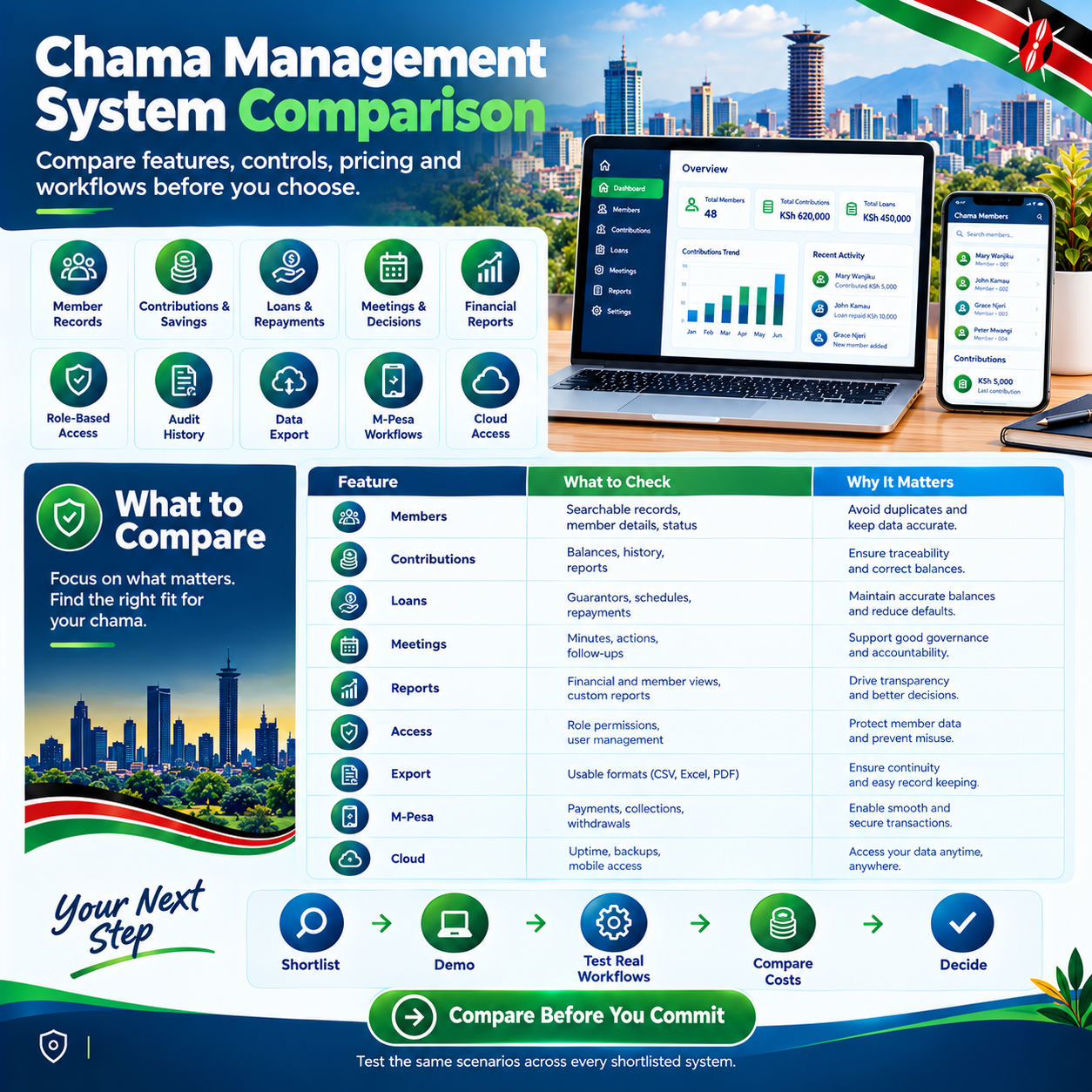
A chama management system comparison is the smartest homework any Kenyan investment group can do before trusting a platform with its money. The market has exploded with options — simple trackers, full financial suites, and everything in between — and not all of them deserve your members’ contributions.
A disciplined comparison is the difference between choosing a lifelong partner and signing up for an expensive frustration.
Groups that skip the chama management system comparison stage almost always regret it. They discover missing features after payment, pay for capacity they never use, or migrate twice when the first choice disappoints. Every one of those outcomes was preventable with one structured evaluation exercise.
The good news is that comparing systems is not complicated. It requires a checklist, a scorecard, and the discipline to test every candidate against identical criteria. That structure is exactly what this guide delivers for your chama management system comparison project.
This article is written for treasurers shortlisting vendors, committees preparing an AGM decision, and founders launching groups that want the right platform from day one. It walks through what to compare, how to test it, and how to score candidates fairly. By the end, your chama management system comparison will feel like a professional procurement exercise rather than a leap of faith.
One truth deserves stating upfront. There is no single “best” system for every group — only the best system for your group’s size, lending habits, and technical comfort. That is precisely why the chama management system comparison process matters more than any vendor’s marketing.
The timing for this exercise has never been better. The Kenyan market now offers genuine depth, with platforms competing on features, support, and price. A well-run chama management system comparison turns that abundance from confusion into negotiating leverage.
So gather your officials, print the checklists ahead, and block out two weeks for the exercise. Rushed comparisons produce expensive lessons; patient ones produce partnerships that last decades. The calmest way to run a chama management system comparison is one deliberate step at a time.
Why Comparing Systems Matters More Than Ever
The first reason is sheer market abundance. Five years ago, Kenyan groups had two or three options; today they face dozens of platforms of wildly varying maturity. Sorting genuine infrastructure from polished vaporware is the core challenge of any chama management system comparison.
The second reason is switching cost. Once your group’s contributions, loans, and history live inside a system, migrating away means exporting, cleaning, and re-importing everything. Choosing right the first time — via a thorough chama management system comparison — avoids that entire burden.
The third reason is money. Subscriptions, SMS volumes, and add-ons differ dramatically across vendors for identical functionality. Groups that compare chama management system pricing properly routinely save thousands of shillings annually for the same features.
The fourth reason is trust. Members accept almost any platform when they see the committee compared options transparently and chose the winner on evidence. A documented chama management system comparison becomes the AGM slide that wins unanimous adoption.
What to Compare: The Seven Pillars
Structure your evaluation around seven pillars that together define platform quality. Every serious chama management system comparison should score candidates on all seven, weighted by your group’s priorities. The sections below unpack each pillar in detail.
Pillar 1: Core Features
Features are the foundation of any chama management system comparison. List your group’s actual workflows first: contribution invoicing, M-Pesa reconciliation, loan management, fines, welfare, meetings, and reports. Then score each candidate on how completely it covers that specific list.
Beware feature lists that look impressive but describe generic group tools. A platform built for Kenyan chamas handles share capital separately from contributions, understands guarantor culture, and speaks M-Pesa natively. Local depth is the sharpest differentiator in any honest chama management system comparison.
Also weigh what the system refuses to do. Platforms that force foreign workflows — like fiscal-year accounting or Western lending structures — create friction no demo can hide. Fit beats breadth every time in a chama management system comparison.
Pillar 2: Ease of Use
Usability decides whether the platform gets adopted or abandoned. Your youngest member and your most senior official must both navigate it comfortably within one meeting. That standard is the pass mark for any chama management system comparison.
Test ease of use during the demo itself. Hand the controls to your least tech-comfortable official and ask them to find their own balance and download their own statement. What they accomplish unaided is the true usability score in your chama management system comparison.
Also check mobile behavior explicitly. Most Kenyan group finance happens on phones, not laptops, so the mobile experience carries double weight. Mobile-first design is a decisive factor in any modern chama management system comparison.
Pillar 3: M-Pesa and Payments Integration
Payment integration is the single most important technical pillar in any chama management system comparison. A platform that cannot reconcile Paybill payments automatically will generate exactly the manual work you are trying to escape. Ask every vendor to demonstrate a live payment posting without human hands.
Test the edge cases during each session. Duplicate payments, partial payments, and payments landing in the wrong month must all resolve gracefully. How a platform handles those three scenarios is the most revealing moment of any chama management system comparison.
Also confirm support for other channels. Bank transfers, check-off arrangements, and cash declarations should all have structured workflows, not “call the treasurer” exceptions. Channel breadth adds real depth to a chama management system comparison.
Pillar 4: Reporting and Transparency
Reporting is where daily transactions become member confidence. Every candidate in your chama management system comparison must show member statements, arrears aging, collection trends, and AGM-ready summaries. Ask to see each one generated live during the demo.
Judge reports as a member would, not as an accountant. If your least tech-savvy official cannot read the statement at a glance, the platform will create questions instead of answering them. Readability is the quiet pass-fail test in any chama management system comparison.
Also verify export freedom. Your group’s history belongs to the group, so full data export in usable formats must be guaranteed in writing. Data ownership is a non-negotiable line in any chama management system comparison.
Pillar 5: Security and Data Protection
Security questions must be asked directly and answered specifically. Where is data stored, how often do backups run, and who can edit historical records? Specific answers distinguish a serious chama management system comparison from a casual one.
Request a live view of role-based access. Log in as treasurer, then as an ordinary member, and confirm each sees exactly what their role requires. Access control demonstrated live is worth more than any promise during a chama management system comparison.
Check the vendor’s track record too. How long have they operated, how many groups rely on them, and what happened the last time something broke? Longevity and transparency weigh heavily in any mature chama management system comparison.
Pillar 6: Pricing and Total Cost
Pricing comparison fails most groups because they compare headline fees instead of totals. Normalize every quote to total first-year cost, including SMS volumes, extra seats, and onboarding fees. Only totals make a chama management system comparison honest.
Also compare pricing against your growth path. A cheap entry tier that doubles in price at fifty members may cost more than a mid-tier that scales gently. Projection is what turns a chama management system comparison into a multi-year financial decision.
Finally, value the relationship you are buying. Responsive support and free training are worth real money, even when the subscription looks higher. Total value, not total price, is the mature frame for any chama management system comparison.
Pillar 7: Support and Company Stability
Support quality reveals itself in small moments during evaluation. How fast did the vendor respond to your demo request, and how well did the presenter handle questions they could not answer immediately? Those behaviors predict the chama management system comparison outcome better than feature lists.
Ask for references from groups like yours. A vendor confident in their product will connect you with current customers the same day. Reference checks are the final validation step in any thorough chama management system comparison.
The Scoring Framework: Turn Opinions into Evidence
Structure your chama management system comparison with a simple weighted scorecard. List the seven pillars, assign each a weight reflecting your group’s priorities, and score every candidate from one to five per pillar. The arithmetic converts impressions into a defensible ranking.
Weight the pillars to your reality, not to marketing. A lending-heavy group might weight loans at thirty percent while a welfare circle weights fines and welfare higher. Personalized weighting is what makes a chama management system comparison truly yours.
Score immediately after each demo while impressions are fresh. Delay lets memory smooth over the exact moments that revealed platform character. Same-day scoring is the discipline behind every reliable chama management system comparison.
Common Comparison Mistakes to Avoid
Mistake one: comparing on demo polish rather than workflow depth. Flashy dashboards impress, but monthly-cycle execution is what your treasurer will live with daily. Judging substance is the entire discipline of a chama management system comparison.
Mistake two: letting one charismatic presenter sway the committee. You are buying a system, not a personality — so score the platform, not the pitch. Emotional distance is the professional posture for any chama management system comparison.
Mistake three: ignoring the migration path. A perfect platform that cannot import your history cleanly will strand your group’s records in spreadsheets forever. Migration capability belongs in every chama management system comparison.
Mistake four: comparing free tools against paid platforms on price alone. Free tools lack reconciliation, automation, and support, so the comparison must weigh what is missing, not just what is cheaper. Feature-normalized pricing is the only fair basis for a chama management system comparison.
Real Stories from Groups That Compared
The Nakuru teachers’ chama demoed four platforms over three weeks using one shared scorecard. Their runner-up scored higher on dashboards, but the winner won decisively on M-Pesa reliability and support response. The group credits their structured chama management system comparison with the smoothest adoption any member had ever witnessed.
The Kitengela landlords’ group compared five systems with a lending focus. Their shortlist came down to two, separated finally by guarantor tracking depth and export freedom. That granular level of chama management system comparison is what separates confident choices from hopeful ones.
The Eldoret youth group combined their comparison with a property decision. Group finance ran through the platform evaluation while rental management was delegated to Tas.co.ke as a specialized tool. Choosing each tool for its specialty — the essence of smart chama management system comparison — gave them one clean, connected ecosystem.
Frequently Asked Questions
How many platforms should we compare?
Three to five is the sweet spot — enough for genuine choice without exhausting your officials. Shortlist from online research, then demo all of them using the identical scorecard. More than five tends to blur the details that actually matter in a chama management system comparison.
How long should the whole comparison take?
Two to three weeks for a group of typical size, including demos, scoring, and reference checks. Rushing past two weeks usually means skipping the edge-case testing where real differences hide. Patience during the chama management system comparison phase is repaid for years.
Can we trust online reviews during comparison?
Use them as a starting point, not a verdict. Reviews reveal broad satisfaction patterns but rarely test the specific workflows your group needs. Direct demos and references remain the strongest evidence in any chama management system comparison.
Should the cheapest system win if features are similar?
Not automatically — support depth, reliability, and vendor longevity are real differences that price tags hide. When features tie, weight the relationship you are buying. The true winner of a chama management system comparison is the platform you will still love in year three.
What if two systems tie on our scorecard?
Break the tie with a one-month parallel pilot using your real monthly cycle. The platform that survives real operations with your real members is your answer. That final test settles any chama management system comparison beyond argument.
Do we need to compare SACCO software too?
Only if your group is transitioning toward formal cooperative registration or deposit-taking operations. Traditional chama platforms are built for group lending and welfare, which SACCO systems treat differently. Match the software category to your group’s actual legal form.
We own rental units — should property management enter the comparison?
Keep it separate, because group finance and property management are different disciplines. The smartest groups run contributions and loans on their chama platform while managing tenants, rent collection, and owner statements on Tas.co.ke. One connected ecosystem beats one overloaded system — a principle worth remembering throughout your chama management system comparison.