Author: Nafisa Feisal

  • Chama Management Software Pricing in Kenya: paying the right price

    Chama management software pricing

    Chama management software pricing is the question every serious Kenyan group asks once the decision to digitize has been made. Members agree on the why, officials agree on the features, and then someone asks the money question. This guide answers it completely, with realistic Kenyan figures rather than vague promises.

    Understanding chama management software pricing before you request quotes puts your group in the strongest possible negotiating position. Vendors quote differently to informed buyers than to hopeful ones. Knowledge, in pricing conversations as everywhere else, is money.

    The honest starting point is that chama management software pricing in Kenya spans a wide range. Small groups can run professional systems for a few thousand shillings a month, while large federations invest in premium tiers. What matters is matching the tier to your group’s actual size and needs.

    This guide walks through every element of chama management software pricing from the ground up. We cover the models vendors use, the add-ons that inflate bills, and fully worked cost examples for groups of different sizes. We finish with a return-on-investment calculation that turns the price question into a profit question.

    One reassurance before the numbers begin. Chama management software pricing is almost always far lower than the value of the arrears it recovers in the first quarter. Groups that do the math almost never return to manual records.

    Bring your treasurer to this guide. The numbers ahead are meant to be penciled against your own group’s size, contribution levels, and ambitions. That exercise converts chama management software pricing from an abstract quote into a concrete line in your budget.

    By the final section, you will know what a fair price looks like for a group exactly like yours. You will also know which questions earn vendors’ respect — and which red flags should lower any offer. That confidence is the real deliverable of mastering chama management software pricing.

    What Determines the Price You Are Quoted

    The first driver of chama management software pricing is group size, measured either by member count or total units managed. Most vendors price in bands — for example, up to 25 members, up to 100, and enterprise tiers beyond. Know your band before the first conversation.

    The second driver is feature depth. A platform handling contributions and reminders costs less than one with full loan books, guarantor tracking, and financial accounting. Deciding which features you actually need is the first step in controlling chama management software pricing.

    The third driver is support depth. Packages with dedicated onboarding, training visits, and phone support cost more than self-service tiers. Many groups find mid-tier support the sweet spot for chama management software pricing once they weigh their own technical comfort.

    The fourth driver is deployment scale. Platforms serving SACCO-scale federations with thousands of members invest more in infrastructure, which shows in their enterprise pricing. A neighborhood chama should never be paying federation rates — an important sanity check within chama management software pricing.

    The final driver is market position. Established vendors with large client bases price for sustainability rather than desperation. That stability is itself worth paying for, which is why the cheapest entry in chama management software pricing is rarely the best deal.

    The Main Pricing Models Explained

    Model one is the flat monthly subscription. You pay one fixed fee per month regardless of how many members the group has, which makes budgeting beautifully simple. Flat pricing is the friendliest entry point into chama management software pricing for small and medium groups.

    Model two is per-member pricing. The platform charges a small amount per active member each month, so costs scale exactly with your group. Growing groups like how per-member chama management software pricing never charges for capacity they do not use.

    Model three is tiered packaging. Vendors bundle features into bronze, silver, and gold-style tiers, each with its own fee and member ceiling. Tiered structures give groups room to upgrade as they outgrow lower levels of chama management software pricing.

    Model four is annual billing with a discount. Paying twelve months upfront typically saves ten to twenty percent compared to monthly payments. Cash-rich groups often choose annual chama management software pricing precisely to capture that saving.

    Model five is one-time licensing with annual support. Older systems charge a large upfront fee plus yearly maintenance, a structure inherited from the banking software era. Most modern vendors have abandoned it, which is one reason current chama management software pricing favors subscriptions.

    There is no universally correct model — only the correct model for your cash flow. A group with uneven monthly collections may prefer flat fees, while a stable one may prefer per-member clarity. Test each structure against your own finances before committing to any chama management software pricing arrangement.

    Typical Price Ranges in Kenya

    Now for the numbers groups actually ask about. Entry-level plans for groups under roughly thirty members typically run between one thousand and three thousand shillings per month. That band is the realistic floor of professional chama management software pricing in Kenya today.

    Mid-tier plans serving groups of thirty to a few hundred members generally fall between three and eight thousand shillings monthly. These tiers add loan management, richer reports, and stronger support. Most growing investment groups find their long-term home in this middle band of chama management software pricing.

    Premium and enterprise tiers — for federations, large SACCO-style operations, and property-heavy portfolios — can run into tens of thousands monthly. The price buys dedicated support, custom configurations, and guaranteed service levels. Few neighborhood chamas ever need this top slice of chama management software pricing.

    Annual totals make budgeting easier to picture. A small group paying two thousand shillings monthly invests twenty-four thousand shillings a year in its entire financial system. Framed that way, chama management software pricing often costs less than the group spends on meeting refreshments.

    Prices also shift with promotions and partnerships. Some vendors run launch discounts, while others bundle with banks or SACCO partnerships for member benefits. Watching the market for one quarter before signing can save a group an entire month’s fee.

    Always ask what the quoted figure includes. Some vendors bundle SMS and support; others quote a bare platform and bill every message separately. Comparing chama management software pricing without normalizing inclusions is how groups accidentally overpay.

    The Add-Ons That Change the Real Bill

    SMS charges are the classic add-on within chama management software pricing. Reminders and receipts sent per message typically cost between one and three shillings each, billed monthly by volume. A group of fifty members messaging ten times a month should budget several hundred shillings for messages alone.

    Onboarding and data migration are the second common extra. Some vendors include setup free; others charge a one-time fee for importing your historical records and training officials. Ask directly, because onboarding can shift chama management software pricing by thousands of shillings in year one.

    Extra admin seats are the third watch-item. Basic plans often include two or three official logins, with additional users billed monthly. Large committees should total this line before comparing chama management software pricing across vendors.

    Premium support is the fourth. Dedicated account managers and priority response times usually live in higher tiers or as add-on contracts. Groups that rely heavily on phone support should read chama management software pricing with that dependency included.

    Payment processing is the fifth, and it cuts both ways. Some platforms pass M-Pesa transaction costs through to the group; others absorb them inside the subscription. Understanding who pays what is essential to a fair reading of chama management software pricing.

    The defense against add-on inflation is a single question, asked in writing. “What is the total first-year cost for a group of our size, including messages, onboarding, and support?” Every vendor confident in chama management software pricing answers it without hesitation — and hesitation is itself an answer.

    Worked Examples: Pricing by Group Size

    Before the examples, one honest caveat. The figures below reflect typical market bands rather than any single vendor’s list price. Use them as planning anchors, then confirm live quotes for your exact size.

    Example 1: The Ten-Member Welfare Table

    Take a ten-member welfare table contributing five thousand shillings monthly each. A typical entry plan plus message charges lands total chama management software pricing at around fifteen to twenty thousand shillings for the whole first year. That covers invoicing, reminders, receipts, and simple reports for every member.

    Per member, that is roughly 125 to 165 shillings a month — the price of a single soda. The group recovers that amount the first time the platform prevents one disputed or forgotten payment. That is the honest mathematics inside small-group chama management software pricing.

    Example 2: The Forty-Member Investment Chama

    Now scale to a forty-member investment chama lending to members and saving toward land. A mid-tier plan with loans and reports plus message volume totals around five thousand shillings monthly. Annualized, chama management software pricing for this group runs about sixty thousand shillings.

    Against that cost stands the group’s collection reality. Forty members at ten thousand monthly means four hundred thousand shillings crossing the books each month. If digitization improves collection by even five percent, chama management software pricing pays for itself twenty times over.

    Example 3: The Property-Owning Chama

    Finally, picture a property-owning chama with one hundred members and eight rental units. Group finance runs on the chama platform while tenants, rent collection, and landlord statements run on Tas.co.ke. Together, chama management software pricing across both subscriptions keeps every shilling visible for an outlay that feels trivial beside the portfolio.

    The pattern across all three examples is consistent. chama management software pricing scales gently with group size, while the value of clean records scales much faster. That widening gap is why satisfaction rates among digitized groups run so high.

    Free Tools Versus Paid Platforms

    The free option must be discussed honestly. Spreadsheets and chat groups cost nothing and serve brand-new groups adequately for a season. But they cannot reconcile M-Pesa, send automatic reminders, or survive an official’s departure — the gaps that eventually make chama management software pricing worthwhile.

    Freemium platforms occupy the middle ground. They offer genuine functionality free for tiny groups, then move you to paid tiers as you grow. Trying before buying is the best way to learn what chama management software pricing should feel like.

    Beware free tools that monetize your data or vanish without notice. If the business model is unclear, the long-term price may be your records. Reputable vendors behind chama management software pricing survive on subscriptions, not on silent data harvesting.

    The practical advice is sequenced. Start free if you are under five members with no lending; graduate to a paid plan when loans, arrears, or disputes appear. Treat the move as a milestone rather than an expense — that mindset reframes chama management software pricing entirely.

    Calculating the Return on Investment

    ROI turns the pricing debate into arithmetic any committee can follow. Begin with recoverable losses: arrears, forgotten fines, and reconciliation errors that manual systems leak. Most groups find these leaks alone exceed their annual chama management software pricing within a single quarter.

    Add the treasurer’s hours next. Five hours monthly at even a modest implicit value is sixty hours a year returned to the group. Time recovered is a real, if unbanked, return on chama management software pricing.

    Then value the disputes prevented. One avoided crisis — the kind that dissolves decades-old groups — is worth more than a decade of subscriptions. Insurance is the fairest frame for this portion of chama management software pricing.

    There is also the confidence dividend that never reaches a spreadsheet. Officials who trust their numbers make faster decisions and sleep better before AGMs. Peace of mind is difficult to price but impossible to replace.

    Finally, count the opportunities unlocked. Bank accounts, credit lines, and credible negotiations all favor groups with clean statements. Access to finance is the quiet multiplier behind well-chosen chama management software pricing.

    Run the full calculation with your own figures before the AGM vote. Present total cost beside total recovered, and let members see the margin for themselves. Groups that vote on chama management software pricing with the math on one page almost always vote yes.

    How to Get the Best Deal

    Negotiation in this market is normal and expected. Vendors discount for annual prepayment, referrals, and case studies — ask for all three. Polite bargaining often trims chama management software pricing by ten or fifteen percent without any haggling drama.

    Request quotes from at least three vendors using an identical requirements list. Identical inputs are the only way comparisons of chama management software pricing mean anything. Differences that survive like-for-like quoting are real differences.

    Ask about nonprofit, welfare, and faith-based discounts where they might apply. Many vendors quietly offer reduced community rates that never appear on public pages. One question can reshape chama management software pricing for qualifying groups.

    Timing matters in negotiations too. Vendors are most flexible at quarter-end and during product launches, when internal targets loom. A patient group that asks at the right moment often hears a better number.

    Read the renewal terms before signing, not after. Auto-renewal escalations, message-rate changes, and tier migrations all belong in the first conversation. Transparency at signing is what keeps chama management software pricing fair in year three.

    Finally, insist on a demo with your own numbers. Enter a real month of contributions and watch the platform compute, remind, and report live. A system that performs has earned its chama management software pricing — one that stumbles has just saved you money.

    Real Stories from Kenyan Groups

    The Nakuru teachers’ chama nearly rejected digitization over a quoted annual fee. Their treasurer ran the ROI calculation with real arrears figures, and the room reversed its verdict in ten minutes. They now credit that one-page analysis of chama management software pricing with their smoothest financial years ever.

    The Kitengela landlords’ group bundled both sides of its operation. Group finance runs on the chama platform while tenants and rent run on Tas.co.ke, with combined statements at every AGM. Members describe the combined spend as the smartest line their review of chama management software pricing ever produced.

    The Eldoret youth group started on a freemium plan with nine members. Within two years, growth into lending moved them to a mid-tier subscription without a single complaint about cost. Their journey shows how chama management software pricing can grow step by step alongside the group itself.

    Across the country, the pattern repeats. Groups do not complain about what they pay for systems; they complain about what disorder costs them quietly. That inversion is the final lesson of chama management software pricing.

    Frequently Asked Questions

    How much should a small chama of ten members expect to pay?

    Budget between one and three thousand shillings monthly on an entry plan, plus small message charges. At that level, chama management software pricing works out to a few hundred shillings per member per year. Most groups recover the full annual cost within one quarter of cleaner collections.

    Is annual billing worth it?

    Yes, when cash flow allows — discounts of ten to twenty percent are common for prepaid years. Just confirm refund terms in writing before committing to annual chama management software pricing. A group with stable finances almost always saves by paying upfront.

    What hidden costs should we ask about?

    Ask specifically about SMS volumes, extra admin seats, onboarding fees, and support tiers. A total first-year figure in writing is the cleanest way to compare chama management software pricing. Vague answers to that request deserve the same suspicion as vague answers anywhere.

    Can we negotiate the quoted price?

    Yes — annual prepayment, referrals, and multi-year commitments are the standard levers. Most vendors expect the conversation, so never accept the first figure in chama management software pricing as final. A respectful ask routinely saves ten to fifteen percent.

    Is a free plan enough for a new group?

    It can be, for very small groups without lending. The moment loans and arrears enter the picture, paid chama management software pricing earns its keep immediately. Graduate when the group’s money becomes bigger than the group’s memory.

    We own rental units — do we need to pay for two systems?

    Many groups pair a chama platform for contributions and loans with Tas.co.ke for tenants, rent collection, and owner statements. Combined, the two subscriptions still cost less than one month’s disputed rent — a decisive fact when judging chama management software pricing. One connected ecosystem beats two half-visible ledgers every time.

    What is the single best question to ask any vendor?

    Ask: “What is the total first-year cost for a group of our size, with everything included?” Vendors who answer instantly have priced chama management software pricing honestly — and those who hesitate have told you something too.

  • What Percentage Do Chamas Charge for Loans? The Ultimate Guide to Fair Group Interest Rates in Kenya

    what percentage do chamas charge for loans

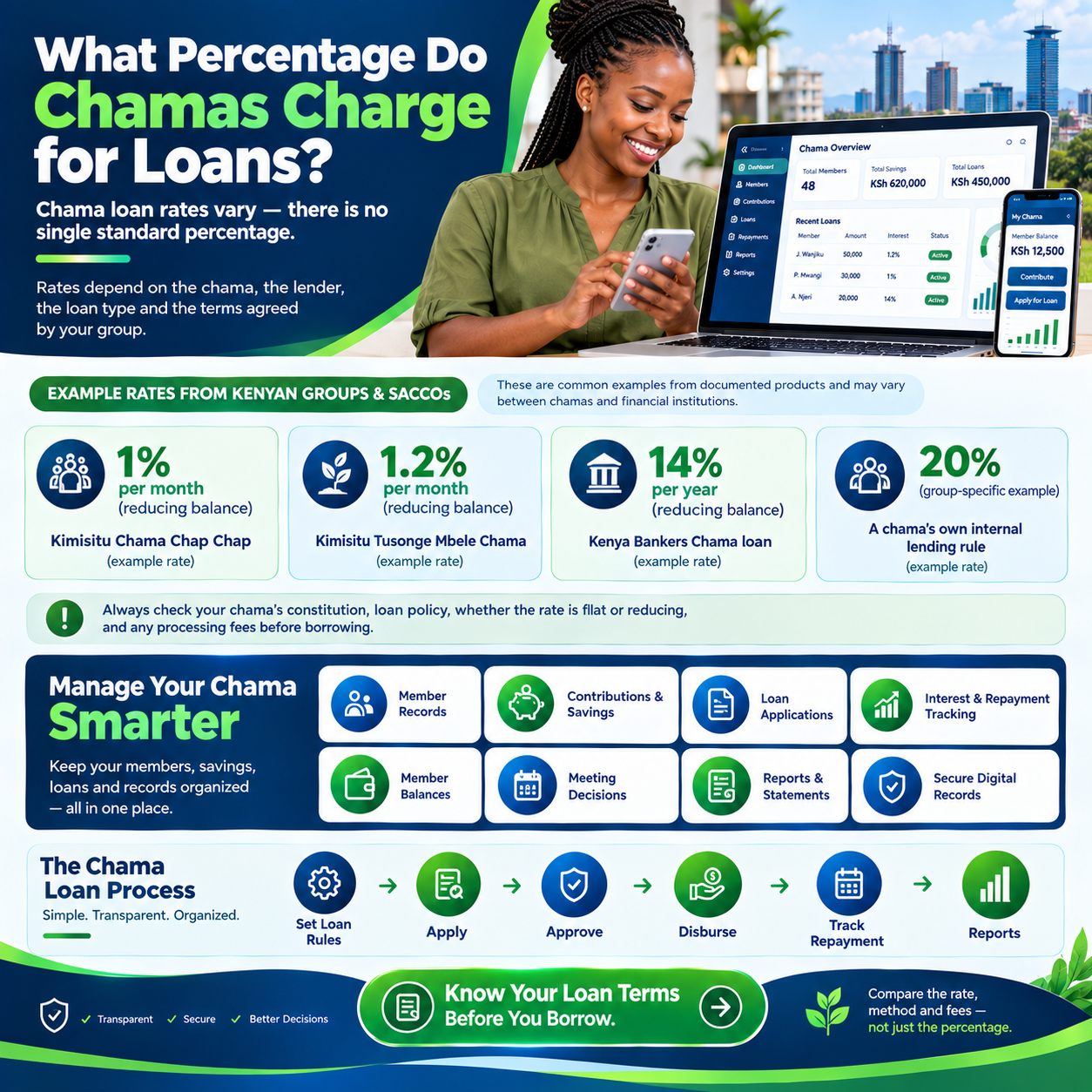
    What percentage do chamas charge for loans is the very first question most new members ask before committing their savings to any group. The answer shapes how much a school-fees loan really costs, how fast the group’s capital grows, and whether members feel the terms are fair.

    Yet across Kenya, the honest reply is a range rather than a single figure — and understanding that range is the entire purpose of this guide.

    The reason no single answer exists is that every chama writes its own lending rules. A teachers’ group in Nakuru, a traders’ circle in Gikomba, and a professionals’ chama in Kilimani can charge very different rates and all remain perfectly legitimate.

    So the real task behind what percentage do chamas charge for loans is learning what is common, what is fair, and what suits your own group.

    This guide gives you the complete picture in plain language. You will see the typical rates Kenyan groups actually charge, the crucial difference between flat and reducing-balance pricing, and fully worked examples you can verify on any calculator.

    By the end, the question of what percentage do chamas charge for loans will feel like a menu of informed choices rather than a mystery.

    The timing for this knowledge could not be better. Group lending has exploded in scale as chamas fund rentals, matatus, and businesses worth millions of shillings. In that environment, a clear answer to what percentage do chamas charge for loans protects both borrowers and savers from silent mispricing.

    Borrowers need the answer to avoid overpriced credit and unpleasant surprises at repayment time. Savers need it because loan interest is usually the largest income line feeding their annual dividends. Both sides of the table meet in the single question of what percentage do chamas charge for loans.

    Officials need it most of all, because they set the rates and defend them at every AGM. A treasurer who can explain the group’s pricing with confidence wins trust that lasts for years. That confidence begins with mastering what percentage do chamas charge for loans from every angle.

    One reassurance before we begin. There is no national rulebook that fixes group lending rates, which means your constitution — not the government — is the true authority. That freedom is exactly why getting informed about what percentage do chamas charge for loans matters so much.

    The Short Answer: Typical Rates in Kenyan Chamas

    Here is the honest snapshot of current practice across the country. Most established chamas charge between 8 and 15 percent per annum, with 10 percent flat per year being the single most common figure.

    So the practical heart of what percentage do chamas charge for loans is this: expect to pay roughly one percent of the principal per month.

    Smaller and newer groups often charge slightly more, in the 2 to 3 percent per month range. The higher figure reflects thin reserves, higher perceived risk, and the need to build capital quickly.

    Anyone researching what percentage do chamas charge for loans among startup groups should expect exactly that pattern.

    Mature, well-capitalized groups charge less. Groups with large loan books and diversified income can comfortably lend at 8 to 12 percent per annum while still paying handsome dividends.

    Their pricing discipline is one of the quiet lessons hidden inside what percentage do chamas charge for loans.

    Table banking circles are the exception worth naming. They commonly charge 10 percent of the monthly pot, which annualizes to far more but lasts only weeks.

    That short-cycle pricing is its own distinctive answer to what percentage do chamas charge for loans within the rotation format.

    Emergency loans carry premium pricing almost everywhere. A one-month facility for hospital bills might cost a flat 5 to 10 percent regardless of the amount borrowed.

    Any complete study of what percentage do chamas charge for loans must include this urgent, short-tenure corner of the market.

    The spread between all these figures is not random. It tracks the group’s cost of funds, risk appetite, administrative burden, and financial goals.

    Understanding that spread is what turns the raw question of what percentage do chamas charge for loans into real negotiating power.

    Flat Rate vs Reducing Balance: The Hidden Difference

    Before any percentage means anything, you must know how it is applied. Two groups can both say “10 percent” and produce very different total costs depending on the calculation method.

    This single distinction is the most important technical detail in the whole subject of what percentage do chamas charge for loans.

    Under a flat rate, interest is computed on the original principal for the entire loan period. Borrow 100,000 at 10 percent flat for a year and you owe 10,000 in interest, full stop, no matter how fast you repay.

    Simplicity is the great appeal of flat pricing in what percentage do chamas charge for loans.

    Under a reducing balance, interest is charged only on what you still owe each month. The same 100,000 at 12 percent per annum reducing costs roughly 6,600 in total interest over a year.

    Members comparing figures in what percentage do chamas charge for loans must therefore always ask which method applies.

    Here is the rule of thumb that surprises most members. A flat 10 percent per annum costs roughly the same as a reducing balance of about 18 percent.

    Every serious discussion of what percentage do chamas charge for loans should include that conversion, because it prevents false comparisons between groups.

    Neither method is dishonest, provided it is disclosed. Flat rates win on simplicity and predictability; reducing balances reward early repayment and cost less overall.

    The fairest groups print the method — not just the number — wherever they publish what percentage do chamas charge for loans.

    What Determines the Rate Your Group Sets

    The first factor is the source of funds. Chamas lend members’ savings, not borrowed money, so there is no bank debt to service beneath the rate.

    That structural advantage explains the lower end of what percentage do chamas charge for loans among disciplined groups.

    The second factor is the group’s financial mission. A chama that exists to generate member income must charge enough to fund dividends after expenses.

    A welfare-first circle may charge minimally, which is why the mission shapes what percentage do chamas charge for loans in every constitution.

    The third factor is risk. Loan size relative to savings, member repayment history, and the strength of guarantors all move the price.

    Groups that screen carefully can afford softer answers to what percentage do chamas charge for loans than groups lending blind.

    The fourth factor is tenure. Short loans justify higher monthly pricing because the administrative cost is the same regardless of size.

    Long development loans justify lower annual pricing — a nuance often missed in heated debates about what percentage do chamas charge for loans.

    The fifth factor is inflation and opportunity cost. Money parked in a five-percent loan loses ground when prices are rising seven percent a year.

    Realistic groups set rates with this arithmetic firmly in mind when deciding what percentage do chamas charge for loans.

    The sixth factor is competition. Members who can access a SACCO at 12 percent reducing will not tolerate a chama charging the equivalent of 25.

    Market awareness keeps the answer to what percentage do chamas charge for loans honest over time.

    The final factor is growth strategy. Some groups deliberately charge higher rates to accelerate capital accumulation toward a building project or land purchase.

    Ambition, as much as cost, drives the most aggressive numbers in what percentage do chamas charge for loans.

    Monthly Rates vs Annual Rates: Reading the Fine Print

    Quoting conventions cause more confusion than actual pricing. “Two percent per month” sounds gentle but equals 24 percent per year on a flat basis.

    Clarity about conventions is therefore essential to any honest answer on what percentage do chamas charge for loans.

    The reverse is equally true. “Twelve percent per annum” looks formal but equals just one percent monthly on the outstanding balance.

    Members comparing notes on what percentage do chamas charge for loans must convert everything to the same basis first.

    The cleanest practice is dual disclosure. State the rate as a monthly figure and as an annualized equivalent, with the calculation method named beside both.

    Groups that publish both formats never argue about what percentage do chamas charge for loans at the meeting

    Put the conversion rule on a poster if you must. Annual flat equals monthly flat multiplied by twelve, and reducing-balance equivalents need the rough 1.8 conversion covered earlier.

    A one-line chart of conversions ends most confusion about what percentage do chamas charge for loans permanently.

    How Chama Rates Compare with Banks, Mobile Apps, and SACCOs

    Context makes group pricing meaningful, so let us place it on the national map. Commercial banks typically price personal loans from the mid-teens upward, plus processing fees and insurance add-ons.

    Against that backdrop, mainstream answers to what percentage do chamas charge for loans look genuinely competitive.

    Mobile loan apps sit at the extreme end of the market. Their short tenures and stacked fees translate into effective annualized costs that can reach triple digits.

    Next to that reality, most findings on what percentage do chamas charge for loans reveal group credit as remarkably affordable.

    SACCOs sit closest to chamas in pricing philosophy. Member-owned lenders commonly charge low double digits on a reducing balance, funded by deposits rather than borrowed money.

    The resemblance is no coincidence, because both models answer what percentage do chamas charge for loans with member interest at heart.

    The chama’s true edge is flexibility, not just price. A group can restructure a struggling member’s loan within the same week, something no bank app will ever do.

    That human dimension is part of the complete answer to what percentage do chamas charge for loans.

    Emergency Loans: The Premium Corner of Group Lending

    Emergency products deserve their own pricing logic. They are small, fast, and unsecured, often disbursed within hours of a hospital call.

    Understandably, then, what percentage do chamas charge for loans in emergencies runs higher — commonly a flat 5 to 10 percent for the month.

    The premium is not profiteering; it reflects speed and risk. Fast cash without guarantor meetings costs the group administrative attention and carries higher default exposure.

    Members who understand this accept emergency pricing as the fair edge of what percentage do chamas charge for loans.

    The wisest groups cap emergency pricing in the constitution.

    A written ceiling — say 10 percent flat per month, repayable within sixty days — protects vulnerable members in their worst moments.

    Compassionate limits are the humane dimension of what percentage do chamas charge for loans.

    The Math: Two Fully Worked Examples

    Numbers make everything real, so let us price one loan two ways.

    Grace borrows 100,000 shillings for twelve months at 10 percent per annum flat. This first branch of what percentage do chamas charge for loans is the easiest to compute by hand.

    Flat calculation: interest equals 100,000 × 10% × 1 year, which is 10,000 shillings.

    Total repayment is 110,000, giving a fixed instalment of about 9,167 per month. That is the complete, final answer under this flat method of what percentage do chamas charge for loans.

    Now the same loan at 12 percent per annum on a reducing balance. The fixed monthly instalment works out to roughly 8,885 shillings, and total interest over the year is about 6,619.

    Notice how differently what percentage do chamas charge for loans resolves when only the method changes.

    Grace repays 110,000 under the flat plan and about 106,619 under the reducing plan. The reducing route saves her around 3,400 shillings despite the higher headline rate.

    That comparison is the practical payoff of understanding what percentage do chamas charge for loans precisely.

    One more everyday example completes the picture. A member takes 20,000 for one month at the common 5 percent flat emergency rate, owing 21,000 on payday.

    Short, simple, and transparent — the cleanest corner of what percentage do chamas charge for loans.

    How to Set a Fair Rate in Your Own Group

    Turn now from asking to deciding, because every group eventually writes its own answer. Begin with the group’s purpose: income generation, capital building, or member welfare.

    The mission is the compass for what percentage do chamas charge for loans in your constitution.

    Second, cost your operations honestly. Platform fees, bank charges, transport, and compliance all need covering from the interest you collect.

    A rate set without this arithmetic will quietly underfund the group — the most common error in what percentage do chamas charge for loans.

    Third, benchmark against the alternatives your members actually have. Check the nearest SACCO, the main mobile lenders, and prevailing group practice in your own area.

    Setting your number inside that map is the realistic way to answer what percentage do chamas charge for loans.

    Fourth, choose your method and disclose it loudly. Write “10 percent per annum flat” or “1 percent per month on reducing balance” into the constitution, in those exact words.

    Precision here is what makes what percentage do chamas charge for loans enforceable and dispute-free.

    Finally, review the rate annually at the AGM. Inflation, portfolio performance, and member feedback all justify small, documented adjustments from time to time.

    An annual review keeps your answer to what percentage do chamas charge for loans current without drama.

    Hidden Costs That Sit Beyond the Interest Rate

    The headline percentage never tells the whole story. Processing fees, insurance charges, and penalty interest can add real cost if they are not disclosed upfront.

    Complete transparency about extras is the honest extension of what percentage do chamas charge for loans.

    Fines deserve special attention because they masquerade as pricing. Late-payment penalties are legitimate, but they should be published, capped, and applied impartially to everyone.

    Members evaluating what percentage do chamas charge for loans should always read the penalty schedule too.

    The best groups consolidate everything into one disclosure. A single line — “this loan costs X in interest and Y in fees, repayable as follows” — eliminates every misunderstanding.

    That discipline is the gold standard for publishing what percentage do chamas charge for loans.

    Keeping Rates Fair: Preventing Conflict Before It Starts

    Rate disagreements are really disclosure failures wearing disguises. When members argue about interest, they are usually arguing about what was never clearly written down.

    Preventing that argument is the deepest purpose of settling what percentage do chamas charge for loans in advance.

    Adopt three fairness habits from the most peaceful groups. Publish the schedule on every application form, show total cost before signature, and apply the rate identically to officials and members alike.

    These habits are what make what percentage do chamas charge for loans a settled matter rather than a recurring battle.

    Also protect vulnerable borrowers deliberately. Cap emergency pricing, allow documented restructuring in genuine hardship, and never let penalties exceed the principal.

    Ethical guardrails are the crown of a well-designed answer to what percentage do chamas charge for loans.

    Remember the two-sided bargain at the heart of group lending. Borrowers deserve affordable credit; savers deserve returns that beat inflation and fund real dividends.

    The right number sits where both sides can shake hands — that is the art behind what percentage do chamas charge for loans.

    Tools That Do the Calculations for You

    Manual arithmetic works, but modern tools remove every excuse for error.

    Dedicated chama platforms compute flat and reducing-balance schedules automatically, generate statements, and apply penalties consistently.

    Automation has quietly standardized the professional answer to what percentage do chamas charge for loans.

    When evaluating any platform, bring a real loan to the demo. Ask it to price your actual 100,000 facility both ways and show the full repayment schedule on screen.

    A system that passes that test will serve your group’s answer to what percentage do chamas charge for loans faithfully for years.

    And once your group owns rental property, connect the two sides of the ledger.

    Rental income managed on Tas.co.ke can flow alongside loan interest into one reconciled financial picture.

    That integration gives your AGM the most complete version of what percentage do chamas charge for loans in black and white.

    Real Stories from Kenyan Groups

    The Nakuru teachers’ chama charged “whatever we agreed that day” for its first five chaotic years.

    After writing 10 percent flat into the constitution, disputes vanished and their loan book doubled within two years.

    Their treasurer credits the transformation to finally codifying what percentage do chamas charge for loans.

    The Kitengela landlords’ group priced development loans at 12 percent reducing while capping emergencies at 5 percent flat.

    Members now compare their chama favorably with the SACCO next door — and the annual dividends say the same.

    Their published schedule has become the neighborhood reference for what percentage do chamas charge for loans.

    A third group manages the property side of its wealth through Tas.co.ke, feeding clean rental income into the same AGM accounts as loan interest.

    Members saw both income streams reconciled on one page for the first time last year.

    Seeing the full picture, they voted to keep lending rates steady rather than raise them.

    Frequently Asked Questions

    Is 10 percent flat per year a fair chama rate?

    Yes — it is the most common figure in Kenya, simple to compute, and competitive with member-owned alternatives. Just disclose the method clearly, because what percentage do chamas charge for loans only means something beside its method.

    What rate should a brand-new group of ten members charge?

    Start around 2 percent per month flat, review after the first year, and step down as reserves grow. That staged approach is the practical beginner’s answer to what percentage do chamas charge for loans.

    Which is cheaper: 10 percent flat or 12 percent reducing?

    The reducing option — total interest on a one-year 100,000 loan is about 6,619 reducing versus 10,000 flat. Always convert both offers to total cost before deciding.

    Can a chama legally charge any rate it wants?

    Informal groups set rates by member consent through their constitutions, with no statutory cap on member-to-member lending. Reasonableness, disclosure, and signed agreements are what protect the group if a dispute ever arises.

    Do chamas charge interest on welfare loans?

    Many do not, treating welfare lending as a benefit funded by subscriptions rather than a business line. Groups that do charge typically use token flat rates of 2 to 5 percent to cover administration.

    Does loan interest affect members’ dividends?

    Directly — interest collected is the group’s income, and after expenses and reserves it feeds the distributable pool. That is why savers care as much about lending rates as borrowers do.

    We also own rental units — should that change our pricing?

    Not necessarily, but it changes your funding mix, because rental income can subsidize cheaper lending. The smartest groups run tenants, rent collection, and owner statements on Tas.co.ke while group lending runs on the chama platform. With both books clean, your answer to what percentage do chamas charge for loans can be more generous than your neighbors’.

  • Diaspora Investment Group Kenya: The Ultimate Guide to Building Wealth Back Home with Confidence

    Diaspora investment group Kenya is now one of the most searched phrases among the millions of Kenyans living and working abroad.

    From Boston to Birmingham, Doha to Dubai, Kenyans abroad are pooling money together to build lasting wealth back home. The dream is as old as migration itself: earn far away, invest meaningfully at home.

    For decades, that dream was pursued alone — one plot here, one rental there, managed through phone calls and hope.

    Today, a powerful shift is underway as cousins, classmates, and colleagues form structured collectives with written rules and shared goals. That shift explains why every diaspora investment group Kenya conversation now starts with systems, not just ambition.

    The numbers behind the movement are staggering. Kenyans abroad send home billions of dollars in remittances every year, ranking among the most productive diaspora communities in Africa. A growing share of that money now flows into organized group investments rather than scattered individual purchases.

    This guide is written for every Kenyan abroad who has ever said, “We should buy land together.” It is for the nursing team in London planning a Kitengela apartment block, and the tech workers in Seattle eyeing agribusiness in Nakuru. Wherever you are, the complete playbook for a successful diaspora investment group Kenya starts in the sections below.

    The opportunities are genuinely exciting. Group purchasing power unlocks plots and developments that no individual member could afford alone. That leverage is the core promise of every well-run diaspora investment group Kenya.

    But honest guides must also name the risks. Distance, trust gaps, exchange rates, and fraud have destroyed more diaspora investments than market forces ever did. The difference between triumph and heartbreak in a diaspora investment group Kenya almost always comes down to structure.

    The good news is that structure is learnable, and the tools now exist. Purpose-built platforms handle records, payments, loans, and reporting for groups spread across multiple time zones. Modern software makes running a diaspora investment group Kenya feel as easy as managing a neighborhood chama.

    Read this guide with your future co-investors beside you — even if “beside you” means a video call across eight time zones. Discuss every section openly, and adapt it to your group’s own circumstances. The strongest diaspora investment group Kenya ventures are built on conversations exactly like the ones this guide will spark.

    What Is a Diaspora Investment Group?

    A diaspora investment group Kenya is a collective of Kenyans living abroad who pool money regularly to invest back home. Members contribute monthly or quarterly, elect officials, agree on investment targets, and track everything in shared records. Think of it as a chama with a longer reach — and a longer flight home.

    The formats vary widely in practice. Some groups are five siblings buying one family plot; others are forty professionals building a rental block in Ruiru. Both are legitimate expressions of the diaspora investment group Kenya movement.

    What unites them is purpose. Members abroad want assets that appreciate, income that grows, and a soft landing for eventual return. That three-part mission defines every serious diaspora investment group Kenya.

    Why Diaspora Kenyans Are Forming Investment Groups

    The first motivation is purchasing power. Individually, a nurse in Atlanta might afford a quarter plot in five years; collectively, her group buys an acre this year. That multiplication effect is the engine of the diaspora investment group Kenya phenomenon.

    The second motivation is presence. Members abroad cannot inspect plots monthly, chase tenants, or supervise construction in person. Pooling resources into a diaspora investment group Kenya with trusted on-the-ground structure solves the distance problem collectively.

    The third motivation is discipline. Saving alone abroad is hard — rent, taxes, and lifestyle consume the best intentions month after month. A diaspora investment group Kenya turns saving into a commitment with witnesses, schedules, and shared goals.

    The fourth motivation is legacy. Many members are building a bridge home — assets awaiting children, retirement, or an eventual return. Legacy, not just returns, is the deeper promise of a diaspora investment group Kenya.

    There is a fifth motivation that officials rarely say aloud. Group membership keeps members connected to home socially, culturally, and financially, even after twenty years away. Belonging, in the end, is part of what a diaspora investment group Kenya truly offers.

    What Diaspora Groups Are Investing In

    Land remains the favorite asset. Plots in satellite towns — Kitengela, Joska, Nanyuki, Ruaka — appreciate steadily as urban Kenya expands outward. Land is the foundational asset in most diaspora investment group Kenya portfolios.

    Rental property is the natural second step. Apartment blocks in Ruiru, Syokimau, and Ngong convert group capital into monthly income streams. Cash-flowing rentals are the growth engine of a mature diaspora investment group Kenya.

    Agribusiness is rising fast. Poultry, greenhouse tomatoes, and dairy ventures near towns like Nakuru and Nyeri offer faster returns than land alone. Diversified groups treat agribusiness as the income layer of a diaspora investment group Kenya.

    Businesses and financial products complete the picture. Some groups fund matatus, franchise outlets, money market funds, or SACCO deposits back home. A balanced diaspora investment group Kenya spreads risk across several of these asset classes.

    The wisest groups sequence their investments deliberately. Land first for security, rentals second for cash flow, and ventures third for growth. That order has served nearly every successful diaspora investment group Kenya well.

    The Challenges Every Diaspora Group Must Beat

    Trust across the distance is challenge number one. Members in Toronto send money to a treasurer in Nairobi, and doubts can grow in the silence between statements. Every healthy diaspora investment group Kenya answers that doubt with radical transparency.

    Fraud is challenge number two. Fake land sellers, double-titled plots, and rogue “agents” have burned countless well-meaning groups over the years. Due diligence is the survival kit of a diaspora investment group Kenya.

    Currency and transfer costs are challenge number three. Exchange rates move, transfer fees bite, and timing affects what actually lands in the group account. Financial discipline includes managing these frictions inside a diaspora investment group Kenya.

    Distance from the assets is challenge number four. Who inspects the fence, collects the rent, or attends the land board meeting when everyone is abroad? On-ground administration is the fourth pillar of a functional diaspora investment group Kenya.

    Time zones create the fifth, quieter challenge. Scheduling decisions across Nairobi, London, and Sydney means consensus can take weeks if the process is informal. Fixed meeting rhythms are what keep a diaspora investment group Kenya decisive.

    How to Start a Diaspora Investment Group the Right Way

    Start with the founding conversation — and write everything down. Agree on purpose, membership, contribution amounts, decision rules, and exit terms before the first shilling moves. A founding minute is the birth certificate of a diaspora investment group Kenya.

    Second, choose officials and separate duties. A chairperson, treasurer, and secretary — ideally with at least one member based in Kenya — create healthy checks and balances. Balanced leadership is the operating system of a trustworthy diaspora investment group Kenya.

    Third, open proper financial channels. A group bank account, a registered Paybill, and dual signatories prevent the single-person custody that destroys trust. Financial architecture is the first test of any serious diaspora investment group Kenya.

    Fourth, write the constitution. Cover contributions, penalties, exits, the death of a member, and dispute resolution in plain language everyone understands. The constitution is the legal spine of a diaspora investment group Kenya.

    Governance Across Time Zones

    Governance is how a group stays one group when its members span continents. Hold virtual meetings on a fixed schedule, publish minutes within days, and record every vote. Consistent rhythm is what keeps a diaspora investment group Kenya cohesive.

    Decide in advance what requires a vote. Purchases above a set amount, new members, and constitutional changes should always go to the full membership. Clear thresholds prevent the power struggles that sink a diaspora investment group Kenya.

    Rotate oversight deliberately. Annual reviews, independent reconciliation checks, and transparent statements keep every official honest year after year. Rotating scrutiny is the self-cleaning mechanism of a mature diaspora investment group Kenya.

    Moving Money Safely and Smartly

    Money movement deserves engineering, not improvisation. Use formal channels with records — bank transfers, registered Paybill accounts, and licensed remittance partners. Traceable payments are the bloodstream of a diaspora investment group Kenya.

    Reconcile every payment the day it lands. A payment that is not matched to a member and a purpose within twenty-four hours is a future dispute being born. Daily reconciliation is the hygiene standard of a disciplined diaspora investment group Kenya.

    Budget for the frictions honestly. Fees and exchange spreads can quietly consume several percent of contributions if nobody tracks them. Cost awareness protects the returns of every diaspora investment group Kenya.

    Legal Essentials: Land, Titles, and Registration

    Legal structure protects everything else the group builds. Register the group formally — as a self-help group, CBO, cooperative, or company — so it can own property in its own name. Formal registration is the foundation of a legitimate diaspora investment group Kenya.

    Never buy land in an individual’s name “for convenience.” Countless groups have lost assets when the named trustee changed, traveled, or turned untrustworthy. Title in the group’s name is the golden rule of a diaspora investment group Kenya.

    Verify every title independently. Official searches at the lands registry, boundary confirmation, and professional conveyancing cost little compared to what they protect. Independent verification is the insurance policy of a careful diaspora investment group Kenya.

    Use professionals for the paperwork. A licensed advocate should handle transfers, and a written power of attorney should authorize any on-ground signatory. Professional handling completes the legal armor of a diaspora investment group Kenya.

    Records, Payments, and Platforms: The Digital Backbone

    Records are where diaspora groups win or lose. Contributions, meetings, decisions, and expenses must live in one place every member can verify from abroad. A shared digital ledger is the memory bank of a diaspora investment group Kenya.

    Purpose-built platforms transform the experience completely. Automated invoicing, M-Pesa reconciliation, instant receipts, loan ledgers, and AGM-ready reports replace midnight spreadsheet sessions. Modern software has become the standard infrastructure of a serious diaspora investment group Kenya.

    Demand three things from any platform. Automatic payment reconciliation, statements every member can read, and responsive support that answers across time zones. Those three tests separate real systems from pretty brochures when choosing tools for a diaspora investment group Kenya.

    Managing Property from Abroad: The Tas.co.ke Connection

    Once the group owns rentals, a second layer of management begins. Tenants, rent collection, deposits, repairs, and owner statements all demand consistent on-ground attention. Professional property administration is the natural next step for a diaspora investment group Kenya.

    This is where Tas.co.ke earns its place in the ecosystem. Groups run their contributions and loans on a chama platform while Tas.co.ke handles tenants, rent invoicing, M-Pesa collection, maintenance records, and owner statements. That pairing gives a diaspora investment group Kenya professional-grade visibility on both fronts.

    The payoff shows up at every AGM. Group statements and property statements reconcile cleanly, and members vote on expansion with real numbers in hand. That confidence is the quiet dividend of a well-run diaspora investment group Kenya.

    Real Stories from the Diaspora

    The Boston builders started as seven nurses sending five hundred dollars monthly. Within four years, their diaspora investment group Kenya owned two plots and had broken ground on a six-unit block in Kitengela. Their secret was a written constitution and monthly statements nobody had to chase.

    The London logistics group chose agribusiness. Greenhouses in Nyeri now supply hotels in Nakuru, and the profits fund the next land purchase. Agriculture became the profitable second act of their diaspora investment group Kenya journey.

    The Dubai drivers’ circle nearly collapsed over a disputed plot purchase. They recovered by registering the group, retitling the land jointly, and digitizing every record. The near-disaster became the founding lesson of their rebuilt diaspora investment group Kenya.

    Across the world, the pattern repeats with remarkable consistency. Groups with written rules, verified titles, and digital records thrive; groups relying on trust alone struggle. Structure, not luck, is what separates the success stories in every diaspora investment group Kenya.

    Common Mistakes to Avoid

    The first classic mistake is skipping formal registration. Unregistered groups cannot hold title, sign contracts, or defend members’ money cleanly in a dispute. Registration is the lesson groups learn the hard way, usually once.

    The second mistake is concentrating power in one trusted person. The founder who holds the money, the title, and the relationships is a single point of failure. Distributed authority is the antidote in every case.

    The third mistake is investing without inspection. Photos are not due diligence; visit the land, or send a trusted committee with a written checklist. Feet on the ground protect the money of a diaspora investment group Kenya.

    The fourth mistake is launching without a platform. Chat threads and scattered spreadsheets eventually bury contributions and breed quiet suspicion. Professional records are the long-term protection of every diaspora investment group Kenya.

    Getting Started This Quarter

    Begin with a founding video call and a written minute. Define the mission, the monthly contribution, and the first-year target on a single page. That single page is the seed document of your diaspora investment group Kenya.

    Then build the infrastructure in the right order. Register the group, open the account, adopt the constitution, and deploy the digital platform. Sequence matters more than speed when founding a diaspora investment group Kenya.

    Finally, make the first investment small and clean. A modest, verified plot that closes without drama builds the confidence for larger ventures. Early wins compound into the culture of a successful diaspora investment group Kenya.

    Frequently Asked Questions

    How much do members typically contribute?

    Most groups start between one hundred and five hundred dollars per member per month, adjusted to local incomes. Consistency matters more than the starting amount, so choose a figure every member can sustain. That principle governs budgeting inside any diaspora investment group Kenya.

    Do we have to be in the same city abroad?

    No — groups routinely span three or four countries and multiple time zones. Shared platforms and scheduled video meetings hold the group together. Geography is no barrier for a modern diaspora investment group Kenya.

    How do we avoid land fraud?

    Buy only after official title searches, physical site visits, and professional conveyancing. Never rely on a seller’s photos or an agent’s promises alone. Diligence is the shield of every prudent diaspora investment group Kenya.

    What happens if a member wants out?

    Your constitution should define exits: refund terms, timelines, and valuation of their share. Exits handled by the book protect both the departing member and the group. That clause is essential reading in any diaspora investment group Kenya.

    Can we manage rentals while everyone is abroad?

    Yes — pair your group platform with professional property administration. Tas.co.ke handles tenants, rent collection, maintenance, and owner statements while your chama platform tracks contributions and loans. That division of labor is the proven model for a diaspora investment group Kenya.

    Which registration form is best?

    It depends on your size and ambitions: self-help groups suit smaller collectives, while companies and cooperatives suit property-holding ventures. Ask a Kenyan advocate to match the structure to your goals. Professional advice always pays for itself inside a diaspora investment group Kenya.

    How do we handle members who fall behind?

    Apply the same gentle escalation used by the best chamas: private reminder, honest conversation, documented plan, then constitutional consequences. Automated reminders prevent most arrears before they ever start. Fair process keeps the peace inside a diaspora investment group Kenya.

    Are diaspora group investments taxed in Kenya?

    Rental income and other Kenya-sourced earnings attract Kenyan tax regardless of where the owners live. Keep clean records and consult a Kenyan tax professional early. Compliance is a mark of a serious diaspora investment group Kenya.

    What platform features matter most?

    Automatic M-Pesa reconciliation, member statements, loan ledgers, arrears tracking, and AGM-ready reports lead the list. Test any platform with your real numbers before committing. Feature depth is what distinguishes the tools powering a modern diaspora investment group Kenya.

    Can our group lend to members like a chama does?

    Yes, and many do — with documented applications, guarantors, and schedules just like any disciplined chama. Your platform should track the loan book separately from contributions. Lending adds income when managed well inside a diaspora investment group Kenya.

    What is the very first step today?

    Gather your founding members on a call, agree on the mission, and write your one-page founding minute. Then register, bank, and digitize before the first shilling moves. That sequence is how every successful diaspora investment group Kenya begins.

  • Managing Chama Contributions on WhatsApp: The Ultimate Fix That Brings Kenyan Groups Peace of Mind

    Managing chama contributions on WhatsApp problems

    Managing chama contributions on WhatsApp problems have quietly become the hidden tax every Kenyan group pays for convenience. The app brought members together like nothing before it, and nobody can honestly deny that. Yet the same tool now loses payments, breeds disputes, and exhausts treasurers from Mombasa to Kitale.

    The story repeats itself in almost every group that relies on chat alone. Members send M-Pesa payments, screenshots fly across the screen, and the treasurer promises to reconcile everything “over the weekend.” Weekends pass, balances drift, and the frustrations of managing chama contributions on WhatsApp problems grow into open arguments.

    This guide confronts the situation honestly, without pretending the app is useless. WhatsApp remains a brilliant communication tool — the trouble begins when it is asked to be a financial system. We will map every failure point in managing chama contributions on WhatsApp problems and show the proven fix.

    The article is written for treasurers drowning in screenshots, chairpersons fielding complaints, and members who no longer trust the numbers. It is also written for groups that have not yet hit the wall but quietly suspect it is coming. By the end, you will know exactly how to escape managing chama contributions on WhatsApp problems before they cost real friendships.

    One truth deserves saying upfront. The difficulties of managing chama contributions on WhatsApp problems are not a sign that your group is failing. They are a sign that your group has simply grown beyond the tool it started with.

    There is genuine good news hiding in that diagnosis. Every single issue on the managing chama contributions on WhatsApp problems list has a tested, affordable, digital solution. Groups that make the switch report calmer meetings, faster collections, and deeper trust within one billing cycle.

    So read this guide with your officials beside you. Discuss each problem section honestly and ask where your own group recognizes itself. The cheapest time to solve managing chama contributions on WhatsApp problems is today — long before the next disputed payment.

    Why WhatsApp Became the Default in the First Place

    To fix a habit, you must first respect why it formed. Managing chama contributions on WhatsApp problems exist precisely because the app solved the original problem so well. Before smartphones, contributions were announced by word of mouth and recorded in notebooks that vanished without trace.

    WhatsApp arrived and suddenly every member was reachable in one place. Announcements, reminders, and payment confirmations could all flow through a single free channel. For a young group with no budget, that felt like a complete financial system.

    The app also matched Kenyan life perfectly. M-Pesa was already in every pocket, and the chat became its natural noticeboard. That pairing made everything look like it was working — which is why managing chama contributions on WhatsApp problems stayed invisible at first.

    The trouble remained hidden in the early months because volumes were small. Ten members paying five thousand shillings are easy to track from memory. Difficulties multiply when amounts grow, members join, and the months stack into years.

    Then the first lost receipt arrives, and the treasurer scrolls through hundreds of messages hunting for one confirmation. That first lost receipt is the opening chapter of managing chama contributions on WhatsApp problems. Scrolling is not reconciliation, and memory is not a ledger.

    The sections that follow name each failure point plainly, because unnamed problems cannot be solved. As you read, tick mentally which ones your own group has already experienced. Most groups recognize themselves in at least five of the ten headings ahead.

    Problem 1: Screenshots, Lost Payments, and the Scroll of Doom

    The most familiar chapter of managing chama contributions on WhatsApp problems starts with a screenshot. A member sends a payment confirmation image, the chat moves fast, and within hours the message is buried under a hundred others. At month-end nobody can find it, and the member insists the group is ignoring their money.

    Screenshots are not receipts in any accounting sense. They can be cropped, edited, or sent twice by accident, and they match no ledger automatically. Building a financial system on images is the root cause of managing chama contributions on WhatsApp problems in most groups.

    Some treasurers fight back by saving every screenshot into a phone folder. But folders multiply, phones change, and one cracked screen can erase the entire archive — that fragility sits at the heart of managing chama contributions on WhatsApp problems. Members sense the fragility too, which is why “send it again” becomes the most repeated sentence in the group.

    The deeper damage is emotional rather than technical. A member whose payment cannot be found feels accused, even when nobody is blaming anyone. Repeated often enough, that feeling becomes the quiet exit door of once-loyal members.

    Problem 2: No Automatic Reminders, Ever

    The second chapter of managing chama contributions on WhatsApp problems is the reminder burden. Every month the treasurer must remember who to remind, compose each message, and send them one by one or in a risky bulk blast. Miss a few members, and the arrears report for that month is already written.

    Reminders sent through chat also feel personal in the wrong way. Members read a public nudge as scolding, and a private nudge as nagging. Either way, the treasurer ends the month with fewer friends and no better numbers.

    Automated reminders are the single most requested fix in every conversation about managing chama contributions on WhatsApp problems. Groups want reminders that leave before the due date, address each member by name, and require zero human effort. That one capability transforms collection rates within a single billing cycle.

    Problem 3: No Reconciliation with M-Pesa

    The third failure point is reconciliation — or rather, the total absence of it. On a proper platform, a member pays through the group Paybill and the payment matches itself to the right member automatically. In chat-based collections, a human must read each confirmation and copy the entry elsewhere by hand.

    That manual copying is where managing chama contributions on WhatsApp problems multiply fastest. A transposed digit credits the wrong member, a missed message leaves a payment invisible, and a busy week pushes reconciliation into next month. Each small slip erodes confidence in the numbers a little further.

    Banks and SACCOs employ professional bookkeepers for reconciliation precisely because the task demands focus and structure. Volunteer treasurers giving free evenings deserve better than a job designed for paid specialists. Recognizing that truth is a turning point in most groups’ journeys.

    Problem 4: Disputes and the Slow Erosion of Trust

    Every unresolved discrepancy becomes tomorrow’s argument, which is why disputes dominate the emotional cost of managing chama contributions on WhatsApp problems. One member’s “I paid” meets another member’s “show me,” and the chat takes sides before the facts surface. Friendships that survived school fees and funerals begin to strain over two thousand shillings.

    Trust is the only real asset of any chama, and managing chama contributions on WhatsApp problems spend that asset daily. Once members begin double-checking each other, every future transaction carries suspicion as its opening balance. Groups rarely collapse from poverty — they collapse from doubt.

    The cruelest part is that most disputes are honest misunderstandings. Nobody stole anything; the system simply cannot prove what happened. Proof, not personality, is what quarrels actually need — and a chat thread cannot supply it.

    Problem 5: Treasurer Burnout and the Admin Nightmare

    Behind every struggling chat-group sits one exhausted volunteer, which is why burnout is the human cost of managing chama contributions on WhatsApp problems. The treasurer tracks payments in a notebook, reconciles screenshots at midnight, sends reminders manually, and fields balance questions at all hours. No salary compensates for that workload, and no constitution prevents the resentment it breeds.

    Groups lose their best officials to managing chama contributions on WhatsApp problems every single year. The most capable, conscientious member burns out first, because they care enough to do the work properly. Their resignation letter often reads politely, but the untranslated message is always the same: the system broke me.

    Burnout also creates succession crises. Nobody volunteers to inherit a system everyone has watched exhaust the last person. The admin burden, left unaddressed, eventually becomes an empty chair at the officials’ table.

    Problem 6: No Reports, No Statements, No AGM Numbers

    Every AGM exposes the reporting gap at the center of managing chama contributions on WhatsApp problems. Members ask reasonable questions — total collected, total outstanding, who is behind — and the treasurer has no document to answer with. The meeting that should celebrate progress becomes an interrogation without exhibits.

    Chat history cannot be audited, summarized, or signed off. There is no arrears aging report, no collection rate, and no year-on-year comparison anywhere in a chat thread. That absence is the structural difference between managing chama contributions on WhatsApp problems and running a real financial system.

    Poor reporting also blocks growth opportunities. Banks, SACCO partners, and land sellers all ask for documented statements before taking a group seriously. A group without reports negotiates on reputation alone — and reputation has never funded a rental block.

    Problem 7: Chat Clutter and the Message That Drowns

    Chat clutter deserves its own heading among managing chama contributions on WhatsApp problems. Birthdays, memes, funeral announcements, and contribution reminders share one scrolling stream with no structure whatsoever. The one payment message that matters disappears between a forwarded video and a debate about the venue.

    Important announcements repeat endlessly, because members genuinely miss them — and repetition is the daily tax of managing chama contributions on WhatsApp problems. “What was the deadline again?” appears every month, asked by different members and answered wearily each time. The group’s official memory lives nowhere, so every question restarts from zero.

    There is also the mute problem. Members silenced by notification fatigue miss the very messages that need action. The loudest tool in the room becomes the least heard — an irony every chat-based group eventually lives through.

    Problem 8: One Phone, One Admin, One Point of Failure

    Single-admin risk is the least discussed but most dangerous entry in the managing chama contributions on WhatsApp problems list. If the admin who holds the group, the records folder, and the informal ledger loses their phone, the group loses its memory overnight. Phone theft, software failure, or a simple account switch can vaporize years of history in one afternoon.

    Succession amplifies the same exposure. When the admin leaves the group or the country, transferring control is possible — but transferring what they alone remember is not. That hidden dependency is the quiet time bomb inside managing chama contributions on WhatsApp problems.

    Proper systems solve this by design rather than by luck. Multiple officials hold verified access, records live in encrypted cloud storage, and handovers take minutes. The group’s memory belongs to the group, not to one handset in one pocket.

    Problem 9: Privacy and Exposed Financial Details

    Privacy is the uncomfortable heading most groups skip when listing managing chama contributions on WhatsApp problems. Screenshots of payments reveal phone numbers, balances, and borrowing patterns to every member — and to anyone a member forwards them to. Financial information deserves walls, and a chat room has none.

    Members in sensitive occupations feel this exposure most. Teachers, civil servants, and businesspeople quietly resent seeing their contribution habits broadcast to thirty acquaintances. Unspoken discomfort with managing chama contributions on WhatsApp problems has ended memberships that no meeting ever formally discussed.

    Respectable systems give each member a private view of their own account. Officials see what their roles require, and nobody scrolls anyone else’s balances. Dignity, like trust, is easier to keep than to rebuild.

    Problem 10: Arrears You Cannot See Until They Are Old

    Arrears aging is the final structural entry among managing chama contributions on WhatsApp problems. In a chat system, a missed payment is invisible until someone goes looking — and looking means scrolling. By the time the absence is noticed, the debt is two months old and the conversation is already awkward.

    Platforms present arrears the moment they form, aged by days and sorted by member. Officials act in week one, when a friendly reminder solves everything. That early-warning capability is the definitive answer to managing chama contributions on WhatsApp problems at the collection stage.

    The Hidden Costs Nobody Adds Up

    Beyond each named failure, the cumulative price of managing chama contributions on WhatsApp problems deserves its own arithmetic. Add the arrears that never surface, the hours the treasurer donates monthly, and the members who quietly resign over doubts. The total, even for a modest group, runs into tens of thousands of shillings a year.

    There is also an opportunity cost hiding inside managing chama contributions on WhatsApp problems. Meetings that should debate the next plot are spent reconciling last month’s screenshots. Ambition, not arithmetic, is supposed to consume a chama’s energy.

    And there is the reputational cost with outsiders. A group that cannot produce its own statements is not taken seriously by banks, land sellers, or partners. Externally visible disorder always begins as invisible internal chaos.

    The Workarounds Groups Try — and Why They Fall Short

    Confronted with managing chama contributions on WhatsApp problems, inventive groups bolt workarounds onto the chat. Pinned messages hold the contribution schedule, polls collect votes, and a linked Google Sheet pretends to be a ledger. Each patch helps a little and hides a lot.

    The pinned message is forgotten the week after someone posts fifty messages beneath it. The poll counts votes but cannot enforce a constitution. The spreadsheet still carries every silent-formula and single-admin risk — which is how managing chama contributions on WhatsApp problems survive their own remedies.

    Google Sheets deserve special honesty, because they are the most popular patch of all. A spreadsheet beside the chat adds arithmetic but adds none of the automation, access control, or audit trails that finance requires. Doubling the tools simply doubles the places for managing chama contributions on WhatsApp problems to hide.

    The pattern to notice is simple: every workaround moves the problem rather than solving it. The chat remains the source of truth, and everything else remains a shadow of it. Shadow systems cannot protect a treasury.

    The Signs You Have Outgrown the Chat

    Certain signals announce that managing chama contributions on WhatsApp problems have outgrown the group’s tolerance. The first is the repeated question — “has anyone seen my payment?” — appearing more than once a month. The second is a treasurer who warns, half-joking, that they will not be standing for re-election.

    The third sign is hesitation among new members asked to contribute. People join groups expecting modern systems, and they sense managing chama contributions on WhatsApp problems within their very first week. The fourth sign is the one you are holding right now: reading an article exactly like this one.

    Two or more signals together mean the window for a calm transition is open. Waiting until a crisis forces the switch costs more money and more friendships. Groups that move while things are still good never regret the timing.

    The Proven Fix: Give the Chat a System Behind It

    The answer to managing chama contributions on WhatsApp problems is not abandoning the chat — it is giving the chat a proper system behind it. A dedicated chama platform becomes the single source of truth, while WhatsApp returns to what it does best: conversation. The two tools finally stop competing for the same job.

    On the system side, members receive automatic invoices before every due date and pay through M-Pesa into a group Paybill. Payments reconcile to the right member and month within seconds, with instant receipts nobody can dispute. Every capability the chat lacked becomes standard equipment — the complete cure for managing chama contributions on WhatsApp problems.

    Officials gain dashboards they can actually act on. Arrears age visibly, collection rates trend monthly, and AGM statements export in minutes instead of weekends. Reports keep giving long after managing chama contributions on WhatsApp problems have been retired.

    Members gain dignity and clarity at the same time. Each person sees their own balance privately, receives reminders on time, and never sends a screenshot again. The chat fills with plans and laughter instead of payment archaeology.

    Best of all, the system never sleeps and never forgets. Records survive phone theft, admin changes, and the passage of years. That permanence is the final defeat of managing chama contributions on WhatsApp problems.

    Making the Switch: A Gentle Migration Plan

    Migration from the chat is easier than most groups fear, and it follows four gentle steps. Start by reconciling the current balances completely, because clean data makes everything that follows painless. This single exercise is where most groups finally close the book on managing chama contributions on WhatsApp problems from years past.

    Second, export those reconciled records and import them into the platform during onboarding, with two officials verifying every figure. Third, run one full billing cycle in parallel — chat and platform side by side. When the month-end totals match, celebrate loudly, because that match is the group’s graduation from managing chama contributions on WhatsApp problems for good.

    Fourth, keep the chat but change its job description. Announcements still live there, now pointing to statements that are always current. The app is finally promoted from overloaded bookkeeper back to beloved messenger.

    One practical tip makes everything smoother: onboard every member together in a single live demonstration. Collective training achieves near-total adoption within one cycle, and nobody feels left behind. That single meeting is usually the last time anyone seriously discusses managing chama contributions on WhatsApp problems as an unsolved issue.

    Real Stories from Groups That Made the Switch

    The Nakuru welfare table ran entirely on chat for four years before managing chama contributions on WhatsApp problems nearly split them apart. Two disputed screenshots in a single quarter triggered a special meeting that lasted three hours. The group adopted a platform the following week, and within three months arrears had fallen by more than eighty percent.

    The Kitengela landlords’ chama collected contributions on WhatsApp while managing its eight rental units separately. After migrating contributions to a dedicated system and moving tenants to Tas.co.ke, their AGM produced both sets of statements in twenty minutes. Members approved a second building that same afternoon — the decisive victory in their private war with managing chama contributions on WhatsApp problems.

    The Eldoret boda fleet tells the youngest story of all. Their treasurer resigned in month eleven of managing chama contributions on WhatsApp problems, citing midnight reconciliation sessions. Her successor requested a platform demo, and the group voted yes before the demonstration even ended.

    Across the country, the pattern is remarkably consistent. Groups do not leave WhatsApp because they stopped loving it — they leave because their money outgrew the tool. The switch feels like finally giving the treasurer a professional team.

    Frequently Asked Questions

    Is WhatsApp completely useless for chama finances? Not at all — managing chama contributions on WhatsApp problems arise when the chat is asked to be a financial system. As a communication layer beside a real platform, WhatsApp remains wonderful. The fix is role clarity, not deletion.

    Can we just be more careful with screenshots and manual recording? Discipline helps, but it cannot change the structure of managing chama contributions on WhatsApp problems. One tired month undoes a year of careful habits. Systems outlast willpower because they do not depend on it.

    What does a dedicated platform cost compared to free WhatsApp? The subscription typically works out to a few hundred shillings per member per year — less than a single unresolved dispute costs the group. Set the fee against recovered arrears and saved treasurer hours before judging it. Honest arithmetic dissolves the price objection, which is exactly how groups finally escape managing chama contributions on WhatsApp problems.

    Will our payments actually reconcile automatically? Yes — payments made through the group Paybill match to the right member, month, and purpose within seconds. Receipts issue instantly, and the member’s ledger updates without human hands. Automatic reconciliation is the single biggest upgrade a group gains when it leaves managing chama contributions on WhatsApp problems behind.

    How do we move our history off WhatsApp? Reconcile current balances first, export the records, and import them during onboarding with two officials verifying the figures. Run one parallel month and celebrate the match at the meeting. A tidy handover is the final chapter of managing chama contributions on WhatsApp problems.

    Will older members cope with a new system? Yes — inclusive platforms send SMS reminders and receipts to any phone, not just smartphones. The live demo meeting converts skeptics faster than any memo ever could. Age has never been the barrier; managing chama contributions on WhatsApp problems have.

    What happens to the WhatsApp group after we switch? It thrives, because it returns to being a social space instead of a filing cabinet. Announcements can link to statements that are always current, and debates can flow without burying payments. The healthiest end state for any group is a happy chat beside a silent, accurate ledger — with managing chama contributions on WhatsApp problems becoming a story the veterans tell the new members.

    We also own rental units — does the same advice apply? Absolutely, because tenants and rent deserve the same structure that managing chama contributions on WhatsApp problems taught your group to want. Run group finance on the chama platform and property operations on Tas.co.ke. One connected ecosystem keeps every shilling visible on both fronts.

    How quickly will we see a difference? Most groups report faster collections and fewer disputes within the very first billing cycle. The treasurer usually notices the change first, in reclaimed evenings and a quieter phone. Peace of mind arrives quickly once managing chama contributions on WhatsApp problems are finally behind the group.

    Is our group’s data safe on a dedicated platform? Reputable providers encrypt data, maintain backups, and restrict access through role-based permissions. Records on a proper platform are far safer than screenshots scattered across thirty personal phones. Security is one more reason groups never regret moving past managing chama contributions on WhatsApp problems.

    What is the single most important first step? Reconcile everything today, while memories are fresh and receipts are still findable. Then book a demo with your real numbers and ask to see your own structure on screen. That honest test is how every smart group begins its exit from managing chama contributions on WhatsApp problems.

    Can the platform also handle loans, fines, and welfare? Yes, with separate ledgers for each so nothing is ever mixed. Loans, guarantors, penalties, and welfare payouts all live in the same secure system. That completeness is the final assurance for any group still weighing managing chama contributions on WhatsApp problems against the cost of change.

  • Chama vs SACCO vs Table Banking: The Ultimate Head-to-Head Guide Every Kenyan Saver Needs

    chama vs SACCO vs table banking

    Chama vs SACCO vs table banking is the money conversation happening in living rooms, staffrooms, and church halls across Kenya right now. Millions of Kenyans pool their hard-earned shillings together every month, yet the rules, risks, and rewards differ dramatically between the three formats. Choosing wisely shapes everything from your returns to your friendships — and this guide settles the debate with total honesty.

    Each model has created genuine wealth, funded apartment blocks, and paid school fees for generations of Kenyan families. Each has also collapsed painfully when run without discipline, records, or clear written rules. Understanding chama vs SACCO vs table banking properly is therefore one of the highest-value financial lessons any Kenyan can learn.

    This guide compares the three formats side by side, honestly and completely. We examine their origins, membership, contributions, loans, returns, regulation, risk, and digital tools. By the final section, the puzzle of chama vs SACCO vs table banking will feel less like a mystery and more like a menu.

    A word of encouragement before we begin. No format is embarrassing to belong to — table banking circles have funded dukas, chamas have raised towers, and SACCOs have put thousands through university. What matters is not which badge you carry but how well your chosen system is run.

    One truth deserves to be said upfront: there is no single winner. The right answer in chama vs SACCO vs table banking depends on your goals, your group’s size, and your appetite for structure. Many of Kenya’s savviest investors eventually use all three formats at once.

    The timing for this conversation has never been better. Kenya’s group-finance culture is going digital at remarkable speed, and purpose-built platforms now serve every format. That technology shift is quietly rewriting the answer to chama vs SACCO vs table banking for a whole new generation.

    So bring your officials, your ambitions, and an open mind. The sections ahead give you every fact you need to decide with total confidence. Let the great national debate of chama vs SACCO vs table banking be settled — for your group — today.

    By the time you finish reading, you will think about group money differently. You will know exactly which format fits your next five years, and which fits your next twenty. That clarity is the real gift hiding inside chama vs SACCO vs table banking.

    What Is a Chama?

    A chama is an informal investment group where friends, colleagues, or relatives pool money regularly toward shared goals. Most chamas meet monthly, contribute a fixed amount, lend to members, and invest collectively in land, rentals, or businesses. In the contest of chama vs SACCO vs table banking, the chama is the most flexible and personal of the three.

    Chamas are governed by a constitution the members write and amend themselves. Elected officials — a chairperson, treasurer, and secretary — run daily affairs, while the big decisions go to a member vote. That self-governance is both the charm and the challenge when weighing chama vs SACCO vs table banking.

    Kenyan chamas have funded some of the most impressive property portfolios in the country. Groups of teachers, nurses, and boda riders own rental blocks stretching from Kitengela to Kisumu. No honest analysis of chama vs SACCO vs table banking is complete without deep respect for that track record.

    The best chamas share identifiable habits worth copying. They meet on time, record everything, lend cautiously, and review their investments at least once a year. Borrow those four habits and your group will already outperform most of the competition.

    What Is a SACCO?

    A SACCO — a savings and credit cooperative — is a formally registered financial institution owned entirely by its members. Members save shares and deposits, borrow at regulated rates, and earn annual dividends on their shareholding. In the matchup of chama vs SACCO vs table banking, the SACCO is the most formal and heavily regulated format.

    Kenya’s cooperative movement is among the strongest in Africa, with deposit-taking SACCOs supervised by SASRA. Giant societies serve teachers, police officers, farmers, and investors with banking-grade products. That institutional muscle is a major factor in chama vs SACCO vs table banking.

    SACCOs employ professional staff, keep audited books, and operate under cooperative law. Members receive ATM cards, FOSA accounts, and mobile banking much like ordinary bank customers. Professionalism, in short, is the SACCO’s defining weapon in chama vs SACCO vs table banking.

    Joining a SACCO is also remarkably straightforward. Registration requires your ID, a small share purchase, and a membership form completed at any branch or online. Within weeks, most new members are saving and already qualifying for their first modest loan.

    What Is Table Banking?

    Table banking is the simplest format of all: members meet, pool money on the table, and lend it out immediately. One member typically takes the lump sum each month at an agreed interest, and the pot returns the following month. Within chama vs SACCO vs table banking, table banking is the fastest and most immediate format.

    The format is beloved by women’s groups, market traders, and village welfare circles across the country. There are no lengthy applications — the group decides on the spot, face to face. Speed and simplicity are table banking’s signature strengths in chama vs SACCO vs table banking.

    But the same simplicity carries real risks, as later sections will show. Cash handling, instant decisions, and rotating sums demand extraordinary honesty from everyone present. Every serious treatment of chama vs SACCO vs table banking must weigh that trade-off honestly.

    Modern table banking is quietly upgrading itself too. Many circles now collect through M-Pesa, record rotations on phones, and photograph the day’s ledger before anyone leaves. The tradition remains, but the bookkeeping has entered the smartphone era.

    Where the Three Formats Came From

    All three formats grew from the same Kenyan root: the harambee spirit of communal effort and saving. Table banking is the oldest, echoing generations of village rotation circles where trust was the only contract. Knowing the shared origin adds real depth to chama vs SACCO vs table banking.

    Chamas emerged as urban workers formalized village habits into serious investment clubs with written constitutions. SACCOs grew out of cooperative law into licensed institutions across five decades of steady expansion. History shows all three answering one need differently — the essential story of chama vs SACCO vs table banking.

    Today the three formats coexist and even intermarry. A chama may keep its accounts at a SACCO, while a table banking circle serves as the chama’s welfare wing. Modern Kenya rarely forces a strict either-or choice between them.

    Membership: Who Joins What

    Membership is the first battleground in chama vs SACCO vs table banking. Chamas are closed clubs of trusted friends, usually numbering five to thirty members. Table banking groups are similar in size but often more open to neighbors and community acquaintances.

    SACCOs welcome thousands of members, usually united by an employer, a profession, or a region. You can join a SACCO without knowing a single existing member personally. That scale difference is fundamental to chama vs SACCO vs table banking.

    Group size also shapes the experience in practical ways. Small groups decide quickly but carry concentrated risk when one member struggles. Large institutions spread risk widely but move more slowly and formally.

    Trust works differently in each format, and it matters more than most people expect. In chamas and table banking circles, trust is personal; in SACCOs, trust is institutional. Ask yourself which kind of trust you prefer when deciding chama vs SACCO vs table banking.

    Contributions: How the Money Flows

    Contributions set the rhythm of every group’s financial life. Chamas fix their own amounts and can raise them by vote as ambitions grow. That flexibility is a genuine chama advantage in chama vs SACCO vs table banking.

    Table banking contributions are usually smaller and tied directly to the monthly pot. The sum collected is the sum available — no reserves, no long-term capital building. That immediacy shapes everything else in chama vs SACCO vs table banking.

    SACCOs build permanent capital through non-withdrawable deposits and share capital. Savings there are designed to compound for years, powering large loans and annual dividends. Long-horizon wealth building is the SACCO’s edge in chama vs SACCO vs table banking.

    Whatever the format, the golden rule is the same: contribute what you can sustain. A contribution you can maintain for five years beats an ambitious one you abandon in month three. Consistency, not size, is what builds serious group capital.

    Loans: Who Borrows What

    Lending is where the three formats diverge most sharply. Chamas lend member savings at agreed interest, with guarantors and constitutions governing every term. Loan sizes scale with group savings — a key consideration in chama vs SACCO vs table banking.

    Table banking lends the monthly pot immediately, often on the very day it is collected. Interest is typically higher, and the repayment window is short. Speed over size is the classic table banking trade-off in chama vs SACCO vs table banking.

    SACCOs lend multiples of a member’s deposits — often three times the savings or more. A teacher saving steadily for two years can borrow hundreds of thousands for land or a car. Borrowing power at scale is the decisive SACCO advantage in chama vs SACCO vs table banking.

    Guarantors deserve special mention across all three formats. In chamas and table banking, guarantors are friends vouching with their own savings; in SACCOs, guarantees are documented against deposits. Either way, never guarantee more than you could comfortably repay yourself.

    Returns: What You Actually Earn

    Returns are the real scorecard in chama vs SACCO vs table banking. Chama members earn from loan interest and from asset appreciation — plots bought early can multiply several times over. The returns are uneven but occasionally spectacular.

    Table banking returns are the interest members pay into the pot, either shared out or rotated forward. They are modest and immediate, rewarding discipline more than strategy. In the contest of chama vs SACCO vs table banking, table banking wins on speed rather than compounding.

    SACCOs pay declared dividends on shares and interest on deposits every financial year. Well-run societies have historically paid double-digit dividends in strong years. Predictable, audited returns are the SACCO’s quiet contribution to chama vs SACCO vs table banking.

    Remember that returns always mirror risk in group finance. The fastest returns usually carry the highest default risk, while the safest returns compound more slowly. Honest groups discuss this trade-off openly before the first shilling moves.

    Regulation and Safety

    Regulation is the starkest contrast in chama vs SACCO vs table banking. Chamas and table banking groups are self-regulated through their constitutions and member vigilance. Freedom and risk arrive together in the informal formats.

    Deposit-taking SACCOs answer to SASRA, with capital rules, external audits, and strict reporting duties. Member savings enjoy protections that informal groups simply cannot offer. Safety-conscious savers weigh this heavily in chama vs SACCO vs table banking.

    But regulation is not everything, and it does not guarantee good governance. A disciplined chama with clean records can outperform a sloppy SACCO on both trust and returns. Governance quality cuts across all three formats in chama vs SACCO vs table banking.

    Registration is worth considering for successful informal groups. Registering as a self-help group, CBO, or cooperative unlocks bank accounts, contracts, and credibility. Many thriving chamas formalized precisely to buy land and sign leases in the group’s own name.

    Risk: What Can Go Wrong

    A clear-eyed risk review completes the safety picture in chama vs SACCO vs table banking. Chama risks include member default, fraud by officials, and collapse through unresolved disputes. Most can be prevented with records, transparency, and a firm constitution.

    Table banking adds cash-handling risk, since sums move physically at every meeting. A stolen pot or a vanished collector can wipe out a cycle’s savings instantly. Digital payment adoption is steadily retiring that oldest risk in chama vs SACCO vs table banking.

    SACCO risks are institutional: weak lending, mismanagement, or regulatory sanctions. They are rarer, but they affect thousands of members at once when they strike. Diversified savers often participate in both worlds after studying chama vs SACCO vs table banking.

    The deepest protection in any format is culture. Groups that reward honesty, document decisions, and confront problems early rarely suffer catastrophic losses. Culture, once lost, is the hardest asset of all to rebuild.

    Record Keeping: The Common Denominator

    Records separate thriving groups from collapsing ones in every single format. Chamas need constitutions, minutes, contribution ledgers, and loan books kept faithfully. That discipline is the common thread running through chama vs SACCO vs table banking.

    Table banking historically ran on memory and notebooks, which explains so many old disputes. Modern groups now track rotations, payouts, and welfare digitally. Clean records have transformed outcomes across chama vs SACCO vs table banking.

    SACCOs maintain professional books with external audits and member statements. Members can verify their balances at any time, from anywhere. That assurance is part of what members gain in chama vs SACCO vs table banking.

    Whichever format you join, inspect the records before contributing. Ask to see the ledger, the minutes, and the bank or M-Pesa statements. A group that hides its books from a prospective member is telling you everything you need to know.

    Decision Time: Which One Is Right for You?

    Now for the practical verdict in chama vs SACCO vs table banking. Choose a chama if your goal is collective investment — land, rentals, businesses — with friends who share your ambition. The chama rewards vision, patience, and strong governance above all.

    Choose table banking if your priority is fast, small, rotating access to lump sums. Market traders, hustlers, and welfare circles thrive on its immediacy and face-to-face simplicity. Its niche is crystal clear within chama vs SACCO vs table banking.

    Choose a SACCO if you want large personal loans, audited safety, and professional banking services. Salaried members building homes, buying cars, or educating children fit SACCOs perfectly. The institutional path holds obvious appeal in chama vs SACCO vs table banking.

    One more lens helps: your own personality. If you love building with a team, the chama will feel like home; if you value structure, the SACCO will; if you live month to month, table banking will. Choose the format that matches your temperament, not just your calculator.

    The Side-by-Side Verdict in Plain Words

    Here is the entire comparison painted in plain words, format by format. A chama is a closed circle of trusted friends building permanent wealth together, flexible in contributions and bound only by its own constitution. It is the format for collective property dreams, patient saving, and compounding ambition — the richest long-term answer to chama vs SACCO vs table banking.

    A SACCO is a professional institution where thousands save side by side, borrowing large multiples of their deposits under audited, regulated oversight. It is the format for salaried members who want banking-grade services, predictable dividends, and personal loans big enough to change a life. Structure and scale are its defining gifts within chama vs SACCO vs table banking.

    Table banking is the immediate one: small sums pooled and rotated on the spot, serving welfare and working capital without paperwork or delay. It rewards month-to-month discipline rather than decade-long strategy. Its genius is speed, and its duty is careful records — the twin truths of chama vs SACCO vs table banking.

    Read the three portraits together and the decision becomes almost intuitive. Match the format to the goal, the goal to the horizon, and the horizon to the people in the room. That simple matching exercise is the final art of chama vs SACCO vs table banking.

    The Digital Revolution Across All Three

    Technology is redrawing the entire map of chama vs SACCO vs table banking. Chamas now run on platforms with M-Pesa reconciliation, loan ledgers, and AGM-ready reports. Table banking groups track rotations digitally, while SACCOs offer full mobile banking.

    For chamas, a dedicated system centralizes contributions, fines, loans, minutes, and statements. Members check balances on their phones and receive instant receipts for every payment. Digital discipline has become the modern edge in chama vs SACCO vs table banking.

    Investment groups that own rental property go one step further. They run group finance on a chama platform while managing tenants, rent collection, and statements on Tas.co.ke. That pairing keeps every shilling visible, whatever your verdict in chama vs SACCO vs table banking.

    Whichever platform a group chooses, demand three things before signing up. M-Pesa reconciliation that happens automatically, reports your members can read, and support that answers when contribution day goes wrong. Those three tests separate serious providers from pretty brochures.

    Common Mistakes in Each Format

    Every format has classic failure modes worth naming plainly. Chamas fail through weak constitutions, hidden records, and selective enforcement of rules. Prevention is cheaper than cure anywhere in chama vs SACCO vs table banking.

    Table banking fails through cash losses and undocumented rotations. One missing notebook can erase nine months of accumulated trust. Digitization is the proven remedy across chama vs SACCO vs table banking.

    SACCOs fail through member overborrowing and weak board oversight. Borrowing against future income is the personal risk every member must manage responsibly. Prudent borrowing completes the practical lessons of chama vs SACCO vs table banking.

    Real Stories from Kenyan Groups

    Stories make any comparison real, so here are three. A Nakuru teachers’ chama bought two plots, built eight rentals, and still meets monthly with clean digital records. Their verdict on chama vs SACCO vs table banking: the chama, powered by discipline, built their wealth.

    A Kisumu market traders’ table banking circle rotated lump sums for a decade without losing a single pot. Their secret was digital records and same-day M-Pesa confirmation for every transaction. They prove the table banking branch of chama vs SACCO vs table banking can run with professional rigor.

    A Machakos farmer borrowed against four years of SACCO deposits and put up a dairy unit. The loan was large, the rate was fair, and her dividend still arrives every year. Her story anchors the SACCO side of chama vs SACCO vs table banking.

    The Smartest Move: Combining All Three

    The most sophisticated Kenyan investors refuse to choose sides in chama vs SACCO vs table banking. They save in a SACCO for personal loans, invest through a chama for property, and keep a table banking circle for welfare. Each format does what it does best, and none competes with the others.

    The combination works because the formats serve different time horizons. Table banking serves this month, SACCOs serve this decade, and chamas serve generations. Matching horizon to format is the deepest lesson of all.

    Getting Started the Right Way

    Whichever format you choose, begin with written rules. A constitution, elected officials, and transparent records cost little and prevent nearly everything. Strong foundations matter in every branch of chama vs SACCO vs table banking.

    Digitize from day one rather than after the first dispute. Automated reminders, instant receipts, and arrears dashboards keep groups peaceful year after year. Purpose-built tools now exist for every format and every budget.

    Then review the group’s health every quarter. Collection rates, loan performance, and member satisfaction reveal problems while they are still small. Regular reviews are the maintenance schedule of lasting group wealth.

    Frequently Asked Questions

    Which format makes the most money? History suggests chamas investing in land and rentals have produced the largest individual gains. SACCO dividends plus large, affordable loans have funded more ordinary family milestones. The definition of “most money” depends on your goals in chama vs SACCO vs table banking.

    Which is safest for my savings? Deposit-taking SACCOs carry regulatory oversight, external audits, and protections informal groups cannot match. That said, a disciplined chama with transparent records is far safer than a poorly run institution anywhere. Safety follows governance more than format — the deeper truth of chama vs SACCO vs table banking.

    Can I belong to all three at once? Absolutely, and thousands of Kenyans do exactly that. A SACCO for personal loans, a chama for property, and a table banking circle for welfare work beautifully together. Just budget honestly so no commitment is neglected — then chama vs SACCO vs table banking stops being a debate and becomes a strategy.

    Which is best for beginners? A small table banking circle or a modest chama is the gentlest entry into group finance. You learn contributions, records, and lending with small sums before scaling upward. Start small, stay disciplined, and graduate when ready.

    Can a chama grow into a SACCO? Yes — established chamas sometimes register formally as cooperatives as their savings and ambitions scale. The transition brings regulation, audits, and professional management. It is a natural evolution many successful groups have taken.

    Is any of the three formats dying out? None of the three is dying — all are going digital instead. Records, reminders, and payments have moved to phones, while the human trust at the core remains untouched. The future belongs to whichever format your group runs with discipline and clean records.

  • How to Handle Chama Defaulters: The Ultimate Fair and Firm Playbook for Kenyan Groups

    How to handle chama defaulters is one of the most delicate questions every Kenyan investment group eventually faces. Money and friendship meet in that exact moment, and the wrong move can cost the group both. The right approach, applied with fairness and courage, can actually leave the chama stronger than before.

    Every group that lends or runs welfare funds will meet a defaulter eventually. It is not a sign of failure; it is a sign that the group is doing real business. What separates thriving chamas from collapsed ones is not the absence of arrears but the wisdom of how to handle chama defaulters.

    The stakes could not be higher. Unmanaged arrears poison meetings, break decades-old friendships, and quietly drain the capital the group depends on. That is why mastering how to handle chama defaulters is a survival skill, not an optional courtesy.

    This guide is written for chairpersons, treasurers, secretaries, and ordinary members alike. It walks the full journey: understanding why members default, preventing arrears before they start, and following a fair, firm, step-by-step process when they do. Along the way, you will learn the constitutional grounding, the human psychology, and the digital tools that make how to handle chama defaulters genuinely manageable.

    One truth will be unmistakable by the end. The best groups do not avoid the question of how to handle chama defaulters — they prepare for it in advance, with written rules and steady hearts. Preparation turns a crisis into a procedure.

    There is good news hiding inside this uncomfortable topic. Groups that manage arrears well report deeper trust, not less of it, because members see that the rules protect everyone equally. Learning how to handle chama defaulters properly is, in truth, an investment in the group’s long-term peace.

    So read this guide before you need it. Share it with your officials, discuss it at a meeting, and adapt it to your constitution. The calmest way to learn how to handle chama defaulters is on paper, long before emotions are ever in the room.

    Why Members Default: Understanding Before Reacting

    Before any strategy makes sense, you must understand why members stop paying. Default is rarely born of malice; it is usually born of circumstance. The first lesson in how to handle chama defaulters is therefore empathy backed by evidence.

    The most common cause is income shock. A member loses a job, a business slows down, a medical bill lands, or a family emergency swallows the monthly budget. Any framework for how to handle chama defaulters that ignores these realities will fail in practice.

    The second cause is poor record visibility. Sometimes a member is not truly defaulting — they cannot see their balance, forgot the due date, or paid into the wrong channel. A surprising share of arrears cases dissolve the moment how to handle chama defaulters begins with a simple, respectful conversation.

    The third cause is disagreement. A member may feel a fine was unfair, a loan was misallocated, or a promise made by officials was broken. Groups that skip this diagnosis in how to handle chama defaulters often discover the real problem only after trust has already bled away.

    The fourth cause is deliberate exploitation, and it must be named honestly. A small minority of borrowers test whether the group’s rules have teeth. Any serious approach to how to handle chama defaulters must therefore distinguish misfortune from misconduct — and respond to each differently.

    The final cause is group culture itself. If officials lend outside the rules, if records are hidden, or if favorites are quietly forgiven, members learn that payments are negotiable. Culture, not character, is often the deepest answer to how to handle chama defaulters.

    Diagnosis, in short, comes before treatment. Spend one honest week classifying your current arrears into these five causes. Your entire strategy for how to handle chama defaulters becomes sharper the moment you know which cause you are actually fighting.

    Prevention: The Best Handling Happens Before Default

    The most effective form of how to handle chama defaulters is prevention, because an arrears problem that never starts needs no solution. Prevention rests on three pillars: clear rules, visible records, and consistent enforcement. Build all three before the first shilling is ever lent.

    Start with the constitution. Every loan product, interest rate, grace period, penalty, and consequence should be written, approved, and shared with every member. A group that has documented its approach to how to handle chama defaulters never argues from memory in the heat of the moment.

    Second, make records visible to everyone entitled to see them. When members can check their own balances anytime, surprises — the fuel of disputes — simply disappear. Transparency is the cheapest prevention tool in the entire practice of how to handle chama defaulters.

    Third, enforce the small things consistently. A fine that is waived “just this once” teaches twenty other members that deadlines are suggestions. Gentle but absolute consistency is the secret of how to handle chama defaulters as practiced by long-lasting groups.

    Screen before you lend, too. Check contribution history, outstanding exposure, and guarantor willingness before approving any facility. Careful screening reduces the future workload of how to handle chama defaulters more than any collection tactic ever will.

    Keep loan sizes proportionate as well. A member borrowing three times their monthly contribution is being set up to fail, no matter how good their intentions. Prudent limits are the quiet foundation of how to handle chama defaulters done well.

    Prevention also means communicating the calendar. Remind members before due dates, not after, through the channel each member actually reads. Groups that remind early rarely need to learn the harder chapters of how to handle chama defaulters.

    The Golden Rules: Principles Before Procedures

    Procedures fail without principles, so anchor your approach to how to handle chama defaulters in five golden rules.

    First: never let arrears age in silence, because silence reads as permission.

    Second: always speak to the member before speaking about the member.

    Third: separate the person from the problem. The group is recovering money, not attacking character, and every communication should make that distinction obvious. Respect is the thread that runs through every successful story of how to handle chama defaulters.

    Fourth: follow the constitution exactly, even when feelings run high. Rules applied selectively are rules destroyed, and members remember every exception forever. Fairness, applied identically to everyone, is what makes how to handle chama defaulters credible.

    Fifth: document everything, from the first reminder to the final settlement. Memories argue, but records end arguments. Documentation is the professional backbone of how to handle chama defaulters.

    Hold these five rules like a compass. Every step in the process below is simply the rules applied in sequence. That is the entire philosophy of how to handle chama defaulters distilled into practice.

    The Step-by-Step Process: From First Miss to Final Resolution

    Here is the process experienced groups follow, stage by stage. It moves from gentle to firm in clear steps, giving the member every chance to recover while protecting the group’s capital. Follow it in order, and you will rarely need the harsher stages — which is the whole point of how to handle chama defaulters.

    Step 1: The friendly reminder. Most arrears are honest oversights, so begin with a warm, private message stating the amount, the due date, and the payment channels. Ninety percent of cases end here, which is why every guide on how to handle chama defaulters starts with kindness.

    Step 2: The private conversation. If the reminder goes unanswered, the treasurer or chairperson calls the member privately — never in the group chat. The goal is to listen first, because the real reason for non-payment shapes every later stage of how to handle chama defaulters.

    Ask open questions and take notes. Is the member facing a temporary setback, a dispute about the records, or a choice not to pay? The honest answer determines whether how to handle chama defaulters continues as support or escalates toward enforcement.

    Step 3: The written notice. If the conversation does not produce a payment plan, send a polite written notice stating the balance, the deadline, and the next step. Written notices change the tone from chat to record, which is a deliberate feature of how to handle chama defaulters.

    Step 4: The restructuring conversation. For members facing genuine hardship, offer a documented restructuring — smaller instalments, a short payment holiday, or an extended schedule. Compassion with paperwork is mercy everyone can trust, and it is the most humane form of how to handle chama defaulters.

    Record the new schedule, the reasons, and the approvals in the minutes. A restructured loan that lives only in conversation will be re-litigated at every future meeting. Documentation is what separates structured compassion from improvisation in how to handle chama defaulters.

    Step 5: Activate the guarantors. If the loan was guaranteed, inform the guarantors officially and give them a clear deadline to prevail on the borrower or begin covering. Guarantor activation is the strongest tool in how to handle chama defaulters, because peer pressure between friends is often more effective than official pressure.

    Give guarantors complete information: the balance, the arrears history, and their own exposure. Guarantors who feel ambushed become enemies, while guarantors kept informed become allies. Communication discipline is the essence of how to handle chama defaulters at this delicate stage.

    Step 6: Apply the penalties. Fines and interest on arrears should apply automatically, exactly as the constitution prescribes, without fresh debate at each meeting. Automatic penalties are impartial, and impartiality is what gives how to handle chama defaulters its moral authority.

    Step 7: Suspend privileges. Most constitutions allow suspending a defaulter’s borrowing rights, voting rights, or welfare benefits until accounts are settled. Suspension is not punishment for its own sake; it is the natural consequence structure of how to handle chama defaulters.

    Step 8: Recover from deposits or shares. If the constitution permits, offset the arrears against the member’s deposits or share capital, following the documented procedure precisely. This is the most decisive step in how to handle chama defaulters, so it must be executed exactly as written.

    Step 9: The final notice. Before any permanent action, issue a final written notice stating the amount, the deadline, and the exact consequence of continued silence. No member should ever be surprised by the outcome of how to handle chama defaulters, because surprises are what breed bitterness.

    Step 10: Expulsion or legal action — the last resort. Expulsion, recovery through guarantors, or the small claims court should follow only after every earlier stage is exhausted and documented. Even the final chapter of how to handle chama defaulters should be conducted with dignity, because today’s defaulter may be tomorrow’s returning friend.

    Two habits make this entire process work. Move through the stages on a fixed timeline — for example, seven days between each — so the process never stalls. And record the date every stage was completed, because the audit trail is what makes how to handle chama defaulters defensible months later.

    Special Cases That Need Extra Care

    Not every default fits the standard process, and wise groups prepare for the exceptions. Death, disappearance, disaster, and diaspora all demand modified handling. Here is how seasoned officials extend how to handle chama defaulters into the hardest situations.

    When a member passes away, compassion comes first, always. Suspend all penalties immediately, involve the family respectfully, and recover any balance from welfare funds, insurance, or guarantees — exactly as the constitution provides. Handling bereavement with grace is the most profound test of how to handle chama defaulters a group will ever face.

    When a member simply disappears — phones off, house emptied — move quickly to guarantors and documented recovery. Every week of delay shrinks the chances of recovery, so treat absence as an escalation trigger, not a mystery. Speed, within the rules, is the guardian of how to handle chama defaulters in abscondment cases.

    Diaspora defaulters need extra patience and extra documentation. Time zones, exchange rates, and distance complicate every conversation, so put everything in writing and set explicit deadlines. Clear written trails are the lifeline of how to handle chama defaulters across borders.

    Welfare fund defaulters deserve a gentler hand than loan defaulters. Welfare exists for the worst days of members’ lives, so pair suspension of benefits with active help to catch up. Many groups find that this softer branch of how to handle chama defaulters produces the fastest recoveries of all.

    When the defaulter is an official or a founder, the constitution must speak louder than any personality. Hand the case to the remaining officeholders, apply every stage identically, and document twice as carefully. Equality at the top is the ultimate credibility test of how to handle chama defaulters.

    What to Actually Say: Scripts for Each Stage

    Words carry this entire process, so borrow these proven phrasings. Adjust the tone to your group, but keep the structure. Good scripts are the daily tools of how to handle chama defaulters done kindly.

    For the first reminder: “Habari, this is a friendly reminder that your contribution of [amount] was due on [date]. If you have already paid, kindly share the confirmation and I will reconcile it today. Thank you for keeping your record clean.”

    For the private call: “We have noticed your account is behind, and we are calling to listen, not to judge. Is everything okay, and is there something the group should understand? We want to find a fair way forward together.”

    For the written notice: “This notice confirms that your outstanding balance is [amount], payable by [date]. If we do not hear from you by then, the constitution requires us to proceed to [next step]. We would much rather resolve this with you directly.”

    For restructuring: “The group has agreed to a new schedule of [amount] per month beginning [date]. This arrangement is recorded in the minutes of [meeting date] and will be reviewed after three months. We are glad to walk this road with you.”

    For guarantor notification: “As guarantor for [member’s] loan, you are formally informed of the arrears of [amount]. By [date], kindly help the member settle, or the constitution requires recovery as provided. Your own exposure currently stands at [amount].”

    Each script does three things: states facts, shows respect, and names the next step. That structure keeps conversations short and dignified. Master these, and the hardest part of how to handle chama defaulters becomes calm routine.

    The Constitutional and Legal Grounding

    Every stage above draws its power from one source: your constitution. The document should define default, deadlines, penalties, guarantor obligations, suspension, and expulsion in plain language. A group that has constitutionalized its approach to how to handle chama defaulters never improvises under pressure.

    Update the constitution before problems arrive, not after. Pass the provisions calmly at an AGM with every member’s voice heard, then apply them without exception. Rules written in peacetime are the shield that makes how to handle chama defaulters fair in wartime.

    Kenyan law also matters. The Small Claims Court handles genuine documented debts efficiently and affordably, giving groups a real enforcement path. Knowing this option exists strengthens every earlier stage of how to handle chama defaulters, because everyone understands the process has a true end point.

    Be careful, though, about what the law cannot do. Courts enforce documented agreements, not verbal promises, so your signed loan forms, notices, and minutes are everything. Legal readiness is the final layer of professional how to handle chama defaulters.

    The Human Side: Recovering Money Without Losing People

    Here is the paradox at the heart of how to handle chama defaulters: the goal is to recover money while preserving the relationships that make the group worth belonging to. Money without friendship is a bank, and friendship without money is a welfare table. A chama is precious precisely because it holds both, which is why how to handle chama defaulters must be done with firmness and warmth together.

    Communicate in private, always. Public shaming feels satisfying for a moment and costs the group members for years. Discretion is the hallmark of groups that master how to handle chama defaulters.

    Celebrate recovery as loudly as you documented the default. When a struggling member clears their balance, mark it warmly at the meeting and restore their standing visibly. Redemption arcs are the most powerful culture-building tool in how to handle chama defaulters.

    Watch the group’s tone, too. If officials become collectors who only call with bad news, members begin avoiding them entirely. Aim to be the group where how to handle chama defaulters is known for fairness, not fear.

    How Digital Platforms Transform the Whole Process

    Technology changes the entire emotional experience of how to handle chama defaulters. Automatic reminders replace awkward personal phone calls, and instant receipts eliminate the “I paid” disputes that start most conflicts. The system becomes the neutral messenger, which protects everyone’s dignity.

    Arrears dashboards show every overdue balance, aged by days, so officials act on facts rather than feelings. Members can see their own standing anytime, which removes the embarrassment of asking the treasurer. That transparency is the quiet revolution behind modern how to handle chama defaulters.

    Platforms also enforce consequences automatically. Penalties post themselves, privileges suspend themselves, and guarantors are notified without anyone playing the villain. Automation brings consistency, and consistency is the soul of fair how to handle chama defaulters.

    Choose a platform with strong arrears features: aging reports, automated reminders, guarantor tracking, and complete audit trails. Demo it with your own numbers before you commit. The right system turns how to handle chama defaulters from a monthly dread into a routine glance.

    And when the group owns rental property, connect the two ecosystems. Many groups run their group finance on a chama platform while managing tenants, rent collection, and landlord statements on Tas.co.ke. Clean books on both sides make every difficult conversation in how to handle chama defaulters shorter, calmer, and evidence-based.

    Common Mistakes That Make Defaults Worse

    The first classic mistake is silence. Officials hope the problem resolves itself, and six polite months later the arrears have doubled and the friendship has soured. Delay is the enemy of how to handle chama defaulters.

    The second mistake is public humiliation. Announcing names in the meeting before a private conversation humiliates one member and terrifies everyone else. Groups that understand how to handle chama defaulters confront privately and restore publicly.

    The third mistake is selective enforcement. Forgiving a friend while prosecuting a rival dissolves the constitution faster than any defaulter ever could. Impartiality, not severity, is what makes how to handle chama defaulters work.

    The fourth mistake is lending more to a struggling borrower. Top-ups feel kind and usually deepen the hole. Discipline about new credit is the hardest and wisest lesson in how to handle chama defaulters.

    Every one of these mistakes is avoidable. A written process, followed calmly, prevents all four. That is the quiet power of knowing how to handle chama defaulters before the first difficult meeting.

    Real Stories from Kenyan Groups

    The Nakuru welfare table had a member fall behind after a long hospitalization. The treasurer followed the steps — private call, written plan, restructured schedule — with warmth at every stage. Within five months the member had cleared everything and became the group’s most loyal ambassador, a living advert for how to handle chama defaulters.

    The Kitengela landlords faced a chronic defaulter with three guaranteed loans. They activated the guarantors with full documentation and recovered from the guarantors’ deposits exactly as the constitution allowed. The whole group learned that how to handle chama defaulters has teeth — and arrears across the board fell for years afterward.

    The Eldoret boda fleet watched their star member default, and emotions ran high. Because their platform records showed an honest income shock, the group chose restructuring over expulsion. The member repaid in full — the proudest outcome in their short history of how to handle chama defaulters.

    Across the country, the pattern repeats. Groups that follow fair processes do not just recover money — they keep their people. That double victory is the true promise of learning how to handle chama defaulters properly.

    Frequently Asked Questions

    Should we report a defaulter to the whole group immediately? No — begin privately, and only report to the meeting after the documented stages have been followed. Privacy first is the founding principle of how to handle chama defaulters.

    What if the defaulter is an official or founder? The constitution applies identically to everyone, and many groups add a rule that officials’ cases are handled by the remaining officeholders. Equality at the top is the ultimate credibility test of how to handle chama defaulters.

    Can we charge interest or fines on arrears? Yes, if the constitution provides for it and members approved it in advance. Pre-approved penalties are the enforceable backbone of how to handle chama defaulters.

    How long should we wait before escalating? Most groups allow seven to fourteen days per stage, so the full journey from reminder to final notice takes about three months. A fixed timeline is what keeps how to handle chama defaulters consistent and defensible.

    Can we take a defaulter to court in Kenya? Yes — the Small Claims Court handles documented debts up to its jurisdictional limit quickly and affordably. Court action is the final step of how to handle chama defaulters, and it only works when your paperwork is complete.

    What if the member denies owing the money? Produce the records — signed forms, reconciliation history, and notices — and offer a joint review meeting. Facts on the table are the fastest resolution path in how to handle chama defaulters.

    Should guarantors always pay when a member defaults? Only if the constitution and the signed guarantee say so, and only after the documented process is followed. Clear guarantee terms are what make how to handle chama defaulters predictable for everyone.

    Can we recover from a member’s deposits or share capital? Yes, if the constitution explicitly allows offsetting, and the procedure is followed precisely with everything recorded. This decisive tool is the strongest single instrument in how to handle chama defaulters.

    What if the default was caused by a genuine emergency? Restructure rather than punish — smaller instalments, a payment holiday, or an extended schedule, all documented. Compassion with paperwork is the most humane expression of how to handle chama defaulters.

    How do we prevent the next defaulter? Keep records visible, remind before due dates, screen loans carefully, and enforce the small rules without exception. Prevention, as this entire guide shows, is the wisest answer to how to handle chama defaulters.

    Can a digital platform really make a difference? Absolutely — automated reminders, arrears dashboards, and audit trails remove both the awkwardness and the disputes. That is why modern groups run how to handle chama defaulters on systems rather than on memory.

    We also own rental units — does any of this change? The principles are identical, and the smartest groups pair their chama platform with a dedicated property system. Contributions and loans run on the group platform, while tenants, rent collection, and statements run on Tas.co.ke — one clean, connected ecosystem for how to handle chama defaulters on every front.

  • Chama Spreadsheet Template: The Smart Way to Track Group Money

    Chama record keeping in Excel has quietly powered thousands of successful Kenyan investment groups over the past two decades.

    Long before dedicated apps existed, treasurers opened a blank spreadsheet, created a few columns, and ran entire chamas on formulas and faith.

    Even today, the humble workbook remains the first tool most groups reach for when they get serious about their money.

    There is real wisdom in that instinct. A well-built chama spreadsheet template brings structure, automatic arithmetic, and one version of the truth to group finances.

    It is a genuine upgrade from the hard-cover notebook, and it costs nothing but a little time.

    But every treasurer eventually discovers the limits. Formulas break silently, versions multiply, and one careless deletion can erase a year of history.

    This guide walks the complete journey: mastering chama record keeping in Excel, building the perfect workbook, and knowing exactly when to graduate to a dedicated platform like Tas.co.ke.

    This article is written for every kind of group. The five-member welfare table, the thirty-member investment chama, and the diaspora group saving across three continents all deserve clean records.

    Wherever your group stands, a proper chama spreadsheet template is a worthy first step toward financial order.

    Why Chamas Still Love Spreadsheets

    It is worth starting with respect, because the spreadsheet earned its place. It is free, familiar, flexible, and works offline on virtually any laptop, tablet, or phone.

    Those qualities explain why so many treasurers credit chama record keeping in Excel with teaching them group finance from first principles.

    Flexibility is the final advantage. When the group invents a new fine, a new fund, or a new project, the workbook simply grows a new column.

    That freedom to evolve is the quiet genius behind every chama spreadsheet template that has served a group for years.

    The Golden Rules Before You Start

    Before building anything, agree on three golden rules as a group.

    First, one master copy lives in one agreed place, controlled by named officials.

    Second, every entry happens only after a payment is verified, never before.

    Third, history is never overwritten — corrections are appended with dates and reasons. Groups that ignore these rules discover why discipline matters more than software. Discipline is what turns chama record keeping in Excel into a system rather than a habit.

    Write your rules on the first sheet of the workbook itself. Anyone who opens the file sees the constitution of the records before the numbers. That single habit elevates any chama spreadsheet template from personal notes into institutional memory.

    Build the Perfect Workbook: Sheet by Sheet

    Here is the blueprint experienced treasurers build, sheet by sheet. Copy it directly into your own workbook and you will have a professional foundation within an hour. This structure is the distilled wisdom of years of chama record keeping in Excel across Kenyan groups.

    Sheet 1: The Member Register

    Start with one row per member and columns for full name, phone number, ID number, and next of kin. Add the joining date, share capital balance, and a unique member number you never reuse.

    A clean register is the anchor of every chama spreadsheet template, because all other sheets reference it.

    Assign member numbers in sequence and never delete a row, even when a member exits. Mark departed members as inactive so their history remains intact for audits.

    Careful register design is what separates durable workbooks from ones that collapse in year two.

    Sheet 2: The Contributions Ledger

    Create one row per payment with columns for date, member number, amount, contribution type, and payment channel.

    Add a column for the month a payment covers, which is often different from the month it was actually paid.

    That single distinction is the secret of accurate chama record keeping in Excel that professionals never skip.

    Record the M-Pesa confirmation code for every payment, however tedious it feels.

    Confirmation codes turn disagreements into thirty-second searches instead of month-long disputes.

    Detail at entry time is the cheapest insurance in any chama spreadsheet template.

    Sheet 3: The Loan Book

    Give every loan its own row: member, date disbursed, principal, interest rate, instalment, and outstanding balance. Add guarantor names and a status column so the health of the book is visible at a glance.

    Lending is where groups lose money, so the loan sheet is the beating heart of serious chama record keeping in Excel.

    Calculate the outstanding balance with a formula, never by typing the figure by hand. Hand-typed balances drift from reality within weeks, and nobody notices until a dispute erupts.

    Letting formulas own the arithmetic is the first commandment of any chama spreadsheet template that involves lending.

    Sheet 4: Fines and Welfare

    Track fines separately with columns for date, member, reason, amount, and whether the fine has been cleared. Welfare subscriptions and payouts deserve their own sheet, so the emergency fund is always visible.

    Separate ledgers prevent the mixing of monies that ruins so much chama record keeping in Excel.

    Record the reason for every fine in plain language, because reasons prevent resentment. A fine without an explanation is a grievance waiting for the next meeting.

    Transparent records are the peacekeeping force of a well-kept chama spreadsheet template.

    Sheet 5: The Cashbook and Summary

    The cashbook records every shilling in and out, with dates, descriptions, and a running balance. The summary sheet then pulls totals from every other sheet into one dashboard the whole committee can read.

    That dashboard is the crown jewel of chama record keeping in Excel.

    Design the summary sheet last, once you know exactly what the committee asks about most. Common questions deserve prominent cells: total collected, total lent, arrears, and the bank balance.

    A dashboard built around real questions is what makes a chama spreadsheet template genuinely useful.

    Essential Formulas Every Treasurer Should Know

    You do not need to be an accountant to run impressive numbers.

    Five tools carry almost all of chama record keeping in Excel: SUM, SUMIF, COUNTIF, VLOOKUP, and conditional formatting. Learn them once, and your workbook will do the heavy lifting for years.

    Use SUMIF to total each member’s contributions by referencing their member number. Use COUNTIF to count late payments, and VLOOKUP to pull any member’s balance onto another sheet. With those three in place, your chama spreadsheet template becomes genuinely powerful.

    Conditional formatting paints arrears red the moment a balance goes overdue. The color arrives automatically, without anyone compiling a list or making awkward announcements. Problems that announce themselves get solved faster — the quiet magic of chama record keeping in Excel.

    Data validation dropdowns keep entry uniform, offering only your approved contribution types and channels. Uniform entries are what make summaries, filters, and pivot tables actually work. Consistency is the hidden engine of every reliable chama spreadsheet template.

    Protect your formulas with sheet protection so a curious click cannot break them. Save a dated copy after every meeting, and keep one backup somewhere completely different. Backups are the unglamorous heroes of disciplined bookkeeping.

    Do not fear the learning curve. Thousands of Kenyan treasurers with no technical background run sophisticated workbooks today. An afternoon of practice on a copy file is usually all it takes.

    Loan Interest Calculations Made Simple

    Interest is where group lending gets technical, so let us make it simple. For a flat-rate loan, multiply the principal by the rate and the period, then divide by the months. That arithmetic fits comfortably inside chama record keeping in Excel with a single formula.

    For a reducing-balance loan, build a small amortization schedule with one row per month. Excel’s PMT function calculates the fixed instalment, while IPMT and PPMT split it into interest and principal. Those functions turn the lending pages of a chama spreadsheet template into copy-and-paste simplicity.

    Always show the member their full schedule before disbursement, printed straight from the sheet. A schedule everyone has seen prevents the disputes nobody wants. Clarity before lending is the highest virtue of chama record keeping in Excel.

    Test every formula with a tiny loan you can verify by hand. If the sheet says three thousand and your calculator agrees, trust the sheet forever. Verified formulas are the confidence behind professional lending records.

    Your First Month: A Step-by-Step Setup Guide

    Week one belongs to structure. Create the five sheets from the blueprint, name your columns carefully, and enter every current member. A careful skeleton is what makes any chama spreadsheet template dependable for years.

    Week two belongs to history. Enter outstanding balances, active loans, and uncleared fines, reconciling each against the old notebook as you go. Most groups find small discrepancies here, and resolving them is chama record keeping in Excel at its most valuable.

    Week three belongs to formulas. Add the SUMIF summaries, the conditional formatting, and the dashboard cells the committee actually asks about. Test everything on a copy file before touching the master.

    Week four belongs to the routine. Record the month’s payments, reconcile against M-Pesa and bank statements, and circulate the summary at the meeting. That first clean cycle is when the group begins to trust its chama spreadsheet template.

    Advanced Features for Growing Groups

    Once the basics run smoothly, a few advanced touches will serve growing groups. Pivot tables summarize contributions by member, by month, and by type in two clicks. That reporting speed is the difference between basic chama record keeping in Excel and genuine analysis.

    Add a filter view for arrears so the treasurer sees only overdue members during follow-up week. Create a simple chart of monthly collections on the dashboard. The line rising — or dipping — tells the group’s story more honestly than any speech, which is the motivational heart of a good chama spreadsheet template.

    Add an assets sheet once the group owns anything: plots, equipment, or vehicles. Record what was bought, when, at what price, and where the document lives. Groups that track assets carefully are practicing chama record keeping in Excel at an institutional level.

    Finally, add a decisions log sheet — date, decision, proposer, and vote result. When memories differ a year later, the log settles the matter in seconds. Governance recorded is governance protected.

    Backing Up and Securing Your Records

    Backups deserve their own discussion because failures are never convenient. Follow the 3-2-1 rule: three copies, on two different types of storage, with one stored elsewhere. That rule is the professional standard behind serious chama spreadsheet template management.

    Cloud storage solves the “elsewhere” automatically. Upload the master file after every meeting to Google Drive or OneDrive, and enable version history. Version history shows who changed what, when — a quiet superpower for chama record keeping in Excel.

    Protect the file with a strong password shared only with named officials. Use sheet protection to lock formulas, and cell locking to guard the register. Once a year, archive a read-only copy labeled with the year as your group’s financial autobiography.

    Excel Versus Google Sheets

    Both tools work beautifully, and the choice is less important than the discipline. Excel offers the most powerful features and works fully offline. Google Sheets offers free collaboration, automatic cloud saving, and access from any phone — advantages worth weighing in any chama spreadsheet template decision.

    Groups whose officials share one laptop often prefer Excel. Groups with officials in different towns — or different countries — thrive on Sheets. Either way, the design principles of good chama record keeping in Excel remain identical.

    Many groups run a hybrid: Excel on the treasurer’s laptop, exported to Sheets for viewing. Just remember that a hybrid is two systems, and two systems must be reconciled. Hybrids are workable, but only with discipline.

    Templates for Different Group Types

    Not all groups are shaped alike, and your workbook should match your format. Merry-go-rounds need a rotation sheet showing who received the pot in which cycle. A clear rotation log is the core of that chama spreadsheet template.

    Table banking groups need columns for the lump sum, the borrower of the month, and the interest earned. Interest earned belongs to the group, so it needs its own visible row. Careful separation is what keeps table banking chama record keeping in Excel honest.

    Investment chamas need the full five-sheet blueprint plus a projects sheet. The projects sheet tracks each investment — plot, building, matatu — from budget to completion. Ambition needs structure, and structure is what a serious chama spreadsheet template provides.

    Welfare groups need subscription tracking and a payout register with dates and beneficiaries. Sensitivity matters here, because welfare records touch the hardest moments in members’ lives. Handle those pages of chama record keeping in Excel with extra care and privacy.

    Diaspora groups need everything above plus currency clarity. Record the currency of every transaction and the exchange rate used on that day. Currency discipline is the make-or-break detail of cross-border group finance.

    Whatever your format, resist adding sheets you will not maintain. An unused sheet is a broken window in the workbook — it signals that standards have slipped. Keep your workbook lean enough that every sheet stays alive.

    The Hidden Risks of Spreadsheet Bookkeeping

    Now for the honest part, because the risks are real. Formulas fail silently when someone inserts a row in the wrong place, and the error can hide for months. No formula on earth warns you that your chama spreadsheet template has quietly drifted from the truth.

    Version chaos is the second risk. The treasurer’s copy, the chairperson’s copy, and the copy emailed before the meeting all disagree within weeks. Reconciling them consumes the very evenings that chama record keeping in Excel was supposed to save.

    Access is the third risk. A workbook usually lives on one person’s device, guarded by one person’s password, and remembered by one person’s memory. When that person travels, falls ill, or steps down, the chama spreadsheet template can go dark overnight.

    There is also no automation. Spreadsheets never send reminders, never reconcile M-Pesa, and never notify a member of their balance. Every alert must be sent by hand, which is why groups eventually outgrow manual records.

    None of these risks is hypothetical. Ask any group official over tea and you will hear a story of vanished files and mystery formulas. Respect the risks, and you will enjoy the benefits safely.

    Excel Versus a Dedicated Chama App

    An honest comparison helps groups decide with open eyes. Excel wins on cost, familiarity, and total flexibility; a dedicated app wins on automation, security, and access. The best path usually runs from one to the other, so treat chama record keeping in Excel as a beginning rather than a destination.

    With a spreadsheet, M-Pesa reconciliation is manual, with someone copying each transaction across by hand. With a dedicated platform, payments reconcile the moment they land, and receipts go out automatically. With a chama spreadsheet template, member self-service is impossible, so every balance enquiry lands on the treasurer’s phone.

    Think of it like transport. A spreadsheet is the trusty boda-boda: cheap, nimble, and perfect for short journeys. A dedicated platform is the matatu fleet that carries the whole group’s ambitions — and every skill built through chama record keeping in Excel transfers directly to it.

    The comparison is not an insult to spreadsheets. Every treasurer who masters a workbook is training for digital group finance. Solid spreadsheet experience is, in truth, the best possible preparation.

    When Should Your Group Upgrade?

    Watch for the signals, because they arrive in a predictable order. The first is arithmetic anxiety: the treasurer begins double-checking everything because the workbook feels fragile. The second is growth past roughly twenty members, when manual reconciliation starts consuming real evenings — a ceiling every chama spreadsheet template eventually hits.

    The third signal is lending, because loans and guarantors push a workbook to its structural limits. The fourth and loudest signal is disputes, when members begin questioning balances. When two or more signals appear together, your chama record keeping in Excel has served its purpose beautifully — and it is time.

    One caution: do not upgrade in panic. Decisions made mid-crisis are rarely the best ones. Move deliberately, with the group’s blessing, and the transition will feel like progress.

    A Monthly Workflow That Keeps Records Honest

    Discipline turns a good workbook into a great one. Within three days of every meeting, post all payments, update balances, and save a dated copy. A fixed rhythm is what keeps any chama spreadsheet template trustworthy month after month.

    Once a month, reconcile the workbook against the bank and M-Pesa statements line by line. Investigate every difference immediately, while memories are fresh and receipts are findable. Monthly reconciliation is the professional standard of chama record keeping in Excel.

    Once a quarter, export a PDF snapshot of the summary sheet for the committee file. Paper snapshots protect the group’s history even if digital copies fail. That habit turns a humble chama spreadsheet template into an archive worth keeping.

    End the year with a full audit afternoon: every sheet checked, every balance signed off by two officials. That sign-off closes the financial year with authority. Few habits protect officials better than this one.

    Migrating Without Losing a Single Shilling of Data

    Migration is easier than most groups fear, because spreadsheets are excellent preparation. The columns you built become the data you import, and your member numbers become the keys that tie everything together. Start by cleaning your chama record keeping in Excel: remove blank rows, standardize names, and confirm every balance.

    Export each sheet as a CSV file and have two officials sign off on the closing figures. That sign-off becomes the bridge from spreadsheet to platform, and the last word on any old discrepancies. Treat it as the graduation day of your chama spreadsheet template.

    Then run both systems in parallel for one full cycle. Compare month-end totals, investigate any difference, and celebrate loudly when the numbers match. Keep the old workbook afterward, archived and read-only, as your group’s founding record.

    If your group owns rentals, prepare those records separately before migrating anything. Many groups move group finance to a dedicated platform while running tenants, rent, and statements on Tas.co.ke. Clean books on both sides make any handover or audit painless.

    Common Mistakes to Avoid

    The first classic mistake is one giant sheet holding everything. Contributions, loans, and fines mixed together become impossible to audit or fix. Separate sheets are the first commandment of every reliable chama record keeping in Excel.

    The second mistake is recording the payer’s name as text in ten different spellings. “Mama Njeri,” “Njeri’s mum,” and “Grace Njeri” will wreck every formula that references them. Consistent member numbers are what make any chama spreadsheet template work at all.

    The third mistake is editing history without a trace. When old figures can be silently changed, every past disagreement becomes contestable again. Lock past months, append corrections, and your records gain something like integrity.

    Compliance and Reporting

    Clean records also serve purposes beyond the meeting. Groups registering formally, opening bank accounts, or declaring income need organized histories at short notice. A well-kept workbook built on chama record keeping in Excel produces those documents in minutes.

    Keep annual summaries showing total contributions, loan performance, and closing balances. Sign each year’s summary at the AGM so the figures become officially adopted records. Signed summaries are what elevate a chama spreadsheet template from private notes into institutional memory.

    If the group owns rental property, keep those records separate but equally disciplined. Many groups manage tenants, rent collection, and landlord statements on Tas.co.ke while their group finance lives elsewhere. Good records also smooth external relationships, because banks and partners respond very differently to organized groups.

    Pro Tips for Power Users

    A few professional touches will lift your workbook from good to exceptional. Store the master file in a shared cloud folder with version history enabled, and build one pivot table the committee loves. Above all, remember that the best chama record keeping in Excel is the one every official can open, understand, and update.

    Simplicity, consistently applied, is the most advanced feature of all. Tools serve people, not the reverse. A workbook everyone trusts is worth more than a clever one nobody understands.

    Real Stories from the Spreadsheet Journey

    The Nakuru welfare table ran its merry-go-round for six years on a single beloved workbook. It worked beautifully until the treasurer’s laptop failed with no backup. Three weeks of reconstruction followed, two members quietly left, and the group rebuilt on a proper platform while keeping a chama spreadsheet template as an offline mirror.

    The Kitengela landlords tracked contributions in Excel while their eight rental units were managed separately. They moved group finance onto a dedicated platform and handed tenant management to Tas.co.ke. At the next AGM, both sets of statements reconciled perfectly, and members approved a second building — proof of how far chama record keeping in Excel can carry a group before its graduation day.

    The Eldoret boda fleet ran its savings on a shared spreadsheet updated faithfully every Sunday. When they finally digitized, they imported three years of history in a single afternoon. Clean spreadsheets, it turns out, are the best gift a group can give its digital future.

    Frequently Asked Questions

    Is Excel still acceptable for group records today? Absolutely, especially for new and small groups, provided records are backed up and reconciled monthly. Disciplined spreadsheet work is far better than informal memory-keeping in any era. Start with a solid chama spreadsheet template and review it together every month.

    Where can we find a ready-made workbook? You can build one in under an hour using the sheet-by-sheet blueprint in this guide. Most chama software providers, including Tas.co.ke, share a starter workbook during a demo. Building your own is the fastest way to learn group bookkeeping for good.

    How many sheets should a good workbook have? Five is the sweet spot: member register, contributions, loans, fines and welfare, and a summary dashboard. More complexity than that usually signals it is time to graduate to a dedicated platform. Resist the urge to turn your workbook into a second accounting job.

    What is the biggest risk with spreadsheets? Silent formula errors and single-device storage top the list. One broken reference can hide for months, and one failed laptop can erase everything. Backups and monthly reconciliations are the seatbelts of every workbook.

    When should a group definitely upgrade? When lending begins, when membership passes twenty, or when disputes start appearing. Those milestones demand automation and transparency a workbook cannot provide. Treat that moment as a natural graduation, not a defeat.

    We own rental units — can the workbook manage those too? It can track rent informally, but tenants, deposits, repairs, and landlord statements deserve professional tools. The smartest groups run property operations on Tas.co.ke while their savings history stays organized elsewhere. That pairing outperforms any attempt to stretch a spreadsheet into property management.

  • The Ultimate SACCO Management Software in Kenya: How it Helps Cooperatives Lend Smarter, Collect Faster, and Grow Stronger

    SACCO management software in Kenya


    SACCO management software in Kenya is now the operating heart of the country’s most successful savings and credit cooperatives.

    From Mombasa to Kitale, SACCOs are replacing dusty ledgers and overloaded spreadsheets with platforms that track every member, every shilling, and every loan in real time. The change is transforming how cooperatives collect savings, disburse loans, and report to regulators.

    Kenya’s cooperative movement is one of the strongest in Africa, with SACCOs holding hundreds of billions of shillings in member savings.

    Teachers’ SACCOs, farmers’ cooperatives, church groups, and staff schemes all depend on accurate records to keep member trust alive. That trust is exactly what modern SACCO management software in Kenya is built to protect.

    A modern platform automates member registration, share capital, deposits, loan processing, guarantor tracking, and dividend calculations.

    Payments made through M-Pesa, bank, or check-off reconcile automatically to the right member’s account. Reports that once took treasurers weeks now export in minutes from SACCO management software in Kenya.

    The stakes could not be higher. A SACCO that loses member records or mismanages a loan book risks not just money but the community’s confidence.

    That is why serious boards now treat SACCO management software in Kenya as essential infrastructure rather than an optional upgrade.

    This guide is written for everyone who leads or serves a cooperative.

    The chairperson, the treasurer, the CEO of a regulated deposit-taking SACCO, and the committee of a small staff scheme will all find practical answers here. Ahead, we unpack what SACCO management software in Kenya does, the features that matter, and how to choose, implement, and afford the right platform.

    One truth will be unmistakable by the end. Professional SACCO management software in Kenya is no longer a luxury reserved for the biggest cooperatives. It is the backbone of any SACCO that takes its members’ savings — and their dreams — seriously.

    The timing has never been better. Mobile money penetration in Kenya is among the highest in the world, and members expect the same digital convenience from their SACCO that they enjoy everywhere else. A new generation of members will judge your cooperative by its systems, and SACCO management software in Kenya is the system they expect to find.

    There is also a quiet emotional dividend waiting for cooperatives that digitize.

    Officials stop fearing audits, members stop suspecting each other, and annual general meetings become celebrations instead of confrontations. That peace of mind, year after year, is the true promise of SACCO management software in Kenya.

    What Is SACCO Management Software in Kenya?

    A SACCO management software in Kenya platform is a complete digital core for a cooperative’s financial life. It manages member registers, share capital, non-withdrawable deposits, withdrawable savings, loan portfolios, guarantor records, and general ledger accounting in one secure place.

    Instead of records scattered across notebooks and spreadsheets, everything lives in one searchable source of truth.

    The finest platforms are built for Kenyan financial realities.

    They reconcile M-Pesa and bank payments automatically, support employer check-off arrangements, and speak the language of dividends and interest on deposits.

    They also understand the reporting expectations that regulators and auditors place on cooperatives using SACCO management software in Kenya.

    Because everything lives in one secure place, the SACCO is no longer hostage to one officer’s memory. Officials hand over duties without drama, and audits become a formality instead of a crisis.

    That continuity is what allows a cooperative to plan in years instead of weeks.

    It is also worth separating a true core system from basic bookkeeping tools. A spreadsheet can total figures, but it cannot enforce loan policies, track guarantor exposure, or produce regulator-ready statements.

    Only dedicated SACCO management software in Kenya turns daily transactions into records every member and auditor can verify.

    A great platform also grows with the SACCO. It serves a two-hundred-member staff scheme today and a twenty-thousand-member deposit-taking cooperative tomorrow without complaint.

    That scalability is what makes SACCO management software in Kenya a long-term partner rather than a short-term purchase.

    Why Kenyan SACCOs Are Going Digital

    The motivations behind digitization are both painful and hopeful. On the painful side sit disputes over unrecorded savings, ghost borrowers, untracked guarantor exposures, and loan books that nobody can reconcile.

    On the hopeful side, mobile money is everywhere, and members expect the same digital ease from their SACCO that they enjoy everywhere else — which is precisely what SACCO management software in Kenya delivers.

    When a cooperative adopts SACCO management software in Kenya, it converts trust from a personality trait into a system.

    Systems endure, scale, and keep every member confident long after the founding officials have moved on. That shift explains why adoption keeps accelerating across the movement.

    The arithmetic is just as convincing. A SACCO with five thousand members saving two thousand shillings monthly controls ten million shillings every month.

    Without SACCO management software in Kenya, nobody can say with total certainty how much of that money reached the right accounts.

    There is also the regulatory dimension. SACCOs under SASRA supervision face strict reporting, capital, and governance expectations, and manual records make every return a battle.

    Clean data from SACCO management software in Kenya turns regulatory reporting into a routine export.

    The generational reason matters just as much. Younger members judge a SACCO’s seriousness by its systems, and they are the future leaders of the movement.

    Cooperatives that digitize today secure the loyalty of the members who will carry them for the next twenty years — and SACCO management software in Kenya is how they do it.

    Finally, there is the diaspora dimension. Members working in Dubai, London, and Toronto want to save, borrow, and guarantee from abroad without waiting for a phone call.

    SACCO management software in Kenya makes the cooperative borderless, keeping every member connected to the same numbers at the same time.

    The True Cost of Manual SACCO Management

    Every experienced cooperative official can recite the horror stories. Deposits credited to the wrong member, loans issued against phantom guarantees, dividends calculated on incomplete records, and interest nobody can explain.

    Each story ends the same way: money lost, trust broken, and a SACCO that once felt like family fractured by suspicion.

    The arithmetic of failure is sobering. A single mispriced loan product or an untracked guarantor exposure can quietly drain millions from a cooperative’s capital.

    Errors that SACCO management software in Kenya would have caught in seconds can survive for years on paper.

    Poor records also poison the SACCO’s culture. Once a single dispute goes unresolved, every future disagreement reopens the old wound.

    Cooperatives rarely collapse from poverty; they collapse from doubt that SACCO management software in Kenya would have eliminated with a single receipt.

    The deepest cost is human. Treasurers burn out, managers resign abruptly, and members drift away from institutions they no longer trust.

    Every one of those losses traces back to records that failed — the exact failure SACCO management software in Kenya exists to end.

    Key Features of Great SACCO Management Software in Kenya

    Not every product deserves your cooperative’s money. The difference between a transformative system and an expensive frustration comes down to features.

    Use the checklist below as a practical shopping list when you evaluate any SACCO management software in Kenya.

    1. Member Registry and Share Capital Management

    The platform should maintain a complete member profile, covering contacts, next of kin, share capital, deposits, and savings history.

    Share capital deserves its own ledger so the cooperative’s true net worth is always visible. This foundation is the first mark of serious SACCO management software in Kenya.

    2. Flexible Savings and Deposit Products

    BOSA deposits, FOSA withdrawable savings, fixed deposits, and junior accounts should all be supported with their own rules.

    Interest postings, withdrawal limits, and member statements should happen automatically. That flexibility is what distinguishes mature SACCO management software in Kenya from basic record keepers.

    3. Complete Loan Lifecycle Management

    From application through approval, disbursement, repayment, and closure, every loan stage should be documented with dates and names.

    Flat and reducing-balance interest, grace periods, penalties, and refinancing should all be configurable to your credit policy. This is where SACCO management software in Kenya pays for itself fastest.

    4. Guarantor and Collateral Tracking

    The system should track who guaranteed whom, for how much, and what exposure remains on every guarantee.

    Members should see their own exposure before accepting another guarantee. That clarity is one of the most appreciated protections of SACCO management software in Kenya.

    5. M-Pesa, Bank, and Check-Off Reconciliation

    Payments from M-Pesa, bank transfers, standing orders, and employer check-off should reconcile to the right member automatically.

    Instant receipts end the classic dispute of “I paid but the book says otherwise” forever. Reliable reconciliation is the daily workhorse of SACCO management software in Kenya.

    6. Financial, Dividend, and Regulatory Reports

    Trial balances, income statements, arrears aging, provisioning, dividend calculations, and regulator-ready returns should export in seconds. They should never need to be assembled over lost weekends.

    Strong reporting is the most persuasive feature of SACCO management software in Kenya during board and AGM seasons.

    Together, these features form a complete operating system for cooperative finance. Missing any one of them creates a gap that disputes or auditors eventually exploit.

    That completeness is what distinguishes true SACCO management software in Kenya from a glorified calculator.

    BOSA and FOSA: One System for Both Worlds

    Kenyan SACCOs famously operate two distinct businesses under one roof. BOSA handles member savings and loans, while FOSA operates like a banking front office with withdrawable accounts and everyday transactions.

    Powerful SACCO management software in Kenya runs both worlds side by side without ever mixing the ledgers.

    The BOSA side tracks non-withdrawable deposits, share capital, and long-term development loans. The FOSA side handles withdrawable savings, salary processing, and instant short-term credit.

    Cooperatives that manage both on SACCO management software in Kenya give members one seamless financial home.

    Cross-products make the pairing even more valuable. FOSA salaries can service BOSA loans automatically, and guarantor checks can span both books instantly.

    That integration is exactly the kind of intelligence SACCO management software in Kenya brings to the modern movement.

    Some cooperatives also invest in rental property for extra income. Managing tenants, rent collection, and landlord statements is best done on a dedicated property platform.

    Many Kenyan SACCOs run that side of the portfolio on Tas.co.ke, keeping group finance and property records equally clean.

    Smarter Lending with SACCO Management Software in Kenya

    Lending is the engine of every SACCO, and it is also where the greatest risks live. Structured workflows protect the institution at every stage of the credit cycle.

    Disciplined SACCO management software in Kenya enforces your credit policy consistently, from the smallest emergency loan to the largest development facility.

    Eligibility rules can check savings history, share capital, and outstanding exposure before an application is even accepted.

    Guarantor limits are verified automatically, so no loan is ever secured against phantom support. Automated checks like these are what keep default rates low under SACCO management software in Kenya.

    When repayments fall behind, the system responds with reminders, penalties, and aging reports — impartially and without drama. Officials reach out from a position of facts, not feelings.

    That quiet strength is one of the most valued outcomes of SACCO management software in Kenya.

    Reporting, Compliance, and the Regulator

    Reporting is where SACCO management software in Kenya repays its cost many times over. Dashboards convert thousands of transactions into a handful of numbers the board can actually act on.

    Collection rates, liquidity, portfolio quality, and growth all become visible at a glance.

    Regulated SACCOs must submit returns to SASRA, and annual audits demand complete, organized records. Manual reconstruction of those documents is painful; exporting them from a proper system takes minutes.

    That is why many boards specifically choose SACCO management software in Kenya to keep them audit-ready all year.

    Clean records also strengthen the SACCO’s external standing. Banks and financiers take a cooperative with documented performance far more seriously when negotiating credit lines or partnerships.

    A three-year performance history produced by SACCO management software in Kenya carries real weight at the negotiating table.

    Members gain transparency too. Individual statements, dividend computations, and annual reports can be shared digitally with every member at once.

    That openness is the ultimate product of professional SACCO management software in Kenya.

    Dividends and Interest on Deposits: Getting the Numbers Right

    Few moments matter more to members than dividend declaration. The annual calculation touches every shareholding member and every shilling of deposits.

    Accurate, defensible figures from SACCO management software in Kenya turn that moment into a celebration.

    The system should compute dividends on share capital and interest on deposits according to your cooperative’s rules.

    Rebates, bonuses, and capitalization options should all be supported. When members can see the math behind their payout, trust in SACCO management software in Kenya deepens immediately.

    Year-end processing also becomes dramatically calmer. Interest postings, closing entries, and member statements generate automatically instead of consuming whole weekends.

    Officials who once dreaded the season now describe it as routine — the quiet gift of SACCO management software in Kenya.

    How to Choose the Right SACCO Management Software in Kenya

    Growing demand has brought growing supply, and your cooperative deserves a deliberate choice rather than a leap of faith. Bring two or three officials to every demonstration and take notes as a team.

    Ten minutes of honest testing reveals more than ten pages of marketing.

    1. M-Pesa and check-off integration: Payments must reconcile automatically across all channels. Manual matching reintroduces the very errors you are trying to escape. Reliable reconciliation is the foundation of serious SACCO management software in Kenya.

    2. Credit policy flexibility: The software must mirror your rules, from interest methods to guarantor limits. If the platform forces its own logic, conflict is guaranteed. Your bylaws are supreme, and the technology behind SACCO management software in Kenya must submit to them.

    3. Scalability and performance: The system must stay fast as your membership grows into the thousands. Ask for references from cooperatives of your size. Proven performance at scale is a hallmark of dependable SACCO management software in Kenya.

    4. Local support: When payday or disbursement day hits a snag, you need a reachable Kenyan team. An overseas email ticket answered in five business days does not count as support. Responsive human help is a defining trait of trustworthy SACCO management software in Kenya.

    5. Data ownership and transparent pricing: Your SACCO’s history belongs to the SACCO, not the vendor. Insist on export options and the total first-year cost in writing, including SMS charges and onboarding. Honest terms are the hallmark of professional SACCO management software in Kenya.

    Implementing SACCO Management Software in Kenya: A Step-by-Step Roadmap

    Choosing the platform is the easy part; adopting it well is where cooperatives win.

    Follow this simple roadmap, and each step will build confidence for the next. SACCOs that plan the switch carefully make the transition feel like a natural upgrade rather than a disruption.

    Step 1: Pass the enabling resolution. Update the bylaws to recognize digital records, digital payments, and digital approvals. That minute in the old register is the last important thing it will ever record.

    Step 2: Clean your data. Reconcile every member balance, loan, and guarantor record before go-live. Most cooperatives discover discrepancies during this exercise, and fixing them early prevents years of quiet resentment after the SACCO management software in Kenya goes live.

    Step 3: Onboard members together. Hold a live demonstration during a members’ meeting, showing how to save, borrow, and check balances. Run one full cycle in parallel with the old records, then celebrate the month-end match loudly. That celebration is the moment the movement officially trusts its SACCO management software in Kenya.

    Common Mistakes to Avoid

    Skipping the bylaw update is the first classic error.

    Digital records must be formally recognized, or a future dispute could render them unenforceable. Pass the resolution before the first digital transaction is logged.

    Ignoring the reports is the second and quietest mistake. Dashboards are the board’s early-warning system, not decoration.

    Officials who read them monthly catch problems while they are still small — which is the entire point of disciplined SACCO management software in Kenya.

    Undertraining staff and officials is the third error. Every teller, loan officer, and committee member should know their part of the system before the first real month begins.

    A short training schedule before go-live protects the investment your cooperative makes in SACCO management software in Kenya.

    Frequently Asked Questions

    Is it worth it for a small staff SACCO with two hundred members? Yes, because even small cooperatives suffer disputes and arrears, and the cost per member is negligible. Most groups find the value appears immediately in saved time and eliminated arguments.

    SACCO management software in Kenya earns its keep from the very first cycle.

    Is our member data safe on a cloud system? Reputable providers encrypt data in transit and at rest, maintain backups, and restrict access through role-based permissions. In practice, digital records are far safer than a single ledger book that can be lost, stolen, or contested.

    Choosing an established provider with a proven track record is the best security decision a SACCO can make.

    What about members without smartphones? Well-designed systems send statements, reminders, and confirmations by SMS, and USSD channels serve feature phones too. Inclusivity is a core design principle of serious platforms, not an afterthought.

    No member should be excluded because of the phone they own — a principle built into quality SACCO management software in Kenya.

    Can the system handle both BOSA and FOSA in one place? Yes, and it should, with separate ledgers for each side so nothing is ever mixed up.

    FOSA salaries can service BOSA loans automatically while both books stay perfectly balanced. That dual capability is what separates true SACCO management software in Kenya from basic record keepers.

    We own rental property — can the SACCO manage that too? Yes, and the smartest cooperatives pair their core system with a dedicated property platform. Loans and savings run on the SACCO system, while tenants, rent collection, and landlord statements run on Tas.co.ke.

    One clean, connected ecosystem for everything the SACCO owns — the final word in SACCO management software in Kenya peace of mind.

  • Proven Chama Contribution Tracker in Kenya: Turns Every Payment into Total Trust

    A chama contribution tracker is now the most requested digital tool among Kenyan investment groups, and the excitement is easy to understand. From Buruburu to Bungoma, groups are discovering that knowing exactly who has contributed — and who has not — changes everything about how they plan and grow. The days of guessing balances from a treasurer’s fading memory are finally coming to an end.

    Kenya’s chamas achieve remarkable things together. They buy plots in Kitengela, raise rental blocks in Ruiru, finance matatus, and stand together through school fees, weddings, and funerals. Every one of those achievements begins with the same humble act: a member making a contribution.

    But contributions are only powerful when they are tracked faithfully. A payment nobody records is a payment the group cannot trust, plan on, or defend. That single truth explains why the search for a reliable chama contribution tracker has surged across the country this year.

    A modern chama contribution tracker captures every payment the moment it lands, reconciles it automatically, and shows every member their standing at a glance. Disputes about “who paid for March” simply dissolve. Meetings become shorter, calmer, and genuinely pleasant.

    This guide is written for every kind of group. The five-member welfare table, the thirty-member investment chama in Eldoret, and the diaspora group in London all deserve the same clarity. Ahead, we unpack what a chama contribution tracker does, the features that matter most, and how to choose and implement one with confidence.

    One truth will be unmistakable by the end. A professional chama contribution tracker is no longer a luxury reserved for big investment clubs. It is essential infrastructure for any group that takes its members’ money — and their dreams — seriously.

    The timing has never been better. Mobile money penetration in Kenya is among the highest in the world, and smartphone adoption climbs every year. A new generation expects digital convenience everywhere else in life, and a chama contribution tracker brings exactly that to group finance.

    There is also a quiet emotional dividend waiting for groups that make the switch. Treasurers stop fearing month-end, members stop suspecting each other, and meetings end early with everyone smiling. That peace of mind, repeated month after month, is the true promise of a chama contribution tracker.

    What Is a Chama Contribution Tracker?

    A chama contribution tracker is a digital system that records, reconciles, and reports every shilling members pay into the group. It covers monthly contributions, share capital, welfare quotas, project funds, fines, and any other payments your constitution defines. Instead of figures scattered across notebooks and WhatsApp chats, everything lives in one searchable source of truth.

    The finest trackers are built for the phones Kenyans actually use. They speak M-Pesa fluently, matching Paybill and Send Money payments to the right member, the right month, and the right purpose automatically. They also send SMS confirmations to members without smartphones, so nobody is ever left out of the loop.

    What separates a purpose-built local tool from generic international software is local depth. It understands the difference between share capital and monthly contributions, the beloved Kenyan culture of fining latecomers fairly, and the reports officials must present at the AGM. That local intelligence is the standard against which every serious chama contribution tracker must be judged.

    Because everything lives in one secure place, the group is no longer hostage to one person’s memory. Officials hand over duties without drama, and audits become a formality instead of a crisis. That continuity is what allows a group to plan in years instead of weeks.

    It is also worth separating a true tracker from a simple chat group. WhatsApp can announce a meeting, but it cannot balance a ledger or produce a member statement. Only a dedicated chama contribution tracker turns daily payments into evidence every member can verify.

    A great tracker also grows with the group. It handles five members today and fifty tomorrow without complaint, and it welcomes new contribution types as ambitions expand. Scalability like this is what makes a chama contribution tracker a long-term partner rather than a short-term app.

    Finally, accessibility defines quality. Members without smartphones stay included through SMS, while tech-comfortable members enjoy full apps and portals. That inclusiveness is the hallmark of a genuinely well-designed chama contribution tracker.

    Why Contribution Tracking Is the Heartbeat of Every Chama

    Contributions are the lifeblood of group finance, and tracking them is the difference between a group and a gathering. Any ten people can meet once a month and collect money. A chama becomes a chama when those collections are documented, owned collectively, and traceable to every member — which is precisely the work of a chama contribution tracker.

    The stakes have never been higher. Modern chamas handle larger sums than ever before, with many controlling hundreds of thousands of shillings every month. At that scale, unrecorded payments are not a small nuisance; they are a crisis a chama contribution tracker prevents by design.

    Clean records also protect officials personally. When every figure can be traced and verified, no honest treasurer ever has to defend themselves against suspicion again. In group finance, reputation is currency, and a chama contribution tracker is how that currency is preserved.

    There is a generational reason as well. Younger members judge a group’s seriousness by its systems, and they are the future leaders of every chama. Groups that track contributions digitally today secure the loyalty of the members who will carry them for the next twenty years.

    Finally, there is the diaspora dimension. Members in Dubai, London, and Toronto want to contribute and see their standing without waiting for a monthly phone call. A chama contribution tracker makes the group borderless, keeping every member connected to the same numbers at the same time.

    The True Cost of Poor Contribution Tracking

    Every experienced group official can recite the horror stories. Payments recorded twice, contributions credited to the wrong member, welfare money that quietly vanished, and arrears nobody noticed until they became unpayable. Each story ends the same way: money lost, trust broken, and a group that once felt like family dissolved in bitterness.

    The arithmetic of failure is sobering. A thirty-member group contributing ten thousand shillings monthly controls three hundred thousand shillings every month. Without a chama contribution tracker, nobody can say with certainty how much of that money actually reached the group.

    Poor records also poison the group’s culture. Once a single dispute goes unresolved, every future disagreement reopens the old wound. Groups rarely collapse from poverty; they collapse from doubt that a chama contribution tracker would have eliminated with a single receipt.

    There is a silent cost in lost opportunities too. Groups with clean, documented contribution histories qualify for bank financing, win bigger mandates, and negotiate with confidence. Groups without records rely on goodwill alone, and goodwill has never funded a rental block.

    The deepest cost is human. Treasurers burn out, chairpersons resign abruptly, and members drift away from groups they no longer trust. Every one of those losses traces back to records that failed — the exact failure a chama contribution tracker exists to end.

    Key Features of a Great Chama Contribution Tracker

    Not every product deserves your group’s money. The difference between a transformative tool and an expensive frustration comes down to features. Use the checklist below as a practical shopping list when you evaluate any chama contribution tracker.

    1. Automated Contribution Schedules and Reminders

    The tracker should invoice each member automatically according to your constitution, covering monthly contributions, share capital top-ups, and welfare quotas. Members should receive reminders before every due date, by SMS or app notification. This single feature is why arrears fall so quickly under a disciplined chama contribution tracker.

    2. Instant M-Pesa Reconciliation

    Payments should reconcile themselves the moment they arrive. A member pays through Paybill or Send Money, and the system matches the money to the correct member and month without anyone lifting a finger. That speed and certainty is the daily workhorse of a serious chama contribution tracker.

    3. Member Statements Available Anytime

    Every member should be able to view their own contribution statement at any time. Arrears, credits, fines, and welfare balances should all be visible without asking the treasurer. Transparency at this level is the signature achievement of a modern chama contribution tracker.

    4. Fines, Penalties, and Welfare Tracking

    Was a member late for the meeting, or did a contribution miss its date? Fines should post automatically according to the group’s rules, appear on the member’s own statement, and clear exactly like any other balance. Automatic enforcement is impartial, which is exactly why it keeps the peace on a chama contribution tracker.

    5. Reports Every Official Will Love

    Contribution summaries, arrears aging, collection rates, and AGM-ready annual reports should export in seconds. They should never need to be assembled over lost weekends. Strong reporting is the most persuasive feature of a chama contribution tracker during committee elections, because the treasurer’s job suddenly looks peaceful enough that people volunteer for it.

    6. Security, Roles, and Audit Trails

    Role-based access for the chairperson, treasurer, secretary, and ordinary members keeps power balanced. Encrypted data, automatic backups, and a complete audit trail protect every entry from loss or manipulation. Members trust what they can verify, and verification is exactly what the security architecture of a serious chama contribution tracker makes possible.

    Together, these features form a complete foundation for group finance. Missing any one of them creates a gap that disputes eventually exploit. That completeness is what distinguishes a true chama contribution tracker from a basic reminder app.

    The Contribution Types Every Group Must Track

    Kenyan groups collect many kinds of payments, and a mature chama contribution tracker handles them all in one place. Each type has its own rhythm, rules, and records. Here are the most common formats and how digital trackers serve them.

    Monthly contributions These are the steady heartbeat of most groups. The tracker invoices every member, reconciles every payment, and flags every arrears within minutes of the due date. That consistency is what turns monthly saving into serious capital.

    Share capital This deserves its own ledger, separate from monthly contributions, so the group’s true net worth is always visible. A capable chama contribution tracker keeps the two perfectly separated while showing both on every statement. Members see exactly what they own versus what they owe.

    Welfare and emergency funds These keep groups ready for hospital bills and funerals. The tracker monitors subscriptions, records payouts, and keeps the welfare balance visible to everyone entitled to see it. That readiness, funded faithfully, is one of the kindest things a chama contribution tracker makes possible.

    Project contributions These fund the big dreams — the plot, the building, the matatu. The tracker shows progress toward the target in real time, which keeps motivation high month after month. Groups consistently report faster completion when a chama contribution tracker displays the goal to everyone at once.

    Fines and penalties These close the loop. Applied automatically and recorded transparently, they restore discipline without a single shouted argument. That gentle firmness is one of the most appreciated outcomes of a chama contribution tracker among long-serving officials.

    The Life-Changing Benefits for Every Official and Member

    For the treasurer, the transformation is close to miraculous. The official who once spent three evenings a month chasing figures now closes the books in under an hour. Burnout — the quiet killer of chama officials — becomes a thing of the past with a chama contribution tracker.

    Treasurers who once dreaded re-election now accept it with a smile. For members, the benefit is confidence: every shilling is receipted, every balance current, and every fine justified. Trust stops depending on who shouts loudest and starts resting on records that never forget — the daily promise of a chama contribution tracker.

    For the chairperson and secretary, it means dignified meetings with less time litigating the past and more time building the future. Groups running a chama contribution tracker typically report shorter meetings, calmer debates, and decisions that actually get implemented. That momentum is how ordinary groups become extraordinary investors.

    There is also a quieter benefit that officials rarely mention aloud. Digital records protect honest people from suspicion, because every figure can be traced and verified by anyone authorized to look. In a space where reputations are everything, the protection a chama contribution tracker offers is priceless insurance.

    One Connected Ecosystem: From Contributions to Property

    Property is the dream investment for many Kenyan groups — a plot today, a rental block tomorrow, and rental income for decades. Owning property adds a second layer of administration: tenants, rent collection, deposits, repairs, and landlord statements. This is where the ecosystem around a chama contribution tracker matters most.

    A group can run its contributions on its group tracker. It can then manage the property side on a dedicated rental system. Investment groups that own apartments, for example, increasingly administer their units and tenants through Tas.co.ke, which handles rent invoicing, M-Pesa collection, maintenance records, and owner statements.

    The combination is powerful. The contribution tracker tells every member what they owe the group, while the property platform tells the group what its tenants owe the chama. Groups that connect both worlds — savings on a chama contribution tracker and rentals on Tas.co.ke — enjoy clarity that once required an accountant on retainer.

    Rental income also smooths the group’s cash flow between contribution cycles. Statements for the AGM are generated automatically, and every shilling of rent is traceable. That confidence is what encourages members to increase their contributions year after year — the quiet multiplier effect of a chama contribution tracker working alongside professional property management.

    Table Banking, Merry-Go-Rounds, and Welfare Groups

    Not every group is chasing land. Table banking groups rotate lump sums, merry-go-rounds cycle the pot from member to member, and welfare societies keep emergency funds ready. A flexible chama contribution tracker handles all these formats gracefully.

    It records who contributed in which cycle and schedules the next payout automatically. It tracks welfare subscriptions and keeps the entire history transparent for every member to see. No one ever again asks “so who is taking it this month?” with suspicion — a small joy a chama contribution tracker delivers every single month.

    Funeral welfare groups and fellowship funds benefit enormously too. The underlying principles are identical: clear records, automatic reminders, and dignified accountability. When money flows through transparent systems, harmony follows — the daily experience of groups that have gone digital.

    How to Choose the Right Chama Contribution Tracker

    Growing demand has brought growing supply, and your group deserves a deliberate choice rather than a leap of faith. Bring two or three officials to every demonstration and take notes as a team. Ten minutes of honest testing reveals more than ten pages of marketing.

    1. M-Pesa integration: If payments cannot reconcile automatically, keep looking. Manual matching reintroduces the very errors you are trying to escape. Reliable reconciliation is the foundation of a serious chama contribution tracker.

    2. Constitution flexibility: The software must mirror your rules, from fine structures to contribution schedules. If the platform forces its own logic, conflict is guaranteed. Your constitution is supreme, and the technology behind a chama contribution tracker must submit to it.

    3. Simplicity for every member: Your youngest member and your most senior member must both use it comfortably. If a live demo confuses anyone in the room, walk away. The best chama contribution tracker feels effortless to the people who actually use it.

    4. Local support: When contribution day hits a snag, you need a reachable Kenyan team. An overseas email ticket answered in five business days does not count as support. Responsive human help is a defining trait of a trustworthy chama contribution tracker.

    5. Data ownership and export: Your group’s history belongs to the group, not the vendor. Confirm export options before signing anything. Confident providers of a chama contribution tracker make leaving easy, and that confidence is itself a quality signal.

    6. Transparent pricing: Insist on the total first-year cost in writing, including SMS charges and onboarding fees. Vague answers today become disputes tomorrow. Honest quoting is the hallmark of a professional chama contribution tracker.

    Implementing Your Chama Contribution Tracker: A Step-by-Step Roadmap

    Choosing the tracker is the easy part; adopting it well is where groups win. Follow this simple roadmap, and each step will build confidence for the next. Groups that plan the switch carefully make the transition feel like a natural upgrade rather than a disruption.

    Step 1: Pass the enabling resolution. Update the constitution to recognize digital records, digital payments, and digital receipts. That minute in the old book is the last important thing the notebook will ever record. Legal clarity makes every future record enforceable under your chama contribution tracker.

    Step 2: Clean your data. Reconcile the old ledger, list every outstanding balance and fine, and confirm contribution records member by member. Most groups discover discrepancies during this exercise. Fixing them early prevents years of quiet resentment after the chama contribution tracker goes live.

    Step 3: Onboard every member together. Hold a live demonstration during a monthly meeting, showing how to pay, check balances, and view statements. Collective training is why groups reach near-total adoption within a single cycle. No member is left behind, and no one feels excluded from the chama contribution tracker.

    Step 4: Run one cycle in parallel. Keep the old book and the new system side by side for one full billing cycle. Reconcile the two at month-end and celebrate the match. That celebration is the moment the group officially trusts its chama contribution tracker as the keeper of its story.

    Step 5: Review after ninety days. Study collection rates, arrears trends, and attendance, then share the wins at the next meeting. Visible improvement converts the last skeptics into the proudest ambassadors. That is the pattern everywhere a chama contribution tracker is adopted properly.

    Real Stories from Groups That Started Tracking

    The Nakuru merry-go-round. A twelve-member women’s group had rotated savings for nine years while constantly at odds over late contributions. Within three months on a chama contribution tracker, automatic reminders and instant receipts had reduced arrears to nearly zero. The change was felt in the very first meeting.

    The treasurer, who had threatened to resign twice, cheerfully stood for another term. “For the first time,” she said, “our records are cleaner than the bank’s.” Happiness, it turns out, is a balanced ledger.

    The Kitengela landlords. A thirty-member investment chama bought a quarter-acre in Kitengela and put up eight rental units. It tracked its contributions on a chama contribution tracker while managing tenants and rent through Tas.co.ke. The two systems worked together like a well-rehearsed team.

    At the last AGM, officials produced complete group statements and property statements in under twenty minutes. Members now discuss the “second building” with the confidence of people who can actually see their numbers. Professional records, they say, turned a part-time headache into a genuine asset.

    The Eldoret boda fleet. A youth group saving toward a boda-boda fleet struggled with chronic lateness until automated reminders and fair fines restored discipline. Six months later, the savings rate had jumped dramatically. The group credits its chama contribution tracker with turning a dream into a savings schedule.

    Across the country, the pattern repeats in different accents and different counties. Groups do not just save faster with clean records — they dream bigger. And bigger dreams, tracked transparently, tend to come true.

    How Much Does a Chama Contribution Tracker Cost?

    Pricing models generally fall into three families: a flat monthly subscription, per-member pricing that scales as you grow, and tiered packages bundling features at different price points. Add-ons such as bulk SMS or premium support may be billed separately. Whatever the model, providers should state the total first-year cost plainly.

    If a provider cannot give you that number without hesitation, treat it as an answer in itself. Set the costs against the measurable returns: recovered arrears, eliminated disputes, saved treasurer hours, and avoided losses. Split across a committee, it often costs less per member per month than a single soda after the meeting.

    Unlike the soda, it compounds in value every month the group grows. Also weigh the cost of not switching, because a single unresolved dispute can wipe out years of faithful saving. Prevention is dramatically cheaper than cure.

    Common Mistakes to Avoid

    Skipping the constitutional update is the first classic error. Digital records must be formally recognized, or a future dispute could render them technically unenforceable. Pass the enabling resolution before the first digital contribution is logged.

    Inventing new penalties just because the software supports them is the second error. Technology should enforce your rules, never replace them. Keep the system configured to mirror the constitution the members actually voted for.

    Ignoring the reports is the third and quietest mistake. Dashboards are the group’s early-warning system, not decoration. Officials who read them monthly catch problems while they are still small — which is the entire point of disciplined tracking.

    Frequently Asked Questions

    Is it worth it for a very small group of five members? Yes, because even tiny groups suffer disputes and arrears, and the cost per member is negligible. Most groups find the value appears immediately in saved time and eliminated arguments. A chama contribution tracker earns its keep from the very first billing cycle.

    Is our financial data safe on a cloud system? Reputable providers encrypt data in transit and at rest, maintain backups, and restrict access through role-based permissions. In practice, digital records are far safer than a single exercise book that can be lost, stolen, or contested. Choosing an established provider with a proven track record is the best security decision a group can make.

    What about members without smartphones? Well-designed systems send invoices, reminders, and confirmations by SMS, so every member stays in the loop. Inclusivity is a core design principle of serious platforms, not an afterthought. No one should be excluded because of the phone they own.

    Can one system handle contributions, loans, and fines together? Yes, and it should, with separate ledgers for each so nothing is ever mixed up. A capable platform keeps every side of group finance perfectly balanced. That dual capability is what separates serious trackers from basic reminder apps.

    Can our diaspora members participate fully? Absolutely — they receive the same invoices, pay through the same channels, and view the same statements as members at home. Distance stops mattering the day the group digitizes. It is one of the most celebrated outcomes of going digital.

    What happens when our treasurer changes? Nothing breaks, because the records live in the system rather than in one person’s head or handbag. New officials log in and find every balance and record exactly where it should be. That continuity is one of the greatest gifts a digital tracker gives a group.

    We own rental units — can the group manage those too? Yes, and the smartest groups pair their contribution tracker with a dedicated property platform. Contributions run on the group system, while tenants, rent collection, and landlord statements run on Tas.co.ke. One clean, connected ecosystem for everything the group owns.

  • Digital Chama Platform in Kenya: How It’s Turning Group Savings into Shared Prosperity

    A digital chama platform is now the smartest upgrade a Kenyan investment group can make this year. From Mombasa to Malaba, groups are retiring their hard-cover notebooks and moving their entire financial lives onto secure digital systems. The change is not cosmetic; it is transforming how groups save, lend, invest, and trust one another.

    Kenya’s chamas are among the most successful informal investment engines in Africa. They buy plots in Kitengela, raise rental blocks in Ruiru, finance matatus, pay school fees, and stand together through weddings and funerals. Every one of those achievements rests on a single fragile foundation: records that everyone can believe.

    That fragility explains why searches for a digital chama platform have surged across the country. Officials are tired of disputes, and members are tired of doubt. Both sides now want numbers they can verify at the tap of a screen.

    A modern digital chama platform answers that desire with automated contributions, transparent loan ledgers, instant M-Pesa receipts, and reports every member can see. Meetings become shorter and calmer because the arguing has been automated away. The group’s energy shifts from defending the past to building the future.

    This guide is written for every kind of group. The five-member welfare table in Buruburu, the thirty-member investment chama in Eldoret, and the diaspora group in London all deserve the same clarity. Ahead, we unpack what a digital chama platform does, the features that matter most, and how to choose and implement one with confidence.

    One truth will be unmistakable by the end. A professional digital chama platform is no longer a luxury reserved for wealthy investment clubs. It is essential infrastructure for any group that takes its members’ money — and their dreams — seriously.

    The timing has never been better. Mobile money penetration in Kenya is among the highest in the world, and smartphone adoption climbs every year. A new generation expects digital convenience everywhere else in their lives, and a digital chama platform brings exactly that to group finance.

    There is also a quiet emotional dividend waiting for groups that make the switch. Officials stop fearing audits, members stop suspecting each other, and meetings end early with everyone smiling. That peace of mind, repeated month after month, is the true promise of a digital chama platform.

    What Is a Digital Chama Platform?

    A digital chama platform is a cloud-based system that centralizes the entire life of an investment group in one secure place.

    It manages member registers, contribution schedules, share capital, loans, fines, meetings, minutes, voting, and financial reports. Instead of records scattered across notebooks, WhatsApp chats, and fragile memories, everything lives in one searchable source of truth.

    The finest platforms are built for the phones Kenyans actually use. They speak M-Pesa fluently, reconciling Paybill and Send Money payments to the right member, the right month, and the right purpose automatically.

    They also send SMS confirmations to members without smartphones, so no one is ever left out.

    What separates a purpose-built local system from generic international tools is local depth. It understands share capital versus monthly contributions, the beloved Kenyan culture of fining latecomers fairly, and the reports officials must present at the AGM. That local intelligence is the standard against which every serious platform must be judged.

    Because everything lives in one secure place, the group is no longer hostage to one person’s memory. Officials hand over duties without drama, and audits become a formality instead of a crisis. That continuity is what allows a group to plan in years instead of weeks.

    It is also worth separating a true platform from simple chat groups. WhatsApp can announce a meeting, but it cannot balance a ledger or produce a signed statement. Only a dedicated digital chama platform turns daily activity into evidence every member can verify.

    A great platform also grows with the group. It handles five members today and fifty tomorrow without complaint, and it welcomes new loan products as ambitions expand. Scalability like this is what makes a digital chama platform a long-term partner rather than a short-term tool.

    Finally, accessibility defines quality. Members without smartphones stay included through SMS, while tech-comfortable members enjoy full apps and portals. That inclusiveness is the hallmark of a genuinely well-designed digital chama platform.

    Why Kenyan Chamas Are Going Digital

    The motivations behind digitization are both painful and hopeful. On the painful side sit disputes over unrecorded payments, ghost borrowers, uncollected fines, and groups that collapsed after a decade of faithful saving. On the hopeful side, mobile money is everywhere, and members expect the same digital ease from their chama that they enjoy everywhere else.

    When a group adopts a digital chama platform, it converts trust from a personality trait into a system. Systems endure, scale, and keep every member smiling long after the founding officials have moved on. That shift explains why adoption keeps accelerating in every county.

    The arithmetic is just as convincing. A thirty-member group contributing ten thousand shillings monthly controls three hundred thousand shillings every month. Without a digital chama platform, nobody can say with certainty how much of that money actually reached the group.

    There is also the diaspora effect. Members in Dubai, London, and Toronto want to contribute, borrow, and vote without waiting for a monthly phone call. A digital chama platform makes the group borderless, keeping every member connected to the same numbers at the same time.

    The generational reason matters just as much. Younger members judge a group’s seriousness by its systems, and they are the future leaders of every chama. Groups that digitize today secure the loyalty of the members who will carry them for the next twenty years.

    Another driver is the survival of the records themselves. Notebooks can be lost, rained on, tea-stained, or carried away by a departing treasurer. Cloud backups inside a digital chama platform mean the group’s history survives everything.

    And the benefits compound quickly. Groups report arrears falling within a single billing cycle, and loan turnaround accelerating within a quarter. Those early wins are why every serious group eventually evaluates a digital chama platform for itself.

    Key Features of a Great Digital Chama Platform

    Not every product deserves your group’s money. The difference between a transformative tool and an expensive frustration comes down to features. Use the checklist below as a practical shopping list when you evaluate any digital chama platform.

    1. Automated Contributions and M-Pesa Reconciliation

    The platform should invoice each member automatically according to your constitution, covering monthly contributions, share capital top-ups, and welfare quotas. It should reconcile M-Pesa payments the instant they land. The treasurer’s long evening of “confirming who sent what” becomes a thirty-second glance at a dashboard — the everyday relief a digital chama platform is built to deliver.

    2. Loan and Guarantor Management

    Where a group lends, the stakes rise, and so must the software. Every application, approval, disbursement, instalment, penalty, and guarantor commitment should be documented with dates and names. This is where a digital chama platform pays for itself fastest, because every shilling out and every shilling back stays visible.

    3. Fines, Penalties, and Welfare Tracking

    Was a member late for the meeting, or did a contribution miss its date? Fines should post automatically according to the group’s rules, appear on the member’s own statement, and clear exactly like any other balance. Automatic enforcement is impartial, which is exactly why it keeps the peace on a digital chama platform.

    4. Meetings, Minutes, and Digital Voting

    The system should schedule meetings, send invitations, record attendance, and store minutes in one place. For the big decisions — like buying that half-acre in Makutano — digital voting leaves a permanent record of who voted and how. Decision-making becomes faster, calmer, and dispute-free for groups on a digital chama platform.

    5. Reports Every Official Will Love

    Member statements, contribution summaries, loan portfolios, arrears aging, and AGM-ready annual reports should export in seconds. They should never need to be assembled over lost weekends. Strong reporting is the most persuasive feature of a digital chama platform during committee elections, because the treasurer’s job suddenly looks peaceful enough that people volunteer for it.

    6. Security, Roles, and Audit Trails

    Role-based access for the chairperson, treasurer, secretary, and ordinary members keeps power balanced. Encrypted data, automatic backups, and a complete audit trail protect every entry from loss or manipulation. Members trust what they can verify, and verification is exactly what the security architecture of a serious digital chama platform makes possible.

    Together, these features form a complete operating system for group finance. Missing any one of them creates a gap that disputes eventually exploit. That completeness is what distinguishes a true digital chama platform from a basic reminder app.

    The Life-Changing Benefits for Every Official and Member

    For the treasurer, the transformation is close to miraculous. The official who once spent three evenings a month chasing figures now closes the books in under an hour. Burnout — the quiet killer of chama officials — becomes a thing of the past with a digital chama platform.

    Treasurers who once dreaded re-election now accept it with a smile. For members, the benefit is confidence: every shilling is receipted, every loan documented, and every fine justified. Trust stops depending on who shouts loudest and starts resting on records that never forget — the daily promise of a digital chama platform.

    For the chairperson and secretary, it means dignified meetings with less time litigating the past and more time building the future. Groups running a digital chama platform typically report shorter meetings, calmer debates, and decisions that actually get implemented. That momentum is how ordinary groups become extraordinary investors.

    There is also a quieter benefit that officials rarely mention aloud. Digital records protect honest people from suspicion, because every figure can be traced and verified by anyone authorized to look. In a space where reputations are everything, the protection a digital chama platform offers is priceless insurance.

    One Connected Ecosystem: From Contributions to Property

    Property is the dream investment for many Kenyan groups — a plot today, a rental block tomorrow, and rental income for decades. Owning property adds a second layer of administration: tenants, rent collection, deposits, repairs, and landlord statements. This is where the ecosystem around a digital chama platform matters most.

    A group can run its contributions, loans, and fines on its group platform. It can then manage the property side on a dedicated rental system. Investment groups that own apartments, for example, increasingly administer their units and tenants through Tas.co.ke, which handles rent invoicing, M-Pesa collection, maintenance records, and owner statements.

    The combination is powerful. The chama platform tells every member what they owe the group, while the property platform tells the group what its tenants owe the chama. Groups that connect both worlds — group finance on a digital chama platform and property operations on Tas.co.ke — enjoy clarity that once required an accountant on retainer.

    Rental income also smooths the group’s cash flow between contribution cycles. Statements for the AGM are generated automatically, and every shilling of rent is traceable. That confidence is what encourages members to increase their contributions year after year — the quiet multiplier effect of a digital chama platform working alongside professional property management.

    Table Banking, Merry-Go-Rounds, and Welfare Groups

    Not every group is chasing land. Table banking groups rotate lump sums, merry-go-rounds cycle the pot from member to member, and welfare societies keep emergency funds ready for hospital bills and funerals. A flexible digital chama platform handles all these formats gracefully.

    It records who received the payout in which cycle and schedules the next payout automatically. It tracks welfare subscriptions and keeps the entire history transparent for every member to see. No one ever again asks “so who is taking it this month?” with suspicion — a small joy a digital chama platform delivers every single month.

    Funeral welfare groups and fellowship funds benefit enormously too. The underlying principles are identical: clear records, automatic reminders, and dignified accountability. When money flows through transparent systems, harmony follows — the daily experience of groups that have gone digital.

    How to Choose the Right Digital Chama Platform

    Growing demand has brought growing supply, and your group deserves a deliberate choice rather than a leap of faith. Bring two or three officials to every demonstration and take notes as a team. Ten minutes of honest testing reveals more than ten pages of marketing.

    1. M-Pesa integration: If payments cannot reconcile automatically, keep looking. Manual matching reintroduces the very errors you are trying to escape. Reliable reconciliation is the foundation of a serious digital chama platform.

    2. Constitution flexibility: The software must mirror your rules, from fine structures to interest methods. If the platform forces its own logic, conflict is guaranteed. Your constitution is supreme, and the technology behind a digital chama platform must submit to it.

    3. Simplicity for every member: Your youngest member and your most senior member must both use it comfortably. If a live demo confuses anyone in the room, walk away. The best digital chama platform feels effortless to the people who actually use it.

    4. Local support: When contribution day hits a snag, you need a reachable Kenyan team. An overseas email ticket answered in five business days does not count as support. Responsive human help is a defining trait of a trustworthy digital chama platform.

    5. Data ownership and export: Your group’s history belongs to the group, not the vendor. Confirm export options before signing anything. Confident providers of a digital chama platform make leaving easy, and that confidence is itself a quality signal.

    6. Transparent pricing: Insist on the total first-year cost in writing, including SMS charges and onboarding fees. Vague answers today become disputes tomorrow. Honest quoting is the hallmark of a professional digital chama platform.

    Implementing Your Digital Chama Platform: A Step-by-Step Roadmap

    Choosing the platform is the easy part; adopting it well is where groups win. Follow this simple roadmap, and each step will build confidence for the next. Groups that plan the switch carefully make the transition feel like a natural upgrade rather than a disruption.

    Step 1: Pass the enabling resolution. Update the constitution to recognize digital records, digital payments, and digital approvals. That minute in the old book is the last important thing the notebook will ever record. Legal clarity makes every future record enforceable under your digital chama platform.

    Step 2: Clean your data. Reconcile the old ledger, list every outstanding loan and fine, and confirm share capital balances member by member. Most groups discover discrepancies during this exercise. Fixing them early prevents years of quiet resentment after the digital chama platform goes live.

    Step 3: Onboard every member together. Hold a live demonstration during a monthly meeting, showing how to contribute, check balances, and view statements. Collective training is why groups reach near-total adoption within a single cycle. No member is left behind, and no one feels excluded from the digital chama platform.

    Step 4: Run one cycle in parallel. Keep the old book and the new system side by side for one full billing cycle. Reconcile the two at month-end and celebrate the match. That celebration is the moment the group officially trusts its digital chama platform as the keeper of its story.

    Step 5: Review after ninety days. Study collection rates, arrears trends, and attendance, then share the wins at the next meeting. Visible improvement converts the last skeptics into the proudest ambassadors. That is the pattern everywhere a digital chama platform is adopted properly.

    Real Stories from Groups That Went Digital

    The Nakuru merry-go-round. A twelve-member women’s group had rotated savings for nine years while constantly at odds over late contributions. Within three months on a digital chama platform, automatic reminders and instant receipts had reduced arrears to nearly zero. The change was felt in the very first meeting.

    The treasurer, who had threatened to resign twice, cheerfully stood for another term. “For the first time,” she said, “our records are cleaner than the bank’s.” Happiness, it turns out, is a balanced ledger maintained by a digital chama platform.

    The Kitengela landlords. A thirty-member investment chama bought a quarter-acre in Kitengela and put up eight rental units. It kept its contributions, loans, and minutes on a digital chama platform while managing tenants and rent through Tas.co.ke. The two systems worked together like a well-rehearsed team.

    At the last AGM, officials produced complete group statements and property statements in under twenty minutes. Members now discuss the “second building” with the confidence of people who can actually see their numbers. Professional records, they say, turned a part-time headache into a genuine asset.

    The Eldoret boda fleet. A youth group saving toward a boda-boda fleet struggled with chronic lateness until automated fines restored discipline — gently, impartially, and without a single shouted argument. Six months later, the savings rate had jumped dramatically. The group credits its digital chama platform with turning a dream into a savings schedule.

    Across the country, the pattern repeats in different accents and different counties. Groups do not just save faster on digital systems — they dream bigger. And bigger dreams, tracked transparently, tend to come true.

    How Much Does a Digital Chama Platform Cost?

    Pricing models generally fall into three families: a flat monthly subscription, per-member pricing that scales as you grow, and tiered packages bundling features at different price points. Add-ons such as bulk SMS or premium support may be billed separately. Whatever the model, providers of a digital chama platform should state the total first-year cost plainly.

    If a provider cannot give you that number without hesitation, treat it as an answer in itself. Set the costs against the measurable returns: recovered fines, eliminated arrears, saved treasurer hours, and avoided disputes. Split across a committee, a digital chama platform often costs less per member per month than a single soda after the meeting.

    Unlike the soda, it compounds in value every month the group grows. Also weigh the cost of not switching, because a single unresolved dispute or a collapsed loan book can wipe out years of faithful saving. Prevention through a digital chama platform is dramatically cheaper than cure.

    Common Mistakes to Avoid

    Skipping the constitutional update is the first classic error. Digital records must be formally recognized, or a future dispute could render them technically unenforceable. Pass the enabling resolution before the first digital contribution is logged — the discipline a digital chama platform is designed to support.

    Inventing new penalties just because the software supports them is the second error. Technology should enforce your rules, never replace them. Keep the system configured to mirror the constitution the members actually voted for, which is exactly how a faithful digital chama platform behaves.

    Ignoring the reports is the third and quietest mistake. Dashboards are the group’s early-warning system, not decoration. Officials who read them monthly catch problems while they are still small — which is the entire point of a disciplined digital chama platform.

    The Future of the Digital Chama Platform

    Artificial intelligence is moving from buzzword to feature. Predictive scoring will flag members likely to fall behind before they do, and smart suggestions will set contribution targets from historical patterns. Deeper financial integration is coming too, as platforms, banks, M-Pesa, and credit reference systems link more richly than ever.

    Imagine a chama whose three-year history, tracked on a digital chama platform, becomes the very evidence that qualifies it for a construction loan. That future is closer than most groups realize. Early adopters will enjoy the strongest head start the market has ever offered.

    As groups mature into genuine investment companies, the pairing of group finance with specialized asset management will define the winners. Groups that run their savings on a digital chama platform and their rentals on platforms like Tas.co.ke will operate like boutique investment firms with the warmth of a family. That combination of trust and professionalism is exactly where the market is headed.

    Frequently Asked Questions About the Digital Chama Platform

    Is it worth it for a very small group of five members? Yes, because even tiny groups suffer disputes and arrears, and the cost per member is negligible. Most groups find the value appears immediately in saved time and eliminated arguments. A digital chama platform earns its keep from the very first billing cycle.

    Is our financial data safe on a cloud system? Reputable providers encrypt data in transit and at rest, maintain backups, and restrict access through role-based permissions. In practice, digital records are far safer than a single exercise book that can be lost, stolen, or contested. Choosing an established provider with a proven track record is the best security decision a group can make.

    What about members without smartphones? Well-designed systems send invoices, reminders, and confirmations by SMS, so every member stays in the loop. Inclusivity is a core design principle of serious platforms, not an afterthought. No one should be excluded because of the phone they own.

    Can one system handle contributions, loans, and fines together? Yes, and it should, with separate ledgers for each so nothing is ever mixed up. A capable digital chama platform keeps every side of group finance perfectly balanced. That dual capability is what separates serious platforms from basic reminder apps.

    Can our diaspora members participate fully? Absolutely — they receive the same invoices, pay through the same channels, vote in digital polls, and view the same statements as members at home. Distance stops mattering the day the group digitizes. It is one of the most celebrated outcomes of going digital.

    We own rental units — can the group manage those too? Yes, and the smartest groups pair their group-finance system with a dedicated property platform. Contributions and loans run on the chama system, while tenants, rent collection, and landlord statements run on Tas.co.ke. One clean, connected ecosystem for everything the group owns.