Understanding Chama Management System: Complete Guide for Kenyan Chamas 2026
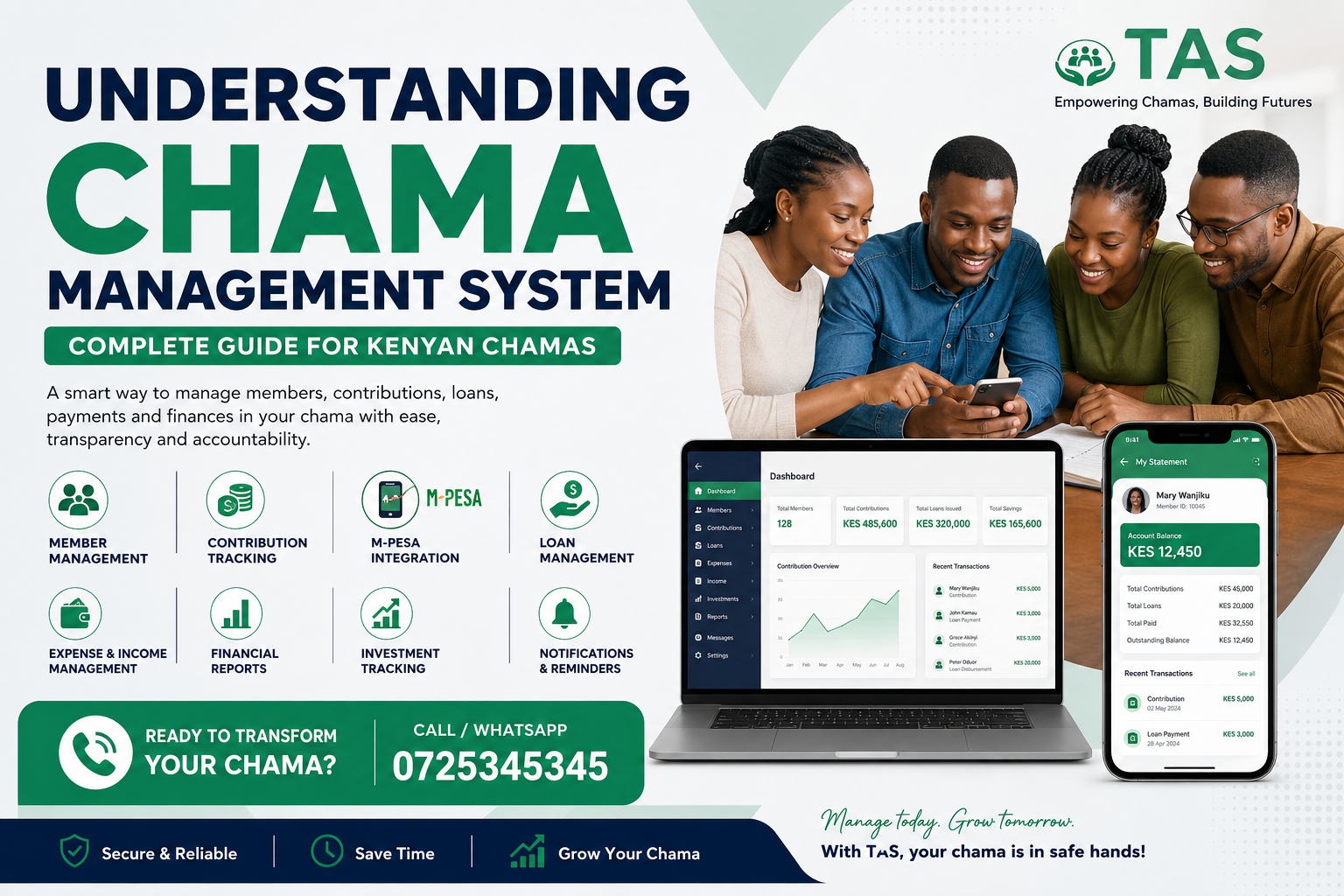 Understanding Chama Management System: Complete Guide for Kenyan Chamas
Chamas have become an important way for people in Kenya to save money, invest together, access loans, support one another and build long-term wealth.
However, as a chama grows, managing members, monthly contributions, loans, penalties, expenses, meetings and financial records manually can become increasingly difficult.
This is where a Chama Management System becomes valuable.
A Chama Management System is software designed to help investment groups, savings groups and welfare groups manage their financial and administrative activities from one centralized platform.
Instead of relying entirely on notebooks, spreadsheets, WhatsApp messages and manual calculations, chama officials can use a digital system to keep organized and accessible records.
In this guide, we explain what a Chama Management System is, how it works, its major features, its benefits and what Kenyan chamas should consider when choosing chama management software.
What Is a Chama Management System?
A Chama Management System is a digital platform that helps a chama manage its members, contributions, loans, payments, expenses, financial records and other group activities.
The system creates a central source of information where authorized officials and members can access relevant chama records.
For example, instead of a treasurer manually checking several spreadsheets to determine how much a member has contributed, the information can be available directly from the chama management platform.
A modern system may handle:
- Member registration
- Monthly contributions
- Savings
- Loans
- Loan repayments
- Fines and penalties
- Expenses
- Income
- Member statements
- M-Pesa payments
- Meetings
- Welfare contributions
- Financial reports
- Group investments
- Notifications and reminders
The objective is simple: make running a chama easier, more transparent and more organized.
Why Kenyan Chamas Need Management Software
Managing a small chama with five or ten members may initially appear straightforward.
Members contribute money, the treasurer records the payments and financial reports are presented during meetings.
Problems often begin when the group grows.
Imagine managing 50 or 100 members contributing different amounts every month.
The officials may need to answer questions such as:
- Who has paid this month?
- Who has contribution arrears?
- How much has each member saved?
- Which members have active loans?
- How much interest is outstanding?
- Which loans are overdue?
- What expenses has the chama incurred?
- How much money should currently be available?
- What penalties are outstanding?
- What is the financial position of the group?
Answering these questions manually can consume significant time.
A Chama Management System in Kenya provides a structured way of maintaining these records.
How Does a Chama Management System Work?
A chama management platform normally creates an account for the group.
Authorized administrators can then configure the chama according to its rules.
Members are registered and their profiles created.
The chama can then configure contribution categories such as:
Monthly savings: KES 5,000
Welfare contribution: KES 500
Investment contribution: KES 2,000
Late contribution fine: KES 200
When members make payments, the transactions are recorded against their accounts.
The platform can therefore maintain a running history for every member.
Instead of searching through physical records, administrators can retrieve information directly from the system.
Key Features of a Chama Management System
1. Member Management
Members are the foundation of every chama.
A good Chama Management System should provide a centralized member database.
Administrators should be able to register members and maintain information such as their contact information, membership status, joining date and transaction history.
Each member’s financial activities can then be connected to their profile.
This makes it much easier to understand an individual member’s position within the group.
2. Contribution Management
Contribution tracking is one of the most important responsibilities of chama officials.
A chama may have several contribution categories.
For example:
- Monthly savings
- Investment contributions
- Welfare contributions
- Emergency funds
- Project contributions
- Merry-go-round contributions
The system should record these separately so that chama officials understand exactly where money is being allocated.
Members can also see their contribution history and outstanding balances.
3. M-Pesa Payment Integration
M-Pesa plays an important role in financial transactions in Kenya.
For this reason, M-Pesa integration for chama management can significantly simplify payment collection and reconciliation.
Depending on the platform and payment configuration, members may be able to make contributions through M-Pesa and have successful payments recorded against their accounts.
This can reduce the amount of manual payment reconciliation required from the treasurer.
4. Loan Management
Many chamas provide loans to their members.
Managing these loans manually becomes complicated when several members borrow money simultaneously.
A Chama Loan Management System can help manage the loan lifecycle, including applications, approvals, disbursements, interest, repayments and outstanding balances.
Administrators can quickly determine which members have active or overdue loans.
Members can also have clearer visibility into their repayment position.
5. Fines and Penalties
Chama constitutions often specify penalties for issues such as late contributions or missed meetings.
Managing these penalties manually can create disagreements when records are unclear.
Chama software can provide structured records of fines, including the amount charged, reason, payment status and member involved.
6. Income and Expense Tracking
Chamas do more than collect contributions.
They also spend money.
Expenses may include:
- Meeting costs
- Bank charges
- Investment expenses
- Professional services
- Administration costs
- Project expenses
Recording income and expenses helps officials understand where chama money is going.
It also makes financial reporting easier.
7. Member Statements
Members should be able to understand their financial position within the chama.
A member statement can show information such as:
- Contributions made
- Savings balance
- Outstanding contributions
- Loans
- Loan repayments
- Fines
- Other transactions
This can significantly reduce questions directed to chama officials because members have clearer financial records.
8. Financial Reports
Reporting is one of the strongest reasons to move away from manual chama management.
Instead of preparing every report from scratch, chama officials can generate reports using recorded financial data.
Depending on the software, reports may include:
- Contribution reports
- Member statements
- Loan reports
- Income reports
- Expense reports
- Outstanding balance reports
- Cash-flow information
- Financial summaries
Good reporting helps members make decisions using actual financial information.
9. Chama Investment Tracking
Many chamas eventually move beyond savings into investments.
These may include land, property, businesses, shares and other investment opportunities.
An advanced chama management platform can help maintain records relating to these investments.
The chama can therefore have a better view of both its day-to-day financial activities and longer-term investments.
10. Notifications and Reminders
Following up with members manually can consume a significant amount of time.
Automated reminders can help members remember upcoming or overdue contributions and other important chama activities.
Notifications can also be useful for confirming transactions and communicating important group information.
Benefits of Using a Chama Management System
Better Financial Transparency
Financial transparency is extremely important in a chama.
Members want to understand how their contributions are being managed.
Centralized records make it easier for authorized users to verify financial information.
Reduced Manual Work
Treasurers often spend hours updating spreadsheets and preparing reports.
Automation reduces repetitive administrative work and gives officials more time to concentrate on the chama’s growth.
Better Record Keeping
Physical books and disconnected spreadsheets can become difficult to maintain over several years.
Digital chama records create a more structured financial history.
Easier Loan Management
Loans can be monitored from application through repayment.
Officials can identify outstanding and overdue balances more easily.
Faster Financial Reporting
Reports that previously required significant manual calculations can be generated from transactions already recorded in the platform.
Better Accountability
Clear transaction records can help chama officials explain where money came from and where it was spent.
Improved Member Experience
Members don’t want to contact the treasurer every time they need to confirm their contribution balance.
A modern system can provide easier access to relevant information.
Manual Chama Management vs Chama Management Software
Traditional chama administration often depends on notebooks, Excel spreadsheets, WhatsApp groups and manual M-Pesa verification.
This approach may work for very small groups.
However, the administrative workload increases as the chama grows.
With chama management software, records can be centralized.
Instead of having contribution information in one spreadsheet, loans in another file and conversations in WhatsApp, important operational information can be maintained through one structured platform.
Who Can Use Chama Management Software?
A Chama Management System isn’t limited to traditional investment chamas.
The underlying technology can potentially support different organized financial groups, including:
- Investment groups
- Savings groups
- Welfare groups
- Merry-go-round groups
- Table banking groups
- Youth groups
- Women’s groups
- Family investment groups
- Community organizations
- Employee savings groups
The exact features required will depend on how the group operates.
How to Choose the Best Chama Management System Kenya
Don’t choose software simply because it has the longest feature list.
Start with the actual problems your chama needs to solve.
Ask whether the platform provides the functions your group requires.
Important areas to evaluate include ease of use, contribution management, loan tracking, M-Pesa support, reporting, member access, security, backups, permissions, customer support and the ability to accommodate future growth.
A small chama may only require contribution and member management today.
However, the group may eventually introduce loans, welfare funds or additional investments.
Choosing a system capable of supporting that growth can prevent another migration later.
Chama Management System With M-Pesa Integration
For Kenyan groups, M-Pesa compatibility deserves special consideration.
Manually checking transaction messages and updating spreadsheets creates unnecessary administrative work.
Where supported, payment integration can help automate parts of the process.
A member makes a contribution, the payment is confirmed and the relevant records can be updated according to the platform’s configuration.
This improves convenience while helping administrators maintain cleaner payment records.
Is Chama Management Software Secure?
Security should be one of the first questions a chama asks before adopting financial management software.
The platform may contain sensitive member and financial information.
A chama should therefore investigate measures such as:
- Secure authentication
- User permissions
- Role-based access
- Data encryption
- Audit logs
- Regular backups
- Secure payment integrations
- Data privacy practices
Administrators should also ensure that members use strong passwords and protect their login information.
Why Move From Excel to Chama Management Software?
Excel remains useful for many financial tasks, but it wasn’t specifically designed to manage every aspect of a chama.
As the group grows, spreadsheets can become complicated.
Different versions may circulate between officials, formulas may be accidentally changed and historical information can become difficult to follow.
Dedicated Chama Management Software creates a more structured environment for managing members, contributions, loans and reports.
The decision isn’t necessarily about whether Excel is bad.
It is about whether your chama has reached a stage where a specialized system can save time and improve accountability.
Frequently Asked Questions About Chama Management Systems
What is a Chama Management System?
A Chama Management System is software that helps savings and investment groups manage members, contributions, loans, expenses, payments and financial reports through a centralized platform.
What is the best Chama Management System in Kenya?
The best solution depends on your group’s size and requirements. Look for a platform that provides strong contribution management, loan management, reporting, security, member access and payment options suitable for your chama.
Can chama software manage loans?
Yes. Loan management is a common feature of modern chama platforms. Depending on the software, it may support applications, approvals, interest calculations, repayments and outstanding loan balances.
Can a Chama Management System integrate with M-Pesa?
Some Kenyan chama management platforms support M-Pesa integration. The exact functionality depends on the provider and payment configuration.
Can members see their contributions?
Platforms offering member portals can allow members to view their contribution history, statements and other authorized information.
Can chama software generate financial reports?
Yes. Reporting is a major advantage of chama management software. Reports may cover contributions, loans, income, expenses, balances and individual member transactions.
Is a Chama Management System suitable for small groups?
Yes. Small groups can use chama software, especially when they want to establish proper records early and reduce future administrative problems.
The Future of Chama Management in Kenya
Kenyan chamas are increasingly becoming sophisticated financial and investment organizations.
As groups expand their membership and investments, digital management will become increasingly important.
Members will expect faster access to information, convenient digital payments and greater financial transparency.
Moving from manual administration to a Chama Management System can therefore be more than an administrative upgrade.
It can provide the digital foundation needed for a chama to operate more professionally as it grows.
Get Started With a Chama Management System Kenya
Managing contributions, loans, members and financial reports shouldn’t consume all of your chama officials’ time.
A centralized Chama Management System can help your group organize its records, improve accountability and simplify everyday administration.
If your chama is still depending heavily on spreadsheets, notebooks and manual payment reconciliation, this may be the right time to consider a more structured digital solution.
TAS Chama Management System is designed to help Kenyan chamas digitize and simplify their group management processes.
Explore TAS to discover how your chama can manage members, contributions, payments, loans and financial records from one platform.
Start managing your chama digitally with TAS today.