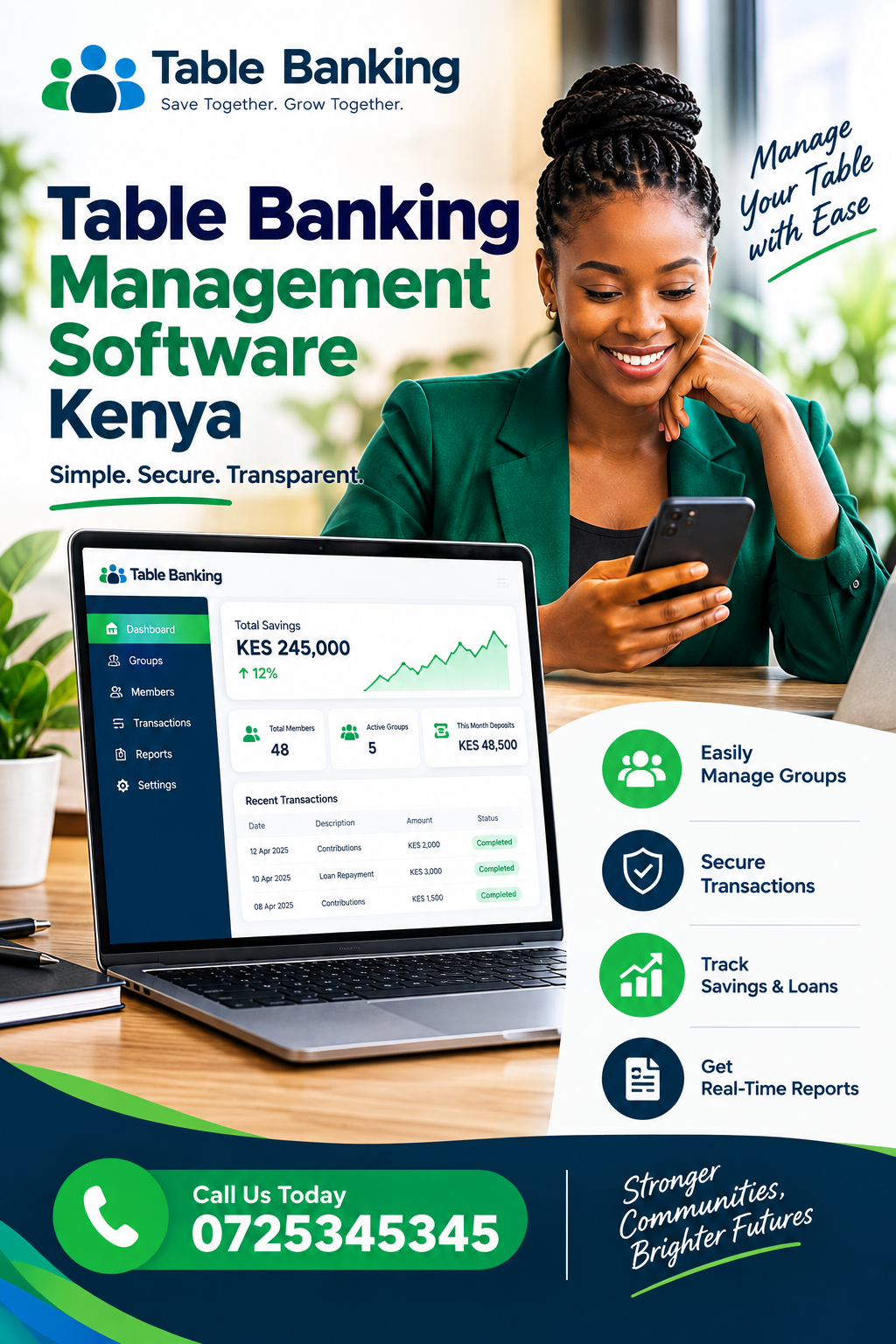
Table Banking Management Software Kenya: A Complete Guide for Chamas and Savings Groups
Table banking has become an important financial model for many Kenyan chamas, women groups, youth groups, investment groups, welfare associations, community organisations and other member-based groups. The concept allows members to pool their money, save together and make funds available to members through structured lending arrangements.
As a table banking group grows, however, the amount of information that needs to be recorded can increase rapidly. Contributions must be tracked, loans must be monitored, repayments must be recorded, expenses must be documented and financial reports must be prepared. When all of this is handled through exercise books, spreadsheets, receipts, WhatsApp messages and individual records, administration can become complicated.
This is where Table Banking Management Software Kenya can become valuable.
Modern software can provide a centralised environment where group officials can manage members, contributions, savings, loans, repayments, penalties, income, expenses, meetings and reports. TAS, for example, describes its platform as a connected workspace for Kenyan groups, with tools covering contributions, loans, meetings, budgets, reports and secure access.
The purpose of digital table banking is not simply to replace a notebook with a computer. The bigger objective is to create a more organised, transparent and reliable method of managing the financial activities of a group.
This comprehensive guide explains how table banking works, why groups are moving toward digital management, the features to consider when selecting software, the benefits of automation and the practical steps a Kenyan group can take when implementing a digital system.
What Is Table Banking?
Table banking is a group-based financial model in which members contribute money into a common pool and make funds available to members according to agreed rules.
The exact structure varies from one group to another. Some groups may focus primarily on savings and loans, while others combine table banking with welfare contributions, investments, emergency funds or other activities.
A typical table banking process may involve:
- Registering members.
- Agreeing on contribution amounts.
- Collecting regular contributions.
- Pooling the funds.
- Allowing eligible members to apply for loans.
- Reviewing and approving loan applications.
- Disbursing approved loans.
- Recording repayments.
- Tracking interest and penalties.
- Preparing financial reports.
A group may initially manage all these activities manually. However, once the membership and transaction volume increases, a digital solution can make administration considerably easier.
Table Banking Management Software Kenya can bring different financial activities into one structured environment rather than forcing officials to maintain several disconnected records.
Why Table Banking Is Popular in Kenya
Table banking provides members with a way to build a shared financial resource.
Instead of every member saving independently, members contribute to a common pool. The pool can then support members through loans or other approved activities.
For many groups, the model is attractive because members establish their own rules around:
- Contributions
- Savings
- Loans
- Interest
- Repayments
- Guarantors
- Penalties
- Meetings
- Financial reporting
The group therefore needs accurate records to ensure that these rules are applied consistently.
Table Banking Management Software Kenya can support this process by organising the information required to manage a growing group.
For example, a group may have 50 members contributing KSh 2,000 every month. The expected monthly contribution would be KSh 100,000. After several months, the group may have accumulated substantial funds, some of which may be lent to members.
The moment multiple members have different contribution histories and loan balances, the record-keeping requirements become more complex.
What Is Table Banking Management Software?
Table Banking Management Software Kenya refers to a digital platform designed to help groups manage their table banking activities.
Instead of keeping membership information in one book, contribution records in another and loan calculations in a spreadsheet, the organisation can maintain connected records within one system.
Depending on the platform, features may include:
- Member registration
- Member profiles
- Contributions
- Savings
- Loan applications
- Loan approvals
- Loan disbursements
- Repayment tracking
- Interest calculations
- Guarantors
- Penalties
- Income
- Expenses
- Meetings
- Budgets
- Reports
- Member statements
- User permissions
- Transaction history
A central system helps officials understand how different transactions relate to individual members and the group as a whole.
Table Banking Management Software Kenya is particularly useful when a group has reached the point where manual administration consumes too much time.
Why Groups Move From Manual Records to Software
Many Kenyan groups begin with simple tools.
The treasurer may have an exercise book. The secretary may keep meeting minutes in another notebook. Loan information may be stored in Excel while payment confirmations are retained in WhatsApp.
This approach can work for a small organisation.
However, it becomes more difficult when:
- Membership increases.
- Contributions become more frequent.
- Loans become larger.
- More members borrow simultaneously.
- Different officials need access to records.
- Members request detailed statements.
- Reports must be prepared regularly.
Table Banking Management Software Kenya can centralise these activities and make information easier to retrieve.
The objective is not to make group administration more technical. Instead, technology should simplify the processes that officials already perform.
Key Feature 1: Member Management
Every table banking group needs an accurate member register.
A digital member management feature can help store information such as:
- Member name
- Membership number
- Contact information
- Date of joining
- Membership status
- Contribution history
- Savings history
- Loan history
- Guarantor information
- Other relevant records
A central member profile makes it easier for authorised officials to understand a member’s financial relationship with the group.
Table Banking Management Software Kenya can therefore help replace scattered member records with structured digital profiles.
This becomes especially useful when a group grows from a small informal association into a larger organisation with dozens or hundreds of members.
Key Feature 2: Contribution Tracking
Contributions are at the heart of table banking.
A group may collect money weekly, monthly or during scheduled meetings.
Officials need to know:
- How much each member should contribute.
- How much each member has paid.
- Which members have outstanding contributions.
- Which members have paid in advance.
- How much the group has collected.
- How contributions have changed over time.
Manual calculations can become difficult when there are many transactions.
Table Banking Management Software Kenya can help maintain a structured contribution ledger.
TAS currently describes its contribution functionality as a way to record savings, welfare funds and member payments in a clear ledger.
This type of central record can help officials answer member questions more efficiently.
Key Feature 3: Savings Management
Some table banking groups distinguish between regular contributions and individual savings.
For example, a group may maintain separate records for:
- Monthly savings
- Welfare contributions
- Investment contributions
- Emergency funds
- Special project contributions
A digital system can make these categories easier to organise.
Table Banking Management Software Kenya should therefore be evaluated based on whether it can accommodate the actual financial structure of the group.
Before selecting software, the committee should identify all the financial categories currently used by the organisation.
Key Feature 4: Loan Management
Loans are one of the most important areas of table banking administration.
A group may need to track:
- Borrower
- Loan amount
- Application date
- Approval date
- Disbursement date
- Interest
- Repayment period
- Amount repaid
- Outstanding balance
- Due dates
- Penalties
- Guarantors
- Loan status
Managing these records manually can become challenging.
Table Banking Management Software Kenya can provide a structured workflow for recording loan information.
TAS describes its loan functionality as covering applications, approvals, repayments and balances.
A digital loan record also makes it easier to review a member’s borrowing history.
Key Feature 5: Loan Application and Approval
A proper loan process should have clear stages.
For example:
Application → Review → Approval → Disbursement → Repayment
Different groups may use different approval structures.
A loan could require approval from:
- Treasurer
- Credit committee
- Chairperson
- Management committee
- Full membership
Table Banking Management Software Kenya can help create a more organised record of the loan process.
The group should, however, establish its own lending rules before configuring the system.
Software should support the group’s constitution and approved procedures rather than replace them.
Key Feature 6: Loan Repayment Tracking
Once a loan is issued, repayments become an important part of the group’s financial records.
Officials need to know:
- Original principal
- Interest
- Repayments received
- Outstanding principal
- Outstanding interest
- Due dates
- Overdue amounts
- Loan status
Table Banking Management Software Kenya can help maintain these records in a structured way.
The benefit becomes particularly clear when multiple members have active loans with different repayment schedules.
Instead of calculating each balance manually, authorised officials can refer to the digital loan records.
Key Feature 7: Guarantor Management
Many groups require members to provide guarantors when borrowing.
A guarantor system should make it possible to identify:
- Borrower
- Loan amount
- Guarantor
- Guaranteed amount
- Outstanding balance
- Related loan
Table Banking Management Software Kenya can support more organised guarantor records where the platform provides this functionality.
This is useful because guarantor obligations can become difficult to track when records are spread across paper documents.
Key Feature 8: Interest and Penalty Management
Different table banking groups use different interest models.
Some may use a fixed percentage while others may use a reducing balance or another approved method.
Similarly, groups may impose penalties for:
- Late contributions
- Missed meetings
- Late loan repayments
- Other violations of group rules
Table Banking Management Software Kenya should therefore be evaluated based on whether its financial rules can be configured to match the organisation’s approved policies.
The committee should test sample calculations before adopting the system.
Key Feature 9: Income and Expense Management
Table banking is not limited to member contributions and loans.
Groups can also have income and expenses.
Income may include:
- Loan interest
- Penalties
- Fees
- Investment income
- Other approved sources
Expenses may include:
- Meeting costs
- Transport
- Bank charges
- Communication
- Administrative costs
- Events
- Professional services
Table Banking Management Software Kenya can help keep these financial activities within a central record.
TAS’s current product information includes budgets and expense tracking alongside contributions and loans.
Key Feature 10: Financial Reporting
Reports transform individual transactions into information that leaders and members can understand.
Useful table banking reports may include:
- Contribution report
- Loan report
- Loan repayment report
- Outstanding loan report
- Member statement
- Income report
- Expense report
- Penalty report
- Group financial summary
Table Banking Management Software Kenya can make reporting more structured when the underlying records are accurately maintained.
Reports can also improve meetings because officials do not have to spend the entire session reconstructing historical transactions.
Member Statements and Transparency
Members often want to know their personal financial position.
A member may ask:
- How much have I contributed?
- How much have I saved?
- How much do I owe?
- How much have I repaid?
- What penalties have I paid?
- What is my current balance?
Table Banking Management Software Kenya can support the idea of maintaining structured member financial histories.
Clear statements can also reduce misunderstandings because members have access to information based on recorded transactions rather than verbal estimates.
Transparency is particularly important where members pool substantial amounts of money.
Role-Based Access
Not every user should necessarily have the same permissions.
A treasurer may need access to financial transactions.
A secretary may need access to member and meeting information.
A chairperson may need broader oversight.
Ordinary members may require limited access to their own records.
Table Banking Management Software Kenya can be evaluated partly on how effectively the system separates responsibilities.
TAS currently highlights role-based permissions as part of its secure-access approach.
This type of access control can reduce the risk of unauthorised changes.
Auditability and Record History
Financial records should be traceable.
If a contribution is changed, a loan is updated or an expense is recorded, officials may need to understand what happened.
Table Banking Management Software Kenya can support the broader objective of maintaining more structured financial records.
An audit trail can be useful when investigating discrepancies.
However, groups should confirm the exact audit functionality provided by their selected software.
Meetings and Decision Management
Table banking groups depend heavily on meetings.
During meetings, members may:
- Approve loans
- Review contributions
- Discuss expenses
- Approve budgets
- Discuss investments
- Elect officials
- Review financial reports
- Make important decisions
Table Banking Management Software Kenya can be part of a broader digital management approach when meeting records and financial information are connected.
TAS currently provides tools for meeting agendas, minutes and group decisions alongside financial functions.
This can help preserve organisational history.
Budget Management
A group should know how it intends to use its money.
A budget can help the committee plan:
- Administrative expenses
- Events
- Investments
- Welfare activities
- Project costs
- Other approved expenditures
Table Banking Management Software Kenya can fit into a wider financial-management approach where budgeting is part of the group’s operations.
TAS specifically lists budgets and expense tracking among its product capabilities.
Table Banking Software vs Manual Records
The difference between manual and digital administration becomes more obvious as a group grows.
| Area | Manual Records | Digital System |
|---|---|---|
| Member records | Books and files | Central profiles |
| Contributions | Manual calculations | Structured ledger |
| Loans | Separate records | Connected loan records |
| Repayments | Manual updates | Digital tracking |
| Statements | Time-consuming | Easier to generate |
| Reports | Prepared manually | Generated from records |
| Permissions | Difficult to control | Role-based |
| Audit history | Limited | Better traceability |
| Leadership handover | File dependent | Centralised records |
Manual records are not automatically wrong.
The issue is scalability.
A system that works for 10 members may become difficult to manage for 200 members.
Benefits of Going Digital
1. Better Organisation
Table Banking Management Software Kenya can help bring related information together.
2. Faster Administration
Officials spend less time searching through notebooks and spreadsheets.
3. Better Financial Visibility
The committee can obtain a clearer picture of contributions, loans and expenses.
4. Improved Reporting
Reports can be prepared from recorded transactions.
5. Easier Loan Monitoring
Active and outstanding loans can be reviewed more systematically.
6. Better Leadership Handover
New officials can access organised records instead of reconstructing information from personal notebooks.
7. Reduced Duplication
A central system can reduce the need to maintain multiple versions of the same record.
8. Better Accountability
Financial activities can be documented more consistently.
Table Banking for Women Groups
Women groups are among the organisations that commonly use table banking models.
A women group may use its pooled funds to provide loans, support emergencies, finance projects or invest collectively.
As membership grows, the group’s financial records become more complicated.
Table Banking Management Software Kenya can help such groups organise their financial administration where the software matches their requirements.
The group should establish clear rules for contributions, lending, repayments, penalties and withdrawals before implementing the system.
Table Banking for Youth Groups
Youth groups may use table banking to encourage savings and provide members with access to group-based financing.
The digital system can help manage:
- Members
- Contributions
- Savings
- Loans
- Repayments
- Reports
Table Banking Management Software Kenya can be considered as part of a broader digital record-keeping strategy.
The key consideration should be whether the system is simple enough for officials to use consistently.
Table Banking for Investment Groups
Investment groups often have more complex financial requirements.
Members may contribute money toward:
- Property
- Businesses
- Shares
- Agriculture
- Other investments
The group may also maintain loans and welfare activities.
Table Banking Management Software Kenya can provide a foundation for organising the contribution and lending side of such operations, provided the selected platform supports the group’s requirements.
Investment accounting may require additional functionality beyond basic table banking, so groups should assess this separately.
Table Banking for Welfare Groups
Welfare groups may collect contributions for emergencies and member support.
They may need to track:
- Member contributions
- Welfare balances
- Disbursements
- Support payments
- Expenses
- Member histories
Table Banking Management Software Kenya can help structure these records where the relevant features are available.
A digital record makes it easier to review the history of group activities.
How to Choose the Right Software
Choosing software should not be based solely on appearance.
The committee should evaluate the platform against its real processes.
1. List Your Requirements
Write down:
- Number of members
- Contribution frequency
- Loan types
- Interest rules
- Repayment schedules
- Guarantor requirements
- Penalties
- Reporting needs
- User roles
Then compare the requirements with Table Banking Management Software Kenya.
2. Test Real Transactions
Do not rely entirely on demonstrations.
Create a sample member.
Record a contribution.
Create a loan.
Approve it.
Record a repayment.
Generate a statement.
Record an expense.
Generate a report.
This provides a more realistic assessment.
3. Check Security
Ask about:
- User permissions
- Password protection
- Backups
- Audit history
- Data access
- Data export
4. Check Support
Confirm how administrators can get help if they encounter difficulties.
5. Understand Pricing
Compare the complete cost of the software, including any additional users, transaction charges, setup costs or other applicable fees.
Implementing Digital Table Banking
Moving from notebooks to software requires preparation.
Step 1: Review Existing Records
Collect:
- Member register
- Contribution records
- Loan schedules
- Repayment records
- Expense records
- Financial statements
Step 2: Verify Balances
Do not import incorrect information.
Reconcile member balances and outstanding loans first.
Step 3: Document Group Rules
Write down the constitution and financial procedures.
Step 4: Create User Roles
Determine which officials require access to different functions.
Step 5: Configure the System
Set up members, contribution categories, loan products and expense categories.
Step 6: Test Transactions
Run sample contributions, loans, repayments and reports.
Step 7: Train Officials
Ensure the treasurer, secretary and other administrators understand their responsibilities.
Step 8: Introduce the System
Explain to members how the new system improves record keeping.
Step 9: Monitor Adoption
Check whether officials are actually using the platform consistently.
Moving From Excel to Digital Software
Excel is often the first step toward digital record keeping.
It can be useful for small groups.
However, spreadsheets can become difficult when multiple users need access to interconnected information.
For example, a group may have one spreadsheet for members, another for contributions and another for loans.
A change in one record may need to be reflected across several files.
Table Banking Management Software Kenya can provide a more centralised approach.
Instead of managing separate documents, officials can work from connected records.
Using M-Pesa With Table Banking
Many Kenyan groups use mobile money for contributions and repayments.
This can create large numbers of transaction records.
The group may need to determine:
- Who made the payment?
- How much was paid?
- What was the payment for?
- Which member account should receive it?
- Was it a contribution or repayment?
- Is there an outstanding balance?
Table Banking Management Software Kenya can be evaluated based on how it supports payment recording and reconciliation.
Groups should always verify the specific payment integrations available from the software provider before implementation.
Data Protection and Security
Table banking records can contain sensitive information.
This may include:
- Names
- Phone numbers
- Membership information
- Financial transactions
- Loan balances
- Payment histories
Table Banking Management Software Kenya should therefore be evaluated not only on features but also on security and access controls.
Groups should understand:
- Who can access information?
- How are passwords protected?
- Are backups available?
- Can access be revoked?
- Can data be exported?
- Is there an activity history?
Security should be considered part of the overall implementation rather than an afterthought.
Common Problems With Manual Table Banking
Missing Records
Paper records can be misplaced or damaged.
Calculation Errors
Interest and repayment calculations can be incorrect.
Duplicate Information
Different officials may maintain conflicting records.
Delayed Reporting
Preparing reports manually can take considerable time.
Leadership Handover Challenges
New officials may struggle to understand historical records.
Disputes
Members may disagree about balances when information is unclear.
Table Banking Management Software Kenya can help address these administrative issues by creating a more organised record-keeping environment.
How Software Can Improve Accountability
Accountability is particularly important when members pool money.
Members should have confidence that their contributions are recorded and that loans are being managed according to agreed rules.
Table Banking Management Software Kenya can contribute to better accountability through structured records, permissions and reporting.
A committee can review:
- Contributions
- Loans
- Repayments
- Expenses
- Income
- Member balances
- Outstanding amounts
The objective is to make important information easier to verify.
Common Mistakes When Implementing Software
Choosing Software Without Testing It
A product may look impressive but fail to match the group’s actual workflow.
Entering Incorrect Historical Data
Old balances should be verified before migration.
Giving Everyone Administrator Access
Permissions should reflect responsibilities.
Ignoring Training
Users need to understand how the system works.
Keeping Parallel Records Forever
Maintaining multiple systems can undermine the benefits of digitalisation.
Failing to Review Reports
Reports should be checked regularly for accuracy.
Table Banking Management Software Kenya should therefore be implemented alongside clear internal procedures.
How TAS Fits Into Digital Table Banking
TAS is designed for Kenyan groups and provides a connected workspace for contributions, loans, meetings, budgets, reports and member records.
Its published table-banking material also discusses members, contributions, savings, loans, repayments, penalties, income, expenses and reports.
For a group evaluating Table Banking Management Software Kenya, TAS provides a relevant platform to test against real table banking workflows.
The group should still carry out its own assessment.
Important questions include:
- Does the software support our contribution structure?
- Does it support our loan rules?
- Can we track repayments?
- Can we generate member statements?
- Can we manage expenses?
- Can we control user access?
- Can we generate the reports we require?
- Can officials learn the system easily?
TAS currently advertises a 14-day trial without requiring a card, allowing groups to evaluate the platform before committing to continued use.
Why Digital Record Keeping Matters as Groups Grow
A small group can sometimes rely on memory and a notebook.
A larger organisation cannot.
As membership grows, the number of transactions grows as well.
More members mean more:
- Contributions
- Savings
- Loans
- Repayments
- Questions
- Reports
- Financial decisions
Table Banking Management Software Kenya can help groups manage this increasing complexity through structured digital records.
The most important benefit is not simply automation.
It is visibility.
When financial information is organised, officials can make decisions based on records rather than assumptions.
Frequently Asked Questions
What is Table Banking Management Software Kenya?
Table Banking Management Software Kenya is software designed to help table banking groups manage members, contributions, savings, loans, repayments, expenses and reports digitally.
Who can use table banking software?
Chamas, women groups, youth groups, welfare groups, investment groups, employee groups and other member-based organisations can potentially use table banking software, depending on their requirements.
Can table banking software manage loans?
Yes, suitable platforms can support loan applications, approvals, disbursements, repayments and balances.
Can the software track contributions?
Yes. Contribution tracking is one of the most important features to evaluate.
Can members receive statements?
A suitable system can provide member statements showing relevant contribution, savings, loan and repayment information.
Can the software track expenses?
Yes, where expense-management functionality is provided.
Can software replace a group constitution?
No. Software supports administration. The group’s constitution and approved governance rules remain important.
Is Excel enough for table banking?
Excel may be sufficient for a small group. As membership and transaction volume increase, a dedicated system may provide better structure, permissions and reporting.
Can table banking software support M-Pesa?
Some platforms support payment integrations or structured payment recording. Groups should confirm the exact integration available from their provider.
Is cloud software useful for table banking?
Cloud-based systems can allow authorised users to access records without depending on a single computer or notebook.
What should a group consider before buying software?
Consider functionality, ease of use, security, permissions, reports, support, data export, pricing and whether the platform matches the group’s actual rules.
Future of Digital Table Banking in Kenya
Kenyan groups are increasingly looking for practical ways to improve financial administration.
The shift from notebooks to digital systems is part of a broader movement toward better record keeping and financial visibility.
Table Banking Management Software Kenya can be part of this transition by helping groups organise information that would otherwise be scattered across paper files, spreadsheets and mobile phones.
The future of table banking is not simply about technology.
It is about combining technology with good governance.
Groups still need:
- Clear constitutions
- Transparent financial rules
- Responsible leadership
- Accurate records
- Regular reporting
- Strong internal controls
- Proper member communication
Software works best when these foundations already exist.
Practical Checklist Before Choosing a Table Banking Platform
Before adopting a digital system, the committee can use the following checklist.
Membership
- Can we create member profiles?
- Can we update membership status?
- Can we maintain member history?
Contributions
- Can we record different contribution types?
- Can we identify outstanding contributions?
- Can we review contribution history?
Loans
- Can we create loan applications?
- Can we approve loans?
- Can we record repayments?
- Can we monitor outstanding balances?
- Can we manage guarantors?
Expenses
- Can we record expenses?
- Can we categorise them?
- Can we review expense reports?
Meetings
- Can we record meetings?
- Can we maintain minutes?
- Can we track decisions?
Reports
- Can we generate member statements?
- Can we generate loan reports?
- Can we generate contribution reports?
- Can we generate financial summaries?
Security
- Can we control user permissions?
- Can we review activity?
- Are backups available?
A group that answers these questions before choosing a platform is more likely to select a system that fits its actual needs.
Conclusion
Table banking provides Kenyan groups with a practical way to combine savings, contributions and member-based lending.
However, as a group grows, manual administration can become increasingly difficult.
Multiple notebooks, spreadsheets, payment messages and individual records can make it harder to understand the group’s true financial position.
Table Banking Management Software Kenya provides a way to bring important activities into a structured digital environment.
The potential benefits include better contribution tracking, organised loan management, easier repayment monitoring, clearer member statements, improved reporting, stronger access controls and easier leadership transitions.
The right approach is not simply to buy software and assume the problem is solved.
Groups should first document their processes, verify historical balances, define user responsibilities and test the software against real transactions.
For Kenyan chamas and table banking organisations considering digital transformation, TAS provides tools covering contributions, loans, meetings, budgets, reports and member records, with its current website offering a 14-day trial.
Ultimately, successful digital table banking comes from combining reliable technology with accurate records, transparent governance and consistent financial procedures.
When these elements work together, a group can spend less time searching for records and more time making informed decisions about its members, savings, loans and future.
Final Takeaway
For organisations that are ready to move beyond notebooks and disconnected spreadsheets, Table Banking Management Software Kenya can provide a structured foundation for modern group administration.
The most important consideration is choosing a system that reflects how the group actually operates.
Start with your constitution.
Define your contribution rules.
Document your loan procedures.
Verify your historical records.
Assign appropriate permissions.
Test the software.
Train your officials.
Then move forward with a consistent digital process.
That approach can help Kenyan table banking groups build stronger financial records while creating a more transparent and efficient experience for both officials and members.