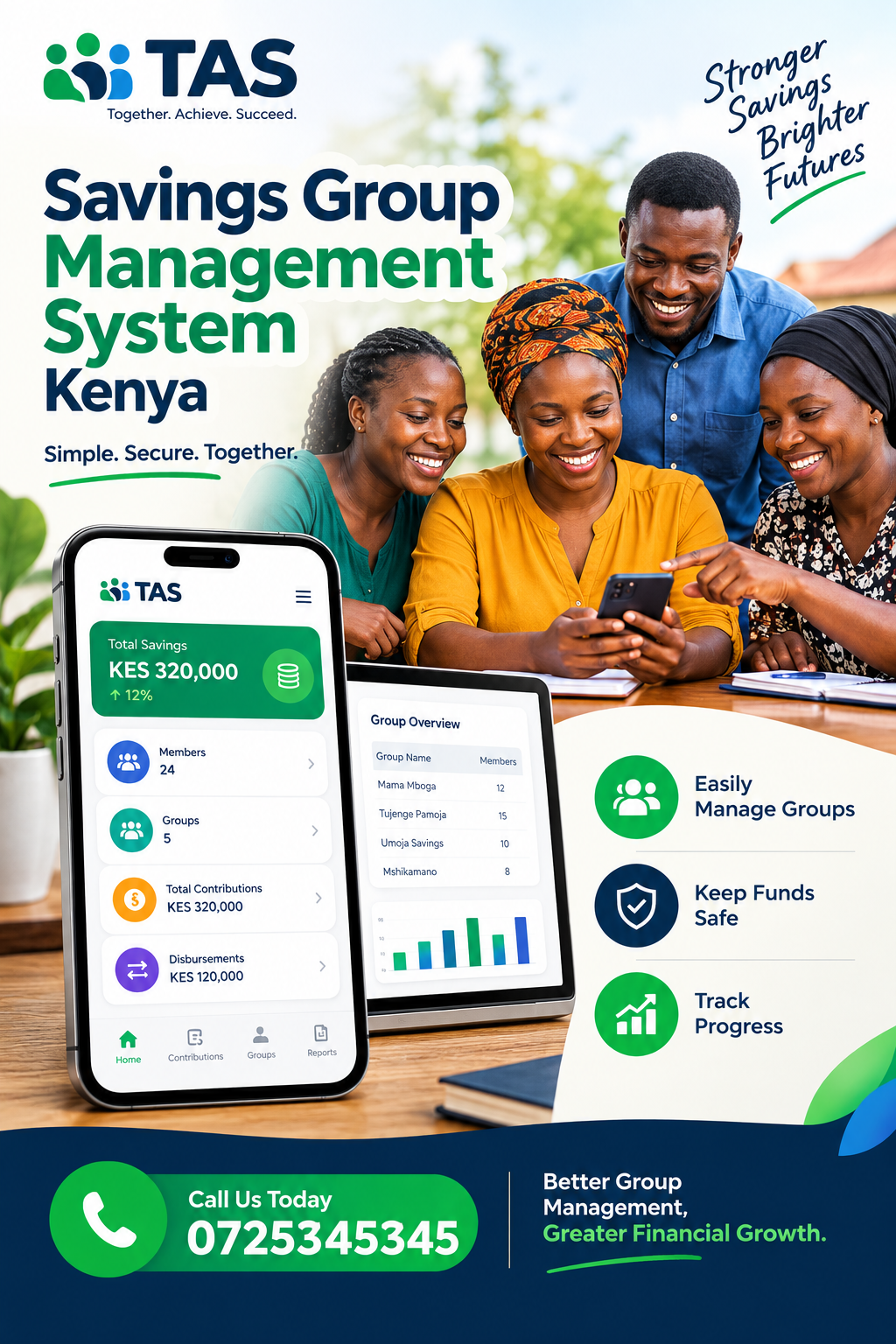
Savings Group Management System Kenya: Complete Guide for Modern Savings Groups
Savings groups play an important role in helping Kenyans save, borrow, invest, and support one another financially. Whether a group consists of friends, colleagues, family members, professionals, women, youth, or community members, its success depends heavily on accurate records and responsible financial administration. As the group grows, however, notebooks, spreadsheets, WhatsApp messages, and manually prepared statements can become increasingly difficult to manage. A Savings Group Management System Kenya gives groups a structured digital environment for managing members, contributions, loans, meetings, expenses, budgets, and reports.
A small savings group may initially have only a handful of members and a simple monthly contribution arrangement. At that stage, a notebook can appear sufficient. The situation changes when membership grows, members begin taking loans, repayments need to be monitored, meetings produce several decisions, and the group starts handling larger amounts of money. A Savings Group Management System Kenya can help bring these activities into one organized workflow.
The objective is not simply to replace paper records with digital records. Effective group management software should make information easier to find, easier to reconcile, and easier to understand. It should help officials maintain reliable member profiles, contribution histories, loan balances, meeting records, financial transactions, and reports. A Savings Group Management System Kenya can therefore become an important administrative tool for a growing group.
Kenyan savings groups operate under many different models. Some focus entirely on regular savings. Others provide loans to members, collect welfare contributions, run table-banking activities, or invest pooled funds. Some groups combine several of these activities. A Savings Group Management System Kenya should be flexible enough to support the group’s actual structure rather than forcing every organization into the same process.
This guide explains how a digital savings group system works, why it matters, the features groups should consider, how it can improve accountability, and how committees can successfully move from manual administration to a more structured digital environment.
What Is a Savings Group Management System?
A savings group management system is a digital platform designed to organize the financial and administrative activities of a member-based group.
At its simplest level, it records who belongs to the group and what each member contributes. However, a comprehensive system can connect membership records with savings, loans, repayments, meetings, expenses, budgets, reports, and other group activities. A Savings Group Management System Kenya can give authorized officials a central location for information that might otherwise be scattered across different files.
The concept is particularly useful because savings groups are more than financial accounts. They are organizations with members, rules, leadership structures, meetings, decisions, and responsibilities.
A typical system may include:
- Member registration
- Member profiles
- Savings contributions
- Welfare contributions
- Loan applications
- Loan approvals
- Loan repayments
- Guarantor records
- Income and expenses
- Budgets
- Meetings
- Minutes
- Action items
- Member statements
- Financial reports
- User permissions
- Audit history
- Data backups
- Data exports
A Savings Group Management System Kenya can connect these different functions so that officials do not have to maintain completely separate records for every activity.
For example, when a member makes a contribution, the transaction should be connected to the correct member profile. If the same member later takes a loan, the loan should also be associated with that profile. When repayments are made, they should update the relevant loan record.
This creates a continuous financial history.
Why Savings Groups Need Digital Management
Many savings groups begin with simple administration.
The treasurer records contributions in a notebook. The secretary maintains member information in a spreadsheet. Loan details may be written in another book, while important discussions happen in a WhatsApp group.
This can work temporarily.
The problem begins when the group becomes more active.
A Savings Group Management System Kenya can help reduce the fragmentation created by maintaining different records in different places.
Imagine a group with 80 members. Every member contributes monthly. Twenty members have active loans. Several members guarantee loans for other members. The group also collects welfare funds, pays administrative expenses, holds monthly meetings, and prepares financial reports.
The treasurer may need to answer questions such as:
- How much has each member contributed?
- Who has not completed their contribution?
- What is the total amount saved?
- Which members have active loans?
- Which loans are overdue?
- Who has guaranteed another member?
- How much money is available?
- What expenses have been paid?
- What decisions were made at the last meeting?
A Savings Group Management System Kenya can make these questions easier to answer by connecting the relevant records.
The Difference Between Savings Tracking and Complete Group Management
It is important to distinguish a simple savings tracker from a full management system.
A basic spreadsheet might record member names and contribution amounts. That can be useful, but it may not provide the wider administrative controls a growing group needs.
A complete platform can combine:
Membership
Who belongs to the group?
Savings
How much has each member contributed?
Loans
How much has each member borrowed?
Repayments
How much has been repaid and what remains outstanding?
Meetings
When did the group meet and what decisions were made?
Expenses
What has the group spent?
Reports
What does the financial position look like?
Permissions
Who is allowed to access or change information?
A Savings Group Management System Kenya is more valuable when these areas work together rather than existing as isolated modules.
Member Management
The member register is the foundation of a savings group.
A group needs a reliable way to know who belongs to it, when they joined, their membership status, and other information that the group is authorized to maintain.
Depending on the group’s requirements, member records may include:
- Full name
- Membership number
- Phone number
- Registration date
- Membership status
- Group role
- Next of kin
- Contribution history
- Loan history
- Outstanding balances
- Other relevant information
A Savings Group Management System Kenya can connect member information with the financial activity associated with each individual.
Preventing Duplicate Member Records
Duplicate records can create serious confusion.
If the same person is registered twice, their savings history could be divided between two accounts. Their loan information might also become inaccurate.
A digital system can reduce this risk by using unique member numbers and structured registration procedures.
However, software cannot replace careful data entry. Officials should still verify information when registering members.
Managing Member Lifecycle
Membership does not remain static.
People join groups. Some leave. Others change their contact details or responsibilities.
A good system should allow authorized officials to update member information while preserving relevant historical records.
A Savings Group Management System Kenya can help make these changes easier to manage.
For example, when a member leaves, the group may need to determine:
- Their savings balance
- Outstanding loans
- Unpaid contributions
- Any applicable obligations
- Amounts payable to the member
- Relevant approval records
The exact process depends on the group’s constitution and rules, but the system should help officials maintain the necessary history.
Contribution Management
Savings contributions are at the centre of most savings groups.
Members may contribute weekly, monthly, quarterly, or according to another schedule.
A Savings Group Management System Kenya can help officials track expected contributions and actual payments.
This can include:
- Regular savings
- Welfare contributions
- Special contributions
- Penalties
- Other approved payments
The system should make it possible to distinguish between money that was expected and money that was actually received.
Contribution History
Members may want to know how much they have saved over time.
Instead of checking several notebooks, officials can retrieve a member’s transaction history.
A Savings Group Management System Kenya can make contribution histories more accessible to authorized users.
This is also useful when a member questions their balance. Officials can review the transaction history and supporting evidence rather than relying entirely on memory.
Handling Different Contribution Types
Not every payment made by a member represents ordinary savings.
A group may have:
- Savings contributions
- Welfare contributions
- Meeting penalties
- Special fundraising
- Emergency contributions
- Investment contributions
Keeping these categories separate is important because they may be governed by different rules.
A Savings Group Management System Kenya can help groups organize different financial categories more clearly.
This makes reports easier to interpret.
For example, a member might have contributed KSh 50,000 in savings and KSh 5,000 toward welfare activities. Those figures should not necessarily be treated as the same type of balance.
Loan Management
Many savings groups also lend money to members.
Loans introduce another layer of administration because officials must track applications, approvals, amounts disbursed, repayment schedules, interest where applicable, guarantors, and outstanding balances.
A Savings Group Management System Kenya can help organize these records.
A typical loan workflow may include:
- Member submits a loan request.
- Officials review the request.
- The loan is approved or rejected.
- The approved amount is recorded.
- Funds are disbursed.
- Repayments are recorded.
- Outstanding balances are monitored.
- The loan is eventually completed.
This creates a clear history from application to completion.
Loan Repayment Tracking
Loan repayments should be recorded accurately.
If a member pays KSh 10,000 toward a loan, the system should update the outstanding balance according to the group’s agreed repayment structure.
A Savings Group Management System Kenya can help officials maintain repayment histories and identify outstanding amounts.
The system can also help answer questions such as:
- How much has the member repaid?
- How much remains?
- When was the last payment?
- Is the loan overdue?
- What repayment schedule applies?
These questions become increasingly difficult to answer manually when the group has many active loans.
Guarantor Management
Some savings groups require members to guarantee loans for other members.
This creates an additional financial relationship that should be recorded carefully.
If Member A guarantees Member B’s loan, officials should know the relevant guarantee amount and whether the guarantee remains active.
A Savings Group Management System Kenya can help groups keep guarantor information connected to relevant loan records.
This reduces reliance on separate handwritten lists that can become outdated.
Meeting Management
Savings groups are not only financial organizations. They also depend on meetings and collective decisions.
Important decisions may involve:
- Loan approvals
- New members
- Member exits
- Contributions
- Investments
- Expenses
- Budgets
- Leadership
- Group policies
A digital system can help officials create meeting records, record minutes, and preserve decisions.
A Savings Group Management System Kenya can support the administrative side of meetings by keeping relevant information organized.
Meeting Minutes
Minutes are important because they provide a historical record of decisions.
Instead of depending entirely on a secretary’s notebook, the group can maintain structured digital meeting records.
Minutes can include:
- Meeting date
- Attendees
- Agenda
- Discussions
- Decisions
- Resolutions
- Action items
This makes it easier to review previous decisions.
Budget Management
Budgeting helps groups plan how money will be used.
A group may budget for:
- Administrative expenses
- Meetings
- Welfare activities
- Investment activities
- Events
- Other approved expenditures
A Savings Group Management System Kenya can help compare planned amounts with actual financial activity.
This can give officials a clearer picture of whether the group is operating within its approved budget.
Expense Tracking
Expenses should be recorded just as carefully as contributions.
A group that tracks savings but does not maintain clear expense records cannot accurately understand its financial position.
Expenses may include meeting costs, administrative expenses, bank charges, approved welfare payments, or investment-related costs.
A Savings Group Management System Kenya can help organize expense records.
Each transaction should ideally include information such as:
- Date
- Amount
- Category
- Description
- Person or supplier involved where relevant
- Supporting documentation
- Approval information
Income Management
Savings groups may receive income from several sources.
Depending on the group’s activities, income might come from loan interest, investments, approved activities, or other sources.
A Savings Group Management System Kenya can help officials distinguish income from ordinary member contributions.
This distinction is important for reporting.
Member savings represent funds contributed by members, while income represents money generated or received through other activities.
Financial Reporting
One of the biggest advantages of a digital system is the ability to produce reports more efficiently.
A committee may need reports covering:
- Member contributions
- Savings balances
- Loan balances
- Loan repayments
- Income
- Expenses
- Cash position
- Budgets
- Outstanding obligations
A Savings Group Management System Kenya can help bring these figures into structured reports.
Good reports should be clear enough for ordinary members to understand.
The goal is not to produce complicated documents. The goal is to provide accurate information that supports accountability and decision-making.
Member Statements
Members may want individual statements showing their financial activity.
A statement might include:
- Contributions
- Savings balance
- Loan activity
- Repayments
- Outstanding amounts
- Other relevant transactions
A Savings Group Management System Kenya can be considered when groups want to provide clearer individual financial histories.
Statements can also reduce disputes because members have a consistent record against which they can compare their own payment evidence.
Financial Reconciliation
Reconciliation is an important control.
The records in the software should be compared against supporting financial records such as bank statements, mobile-money records, receipts, or other evidence.
A Savings Group Management System Kenya can help create a more organized foundation for reconciliation.
For example, suppose the system shows that members paid KSh 250,000 during a month, while the bank records show KSh 245,000. Officials should investigate the difference.
Possible explanations might include:
- A transaction was not entered.
- A transaction was duplicated.
- A payment was reversed.
- A charge was deducted.
- An amount was entered incorrectly.
- A payment was recorded in the wrong period.
The system helps organize the information, but officials still need to perform the review.
M-Pesa and Digital Payments
Mobile money is an important consideration for Kenyan savings groups.
Members may make contributions using M-Pesa or other payment methods.
A Savings Group Management System Kenya should be evaluated based on how it handles the payment workflow used by the specific group.
Some platforms may provide integrations, while others may require manual entry or reconciliation.
Groups should never assume that a software product supports a particular payment integration simply because it is marketed for Kenyan organizations. The exact capabilities should be demonstrated before purchase.
Security and User Permissions
Savings groups manage financial and personal information.
Not every user should necessarily have access to every function.
For example:
- A treasurer may enter financial transactions.
- A secretary may manage member and meeting records.
- A chairperson may review reports.
- An ordinary member may only access their own information or approved reports.
- An administrator may manage system settings.
A Savings Group Management System Kenya should therefore provide appropriate access controls where possible.
Role-based permissions can reduce the risk of unauthorized changes and help establish clearer responsibilities.
Audit History
An audit history can provide useful accountability.
If a record is changed, authorized officials may need to know who made the change and when.
A Savings Group Management System Kenya can be assessed for the audit capabilities it provides.
An audit history is particularly useful when investigating discrepancies.
It does not prevent every error, but it makes it easier to understand what happened.
Data Backups
Financial records need protection against accidental loss.
A group should understand how its chosen platform handles backups and recovery.
A Savings Group Management System Kenya should be evaluated on questions such as:
- How frequently is data backed up?
- How is data recovered?
- Who can access backups?
- What happens if a user accidentally deletes information?
- Can important records be exported?
These questions are important before the group moves critical financial information into a digital system.
Data Export
A group should not assume that its information will always remain inside one platform.
There may be situations where officials need to export reports or records for review, auditing, analysis, or migration.
A Savings Group Management System Kenya can be evaluated according to the export options it provides.
Data portability can become especially important when leadership changes or when a group evaluates another system in the future.
Why Digital Records Improve Accountability
Accountability depends on evidence.
If a member asks how much they have contributed, officials should be able to provide a record.
If a committee approves an expense, there should be evidence of that approval.
If a member receives a loan, the group should have a record of the amount and repayment activity.
A Savings Group Management System Kenya can help establish this evidence in an organized environment.
This does not mean technology automatically creates accountability. The group must still have rules, responsible officials, approvals, reconciliations, and regular reviews.
Software simply makes these processes easier to document and manage.
Benefits for Treasurers
The treasurer often carries a large part of the administrative burden.
They may need to:
- Record contributions
- Reconcile payments
- Track loans
- Record repayments
- Prepare financial reports
- Track expenses
- Answer member questions
A Savings Group Management System Kenya can reduce the need to perform these activities across several disconnected documents.
Instead of calculating balances manually every month, the treasurer can work from structured records.
Benefits for Secretaries
Secretaries often manage member records and meeting documentation.
They may be responsible for:
- Member registration
- Meeting agendas
- Minutes
- Attendance
- Resolutions
- Communication
A Savings Group Management System Kenya can bring these administrative tasks into a central workflow.
This is especially useful when a group has frequent meetings and many decisions to document.
Benefits for Chairpersons
Chairpersons need visibility without necessarily performing every transaction themselves.
They may want to understand:
- Overall savings
- Loan activity
- Expenses
- Financial reports
- Pending actions
- Meeting decisions
A Savings Group Management System Kenya can provide a central source of information from which authorized leaders can review the group’s position.
Benefits for Members
Members are ultimately the people whose contributions make the group possible.
They need confidence that:
- Their payments are recorded.
- Their balances are accurate.
- Loans are properly tracked.
- Expenses are documented.
- Group decisions are recorded.
- Financial reports are understandable.
A Savings Group Management System Kenya can contribute to better member visibility when the system provides appropriate reporting or member-access features.
Managing Welfare Activities
Many savings groups combine savings with welfare support.
Members may contribute separate amounts toward welfare activities and receive assistance when qualifying events occur.
A Savings Group Management System Kenya can help separate welfare transactions from ordinary savings.
This is important because welfare funds may have different rules from savings or investment funds.
The group should establish clear categories so that reports accurately show how each type of money is being managed.
Managing Table-Banking Activities
Table banking groups often combine savings and lending.
Members contribute funds, and the pooled amount can then be used to provide loans according to group rules.
A Savings Group Management System Kenya can help maintain records of both savings and lending activities.
The connection between contributions and loans is important because the group needs to understand how much capital is available for lending and how much is already committed.
Managing Investment Groups
Some groups use pooled savings to purchase assets or make investments.
These groups need more than contribution tracking.
They may need to monitor:
- Investment capital
- Investment transactions
- Income
- Expenses
- Asset records
- Supporting documents
- Financial performance
A Savings Group Management System Kenya can be considered as part of a broader digital approach to group financial administration.
Supporting Group Growth
A group may start with ten members and eventually grow to 100 or more.
As membership increases, administrative complexity usually increases as well.
A Savings Group Management System Kenya can provide a structured environment that grows with the organization’s records, provided the selected platform supports the required scale.
Growth may also introduce:
- More loans
- More transactions
- More reports
- More committee members
- More complex approvals
- Greater document requirements
This makes scalability an important consideration.
Choosing the Right System
The right software should be selected based on the group’s actual requirements.
Before purchasing, the committee should write down the problems it wants to solve.
For example:
- Contribution records are difficult to reconcile.
- Loan balances take too long to calculate.
- Member information is scattered.
- Meeting minutes are difficult to retrieve.
- Financial reports take too long to prepare.
- Different officials maintain different versions of records.
A Savings Group Management System Kenya can then be evaluated against these specific problems.
Questions to Ask Vendors
Before choosing a provider, ask practical questions.
Can the platform manage the group’s current membership?
Can it handle contributions and different contribution categories?
Can it track loans and repayments?
Can it maintain guarantor information?
Can it produce member statements?
Can it manage meetings and minutes?
Can it record income and expenses?
Can it produce financial reports?
Can users have different permissions?
Can data be exported?
How are backups handled?
What support is available?
A Savings Group Management System Kenya should be tested using the group’s actual scenarios rather than simply reviewed through a presentation.
Do Not Choose Software Based Only on Features
A long feature list does not necessarily mean a system is suitable.
A group should prioritize usability.
If officials find the platform difficult to operate, they may return to spreadsheets and notebooks.
The best system is one that people can use consistently.
A Savings Group Management System Kenya should therefore be evaluated through practical demonstrations.
Ask the vendor to demonstrate a real workflow.
For example:
- Register a member.
- Record a contribution.
- Apply for a loan.
- Approve the loan.
- Record repayment.
- Generate a statement.
- Record an expense.
- Create a meeting.
- Produce a financial report.
This approach provides a better understanding of how the software will work in practice.
Cost Considerations
Cost is naturally important for savings groups.
However, the cheapest option may not always be the most economical.
Consider the total cost of ownership.
This may include:
- Subscription fees
- Setup costs
- Training
- Data migration
- Support
- Additional users
- Integrations
- Storage
- Future upgrades
A Savings Group Management System Kenya should be evaluated according to the value it provides relative to the group’s budget and administrative needs.
A low-cost system that creates additional manual work may ultimately cost the group more in time and administration.
Implementation Strategy
Moving from paper to software should be planned carefully.
Do not simply enter every old record without reviewing it first.
Start by cleaning the data.
Check:
- Member names
- Member numbers
- Contribution balances
- Loan balances
- Outstanding repayments
- Historical transactions
A Savings Group Management System Kenya can provide the new environment, but the quality of the information depends on what the group imports or enters.
Training Officials
Training is important.
Treasurers, secretaries, chairpersons, administrators, and other users should understand the functions relevant to their responsibilities.
Training should cover real activities rather than theoretical demonstrations.
A Savings Group Management System Kenya becomes much more useful when users understand how to record transactions correctly and interpret the reports it produces.
Establishing Internal Procedures
Technology works best when supported by clear procedures.
The group should establish rules for:
- Who enters transactions
- Who approves transactions
- Who reviews reports
- Who can edit records
- How corrections are handled
- How often reconciliation occurs
- How meetings are documented
- How members access information
A Savings Group Management System Kenya should support these procedures rather than replace them.
Common Implementation Mistakes
One common mistake is entering inaccurate historical information into the new system.
Another is giving every user administrator-level access.
A third is failing to reconcile digital records with bank or mobile-money information.
Another problem is not training new committee members when leadership changes.
A Savings Group Management System Kenya should therefore be introduced as part of a complete administrative process rather than treated as a standalone technology purchase.
A Practical Monthly Workflow
A savings group can establish a repeatable monthly workflow.
Step 1: Record expected contributions
The group identifies what members are expected to contribute.
Step 2: Record actual payments
As payments arrive, officials record or reconcile them.
Step 3: Review outstanding amounts
Members who have not completed their contributions can be identified.
Step 4: Update loan records
New loans and repayments are recorded.
Step 5: Reconcile financial records
Digital records are compared with supporting evidence.
Step 6: Record expenses
Approved expenses are entered into the system.
Step 7: Prepare reports
The committee reviews financial and member reports.
Step 8: Hold the meeting
Members discuss the group’s financial position and make decisions.
Step 9: Record minutes
Decisions and action items are documented.
Step 10: Follow up
Officials complete approved actions before the next reporting period.
A Savings Group Management System Kenya can support this repeatable workflow when its features align with the group’s requirements.
Improving Transparency Through Reporting
Transparency is not simply about giving members access to every transaction.
It is about making important information understandable and verifiable.
Members should be able to understand:
- What they have contributed
- What they owe
- What they have borrowed
- How much the group has saved
- What the group has spent
- What major decisions have been made
A Savings Group Management System Kenya can support transparent reporting by helping officials maintain organized records.
The group should still establish appropriate rules about which information is shared and with whom.
Data Privacy
Savings groups may hold personal information such as names, telephone numbers, membership information, contribution histories, and loan details.
This information should be handled responsibly.
Access should be restricted to people who need it for legitimate group responsibilities.
A Savings Group Management System Kenya should therefore be evaluated not only for functionality but also for its approach to access control, data protection, backups, and account management.
The Importance of Good Data
Software cannot fix incorrect information.
If a treasurer enters the wrong amount, the system will record the wrong amount unless someone identifies and corrects the mistake.
Therefore, data quality remains a human responsibility.
A Savings Group Management System Kenya can make accurate record keeping easier, but officials should still review important entries.
Regular reconciliation is one of the best ways to identify problems early.
Managing Leadership Changes
Leadership transitions are common in member-based organizations.
A new treasurer should not have to depend on the previous treasurer’s personal notebook or computer.
A centralized system can make handovers easier because records remain organized in one environment.
A Savings Group Management System Kenya can support continuity when responsibilities move between officials.
The group should also remove or change access for officials who leave their roles.
Scaling the System as the Group Grows
Growth can create additional administrative requirements.
A group may move from:
- 20 members to 50
- 50 members to 100
- One loan product to several
- One savings category to multiple categories
- One investment to several investments
A Savings Group Management System Kenya can help groups plan for this growth if the platform provides suitable scalability.
However, the group should confirm capacity and pricing with the provider before committing.
Savings Groups and Financial Discipline
Technology does not create discipline by itself.
A group still needs members to contribute on time, officials to reconcile transactions, leaders to follow approved procedures, and members to participate in meetings.
What software can do is make the discipline easier to maintain.
A Savings Group Management System Kenya can provide reminders, records, reports, and structured workflows that help officials follow established procedures.
Frequently Asked Questions
What is a Savings Group Management System?
It is a digital platform that helps savings groups manage members, contributions, savings, loans, repayments, expenses, meetings, budgets, and reports in an organized environment.
Who can use a savings group management system?
Chamas, table-banking groups, welfare groups, investment clubs, workplace groups, community organizations, and other member-based savings groups can use suitable systems.
Can the system track member contributions?
Yes. A suitable platform can record individual member contributions and maintain contribution histories. The exact functionality depends on the provider.
Can savings group software manage loans?
Many systems designed for savings groups include loan applications, approvals, repayment tracking, outstanding balances, and guarantor management.
Can members view their statements?
Some platforms provide member-facing access or statements. Groups should confirm the exact member-access features before choosing a provider.
Can a savings group use M-Pesa?
A group may use M-Pesa as one of its payment channels, but the exact software integration depends on the platform. The group should verify whether direct integration or reconciliation is supported.
Is savings group software suitable for small groups?
Yes. Small groups can benefit from organized records, provided they select a system that matches their size and budget.
Can the software manage meetings?
Some platforms include meeting management, agendas, minutes, resolutions, and action tracking.
How secure are digital savings group records?
Security depends on the provider and how the group configures access. Important considerations include user permissions, authentication, backups, audit histories, and data management practices.
Can historical records be transferred?
This depends on the platform. Before migration, the group should clean and verify its existing records.
Does software replace the treasurer?
No. Software supports the treasurer and other officials. Human oversight, reconciliation, approvals, and governance remain essential.
What should a group consider before choosing software?
The group should consider member management, contributions, loans, repayments, meetings, reports, expenses, permissions, security, support, scalability, data export, usability, and total cost.
Conclusion
Savings groups are built on collective trust and financial discipline. As these groups grow, however, managing their activities entirely through notebooks, spreadsheets, payment messages, and personal records can become increasingly difficult.
A Savings Group Management System Kenya provides a structured approach to organizing the information that keeps a group functioning. From member registration and contributions to loans, repayments, expenses, meetings, budgets, and reports, digital tools can reduce repetitive administrative work and make important information easier to access.
The most important consideration is not the number of features a platform advertises. The real question is whether it can support the group’s actual workflow.
A committee should identify its current problems, establish its requirements, test realistic scenarios, review user permissions, understand the cost, and train the people who will use the platform.
A Savings Group Management System Kenya can become especially valuable when it gives officials a reliable source of information instead of requiring them to reconcile several disconnected records every month.
Digital management also supports continuity. When a treasurer, secretary, or chairperson changes, the group’s institutional records should remain available to authorized officials.
A Savings Group Management System Kenya can help create that continuity by moving important records away from individual notebooks and personal spreadsheets into a structured environment.
For Kenyan chamas, welfare groups, table-banking groups, investment groups, and other member-based organizations, the transition to digital management does not have to eliminate the personal relationships that make these groups successful.
Instead, it can reduce administrative friction and allow members to spend more time discussing meaningful financial decisions.
A Savings Group Management System Kenya should ultimately support the group’s governance, not replace it.
When accurate records, responsible officials, clear procedures, regular reconciliation, transparent reporting, and appropriate technology work together, savings groups can build a stronger foundation for long-term organization and growth.