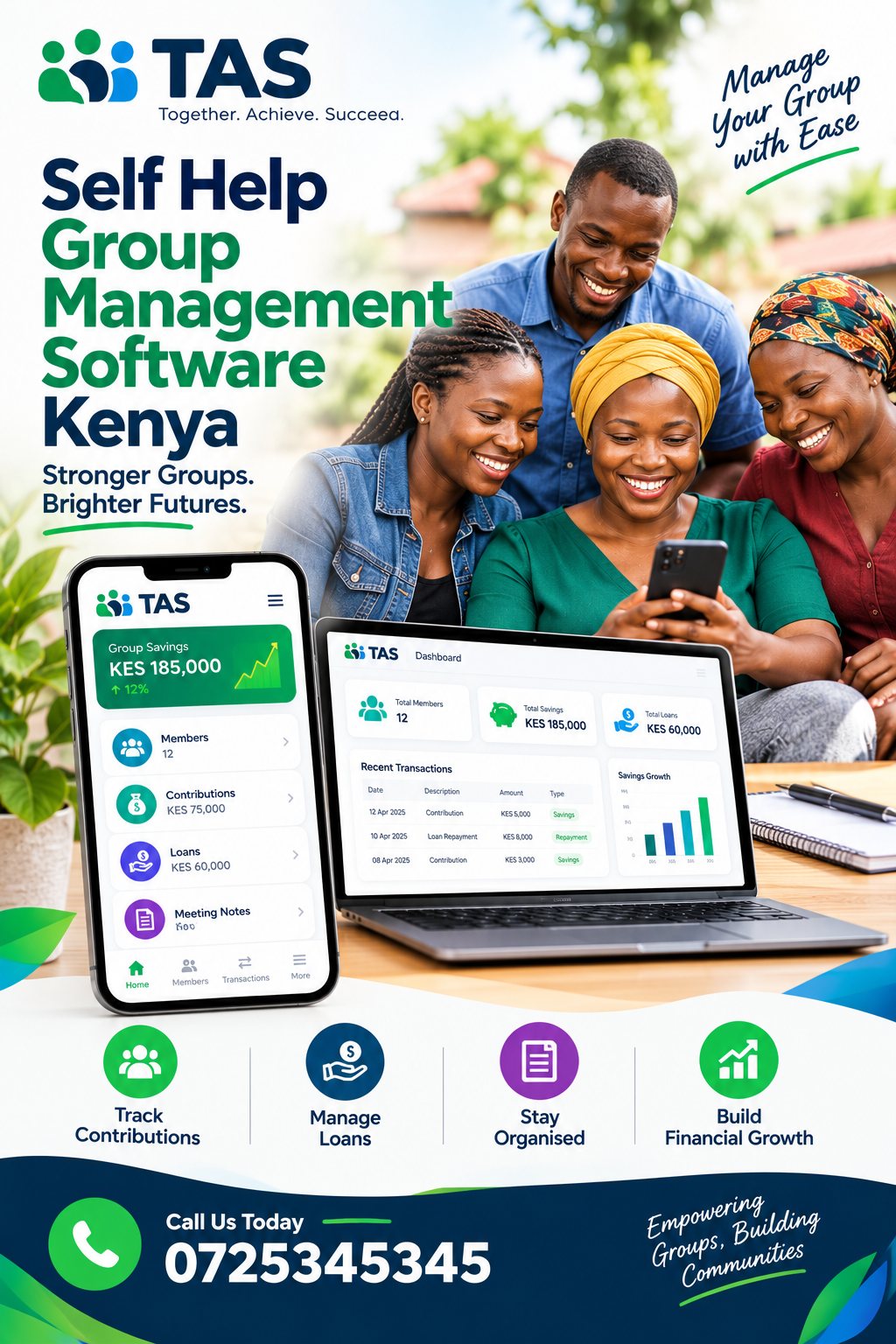
Self Help Group Management Software Kenya: Complete Guide for Modern Groups
Managing a self-help group involves much more than keeping a list of members. Groups need to record contributions, manage savings, monitor loans, document meetings, track expenses, prepare reports and maintain a reliable history of financial activity. Self Help Group Management Software Kenya gives Kenyan self-help groups a digital way to organise these responsibilities within a structured system.
For a small group, an exercise book and spreadsheet may initially seem sufficient. As membership increases, however, the volume of information grows quickly. A treasurer may have to track dozens of contributions every month, while the secretary maintains membership and meeting records and committee members review loans, expenses and group projects.
The right software can bring these activities together, making information easier to record, retrieve and review. This guide explains what self-help group management software is, the features groups should consider, the benefits of digital administration, common mistakes to avoid and how Kenyan groups can choose a suitable platform.
What Is Self Help Group Management Software?
Self Help Group Management Software Kenya is a digital system designed to help member-based groups manage their administrative and financial activities.
A self-help group may exist to promote savings, provide member loans, support welfare activities, finance projects or pursue collective economic goals. Whatever the purpose, the group needs dependable records.
Instead of keeping separate notebooks for different activities, a digital management platform can organise information into connected records.
Depending on the platform, this can include:
- Member profiles
- Membership status
- Contributions
- Savings
- Welfare funds
- Loans
- Loan applications
- Guarantors
- Repayments
- Interest
- Penalties
- Income
- Expenses
- Budgets
- Meetings
- Minutes
- Actions
- Member statements
- Financial reports
- User permissions
- Audit history
The goal is not simply to replace paper with a computer.
The bigger objective is to create a reliable administrative process where authorised officials can understand what has happened, who was involved, what money was received or spent and what actions still need attention.
Why Kenyan Self-Help Groups Need Better Record Management
Self Help Group Management Software Kenya becomes particularly useful when a group grows beyond the point where one person can remember or manually track everything.
Consider a group with 50 members.
If every member makes one contribution each month, there are already 600 contribution records in a year. If the group also has loans, repayments, expenses, welfare activities and other transactions, the number of records becomes much larger.
This creates several practical challenges.
Growing Membership
A group with ten members may be able to manage member information informally.
A group with 100 members cannot rely on memory.
Officials need to know:
- Who is an active member?
- When did the member join?
- What contributions have been recorded?
- Does the member have an outstanding loan?
- What repayments have been made?
- What is the current balance?
A centralised system makes this information easier to organise.
Increasing Financial Activity
A self-help group may start with savings but later introduce lending, investments or welfare funds.
Each new activity creates another category of records.
Without a structured system, officials may maintain multiple spreadsheets and notebooks, increasing the possibility of inconsistencies.
Leadership Changes
Self-help groups often operate through elected or appointed committees.
When a treasurer or secretary leaves office, the incoming official should receive complete records.
A digital system can make the handover more structured because information does not have to remain dependent on one person’s notebook or personal computer.
Key Features to Look For
When evaluating Self Help Group Management Software Kenya, committees should focus on functionality that matches their actual activities.
A platform does not need every possible feature. It needs the right features.
1. Member Management
A reliable member register is the foundation of group administration.
The system should allow authorised officials to maintain relevant information about members and track membership status.
Useful records may include:
- Full name
- Contact details
- Membership date
- Membership status
- Next-of-kin information where appropriate
- Contribution history
- Loan history
- Other approved financial information
The group should only collect information that is necessary for its legitimate activities.
2. Contribution Management
Contributions are central to most self-help groups.
Self Help Group Management Software Kenya can help officials record payments against individual members and relevant contribution categories.
A group may have:
- Monthly savings
- Welfare contributions
- Emergency contributions
- Project contributions
- Investment contributions
- Special collections
Separating these categories can make financial reporting clearer.
3. Savings Tracking
Savings records should provide a clear history of member deposits where the group’s rules require individual savings balances.
A digital system can reduce the need to calculate balances manually.
This is especially useful when members ask questions about their contribution history.
4. Loan Management
Many self-help groups provide loans to members.
A loan process may involve:
- Application
- Review
- Approval
- Guarantor confirmation
- Disbursement
- Repayment
- Interest
- Balance monitoring
- Loan closure
Self Help Group Management Software Kenya can organise these stages and connect them with the relevant member records.
The committee should confirm that the system can accommodate the group’s actual loan rules before implementation.
Managing Loan Repayments
Loan administration can become one of the most demanding responsibilities for a treasurer.
Self Help Group Management Software Kenya can help officials keep repayment records organised when the platform supports loan management.
A repayment record may include:
- Member
- Loan reference
- Payment date
- Amount
- Interest component where applicable
- Principal component where applicable
- Remaining balance
- Payment reference
Accurate repayment records make it easier to identify outstanding balances.
They also make member statements more useful.
Guarantor Management
Some self-help groups require members to guarantee loans for other members.
Guarantor information should therefore be linked carefully to the relevant loan.
Self Help Group Management Software Kenya can support this type of record structure when guarantor management is available.
The committee should be able to understand:
- Who borrowed?
- Who guaranteed the loan?
- What amount was guaranteed?
- What is the outstanding balance?
- What happens if repayment problems arise?
The exact process should follow the group’s constitution and loan policy.
Expense Management
A group needs to track money going out as carefully as it tracks money coming in.
Self Help Group Management Software Kenya can help organise expense records by category.
Common group expenses may include:
- Meeting costs
- Transport
- Administration
- Communication
- Bank charges
- Project expenses
- Welfare activities
- Training
- Professional services
Expense records should ideally show what was purchased or paid for, when it happened, how much it cost and what approval supported the transaction.
Income Management
Groups can receive money from sources other than member contributions.
For example, income may include:
- Loan interest
- Penalties
- Investment income
- Approved fees
- Project-related income
Self Help Group Management Software Kenya can help categorise these transactions when the system provides income-management functionality.
Clear categorisation makes financial reports easier to understand.
Budget Management
A budget provides a plan for how the group expects to receive and spend money.
Self Help Group Management Software Kenya can support budget tracking where budgeting functionality is included.
A group might create a budget covering:
| Category | Planned Amount |
|---|---|
| Member contributions | KSh 600,000 |
| Expected loan interest | KSh 100,000 |
| Administration | KSh 40,000 |
| Meetings | KSh 30,000 |
| Welfare activities | KSh 60,000 |
| Investment allocation | KSh 400,000 |
The figures above are only an example. Every group should prepare its budget based on its own membership, constitution and financial objectives.
Budgeting helps the committee compare what it expected to happen with what actually happened.
Financial Reporting
Reporting is one of the strongest reasons for moving away from manual records.
Self Help Group Management Software Kenya can help turn recorded transactions into useful reports when the required reporting features are available.
Useful reports may include:
- Contribution summaries
- Member statements
- Loan reports
- Repayment reports
- Income reports
- Expense reports
- Budget reports
- Cashbook reports
- Meeting records
- Financial summaries
The value of a report depends on the quality of the underlying records.
Software cannot correct information that was entered incorrectly.
Member Statements
Members often want straightforward answers about their financial position.
Self Help Group Management Software Kenya can support member-level reporting where statements are available.
A member statement may show:
- Contributions
- Savings
- Loans
- Repayments
- Interest
- Penalties
- Balances
- Transaction dates
Clear statements can reduce misunderstandings.
Instead of searching through several notebooks to determine whether a member made a particular payment, officials can review the relevant transaction history.
Meetings and Minutes
Financial management is closely connected to group meetings.
Important decisions may involve:
- Loan approvals
- Expenses
- Investments
- New contribution categories
- Changes to group policies
- Welfare support
- Committee decisions
Self Help Group Management Software Kenya can help organise meeting information where meeting-management features are provided.
A digital meeting record can include:
- Meeting date
- Agenda
- Attendance
- Minutes
- Decisions
- Assigned actions
- Responsible persons
Keeping these records together helps create continuity between meetings.
Why Meeting Records Matter
A financial transaction may make sense only when viewed alongside the decision that authorised it.
For example, the committee may approve an expenditure during a meeting.
If the expense is later questioned, the minutes can provide important context.
Self Help Group Management Software Kenya can support an organised approach to meeting records when the platform includes meeting functionality.
The objective is not to create unnecessary paperwork.
The objective is to preserve useful information about decisions.
Transparency and Accountability
Transparency is essential for member-based organisations.
Self Help Group Management Software Kenya can support better visibility by providing authorised users with access to organised records.
Transparency should not mean unrestricted access.
Different users may need different permissions.
For example:
- A treasurer may record financial transactions.
- A secretary may maintain member and meeting information.
- A chairperson may review reports.
- Members may view information that the group has decided to make available to them.
This approach balances visibility with responsible access control.
User Permissions
Financial and personal information should be protected.
Self Help Group Management Software Kenya provides role-based access as part of its published group-management platform.
This type of approach can help ensure that users receive access according to their responsibilities.
A committee should ask:
- Can each official have an individual account?
- Can access be removed when an official leaves?
- Are permissions configurable?
- Is there an activity history?
- Are sensitive records protected?
- Can exports be controlled?
The group should also establish internal rules for passwords, account access and handling downloaded records.
Audit History
An audit history can help officials understand activity within a system.
Self Help Group Management Software Kenya can support this kind of accountability when audit functionality is included.
An audit record may help identify:
- Who entered information
- When an entry was made
- What action occurred
- Whether a record was changed
This does not automatically make the underlying transaction correct.
The committee still needs approval procedures and regular reconciliation.
Data Security and Privacy
Self-help groups handle personal and financial information.
Self Help Group Management Software Kenya should therefore be assessed partly on how information is protected.
TAS describes secure authentication, role-based permissions, cloud access, backups and audit history on its current website.
However, technology is only one part of data protection.
Groups should also:
- Avoid shared passwords.
- Remove access when officials leave.
- Limit unnecessary data collection.
- Protect exported files.
- Use authorised devices.
- Review who can access member information.
- Keep appropriate records of corrections.
Kenya’s data-protection requirements can depend on the nature of the organisation and the information being processed. Groups should obtain appropriate professional guidance when they are uncertain about their obligations.
Moving From Notebooks to Digital Records
A group does not need to digitise everything overnight.
Self Help Group Management Software Kenya can be introduced through a structured transition process.
Step 1: Review Existing Records
Identify all current sources of information.
These may include:
- Exercise books
- Excel files
- Receipts
- Mobile-money messages
- Bank statements
- Meeting minutes
- Loan forms
- Member lists
Step 2: Identify Problems
Look for:
- Duplicate records
- Missing payments
- Unexplained balances
- Incomplete member details
- Old loans
- Unrecorded expenses
Step 3: Reconcile Opening Balances
Do not simply copy questionable information into the new system.
Review opening balances before migration.
Step 4: Create User Accounts
Assign access according to responsibilities.
Step 5: Test the Workflow
Use sample or approved records to test the process.
Step 6: Establish a Cut-Off Date
Choose when the new system becomes the main operating record.
Step 7: Review the First Reporting Cycle
Compare system results with the relevant source records.
Choosing the Right Software
Selecting Self Help Group Management Software Kenya should start with the group’s actual requirements.
Do not begin by asking, “Which system has the most features?”
Begin by asking:
“What problems are we trying to solve?”
A committee can create a requirements list covering:
- Members
- Contributions
- Savings
- Loans
- Repayments
- Expenses
- Income
- Meetings
- Reports
- Permissions
- Security
- Data export
This list becomes the basis for comparing platforms.
Test Real Workflows
A demonstration can look impressive without proving that the software fits the group.
Self Help Group Management Software Kenya should be tested using realistic examples.
For example:
- Create a member.
- Record a contribution.
- Record another contribution.
- Create a loan application.
- Approve the loan.
- Add a guarantor.
- Record a repayment.
- Record an expense.
- Prepare a report.
- Review the member statement.
If the workflow feels confusing during the test, it may become more difficult when hundreds of transactions are involved.
Questions to Ask a Software Provider
Before purchasing Self Help Group Management Software Kenya, ask direct questions.
About Members
- How are member records created?
- Can membership status be updated?
- Can member records be exported?
About Contributions
- Can different contribution categories be created?
- Can historical payments be corrected?
- Can contribution reports be produced?
About Loans
- Can the system support the group’s loan rules?
- Can guarantors be recorded?
- Can repayments be tracked?
- Can outstanding balances be viewed?
About Security
- Are user permissions available?
- Is there an audit trail?
- Are backups maintained?
- How are accounts protected?
About Support
- Is training provided?
- How can users get assistance?
- Is documentation available?
About Data
- Can the group export its information?
- What happens if the group stops using the platform?
- Who can access the records?
Benefits for the Treasurer
The treasurer often has the largest financial workload.
Self Help Group Management Software Kenya can reduce repetitive administrative work by organising financial information into a consistent structure.
Potential benefits include:
- Easier contribution tracking
- Better loan visibility
- Faster report preparation
- Easier member statements
- More organised expense records
- Better financial history
The system does not remove the treasurer’s responsibility.
It gives the treasurer better tools for performing that responsibility.
Benefits for the Secretary
The secretary often manages membership and meetings.
Self Help Group Management Software Kenya can help connect member information with meeting records and other approved administrative information.
This can be useful during:
- New-member registration
- Committee meetings
- Annual meetings
- Leadership transitions
- Membership reviews
The secretary can spend less time searching through files and more time maintaining accurate records.
Benefits for the Chairperson
The chairperson needs oversight rather than necessarily entering every transaction.
Self Help Group Management Software Kenya can provide structured reports that help leadership understand the group’s position.
A chairperson may want to review:
- Contribution performance
- Loan activity
- Outstanding balances
- Expenses
- Budget performance
- Meeting actions
This information can support better discussions during committee meetings.
Benefits for Ordinary Members
Members are ultimately the people whose money and participation keep the group operating.
Self Help Group Management Software Kenya can help make member records more organised and easier to review.
Members may want to know:
- What have I contributed?
- What is my savings balance?
- Do I have an outstanding loan?
- How much have I repaid?
- Are my records correct?
A transparent record-keeping process can strengthen confidence in group administration.
Supporting Leadership Handover
Leadership handover is often overlooked.
Self Help Group Management Software Kenya can support continuity by keeping records within an organisational system rather than depending entirely on individual officials.
A handover should cover:
- Member records
- Financial records
- Active loans
- Outstanding contributions
- Budgets
- Expenses
- Meeting records
- Reports
- User accounts
- Supporting documentation
When the new committee receives organised records, it can begin its work with a clearer understanding of the group’s position.
Financial Controls Still Matter
Software does not replace internal controls.
Self Help Group Management Software Kenya should be part of a broader governance framework.
Useful controls may include:
- Separation of duties
- Approval thresholds
- Regular reconciliation
- Individual user accounts
- Review of financial reports
- Documented corrections
- Periodic committee reviews
For example, the person who enters an expense may not necessarily be the only person who approves it.
The exact control structure should depend on the size and activities of the group.
Reconciliation Is Essential
One of the biggest mistakes groups can make is assuming that software automatically makes every financial figure correct.
Self Help Group Management Software Kenya can organise records, but officials still need to reconcile information.
A monthly reconciliation may compare:
- Recorded contributions
- Payment confirmations
- Bank records
- Cash records
- Loan repayments
- Expense receipts
Any difference should be investigated.
This process protects the integrity of the group’s records.
M-Pesa and Digital Payments
Many Kenyan groups use mobile money for member payments.
Self Help Group Management Software Kenya can support organised payment records, depending on the functionality offered by the selected platform.
However, groups should distinguish between recording a payment and automatically processing or reconciling a payment.
Officials should confirm exactly what a software provider supports.
Where payments are entered manually, the committee should establish a consistent process for matching payment references with member records.
Handling Welfare Activities
Some self-help groups also operate welfare funds.
Self Help Group Management Software Kenya can help organise welfare-related financial records where the platform supports the group’s requirements.
A welfare fund may have its own rules for:
- Contributions
- Eligibility
- Approvals
- Disbursements
- Reporting
The group should configure or document these rules clearly.
Software should support the rules rather than silently changing them.
Supporting Group Projects
Self-help groups may undertake collective projects.
These could include:
- Agriculture
- Small businesses
- Community activities
- Property-related projects
- Equipment purchases
- Other approved investments
Self Help Group Management Software Kenya can help maintain financial records related to such activities when the relevant features are available.
The committee should distinguish project expenses and income from ordinary operating transactions where necessary.
This improves reporting and makes it easier to understand whether a project is meeting its financial objectives.
Scaling a Growing Group
Growth can make administration significantly more complicated.
Self Help Group Management Software Kenya becomes more useful when the group has many members and recurring transactions.
TAS describes its platform as supporting savings groups, investment groups, welfare groups, business groups and SACCOs or co-operatives, with tools for contributions, loans, meetings, budgets and reports.
Groups should nevertheless choose capacity based on their actual needs.
A small group may need a simple setup, while a larger organisation may require more administrators, reporting or organisational structures.
Pricing Considerations
Cost matters when selecting Self Help Group Management Software Kenya, but the cheapest option is not necessarily the best value.
Consider:
- Subscription fees
- Setup costs
- Training
- Support
- Data migration
- Reporting capabilities
- Security
- Scalability
- Administrative time saved
TAS currently advertises a 14-day trial and publishes subscription options on its website.
Prices and plan limits can change, so committees should confirm the current commercial terms directly with the provider before making a purchase.
Common Mistakes When Digitising
A group can still experience problems after purchasing software if implementation is poorly managed.
Self Help Group Management Software Kenya should therefore be introduced with clear procedures.
Mistake 1: Importing Bad Data
If existing records contain errors, those errors should be reviewed before migration.
Mistake 2: Sharing One Login
Individual accounts improve accountability.
Mistake 3: Ignoring Reconciliation
Software records should still be checked against appropriate source records.
Mistake 4: Giving Everyone Administrator Access
Users should receive only the access they need.
Mistake 5: Failing to Train Officials
Even an easy-to-use system needs a clear operating process.
Mistake 6: Keeping Unofficial Master Files
Once a system becomes the approved record, maintaining several competing spreadsheets can create confusion.
A Practical Monthly Workflow
A self-help group can establish a recurring monthly routine.
Self Help Group Management Software Kenya can support a workflow such as:
- Review expected contributions.
- Record received payments.
- Reconcile payment records.
- Identify outstanding contributions.
- Update loan repayments.
- Review active loans.
- Record approved expenses.
- Record income.
- Compare actual spending with the budget.
- Review member balances.
- Generate reports.
- Present important issues to the committee.
The workflow should be adapted to the group’s constitution.
A Practical Annual Workflow
At the end of a financial year or reporting period, Self Help Group Management Software Kenya can support a more comprehensive review.
The committee may review:
- Total contributions
- Savings
- Loans issued
- Loans repaid
- Outstanding balances
- Income
- Expenses
- Investments
- Welfare activity
- Budget performance
- Membership changes
The group can then use these records to plan the next period.
How to Improve Member Trust
Trust is difficult to build when members cannot understand financial records.
Self Help Group Management Software Kenya can contribute to clearer administration when combined with good governance.
A group can improve trust by:
- Maintaining accurate records
- Reporting regularly
- Explaining financial categories
- Reconciling transactions
- Documenting decisions
- Restricting inappropriate access
- Addressing member queries promptly
Technology should make these practices easier to maintain.
When Software May Not Be Enough
Not every organisation has the same requirements.
Self Help Group Management Software Kenya may be suitable for groups whose needs match the platform’s published capabilities.
However, a group with highly specialised requirements may need additional systems.
For example, a programme involving complex case management, donor reporting, regulated financial services or specialised welfare claims may require functionality beyond ordinary group-management software.
The committee should identify those requirements before selecting a platform.
How TAS Fits Kenyan Self-Help Groups
TAS positions its platform for Kenyan groups and provides tools covering members, contributions, loans, meetings, budgets and reports.
Self Help Group Management Software Kenya can therefore be evaluated as part of a broader digital administration strategy for a self-help group.
TAS also describes role-based access, cloud availability, backups and data export on its current platform information.
The best way to determine whether it fits a particular organisation is to test the actual workflow.
A committee should prepare representative examples involving:
- Members
- Contributions
- Loans
- Repayments
- Expenses
- Meetings
- Reports
Then test whether the software handles them clearly.
Questions to Ask Before Implementation
Before adopting Self Help Group Management Software Kenya, the committee should agree on several points.
Who will administer the system?
The group should appoint responsible officials.
Who will enter transactions?
Roles should be clear.
Who reviews financial information?
The group should establish appropriate review procedures.
What is the official source of truth?
The committee should avoid maintaining competing master records.
How will corrections be handled?
There should be a documented correction process.
What happens when officials change?
Access should be updated promptly.
How will members raise disputes?
The group should establish a clear process for reviewing questioned transactions.
Measuring Success
After adopting Self Help Group Management Software Kenya, the committee should assess whether the original problems have improved.
Useful indicators may include:
- Less time spent preparing reports
- Faster member statement preparation
- Fewer unexplained differences
- Better loan tracking
- Easier leadership handover
- More organised meeting records
- Better access to current information
The committee should review these indicators after the first few months.
If the software is not delivering the expected benefits, identify whether the problem is related to configuration, training, data quality or the workflow itself.
Frequently Asked Questions
What is Self Help Group Management Software Kenya?
Self Help Group Management Software Kenya is software designed to help Kenyan self-help groups manage member records, contributions, savings, loans, expenses, meetings and reports from an organised digital environment.
Can a women’s group use self-help group management software?
Yes. Self Help Group Management Software Kenya can be relevant to women’s groups when their activities match the supported functionality. The committee should test its actual contribution, loan, welfare and reporting processes.
Can youth groups use the software?
Yes. Self Help Group Management Software Kenya can support youth groups where their administrative and financial requirements fit the platform.
Can the software manage contributions?
Yes. Self Help Group Management Software Kenya can support contribution management where the platform provides the relevant functionality. TAS publicly describes contribution tools for savings, welfare funds and member payments.
Can it manage loans?
Yes. Self Help Group Management Software Kenya can support loan administration where loan functionality is included. TAS describes applications, approvals, repayments and balances among its published features.
Can it track expenses?
Yes. Self Help Group Management Software Kenya can help organise expense information when expense management is supported.
Can members access their own records?
This depends on the platform’s permissions and member-access features. TAS states that its system supports role-based access so users can see the appropriate information.
Does software replace the group’s constitution?
No. Self Help Group Management Software Kenya should support the group’s established rules and procedures rather than replace them.
Can software automatically guarantee accurate records?
No. Self Help Group Management Software Kenya can organise records, but officials remain responsible for accurate data entry, reconciliation, approvals and financial review.
How should a group select the right system?
The group should map its current processes, identify its problems, create a requirements list and test shortlisted platforms using realistic examples.
Final Checklist
Before implementing Self Help Group Management Software Kenya, use this checklist:
- Member records are organised.
- Membership status can be maintained.
- Contributions can be recorded.
- Savings can be tracked where required.
- Loans can be managed.
- Guarantors can be recorded where needed.
- Repayments can be tracked.
- Expenses can be categorised.
- Income can be recorded.
- Budgets can be monitored.
- Meetings can be documented.
- Reports are understandable.
- Member statements can be produced where required.
- User permissions are available.
- Access can be removed when officials leave.
- Audit history is available where needed.
- Data can be exported.
- Backups are maintained.
- Support is available.
- Officials can be trained.
The checklist should be tested against the actual constitution and workflow of the group.
Conclusion
Self-help groups play an important role in helping members save, borrow, invest, support one another and pursue collective objectives. As these groups grow, the volume of administrative and financial information can make manual record keeping increasingly difficult.
Self Help Group Management Software Kenya provides a digital approach to organising this information, but the value of software depends on how well it fits the group’s actual processes.
The strongest implementation combines suitable technology with accurate records, clear responsibilities, regular reconciliation, appropriate user permissions and consistent reporting.
For Kenyan self-help groups, the first step should not be choosing the software with the longest feature list. It should be identifying the group’s real needs.
Does the group need better contribution tracking?
Are loan balances difficult to monitor?
Do members frequently request clarification of their balances?
Are financial reports difficult to prepare?
Are meeting records scattered?
Does leadership handover depend too heavily on one person’s files?
These questions help define the problem that software needs to solve.
TAS currently presents a platform built for Kenyan groups, with published tools for contributions, loans, meetings, budgets, reports and member records. It also states that users can access the platform from different devices and that role-based permissions are used to protect appropriate information.
Ultimately, good group management is about more than technology. A digital system should help officials maintain reliable records, make financial information easier to understand and create continuity when responsibilities change.
When the right processes and the right technology work together, a self-help group can spend less time searching through scattered records and more time focusing on its members, projects, savings goals and long-term objectives.