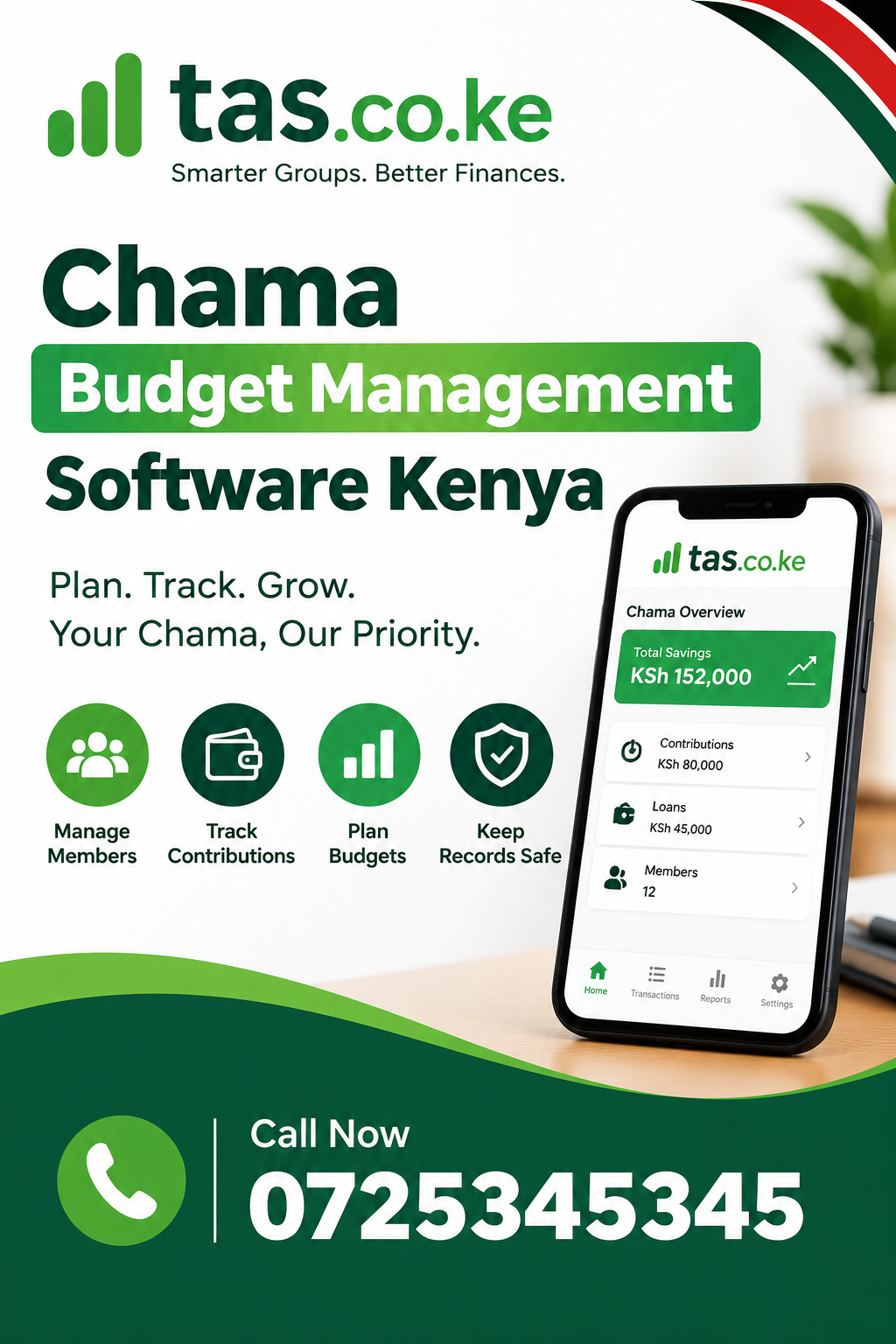
Chama Budget Management Software Kenya: Complete Guide to Smarter Chama Financial Management
Managing money is one of the most important responsibilities in any chama. Members contribute their hard-earned money with the expectation that it will be recorded correctly, spent responsibly and directed toward agreed goals. As groups become larger and transactions become more frequent, using notebooks, spreadsheets and scattered WhatsApp messages can make financial management unnecessarily difficult. A dedicated Chama Budget Management Software Kenya solution gives committees a structured way to plan income and expenditure, monitor actual spending, maintain financial records and communicate financial information to members.
A good budgeting system is not simply about creating a list of expenses. It helps a group decide what it can afford, identify priorities, control unnecessary spending and compare planned figures with actual results. For Kenyan savings groups, investment chamas, table banking groups, welfare associations and employee savings groups, this can make a significant difference in day-to-day administration.
This guide explains how digital chama budgeting works, why budgeting matters, which features to look for, how to create an effective chama budget, common mistakes to avoid, and how a digital system can make financial control easier.
What Is Chama Budget Management Software?
Chama Budget Management Software Kenya refers to digital software designed to help a chama prepare, monitor and manage its financial plans. Instead of maintaining a budget in a notebook or a separate spreadsheet, officials can organise expected income, planned expenditure, actual transactions and financial reports in one controlled environment.
The basic idea is simple. A chama decides what it expects to receive and what it intends to spend. The system then provides a way to record financial activity against those plans.
For example, suppose a group expects to collect KSh 100,000 in monthly contributions. It may allocate part of that amount toward administration, welfare, loan-related activities, investment, meetings and other approved expenses. If the group spends more than planned in one category, the committee can identify the variance before the problem becomes difficult to correct.
A digital budget can therefore become a management tool rather than just a document.
For a growing chama, Chama Budget Management Software Kenya can support several related activities, including:
- Creating annual, quarterly or monthly budgets
- Recording income
- Recording expenses
- Assigning transactions to budget categories
- Monitoring spending against approved limits
- Comparing budgeted and actual amounts
- Preparing financial reports
- Maintaining an organised financial history
- Supporting accountability among officials
The exact functionality varies between software providers, so a chama should always evaluate a system against its own constitution, financial procedures and reporting requirements.
Why Budgeting Matters in a Kenyan Chama
A chama can collect substantial amounts of money without having a strong financial plan. Contributions may be consistent, but that does not automatically mean the group is financially organised.
Budgeting gives members a framework for deciding how money should be used.
With Chama Budget Management Software Kenya, the treasurer and committee can work from an agreed financial plan instead of relying on memory or informal conversations.
Consider a group that receives regular member contributions. The money may be needed for several purposes:
- Group investments
- Welfare support
- Loan activities
- Administrative expenses
- Meeting costs
- Bank or transaction charges
- Approved projects
- Emergency requirements
Without clear categories, expenses can gradually become difficult to distinguish. A small payment here and another there may not appear significant, but the total can affect the group’s ability to achieve its larger objectives.
A budget makes priorities visible.
It can also help members ask better questions. Instead of simply asking how much money is available, they can ask how much was planned for a particular activity, how much has already been spent and what remains.
That distinction is important because a high bank or cash balance does not necessarily mean that all the money is available for discretionary spending.
The Difference Between a Chama Budget and Financial Records
Budgeting and accounting records are closely related, but they are not the same thing.
A budget is primarily a plan. Financial records show what actually happened.
For example, a chama might budget KSh 20,000 for administrative expenses during a particular period. The actual records may later show that the group spent KSh 17,500.
The budget tells the group what it intended to spend.
The transaction records tell the group what it actually spent.
Chama Budget Management Software Kenya can help bring these two sides together by allowing officials to compare planned amounts with actual financial activity.
This comparison is often more useful than looking at either figure in isolation.
If the group consistently spends less than its budget, that may indicate that some allocations are too high. If it repeatedly exceeds the budget, the committee may need to investigate whether the original estimate was unrealistic or whether spending controls need improvement.
Budgeting therefore becomes part of an ongoing management cycle:
Plan → Spend → Record → Compare → Review → Adjust
The cycle can be repeated throughout the financial year.
Key Features to Look For
Not every financial application is suitable for a chama. A general accounting package may contain many features that a group does not need while missing workflows that are important to chama administration.
When evaluating Chama Budget Management Software Kenya, focus on the features that directly support your group’s activities.
1. Budget Creation
The system should allow authorised officials to create a budget based on the group’s financial period.
Useful budget categories might include:
- Contributions
- Welfare
- Meetings
- Administration
- Investments
- Loan-related income and expenses
- Bank charges
- Communication
- Events
- Approved projects
The categories should be flexible enough to match the chama’s own financial structure.
2. Income Tracking
A budget is only useful when expected income can be compared with actual income.
A chama may receive money from member contributions, penalties, loan interest, investment returns, fundraising activities or other approved sources.
A good system should help officials distinguish these income streams rather than placing everything into one general figure.
3. Expense Tracking
Expense management is one of the most important components of digital budgeting.
Chama Budget Management Software Kenya should make it easy to record expenses with useful information such as:
- Date
- Amount
- Category
- Description
- Responsible official
- Supporting documentation where applicable
- Approval information
This creates a clearer history of how group funds were used.
4. Budget Versus Actual Reports
A committee should not have to calculate every variance manually.
A useful reporting system can show:
| Budget Category | Planned | Actual | Difference |
|---|---|---|---|
| Administration | KSh 15,000 | KSh 12,500 | KSh 2,500 |
| Meetings | KSh 10,000 | KSh 11,200 | -KSh 1,200 |
| Welfare | KSh 30,000 | KSh 26,000 | KSh 4,000 |
| Communication | KSh 5,000 | KSh 4,100 | KSh 900 |
The figures in this example are illustrative rather than a recommended budget.
The purpose is to show how a budget-versus-actual report can highlight areas requiring attention.
5. Expense Categories
Categories make reports easier to understand.
Instead of seeing dozens of unrelated transactions, officials can group them into meaningful areas. This is especially useful when a chama has many transactions during the month.
Chama Budget Management Software Kenya can be particularly valuable when the system allows categories to reflect the group’s actual financial structure.
6. Approval Controls
Financial control should not depend entirely on one person.
Depending on the chama’s rules, some expenses may require approval by the treasurer, chairperson, committee or members.
A digital system should support the group’s existing approval structure rather than bypassing it.
7. Financial Reports
Reports are essential for committee meetings and member updates.
Useful reports may include:
- Income reports
- Expense reports
- Budget reports
- Contribution summaries
- Loan reports
- Member statements
- Cash-flow summaries
- Transaction histories
The objective is to turn raw transactions into information that people can understand.
How a Digital Budget Can Improve Accountability
Trust is central to every chama.
Members need confidence that contributions are being handled according to the group’s rules. Officials also need records that demonstrate what decisions were made and how money was used.
Chama Budget Management Software Kenya can strengthen accountability by creating a structured record of financial activities.
For example, imagine that a committee approves an allocation for a group event. The budget records the approved amount. The expense record shows the amount actually paid. The financial report can then show whether the event remained within the approved allocation.
This is much easier to review than searching through paper receipts and old messages.
Transparency does not mean every member must have access to every administrative function. Instead, the system should provide appropriate visibility according to roles and permissions.
That makes role-based access important.
A treasurer may need access to financial transactions. A secretary may focus more on meetings and records. Members may need access to their own contributions and relevant group information.
Budgeting for Different Types of Chamas
Not all Kenyan chamas operate in the same way.
A system should accommodate the group’s purpose rather than forcing every organisation into one financial model.
Investment Chamas
Investment groups may need budgets that distinguish between administrative expenses and investment allocations.
For example, a group may decide that most contributions should go toward acquiring an asset or funding an investment opportunity.
Chama Budget Management Software Kenya can help the committee track whether money is being directed according to the agreed plan.
Table Banking Groups
Table banking groups may have frequent contributions, lending and repayments.
Their budget may need to account for meeting expenses, welfare allocations and other operational costs while keeping loan-related transactions separate.
Welfare Groups
Welfare groups may place greater emphasis on emergency assistance, member support and claims.
Budgeting can help the group reserve appropriate amounts for these purposes rather than spending money intended for welfare on unrelated activities.
Employee Chamas
Employee savings groups may have predictable contribution cycles but still need clear financial controls.
Because members may contribute directly from their salaries or through regular payment arrangements, accurate records and periodic reconciliation become especially useful.
Merry-Go-Round Groups
Merry-go-round groups operate around scheduled contribution and payout cycles.
Their financial planning may be simpler than that of an investment group, but accurate records remain essential because members need to know who has contributed and when payouts are due.
Integrating Budgeting With Contributions
Budgeting becomes more useful when it is connected to the rest of the chama’s financial activity.
For example, a group may plan to collect KSh 200,000 over a particular period.
The contribution records can show the money actually received.
The budget can then provide the context:
- How much was expected?
- How much has been collected?
- How much remains?
- How much has been allocated to different activities?
- Is the group on track?
Chama Budget Management Software Kenya can support this connected approach when budgeting, contributions and financial records are handled within the same environment.
This reduces the need to transfer figures manually between multiple spreadsheets.
It also reduces the possibility of creating different versions of the same financial information.
Managing Expenses More Effectively
Expense control does not mean that a chama should avoid spending money.
The objective is to spend according to priorities.
A useful expense-management process can include five steps:
- Identify the need.
- Confirm that it is permitted under the group’s rules.
- Check the available budget.
- Obtain the required approval.
- Record the transaction and supporting information.
A digital system can make these steps easier to document.
With Chama Budget Management Software Kenya, officials can establish a clearer relationship between approved budgets and actual expenditure, depending on the features provided by the selected platform.
This can be particularly useful when the group has multiple officials handling different financial responsibilities.
M-Pesa and Chama Budgeting
Mobile money is an important part of financial activity for many Kenyan groups.
Members may use M-Pesa to make contributions, repay loans or send other approved payments. However, a payment confirmation alone is not a complete financial management system.
The transaction needs to be connected to the correct member, category, purpose and accounting record.
When selecting Chama Budget Management Software Kenya, ask how the platform handles mobile-money-related records and reconciliation.
Important questions include:
- Can payment records be matched to members?
- Can officials review transaction histories?
- Can payments be categorised correctly?
- Can financial reports incorporate the recorded transactions?
- Is there an approval or verification process?
- Can the group export its records?
The answers will depend on the particular platform and integration.
The key principle is that payment collection and budgeting should not exist as completely separate processes.
Budgeting for Loans
Loans introduce another layer of financial complexity.
A chama may need to track:
- Loan applications
- Approvals
- Principal amounts
- Interest
- Repayments
- Outstanding balances
- Guarantors
- Penalties
- Loan-related income
Chama Budget Management Software Kenya can be useful when a platform connects loan information with broader financial reporting.
For example, if loan interest is treated as group income, the committee should be able to understand how expected interest compares with actual collections.
Similarly, repayment records should not be confused with ordinary member contributions.
Clear categorisation is essential.
Budgeting for Welfare
Welfare funds deserve careful treatment because they often serve a specific purpose.
A group may collect a separate welfare contribution or allocate part of its regular income toward welfare support.
The budget should make this allocation visible.
Chama Budget Management Software Kenya can help officials maintain clearer financial categories when the software supports separate welfare records or expense classifications.
For example, a welfare budget could show:
- Opening balance
- Expected welfare contributions
- Approved welfare payments
- Actual welfare payments
- Remaining balance
The group can then evaluate whether its welfare allocation is sustainable.
Preparing an Annual Chama Budget
An annual budget does not need to be complicated.
Start with the group’s objectives.
Ask:
What does the chama want to accomplish during the year?
The answer could involve investment, saving, lending, asset acquisition, welfare support or a combination of activities.
Then estimate expected income.
After that, identify unavoidable and discretionary expenses.
A practical structure might look like this:
Step 1: Estimate Income
List expected contributions and other legitimate sources of income.
Step 2: List Fixed Costs
Identify recurring expenses such as approved administration or service costs.
Step 3: Estimate Variable Costs
Consider meetings, events, communication and other expenses that may change.
Step 4: Allocate Strategic Funds
Determine how much should go toward investment, savings or other major goals.
Step 5: Establish Limits
Set reasonable spending limits for categories where overspending is possible.
Step 6: Review With Members
The budget should reflect the group’s agreed priorities and constitution.
Step 7: Monitor Throughout the Year
Do not wait until the end of the financial year to discover that the group exceeded an important allocation.
A Simple Monthly Budget Example
Consider a hypothetical chama with 20 members.
If each member contributes KSh 2,000 per month, expected monthly contributions would be KSh 40,000.
The group could establish a planning framework such as:
| Purpose | Example Allocation |
|---|---|
| Investment | KSh 20,000 |
| Welfare | KSh 6,000 |
| Administration | KSh 4,000 |
| Meetings | KSh 3,000 |
| Reserve | KSh 7,000 |
These figures are only an illustration. Every chama should determine its own allocation based on its rules, objectives and financial circumstances.
The value of Chama Budget Management Software Kenya is not that it decides these percentages for the group. The software should help the group implement and monitor the decisions its members make.
That distinction is important.
Software should support governance, not replace it.
Monitoring Budget Variances
A variance occurs when actual financial activity differs from the budget.
There are two basic possibilities.
A favourable variance may occur when an expense is lower than planned or income is higher than expected.
An unfavourable variance may occur when expenses exceed the planned amount or income falls below expectations.
Not every variance is a problem.
Suppose a chama budgets KSh 5,000 for a meeting but spends KSh 3,500. That may be positive.
On the other hand, if the group budgets KSh 5,000 and spends KSh 9,000 without approval, the difference deserves explanation.
Chama Budget Management Software Kenya can make these differences easier to identify when the platform provides budget-versus-actual reporting.
Regular review is more useful than waiting until the end of the year.
Reports That Chama Committees Should Review
A committee does not necessarily need dozens of reports.
It needs the right reports.
Useful financial reports may include:
Budget Summary
Shows planned and actual figures by category.
Expense Report
Lists expenditure during a selected period.
Income Report
Shows money received by category.
Cash Position
Provides a picture of available funds based on recorded transactions.
Contribution Report
Shows member contribution activity.
Loan Report
Shows outstanding loans, repayments and related information.
Member Statement
Provides an individual member’s financial activity.
Chama Budget Management Software Kenya becomes more valuable when reports are understandable enough for ordinary members rather than only trained accountants.
Clear reporting supports better meetings because officials can discuss numbers instead of spending the entire session trying to reconstruct them.
Security and Access Control
Financial information should be handled carefully.
When evaluating Chama Budget Management Software Kenya, ask how the provider protects group data and controls user access.
Important considerations include:
- User authentication
- Role-based permissions
- Data backups
- Audit history
- Secure hosting
- Data export
- Account recovery
- Administrative controls
The specific security architecture differs between providers, so a committee should request clear explanations before committing to a platform.
Security is also about internal controls.
If every official can change every record without restriction, it becomes difficult to establish responsibility.
A better approach is to give users the permissions they need for their roles.
Why Spreadsheets May Stop Being Enough
Excel and other spreadsheet applications are useful tools.
A small chama may successfully use a spreadsheet for some time.
The challenge usually appears when the number of transactions increases.
A spreadsheet can become difficult to maintain when:
- Several people edit it
- Formulas are changed accidentally
- Different versions circulate
- Data is entered inconsistently
- Members need access to information
- Loan calculations become complicated
- Reports need to be prepared frequently
Chama Budget Management Software Kenya can provide a more structured environment by keeping related information within defined workflows.
The goal is not to eliminate spreadsheets because they are inherently bad. The goal is to use a tool appropriate to the group’s complexity.
Moving From Manual Records to Digital Budgeting
Switching systems should be planned carefully.
Do not simply upload every old number without checking it.
A sensible transition process is:
1. Review Existing Records
Collect notebooks, spreadsheets, contribution records, loan schedules and relevant financial documents.
2. Reconcile Important Balances
Confirm opening balances and outstanding loans.
3. Clean Member Records
Make sure names, phone numbers and other relevant details are consistent.
4. Establish Categories
Create budget and expense categories that match the group’s structure.
5. Define Roles
Decide who should manage members, finances, loans and reports.
6. Train Officials
The people responsible for daily administration should understand the system before full adoption.
7. Communicate With Members
Members should understand how their information will be recorded and how they can access relevant records.
8. Review the First Reporting Period
After the first month or quarter, identify problems and adjust processes.
Chama Budget Management Software Kenya should make this transition easier, but good implementation still depends on accurate source records and clear group procedures.
How to Choose the Right Software
Choosing software based on screenshots or a long feature list can be misleading.
Instead, create a practical checklist.
Ask whether the system can support:
- Your number of members
- Your contribution frequency
- Your loan structure
- Your welfare activities
- Your meeting processes
- Your budget categories
- Your reporting requirements
- Your approval procedures
- Your preferred payment workflows
- Your data-export requirements
Then ask the provider to demonstrate those workflows.
A useful demonstration is not a presentation of every feature. It is a practical simulation of how your chama operates.
For example:
Create a member → record a contribution → approve a loan → record repayment → create an expense → compare actual spending with the budget → generate a report.
If the system handles the complete workflow clearly, it is easier to evaluate its suitability.
Chama Budget Management Software Kenya should be assessed on practical usefulness rather than marketing language alone.
Questions to Ask a Software Provider
Before purchasing a platform, ask the provider:
- How many members can the selected plan support?
- Are there limits on transactions?
- Are additional administrators charged separately?
- How are backups handled?
- Can the chama export its data?
- What reports are included?
- Does the system support different budget categories?
- Can users have different permissions?
- How are payments reconciled?
- Is training available?
- What support channels are provided?
- What happens if the subscription ends?
- Can historical data be imported?
- Are there additional integration costs?
- Can the system accommodate the group’s constitution and approval process?
The answers should be documented before the committee makes a decision.
Cost Considerations
Price is important, but it should not be the only consideration.
A cheap system may become expensive if it requires extensive manual work.
Similarly, a more expensive platform may not be good value if the chama uses only a small portion of its functionality.
When comparing Chama Budget Management Software Kenya, consider the total cost of ownership.
This can include:
- Subscription fees
- Setup costs
- Training
- Data migration
- Payment integrations
- Additional users
- Support
- Reporting features
- Future upgrades
The committee should compare plans based on what the group actually needs.
Avoid choosing a package simply because it has the lowest advertised price.
Common Chama Budgeting Mistakes
Mistake 1: Creating a Budget and Never Reviewing It
A budget is not useful if it sits untouched for twelve months.
Review it regularly.
Mistake 2: Mixing Personal and Group Expenses
Group funds should be kept distinct from personal money.
Mistake 3: Using One General Expense Category
“Miscellaneous” should not become the category for everything.
Use meaningful classifications.
Mistake 4: Ignoring Small Expenses
Small purchases can accumulate.
Mistake 5: Allowing Unapproved Spending
Every chama should have clear rules around expenditure approvals.
Mistake 6: Failing to Reconcile
Records should be checked against actual payment and account information.
Mistake 7: Keeping Financial Knowledge With One Person
A chama should have appropriate shared oversight and documented processes.
Mistake 8: Ignoring Historical Records
When changing systems, old records should be reviewed and reconciled rather than blindly transferred.
Chama Budget Management Software Kenya can reduce administrative workload, but technology cannot compensate for weak financial governance.
The Role of the Treasurer
The treasurer often carries much of the financial administration burden.
In a manual system, the treasurer may have to:
- Record contributions
- Calculate balances
- Track expenses
- Maintain receipts
- Prepare reports
- Reconcile transactions
- Calculate loan balances
- Answer member questions
A digital platform can reduce repetitive administrative work.
Chama Budget Management Software Kenya can give the treasurer a central place to review financial activity when the platform provides the relevant functionality.
However, the treasurer should not become the only person who understands the system.
At least some committee members should be familiar with the financial workflow so that the group maintains continuity when officials change.
The Role of the Chairperson
The chairperson is responsible for leadership and oversight rather than doing every financial task personally.
A digital budget can help the chairperson review whether spending aligns with approved decisions.
For example, before approving a major expense, the chairperson can ask:
- Was this expense budgeted?
- Is it permitted by the group?
- Has the required approval been obtained?
- What impact will it have on the available funds?
Chama Budget Management Software Kenya can support this kind of review when financial information is clearly presented.
The Role of Members
Members should not think of budgeting as something that belongs only to the treasurer.
The group owns the financial decisions collectively.
Members can contribute to budgeting by:
- Agreeing on priorities
- Reviewing proposed allocations
- Asking questions
- Understanding financial reports
- Participating in important decisions
- Following contribution obligations
Chama Budget Management Software Kenya can help make information easier to organise, but member participation remains essential.
Budgeting and Long-Term Chama Growth
A strong budget should connect daily spending to long-term goals.
Suppose a chama wants to purchase an income-generating asset.
The budget can identify how much money should be set aside each month.
The committee can then monitor progress.
If the group falls behind, officials can identify the reason early.
Perhaps contributions are lower than expected. Perhaps administrative expenses are too high. Perhaps the investment allocation needs adjustment.
Chama Budget Management Software Kenya can help make these relationships more visible through organised financial records and reports.
The objective is not merely to produce attractive reports. It is to make better decisions.
Using Budgets During Chama Meetings
A budget becomes most useful when it is part of the meeting agenda.
A committee could review:
- Previous period income
- Previous period expenses
- Budget variances
- Outstanding contributions
- Loan performance
- Welfare expenditure
- Upcoming expenses
- Progress toward financial goals
This creates a repeatable financial review process.
Chama Budget Management Software Kenya can help officials prepare information before the meeting, allowing members to spend more time discussing decisions and less time reconstructing records.
Creating a Budget Review Calendar
A chama can establish a simple schedule.
Monthly
Review major income and expenses.
Quarterly
Compare budgeted and actual performance.
Semi-annually
Review major financial goals and allocations.
Annually
Prepare the next budget and assess the previous year’s performance.
The exact schedule should match the group’s constitution and activities.
The important principle is consistency.
Chama Budget Management Software Kenya is most useful when the group develops a regular financial management process around the technology.
Frequently Asked Questions
What is Chama Budget Management Software?
It is software designed to help a chama plan and monitor income and expenses, organise financial categories, compare budgets with actual transactions and generate useful financial reports.
Why should a chama use digital budgeting?
Digital budgeting can reduce dependence on scattered notebooks and spreadsheets. It can make financial information easier to organise, review and report, particularly as transaction volumes and membership increase.
Can a small chama use budgeting software?
Yes. A small chama can use digital tools if the benefits justify the cost and the software matches its needs. However, the group should avoid paying for complex functionality it does not require.
Does budgeting software replace a treasurer?
No. Software supports the treasurer; it does not replace financial responsibility, approval processes or governance. People still need to review transactions and make decisions.
Can budgeting software track M-Pesa transactions?
Some platforms support payment-related workflows or integrations, while others may require manual recording. A chama should confirm the exact functionality with the provider before purchasing.
Can software manage loans and budgets together?
Some chama platforms combine budgeting with member, contribution and loan management. This can be useful because loan activity may affect income, cash flow and overall financial reporting.
How often should a chama review its budget?
Many groups benefit from monthly transaction reviews and more detailed quarterly budget-versus-actual reviews. The best schedule depends on the group’s size, transaction volume and constitution.
What should we check before buying chama software?
Check member capacity, reporting, security, permissions, payment workflows, loan management, budget functionality, data export, support, pricing and ease of use.
Is the cheapest chama software always the best?
No. The cheapest option may not provide the workflows, reporting, support or capacity your group needs. Compare the total cost against the functionality your chama will actually use.
Can a digital budget improve transparency?
It can make records easier to organise and review, especially when the system provides appropriate permissions, transaction histories and reports. Transparency still depends on good governance and honest administration.
Practical Checklist for Kenyan Chama Officials
Before implementing a digital budgeting system, use this checklist:
Financial Structure
- Define income categories
- Define expense categories
- Identify savings and investment allocations
- Define welfare allocations
- Establish spending limits
- Document approval requirements
Records
- Clean member information
- Verify opening balances
- Reconcile outstanding loans
- Review previous expenses
- Organise supporting documents
Software
- Test budget creation
- Test expense recording
- Test reports
- Test permissions
- Test contribution workflows
- Test loan workflows
- Check payment integration options
- Confirm data export
- Review security controls
Governance
- Agree on user roles
- Train officials
- Explain the system to members
- Establish review meetings
- Document procedures
- Review performance periodically
A checklist like this helps the committee evaluate software based on real operational requirements rather than choosing a system because its interface looks attractive.
Why TAS Is Relevant to Chama Financial Management
TAS positions its platform specifically around Kenyan group management and provides tools for contributions, loans, meetings, budgets, reports and secure access. Its public website describes budgeting functionality as a way to plan money, track expenses and stay within budget.
That combination is relevant because budgeting rarely operates in isolation.
A chama’s budget is connected to its members, contributions, loans, meetings and financial reports. When these activities are managed in separate systems, officials may spend additional time moving information between them.
A connected workspace can make the administrative process easier to follow.
For a chama considering Chama Budget Management Software Kenya, the most important step is still to test the actual workflow. The committee should determine whether the platform reflects its own rules and whether the reports provide enough information for effective financial oversight.
Final Thoughts
Good chama budgeting is ultimately about discipline, visibility and shared responsibility.
A budget tells members what the group intends to do with its money. Financial records show what actually happened. Reports help the committee compare the two. Regular reviews then allow the group to correct problems and improve future planning.
For groups still relying entirely on notebooks, scattered spreadsheets and messages, moving to a structured digital system can reduce repetitive administration and make financial information easier to manage.
The best Chama Budget Management Software Kenya is not necessarily the platform with the longest feature list. It is the platform that fits the group’s actual workflow, supports its financial controls, protects its records, produces understandable reports and remains practical as the chama grows.
Before making a decision, define your requirements first. Identify the financial categories you use, the reports you need, the people who should have access, the payment processes you follow and the way your constitution handles approvals.
Then test potential software using real examples from your chama.
If the system can help your officials plan income, control expenditure, monitor variances, manage related financial activities and produce clear reports without creating unnecessary complexity, it is much more likely to deliver lasting value.
For Kenyan chamas focused on saving, investing, lending or supporting members, budgeting should not be treated as a once-a-year exercise. It should become part of the group’s normal management process.
With the right procedures and the right technology, financial planning can become clearer, more accountable and easier for everyone involved.
Chama Budget Management Software Kenya
Chama Budget Management Software Kenya
Chama Budget Management Software Kenya
Chama Budget Management Software Kenya
Chama Budget Management Software Kenya
Chama Budget Management Software Kenya
Chama Budget Management Software Kenya
Chama Budget Management Software Kenya
Chama Budget Management Software Kenya
Chama Budget Management Software Kenya
Chama Budget Management Software Kenya
Chama Budget Management Software Kenya
Chama Budget Management Software Kenya
Chama Budget Management Software Kenya
Chama Budget Management Software Kenya
Chama Budget Management Software Kenya
Chama Budget Management Software Kenya
Chama Budget Management Software Kenya
Chama Budget Management Software Kenya
Chama Budget Management Software Kenya