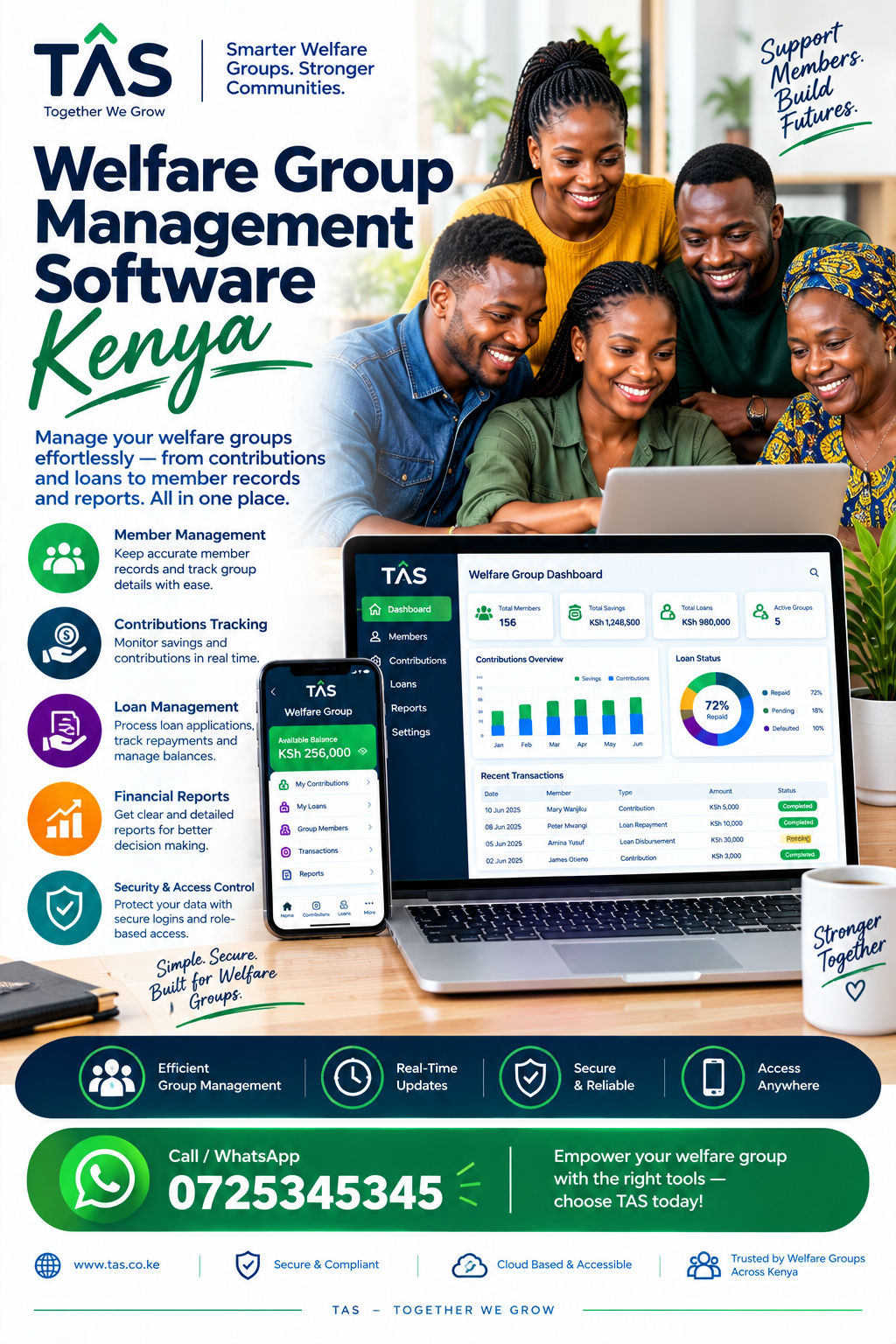
Welfare Groups in Kenya: A Practical Guide to Better Member and Financial Management
Welfare groups play an important role in helping members support one another during emergencies, family events, medical situations, education needs and other circumstances agreed upon by the group. Some welfare groups are informal, while others have developed into structured organisations with regular contributions, meetings, savings and financial support programmes.
As a welfare group grows, managing information can become increasingly difficult. Member details may be stored in notebooks, contribution records may be kept in spreadsheets, and meeting decisions may remain in handwritten minutes. When different records are kept separately, it can take considerable time to find accurate information.
Digital management can help welfare groups organise their records and simplify routine administration. The right system can bring member information, contributions, welfare funds, meetings, reports and other activities into a more structured environment.
Understanding Welfare Group Management
Welfare group management involves much more than collecting monthly contributions. Officials may need to register members, track their contributions, record welfare payments, manage group expenses, maintain meeting records and prepare financial reports.
A good system should support the group’s existing rules instead of making the organisation unnecessarily complicated. It should help officials perform routine tasks accurately while giving members confidence that their records are being maintained properly.
For groups that are expanding, moving from completely manual administration to a digital system can be an important step towards better organisation.
60 Important Areas for Welfare Groups
1. Centralising Member Information
Using Welfare Group Management Software Kenya can give a welfare group a central place to organise member information. Instead of maintaining separate lists for names, contacts, contributions and welfare participation, authorised officials can work from structured member records. This can make it easier to identify active members, update details and prepare reports. A central register also provides continuity when a new secretary or treasurer takes over.
2. Registering New Members
Welfare Group Management Software Kenya can make the process of registering new members more organised. A welfare group can establish the information it needs before accepting a member into its records. Depending on its rules, this could include a name, contact information, membership number and joining date. A consistent registration process helps prevent incomplete records and ensures that new members are properly included in future contribution and welfare activities.
3. Maintaining Accurate Member Records
With Welfare Group Management Software Kenya, officials can maintain member records in a more consistent way. Member details can change over time, particularly phone numbers and other contact information. Having an organised record makes it easier to update information when a member provides new details. Accurate records are important because contribution and welfare transactions need to be associated with the correct people.
4. Tracking Membership Status
Welfare Group Management Software Kenya can help a welfare organisation keep track of membership status. Groups may have active members, inactive members or former members depending on their policies. Recording these changes helps ensure that reports reflect the current membership position. It can also prevent former members from accidentally being included in current contribution calculations or welfare participation records.
5. Managing Monthly Contributions
Using Welfare Group Management Software Kenya can make regular contribution tracking more organised. Many welfare groups depend on members contributing a fixed amount at agreed intervals. Recording each payment against the correct member makes it easier to determine who has contributed and what amount the group has received. This also provides a useful history when members ask about their previous payments.
6. Recording Different Types of Contributions
Welfare Group Management Software Kenya can help groups distinguish between different types of financial contributions where their structure requires it. A welfare group may collect regular welfare contributions as well as additional amounts for a particular activity or emergency. Keeping these records separate can make financial reporting clearer and help officials explain how group funds have been collected and used.
7. Monitoring Outstanding Contributions
Using Welfare Group Management Software Kenya can help officials identify outstanding contributions. If members are expected to contribute monthly, the group needs a reliable way to determine which payments have been received and which remain outstanding. This information can support appropriate follow-up. It can also help the treasurer prepare accurate reports without manually comparing several pages of records.
8. Managing Welfare Fund Balances
Welfare Group Management Software Kenya can support better visibility into the group’s welfare fund. Officials need to understand how much money has been collected, how much has been paid out and what remains available. Keeping these transactions organised makes it easier to monitor the group’s financial position. It can also help the committee avoid making commitments without understanding the funds currently available.
9. Recording Welfare Payments
A welfare group can use Welfare Group Management Software Kenya to maintain records of welfare payments made to members. Payments may be associated with emergencies or other events covered by the group’s rules. Recording the amount, recipient and relevant details creates a reference that can be reviewed later. This is particularly important when the group needs to prepare financial reports for members.
10. Managing Welfare Requests
Welfare Group Management Software Kenya can help organise requests for welfare assistance. A member may need support because of an event or situation covered by the group’s welfare policy. Recording the request and its outcome gives officials a clearer administrative trail. The software does not replace the committee’s decision-making process; it simply helps document the information surrounding the request.
11. Supporting Approval Processes
Using Welfare Group Management Software Kenya can make approval processes easier to document. Depending on the group’s constitution, welfare requests may require approval from officials or members. Recording the decision helps ensure that payments are made based on an authorised process. It also gives the treasurer a reference before releasing group funds.
12. Recording Group Expenses
Welfare Group Management Software Kenya can help welfare groups organise expenses in addition to member contributions. Groups may incur administrative costs, meeting expenses or other approved expenditures. Recording these transactions alongside income provides a more complete picture of the group’s finances. Regularly updating expenses also makes financial reports more useful during meetings.
13. Managing Group Budgets
Using Welfare Group Management Software Kenya can support budget planning for welfare activities. A group may want to estimate expected contributions and planned expenses before the start of a particular period. Having previous financial information available can help officials prepare more realistic budgets. The final decisions should always follow the group’s approved financial procedures.
14. Tracking Financial Transactions
Welfare Group Management Software Kenya can give officials a structured place to record financial transactions. This is important because a welfare group’s financial position depends on both money coming in and money going out. When transactions are recorded consistently, officials can review the group’s activity without relying entirely on memory or several independent notebooks.
15. Preparing Member Statements
Using Welfare Group Management Software Kenya can make it easier to provide members with clearer statements where the selected system supports this feature. A statement can show relevant contributions and other recorded activities. This can be useful when a member wants to confirm their financial history. Clear statements can also reduce disagreements caused by missing or unclear records.
16. Improving Financial Transparency
Welfare Group Management Software Kenya can support transparency by making financial records more organised and easier for authorised officials to review. Transparency is particularly important in welfare groups because members contribute money with the expectation that it will be managed responsibly. Digital records can complement regular meetings, financial reports and other accountability procedures established by the organisation.
17. Supporting the Treasurer
The treasurer can benefit from Welfare Group Management Software Kenya when managing contributions, welfare payments, expenses and reports. Instead of repeatedly calculating figures manually, the treasurer can work from structured transactions. This can reduce repetitive administrative work and make it easier to prepare information before meetings. The treasurer should still reconcile records and follow the group’s financial controls.
18. Supporting the Secretary
Welfare Group Management Software Kenya can also assist the secretary with membership administration. Secretaries may be responsible for maintaining member lists, meeting information and communications. Having member records organised in one place can reduce the need to update multiple documents. It can also make leadership handovers easier because important information remains accessible to authorised officials.
19. Maintaining Meeting Records
Using Welfare Group Management Software Kenya can complement a welfare group’s meeting administration. Meetings may be used to discuss contributions, welfare requests, expenses and other organisational matters. Keeping relevant records together can help officials understand which decisions were made and ensure that approved actions are followed up after the meeting.
20. Tracking Meeting Attendance
Welfare Group Management Software Kenya can support attendance tracking where this is part of the group’s administrative requirements. Some welfare groups may want to know whether members regularly participate in meetings. Attendance information can be useful for internal reporting or for applying rules that the group has formally adopted. It should only be collected and used for legitimate organisational purposes.
21. Managing Member Communication
Using Welfare Group Management Software Kenya can help officials maintain accurate member information needed for communication. Groups may need to notify members about meetings, contribution deadlines, welfare decisions or other activities. Having current contact details can make these communications more reliable. The group should still follow responsible practices when handling members’ personal information.
22. Supporting Member Engagement
Welfare Group Management Software Kenya can help a welfare group understand its membership activity. Regular participation is important for many groups because the organisation depends on members contributing and attending meetings. Organised records can help officials identify participation patterns and communicate with members more effectively when appropriate.
23. Managing Emergency Support
Welfare groups often exist partly to help members during difficult circumstances. Using Welfare Group Management Software Kenya can help officials maintain records of emergency support provided to members. The group can document relevant payments and maintain a history of assistance. This can help with future reporting and ensure that welfare funds are being managed according to the group’s rules.
24. Recording Welfare Categories
Welfare Group Management Software Kenya can help groups organise welfare activities into categories where necessary. A group may have separate arrangements for medical support, bereavement, education, family emergencies or other approved situations. Categorising records can make reporting easier and help officials understand how welfare funds are being used.
25. Monitoring Welfare Spending
Using Welfare Group Management Software Kenya can make it easier to monitor spending from the welfare fund. Officials can review payments and expenses over a selected period and compare them with available funds. This information can help committees understand whether the group’s current contribution structure is sufficient to support its welfare activities.
26. Maintaining a Transaction History
Welfare Group Management Software Kenya can provide a structured history of financial activity. Historical records are useful when questions arise about a previous payment or contribution. Instead of searching through several notebooks, authorised officials can review the available transaction history. This can save time and provide better evidence when resolving financial queries.
27. Reducing Duplicate Records
Using Welfare Group Management Software Kenya can help reduce duplicate member records when the group follows a consistent registration process. Duplicate profiles can cause financial records to be split between two versions of the same person. Before creating a new profile, officials should check whether the member already exists. This simple practice can improve data accuracy.
28. Improving Data Accuracy
Welfare Group Management Software Kenya can support more consistent data entry. Structured forms can encourage officials to record information in the same way each time. This can reduce common problems such as incomplete names, missing membership numbers or inconsistent categories. Regular review remains necessary because digital systems cannot correct incorrect information that users enter.
29. Managing Member Changes
Members may change their phone numbers, addresses or other information during their time in the organisation. With Welfare Group Management Software Kenya, authorised officials can maintain updated records when changes are reported. Keeping information current makes communication easier and reduces the chance that important notices will be sent using outdated contact details.
30. Managing Former Members
Welfare Group Management Software Kenya can help distinguish former members from current participants. A member who leaves may still have historical contribution or welfare information that the group needs to retain according to its policies. Keeping appropriate historical records avoids losing important information while ensuring that former members are not incorrectly treated as active participants.
31. Role-Based Access
Using Welfare Group Management Software Kenya can help organisations manage access according to official responsibilities. The treasurer may require financial access, while the secretary may primarily manage member information. Limiting access can help protect personal and financial records. Groups should review permissions whenever officials change roles or leave the committee.
32. Protecting Member Information
Welfare Group Management Software Kenya should be considered alongside appropriate privacy and security practices. Welfare records can contain personal and financial information that should not be available to everyone. Officials should understand who can access records, how passwords are managed and what security measures are available within the selected system.
33. Creating Better Handover Processes
Using Welfare Group Management Software Kenya can make leadership handovers more organised. When a new treasurer or secretary takes over, they need access to current member and financial information. A central system can reduce dependence on a previous official’s personal notebook or computer. This helps the organisation preserve continuity when committee positions change.
34. Supporting Growing Groups
As membership increases, Welfare Group Management Software Kenya can become more valuable. A welfare group with a small number of members may manage information manually without much difficulty. As membership and transaction volumes grow, however, searching through paper records can become time-consuming. Digital management provides greater structure for growing organisations.
35. Supporting Large Membership Registers
Welfare Group Management Software Kenya can help groups manage larger member registers. Search and filtering functions can make it easier to locate a particular person without scanning an entire document. This becomes particularly useful during meetings when officials need information quickly and do not want to spend several minutes searching through paper files.
36. Connecting Members to Contributions
Using Welfare Group Management Software Kenya can help connect individual members with their contribution history. This allows officials to see how much has been recorded against a particular member. A connected record also makes it easier to prepare individual statements and group reports because the information is already associated with the correct member.
37. Supporting Welfare Eligibility
Welfare Group Management Software Kenya can help officials access membership information relevant to welfare eligibility. Some groups have rules requiring a member to meet certain conditions before receiving assistance. Having accurate membership and contribution records can help officials apply those rules consistently. The system should support the group’s policies rather than make independent decisions.
38. Managing Welfare Claims
Using Welfare Group Management Software Kenya can help a welfare group organise claims or requests for assistance. Each request can be reviewed according to the group’s procedures, and the eventual outcome can be recorded. Maintaining this information can help officials track how welfare resources are being distributed and prepare accurate reports.
39. Recording Approved Assistance
Welfare Group Management Software Kenya can help officials record assistance that has been approved for a member. A clear record can include the relevant member, amount and date where appropriate. This provides a reference for the treasurer and committee and can make later financial reconciliation easier.
40. Tracking Group Income
Using Welfare Group Management Software Kenya can help welfare groups organise income from member contributions and other approved sources. Understanding total income is necessary when assessing the group’s financial position. Recording income promptly can also make reports more accurate and reduce the need for officials to reconstruct financial information later.
41. Tracking Group Expenses
Welfare Group Management Software Kenya can help officials record approved group expenses. Expenses may include welfare payments, meetings, administration or other costs recognised by the organisation. Recording them consistently helps show how group funds have been used. It also allows members to review financial information through the reporting processes established by the group.
42. Preparing Monthly Reports
Using Welfare Group Management Software Kenya can support monthly financial and membership reporting. Regular reports can show contributions received, welfare payments made, expenses and current balances. Monthly reporting gives officials an opportunity to identify discrepancies early instead of waiting until the end of the year to review the group’s entire financial history.
43. Preparing Annual Reports
Welfare Group Management Software Kenya can also assist with annual reporting where the system provides suitable reports. An annual review can help the group understand membership changes, total contributions, welfare spending and other financial activity. Having transactions recorded throughout the year makes this process more manageable than attempting to reconstruct twelve months of activity at once.
44. Supporting Financial Reviews
Using Welfare Group Management Software Kenya can make internal financial reviews more organised. Officials can compare recorded contributions and payments with available supporting records. Regular reviews can identify missing entries, duplicate transactions or other discrepancies. Finding problems early gives the group an opportunity to investigate and correct them using its established procedures.
45. Supporting Accountability
Welfare Group Management Software Kenya can support accountability by creating clearer records of financial activity and membership administration. Members need confidence that their contributions are being managed responsibly. Digital records can provide useful evidence when combined with proper approvals, regular reporting and oversight by the relevant committee.
46. Making Meetings More Efficient
Using Welfare Group Management Software Kenya can reduce the time spent searching for information during meetings. Officials can prepare relevant reports before members meet. This means discussions can focus more on decisions and less on trying to determine basic figures. Better preparation can also make meetings more structured and productive.
47. Improving Member Statements
Welfare Group Management Software Kenya can support clearer member statements where the platform provides this functionality. Members may want to confirm their contributions or understand how their recorded participation has changed over time. A well-organised statement provides a useful reference and can reduce misunderstandings between members and officials.
48. Supporting Better Communication
Using Welfare Group Management Software Kenya can help officials work with more accurate information when communicating with members. Whether the group is reminding members about contributions or sharing meeting information, current records are important. Communication should still be handled carefully, especially when the information being discussed relates to an individual’s finances or welfare situation.
49. Managing Multiple Welfare Activities
Welfare Group Management Software Kenya can help groups organise several welfare activities within one administrative structure. A group may have regular welfare contributions, emergency assistance, social activities and other member services. Separating these activities appropriately can make reports easier to understand and prevent different types of transactions from being mixed together.
50. Supporting Community-Based Groups
Using Welfare Group Management Software Kenya can benefit community-based welfare organisations that want to improve their administrative processes. These groups may operate through regular meetings and member contributions. Digital records can provide a more organised alternative to multiple notebooks while still allowing the group to maintain its existing structure and decision-making practices.
51. Supporting Workplace Welfare Groups
Welfare Group Management Software Kenya can also be useful for workplace welfare groups. Colleagues may contribute regularly and provide support to one another when members experience qualifying events. A central record can make it easier to manage contributions and communicate with members, especially when the organisation has grown beyond a small informal group.
52. Supporting Family Welfare Groups
Using Welfare Group Management Software Kenya can help family-based welfare groups organise their membership and financial records. Family groups may have unique rules concerning contributions and assistance. Digital management can still provide value by giving members a clear record of transactions while allowing the group to maintain its own policies.
53. Supporting Church or Social Groups
Welfare Group Management Software Kenya can help social and community groups maintain structured member records where appropriate. Such organisations may combine welfare activities with meetings and regular contributions. Keeping information organised can make it easier for officials to manage the group’s activities without relying on several disconnected documents.
54. Supporting Long-Term Record Keeping
Using Welfare Group Management Software Kenya can help preserve a group’s administrative history. Welfare groups can operate for many years, and their records may become valuable when reviewing previous contributions, payments and membership changes. A structured system can make historical information easier to locate than a collection of old notebooks.
55. Making Leadership Transitions Easier
Welfare Group Management Software Kenya can make it easier for incoming officials to understand the group’s current position. A new treasurer needs to know contribution balances, welfare payments and outstanding issues. A new secretary needs access to current membership information. Organised records make these transitions less dependent on verbal explanations.
56. Reducing Administrative Work
Using Welfare Group Management Software Kenya can reduce some repetitive administrative tasks. Officials can spend considerable time calculating totals, updating registers and preparing reports when everything is done manually. A structured system can automate or simplify some of these activities, allowing officials to focus more on managing the group and supporting members.
57. Choosing Suitable Features
When comparing Welfare Group Management Software Kenya, welfare groups should focus on features that solve their actual problems. Important areas may include member registration, contribution tracking, welfare payments, expenses, meetings, reports, statements, permissions and data security. A long list of features is not necessarily useful if the system is difficult for officials to use.
58. Considering Data Security
Before choosing Welfare Group Management Software Kenya, officials should understand how member information is protected. Questions about passwords, user permissions, backups and access management should be considered. The group should also have a process for removing or changing access when an official leaves a leadership position.
59. Training Welfare Officials
A successful transition to Welfare Group Management Software Kenya requires officials to understand the system. Training should focus on the tasks they actually perform, such as adding members, recording contributions, entering welfare payments and preparing reports. Simple practical training can help reduce errors and increase confidence among users.
60. Building a Sustainable Administrative System
Using Welfare Group Management Software Kenya can help a welfare group build a more sustainable approach to member and financial administration. The objective should be to create consistent processes for registration, contributions, welfare requests, payments, reporting, access control and leadership handovers. When technology is combined with clear rules and responsible management, it can become a useful part of the group’s everyday operations.
Key Features Welfare Groups Should Look For
A welfare group considering digital management should evaluate the features according to its own activities. Useful capabilities may include:
- Member registration
- Membership status tracking
- Contribution management
- Welfare fund tracking
- Welfare request records
- Payment records
- Expense management
- Meeting management
- Member statements
- Financial reports
- Search and filtering
- User roles and permissions
- Data backups
- Historical transaction records
The group does not necessarily need every possible feature. The priority should be functionality that makes its existing processes easier and more reliable.
Managing Welfare Contributions Properly
Contributions are usually the foundation of a welfare group’s financial activities. Members may contribute weekly, monthly or according to another schedule established by the organisation.
A reliable contribution process should identify the member, amount, date and relevant contribution category. Officials should also be able to determine the total amount received during a particular period.
Regular reconciliation is important. If the group’s records show one figure while the actual financial account shows another, officials should investigate the difference rather than allowing the discrepancy to continue.
Managing Welfare Assistance
Welfare assistance should be governed by clear rules. Members should understand what circumstances qualify for support and how decisions are made.
A digital record can document the request, decision and payment, but it should not replace the committee’s responsibility to apply the organisation’s policies.
Clear records can also help the group understand how much of its welfare fund is being used and whether its current contribution structure remains appropriate.
Why Accurate Member Records Matter
Every financial transaction should be associated with the correct member where appropriate. If a contribution is recorded under the wrong person, that member’s statement may become inaccurate.
The same issue can occur with welfare payments. A payment recorded against the wrong member can create unnecessary disputes.
For this reason, groups should establish a simple process for checking member details before entering important transactions.
Digital Management and Transparency
Transparency is one of the most important considerations for any organisation handling members’ money.
Members should have confidence that contributions are being recorded, welfare payments are authorised and group expenses are properly documented.
Digital systems can support this by creating structured records and reports. However, transparency still requires responsible leadership, regular meetings, appropriate approvals and communication with members.
Digital Management and Leadership
Committee members have different responsibilities, and a good administrative process should reflect those responsibilities.
The treasurer may be responsible for financial records. The secretary may maintain member information and meeting records. Other committee members may review reports or approve welfare requests.
Using appropriate user roles can help prevent unnecessary access while allowing officials to perform their duties.
Moving From Paper Records
A welfare group does not have to abandon all paper records immediately.
The transition can begin by reviewing existing member lists, checking contribution balances and identifying active welfare commitments. Officials can then determine which information should be entered into the new system.
It is important to clean the information before migration. Moving incorrect or duplicate records into a digital system simply transfers the problem rather than solving it.
Moving From Spreadsheets
Spreadsheets can be useful for small groups, but problems may appear when several people maintain different files.
One spreadsheet may contain the newest member information while another contains the latest contribution figures. If officials do not coordinate changes, the records can quickly become inconsistent.
A dedicated system can provide a central environment where authorised users work with the same information.
Questions to Ask Before Choosing a System
Before adopting a digital welfare management platform, officials can ask:
- Is member registration easy?
- Can member information be updated?
- Can contributions be tracked?
- Can welfare payments be recorded?
- Can expenses be managed?
- Can the system generate reports?
- Can members receive statements?
- Are different user roles available?
- Are records backed up?
- Can historical transactions be searched?
- Can data be exported?
- Is the system easy for officials to learn?
- Does the cost fit the group’s budget?
- Can it support the group as membership grows?
These questions can help a welfare group choose based on practical requirements rather than simply selecting the platform with the largest feature list.
Frequently Asked Questions
What is welfare group management software?
It is a digital system designed to help welfare or member-based groups organise activities such as membership administration, contributions, welfare payments, expenses, meetings and reporting.
Can a small welfare group use digital management?
Yes. A small group can use digital tools if they provide practical value. The system should be simple, affordable and suitable for the group’s actual activities.
Can welfare contributions be tracked?
Many group-management platforms provide contribution tracking. Officials should confirm the specific functionality available before selecting a platform.
Can welfare payments be recorded?
A suitable system can provide records for welfare assistance, including information such as the member involved, payment amount and date, depending on the platform’s functionality.
Why are member records important?
Member records provide the foundation for many other activities. Contributions, welfare assistance, communication and reports all depend on knowing who the members are and maintaining accurate information about them.
How can software improve accountability?
Structured records can make financial activity easier to review. When combined with approvals, regular reporting and proper oversight, they can support stronger accountability.
Should every official have full access?
Not necessarily. Access should correspond to responsibilities. Limiting permissions can help protect member and financial information.
How often should records be updated?
Records should ideally be updated as transactions and legitimate member changes occur. Delaying entries can make reports less accurate.
Can digital records help during leadership changes?
Yes. A central record can make it easier for incoming officials to understand the group’s current membership and financial position.
What should a welfare group do before moving online?
The group should review its existing records, identify active members, verify important balances, remove obvious duplicates and establish clear responsibilities for system users.
A Simple Welfare Group Management Workflow
A practical workflow can begin with member registration. Once members are properly recorded, their contributions can be entered against the relevant profiles. Welfare requests can then be recorded and reviewed according to the group’s rules.
When assistance is approved, the payment should be entered into the financial records. Expenses should also be recorded promptly. At regular intervals, officials can prepare reports showing contributions, welfare payments, expenses and balances.
This creates a continuous record from membership through financial activity and reporting.
Building Better Welfare Administration
Good welfare administration depends on accurate information, consistent procedures and responsible leadership. Technology can make these processes easier, but the group still needs clear rules.
Officials should know who is responsible for each task. Members should understand contribution requirements and welfare procedures. Financial information should be reviewed regularly.
A digital system is most useful when it becomes part of these established processes rather than being treated as a separate activity.
Practical Checklist for Welfare Group Officials
Before implementing a digital system, officials can review the following:
- Confirm the current membership list.
- Verify member contact details.
- Check outstanding contributions.
- Confirm current welfare fund balances.
- Review recent welfare payments.
- Record approved expenses.
- Identify duplicate member records.
- Establish user responsibilities.
- Set appropriate access permissions.
- Train committee members.
- Establish a regular reporting schedule.
- Review records periodically.
- Maintain appropriate backups.
- Update information when members provide legitimate changes.
- Prepare a clear handover procedure for future officials.
This checklist can help a welfare group move towards more organised administration while maintaining the procedures that members have already agreed upon.
The Role of Technology in Growing Welfare Groups
As welfare groups grow, administration becomes more demanding. More members create more contributions, more records and potentially more welfare requests.
A digital approach can provide the structure needed to handle this increased activity. It can make information easier to search, reports easier to prepare and records easier to maintain.
The important thing is to choose a system that matches the group’s current needs while providing enough flexibility for future growth.
Getting Members Comfortable With Digital Records
Technology adoption works better when officials explain why the group is changing its record-keeping process.
Members may initially be comfortable with notebooks because they have used them for years. Showing how digital records can make statements, contribution tracking and reporting easier can help demonstrate the practical value.
Officials should also explain who will have access to information and how member records will be handled. Clear communication can help members feel more comfortable with the transition.
Keeping the System Useful Over Time
Introducing software is only the beginning. The system needs to remain updated to provide useful information.
Officials should avoid entering transactions in batches months later. Member changes should be recorded promptly. Reports should be reviewed regularly. User access should be updated when committee positions change.
These habits help ensure that the information displayed by the system reflects the group’s actual position.
What Makes a Good Welfare Management Process?
A good process should be:
Accurate — records should reflect actual transactions and membership information.
Consistent — officials should follow the same procedures.
Accessible — authorised users should be able to find relevant information when needed.
Secure — personal and financial information should be appropriately protected.
Transparent — members should have confidence in the group’s financial administration.
Scalable — the process should continue working as membership and activity increase.
Practical — officials should be able to use it without unnecessary complexity.
For Kenyan welfare groups, these principles can provide a useful foundation when evaluating digital management options and improving everyday administration.