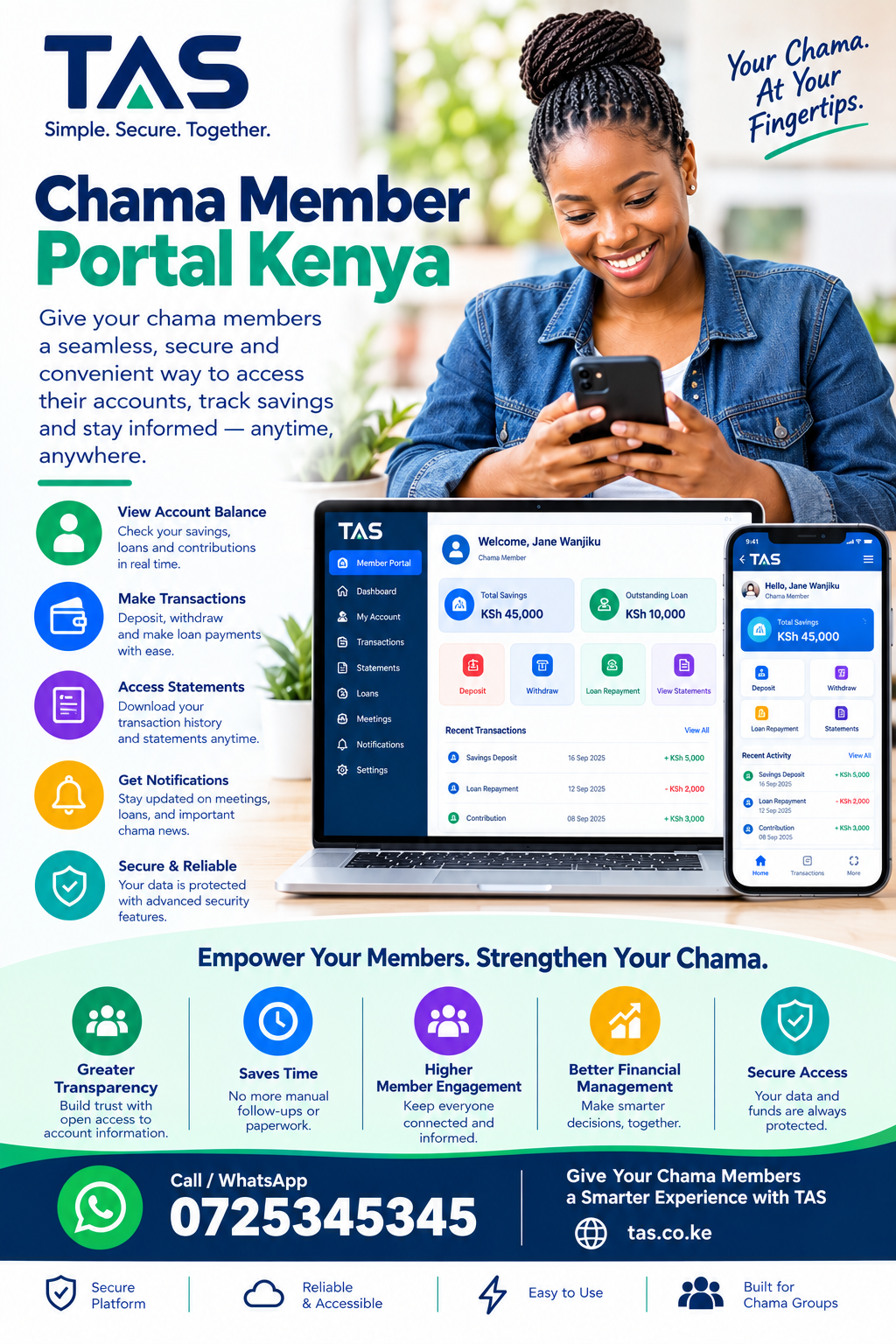
Chama Member Portal Kenya: A Complete Guide for Kenyan Chamas
Managing a chama involves more than collecting money every month. Members need accurate records, officials need reliable financial information, and everyone needs to understand how the group is progressing. A Chama Member Portal Kenya gives savings groups, investment groups, welfare groups and other member-based organizations a structured way to manage membership information, contributions, loans, meetings, budgets, reports and communication. This guide explains how digital member management works, why it matters to Kenyan chamas, which features to look for, and how a group can introduce a portal without disrupting its existing operations.
What Is a Chama Member Portal?
A Chama Member Portal Kenya is a digital platform designed to give members and authorized officials access to information and services associated with their group. Instead of keeping member details in one notebook, contribution records in a spreadsheet and meeting information in a messaging group, a portal can bring related activities into a centralized environment.
For a chama, membership information can include names, contact details, membership dates, contribution records, loan information and other relevant details. Officials can use the system to organize administrative activities, while members can access information they are permitted to see.
The exact functions differ between platforms, but a useful member portal may include:
- Member registration
- Digital member profiles
- Contribution tracking
- Loan management
- Repayment tracking
- Meeting management
- Attendance records
- Meeting minutes
- Notices
- Budget management
- Financial reports
- User permissions
- Document management
- Member self-service
A Chama Member Portal Kenya should therefore be viewed as more than an online membership directory. It can become part of the group’s day-to-day administration.
Why Chamas Are Moving Toward Digital Member Management
Many Kenyan chamas begin with a simple system. The secretary keeps a notebook, the treasurer records contributions, and members communicate through a WhatsApp group. For a small group, this may initially seem sufficient.
Problems can emerge as the group grows.
A Chama Member Portal Kenya can help address some of these challenges by organizing information into one system.
Consider a chama with 40 members. If every member makes a monthly contribution, there can be hundreds of payment entries within a year. Add loans, repayments, penalties, expenses, investments and welfare payments, and the administrative workload increases considerably.
The issue is not simply the amount of information. It is also the difficulty of keeping information consistent.
A Chama Member Portal Kenya can provide a central location for records that would otherwise be spread across several files and communication channels.
Common problems with manual records
Chamas relying heavily on manual administration may encounter:
- Lost or damaged records
- Duplicate entries
- Incorrect calculations
- Delayed updates
- Difficult report preparation
- Limited visibility for members
- Confusion during committee handovers
- Difficulty tracking loans
- Unclear contribution histories
- Multiple versions of spreadsheets
A Chama Member Portal Kenya can help create a more consistent record-keeping process.
Member Registration and Profiles
Membership is the foundation of a chama. Before financial transactions can be managed properly, the organization needs accurate information about its members.
A Chama Member Portal Kenya can provide structured member profiles rather than relying on handwritten lists.
Depending on the system, member information may include:
| Information | Purpose |
|---|---|
| Full name | Identifies the member |
| Phone number | Communication |
| Email address | Digital communication |
| Membership date | Establishes membership history |
| Membership status | Tracks active or inactive members |
| Contribution history | Tracks savings |
| Loan information | Monitors borrowing |
| Relevant notes | Supports administration |
A well-maintained member profile can make committee work easier. When leadership changes, incoming officials can access organized records rather than starting from scratch.
A Chama Member Portal Kenya can also help standardize how new members are added to the system.
Keeping member information accurate
Digital records are useful only when they are maintained properly.
The chama should establish procedures for:
- Registering new members.
- Updating contact information.
- Recording membership changes.
- Removing inappropriate or duplicate records.
- Reviewing inactive members.
- Restricting access when someone leaves the group.
A Chama Member Portal Kenya gives the organization a structured place for this information, but officials remain responsible for maintaining accurate records.
Contribution Management
Contributions are central to most chamas.
Members may save a fixed amount every month or make different contributions depending on the group’s rules. Some groups maintain separate savings, welfare and investment funds.
A Chama Member Portal Kenya can help organize these financial records and make contribution histories easier to review.
Instead of searching through spreadsheets or notebooks, officials can use a centralized system to review transactions.
Contribution tracking should answer important questions
A useful contribution system should make it easier to determine:
- How much has a member contributed?
- Which months have been paid?
- Are there outstanding contributions?
- How much has the entire group collected?
- Which contribution category does a payment belong to?
- What is the contribution history over a selected period?
A Chama Member Portal Kenya can support this type of organized information management where the relevant features are available.
Why contribution visibility matters
Contribution disputes can create unnecessary tension.
For example, a member may believe that they have made every monthly payment while the treasurer’s records show a missing entry. If the group relies on paper receipts and memory, resolving the issue can take considerable time.
A Chama Member Portal Kenya can provide a clearer transaction history when payments are entered accurately and consistently.
Managing M-Pesa Payments
Mobile money is an important part of financial activity in Kenya. Many chamas use M-Pesa to receive contributions and other payments.
However, receiving money and maintaining accurate accounting records are separate tasks.
A Chama Member Portal Kenya can help organize payment information when the chosen platform supports the relevant workflows.
A chama should consider how its software handles:
- Payment identification
- Member allocation
- Transaction dates
- Amounts
- Contribution categories
- Reconciliation
- Reporting
The group should verify the specific payment integrations and procedures offered by any provider before implementation.
Loan Management
Loans are another area where manual administration can become difficult.
A member may apply for a loan, receive approval, make several repayments and eventually clear the balance. If each stage is recorded separately, calculating the remaining amount manually can introduce errors.
A Chama Member Portal Kenya can help organize loan records when loan management is part of the platform.
A structured loan process may include:
- Loan application
- Application review
- Approval
- Loan disbursement
- Repayment schedule
- Repayment entries
- Outstanding balance
- Loan completion
Loan application records
The application process should provide a clear record of what a member requested.
This can include:
- Requested amount
- Application date
- Purpose where required
- Approval status
- Approved amount
- Relevant supporting information
A Chama Member Portal Kenya can provide an organized location for these records when the platform includes loan application functionality.
Repayment tracking
Repayments are easier to manage when every transaction is attached to the correct loan.
A Chama Member Portal Kenya can help officials review repayment information and determine outstanding balances when the appropriate functionality is available.
The group should also establish rules for handling missed payments, partial payments and any applicable penalties.
Meeting Management
Chama meetings are where members discuss savings, loans, investments, welfare matters and group decisions.
Meeting management therefore deserves attention when selecting digital software.
A Chama Member Portal Kenya can help organize meeting-related information where those functions are included in the system.
Important meeting features can include:
- Meeting dates
- Agendas
- Attendance
- Minutes
- Decisions
- Assigned actions
- Follow-up activities
- Meeting notices
Digital meeting records
Meeting minutes are particularly important when committee members change.
A new secretary should be able to understand previous decisions without depending completely on verbal explanations from former officials.
A Chama Member Portal Kenya can provide a structured place for meeting records when supported by the software.
Attendance and Member Participation
Attendance can be useful for groups that require members to participate regularly.
A digital system can make it easier to identify participation patterns and maintain records over time.
A Chama Member Portal Kenya can support broader member administration where appropriate.
Attendance records may help the committee understand:
- Who attended a meeting
- Which members were absent
- When meetings occurred
- Whether specific participation requirements were met
The group should determine which attendance information is necessary rather than collecting unnecessary personal data.
Budget Management
Chamas often need budgets for administration, welfare activities, investments, meetings and other expenses.
A budget gives members a framework for comparing planned spending with actual spending.
A Chama Member Portal Kenya can help organize budget information when the relevant features are provided.
For example:
| Budget Category | Planned | Actual | Variance |
|---|---|---|---|
| Meetings | KSh 15,000 | KSh 14,500 | KSh 500 |
| Administration | KSh 20,000 | KSh 21,500 | -KSh 1,500 |
| Welfare | KSh 50,000 | KSh 47,000 | KSh 3,000 |
| Investment | KSh 100,000 | KSh 100,000 | KSh 0 |
The numbers above are illustrative rather than recommended amounts.
A Chama Member Portal Kenya can make financial information easier to organize when budgeting functionality is available.
Financial Reporting
Members need understandable financial information.
A financial report might include:
- Total contributions
- Loan balances
- Loan repayments
- Group expenses
- Income
- Investment activity
- Budget performance
A Chama Member Portal Kenya can help centralize reporting processes when the platform supports them.
Monthly reports
Monthly reporting allows the committee to review activity regularly.
It can help identify issues such as:
- Missing contributions
- Unexpected expenses
- Delayed loan repayments
- Budget differences
- Unrecorded transactions
A Chama Member Portal Kenya can form part of a structured reporting workflow where appropriate.
Member Self-Service
One of the biggest advantages of a digital portal is that members do not have to ask an official for every piece of information.
A Chama Member Portal Kenya can give members access to appropriate information directly.
Depending on permissions, members may be able to view:
- Their contribution history
- Loan balances
- Repayment records
- Meeting dates
- Notices
- Relevant reports
- Personal profile information
This can reduce repetitive administrative questions.
Instead of sending a message such as, “How much have I contributed this year?” a member may be able to check the relevant record themselves.
Role-Based Access
Not every member should necessarily have access to every record.
A Chama Member Portal Kenya can use different access levels to separate ordinary member access from administrative responsibilities when supported by the platform.
For example:
| Role | Example responsibilities |
|---|---|
| Member | View personal records and notices |
| Treasurer | Manage financial records |
| Secretary | Manage members and meetings |
| Chairperson | Review group information |
| Administrator | Manage users and settings |
The exact roles should reflect the group’s constitution and internal procedures.
Why permissions matter
Imagine that every user could edit every financial transaction. A simple mistake could change a balance and create confusion.
A Chama Member Portal Kenya can provide a more controlled environment when role-based permissions are available.
Access should be reviewed whenever officials change.
Security and Data Protection
Chamas handle personal and financial information, so security should be part of the selection process.
A Chama Member Portal Kenya should be evaluated for authentication, access controls, backup arrangements and other relevant security measures.
Questions to ask a provider include:
- How are accounts protected?
- Who can access member records?
- Are permissions configurable?
- How are backups handled?
- Can former officials be removed?
- How is data exported?
- What happens if the organization stops using the platform?
Security is not only a technology issue. Chamas should also establish internal procedures for passwords, user access and administrative responsibility.
Communication With Members
Important chama information can easily become buried in WhatsApp messages.
A member portal can act as a structured reference point for official notices.
A Chama Member Portal Kenya can help organize member-facing information where communication features are available.
Examples of useful notices include:
- Meeting reminders
- Contribution deadlines
- Loan announcements
- Annual meeting notices
- Investment updates
- Policy changes
- Administrative announcements
The portal does not necessarily need to replace messaging applications. It can complement them by providing a more permanent location for formal information.
Benefits for the Treasurer
The treasurer has one of the most demanding administrative roles in many chamas.
Financial responsibilities can include contributions, expenses, loans, repayments and reporting.
A Chama Member Portal Kenya can help the treasurer organize financial records in one environment.
Instead of switching between notebooks, spreadsheets and payment messages, the treasurer can work from centralized records where the software supports the required processes.
This can also make committee reporting easier.
Benefits for the Secretary
The secretary often manages information that extends beyond finances.
A Chama Member Portal Kenya can support the organization of member information, meetings, notices and other administrative records.
For example, the secretary may need to maintain:
- Member lists
- Meeting schedules
- Agendas
- Minutes
- Attendance
- Notices
- Administrative documents
Centralization makes committee handovers easier.
Benefits for the Chairperson
A chairperson may need a broad overview of the group’s activities rather than every individual transaction.
A Chama Member Portal Kenya can provide access to relevant reports and group information where supported.
This can help leadership prepare for meetings and identify issues requiring attention.
The objective is not to give one person unlimited access. Appropriate permissions should remain in place.
Benefits for Ordinary Members
Members are the reason the portal exists.
A Chama Member Portal Kenya can improve the member experience by providing convenient access to personal and group information.
Members can potentially spend less time requesting routine information from officials.
A useful member experience should be:
- Simple
- Accessible
- Clear
- Mobile-friendly
- Secure
- Relevant
A system that works well for administrators but frustrates ordinary members may struggle to achieve widespread adoption.
Supporting Investment Groups
Not every chama operates as a simple savings club.
Investment groups may pool money for:
- Property
- Land
- Businesses
- Shares
- Agriculture
- Other approved investments
A Chama Member Portal Kenya can help organize member and financial information for such groups when its capabilities match their needs.
Investment groups should pay particular attention to reporting.
Members need to understand how funds are being allocated and how investment activities are progressing.
Supporting Welfare Chamas
Welfare groups may focus on assisting members during agreed circumstances.
Their administration can involve:
- Member contributions
- Welfare funds
- Assistance requests
- Approved support
- Meeting decisions
- Member status
A Chama Member Portal Kenya can provide a centralized environment for relevant records where suitable features are available.
Because welfare information may be sensitive, access controls deserve particular attention.
Supporting Business-Oriented Chamas
Some groups combine savings with business activities.
They may need to manage:
- Member contributions
- Business income
- Operating expenses
- Budgets
- Projects
- Investments
- Loans
A Chama Member Portal Kenya can help bring these administrative activities together where the software supports them.
The group should map its processes before selecting software so that it understands which functions are essential.
Moving From Excel to a Digital System
Excel and other spreadsheet tools are common starting points for chamas.
They are flexible and familiar, but they can become difficult to control when multiple people edit files or when the number of transactions grows.
A Chama Member Portal Kenya can provide a more specialized environment for member administration.
Common spreadsheet challenges include:
- Formula errors
- Duplicate records
- Accidental edits
- Multiple file versions
- Missing information
- Difficult permissions
- Manual report preparation
A group does not have to digitize everything at once.
It can start with the processes that create the most administrative pressure.
How to Implement a Member Portal
Successful implementation requires more than purchasing software.
A Chama Member Portal Kenya can be introduced through a structured process.
Step 1: Review existing records
Gather current member lists, contribution records, loan information and other important documents.
Step 2: Clean the data
Remove duplicate records and correct obvious errors before entering information into the new system.
Step 3: Define roles
Determine who will manage members, finances, meetings and system settings.
Step 4: Configure the system
Set up the relevant member categories, contribution types, loan rules and permissions.
Step 5: Train officials
Officials should know how to enter information, correct legitimate mistakes and generate reports.
Step 6: Onboard members
Give members simple instructions for accessing the system.
Step 7: Review adoption
After implementation, determine which features members are using and which processes need improvement.
Common Implementation Mistakes
Even a capable system can fail when the organization does not establish good processes.
A Chama Member Portal Kenya works best when officials understand their responsibilities and records are kept consistently.
Giving everyone administrator rights
Administrative privileges should be limited to people who genuinely need them.
Maintaining too many parallel records
If the same contribution is recorded in a notebook, spreadsheet and portal, inconsistencies can develop.
Skipping training
A short training session can help officials understand the correct workflow.
Ignoring data quality
A digital system does not automatically make incorrect information accurate.
Focusing only on officials
Ordinary members should also find the system useful.
How to Evaluate Different Platforms
Choosing software should begin with the chama’s needs.
A Chama Member Portal Kenya should be evaluated against practical requirements rather than marketing claims alone.
Consider the following areas:
| Evaluation Area | Questions to Ask |
|---|---|
| Members | Can the system manage member profiles? |
| Contributions | Can payments be recorded and reviewed? |
| Loans | Can applications and repayments be tracked? |
| Meetings | Can meetings and minutes be organized? |
| Reports | Can useful financial reports be produced? |
| Security | Are permissions available? |
| Access | Can members access appropriate records? |
| Support | Is assistance available when needed? |
| Pricing | Is the pricing structure clear? |
| Data | Can the group access its information? |
A demonstration can help committee members understand how the software works before committing.
Mobile Accessibility
Kenyan members may access systems from smartphones, tablets and computers.
A Chama Member Portal Kenya should therefore be assessed for ease of use on the devices members actually use.
Mobile accessibility matters because a member may want to check a contribution record while away from a computer.
Important considerations include:
- Responsive design
- Simple navigation
- Secure login
- Readable information
- Efficient data usage
- Reliable access
The specific technical requirements will depend on the software provider.
Data Migration
Moving from paper or spreadsheets to a portal requires careful data migration.
A Chama Member Portal Kenya can only produce useful reports if the information entered into it is accurate.
Before migration, officials should reconcile important records.
For example:
- Confirm the official member list.
- Verify contribution balances.
- Check outstanding loans.
- Confirm repayment histories.
- Review financial totals.
- Resolve obvious discrepancies.
- Import or enter verified information.
This process may take time, but it can prevent historical errors from being transferred into the new system.
Creating a Digital Chama Policy
A digital system works better when supported by simple internal rules.
A Chama Member Portal Kenya can form part of a broader governance framework that defines how information is handled.
The policy could cover:
- Who may access the platform
- Who may enter transactions
- Who approves loans
- Who reviews financial reports
- How errors are corrected
- How passwords are managed
- How former officials lose access
- How records are reviewed
- How data is backed up
The rules should be simple enough for committee members to follow consistently.
Measuring the Value of a Member Portal
After implementation, the chama should assess whether the system is solving actual problems.
A Chama Member Portal Kenya can be evaluated through practical indicators such as:
- Time spent preparing reports
- Number of unresolved record discrepancies
- Percentage of members onboarded
- Frequency of contribution updates
- Number of members accessing their records
- Time required to locate historical information
- Number of manual processes replaced
The purpose is not to create unnecessary statistics. It is to determine whether the software is making administration easier.
Questions to Ask a Software Provider
Before selecting a system, committee members should prepare a list of questions.
A Chama Member Portal Kenya provider should be able to explain how its platform handles relevant requirements.
Ask:
- How are members registered?
- Can members access their own information?
- How are contributions recorded?
- Can loans be managed?
- How are repayments tracked?
- Can meetings and minutes be managed?
- What reports are available?
- Can user roles be configured?
- How is data protected?
- How are backups handled?
- Can information be exported?
- What support is available?
- How does pricing work?
- Are there additional charges?
- Can the platform scale as membership grows?
These questions help a chama compare functionality rather than choosing software based only on appearance.
The Role of Transparency in Chama Management
Transparency is important because members contribute their money based on collective trust.
A Chama Member Portal Kenya can support transparency by making appropriate records easier to access.
However, transparency should be balanced with privacy.
For example, a member may need access to their own contribution and loan records without automatically receiving access to every other member’s personal information.
This is where role-based permissions become valuable.
Why Accurate Records Matter
A digital portal cannot compensate for poor data entry.
A Chama Member Portal Kenya should be supported by procedures that encourage timely and accurate record keeping.
For every financial transaction, the group should establish a consistent process.
A transaction may need:
- Member identification
- Amount
- Date
- Transaction type
- Reference information
- Appropriate approval or verification
Consistency improves the reliability of reports.
Committee Handover
Leadership changes are a normal part of many chamas.
Problems can occur when records are stored primarily in one official’s personal notebook, computer or email.
A Chama Member Portal Kenya can help create institutional continuity when information is stored centrally.
A proper handover should include:
- Member records
- Financial records
- Outstanding loans
- Meeting information
- Current budgets
- Important documents
- User access
- Administrative responsibilities
New officials should receive appropriate access while former officials should have their permissions reviewed.
Scaling With Membership Growth
A chama with 10 members may have very different administrative requirements from one with 100 members.
A Chama Member Portal Kenya can become increasingly useful as the volume of membership and financial information grows, provided that the platform can accommodate the organization’s size.
Growth may create additional requirements for:
- Member management
- Contribution tracking
- Loan administration
- Reporting
- User permissions
- Communication
- Financial controls
The group should evaluate expected growth before choosing a platform.
Frequently Asked Questions
What is a chama member portal used for?
A Chama Member Portal Kenya is used to organize member information and provide controlled access to activities such as contributions, loans, meetings, notices and reports.
Can a chama manage contributions digitally?
Yes. A Chama Member Portal Kenya can provide tools for recording and reviewing contributions when the selected platform supports contribution management.
Can members see their own records?
A Chama Member Portal Kenya can provide member self-service access where the platform supports it and appropriate permissions are configured.
Can a member portal manage loans?
Yes. A Chama Member Portal Kenya may support loan applications, approvals, repayments and outstanding balances depending on its available functionality.
Is digital chama management suitable for small groups?
A Chama Member Portal Kenya can be useful for small groups that want to establish organized records before their membership and financial activity increase.
Can M-Pesa payments be incorporated?
A Chama Member Portal Kenya may support payment-related workflows depending on its integrations. Chamas should confirm the exact M-Pesa capabilities offered by the provider.
How does a member portal improve accountability?
A Chama Member Portal Kenya can help maintain organized records of contributions, loans, expenses and other activities, making information easier to review.
Should every member have administrator access?
No. A Chama Member Portal Kenya should ideally use appropriate permissions so users only receive access necessary for their roles.
Can the system replace WhatsApp?
A Chama Member Portal Kenya does not necessarily need to replace WhatsApp. The portal can provide structured records and formal notices while messaging platforms remain useful for quick communication.
What should a chama check before choosing software?
A Chama Member Portal Kenya should be evaluated for member management, contributions, loans, meetings, reporting, security, accessibility, support, data management and pricing.
Final Checklist for Kenyan Chamas
Before adopting a member management platform, the committee can use this checklist:
- Member profiles can be maintained.
- New members can be registered.
- Contributions can be recorded.
- Contribution histories can be reviewed.
- Loans can be tracked.
- Repayments can be recorded.
- Meetings can be organized.
- Minutes can be maintained.
- Notices can be shared.
- Budgets can be monitored.
- Financial reports can be produced.
- Members can access relevant information.
- User permissions can be controlled.
- Data backup arrangements are understood.
- The system works on members’ devices.
- Support is available.
- Pricing is understood.
- Data export arrangements are clear.
A Chama Member Portal Kenya can become an important part of a chama’s administrative infrastructure when it matches the group’s size, financial activities, governance structure and member expectations. The most useful approach is to begin with the processes that cause the greatest administrative challenges, establish clear responsibilities, maintain accurate records and ensure that members can access information appropriate to their roles.