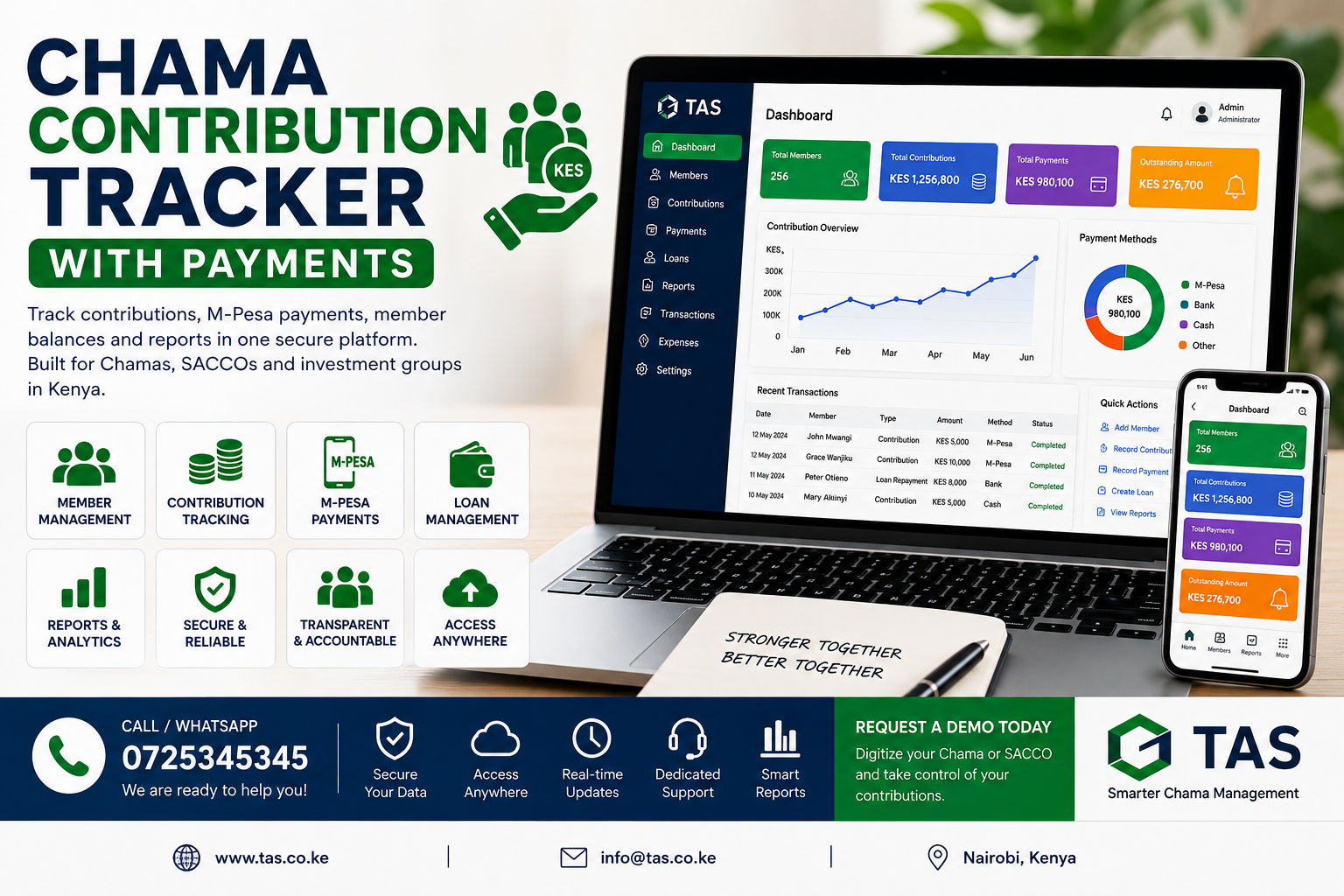
 Building a Chama Contribution Tracker with Payments in Kenya
Managing Chama contributions manually can become difficult as membership grows. Treasurers may have to check M-Pesa messages, update spreadsheets, calculate outstanding balances and answer members who want to know whether their payments have been recorded.
A Chama Contribution Tracker with Payments provides a better way to organize this process.
Instead of maintaining contribution records across WhatsApp messages, notebooks and Excel spreadsheets, a digital contribution tracking system can centralize member payments, balances and transaction histories.
For Chamas and SACCOs in Kenya, this can improve transparency, reduce administrative work and provide officials with clearer financial records.
What Is a Chama Contribution Tracker?
A Chama Contribution Tracker is a digital system used to record, organize and monitor contributions made by members of a Chama, savings group, welfare group or investment group.
The system can maintain information such as:
- Member names
- Contribution amounts
- Payment dates
- Payment methods
- Expected contributions
- Amounts already paid
- Outstanding contributions
- Member balances
- Transaction histories
- Payment references
- Contribution reports
Instead of checking several different records, authorized Chama officials can access contribution information from one centralized platform.
Why Chamas Need Contribution Tracking Software
Contribution management may seem simple when a Chama has only a few members.
Consider a Chama with 50 members where every member contributes KES 5,000 each month.
The treasurer needs to determine who has paid, confirm every payment, update individual balances and identify members who have not contributed.
As the number of members and transactions increases, manual administration becomes more difficult.
A Chama Contribution Tracking System provides a structured way of maintaining these records.
Problems With Tracking Chama Contributions Manually
Many Chamas still depend on combinations of:
- Excel spreadsheets
- Notebooks
- M-Pesa confirmation messages
- WhatsApp screenshots
- Bank statements
- Paper receipts
These methods can work for small groups, but they become increasingly difficult to manage as transaction volumes increase.
For example, a payment may appear in an M-Pesa message but not be entered into the contribution spreadsheet.
A member may then believe that they have paid while the Chama’s records show an outstanding contribution.
Centralizing contribution records can help reduce these inconsistencies.
How a Chama Contribution Tracker Works
A contribution tracking system begins by creating individual records for Chama members.
The organization can then define the contributions expected from its members.
When a member makes a contribution, the transaction is associated with that member’s account.
The system can therefore maintain a historical record showing what was expected, what was paid and what remains outstanding.
A typical process may look like this:
Add Member → Set Contribution → Receive Payment → Record Transaction → Update Member Balance → Generate Report
This creates a clearer financial trail for both officials and members.
Chama Member Management
Contribution tracking starts with accurate member information.
Each member should have an individual profile containing the information required by the organization.
This can include:
- Member name
- Membership number
- Contact information
- Joining date
- Membership status
- Contribution history
- Savings history
- Outstanding obligations
- Transaction history
Connecting transactions to individual member profiles makes financial records easier to understand.
Setting Up Chama Contributions
Different Chamas operate under different contribution rules.
Some collect contributions every week.
Others collect them monthly, quarterly or according to specific investment projects.
A Chama Contribution Management System should therefore support different contribution structures.
For example, a group may collect:
Monthly Contributions
Regular amounts contributed by every member.
Savings Contributions
Money allocated toward individual or collective savings.
Investment Contributions
Funds collected for a particular investment opportunity.
Welfare Contributions
Money collected to support members according to the group’s welfare policies.
Emergency Contributions
Additional contributions created when the organization needs to raise money for a specific purpose.
Project Contributions
Funds collected for property, agriculture, business or another Chama project.
Categorizing these transactions makes financial reporting clearer.
Chama Contribution Tracker with M-Pesa
M-Pesa is particularly relevant to contribution management in Kenya.
A Chama payment workflow can be designed so that digital payments and contribution records work together.
Depending on the system and configured payment integration, members can make payments through supported channels and the corresponding transaction information can be recorded against their accounts.
This reduces the amount of manual reconciliation required from Chama officials.
Automatic Payment Reconciliation
One of the biggest challenges for Chama treasurers is matching payments to members.
For example, the organization may receive many transactions during the final days of the contribution period.
Someone then needs to determine:
Who sent this payment?
What was the payment for?
Has it already been recorded?
How much does the member still owe?
A well-designed contribution tracking system can simplify reconciliation by connecting transaction information with member records.
This can significantly reduce repetitive administrative work.
Tracking Paid and Unpaid Contributions
One of the most useful features of a Chama Contribution Tracker is the ability to understand contribution status.
Officials should be able to determine:
- Members who have paid
- Members who have partially paid
- Members with outstanding contributions
- Total contributions received
- Total amount expected
- Individual member balances
This information can help the treasurer prepare for meetings without manually calculating every member’s position.
Member Contribution History
Every contribution should form part of the member’s financial history.
For example:
| Date | Contribution | Amount | Status |
|---|---|---|---|
| January | Monthly Contribution | KES 5,000 | Paid |
| February | Monthly Contribution | KES 5,000 | Paid |
| March | Monthly Contribution | KES 5,000 | Paid |
| April | Monthly Contribution | KES 5,000 | Outstanding |
This provides a straightforward way of understanding a member’s contribution activity.
Historical records can also help officials resolve questions about previous payments.
Chama Payment Records
Good financial management requires more than knowing the total amount collected.
The organization should maintain sufficient transaction information to understand how its records were created.
A payment record may contain:
- Member
- Amount
- Date
- Contribution category
- Payment method
- Transaction reference
- Payment status
- Recorded or approved by
Maintaining organized payment records improves accountability.
Chama Contribution Reports
Reports turn transaction records into information that Chama officials can use.
A contribution report can help answer questions such as:
How much money did we collect this month?
How much were we expecting?
Which members still have outstanding contributions?
How have contributions changed during the year?
What is the total amount contributed by each member?
Instead of preparing these reports manually before every meeting, officials can work from centralized contribution records.
Contribution Tracking for Chama Treasurers
The treasurer often carries much of the responsibility for maintaining Chama financial records.
Without a proper system, this can mean constantly updating spreadsheets and checking payment messages.
A digital Chama Contribution Tracker can provide the treasurer with one place to manage member contribution information.
This saves time and creates a more structured financial record for the organization.
Contribution Tracking for SACCOs
Contribution tracking is also relevant to SACCO management.
SACCOs may need to maintain information relating to:
- Member deposits
- Savings
- Share capital
- Loan repayments
- Other member payments
A centralized system can help administrators maintain these transactions against individual member records.
As membership increases, having organized digital records becomes increasingly important.
Chama Contribution Tracker for Welfare Groups
Welfare groups also depend heavily on member contributions.
Members may contribute weekly or monthly to create a fund that can provide support according to the organization’s rules.
A digital contribution tracker can help officials understand how much each member has contributed and maintain a historical record of welfare payments.
Chama Contribution Tracker for Investment Groups
Investment Chamas may collect money for specific projects.
For example, members might contribute toward:
- Land
- Property development
- Agriculture
- Business investments
- Equipment
- Group projects
A contribution tracking system allows these payments to be categorized appropriately instead of mixing every transaction together.
This provides better visibility into how much has been collected for each activity.
Contribution Reminders
Late contributions can affect a group’s plans.
A modern contribution management platform can support notification and reminder workflows so that members are informed about contribution obligations.
Reminders may relate to:
- Upcoming contribution deadlines
- Outstanding contributions
- Payment confirmations
- Loan repayments
- Group announcements
This can reduce the amount of manual follow-up required from officials.
Transparency in Chama Contributions
Transparency is one of the biggest reasons for maintaining proper contribution records.
Members want confidence that their payments have been recorded correctly.
Officials also need reliable information when preparing reports and making financial decisions.
Digital transaction histories create a stronger foundation for accountability because contribution records can be maintained systematically instead of being scattered across multiple files and messages.
Chama Contribution Tracker vs Excel
Excel remains useful for many organizations, but it requires considerable manual work.
| Feature | Excel | Chama Contribution Tracker |
| Member records | Manual | Centralized |
| Contributions | Manual entry | Structured tracking |
| Payment history | Spreadsheet rows | Member transaction history |
| Outstanding amounts | Manual calculations | Centralized records |
| Reports | Manually prepared | Structured reporting |
| Multiple users | File sharing | Controlled user access |
| Growth | Increasing complexity | Designed for group management |
A small Chama may begin with Excel and later move to dedicated software as membership and transactions increase.
What Makes a Good Chama Contribution Tracker?
Before choosing contribution tracking software, Chama officials should consider whether the system can handle the organization’s actual processes.
Important features can include:
- Member management
- Contribution tracking
- Multiple contribution categories
- Payment recording
- Member balances
- Transaction histories
- Outstanding contribution tracking
- Financial reports
- User permissions
- Payment integration options
- Data security
- Backups
- Reliable support
The best system is not necessarily the one with the longest feature list.
It should solve the practical problems experienced by the Chama.
Security and Chama Payment Data
Contribution information is financial information and should be handled carefully.
A Chama contribution platform should therefore consider appropriate security controls, including user authentication, permissions, secure connections, backups and controlled access to sensitive records.
Not every member should necessarily have the same administrative permissions as the treasurer or chairperson.
Role-based access can help organizations determine who is allowed to view or modify specific records.
Building Better Financial Records for Your Chama
A contribution tracker does more than show who has paid.
Over time, it creates an important financial history for the organization.
That history can help Chama officials understand contribution patterns, prepare reports and maintain records when leadership changes.
Instead of financial information belonging to one treasurer’s laptop or notebook, the organization can maintain structured institutional records.
How TAS Can Help Manage Chama Contributions
TAS provides a centralized approach to managing Chama and SACCO information.
Rather than maintaining separate member lists, contribution spreadsheets, loan records and financial reports, organizations can bring these processes together.
A Chama can use TAS to organize areas such as:
- Members
- Contributions
- Savings
- Loans
- Repayments
- Payments
- Expenses
- Financial reports
This gives officials better visibility into day-to-day Chama operations.
Frequently Asked Questions About Chama Contribution Tracking
What is a Chama Contribution Tracker?
A Chama Contribution Tracker is a system for recording and monitoring contributions made by individual members. It helps officials maintain payment histories, member balances and contribution records.
Can I track Chama contributions online?
Yes. A web-based Chama management platform can maintain contribution records digitally, allowing authorized users to work with the information through supported devices.
Can a contribution tracker work with M-Pesa?
Payment integrations can be incorporated into Chama management systems depending on the platform’s configuration and supported payment services.
Can I see members who have not contributed?
A properly configured contribution system can maintain expected and recorded contributions, helping administrators identify outstanding member obligations.
Can SACCOs use contribution tracking software?
Yes. SACCOs can use digital systems to maintain member deposits, savings, repayments and other financial records.
Is a Chama Contribution Tracker better than Excel?
It depends on the size and complexity of the organization. Excel may be sufficient for very small groups, while dedicated software becomes increasingly useful as membership, transactions and reporting requirements grow.
Start Tracking Chama Contributions Digitally
Managing Chama contributions should not require searching through hundreds of M-Pesa messages, WhatsApp conversations and spreadsheet rows.
A Chama Contribution Tracker with Payments provides a structured way to manage members, contributions, payment histories, outstanding balances and financial reports.
For growing Chamas, SACCOs, investment groups and welfare groups in Kenya, moving to organized digital contribution management can save administrative time and improve financial transparency.
TAS helps bring your Chama members, contributions, savings, loans, repayments and financial records together in one platform.
Ready to Simplify Chama Contribution Tracking?
Move away from scattered spreadsheets and manual contribution records.
Start managing your Chama contributions digitally with TAS.