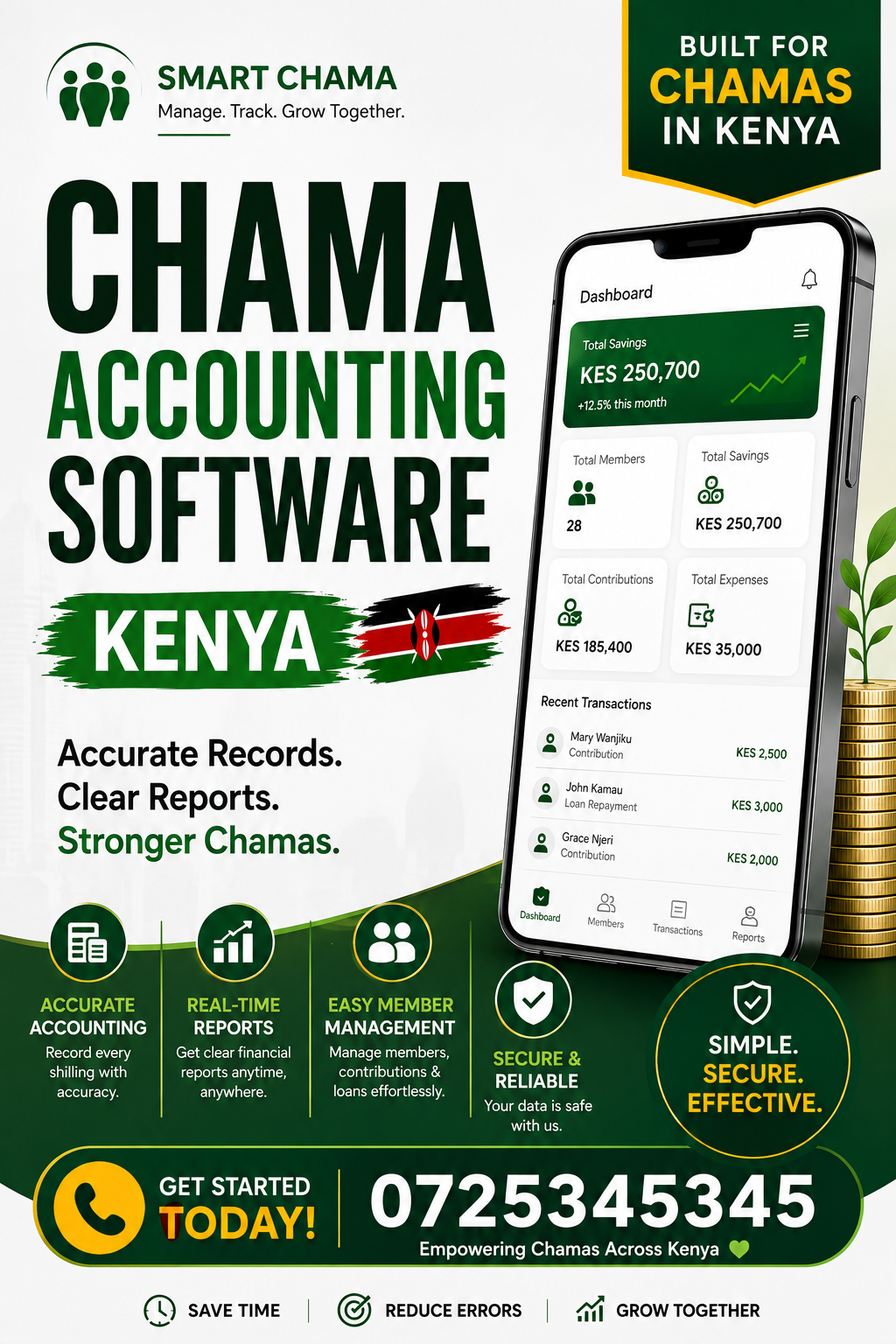
Managing Chama Finances Digitally in Kenya
Running a chama involves much more than collecting money every month. A group may have regular contributions, welfare funds, loans, repayments, penalties, expenses, investments, meetings and budgets to manage. As the number of members and transactions increases, keeping everything in notebooks and spreadsheets can become difficult. This is where Chama Accounting Software Kenya can help Kenyan groups organise financial and administrative information in a more structured way.
A small chama may initially manage its finances using an exercise book, Excel spreadsheet, WhatsApp messages and M-Pesa transaction confirmations. These methods can work for a limited number of members. However, the larger the group becomes, the more difficult it is to maintain accurate records across several separate sources.
Modern group-management platforms are designed to bring related records together. TAS, for example, describes its platform as supporting contributions, loans, meetings, budgets, reports and member records for Kenyan groups.
What Is Chama Accounting Software?
Chama Accounting Software Kenya refers to a digital system designed to help a chama organise its financial records and related administrative activities.
Instead of maintaining separate records for every financial activity, the group can use one structured environment for important information.
Depending on the platform, this may include:
- Member records
- Contributions
- Savings
- Welfare funds
- Loans
- Loan repayments
- Income
- Expenses
- Budgets
- Meetings
- Financial reports
- Member statements
- User permissions
- Historical records
The purpose is not simply to replace an exercise book with a computer screen. A useful system should make it easier to connect financial activities and understand what is happening within the group.
For example, when a member contributes KSh 5,000, the contribution should be associated with the correct member and financial period. If the same member later receives a loan, the loan should also be connected to that member. When repayments are made, the outstanding balance should be updated appropriately.
This creates a connected financial record instead of isolated transactions.
Why Kenyan Chamas Are Moving Away From Manual Records
Chama Accounting Software Kenya becomes particularly useful when a group starts experiencing the limitations of manual administration.
Consider a chama with 20 members. If every member contributes once a month, the treasurer already has 240 contribution records to manage annually.
Now add:
- Loan applications
- Loan repayments
- Welfare contributions
- Penalties
- Meeting expenses
- Bank charges
- Investment income
- Administrative costs
- Special contributions
The number of transactions can increase quickly.
A chama with 100 members could easily have thousands of financial entries over several years. Finding an old transaction in a notebook becomes difficult, while a spreadsheet may become complicated if multiple people are editing it.
Chama Accounting Software Kenya can provide a central place where authorised officials record and review these activities.
This can be especially useful when a treasurer changes. Instead of handing over several books, spreadsheets and WhatsApp conversations, the outgoing treasurer can hand over access to the organisation’s central records.
Managing Member Contributions
Contributions are usually at the heart of chama finances.
A group may have a monthly contribution of KSh 5,000 per member. It may also have separate welfare contributions, emergency contributions or investment contributions.
Keeping these categories separate is important.
For example:
| Contribution Type | Monthly Amount |
|---|---|
| Main savings | KSh 5,000 |
| Welfare | KSh 500 |
| Investment fund | KSh 1,000 |
| Emergency fund | KSh 300 |
A member may therefore contribute KSh 6,800 in a particular month, but the money does not necessarily belong to one category.
Chama Accounting Software Kenya can help a group maintain more organised contribution records by associating payments with members and contribution categories.
This is important when preparing reports because the committee may need to know not only how much money has been received, but also where that money belongs.
A good contribution process should answer questions such as:
- Who has contributed?
- How much was expected?
- How much was received?
- Which period does the payment cover?
- Is the payment for savings or welfare?
- Are there outstanding contributions?
- Was a payment reversed or corrected?
The system should support the group’s approved contribution rules rather than forcing the group to change its constitution simply to fit the software.
Tracking Loans and Repayments
Loans are another area where manual calculations can become complicated.
Many Kenyan chamas provide loans to members using rules established by the group. The rules may determine the maximum loan amount, interest rate, repayment period, guarantor requirements and penalties.
For example, a chama could approve a KSh 100,000 loan for a member to be repaid over ten months.
The financial records may need to show:
- Loan approval date
- Principal amount
- Interest
- Repayment schedule
- Amount repaid
- Remaining balance
- Due dates
- Guarantors
- Penalties where applicable
Chama Accounting Software Kenya can help organise this information in a structured workflow.
TAS’s published material describes workflows involving loan applications, guarantors, schedules, repayments and balances.
This is useful because loan records should not exist separately from member records.
A member’s financial history may include contributions, loans, repayments and other transactions. Keeping these activities connected makes reporting easier.
Handling Income and Expenses
Not every financial transaction in a chama is a contribution.
Groups can receive income from:
- Loan interest
- Penalties
- Investment proceeds
- Membership fees
- Other approved activities
They can also have expenses such as:
- Meeting costs
- Bank charges
- Administrative expenses
- Welfare payments
- Investment-related expenses
- Professional services
Chama Accounting Software Kenya can help the treasurer categorise these transactions instead of recording everything under a generic “money in” or “money out” heading.
Clear categories are useful when preparing financial reports.
For example, if a group spends KSh 25,000 during a month, members may want to know whether the money went toward welfare, administration, investment expenses or another approved activity.
The financial system should make it possible to trace the transaction back to its source information.
TAS’s published guidance specifically discusses income, expenses and cashbook records alongside contributions, loans, meetings and reports.
Creating Better Financial Reports
A treasurer may spend considerable time preparing reports before a chama meeting.
Without a structured system, the treasurer may need to collect information from:
- A contribution spreadsheet
- A loan spreadsheet
- A notebook
- M-Pesa messages
- Bank statements
- Receipts
- Previous meeting records
This creates opportunities for inconsistencies.
Chama Accounting Software Kenya can reduce this administrative burden where the required reporting functions are available.
Useful reports may include:
- Member register
- Contribution summary
- Individual member statements
- Arrears report
- Active loan report
- Loan repayment report
- Income report
- Expense report
- Meeting and attendance report
TAS’s financial reporting guidance identifies these types of reports as useful records for chama administration.
The important point is that software does not automatically make financial information accurate. Reports are only as reliable as the transactions entered into the system.
The committee should therefore establish procedures for recording and checking transactions.
Individual Member Statements
Members often want to understand their personal financial position.
A member may ask:
“How much have I contributed this year?”
“How much do I still owe?”
“How much have I repaid?”
“Do I have outstanding arrears?”
“How much is recorded under my name?”
Chama Accounting Software Kenya can make it easier to organise member-specific information where statement functionality is available.
A useful member statement could include:
| Item | Example |
|---|---|
| Main contributions | KSh 60,000 |
| Welfare contributions | KSh 6,000 |
| Loan received | KSh 100,000 |
| Loan repayments | KSh 50,000 |
| Outstanding loan | KSh 50,000 |
Member statements also support transparency.
Instead of waiting for the treasurer to manually calculate a member’s history, the information can be retrieved from the central system.
However, access should be controlled. A member should not automatically have access to confidential financial information belonging to other members.
Managing Arrears
Late contributions can affect a chama’s financial planning.
Suppose ten members are expected to contribute KSh 5,000 each month. The expected collection is KSh 50,000.
If three members fail to pay, the group receives only KSh 35,000.
The committee therefore needs to know not only how much money has been received but also how much remains outstanding.
Chama Accounting Software Kenya can help officials identify outstanding contributions where the system supports arrears reporting.
An arrears report can help answer:
- Which members have outstanding contributions?
- How much is outstanding?
- Which contribution period is affected?
- Are there repeated late payments?
- Has the member made a partial payment?
This information can then be discussed according to the group’s constitution and agreed policies.
Software should support the process; it should not replace the committee’s decisions.
Budget Management for Chamas
A budget gives a chama a plan for how money will be used.
For example, the group could prepare an annual budget covering:
| Category | Annual Budget |
|---|---|
| Meetings | KSh 30,000 |
| Administration | KSh 20,000 |
| Welfare | KSh 100,000 |
| Investment | KSh 300,000 |
| Bank charges | KSh 10,000 |
The actual figures will depend on the group’s activities.
Chama Accounting Software Kenya can support better budget monitoring where budgeting features are included.
A budget becomes more useful when the group can compare planned spending with actual spending.
For example, if KSh 30,000 was budgeted for meetings but KSh 48,000 has already been spent, the committee can investigate the difference.
This does not necessarily mean that the spending was wrong. There may have been an approved reason.
The value of the system is that it makes the difference visible.
Connecting Meetings With Financial Decisions
Chamas make important decisions during meetings.
Members may approve:
- Loans
- Investments
- Budgets
- Welfare payments
- New contribution rules
- Changes in membership
- Major expenses
Chama Accounting Software Kenya can be particularly useful when financial records and meeting records are managed within the same organisational environment.
For example:
Meeting decision → Approved budget → Expense → Financial report
This creates a clearer relationship between what the group decided and what was subsequently recorded.
TAS describes meeting functionality alongside contributions, loans, budgets and reporting.
A committee should still maintain proper meeting minutes and approvals according to its constitution.
Role-Based Access
Not every official should have unrestricted access to every function.
The chairperson, treasurer and secretary may have different responsibilities.
For example:
| Role | Possible Responsibility |
|---|---|
| Chairperson | Oversight and approvals |
| Treasurer | Financial records |
| Secretary | Members and meetings |
| Auditor | Review |
| Ordinary member | Approved personal information |
Chama Accounting Software Kenya should therefore be evaluated based on its user-permission controls.
TAS states that its platform supports role-based access.
Role-based access can reduce the risk of every user sharing the same administrator account.
It can also create clearer accountability.
If responsibilities are separated properly, the group can establish who is allowed to enter transactions, approve activities, generate reports or make administrative changes.
Security and Financial Records
Financial records should be treated carefully.
A chama may store names, member details, contribution histories, loan information and other sensitive organisational data.
Chama Accounting Software Kenya should therefore be assessed for security controls as well as accounting features.
Questions to ask a provider include:
- How are accounts protected?
- Are user permissions available?
- Are backups maintained?
- Can access be removed when an official leaves?
- Can records be exported?
- Is activity history available?
- How is data stored?
- What happens if an account administrator changes?
TAS’s published material describes secure access, cloud functionality, backups, audit history and data export capabilities.
Security is particularly important during leadership transitions.
An outgoing treasurer should not remain the only person who knows where financial records are stored.
Why Cloud-Based Records Can Help
Traditional records are often stored in one physical location.
If the treasurer keeps the main chama book at home, other officials may have limited access to it.
A laptop-based spreadsheet can create a similar problem if the file exists only on one computer.
Chama Accounting Software Kenya can provide a central digital workspace when the selected platform operates through cloud infrastructure.
Cloud-based access can make it easier for authorised officials to access records from different locations.
For a Kenyan chama whose officials live or work in different parts of Nairobi, Kiambu, Machakos, Nakuru or other counties, this can be convenient.
However, cloud access should always be combined with proper passwords, user permissions and account management.
Convenience should not come at the expense of security.
M-Pesa and Chama Accounting
M-Pesa is an important part of everyday financial activity in Kenya.
Many chama members may send contributions using mobile money.
However, receiving a payment confirmation is not the same as maintaining a complete accounting record.
Chama Accounting Software Kenya can help organise the accounting side of transactions, but the committee should understand exactly what the platform does and does not integrate with.
For example, TAS’s current cashbook guidance specifically states that TAS should not be presented as a bank feed, M-Pesa integration or automatic reconciliation service. Officials remain responsible for checking entries against approved source evidence.
This distinction matters.
A chama should establish a reconciliation process.
For example:
- Member sends payment.
- Treasurer verifies the transaction.
- Transaction is recorded.
- Member and contribution category are selected.
- Supporting reference is retained.
- Records are reviewed.
- Period totals are compared against independent statements.
This provides stronger financial control than simply assuming that every mobile-money message represents a correctly recorded contribution.
Reconciling Chama Records
Reconciliation means comparing records against an independent source.
For example, a treasurer might compare the chama’s recorded transactions with official payment or bank statements.
Chama Accounting Software Kenya can be useful as part of a structured record-keeping process, but reconciliation still requires human review.
Suppose the software says KSh 500,000 was received during the month.
The treasurer should not automatically assume the figure is correct.
The committee may need to verify:
- Duplicate entries
- Missing transactions
- Reversals
- Incorrect member assignments
- Incorrect amounts
- Wrong contribution categories
- Unmatched payments
TAS’s reporting guidance also highlights the importance of matching reports against official payment and bank records.
This is one reason why accounting software should be viewed as a control tool rather than a replacement for financial oversight.
Cashbook Management
A cashbook records money coming into and going out of the organisation.
For a chama, this can include:
- Contributions
- Loan repayments
- Loan interest
- Penalties
- Welfare payments
- Meeting expenses
- Bank charges
- Investment income
- Administrative expenses
Chama Accounting Software Kenya can make these records easier to organise when cashbook functionality is included.
A useful cashbook should make it possible to identify the date, amount, category, description and supporting reference for a transaction.
The treasurer should also establish a routine for reviewing entries.
For example, weekly review can identify mistakes before they become difficult to correct.
Monthly review can support the preparation of financial reports.
Annual review can help prepare for an AGM or external review.
Audit Trails and Accountability
An audit trail helps explain what happened to a record.
For example, if an expense was changed, the organisation may want to know who made the change and when.
Chama Accounting Software Kenya can be evaluated for audit-history functionality when accountability is an important requirement.
TAS’s published materials describe audit history as part of its capabilities and include it in its published Growth plan information.
Audit history is useful because financial administration involves people.
People can make mistakes.
They can enter the wrong amount.
They can select the wrong member.
They can forget to record a transaction.
A history of changes can help officials investigate discrepancies instead of simply guessing what happened.
Leadership Handover
Leadership changes are normal in chamas.
One year, one person may be treasurer.
The next year, another member may take over.
If the financial system depends heavily on one person’s personal knowledge, handover can become stressful.
Chama Accounting Software Kenya can provide a central record that supports continuity.
The incoming treasurer can review:
- Current membership
- Contribution history
- Outstanding balances
- Loans
- Repayments
- Expenses
- Budgets
- Reports
- Previous decisions
This can reduce dependence on the outgoing official’s personal files.
TAS’s published chama-management guidance specifically identifies organisational continuity as an advantage of maintaining records within a central workspace.
A proper handover should still include passwords, permissions, documentation and any relevant physical records according to the organisation’s procedures.
Choosing the Right System for a Chama
Not every accounting platform is designed for member-based groups.
A general accounting package may provide standard financial functions but lack the workflows that a chama needs.
Chama Accounting Software Kenya should be evaluated against the group’s actual activities.
Before subscribing, ask:
Does it manage members?
The system should make it possible to maintain an accurate member register.
Does it handle contributions?
The group should be able to record different contribution types and associate them with the correct members.
Does it manage loans?
If the chama provides loans, the system should support the required loan workflow.
Does it provide reports?
The committee should identify the reports it actually needs.
Does it support permissions?
Different officials may require different levels of access.
Can records be exported?
Data export can be important for continuity and future migration.
Is support available?
The committee should know how technical problems are handled.
Testing Before Implementation
A common mistake is subscribing to software without testing a realistic workflow.
Chama Accounting Software Kenya should be tested using the type of transactions the chama actually handles.
Create sample members.
Enter sample contributions.
Create a test loan.
Record repayments.
Add an expense.
Prepare a report.
Then check whether the information is accurate.
TAS currently advertises a 14-day trial for its plans, giving groups an opportunity to test the platform before making a longer-term decision.
A test should not only involve clicking around the dashboard.
The committee should simulate a normal month.
For example:
Week 1: Member contributions are recorded.
Week 2: A loan is approved.
Week 3: A loan repayment is entered.
Week 4: An expense is recorded and the monthly report is generated.
If the system handles the complete workflow comfortably, it is more likely to fit the group’s needs.
Cost Considerations
Price matters, but it should not be the only consideration.
Chama Accounting Software Kenya should be evaluated based on value rather than subscription cost alone.
A cheap system that produces unreliable reports may cost the group more in administrative time and corrections.
A more expensive system may be worthwhile if it significantly reduces manual work and improves financial visibility.
TAS currently publishes two plans, including an Essential plan listed at KSh 7,500 per quarter and a Growth plan listed at KSh 12,000 per quarter. Its published information also states that both plans include a 14-day trial. Pricing and plan terms should always be confirmed before purchase because they can change.
A committee can compare:
| Consideration | Question |
|---|---|
| Price | What will the group pay? |
| Members | How many members are supported? |
| Users | How many officials need access? |
| Reports | Are required reports available? |
| Loans | Are loan workflows supported? |
| Security | Are permissions available? |
| Support | How are issues handled? |
| Export | Can records be exported? |
| Trial | Can the committee test it first? |
This creates a more practical basis for choosing software.
Moving From Excel to a Digital System
Many Kenyan chamas already have years of records in Excel.
Moving to a digital platform therefore requires planning.
Chama Accounting Software Kenya can support a more structured future workflow, but the group should first clean its existing information.
Before migration, review:
- Duplicate members
- Inactive members
- Incorrect balances
- Missing transactions
- Old loans
- Outstanding contributions
- Incorrect categories
- Incomplete member information
Do not simply upload a messy spreadsheet and expect the new platform to automatically fix everything.
A better approach is to establish a clean starting point.
For example:
Step 1: Confirm the active member list.
Step 2: Confirm opening balances.
Step 3: Review outstanding loans.
Step 4: Review contribution arrears.
Step 5: Confirm categories.
Step 6: Import or enter verified information.
Step 7: Compare opening figures with approved records.
This can reduce future confusion.
Managing Welfare Funds
Many Kenyan chamas have welfare activities in addition to savings and loans.
Members may contribute specifically toward emergencies, medical support, funerals or other approved welfare activities.
Chama Accounting Software Kenya can help the group distinguish welfare-related transactions from ordinary savings when the system supports separate categories.
This distinction matters.
Suppose a group has KSh 500,000 in total recorded contributions.
It would be misleading to treat all of that money as available for investment if some of it belongs to a welfare fund.
Proper categorisation therefore helps the committee understand what funds are available for different purposes.
The constitution and financial policies of the chama should determine how welfare funds are collected and used.
Investment Groups and Chamas
Some chamas operate primarily as investment groups.
Their financial activities may include:
- Property investments
- Shares
- Businesses
- Land
- Money-market investments
- Other approved projects
Chama Accounting Software Kenya can support the record-keeping side of these activities where the required features are available.
However, software should not replace investment due diligence.
The group still needs to establish:
- Who approves investments?
- What voting threshold applies?
- Who signs agreements?
- How is ownership recorded?
- How are returns reported?
- How are investment expenses handled?
TAS’s published guidance also recommends maintaining records such as member registers, contribution ledgers, approved budgets, meeting minutes, income and expense records and contracts or ownership documents for investment groups.
Financial Transparency During Meetings
Members are more likely to participate confidently when financial information is understandable.
Chama Accounting Software Kenya can help officials prepare structured information for regular meetings.
Instead of presenting a long spreadsheet, the treasurer can organise the meeting around key figures:
- Total contributions
- Outstanding contributions
- Active loans
- Loan repayments
- Income
- Expenses
- Budget performance
- Available funds
This makes discussions more focused.
Members can also ask questions based on specific figures rather than relying on general statements.
For example:
“Why were expenses KSh 10,000 above budget?”
“Which members have outstanding contributions?”
“How much has been collected from loan interest?”
“What is the total outstanding loan balance?”
Good records make these questions easier to investigate.
Reducing Dependence on One Treasurer
A chama should not depend entirely on one person.
When only one person understands the financial records, the group becomes vulnerable if that person leaves, loses access or becomes unavailable.
Chama Accounting Software Kenya can support shared organisational visibility through authorised access.
This does not mean everyone should have full administrative privileges.
Instead, responsibilities can be divided.
The treasurer handles financial entries.
The secretary handles member or meeting information.
The chairperson provides oversight.
An auditor or authorised reviewer checks reports.
This separation can strengthen internal controls.
Common Mistakes to Avoid
Implementing software does not automatically eliminate poor financial practices.
A chama can still make mistakes.
Chama Accounting Software Kenya should therefore be accompanied by clear procedures.
Common mistakes include:
Entering transactions late
When transactions are entered weeks later, it becomes easier to forget details.
Using unclear categories
Recording every transaction as “other” makes reports less useful.
Sharing administrator passwords
Each authorised user should ideally have their own account where the platform supports it.
Failing to reconcile
Digital records still need to be checked against source evidence.
Ignoring old records
Outstanding balances should be verified rather than simply carried forward without review.
Failing to document approvals
Major expenses and loans should follow the group’s approved processes.
Monthly Chama Accounting Routine
A simple monthly routine can make digital financial management easier.
Chama Accounting Software Kenya can be used as part of a repeatable process rather than only when a report is required.
A monthly routine could look like this:
1. Record contributions
Enter all verified payments.
2. Review arrears
Identify members with outstanding contributions.
3. Update loans
Record repayments and review balances.
4. Record income
Enter interest, penalties and other approved income.
5. Record expenses
Categorise all approved spending.
6. Reconcile
Compare records with official supporting information.
7. Review exceptions
Investigate unusual balances or missing transactions.
8. Generate reports
Prepare information needed for the monthly meeting.
9. Present key figures
Share relevant information with members according to the group’s governance rules.
This routine can become much easier when the system stores related records in one place.
Annual Chama Financial Review
At the end of a financial year, the group may need a broader review.
Chama Accounting Software Kenya can help organise information needed for that review where the relevant reporting features are available.
The committee can review:
- Opening balances
- Total contributions
- Loan disbursements
- Loan repayments
- Interest income
- Expenses
- Welfare payments
- Investments
- Outstanding balances
- Budget performance
- Member statements
Before an AGM, reports should be checked carefully.
TAS recommends preparing records such as the member register, contribution summary, loan reports, income and expense information, budget comparisons and meeting records for annual reviews.
The exact requirements will depend on the group’s structure and governing documents.
Data Export and Continuity
A chama should consider what happens if it stops using a particular platform.
Chama Accounting Software Kenya should ideally be evaluated for data export and continuity options.
Exportability can be useful if:
- The committee changes providers.
- A backup is required.
- An auditor requests records.
- Members need historical information.
- The organisation needs to archive information.
TAS’s published plan information states that data export is available.
Before subscribing, the committee should understand what can be exported, in which format and whether all relevant records are included.
Supporting a Growing Chama
The needs of a 15-member chama can be very different from those of a 500-member organisation.
Chama Accounting Software Kenya should therefore be assessed based on both current and expected future requirements.
A group should ask:
“How many members might we have in three years?”
“How many officials will need access?”
“How many transactions do we process every month?”
“Will we open another branch?”
“Will we add investment activities?”
“Will our loan portfolio grow?”
Scalability matters because changing systems repeatedly can create additional administrative work.
TAS currently publishes plans with different member and administrative-user limits, including a Growth plan that supports up to 500 members and multiple branches according to its current published pricing information.
Practical Example: A 50-Member Chama
Consider a chama with 50 members.
Each member contributes KSh 5,000 monthly.
The group therefore expects KSh 250,000 in monthly contributions.
Chama Accounting Software Kenya could help organise these records if the platform’s contribution features match the group’s requirements.
During the same month:
- Three members receive loans.
- Five members repay existing loans.
- The group spends KSh 12,000 on approved expenses.
- Members contribute KSh 25,000 to welfare.
- The group receives KSh 8,000 in loan interest.
The treasurer now has several different types of transactions to record.
A structured system can connect these transactions with members and categories, making it easier to prepare a monthly report.
The committee can then see not just the amount of money received but also how the funds were categorised.
Practical Example: A 200-Member Organisation
Now consider a group with 200 members.
If every member makes one contribution per month, there can be 2,400 contribution records in a year before loans, expenses and other transactions are considered.
Chama Accounting Software Kenya becomes more relevant as the volume of information increases.
The group may need:
- Multiple administrative users
- Better reporting
- Member statements
- Loan monitoring
- Contribution tracking
- Expense categories
- Role-based permissions
- Historical records
- Data exports
At this scale, relying on one spreadsheet can create significant administrative pressure.
Digital systems can help by providing a structured environment.
Questions a Chama Should Ask a Software Provider
Before choosing a platform, the committee should prepare questions.
Chama Accounting Software Kenya should not be selected simply because the website lists many features.
Ask the provider:
- How are member records managed?
- Can different contribution types be created?
- Can loans and repayments be tracked?
- Can expenses be categorised?
- Which financial reports are available?
- Are member statements available?
- Can user permissions be customised?
- Is there an audit history?
- Can records be exported?
- Is there a free trial?
- How is customer support provided?
- What happens when a subscription ends?
The answers should then be compared against the chama’s actual needs.
Frequently Asked Questions
What is Chama Accounting Software?
Chama Accounting Software Kenya is a digital system designed to help chamas organise financial and related administrative records such as contributions, loans, expenses, income and reports.
The exact features vary by provider.
Can accounting software track member contributions?
Yes, many systems provide contribution-management functionality. A chama should confirm whether the software can handle its specific contribution categories, payment periods and reporting requirements.
Chama Accounting Software Kenya can be useful for this purpose when the platform supports the group’s required contribution workflow.
Can a chama use software to manage loans?
Yes. Some platforms support loan applications, approvals, guarantors, repayment schedules, repayments and outstanding balances.
Chama Accounting Software Kenya can therefore be considered by groups that want to connect loan information with member records and financial reports.
The group should verify that the system supports its specific interest, penalty and repayment rules.
Does software replace the chama treasurer?
No.
Software is a tool for organising records and supporting financial administration. The treasurer and committee remain responsible for reviewing transactions, following the group’s constitution and making financial decisions.
Chama Accounting Software Kenya should therefore be viewed as a support system rather than a replacement for financial responsibility.
Can accounting software handle expenses?
Many platforms can record income and expenses.
Chama Accounting Software Kenya can be useful where expense categorisation and reporting are included.
The group should define appropriate expense categories before implementation.
Can members receive financial statements?
Some systems provide member-specific statements.
Chama Accounting Software Kenya may be useful where statement functionality is available and properly configured.
The group should also establish what information each member is entitled to access.
Is M-Pesa automatically connected to chama accounting software?
Not necessarily.
A group should never assume that software automatically imports or reconciles M-Pesa transactions.
TAS’s current cashbook guidance specifically distinguishes its system from a bank feed, M-Pesa integration or automatic reconciliation service.
Chama Accounting Software Kenya should therefore be evaluated carefully based on its actual integration capabilities rather than assumptions.
Is cloud software safe for chama records?
Cloud systems can provide convenient access and centralised records, but security depends on the provider’s controls and how users manage their accounts.
Chama Accounting Software Kenya should be evaluated for authentication, permissions, backups, account management and other security features.
Can a chama use software if it currently uses Excel?
Yes.
A group can begin by reviewing and cleaning its existing records before entering or importing verified information into a new platform.
Chama Accounting Software Kenya can support the transition when its data-import or data-entry options match the group’s needs.
How much does chama accounting software cost?
Prices vary depending on the provider, number of members, features, administrative users and billing period.
TAS currently publishes quarterly plans, including an Essential plan at KSh 7,500 per quarter and a Growth plan at KSh 12,000 per quarter, with a 14-day trial according to its current published pricing page.
Chama Accounting Software Kenya should therefore be compared based on both cost and the actual value provided.
How can a chama test accounting software?
The best approach is to use a realistic test scenario.
Chama Accounting Software Kenya can be evaluated by creating test members, recording contributions, entering loans and repayments, adding expenses and generating reports.
The committee should then check whether the results match the expected figures.
What reports should a chama have?
A practical reporting setup may include:
- Member register
- Contribution summary
- Member statements
- Arrears report
- Active loan report
- Loan repayment report
- Income report
- Expense report
- Meeting and attendance report
Chama Accounting Software Kenya can be assessed against these reporting requirements before a group commits to a platform.
Can software improve accountability?
It can support accountability by centralising records, separating user permissions, maintaining transaction histories and making reports easier to prepare.
However, software alone cannot prevent fraud or guarantee accurate information.
Chama Accounting Software Kenya works best when combined with clear financial procedures, approvals, reconciliation and regular review.
Should every member have administrator access?
Usually, there is little reason for every member to have full administrative access.
Chama Accounting Software Kenya should ideally allow the group to assign appropriate permissions to different users.
The exact arrangement should follow the chama’s constitution and internal-control procedures.
Building a Simple Digital Chama Workflow
A chama does not need to make the implementation unnecessarily complicated.
A practical workflow can be:
Member registration
↓
Contribution recording
↓
Loan application
↓
Loan approval
↓
Loan disbursement
↓
Repayment recording
↓
Income and expense recording
↓
Reconciliation
↓
Financial reporting
↓
Committee review
Chama Accounting Software Kenya can support this type of connected process where the selected platform provides the relevant functions.
The benefit of this approach is that each financial activity becomes part of a wider record rather than a separate spreadsheet.
What a Treasurer Should Review Every Month
A monthly review can be relatively simple.
Chama Accounting Software Kenya can help organise the information required for the review.
The treasurer can check:
- Total contributions
- Contribution arrears
- Loan balances
- Loan repayments
- Income
- Expenses
- Cash or bank balances
- Budget performance
- Unusual transactions
- Missing supporting information
The committee can then discuss significant issues during its meeting.
This creates a consistent financial-management routine instead of waiting until the end of the year to discover discrepancies.
Why Accurate Data Matters
Even the best software cannot correct information that was entered incorrectly.
Chama Accounting Software Kenya therefore needs to be supported by accurate data-entry procedures.
Before saving a transaction, the official should verify:
- Correct member
- Correct amount
- Correct date
- Correct category
- Correct reference
- Correct transaction type
Small errors can accumulate.
For example, entering KSh 50,000 instead of KSh 5,000 creates a KSh 45,000 difference.
Regular reviews can help identify such mistakes early.
Getting the Committee Involved
Software implementation should not be the treasurer’s private project.
Chama Accounting Software Kenya should be introduced to the relevant committee members so that everyone understands the purpose of the system.
A short implementation meeting can cover:
- Why the chama is moving to digital records.
- What information will be stored.
- Who will have access.
- Who will enter transactions.
- How records will be checked.
- How reports will be prepared.
- How leadership handover will work.
This makes the software part of the organisation’s process rather than simply another application that one person uses.
Creating Better Financial Discipline
Technology is most effective when combined with discipline.
Chama Accounting Software Kenya can make information easier to organise, but the group still needs rules.
For example:
- Record transactions promptly.
- Keep supporting evidence.
- Review entries regularly.
- Separate financial responsibilities.
- Reconcile records.
- Protect user accounts.
- Review reports.
- Document major decisions.
- Maintain backups or exports where appropriate.
These practices can make digital accounting more reliable.
When a Chama Has Outgrown Spreadsheets
Excel remains a useful tool.
It can be appropriate for a small group with limited transactions.
However, the warning signs that a group may need a dedicated system include:
- Too many spreadsheets
- Frequent calculation errors
- Difficulty finding old transactions
- Delayed monthly reports
- Unclear loan balances
- Frequent contribution disputes
- One person controlling all records
- Difficult leadership handovers
- Increasing membership
- Increasing transaction volume
Chama Accounting Software Kenya can be considered when these problems begin affecting the group’s normal operations.
The goal is not to use technology simply because it is modern.
The goal is to solve actual administrative problems.
A Practical Implementation Checklist
Before going live, the committee can use this checklist:
Members
- Confirm active member list
- Remove duplicates
- Verify contact information
- Confirm membership status
Contributions
- Define contribution categories
- Confirm monthly amounts
- Confirm outstanding balances
- Establish recording procedure
Loans
- Verify outstanding loans
- Confirm repayment balances
- Confirm interest rules
- Confirm guarantor requirements
Expenses
- Create expense categories
- Confirm approval procedures
- Establish supporting-document requirements
Reports
- Identify monthly reports
- Identify AGM reports
- Identify member statements
- Identify arrears reports
Security
- Create individual user accounts
- Assign appropriate permissions
- Remove unnecessary access
- Establish handover procedures
Chama Accounting Software Kenya can be tested against this checklist before the group makes a final implementation decision.
The Role of Digital Records in Modern Chama Management
Kenyan chamas are increasingly handling larger amounts of information.
A group can begin with ten friends saving money every month.
Over time, that same group may become a structured organisation with dozens or hundreds of members, multiple financial activities, loans, investments and formal leadership structures.
Chama Accounting Software Kenya can help such organisations move from scattered records toward a more connected digital environment.
The most important consideration remains accuracy.
A system should make it easier to answer practical questions:
How much has been collected?
Who has contributed?
Who is in arrears?
How much is currently loaned out?
How much has been repaid?
What expenses have been incurred?
What income has been generated?
What decisions were approved?
What reports support the current figures?
When the answers are supported by organised records, the committee can spend less time searching through files and more time managing the group.
Final Selection Checklist for Kenyan Chamas
Before selecting a platform, the committee can score each option against the following areas:
| Requirement | Priority |
|---|---|
| Member management | Very high |
| Contribution tracking | Very high |
| Loan management | Very high |
| Repayment tracking | Very high |
| Income and expenses | Very high |
| Financial reporting | Very high |
| Member statements | High |
| User permissions | High |
| Audit history | High |
| Cloud access | High |
| Data export | High |
| Meeting management | Medium to high |
| Budget management | High |
| Customer support | High |
| Price | High |
| Trial availability | High |
Chama Accounting Software Kenya should ultimately be selected according to how well it handles the group’s real workflows rather than how many features appear on a marketing page.
A committee can shortlist two or three platforms, test them using the same sample transactions and compare the resulting reports.
That approach gives members a practical basis for decision-making.
A Simple Example of a Monthly Financial Review
Imagine a chama begins the month with KSh 600,000.
During the month:
- Contributions received: KSh 250,000
- Loan repayments: KSh 80,000
- Loan interest: KSh 15,000
- Welfare contributions: KSh 25,000
- Expenses: KSh 20,000
- New loans issued: KSh 150,000
Chama Accounting Software Kenya can help organise these figures into appropriate transaction categories.
The committee can then review the activity rather than simply looking at one bank balance.
The financial position can be understood by examining each component.
This is one of the main reasons structured financial records matter.
A single balance does not explain where the money came from, where it went or what obligations remain outstanding.
Making Chama Accounting Easier for Members
Members do not necessarily need to understand every accounting process.
They need understandable information.
Chama Accounting Software Kenya can support transparency when reports and statements are presented clearly.
For example, instead of giving members a large spreadsheet, the treasurer can provide relevant information such as:
- Total contributions
- Personal contribution balance
- Outstanding loan
- Repayments made
- Arrears
- Approved welfare contributions
This can reduce unnecessary confusion during meetings.
The committee should still decide what information should be shared and who can access it.
Preparing for Future Growth
A chama that currently has 30 members may eventually have 100.
Chama Accounting Software Kenya should therefore be evaluated not only against today’s requirements but also tomorrow’s.
Consider future needs such as:
- More members
- More loans
- More administrative users
- Multiple branches
- More investment activities
- More detailed reports
- More complex permissions
- Increased transaction volume
Choosing a system with room to grow can reduce the disruption associated with changing platforms later.
TAS currently publishes different plans based on member and administrative-user capacity, illustrating why these limits should be checked during software selection.
Practical Questions Before Going Live
Before switching from notebooks or spreadsheets, the committee should be able to answer:
Who will enter contributions?
Who will verify them?
Who approves loans?
Who records repayments?
Who records expenses?
Who reviews monthly reports?
Who manages users?
Who handles leadership handover?
Who checks discrepancies?
Who exports or archives records?
Chama Accounting Software Kenya becomes most useful when these responsibilities are clearly defined.
Technology should make an established process easier to follow.
It should not be expected to create governance where none exists.
Using a Trial Effectively
If a provider offers a trial period, do not use it only to explore the dashboard.
Chama Accounting Software Kenya should be tested using realistic scenarios.
Create at least five sample members.
Record several contributions.
Create an outstanding loan.
Record a repayment.
Add an expense.
Generate a contribution report.
Generate a loan report.
Generate a member statement.
Check the figures manually.
Ask whether another official can understand the system without extensive training.
This provides a much better evaluation than simply reading a feature list.
Questions for a Chama Committee Meeting
A committee discussing digital accounting can use these questions:
- What financial records currently take the most time to maintain?
- How often do members dispute balances?
- How long does monthly reporting take?
- Who currently controls the main records?
- What happens when the treasurer changes?
- Which reports do members need?
- How are loan balances currently calculated?
- How are expenses documented?
- How are M-Pesa or bank transactions verified?
- What would make a new system worth paying for?
Chama Accounting Software Kenya should be evaluated against the answers to these questions.
This keeps the decision focused on the group’s actual problems.
From Manual Administration to Structured Digital Management
Moving from a notebook to software is not simply a technology upgrade.
It can change how information flows through the organisation.
Chama Accounting Software Kenya can bring members, contributions, loans, repayments, income, expenses and reports into a more structured workflow.
A successful transition requires three things:
Good data
The starting information should be accurate.
Good processes
Officials should know how transactions are recorded and reviewed.
Good controls
Permissions, reconciliation and reporting procedures should be established.
When these three elements work together, digital accounting becomes much more useful.
Frequently Asked Questions About Implementation
How long does implementation take?
The timeframe depends on the size of the chama, the amount of historical data and how much information must be cleaned before migration.
A small group with clean records can move faster than a large group with several years of inconsistent spreadsheets.
Chama Accounting Software Kenya should therefore be implemented according to the group’s actual data and operational complexity.
Should old records be entered?
Important historical records should be retained according to the group’s needs and applicable requirements.
However, not every old transaction necessarily needs to be manually re-entered.
The committee can decide on an appropriate opening balance and historical-data strategy.
Should we keep our Excel files?
It can be useful to retain original records according to the group’s document-retention policy.
Chama Accounting Software Kenya should complement proper record retention rather than encourage the organisation to immediately destroy its historical documents.
Who should manage the software?
Usually, responsibility should be divided rather than concentrated in one person.
The treasurer may handle financial records while other authorised officials maintain oversight.
What happens when a treasurer leaves?
The organisation should deactivate or change the outgoing user’s access and assign the appropriate permissions to the incoming official.
This is much easier when records belong to the organisation rather than an individual’s personal account.
Final Practical Takeaway for Kenyan Chamas
A chama’s financial records are more than numbers in a spreadsheet. They show member contributions, loans, repayments, expenses, income, budgets and decisions made by the organisation.
Chama Accounting Software Kenya can help bring these records into a more structured environment when the selected platform matches the group’s needs.
The strongest implementation is one where members know how records are maintained, officials understand their responsibilities, financial information is reviewed regularly and reports can be traced back to supporting transactions.
For a small chama, this may mean replacing several notebooks with a simple digital workflow.
For a larger organisation, it may mean establishing role-based access, loan workflows, contribution categories, expense controls, monthly reconciliation, detailed reporting and formal handover procedures.
Chama Accounting Software Kenya can be evaluated using those practical requirements instead of choosing a system based only on its advertised features.
A committee can start by documenting its existing process, identifying the biggest weaknesses, preparing sample transactions and testing shortlisted platforms.
That gives the group a clear way to determine whether a digital accounting platform actually solves its day-to-day problems.
Chama Accounting Software Kenya
Chama Accounting Software Kenya
Chama Accounting Software Kenya
Chama Accounting Software Kenya
Chama Accounting Software Kenya
Chama Accounting Software Kenya
Chama Accounting Software Kenya