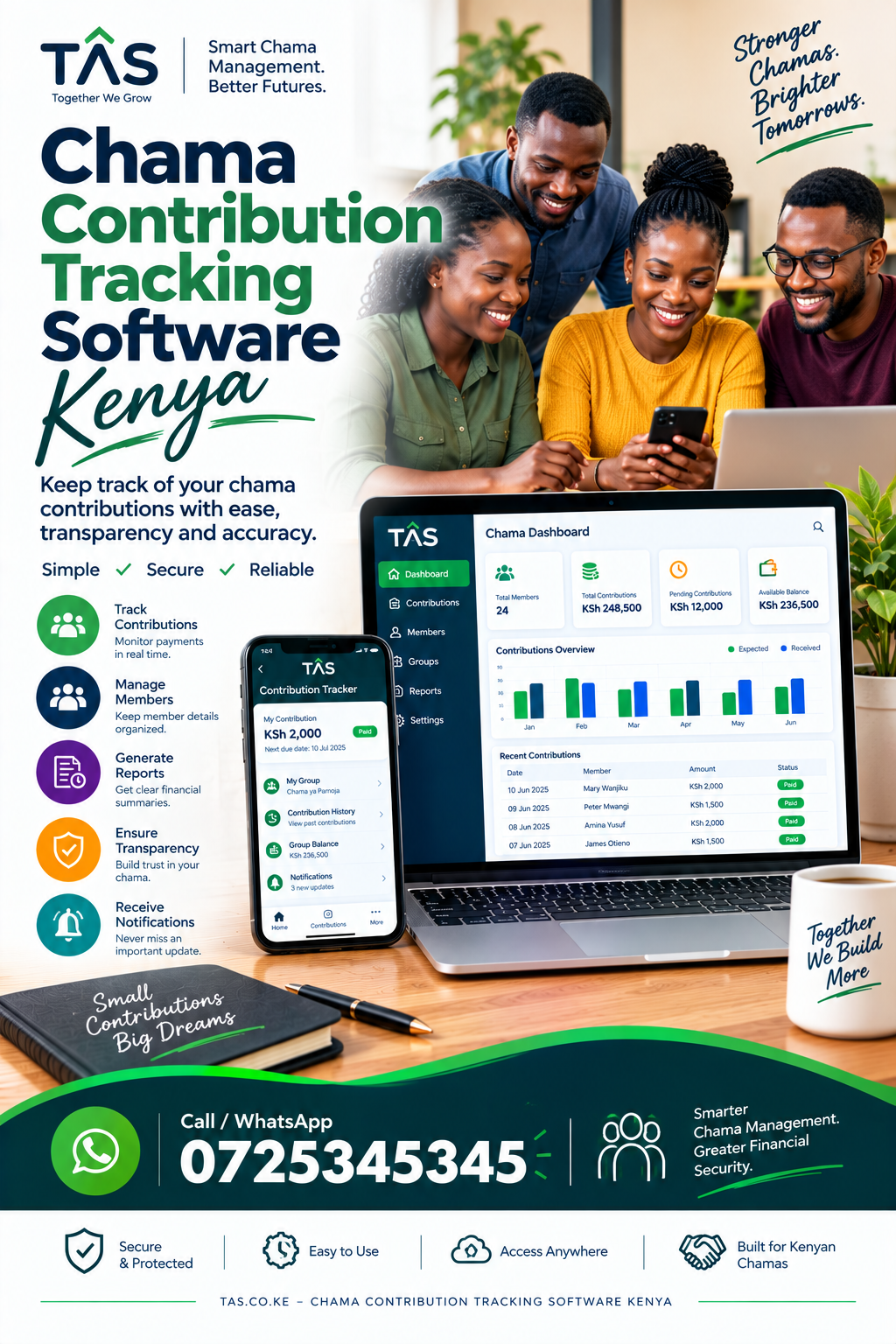
How Kenyan Chamas Can Improve Contribution Management
Managing contributions is one of the most important responsibilities in a chama. Whether a group has ten members or several hundred, accurate contribution records help members understand how much has been collected, who has paid, which payments are outstanding and how group funds are being used.
A modern Chama Contribution Tracking Software Kenya solution can bring these records into one organised digital environment instead of leaving them across notebooks, Excel files, WhatsApp messages and payment screenshots.
Kenyan chamas operate in many different ways. Some members contribute weekly, while others make monthly payments. Some groups have separate savings, welfare and investment contributions. Others collect money for specific projects, emergencies or table-banking activities.
As the number of transactions increases, manually tracking every payment becomes more difficult. A digital system can help the treasurer and committee maintain a clearer record while reducing repetitive calculations.
What Is Contribution Tracking for a Chama?
At its simplest, contribution tracking answers several important questions:
- Who is expected to contribute?
- How much should each member contribute?
- When is the contribution due?
- How much has the member actually paid?
- Which contribution category does the payment belong to?
- Is there an outstanding balance?
- What has the member contributed historically?
- How much has the entire group collected?
These questions appear simple when a chama has a few members. The situation changes when there are dozens or hundreds of members making payments at different times.
A structured Chama Contribution Tracking Software Kenya platform allows the group to organise these details around member records and contribution periods rather than relying entirely on manual calculations.
This is particularly useful for groups that have several contribution categories. A chama may have monthly savings, welfare contributions, investment contributions, emergency funds and special project contributions at the same time.
Instead of treating every payment as one general amount, the records can be organised according to the purpose approved by the group.
Why Contribution Records Matter
Contributions are often the foundation of a chama’s financial activities. They can provide the funds used for investments, loans, welfare support, projects and other activities approved by members.
Poor records can therefore create problems beyond bookkeeping.
For example, imagine a chama with 40 members. Every member is expected to contribute KSh 5,000 each month. The expected monthly collection is KSh 200,000.
If five members pay late, two members make partial payments and another member pays two months in advance, the treasurer needs more than a simple total.
They need to know exactly how each transaction affects each member’s balance.
This is where Chama Contribution Tracking Software Kenya can become useful. Instead of repeatedly calculating balances from separate documents, authorised officials can work from structured contribution records.
A reliable contribution record should normally show the member, amount, date, contribution category and relevant period. The group should also maintain supporting payment evidence according to its own procedures.
Moving Beyond Notebooks
Notebooks are still widely used by small groups because they are inexpensive and easy to start with.
A treasurer can write:
| Member | January | February | March |
|---|---|---|---|
| Member A | 5,000 | 5,000 | 5,000 |
| Member B | 5,000 | 3,000 | 5,000 |
| Member C | 5,000 | 5,000 | 0 |
For a very small group, this may be manageable.
However, the same method becomes harder when the number of members increases. More members mean more rows, more payment dates, more corrections and more opportunities for calculation errors.
A digital Chama Contribution Tracking Software Kenya platform can organise these transactions in a way that makes them easier to search, review and report.
The goal is not simply to replace paper with a computer.
The goal is to create a more reliable process for maintaining the group’s financial history.
The Problem With Using Multiple Excel Files
Excel can be a useful tool for a chama, especially during the early stages.
The challenge is that spreadsheets can easily become fragmented.
One treasurer may have the latest file on their laptop. Another official may have an older copy. A committee member may have a version that was shared through WhatsApp.
After several months, determining which spreadsheet represents the official record can become difficult.
A dedicated Chama Contribution Tracking Software Kenya solution can provide a central location for authorised contribution information.
This can also make leadership transitions easier.
When a new treasurer takes over, they should not have to reconstruct the group’s entire contribution history from the outgoing treasurer’s personal files.
Tracking Different Contribution Types
One of the major advantages of structured contribution management is the ability to distinguish between different types of payments.
For example, a chama might have:
Monthly Savings
This could be the regular amount members contribute toward the group’s main savings pool.
Welfare Contributions
These may support members during approved welfare situations.
Investment Contributions
A group may collect additional money for a particular investment.
Emergency Fund
Some groups maintain a separate fund for unexpected situations.
Project Contributions
A chama may temporarily collect money for land, construction, equipment or another approved project.
When all these payments are placed into one undifferentiated figure, reporting becomes difficult.
A Chama Contribution Tracking Software Kenya system can help officials maintain clearer categories, provided the categories are configured according to the group’s approved rules.
Member-Level Contribution Histories
A member should be able to have a clear contribution history.
For example:
| Date | Contribution | Category | Amount |
|---|---|---|---|
| 5 Jan | Monthly Savings | Savings | KSh 5,000 |
| 7 Feb | Monthly Savings | Savings | KSh 5,000 |
| 6 Mar | Welfare | Welfare | KSh 500 |
| 8 Mar | Monthly Savings | Savings | KSh 5,000 |
This type of history makes it easier to investigate questions.
If a member says, “I paid last month,” the treasurer should be able to check the record rather than searching through hundreds of WhatsApp messages.
A Chama Contribution Tracking Software Kenya solution can make member-level records easier to organise when contribution information is stored systematically.
Identifying Outstanding Contributions
Another important function is identifying members with unpaid or partially paid contributions.
Suppose 50 members are expected to contribute KSh 3,000 each month.
The expected collection is KSh 150,000.
If the actual collection is KSh 138,000, the committee needs to determine why there is a KSh 12,000 difference.
Is one member behind by KSh 12,000?
Are four members behind by KSh 3,000?
Did some members make partial payments?
Were some payments recorded under the wrong category?
Without member-level records, answering these questions can take considerable time.
With Chama Contribution Tracking Software Kenya, authorised officials can organise contribution information around individual members and periods.
Contribution Tracking and Chama Meetings
Monthly chama meetings often involve reviewing financial information.
Members may ask:
- How much did we collect this month?
- Who has not paid?
- How much is outstanding?
- How much is in the welfare fund?
- How much have we saved this year?
- Which members have arrears?
If the treasurer has to calculate everything manually during the meeting, valuable time can be lost.
A Chama Contribution Tracking Software Kenya platform can help officials prepare reports before meetings, allowing members to spend more time discussing decisions instead of reconstructing basic figures.
Reports should still be reviewed by authorised officials. Software does not remove the responsibility for checking financial information.
Reducing Contribution Disputes
Financial disputes can damage trust within a chama.
A member may believe they have paid while the treasurer’s records show an outstanding balance.
Sometimes the problem is not dishonesty. It may simply be poor record keeping.
A payment could have been made through M-Pesa but not entered into the group’s records. A receipt could have been misplaced. A payment could have been assigned to the wrong member.
A structured Chama Contribution Tracking Software Kenya process gives the group a clearer way to connect payments with members and contribution periods.
The group should also establish procedures for correcting errors rather than allowing officials to silently overwrite financial records.
M-Pesa and Chama Contributions
M-Pesa is an important payment method for many Kenyan groups.
However, a payment appearing in an M-Pesa statement does not automatically mean that the chama’s internal records are correct.
The treasurer may still need to verify:
- The sender.
- The amount.
- The transaction reference.
- The payment date.
- The intended contribution.
- The member account.
- The contribution period.
Depending on the software, payments may need to be entered manually or imported through supported functionality.
A Chama Contribution Tracking Software Kenya system should therefore be evaluated based on how it handles the group’s actual payment workflow rather than assumptions about automatic M-Pesa integration.
Contribution Reconciliation
Reconciliation is the process of checking records against supporting evidence.
For example, the treasurer may compare:
Internal contribution record → M-Pesa statement → Bank statement → Receipts
The objective is to identify differences before they become larger problems.
A Chama Contribution Tracking Software Kenya platform can provide the structured internal record, but the committee remains responsible for checking transactions against appropriate source evidence.
This distinction is important.
Software can organise records. It cannot independently confirm that a payment actually happened unless it has a verified connection to the relevant payment source.
How a Treasurer Can Use Digital Contribution Records
The treasurer’s responsibilities can become easier to organise when contribution information is structured.
A simple monthly workflow could be:
Step 1: Review Expected Contributions
Determine how much each active member should contribute.
Step 2: Record Verified Payments
Enter payments against the appropriate member and contribution category.
Step 3: Review Exceptions
Identify partial payments, missed payments and unusual transactions.
Step 4: Reconcile
Compare the internal records with available payment evidence.
Step 5: Generate Reports
Prepare the information required for the committee or general membership meeting.
Step 6: Correct Verified Errors
Where a mistake is confirmed, follow the chama’s approved correction process.
This workflow can be supported by Chama Contribution Tracking Software Kenya rather than relying on multiple disconnected documents.
Contribution Records for Growing Chamas
A chama may begin with 10 members and eventually grow to 100 or more.
Growth changes the record-keeping requirements.
Consider a group with 100 members contributing KSh 2,000 every month.
That represents 1,200 expected member-payment records in a year before considering welfare contributions, special collections, loans, repayments and expenses.
A spreadsheet may still technically handle the data, but administration becomes increasingly dependent on careful formulas and disciplined file management.
A Chama Contribution Tracking Software Kenya solution can help organise growing volumes of contribution information within a dedicated workflow.
What Should Chamas Look For in Contribution Software?
A chama should not choose software simply because the product description contains the word “contributions.”
The committee should test the actual workflow.
Important areas include:
- Member management
- Contribution categories
- Payment recording
- Contribution history
- Outstanding balances
- Reports
- User permissions
- Audit history
- Data export
- Cloud access
- Security
- Support
- Pricing
- Scalability
A Chama Contribution Tracking Software Kenya solution should be assessed against the group’s actual requirements.
A small group may need a simple system, while a larger investment group may need more advanced controls.
Role-Based Access
Not every chama official should necessarily have unrestricted access.
The chairperson, treasurer, secretary and ordinary committee members may have different responsibilities.
For example:
| Role | Possible Responsibility |
|---|---|
| Treasurer | Financial records |
| Secretary | Members and meetings |
| Chairperson | Oversight |
| Committee | Reviews and approvals |
| Member | Approved personal information |
A Chama Contribution Tracking Software Kenya platform with role-based permissions can help the organisation limit access according to responsibilities.
The exact permissions should be configured according to the chama’s constitution and internal policies.
Keeping an Audit Trail
A financial system should make it easier to understand what happened to a record.
For example, if a contribution was initially recorded as KSh 5,000 and later corrected to KSh 3,000, authorised officials may need to understand why the correction happened.
An audit history can be valuable in such situations.
A Chama Contribution Tracking Software Kenya solution can form part of a controlled record-keeping process where changes, approvals and corrections are handled according to the group’s procedures.
TAS positions its chama platform around members, contributions, loans, meetings, budgets, reports and related records.
Cloud-Based Chama Records
Cloud software can be useful for organisations whose officials work from different locations.
Instead of having the only copy of a spreadsheet on the treasurer’s laptop, authorised users can access the system according to their permissions.
This can be especially helpful when leadership changes.
However, cloud access should not be confused with unlimited access.
The committee should understand:
- Who can log in?
- What can each role see?
- How are passwords protected?
- What happens when an official leaves?
- How is data backed up?
- Can authorised data be exported?
A Chama Contribution Tracking Software Kenya platform should be evaluated based on these practical questions.
Member Statements
Member statements can improve transparency.
A statement could show:
- Opening balance
- Expected contributions
- Payments made
- Contribution categories
- Outstanding amounts
- Other approved financial information
Instead of telling a member to wait while the treasurer searches through a spreadsheet, the relevant information can be retrieved from an organised system.
A Chama Contribution Tracking Software Kenya system can support this type of structured member history.
The exact statement format depends on the software and the group’s reporting requirements.
Contribution Reports
A useful contribution report should answer questions rather than simply display numbers.
For example, a monthly report might show:
| Member | Expected | Paid | Balance |
|---|---|---|---|
| Member A | 5,000 | 5,000 | 0 |
| Member B | 5,000 | 3,000 | 2,000 |
| Member C | 5,000 | 0 | 5,000 |
The committee can then focus on exceptions.
A Chama Contribution Tracking Software Kenya platform should therefore be tested for the quality and usefulness of its reporting functions, not simply whether a “reports” menu exists.
Contribution Tracking for Welfare Funds
Many chamas maintain welfare funds separately from regular savings.
For example, members may contribute KSh 500 every month toward welfare while contributing KSh 5,000 toward savings.
Combining both figures into one balance can make reporting confusing.
The group should clearly define the purpose of each contribution category.
A Chama Contribution Tracking Software Kenya solution can help separate records according to configured categories.
This can make it easier to determine how much has been collected for each approved purpose.
Contribution Tracking for Investment Groups
Investment chamas often have more complicated financial structures.
Members may contribute regular savings and additional amounts toward investments.
The group may also receive investment income and incur expenses.
Contribution records should remain distinguishable from investment returns.
A Chama Contribution Tracking Software Kenya platform can help organise contribution records separately from other financial activities, depending on its available features.
This separation is important because the amount a member contributed is not necessarily the same as the member’s share of the group’s current assets.
Contribution Tracking and Loans
Many chamas use member contributions to build a fund from which loans can be issued.
That means contribution records may sit alongside loan records.
For example:
Member contribution → Group fund → Loan issued → Repayment → Updated loan balance
The contribution should not be confused with the loan repayment.
A member who has contributed KSh 100,000 over several years may still owe the group money if they have an outstanding loan.
A Chama Contribution Tracking Software Kenya platform should therefore keep different financial activities properly categorised.
TAS’s current chama materials describe connected workflows covering members, contributions, loans, repayments, income, expenses, meetings and reporting.
Contribution Tracking and Expenses
A chama’s contribution records show money coming from members.
Expenses show money leaving the group.
These should not be mixed together.
For example, if members contribute KSh 200,000 and the chama spends KSh 20,000 on an approved activity, the contribution total remains KSh 200,000.
The expense is recorded separately.
A Chama Contribution Tracking Software Kenya system can support better organisation when contribution and expense records are maintained separately.
This makes financial reporting easier to understand.
Contribution Budgets
A budget helps the committee compare expected financial activity with actual results.
Suppose a chama expects:
- KSh 300,000 in monthly contributions
- KSh 50,000 in loan repayments
- KSh 20,000 in other income
The committee can compare these expectations with actual records.
A Chama Contribution Tracking Software Kenya solution can be useful when contribution information needs to be considered alongside broader financial planning.
TAS currently describes budgets as one of the activities supported within its connected chama workspace.
Adding a New Member
Contribution tracking begins with accurate member records.
When a new member joins, the chama should establish:
- Membership status
- Joining date
- Approved contribution obligations
- Applicable contribution categories
- Payment schedule
- Relevant contact information
The exact information collected should follow the group’s constitution and privacy practices.
A Chama Contribution Tracking Software Kenya platform can help provide a structured environment for organising member-related information, while the chama remains responsible for determining what information should be collected and who can access it.
Handling Partial Payments
Partial payments are common in real-world financial administration.
A member who owes KSh 5,000 may pay KSh 3,000.
The record should not simply show “paid” if KSh 2,000 remains outstanding.
Instead, the system should distinguish:
Expected: KSh 5,000
Paid: KSh 3,000
Outstanding: KSh 2,000
A Chama Contribution Tracking Software Kenya solution can make these distinctions easier to manage when its contribution functionality supports balances and payment histories.
The group’s rules should determine how partial payments are treated.
Handling Advance Payments
Some members may pay more than the amount due for a particular period.
For example, a member may pay KSh 10,000 when the monthly contribution is KSh 5,000.
The extra KSh 5,000 should not automatically be treated as income for an unrelated category.
The chama should have a defined policy for advance payments.
A Chama Contribution Tracking Software Kenya system should be configured according to that policy so that future balances remain understandable.
Handling Missed Contributions
Missed contributions should be clearly identifiable.
The group may decide that a missed contribution creates an outstanding balance or attracts a penalty.
Software should not create the policy itself.
The members and committee should establish the rules.
Once the rules exist, a Chama Contribution Tracking Software Kenya platform can help officials record and monitor the resulting balances.
This separation between policy and software is important.
The system records the approved rules; it should not invent financial obligations.
Contribution Tracking During Leadership Changes
A common challenge for member organisations is leadership turnover.
A new treasurer may inherit records from someone who has managed the chama for several years.
If information is spread across notebooks, Excel files, receipts and phones, the handover can become difficult.
A central Chama Contribution Tracking Software Kenya system can make the handover process more structured because authorised records remain within the group’s workspace.
The outgoing official should still provide appropriate explanations and supporting documentation.
Data Migration From Excel
A chama that has used Excel does not necessarily need to abandon its historical records.
However, the spreadsheet should be cleaned before migration.
Check for:
- Duplicate members
- Incorrect balances
- Missing payment dates
- Inconsistent names
- Duplicate transactions
- Incorrect formulas
- Unverified payments
A Chama Contribution Tracking Software Kenya platform may be able to support imported information depending on its capabilities, but the committee should verify historical data before treating it as the official record.
Why Data Accuracy Matters
Digital records can make administration easier, but incorrect information entered into software remains incorrect information.
If a treasurer enters KSh 50,000 instead of KSh 5,000, the system may calculate everything correctly based on the wrong number.
This is why controls matter.
A Chama Contribution Tracking Software Kenya system should be combined with proper verification procedures.
The group can establish responsibilities for recording, reviewing and approving financial information.
Creating a Contribution Calendar
A contribution calendar can help members and officials understand payment expectations.
For example:
| Period | Contribution | Due Date |
|---|---|---|
| January | KSh 5,000 | 5 January |
| February | KSh 5,000 | 5 February |
| March | KSh 5,000 | 5 March |
| April | KSh 5,000 | 5 April |
When this schedule is configured properly, the treasurer can compare expected contributions with actual payments.
A Chama Contribution Tracking Software Kenya solution can make recurring contribution administration more organised.
Contribution Tracking for Large Groups
Larger chamas have more complicated administrative needs.
A group with 300 members may have thousands of annual contribution records.
At this level, manual tracking can consume significant administrative time.
A Chama Contribution Tracking Software Kenya platform can help centralise member and contribution information.
However, larger organisations should also consider user permissions, audit history, data backup, reporting requirements and support.
Using Reports Before Meetings
The committee can prepare reports before a meeting rather than calculating figures during the meeting.
Useful reports may include:
- Total contributions
- Member contribution status
- Outstanding contributions
- Contributions by category
- Monthly collection trends
- Member statements
A Chama Contribution Tracking Software Kenya system can help transform stored transaction information into reports that support decision-making.
The committee should decide which reports are genuinely useful rather than generating reports simply because the software offers them.
Improving Transparency
Transparency is an important part of maintaining trust.
Members should understand how their contributions are recorded and how group funds are managed.
That does not necessarily mean every member needs unrestricted access to every record.
Instead, the group can establish clear reporting and access procedures.
A Chama Contribution Tracking Software Kenya solution can form part of that transparency framework by keeping information organised and easier to review.
Contribution Records and Financial Reviews
Periodic reviews can help identify errors.
A committee may review:
- Member records.
- Contribution totals.
- Outstanding balances.
- Payment evidence.
- Bank or mobile money records.
- Corrections.
- Reports.
A Chama Contribution Tracking Software Kenya platform can provide the internal records used during such reviews.
The software should complement, rather than replace, the group’s financial controls.
Security Considerations
Contribution records contain financial information and should be treated carefully.
When selecting software, a chama should ask about:
- User authentication
- Password management
- Role-based access
- Data backups
- Data recovery
- Audit logs
- Data export
- Account deactivation
- Support procedures
A Chama Contribution Tracking Software Kenya platform should be assessed for security controls alongside its contribution features.
Security is not only a technology issue. Officials should also avoid sharing passwords or leaving financial systems logged in on shared devices.
How TAS Approaches Chama Management
TAS currently positions its platform around the needs of member-based groups and chamas.
Its published materials describe workflows covering contributions, loans, meetings, budgets, reports, member records, income and expenses.
The platform’s current chama guides also emphasise keeping contribution records connected to the appropriate member, fund and period rather than treating scattered spreadsheets and WhatsApp messages as the official ledger.
For a chama considering Chama Contribution Tracking Software Kenya, the practical question is whether the software can support the group’s existing rules and workflows accurately.
Comparing Manual Tracking With Digital Tracking
| Area | Manual Approach | Digital Approach |
|---|---|---|
| Member records | Notebook or spreadsheet | Centralised records |
| Payments | Manual entry | Structured entries |
| Balances | Calculated manually | System-supported calculations |
| Reports | Prepared manually | Generated from records |
| Access | Physical files | User permissions |
| History | Multiple documents | Centralised transaction history |
| Handover | File-based | Account-based |
| Corrections | Difficult to trace | Potential audit history |
The choice should depend on the group’s size and requirements.
A small chama with very few transactions may find manual processes sufficient.
A growing organisation may benefit more from Chama Contribution Tracking Software Kenya.
Questions to Ask a Software Provider
Before subscribing, the committee should ask practical questions.
Can the system record different contribution types?
A group with savings and welfare funds may need separate categories.
Can it show member balances?
The committee should be able to identify outstanding amounts.
Can it generate reports?
Ask for actual examples rather than relying on a feature list.
Can different officials have different permissions?
This is important for internal controls.
Can historical data be exported?
The group should understand what happens to its data if it changes providers.
What support is available?
Ask how technical issues are handled.
Can the system grow with the group?
A solution that works for 20 members may need to support more members later.
These questions help a chama evaluate Chama Contribution Tracking Software Kenya based on practical needs rather than marketing language.
A Practical Implementation Process
A chama does not need to digitise everything overnight.
A controlled implementation can reduce confusion.
Phase 1: Document the Rules
Write down contribution amounts, categories, deadlines and approved exceptions.
Phase 2: Clean Member Records
Remove duplicates and confirm active membership.
Phase 3: Verify Opening Balances
Do not simply copy old spreadsheet balances without checking them.
Phase 4: Configure Contribution Categories
Create only the categories the group actually uses.
Phase 5: Test Transactions
Enter sample payments and confirm that balances and reports make sense.
Phase 6: Train Officials
Treasurers and other authorised users should understand their responsibilities.
Phase 7: Begin Live Recording
Choose a defined starting date.
Phase 8: Review
After the first reporting period, compare the system against independent records.
A Chama Contribution Tracking Software Kenya solution becomes much more useful when the organisation has a clear implementation process.
Common Mistakes to Avoid
1. Entering Unverified Payments
Do not assume every payment message represents a confirmed contribution.
2. Using One Category for Everything
Separate savings, welfare and project funds where the group requires separation.
3. Giving Everyone Administrator Access
Use appropriate permissions.
4. Ignoring Historical Errors
Clean old records before importing them.
5. Changing Records Without Explanation
Corrections should follow a documented process.
6. Failing to Reconcile
Internal records should be checked against appropriate supporting evidence.
7. Choosing Software Based Only on Price
The cheapest system may not support the group’s actual workflow.
A Chama Contribution Tracking Software Kenya solution should be evaluated according to functionality, security, usability, support and total cost.
How Contribution Tracking Supports Accountability
Accountability becomes easier when financial information can be traced.
Suppose a member asks:
“How much have I contributed this year?”
The treasurer should be able to answer using the group’s records.
Suppose the committee asks:
“How much did members contribute toward the investment fund?”
The system should make it possible to produce the relevant information.
Suppose a member disputes an outstanding amount.
The committee should be able to review the member’s payment history.
A Chama Contribution Tracking Software Kenya platform can help create this structured information environment.
Contribution Tracking and Member Confidence
Members are more likely to trust a financial system when records are understandable.
A complicated system that officials cannot use properly can create new problems.
The best system is not necessarily the one with the largest number of features.
It is the one that the chama can consistently use.
A Chama Contribution Tracking Software Kenya solution should therefore be tested by the actual people who will manage the chama.
Let the treasurer enter payments.
Let the secretary review members.
Let the chairperson review reports.
Then collect feedback before full implementation.
Cost Considerations
Price is naturally an important factor for Kenyan chamas.
However, the committee should consider total value rather than subscription cost alone.
A cheap system may become expensive if officials spend many hours correcting records.
Similarly, an expensive platform may provide features the group never uses.
Consider:
- Monthly or annual subscription
- Number of members supported
- Number of users
- Available features
- Training
- Customer support
- Data export
- Security
- Storage
- Future growth
A Chama Contribution Tracking Software Kenya solution should be compared with alternatives based on the group’s actual needs and budget.
Why Simplicity Matters
Financial software should not make simple activities unnecessarily complicated.
If a treasurer wants to record a KSh 5,000 contribution, the process should be clear.
If a committee member wants to view a contribution report, they should know where to find it.
If an administrator wants to identify members with outstanding balances, the report should be understandable.
A Chama Contribution Tracking Software Kenya platform should therefore be assessed for usability as well as functionality.
Chama Contribution Tracking Checklist
Before choosing a system, a committee can use the following checklist:
- Member records
- Contribution categories
- Payment recording
- Contribution history
- Outstanding balances
- Member statements
- Contribution reports
- Role-based access
- Audit history
- Data export
- Backup procedures
- Support
- Cloud access
- Pricing
- Scalability
A Chama Contribution Tracking Software Kenya platform should meet the requirements that are genuinely important to the group.
Frequently Asked Questions
What is contribution tracking software for a chama?
Contribution tracking software is a digital system used to organise member payments, contribution categories, payment periods, balances, histories and reports.
Can small chamas use digital contribution software?
Yes. The important consideration is whether the system is appropriate for the group’s size and workflow.
Can software replace a chama treasurer?
No. Software is a management tool. The treasurer and committee remain responsible for accurate records, verification, approvals and financial oversight.
Can contribution software track arrears?
A suitable system can help identify expected contributions, recorded payments and outstanding amounts. The exact functionality depends on the platform.
Can different contribution types be recorded?
Many systems support different contribution categories. The chama should confirm that the categories it needs are supported.
Can contribution records be connected to member records?
This is one of the most important features to test. A contribution should be associated with the correct member and relevant period.
Is Excel completely unsuitable for chamas?
No. Excel can be useful, particularly for small groups. The challenge is that larger or more complex chamas may require stronger controls and centralised workflows.
Should a chama migrate all historical records?
Not necessarily without checking them first. Historical records should be reviewed, cleaned and reconciled before being treated as reliable opening balances.
Does software automatically verify M-Pesa payments?
Not necessarily. Capabilities differ between providers. A chama should ask whether the system has M-Pesa integration, import functionality or manual transaction recording.
What should a chama test before subscribing?
The committee should test realistic member records, contributions, partial payments, outstanding balances, reports, permissions, corrections and data export.
A practical trial is often more useful than relying entirely on a software provider’s feature list.
Questions a Chama Committee Should Discuss Before Digitisation
Before implementing a new system, the committee can hold a short meeting around the following questions:
What are our contribution categories?
List every contribution currently collected.
How often do members pay?
Document weekly, monthly, quarterly or project-based schedules.
How do we verify payments?
Define the accepted evidence.
Who records payments?
Assign responsibility clearly.
Who reviews the records?
Separate recording from oversight where practical.
What reports do members need?
Avoid producing unnecessary reports.
How are corrections handled?
Create a transparent procedure.
What happens when officials change?
Make sure the process does not depend on one person’s personal files.
These questions can help a chama prepare before adopting Chama Contribution Tracking Software Kenya.
A Simple Monthly Digital Workflow
A practical monthly routine could look like this:
Beginning of month
Confirm expected contributions.
During the month
Record verified payments.
After each payment
Check the member, amount and contribution category.
Before the meeting
Generate outstanding and collection reports.
During the meeting
Review exceptions and financial information.
After the meeting
Record approved decisions and maintain supporting documentation.
This routine can make contribution management more consistent.
A Chama Contribution Tracking Software Kenya system can support the record-keeping side of this workflow, while the chama’s leadership remains responsible for the policies and decisions governing its funds.
Choosing the Right System for a Kenyan Chama
There is no single system that is automatically perfect for every chama.
A ten-member welfare group may have very different needs from a 500-member investment organisation.
The selection process should therefore begin with the group’s requirements.
Consider:
- Number of members
- Contribution frequency
- Number of contribution categories
- Loan activities
- Welfare activities
- Investment activities
- Reporting requirements
- Number of administrators
- Security requirements
- Budget
- Expected future growth
A Chama Contribution Tracking Software Kenya solution should be selected only after comparing these requirements with what the platform actually provides.
The Role of Digital Records in Modern Chamas
Kenyan chamas are becoming increasingly organised as they manage larger amounts of money and more complicated activities.
Digital systems can support this transition by making information easier to store, retrieve and report.
The objective should not be technology for its own sake.
The objective is better administration.
A chama should still have clear rules, responsible officials, proper approvals and regular financial reviews.
Technology can then provide the structure around those processes.
A Chama Contribution Tracking Software Kenya platform can be one part of that wider management system.
Final Selection Checklist for a Chama
Before committing to a provider, the committee should be able to answer “yes” to most of these questions:
- Can we record every contribution clearly?
- Can we identify which member made a payment?
- Can we distinguish contribution categories?
- Can we identify outstanding balances?
- Can we view contribution history?
- Can we generate useful reports?
- Can we control user access?
- Can we investigate corrections?
- Can we export authorised data?
- Can we get support when needed?
- Can the system handle our expected growth?
- Can our officials use it without unnecessary complexity?
A Chama Contribution Tracking Software Kenya solution should ultimately make the group’s contribution process easier to understand and manage rather than introducing another layer of confusion.
Frequently Asked Questions About Implementation
How long does it take to digitise a chama?
The time depends on the size of the group and the condition of its existing records. A small group with clean records can usually begin faster than a large organisation with several years of inconsistent spreadsheets.
Should the chama continue using Excel after adopting software?
Excel may still be useful for authorised analysis or specific tasks, but the group should define which system is considered the official source of contribution records.
Who should be trained?
At minimum, officials responsible for recording, reviewing and reporting financial information should understand the system.
What happens when the treasurer changes?
The new treasurer should receive the appropriate account access and a proper handover. A central system can make this easier than relying on a personal notebook or laptop.
Should members have access?
That depends on the software and the chama’s policies. If member access is provided, permissions should be configured carefully.
What happens if a contribution is entered incorrectly?
The group should follow its correction procedure. The system should not be used to hide mistakes.
Can the software manage loans as well?
Some chama platforms combine contribution management with loans, repayments, guarantors and other activities. The committee should test these workflows separately.
Can contribution data be used for annual reporting?
Yes, provided the underlying records are accurate and the software provides appropriate reporting or export functionality.
Is digital contribution tracking suitable for welfare groups?
It can be. Welfare organisations often need to track members, contributions, claims, benefits, income, expenses and reports. The appropriate features should be confirmed before selection. TAS’s published materials describe contribution tracking alongside broader member and financial workflows.
What a Good Contribution Record Should Contain
At minimum, the group should be able to identify:
Member: Who made the payment?
Amount: How much was paid?
Date: When was it paid?
Category: What was the payment for?
Period: Which contribution period does it cover?
Reference: What evidence supports the payment?
Status: Is it fully paid, partially paid or outstanding?
History: What other contributions has the member made?
This structure helps turn individual payments into useful financial information.
A Chama Contribution Tracking Software Kenya system can support this type of organised record keeping when configured around the group’s approved contribution rules.
Building Better Contribution Habits
Software works best when supported by consistent habits.
Treasurers should avoid waiting until the end of the month to enter dozens of payments.
Where practical, payments should be recorded promptly after verification.
Officials should also avoid maintaining unofficial parallel records for long periods.
The more systems a chama uses simultaneously, the greater the possibility of inconsistent information.
A Chama Contribution Tracking Software Kenya system can become more useful when it is treated as part of a defined administrative workflow.
Contribution Tracking and Future Growth
A chama may not need every feature today.
However, its needs can change.
A group that currently only collects monthly savings may later introduce:
- Member loans
- Welfare funds
- Investment projects
- Multiple contribution categories
- Budgets
- Detailed financial reports
- Additional administrators
- More members
Choosing a system with room for growth can reduce the need to migrate repeatedly.
A Chama Contribution Tracking Software Kenya platform should therefore be assessed not only according to current needs but also according to realistic future requirements.
Contribution Tracking as Part of Wider Chama Management
Contribution management should not exist in isolation.
A well-organised chama may need to connect:
Members → Contributions → Loans → Repayments → Income → Expenses → Meetings → Reports
This creates a clearer picture of how money moves through the organisation.
For example, contributions can form part of the group’s available funds, while loans represent money advanced to members and repayments return money to the group.
A Chama Contribution Tracking Software Kenya platform that connects related workflows can therefore be more useful than a simple standalone contribution spreadsheet.
Why Kenyan Context Matters
A solution intended for Kenyan chamas should be evaluated using Kenyan workflows.
The committee may need to consider:
- M-Pesa payment evidence
- Kenyan shilling amounts
- Local contribution practices
- Chama meeting structures
- Table-banking activities
- Welfare contributions
- Member loans
- Local reporting expectations
- Internet access
- Mobile and desktop usage
- Local customer support
A Chama Contribution Tracking Software Kenya platform should therefore be tested using real examples from the chama rather than generic sample transactions.
A Practical Example
Imagine Umoja Investment Chama has 60 members.
Each member contributes KSh 5,000 every month.
The group therefore expects KSh 300,000 every month.
In January:
- 50 members pay KSh 5,000.
- 5 members pay KSh 3,000.
- 5 members make no payment.
The actual collection is:
50 × 5,000 = KSh 250,000
5 × 3,000 = KSh 15,000
Total = KSh 265,000
Outstanding amount:
KSh 300,000 − KSh 265,000 = KSh 35,000
A good contribution record should make it easy to identify where that KSh 35,000 comes from.
A Chama Contribution Tracking Software Kenya system can help present the information at member level rather than leaving the treasurer with only a single unexplained total.
What the Treasurer Should See
A useful dashboard or report could show:
Expected: KSh 300,000
Collected: KSh 265,000
Outstanding: KSh 35,000
Members fully paid: 50
Members partially paid: 5
Members unpaid: 5
This gives the committee a quick overview.
The details behind those figures should remain available for verification.
A Chama Contribution Tracking Software Kenya solution can be valuable when it provides both summary information and underlying transaction details.
Practical Questions Before Going Live
Before moving from testing to actual use, the committee should perform several sample transactions.
Create a test member.
Record a full payment.
Record a partial payment.
Record a missed payment.
Record a second contribution category.
Generate a report.
Check the member statement.
Correct a deliberately incorrect test entry.
Review permissions.
Export sample data if the system supports exports.
This practical testing process gives the committee more information than simply watching a software demonstration.
A Chama Contribution Tracking Software Kenya platform should be tested against the group’s real requirements before the committee commits to long-term use.
Maintaining Good Records After Implementation
Implementation is only the beginning.
The chama should periodically review whether officials are following the agreed process.
For example:
- Are payments entered promptly?
- Are payment references recorded?
- Are contribution categories being used consistently?
- Are outstanding balances reviewed?
- Are reports checked?
- Are inactive members handled correctly?
- Are user accounts updated after leadership changes?
- Are backups and exports understood?
A Chama Contribution Tracking Software Kenya system is most effective when the people using it maintain consistent administrative practices.
How Members Can Benefit
Although the treasurer may be the main user, accurate contribution records can benefit the entire membership.
Members can have greater clarity around:
- Their payment history
- Outstanding contributions
- Group collection levels
- Fund-specific contributions
- Financial reports
This can reduce unnecessary arguments caused by incomplete records.
A Chama Contribution Tracking Software Kenya system can support better member communication when reports are prepared clearly and shared according to the group’s approved procedures.
Contribution Management and Trust
Trust is particularly important when people pool their money.
Members need confidence that contributions are being recorded accurately and that financial information can be reviewed.
No software can create trust automatically.
Trust comes from a combination of:
- Clear rules
- Honest leadership
- Proper approvals
- Accurate records
- Regular reporting
- Reconciliation
- Appropriate access controls
- Consistent communication
A Chama Contribution Tracking Software Kenya system can provide the digital structure supporting these processes.
TAS’s current guides specifically recommend using one controlled contribution record rather than treating scattered spreadsheets, WhatsApp messages and notebooks as the official ledger.
Frequently Asked Questions About Contribution Accuracy
How can a chama reduce contribution errors?
Use consistent member records, clearly defined contribution categories, prompt payment entry, verification and regular reconciliation.
Should every payment have a reference?
Where possible, keeping a payment reference makes it easier to connect the internal record with supporting evidence.
What if two members have similar names?
The chama should use a consistent member identifier or another reliable method of distinguishing members.
What if a member pays for another member?
The group should have a defined procedure for handling such payments rather than assuming the payer and beneficiary are automatically the same person.
How often should contribution records be reviewed?
The frequency depends on the group’s transaction volume, but regular reviews are preferable to waiting until the end of the year.
Can software prevent fraud?
Software can provide controls such as permissions and audit histories, but it cannot guarantee that fraud will never occur. Human oversight remains essential.
Contribution Software Selection Scorecard
A committee can score potential systems from 1 to 5 in the following areas:
| Requirement | Score |
|---|---|
| Member management | /5 |
| Contribution tracking | /5 |
| Contribution categories | /5 |
| Outstanding balances | /5 |
| Reports | /5 |
| User permissions | /5 |
| Audit history | /5 |
| Data export | /5 |
| Ease of use | /5 |
| Support | /5 |
| Security | /5 |
| Scalability | /5 |
| Pricing | /5 |
The final score should not be the only deciding factor.
A platform with a lower total score might still be the better fit if it performs particularly well in the areas most important to the group.
For a chama focused heavily on member payments, Chama Contribution Tracking Software Kenya should be judged primarily on the accuracy, usability and transparency of its contribution workflow.
The Importance of Regular Backups and Data Export
A chama should understand what happens to its information if it changes providers, loses access to an account or needs historical records.
Ask:
- Can data be exported?
- What format is used?
- Who can perform an export?
- How often should exports be maintained?
- How is exported data stored securely?
These questions are often overlooked during software selection.
A Chama Contribution Tracking Software Kenya platform should be evaluated not only for daily use but also for long-term record continuity.
Preparing for a Digital Handover
When a new treasurer takes over, the handover should include:
- System access
- Member records
- Current balances
- Contribution categories
- Outstanding payments
- Supporting documents
- Reporting procedures
- Reconciliation procedures
- Known corrections or disputed records
This creates continuity.
A Chama Contribution Tracking Software Kenya platform can help preserve structured information between leadership periods.
The outgoing treasurer should not be the only person who understands how the financial records work.
The Future of Chama Contribution Management
As Kenyan chamas become more organised, digital financial administration is likely to become increasingly useful.
Groups are managing more members, larger contributions, loans, investments and welfare activities.
The basic principle remains unchanged:
Every contribution should be traceable to the correct member, amount, date, category and period.
Technology simply provides better tools for maintaining that information.
A Chama Contribution Tracking Software Kenya system can support this transition when combined with proper financial procedures and responsible administration.
A Final Practical Review
Before adopting any system, a chama committee should sit down with its actual records.
Take one month of contribution information.
Enter the members.
Enter the expected contributions.
Enter actual payments.
Include a partial payment.
Include an unpaid member.
Add a welfare contribution.
Generate a report.
Check the balances.
Review the member statement.
Test permissions.
Review the correction process.
Then ask the most important question:
Does this system make our actual work easier and our records easier to understand?
If the answer is yes, the software may be worth considering.
If the answer is no, adding more features will not necessarily solve the problem.
A Chama Contribution Tracking Software Kenya platform should ultimately be judged by how well it supports the chama’s real contribution and financial-management processes.
Frequently Asked Questions About Chama Contribution Tracking
What is the main purpose of contribution tracking?
The main purpose is to maintain an accurate record of expected and actual member payments so that balances, histories and group totals can be understood.
Why is manual contribution tracking difficult?
Manual records become harder to manage as membership and transaction volumes increase. Multiple spreadsheets, notebooks and messages can create inconsistencies.
What is the most important contribution feature?
There is no single feature that suits every group, but member-level payment history, contribution categories, outstanding balances and useful reporting are important areas to evaluate.
Should contribution records be connected to loans?
They can be, but contributions and loans should remain distinct financial activities. A member’s contribution history does not automatically equal their loan balance.
Can contribution software improve meetings?
It can reduce the amount of time officials spend manually calculating basic figures, allowing meetings to focus more on reviewing information and making decisions.
Can software improve accountability?
Structured records, permissions, reporting and audit histories can support accountability, but the committee remains responsible for governance and financial oversight.
Is cloud software better than Excel?
Not automatically. The right choice depends on the group’s needs. Cloud software can offer centralised access and structured workflows, while Excel can remain useful for smaller or simpler groups.
How should a chama start digitising?
Start by documenting the rules, cleaning member records, verifying opening balances, configuring contribution categories and testing the most important workflows before going live.
What should happen to the old records?
Keep appropriate historical records, but verify them before importing balances or treating them as accurate opening figures.
How often should contribution records be checked?
The appropriate frequency depends on transaction volume and the group’s procedures. Higher transaction volumes generally require more frequent review.
A Practical Digital Contribution Workflow
A straightforward workflow for many chamas can be represented as:
Member Registration → Contribution Setup → Expected Payment → Payment Verification → Contribution Entry → Balance Update → Reconciliation → Reporting → Committee Review
Each stage has a role.
Member registration establishes who belongs to the group.
Contribution setup establishes what the member is expected to pay.
Payment verification confirms the transaction.
Contribution entry records the payment.
Balance updates show what remains.
Reconciliation compares internal records with supporting evidence.
Reporting turns the information into something the committee can review.
A Chama Contribution Tracking Software Kenya solution can support this type of workflow when the system’s features match the group’s requirements.
Building a Reliable Chama Financial Culture
The strongest digital system will still depend on the people operating it.
A chama should encourage officials to:
- Record transactions promptly.
- Keep supporting evidence.
- Review unusual entries.
- Avoid sharing account credentials.
- Follow approval procedures.
- Reconcile records regularly.
- Communicate financial information clearly.
- Document important changes.
- Maintain proper handovers.
These habits make digital tools more valuable.
A Chama Contribution Tracking Software Kenya platform can provide the structure, but good governance remains the foundation of reliable chama administration.
Using Technology Without Losing Human Oversight
Automation should make administration easier, not remove responsibility.
The treasurer still needs to review transactions.
The committee still needs to approve spending.
Members still need to follow the constitution.
Financial decisions still require proper discussion.
Reports still need to be interpreted.
A Chama Contribution Tracking Software Kenya solution should therefore be treated as a tool that supports officials rather than a replacement for financial leadership.
What a Modern Chama Can Track
Depending on its needs and chosen platform, a chama may track:
- Members
- Contributions
- Savings
- Welfare funds
- Investment contributions
- Loans
- Guarantors
- Loan repayments
- Income
- Expenses
- Budgets
- Meetings
- Reports
- Member statements
- User permissions
The more activities a chama manages, the more important it becomes to keep related records organised.
A Chama Contribution Tracking Software Kenya solution can be evaluated as part of this broader digital-management approach.
Practical Advice for Kenyan Chama Officials
If your chama is still using notebooks and spreadsheets, you do not necessarily need to change everything immediately.
Start by identifying the biggest problem.
Is it missed payments?
Unclear member balances?
Difficult reporting?
Loan tracking?
Leadership handovers?
Multiple Excel files?
Payment reconciliation?
Once the main problem is clear, compare software based on whether it actually addresses that problem.
A Chama Contribution Tracking Software Kenya solution should solve a real administrative problem rather than simply being adopted because digital systems are popular.
Final FAQ: Is Digital Contribution Tracking Worth It?
For a growing chama, digital contribution tracking can provide significant administrative benefits when implemented properly.
The value comes from having organised information that can answer basic questions quickly:
Who paid?
How much did they pay?
When did they pay?
What was the payment for?
Which period does it cover?
What remains outstanding?
How much has the group collected?
What does the member’s history look like?
A Chama Contribution Tracking Software Kenya platform can help answer these questions through structured records and reporting.
The most important step is to select a system that matches the group’s actual workflow, test it using realistic transactions and establish clear procedures for recording, reviewing and correcting financial information.
Final Implementation Checklist
Before going live, confirm:
- Member records are accurate.
- Contribution categories are clearly defined.
- Contribution amounts are correct.
- Due dates are documented.
- Opening balances have been verified.
- Payment evidence is available.
- Officials understand their roles.
- User permissions are configured.
- Sample transactions have been tested.
- Reports have been reviewed.
- Correction procedures are documented.
- Data export procedures are understood.
- Members know how contribution information will be communicated.
- The committee has agreed on the official source of financial records.
- Regular reconciliation has been included in the group’s routine.
Once these controls are in place, a Chama Contribution Tracking Software Kenya system can become a practical part of day-to-day chama administration rather than simply another digital tool.
The key is consistency: clear rules, accurate member information, verified payments, organised contribution categories, regular reporting and responsible oversight.
Chama Contribution Tracking Software Kenya
Chama Contribution Tracking Software Kenya
Chama Contribution Tracking Software Kenya
Chama Contribution Tracking Software Kenya
Chama Contribution Tracking Software Kenya
Chama Contribution Tracking Software Kenya
Chama Contribution Tracking Software Kenya
Chama Contribution Tracking Software Kenya
Chama Contribution Tracking Software Kenya