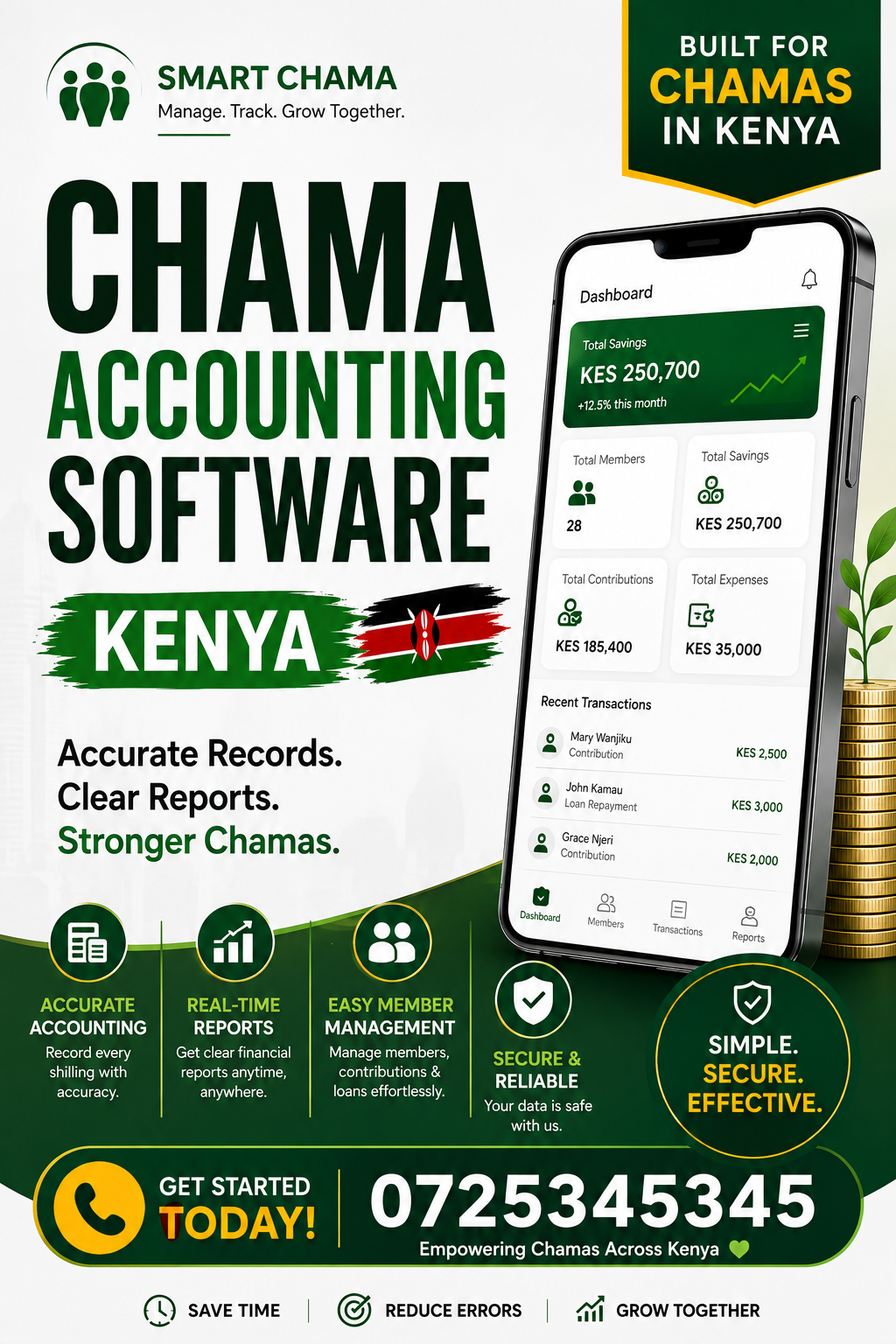
Chama Accounting Software Kenya: Complete Guide to Digital Financial Management for Kenyan Chamas
For a modern Kenyan chama, accurate financial records are essential for maintaining trust, controlling money and making informed decisions. Chama Accounting Software Kenya can help a savings or investment group move away from scattered notebooks, spreadsheets and manual calculations toward a more organised approach to financial administration.
Chamas operate in different ways. Some focus on regular savings, others provide member loans, while investment groups may use pooled funds to purchase property, shares, businesses or other assets. Welfare groups may manage emergency contributions and payments, while table-banking groups can handle several transactions during a single meeting.
Regardless of the model, financial records remain central to the organisation.
When records are kept manually, the treasurer may have to maintain several books at once. Contributions may be recorded in one spreadsheet, loans in another, expenses in a notebook and supporting documents in a physical file. As the group grows, reconciling these records can become increasingly difficult.
Digital accounting software can bring these activities into a more structured environment. It can help officials record transactions, review balances, prepare reports and maintain historical information.
This guide explains what Kenyan chamas should know when considering accounting software, including contribution management, loan accounting, expenses, income, member statements, reporting, security, reconciliation, implementation and software selection.
What Is Chama Accounting Software?
Chama Accounting Software Kenya refers to software designed to help a chama organise and manage its financial records digitally. Instead of depending entirely on paper books or disconnected spreadsheets, the group can maintain financial information within a structured system.
The exact capabilities vary between providers. Some platforms concentrate primarily on accounting, while others combine financial functions with member management, loans, meetings and other chama administration activities.
A good system should make routine financial tasks easier to perform and easier to review.
For example, a treasurer should be able to record a contribution and later determine how that transaction affects the member’s financial history. Similarly, when a member repays a loan, the repayment should be connected to the appropriate loan record.
The objective is consistency.
Why Chamas Need Accounting Software
As membership and transaction volumes increase, Chama Accounting Software Kenya can become an important administrative tool.
A chama’s financial information can include contributions, loan disbursements, repayments, interest, penalties, expenses, income and investment-related transactions. Managing these activities manually can require substantial administrative effort.
Accounting software can provide a central place for authorised officials to maintain financial information.
This does not eliminate the responsibility of the treasurer or committee. Instead, it gives them a structured tool through which they can perform their responsibilities.
The group should still maintain appropriate approvals, supporting documents and financial policies.
Member Financial Records
A reliable member record is one of the foundations of chama accounting. Chama Accounting Software Kenya can help connect member information with relevant financial activity.
A member profile may contain information such as membership status, contribution history, loan activity and other records relevant to the group’s operations.
The committee should decide what information is necessary and who should be able to access it.
Centralised records can also make leadership transitions easier. When a new treasurer takes over, they can work from the group’s established records instead of relying solely on the outgoing official’s personal files.
Contribution Accounting
Contributions are often the most frequent financial transactions in a chama. Chama Accounting Software Kenya can help organise these payments and provide a historical record.
The system should make it possible to associate a payment with the correct member and financial category.
For example, a chama may have ordinary savings, investment contributions, welfare contributions and special project contributions.
Separating these categories can make financial reporting clearer.
It also helps members understand where their money has been allocated.
Monthly Contributions
Monthly contributions require consistency. Chama Accounting Software Kenya can help officials track recurring contribution obligations where the selected system supports this functionality.
The treasurer should be able to identify expected contributions and compare them with actual payments.
This can make it easier to identify outstanding contributions without manually checking several pages of a cashbook.
The chama should establish clear rules for late contributions, missed payments and approved exemptions.
Software should record those rules; it should not create them.
Different Contribution Categories
Not every payment made by a member represents the same financial activity. Chama Accounting Software Kenya can help maintain clearer records when different categories are recorded separately.
A member might make a regular savings contribution, a welfare payment and a loan repayment during the same month.
If these transactions are combined incorrectly, the member’s financial position can become difficult to understand.
Separate categories allow the treasurer to report on each type of transaction more accurately.
Contribution History
Historical records are valuable when reviewing a member’s participation. Chama Accounting Software Kenya can help maintain a structured contribution history.
A historical view can show whether payments were recorded consistently and can help officials respond to questions about past transactions.
It can also provide useful information during leadership handovers.
Instead of searching through old notebooks, authorised officials can refer to the digital record.
Loan Management
Loans are among the most important accounting functions for many chamas. Chama Accounting Software Kenya can help organise information relating to loans where the selected platform supports loan management.
A loan record should identify the borrower, principal amount, applicable terms, repayment information and outstanding balance.
Where guarantors are used, the relevant relationships should also be recorded.
The committee should compare the software’s loan workflow with the chama’s constitution before adopting it.
Loan Applications
The lending process normally begins with an application. Chama Accounting Software Kenya can help structure loan information when application functionality is included.
The group should define who can apply, how much members may borrow, what approval is required and what documentation must be retained.
Software can make the administrative process more organised, but the committee remains responsible for applying its lending rules consistently.
Loan Disbursement
Once a loan is approved, the disbursement should be recorded accurately. Chama Accounting Software Kenya can help officials maintain the financial record associated with the approved loan.
The disbursement should be linked to the correct member and loan account.
The committee should retain evidence of the payment according to its financial procedures.
This creates a clear trail from approval to disbursement and eventually to repayment.
Loan Repayments
Repayment tracking is essential for maintaining accurate outstanding balances. Chama Accounting Software Kenya can help organise repayment records.
Each repayment should be allocated to the correct loan.
If a member has multiple loans, the accounting process should make it clear which loan received the payment.
Clear repayment records can reduce confusion and help the treasurer prepare accurate reports.
Interest Calculation
Some chamas charge interest on member loans. Chama Accounting Software Kenya can help manage the associated records where interest calculations are supported.
The group should first establish how interest is calculated under its own rules.
Possible methods can differ between organisations.
Before implementation, the treasurer should test the software using sample calculations and compare the results with manually verified figures.
Loan Penalties
Late-payment penalties should also be clearly defined. Chama Accounting Software Kenya can help record penalties when such functionality is available.
The software should reflect the chama’s approved policy.
Officials should avoid making informal changes to penalty calculations without committee approval.
A consistent approach helps members understand how their balances were calculated.
Guarantor Records
Guarantors are part of the lending structure used by some Kenyan chamas. Chama Accounting Software Kenya can help organise guarantor information where the platform supports it.
The system should allow authorised officials to identify the relationship between a loan and its guarantors.
Guarantor information should be treated as financial information and protected appropriately.
The chama should also make sure its constitution clearly explains guarantor responsibilities.
Income Management
Chamas can receive income from several sources. Chama Accounting Software Kenya can help categorise financial inflows where the system provides income-management functionality.
Income may include loan-related charges, investment proceeds, approved fees or other legitimate sources.
Keeping income categories separate makes it easier to understand how the group generates funds.
The treasurer can then present clearer financial information during committee or member meetings.
Expense Management
Every chama needs to know where its money is going. Chama Accounting Software Kenya can help organise expenditure records.
Expenses might include meeting costs, administration, communication, banking charges, investment-related costs or approved welfare payments.
Each expense should have an appropriate description and category.
Supporting documents should be retained according to the chama’s policies.
Expense Approval
Recording an expense is different from approving an expense. Chama Accounting Software Kenya can support the record-keeping process, but the chama should establish its own approval procedures.
For example, certain expenditure may require committee approval while smaller routine expenses may fall within the treasurer’s authority.
Clear separation of responsibilities can reduce the risk of unauthorised spending.
The software should support these controls where possible.
Budget Management
Budgeting gives a chama a financial plan. Chama Accounting Software Kenya can help organise budget information where budgeting tools are included.
The committee can establish expected income and expenditure for a particular period.
Actual results can then be compared with the approved budget.
If spending is significantly different from expectations, the committee can investigate the reason.
Cashbook Management
A cashbook provides a chronological record of financial movements. Chama Accounting Software Kenya can help digitise this type of financial record where the platform includes cashbook functionality.
The objective is to maintain an understandable history of money received and money paid out.
Even when transactions are digital, the underlying accounting record remains important.
A digital transaction still needs to be classified correctly.
M-Pesa Transactions
M-Pesa is widely used for payments in Kenya, including chama contributions. Chama Accounting Software Kenya can support financial record organisation around mobile-money transactions depending on the provider’s capabilities.
Committees should ask whether the platform provides direct integration, transaction import, reconciliation tools or manual recording.
These are different capabilities.
A provider should demonstrate the exact workflow before the group commits to a subscription.
Bank Transactions
Bank accounts are also common among established chamas. Chama Accounting Software Kenya can help organise bank-related financial records where the software supports them.
Bank statements should remain important source documents.
The digital accounting record should be compared with the statement during reconciliation.
Any difference should be investigated and documented.
Bank Reconciliation
Reconciliation involves comparing the accounting records with an independent financial record. Chama Accounting Software Kenya can make reconciliation easier by providing organised transaction information.
A treasurer may compare system entries with a bank statement or mobile-money record.
The purpose is to identify missing, duplicated or incorrectly recorded transactions.
Regular reconciliation is preferable to waiting until the end of the financial year.
Member Statements
Members often want to know their current financial position. Chama Accounting Software Kenya can support member reporting where statement functionality is available.
A statement may include contributions, loan activity, repayments and other relevant transactions.
The group should establish what information members are entitled to receive.
Confidential information relating to other members should remain restricted.
Financial Reports
Reports help transform individual transactions into useful financial information. Chama Accounting Software Kenya can help generate structured reports where reporting functionality is included.
Reports may cover contributions, loans, expenses, income and outstanding balances.
The committee should identify the reports it actually needs before selecting a system.
A report is only useful when the underlying data is accurate.
Treasurer Reports
The treasurer may need to provide financial updates during regular meetings. Chama Accounting Software Kenya can reduce the administrative effort involved in compiling information where appropriate reports are available.
The treasurer should review reports before presenting them.
Any unexplained difference should be investigated before the figures are shared.
This supports transparency and confidence in the group’s records.
Monthly Financial Reviews
Monthly reviews help identify issues early. Chama Accounting Software Kenya can provide an organised basis for these reviews.
The committee can review contributions, loans, repayments, income and expenses.
The review should also consider unresolved discrepancies.
Regular monitoring is generally easier than attempting to reconstruct a full year of transactions at once.
Annual Financial Review
At the end of a financial year, a chama needs to understand its overall position. Chama Accounting Software Kenya can help consolidate financial information for review.
The committee can examine total contributions, outstanding loans, income, expenses and other relevant activities.
The precise reporting requirements will depend on the group’s structure and circumstances.
Where professional accounting or legal advice is required, the chama should obtain it.
Audit Trails
An audit trail can help explain changes to financial records. Chama Accounting Software Kenya can be valuable where the selected system provides activity history.
Audit information can help authorised reviewers understand who performed particular actions and when.
This can strengthen accountability.
However, software should complement rather than replace internal controls and proper governance.
User Roles
Financial information should not automatically be accessible to everyone. Chama Accounting Software Kenya can support role-based administration where such controls are available.
The treasurer may need extensive financial access.
The secretary may need membership and meeting-related access.
The chairperson may require oversight.
Ordinary members may need access to their own information or approved reports.
Role separation helps protect sensitive information.
Password Security
Even sophisticated accounting software can be compromised by poor password practices. Chama Accounting Software Kenya should therefore be used alongside sensible account-security practices.
Officials should use strong passwords and avoid sharing credentials.
Where multi-factor authentication is available, the committee should consider enabling it.
Access should also be removed or changed when an official leaves their role.
Data Protection
Chama records can contain personal and financial information. Chama Accounting Software Kenya should therefore be evaluated partly on its data-handling practices.
Before subscribing, ask the provider how information is stored, protected and backed up.
The committee should also understand its own responsibilities when collecting and processing member information.
Only necessary information should be collected and access should be appropriately controlled.
Cloud Accounting
Cloud-based systems can allow authorised officials to access records from different locations. Chama Accounting Software Kenya may be useful for chamas whose officials do not always work from the same physical location.
Cloud access can also make leadership handovers easier.
However, the committee should understand the provider’s backup and recovery procedures.
Cloud storage does not eliminate the need for good governance.
Mobile Access
Many chama officials use smartphones for daily communication. Chama Accounting Software Kenya can be particularly useful when common administrative tasks can be performed conveniently on mobile devices.
The committee should test the actual mobile experience.
A system that technically opens on a smartphone may not necessarily make every financial task convenient.
Testing is therefore important.
Accounting for Small Chamas
Small chamas may believe that accounting software is unnecessary. Chama Accounting Software Kenya can nevertheless provide value when a group wants to establish organised records early.
Starting with proper records can make future growth easier.
The group does not necessarily need a complicated system.
It should select functionality appropriate to its current size and future plans.
Accounting for Growing Chamas
As membership increases, administration becomes more demanding. Chama Accounting Software Kenya can help growing groups establish a more consistent financial workflow.
More members mean more contributions and potentially more loans.
The committee may also have several officials handling different responsibilities.
A system with appropriate user permissions and reporting can help manage this complexity.
Investment Chamas
Investment chamas require careful financial record keeping. Chama Accounting Software Kenya can help organise the underlying financial records associated with contributions, expenses and other transactions.
However, general chama accounting software may not cover every investment-management requirement.
If the group owns property, shares or businesses, the committee should determine which asset-management records need to be maintained separately.
Do not assume that ordinary accounting functionality automatically provides investment portfolio management.
Welfare Chamas
Welfare groups often have contribution and payment structures that differ from investment chamas. Chama Accounting Software Kenya can help organise these records where the software supports appropriate categories.
The group should clearly separate welfare contributions from other financial activities.
Payments should be authorised according to the group’s policies.
Confidential member information should receive appropriate protection.
Table Banking
Table banking involves regular financial transactions among members. Chama Accounting Software Kenya can support record organisation when the selected system accommodates table-banking workflows.
Because several transactions can occur during a meeting, consistent recording is important.
The group should establish how contributions, loans and repayments are captured.
A reliable digital record can make post-meeting reconciliation easier.
Merry-Go-Round Groups
Merry-go-round groups operate according to agreed contribution and distribution arrangements. Chama Accounting Software Kenya can help maintain organised financial records for groups using supported workflows.
The group should define its contribution schedule and distribution rules clearly.
Software should then be configured to reflect those rules.
Members should receive appropriate information about their transactions.
Financial Transparency
Transparency is essential to member confidence. Chama Accounting Software Kenya can support transparency by helping officials maintain consistent records and prepare financial information.
Transparency does not mean unrestricted access.
Instead, it means members can receive information they are entitled to while confidential records remain protected.
The committee should document its approach to financial reporting.
Reducing Manual Errors
Manual accounting can involve repeated calculations and data entry. Chama Accounting Software Kenya can reduce some of this administrative burden where calculations and reporting are automated.
Automation does not guarantee accuracy.
Incorrect data entered into a system can still produce incorrect results.
Officials should therefore verify transactions and perform regular reconciliation.
Moving From Excel
Excel spreadsheets can be useful, but multiple versions can create confusion. Chama Accounting Software Kenya can provide a more structured environment for groups moving beyond spreadsheets.
Before migration, the chama should clean its existing spreadsheet.
Duplicate members should be removed.
Opening balances should be checked.
Unresolved differences should be documented.
Only verified information should be migrated where possible.
Moving From Paper Records
Some chamas continue to use physical cashbooks. Chama Accounting Software Kenya can support a gradual move toward digital records.
The first step is identifying which historical records need to be transferred.
These may include member information, contribution balances, loans and outstanding repayments.
The committee should verify opening balances before using the digital system as its primary record.
Data Migration
Data migration requires planning. Chama Accounting Software Kenya should be introduced only after the existing records have been reviewed.
The group should determine what information is essential and what historical information can remain archived.
Migration should include a verification stage.
After importing information, compare selected records against the original source documents.
This reduces the risk of carrying old errors into the new system.
Training the Treasurer
Training is essential for successful adoption. Chama Accounting Software Kenya should be assessed partly on how easily the treasurer can learn the main workflows.
Training should cover member records, contributions, loans, repayments, income, expenses and reports.
The treasurer should also learn how to correct errors appropriately.
A clear procedure is preferable to informal experimentation with live financial records.
Training Committee Members
The committee should also understand the system. Chama Accounting Software Kenya can provide more value when multiple authorised officials understand how to review information.
Committee members do not necessarily need the same access as the treasurer.
However, they should understand the reports relevant to their oversight responsibilities.
This supports shared accountability.
Leadership Handover
A software system can make leadership transitions more structured. Chama Accounting Software Kenya can help preserve financial records beyond the tenure of one treasurer.
During a handover, access should be reviewed.
Outgoing officials should transfer responsibilities using approved procedures.
Passwords should not simply be passed from one person to another.
Instead, each authorised official should have their own account where the system supports individual users.
Data Export
Before choosing a platform, the committee should understand how it can retrieve its records. Chama Accounting Software Kenya should be evaluated for data-export options and any conditions associated with them.
Ask whether member records, transaction histories and reports can be exported.
Also ask what formats are available.
Data portability is important because a chama should understand what happens to its records if it eventually changes providers.
Backup and Recovery
Financial information should be protected against accidental loss. Chama Accounting Software Kenya should therefore be evaluated according to the provider’s backup and recovery procedures.
Ask how backups are performed.
Ask how records can be restored.
Ask what happens if an account becomes inaccessible.
The committee should retain important supporting documentation according to its own policies.
Software Support
Technical support can be important when a chama begins using a new system. Chama Accounting Software Kenya should be assessed not only for features but also for available support.
Ask how users contact support.
Ask whether training is included.
Ask what happens when a technical problem affects financial reporting.
Clear support procedures can reduce disruption.
Pricing
Price is an important consideration, but it should not be the only factor. Chama Accounting Software Kenya should be compared based on total value and the actual features required by the group.
Consider membership limits, user limits, reporting, support and any additional charges.
The committee should understand both the initial price and recurring subscription costs.
It should also confirm what happens when the subscription is renewed or cancelled.
Choosing Software
The best way to select accounting software is to begin with the chama’s requirements. Chama Accounting Software Kenya should be evaluated against actual workflows.
Create a list of required functions.
For example:
- Member management
- Contribution tracking
- Loan management
- Repayment tracking
- Income recording
- Expense recording
- Financial reporting
- User permissions
- Data export
- Backup and recovery
Then compare providers against that list.
Demonstrating the Software
A demonstration is more useful when it uses realistic scenarios. Chama Accounting Software Kenya should be tested with sample chama transactions before adoption.
Create a sample member.
Record a contribution.
Create a loan.
Record a repayment.
Enter an expense.
Generate a report.
Then compare the results with expected figures.
This practical approach can reveal limitations that may not be obvious from a feature list.
Questions to Ask Providers
Before purchasing, ask detailed questions. Chama Accounting Software Kenya should be considered only after the provider has clearly explained the relevant functionality.
Important questions include:
- How are contributions recorded?
- How are loans managed?
- Can guarantors be recorded?
- How are repayments handled?
- What reports are available?
- Can users have different permissions?
- How are backups performed?
- Can data be exported?
- What support is provided?
- How does the provider handle account termination?
The answers should be documented before making a final decision.
Common Accounting Mistakes
Even with software, chamas can make accounting mistakes. Chama Accounting Software Kenya should therefore be used within a clear financial-control framework.
Common problems include entering transactions twice, failing to reconcile payments, using incorrect categories and allowing unauthorised users to make changes.
Another common problem is failing to verify opening balances during migration.
Software can make good processes easier, but it cannot replace disciplined financial administration.
Correcting Errors
Errors should be corrected transparently. Chama Accounting Software Kenya can support proper corrections where the system provides appropriate transaction-editing or audit functionality.
Officials should avoid simply deleting questionable records without an explanation.
Where possible, the correction should leave enough information for an authorised reviewer to understand what changed.
This is particularly important for financial records that may be reviewed later.
Financial Policies
Software works best when a chama has clear financial policies. Chama Accounting Software Kenya should be configured around the group’s established procedures.
The constitution or financial policy should define contribution requirements, lending rules, approvals, expenses and reporting.
If the rules are unclear, software cannot resolve the underlying governance problem.
The committee should therefore review its policies before implementing a new accounting system.
Role of the Treasurer
The treasurer remains central to financial administration. Chama Accounting Software Kenya should be treated as a tool that assists the treasurer rather than replacing their responsibility.
The treasurer should ensure transactions are recorded correctly.
They should reconcile records.
They should prepare reports.
They should retain supporting documentation.
They should also cooperate with the committee during financial reviews.
Role of the Chairperson
The chairperson provides governance oversight. Chama Accounting Software Kenya can provide the chairperson with access to relevant financial information where the system’s permissions allow it.
The chairperson should not necessarily perform the treasurer’s duties.
Instead, the role can involve oversight, approvals and ensuring that established procedures are followed.
Clear separation of responsibilities strengthens accountability.
Role of the Secretary
The secretary may maintain membership and meeting records. Chama Accounting Software Kenya can support coordination between administrative and financial information where the selected system combines these functions.
The secretary should have only the access necessary for their responsibilities.
Committee roles should remain clearly defined.
Member Access
Members may need access to approved financial information. Chama Accounting Software Kenya can support member transparency where the platform provides appropriate access features.
The group should establish what members can view.
For example, members may receive their own statements and approved financial reports without gaining access to confidential information belonging to other members.
Financial Accountability
Accountability depends on reliable records and responsible officials. Chama Accounting Software Kenya can strengthen the record-keeping side of this process.
The committee should still maintain approval procedures, reconciliation routines and financial reviews.
Software should make those processes easier to perform and document.
Growing With Technology
Digital transformation does not need to happen all at once. Chama Accounting Software Kenya can be introduced gradually as the chama becomes ready.
A group can begin with member and contribution records.
It can then introduce loan management and reporting.
Later, it may expand its use of other supported functions.
A phased approach can make adoption easier for officials who are moving away from manual records.
Measuring Success
After implementation, the committee should measure whether the software is actually helping. Chama Accounting Software Kenya should be evaluated based on practical outcomes.
Questions to consider include:
- Are reports easier to prepare?
- Are member balances easier to verify?
- Are fewer discrepancies occurring?
- Can officials find records faster?
- Is the handover process easier?
- Are members receiving clearer financial information?
The answers can help determine whether the chosen solution is delivering value.
Final Checklist
Before adopting accounting software, a Kenyan chama should confirm that it has:
- A verified member list
- Accurate opening balances
- Defined contribution categories
- Clear loan rules
- Documented expense procedures
- Defined approval responsibilities
- Appropriate user permissions
- A reconciliation process
- A reporting schedule
- Data backup arrangements
- A data-export procedure
- Trained officials
- A leadership-handover process
This preparation can make implementation much smoother.
Frequently Asked Questions
What is Chama Accounting Software Kenya?
Chama Accounting Software Kenya is a digital solution intended to help Kenyan chamas organise financial records such as contributions, loans, repayments, income, expenses and reports.
Can accounting software manage chama contributions?
Yes, many platforms provide contribution-recording functionality. The exact features vary, so a chama should test how the provider handles member payments and balances.
Can it manage chama loans?
Many chama-focused systems include loan-management capabilities. The committee should confirm how applications, approvals, guarantors, repayments, interest and outstanding balances are handled.
Can it track M-Pesa payments?
This depends on the platform. Some systems may offer integrations or import options, while others may require transactions to be recorded manually.
Is accounting software suitable for a small chama?
It can be. A small group should choose a system appropriate to its size and requirements rather than paying for functionality it does not need.
Can a chama migrate from Excel?
Yes. Before migration, the group should clean its spreadsheets, verify balances and establish which information needs to be transferred.
Can members access their financial information?
This depends on the platform. Where member access is available, the committee should configure permissions according to its policies.
How secure is chama accounting software?
Security depends on the provider’s technology, policies and user practices. Committees should ask about access controls, backups, authentication, data handling and recovery.
Does software replace a treasurer?
No. Software is a financial-management tool. The treasurer and committee remain responsible for accurate records, approvals, reconciliation and financial oversight.
How should a chama choose accounting software?
The group should document its requirements, compare suitable providers, request demonstrations, test realistic transactions and review pricing, support, security and data-export arrangements.
Conclusion
The financial administration of a chama becomes increasingly important as the organisation grows. Chama Accounting Software Kenya can help create a more structured approach to managing contributions, loans, repayments, expenses, income and financial reports.
However, software alone does not create accountability.
A successful chama needs clear financial rules, responsible officials, appropriate approvals, accurate source records and regular reconciliation.
The right software can bring these processes together and make them easier to manage.
Before choosing a platform, Kenyan chamas should identify their actual requirements and test potential solutions using realistic transactions. They should examine member management, contribution tracking, loan accounting, expenses, reports, security, permissions, backups, support and data portability.
A system that is easy for officials to understand and consistent with the group’s financial procedures is likely to be more useful than one selected solely because it has a long list of features.
For a chama considering digital transformation, the best starting point is therefore simple: understand the current financial process, identify weaknesses, define the required controls, compare suitable software and implement the chosen system carefully.
With proper planning, digital accounting can help a Kenyan chama maintain clearer records, improve financial visibility, simplify reporting and build stronger confidence among its members.