Chama Accounting System Kenya: Complete 2026 Guide for Groups
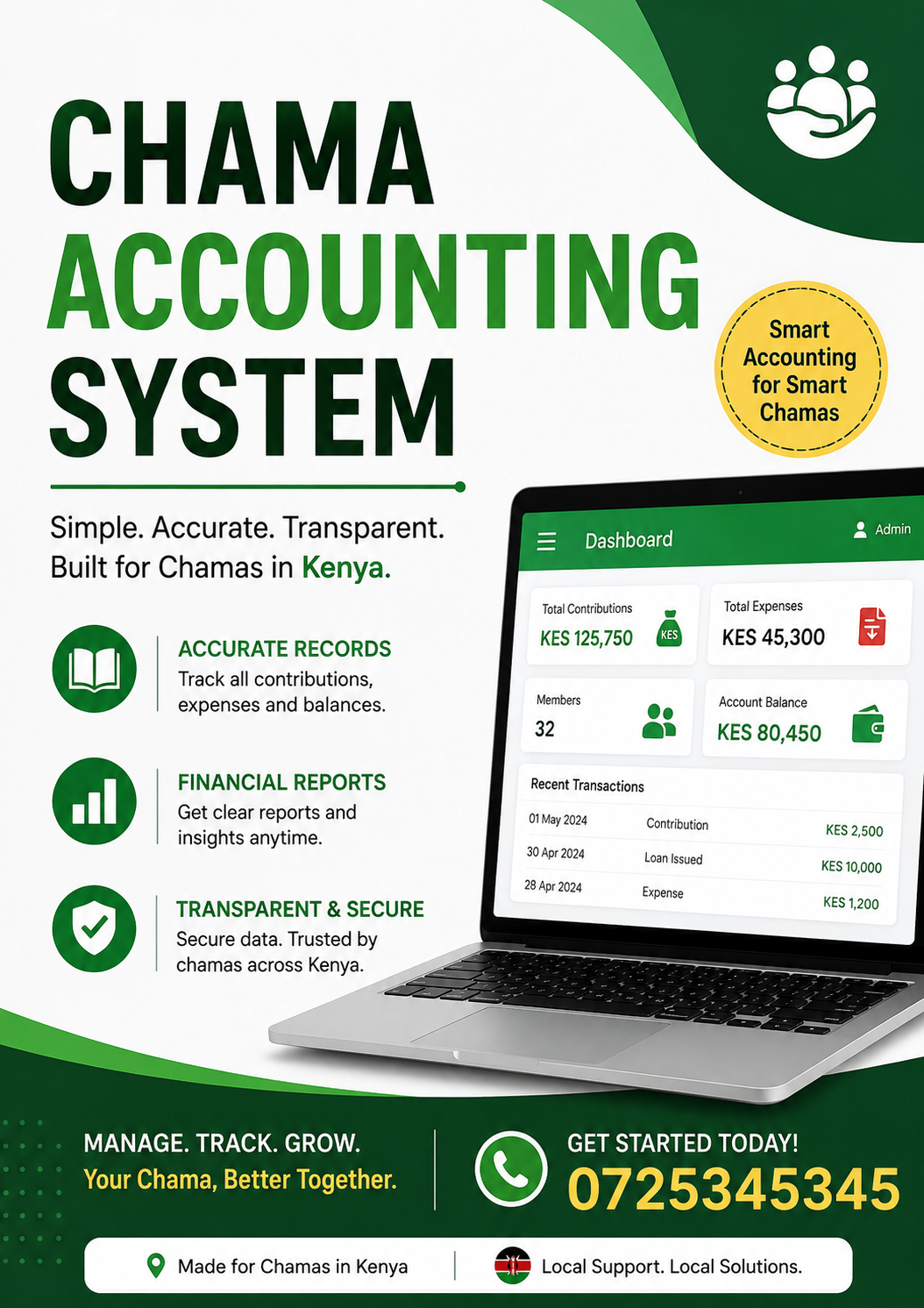
Chama Accounting System Kenya: The Complete Guide to Digitising Group Finances
Table of Contents
- What Group Finance Software Actually Does
- Why Manual Records Fail Kenyan Investment Groups
- Core Features Every Platform Should Have
- M-Pesa and Bank Integration Explained
- Contribution Tracking and Member Statements
- Loan Management and Interest Calculation
- Fines, Penalties and Attendance Records
- Financial Reporting and AGM Preparation
- Legal and Regulatory Compliance
- Data Security and the Data Protection Act
- Spreadsheets Versus Purpose-Built Software
- Pricing and What Groups Actually Pay
- How to Choose the Right Platform
- Step-by-Step Implementation Plan
- Mistakes Groups Make When Going Digital
- Mobile Access and Low-Connectivity Realities
- Different Group Types and Their Different Needs
- Frequently Asked Questions
Chama accounting system Kenya tools have quietly become the difference between groups that survive their third year and groups that dissolve in a WhatsApp argument over a missing forty thousand shillings. Across Nairobi, Kisumu, Nakuru, Eldoret and Mombasa, hundreds of thousands of savings and investment groups pool money every month, lend it out, buy land, run businesses and pay school fees — and a surprising number of them still track all of it in a hardcover exercise book that travels home with the treasurer. That model worked when a chama had eight members and one contribution type. It collapses the moment you add loans at differing interest rates, welfare contributions, project levies, late fines, partial payments, a group bank account, three M-Pesa channels and members who joined at different times. A chama accounting system Kenya groups can actually operate — meaning one built around M-Pesa, around Kenyan group structures, and around members who check things on a phone rather than a laptop — replaces that fragility with a single ledger everybody can see. This guide walks through what these platforms do, what they cost, how to evaluate them, how to migrate years of paper records into one, and the regulatory obligations that come with formalising your group’s books. Whether you are a five-year-old investment club with property assets or a new merry-go-round of twelve colleagues, the reasoning behind a chama accounting system Kenya is the same: money that is recorded transparently is money that stops disappearing, and trust that is backed by records is trust that survives disagreement. By the end of this guide you should know exactly what to look for, what to ignore as marketing noise, and how to get a chama accounting system Kenya running inside a single month without losing a member along the way.
<a name=”what-it-does”></a>
What Group Finance Software Actually Does
At its simplest, a chama accounting system Kenya provides is a shared digital ledger. Every shilling that enters the group and every shilling that leaves it is recorded against a member, a date, a purpose and a payment channel.
That sounds modest. In practice it removes the single biggest source of conflict in Kenyan groups, which is not theft but ambiguity — nobody can prove what was paid, when, or by whom.
The software sits between three things: your members, your money channels, and your officials. Members submit or are credited with contributions. Money channels — M-Pesa paybill, till, bank account, cash — feed transactions in. Officials approve, categorise and report.
A well-built chama accounting system Kenya uses will also enforce your own constitution automatically. If your rules say a late contribution attracts a two hundred shilling fine after the tenth of the month, the system applies it without the treasurer having to remember or having to be the bad guy.
Beyond bookkeeping, most platforms handle membership records, meeting minutes, document storage, loan applications, guarantor chains, dividend calculations and end-of-year statements.
The important mental shift is this: you are not buying a calculator. You are buying an institutional memory that does not resign, relocate to Kitengela or lose its phone.
That memory matters most at the two moments groups are most vulnerable — when an official hands over, and when a member exits and wants their money back. A chama accounting system Kenya group adopts early makes both moments administrative rather than adversarial.
<a name=”why-manual-fails”></a>
Why Manual Records Fail Kenyan Investment Groups
Paper and Excel do not fail because Kenyan treasurers are careless. They fail because the volume and complexity of group transactions grows faster than any manual method can absorb.
Consider a twenty-member group in its fourth year. Monthly contributions, welfare, a project fund, eleven active loans at two interest rates, fines, interest arrears, one land purchase in instalments and a members’ savings account. That is well over a thousand transactions a year.
Manual records also have no audit trail. When a figure changes in a notebook or a spreadsheet cell, there is no record of who changed it, when, or what it was before. A chama accounting system Kenya provides logs every edit permanently.
Then there is the single-point-of-failure problem. The treasurer’s laptop dies, the exercise book gets rained on, the phone with all the M-Pesa messages is stolen at a matatu stage — and four years of history evaporates.
Reconciliation is the other killer. Money arrives through the group paybill, through personal M-Pesa to the treasurer, through the bank, and in cash at meetings. Matching all four streams to a members’ register by hand is genuinely difficult work.
Groups also underestimate the emotional cost. The treasurer who spends eleven hours a month chasing figures eventually burns out and quits, taking their undocumented knowledge with them.
A chama accounting system Kenya group runs shifts that labour onto software. The treasurer stops being a data-entry clerk and becomes a supervisor of automated records.
Finally, manual records make growth impossible. No bank, SACCO or investor will extend a facility to a group that cannot produce three years of clean, verifiable statements. A chama accounting system Kenya member group maintains becomes the evidence base for external financing.
<a name=”core-features”></a>
Core Features Every Platform Should Have
Not every platform marketed to Kenyan groups is complete. Some are glorified spreadsheets with a login page. Use the list below as a hard checklist.
Member register with full profiles. Names, national ID numbers, phone numbers, next of kin, join date, share balance and status (active, dormant, exited). Without this, every other module is guesswork.
Multiple contribution types. Your group almost certainly runs more than one pot — monthly savings, welfare, project levies, registration fees, share capital. A chama accounting system Kenya groups can trust must keep these strictly separate.
Automated M-Pesa reconciliation. The platform should ingest paybill or till transactions and match them to members automatically using phone numbers or account references.
Loan module with configurable interest. Reducing balance and flat rate, different tenors, guarantor tracking, repayment schedules and automatic arrears calculation.
Fines and penalties engine. Rules-based, automatic, and visible to the member so nobody argues about it at the next meeting.
Member self-service. Every member should be able to see their own statement on their phone without asking the treasurer. This single feature eliminates the majority of internal disputes.
Role-based permissions. The chairperson, secretary, treasurer and ordinary members should each see and do different things. A serious chama accounting system Kenya deploys never gives one person unilateral write access to everything.
Approval workflows. Withdrawals, expenses and loan disbursements should require two or three officials to approve digitally, mirroring your bank mandate.
Reporting suite. Income and expenditure statements, balance sheet, member schedules, loan books, arrears reports and a full transaction log exportable to Excel or PDF.
Meeting and minutes management. Attendance registers, agendas, minute storage and resolutions linked to the financial decisions they authorised.
Audit trail. Immutable, timestamped, attributed. If a platform lets an admin silently delete a transaction, walk away.
Notifications. SMS or in-app reminders for contributions due, loans due and meetings scheduled. A chama accounting system Kenya chooses should reduce the number of reminder messages officials personally send, not increase them.
Data export. You must be able to leave. Insist on full CSV or Excel export of every record you own before you sign up.
Dividend and share calculation. At year end, the platform should compute each member’s share of profit based on contribution weight and timing, not on a rough average.
Anything beyond this list — investment portfolio tracking, asset registers, budgeting tools, integrations with accounting packages — is a bonus. A chama accounting system Kenya evaluates should nail the fundamentals first.
Be sceptical of feature lists that lead with AI, dashboards or gamification while burying reconciliation and permissions. The unglamorous features are the ones that keep groups together. Any credible chama accounting system Kenya invests in leads with accuracy, not aesthetics.
<a name=”mpesa-integration”></a>
M-Pesa and Bank Integration Explained
This is the feature Kenyan groups care about most, and it is also the one most misunderstood. There are several different things vendors call “M-Pesa integration.”
Manual entry. The treasurer reads M-Pesa messages and types them in. Not integration at all, though many platforms present it as such.
Statement import. You download an M-Pesa statement from Safaricom and upload the file. The system parses it and suggests matches. Workable, cheap, but always a day or more behind.
Paybill or till API integration. The group has its own paybill or till number and the platform receives transactions in real time through Safaricom’s Daraja API. This is true integration and it is what you want from a chama accounting system Kenya group relies on for live balances.
STK push collection. The system prompts a member’s phone to enter their PIN and pay directly. Excellent for contribution drives, since it removes the “wrong paybill account number” problem entirely.
B2C disbursement. The platform sends money out to members — loan disbursements, refunds, dividends — directly from the group account after approvals. Powerful, and precisely why approval workflows matter so much.
Getting a group paybill is a meaningful step. Safaricom requires the group to be registered, to have supporting documents and usually a linked bank account. Many groups start with a till number or a dedicated bank account and add a paybill later.
The account reference is the quiet hero of reconciliation. If every member pays using a unique reference — a member number, or their phone number — a chama accounting system Kenya group installs matches close to one hundred per cent of payments automatically.
Bank integration is less mature in Kenya than mobile money. Most platforms handle banks through statement upload rather than live API feeds, though several tier-one banks now offer group account portals that export cleanly.
Do not overlook cash. Meetings still generate cash, and the system needs a way to log a cash receipt with the collecting official’s name attached. A chama accounting system Kenya uses in rural or peri-urban settings without solid cash handling will leak.
Ask vendors one blunt question: when a member pays the paybill at 9pm on a Sunday, how long before it appears on their statement? “Instantly” and “when the treasurer next logs in” are very different products. The right chama accounting system Kenya group picks answers that question with a number, not a paragraph.
<a name=”contributions”></a>
Contribution Tracking and Member Statements
Contribution tracking is where most groups feel the benefit within the first month. It converts a recurring monthly argument into a screen anybody can check.
The system should hold a contribution schedule per member — amount, frequency, start date — and generate expected obligations automatically. Actual payments are then matched against expectations.
Partial payments are a real Kenyan scenario and many platforms handle them badly. If a member owes 5,000 and pays 3,000, the system must carry a 2,000 arrear forward rather than silently marking the month unpaid.
Backdating is equally important during migration. When you load three years of history, you need to record transactions with their original dates, not the date you typed them. A chama accounting system Kenya group adopts should support dated entry with an audit note.
Member statements should be self-service, downloadable and shareable. The best implementations send a monthly SMS or WhatsApp link so members review their own position without prompting.
Statement clarity matters more than statement beauty. A member should see opening balance, contributions in, loans out, repayments, fines, interest earned and closing balance in plain language.
Multi-currency is rarely needed, but diaspora contributions are increasingly common. If a quarter of your members are abroad, check how a chama accounting system Kenya group considers handles international payment channels.
Finally, insist on arrears reporting by member and by period. This one report, reviewed at every meeting, is often enough to lift collection rates without any additional pressure. A disciplined chama accounting system Kenya group runs makes arrears visible before they become defaults.
<a name=”loans”></a>
Loan Management and Interest Calculation
Lending is where chamas make most of their money and take most of their risk. It is also where manual records break first.
The platform must support at least two interest models: flat rate (interest calculated on the original principal for the full term) and reducing balance (interest calculated on the outstanding amount). Kenyan groups use both, sometimes simultaneously for different products.
Configurable terms are essential — one-month emergency loans, three-month standard loans, twelve-month development loans, each with their own rate, processing fee and penalty structure.
Guarantor tracking should be built in. When a member guarantees a loan, their own savings should be visibly encumbered so the group knows its true liquid position. A chama accounting system Kenya group depends on for lending must expose that encumbrance clearly.
Repayment schedules should generate automatically and update in real time as payments arrive. Members should be able to see their next due date and amount without asking.
Arrears and penalty automation is the point at which software earns its subscription. Late loans accrue penalties by rule, not by whoever remembers.
Provisioning and write-offs are advanced but valuable. Mature groups classify non-performing loans and provision against them so the balance sheet reflects reality rather than optimism. A serious chama accounting system Kenya evaluates will support at least a simple ageing classification.
Loan application workflows deserve attention too. Digital application, guarantor consent, committee approval and disbursement should form one traceable chain, ending with a record that survives any future dispute. That chain is what turns a chama accounting system Kenya group installs into a genuine credit administration tool rather than a ledger.
<a name=”fines”></a>
Fines, Penalties and Attendance Records
Fines are small money with outsized social consequences. Automating them removes the interpersonal friction that makes officials reluctant to enforce group rules.
Configure fines by category: late contribution, late loan repayment, absence from meeting, lateness to meeting, failure to submit documents. Each should have its own trigger and amount.
The system should apply fines automatically at a defined cut-off, notify the member, and post the charge to their statement. Silent fines that appear only at the AGM cause resentment.
Waivers need a workflow. Groups routinely waive fines for bereavement, illness or genuine hardship, and that waiver should require a second approver and leave a record of the reason.
Attendance registers link naturally to fines. Digital attendance — marked at the meeting on a phone — feeds absence penalties without a separate process. A chama accounting system Kenya selects should make marking attendance a thirty-second task.
Fine income should be reportable separately. Many groups are surprised to discover that fines fund a meaningful share of their operating costs, and a decent chama accounting system Kenya group deploys will show that line clearly rather than burying it in miscellaneous income.
<a name=”reporting”></a>
Financial Reporting and AGM Preparation
The annual general meeting is the moment a group’s records are stress-tested in public. Software turns a two-week preparation ordeal into an afternoon.
Core reports you should be able to produce on demand: income and expenditure, balance sheet or statement of financial position, member contribution schedule, loan book with ageing, arrears report, fines summary and full transaction listing.
Period comparison matters. Showing this year against last year is what allows members to see growth rather than just balances.
Per-member annual statements should be generated in bulk and distributed digitally. A chama accounting system Kenya group uses should produce all of them in one action, not one at a time.
Dividend computation is the report members care about most. The platform should calculate each member’s entitlement based on the timing and weight of their contributions, so somebody who joined in November does not receive the same share as somebody who has contributed since January.
External audit readiness is worth planning for. Groups holding property or exceeding certain thresholds increasingly engage an accountant, and clean exportable records reduce that fee substantially. Choosing a chama accounting system Kenya group can export from freely means your auditor works with data instead of reconstructing it.
Present reports at every meeting, not only at the AGM. Monthly visibility prevents the annual shock, and a well-configured chama accounting system Kenya runs can email or WhatsApp a summary pack automatically before each sitting.
<a name=”compliance”></a>
Legal and Regulatory Compliance
Digitising your books surfaces obligations that informal groups often overlook. Better to meet them deliberately than to discover them under pressure.
Registration. Most Kenyan chamas register either as self-help groups with the State Department for Social Protection at county level, or as societies under the Societies Act, or occasionally as companies limited by guarantee or shares. Each route carries different reporting duties.
Constitution. A written constitution setting out contributions, loans, fines, exit terms, dissolution and dispute resolution is the document your software should be configured to mirror. Where a chama accounting system Kenya group adopts cannot express a rule in your constitution, either the rule or the software needs rethinking.
Tax. Groups generating income — interest on loans, rent, business profit, dividends — have tax exposure. Many chamas obtain a KRA PIN and file returns; interest and dividend income may attract withholding tax deducted at source. Speak to a tax practitioner about your specific structure rather than relying on what a neighbouring group does.
Bank mandates. Group accounts typically require multiple signatories. Your digital approval workflow should match the mandate so the software and the bank enforce the same control.
Record retention. Keep financial records for at least seven years. A cloud-based chama accounting system Kenya group runs handles this far more reliably than a cupboard of receipt books.
Anti-money-laundering awareness. Larger groups moving significant sums should understand basic source-of-funds documentation, particularly when purchasing land or making large transfers.
Investment regulation. Groups that begin taking deposits from non-members, or that market investment returns publicly, can stray into territory regulated by SASRA or the Capital Markets Authority. Keep membership closed and returns internal unless you have taken specific advice.
Land and asset ownership. Chamas cannot always hold title in the group’s own name unless properly registered. Many groups form a company or hold through trustees. Your chama accounting system Kenya maintains should record the beneficial interest of every member in any asset held externally.
None of this is legal advice — I am not a lawyer, and group structures in Kenya vary considerably. Confirm your specific obligations with an advocate or a registered accountant before making structural decisions.
<a name=”security”></a>
Data Security and the Data Protection Act
A group ledger holds national ID numbers, phone numbers, financial histories and next-of-kin details. Under Kenya’s Data Protection Act, 2019, that makes your group a data controller with real obligations.
Practically, this means you must collect only what you need, tell members what you hold and why, keep it secure, and delete it when there is no longer a lawful reason to retain it.
Ask any vendor where data is hosted, whether it is encrypted at rest and in transit, and whether they are registered with the Office of the Data Protection Commissioner. A credible chama accounting system Kenya group entrusts with member data should answer all three without hesitation.
Backups deserve equal scrutiny. Ask how often backups run, where they are stored, and — critically — whether the vendor has ever tested a restore.
Access control within the group is the more common risk. Shared logins are the norm in Kenyan chamas and they destroy accountability entirely. Every official needs their own credentials on any chama accounting system Kenya group operates.
Two-factor authentication should be available at minimum for treasurer and admin roles. Also confirm what happens when an official leaves: revoking access should be immediate and logged, and a properly configured chama accounting system Kenya group manages makes that a one-click action rather than a password change everybody has to be told about.
<a name=”spreadsheets”></a>
Spreadsheets Versus Purpose-Built Software
Excel and Google Sheets are not wrong for every group. They are wrong for most growing ones, and it helps to know exactly where the line sits.
Spreadsheets work adequately when you have fewer than about twelve members, a single contribution type, no lending, and one person who genuinely enjoys maintaining them.
They break down the moment lending starts. Interest schedules, guarantor encumbrance and arrears ageing in Excel are error-prone even for skilled users.
Spreadsheets also have no permission model worth the name. Google Sheets sharing is binary in practice — either somebody can edit the file or they cannot see it. A chama accounting system Kenya group moves to gives each role its own boundaries.
There is no audit trail either. Version history exists in Google Sheets but no member is going to trawl it to establish who changed a figure last April.
The reconciliation gap is the decisive one. Spreadsheets cannot receive M-Pesa transactions automatically, so someone types every entry — and typing is where errors live.
That said, do not migrate for its own sake. If your group is small, stable and content, a well-structured spreadsheet with a monthly PDF snapshot circulated to members is honest and sufficient.
The signal to move is usually one of three events: your first loan default, your first officials’ handover, or your first month where reconciliation takes more than two hours. At that point a chama accounting system Kenya group commits to stops being an expense and starts being a control. Groups that wait past the third signal usually migrate under stress, with incomplete records, which is exactly when a chama accounting system Kenya group implements is hardest to set up correctly.
<a name=”pricing”></a>
Pricing and What Groups Actually Pay
Pricing in this market varies widely and is not always transparent. Understand the models before you compare numbers.
Per-member per-month. The most common structure. You pay a small amount for each active member each month. Predictable, scales with the group, and easy to fund from a small levy.
Flat monthly or annual subscription. Sometimes banded by group size. Better value for larger groups, worse for very small ones.
Transaction fees. Some platforms take a percentage or fixed fee on M-Pesa collections and disbursements, on top of Safaricom’s own charges. Model this carefully — on high monthly volumes it can dwarf the subscription.
Freemium. A free tier limited by member count or features. Useful for evaluation, but check the export terms before you build a year of history on a free plan.
Watch for the hidden costs: setup and data migration fees, SMS bundles for notifications, training sessions, paybill integration charges and per-report export fees. A chama accounting system Kenya group budgets for should be quoted all-in, not headline-only.
Most groups fund this through a small monthly systems levy — often between fifty and two hundred shillings per member — voted at a general meeting. Framing it as a levy rather than an expense makes the vote easier.
Compare the cost to the alternative honestly. A single unreconciled loan, one disputed contribution history or one officials’ handover gone wrong typically costs a group more than several years of subscription to a chama accounting system Kenya group would otherwise have paid for.
Negotiate. Vendors in this space frequently discount annual prepayment, and several offer reduced rates for groups referred by an existing customer. Ask before you accept the list price for any chama accounting system Kenya group is seriously considering.
<a name=”choosing”></a>
How to Choose the Right Platform
Do not start with vendor demos. Start with your own constitution, because it defines the rules the software must be able to express.
Write down every rule: contribution amounts and dates, fine triggers, loan products and rates, approval thresholds, exit terms, dividend formula. Then test each candidate against that list.
Insist on a live trial with real data. Load two months of your actual history and reconcile it. Any chama accounting system Kenya group is evaluating that cannot survive sixty days of your real transactions will not survive year three.
Test the member experience, not just the admin experience. Give three ordinary members access and ask whether they can find their own balance unaided. If they cannot, adoption will fail regardless of how good the back end is.
Ask about support. Response times, channel (WhatsApp support is genuinely valuable in this market), whether support is local and whether it is available during the evenings and weekends when chama meetings actually happen.
Check the vendor’s longevity. How long have they operated, how many groups do they serve, and what happens to your data if they close? A chama accounting system Kenya group adopts should come with a clear exit and export guarantee in writing.
Speak to two existing customers, ideally groups of similar size and structure to yours. Ask them what they wish they had known before signing. Their answers will tell you more about a chama accounting system Kenya group is considering than any feature comparison table.
<a name=”implementation”></a>
Step-by-Step Implementation Plan
Migration fails when it is treated as an IT task rather than a governance one. Run it as a project with a named owner and a deadline.
Week one: decide and mandate. Present the case at a general meeting, vote on the platform and the levy, and record the resolution in the minutes. Appoint two members — not just the treasurer — to run the migration.
Week one: clean your data. Reconcile your existing records to a single agreed closing balance per member as at a chosen cut-off date. Do not migrate disputed figures; resolve them first.
Week two: configure. Set up contribution types, loan products, fine rules, roles and approval thresholds to mirror your constitution exactly. This is the step groups rush and later regret.
Week two: load opening balances. Enter each member’s savings balance, outstanding loan, accrued interest and any arrears as at the cut-off date. Have a second official verify every figure independently.
Week three: parallel run. Operate the old records and the new system side by side for one full cycle. Reconcile at month end. Discrepancies found here are cheap; discrepancies found in year two are not. Any chama accounting system Kenya group commits to should be proven through at least one parallel month.
Week three: onboard members. Send invitations, help people log in during a physical meeting, and walk everyone through finding their own statement. Expect to personally assist a third of your members.
Week four: go live and cut over. Announce the new paybill or reference format, stop accepting payments to personal numbers, and archive the old records securely rather than discarding them.
Ongoing: review monthly. Put a five-minute system review on every meeting agenda for the first six months — arrears report, reconciliation status, any access changes. A chama accounting system Kenya group maintains actively stays accurate; one nobody reviews drifts.
Budget realistically: for a twenty-member group with three years of history, expect roughly twenty to thirty hours of total effort across the month. Groups that allocate that time deliberately succeed; groups that squeeze migration into evenings usually abandon it halfway and end up running a chama accounting system Kenya group half-configured alongside the notebook they meant to retire.
<a name=”mistakes”></a>
Mistakes Groups Make When Going Digital
Migrating disputed balances. If two members disagree about a 2019 contribution, resolve it before migration. Software does not settle arguments; it preserves them.
Configuring the software instead of following the constitution. When the platform cannot do something your rules require, groups often quietly change the rule without a vote. Amend the constitution properly or find different software.
One person holding all access. The treasurer who sets everything up and never grants anybody else admin rights recreates the exact single point of failure the group was trying to escape.
Skipping the parallel run. Going live cold means errors surface months later with no clean record to compare against. Every chama accounting system Kenya group deploys deserves one month of shadow operation.
Ignoring member onboarding. If only officials use the system, you have bought a more expensive spreadsheet. Member self-service is where the transparency dividend actually comes from.
Continuing to accept payments to personal numbers. This single habit undoes automated reconciliation entirely. Cut it off firmly at go-live.
Not testing the export. Groups discover on the day they want to leave that export is limited or paid. Test it in week one of your trial.
Assuming the software enforces honesty. It enforces records. Segregation of duties, dual approvals and regular member review are still governance decisions your group must make. No chama accounting system Kenya group buys substitutes for that.
Underinvesting in training. Fifteen minutes at one meeting is not training. Plan two sessions and a WhatsApp group for questions during the first month of any chama accounting system Kenya group rolls out.
<a name=”mobile”></a>
Mobile Access and Low-Connectivity Realities
Most Kenyan chama members will interact with the platform entirely on a phone, often on a modest Android device with a metered data bundle.
That has design consequences. Heavy dashboards, large images and desktop-first layouts fail in practice. Test any candidate on a mid-range phone on 3G before committing.
USSD and SMS fallbacks matter for members without smartphones. A statement request by SMS, or a balance check by USSD, keeps older members included rather than dependent on relatives. A chama accounting system Kenya group chooses for a mixed-literacy membership should offer at least SMS statements.
Offline tolerance is worth checking for groups meeting in areas with weak coverage. Some platforms let officials record attendance and cash receipts offline and sync later.
Language matters too. Kiswahili interfaces and Kiswahili SMS notifications materially improve adoption in many groups, and any chama accounting system Kenya group deploys across a broad age range should be tested for exactly that.
<a name=”group-types”></a>
Different Group Types and Their Different Needs
Merry-go-rounds (rotating savings). The core need is rotation scheduling and payout tracking, not lending. Look for explicit rotation support rather than trying to model it as loans.
Table banking groups. Lending is central, cycles are short, and meetings are frequent. Prioritise fast loan processing, arrears visibility and meeting-day workflows.
Investment clubs. These hold assets — land, shares, businesses — and need asset registers, valuation tracking and per-member equity computation alongside cash accounting.
Welfare and burial societies. Contributions are irregular and disbursements are event-driven. Claims workflows and rapid payout approval matter more than interest calculation.
Workplace and professional chamas. Members are dispersed, meetings are often virtual, and payroll-linked contributions are common. Strong self-service and digital approvals are essential in any chama accounting system Kenya group of this type adopts.
Diaspora-linked groups. Cross-border contributions, currency questions and timezone-spread approvals. Prioritise flexible payment channels and asynchronous approval workflows.
Youth and student groups. Small amounts, high member turnover, thin margins. Free or low-cost tiers with easy member exit handling suit these best, and the right chama accounting system Kenya group starts with here is often the simplest one that supports clean export later.
<a name=”faq”></a>
Frequently Asked Questions
Do we need to be registered to use group finance software?
No. Most platforms will onboard unregistered groups. However, you will need registration to open a group bank account or obtain a paybill in the group’s name, so registration usually follows quickly.
Can we use it if some members do not have smartphones?
Yes. Look for SMS statements or USSD balance checks. Officials can also print statements for members who prefer paper.
How long does migration actually take?
For a twenty-member group with three years of history, plan on a full month including a parallel run. Smaller and newer groups can be live in a week.
What happens if the vendor shuts down?
This is why export rights matter. Confirm in writing that you can export all your data in a standard format at any time, and actually test the export during your trial. Choose a chama accounting system Kenya group can walk away from cleanly.
Is our data safe in the cloud?
Cloud hosting with a reputable provider is generally far safer than a treasurer’s laptop. Verify encryption, backup practice and ODPC registration before you commit.
Can the software stop theft?
It cannot stop it, but it makes it dramatically harder to conceal and much faster to detect. Combined with dual approvals and monthly member review, a properly configured chama accounting system Kenya group runs closes most of the gaps that misappropriation exploits.
Do we still need a treasurer?
Yes — but the role changes from data entry to oversight, reconciliation and reporting. Most treasurers find the job takes a fraction of the time it used to.
What about groups with both savings and business operations?
Keep them separate. Run the group ledger for member funds and proper business accounting for the enterprise, with a clearly recorded capital relationship between the two. Trying to run a trading business inside a chama accounting system Kenya group designed for savings creates reporting confusion at year end.
How do we handle a member who wants to exit mid-year?
Your constitution should define the exit formula. The software should then produce a definitive statement of contributions, share of retained earnings, outstanding loans and any guarantees still active.
Can we get a loan from a bank based on our records?
Increasingly, yes. Several Kenyan lenders now offer group facilities assessed on contribution history and lending performance. Clean, exportable, multi-year records from a chama accounting system Kenya group has run consistently are exactly the evidence those lenders ask for.