Chama Management Software: Complete 2026 Guide for Kenyan Groups
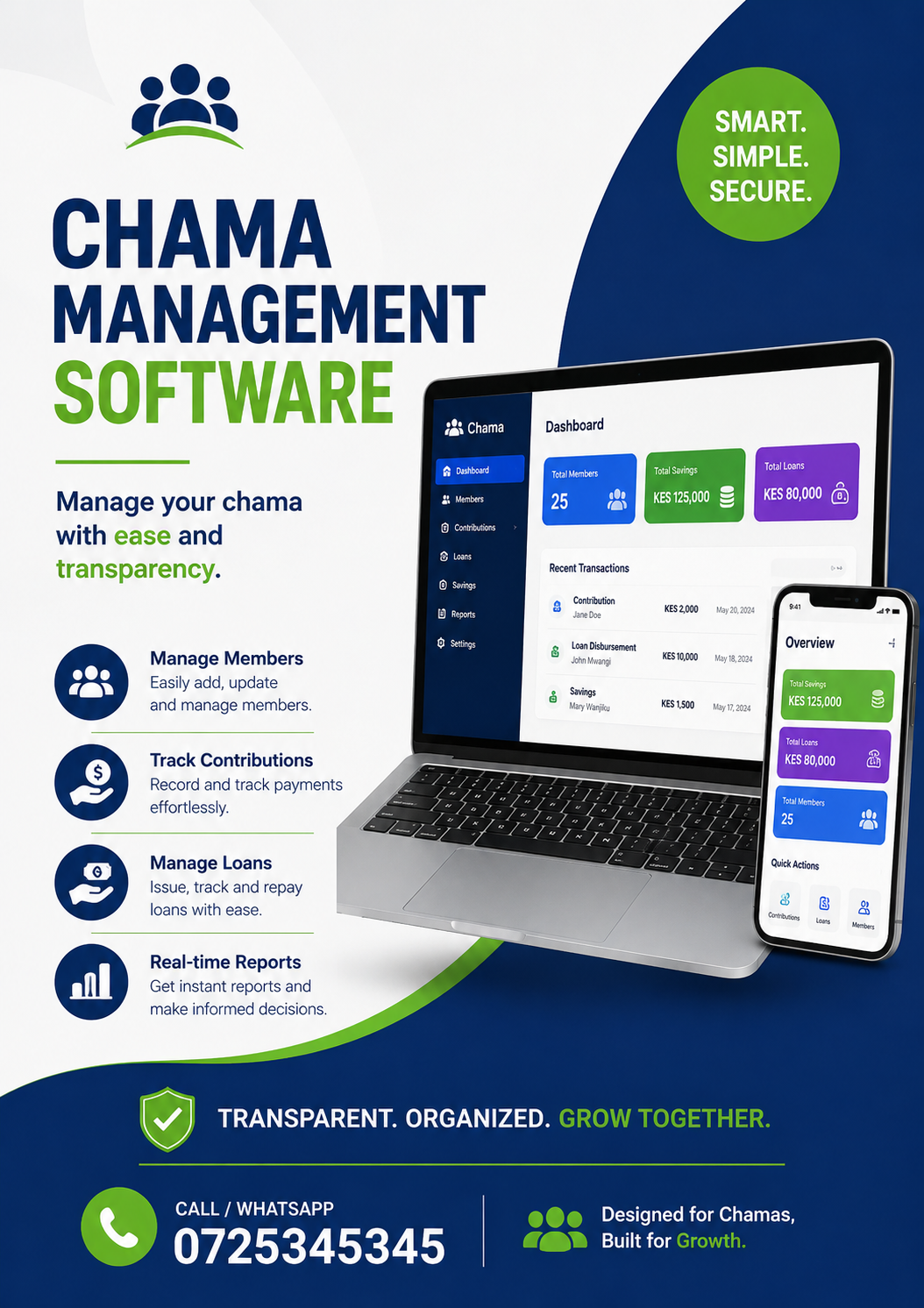
Chama Management Software: The Complete 2026 Guide for Kenyan Savings and Investment Groups
Somewhere in Nairobi this evening, a treasurer is sitting with a hardcover exercise book, a calculator and a phone full of M-Pesa messages, trying to work out why the group’s records say KES 412,000 but the account balance says KES 398,500. She will find the gap eventually — a member who paid twice, a disbursement recorded in the wrong month, a fine that was waived verbally but never struck off. It will take her three hours, and she will do the same exercise next month, and the month after that. Multiply that by the roughly 300,000 chamas operating across Kenya and you are looking at millions of unpaid administrative hours poured into arithmetic that a computer settles in milliseconds. This is the gap that chama management software exists to close, and it is why the category has grown from a handful of experimental products a decade ago into a genuine market with real competition, real pricing tiers and real integration depth. This guide walks through what these systems do, how to evaluate them, what they cost, how to move your group across without losing history, and how to get members who have never trusted anything but the notebook to trust a dashboard instead.
Table of Contents
- Why Kenyan Groups Are Leaving the Notebook Behind
- What This Category of Tool Actually Does
- The Real Cost of Manual Record-Keeping
- The Core Modules You Should Expect
- Member Records and Onboarding
- Contribution Tracking and Schedules
- Lending, Interest and Repayment Schedules
- Fines, Penalties and Group Discipline
- Meetings, Minutes and Attendance
- M-Pesa Integration and Automatic Reconciliation
- SMS, Reminders and Member Communication
- Statements, Reports and the Audit Trail
- Investments, Projects and Asset Registers
- Welfare Funds and Emergency Support
- Matching the Tool to Your Group Type
- Security, Privacy and Data Protection Obligations
- Registration and Compliance Context
- Designing for Kenyan Connectivity Realities
- Web Dashboard Versus Mobile App
- Pricing Models and What to Budget
- Buying Off the Shelf Versus Building Custom
- A Vendor Evaluation Checklist
- Migrating From Excel and Paper
- A Thirty-Day Rollout Plan
- Getting Members to Actually Use It
- Mistakes That Kill Adoption
- Metrics Your Officials Should Watch
- Where the Category Is Heading
- Frequently Asked Questions
- Final Thoughts
Why Kenyan Groups Are Leaving the Notebook Behind
The chama is not a marginal institution in Kenya. Roughly one in three adults belongs to one, and collectively these groups hold assets estimated in the hundreds of billions of shillings.
What has changed is not the appetite for group saving but the complexity of it. A merry-go-round with eight neighbours contributing KES 500 a month can genuinely be run on paper.
An investment club with forty-five members, a loan book, three rental units, a welfare kitty and a bank account cannot. That is the threshold at which chama management software stops being a nice idea and starts being infrastructure.
The second driver is mobile money. When almost every contribution arrives as an M-Pesa message rather than cash handed over at a meeting, the treasurer’s job shifts from counting notes to reconciling transaction logs.
That is data work, and data work belongs in a system. Chama management software was built precisely for that reconciliation problem, which is why the best products in the market treat M-Pesa integration as a core feature rather than an add-on.
The third driver is trust. Groups collapse over suspicion far more often than they collapse over poor returns, and suspicion grows in the dark spaces where only one person can see the numbers.
What This Category of Tool Actually Does
At its simplest, chama management software is a shared ledger with rules. It records who is a member, what each person owes, what each person has paid, what the group holds, and what the group has lent out.
Where it goes beyond a spreadsheet is in enforcing the rules automatically. If your constitution says contributions are due by the fifth and attract a KES 200 late fee thereafter, the system applies that fee on the sixth without anyone remembering to.
It also changes who can see what. In a notebook system, visibility is a privilege granted by the treasurer; in chama management software, every member logs in and sees their own statement, their loan balance and the group’s overall position.
That single shift — from requested information to available information — is the reason many groups adopt these platforms even when their arithmetic was never actually wrong.
Modern chama management software also handles the surrounding workflow: calling meetings, circulating agendas, storing minutes, running votes, generating reports for the AGM, and producing the statements a bank asks for when the group applies for a facility.
Think of it less as an accounting package and more as an operating system for the group’s collective life.
The Real Cost of Manual Record-Keeping
Officials rarely price their own labour, which is how manual systems appear free. A treasurer spending four hours a month on reconciliation is spending forty-eight hours a year, and a secretary writing and distributing minutes is spending a similar amount.
At any reasonable valuation of that time, most groups are already paying more for their manual system than a subscription would cost. The difference is that the subscription shows up on a statement and the volunteer hours do not.
The larger cost is error. A single misallocated contribution compounds quietly — it distorts the member’s savings balance, which distorts their borrowing limit, which distorts the interest they are charged, which eventually distorts the dividend calculation at year end.
By the time anyone catches it, unwinding it means reopening months of records. Chama management software prevents most of this class of error by making the transaction record the single source of truth rather than a summary someone typed in by hand.
Then there is key-person risk. When the group’s entire financial history lives in one person’s notebook, laptop or head, the group is one resignation, one accident or one falling-out away from losing it.
Cloud-based chama management software distributes that risk across the group and the vendor rather than concentrating it in an individual.
The Core Modules You Should Expect
Any credible chama management software should ship with a recognisable set of modules, and you should be sceptical of a product missing more than one or two of them.
Members and profiles. Contributions and savings. Loans and repayments. Fines and penalties. Expenses. Investments and projects. Welfare. Meetings and minutes. Statements. Reports.
Those ten cover the operational reality of nearly every Kenyan group. Beyond them, the differentiators are integrations — M-Pesa, SMS, bank feeds, and occasionally accounting exports.
A useful test when demoing chama management software is to take a genuinely awkward transaction from your own history and ask the vendor to enter it live. Partial loan repayment made by a third party on behalf of a member, for instance.
Clean products handle it in a few clicks. Weak ones force a workaround, and workarounds become the cracks your data eventually falls through.
Member Records and Onboarding
The member module is where most groups underestimate what they need. Beyond names and phone numbers, you want national ID references, KRA PIN where relevant, next of kin, join date, membership class and status.
Membership class matters more than people expect. Groups routinely have founding members, ordinary members, dormant members and honorary members, each with different contribution obligations and different claims on the group’s assets.
Good chama management software lets you define those classes and attaches the right rules to each automatically. Weaker systems treat all members identically and push the exceptions back onto the treasurer.
Exit handling is the other neglected area. When a member leaves, the system should be able to compute their exit position — savings, less outstanding loans, less unpaid fines, plus or minus their share of retained earnings.
If your prospective chama management software cannot produce that figure without manual assembly, expect every departure to become an argument.
Contribution Tracking and Schedules
Contributions are the heartbeat of the group, and this is where chama management software earns its subscription fastest. The system should let you define a schedule — monthly, weekly, fortnightly — with an amount and a due date.
From there it should invoice automatically, track partial payments, carry arrears forward, and show each member a running statement they can check without asking anyone.
Multiple contribution types are essential. Most Kenyan groups run at least three parallel streams: a core savings contribution, a welfare or emergency contribution, and periodic project-specific calls.
These must be tracked separately because they have different rules. Welfare money is usually not refundable on exit; savings usually are. Chama management software that lumps them into one balance will eventually produce a wrong exit figure.
Watch for how the platform handles advance payments. A member who pays six months upfront should have those months marked as settled going forward, not sitting as an unallocated credit that confuses the arrears report.
Lending, Interest and Repayment Schedules
Once a group starts lending, its record-keeping complexity roughly triples, and this is the single strongest argument for chama management software. Loans introduce interest, schedules, guarantors, defaults and restructures.
The system should support the interest methods Kenyan groups actually use, which are usually flat rate on the principal or reducing balance. Flat rate is more common in table banking; reducing balance is more common in groups modelling themselves on SACCOs.
Confirm which your prospective chama management software supports before committing, because retrofitting the other method later is painful.
Guarantorship needs first-class treatment. In most chamas a loan is secured by the savings of two or three fellow members, and the system should record those pledges and prevent a guarantor from over-committing.
It should also show each member their exposure as a guarantor, since that is a liability they carry whether or not anyone tells them about it. Chama management software that tracks guarantor exposure gives your credit committee something to actually work with.
Repayment handling is where products separate. You want automatic allocation of a payment across interest and principal according to your policy, support for early settlement, and a clean way to restructure a struggling loan without deleting and re-entering it.
Default management deserves a mention too. The system should age arrears into buckets, flag chronic defaulters, and let you apply the penalty rules in your constitution without the treasurer computing them by hand.
Fines, Penalties and Group Discipline
Fines are small money with outsized emotional weight, which is exactly why they should be automated. When a system applies a late fee, nobody accuses the treasurer of favouritism.
Chama management software should let you configure fine types — late contribution, meeting absence, lateness to meetings, late loan repayment — with amounts and triggers, then apply them without human intervention.
Waivers should be possible but logged. A chairperson forgiving a fine for a bereaved member is entirely reasonable; a waiver that leaves no trace is how discretion turns into suspicion.
Look for a waiver function that records who approved it and why. That audit trail is one of the quieter benefits of chama management software and one members appreciate only after the first contested year-end.
Meetings, Minutes and Attendance
The secretarial side is often treated as an afterthought, but it carries real governance weight. Minutes are the evidentiary record of every decision the group makes about money.
Your chama management software should store agendas, attendance registers, minutes and resolutions against a dated meeting record. Attendance especially, because absence fines depend on it and because quorum questions become disputes when nobody kept a register.
Resolution tracking is a genuine differentiator. A meeting that resolves to buy a plot in Kitengela should generate a tracked item with an owner and a deadline, not a line buried in a document nobody reopens.
Some platforms now support digital voting for resolutions, which is useful for groups with members in the diaspora or in other counties. Where offered, check whether votes are anonymous and whether the tally is stored immutably.
M-Pesa Integration and Automatic Reconciliation
If you take one thing from this guide, take this: M-Pesa integration is the feature that determines whether your chama management software saves time or merely relocates it.
Without it, someone still reads every payment message and types it into a screen. That is data entry with extra steps, and groups abandon systems over exactly this.
Proper integration means the group has its own paybill or till, and payments hit the system automatically with the member’s account reference attached. Contributions are then matched to members and periods without anyone touching a keyboard.
The technical mechanism is Safaricom’s Daraja API, typically using C2B callbacks for incoming payments and STK push where the platform prompts a member’s phone directly. When evaluating chama management software, ask specifically which of these it supports.
STK push matters because it eliminates the most common cause of unmatched payments — members entering the wrong account reference. If the system initiates the prompt, the reference is always correct.
Ask also about the paybill arrangement. Some vendors provide a shared paybill where your group is a sub-account; others help you acquire a dedicated one. Dedicated is cleaner but takes longer to set up and costs more.
Finally, ask how the chama management software handles unmatched payments. There should be a suspense account, a clear queue, and a way for an official to assign an orphan transaction to the right member with a note explaining the decision.
SMS, Reminders and Member Communication
Automated reminders are among the quietest wins in chama management software, because they change payment behaviour measurably. A message three days before the due date and another on the due date will lift on-time contributions in most groups without anyone having to nag.
Beyond reminders, chama management software should confirm receipts by SMS, notify members of loan approvals and disbursements, and circulate meeting notices. Every one of those messages is a small trust deposit.
Check whether SMS costs are bundled or billed separately, because per-message charges on a large group add up. Ask about sender ID registration too, since a message from a recognisable name gets read and one from a random shortcode gets ignored.
Statements, Reports and the Audit Trail
Reporting is the part officials undervalue until the AGM, at which point it becomes the only thing that matters. At minimum, chama management software should give you member statements, a contribution summary, a loan portfolio report, an income and expenditure statement, and a balance position.
The individual member statement is the highest-value output of any chama management software. It answers the question every member privately holds — what exactly is mine? — without them having to ask a person.
Export matters. Reports should come out as PDF for circulation and Excel or CSV for anyone who wants to work with the numbers, and both should be available to officials without a support ticket.
The audit trail underneath all of this is the real deliverable. Every entry should record who made it, when, and what it replaced if it was an edit.
Groups that later formalise into cooperatives or companies will need this history, and chama management software that keeps an immutable log makes that transition dramatically easier than reconstructing it from notebooks.
Investments, Projects and Asset Registers
Groups that graduate from saving to investing need somewhere to record what they own. Land parcels, rental units, shares, treasury bills, a matatu, a shop — each with acquisition cost, current valuation, ownership documents and income.
Not all chama management software handles this well, and some handle it barely at all. If your group holds real assets, make asset registers a hard requirement rather than a nice-to-have.
Project tracking is the related need. A construction project has a budget, drawdowns, contractors and milestones, and folding that into the general expenses ledger loses all of it.
Income attribution closes the loop. Rent from a group-owned unit should flow into the books and ultimately into member returns, and your chama management software should show that chain clearly enough for members to follow it.
Welfare Funds and Emergency Support
Most Kenyan groups run a welfare kitty for bereavement, illness, weddings and school emergencies. It is socially the most important fund and administratively the most loosely governed.
Chama management software should treat welfare as its own fund with its own contribution stream, its own rules on claims, and its own balance. Mixing it into general savings is how groups discover at exit time that they disagree about whose money it was.
Claim workflow is worth checking. A request, an approval by named officials, a disbursement record and a receipt is a short chain, but having it in the system prevents the awkward conversations that follow undocumented payouts.
Matching the Tool to Your Group Type
Not every group needs the same product, and the most common selection error is buying for a group you are not yet. A merry-go-round of twelve people needs contribution tracking and a rotation schedule, and very little else.
Table banking groups need strong loan modules above all, because lending is the core activity and the loan book turns over quickly. Look for chama management software with flat-rate interest, short cycles and fast disbursement recording.
Investment clubs need asset registers, project tracking, share or unit accounting and dividend computation. Their contribution logic is simpler but their equity logic is much harder.
Welfare and burial societies need claim workflows and membership status tracking more than they need lending features. Chama management software sold primarily on its loan engine will feel bloated to them.
Larger groups approaching SACCO scale need audit-grade reporting, role separation and controls that will satisfy an external auditor. At that point you are shopping close to cooperative software rather than chama management software proper.
Security, Privacy and Data Protection Obligations
Your group is holding national ID numbers, phone numbers, financial histories and next-of-kin details for dozens of people. Under Kenya’s Data Protection Act, that makes the group a data controller with real obligations.
Ask any chama management software vendor where data is hosted, who on their team can access it, whether traffic and stored data are encrypted, and how often backups run. Vague answers are answers.
Role-based access is the control that matters most day to day. The treasurer should post transactions, the chairperson should approve, the secretary should manage minutes, and ordinary members should see their own position and group summaries only.
Two-factor authentication on official accounts is no longer exotic and should be available. Chama management software guarding a six-figure loan book with a single reusable password is a liability regardless of how good the ledger is.
Ask about data portability before you sign, not after. If relations with the vendor sour, you need a full export of members, transactions, loans and documents in a usable format, and that expectation should be written into the agreement.
Registration and Compliance Context
Software does not register your group, but it makes registration and ongoing compliance far less painful. Most self-help groups and chamas now register under the Community Groups Registration Act of 2022, which provides a county-level framework and grants legal personality.
Registration typically requires a minimum membership, a constitution, and a modest fee, with small annual returns thereafter. Groups that fail to file returns risk deregistration, which is an avoidable and embarrassing way to lose legal standing.
Investment-focused groups often go further and incorporate as a limited company or limited liability partnership, which makes property ownership and securities investment much cleaner. Either route demands proper books, and chama management software is the cheapest way to produce them.
Tax obligations follow legal form. A registered entity earning rental or interest income has KRA exposure, and having categorised, exportable records makes that a filing exercise rather than a reconstruction project.
The practical point is this: groups that keep clean digital records find formalisation straightforward, and groups that do not find it expensive. Adopting chama management software early is effectively pre-paying for that transition.
Designing for Kenyan Connectivity Realities
Connectivity is uneven, and any product built without acknowledging that will frustrate rural and peri-urban groups. Meetings happen where members are, not where bandwidth is.
Ask whether the chama management software offers offline capture with later synchronisation, or at minimum a lightweight mode that works on a weak connection. A secretary should be able to record attendance in a hall with one bar of signal.
USSD access is worth asking about for groups with members on feature phones. Not every member owns a smartphone, and a system that assumes otherwise quietly excludes people.
Data cost is the other constraint. Chama management software with heavy image-laden dashboards burns bundles, and members notice. Light interfaces get used; heavy ones get abandoned.
Web Dashboard Versus Mobile App
Officials need a web dashboard, because that is where most of the heavy work in chama management software actually happens. Bulk entry, report generation, loan approvals and configuration are all easier on a larger screen, and treasurers doing month-end work will not thank you for a phone-only product.
Members need a mobile experience. They want to check a balance, see a statement and pay, and they want to do it in under a minute.
The best chama management software gives you both, sharing one database so nothing has to be reconciled between them. Products offering only one side tend to push the missing half onto WhatsApp, which defeats the purpose.
If an Android app is offered, check its store rating and, more usefully, its update history. An app last updated three years ago tells you what you need to know about the vendor’s commitment.
Pricing Models and What to Budget
The market prices chama management software in three broad ways: free tiers with limits, per-member or per-group monthly and annual subscriptions, and one-off licences for a self-hosted or purchased system.
Subscription tiers commonly bracket by member count, with the cheapest bands covering around twenty members and stepping up from there. Annual payment almost always beats monthly on total cost.
Free tiers are genuinely useful for small groups and for trialling the workflow, but read the ceilings carefully. The limit is usually member count, transaction volume or the absence of M-Pesa integration, and it is the last of those that hurts.
One-off licences appeal to groups that dislike recurring costs, but budget for hosting, updates and support separately. Chama management software is only as safe as its maintenance, and unmaintained software becomes a security problem.
Do not forget variable costs. SMS bundles, paybill transaction charges and occasional support or training fees are real, and a cheap subscription with expensive messaging can cost more than a bundled competitor.
A reasonable planning approach is to compare total annual cost against the value of officials’ time saved. Most groups above twenty-five members find chama management software pays for itself well before the first AGM.
Buying Off the Shelf Versus Building Custom
Almost every group should buy. Established chama management software already encodes the edge cases your group has not hit yet, and it is maintained by someone whose job that is.
Custom development makes sense in a narrow set of cases: an unusual constitution that no product models, a group large enough to need bespoke controls, or a sponsor building a platform for many groups at once.
If you do build, budget honestly. The build is the small part; M-Pesa integration, security, support and ongoing maintenance are the ongoing part, and groups routinely underestimate all four.
A middle path exists. Several vendors offer configurable chama management software with white-labelling for saccos, employers and associations running many groups, which delivers most of the customisation benefit without the maintenance burden.
A Vendor Evaluation Checklist
Run every candidate through the same questions and score them. Does it support your interest calculation method? Does it handle multiple contribution types separately? Does it integrate directly with M-Pesa via paybill or STK push?
Can members log in and see their own statements? Does it produce an exit computation? Does it store meeting minutes and attendance? Does it keep an immutable audit log?
Then the vendor questions. How long have they operated, how many active groups do they serve, what does support look like, and what happens to your data if they shut down?
Insist on a trial with your own numbers. Load one real month of transactions into the chama management software and see whether the closing position matches your books.
Talk to a reference group of similar size. Ten minutes with a treasurer who has used the product for a year is worth more than any feature list.
Migrating From Excel and Paper
Pick a clean cut-over date, ideally the start of a financial year or immediately after an AGM. Migrating mid-cycle creates a split record that confuses everyone.
Enter opening balances rather than full history. For each member you need savings balance, outstanding loan principal and interest, unpaid fines, and welfare balance as at the cut-over date.
Have those opening balances signed off by the treasurer and chairperson before you load them. Once they are in the chama management software they become the baseline for everything that follows, and correcting them later is messy.
Keep the old records. Run the notebook or spreadsheet in parallel for one full cycle and compare, then archive the paper securely rather than discarding it.
Where full history genuinely matters — for a group with years of dividend calculations — ask whether the vendor offers a data migration service. Many do, sometimes free during onboarding.
A Thirty-Day Rollout Plan
Week one is selection and setup. Shortlist two products, run the trial, choose one, and configure member records, contribution schedules, loan products and fine rules.
Week two is officials’ training and parallel entry. The treasurer, chairperson and secretary should each work through their own tasks in the chama management software while the old system still runs.
Week three is member onboarding. Send invitations, get people logged in, and hold a short walkthrough at the monthly meeting focused on one thing only — how to check your own statement.
Week four is the first live cycle. Contributions come in through the paybill, reminders go out automatically, and the treasurer reconciles the two systems at the end and documents any differences.
By day thirty you should be able to decide honestly whether to retire the manual system. Groups that skip the parallel month almost always end up running both indefinitely.
Getting Members to Actually Use It
Adoption is a social problem, not a technical one. The members most resistant to chama management software are usually the ones who have most trusted the existing treasurer, and their resistance is loyalty rather than obstruction.
Frame the change around transparency for everyone rather than efficiency for officials. Nobody is moved by the treasurer saving time; everybody is moved by seeing their own money clearly.
Recruit the sceptics early. Give the most doubtful member an early login and let them verify their balance against their own records — once they confirm it publicly, the rest follows.
Pair every member with someone who can help them log in the first time. One assisted login removes almost all of the friction, and unassisted first attempts are where adoption dies.
Keep one WhatsApp group for conversation but move all financial questions into the system. If balances are still being asked and answered in chat, the chama management software has not actually replaced anything.
Mistakes That Kill Adoption
Choosing on price alone. The cheapest option that lacks M-Pesa integration will cost more in treasurer hours than the difference in subscription.
Configuring rules that do not match your constitution. If the system fines at a different rate than your rules specify, members will lose faith in it within one cycle.
Letting one person hold all the access. Concentrating every credential in the treasurer reproduces the exact key-person risk the chama management software was meant to remove.
Skipping the opening-balance sign-off. Unverified starting numbers poison everything downstream and surface at the worst possible moment.
Running the system and the notebook forever. Parallel running is a one-cycle validation exercise, not a permanent state, and groups that never commit get the costs of both systems and the benefits of neither.
Ignoring dormant members. A group that never marks members inactive ends up with arrears reports full of people who left in 2023, and eventually nobody reads the report at all.
Metrics Your Officials Should Watch
On-time contribution rate is the clearest health indicator. If it drops for two consecutive months, something is wrong socially, not technically.
Loan portfolio at risk — the share of the loan book in arrears — is the number that predicts trouble earliest. Chama management software should surface it without anyone building a report.
Member login rate tells you whether transparency is real or theoretical. If only officials ever log in, the group has digitised its bookkeeping but not its trust.
Cost per member per year, including subscription and SMS, keeps the decision honest. Track it and compare it against the alternative every renewal.
Where the Category Is Heading
Three shifts are visible. The first is credit scoring: platforms holding years of contribution and repayment history can generate a group-level or member-level score, which opens doors to bank facilities on better terms.
The second is embedded finance. Chama management software increasingly plugs into money market funds, treasury bills and insurance products, so idle group balances earn rather than sit.
The third is automation of the tedious parts — minutes drafted from meeting recordings, anomalies flagged before the treasurer notices, statements narrated in plain language. These are useful additions but they are not the reason to buy.
Choose chama management software for its ledger, its M-Pesa integration and its audit trail. Everything else is a bonus that will look different in two years anyway.
Frequently Asked Questions
Is chama management software worth it for a group of ten members? Usually only if you lend. Ten members contributing a fixed amount can run on a shared spreadsheet, but ten members with an active loan book cannot.
Can we use it without registering the group? Yes. Nothing about the software requires legal registration, though good records make registration easier when you get there.
Do all members need smartphones? No, but the experience is better with them. Ask about USSD or SMS access for members on feature phones.
What happens to our data if the vendor closes down? This is why you insist on an export function and a contractual data portability clause before signing.
Can it replace our treasurer? No, and any vendor implying otherwise is overselling. It replaces the arithmetic, not the judgement, the relationships or the accountability.
How long does setup take? A small group can be operational in a day. A forty-member group with a live loan book should plan for the full thirty-day approach described above.
Does chama management software work for groups outside Kenya? The core logic travels well across East and West Africa, but mobile money integration is country-specific, so confirm support for your local rails.
Final Thoughts
The strongest argument for chama management software has never really been efficiency. It is that a group which can see its own numbers argues less, trusts more and survives longer.
Kenyan chamas fail for predictable reasons — opaque records, unfair-feeling discipline, disputes at exit, and officials burning out on unpaid administration. Every one of those is at least partly a record-keeping problem.
Choose a product that fits the group you are today, insists on a real audit trail, and connects directly to M-Pesa. Run it in parallel for a cycle, get your opening balances signed, and commit.
If you are weighing options and want help mapping your group’s constitution onto a system’s rules, or planning a migration that will not lose a decade of history, that is exactly the kind of implementation work worth getting right the first time.