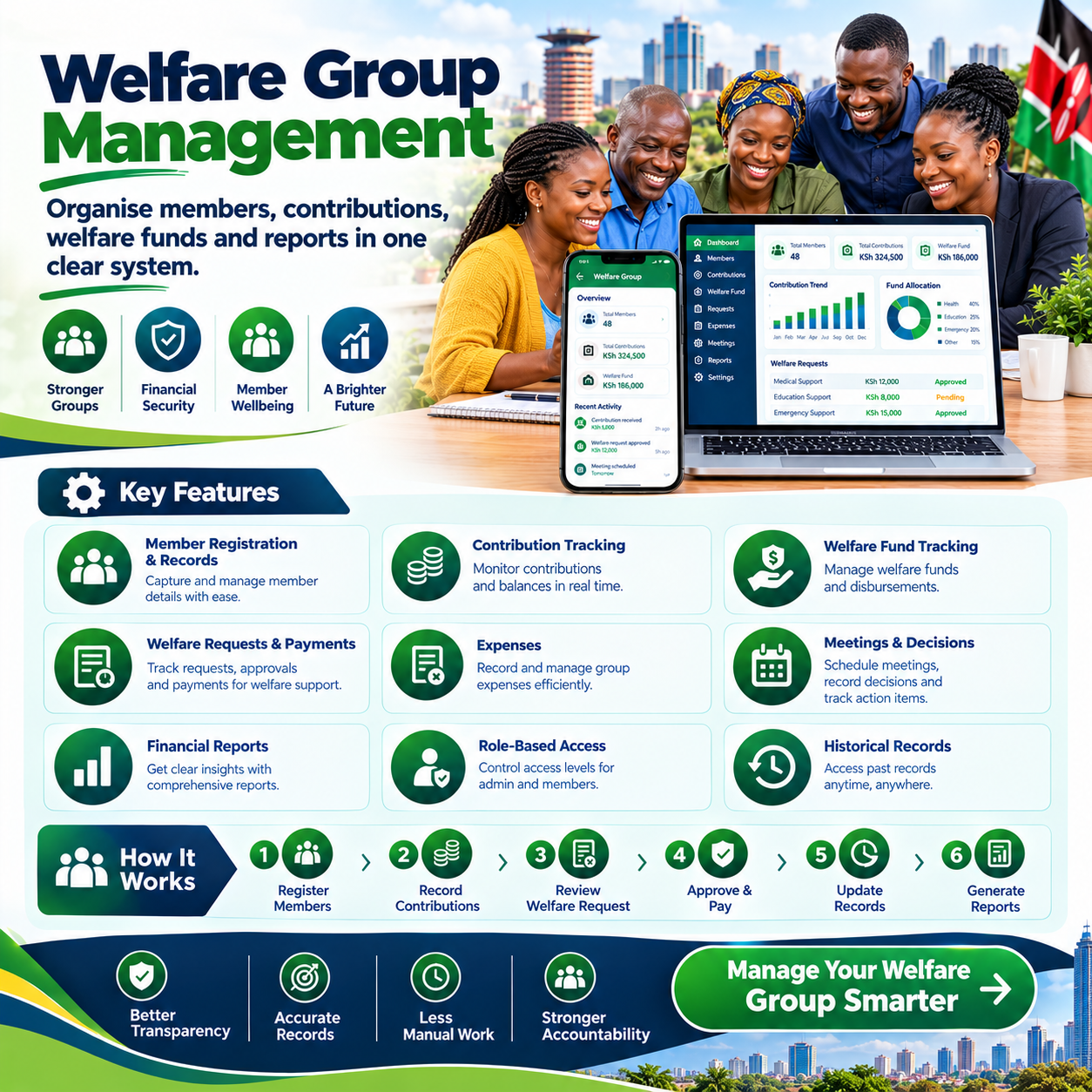
Welfare group management is the discipline that allows communities to show up for each other in life’s hardest moments — hospitalizations, bereavements, weddings, and emergencies — with money that is ready, records that are clear, and dignity that is intact. Across Kenya, welfare groups collect contributions weekly and monthly, standing behind their members when it matters most. Yet the difference between groups that deliver support smoothly and groups that stumble at the worst moments is rarely compassion; it is whether proper welfare group management sits behind the kindness.
The stakes in this space are uniquely high. Welfare money moves during the most emotionally charged moments of members’ lives, when families are grieving, hospitalized, or overwhelmed. Errors, delays, or disputes during those moments cut deeper than any financial argument ever could, which is why excellence in welfare group management is not optional for any group that takes its mission seriously.
The trouble is that compassion is often mistaken for a substitute for structure. Groups assume that because their intentions are noble, their administration can stay informal — and the assumption fails predictably. Benefits arrive late, subscriptions go untracked, and disputes about who contributed what poison precisely the bonds the group exists to protect. Structure is what allows kindness to be delivered reliably, and that structure is the subject of this complete guide to welfare group management.
The article is written for treasurers who hold the welfare fund, chairpersons who must approve payouts under pressure, and secretaries who keep the records families will rely on later. It is equally written for members who subscribe faithfully and deserve to know their safety net will actually catch them. Everyone connected to these groups benefits when proper welfare group management becomes the group’s operating standard.
One truth deserves stating before anything else. Welfare groups are judged at their worst moments, not their best ones. A group can run pleasantly for years, but its reputation is decided by how it performed during its members’ three or four hardest days — and that performance is determined entirely by the quality of its welfare group management in the calm years before.
There is a second truth that follows close behind. Compassion without administration is a promise that cannot be kept. The group that means well but cannot say how much is in the fund, who has subscribed, or when the payout will arrive will eventually fail someone at the worst possible time. Reliable generosity is engineered through disciplined welfare group management, not wished into existence.
The timing for this conversation has never been better. Mobile money reaches every pocket, smartphones fill every meeting, and platforms built for Kenyan groups now cost less per member than a single soda each month. The conditions that make professional welfare group management achievable have never been more accessible than they are right now.
There is also a quieter reward hiding behind the administrative discipline. Groups that manage their welfare operations well report stronger attendance, more willing volunteers, and members who recruit their friends — because people trust institutions that handled their darkest days with grace. That trust compounding is the deepest story inside every welfare group management success.
So read this guide with your group’s current practices open beside you. Note where your welfare operations are strong and where the gaps are hiding. By the final page, your group will have a complete blueprint for welfare group management that protects both the money and the humanity it serves.
What Is Welfare Group Management?
Welfare group management is the organized system of rules, records, roles, and routines that allows a group to collect subscriptions, hold funds safely, and deliver support reliably when members face hardship. It covers the entire journey — from the moment a member subscribes to the moment a payout reaches a grieving family. That end-to-end responsibility is what distinguishes professional welfare group management from informal goodwill.
Think of it as the operating system beneath the compassion. The kindness is the mission, but the system is what delivers the mission on schedule, every time, for every member. Groups that separate those two concepts build institutions; groups that blur them build vulnerabilities.
Without that system, welfare groups improvise. Subscriptions are remembered differently by different members, fund balances are estimated rather than known, and payouts depend on whatever cash happens to be available when tragedy strikes. Improvised welfare fails at precisely the moments it exists for — the pattern that disciplined welfare group management exists to break.
With strong welfare group management, the same group operates on structure. Subscriptions reconcile automatically, the fund balance is always known to the shilling, and payout procedures are documented before they are ever needed. Members feel the difference, because certainty during crisis is itself a form of care.
The discipline also protects the officials who serve. Welfare treasurers handle the group’s most sensitive money during its most emotional moments, and clear records are their armor against suspicion. That protection is one of the most valuable, least discussed functions of proper welfare group management.
It also helps to define the scope. Welfare group management covers subscriptions, fund custody, eligibility rules, payout procedures, record keeping, communication, and governance — the complete machinery behind mutual aid. Every element below serves that single mission of being ready.
Why Welfare Groups Exist — and Why Their Administration Matters
Welfare groups are among Kenya’s oldest and most trusted institutions. Long before insurance reached most households, communities pooled small subscriptions so that no member would face burial costs, hospital bills, or emergencies alone. That tradition of mutual aid is the foundation on which all modern welfare group management stands.
The first reason their administration matters is the emotional weight of the money. A welfare subscription is not an investment and not a fee — it is a promise made to every other member. When groups honor that promise with reliable welfare group management, the promise becomes real; when they fumble it, the promise becomes a grievance.
The second reason is timing. Support that arrives two weeks after the funeral helps nobody, while support that arrives the same day changes everything. Speed during crisis is engineered in advance through the subscription discipline, fund liquidity, and documented procedures that proper welfare group management maintains.
The third reason is fairness between members. Everyone subscribes equally, so everyone should be eligible equally — with no favoritism determining whose emergency gets answered first. Impartial eligibility, enforced through structured welfare group management, is what keeps the mutual promise credible.
The fourth reason is dignity. Families in grief should never have to chase their own group for updates or plead for their own entitlements. Transparent records and clear procedures, maintained through professional welfare group management, preserve the dignity that crisis moments deserve.
The fifth reason is sustainability. Welfare funds that are tracked, replenished, and budgeted survive decades, while loosely held funds evaporate after the first few major claims. Longevity is a direct product of disciplined welfare group management practiced through the calm years.
The sixth reason is trust compounding. Every well-handled claim becomes a story members tell, and those stories recruit new members more effectively than any invitation. Reputation is the compounding asset that professional welfare group management builds claim by claim.
The Four Pillars of Welfare Group Management
Professional administration of any welfare collective rests on four pillars working together. Groups that master all four deliver support like institutions; groups missing any one eventually feel the gap at the worst moment. Understanding the pillars is the foundation of welfare group management applied deliberately.
Pillar One: Governance and Rules
Governance is the written constitution of the welfare promise. It defines who qualifies, what benefits are payable, how much is subscribed, who approves payouts, and how disputes are resolved — all before any emergency arrives. Pre-agreed rules are the first act of serious welfare group management, because they replace future arguments with present agreements.
Benefit schedules deserve special care. The constitution should state clearly what the fund pays for bereavement, hospitalization, and other covered events, with amounts and conditions written down. Clear benefit definitions are the credibility core of welfare group management, because vague promises cannot be honored consistently.
Eligibility rules protect the fund’s fairness. Waiting periods for new members, subscription-standing requirements, and definitions of covered dependents all belong in the written rules. Impartial eligibility is the structural guarantee that welfare group management provides to every member equally.
Governance also defines the approval chain. Who confirms a claim, who authorizes the payout, and who signs the disbursement should be named in advance. Named authority is the accountability structure that disciplined welfare group management installs before it is ever tested.
Pillar Two: Financial Controls
Financial controls protect the welfare fund from error and temptation. The foundational rule is separation — welfare money lives in its own dedicated account, never blended with investment capital or any official’s personal funds. That separation is the non-negotiable floor of welfare group management everywhere.
Dual control is the second essential control. Two signatories on the welfare account and two approvals on every payout mean no single person can move the fund alone. That structure protects honest officials from suspicion as much as it protects money from misuse — the twin protection at the heart of welfare group management.
Liquidity management is the third control. Welfare money must remain accessible, because emergencies do not schedule themselves around investments. Keeping the fund liquid — with clear minimum balances and defined replenishment rules — is the readiness discipline of professional welfare group management.
Reconciliation completes the controls. Every subscription recorded must match the fund account, verified monthly by two officials together. Clean reconciliations are what let treasurers answer “is the fund healthy?” with certainty, and they are the heartbeat of credible welfare group management.
Pillar Three: Records and Transparency
Records transform subscriptions into verifiable entitlements. Every member’s payment history, standing, and claim history should live in one system any authorized official can read instantly. Complete records are the evidence layer that separates professional welfare group management from informal memory-keeping.
Member statements deserve particular emphasis. Each member should see their own subscription history and current standing on demand, without asking anyone’s permission. Self-service transparency dissolves the quiet doubts that form when records are hidden — a defining benefit of modern welfare group management.
Claim documentation is the most sensitive record in the group. Each claim should carry its verification, its approvals, its payout details, and its signatures, preserved permanently. Respectful completeness in claim files is the dignity standard of serious welfare group management.
Reporting rhythms complete this pillar. Monthly fund summaries at meetings, quarterly reviews, and annual statements at the AGM create predictable moments when the whole group sees the fund’s health together. Predictable rhythm turns welfare reporting into an institution within welfare group management practice.
Pillar Four: Member Engagement
Members are the source of the fund and the reason it exists, and engagement keeps both flowing. Communication rhythms — subscription reminders, fund updates, and claim confirmations — keep members connected between meetings. Sustained connection is the human side of welfare group management that spreadsheets alone cannot deliver.
Meetings themselves are engagement infrastructure. Short, structured sessions with clear agendas respect members’ time while keeping everyone informed about the fund they collectively own. Attendance patterns reveal engagement health long before any crisis tests it, making attendance a genuine metric within welfare group management.
Care beyond money completes the pillar. Visits to hospitalized members, calls during bereavement, and presence at difficult moments are the human expressions that make the fund meaningful. Groups that pair financial readiness with personal presence elevate welfare group management from administration into community.
The Welfare Payout Process: Step by Step
The payout is the moment the entire system exists for, and it deserves a documented, rehearsed procedure. The sequence below is the professional standard, and groups that follow it deliver support with speed and dignity together.
Step one is claim notification. When a covered event occurs, the member or their family notifies the officials through the agreed channel, immediately. Fast notification is the trigger that activates every subsequent step of professional welfare group management.
Step two is verification. The committee confirms the event against the constitution’s definitions — the covered relationship, the eligibility, and the member’s subscription standing. Documented verification is the fairness gate that protects the fund through disciplined welfare group management.
Step three is approval. The named authorities confirm the payout amount per the benefit schedule, and the approval is minuted with names and times. Recorded authorization is the accountability core of trustworthy welfare group management.
Step four is disbursement. The funds move through traceable channels — bank transfer or mobile money to the verified beneficiary — with receipts retained by both sides. Traceable delivery is the closing discipline of reliable welfare group management.
Step five is documentation and closure. The complete claim file — notification, verification, approval, and disbursement — is archived together. Permanent files are what future audits and reviews will rely on, and they are the archival finish of professional welfare group management.
Groups that rehearse this sequence in calm times deliver it in perfect order during storms. Groups that improvise it during storms discover every gap they never knew existed. That difference is the practical argument for treating welfare procedures as infrastructure rather than inspiration.
Subscriptions: The Lifeblood of the Fund
Subscriptions are the steady heartbeat that keeps the welfare promise funded. The discipline below keeps them current, recorded, and fair — which is the everyday work of welfare group management.
Subscription levels must be set sustainably. Amounts should reflect what every member can maintain across years, including lean seasons, because welfare funds built on unsustainable subscriptions fail quietly. Sustainable pacing is the longevity rule of welfare group management.
Collection rhythms matter as much as amounts. Fixed dates, automatic reminders, and familiar payment channels make subscribing effortless rather than memorable. Frictionless collection is the practical design goal of modern welfare group management.
Arrears need gentle, consistent handling. Members who fall behind should receive reminders, private conversations, and documented plans — not public embarrassment. Compassionate escalation is the humane discipline within welfare group management.
Standing must be visible to everyone concerned. Members should know their own subscription status instantly, and officials should see the fund’s overall health at a glance. Real-time visibility is the transparency dividend of digital welfare group management.
Fund health needs monitoring too. Officials should track the balance against expected claim frequencies, adjusting subscriptions deliberately when the math demands it. Actuarial awareness — even informal — is the foresight that separates enduring welfare groups from fading ones, and it is a core habit of mature welfare group management.
Technology’s Role in Modern Welfare Group Management
Technology has transformed what welfare groups can achieve. Tasks that once consumed treasurer evenings — recording subscriptions, tracking standings, preparing fund reports — now run automatically on dedicated platforms. That automation is the single biggest upgrade available to any group pursuing modern welfare group management.
The foundational technology is the management platform itself. Modern systems connect to group paybills and tills, reconcile every subscription automatically, and maintain clean ledgers for welfare funds separate from every other pool. Members check their own standing from their phones, and officials review live dashboards instead of reconstructing figures from memory — the daily experience of digital welfare group management.
Payment integration deserves special mention. When a member pays through M-Pesa, the platform should match the payment to the right member and fund within seconds, issuing an instant receipt. That automation eliminates the classic “I paid but nobody recorded it” dispute permanently — a dispute that welfare groups can least afford.
Claim tracking transforms crisis response too. Modern platforms record notifications, verifications, approvals, and disbursements in one trail, giving officials complete visibility during the most pressured moments. That documented speed is the crisis capability that distinguishes platforms built for serious welfare group management.
Reporting completes the technology picture. Fund summaries, member statements, and AGM-ready reports generate in minutes, giving officials figures they can defend anywhere. Speed with accuracy is the combination that marks genuine platforms in the practice of welfare group management.
Tas.co.ke serves groups at exactly this intersection. Contributions, welfare subscriptions, statements, and records run in one reconciled system with real Kenyan support, pairing naturally with any collection channel the group already uses. Groups that run their welfare operations on Tas.co.ke find that the discipline of professional welfare group management becomes automatic rather than effortful.
The guidance for choosing tools is consistent across the market. Demand automatic M-Pesa reconciliation, statements members can actually read, and real support that answers on collection day. Those three tests separate genuine infrastructure from pretty brochures in every evaluation of platforms for welfare group management.
Common Welfare Group Management Mistakes
Even well-intentioned groups repeat predictable mistakes. Recognizing them early is cheaper than correcting them late, and each error below has a structural cure that disciplined welfare group management provides.
Mistake one: relying on memory instead of records. Groups that keep subscription figures in notebooks and heads eventually disagree about who paid what, and those disagreements surface during the worst moments. Written, reconciled records are the antidote — the first prescription in welfare group management everywhere.
Mistake two: blending welfare money with other funds. The moment welfare money mixes with investment capital or operational cash, the fund’s true position becomes unprovable. Dedicated accounts and separate ledgers are the non-negotiable foundation of trustworthy welfare group management.
Mistake three: concentrating fund control in one person. A single signatory with full access to the welfare fund is a structural risk, however honest the individual. Dual control costs nothing and prevents the catastrophes that single control invites — a rule that no serious approach to welfare group management ever waives.
Mistake four: leaving benefit rules vague. Undefined payouts produce inconsistent decisions, and inconsistency during grief is remembered for years. Written benefit schedules are the fairness guarantee that disciplined welfare group management provides — applied identically to every member, every time.
Mistake five: underfunding the liquidity position. Funds locked into illiquid investments cannot respond when claims arrive, however wealthy the group is on paper. Preserved liquidity is the readiness discipline within welfare group management that every welfare treasurer must protect.
Mistake six: ignoring arrears until claims test them. A member with unpaid subscriptions who suffers an emergency creates the group’s hardest governance moment, and improvising that moment produces grievances. Clear standing rules, applied kindly and consistently, are the preventive discipline of welfare group management.
(keyword-free reflection) Every one of these mistakes is avoidable, and none of the cures costs more than the failures themselves. Groups that audit their welfare operations annually against this list rarely suffer the crises it describes. Prevention remains dramatically cheaper than repair.
Building Your Group’s Welfare System: A Practical Roadmap
Groups ready to professionalize should follow a sequence rather than attempt everything at once. Each step below builds on the one before it, and together they form a complete upgrade path for welfare group management in any collective.
Step one: write the welfare constitution. Cover benefit schedules, eligibility rules, subscription levels, approval chains, and dispute paths. Every member should sign it, and it should be reviewed annually — the living foundation of all welfare group management.
Step two: formalize the fund. Open a dedicated welfare account with dual signatories, separate from every other pool the group holds. That separation is the first wall of professional welfare group management.
Step three: adopt records infrastructure. Implement a platform that reconciles subscriptions automatically, maintains clean welfare ledgers, and provides member self-service. This single step typically eliminates most welfare disputes within one quarter, which is why it anchors modern welfare group management.
Step four: establish the rhythms. Monthly fund reports at meetings, quarterly reviews, and annual statements at the AGM. Predictable rhythm builds the trust that sporadic attention cannot, and rhythm is the heartbeat of sustainable welfare group management.
Step five: rehearse the payout procedure. Walk the committee through the claim sequence while nothing is urgent, so the process is memory when it is needed. Rehearsed procedures are the readiness guarantee of serious welfare group management.
Step six: plan succession from the start. Staggered terms, documented records, and a named understudy for the welfare treasurer. Groups that plan transitions survive them, and continuity is especially precious in groups where welfare group management carries the members’ deepest trust.
(keyword-free encouragement) Groups completing this roadmap report the same pattern everywhere. Claims move faster, disputes disappear, volunteers return willingly, and members recruit their friends. The system, once installed, quietly protects the compassion it was built to serve.
Management Across Different Welfare Formats
Welfare collectives take many forms, and each format stresses administration differently. The adaptations below keep governance relevant across every common structure, showing the flexibility within welfare group management done well.
Church welfare committees need congregation-scale records. Subscriptions across hundreds of members, multiple fund streams, and regular payouts demand structured systems. Congregational scale is where digital welfare group management proves indispensable.
Workplace welfare associations need employment-aware rules. Members join and leave with jobs, so eligibility, transfers, and exits must be handled by documented procedure. Mobility-aware design is the distinguishing requirement of welfare group management in employment settings.
Estate and village welfare groups need neighborly flexibility with firm records. Members see each other daily, which makes visible fairness even more important than elsewhere. Community transparency is the social standard within welfare group management for close-knit circles.
Family welfare groups need generational planning. Members across three generations subscribe, claim, and eventually pass entitlements between them. Documented succession is the peace-keeping layer that welfare group management provides across family lines.
Diaspora welfare groups need borderless systems. Members across time zones need subscriptions, claims, and confirmations that work while Nairobi sleeps. Cloud platforms have made borderless welfare group management routine rather than remarkable.
Real Stories from Kenyan Groups
The Nakuru market traders’ welfare circle transformed its crisis response in one season. Moving from cash collections to automated subscription tracking, their fund became provably healthy, and a member’s hospitalization was answered with same-day support that the whole community witnessed. Speed with dignity, they say, is what proper welfare group management delivered.
The Kitengela landlords’ group runs its compassion alongside its investments. Welfare subscriptions track on a dedicated fund while rental income and property matters run through Tas.co.ke, and both streams meet in one complete financial picture at every AGM. Members know exactly how their kindness and their capital both stand — the compounding payoff of integrated welfare group management.
The Eldoret youth group tells the cautionary version. Their first major bereavement arrived before they had written rules, and the improvised payout produced three years of quiet resentment. Rebuilding with structured welfare group management taught them that compassion needs infrastructure the way a house needs foundations.
Across all these stories, one pattern repeats without exception. Groups that administer their compassion deliberately deliver faster, argue less, and keep their members longer. Those outcomes together are the complete promise of professional welfare group management.
Frequently Asked Questions
What is the single most important element of welfare group management? A written benefit schedule — because every dispute in welfare groups traces back to unclear entitlements. Defined benefits, eligibility, and procedures are the first prescription in every framework of welfare group management.
How much should members subscribe? Only what every member can sustain across years, including lean seasons — consistency matters far more than size. Sustainable pacing is the longevity rule of welfare group management.
Should the welfare fund be invested? Prudently and never entirely — the fund must keep a defined liquid reserve sufficient for expected claims, with only genuine surplus placed in slower assets. Liquidity-first discipline is the investment rule within welfare group management.
How do we handle a member who claims while behind on subscriptions? Follow the standing rules written in the constitution, applied kindly and consistently — typically partial support with a documented arrangement rather than improvised generosity. Predictable compassion is the mature standard of welfare group management.
Can small welfare groups really manage professionally? Yes — professional discipline costs almost nothing at small scale, and habits built early scale smoothly. The ten-member circle that starts with structure becomes the two-hundred-member society that thrives, which is the founding argument of welfare group management applied from day one.
How do we protect the fund from misuse? Dedicated accounts, dual signatories, monthly reconciliations, and complete claim files — four controls that together make misuse structurally difficult. That layered protection is the security architecture of trustworthy welfare group management.
Where does Tas.co.ke fit in? Tas.co.ke runs subscriptions, statements, records, and fund tracking in one reconciled system with real Kenyan support, serving welfare groups at every stage of the welfare group management journey. Groups that run their welfare operations on Tas.co.ke gain records their members can verify and speed their families can feel — and the same platform extends to tenants and rent when the group also holds property.