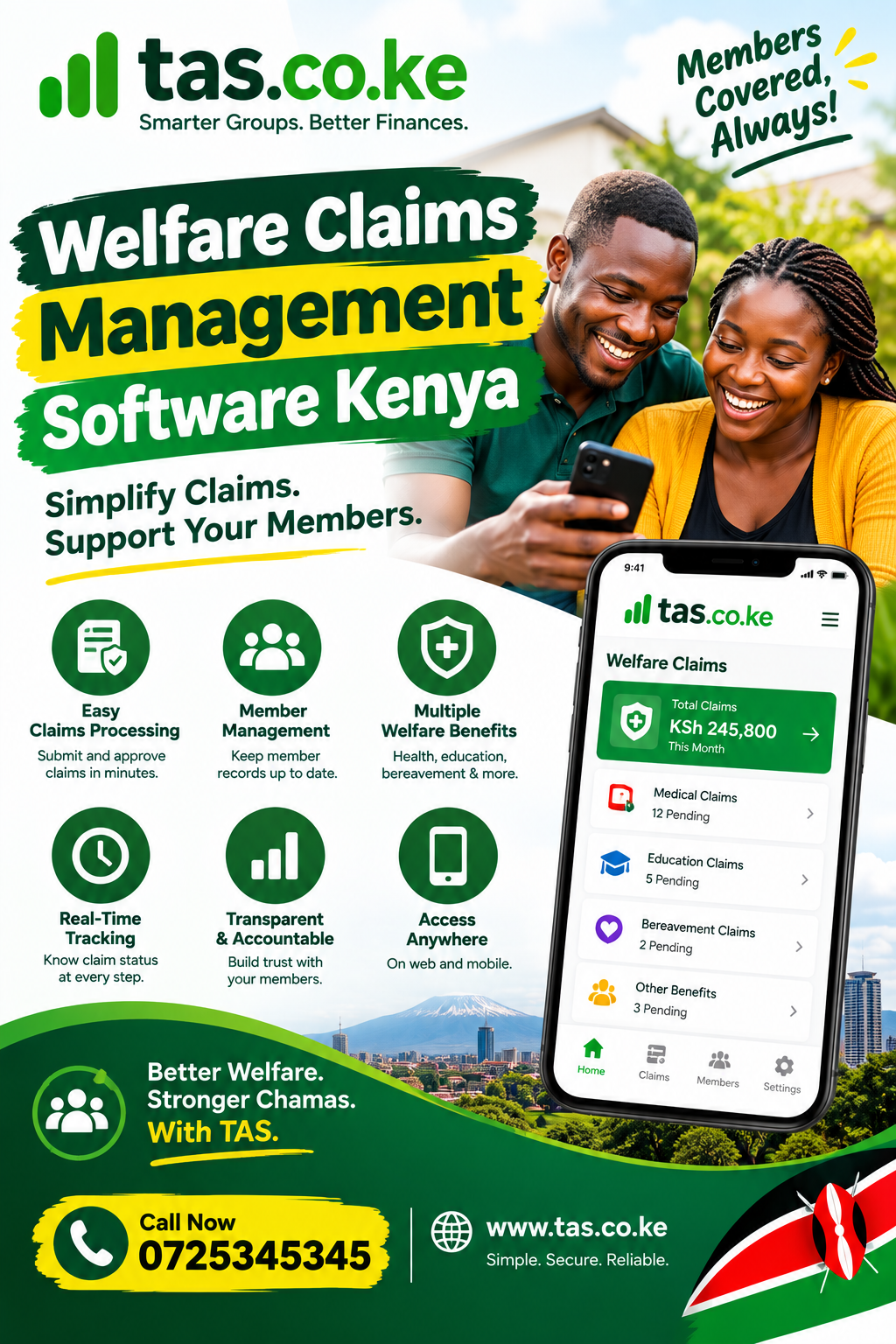
Welfare Claims Management Software Kenya: Complete Guide for Better Welfare Administration
Managing a welfare group involves more than collecting monthly contributions. Members expect the organisation to provide support when they experience qualifying events such as bereavement, hospitalisation, family emergencies or other circumstances covered by the group constitution.
As membership grows, however, managing welfare claims manually can become increasingly difficult. Committees may have to check notebooks, spreadsheets, WhatsApp conversations, payment confirmations and physical documents before deciding whether a claim qualifies.
This is where Welfare Claims Management Software Kenya becomes valuable.
A digital welfare claims system can help an organisation organise member information, contributions, claim requests, supporting documents, approvals, payments and reports within a structured environment. Instead of relying on disconnected records, officials can follow a consistent workflow from claim submission to final payment.
For Kenyan chamas and welfare organisations, the objective is not simply to replace paper with software. The objective is to make welfare administration more transparent, traceable, efficient and easier to review.
TAS provides digital tools designed for Kenyan member-based groups, including member records, contributions, financial records, meetings, reporting and role-based access. Its current public information also specifically identifies welfare groups as one of the organisations it supports.
What Is Welfare Claims Management Software Kenya?
Welfare Claims Management Software Kenya is a digital system designed to help welfare organisations manage requests for financial assistance according to their approved rules.
A typical welfare claim may involve several steps:
- A member reports a qualifying event.
- The claim is recorded.
- Eligibility is checked.
- Supporting information is reviewed.
- The claim is submitted to the appropriate committee or authorised official.
- The claim is approved or rejected.
- Payment is authorised.
- The payment is recorded.
- The welfare fund balance is updated.
- The transaction becomes available for reporting and future verification.
Without a structured system, these steps may be scattered across different files and communication channels.
Welfare Claims Management Software Kenya brings these activities into a more organised workflow. It allows the organisation to establish consistent records while maintaining the rules defined by its constitution.
The software does not replace the constitution. Instead, it provides a practical way for officials to implement and document the constitution.
For example, if a welfare group has established a specific benefit for bereavement, the committee can use its approved rules to determine eligibility, benefit amounts, required documentation and approval authority.
The system then helps officials record what happened.
Why Kenyan Welfare Groups Need Better Claims Management
Welfare Claims Management Software Kenya is increasingly relevant because welfare groups handle information that needs accuracy and accountability.
A small group may initially manage its welfare activities using a notebook.
One person records contributions.
Another person keeps a list of members.
The secretary records decisions.
The treasurer handles payments.
Claims may be discussed through WhatsApp.
Receipts may remain on individual phones.
This arrangement may work temporarily.
However, it can become difficult when the organisation grows.
Suppose a welfare group has 100 members. If every member contributes monthly, the organisation already has thousands of contribution records over several years.
Now add welfare claims.
A single claim may require:
- Member identification
- Contribution history
- Eligibility confirmation
- Event classification
- Supporting documents
- Approval records
- Payment information
- Claim status
- Financial reconciliation
Welfare Claims Management Software Kenya can help bring these records together so authorised officials can work from a common source of information.
This reduces the need to search through multiple spreadsheets or old conversations whenever a member asks about a claim.
Common Problems With Manual Welfare Claims
Manual systems are not automatically wrong. In fact, a small organisation with very few transactions may manage its records effectively using spreadsheets or physical files.
The problem occurs when the process becomes too dependent on individuals.
Welfare Claims Management Software Kenya can address several common administrative problems.
1. Missing Claim Information
A claim may be discussed verbally or through WhatsApp without creating a complete formal record.
Later, officials may struggle to determine:
- When was the claim submitted?
- Who submitted it?
- What event occurred?
- Which benefit category applies?
- What amount was approved?
- Who approved it?
- When was it paid?
A digital claim record creates a consistent place for this information.
2. Duplicate Records
When several officials maintain separate spreadsheets, the same claim can sometimes be entered more than once.
Welfare Claims Management Software Kenya can help establish a central record that reduces duplication and improves visibility.
3. Difficult Reconciliation
Welfare contributions and welfare payouts must eventually make sense financially.
If the treasurer records a payment in one spreadsheet while the secretary records the approved claim in another document, reconciliation can take time.
A connected system makes it easier to link the claim decision with the financial transaction.
4. Leadership Handover Problems
Leadership changes are common in member organisations.
A new treasurer should not have to depend entirely on the previous treasurer’s personal files or memory.
Welfare Claims Management Software Kenya can provide a structured history that helps incoming officials understand previous claims and transactions.
How a Digital Welfare Claim Workflow Works
A good welfare claims process should be simple enough for officials to follow consistently.
Welfare Claims Management Software Kenya can support a workflow such as the following.
Step 1: Member Identification
The process begins by identifying the member associated with the claim.
The member record may include their membership details, contribution history and other information relevant to the organisation’s rules.
This is important because eligibility may depend on membership status or contribution requirements.
Step 2: Claim Category
The claim should be assigned to an approved category.
Examples may include:
- Bereavement
- Hospitalisation
- Medical support
- Family emergency
- Wedding support
- Birth-related support
- Other constitutionally approved events
The exact categories should come from the organisation’s own welfare policy.
Welfare Claims Management Software Kenya should not create welfare rules automatically. Instead, it should help officials apply the rules that members have approved.
Step 3: Supporting Evidence
Some welfare categories may require supporting evidence.
Depending on the organisation’s rules, this could include documentation confirming the event.
The objective is not to collect unnecessary sensitive information. The objective is to provide enough evidence for authorised officials to determine whether the claim qualifies.
Step 4: Eligibility Review
The committee checks whether the member meets the requirements.
Questions might include:
- Is the person an active member?
- Are required contributions up to date?
- Does the event fall under an approved welfare category?
- Has the member already received assistance for the same event?
- Is the requested amount within the approved benefit limit?
Welfare Claims Management Software Kenya can help officials record the outcome of these checks.
Step 5: Approval
The appropriate official or committee reviews the claim.
A strong process should clearly distinguish between people who submit claims, people who review claims and people who approve payments where the organisation’s controls require separation of duties.
Step 6: Payment
Once approved, payment is processed according to the organisation’s financial procedures.
The payment reference should be recorded.
Step 7: Reconciliation
The transaction should then appear in the relevant financial records.
This helps the treasurer understand how much the welfare fund has collected, paid and retained.
Key Features to Look For
When evaluating Welfare Claims Management Software Kenya, organisations should focus on practical controls rather than simply counting the number of features advertised.
Member Records
The software should allow officials to maintain accurate member records.
A claim should be connected to the correct member rather than existing as an isolated transaction.
Contribution Tracking
Eligibility may depend on whether a member has met contribution requirements.
Welfare Claims Management Software Kenya can be particularly useful when contribution records and welfare activities are maintained within the same administrative environment.
TAS currently describes its contribution tools as supporting savings, welfare funds and member payments in a clear ledger.
Claim Status Tracking
A claim should have a clear status.
For example:
- Submitted
- Under review
- Awaiting information
- Approved
- Rejected
- Paid
- Closed
This prevents officials from relying on memory to determine what happened to a claim.
Approval Records
A welfare payment should have a traceable approval.
Welfare Claims Management Software Kenya should make it possible for authorised officials to determine who approved a transaction and when.
Payment References
The system should record payment information in a way that supports later reconciliation.
Reporting
A welfare committee may need reports showing:
- Contributions
- Claims
- Approved benefits
- Payments
- Outstanding claims
- Welfare fund balances
- Member-level activity
Welfare Claims Management Software Kenya can make these reports easier to organise than manually combining multiple spreadsheets.
Welfare Contributions and Claims Should Be Connected
One of the biggest advantages of digital welfare administration is the connection between contributions and claims.
A welfare group collects money for a defined purpose.
Members contribute.
The organisation maintains the fund.
Qualifying events generate support requests.
Approved claims result in payments.
The financial records therefore need to tell a consistent story.
Welfare Claims Management Software Kenya helps organisations think about claims as part of a broader welfare financial workflow rather than isolated requests.
For example, imagine a group with 50 members.
Each member contributes KSh 500 every month toward welfare.
The group collects KSh 25,000 per month.
If three qualifying claims are approved during a particular month, the committee needs to understand:
- How much was collected?
- How much was paid?
- What remains?
- Which claims were approved?
- Which claims are still pending?
- Are any member contributions outstanding?
A structured system can make these questions easier to answer.
Improving Transparency With Digital Welfare Records
Transparency does not mean exposing every private detail about a member.
Welfare matters can involve highly personal circumstances.
Instead, transparency should focus on the financial and administrative process.
Welfare Claims Management Software Kenya can help authorised officials establish records showing that a claim was received, reviewed, approved and paid according to the organisation’s procedures.
Members may need to know:
- Whether the welfare fund is being managed properly
- How much has been collected
- How much has been paid
- Whether claims are being processed according to policy
- Whether balances are accurate
At the same time, sensitive personal information should only be available to people who genuinely need it.
This is why access controls matter.
Role-Based Access for Welfare Organisations
Not every official should have unrestricted access to every piece of information.
The secretary may need to manage member records.
The welfare committee may need to review claims.
The treasurer may need to process financial transactions.
An auditor may need access to reports and transaction history.
Welfare Claims Management Software Kenya should support appropriate permissions so organisations can control who can view or change information.
TAS states that role-based permissions are part of its secure group-management approach.
This is particularly important for welfare groups because claims may contain information that should not be broadly accessible.
Welfare Claims and Audit Trails
An audit trail helps answer a simple question:
What happened to this transaction?
Welfare Claims Management Software Kenya can support better traceability when claims, approvals and payments are recorded systematically.
For example, an audit trail could help officials establish:
- A claim was submitted.
- The claim was reviewed.
- Supporting information was checked.
- An authorised person approved the claim.
- Payment was made.
- The transaction was recorded.
- The welfare balance was updated.
This is much stronger than relying on a message that says, “The committee approved this.”
Moving From Excel to Welfare Claims Software
Many Kenyan welfare organisations begin with Excel.
There is nothing inherently wrong with using spreadsheets.
The challenge comes when spreadsheets become the central infrastructure for every process.
Welfare Claims Management Software Kenya can be considered when officials spend increasing amounts of time maintaining formulas, checking duplicate records and reconciling separate files.
Before moving from Excel, organisations should clean their existing data.
This means checking:
- Member names
- Member numbers
- Contribution balances
- Opening welfare fund balance
- Previous claims
- Payments
- Outstanding claims
- Duplicate entries
- Missing transactions
Migration should not simply copy inaccurate records into a new system.
The organisation should first reconcile the information.
Implementation Checklist for Kenyan Welfare Groups
Choosing Welfare Claims Management Software Kenya is only the first step.
Successful implementation also requires clear internal procedures.
1. Review the Constitution
Identify the rules governing welfare contributions and benefits.
2. Define Claim Categories
Write down the events that qualify for assistance.
3. Define Benefit Amounts
Document the approved amounts or calculation methods.
4. Define Eligibility
Determine what members must do to qualify.
5. Define Documentation
Decide what evidence is reasonably required for each category.
6. Define Approval Authority
Specify who reviews and approves claims.
7. Define Payment Procedures
Determine who authorises and records payments.
8. Define Reporting Requirements
Decide which reports the committee and members need.
Welfare Claims Management Software Kenya works best when these rules are clear before the software is configured.
How TAS Can Support Welfare Groups
TAS is designed for Kenyan member-based organisations and provides a connected environment for activities such as member administration, contributions, financial records, meetings and reporting.
For organisations managing welfare activities alongside broader chama operations, this connected approach can be useful.
Welfare Claims Management Software Kenya can be evaluated alongside the group’s wider requirements.
For example, a welfare-focused chama may need to manage:
- Members
- Contributions
- Welfare funds
- Claims
- Payments
- Expenses
- Meetings
- Reports
A group that also operates savings or loan activities may need:
- Savings
- Loans
- Repayments
- Guarantors
- Investments
- Budgets
TAS’s broader platform is designed around several of these group-management functions rather than treating every activity as an isolated spreadsheet.
Benefits of Using Digital Welfare Administration
The main advantage of Welfare Claims Management Software Kenya is not simply speed.
The bigger advantage is consistency.
Better Record Keeping
Every claim can follow the same basic process.
Easier Reporting
Officials can spend less time manually combining records.
Improved Accountability
Approvals and payments can be associated with specific transactions.
Reduced Administrative Work
Officials can avoid repeatedly searching through multiple documents.
Better Leadership Handover
New officials can work from organisational records instead of relying exclusively on previous office holders.
Stronger Financial Visibility
The organisation can better understand contributions, payouts and balances.
Welfare Fund Management and Claims
A welfare claim cannot be separated from welfare fund management.
The fund needs money coming in.
It also has money going out.
Welfare Claims Management Software Kenya can help connect these activities in a structured record.
A welfare committee should be able to review questions such as:
- How much has been contributed this month?
- What is the total welfare fund balance?
- How many claims were approved?
- How much has been paid?
- Are there pending claims?
- Are members behind on contributions?
- Are there unusual transactions?
- Can the balance be reconciled?
TAS’s welfare-management guidance similarly emphasizes connecting contributions, claims, benefits, expenses, approvals and reporting in a structured environment.
Handling Welfare Claims Fairly
Software cannot make an unfair policy fair.
The organisation must first establish fair and understandable rules.
Welfare Claims Management Software Kenya can then help apply those rules consistently.
For example, suppose a group has approved a benefit for hospitalisation.
The constitution might specify:
- Minimum membership period
- Contribution requirements
- Maximum benefit
- Required documentation
- Number of claims allowed
- Approval process
The software should help officials follow these rules rather than allowing decisions to depend entirely on personal relationships.
Consistency is particularly important in member organisations because every member should understand how welfare benefits are determined.
Managing Sensitive Welfare Information
Welfare claims can contain personal information.
A member may be requesting support because of illness, bereavement or another difficult situation.
Welfare Claims Management Software Kenya should therefore be implemented with appropriate privacy and access controls.
Organisations should consider:
- Who can view claim details?
- Who can approve claims?
- Who can edit records?
- Who can export data?
- How are former officials’ accounts removed?
- How are corrections documented?
The principle should be simple:
Give people the access they need to perform their responsibilities, but avoid unnecessary access.
Digital Welfare Claims for Employee Groups
Employee welfare groups are another important use case.
Employees may contribute monthly toward a welfare fund.
The group may provide support for qualifying events.
As the number of employees increases, manual administration becomes more difficult.
Welfare Claims Management Software Kenya can help employee welfare committees organise member records, contribution histories, claims and payments.
The same principle applies to professional associations, churches, alumni organisations, community groups and other member-based organisations.
The software should be configured according to the organisation’s own rules.
Welfare Claims for Chamas
Many Kenyan chamas combine savings, investment and welfare activities.
This creates an additional administrative challenge.
A group may have one pool of money for savings, another for investments and another for welfare.
Welfare Claims Management Software Kenya can help the organisation maintain clearer records around the welfare component.
Separating welfare transactions from investment activity is important.
A welfare payment should not accidentally appear as an investment expense.
Likewise, a member’s regular savings contribution should not automatically be treated as a welfare contribution unless the group’s rules say so.
Clear categories improve reporting and reduce confusion.
Choosing the Right Welfare Claims System
Before selecting Welfare Claims Management Software Kenya, a welfare committee should create a practical checklist.
Ask the provider:
Does the software manage member records?
A claim should be connected to a member.
Can contributions be tracked?
Contribution history may be important for eligibility.
Can claims be categorised?
Different welfare events may have different rules.
Can approvals be recorded?
The system should provide a clear approval trail.
Can payments be reconciled?
Approved claims should eventually connect to financial records.
Can users have different permissions?
Not every official needs the same access.
Can reports be generated?
The committee needs reliable information for decision-making.
Can data be exported?
Organisations should understand how they can retrieve their records.
Can the system support leadership changes?
A system should remain useful even when committee members change.
Testing Software Before Adoption
A demonstration can be useful, but a real workflow test is even better.
Welfare Claims Management Software Kenya should be tested using scenarios that reflect the organisation’s actual activities.
For example, test:
Scenario 1: A member submits a normal welfare claim.
Scenario 2: A member does not meet the contribution requirement.
Scenario 3: A claim requires additional evidence.
Scenario 4: A claim is rejected.
Scenario 5: An approved claim is paid.
Scenario 6: A payment needs to be corrected.
Scenario 7: A new committee takes over.
Scenario 8: The treasurer needs a monthly welfare report.
Testing these scenarios provides much more useful information than simply looking at a feature list.
Monthly Welfare Reporting
A welfare committee should regularly review its financial and claims position.
Welfare Claims Management Software Kenya can support regular reporting where the platform provides the relevant records and reports.
A monthly review could include:
- Opening balance
- Member contributions
- Special welfare collections
- Approved claims
- Paid claims
- Outstanding claims
- Welfare expenses
- Closing balance
- Outstanding member contributions
The committee should compare reported figures with bank, mobile-money or other financial records where applicable.
Software improves organisation, but reconciliation remains an important management responsibility.
The Role of Welfare Committees
Digital tools do not eliminate the role of a welfare committee.
The committee remains responsible for applying the constitution and making decisions within its authority.
Welfare Claims Management Software Kenya simply provides a more structured environment for documenting those activities.
Committee members still need to:
- Review claims
- Apply eligibility rules
- Verify evidence
- Approve payments
- Monitor the welfare fund
- Resolve disputes
- Review reports
- Protect member information
The software supports these responsibilities; it does not replace governance.
Common Mistakes to Avoid
Organisations adopting Welfare Claims Management Software Kenya should avoid several common mistakes.
Mistake 1: Digitising Bad Records
If existing records are inaccurate, simply importing them does not solve the problem.
Mistake 2: Giving Everyone Full Access
Access should reflect responsibilities.
Mistake 3: Ignoring the Constitution
The software should support approved rules rather than replacing them.
Mistake 4: Failing to Reconcile
Reports should still be checked against underlying financial records.
Mistake 5: Keeping Critical Decisions in WhatsApp
Important approvals should be captured in the official organisational record.
Mistake 6: Not Training Officials
A system is only useful if officials understand how to use it.
Future-Proofing Welfare Administration
As a welfare organisation grows, its administrative requirements normally increase.
Welfare Claims Management Software Kenya can provide a foundation for more structured administration when combined with appropriate governance procedures.
A growing group may eventually require:
- More members
- More administrators
- More detailed reports
- More claim categories
- Stronger access controls
- Better financial reconciliation
- More structured meetings
- Better historical records
Choosing a system that can accommodate organisational growth is therefore important.
Why Record Accuracy Matters
A welfare fund deals directly with members’ money.
An incorrect contribution balance can affect eligibility.
An incorrect claim amount can affect the fund.
An unrecorded payment can create reconciliation problems.
Welfare Claims Management Software Kenya can reduce administrative fragmentation, but officials must still verify their records.
Accuracy should be treated as an ongoing process.
Every month, officials should ask:
- Are member balances correct?
- Are contributions complete?
- Are claims recorded?
- Are payments recorded?
- Does the welfare fund balance reconcile?
- Are outstanding items explained?
Welfare Claims and Member Trust
Trust is one of the most important assets of a welfare organisation.
Members contribute because they believe the organisation will use the money according to agreed rules.
Welfare Claims Management Software Kenya can support that trust by making records easier to maintain and review.
When members ask questions, officials should be able to provide understandable explanations.
For example:
Question: How much has the welfare fund received?
Answer: The contribution report should provide the relevant figure.
Question: How much has been paid in welfare benefits?
Answer: The claims and payment records should provide the answer.
Question: Why was a particular claim paid?
Answer: The organisation should be able to refer to the relevant approval and supporting records while protecting confidential information.
That is the type of transparency that digital administration can support.
A Practical Welfare Claims Management Process
A strong workflow can be summarised as:
Member → Claim → Eligibility → Evidence → Review → Approval → Payment → Reconciliation → Reporting
Welfare Claims Management Software Kenya can help organisations structure this sequence.
The exact process will vary depending on the group’s constitution.
However, the principle remains the same:
Every welfare transaction should have a clear beginning, decision, financial outcome and record.
How TAS Fits Into a Broader Chama System
A welfare group may eventually require more than claims management.
It may need member administration, contributions, loans, meetings, budgets and reports.
Welfare Claims Management Software Kenya can therefore be evaluated as part of the group’s wider digital-management requirements.
TAS describes its platform as a connected workspace covering contributions, loans, meetings, budgets, reports and member records, with role-based access.
This can be useful for a chama where welfare is one part of a broader financial structure.
For example, the same organisation may collect monthly savings, issue loans, maintain a welfare fund, hold meetings and prepare financial reports.
A connected system can reduce the number of separate administrative tools required.
Frequently Asked Questions
What is Welfare Claims Management Software Kenya?
Welfare Claims Management Software Kenya is software designed to help welfare organisations manage member welfare claims, eligibility, supporting records, approvals, payments, financial information and reporting in a structured digital environment.
Who can use welfare claims software?
Welfare chamas, employee welfare groups, churches, community organisations, alumni groups, professional associations and other member-based organisations can potentially benefit from welfare claims software.
Can welfare software track contributions?
Yes. Contribution tracking is an important part of welfare administration because eligibility may depend on contribution status.
Can the system manage claim approvals?
A suitable system can provide structured workflows and records for claim reviews and approvals, depending on its specific functionality.
Can welfare software track payments?
A welfare-management system can help organisations record approved payments and associate them with the relevant claims and financial records.
Does software replace a welfare constitution?
No. The constitution remains the authority. Software should help officials implement and document the rules that members have approved.
Is welfare claims software suitable for small chamas?
Yes, although small organisations should choose a solution that matches their actual requirements and avoids unnecessary complexity.
Can a welfare group move from Excel?
Yes. Before migration, the group should clean, reconcile and verify existing member, contribution and claims records.
Why are audit trails important?
Audit trails make it easier to understand what happened to a transaction, including important changes, approvals and payments.
Can welfare claims contain sensitive information?
Yes. Some claims may involve personal circumstances. Organisations should therefore apply appropriate access controls and avoid exposing unnecessary details.
How should a welfare group choose software?
Start with the organisation’s constitution and workflow. Then test the software using real scenarios involving members, contributions, claims, approvals, payments and reports.
Conclusion
Welfare administration is fundamentally about people helping one another through an organised financial structure.
As Kenyan welfare groups grow, relying entirely on notebooks, spreadsheets and informal messages can make it harder to maintain accurate records and process claims consistently.
Welfare Claims Management Software Kenya provides a way to organise the claim lifecycle from member identification and eligibility review through approval, payment and reporting.
The most effective approach is not to digitise everything without a plan.
Instead, welfare organisations should first establish clear rules.
They should define:
- Who qualifies
- What events qualify
- What evidence is required
- How claims are reviewed
- Who approves payments
- How payments are recorded
- How the welfare fund is reconciled
- What information members can access
- What reports the committee needs
Once these processes are clear, software can make administration easier to manage.
TAS is built for Kenyan member-based groups and provides connected tools for members, contributions, financial records, meetings, reporting and secure access. Its public information also highlights welfare groups as one of the group types supported by the platform.
For organisations considering digital welfare administration, the best approach is to test the platform using actual workflows rather than judging software purely by the number of advertised features.
A good system should make records easier to maintain, decisions easier to trace, payments easier to reconcile and reports easier to understand.
Welfare Claims Management Software Kenya can therefore play an important role in helping Kenyan welfare groups move from fragmented administration toward more organised and accountable digital management.
If your group is ready to modernise its welfare administration, explore TAS and test how its member, contribution, financial and reporting workflows can fit your organisation’s requirements.
Final Checklist
Before adopting a system, ask:
- Are our member records accurate?
- Are welfare contributions properly recorded?
- Are our claim categories clearly defined?
- Are eligibility rules documented?
- Is supporting evidence clearly defined?
- Are approval responsibilities clear?
- Can we trace payments?
- Can we reconcile the welfare fund?
- Are user permissions appropriate?
- Can we generate useful reports?
- Can new officials understand historical records?
- Can we retrieve our data when required?
- Does the system fit our constitution and actual workflow?
If the answer to these questions is yes, your organisation will have a much stronger foundation for transparent welfare administration.