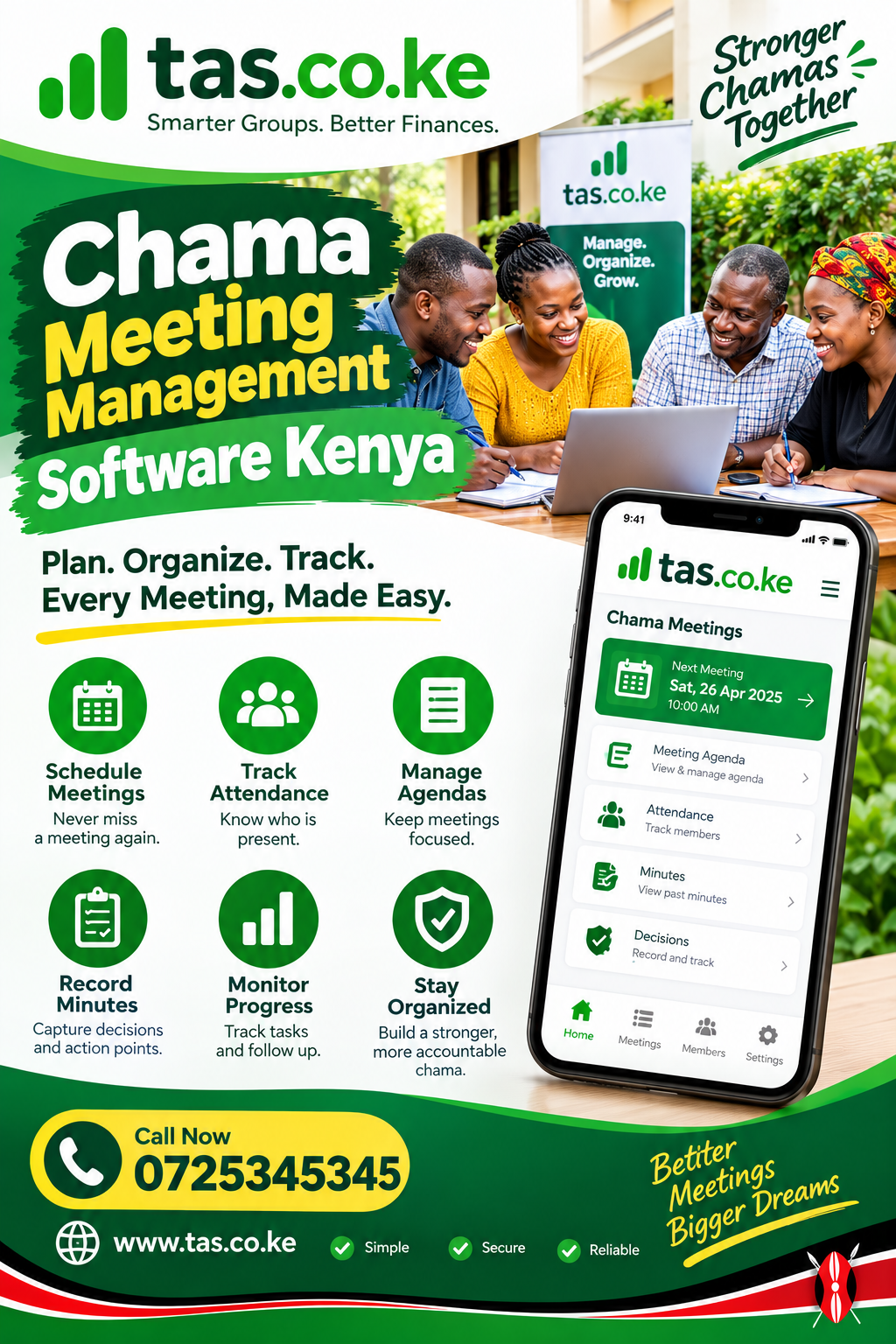
Chama Meeting Management Software Kenya: Complete Guide to Better Meetings, Minutes and Decisions
A chama meeting is where many of the group’s most important decisions are made. Members may approve loans, discuss contributions, review financial reports, agree on investments, authorise expenses, address welfare matters and assign responsibilities. When those discussions are recorded poorly, the group can struggle to remember what was agreed, who was responsible and when an action was supposed to be completed. A structured Chama Meeting Management Software Kenya solution can help a chama organise meeting schedules, agendas, attendance, minutes, decisions and follow-up actions in one place.
Good meeting management is not about producing pages of minutes. It is about creating a dependable record of decisions.
For Kenyan savings groups, investment chamas, welfare associations, table-banking groups, employee savings groups and other member-based organisations, this distinction matters. A meeting may last two hours, but the decisions made during those two hours can affect the group for months or years.
This guide explains how digital meeting management works, why organised meeting records matter, what features a chama should look for, how to prepare better agendas, how to capture minutes and decisions, how to follow up action items, and how meeting records can connect with the group’s financial and member-management activities.
What Is Chama Meeting Management Software?
Chama Meeting Management Software Kenya refers to digital software that helps a chama organise the administrative work surrounding its meetings.
That can include:
- Creating meetings
- Setting dates and times
- Recording venues or meeting methods
- Preparing agendas
- Recording attendance
- Capturing minutes
- Recording decisions
- Assigning action items
- Tracking outstanding actions
- Reviewing previous minutes
- Connecting meeting decisions with relevant group activities
The exact functionality depends on the software provider.
The important idea is that meeting information should not exist only in a notebook, a secretary’s personal computer or a WhatsApp conversation.
A digital meeting record can provide a central reference for authorised officials and members.
TAS currently describes its meeting functionality as allowing groups to create agendas, record minutes and keep group decisions visible. Its wider platform connects meetings with member, contribution, loan, budget and reporting records.
This connected approach can be particularly useful when a meeting decision affects another part of the chama’s operations.
For example:
Meeting decision → Budget allocation → Expense → Financial report
Or:
Meeting decision → Loan approval → Loan record → Repayment
The meeting is therefore not an isolated administrative event.
It can be the point where an important group decision begins.
Why Chama Meetings Need Better Recordkeeping
Many chamas begin with informal meetings.
The secretary writes notes in an exercise book.
Someone takes attendance.
Members discuss financial matters.
The chairperson announces decisions.
The group moves on.
For a small group, this may seem sufficient.
Problems can arise later.
A member may ask:
When was this decision made?
Another member may ask:
Who approved the expense?
The treasurer may ask:
Was this expenditure actually authorised?
The secretary may wonder:
Who was supposed to complete this task?
A committee member may ask:
What happened to the action agreed at the previous meeting?
If the answers depend on someone’s memory, the group has a recordkeeping weakness.
Chama Meeting Management Software Kenya can help create a more structured meeting history when the selected platform provides the appropriate functionality.
The purpose is not to record every sentence spoken.
The purpose is to preserve the information that matters.
What Should Chama Meeting Minutes Contain?
Good minutes should be concise enough to read but detailed enough to establish what happened.
A useful meeting record may include:
Meeting Details
- Meeting title
- Date
- Time
- Venue or meeting method
- Meeting type
Attendance
Record who attended according to the group’s rules.
Apologies
Where appropriate, record members who were expected but unable to attend.
Agenda
List the subjects to be discussed.
Previous Minutes
Record whether the previous minutes were approved or amended.
Matters Arising
Identify unresolved issues from previous meetings.
Discussions
Capture important points without turning the minutes into a word-for-word transcript.
Decisions
Clearly state what the group agreed.
Action Items
Identify who is responsible and, where appropriate, the expected completion date.
Closing
Record the closing time and any other required information.
Chama Meeting Management Software Kenya can make these elements easier to organise when meeting records are structured within the platform.
The Difference Between Minutes and Decisions
One of the most common meeting-recording mistakes is treating minutes as a transcript.
Minutes do not need to capture every comment.
A useful record should focus on outcomes.
For example, instead of writing several paragraphs about a discussion concerning a proposed investment, the minutes could record:
Decision: The committee agreed to conduct additional due diligence before the investment proposal is presented to members for consideration.
Action: Investment committee to obtain the required information before the next meeting.
That is more useful than reproducing every argument made during the discussion.
Chama Meeting Management Software Kenya can help separate the meeting record from the specific decisions and actions that need follow-up.
The objective is clarity.
After reading the minutes, an authorised person should understand:
- What was discussed?
- What was decided?
- Who is responsible?
- What happens next?
Preparing an Effective Chama Agenda
A good meeting begins before members arrive.
The agenda gives the meeting structure.
A practical monthly agenda might include:
- Opening
- Confirmation of attendance
- Apologies
- Approval of previous minutes
- Matters arising
- Treasurer’s report
- Contribution review
- Loan updates
- Welfare matters
- Budget and expense review
- New business
- Decisions requiring approval
- Action assignments
- Any other business
- Next meeting
- Closing
The agenda should be adapted to the group’s constitution and actual needs.
A meeting does not become better simply because it has more agenda items.
Chama Meeting Management Software Kenya can help officials organise agendas consistently so that important recurring matters are not forgotten.
The goal is to give members enough structure to make the meeting productive without making it unnecessarily rigid.
Why an Agenda Matters
Without an agenda, meetings can easily become reactive.
Someone raises an unrelated issue.
Another member introduces a different topic.
The conversation shifts again.
Important matters may be rushed at the end.
An agenda helps the chairperson maintain direction.
It also gives members an opportunity to prepare.
For example, if the agenda says the committee will review monthly expenses, the treasurer can prepare the relevant information beforehand.
If the group will discuss a proposed investment, members can receive the relevant information in advance.
Chama Meeting Management Software Kenya can support a more organised meeting process when the system allows agendas and related meeting records to be maintained together.
Recording Attendance
Attendance is an important part of meeting governance.
The exact attendance requirements depend on the group’s rules.
A meeting record may need to show:
- Members present
- Members absent
- Apologies
- Officials present
- Guests, where applicable
- Quorum status, where relevant
Digital attendance records can reduce uncertainty later.
Suppose an important decision was made.
A member later questions whether the meeting had enough members present.
A properly maintained attendance record can help officials review what happened.
Chama Meeting Management Software Kenya can be evaluated on whether it supports the group’s attendance requirements and provides a clear historical record.
Attendance should not, however, be treated as a substitute for following the group’s constitution.
If the constitution defines quorum or voting requirements, those rules remain important.
Quorum and Meeting Governance
Quorum is a governance matter.
A chama should follow the requirements established in its constitution or other governing documents.
Software can help record attendance and make the information easier to review, but it should not invent the group’s rules.
For example, if a chama requires a certain proportion of members to be present before specific decisions can be made, officials should understand that requirement before relying on meeting records.
Chama Meeting Management Software Kenya can support the administrative record of attendance, while the committee remains responsible for applying its governing rules correctly.
This distinction is important.
Technology records what happens.
Governance determines what is authorised.
Recording Decisions Clearly
A decision should be written so that someone reading the minutes several months later can understand it.
Weak wording:
Members discussed the investment and agreed.
Better wording:
Members agreed to conduct further due diligence before proceeding with the proposed investment.
Even better where appropriate:
Members agreed that the investment committee would obtain the outstanding due-diligence documents and present its findings at the next scheduled meeting before any commitment is made.
The exact wording depends on what was actually decided.
Chama Meeting Management Software Kenya can provide a structured place to preserve these decisions, making them easier to find during future meetings.
The objective is to avoid ambiguous minutes.
Tracking Action Items
A meeting is not complete when the minutes are written.
Many decisions create tasks.
For example:
| Action | Responsible Person | Due Date | Status |
|---|---|---|---|
| Obtain investment documents | Investment committee | Next meeting | Pending |
| Confirm venue | Secretary | Before next meeting | Complete |
| Prepare loan report | Treasurer | Meeting date | Complete |
| Review welfare claims | Welfare committee | Friday | Pending |
These action items transform discussion into follow-through.
Chama Meeting Management Software Kenya can help a group maintain a visible record of outstanding actions when the platform supports action tracking.
This can reduce the common problem where a decision is recorded but nobody remembers who was supposed to implement it.
The “Matters Arising” Problem
Many meetings include a section called “matters arising.”
The problem is that this section can become vague.
A better approach is to carry forward specific actions.
For example:
Previous action: Treasurer to reconcile the outstanding contribution records.
Status: Completed.
Outcome: Two unmatched payments were identified and corrected.
This is more useful than simply writing:
Matters arising were discussed.
Chama Meeting Management Software Kenya can help officials keep previous actions visible so that unresolved matters do not disappear between meetings.
The meeting history then becomes a continuous management record.
Connecting Meetings With Financial Decisions
Chama meetings frequently involve money.
Members may approve:
- Budgets
- Expenses
- Loans
- Investments
- Welfare payments
- Contribution changes
- Penalties
- Financial policies
This means meeting records can provide important context for financial transactions.
For example:
Meeting: Members approve a KSh 30,000 expenditure.
Financial record: KSh 28,500 is later paid.
Report: The expense appears under the approved category.
The figures are illustrative.
The important principle is traceability.
Chama Meeting Management Software Kenya can be evaluated on how well meeting information works alongside financial records.
When related information is easier to connect, officials can answer questions more confidently.
Meeting Management for Investment Chamas
Investment groups often make decisions that require careful documentation.
Examples include:
- Evaluating investment opportunities
- Approving due diligence
- Appointing professional advisers
- Authorising project expenditure
- Reviewing investment performance
- Changing investment strategy
- Approving new projects
The minutes should capture the decision rather than every detail of the discussion.
Supporting documents should be preserved separately where appropriate.
Chama Meeting Management Software Kenya can help provide a structured meeting history for investment groups when its functionality matches the group’s requirements.
Before adopting any system, the committee should test how investment-related decisions will be recorded and retrieved.
Meeting Management for Welfare Groups
Welfare groups may discuss:
- Member support
- Welfare claims
- Contributions
- Emergency assistance
- Group events
- Member eligibility
- Welfare budgets
These matters can sometimes be sensitive.
The meeting record should contain enough information to document the decision without unnecessarily exposing private information.
Chama Meeting Management Software Kenya can be assessed on its access controls and ability to separate appropriate user permissions.
Privacy should be considered when deciding who can view detailed meeting records.
Not every member necessarily needs unrestricted access to every administrative note.
Meeting Management for Table Banking Groups
Table banking meetings can involve frequent financial decisions.
Members may discuss:
- Contributions
- Loan requests
- Repayments
- Penalties
- Welfare matters
- Group expenses
- Future activities
Because the meeting may contain both administrative and financial discussions, consistent documentation is useful.
Chama Meeting Management Software Kenya can be considered as part of a broader digital workflow if the group needs to connect meetings with member and financial records.
The group should establish which decisions require formal approval and how those approvals should be documented.
Meeting Management for Employee Chamas
Employee chamas can face a particular continuity challenge.
Members may leave employment.
Committee members may rotate.
Officials may hand over responsibilities periodically.
If meeting records exist only in personal notebooks or computers, important institutional knowledge can be lost.
Chama Meeting Management Software Kenya can support continuity when meeting records are stored centrally and authorised officials can access the relevant history.
A new secretary should be able to understand previous decisions without relying entirely on the previous secretary’s memory.
That is one of the strongest reasons to create an organisational record rather than a personal record.
Digital Minutes Versus Paper Minutes
Paper minutes are not inherently bad.
They can be useful and may form part of a group’s formal records.
The challenge is accessibility.
Finding a decision made two years ago may require searching through multiple notebooks.
Digital records can make this easier.
A system may allow authorised users to search or browse previous meetings.
Chama Meeting Management Software Kenya can be evaluated on how easily officials can locate previous agendas, minutes, decisions and actions.
The ideal approach may also involve retaining appropriate historical records according to the group’s own policies.
Digital does not automatically mean better.
The quality of the recordkeeping process still matters.
How the Secretary Benefits From Meeting Software
The secretary often carries the largest administrative workload associated with meetings.
Before the meeting, the secretary may prepare the agenda.
During the meeting, the secretary records attendance and minutes.
After the meeting, the secretary may type, edit and distribute the minutes.
The secretary then has to remember unresolved actions at the next meeting.
This can become time-consuming.
Chama Meeting Management Software Kenya can help create a repeatable workflow for these tasks when the platform supports the required features.
A good system should reduce duplicate work rather than simply moving the same manual process onto a computer.
How the Chairperson Benefits
The chairperson needs visibility rather than necessarily doing all the administrative work.
Before a meeting, the chairperson can review the agenda.
During the meeting, the chairperson can guide discussion according to the agenda.
After the meeting, the chairperson can review decisions and outstanding actions.
This creates continuity.
Chama Meeting Management Software Kenya can help structure this process when authorised users can access the relevant meeting records.
The chairperson can then focus on leadership rather than trying to remember every outstanding matter personally.
How the Treasurer Benefits
The treasurer may need to present:
- Contribution reports
- Loan information
- Expense reports
- Budget information
- Financial balances
Meeting management becomes more useful when these reports are available before the meeting.
TAS’s published product information describes meetings alongside contributions, loans, budgets and reports in one connected workspace.
Chama Meeting Management Software Kenya can therefore be evaluated based on whether the meeting workflow makes it easier to bring the appropriate financial information into discussions.
The goal is not to overload members with numbers.
The goal is to provide the information needed for informed decisions.
How Members Benefit
Members benefit when meetings become more organised.
A well-managed meeting gives them:
- A clear agenda
- Better preparation
- Understandable decisions
- More reliable minutes
- Visibility into outstanding actions
- A clearer record of what the group agreed
Chama Meeting Management Software Kenya can contribute to this transparency when members receive the level of access appropriate to the group’s governance structure.
The system should not remove healthy discussion.
Instead, it should make the outcome of that discussion easier to preserve.
Preparing for a Chama Meeting
A practical preparation process can look like this.
One Week Before
Confirm the meeting date and prepare the draft agenda.
Several Days Before
Collect reports and documents needed for discussion.
Before the Meeting
Review outstanding actions from the previous meeting.
At the Start
Record attendance and confirm whether the meeting can proceed according to the group’s rules.
During the Meeting
Follow the agenda and record decisions clearly.
Immediately After
Review the decisions and action items while the discussion is still fresh.
Before the Next Meeting
Review progress on outstanding actions.
Chama Meeting Management Software Kenya can support this recurring workflow where the relevant meeting features are available.
How to Write Better Chama Minutes
Good minutes should be:
Accurate: They should reflect what actually happened.
Clear: A reader should understand the decision.
Concise: They should not become a transcript.
Consistent: The same structure should be used across meetings.
Action-oriented: Tasks should identify responsibility.
Accessible: Authorised people should be able to retrieve them.
A useful sentence structure for decisions is:
The members/committee agreed to [decision], with [person/committee] responsible for [action] by [date], subject to [relevant condition].
The exact language should match what the group actually decided.
Chama Meeting Management Software Kenya can make consistent minute structures easier to maintain.
Meeting Templates
A standard meeting template can save time.
A basic template could contain:
Meeting Title
Date
Time
Venue
Chairperson
Secretary
Attendance
Apologies
Agenda
Previous Minutes
Matters Arising
Agenda Item 1
Decision
Action
Responsible Person
Agenda Item 2
Decision
Action
Any Other Business
Next Meeting
Closing
The template should be adapted to the group’s constitution and procedures.
Chama Meeting Management Software Kenya can help standardise this structure when the platform allows reusable meeting workflows or consistent meeting records.
Meeting Decisions and Voting
Some chama decisions may require voting.
The exact voting rules depend on the constitution.
A meeting record should distinguish between:
- Discussion
- Proposal
- Amendment
- Vote
- Decision
For example:
Proposal: Increase the monthly contribution.
Discussion: Members considered the effect on different income levels.
Vote: The proposal was put to a vote according to the group’s rules.
Decision: The required majority approved the change.
The minutes should record the outcome accurately.
Do not invent voting results or procedural details that were not actually recorded.
Chama Meeting Management Software Kenya can provide a structured place for documenting the resulting decision.
Meeting Records and Financial Accountability
A financial transaction can sometimes raise questions long after the meeting where it was authorised.
Suppose the group approves an expense in January.
The payment occurs in February.
The financial report is presented in March.
If the meeting decision is easy to retrieve, the committee can establish the context.
This is particularly valuable for larger expenses.
Chama Meeting Management Software Kenya can support this chain of information when meeting and financial records are managed within a connected environment.
The purpose is not to create unnecessary bureaucracy.
It is to preserve institutional memory.
Meeting Management and Loan Decisions
Loans are another area where meeting records can matter.
A group may discuss:
- A loan application
- A guarantor arrangement
- An exception
- A repayment issue
- A restructuring request
- A loan policy
The decision should be recorded clearly.
Financial records can then reflect the approved transaction.
Chama Meeting Management Software Kenya can be useful when meeting management sits alongside loan and member records.
The group should nevertheless verify that the platform supports its particular loan rules.
Software should not be assumed to understand every constitution automatically.
Meeting Management and Member Administration
Meetings can also affect membership.
Decisions may concern:
- New members
- Resignations
- Suspensions
- Transfers
- Changes in membership status
- Committee appointments
These decisions should be recorded according to the group’s rules.
Chama Meeting Management Software Kenya can help preserve the meeting history associated with such decisions where appropriate.
This becomes especially useful when leadership changes.
The new committee can review previous decisions instead of starting from scratch.
Digital Meeting Records and Security
Meeting minutes may contain sensitive information.
They may reference:
- Member finances
- Loan matters
- Welfare issues
- Disciplinary matters
- Investment proposals
- Internal disagreements
Access should therefore be controlled.
TAS publicly describes role-based permissions and secure access as part of its platform.
Chama Meeting Management Software Kenya can be assessed by asking exactly which users can view, create, edit or delete meeting records.
Security questions should include:
- Who can create meetings?
- Who can edit minutes?
- Who can view financial discussions?
- Can records be deleted?
- Is there an audit history?
- How are user accounts protected?
- Can records be exported?
These questions are more useful than simply asking whether a system is “secure.”
Audit Trails and Meeting History
An audit history can help show how records changed over time.
This can be particularly valuable when:
- Minutes are corrected
- Decisions are updated
- Information is amended
- Officials change
- A member disputes a record
TAS’s published meeting-management material describes an audit history as part of its broader recordkeeping approach.
Chama Meeting Management Software Kenya can therefore be evaluated on whether its audit functionality meets the group’s requirements.
The committee should ask for a demonstration rather than relying solely on a feature label.
Data Export and Handover
A meeting record belongs to the organisation, not merely to the secretary who created it.
That principle becomes important when leadership changes.
Suppose the secretary leaves the group.
The new secretary should not need to obtain a personal laptop or private email account simply to access previous minutes.
TAS states publicly that group records remain available to the group and can be exported.
Chama Meeting Management Software Kenya can therefore be evaluated partly on how well it supports continuity and data ownership.
Ask:
- Can we export meeting records?
- What format are they exported in?
- Are attachments included?
- Can historical records be retained?
- Who controls access when an official leaves?
Moving From Paper Minutes to Digital Meetings
A chama does not have to digitise everything at once.
A gradual approach can work well.
Step 1: Organise Existing Records
Collect previous minutes and identify the most important historical records.
Step 2: Establish a Standard Template
Agree on the structure of future meeting records.
Step 3: Define Roles
Decide who creates meetings, records minutes and reviews them.
Step 4: Start With New Meetings
Begin digital recording from a clearly defined date.
Step 5: Preserve Important Historical Records
Transfer or retain older records according to the group’s needs.
Step 6: Review the First Few Meetings
Identify what works and what needs adjustment.
Chama Meeting Management Software Kenya can become part of this transition when the system fits the group’s administrative process.
The important thing is consistency.
A sophisticated platform is not useful if officials continue maintaining separate unofficial records.
Common Chama Meeting Management Mistakes
Mistake 1: Writing Minutes From Memory Days Later
Important details may be forgotten.
Mistake 2: Recording Discussions but Not Decisions
Members need to know what was actually agreed.
Mistake 3: Failing to Assign Actions
A decision without responsibility may never be implemented.
Mistake 4: Not Reviewing Previous Actions
Unfinished work can disappear between meetings.
Mistake 5: Using Vague Language
“Members agreed to proceed” may not explain what happens next.
Mistake 6: Ignoring Attendance
Attendance can be important for governance and quorum.
Mistake 7: Keeping Minutes on One Person’s Device
This creates continuity risks.
Mistake 8: Giving Everyone Unlimited Access
Meeting records may contain sensitive information.
Mistake 9: Mixing Financial Decisions With Unclear Notes
Financial approvals should be recorded clearly enough to establish the decision.
Mistake 10: Treating the Minutes as a Transcript
Longer minutes are not necessarily better minutes.
Chama Meeting Management Software Kenya can help create structure, but the quality of the records still depends on how officials use the system.
Choosing Meeting Management Software
A chama should evaluate software based on actual workflows.
Ask whether the system supports:
- Meeting creation
- Agenda preparation
- Attendance
- Minutes
- Decisions
- Action items
- Previous meeting review
- Member records
- Financial records
- User permissions
- Data export
- Audit history
Then test it.
Do not rely solely on a product brochure.
Chama Meeting Management Software Kenya should be tested using an actual example from your chama.
Create a meeting.
Add an agenda.
Record attendance.
Capture a decision.
Assign an action.
Review the meeting later.
Then ask whether the process is simple enough for the people who will use it every month.
Questions to Ask a Software Provider
Before choosing a platform, ask:
- Can we create recurring meetings?
- Can we customise meeting types?
- Can we prepare agendas?
- Can we record attendance?
- Can we record minutes?
- Can we record decisions separately?
- Can we assign actions?
- Can we track unfinished actions?
- Can authorised members access records?
- Can permissions be customised?
- Is there an audit history?
- Can records be exported?
- Can meetings connect with member records?
- Can meetings connect with financial information?
- Can the system support our membership size?
- What happens when officials change?
- How are records backed up?
- What support is available?
A provider should be able to demonstrate the workflow rather than simply describing it.
Why Integrated Meeting Management Matters
A chama meeting rarely exists separately from the rest of the organisation.
A meeting may discuss contributions.
The treasurer may present a financial report.
Members may approve an expense.
The committee may approve a loan.
An investment committee may be assigned an action.
These activities are connected.
Chama Meeting Management Software Kenya can therefore be evaluated as part of the group’s wider management system.
TAS’s current product positioning reflects this connected model by placing meetings alongside contributions, loans, budgets, reports and member records.
This can reduce the need to maintain separate versions of information.
For example, instead of recording an expense decision in meeting minutes and then separately trying to remember where the financial approval came from, the relevant records can be reviewed together.
Meetings as the Governance Engine of a Chama
Financial records tell you what happened financially.
Meeting records help explain why important decisions happened.
That distinction is valuable.
A transaction may show:
KSh 50,000 paid.
The meeting record may explain:
Members approved the expenditure for the group’s investment due-diligence process.
Together, those records provide stronger context.
Chama Meeting Management Software Kenya can support this type of organisational memory when meeting and financial workflows are appropriately connected.
The goal is not to create more paperwork.
It is to make the group’s history easier to understand.
Using Meetings to Improve Accountability
Accountability becomes easier when responsibilities are explicit.
Instead of:
The committee will follow up.
Write:
The investment committee will obtain the outstanding documentation and report back at the next meeting.
This identifies responsibility.
The next meeting can then review the status.
Chama Meeting Management Software Kenya can support this action-oriented approach when the platform provides appropriate task or action tracking.
A meeting should ideally create momentum.
Members should leave knowing what needs to happen next.
Meeting Management and Member Trust
Trust is one of the most valuable assets in a chama.
Members want confidence that:
- Their contributions are recorded
- Decisions are respected
- Officials are accountable
- Financial information is understandable
- Important agreements are not forgotten
Good meeting records contribute to that trust.
Chama Meeting Management Software Kenya can support transparent recordkeeping when used alongside clear governance rules.
However, transparency does not mean publishing every piece of information to every person.
The group should decide what information members can access and what should remain restricted.
Creating a Meeting Calendar
A regular meeting schedule makes administration easier.
For example:
First Saturday: Monthly members meeting
Second Saturday: Investment committee
Third Saturday: Credit committee
Last week of the month: Financial review
The exact schedule depends on the group.
The important thing is to establish predictable routines.
Chama Meeting Management Software Kenya can support meeting organisation when the platform allows officials to maintain consistent meeting records.
A calendar also helps officials prepare reports in advance.
Meeting Management for Large Chamas
As membership grows, meetings become more complicated.
A large group may need:
- More structured agendas
- Better attendance records
- More committee meetings
- More financial reports
- More action tracking
- More document management
- More controlled permissions
What works for ten members may not work for 150.
Chama Meeting Management Software Kenya can be evaluated based on whether it can support the group’s current size and expected growth.
Do not purchase based solely on today’s membership.
Consider where the chama expects to be in the next few years.
The Cost of Poor Meeting Records
Poor meeting management has a hidden cost.
A decision may need to be repeated because nobody can confirm what was agreed.
An action may be forgotten.
A financial approval may be questioned.
A new committee may spend hours reconstructing history.
Members may disagree about what happened.
The cost is not necessarily a direct software expense.
It is administrative time and uncertainty.
Chama Meeting Management Software Kenya can reduce some of this friction when the platform creates a dependable central record.
But again, technology is only useful when officials consistently use it.
Measuring Meeting Effectiveness
A chama can assess whether its meetings are improving.
Useful measures may include:
- Percentage of meetings with complete minutes
- Number of outstanding actions
- Percentage of actions completed on time
- Time taken to prepare minutes
- Number of unresolved decisions
- Attendance levels
- Number of decisions requiring clarification
These are not universal performance standards.
They are examples of measures a group might choose.
Chama Meeting Management Software Kenya can provide a structured environment from which some of these records can be reviewed if the platform supports the necessary reporting.
The objective is continuous improvement.
A Practical Chama Meeting Workflow
A simple end-to-end process can look like this:
Before
Create the meeting.
Set the agenda.
Collect supporting reports.
Review previous actions.
During
Record attendance.
Follow the agenda.
Capture important discussion points.
Record decisions.
Assign actions.
After
Review the minutes.
Confirm action owners.
Publish or share the appropriate record.
Before the Next Meeting
Review outstanding actions.
Identify unfinished decisions.
Prepare follow-up items.
This creates a continuous cycle.
Chama Meeting Management Software Kenya can support this workflow when the platform provides the relevant meeting-management capabilities.
Frequently Asked Questions
What is Chama Meeting Management Software?
It is digital software designed to help a chama organise meetings, agendas, attendance, minutes, decisions and action items. Depending on the platform, it may also connect meeting records with members, contributions, loans, budgets and reports.
Why should a chama digitise meeting management?
Digital meeting management can reduce reliance on notebooks, personal computers and scattered messages. It can make historical decisions easier to find and help officials follow up outstanding actions.
What should be included in chama minutes?
Minutes should normally capture meeting details, attendance, agenda items, important discussion outcomes, decisions, action items and other information required by the group’s rules.
Should meeting minutes record every discussion?
Usually, no. Minutes should capture the information needed to establish what was discussed and decided without becoming a word-for-word transcript.
How can a chama track action items?
Each action should identify what needs to be done, who is responsible and, where appropriate, when it should be completed. The action should then be reviewed at subsequent meetings.
Can meeting software manage attendance?
Some platforms provide attendance functionality. A chama should confirm whether the system supports the attendance process required by its constitution and meeting procedures.
Can meeting decisions be connected to financial records?
Some integrated chama platforms allow meetings to sit alongside budgets, expenses, contributions and other financial records. This can make it easier to understand the context behind financial decisions.
Is digital meeting management suitable for small chamas?
Yes, provided the benefits justify the cost. A small group may need only simple functionality, while a larger group may require more advanced permissions, reporting and action tracking.
Who should have access to meeting minutes?
That depends on the group’s rules and the nature of the information. Members may need access to approved minutes, while sensitive administrative matters may require restricted access.
How should a chama choose meeting software?
Start with the group’s actual meeting workflow. Test agenda creation, attendance, minutes, decisions, actions, permissions, historical retrieval and data export. Then compare the results with the group’s requirements.
Chama Meeting Management Checklist
Before adopting digital meeting management, a committee can use this checklist.
Before Meetings
- Meeting date is recorded
- Meeting type is defined
- Agenda is prepared
- Previous actions are reviewed
- Supporting reports are available
- Responsible officials are identified
During Meetings
- Attendance is recorded
- Agenda is followed
- Important decisions are captured
- Actions are assigned
- Responsibilities are clear
- Required approvals are documented
After Meetings
- Minutes are reviewed
- Decisions are clearly stated
- Action items are recorded
- Appropriate members receive the record
- Sensitive information has appropriate access controls
- Outstanding actions are carried forward
System Management
- User roles are defined
- Access permissions are reviewed
- Data backup arrangements are understood
- Export procedures are understood
- Historical records are retained appropriately
- Officials are trained
This checklist can help turn meeting management into a consistent organisational process.
Why TAS Can Be Considered for Chama Meeting Management
TAS’s current public product information places meetings within a broader chama-management workspace that includes contributions, loans, budgets, reports and member records. It specifically describes meeting tools for creating agendas, recording minutes and keeping decisions visible.
Its published meeting-management guide also describes a before-during-after workflow involving meeting creation, agenda preparation, attendance, minutes, decisions and action tracking.
For a group considering Chama Meeting Management Software Kenya, this integrated approach is worth testing against the group’s real procedures.
A committee should not choose software simply because it has a meeting module.
Instead, test an actual meeting.
Create the meeting.
Add the agenda.
Record attendance.
Capture a financial decision.
Assign an action.
Review the minutes.
Return to the record later.
Check the permissions.
Export the information if required.
Then ask whether the system genuinely makes administration easier.
What Good Chama Meeting Management Looks Like
A well-managed meeting should produce more than a set of notes.
It should produce clarity.
Members should know what was decided.
Officials should know what they are responsible for.
The treasurer should understand financial decisions.
The secretary should have a dependable record.
The chairperson should know which actions remain outstanding.
The next meeting should begin with continuity rather than confusion.
Chama Meeting Management Software Kenya can help provide the digital structure for this process when its features match the group’s requirements.
The software should make the meeting record easier to create, retrieve and review.
It should not make a simple meeting unnecessarily complicated.
Building a Culture of Better Meetings
Technology alone will not fix poor meetings.
The group also needs good habits.
Members should receive agendas early enough to prepare.
Officials should bring the required reports.
The chairperson should keep discussions focused.
The secretary should record decisions accurately.
Members should ask questions when information is unclear.
Action owners should report progress.
The committee should review unresolved matters.
Chama Meeting Management Software Kenya can support these habits by giving the group a structured place to maintain its records.
The software is the tool.
The culture is created by the people.
Meeting Management and Leadership Handover
One of the strongest arguments for digital meeting records is continuity.
Leadership changes.
A new chairperson may take over.
A new secretary may be elected.
A new treasurer may assume responsibility.
Without organised records, the incoming officials may struggle to understand why previous decisions were made.
With a structured history, they can review:
- Previous meetings
- Decisions
- Outstanding actions
- Financial discussions
- Committee responsibilities
- Previous commitments
Chama Meeting Management Software Kenya can help preserve institutional memory when authorised officials can access the relevant records.
This can make leadership transitions less disruptive.
Final Thoughts
A chama meeting is more than a gathering of members.
It is a decision-making process.
Members discuss priorities.
Committees review information.
Officials present reports.
Loans may be considered.
Expenses may be approved.
Investments may be evaluated.
Responsibilities may be assigned.
The quality of the resulting record affects how well the group can follow through.
Chama Meeting Management Software Kenya can help turn meeting administration into a structured digital workflow when the software fits the group’s actual requirements.
The most important features are not necessarily the most impressive ones.
A good system should make it easy to prepare an agenda, record attendance, capture useful minutes, document decisions, assign actions and review previous meetings.
It should also provide appropriate security and access controls.
For larger or more active chamas, it becomes increasingly valuable for meeting information to connect with financial and member records.
A meeting decision may affect a budget.
A budget may lead to an expense.
A loan approval may create a financial obligation.
A membership decision may change a member’s records.
Keeping these activities connected can reduce administrative confusion.
Chama Meeting Management Software Kenya should therefore be evaluated as part of the chama’s overall management workflow rather than as a standalone meeting application.
Before choosing a platform, document how your group currently conducts meetings.
Who prepares the agenda?
Who records attendance?
Who writes minutes?
Who approves them?
How are decisions documented?
How are actions followed up?
How are financial decisions connected to the treasurer’s records?
Who can access historical minutes?
What happens when an official leaves?
These questions reveal the real requirements.
Then test the software using an actual meeting scenario.
Do not rely only on screenshots.
Create a test meeting.
Add an agenda.
Record attendees.
Capture a decision.
Assign an action.
Review the completed record.
Check permissions.
Test retrieval.
Test export.
Ask members and officials whether they can understand the workflow.
If the system makes those tasks easier, it has potential value.
If it creates additional complexity, the committee should investigate why before adopting it.
Ultimately, the purpose of Chama Meeting Management Software Kenya is not to make meetings more technological.
It is to make them more organised.
The best meeting record is one that helps the group remember what happened, understand what was decided and act on what comes next.
When agendas are clear, attendance is properly recorded, minutes focus on meaningful outcomes, decisions are explicit and actions have owners, meetings become more useful.
When those records are kept in a secure and accessible digital environment, the chama also gains a stronger institutional memory.
That can be especially valuable as the group grows.
A chama that begins with a handful of members may eventually have dozens or hundreds. Its financial activity may increase. Its committees may become more specialised. Its investment decisions may become more complex.
The meeting process needs to grow with it.
Chama Meeting Management Software Kenya can provide part of that foundation when its capabilities match the group’s needs and governance structure.
But the technology should always remain subordinate to the group’s rules.
The constitution should define authority.
Members should make the decisions they are entitled to make.
Officials should follow approved procedures.
The software should document and support those processes.
That combination—clear governance, disciplined meeting procedures and appropriate digital tools—is what creates reliable chama administration.
For Kenyan chamas seeking to improve meetings, the starting point is simple: stop treating minutes as an afterthought.
Treat every meeting as part of the organisation’s permanent record.
Prepare properly.
Record accurately.
Decide clearly.
Assign responsibility.
Follow up consistently.
Preserve the history.
When those practices become routine, the chama can spend less time reconstructing its past and more time working toward its future.
Chama Meeting Management Software Kenya
Chama Meeting Management Software Kenya
Chama Meeting Management Software Kenya
Chama Meeting Management Software Kenya
Chama Meeting Management Software Kenya
Chama Meeting Management Software Kenya
Chama Meeting Management Software Kenya
Chama Meeting Management Software Kenya
Chama Meeting Management Software Kenya
Chama Meeting Management Software Kenya
Chama Meeting Management Software Kenya
Chama Meeting Management Software Kenya
Chama Meeting Management Software Kenya
Chama Meeting Management Software Kenya
Chama Meeting Management Software Kenya