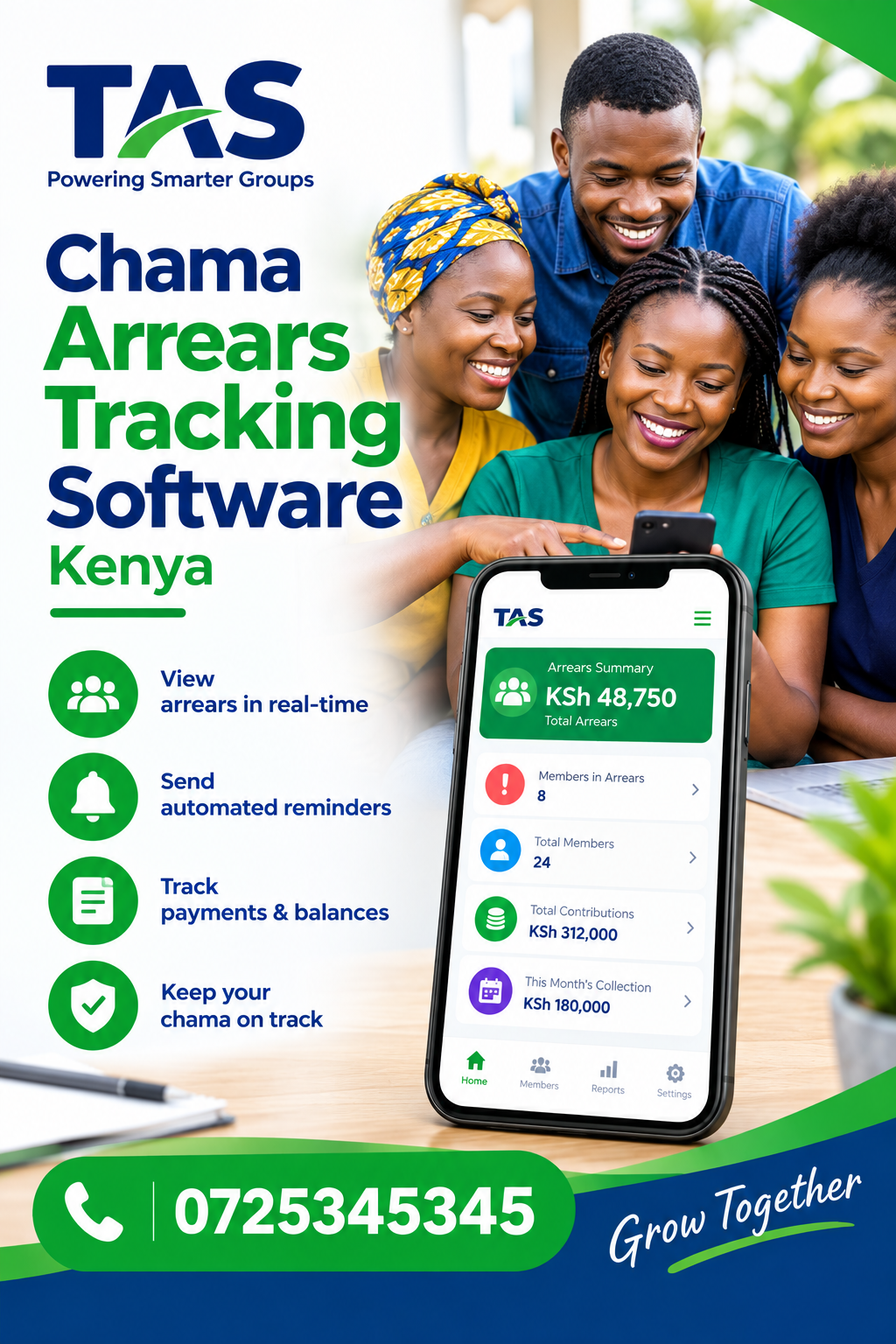
 Savings Group Management Software Kenya is becoming an important digital solution for chamas, savings groups, welfare groups, table-banking groups, investment clubs and other member-based organisations that need better ways to manage members, contributions, loans, repayments, meetings and financial records.
Many savings groups in Kenya still depend on notebooks, Excel spreadsheets, WhatsApp messages and manually calculated records. These methods may work for a small group, but administration becomes more complicated as membership, contributions and loans increase.
A modern Savings Group Management Software Kenya solution brings important group activities into one organised digital platform. Instead of maintaining separate records for members, savings, loans and repayments, authorised officials can manage connected information from a central system.
For a growing savings group, the objective is not simply to replace paper records with software. The bigger objective is to create accurate, accessible, organised and transparent records that make daily group administration easier.
What Is Savings Group Management Software?
Savings Group Management Software is a digital system designed to help savings groups manage their members and financial activities.
Depending on the software, a group may be able to manage:
- Member registration
- Member profiles
- Savings and contributions
- Loan applications
- Loan approvals
- Loan repayments
- Guarantors
- Interest calculations
- Fines and penalties
- Income and expenses
- Budgets
- Meetings
- Meeting minutes
- Member statements
- Financial reports
- User roles and permissions
- Audit records
- Data backups
- Data exports
The exact features vary between providers, so groups should evaluate software according to their actual constitution, financial processes and administrative requirements.
Why Kenyan Savings Groups Are Moving to Digital Management
Savings groups often start with a simple structure.
A few members agree to contribute a fixed amount every month. The treasurer records the payments in a notebook, while the secretary keeps a membership list.
As the group grows, additional activities may appear.
Members may start borrowing against their savings. The group may introduce guarantors, welfare contributions, penalties, investments and different types of loans.
At this point, manual administration can create additional work.
The committee may need to answer questions such as:
- How much has each member contributed?
- Who has outstanding contributions?
- Which members have active loans?
- How much does a member still owe?
- Which repayments are overdue?
- Who guaranteed a particular loan?
- How much money has the group collected?
- What expenses have been recorded?
- What is the current financial position?
- What decisions were made during previous meetings?
A properly configured Savings Group Management Software Kenya platform can organise these records and make them easier for authorised users to retrieve.
Savings Group Management Software Kenya for Chamas
Chamas are one of the major groups that can benefit from digital management.
A typical chama may combine regular savings with loans, investments, meetings and welfare activities.
For example, a chama can use software to maintain:
Member Records
Each member can have a structured profile containing relevant information and membership status.
This provides the committee with a central reference instead of maintaining several separate member lists.
Contribution Tracking
The system can record regular or one-off contributions and maintain a history for individual members.
This makes it easier to review contribution activity and identify outstanding amounts.
Savings Records
Savings information can be organised alongside the member’s other financial records.
Instead of calculating totals manually every time a member asks for their balance, authorised officials can generate the relevant information from the system.
Loan Management
Loan administration is another important reason groups consider digital management.
A suitable system can help officials record:
- Loan applications
- Approved amounts
- Interest
- Repayment schedules
- Repayments
- Outstanding balances
- Loan status
- Guarantors
The system should reflect the group’s approved loan rules rather than replacing the committee’s decision-making process.
Savings Group Software for Table-Banking Groups
Table banking groups require consistent financial records because members may contribute and borrow money within the same group.
A digital platform can help organise:
- Member contributions
- Savings
- Loans
- Repayments
- Meeting records
- Expenses
- Financial reports
Instead of relying on multiple notebooks, a group can maintain a central digital record.
This becomes especially useful when the number of transactions increases.
Savings Group Management Software for Welfare Groups
Welfare groups often collect regular contributions and provide financial assistance according to their agreed rules.
A digital system can help maintain contribution histories and records of approved welfare payments.
For example, the committee may need to determine whether a member has made the required contributions before processing assistance.
Having organised records can make such verification easier.
Savings Group Software for Investment Groups
Investment groups have additional record-keeping requirements.
Members may contribute money that the group uses to purchase or develop assets.
Depending on the organisation, investments may include:
- Property
- Agriculture
- Businesses
- Shares
- Approved financial products
- Other group investments
The group needs reliable records showing contributions, expenses, investment activity and financial results.
Savings Group Management Software can provide a structured foundation for organising these records.
Important Features of Savings Group Management Software Kenya
When evaluating software, committees should look beyond attractive dashboards.
The most important question is whether the platform supports the actual workflow of the group.
1. Member Management
A good system should provide structured member records.
The committee should be able to manage relevant member information, membership status and historical records.
2. Contribution Management
Contribution management should allow authorised officials to record and review member contributions.
Useful functionality may include:
- Contribution history
- Expected contributions
- Actual contributions
- Outstanding contributions
- Contribution reports
- Member statements
3. Loan Management
Loan management is particularly important for groups that lend money to members.
The software should make it possible to track the loan from application through approval, disbursement and repayment.
4. Guarantor Management
Where groups use guarantors, the system should connect guarantor information to the appropriate loan.
This makes it easier for officials to understand existing obligations.
5. Repayment Tracking
The system should maintain a clear history of repayments and outstanding balances.
This can reduce the need for manual calculations.
6. Financial Reporting
Reports help committees understand the group’s financial activities.
Depending on the platform, reports may cover:
- Contributions
- Loans
- Repayments
- Income
- Expenses
- Budgets
- Member balances
- Financial activity
7. Meeting Management
Savings groups are not only financial organisations.
Meetings are central to group governance.
A suitable platform can help record:
- Meeting dates
- Attendance
- Minutes
- Decisions
- Assigned actions
8. User Roles and Permissions
Not every person should have access to every function.
A system should provide appropriate roles and permissions so that users only access the information and functions relevant to their responsibilities.
9. Audit History
An audit trail can help the committee understand changes made to important records.
This is particularly useful when several authorised officials use the same system.
10. Backups and Data Export
Financial and membership information should not depend on one computer or one person’s phone.
Groups should ask providers how data is backed up and whether information can be exported when necessary.
Benefits of Using Savings Group Management Software Kenya
Better Record Keeping
Digital records can reduce dependence on handwritten notebooks and scattered spreadsheets.
Easier Member Administration
Member information can be organised in one central system.
Faster Financial Reporting
Instead of manually combining different documents, officials can generate reports from the available records.
Improved Transparency
Clear records can make it easier for members and officials to review contributions, loans and other financial activities.
Reduced Manual Work
Automating repetitive calculations and record management can save administrative time.
Better Access to Information
Authorised users can access relevant records without searching through multiple notebooks and files.
Easier Group Growth
As membership increases, structured software can provide a more scalable administrative environment.
Manual Records vs Savings Group Management Software
Traditional administration often involves notebooks, spreadsheets, receipts and WhatsApp conversations.
Digital management brings these processes into a structured platform.
| Manual Management | Digital Management |
|---|---|
| Multiple notebooks | Centralised records |
| Manual calculations | System-supported calculations |
| Separate spreadsheets | Connected member records |
| Difficult historical searches | Faster record retrieval |
| Manual reports | Digital reporting |
| Physical documents | Digital records |
| Limited access | Controlled authorised access |
| Greater dependence on individuals | Shared organisational records |
The objective is not to eliminate human oversight.
Instead, software should help officials perform their responsibilities more efficiently.
How to Choose the Right Savings Group Management Software in Kenya
Choosing software should be treated as a practical evaluation exercise.
Before selecting a platform, create a list of the group’s actual requirements.
Ask:
- How many members do we have?
- How many members do we expect in the future?
- Do we provide loans?
- Do we use guarantors?
- How frequently are contributions made?
- Do we manage welfare funds?
- Do we have investments?
- What reports do members require?
- How many administrators will use the system?
- What permissions are required?
- How is data backed up?
- Can information be exported?
- What support is available?
- What is the total cost?
- Can the software handle our future growth?
These questions can help a committee compare systems based on its actual needs rather than choosing simply because a platform has a long list of features.
M-Pesa and Savings Group Management
Mobile money is an important consideration for many Kenyan organisations.
When evaluating software that claims to support M-Pesa, ask exactly how the integration works.
For example:
- Can contributions be recorded automatically?
- Can payment references be matched to members?
- Are transactions reconciled?
- Can authorised officials review payment history?
- Are disbursements supported?
- What happens when a transaction fails?
Do not assume that a system supports every M-Pesa workflow simply because the provider mentions M-Pesa.
Ask for a demonstration using a realistic group scenario.
Data Security for Savings Groups
Savings group systems can contain personal and financial information.
Security should therefore be part of the purchasing decision.
Groups should ask about:
- User authentication
- Password security
- Role-based permissions
- Backups
- Data access
- Audit logs
- Data export
- Account recovery
- Provider support
Members should also avoid sharing passwords or allowing unauthorised people to use administrator accounts.
Savings Group Management Software and Transparency
Transparency is one of the major reasons groups move toward structured digital records.
A digital system can provide a common reference for authorised officials.
For example, instead of debating different spreadsheets during a meeting, officials can review the relevant transaction history in the system.
However, software itself does not guarantee good governance.
The committee still needs:
- Clear financial procedures
- Proper approvals
- Regular reconciliation
- Accurate data entry
- Responsible access management
- Member oversight
- Proper documentation
Technology supports these processes; it does not replace them.
How to Move From Excel to Savings Group Software
Moving from spreadsheets to software does not have to happen all at once.
Step 1: Review Existing Records
Collect the group’s current member, contribution and loan records.
Step 2: Clean the Data
Correct duplicate members, inconsistent names and incorrect balances before importing information.
Step 3: Define Roles
Decide who will administer members, financial records, loans and reports.
Step 4: Configure the System
Set up the group’s contribution rules, loan rules and other workflows according to its approved procedures.
Step 5: Test With Realistic Scenarios
Test common situations such as:
- Registering a member
- Recording a contribution
- Creating a loan
- Recording repayment
- Producing a statement
- Generating a report
Step 6: Train Officials
Treasurers, secretaries and other administrators should understand how to use the system correctly.
Step 7: Review Regularly
After implementation, review records and workflows to identify errors and improve administration.
Who Needs Savings Group Management Software?
Savings Group Management Software Kenya can be relevant to many types of member-based organisations, including:
- Chamas
- Savings groups
- Investment groups
- Table-banking groups
- Welfare groups
- Women groups
- Youth groups
- Employee savings groups
- Community organisations
- Clubs
- Associations
- Cooperative-style groups
The appropriate software depends on the organisation’s structure and requirements.
Questions to Ask Before Buying Savings Group Software
Before committing to a platform, ask the provider:
Does the software support our type of group?
A savings group, investment group and large cooperative may have different requirements.
Can we manage different types of contributions?
Find out whether the system can handle the contribution structures used by your organisation.
Can we manage loans and repayments?
If your group provides loans, test the complete loan lifecycle.
Can we generate member statements?
Member statements can make financial reviews easier.
Can different administrators have different permissions?
This is important when several officials use the system.
Can we export our data?
Ask what happens if the group changes providers in the future.
What support is available?
Find out how technical problems and user questions are handled.
What is the complete cost?
Consider subscription, setup, training, integrations, support and other possible charges.
Why Savings Group Management Software Is Important for Growing Groups
A small group can sometimes operate successfully with a notebook.
A larger group has a different administrative challenge.
More members mean more transactions.
More transactions mean more records.
More records mean a greater need for organised systems.
This is why Savings Group Management Software Kenya can become increasingly valuable as a group grows.
Instead of building administration around one treasurer’s notebook or one secretary’s spreadsheet, the organisation can create a structured system that remains useful when leadership changes.
Frequently Asked Questions
What is Savings Group Management Software Kenya?
It is software designed to help Kenyan savings groups manage members, contributions, loans, repayments, meetings, expenses and reports through a digital system.
Can a chama use savings group management software?
Yes. Chamas can use suitable software to organise member records, contributions, loans, repayments, meetings and reports.
Can savings group software manage loans?
Many platforms provide loan management features. The exact capabilities, including interest, guarantors and repayment schedules, depend on the software.
Can savings groups manage M-Pesa transactions?
Some platforms provide M-Pesa-related functionality or integrations. Groups should verify the exact payment and reconciliation workflow with the provider before implementation.
Is savings group software suitable for small groups?
It can be. However, the group should consider its current needs, expected growth, budget and administrative complexity before selecting a platform.
Can several administrators use the same system?
Many modern platforms support multiple users with different permissions. Groups should verify the available roles and access controls before purchasing.
Is savings group management software better than Excel?
Excel can be useful for basic record keeping, but dedicated software may provide specialised member, contribution, loan, reporting and access-control functionality that spreadsheets do not provide as a single integrated workflow.
The Future of Savings Group Management in Kenya
Kenyan savings groups are becoming increasingly interested in organised digital administration.
The future is not simply about having an online spreadsheet.
Modern group-management platforms can bring together membership, contributions, loans, meetings, reports and financial records into connected workflows.
For organisations that are growing, the ability to maintain consistent records becomes increasingly important.
The right technology can help committees spend less time searching for information and more time managing the organisation.
Savings Group Management Software Kenya provides a structured way for chamas, savings groups, welfare groups, table-banking groups and investment groups to organise their daily operations.
The most valuable system is not necessarily the one with the longest feature list.
It is the one that fits the group’s actual workflow, provides appropriate controls, supports reliable records and remains practical as membership and financial activity increase.
Before choosing a platform, identify your group’s requirements, compare relevant features, test realistic scenarios, examine security and permissions, understand the total cost and ensure administrators receive adequate training.
For a growing Kenyan savings group, moving from scattered notebooks and spreadsheets to an organised digital management system can create a stronger foundation for accurate record keeping, efficient administration and better access to financial information.