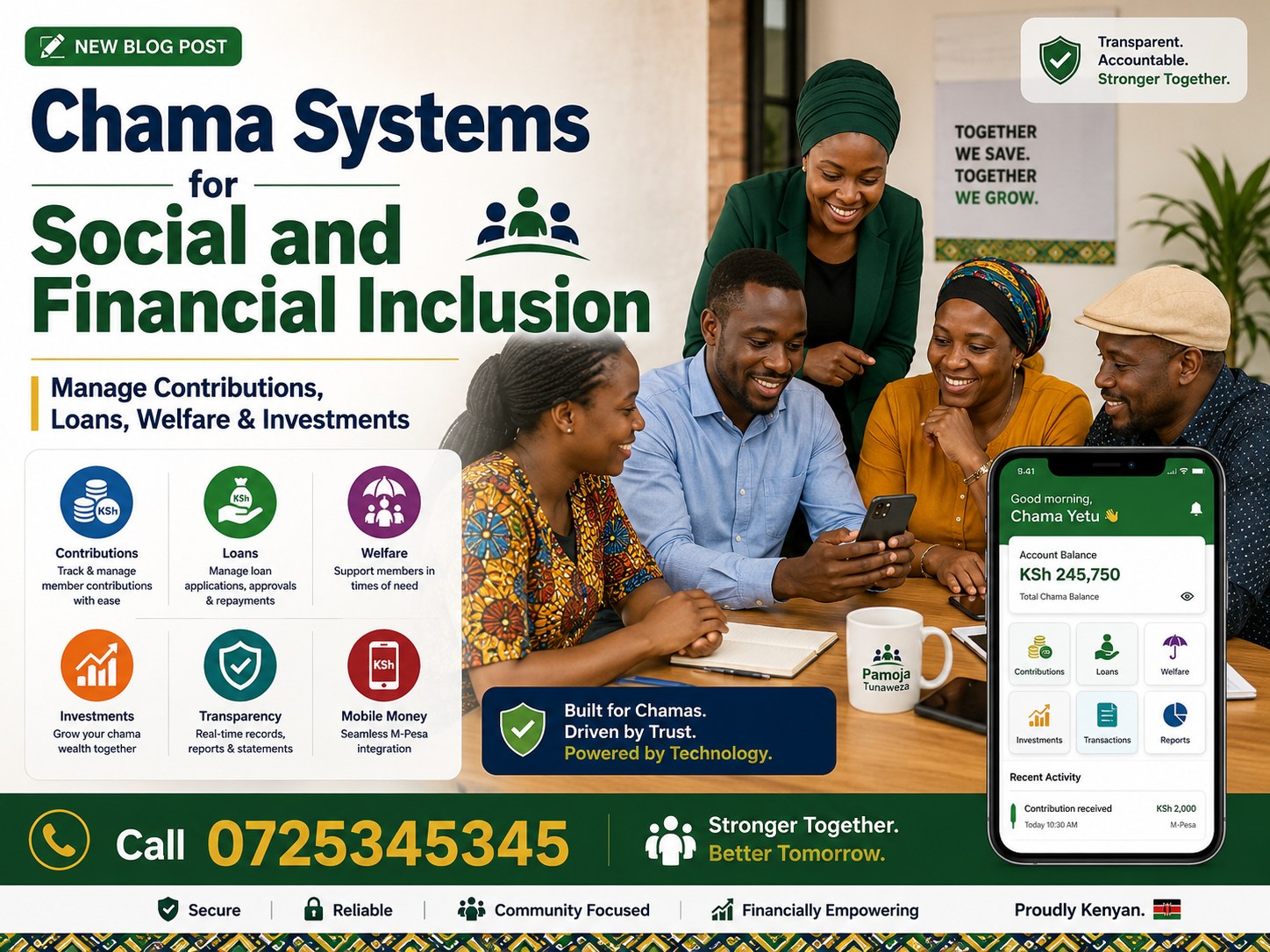
 Chama Systems for Social and Financial Inclusion in Kenya
Chama Systems for Social and Financial Inclusion help groups improve transparency, accountability and financial management.Chamas have long been one of Kenya’s most important community-based approaches to saving, investing, borrowing and supporting one another. From small family welfare groups to women’s savings groups, youth investment groups, table banking associations and large investment chamas, millions of Kenyans rely on collective financial structures to achieve goals that may be difficult to accomplish individually.
As these groups grow, however, traditional methods of managing contributions through notebooks, spreadsheets, WhatsApp messages and manually prepared reports can become increasingly difficult.
This is where Chama Systems for Social and Financial Inclusion are becoming increasingly important.
A modern digital chama system can help groups manage members, contributions, loans, welfare funds, expenses, investments and financial reports while creating greater transparency and accountability.
More importantly, digitising chamas is not simply about replacing notebooks with software. It can help strengthen financial participation by giving members better visibility into their money, improving record keeping and creating stronger structures through which communities can save, borrow, invest and support each other.
What Are Chama Systems for Social and Financial Inclusion?
CKenyan savings groups can use Chama Systems for Social and Financial Inclusion to manage contributions, loans, welfare and investments.hama Systems for Social and Financial Inclusion are digital platforms designed to help savings groups, investment groups, welfare associations, table banking groups and similar organisations manage their financial and administrative activities.
A well-designed chama management system brings important group activities into one central platform.
These can include:
- Member registration
- Member contributions
- Savings management
- Loans and repayments
- Table banking
- Welfare contributions
- Fines and penalties
- Group expenses
- Investment tracking
- Member statements
- Financial reports
- Meeting records
- Notifications
- User permissions
- Audit trails
Instead of relying on several notebooks, spreadsheets and chat conversations, members and officials can access organised information from a structured digital system.
The result can be better accountability, easier administration and improved member confidence.
Why Chamas Matter to Financial Inclusion in Kenya
Chama Systems for Social and Financial Inclusion can support both small community groups and growing investment chamas.Chamas are more than social organisations.
They form an important part of Kenya’s financial ecosystem.
The Central Bank of Kenya’s 2024 FinAccess Household Survey reported that 28.3% of adults used groups or chamas, demonstrating how significant group-based financial services remain in the country.
Savings groups can serve several purposes simultaneously.
Members may use their chama to:
- Build regular saving habits
- Access affordable loans
- Raise capital for businesses
- Purchase land
- Invest in property
- Pay school fees
- Handle medical or family emergencies
- Support members during bereavements
- Purchase assets
- Start collective businesses
- Finance agricultural activities
- Create emergency funds
FSD Kenya describes savings and investment groups as chamas and notes that some operate through regular savings while others provide loans to members before eventually distributing accumulated savings and earnings.
Digital technology can strengthen these existing community structures by making their records easier to manage and understand.
The Problem With Manual Chama Management
Modern Chama Systems for Social and Financial Inclusion make it easier for members to access accurate financial records.Many chamas begin with only a few members.
At this stage, a notebook, spreadsheet or simple WhatsApp group may appear sufficient.
Problems often emerge as membership and financial activity increase.
Imagine a chama with 50 members.
Every month, the treasurer may have to manually determine:
- Who contributed
- How much each member contributed
- Who has arrears
- Who has an outstanding loan
- Interest owed
- Loan repayments received
- Welfare contributions
- Fines
- Expenses
- Bank balances
- Investment balances
One incorrect entry can affect several reports.
Members may then begin asking questions such as:
“Why does my contribution balance look different?”
“How much do I still owe on my loan?”
“Where was this expense recorded?”
“How much money does the chama currently have?”
“Who approved this transaction?”
When financial information is scattered across notebooks, spreadsheets, bank statements and messages, answering these questions becomes difficult.
A digital chama management system creates one organised source of information.
How Digital Chama Systems Improve Transparency
Transparency is one of the most important foundations of a successful chama.
Members contribute their own money and therefore need confidence that every transaction is properly recorded.
A chama system should allow authorised members to see information such as:
- Contributions made
- Outstanding balances
- Loans issued
- Loan repayments
- Welfare contributions
- Fines
- Expenses
- Member balances
- Group balances
Officials can also have administrative dashboards while ordinary members receive access only to information relevant to them.
This creates clearer accountability without exposing sensitive administrative information unnecessarily.
Digital record keeping has previously been explored in Kenyan savings groups. FSD Kenya documented savings-group digitisation initiatives where records such as savings, loans, repayments, fines and welfare contributions were electronically recorded, with the aim of improving transparency and maintaining reliable records.
Digital Contribution Management
Contribution management is at the heart of most chamas.
Some groups require members to contribute weekly.
Others collect money monthly, quarterly or according to specific projects.
A good chama contribution management system should make it possible to configure different contribution categories.
For example:
Monthly savings
Every member contributes a fixed amount each month.
Investment contributions
Members contribute towards a specific investment such as land, property, vehicles or shares.
Welfare contributions
Money is reserved for emergencies and social support.
Project contributions
Members contribute towards a specific development project.
Special contributions
The group may occasionally raise additional funds for a particular purpose.
Digitising these records makes it easier to identify completed contributions and outstanding balances without manually reviewing hundreds of transactions.
Loan Management for Chamas
Many chamas operate internal lending programs.
Members save money into a shared fund, after which qualifying members can borrow according to the group’s constitution.
Managing these loans manually can become complicated.
A digital chama loan management system can maintain records covering:
- Loan applications
- Principal amount
- Interest rate
- Repayment period
- Guarantors
- Approval status
- Disbursement date
- Repayment schedule
- Amount repaid
- Outstanding balance
- Late payments
- Loan history
This gives officials a much clearer picture of the group’s loan portfolio.
Members can also understand their obligations without repeatedly requesting calculations from the treasurer.
Supporting Table Banking Groups
Table banking remains another important community financial model.
Members regularly contribute money into a group fund from which loans can be provided.
A table banking management system can help digitise activities such as contributions, loans, repayments, interest calculations and member statements.
This can be particularly useful for women’s groups, youth organisations, community groups and small business associations.
Instead of spending a large portion of meetings reconciling figures manually, members can focus on financial planning and investment decisions.
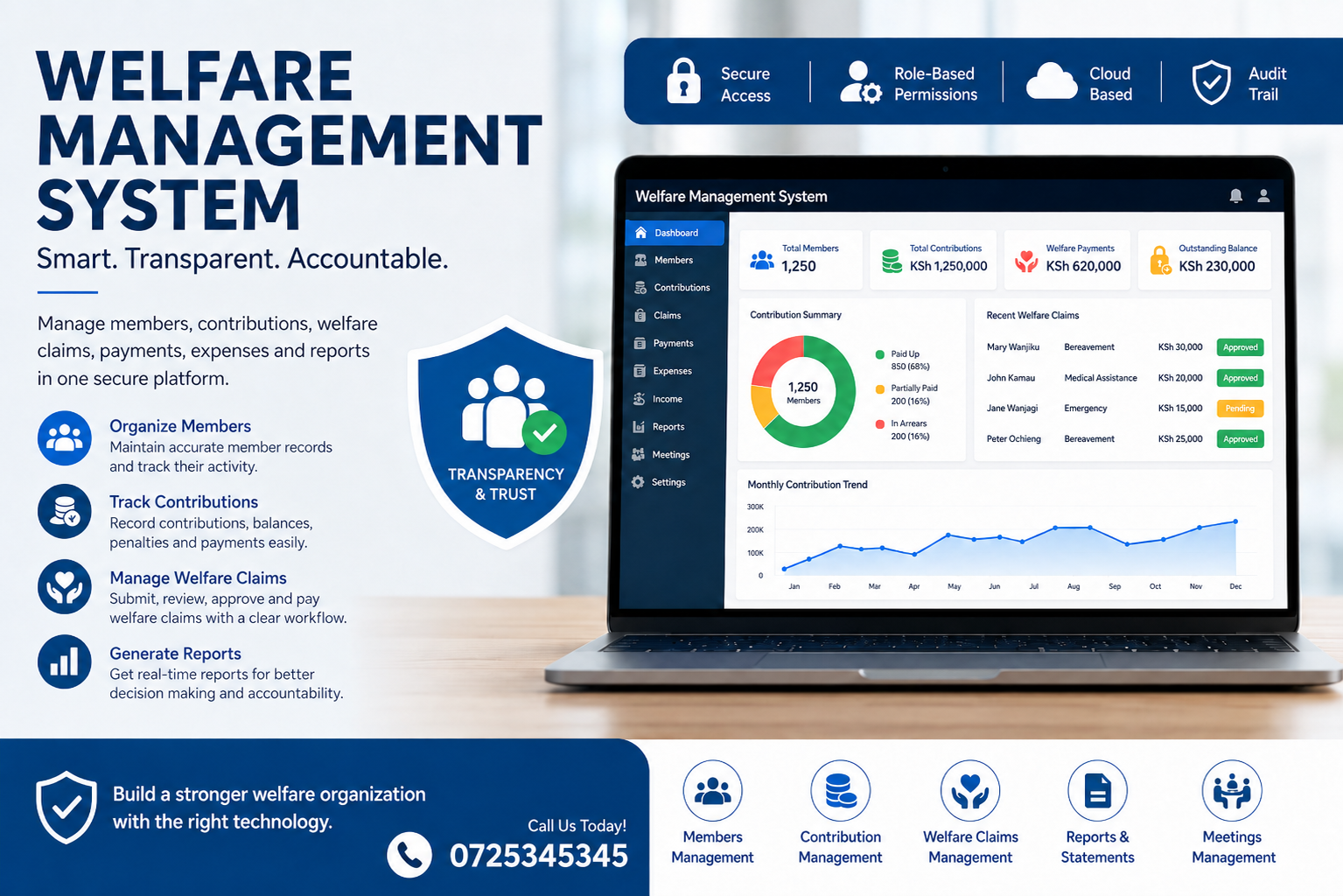
Welfare Management
Not every chama exists primarily for investment.
Thousands of groups exist to support members during important life events.
These may include:
- Bereavement
- Medical emergencies
- Weddings
- Childbirth
- Education
- Family emergencies
- Member hardship
The 2024 FinAccess survey framework itself recognises welfare groups among the different activities undertaken by Kenyan chamas and community groups.
A welfare management system can maintain records of member contributions and benefits while showing how welfare funds are being utilised.
This creates a clear financial history while maintaining the social purpose of the organisation.
Promoting Social Inclusion Through Chama Technology
Financial inclusion is only one part of the story.
Chamas also strengthen social inclusion.
They bring people together around shared goals regardless of whether those members would individually qualify for traditional financial products.
Groups can include:
- Small business owners
- Farmers
- Women entrepreneurs
- Youth groups
- Community organisations
- Family groups
- Religious organisations
- Workers
- Professionals
- Diaspora communities
A digital chama platform can make participation easier, particularly where members live in different locations.
A member working in Nairobi, another living in Nakuru and another outside Kenya can potentially remain connected to the same group structure without requiring every administrative process to happen physically.
Better Financial Records Can Build Trust
Trust is essential when people pool money.
Unfortunately, poor records can create conflict even where nobody intended to misuse funds.
Consider a treasurer who receives hundreds of transactions every month.
Without a good system, an innocent recording mistake can appear suspicious.
Digital systems reduce this risk by creating structured transaction histories.
Every transaction can include important information such as:
- Transaction date
- Member
- Amount
- Transaction category
- Payment reference
- Recorded by
- Approval status
An audit trail can provide even stronger accountability by showing who performed important actions inside the system.
Chama Accounting and Financial Reporting
Successful chamas eventually require more than a simple contribution list.
Officials need to understand the overall financial position of the group.
A chama accounting system can provide reports such as:
Contribution reports
Shows amounts expected, received and outstanding.
Member statements
Provides an individual financial history for each member.
Loan reports
Shows active loans, completed loans, repayments and outstanding balances.
Income and expense reports
Helps officials understand how money enters and leaves the organisation.
Welfare reports
Shows collections and utilisation of welfare funds.
Cash flow reports
Helps leaders understand the movement of money during a specific period.
Investment reports
Tracks money allocated toward collective investments.
Better reports allow chama leaders to make decisions using financial information rather than assumptions.
Investment Management for Growing Chamas
Some chamas eventually move beyond basic savings and lending.
They begin investing in:
- Land
- Rental properties
- Agriculture
- Transport
- Shares
- Money market funds
- Businesses
- Equipment
- Commercial property
At this stage, financial management becomes increasingly important.
The group needs to know how much was invested, ownership percentages, income generated, related expenses and returns.
A digital system can create a structured history of these investments.
Members can therefore understand how their collective capital is being utilised.
Role-Based Access and Member Privacy
Not every user should have unlimited access to a chama system.
Different responsibilities require different permissions.
For example:
Chairperson
May access high-level group information and approvals.
Treasurer
May manage financial transactions and reports.
Secretary
May manage members, meetings and administrative records.
Credit committee
May review loan applications.
Ordinary member
May view personal statements, contributions and relevant group information.
Role-based access helps maintain privacy while creating accountability.
Digital Chama Systems for Diaspora Groups
Diaspora investment groups have also become an important part of collective investment.
Members may live in Kenya, the United Kingdom, United States, Canada, Qatar, United Arab Emirates or other countries.
Traditional physical meetings become difficult in these circumstances.
A web-based chama system can allow members to view financial information regardless of location.
For diaspora chamas, important features can include:
- Online member access
- Contribution tracking
- Digital statements
- Investment reports
- Document storage
- Remote approvals
- Notifications
- Meeting records
This creates a central administrative environment despite geographical distance.
Mobile Money and Digital Payments
Kenya’s digital payment ecosystem has transformed the way individuals and organisations exchange money.
A modern chama platform should therefore be designed with digital payments in mind.
Where supported, integrations can simplify the reconciliation of contributions and repayments.
Instead of manually identifying every transfer, payment references can be matched against the appropriate member account.
This can reduce administrative work while providing members with more timely updates.
Automated Member Statements
One of the simplest but most valuable features of a digital chama system is the member statement.
Rather than asking the treasurer for a manually prepared report, members can receive a clear breakdown of their financial activity.
A statement may contain:
- Contributions
- Loans
- Repayments
- Welfare contributions
- Fines
- Other transactions
- Current balances
Giving members reliable access to their records can improve confidence in the organisation.
Notifications and Reminders
Chama officials often spend significant time reminding members about:
- Monthly contributions
- Loan repayments
- Meetings
- Outstanding balances
- Special contributions
Digital systems can reduce this administrative burden through automated notifications.
Depending on the platform, communication may be delivered through channels such as SMS, email, mobile applications or other digital messaging tools.
Members remain informed while officials spend less time following up manually.
Chama Systems and Good Governance
Technology alone cannot make a chama successful.
Good leadership and clear governance remain essential.
However, technology can reinforce good governance.
A professionally managed group should have:
- A constitution
- Defined leadership roles
- Clear financial policies
- Loan policies
- Approval procedures
- Accurate records
- Regular reporting
- Transparent elections
- Member accountability
The chama management system then becomes the infrastructure supporting those governance processes.
How Chama Systems Support Financial Inclusion
The relationship between Chama Systems for Social and Financial Inclusion becomes clearer when we examine what financial inclusion actually requires.
People need practical mechanisms through which they can:
- Save money safely.
- Access financing.
- Build assets.
- Handle emergencies.
- Participate in investments.
- Maintain reliable financial records.
- Understand their financial position.
Chamas already provide many of these services at community level.
Digitising them can strengthen their capacity to deliver those services efficiently.
FSD Kenya has repeatedly recognised savings groups, including ROSCAs and ASCAs, as an important component of Kenya’s financial landscape.
Financial Inclusion Must Also Mean Accessibility
Digital transformation should not exclude people who have limited digital skills or access to sophisticated technology.
The Kenya National Financial Inclusion Strategy 2025–2028 highlights the importance of multiple digital and community channels as well as accessibility approaches that accommodate different user needs.
Therefore, successful chama technology should prioritise simplicity.
Members should not need accounting qualifications to understand their balances.
Interfaces should be:
- Easy to navigate
- Mobile friendly
- Clearly labelled
- Fast
- Accessible
- Designed around real chama workflows
Technology only contributes to inclusion when people can actually use it.
Who Needs a Chama Management System?
A chama system can be useful for many types of organisations.
These include:
Investment chamas
Groups pooling funds for collective investments.
Savings groups
Groups encouraging members to build savings consistently.
Table banking groups
Groups providing loans from pooled member contributions.
Welfare groups
Organisations collecting money to support members during emergencies or major life events.
Women’s groups
Community or business groups managing savings, lending and investments.
Youth groups
Young entrepreneurs or community groups building collective capital.
Family chamas
Extended families contributing towards investments, emergencies or development projects.
Church and religious groups
Groups managing welfare, development or member-support funds.
Professional associations
Professionals pooling resources for investment opportunities.
Diaspora investment groups
Members living in different countries who need centralised financial records.
How to Choose the Best Chama Management System
Before choosing a platform, chama officials should evaluate more than price.
Consider the following areas.
1. Ease of use
Can ordinary members understand the platform?
2. Contribution management
Can different types of contributions be configured?
3. Loan management
Does the system support your group’s lending model?
4. Welfare management
Can social and welfare funds be tracked independently?
5. Reporting
Can officials generate useful financial reports?
6. Member statements
Can members clearly understand their own financial records?
7. Security
Does the system provide proper access controls?
8. Audit trails
Can important activities be traced?
9. Scalability
Will the system continue working effectively as membership and transactions increase?
10. Support
Can the provider assist administrators when necessary?
The best chama software should match how the group actually operates instead of forcing the group into an unsuitable workflow.
From Informal Records to Strong Financial Institutions
Many successful organisations begin informally.
A group of ten friends may start by contributing KSh 5,000 every month.
Years later, the same chama could have significant investments, loans, property and financial obligations.
The systems used to manage the group must evolve alongside it.
Continuing to manage millions of shillings using disconnected spreadsheets and notebooks can create unnecessary risk.
Digital chama management provides an opportunity to establish stronger financial structures early.
The Future of Digital Chamas in Kenya
Kenya’s financial system is already highly digital.
The next stage of transformation will increasingly involve digitising community financial organisations themselves.
Instead of simply transferring money electronically, chamas need technology capable of managing the entire financial relationship surrounding that money.
This includes:
- Who paid
- Why they paid
- What they owe
- What they borrowed
- What the group invested
- What the investment earned
- What expenses occurred
- What each member owns
- What approvals were made
As these systems become more accessible, chamas can become better organised, more transparent and easier to scale.
Chama Systems for Social and Financial Inclusion: Building Stronger Communities Through Technology
The real value of Chama Systems for Social and Financial Inclusion is not simply automation.
It is the ability to strengthen community financial structures.
When members can clearly see their contributions, loans, repayments and group financial position, trust improves.
When officials can generate accurate reports without manually reconciling hundreds of transactions, administration becomes easier.
When members living in different locations can remain involved, participation expands.
And when groups maintain reliable financial records, they are better positioned to plan, invest and grow.
Chamas have helped Kenyan communities save, borrow, invest and support each other for generations.
Digital technology does not need to replace that model.
It can make it stronger.
Frequently Asked Questions About Chama Systems
What is a chama management system?
A chama management system is software used to manage members, contributions, loans, repayments, welfare funds, expenses, investments and financial reports for savings, investment and welfare groups.
What is the best chama software in Kenya?
The best chama software depends on the group’s requirements. Look for contribution management, loan management, member statements, financial reporting, role-based access, security, audit trails and good customer support.
Can a chama system manage loans?
Yes. A properly designed system can maintain loan applications, approvals, interest, repayments, outstanding balances and member loan histories.
Can chama software manage table banking?
Yes. Table banking groups can use digital systems to manage contributions, loans, repayments, interest and member financial records.
Can welfare groups use a chama management system?
Yes. Welfare groups can manage recurring contributions, special contributions, beneficiaries, welfare payments and financial reports.
Can investment groups use chama software?
Yes. Investment chamas can use a digital platform to organise member contributions, expenses, investments and financial reports.
Why should a chama move from Excel to dedicated software?
Spreadsheets can work for small groups, but complexity increases as membership, loans and transactions grow. Dedicated chama software provides structured workflows, permissions, reporting, member accounts and transaction histories.
How do chama systems promote financial inclusion?
They can make group-based saving, lending, investment and welfare management more organised and transparent, helping communities participate more effectively in financial activities.
Start Building a More Transparent Digital Chama
Managing a successful chama requires trust, accountability and reliable financial information.
Whether you operate an investment chama, welfare group, table banking organisation, women’s group, youth group, family chama or diaspora investment group, moving from scattered manual records to a structured digital platform can transform how the organisation operates.
Chama Systems for Social and Financial Inclusion can provide the technological foundation needed to organise contributions, strengthen accountability, improve reporting and support long-term financial growth.
Visit chamasystems.com to learn more about digital solutions for modern chama and community financial management.