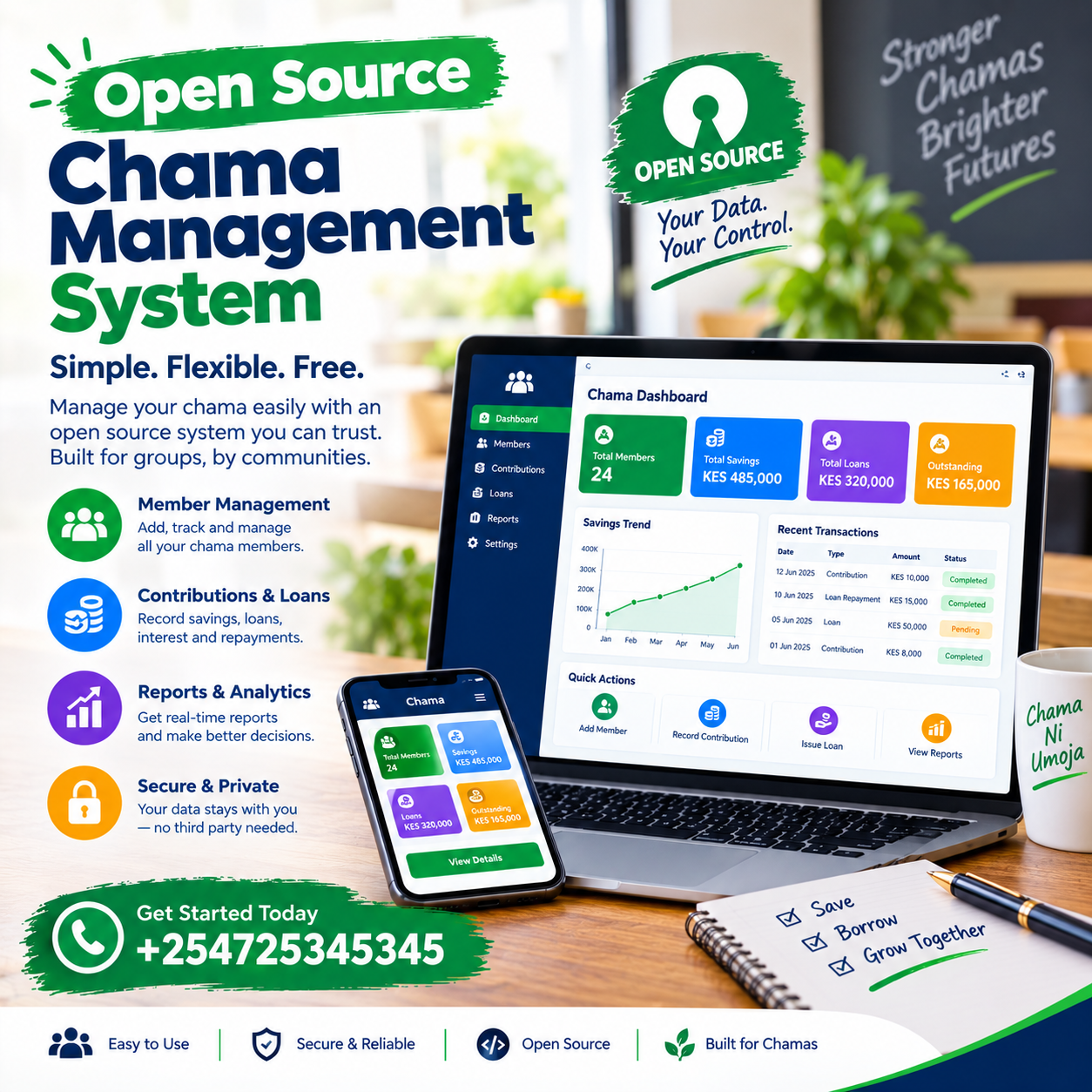
An open source chama management system is the option many technically minded Kenyan groups explore before committing to any paid platform. The idea is genuinely attractive — community-built software, no subscription fees, and total control over your own records. This guide examines that option honestly, because the truth about open source is more nuanced than either its advocates or its critics usually admit.
The conversation usually begins the same way in every group. A tech-savvy member suggests saving money by building or adopting free software, and suddenly the committee is comparing downloads against demos. Understanding what an open source chama management system really involves is the first step toward a decision you will never regret.
This guide serves that exact moment. It explains what open source actually means, what it genuinely offers, and where its hidden costs hide. By the end, your group will be able to evaluate any open source chama management system against dedicated platforms with clear eyes and complete information.
The article is written for treasurers weighing their options, IT-minded members who would maintain the software, and committees trying to do right by everyone’s savings. It is equally written for founders of new groups deciding what infrastructure to adopt from day one. Everyone benefits from understanding the full story of the open source chama management system question.
One honesty statement belongs at the very start. Open source software is a legitimate and powerful movement that runs much of the modern internet, and this guide respects it deeply. The question is never whether open source works in general — it is whether an open source chama management system is the right fit for your specific group.
The answer depends on factors most comparisons skip entirely. Technical capacity, maintenance appetite, security responsibility, and support needs all shape the outcome far more than the price tag does. Working through those factors is the real purpose of this guide to the open source chama management system decision.
There is also a pattern worth naming early. Groups that choose open source successfully are usually groups that already had the skills and time to sustain it. Groups that choose it mainly to avoid fees often end up paying more in frustration than they ever saved — a lesson that shapes every honest discussion of the open source chama management system path.
So read this guide as a map rather than a verdict. Every section ahead gives you a fact, a tradeoff, or a test you can apply to your own group’s situation. By the final page, the open source chama management system question will have a clear answer — for your group specifically.
What Does Open Source Actually Mean?
Open source software is code that anyone can inspect, modify, and redistribute under its license terms. The source code is public, community contributions improve it over time, and no single vendor controls it. Understanding that definition is the foundation of the entire open source chama management system conversation.
Free to use is not quite the same as open source. Some software is free but closed, while some open source projects charge for hosting and support. The distinction matters greatly when evaluating any open source chama management system offering you encounter.
The open source movement powers much of the digital world you already use. Web servers, phone operating systems, and banking infrastructure all run on community-built code. That pedigree is why the open source chama management system idea deserves serious consideration rather than dismissal.
However, group finance software has specific demands that distinguish it from generic applications. It handles money records, member privacy, automated reconciliation, and years of irreplaceable history. Those demands are exactly where the open source chama management system evaluation gets interesting.
Deployment is the first fork in the road. Self-hosted means the software runs on servers your group controls, while cloud-hosted open source means someone else runs it for a fee. Each deployment model changes the total experience of an open source chama management system dramatically.
The license also deserves attention. Some licenses permit commercial use freely, while others restrict how the software can be deployed or sold. Reading the license is a genuine step in adopting any open source chama management system responsibly.
Finally, understand what community-driven actually means in practice. Updates depend on volunteer contributors, documentation varies wildly between projects, and abandoned projects simply stop evolving. Project health is the single best predictor of success with any open source chama management system you might choose.
The Genuine Appeal: Why Groups Consider Open Source
Cost is the appeal that starts every conversation. A subscription of two or three thousand shillings monthly feels significant to a young group, while a free download costs nothing upfront. That arithmetic is the honest starting point of the open source chama management system appeal.
Control is the second attraction. Self-hosted software means your records live on servers you own, with no vendor able to change terms, raise prices, or shut down. Sovereignty over data is a legitimate and powerful draw toward an open source chama management system.
Customization is the third advantage. Groups with unique workflows can modify open source code to match their exact processes. Flexibility at the source-code level is something no packaged platform can match, which is a real argument for an open source chama management system in skilled hands.
Independence from vendor fate is the fourth benefit. Commercial platforms can be acquired, pivoted, or discontinued, while open source code survives its original authors. That permanence is a philosophical comfort for groups choosing an open source chama management system.
Learning is the fifth, quieter benefit. Groups with students and tech enthusiasts find that maintaining their own system builds genuine skills among members. The educational value of running an open source chama management system can even become part of a group’s culture.
Transparency is the sixth appeal. Auditable code means technically capable members can verify exactly how balances are calculated. That verifiability is a trust feature no proprietary open source chama management system alternative can fully replicate.
The Real Costs Behind “Free”
Now for the honest half of the ledger, because free software is never truly free. What you save in subscription fees, you pay in time, skills, and responsibility. Accounting for those costs is the essential discipline of any open source chama management system evaluation.
Hosting is the first real cost. Self-hosted software needs a server — rented cloud infrastructure or reliable hardware with power backup and internet. Those requirements typically cost thousands of shillings monthly, which shrinks the savings gap between an open source chama management system and a paid platform considerably.
Maintenance is the second cost, and it is human rather than financial. Updates, backups, security patches, and troubleshooting all require a competent person’s ongoing attention. That person becomes the group’s single point of failure, which is the structural risk inside every open source chama management system arrangement.
Setup is the third cost. Installation, configuration, data import, and workflow customization demand real technical hours before the first contribution is ever recorded. Groups consistently underestimate the setup burden of an open source chama management system by a factor of three or more.
Security responsibility is the fourth and heaviest cost. A commercial vendor employs specialists to protect your data; a self-hosted group relies on whoever maintains the server. Breach liability shifts entirely to the group under an open source chama management system self-hosting model.
Downtime is the fifth cost. When the server fails on collection day, there is no support line to call and no vendor to fix it. Recovery time under an open source chama management system depends entirely on your volunteer’s availability that evening.
Opportunity cost is the sixth. Every hour a member spends administering software is an hour not spent on investments, records, or group growth. That trade is rarely visible when the group first adopts an open source chama management system and becomes very visible by year two.
Key-person risk deserves its own paragraph because it is the most common failure mode. The tech-savvy member who set everything up eventually graduates, relocates, or simply loses interest. When they leave, an open source chama management system can become an orphaned mystery overnight.
Feature Gaps to Expect
Be realistic about what community projects typically offer. Financial group software demands a very specific combination of features that generic tools rarely cover completely. Mapping those gaps is a necessary step before choosing any open source chama management system.
M-Pesa integration is the most common gap. Automated reconciliation through Daraja requires setup, credentials, and ongoing maintenance that packaged platforms handle invisibly. Manual payment matching reappears quickly when an open source chama management system lacks native mobile money support.
Member self-service is the second frequent gap. Portals where members check balances and statements require polished interfaces that volunteer projects rarely prioritize. Without them, an open source chama management system quietly shifts all enquiry work back onto the treasurer.
Loan lifecycle depth is the third gap. Guarantor tracking, reducing-balance schedules, penalty automation, and arrears aging demand sophisticated logic. Groups with active lending often find an open source chama management system covers contributions well but lending poorly.
SMS delivery is the fourth gap. Reminders and receipts need a gateway account, per-message costs, and integration code. Budget for that hidden layer when calculating the true cost of an open source chama management system.
Reporting polish is the fifth. AGM-ready statements, member statements, and dashboards are exactly the areas where volunteer-built interfaces lag commercial design. Members judge software by its outputs, which is where many an open source chama management system disappoints.
Mobile experience is the sixth gap. Kenya’s group finance happens on phones, and responsive mobile design demands professional attention. Test any open source chama management system on the committee’s oldest phone before committing.
Updates and compliance are the seventh. Tax rules, reporting formats, and payment APIs change, and packaged platforms absorb those changes for you. An open source chama management system waits for a contributor to notice — or for your group to notice instead.
What Actually Exists in the Open Source Landscape
Honesty requires naming the landscape accurately. Dedicated, Kenyan-specific open source chama platforms are rare; most groups adapt general-purpose financial software instead. Knowing that reality prevents wasted weeks searching for a perfect open source chama management system that does not exist.
Cooperative and microfinance frameworks form one category. International projects built for credit unions and micro-lenders can be adapted toward group lending with real effort. These are the closest relatives of a true open source chama management system in the global open source world.
General business suites form the second category. Broad accounting platforms with community editions can be configured to track members, contributions, and loans. Flexibility comes at the cost of fitting, which is the universal tradeoff when forcing a general suite into open source chama management system service.
Spreadsheets occupy the informal end of the spectrum. They are not software projects, but groups often treat a shared workbook as their de facto open source chama management system. The familiar risks — broken formulas and single-device storage — apply in full.
Community-built group tools form a final small category. Occasionally, developers publish chama apps on public code repositories, usually as hobby projects. Evaluate their maintenance history carefully, because an abandoned open source chama management system is worse than none at all.
Whatever option you examine, check five health signals. Recent commits, responsive issue discussions, clear documentation, an active community, and real production users elsewhere. Healthy projects make viable open source chama management system candidates; dead ones make expensive lessons.
The Skills Your Group Will Need
Self-assessment comes before software selection. List honestly who in your group can install, configure, secure, and maintain a web application. The answer determines whether an open source chama management system is a project or a gamble.
Server administration is the first required skill. Someone must manage hosting, domains, SSL certificates, and basic monitoring. Without that competence, an open source chama management system becomes fragile the moment anything breaks.
Database care is the second skill. Backups, restores, and occasional repairs demand someone comfortable with data engines. A group that cannot confidently restore yesterday’s backup has no business running an open source chama management system on its own servers.
Security hygiene is the third. Patching, access control, and safe configuration require knowledge that paid platforms employ specialists to provide. Underestimate this and any open source chama management system becomes a liability holding your members’ personal data.
API integration is the fourth. Connecting M-Pesa, SMS gateways, and email services involves credentials, tokens, and debugging. That glue work is where many open source chama management system projects stall permanently.
Documentation discipline is the fifth. Everything the admin does must be written down for the successor who will eventually take over. Undocumented open source chama management system setups die with the departure of the person who built them.
Succession planning is the sixth skill, and the rarest. The group needs a pipeline of at least two technically capable members, always. Single-admin dependency is the graveyard where most self-hosted open source chama management system deployments quietly end.
Security and Data Responsibility in Depth
Data protection deserves its own focused discussion. Member records include national IDs, phone numbers, and complete financial histories. Under an open source chama management system you self-host, the duty to protect all of that belongs entirely to your group.
Backups must be engineered, not hoped for. The professional standard — multiple copies, two locations, tested restores — requires deliberate setup and monthly verification. Build that discipline before any real data enters your open source chama management system.
Encryption in transit and at rest should be non-negotiable. Certificates, secure configuration, and protected database storage are the minimum baseline. A professional audit of your open source chama management system setup once a year is a wise investment.
Access control needs the same rigor commercial platforms provide. Role-based permissions, strong authentication, and complete audit logs protect both data and officials. Weak access control is the most common vulnerability found in self-hosted open source chama management system deployments.
Incident response should be written down. If the server is breached or the data corrupted, the group needs a pre-agreed plan — who investigates, who informs members, and who restores from backup. Groups without an incident plan should not operate an open source chama management system at all.
Compliance adds a final layer. Kenya’s data protection environment expects organizations to handle personal information responsibly, and group records are personal information. Duty-of-care framing is the mature way to approach any open source chama management system decision.
The Honest Comparison: Open Source Versus Dedicated Platforms
A fair comparison weighs total cost, not sticker price. Add hosting, SMS, maintenance hours, and risk to the open source side; add subscription and onboarding to the commercial side. Only that honest arithmetic can settle the open source chama management system question for any specific group.
Feature completeness usually favors dedicated platforms. Vendors build specifically for Kenyan group workflows — share capital, fines, guarantors, and M-Pesa reconciliation out of the box. Replicating that depth in an open source chama management system demands months of configuration and customization.
Support is the starkest difference. Commercial platforms answer the phone on collection day; open source offers forums and your own volunteer. When money is moving and members are waiting, that difference defines the daily experience of an open source chama management system versus a paid one.
Reliability engineering favors the vendors too. Redundant infrastructure, professional monitoring, and tested recovery are included invisibly in every subscription. Reproducing that resilience around an open source chama management system is a serious engineering project in itself.
Time-to-value strongly favors packaged platforms. A group can be fully operational on a dedicated system within a week, while open source setup commonly stretches across months. Speed matters when the group’s records are currently living in notebooks.
Where open source genuinely wins is cost at scale for skilled organizations. A large federation with full-time IT staff can operate open infrastructure economically over many years. That profile, however, describes very few groups actually searching for an open source chama management system today.
The hybrid path deserves mention as a middle way. Some groups run their records on a dedicated platform while using open tools for websites and documents. Choosing the right tool per job is wiser than forcing one philosophy onto everything through an open source chama management system alone.
When Open Source Genuinely Makes Sense
Certain profiles should still consider the open source route seriously. Naming them honestly keeps this guide balanced rather than one-sided. Check your group against these profiles before dismissing any open source chama management system.
Groups with resident technical talent top the list. A committee containing working software engineers changes every calculation, because maintenance ceases to be a bottleneck. With two capable members sharing duties, an open source chama management system becomes genuinely viable.
Large federations form the second profile. Organizations coordinating dozens of branches may need custom workflows no vendor offers. At that scale, the investment in a tailored open source chama management system can be justified by control alone.
Learning-focused groups form the third. Student associations and tech communities sometimes choose self-hosting deliberately as a skill-building project. For them, the journey of running an open source chama management system carries value beyond the software itself.
Privacy-maximalist groups form the fourth. Collectives handling unusually sensitive information may insist on owning their infrastructure completely. That conviction is a legitimate foundation for an open source chama management system choice.
If your group matches none of these profiles, read the next section carefully. The honest recommendation for most Kenyan chamas points elsewhere, and pretending otherwise would make this guide to the open source chama management system decision worthless.
When a Dedicated Platform Is the Better Choice
Most groups fit a simpler profile. They have enthusiasm, a treasurer, and limited technical depth — and they need records that simply work. For that majority, a purpose-built platform beats any open source chama management system on every practical measure.
The reasons stack up quickly. Instant M-Pesa reconciliation, member portals, automated fines, guarantor tracking, and AGM reports arrive configured from day one. No amount of free licensing closes that readiness gap between an open source chama management system and a mature platform.
Support seals the argument. When a payment fails to reconcile at 8 p.m. before a meeting, a vendor’s support team answers and fixes it. An open source chama management system leaves that 8 p.m. crisis in the lap of whichever volunteer is available.
Cost reframing completes the case. At one to three thousand shillings monthly for a typical group, the subscription usually costs less than the value of a single recovered month of arrears. Paid platforms routinely deliver returns that make the open source chama management system savings argument look like penny wisdom.
Tas.co.ke exists precisely for the majority profile described above. Contributions, loans, fines, statements, and member records run in one reconciled system with real Kenyan support behind it. Groups that evaluate Tas.co.ke alongside any open source chama management system consistently choose the platform for one reason: their evenings are worth more than the subscription.
How to Evaluate Either Path Fairly
Whichever direction tempts your group, evaluate with identical discipline. Build one checklist covering payments, members, loans, fines, reports, security, support, and total cost. Scoring both an open source chama management system and commercial platforms against the same sheet is the only honest method.
Test with your real data regardless of the path. Load genuine members and figures, then run a full monthly cycle end to end. An open source chama management system that survives your real workflows has earned serious consideration.
Interrogate maintenance before choosing self-hosting. Name the person, the backup person, the weekly hours, and the succession plan in writing. If those blanks cannot be filled, the open source chama management system option has already answered itself.
Demand the total cost of each path on one page. Hosting, SMS, maintenance hours valued at real rates, and risk reserves belong beside every subscription quote. Groups that complete that page rarely choose an open source chama management system for cost reasons alone.
Pilot before committing either way. One full billing cycle in parallel with your old records proves or disproves every promise. The pilot is the final exam for both the open source chama management system route and the platform route alike.
Common Mistakes to Avoid
The first classic mistake is choosing open source for the price and ignoring the skills requirement. Free software with no administrator is simply a delayed crisis. Every abandoned open source chama management system deployment began exactly that way.
The second mistake is underestimating security work. Groups routinely assume that installing software equals protecting data, and the gap between those two facts is where breaches live. Take the security sections of this open source chama management system guide literally.
The third mistake is building instead of running. Some groups spend a year customizing code before recording their first real contribution, while their paperwork continues decaying. Perfectionism is the most expensive way to approach an open source chama management system.
The fourth mistake is ignoring the exit. Whatever system you choose, ensure complete data export is possible from day one. Lock-in applies to self-built open source chama management system setups just as surely as to any vendor.
Real Stories from Kenyan Groups
A Nairobi tech professionals’ chama chose self-hosting deliberately and made it work. Two engineer members shared maintenance duties, documented everything, and trained successors before each handover. Their success with an open source chama management system came precisely from the disciplines this guide describes.
A Nakuru welfare table tells the opposite story honestly. Their enthusiastic volunteer built a system, graduated two years later, and left no documentation behind. The group migrated to a dedicated platform, and the treasurer now describes their brief open source chama management system era as “an expensive lesson in free.”
The Kitengela landlords’ group found the balanced path. Records, loans, and statements run on Tas.co.ke while their website and documents use open tools. Choosing each tool for its strengths, rather than forcing an open source chama management system to do everything, gave them the best of both worlds.
Frequently Asked Questions
Is open source software really free?
The license is free, but hosting, SMS gateways, maintenance hours, and security work all carry real costs. Count those honestly before comparing against any subscription. That full accounting is the core lesson of the open source chama management system decision.
What technical skills do we need to self-host?
Server administration, database backups, security hygiene, and API integration at minimum, plus documentation discipline for succession. Without at least two capable members, self-hosting is not advisable. That staffing rule governs every open source chama management system deployment.
Can open source handle M-Pesa reconciliation automatically?
Only if the project includes or supports integration with payment APIs, which usually requires technical setup and credentials to maintain. Many community projects leave this to the operator. Verify it live before trusting any open source chama management system with collections.
What if our volunteer admin leaves the group? Without documentation and a trained successor, the system becomes unmanageable almost immediately. Build a two-person pipeline before adopting self-hosting. Single-admin dependency is the most common failure of an open source chama management system.
Is our data safer with open source or a vendor?
A reputable vendor employs security specialists, redundant infrastructure, and tested backups that volunteer teams rarely match. Self-hosting can be safe, but only with professional-grade discipline. Compare actual practices, not philosophies, when judging an open source chama management system.
Are there ready-made open source chama apps we can just install?
Dedicated, Kenyan-specific open source chama platforms are rare; most options are adapted general financial software requiring heavy configuration. Check project health signals before investing weeks. That scarcity is itself an answer about the open source chama management system landscape.
Which is faster to launch: open source or a platform?
A dedicated platform typically has your group fully operational within a week, while open source setup commonly takes months. Speed matters when records are currently kept in notebooks. Time-to-value is one of the strongest arguments against an open source chama management system for most groups.
Can we start with open source and move to a platform later?
Yes, provided you maintained clean, exportable records throughout the open source period. Clean migration data makes any future switch straightforward. Plan the exit before beginning any open source chama management system project.
Is a hybrid approach sensible?
Very — many groups run their finances on a dedicated platform while using open tools for websites, documents, and communication. Match each tool to the job it does best. That pragmatism beats ideological commitment to either an open source chama management system or a single vendor.
We also own rental units — which system should manage the property side?
Property deserves dedicated tools regardless of your group-finance choice. The smartest arrangement pairs a chama platform for contributions and loans with Tas.co.ke for tenants, rent collection, and owner statements. One connected ecosystem across both fronts outperforms any attempt to stretch an open source chama management system into property management.
What is the single best question before choosing open source?
Ask who will maintain it for the next five years, by name, with a named backup. If the group cannot answer confidently, choose a platform instead. That one question settles most open source chama management system debates before they begin.