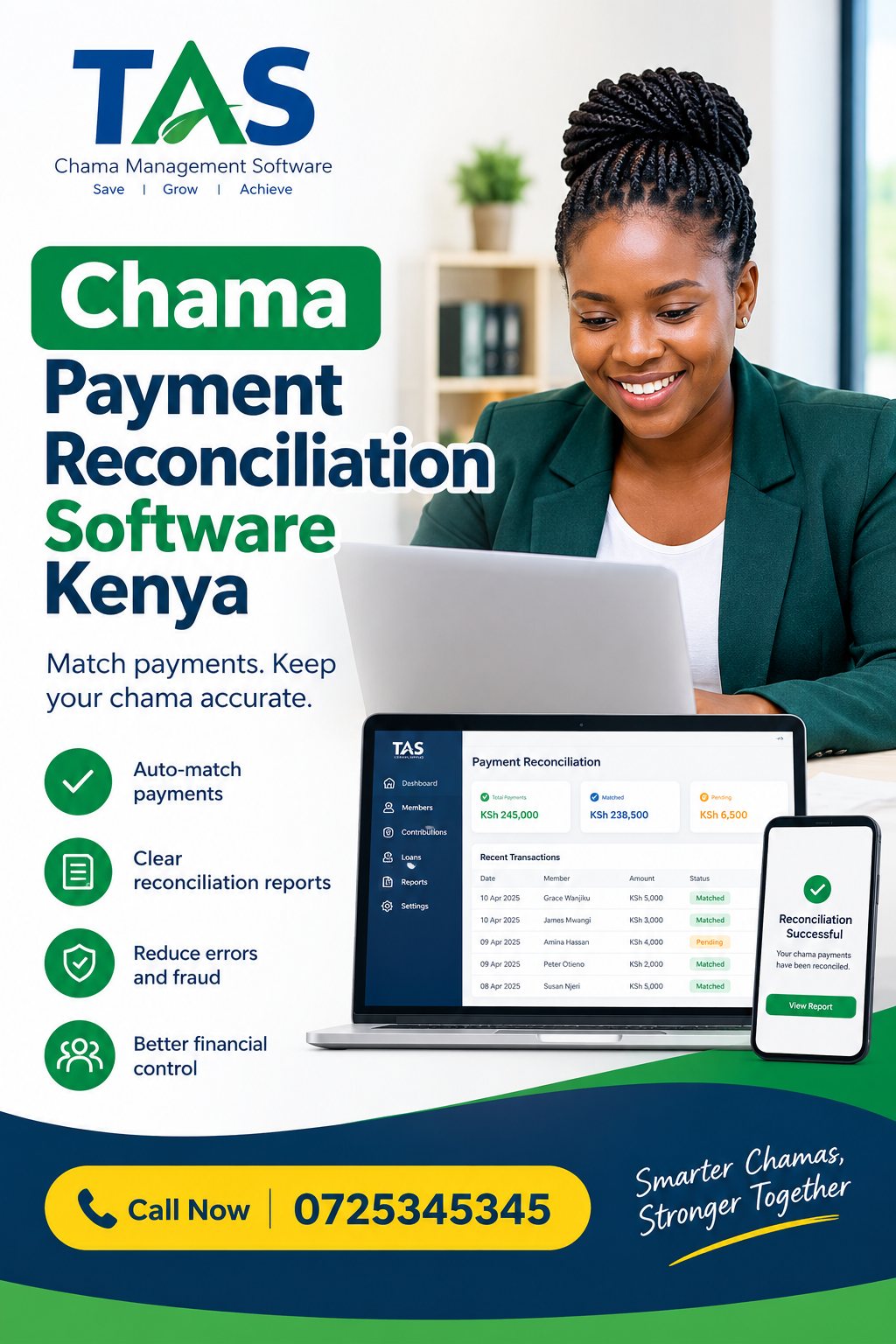
Chama Payment Reconciliation Software Kenya: A Practical Guide for Accurate Group Finances
Chamas in Kenya handle regular member contributions, welfare payments, loans, repayments, penalties, project income, bank transfers, and mobile-money transactions. That activity creates a simple but important question: does the amount recorded by the group actually match the money received? Chama Payment Reconciliation Software Kenya helps groups answer that question systematically by bringing payment records, member accounts, contribution schedules, and reconciliation work into one organized process. This guide is for chama officials, treasurers, secretaries, accountants, administrators, and members who want clearer financial records, fewer disputes, and faster monthly reporting.
What Payment Reconciliation Means for a Chama
Payment reconciliation is the process of comparing money that should have been received with money that was actually received and then matching each transaction to the correct member, purpose, date, and account. In a small group, this might be done with a notebook, receipts, a mobile-money statement, and a spreadsheet. As the group grows, that approach becomes harder to control.
A well-designed Chama Payment Reconciliation Software Kenya workflow gives officials a repeatable method for checking transactions instead of relying on memory. The system can help identify matched payments, missing payments, duplicate entries, wrong allocations, unpaid balances, and transactions that require review.
For example, imagine a chama with 80 members who contribute KSh 2,000 every month. The expected contribution is KSh 160,000. If the group receives money through several channels, the treasurer may need to compare the expected amount against multiple transaction records. A reconciliation process makes that comparison visible.
The goal is not simply to say that the cash balance looks correct. The goal is to explain every significant movement of money.
Why Matching Every Payment Matters
A payment can be genuine but still be recorded incorrectly. A member might send the correct amount but use a reference that is difficult to identify. Another member may pay two months at once. Someone else may pay a loan installment when the treasurer records it as a contribution.
These differences can affect:
- Member balances
- Contribution reports
- Loan balances
- Arrears reports
- Welfare records
- Cash-flow visibility
- Meeting statements
- Year-end financial summaries
Using Chama Payment Reconciliation Software Kenya can make the matching process more structured because officials can work from transaction records rather than reconstructing the history from scattered notes.
Why Manual Reconciliation Becomes Difficult
Manual bookkeeping is not automatically bad. For a very small group with few transactions, it can be practical. The problem starts when transaction volume increases and several people become involved in recording, approving, collecting, and reviewing money.
A treasurer may receive a payment notification, write it in a notebook, update a spreadsheet later, and then prepare a report before the next meeting. Each handoff creates an opportunity for an error.
With Chama Payment Reconciliation Software Kenya, the group can move toward a single record of financial activity. Instead of maintaining separate lists for contributions, receipts, balances, and payment confirmations, officials can use a connected workflow.
Common Problems With Spreadsheets and Notebooks
The most common difficulties include:
- Duplicate entries. The same payment may be recorded twice.
- Unmatched payments. Money arrives but nobody immediately knows which member account it belongs to.
- Wrong allocation. A loan repayment is posted as a contribution or welfare payment.
- Delayed updates. A member pays today but the record is updated several days later.
- Formula errors. Spreadsheet calculations can be overwritten or copied incorrectly.
- Version confusion. Several officials may have different copies of the same workbook.
- Weak audit trails. It can be difficult to establish who changed a record and why.
- Slow reporting. The treasurer may spend hours preparing a simple meeting report.
A Chama Payment Reconciliation Software Kenya solution is valuable when the group needs a consistent process that can be repeated every day or every month.
How a Reconciliation Workflow Should Work
A strong process begins before the payment arrives. The group first defines what each payment is expected to represent and how it should be identified.
A practical workflow has these stages:
- Set up members and financial obligations.
- Define contribution, loan, welfare, penalty, and other payment categories.
- Record or import incoming transactions.
- Match each transaction to a member or account.
- Compare the amount received with the amount expected.
- Investigate unmatched or unusual transactions.
- Approve corrections.
- Reconcile totals.
- Generate reports for officials and members.
The same principles can be applied with Chama Payment Reconciliation Software Kenya even when a group has different contribution rules. One chama may have a fixed monthly contribution, while another may allow variable contributions or special project payments.
Step 1: Establish Expected Payments
The system needs a reliable baseline. For each member, officials should know what amount is due, when it is due, and what the payment is for.
Expected payments may include:
- Monthly contributions
- Loan installments
- Interest
- Welfare contributions
- Penalties
- Registration fees
- Project contributions
- Emergency fund payments
- Special meeting levies
When expectations are clear, Chama Payment Reconciliation Software Kenya can be used to compare what should have been collected against what actually arrived.
Step 2: Capture Actual Transactions
The next stage is recording the money that actually reached the group. Depending on the group’s processes, this may involve mobile-money records, bank transactions, cash receipts, or other approved payment channels.
The quality of the transaction information matters. Useful fields can include:
- Transaction date
- Amount
- Member name
- Member number
- Payment reference
- Payment category
- Account affected
- Status
- Notes
A system such as Chama Payment Reconciliation Software Kenya should make it easier to preserve these details and retrieve them later.
Step 3: Match Transactions
Matching is the heart of reconciliation. A transaction should be connected to the correct member and purpose.
Suppose a member sends KSh 5,000. The group must determine whether the payment represents a KSh 2,000 contribution plus a KSh 3,000 loan installment, a full loan payment, a project contribution, or something else. The correct allocation matters because each category affects reporting differently.
With Chama Payment Reconciliation Software Kenya, officials can use defined categories and member records to reduce ambiguity.
Handling M-Pesa and Mobile-Money Payments
Mobile-money payments are central to many Kenyan chamas because they make contributions convenient. They also create reconciliation work because the payment record and the group’s internal ledger must agree.
A payment message may show an amount and reference, but the group’s records still need to explain who paid, what the money was for, and whether the member’s account has been updated correctly.
For a chama using Chama Payment Reconciliation Software Kenya, the reconciliation process should include a clear procedure for mobile-money records.
A Practical M-Pesa Reconciliation Routine
At a minimum, officials should:
- Obtain the relevant transaction record.
- Confirm the transaction date.
- Confirm the amount.
- Identify the sender.
- Match the sender to the member record.
- Identify the intended payment category.
- Post the payment.
- Compare the updated balance with the expected balance.
- Flag exceptions for review.
The group should avoid assuming that every transaction can be automatically understood from a name alone. Names can be similar, phone numbers can change, and members can make payments on behalf of other people.
That is why Chama Payment Reconciliation Software Kenya should support a review process for ambiguous transactions instead of silently assigning every payment.
Managing Unmatched Payments
An unmatched payment is not necessarily a mistake. It may simply require more information.
For example, a member could make a payment from a different phone number, pay for another member, or combine several obligations in one transfer. The transaction should remain visible while officials investigate it.
A useful unmatched-payment process includes:
- A pending status
- Transaction reference
- Date and amount
- Initial payer information
- Notes from the treasurer
- Assigned reviewer
- Resolution date
- Final allocation
A reconciliation platform using Chama Payment Reconciliation Software Kenya can make these exceptions easier to monitor.
Why Exception Handling Matters
Without an exception process, officials may edit figures until the total balances. That can make the books appear correct while hiding the reason for a discrepancy.
A better approach is to preserve the original transaction, document the correction, and make the final allocation clear.
This improves trust because members can ask questions and officials can explain what happened.
Reconciling Contributions Accurately
Contribution reconciliation is one of the most common uses for a chama financial system. The group normally has an expected amount for each member and period.
Consider a group with 50 members paying KSh 1,500 per month. The expected monthly total is KSh 75,000. If the actual received amount is KSh 70,500, the group has a KSh 4,500 difference that needs explanation.
Possible reasons include:
- Three members have not paid.
- One member paid only part of the amount.
- A payment was received but not recorded.
- A payment was allocated to another category.
- A transaction was duplicated.
- A member paid in advance for a future period.
Using Chama Payment Reconciliation Software Kenya, officials can structure the review around member-level differences instead of looking only at the final group total.
Partial Payments
Partial payments deserve special attention. If a member owes KSh 2,000 and pays KSh 1,000, the system should not treat the account as fully settled.
The record should show:
- Amount due
- Amount paid
- Remaining balance
- Payment date
- Payment reference
- Status
This is especially important where the group applies penalties or uses different rules for overdue contributions. Chama Payment Reconciliation Software Kenya can support more transparent member statements when these balances are maintained consistently.
Loan Repayment Reconciliation
Many chamas combine savings with lending. Loan repayments create a second layer of reconciliation because every payment can affect principal, interest, penalties, and outstanding balances.
A payment that is correctly recorded as cash received can still be wrong if it is allocated to the wrong loan.
A sound loan reconciliation process should connect the payment to:
- Borrower
- Loan account
- Installment
- Principal
- Interest
- Penalty, where applicable
- Remaining balance
- Payment date
A group using Chama Payment Reconciliation Software Kenya can use these fields to make loan records easier to review.
Example of a Loan Discrepancy
Suppose a member has an outstanding balance of KSh 30,000 and makes a KSh 5,000 payment. The treasurer records KSh 5,000 as received, but the member’s loan balance still shows KSh 30,000.
The cash total may look correct, yet the member statement is wrong.
A reconciliation check should identify the difference before the next meeting. That is why reconciliation is more than balancing cash; it is about ensuring that every affected account tells the same story.
Reconciliation and Financial Reporting
Reliable reports depend on reliable underlying transactions. If payment records are incomplete, reports may show misleading totals.
Useful chama reports can include:
| Report | What it helps answer |
|---|---|
| Contribution report | Who has paid and who is behind? |
| Payment reconciliation report | Which transactions have been matched? |
| Member statement | What has a specific member paid or received? |
| Loan report | What is outstanding and what has been repaid? |
| Arrears report | Which obligations remain unpaid? |
| Cash-flow report | What money came in and went out? |
| Transaction report | What activity occurred during a period? |
| Exception report | Which transactions need review? |
With Chama Payment Reconciliation Software Kenya, these reports can become part of routine administration rather than a manual exercise performed only before an annual meeting.
Monthly Reporting
A practical monthly reporting cycle might look like this:
Week 1: Confirm opening balances and expected payments.
Week 2: Record and reconcile incoming transactions.
Week 3: Investigate exceptions and update member accounts.
Week 4: Review totals, approve corrections, and prepare reports.
The exact timing depends on the group, but the principle is consistent: reconcile continuously instead of waiting until the end of the year.
Reducing Disputes Among Members
Financial disputes often begin with a simple question: “Where did my payment go?”
A member may have a transaction confirmation showing payment, while the chama ledger shows an outstanding balance. Neither side necessarily intends to make a mistake. The issue may be a delayed posting, wrong allocation, or incomplete record.
A clear Chama Payment Reconciliation Software Kenya process can help officials respond with evidence.
Instead of searching through notebooks, the treasurer can review the transaction history and explain:
- When the payment was received
- How much was received
- Which account it was applied to
- Whether it was split across categories
- What balance remains
Transparency is particularly important in groups where members contribute for long-term investments. Small unexplained differences can undermine confidence even when the amounts are not large.
Improving Accountability for Chama Officials
Chama officials manage other people’s money, so accountability should be built into the process rather than added after a problem occurs.
A useful system can separate responsibilities. For example:
- One person records transactions.
- Another reviews exceptions.
- Authorized officials approve corrections.
- Members receive statements or summaries.
- Reports are retained for future reference.
Chama Payment Reconciliation Software Kenya can support this type of controlled workflow when the group configures permissions and approval procedures appropriately.
Maintaining an Audit Trail
An audit trail helps answer questions about changes. If a payment was initially allocated to contributions and later moved to loan repayment, the group should be able to explain why.
Good records should preserve:
- Original transaction details
- Date of correction
- Person responsible
- Reason for correction
- New allocation
- Supporting note
This approach is safer than deleting an old entry and replacing it without explanation.
Reconciliation for Different Chama Structures
Not every chama operates in the same way. A savings group, investment group, welfare group, and lending circle can have different payment rules.
A flexible Chama Payment Reconciliation Software Kenya setup should accommodate different financial structures rather than forcing every group into one template.
Savings and Investment Groups
These groups may collect regular savings and occasional project contributions. Their priority is often knowing how much each member has contributed and how group funds have been allocated.
Welfare Groups
Welfare groups may collect smaller recurring amounts and make payments for approved events. Reconciliation needs to distinguish member contributions from welfare disbursements.
Lending Groups
Lending groups need stronger loan-level tracking because repayments can include multiple components.
Mixed-Purpose Chamas
Many Kenyan groups combine savings, investments, welfare, and lending. These groups benefit from clearly separated categories because a single cash balance does not explain what the money represents.
A Chama Payment Reconciliation Software Kenya workflow can be organized around these categories so that reports remain meaningful.
Data Quality Practices That Improve Reconciliation
Technology cannot fix poor data automatically. The group should establish clear data-entry rules.
Useful practices include:
- Give every member a unique identifier.
- Keep member names consistent.
- Record phone numbers carefully.
- Define payment categories before posting transactions.
- Avoid deleting historical transactions without authorization.
- Review duplicate references.
- Reconcile frequently.
- Document unusual payments.
- Back up or securely retain records.
- Restrict sensitive financial information to authorized users.
When these habits are combined with Chama Payment Reconciliation Software Kenya, the result is a more dependable financial record.
Security and Access Control
Chama records can contain personal and financial information. Access should therefore be controlled.
Before selecting a platform, ask:
- Who can view member balances?
- Who can edit transactions?
- Who can approve corrections?
- Can administrators manage user access?
- Are records protected during transmission?
- Are backups available?
- Can access be removed when an official leaves office?
A good Chama Payment Reconciliation Software Kenya implementation should be part of a broader governance process. Technology does not replace financial controls, but it can make them easier to enforce.
What to Look for When Choosing Reconciliation Software
There are many financial tools, but the best choice depends on how the chama operates.
When evaluating Chama Payment Reconciliation Software Kenya, consider the following features.
Member Management
The system should maintain accurate member profiles and connect transactions to the correct account.
Payment Tracking
Officials should be able to see incoming payments and their status.
Reconciliation Tools
Look for functions that help compare expected and actual payments and identify exceptions.
Contribution Management
The software should handle recurring contributions and different payment schedules.
Loan Management
If the chama lends money, loan balances and repayments should be connected to member accounts.
Reporting
Reports should be easy to generate and understandable to officials.
Search and Filtering
A treasurer should be able to find a transaction without scrolling through hundreds of rows.
User Permissions
Different roles should have appropriate levels of access.
Mobile Accessibility
Because chama officials may work from phones as well as computers, a practical interface should be usable on common devices.
Support and Onboarding
A technically capable platform is less useful if officials cannot learn it quickly. Ask about onboarding, documentation, and support.
Questions to Ask Before Adopting a System
Before making a decision, a chama committee can use this checklist:
- Can the platform track individual member payments?
- Can it distinguish contributions from loan repayments?
- Can it show outstanding balances?
- Can officials review unmatched transactions?
- Can reports be exported or shared?
- Can several authorized users work with the records?
- Is there an audit trail?
- How are backups handled?
- What happens when officials change?
- Can the group migrate its existing records?
- Is the pricing understandable?
- Can the group get assistance during setup?
A Chama Payment Reconciliation Software Kenya solution should be judged on how well it fits the group’s actual workflow, not simply on the number of features listed on a product page.
Implementation Plan for a Kenyan Chama
Moving from manual records to software should be done carefully. A rushed migration can create more confusion.
Phase 1: Clean the Existing Records
Before importing anything, review member names, balances, loan accounts, and historical payments.
Phase 2: Define Categories
Agree on categories for contributions, loans, interest, welfare, penalties, projects, and other transactions.
Phase 3: Establish Opening Balances
Confirm the balance for each member and account before the new process begins.
Phase 4: Train Officials
The treasurer, secretary, chairperson, and any other authorized users should understand their responsibilities.
Phase 5: Run a Test Period
For the first cycle, compare the software reports with the group’s existing records. Investigate differences rather than assuming one system is automatically correct.
Phase 6: Adopt the New Process
Once the committee is satisfied, make the system the primary operational record and define procedures for corrections.
Using Chama Payment Reconciliation Software Kenya as part of a documented implementation plan reduces the risk of simply moving old record-keeping problems into a new interface.
Common Mistakes to Avoid
Even good software can be undermined by poor processes.
Recording Payments Without Categories
If every payment is simply entered as “cash received,” later reporting becomes difficult.
Ignoring Unmatched Transactions
Unmatched payments should be investigated promptly. They should not remain unresolved indefinitely.
Allowing Unrestricted Editing
If anyone can change financial records, accountability becomes difficult.
Reconciling Only at Year-End
Waiting months increases the amount of information officials must reconstruct.
Mixing Personal and Group Transactions
Group finances should remain clearly separated from individual officials’ money.
Failing to Document Corrections
A correction without a note can create another dispute later.
Using Inconsistent Member Names
Small differences in spelling can make matching harder.
A disciplined Chama Payment Reconciliation Software Kenya process addresses these risks by making reconciliation part of normal administration.
How Automation Can Save Officials Time
The value of automation is not simply speed. It is consistency.
If a treasurer spends three hours every month matching payments manually, that is time that could be used for member communication, investment planning, or reviewing the group’s financial performance.
Automation can help with repetitive tasks such as:
- Calculating expected contributions
- Updating member balances
- Identifying overdue obligations
- Organizing transaction histories
- Producing recurring reports
- Highlighting exceptions
With Chama Payment Reconciliation Software Kenya, the group can shift more attention from data entry toward financial oversight.
Reconciliation and Member Communication
A good financial process should be understandable to members, not only to the treasurer.
Member statements should ideally show:
- Opening balance
- Payments made
- Payments received
- Loans or advances
- Charges or penalties where applicable
- Closing balance
When members can understand their own records, they are more likely to identify errors early.
For officials, Chama Payment Reconciliation Software Kenya can support clearer communication because questions can be answered using transaction-level information.
Preparing for Leadership Changes
Chama officials eventually change. A treasurer may hand over to another member, a secretary may leave office, or a committee may be reorganized.
Manual records can make handover difficult because important information may exist in notebooks, personal phones, spreadsheets, and email attachments.
A centralized Chama Payment Reconciliation Software Kenya process makes the handover more structured. The outgoing official can transfer responsibilities while the new official reviews member records, outstanding items, reports, and reconciliation status.
A good handover should include:
- Current member list.
- Current balances.
- Outstanding loans.
- Unmatched payments.
- Recent reconciliation reports.
- User access information.
- Pending corrections.
- Relevant financial procedures.
Measuring Whether Reconciliation Is Improving
A chama should not adopt software simply because it is digital. It should measure whether the process is actually better.
Useful indicators include:
- Number of unmatched transactions
- Average time to resolve an exception
- Number of duplicate entries
- Number of member payment disputes
- Time required to prepare monthly reports
- Percentage of payments reconciled on schedule
- Number of correction entries
- Frequency of reporting delays
A Chama Payment Reconciliation Software Kenya implementation should ideally make these indicators easier to monitor.
A Practical Example
Consider a fictional chama in Nairobi with 60 members. Each member contributes KSh 3,000 monthly, creating an expected contribution total of KSh 180,000.
During one month, the group receives:
- KSh 150,000 in identifiable contributions
- KSh 15,000 in partial contributions
- KSh 10,000 in payments that appear to be loan repayments
- KSh 5,000 in an unidentified transaction
The total received is KSh 180,000, so the cash amount appears to match the expected contribution figure. But the classification is not correct.
If the KSh 10,000 is really loan repayment money, treating it as contributions would distort member contribution balances and loan balances.
A Chama Payment Reconciliation Software Kenya reconciliation process would separate the transactions, investigate the unidentified KSh 5,000, and allocate the amounts to the correct accounts.
This example illustrates an important principle: a balanced total does not necessarily mean accurate records.
Why Real-Time Visibility Matters
The longer a discrepancy remains unresolved, the harder it can become to trace.
A payment made this morning is easier to investigate today than several months later when the treasurer has to search through old statements and meeting notes.
Regular use of Chama Payment Reconciliation Software Kenya can encourage officials to review transactions as they occur rather than postponing all reconciliation work.
That does not mean every group needs to reconcile every minute. It means the process should match the group’s transaction volume and risk.
Supporting Better Financial Decisions
Accurate reconciliation is also useful for decision-making.
A group may want to know:
- How much is currently available?
- How much is committed to loans?
- How much is overdue?
- How much has been collected this month?
- Are contribution levels improving?
- Which obligations are outstanding?
- How much can safely be allocated to a project?
If the underlying transaction data is unreliable, those decisions become harder.
A well-maintained Chama Payment Reconciliation Software Kenya record gives officials a stronger foundation for reviewing cash flow, member participation, and outstanding obligations.
Reconciliation Policies Every Chama Should Document
Software works best when supported by written rules. A simple policy can define:
- Who records payments
- Who reviews unmatched payments
- Who approves corrections
- How quickly payments should be posted
- How partial payments are handled
- How payments made for another member are treated
- How refunds are recorded
- How records are retained
- How access is removed after leadership changes
The committee can then configure Chama Payment Reconciliation Software Kenya around these rules instead of allowing every official to develop a different method.
Cost Considerations
Price should be considered, but it should not be the only factor.
The true cost of manual reconciliation includes staff or volunteer time, delayed reporting, errors, disputes, and the effort required to recover historical information.
When evaluating Chama Payment Reconciliation Software Kenya, consider total value rather than subscription price alone.
Ask:
- How many members can the system support?
- What features are included?
- Are reports included?
- Is onboarding available?
- Are there additional charges for users or transactions?
- Can the system scale as the group grows?
- What support is available?
A low-cost system that creates additional administrative work may not be the cheapest option in practice.
Frequently Asked Questions
What Is Payment Reconciliation in a Chama?
Payment reconciliation is the process of comparing expected payments with actual transactions and ensuring each payment is correctly assigned to the right member, account, and purpose. It helps identify missing, duplicate, partial, or incorrectly allocated transactions.
Why Is Reconciliation Important for Savings Groups?
It helps the group maintain accurate member balances, contribution records, loan accounts, and financial reports. It also gives officials evidence when members question a payment or balance.
Can Mobile-Money Payments Be Reconciled?
Yes. The group can compare transaction records with its internal member accounts. The exact process depends on the payment channels and software being used. Chama Payment Reconciliation Software Kenya can form part of that workflow when configured for the group’s payment structure.
How Often Should a Chama Reconcile Payments?
The frequency should match transaction volume and risk. Groups with frequent payments should reconcile regularly, while smaller groups may use a weekly or monthly cycle. The important point is to avoid allowing discrepancies to accumulate.
Can Reconciliation Software Track Partial Payments?
A suitable system should be able to record the amount received, the amount still due, and the purpose of the payment. Chama Payment Reconciliation Software Kenya can support this kind of member-level tracking when the group’s contribution rules are configured correctly.
What Should Happen to an Unidentified Payment?
It should remain visible as an exception until officials confirm the payer and purpose. The original transaction should not simply be deleted. The final allocation should be documented.
Can Reconciliation Help Prevent Chama Disputes?
It can reduce disputes by providing clearer transaction histories, member statements, and explanations for how payments were allocated. It does not eliminate every disagreement, but better records make issues easier to investigate.
Is Reconciliation Software Suitable for Small Chamas?
Yes, if the software matches the group’s needs and is simple enough for officials to use consistently. A small group should avoid paying for complexity it does not need, while still considering whether its transaction volume may grow.
What Should Officials Check Before Adopting a Platform?
They should review payment tracking, member management, reconciliation, reporting, permissions, security, support, accessibility, and migration options. The committee should also confirm that the workflow matches its actual financial procedures.
Does Software Replace Financial Controls?
No. Software supports controls; it does not replace them. The chama should still define approval responsibilities, review procedures, access rules, and correction policies.
Final Checklist for Chama Officials
Before declaring a payment cycle complete, confirm:
- Every expected payment has a status.
- Received transactions are matched where possible.
- Unmatched payments are documented.
- Partial payments are correctly reflected.
- Loan repayments are allocated correctly.
- Member balances agree with transaction records.
- Duplicate transactions have been investigated.
- Corrections have supporting notes.
- Reports have been reviewed.
- Access is limited to authorized users.
- Important records are securely retained.
A Chama Payment Reconciliation Software Kenya process becomes most valuable when these checks are performed consistently.
Additional Practices for a More Reliable Reconciliation System
A practical Chama Payment Reconciliation Software Kenya dashboard should give the treasurer a quick view of matched transactions, pending items, member balances, and recent payment activity. This makes routine review easier before a committee meeting.
For groups with many members, Chama Payment Reconciliation Software Kenya can also make it easier to filter transactions by member, date, payment type, or status. That reduces the time spent searching through long transaction lists.
Another advantage of Chama Payment Reconciliation Software Kenya is consistency. When officials follow the same categories and procedures each month, reports become easier to compare from one period to another.
During monthly meetings, Chama Payment Reconciliation Software Kenya records can help officials answer questions without reconstructing transactions from memory. A clear history is especially useful when several months have passed since a payment was made.
A good Chama Payment Reconciliation Software Kenya process should also make corrections controlled rather than informal. Financial records should show why an adjustment was made and who authorized it.
For growing groups, Chama Payment Reconciliation Software Kenya can help create a foundation for more disciplined financial administration. Processes that work for 20 members may need more structure when the group reaches 100 or more.
When evaluating Chama Payment Reconciliation Software Kenya, officials should test common scenarios using sample transactions. This can reveal whether the system handles partial payments, combined payments, wrong references, and late payments properly.
Training should include practical exercises with Chama Payment Reconciliation Software Kenya, not only demonstrations. Officials should practice entering a payment, finding a member, resolving an exception, and producing a report.
A committee can also use Chama Payment Reconciliation Software Kenya to standardize the language used in financial records. Clear categories reduce confusion when different officials handle transactions at different times.
The strongest Chama Payment Reconciliation Software Kenya workflow is one that officials can follow even when the treasurer is absent. Documentation and shared access rules make continuity easier.
For member confidence, Chama Payment Reconciliation Software Kenya records should support straightforward statements rather than forcing members to interpret technical accounting information. Clear summaries are easier to discuss during meetings.
Where a group has multiple projects, Chama Payment Reconciliation Software Kenya can help keep project-related contributions separate from ordinary savings or welfare funds. This improves visibility over how money is being collected.
An investment-focused chama may use Chama Payment Reconciliation Software Kenya alongside project records to understand which members have contributed to a particular initiative and whether the expected funding has been reached.
A welfare-focused group can use Chama Payment Reconciliation Software Kenya to distinguish ordinary contributions from approved welfare payments, helping officials understand both collections and disbursements.
A lending-focused chama can use Chama Payment Reconciliation Software Kenya to connect repayments with borrower accounts, making it easier to review outstanding balances and payment histories.
If the group accepts payments through more than one channel, Chama Payment Reconciliation Software Kenya can help officials maintain one reconciliation process instead of separate manual procedures for every channel.
As transaction volumes rise, Chama Payment Reconciliation Software Kenya becomes more useful when exception queues are reviewed regularly. Small unresolved issues are easier to solve before they become historical problems.
The committee should review Chama Payment Reconciliation Software Kenya reports periodically and compare them with bank or mobile-money records according to its internal controls. Independent review adds another layer of confidence.
The best Chama Payment Reconciliation Software Kenya setup is therefore a combination of software, clear responsibilities, accurate member data, and regular financial review. None of these elements works well in isolation.
Ultimately, Chama Payment Reconciliation Software Kenya should make the financial story of the chama easier to understand: what came in, what went out, who paid, what each payment was for, and what remains outstanding.
A committee that adopts Chama Payment Reconciliation Software Kenya should review its reconciliation procedure after the first few payment cycles and improve any steps that repeatedly create exceptions.
Conclusion
For Kenyan chamas, accurate payment records are the foundation of trustworthy financial management. As groups grow, relying on notebooks, scattered messages, and disconnected spreadsheets can make reconciliation slow and difficult to audit. A structured digital process can bring expected payments, actual transactions, member accounts, loan records, exceptions, and reports into a clearer workflow.
The most useful Chama Payment Reconciliation Software Kenya approach is not simply about entering transactions faster. It is about knowing what was expected, what was received, where each payment belongs, what remains unresolved, and how the final figures were reached. That clarity can help treasurers work more efficiently, help members understand their balances, and give committees better information for financial decisions.
For a chama considering a move from manual records to a more organized financial system, the right starting point is to map the current payment process, identify recurring reconciliation problems, define approval rules, and then choose a solution that fits the group’s size and structure. When technology is combined with clear procedures and regular review, reconciliation becomes a routine control rather than a stressful task before the next meeting.