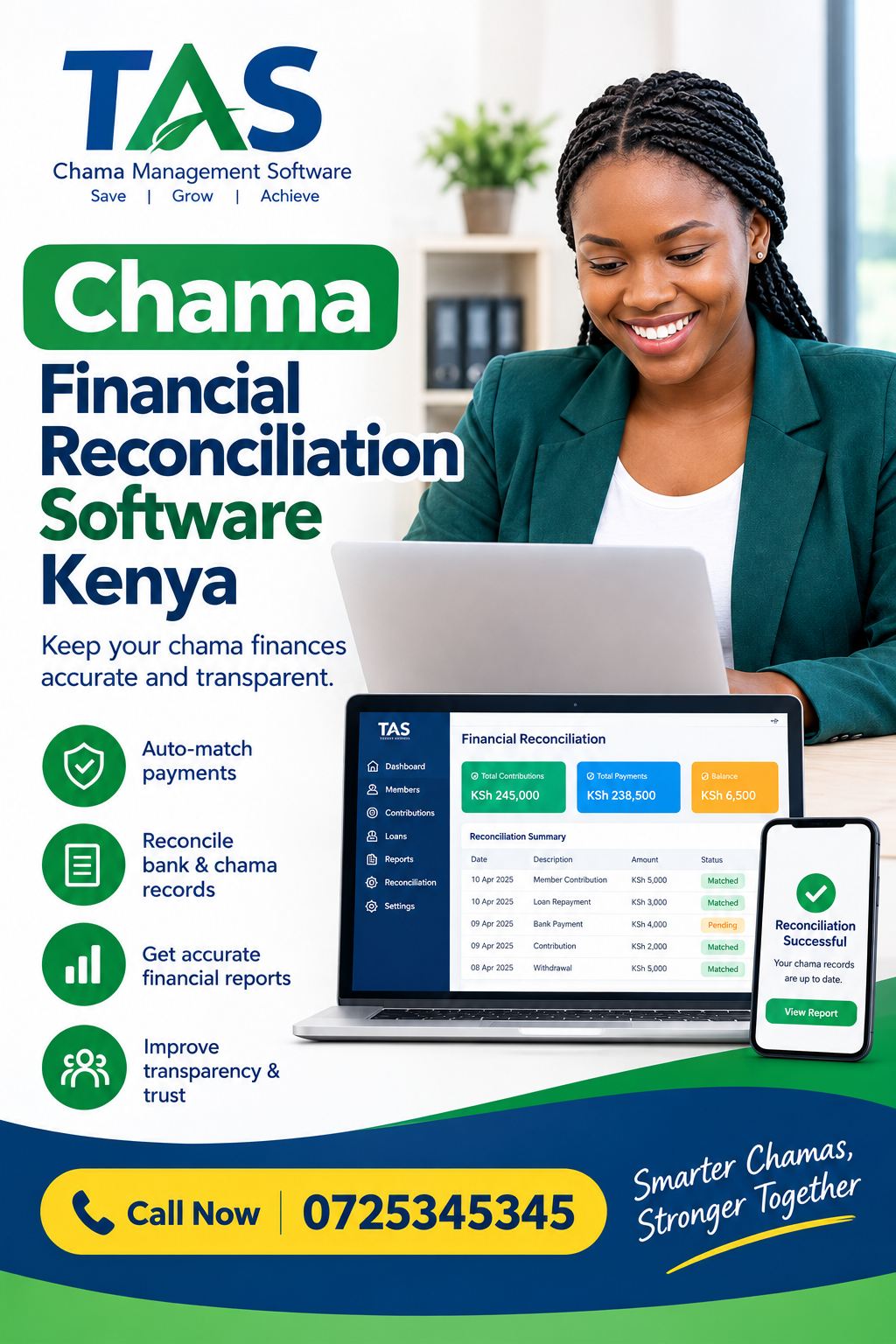
Managing money in a chama requires more than recording how much members contribute each month. A group may receive contributions through M-Pesa, bank transfers, cash payments and other channels while also issuing loans, receiving repayments, paying expenses and maintaining member balances. Chama Financial Reconciliation Software Kenya helps bring these financial activities together so that the records maintained by the group can be compared, checked and corrected systematically. This guide explains how financial reconciliation works for Kenyan chamas, why it matters, what features to look for, and how the right software can improve financial accountability.
What Is Chama Financial Reconciliation?
Financial reconciliation is the process of comparing financial records from different sources and confirming that they agree. For a chama, those sources may include member contribution records, M-Pesa transactions, bank statements, loan records, cashbooks, receipts and expense records. Chama Financial Reconciliation Software Kenya provides a structured way to compare these records instead of depending entirely on notebooks, spreadsheets or manual calculations.
The purpose is not simply to identify missing figures. Reconciliation helps the treasurer or administrator understand why two records may show different balances. A payment could have been received but not posted to a member account. A transaction could have been entered twice. A loan repayment could have been assigned to the wrong member. An expense could also have been recorded in the cashbook but omitted from another financial report.
These differences can become difficult to identify when a group has many members and handles transactions every week. Chama Financial Reconciliation Software Kenya can make the comparison process more organized by bringing relevant transaction information into a central system.
Why Reconciliation Matters
Accurate reconciliation gives members greater confidence in their group’s financial records. When members can see that contributions, loans, repayments and expenses are properly recorded, discussions about money become easier and more objective. Chama Financial Reconciliation Software Kenya can support this process by giving administrators better tools for checking financial information.
A chama that does not reconcile regularly may discover discrepancies only when preparing annual accounts or when a member challenges their balance. By then, the original transaction may be difficult to trace. Regular reconciliation allows problems to be identified while the relevant information is still easy to locate.
This is particularly useful for groups where one person collects payments, another keeps financial records and a committee reviews the accounts. Chama Financial Reconciliation Software Kenya can provide a shared record that makes it easier for authorized users to work from consistent information.
Why Kenyan Chamas Need Better Financial Controls
Many Kenyan savings groups start with a small number of members and relatively simple transactions. As the group grows, however, its financial responsibilities usually become more complicated. Members may contribute different amounts, take different loans and make repayments on different dates. Chama Financial Reconciliation Software Kenya can help groups maintain financial records as their operations become more sophisticated.
M-Pesa has also made it convenient for members to send money remotely. A member does not necessarily need to attend a physical meeting to make a contribution. This convenience creates an important administrative requirement: every electronic payment must still be correctly identified, allocated and recorded.
Manual reconciliation can become particularly challenging when payment references are inconsistent. A member might use a phone number, name, account reference or another description when sending money. Chama Financial Reconciliation Software Kenya can help administrators organize payment information so that transactions can be matched with the correct member accounts.
Managing Multiple Financial Records
A typical chama may maintain several records at the same time:
- Member contribution records
- Loan registers
- Loan repayment schedules
- Bank records
- M-Pesa transactions
- Cashbook entries
- Expense records
- Member balances
- Meeting collections
- Financial reports
The more records a group maintains, the greater the possibility of inconsistencies. Chama Financial Reconciliation Software Kenya can reduce the administrative burden by helping the group manage related financial information within one system.
The goal should not be to eliminate human oversight. Instead, software should make it easier for people responsible for the group to review transactions, investigate exceptions and approve corrections.
Key Features to Look For
When comparing financial management systems for a chama, the most important consideration is whether the software addresses the group’s actual financial workflow. Chama Financial Reconciliation Software Kenya should provide more than a digital version of a basic cashbook.
Contribution Reconciliation
Member contributions are one of the most common transactions in a savings group. The system should make it easy to determine whether each expected contribution has been received and recorded. Chama Financial Reconciliation Software Kenya can support administrators in comparing expected contributions against actual transactions.
A useful contribution reconciliation process can show:
- The member expected to contribute.
- The amount expected.
- The amount received.
- The date of payment.
- The payment reference.
- Whether the transaction has been matched.
- Any outstanding amount.
This provides a clearer picture than simply looking at the total amount held by the group. Chama Financial Reconciliation Software Kenya can help transform individual transactions into information that administrators can review and act upon.
M-Pesa Transaction Matching
For many Kenyan groups, mobile money is an important part of collecting contributions and loan repayments. A reconciliation system should therefore make it easier to compare mobile transactions with the group’s internal records. Chama Financial Reconciliation Software Kenya can support transaction matching when payment information is available to the group.
Suppose a chama expects ten members to contribute KSh 5,000 each. The financial record should eventually show whether the expected KSh 50,000 was actually received. If only KSh 45,000 appears, administrators can investigate the five-thousand-shilling difference rather than assuming that everything is correct.
Loan Reconciliation for Chamas
Loans introduce another layer of financial complexity. A member may receive a loan today, make a partial repayment next month and clear the balance over several installments. Chama Financial Reconciliation Software Kenya can help the group compare loan balances, repayment records and member accounts.
A proper loan reconciliation process should answer questions such as:
- How much was originally borrowed?
- What repayment schedule was agreed?
- How much has been paid?
- How much principal remains?
- How much interest has been charged?
- Are there penalties?
- Was each payment assigned correctly?
- Does the member’s balance match the group’s loan records?
When these questions can be answered from a central system, financial reviews become easier. Chama Financial Reconciliation Software Kenya can also help reduce the risk of relying on separate spreadsheets maintained by different committee members.
Identifying Loan Payment Errors
Loan repayments can be particularly difficult to reconcile manually because one payment may contain different components. For example, a payment could include principal, interest and a penalty. Chama Financial Reconciliation Software Kenya can help administrators maintain clearer records of how repayments affect outstanding balances.
Consider a member who sends KSh 8,000 toward a loan. If the payment is recorded against the wrong loan or assigned to another member, the group’s total cash may still appear correct while the individual accounts are wrong. Reconciliation therefore needs to examine both the overall financial position and individual member records.
Cashbook Reconciliation
The cashbook remains an important financial record for many chamas. It shows money coming into and leaving the group. Chama Financial Reconciliation Software Kenya can complement cashbook management by helping administrators compare recorded transactions against other financial sources.
A strong reconciliation process should distinguish between:
- Opening balance
- Contributions
- Loan repayments
- Loan disbursements
- Bank deposits
- Withdrawals
- Administrative expenses
- Meeting expenses
- Other income
- Closing balance
If the calculated closing balance does not agree with the actual bank or cash position, the difference needs investigation. Chama Financial Reconciliation Software Kenya can make that investigation more structured by maintaining transaction histories and financial records in one place.
Why Cashbook Accuracy Matters
An inaccurate cashbook can create confusion even when the actual money is safe. For example, a group could have KSh 300,000 in its bank account but show KSh 315,000 in its internal records because an expense was never entered. Chama Financial Reconciliation Software Kenya can help administrators identify discrepancies before they become larger accounting problems.
The earlier a discrepancy is identified, the easier it usually is to investigate. That is why reconciliation should be a regular process rather than something performed only at the end of the year.
Member Account Reconciliation
Every member should have a reliable financial record. This may include contributions, loans, repayments, dividends, penalties and other transactions. Chama Financial Reconciliation Software Kenya can help administrators maintain individual member financial histories.
Member reconciliation is important because the group’s total balance can be correct while individual member balances are wrong. For example, if a KSh 10,000 contribution is accidentally posted to Member A instead of Member B, the total cash remains unchanged, but both member accounts become inaccurate.
A good system should therefore make it possible to review transactions by member. Chama Financial Reconciliation Software Kenya can provide a more practical foundation for investigating questions raised during member meetings.
Financial Reporting for Chamas
Reconciliation becomes more useful when the resulting information can be turned into understandable reports. Chama Financial Reconciliation Software Kenya can support better reporting by organizing transaction data into useful summaries.
A chama may want reports covering:
| Report | Purpose |
|---|---|
| Contribution report | Shows member contributions |
| Loan report | Tracks loans issued and outstanding |
| Repayment report | Shows loan repayments |
| Expense report | Tracks money spent |
| Cashbook report | Summarizes cash movement |
| Member statement | Shows individual financial activity |
| Reconciliation report | Highlights matched and unmatched transactions |
| Financial summary | Gives an overall view of group finances |
Reports are especially useful during committee meetings. Instead of spending most of the meeting reconstructing figures, members can focus on decisions. Chama Financial Reconciliation Software Kenya can help create a more organized environment for reviewing financial information.
Reports and Accountability
Transparency does not mean giving every person unrestricted access to every financial function. It means ensuring that authorized members can obtain accurate information and that transactions can be traced. Chama Financial Reconciliation Software Kenya can support this principle through organized records and controlled access.
A treasurer should be able to explain how the group’s funds moved during a reporting period. If a member asks why the balance changed, the supporting transactions should be available.
Reducing Duplicate Transactions
Duplicate entries are a common problem in manual bookkeeping. A transaction may be entered when a payment is received and then entered again when the bank or mobile-money statement is reviewed. Chama Financial Reconciliation Software Kenya can help administrators identify records that appear to represent the same transaction.
Duplicate transactions can distort contribution totals and member balances. They can also create unnecessary arguments because the group may appear to have more money than it actually does.
A reconciliation workflow should therefore flag suspicious duplicates for review rather than simply adding every transaction to the total. Chama Financial Reconciliation Software Kenya can be part of a broader digital approach to maintaining cleaner transaction records.
Detecting Missing Transactions
Missing records can be just as serious as duplicate records. A member may have paid but the transaction may not have been entered into the chama’s system. Chama Financial Reconciliation Software Kenya can help administrators compare expected activity with recorded transactions.
For example, if a group has 30 members who each owe a monthly contribution, the system can help identify members whose expected payments do not match recorded transactions.
This does not automatically mean a member failed to pay. It may mean the payment is sitting in an unmatched transaction list. Chama Financial Reconciliation Software Kenya can help separate confirmed non-payments from transactions that simply require investigation.
Handling Unmatched Payments
An unmatched payment is a transaction received by the group but not yet associated with the correct member, purpose or account. Chama Financial Reconciliation Software Kenya can help administrators maintain visibility over these transactions instead of forcing them into an account prematurely.
A useful workflow is to place unmatched transactions into a review queue. The administrator can then examine the payment reference, amount, date and available information before assigning it.
This is safer than guessing. Chama Financial Reconciliation Software Kenya can support a controlled process where uncertain transactions remain visible until the responsible person confirms their correct allocation.
Reconciliation and Chama Governance
Good financial management supports good governance. Committee members need reliable financial information when making decisions about loans, investments, expenses and member distributions. Chama Financial Reconciliation Software Kenya can support governance by giving decision-makers clearer financial records.
For example, a committee deciding whether to increase loan limits needs to know the group’s liquidity, outstanding loans and repayment performance. If those figures are unreliable, the decision becomes difficult to justify.
Reconciliation therefore supports more than accounting. Chama Financial Reconciliation Software Kenya can contribute to a broader culture of accountability by helping the group maintain records that can be reviewed and explained.
Audit Trails and Financial History
A financial system should make it possible to understand what happened to a transaction over time. If an amount is corrected, administrators should ideally be able to identify the original entry and the reason for the change. Chama Financial Reconciliation Software Kenya can support stronger record keeping when audit-friendly functionality is available.
Audit trails are particularly valuable when committee responsibilities change. A new treasurer should not have to reconstruct years of transactions from notebooks and scattered spreadsheets.
A centralized history provides continuity. Chama Financial Reconciliation Software Kenya can help ensure that financial knowledge remains with the group rather than depending entirely on one individual.
Improving Treasurer Productivity
Treasurers often perform several responsibilities at once. They may collect payments, record transactions, prepare reports, monitor loans and answer member questions. Chama Financial Reconciliation Software Kenya can reduce the amount of repetitive work involved in maintaining these records.
Automation is valuable when it eliminates unnecessary copying and recalculation. A treasurer should spend more time reviewing exceptions and less time transferring the same figures between multiple spreadsheets.
This can also make the role more manageable for volunteers who do not have formal accounting training. Chama Financial Reconciliation Software Kenya can give such users a structured workflow without requiring them to build their own complex spreadsheets.
Reconciliation Frequency
There is no single frequency that works for every chama. A small group with few transactions might reconcile weekly or monthly, while a larger organization may need more frequent checks. Chama Financial Reconciliation Software Kenya can make frequent reconciliation easier because transactions can be reviewed systematically.
A practical schedule could include:
- Daily checks for high-volume payment activity
- Weekly transaction matching
- Monthly bank and mobile-money reconciliation
- Monthly member balance review
- Quarterly financial review
- Annual comprehensive financial reconciliation
The exact schedule should reflect transaction volume and the group’s governance requirements. Chama Financial Reconciliation Software Kenya can support whichever schedule the committee adopts.
Choosing the Right Chama Software
Not every accounting or business application is designed around the needs of savings groups. When evaluating software, the committee should start with its actual processes. Chama Financial Reconciliation Software Kenya should fit the group’s workflow rather than forcing the group into an unnecessarily complicated structure.
Consider these questions:
- Can the system manage members?
- Can it record contributions?
- Can it track loans?
- Can it record repayments?
- Can it handle different payment channels?
- Can administrators reconcile transactions?
- Can members receive statements?
- Can the system generate financial reports?
- Can authorized users access information securely?
- Can the group export or review its records?
A good evaluation should also consider ease of use. Chama Financial Reconciliation Software Kenya may provide sophisticated functionality, but if the treasurer finds it difficult to use, the group may not receive the expected benefit.
Security and Access Control
Financial records should be treated as sensitive information. A chama may hold member names, contact information, contribution histories, loan balances and payment details. Chama Financial Reconciliation Software Kenya should therefore be evaluated partly on how it protects access to financial data.
The group should consider whether the system supports appropriate user roles. A treasurer may require more financial permissions than an ordinary member. Committee members may need reporting access without being able to modify every transaction.
Strong access control reduces the possibility of unauthorized changes. Chama Financial Reconciliation Software Kenya can support a more controlled financial environment when access permissions and user responsibilities are properly configured.
Moving From Spreadsheets to Software
Spreadsheets are useful for small groups, but they can become difficult to manage as transactions increase. Different versions of the same spreadsheet can circulate among committee members, creating uncertainty about which file is correct. Chama Financial Reconciliation Software Kenya can provide a centralized alternative.
The transition should be planned rather than rushed. The group should first clean existing records, confirm member balances and identify outstanding loans.
Once the opening balances are verified, the group can start using the new system for future transactions. Chama Financial Reconciliation Software Kenya can then become part of the group’s regular financial workflow rather than simply another place to store information.
Training Chama Officials
Even good software requires proper onboarding. Treasurers, secretaries and committee members should understand the difference between entering a transaction, matching it and correcting it. Chama Financial Reconciliation Software Kenya can deliver better results when users understand how its financial workflows operate.
Training should cover:
- Member setup
- Contribution entry
- Payment matching
- Loan recording
- Loan repayment
- Expense recording
- Reconciliation
- Report generation
- User permissions
- Error correction
Training does not need to be complicated. Chama Financial Reconciliation Software Kenya should be practical enough for users to learn through real examples from the group’s own financial activities.
A Practical Reconciliation Example
Imagine a chama with 20 members. Each member is expected to contribute KSh 5,000 every month. The expected contribution total is therefore KSh 100,000. Chama Financial Reconciliation Software Kenya can help the treasurer compare this expectation with actual payment records.
Suppose the payment records show KSh 90,000. At first glance, the group may assume that two members have not paid. But reconciliation may reveal that one member paid KSh 5,000 using a transaction reference that has not yet been matched, while another member paid KSh 5,000 in cash.
The actual position could therefore be completely different from the initial report. Chama Financial Reconciliation Software Kenya can help administrators investigate the difference before concluding that money is missing.
Reconciliation During Leadership Changes
Leadership transitions can expose weaknesses in financial records. When a new treasurer takes over, the group needs a reliable opening position. Chama Financial Reconciliation Software Kenya can help make the handover easier when transaction histories, member accounts and financial reports are centralized.
A good handover should include:
- Current cash balance
- Bank balance
- Mobile-money position
- Outstanding loans
- Member contribution status
- Unmatched transactions
- Outstanding expenses
- Recent financial reports
- Relevant supporting documents
The outgoing treasurer should not simply hand over a spreadsheet and a password. Chama Financial Reconciliation Software Kenya can support a more structured transition by preserving the group’s financial history.
Common Reconciliation Mistakes
Several mistakes can undermine the accuracy of a chama’s financial records.
Relying on Memory
Committee members should not rely on memory to reconstruct transactions. Chama Financial Reconciliation Software Kenya provides a stronger foundation when transactions are recorded promptly and consistently.
Recording Transactions Late
Delaying entries increases the chance of forgetting details. A payment recorded weeks later may be difficult to identify accurately. Chama Financial Reconciliation Software Kenya can support timely record keeping by making transaction management more structured.
Ignoring Small Differences
A small discrepancy may seem unimportant, but several small discrepancies can become a major problem. Chama Financial Reconciliation Software Kenya can help groups identify differences before they accumulate.
Mixing Personal and Chama Money
Personal and group funds should remain separate. Chama Financial Reconciliation Software Kenya can help maintain a clearer record of group transactions, but the group must still maintain appropriate financial discipline outside the software.
How Software Supports Transparency
Transparency is easier when financial information can be presented clearly. Members do not necessarily need access to every administrative function, but they should have appropriate visibility into the group’s financial position. Chama Financial Reconciliation Software Kenya can support structured reporting that makes financial discussions more evidence-based.
For example, instead of saying that loan repayments appear to be improving, the committee can review actual repayment reports. Instead of estimating total contributions, it can review contribution records.
This changes the quality of decision-making. Chama Financial Reconciliation Software Kenya can help turn financial data into information that members and committee leaders can understand.
Cost Considerations
The cost of software should be evaluated against the administrative problems it solves. A cheap system that cannot support reconciliation may ultimately create more work. Chama Financial Reconciliation Software Kenya should be assessed based on usability, functionality, reliability and the value it provides to the group.
Before choosing a solution, the committee should identify its most important requirements. For a small chama, basic contribution and loan management may be enough. A larger organization may require detailed reporting, payment reconciliation, user roles and stronger financial controls.
The right solution is therefore not necessarily the one with the largest number of features. Chama Financial Reconciliation Software Kenya should be selected according to the group’s real needs.
Benefits for Members
The benefits of reconciliation are not limited to treasurers. Members also gain when their accounts are accurate. Chama Financial Reconciliation Software Kenya can help create more reliable member statements and clearer records of contributions and loans.
A member should be able to understand:
- How much they have contributed
- How much they owe
- How much they have repaid
- Whether their payments have been recorded
- What charges apply
- What their current balance is
When this information is easy to obtain, unnecessary disputes can be reduced. Chama Financial Reconciliation Software Kenya can therefore support both administrative efficiency and member confidence.
Building a Strong Financial Reconciliation Process
Technology works best when supported by clear procedures. A chama should establish rules for when transactions are recorded, who can approve corrections and how reconciliation results are reviewed. Chama Financial Reconciliation Software Kenya can support these procedures but should not replace them.
A practical process can follow five stages:
- Record the transaction.
- Match it with the relevant payment or account.
- Review unmatched or unusual items.
- Correct verified errors.
- Approve the final reconciliation.
This process should be repeated consistently. Chama Financial Reconciliation Software Kenya can make the workflow easier to maintain because financial information is organized within the system.
Preparing for Growth
A chama may begin with ten members and eventually grow into a much larger savings organization. Software selected at the beginning should ideally accommodate reasonable growth. Chama Financial Reconciliation Software Kenya can be valuable when a group’s transaction volume grows beyond what manual methods can comfortably support.
Growth may involve more members, larger loans, more frequent payments and additional committees. The financial system should continue to provide accurate records as complexity increases.
This is why scalability matters when comparing software. Chama Financial Reconciliation Software Kenya should be capable of supporting the group’s future needs without making everyday operations unnecessarily complicated.
Questions to Ask Before Implementation
Before adopting a reconciliation platform, a chama committee can ask vendors several practical questions:
- How are member contributions recorded?
- How are unmatched payments handled?
- Can loan repayments be reconciled?
- Are member statements available?
- What reports can be generated?
- How are corrections tracked?
- What user roles are available?
- How is data backed up?
- Can authorized users access records remotely?
- How does the system handle financial reporting?
These questions help the committee evaluate functionality instead of choosing software based only on appearance. Chama Financial Reconciliation Software Kenya should be judged by how well it solves the group’s actual financial problems.
Frequently Asked Questions
1. What is chama financial reconciliation?
Chama financial reconciliation is the process of comparing financial records such as contributions, loans, repayments, expenses, cashbook entries and payment records to ensure they agree. Chama Financial Reconciliation Software Kenya can help automate and organize this process.
2. Can software reconcile M-Pesa payments?
Yes, depending on the capabilities of the selected system and the payment information available to the chama. Chama Financial Reconciliation Software Kenya can help administrators organize and match electronic payment records with member accounts.
3. Can reconciliation software track chama loans?
A suitable chama management platform can combine loan records with repayment information. Chama Financial Reconciliation Software Kenya can help administrators monitor loan balances, repayments and related member records.
4. Why should a chama reconcile its accounts regularly?
Regular reconciliation helps identify missing transactions, duplicate entries, incorrect allocations and other discrepancies before they become difficult to investigate. Chama Financial Reconciliation Software Kenya can make regular financial reviews more manageable.
5. Can software improve member transparency?
Yes. Clear member statements, contribution reports, loan reports and financial summaries can make it easier for members to understand their accounts. Chama Financial Reconciliation Software Kenya can support better access to organized financial information.
6. Is reconciliation software suitable for small chamas?
It can be, particularly when the group wants to establish good financial practices early. Chama Financial Reconciliation Software Kenya can help small groups avoid building complicated manual processes that become difficult to maintain as membership grows.
7. What should a chama consider when selecting software?
The committee should consider member management, contributions, loan tracking, payment reconciliation, reporting, security, usability and support. Chama Financial Reconciliation Software Kenya should be evaluated against the group’s specific requirements rather than simply comparing feature lists.
8. Can reconciliation reduce financial disputes?
Accurate and traceable records can reduce disputes because members and committee members can refer to documented transactions instead of relying on memory. Chama Financial Reconciliation Software Kenya can support this transparency when the group maintains records consistently.
9. How often should a chama reconcile its finances?
The appropriate frequency depends on transaction volume. A group handling many payments may benefit from frequent reconciliation, while a smaller group may reconcile weekly or monthly. Chama Financial Reconciliation Software Kenya can support whichever review schedule the group adopts.
10. What is the main benefit of using financial reconciliation software?
The main benefit is better control over financial information. Chama Financial Reconciliation Software Kenya can help a chama compare transactions, identify discrepancies, maintain member records and produce clearer financial reports.
Final Thoughts
A chama’s financial strength depends heavily on the quality of its records. Contributions, loans, repayments, expenses and payment transactions need to agree if members and leaders are going to have confidence in the group’s financial position. Chama Financial Reconciliation Software Kenya can provide the structure needed to manage these records more efficiently.
Reconciliation should not be viewed as an administrative burden that is performed only when something goes wrong. It should be part of the group’s normal financial management routine. Chama Financial Reconciliation Software Kenya can help make that routine more organized by giving administrators tools for matching transactions and investigating discrepancies.
For groups handling M-Pesa payments, bank transactions, member contributions and loans, accurate financial records are especially important. Chama Financial Reconciliation Software Kenya can help bring these different activities into a more consistent financial workflow.
The best results come when software is combined with clear procedures, responsible users and regular financial reviews. Chama Financial Reconciliation Software Kenya can support the technology side, while the chama’s committee remains responsible for oversight and financial decisions.
A well-managed reconciliation process can also make leadership transitions easier, improve reporting and give members clearer information about their money. Chama Financial Reconciliation Software Kenya can help preserve financial records so that the group does not depend entirely on one treasurer’s personal spreadsheets or notebooks.
Ultimately, the goal is straightforward: every contribution should be accounted for, every loan should have a clear balance, every repayment should be allocated correctly and every major financial movement should be traceable. Chama Financial Reconciliation Software Kenya can help a chama move closer to that standard.
For Kenyan savings groups looking to improve financial accountability without making administration unnecessarily complicated, adopting a structured digital reconciliation process is a practical step. Chama Financial Reconciliation Software Kenya can help turn reconciliation from a difficult manual exercise into a regular part of effective chama management.