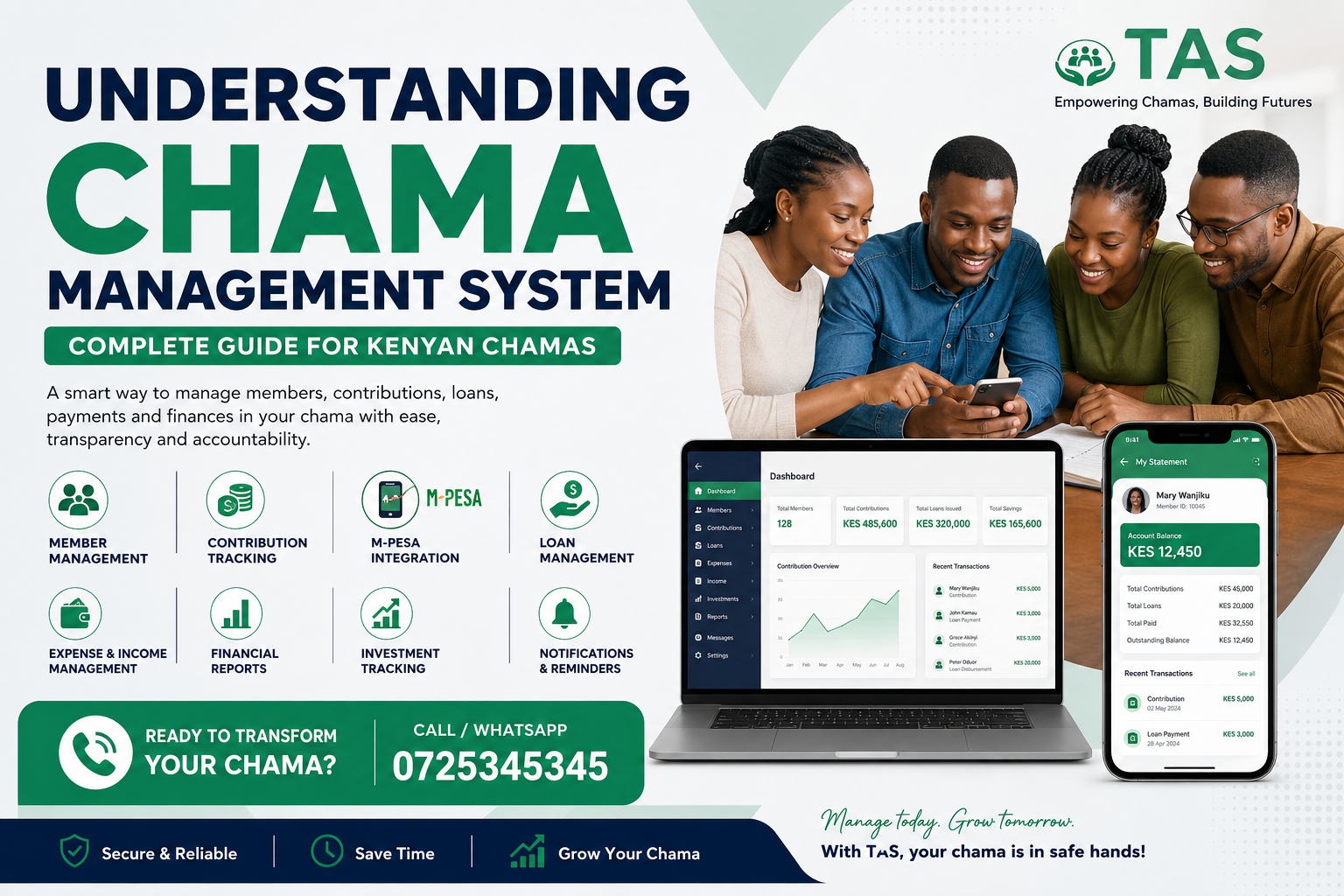
Author: Esther macharia

  • Manage Your Chama Online Kenya: 10 Powerful Ways to Simplify Chama Management

    Manage Your Chama Online Kenya
    Manage Your Chama Online Kenya: 10 Powerful Ways to Simplify Chama Management

    Managing a chama should not mean spending hours checking notebooks, calculating contributions, following up on loan repayments and preparing reports manually.

    Today, chamas, investment groups, table banking groups, welfare groups and savings groups can use technology to simplify everyday administration.

    If you want to manage your chama online Kenya, a digital chama management system can bring members, contributions, loans, repayments, expenses and financial reports together in one organized platform.

    This guide explains how to manage your chama digitally, the features to look for and why Kenyan groups are increasingly moving away from notebooks and complicated spreadsheets.With TAS, you can Manage Your Chama Online Kenya while keeping members, contributions, loans and financial records organized.”

    What Does It Mean to Manage Your Chama Online?

    To manage your chama online Kenya means using a digital system to maintain your group’s administrative and financial records.

    Instead of keeping information across notebooks, receipt books, WhatsApp messages and spreadsheets, authorized officials can maintain records from one centralized platform.

    Depending on the software, this can include:

    • Member management
    • Contributions
    • Savings
    • Loans
    • Loan repayments
    • Fines and penalties
    • Expenses
    • Welfare funds
    • Member statements
    • Financial reports
    • Group activities
    • Payment records

    The objective is simple: make chama administration easier, more accurate and more transparent.

    Why Kenyan Chamas Need Better Management

    A chama can start with a small group of friends contributing money every month.

    Managing ten members manually might initially appear easy.

    However, imagine the group growing to 50 or 100 members.

    Every month, officials may need to record contributions, issue loans, update repayments, calculate outstanding balances, record expenses and answer questions from members.

    As transactions increase, manual administration becomes increasingly difficult.

    A chama management system in Kenya can provide a structured way to manage these activities.

    1. Manage Your Chama Members in One Place

    Member management is the foundation of good chama administration.

    Instead of maintaining separate member lists, a digital system can provide centralized member profiles.

    A profile may contain:

    • Member name
    • Membership number
    • Phone number
    • Date joined
    • Membership status
    • Contribution history
    • Loan information
    • Outstanding balances
    • Fines
    • Other financial records

    When you manage your chama online Kenya, officials can find relevant member information without repeatedly searching through physical files.

    2. Track Chama Contributions

    TAS makes it easier to Manage Your Chama Online Kenya and maintain accurate contribution records for every member.”

    Contributions are central to most chamas.

    Members may contribute weekly, monthly or according to another schedule established by the group.

    Consider a chama with 100 members contributing KES 5,000 every month.

    That creates 100 contribution transactions every month and potentially 1,200 transactions in one year.

    Managing this manually can become time-consuming.

    Digital contribution tracking allows each payment to be associated with the appropriate member.

    Officials can then review:

    • Contributions received
    • Member contribution history
    • Expected contributions
    • Outstanding contributions
    • Total group contributions

    This makes contribution management much easier.

    3. Manage Chama Loans Digitally

    Groups can Manage Your Chama Online Kenya while tracking loans, repayments and outstanding balances from one platform.

    Many Kenyan chamas provide loans to their members.

    As lending activity grows, officials need accurate records.

    A chama loan management system can maintain information such as:

    • Borrower
    • Loan amount
    • Date issued
    • Interest rate
    • Repayment period
    • Amount repaid
    • Outstanding balance
    • Loan status
    • Guarantor information where applicable

    Instead of calculating every outstanding balance manually, officials have a structured loan record.

    4. Track Chama Loan Repayments

    Issuing a loan is only one part of lending.

    Repayments must also be recorded accurately.

    For example, if a member receives a KES 50,000 loan and subsequently makes several repayments, officials should be able to see the complete transaction history.

    Digital loan management makes it easier to determine:

    • Original loan amount
    • Repayments received
    • Outstanding principal
    • Applicable interest
    • Payment dates
    • Loan status

    This provides better visibility for both officials and members.

    5. Manage Chama M-Pesa Payments

    You can Manage Your Chama Online Kenya while keeping digital payment and member transaction records organized.”Mobile money has become an important payment channel for Kenyan groups.

    A modern chama system may support workflows around M-Pesa contributions and other group payments.

    Depending on the implementation and payment integration, this can reduce the amount of manual reconciliation required after members make payments.

    Digital payment records are particularly useful for groups collecting:

    • Monthly contributions
    • Loan repayments
    • Welfare contributions
    • Registration fees
    • Fines
    • Special contributions

    The goal is to create a clear connection between payments and member accounts.

    6. Generate Member Statements

    When you Manage Your Chama Online Kenya, preparing contribution, loan and member reports becomes much easier.One common question during chama meetings is:

    “How much have I contributed?”

    Another is:

    “How much do I still owe?”

    Officials should not have to spend several minutes checking different books every time a member asks.

    A digital chama management platform can maintain member transaction histories.

    A member statement may show:

    • Contributions
    • Loans
    • Loan repayments
    • Fines
    • Welfare payments
    • Other transactions
    • Relevant balances

    Member statements improve visibility and make financial discussions easier.

    7. Manage Chama Expenses

    Chamas don’t only receive money.

    They also spend money.

    Possible expenses include:

    • Bank charges
    • Meeting expenses
    • Professional services
    • Investment expenses
    • Administrative costs
    • Project expenses

    Every expense should be recorded properly.

    Digital expense management creates a historical record showing how group money has been used.

    8. Generate Chama Financial Reports

    Reporting is one of the strongest reasons to manage your chama online Kenya.

    Instead of preparing every report manually, a digital system can organize information into useful summaries.

    Important reports may include:

    Contribution Report

    Shows member contributions over a selected period.

    Loan Report

    Shows loans issued to members.

    Loan Repayment Report

    Shows payments made against loans.

    Outstanding Loans Report

    Identifies loans that still have balances.

    Member Statement

    Shows the financial history of an individual member.

    Expense Report

    Shows recorded expenditure.

    Group Financial Summary

    Provides an overview of the group’s financial activities.

    These reports can make monthly and annual chama meetings easier to manage.

    9. Improve Chama Transparency

    Trust is extremely important when people contribute money together.

    Members need confidence that their payments are being recorded accurately.

    Officials also need reliable records when answering financial questions.

    A digital system can improve transparency by providing organized transaction histories, statements and reports.

    Good software does not replace responsible leadership.

    Instead, it gives chama officials better tools for maintaining accurate records.

    10. Reduce Manual Errors

    Spreadsheets and notebooks depend heavily on manual data entry and calculations.

    Mistakes can happen.

    A formula may be changed accidentally.

    A transaction may be recorded against the wrong member.

    An old spreadsheet may be mistaken for the latest version.

    A well-designed chama platform reduces repeated calculations and keeps records in a centralized system.

    This can reduce administrative errors and make reconciliation easier.

    Manage Your Table Banking Group Online

    Table banking groups can Manage Your Chama Online Kenya and maintain clearer records of savings, loans, repayments and member balances.

    Table banking groups have additional administrative requirements.

    Members contribute money into a common fund and eligible members can borrow according to the group’s rules.

    A digital table banking system can help manage:

    • Contributions
    • Member savings
    • Loans
    • Interest
    • Repayments
    • Outstanding balances
    • Fines
    • Statements
    • Financial reports

    This provides officials with a clearer picture of the group’s financial position.

    Manage Merry-Go-Round Contributions

    Some chamas operate merry-go-round arrangements where members contribute regularly and pooled funds are distributed according to an agreed rotation.

    Managing the schedule manually can become complicated as membership increases.

    Digital records can help maintain:

    • Members
    • Contribution amounts
    • Contribution dates
    • Rotation schedules
    • Previous beneficiaries
    • Upcoming beneficiaries

    This creates an organized historical record of the group’s activities.

    Manage Chama Welfare Funds

    Many groups maintain welfare funds alongside their normal savings.

    These funds may be used according to rules established by the members.

    A chama management platform can help separate welfare transactions from normal contributions and loans.

    This is particularly useful when a group operates several different funds simultaneously.

    Manage an Investment Chama

    Investment groups can have more complex financial records than ordinary savings groups.

    Members may pool money for projects such as property, agriculture, businesses or other investments.

    As investment activity grows, accurate records become increasingly important.

    An online chama management platform can provide a centralized place for maintaining member contributions and group financial transactions.

    Manage Women Groups Digitally

    Women groups can Manage Your Chama Online Kenya while keeping contributions, loans, welfare funds and member records organized.

    Women groups involved in savings, table banking, welfare and investment can also benefit from digital record keeping.

    Instead of depending entirely on physical books, officials can maintain structured financial records.

    This can make it easier to track contributions, loans and member balances as the group grows.

    Manage Youth Groups Online

    Youth groups can Manage Your Chama Online Kenya while tracking members, contributions, loans and group activities digitally.

    Youth groups often manage contributions, projects, investments and member activities.

    Digital chama software provides a centralized administrative system that authorized officials can access from compatible devices.

    This can be particularly useful when members live or work in different locations.

    Chama Management Dashboard

    A centralized dashboard makes it easier to Manage Your Chama Online Kenya by giving officials quick access to contributions, loans, members and balances.

    A useful chama dashboard should give officials an immediate overview of important information.

    Depending on the platform, this could include:

    • Total members
    • Active members
    • Total contributions
    • Total loans issued
    • Outstanding loans
    • Repayments received
    • Expenses
    • Available balances

    Instead of opening several spreadsheets, officials can review key information from one dashboard.

    Chama Management Software vs Excel

    Excel is useful and many groups begin with spreadsheets.

    However, spreadsheets can become difficult to manage as the chama grows.

    Excel/Manual Management Chama Management Software
    Multiple files Centralized records
    Manual calculations Automated calculations
    Manual statements Faster member statements
    Difficult permissions User access controls
    Manual reporting Structured reports
    Version confusion Central database
    Manual loan tracking Digital loan records

    A growing chama may eventually require a dedicated platform designed specifically for group administration.

    Moving from Books to Digital Chama Management

    Groups that want to Manage Your Chama Online Kenya can begin by verifying existing member balances before moving their records to the digital system.

    Existing groups can move from physical books to a digital system.

    The process should be handled carefully.

    Step 1: Prepare Your Member List

    Confirm all active members and their details.

    Step 2: Verify Contributions

    Confirm each member’s contribution balance.

    Step 3: Verify Loans

    Review existing loans, repayments and outstanding balances.

    Step 4: Verify Other Balances

    Check fines, welfare contributions and other relevant transactions.

    Step 5: Configure Your Chama

    Set up your group’s rules and structure in the system.

    Step 6: Enter Opening Balances

    Transfer verified balances into the platform.

    Step 7: Verify Everything

    Compare the digital balances against the group’s approved records.

    Step 8: Train Officials

    Ensure authorized officials understand how to use the system.

    Once these steps are complete, the chama can begin maintaining new transactions digitally.

    How to Choose the Best Chama Management System in Kenya

    Before choosing a platform to Manage Your Chama Online Kenya, consider security, reporting, ease of use, support and the features your group actually needs.

    Before choosing software, don’t look only at price.

    Evaluate whether the platform can support the way your chama actually operates.

    Look for features such as:

    • Member management
    • Contribution tracking
    • Loan management
    • Repayment tracking
    • Member statements
    • Financial reporting
    • Expense management
    • Mobile accessibility
    • User permissions
    • Data backups
    • Customer support

    Your chama should choose a solution that is easy enough for officials to use consistently.

    Why Managing Your Chama Online Is a Powerful Upgrade

    Many groups choose to Manage Your Chama Online Kenya to reduce paperwork and keep financial records organized in one place.

    Moving online isn’t simply about replacing a notebook with a computer.

    The bigger benefit is creating structured financial information.

    Officials can spend less time searching for records and more time discussing the group’s financial goals.

    Members can receive clearer information about their contributions and obligations.

    Committees can prepare for meetings more efficiently.

    And growing chamas have a stronger foundation for maintaining their historical records.

    Frequently Asked Questions About Managing a Chama

    How can I manage my chama online in Kenya?

    You can use a chama management system that allows officials to manage members, contributions, loans, repayments, expenses and financial reports from a centralized platform.

    What is chama management software?

    Chama management software is a digital platform designed to organize administrative and financial activities for savings groups, investment groups, table banking groups and similar organizations.

    Can chama contributions be tracked online?

    Yes. Digital chama software can maintain contribution records for individual members and provide historical contribution information.

    Can I manage chama loans online?

    Yes. A chama loan management platform can maintain loan amounts, repayments, interest and outstanding balances according to the group’s lending rules.

    Can a table banking group use chama management software?

    Yes. Table banking groups can use digital software to manage members, contributions, loans, repayments and reports.

    Can women groups use chama software?

    Yes. Women groups, youth groups, investment groups, welfare groups and other savings organizations can use digital chama management platforms.

    Can I move existing chama records to a digital system?

    Yes. Existing records can be migrated, but opening balances should be carefully verified before the group begins using the new system.

    Is online chama management better than Excel?

    It depends on the size and complexity of the group. Excel can work for simple records, while dedicated chama management software provides more structured member, contribution, loan and reporting functionality.

    Start Managing Your Chama Online Today

    If your group is still spending hours checking notebooks, updating spreadsheets and calculating loan balances manually, it may be time to digitize your administration.

    A modern system can bring your members, contributions, loans, repayments, expenses and reports into one place.

    When you manage your chama online Kenya, you create a more organized system for maintaining financial records while giving officials better tools to serve members.

    Whether you operate a table banking group, investment chama, women group, youth group, welfare group or savings group, digital chama management can provide a stronger foundation for future growth.

    Start by organizing your existing records, verifying your balances and choosing a chama management platform that matches the way your group operates.

    Start using TAS to Manage Your Chama Online Kenya and simplify how your group handles members, contributions, loans and reports.
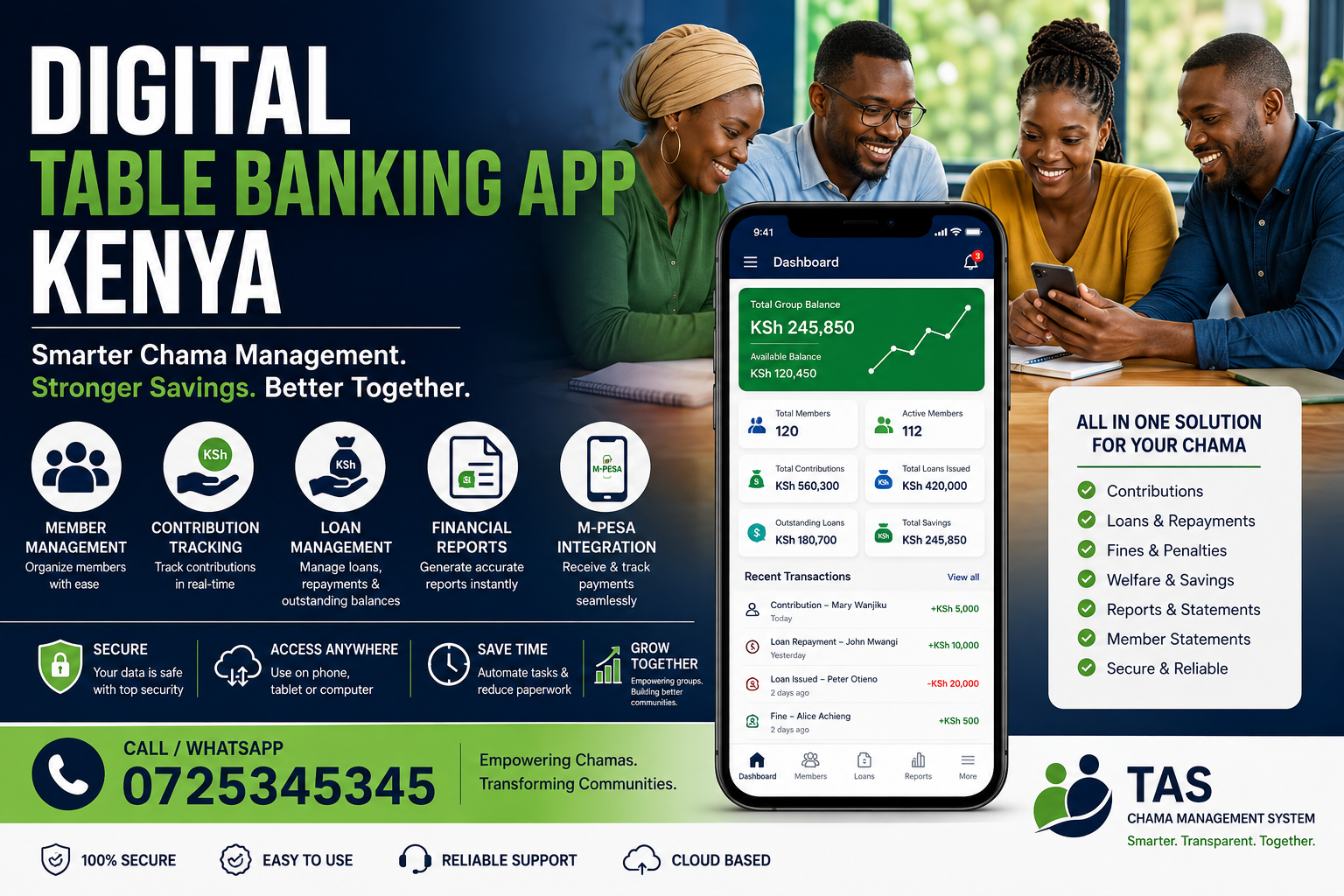

  • Digital Table Banking App Kenya: Best Table Banking Software for Chamas & Investment Groups

    Digital Table Banking App Kenya
    Digital Table Banking App Kenya: Modern Table Banking Software for Chamas

    Table banking has become an important way for chamas, investment groups, self-help groups, women groups, youth groups and community savings groups in Kenya to save money, provide loans to members and grow together financially.

    However, managing a table banking group using notebooks, spreadsheets and manual calculations can become difficult as the number of members and transactions increases.

    A Digital Table Banking App Kenya solution provides a better way to manage members, contributions, loans, repayments, fines, expenses and financial reports from one centralized system.

    Instead of spending hours calculating balances and checking handwritten records, chama officials can use digital table banking software to maintain organized and accurate financial records.

    What Is a Digital Table Banking App?

    A digital table banking app is software designed to help savings groups manage their financial activities electronically.

    The system replaces or complements traditional notebooks, receipt books and spreadsheets used during chama meetings.

    Depending on the system being used, officials can record:

    • Member registrations
    • Member contributions
    • Savings
    • Loans
    • Loan repayments
    • Interest
    • Fines and penalties
    • Welfare contributions
    • Expenses
    • Member balances
    • Group balances
    • Financial reports
    • Dividend calculations

    This gives officials and members a clearer picture of the financial position of their group.

    Why Kenyan Table Banking Groups Are Going Digital

    Traditional table banking normally involves members meeting regularly, contributing money and allowing members to borrow from the accumulated funds.

    This model can work extremely well.

    The challenge usually appears when the group grows.

    Imagine managing 40, 80 or even 200 members using a notebook.

    The secretary has to record contributions.

    The treasurer has to reconcile money received.

    Loan balances have to be calculated.

    Interest must be calculated.

    Previous payments have to be checked.

    Members may also want statements showing their individual financial position.

    A digital table banking system simplifies these administrative activities.

    1. Manage Chama Members Digitally

    Good table banking management starts with accurate member records.

    A digital table banking app can provide a centralized member database containing information such as:

    • Member name
    • Phone number
    • Membership number
    • Date joined
    • Membership status
    • Contributions
    • Outstanding loans
    • Repayment history
    • Fines
    • Welfare contributions

    Officials therefore don’t have to search through several notebooks whenever they need information about a member.

    2. Track Member Contributions

    Contribution management is one of the most important features of a table banking app Kenya.

    Groups may collect contributions weekly, monthly or according to their own schedules.

    Instead of manually writing every transaction in a contribution book, officials can record contributions against individual member accounts.

    The system creates a historical record showing how much each member has contributed.

    This makes it easier to identify:

    • Total contributions
    • Contributions per member
    • Missed contributions
    • Outstanding contributions
    • Contribution history
    • Group savings

    Accurate contribution records also make financial reporting easier.

    3. Manage Table Banking Loans

    Loans are at the heart of many table banking groups.

    Members contribute money into a common pool and eligible members can borrow according to the group’s constitution and lending policies.

    Managing these loans manually can become complicated.

    A digital table banking system can maintain records showing:

    • Borrower
    • Loan amount
    • Loan issue date
    • Interest
    • Repayment period
    • Amount repaid
    • Outstanding balance
    • Repayment history
    • Loan status

    Officials can quickly determine which members have active loans and how much remains outstanding.

    4. Track Loan Repayments

    Recording loan repayments correctly is essential for maintaining accurate financial records.

    Each payment can be associated with the relevant member and loan.

    For example:

    Original loan: KES 50,000

    Amount repaid: KES 30,000

    Outstanding balance: KES 20,000 plus any applicable interest or charges according to the group’s rules.

    Instead of repeatedly performing calculations manually, the software can maintain the loan transaction history.

    5. Improve Transparency in Your Chama

    Transparency is extremely important in table banking.

    Members want to know that their contributions and loan repayments have been recorded correctly.

    Poor financial records can create disagreements between members and officials.

    A digital system creates structured records that can make transactions easier to verify.

    This can improve accountability between:

    • Chairpersons
    • Treasurers
    • Secretaries
    • Committee members
    • Ordinary members

    A well-managed chama should be able to explain where its money came from and how it has been used.

    6. Reduce Manual Calculation Errors

    Manual calculations can produce mistakes, especially when a group has hundreds or thousands of transactions.

    An incorrect figure can affect:

    • Member balances
    • Loan balances
    • Interest
    • Group totals
    • Financial statements
    • Year-end calculations

    Using a digital table banking app reduces dependence on repeated manual calculations and gives officials a consistent financial record.

    7. Generate Table Banking Reports

    Reporting is another major advantage of digitizing table banking.

    Officials should be able to understand the financial position of their group without spending several hours preparing reports manually.

    Useful reports can include:

    Member Contribution Report

    Shows contributions made by individual members.

    Loan Report

    Shows issued loans, repayments and outstanding balances.

    Member Statement

    Provides the transaction history associated with a particular member.

    Income and Expense Report

    Shows money received and expenditure recorded by the group.

    Outstanding Loans Report

    Helps officials identify loans that still have balances.

    Group Financial Summary

    Provides an overview of the group’s financial activities.

    These reports can make chama meetings more productive because officials have information available when financial questions arise.

    8. Manage Fines and Penalties

    Many table banking groups have rules regarding late contributions, missed meetings and delayed loan repayments.

    A digital system can help officials record applicable fines and penalties.

    This creates a clearer history showing why a member has an outstanding amount.

    It also helps prevent disputes caused by missing or inconsistent records.

    9. Manage Welfare and Social Funds

    Many Kenyan chamas operate more than one fund.

    For example, a group might have:

    • Main savings fund
    • Welfare fund
    • Emergency fund
    • Development fund
    • Investment fund
    • Education fund

    Managing all these funds in the same notebook can become confusing.

    A table banking management system can help separate transactions according to their respective categories.

    10. Access Chama Information from Anywhere

    Cloud-based table banking software can allow authorized users to access information using devices such as:

    • Smartphones
    • Tablets
    • Laptops
    • Desktop computers

    This can be particularly useful for groups whose members live in different towns or counties.

    Officials do not necessarily need to carry the group’s physical books everywhere.

    Digital Table Banking App vs Manual Record Keeping

    Traditional bookkeeping has served table banking groups for many years, but digital management provides significant administrative advantages.

    Manual Table Banking Digital Table Banking
    Paper contribution books Digital contribution records
    Manual loan calculations Automated calculations
    Physical member files Central member database
    Manual reports Faster financial reports
    Difficult transaction searches Searchable transaction history
    Risk of damaged books Digital data storage
    Time-consuming reconciliation Faster reconciliation
    Limited visibility Better financial visibility

    The objective isn’t necessarily to change how the group operates.

    It is to improve how its records are managed.

    Who Can Use a Digital Table Banking App Kenya?

    Table banking software can be useful for many types of groups, including:

    • Chamas
    • Women groups
    • Youth groups
    • Investment groups
    • Welfare groups
    • Self-help groups
    • Community groups
    • Village savings groups
    • Employee savings groups
    • Church savings groups
    • Family investment groups
    • Merry-go-round groups

    Each organization can configure its processes according to its own constitution and financial rules.

    Table Banking Software for Women Groups in Kenya

    Women groups have played an important role in community savings and investment throughout Kenya.

    As membership and financial activity increase, maintaining accurate records becomes increasingly important.

    A digital table banking app can help women groups manage contributions, loans, welfare funds, member records and reports without depending entirely on physical books.

    Table Banking Software for Youth Groups

    Youth groups can also use digital platforms to manage pooled savings, projects and member loans.

    Digital record keeping is particularly useful when members need access to financial information from different locations.

    The system can provide a centralized source of information rather than having records scattered between different officials.

    Digital Chama Management

    Table banking is closely connected with chama management.

    Therefore, groups searching for a chama management system Kenya may also need table banking functionality.

    A complete chama platform can combine:

    • Membership management
    • Contribution tracking
    • Loan management
    • Repayment tracking
    • Expense management
    • Financial reporting
    • Member statements
    • Notifications
    • User permissions
    • Audit records

    This provides one platform for managing both membership and financial activities.

    Why Accurate Table Banking Records Matter

    Financial records are the foundation of accountability.

    If members contribute money every month, the group should have an accurate historical record showing those transactions.

    The same applies to loans.

    Officials should be able to answer questions such as:

    How much has the group collected?

    How much has each member contributed?

    How much money has been issued as loans?

    Who has outstanding loans?

    How much has been repaid?

    What expenses has the group incurred?

    What is the group’s current financial position?

    A properly implemented digital system makes these questions much easier to answer.

    Moving from Excel to a Digital Table Banking App

    Some groups initially move from notebooks to Excel.

    Excel can be useful for smaller groups, but administration becomes harder as transactions and membership increase.

    Problems can include:

    • Multiple spreadsheet versions
    • Accidental formula changes
    • Missing information
    • Difficulty controlling access
    • Complicated reporting
    • Files stored on individual computers

    A centralized digital table banking platform provides a more structured solution.

    Choosing the Best Digital Table Banking App  Kenya

    Before choosing table banking software, evaluate whether it supports your group’s actual operations.

    Important features to consider include:

    Easy Member Management

    Adding and managing members should be straightforward.

    Contribution Tracking

    The platform should maintain an accurate contribution history.

    Loan Management

    Officials should easily see issued loans, repayments and outstanding balances.

    Financial Reporting

    Reports should provide useful information without complicated manual calculations.

    User Permissions

    Different officials should have appropriate access according to their responsibilities.

    Data Security

    Financial and member information should be properly protected.

    Mobile Accessibility

    Because smartphones are widely used, the system should work effectively on mobile devices.

    Support

    Your provider should offer assistance when your officials encounter difficulties.

    Future of Digital Table Banking  Kenya

    Digital table banking is becoming increasingly relevant as Kenyan savings groups adopt technology for record keeping and administration.

    The movement toward digitization is also visible institutionally. Kenya’s Uwezo Fund strategic planning includes increasing the number of groups practicing table banking through a digital application.

    For chamas, the opportunity is straightforward: retain the community-based savings model while improving the technology used to manage records.

    Instead of replacing table banking, technology can make it easier to administer.

    Frequently Asked Questions

    What is a digital table banking app?

    A digital table banking app is software used to manage savings-group activities such as members, contributions, loans, repayments, fines, expenses and financial reports.

    Can a chama use table banking software?

    Yes. Chamas that operate table banking can use a digital platform to maintain their member and financial records.

    Can table banking loans be managed digitally?

    Yes. A table banking management system can record loan amounts, repayments, interest and outstanding balances.

    Can members’ contributions be tracked?

    Yes. Contributions can be recorded against individual member accounts, creating a contribution history.

    Is digital table banking suitable for women groups?

    Yes. Women groups, youth groups, investment groups, welfare groups and other savings organizations can use digital table banking software.

    Can I move from manual table banking records to a digital system?

    Yes. Groups can transition from notebooks or spreadsheets to digital record keeping. Existing records should be reviewed carefully during migration to ensure opening balances are correct.

    Start Managing Your Table Banking Group Digitally

    Managing a growing savings group shouldn’t require endless notebooks, complicated spreadsheets and hours of manual calculations.

    A Digital Table Banking App Kenya solution can help your chama organize members, contributions, loans, repayments, fines and financial reports from one central platform.

    Digital record keeping can improve efficiency, accountability and financial visibility while allowing the group to continue operating according to its existing table banking rules.

    If your chama, women group, youth group, investment group or self-help group is still relying heavily on manual records, moving to a digital table banking management system can be an important next step.

    Digital Table Banking App with M-Pesa Integration

    M-Pesa is one of the most important payment methods for savings groups and chamas in Kenya.

    A Digital Table Banking App Kenya can become even more useful when combined with M-Pesa payment capabilities.

    Depending on the platform and payment setup, groups can use digital payment records to simplify the management of:

    • Monthly contributions
    • Weekly contributions
    • Loan repayments
    • Registration fees
    • Welfare contributions
    • Fines and penalties
    • Special contributions
    • Investment contributions

    Instead of officials manually checking payment messages and updating notebooks, payment information can be reconciled against member records.

    This can significantly reduce the administrative workload of chama treasurers.

    M-Pesa Chama Contribution Tracking

    Contribution tracking is one of the biggest administrative challenges facing growing chamas.

    For example, consider a chama with 100 members contributing KES 5,000 every month.

    That represents 100 individual transactions that must be identified and correctly allocated every month.

    Over one year, officials may need to manage more than 1,200 contribution transactions before even considering loans, repayments, fines and other payments.

    A digital contribution tracking system creates a more organized way of maintaining these records.

    Members’ payment histories can be maintained under their individual profiles, making reconciliation and reporting easier.

    Online Chama Loan Management System Kenya

    Many people searching for table banking solutions are ultimately looking for an easier way to manage chama loans.

    A chama loan management system Kenya can help officials maintain the complete lifecycle of a loan.

    This can include:

    1. Member loan application
    2. Loan review
    3. Approval or rejection
    4. Loan disbursement
    5. Repayment schedule
    6. Repayment recording
    7. Outstanding balance monitoring
    8. Loan completion

    Having these records in one system makes it easier for officials to understand the group’s lending position.

    Table Banking Loan Calculator

    Loan calculations can become complicated when groups offer different lending products or interest rules.

    A table banking application can help calculate important figures based on the group’s configured policies.

    For example, the system may help determine:

    • Principal amount
    • Interest amount
    • Expected repayment
    • Amount already paid
    • Outstanding balance
    • Penalties where applicable

    The exact calculations should always follow the group’s approved lending rules.

    Chama Member Statements

    Members frequently want to know their current financial position within a chama.

    Instead of asking the treasurer to manually calculate everything, a digital table banking platform can generate member statements.

    A statement may contain:

    • Contributions made
    • Loans received
    • Loan repayments
    • Outstanding loan balances
    • Fines
    • Welfare payments
    • Other recorded transactions

    This creates better financial visibility for both members and officials.

    Table Banking Management Dashboard

    A useful table banking management system should provide officials with an easy-to-understand dashboard.

    Depending on the platform, the dashboard could display indicators such as:

    • Total members
    • Active members
    • Total contributions
    • Total loans issued
    • Outstanding loans
    • Repayments received
    • Group expenses
    • Available funds
    • Overdue payments

    Instead of opening several spreadsheets, officials can view important information from one dashboard.

    Digital Table Banking for Investment Groups

    Not every chama exists only for savings and loans.

    Many Kenyan groups pool money for investments such as:

    • Land
    • Property
    • Farming
    • Businesses
    • Equipment
    • Shares
    • Group projects

    A digital system can help maintain records of member contributions and group financial transactions associated with these activities.

    As the group grows, organized financial records become increasingly important.

    Table Banking App for SACCO-Style Groups

    Some savings groups gradually become more structured and begin operating processes similar to small SACCOs.

    They may manage:

    • Regular savings
    • Member shares
    • Multiple loan products
    • Guarantors
    • Interest
    • Penalties
    • Member statements
    • Financial reports

    Using software early can make it easier to maintain structured historical records as the organization grows.

    However, groups should ensure their operations comply with any applicable Kenyan laws and regulatory requirements as they expand.

    Chama Loan Guarantor Management

    Some table banking groups require members to provide guarantors before receiving loans.

    Managing guarantors manually can become difficult when several members have active loans.

    A digital platform can maintain information connecting:

    Borrower → Loan → Guarantor → Outstanding Balance

    This helps officials understand which members have guaranteed loans and makes loan records easier to review.

    Table Banking Arrears Management

    Late repayments can affect the amount of money available for other members to borrow.

    A digital table banking application can help officials identify outstanding repayments.

    Rather than manually checking every member’s book, officials can review outstanding balances from a centralized report.

    This helps the committee follow up on delayed repayments according to the group’s agreed policies.

    Chama Financial Reports

    Reliable reporting is essential for good chama management.

    A digital table banking system can provide reports covering different areas of group activity.

    Contributions Report

    Shows money contributed by members over a selected period.

    Loan Disbursement Report

    Shows loans issued to members.

    Loan Repayment Report

    Shows repayments received.

    Outstanding Loans Report

    Shows active loans with unpaid balances.

    Member Balance Report

    Provides financial information for individual members.

    Expense Report

    Shows recorded group expenses.

    Transaction Report

    Provides a history of financial transactions.

    These reports can be especially useful during monthly meetings and annual financial reviews.

    Table Banking Software with Role-Based Access

    Not every chama member should necessarily have permission to modify financial records.

    A good digital system can provide different access levels.

    For example:

    Administrator

    Can configure the platform and manage system settings.

    Treasurer

    Can manage financial transactions.

    Secretary

    Can manage member information and administrative records.

    Chairperson

    Can review group activities and reports.

    Member

    Can view information made available to their account.

    Role-based permissions can help protect sensitive records and reduce unauthorized changes.

    Digital Audit Trail for Chamas

    Financial accountability becomes more important as a group’s funds increase.

    An audit trail can maintain a history of important activities performed within the system.

    Depending on the software, this may help officials determine:

    • What transaction was recorded
    • When it was recorded
    • Which authorized account performed an action
    • Whether important information was subsequently updated

    Audit records can improve accountability and make financial reviews easier.

    Table Banking Data Security

    Financial information should be protected carefully.

    When evaluating table banking software, groups should ask their provider about measures such as:

    • Secure user authentication
    • Access permissions
    • Data backups
    • Secure connections
    • Activity records
    • Account protection
    • Recovery procedures

    Members should also use strong passwords and avoid sharing their login credentials.

    Cloud-Based Table Banking Software Kenya

    Cloud-based table banking software allows authorized users to access the platform through the internet.

    This eliminates the need to install the software on every computer.

    A chama can potentially access its system using a phone, tablet or computer, depending on the application’s design.

    This can be particularly useful for groups whose officials and members are spread across Nairobi, Kiambu, Nakuru, Mombasa, Kisumu, Eldoret and other parts of Kenya.

    Digital Table Banking for Diaspora Chamas

    Some Kenyan investment groups have members living outside the country.

    Physical meetings and paper-based records can make administration difficult for these groups.

    A cloud-based system can give authorized members access to financial information regardless of their location.

    This makes digital table banking particularly useful for diaspora investment groups managing projects or investments in Kenya.

    Table Banking Software for Small Groups

    A group doesn’t need hundreds of members before it can benefit from digital record keeping.

    Small groups can also digitize their records early.

    Starting digitally helps create a structured financial history from the beginning.

    As membership increases, the group already has an organized system instead of having to migrate years of handwritten records.

    How to Move Your Chama from Books to a Digital Table Banking App

    Migrating from manual records should be done carefully.

    Step 1: Prepare the Member List

    Create an accurate list of active members.

    Step 2: Verify Member Balances

    Confirm each member’s contributions, loans and other balances.

    Step 3: Verify Outstanding Loans

    Confirm the principal, interest and repayments associated with existing loans.

    Step 4: Configure Group Rules

    Configure contribution schedules, lending rules and other applicable policies.

    Step 5: Import or Enter Opening Balances

    Existing balances should be entered carefully so the digital system starts from accurate figures.

    Step 6: Verify the Data

    Officials should compare the system balances with existing approved records.

    Step 7: Train Officials

    The chairperson, secretary, treasurer and other relevant officials should understand how to use the platform.

    Step 8: Begin Digital Operations

    Once records have been verified, new transactions can be maintained through the digital platform.

    Benefits of Digital Table Banking Software

    Moving from manual records to a digital table banking platform can provide several advantages.

    These include:

    • Better financial organization
    • Faster loan tracking
    • Easier contribution management
    • Improved accountability
    • Faster financial reporting
    • Centralized member information
    • Better access to historical records
    • Reduced repetitive calculations
    • Improved visibility of outstanding loans
    • Easier preparation for meetings

    Technology doesn’t replace good financial management.

    Instead, it provides officials with better tools for carrying out their responsibilities.

    Digital Table Banking App Kenya for Growing Chamas

    A chama may begin with ten friends contributing a small amount every month.

    Over time, membership can increase.

    Contributions can increase.

    The group may introduce loans.

    It may purchase land.

    It may invest in businesses or property.

    Financial administration consequently becomes more complicated.

    Implementing a Digital Table Banking App Kenya early can provide a stronger foundation for managing this growth.

    Why Digital Transformation Matters for Kenyan Chamas

    Kenya has a strong culture of collective saving and investment.

    Chamas have helped members raise capital, access loans, purchase property, start businesses and support one another financially.

    Digital technology provides an opportunity to strengthen this model.

    Instead of replacing the community element of table banking, technology can improve the administrative side.

    Members can continue meeting, saving and investing together while the system handles the organization of their financial records.

    A Digital Table Banking App Kenya provides chamas and savings groups with a modern way to manage members, contributions, loans, repayments and financial records.

    For groups still relying entirely on notebooks or complicated spreadsheets, digitization can provide better organization, transparency and financial visibility.

    Whether you manage a women group, youth group, investment chama, welfare group, self-help group or community savings organization, adopting table banking software can make administration easier as your membership and financial activities grow.

    The future of table banking in Kenya is increasingly digital.

    Groups that establish accurate digital records today will be better prepared to manage their growth tomorrow.

  • Investment Club Financial Management Software Kenya: The Complete Guide for Chamas and Investment Groups

    Investment Club Financial Management Software  KenyaInvestment Club Financial Management Software Kenya

    Managing an investment club requires more than collecting monthly contributions and recording figures in a notebook or spreadsheet. As a group grows, its financial activities become more complex. Members need to know how much they have contributed, outstanding balances, loans issued, expenses incurred and the overall financial position of the group.

    This is where Investment Club Financial Management Software becomes important.

    TAS provides a digital approach to managing investment clubs, chamas and savings groups in Kenya. Instead of relying on scattered spreadsheets, notebooks, WhatsApp messages and manually prepared statements, groups can organize important financial and membership information from a centralized system.

    Whether you manage a small chama, an established investment club, a welfare group or another member-based savings organization, adopting an investment club management system can help improve accountability, transparency and efficiency.

    What Is Investment Club Financial Management Software?

    Investment Club Financial Management Software is a digital system designed to help investment groups manage their members and financial activities.

    The software replaces many repetitive administrative processes traditionally handled by chairpersons, treasurers and secretaries.

    Instead of manually calculating what every member has paid, administrators can maintain structured records for:

    • Members
    • Contributions
    • Member balances
    • Loans
    • Loan repayments
    • Expenses
    • Fines and penalties
    • Financial transactions
    • Group financial reports
    • Investment-related records

    Having these records in one organized system makes it easier for officials to understand the financial position of their investment club.

    Why Kenyan Investment Clubs Are Moving Away From Spreadsheets

    Many chamas start with only a few members.

    At this stage, a notebook or Excel spreadsheet may appear sufficient.

    The challenge comes when the group expands.

    Imagine an investment club with 50 members contributing every month. Some members pay on time, some make partial payments, some have outstanding loans and others may have penalties.

    The treasurer must continuously update all these records.

    A single incorrect entry can create disagreements.

    Members may begin asking:

    “How much have I contributed?”

    “How much do I still owe?”

    “Was my last payment recorded?”

    “How much money has the group collected?”

    “Who has an outstanding loan?”

    “What were our expenses this month?”

    Answering these questions manually becomes increasingly difficult.

    An Investment Club Financial Management Software  Kenya provides a centralized system where these records can be organized and retrieved more efficiently.

    Investment Club Management Software  Kenya

    Kenyan investment clubs are increasingly adopting digital financial-management tools.

    The concept is already well established within the Kenyan financial sector. Digital chama platforms demonstrate how technology can be used to organize contributions, member records, loans, transactions and group financial reporting.

    TAS is designed around the same fundamental need: helping groups move from fragmented manual administration toward organized digital management.

    For growing investment clubs, this transition can significantly reduce the administrative workload placed on officials.

    Key Features of Investment Club Financial Management Software

    When choosing software for an investment club, groups should consider whether the system addresses their actual administrative and financial-management requirements.

    1. Member Management

    Every investment club starts with its members.

    A digital member-management system makes it easier to maintain organized member records.

    Officials can maintain information relating to individual members and connect financial activity with the appropriate member account.

    This becomes particularly important when an investment group grows from a handful of people to dozens or hundreds of members.

    2. Contribution Tracking

    Contributions are at the heart of most investment clubs.

    However, manually tracking contributions can become complicated.

    An Investment Club Financial Management Software allows groups to maintain structured contribution records so officials can determine which payments have been recorded and identify outstanding contributions.

    Instead of checking multiple spreadsheets, messages and payment confirmations, authorized officials have a central reference point.

    3. Member Statements

    Members should be able to understand their financial relationship with their group.

    Member statements can provide a structured history of relevant transactions associated with an individual member.

    This improves transparency because members do not have to depend entirely on manually prepared updates from the treasurer.

    4. Loan Management

    Many Kenyan chamas provide internal loans to members.

    Managing these loans manually creates additional work because administrators need to track applications, amounts issued, repayments and outstanding balances.

    A chama financial management system can help organize loan records and repayment information.

    This gives officials a clearer picture of outstanding member loans.

    5. Expense Management

    Collecting money is only one part of managing an investment club.

    Groups also spend money.

    Common expenses can include administration, professional services, meetings and costs associated with group projects.

    Recording expenses properly is essential for understanding where group funds are going.

    Investment club software provides a centralized place for maintaining these records.

    6. Financial Reports

    Financial information becomes much more valuable when it can be converted into understandable reports.

    Instead of manually combining information from multiple spreadsheets, group officials can use properly recorded data to understand the group’s financial activities.

    Reports can support better discussions during annual general meetings, committee meetings and investment-planning sessions.

    7. Fines and Penalties

    Some investment clubs have rules regarding late contributions, missed meetings or other obligations.

    Keeping these penalties in separate notebooks can make reconciliation difficult.

    A digital chama management system can help administrators maintain structured records of fines and penalties alongside other member financial information.

    8. Role-Based Administration

    Not everyone should have the same level of access to sensitive group information.

    A properly designed system can distinguish between different administrative responsibilities.

    For example, the chairperson, treasurer and ordinary member may require different levels of access.

    This makes digital administration more structured than sharing one spreadsheet among multiple people.

    Benefits of Investment Club Financial Management Software

    Moving from manual records to an organized digital system can provide several benefits.

    Better Financial Transparency

    Transparency is extremely important for an investment club.

    Members contribute their own money and therefore need confidence that accurate records are being maintained.

    Centralized records make it easier for officials to provide consistent information about group finances.

    Improved Accountability

    Digital records create a more structured approach to financial administration.

    Instead of relying entirely on one person’s notebook or computer, important group information can be maintained within an organized system.

    Reduced Administrative Work

    Treasurers often spend considerable time updating contribution records, calculating balances and preparing reports.

    Automation and centralized record keeping can reduce repetitive administrative work.

    Officials can then spend more time discussing the group’s investments and long-term objectives.

    Easier Access to Information

    Searching through old notebooks or several Excel files is inefficient.

    With digital financial management, authorized users can retrieve relevant information much more efficiently.

    Better Decision-Making

    An investment group cannot make good financial decisions without reliable information.

    Organized financial records allow officials and members to understand their current position before making decisions concerning projects, lending or future investments.

    Investment Club Software vs Excel

    Excel remains useful, particularly for very small groups.

    However, an investment club may eventually outgrow a basic spreadsheet.

    A spreadsheet generally requires someone to manually enter transactions, create formulas, maintain backups, control access and prepare reports.

    Dedicated investment club software is built specifically around group-management workflows.

    Instead of designing everything from scratch, the group works with structured modules for activities such as members, contributions, loans and financial records.

    For a growing chama, this can make administration considerably easier.

    Who Can Use TAS Investment Club Management Software?

    TAS can be considered by different types of member-based organizations looking to improve their administration.

    These include:

    Investment Clubs

    Groups pooling resources to pursue collective investments can use a centralized platform to organize their membership and financial records.

    Chamas

    Kenyan chamas collecting regular contributions can digitize their administration rather than depending exclusively on manual records.

    Savings Groups

    Groups whose members save regularly need accurate contribution and member-balance records.

    Welfare Groups

    Member welfare organizations can benefit from structured member and financial administration.

    Table-Banking Groups

    Groups involved in member contributions and internal lending require organized records of money coming into and moving through the group.

    Community Groups

    Community organizations collecting funds for common objectives can also benefit from centralized financial record keeping.

    How Investment Club Software Improves Transparency

    Transparency is one of the most important reasons to digitize an investment club.

    Traditional record keeping often concentrates information with a small number of officials.

    This can create problems when members need clarification.

    Digital management creates a structured source of financial information.

    When records are properly maintained, officials can answer member questions more efficiently and prepare financial information using consistent data.

    This does not replace good governance, but it provides better tools for implementing it.

    Managing Chama Contributions Digitally

    Contribution management can become one of the most time-consuming responsibilities for a chama treasurer.

    Consider a group where every member contributes monthly.

    The administrator needs to know:

    • Expected contribution
    • Amount received
    • Member responsible
    • Payment period
    • Outstanding balance
    • Historical contributions

    When these records are maintained manually, mistakes become more likely as transaction volumes increase.

    Digital contribution tracking organizes this information systematically.

    This makes reconciliation and reporting easier.

    Managing Investment Club Loans

    Internal lending is common among many investment groups.

    However, loan management introduces additional financial records.

    Groups need to maintain information about borrowers, loan amounts, repayments and balances.

    Without a structured system, administrators may end up maintaining separate loan spreadsheets alongside contribution spreadsheets.

    An integrated investment club management system keeps related information within the same environment.

    This provides a more complete view of the group’s financial activities.

    Why Financial Reporting Matters for Chamas

    A successful investment club should know its financial position.

    Financial reports help officials and members understand what has happened to group funds over a particular period.

    Good reporting can also improve discussions during meetings because decisions can be based on organized information rather than estimates.

    The exact reports required will depend on the group’s structure, policies and accounting requirements.

    However, the principle remains the same: better records create a stronger foundation for better reporting.

    Choosing the Best Investment Club Financial Management Software  Kenya

    Before selecting a system, an investment club should evaluate its own requirements.

    Ask questions such as:

    Does the software support our membership structure?

    Can we track member contributions?

    Can we maintain loan information?

    Can we record expenses?

    Can officials retrieve financial reports?

    Is the platform easy for our administrators to use?

    Can the system continue supporting us as membership increases?

    Is assistance available when administrators need help?

    Choosing software should not simply be about finding the system with the longest feature list.

    The best solution is one that fits the group’s actual processes.

    Why Consider TAS for Your Investment Club?

    TAS is designed to help groups move away from fragmented manual administration and toward centralized digital management.

    Instead of keeping member information in one location, contributions somewhere else and loan records in another spreadsheet, a centralized approach makes administration easier to manage.

    For investment clubs looking to improve organization, transparency and access to financial information, digitization can be an important step toward more professional group management.

    Future of Chama Management in Kenya

    Kenya’s financial ecosystem is highly digital.

    Members increasingly expect convenient access to information, faster communication and more transparent financial administration.

    Investment groups are therefore likely to continue moving toward digital platforms.

    The transition is similar to what has happened across many areas of business.

    Organizations initially move from paper to spreadsheets.

    They eventually move from spreadsheets to specialized software.

    Investment clubs are following the same path.

    Groups that establish good digital record-keeping practices today can be better prepared to manage increasing membership and more complex financial activities tomorrow.

    Frequently Asked Questions

    What is Investment Club Financial Management Software?

    It is software designed to help investment clubs organize member and financial information, including contributions, loans, expenses and other group records.

    What is Chama Management Software?

    Chama Management Software is a digital system that helps chamas manage activities such as membership, contributions, loans and financial records from a centralized platform.

    Can investment clubs use financial management software?

    Yes. Investment clubs can use specialized software to organize financial records and reduce their reliance on spreadsheets and manual bookkeeping.

    Is Investment Club Management Software useful for Kenyan chamas?

    It can be particularly useful for growing groups that handle recurring contributions, member loans, expenses and large volumes of financial records.

    Can a chama move from Excel to a digital system?

    Yes. Groups that have been maintaining their records in spreadsheets can transition to specialized software. The exact migration process depends on the platform and the structure of the existing data.

    Why should an investment club digitize its records?

    Digitization can improve organization, accessibility, transparency and efficiency while reducing repetitive administrative work.

    What should I look for in Chama Management Software in Kenya?

    Consider member management, contribution tracking, loan management, financial records, reporting, access controls, usability and support.

    Get Started With Investment Club Financial Management Software

    Managing an investment club should not mean spending hours checking spreadsheets, calculating member balances and searching through old records.

    With the right Investment Club Financial Management Software, chamas and investment groups can create a more organized approach to managing members and finances.

    TAS provides a digital foundation for groups that want to improve financial administration, transparency and efficiency.

    If your chama or investment club is still relying heavily on notebooks and spreadsheets, this may be the right time to consider moving your group management online.

    Start digitizing your investment club with TAS today.

  • Chama Management System Kenya – Empower Your Chama & Community in 2026

    Chama Management System KenyaChama Management System Kenya – Empower Your Chama and Community

    As membership grows, chama officials must manage contributions, member records, loans, repayments, expenses, penalties, investments and financial reports while maintaining transparency among members.

    Managing all these activities manually using notebooks, spreadsheets and WhatsApp messages can quickly become difficult.

    A Chama Management System Kenya provides a smarter way for Kenyan chamas to manage their operations digitally.

    With modern chama management software, officials can centralize member records, monitor contributions, manage loans, track payments and generate financial reports from one platform.

    For chamas looking to improve accountability, transparency and efficiency, digital management is increasingly becoming an important part of running a successful group.

    What Is a Chama Management System?

    A Chama Management System is software developed to help savings groups, investment groups, welfare groups and other community organizations manage their financial and administrative activities.

    Instead of maintaining separate spreadsheets for members, contributions and loans, the information can be organized within one centralized system.

    Depending on the platform, chama management software can help manage:

    • Members
    • Contributions
    • Savings
    • Loans
    • Loan repayments
    • M-Pesa payments
    • Fines and penalties
    • Income
    • Expenses
    • Investments
    • Member statements
    • Financial reports
    • Notifications
    • User permissions

    This provides chama officials with a clearer picture of how their group is performing.

    Why Chamas in Kenya Need a Management System

    A Chama Management System Kenya solution can help investment groups reduce manual work while keeping member contributions, loans, payments and financial records organized.

    Kenya has a strong culture of collective saving and investing.

    Chamas can start with a small group of friends, colleagues, relatives or community members.

    However, administration becomes increasingly complicated as membership and financial activities grow.

    A treasurer may need to determine:

    • Which members have contributed?
    • Who has outstanding contributions?
    • How much has each member saved?
    • Which members have active loans?
    • Which loans are overdue?
    • How much money has been collected?
    • What expenses have been incurred?
    • What penalties are outstanding?
    • What investments does the chama own?

    When these records are maintained manually, answering simple financial questions may require checking multiple documents.

    A Chama Management System in Kenya centralizes these records so that authorized officials can access the information they need more efficiently.

    Key Features of Chama Management Software Kenya

    1. Member Management

    Every chama starts with its members.

    A good Chama Management System should allow administrators to create and maintain individual member profiles.

    A profile can contain information such as the member’s name, contact information, membership status, joining date and financial transaction history.

    This gives chama officials a centralized membership database instead of maintaining several disconnected records.

    2. Chama Contribution Tracking

    Contribution management is one of the most important functions of any chama.

    Different groups may collect several types of contributions, including:

    • Monthly savings
    • Welfare contributions
    • Investment contributions
    • Emergency funds
    • Project contributions
    • Special contributions

    A digital contribution tracker can record payments against the appropriate member and contribution category.

    Officials can therefore identify members who have paid and those with outstanding contributions.

    3. M-Pesa Integration for Chamas

    Choosing a

    with M-Pesa support can make contribution collection and payment reconciliation easier for both members and administrators.

    M-Pesa is widely used for payments in Kenya, making payment integration particularly useful for local chamas.

    Where supported and properly configured, a Chama Management System can integrate digital payment processes with member records.

    This can reduce manual reconciliation and help maintain more accurate transaction records.

    Members can make payments remotely while administrators have a structured record of confirmed transactions.

    4. Chama Loan Management

    Many chamas allow members to borrow from pooled savings.

    Once several members have active loans, spreadsheets can become increasingly difficult to maintain.

    A Chama Loan Management System can help manage different stages of the lending process.

    Depending on the chama’s policies and software capabilities, this may include:

    • Loan applications
    • Loan approvals
    • Loan disbursement records
    • Interest calculations
    • Repayment schedules
    • Loan repayments
    • Outstanding balances
    • Penalties
    • Loan statements

    Officials can therefore identify active and overdue loans more easily.

    5. Income and Expense Management

    Chamas don’t only receive money.

    They also incur expenses.

    These may include meeting expenses, professional services, bank charges, investment expenses and administration costs.

    Recording income and expenses in the same system helps officials maintain a clearer view of the group’s financial position.

    6. Member Statements

    Members naturally want to understand their financial position within their chama.

    Instead of contacting the treasurer every time they need information, a digital platform can maintain individual member statements.

    Depending on the system, a statement may show:

    • Contributions
    • Savings
    • Loans
    • Repayments
    • Outstanding balances
    • Penalties
    • Other transactions

    Better access to information can improve transparency between members and chama officials.

    7. Chama Financial Reports

    Preparing financial reports manually can consume significant amounts of a treasurer’s time.

    A digital Chama Management System can use the transactions already recorded in the platform to prepare useful financial information.

    Reports may include contribution reports, loan reports, expense reports, income reports, member statements and outstanding balances.

    These reports help chama leaders understand the financial health of their organization and make more informed decisions.

    8. Fines and Penalty Management

    Many chamas have rules covering late contributions, missed meetings and delayed loan repayments.

    A management platform can help maintain structured records of these penalties.

    Members and officials can therefore see why a penalty was applied, the amount involved and whether it has been paid.

    Clear records can reduce unnecessary disputes.

    9. Chama Investment Management

    Many successful chamas eventually begin investing their accumulated savings.

    Investments may include property, land, businesses, shares or other projects approved by members.

    A comprehensive chama management platform can help administrators maintain important investment records alongside other chama financial information.

    10. Notifications and Reminders

    Chama officials often spend considerable time reminding members about contributions, meetings and repayments.

    Automated notifications can reduce this administrative burden.

    Depending on the system, members may receive reminders concerning contributions, outstanding payments, loans and other important chama activities.

    Benefits of Using a Chama Management System  Kenya

    Improved Transparency

    The right Chama Management System Kenya can improve transparency, reduce administrative work and give chama leaders better visibility into their group’s financial activities.

    Transparency is extremely important when people contribute and invest money together.

    Centralized records provide chama officials and authorized members with clearer information about the group’s finances.

    Better Accountability

    Transactions can be recorded systematically rather than depending entirely on handwritten records.

    This makes it easier to understand when transactions occurred and what they represented.

    Saves Time

    Automating repetitive administrative activities can significantly reduce the workload placed on chama officials.

    Better Financial Records

    Digital records create a structured financial history that can be easier to retrieve than physical books or scattered spreadsheets.

    Easier Contribution Tracking

    Administrators can quickly determine which members have contributed and identify outstanding balances.

    Improved Loan Management

    Loan applications, repayments and outstanding balances can be managed through a structured process.

    Faster Reporting

    Financial reports can be generated from existing transaction records rather than repeatedly preparing reports from scratch.

    Better Member Experience

    Giving members clearer access to their financial information can reduce misunderstandings and unnecessary inquiries.

    Chama Management System vs Excel

    Many Kenyan chamas start by managing their finances through Excel.

    There is nothing inherently wrong with spreadsheets.

    They can work well when the chama is small and its transactions are simple.

    Problems can arise when membership and transactions increase.

    Officials may have multiple spreadsheet versions, formulas may be changed accidentally and information may be distributed across several files.

    Dedicated Chama Management Software Kenya provides a structure specifically designed around chama activities.

    Instead of adapting a spreadsheet to manage contributions, loans and member records, administrators use tools created specifically for those processes.

    Who Can Use a Chama Management System?

    Chama management software can potentially serve many different types of groups, including:

    • Investment chamas
    • Savings groups
    • Welfare groups
    • Women’s groups
    • Youth groups
    • Table banking groups
    • Family investment groups
    • Employee groups
    • Merry-go-round groups
    • Community groups

    Each group should select software according to its own constitution, processes and financial requirements.

    How to Choose the Best Chama Management System in Kenya

    When comparing a Chama Management System Kenya, consider ease of use, security, M-Pesa integration, contribution tracking, loan management, reporting and customer support.

    Choosing chama software shouldn’t be based on features alone.

    Consider how the platform will actually support your group’s everyday activities.

    Ease of Use

    Members and administrators should be able to understand the system without unnecessary complexity.

    Contribution Management

    Check whether the platform can support the different contribution categories used by your chama.

    Loan Management

    If your chama provides loans, ensure the platform can accommodate your lending and repayment processes.

    M-Pesa Support

    For groups collecting money digitally, investigate what payment integration options are available.

    Financial Reporting

    Ensure administrators can obtain the financial information required during meetings and audits.

    Security

    Financial and member information should be protected appropriately.

    Consider authentication, permissions, backups and other security controls offered by the provider.

    Scalability

    Your chama may have 20 members today and significantly more members several years from now.

    Choose a solution capable of supporting the group’s expected growth.

    Customer Support

    Good technical support becomes important when administrators encounter problems or require assistance configuring the system.

    Chama Management System With M-Pesa Integration

    For many Kenyan chamas, M-Pesa support is an important consideration.

    Traditionally, a treasurer may receive payments and then manually update member records.

    This creates additional administrative work and increases the possibility of reconciliation mistakes.

    Depending on the provider and configuration, integrated payment functionality can streamline parts of this process.

    Confirmed payments can be associated with the appropriate member and transaction records.

    This creates a cleaner connection between payment collection and chama accounting.

    Chama Management System for Small Chamas

    Digital chama management isn’t only for large investment groups.

    Small groups can benefit from establishing structured financial records from the beginning.

    Starting digitally can make future growth easier because historical member and transaction information is already organized.

    The important consideration is choosing software whose cost and capabilities make sense for the group’s current requirements.

    Chama Management System for Large Investment Groups

    Larger groups generally require more sophisticated controls.

    They may have hundreds of members, several contribution categories, many active loans and multiple investments.

    They may therefore require functionality such as:

    • Different administrator roles
    • Advanced reporting
    • Member portals
    • Detailed audit records
    • Payment integrations
    • Investment tracking
    • Automated notifications

    Scalability should therefore be considered when selecting a platform.

    Security and Data Protection

    Chama management platforms can contain personal and financial information.

    Security should therefore be treated seriously.

    Groups should evaluate how their provider handles access control, authentication, backups and data protection.

    Members should also protect their accounts by using secure passwords and avoiding sharing login credentials.

    Why Digital Chama Management Matters

    A chama isn’t simply a collection of contributions.

    It can become an important financial organization responsible for significant savings and investments belonging to its members.

    The systems used to manage those resources should grow alongside the organization.

    Digital management provides an opportunity to improve record keeping, accountability and access to information.

    Instead of spending meetings debating whose spreadsheet is correct, members can spend more time discussing how to grow their investments.

    TAS Chama Management System Kenya

    TAS Chama Management System provides a digital approach to managing the everyday operations of a chama.

    The goal is to help Kenyan groups move away from fragmented manual processes toward organized digital management.

    Chamas can use technology to simplify important areas such as member administration, contribution tracking, financial records and other group-management processes.

    Whether you’re starting a new chama or looking to digitize an established investment group, choosing the right system can help establish a stronger foundation for future growth.

    Frequently Asked Questions

    What is a Chama Management System?

    A Chama Management System is software designed to help chamas organize members, contributions, loans, payments, expenses and financial records through a centralized platform.

    What is the best Chama Management System  Kenya?

    There isn’t one system that is automatically best for every chama. Compare platforms based on your membership size, contribution structure, lending processes, payment requirements, security, reporting needs and budget.

    Can a Chama Management System track contributions?

    Yes. Contribution tracking is one of the core capabilities typically associated with chama management software.

    Can chama software manage loans?

    Many platforms provide loan-management functionality. Exact capabilities vary between providers, so chamas should confirm that the system supports their particular lending rules.

    Can a Chama Management System work with M-Pesa?

    Some Kenyan chama platforms offer M-Pesa-related payment functionality. Availability and functionality depend on the software provider and payment configuration.

    Is chama software suitable for investment groups?

    Yes. Chama software can be useful for savings and investment groups that need structured management of members and financial activities.

    Can small chamas use management software?

    Yes. Small groups can use digital management software to establish organized records early and make future growth easier.

    Start Managing Your Chama Digitally

    The days of relying entirely on notebooks, spreadsheets and manual payment records don’t have to continue.

    The right Chama Management System Kenya can help your group maintain better records, improve transparency, simplify administration and create a stronger foundation for growth.

    If you’re looking for a digital solution for your investment or savings group, explore TAS Chama Management System and discover how technology can simplify the way your chama operates.

    Empower your members. Improve transparency. Simplify your chama management.

  • Understanding Chama Management System: Complete Guide for Kenyan Chamas 2026

    Understanding Chama Management SystemUnderstanding Chama Management System: Complete Guide for Kenyan Chamas

    Chamas have become an important way for people in Kenya to save money, invest together, access loans, support one another and build long-term wealth.

    However, as a chama grows, managing members, monthly contributions, loans, penalties, expenses, meetings and financial records manually can become increasingly difficult.

    This is where a Chama Management System becomes valuable.

    A Chama Management System is software designed to help investment groups, savings groups and welfare groups manage their financial and administrative activities from one centralized platform.

    Instead of relying entirely on notebooks, spreadsheets, WhatsApp messages and manual calculations, chama officials can use a digital system to keep organized and accessible records.

    In this guide, we explain what a Chama Management System is, how it works, its major features, its benefits and what Kenyan chamas should consider when choosing chama management software.

    What Is a Chama Management System?

    A Chama Management System is a digital platform that helps a chama manage its members, contributions, loans, payments, expenses, financial records and other group activities.

    The system creates a central source of information where authorized officials and members can access relevant chama records.

    For example, instead of a treasurer manually checking several spreadsheets to determine how much a member has contributed, the information can be available directly from the chama management platform.

    A modern system may handle:

    • Member registration
    • Monthly contributions
    • Savings
    • Loans
    • Loan repayments
    • Fines and penalties
    • Expenses
    • Income
    • Member statements
    • M-Pesa payments
    • Meetings
    • Welfare contributions
    • Financial reports
    • Group investments
    • Notifications and reminders

    The objective is simple: make running a chama easier, more transparent and more organized.

    Why Kenyan Chamas Need Management Software

    Managing a small chama with five or ten members may initially appear straightforward.

    Members contribute money, the treasurer records the payments and financial reports are presented during meetings.

    Problems often begin when the group grows.

    Imagine managing 50 or 100 members contributing different amounts every month.

    The officials may need to answer questions such as:

    • Who has paid this month?
    • Who has contribution arrears?
    • How much has each member saved?
    • Which members have active loans?
    • How much interest is outstanding?
    • Which loans are overdue?
    • What expenses has the chama incurred?
    • How much money should currently be available?
    • What penalties are outstanding?
    • What is the financial position of the group?

    Answering these questions manually can consume significant time.

    A Chama Management System in Kenya provides a structured way of maintaining these records.

    How Does a Chama Management System Work?

    A chama management platform normally creates an account for the group.

    Authorized administrators can then configure the chama according to its rules.

    Members are registered and their profiles created.

    The chama can then configure contribution categories such as:

    Monthly savings: KES 5,000

    Welfare contribution: KES 500

    Investment contribution: KES 2,000

    Late contribution fine: KES 200

    When members make payments, the transactions are recorded against their accounts.

    The platform can therefore maintain a running history for every member.

    Instead of searching through physical records, administrators can retrieve information directly from the system.

    Key Features of a Chama Management System

    1. Member Management

    Members are the foundation of every chama.

    A good Chama Management System should provide a centralized member database.

    Administrators should be able to register members and maintain information such as their contact information, membership status, joining date and transaction history.

    Each member’s financial activities can then be connected to their profile.

    This makes it much easier to understand an individual member’s position within the group.

    2. Contribution Management

    Contribution tracking is one of the most important responsibilities of chama officials.

    A chama may have several contribution categories.

    For example:

    • Monthly savings
    • Investment contributions
    • Welfare contributions
    • Emergency funds
    • Project contributions
    • Merry-go-round contributions

    The system should record these separately so that chama officials understand exactly where money is being allocated.

    Members can also see their contribution history and outstanding balances.

    3. M-Pesa Payment Integration

    M-Pesa plays an important role in financial transactions in Kenya.

    For this reason, M-Pesa integration for chama management can significantly simplify payment collection and reconciliation.

    Depending on the platform and payment configuration, members may be able to make contributions through M-Pesa and have successful payments recorded against their accounts.

    This can reduce the amount of manual payment reconciliation required from the treasurer.

    4. Loan Management

    Many chamas provide loans to their members.

    Managing these loans manually becomes complicated when several members borrow money simultaneously.

    A Chama Loan Management System can help manage the loan lifecycle, including applications, approvals, disbursements, interest, repayments and outstanding balances.

    Administrators can quickly determine which members have active or overdue loans.

    Members can also have clearer visibility into their repayment position.

    5. Fines and Penalties

    Chama constitutions often specify penalties for issues such as late contributions or missed meetings.

    Managing these penalties manually can create disagreements when records are unclear.

    Chama software can provide structured records of fines, including the amount charged, reason, payment status and member involved.

    6. Income and Expense Tracking

    Chamas do more than collect contributions.

    They also spend money.

    Expenses may include:

    • Meeting costs
    • Bank charges
    • Investment expenses
    • Professional services
    • Administration costs
    • Project expenses

    Recording income and expenses helps officials understand where chama money is going.

    It also makes financial reporting easier.

    7. Member Statements

    Members should be able to understand their financial position within the chama.

    A member statement can show information such as:

    • Contributions made
    • Savings balance
    • Outstanding contributions
    • Loans
    • Loan repayments
    • Fines
    • Other transactions

    This can significantly reduce questions directed to chama officials because members have clearer financial records.

    8. Financial Reports

    Reporting is one of the strongest reasons to move away from manual chama management.

    Instead of preparing every report from scratch, chama officials can generate reports using recorded financial data.

    Depending on the software, reports may include:

    • Contribution reports
    • Member statements
    • Loan reports
    • Income reports
    • Expense reports
    • Outstanding balance reports
    • Cash-flow information
    • Financial summaries

    Good reporting helps members make decisions using actual financial information.

    9. Chama Investment Tracking

    Many chamas eventually move beyond savings into investments.

    These may include land, property, businesses, shares and other investment opportunities.

    An advanced chama management platform can help maintain records relating to these investments.

    The chama can therefore have a better view of both its day-to-day financial activities and longer-term investments.

    10. Notifications and Reminders

    Following up with members manually can consume a significant amount of time.

    Automated reminders can help members remember upcoming or overdue contributions and other important chama activities.

    Notifications can also be useful for confirming transactions and communicating important group information.

    Benefits of Using a Chama Management System

    Better Financial Transparency

    Financial transparency is extremely important in a chama.

    Members want to understand how their contributions are being managed.

    Centralized records make it easier for authorized users to verify financial information.

    Reduced Manual Work

    Treasurers often spend hours updating spreadsheets and preparing reports.

    Automation reduces repetitive administrative work and gives officials more time to concentrate on the chama’s growth.

    Better Record Keeping

    Physical books and disconnected spreadsheets can become difficult to maintain over several years.

    Digital chama records create a more structured financial history.

    Easier Loan Management

    Loans can be monitored from application through repayment.

    Officials can identify outstanding and overdue balances more easily.

    Faster Financial Reporting

    Reports that previously required significant manual calculations can be generated from transactions already recorded in the platform.

    Better Accountability

    Clear transaction records can help chama officials explain where money came from and where it was spent.

    Improved Member Experience

    Members don’t want to contact the treasurer every time they need to confirm their contribution balance.

    A modern system can provide easier access to relevant information.

    Manual Chama Management vs Chama Management Software

    Traditional chama administration often depends on notebooks, Excel spreadsheets, WhatsApp groups and manual M-Pesa verification.

    This approach may work for very small groups.

    However, the administrative workload increases as the chama grows.

    With chama management software, records can be centralized.

    Instead of having contribution information in one spreadsheet, loans in another file and conversations in WhatsApp, important operational information can be maintained through one structured platform.

    Who Can Use Chama Management Software?

    A Chama Management System isn’t limited to traditional investment chamas.

    The underlying technology can potentially support different organized financial groups, including:

    • Investment groups
    • Savings groups
    • Welfare groups
    • Merry-go-round groups
    • Table banking groups
    • Youth groups
    • Women’s groups
    • Family investment groups
    • Community organizations
    • Employee savings groups

    The exact features required will depend on how the group operates.

    How to Choose the Best Chama Management System Kenya

    Don’t choose software simply because it has the longest feature list.

    Start with the actual problems your chama needs to solve.

    Ask whether the platform provides the functions your group requires.

    Important areas to evaluate include ease of use, contribution management, loan tracking, M-Pesa support, reporting, member access, security, backups, permissions, customer support and the ability to accommodate future growth.

    A small chama may only require contribution and member management today.

    However, the group may eventually introduce loans, welfare funds or additional investments.

    Choosing a system capable of supporting that growth can prevent another migration later.

    Chama Management System With M-Pesa Integration

    For Kenyan groups, M-Pesa compatibility deserves special consideration.

    Manually checking transaction messages and updating spreadsheets creates unnecessary administrative work.

    Where supported, payment integration can help automate parts of the process.

    A member makes a contribution, the payment is confirmed and the relevant records can be updated according to the platform’s configuration.

    This improves convenience while helping administrators maintain cleaner payment records.

    Is Chama Management Software Secure?

    Security should be one of the first questions a chama asks before adopting financial management software.

    The platform may contain sensitive member and financial information.

    A chama should therefore investigate measures such as:

    • Secure authentication
    • User permissions
    • Role-based access
    • Data encryption
    • Audit logs
    • Regular backups
    • Secure payment integrations
    • Data privacy practices

    Administrators should also ensure that members use strong passwords and protect their login information.

    Why Move From Excel to Chama Management Software?

    Excel remains useful for many financial tasks, but it wasn’t specifically designed to manage every aspect of a chama.

    As the group grows, spreadsheets can become complicated.

    Different versions may circulate between officials, formulas may be accidentally changed and historical information can become difficult to follow.

    Dedicated Chama Management Software creates a more structured environment for managing members, contributions, loans and reports.
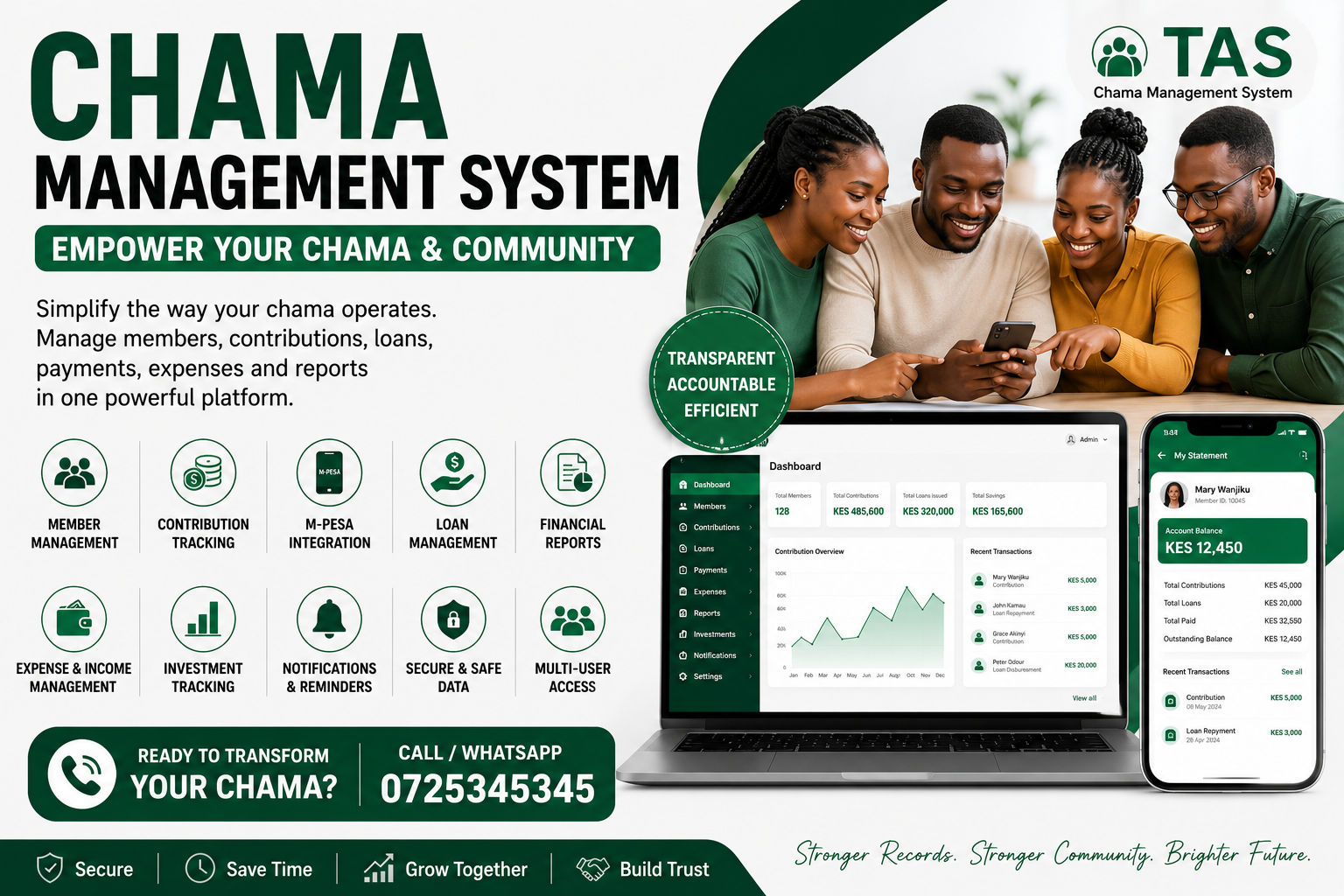
    The decision isn’t necessarily about whether Excel is bad.

    It is about whether your chama has reached a stage where a specialized system can save time and improve accountability.

    Frequently Asked Questions About Chama Management Systems

    What is a Chama Management System?

    A Chama Management System is software that helps savings and investment groups manage members, contributions, loans, expenses, payments and financial reports through a centralized platform.

    What is the best Chama Management System in Kenya?

    The best solution depends on your group’s size and requirements. Look for a platform that provides strong contribution management, loan management, reporting, security, member access and payment options suitable for your chama.

    Can chama software manage loans?

    Yes. Loan management is a common feature of modern chama platforms. Depending on the software, it may support applications, approvals, interest calculations, repayments and outstanding loan balances.

    Can a Chama Management System integrate with M-Pesa?

    Some Kenyan chama management platforms support M-Pesa integration. The exact functionality depends on the provider and payment configuration.

    Can members see their contributions?

    Platforms offering member portals can allow members to view their contribution history, statements and other authorized information.

    Can chama software generate financial reports?

    Yes. Reporting is a major advantage of chama management software. Reports may cover contributions, loans, income, expenses, balances and individual member transactions.

    Is a Chama Management System suitable for small groups?

    Yes. Small groups can use chama software, especially when they want to establish proper records early and reduce future administrative problems.

    The Future of Chama Management in Kenya

    Kenyan chamas are increasingly becoming sophisticated financial and investment organizations.

    As groups expand their membership and investments, digital management will become increasingly important.

    Members will expect faster access to information, convenient digital payments and greater financial transparency.

    Moving from manual administration to a Chama Management System can therefore be more than an administrative upgrade.

    It can provide the digital foundation needed for a chama to operate more professionally as it grows.

    Get Started With a Chama Management System Kenya

    Managing contributions, loans, members and financial reports shouldn’t consume all of your chama officials’ time.

    A centralized Chama Management System can help your group organize its records, improve accountability and simplify everyday administration.

    If your chama is still depending heavily on spreadsheets, notebooks and manual payment reconciliation, this may be the right time to consider a more structured digital solution.

    TAS Chama Management System is designed to help Kenyan chamas digitize and simplify their group management processes.

    Explore TAS to discover how your chama can manage members, contributions, payments, loans and financial records from one platform.

    Start managing your chama digitally with TAS today.