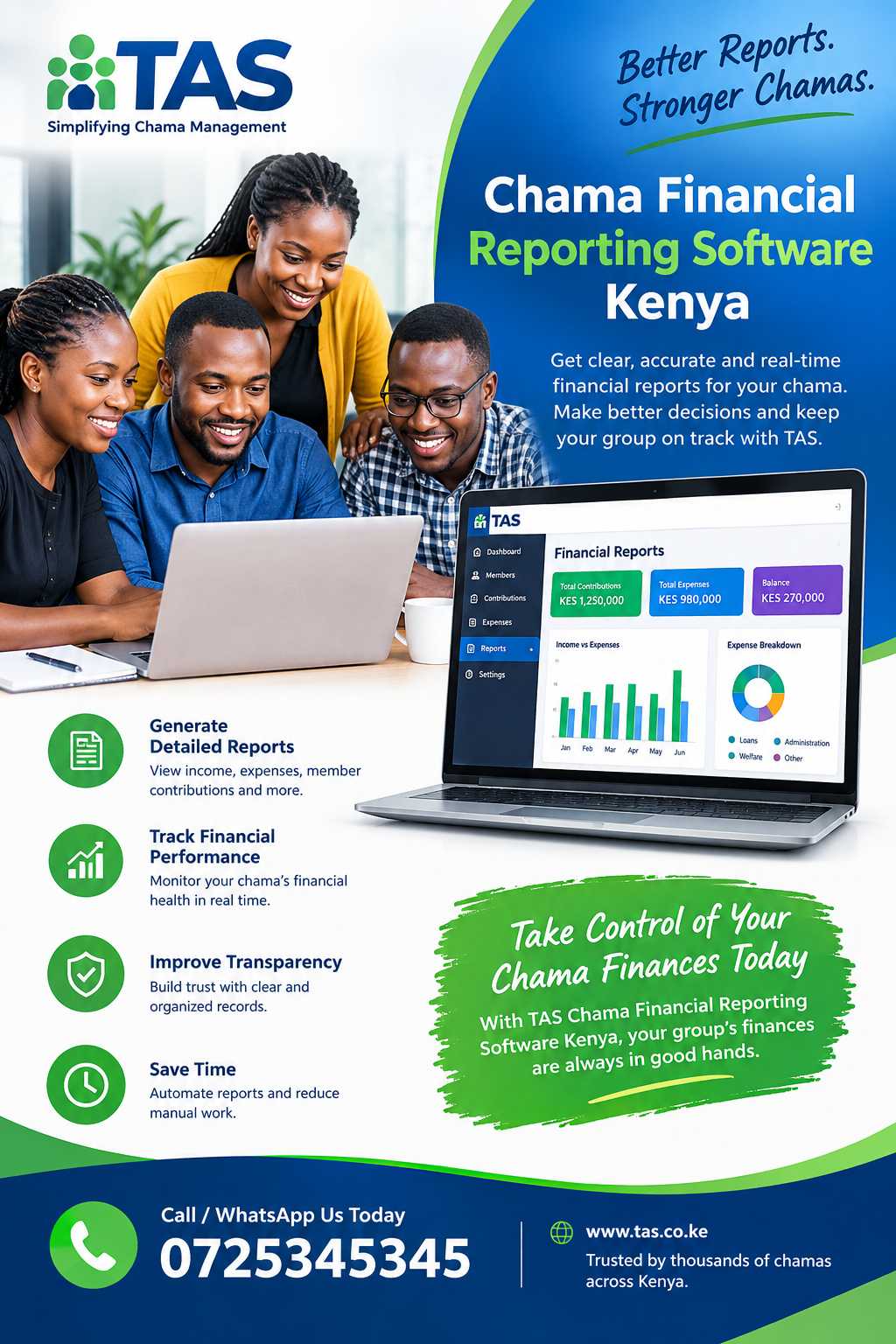
Chama Financial Reporting Software Kenya: A Complete Guide to Better Chama Financial Management
Managing a chama requires more than collecting contributions and keeping money in a bank or mobile wallet. Members need to know how much has been contributed, what has been spent, what the group owns, what it owes, and how its funds are performing. Chama Financial Reporting Software Kenya gives groups a structured way to organize this information, prepare financial reports, maintain accurate records, and make important decisions using reliable financial data.
For many Kenyan chamas, financial management begins with notebooks, spreadsheets, WhatsApp messages, receipt books, bank statements, and M-Pesa transaction records. These tools can work for a small group for a while, but they become difficult to manage as membership grows and transactions increase.
A modern financial reporting system can bring these records into one organized environment. Instead of spending hours checking different files before a meeting, committee members can access financial information from a central system and generate reports when needed.
This guide explains how financial reporting software can support Kenyan chamas, the reports groups should consider, important features to look for, common implementation challenges, and practical ways to improve financial transparency.
Why Financial Reporting Matters in a Chama
Financial reporting is one of the most important responsibilities of a chama committee. Members contribute their money with the expectation that the funds will be properly recorded and managed.
Chama Financial Reporting Software Kenya can help structure financial information so that transactions are easier to review. Instead of relying entirely on manual calculations, the group can maintain organized records that can be used when preparing reports.
A financial report can answer questions such as:
- How much money has the group collected?
- How much has been spent?
- Which members have outstanding contributions?
- How much is available for investment?
- What loans have been issued?
- What loan repayments have been received?
- What expenses were recorded during a particular period?
- What assets does the group have?
- How much money is held in different accounts?
- What is the group’s current financial position?
These questions are particularly important during regular chama meetings.
When financial information is organized, committee members can spend less meeting time searching for figures and more time discussing investments, projects, member welfare, savings targets, and future plans.
What Is Chama Financial Reporting Software?
Chama Financial Reporting Software Kenya refers to software designed to help chama administrators organize financial transactions and turn those records into useful reports.
The system may bring together information relating to contributions, expenses, loans, repayments, income, investments, balances, members, and other financial activities.
Rather than preparing every report manually, administrators can record transactions throughout the month and use the stored data when preparing financial summaries.
For example, imagine a chama with 30 members. Each member contributes KSh 5,000 every month. The group may also issue loans, collect repayment amounts, pay administrative expenses, and invest part of its savings.
Without an organized system, the treasurer might maintain several spreadsheets and notebooks. At the end of the month, these records must be reconciled manually.
With Chama Financial Reporting Software Kenya, transactions can be structured in a way that makes reporting easier. The exact features depend on the system selected, but the general objective is to make financial information more accessible and organized.
The Challenges of Manual Chama Financial Reporting
Manual reporting is not automatically wrong. Many successful groups have operated for years using paper records and spreadsheets. The challenge is that manual processes become increasingly difficult as financial activity grows.
1. Calculation Errors
A spreadsheet formula can be changed accidentally. A number can be entered in the wrong column. A transaction can also be forgotten.
When many transactions are involved, even a small error can make the final report difficult to reconcile.
Chama Financial Reporting Software Kenya can reduce dependence on manual calculations by using structured transaction records and automated calculations where supported.
2. Difficult Record Retrieval
A member may ask for a contribution history from several months ago. If the information is stored in different books or spreadsheets, finding the relevant entries can take time.
Centralized digital records make it easier to retrieve historical information.
3. Delayed Reports
A treasurer may need several hours to prepare a monthly report before a chama meeting. If the report requires information from different sources, preparation can take even longer.
Reporting software can help administrators generate summaries from information already entered into the system.
4. Duplicate Data Entry
When the same transaction has to be entered into multiple spreadsheets, there is a higher risk of inconsistent information.
A structured system can reduce unnecessary duplication by keeping related records together.
5. Limited Visibility
Committee members may not always have immediate access to the information they need. This can make it harder to review financial performance between meetings.
A suitable reporting platform can give authorized users better access to relevant financial information.
Core Reports a Chama Should Track
Chama Financial Reporting Software Kenya becomes especially useful when the group has several financial activities that need to be monitored.
The following reports are commonly useful for organized chama management.
Contribution Report
A contribution report shows how much each member was expected to contribute and how much has actually been received.
It can help identify:
- Paid contributions
- Outstanding contributions
- Contribution dates
- Member contribution history
- Total group contributions
This is useful when a group has regular monthly or weekly savings requirements.
Income and Expense Report
This report provides an overview of money coming into and leaving the group.
Income may include contributions, interest, investment returns, penalties, or other approved sources.
Expenses may include meeting costs, administration, bank charges, project expenses, or approved welfare payments.
Chama Financial Reporting Software Kenya can help present these figures in an organized format.
Cash Flow Report
Cash flow reporting helps the committee understand how money moves through the group.
A chama may have a healthy balance but still need to monitor when money enters and leaves the account.
For example, a group may collect contributions throughout the month but make a large investment at the end of the month. Understanding the timing of these transactions helps the committee plan appropriately.
Loan Report
Many chamas provide loans to members. A loan report can show:
- Amount issued
- Member receiving the loan
- Loan date
- Repayment schedule
- Amount repaid
- Outstanding balance
- Interest where applicable
- Loan status
This information is important for both financial reporting and member accountability.
Investment Report
A chama that invests its savings needs to know how much has been invested, where funds have been allocated, and what returns have been received.
An investment report can help the committee maintain a clear record of these activities.
Member Financial Statement
A member statement can summarize the individual’s financial activity within the group.
Depending on the system, this could include contributions, loans, repayments, penalties, welfare transactions, dividends, or other relevant records.
Chama Financial Reporting Software Kenya can make it easier to organize this information for authorized review.
How Reporting Software Supports Chama Transparency
Transparency is closely connected to good record keeping.
Members are more likely to understand the group’s financial position when financial information is clearly documented and presented.
Transparency does not mean every member should automatically have access to every administrative function. Instead, the group can define appropriate access levels.
For example:
- The treasurer may record and review transactions.
- The secretary may manage member records.
- Committee members may review selected reports.
- Ordinary members may receive statements or summaries.
- An authorized auditor or reviewer may access records needed for verification.
Chama Financial Reporting Software Kenya can support this type of structured approach when the selected system includes appropriate user access controls.
Clear records also make it easier to explain decisions during meetings.
If the group approves an expense, the transaction can be recorded. If a loan is issued, its details can be documented. If an investment is made, the amount and relevant information can be captured.
M-Pesa and Digital Payment Records
M-Pesa is an important part of financial activity for many Kenyan groups.
Chama members may send contributions through mobile money, while groups may also use mobile payments for expenses, loan repayments, or other transactions.
One challenge is matching payment information to the correct member and transaction.
Chama Financial Reporting Software Kenya can be useful when financial data from different payment activities needs to be organized.
A good process should include:
- Recording the transaction.
- Identifying the member or source.
- Confirming the amount.
- Recording the transaction date.
- Assigning the correct transaction category.
- Reconciling the entry with the available payment record.
- Including the transaction in relevant reports.
The software should support the group’s actual workflow rather than forcing the committee into a complicated process.
Contribution Tracking and Financial Reporting
Contribution records are the foundation of many chama financial reports.
Suppose 20 members are required to contribute KSh 3,000 every month. The expected monthly contribution is KSh 60,000.
If only KSh 54,000 is received, the committee needs to know which members have not completed their contributions.
Chama Financial Reporting Software Kenya can help connect contribution records with financial reporting so the committee can see both individual and group-level information.
This becomes even more useful when contribution amounts vary.
For example, a group could have:
- Monthly savings
- Emergency contributions
- Welfare contributions
- Project contributions
- Investment contributions
- Special event contributions
Keeping these categories separate can make financial reports easier to understand.
Expense Management and Reporting
Expenses should be documented carefully because they affect the group’s available funds.
A simple expense record can include:
| Information | Example |
|---|---|
| Date | 15 September |
| Category | Meeting expenses |
| Amount | KSh 4,500 |
| Description | Venue and refreshments |
| Approved by | Committee |
| Payment method | Bank/M-Pesa |
| Supporting document | Receipt |
Chama Financial Reporting Software Kenya can help organize expense information so that it can later be included in financial reports.
Expense categories should be agreed upon by the chama. This prevents similar expenses from being recorded under unrelated descriptions.
For example, meeting expenses, transport expenses, bank charges, project costs, and administrative expenses can have separate categories.
Loan Reporting for Chamas
Loans introduce additional complexity into financial management.
A loan is not simply an expense. It is money advanced to a member that is expected to return to the group under agreed terms.
A useful loan report should therefore distinguish between:
- Loans issued
- Principal repaid
- Interest received
- Outstanding principal
- Overdue amounts
- Completed loans
Chama Financial Reporting Software Kenya can help present loan information alongside the group’s broader financial records.
Consider a member who receives a KSh 100,000 loan and repays KSh 10,000 every month. The committee needs to know how much has been repaid and what remains outstanding.
If the calculations are performed manually across several spreadsheets, mistakes can occur. A structured system can make the process easier to monitor.
Investment Reporting
Many chamas eventually move beyond savings and begin investing.
Investment activities may include approved property projects, business activities, financial products, or other investments permitted by the group’s rules and applicable requirements.
Each investment should have clear records.
The group may need to track:
- Investment name
- Amount invested
- Date of investment
- Ownership information
- Income received
- Expenses associated with the investment
- Current status
- Relevant supporting documents
Chama Financial Reporting Software Kenya can help keep investment records connected to the group’s overall financial information.
The purpose is not simply to show that an investment exists. Members also need meaningful information about the financial activity associated with it.
Preparing for Chama Meetings
Financial reporting software can be particularly helpful before regular chama meetings.
Instead of beginning the meeting by manually calculating balances, the committee can prepare relevant reports beforehand.
A meeting reporting pack might include:
- Opening balance.
- Contributions received.
- Outstanding contributions.
- Loans issued.
- Loan repayments.
- Outstanding loans.
- Expenses.
- Investment transactions.
- Closing balance.
- Other approved financial activities.
Chama Financial Reporting Software Kenya can support this reporting workflow when the appropriate features are available.
The exact reports should depend on the group’s activities and constitution.
Using Reports to Support Better Decisions
Financial reports are not useful only because they satisfy record-keeping requirements. They also help members understand the group’s position.
For example, suppose the committee wants to determine whether the group can afford a new project.
A simple review might consider:
- Available cash
- Expected contributions
- Outstanding loans
- Upcoming expenses
- Existing investment commitments
- Emergency reserves
- Other financial obligations
Chama Financial Reporting Software Kenya can make it easier to gather the relevant information before such discussions.
The software should not make the decision for the members. Instead, it should provide organized information that members can use during their discussions.
Benefits of Digital Financial Reporting
There are several practical benefits to moving from manual reporting to a structured digital system.
Faster Report Preparation
When transactions are already recorded, reports can be prepared more efficiently.
Better Organization
Financial records can be grouped by member, transaction type, period, account, or activity.
Easier Historical Review
Previous transactions can be retrieved without searching through multiple physical books.
Reduced Manual Work
Automated calculations and report generation can reduce repetitive administrative tasks.
Improved Accountability
Documented transactions create a clearer record of financial activity.
Better Meeting Preparation
Committees can prepare reports before meetings instead of calculating everything during the meeting.
Chama Financial Reporting Software Kenya can form part of a broader digital approach to chama administration and financial management.
What Features Should You Look For?
Not every reporting platform is the same. A chama should consider its actual requirements before selecting software.
Member Management
The system should make it easy to maintain accurate member records.
Contribution Management
It should support the group’s contribution structure and provide useful contribution reports.
Expense Tracking
Expenses should be categorized and recorded consistently.
Loan Management
If the chama issues loans, the system should support loan records and repayment tracking.
Investment Records
Groups with investments should have a way to record relevant investment transactions.
Financial Reports
Reporting should be one of the central functions rather than an afterthought.
Chama Financial Reporting Software Kenya should ideally make important financial information accessible without requiring complicated manual calculations.
Search and Filtering
Administrators should be able to find transactions by relevant criteria such as member, date, category, or transaction type.
Export Options
Exporting reports can be useful for sharing records, reviewing information, or maintaining additional documentation.
Why Data Accuracy Matters
Software does not automatically make incorrect information correct.
If the treasurer enters the wrong amount, the resulting report may still contain that incorrect amount.
That is why a chama should establish clear data-entry procedures.
For example, every transaction can be checked for:
- Correct member
- Correct amount
- Correct date
- Correct category
- Correct payment method
- Supporting evidence
- Approval where required
Chama Financial Reporting Software Kenya works best when the group combines technology with clear internal procedures.
Regular reconciliation is also important.
The treasurer can compare recorded transactions against bank statements, M-Pesa records, receipts, or other relevant financial documents.
Financial Reporting for Small and Large Chamas
A small chama may have relatively few transactions each month. It may initially appear that software is unnecessary.
However, even small groups can benefit from organized records when they have long-term savings objectives.
A larger chama has a different challenge. With more members and transactions, manual administration can become increasingly time-consuming.
Chama Financial Reporting Software Kenya can be considered by groups that want a structured approach to handling growing financial records.
The right level of functionality depends on the group.
A system should be neither unnecessarily complicated nor too limited for the group’s needs.
Reporting Frequency
A chama should decide how frequently financial reports are reviewed.
Possible reporting periods include:
- Weekly
- Monthly
- Quarterly
- Annually
- At special committee meetings
- Before major investment decisions
Monthly reporting is often useful because it gives the committee a regular view of financial activity.
Quarterly and annual reports can provide a broader picture.
Chama Financial Reporting Software Kenya can help generate reports for different periods when the system supports flexible date ranges.
The group should agree on its reporting schedule and ensure that reports are reviewed consistently.
Financial Reporting and Accountability
Accountability begins with knowing what happened to group funds.
If a transaction cannot be explained, it becomes difficult for members to understand the group’s financial position.
A well-maintained record can show:
- What happened
- When it happened
- How much was involved
- Who was involved
- Why it was recorded
- What supporting evidence exists
Chama Financial Reporting Software Kenya can help create a structured record of financial activities when used alongside the group’s approval and documentation procedures.
This can be particularly useful when committee members change.
A new treasurer should not have to rely entirely on verbal explanations from the previous treasurer. Proper historical records provide continuity.
Data Security and Access Control
Financial information should be treated carefully.
When choosing a system, a chama should ask how user access is managed and what safeguards are available.
Important considerations include:
- User accounts
- Password protection
- Role-based permissions
- Data backups
- Activity records
- Secure access
- Recovery procedures
Chama Financial Reporting Software Kenya should be evaluated not only on the reports it generates but also on how it handles financial information.
Access should be given according to responsibilities.
A user who only needs to view reports may not need the same permissions as the person recording transactions.
Moving From Spreadsheets to Software
Changing from spreadsheets to software requires planning.
The first step is to understand the current process.
List:
- Where member information is stored.
- Where contribution records are stored.
- Where expenses are recorded.
- How loans are tracked.
- How repayments are recorded.
- How investments are documented.
- How reports are prepared.
- Who currently manages each process.
Once the existing workflow is understood, the group can determine which processes should move into the new system.
Chama Financial Reporting Software Kenya can then be incorporated into a broader transition plan.
Historical data should be handled carefully. Before importing information, the committee should review it for duplicate members, incorrect balances, missing transactions, and inconsistent categories.
Training the Chama Committee
Technology is only useful when people know how to use it.
The treasurer and other responsible users should understand the system before it becomes the main source of financial reporting.
Training can cover:
- Adding members
- Recording contributions
- Entering expenses
- Recording loans
- Entering repayments
- Generating reports
- Checking balances
- Correcting permitted errors
- Managing user access
- Exporting reports
Chama Financial Reporting Software Kenya should be accompanied by a clear internal process so that users understand both the software and their responsibilities.
A short written procedure can also help new committee members learn the system when leadership changes.
Common Mistakes Chamas Should Avoid
Recording Transactions Late
Delaying data entry can make records harder to reconcile.
Mixing Transaction Categories
If all payments are recorded under one category, financial reports may become less informative.
Sharing User Credentials
Users should generally have their own authorized access rather than sharing one account.
Ignoring Reconciliation
Records should be compared with available financial evidence regularly.
Failing to Back Up Information
Important records should be protected against accidental loss.
Choosing Software Based Only on Price
The cheapest option may not provide the reporting functionality the group needs.
Buying More Features Than Necessary
At the same time, a small group may not need a complicated platform with functions it will never use.
How to Evaluate Chama Financial Reporting Software
Before adopting a system, create a checklist based on the group’s needs.
Consider asking:
- Does it support our contribution structure?
- Can we track individual members?
- Can we record expenses?
- Can we manage loans?
- Can we track repayments?
- Can we record investments?
- Can we generate financial statements?
- Can we filter reports by date?
- Can authorized users access reports?
- Can we export information?
- How is data backed up?
- What support is available?
- Is the interface easy for our committee to understand?
Chama Financial Reporting Software Kenya can be assessed using these practical questions rather than relying only on promotional descriptions.
A demonstration can also help the committee understand whether the software matches its workflow.
Cost Considerations
Software costs vary depending on the provider, features, number of users, implementation requirements, and pricing structure.
A chama should avoid assuming that a particular price applies universally.
Instead, identify the total requirements and compare the available options.
Potential costs to consider include:
- Subscription fees
- Setup costs
- Training
- Data migration
- Support
- Additional users
- Optional modules
- Reporting or integration features
Chama Financial Reporting Software Kenya should be evaluated against the administrative time and reporting needs of the group.
The objective should be to find a solution that provides appropriate functionality without creating unnecessary financial or administrative burden.
Practical Example: A Monthly Chama Reporting Process
Consider a chama that has 25 members.
Each member contributes a fixed monthly amount. The group also issues member loans and pays occasional administrative expenses.
A practical monthly process could look like this:
Step 1: Record Contributions
Each contribution is entered against the correct member.
Step 2: Verify Payments
The treasurer checks the available payment records.
Step 3: Record Expenses
Approved expenses are entered with their categories and supporting details.
Step 4: Update Loans
New loans and repayments are recorded.
Step 5: Reconcile Accounts
Recorded transactions are compared with bank or mobile-money records.
Step 6: Generate Reports
The committee generates contribution, expense, loan, and balance reports.
Step 7: Review Before the Meeting
The treasurer checks unusual entries and outstanding items.
Step 8: Present to Members
Relevant financial summaries are presented during the chama meeting.
Chama Financial Reporting Software Kenya can support this kind of workflow by keeping financial records organized throughout the reporting period.
How Reports Can Improve Member Communication
Financial reports are also communication tools.
A member may not understand a complex spreadsheet filled with transactions. A clear summary can make the information easier to interpret.
For example, a monthly summary might show:
| Area | Current Period |
|---|---|
| Contributions | KSh 125,000 |
| Loan repayments | KSh 80,000 |
| Other income | KSh 5,000 |
| Expenses | KSh 20,000 |
| New loans | KSh 90,000 |
| Closing cash balance | Based on recorded transactions |
The actual figures will vary from group to group. What matters is that the report provides a clear picture of the period.
Chama Financial Reporting Software Kenya can help structure these summaries when its reporting functionality matches the group’s requirements.
Using Historical Reports
Historical reports allow committees to examine financial activity over time.
For example, the group could compare monthly contribution collections to identify patterns in payment completion.
It could also review loan balances over several months or examine how expenses changed.
Historical reporting is particularly valuable when the group has long-term goals.
Chama Financial Reporting Software Kenya can help maintain organized historical information rather than forcing administrators to reconstruct old records manually.
The quality of historical analysis depends on the quality and consistency of the underlying records.
The Role of the Treasurer
The treasurer remains important even when software automates many administrative tasks.
The system does not replace financial oversight.
The treasurer may still be responsible for:
- Checking transactions
- Reviewing supporting documents
- Reconciling accounts
- Preparing reports
- Identifying discrepancies
- Presenting financial information
- Following the group’s financial procedures
Chama Financial Reporting Software Kenya should therefore be viewed as a tool that supports the treasurer rather than a replacement for financial responsibility.
The Role of the Chama Committee
Financial reporting should not be treated as the responsibility of one person alone.
A committee can establish procedures for:
- Approving expenses
- Reviewing reports
- Authorizing loans
- Monitoring investments
- Checking reconciliations
- Reviewing member balances
- Managing user permissions
Chama Financial Reporting Software Kenya can help the committee access structured information for these responsibilities where the relevant features are available.
Clear roles reduce confusion and make it easier to identify who should perform each task.
Preparing Annual Financial Summaries
An annual report provides a broader view of the group’s financial activities.
It may include:
- Total contributions
- Total income
- Total expenses
- Loans issued
- Loan repayments
- Outstanding loans
- Investments
- Assets
- Liabilities
- Closing balances
Chama Financial Reporting Software Kenya can help compile information across the financial year if transactions have been consistently recorded.
Annual reporting is also an opportunity to review whether the group’s procedures are working effectively.
Improving Financial Discipline
Good reporting can encourage better financial discipline because transactions become easier to track.
When members know that contributions and repayments are systematically recorded, expectations become clearer.
Similarly, when expenses require documentation and approval, the group can maintain stronger financial controls.
Chama Financial Reporting Software Kenya can support this structured environment by making records easier to organize and review.
Technology alone cannot guarantee accountability. The group still needs rules, responsible users, approvals, and regular reviews.
Frequently Asked Questions
1. What is Chama Financial Reporting Software Kenya?
Chama Financial Reporting Software Kenya is software used to organize chama financial information and support reporting activities such as contributions, expenses, loans, repayments, balances, and other transactions.
2. Can financial reporting software track chama contributions?
Yes, systems designed for chama management may provide contribution tracking features that allow administrators to record individual payments and prepare contribution summaries.
3. Can a chama use software to track loans?
Yes. A suitable system can record loan amounts, repayments, balances, dates, and other relevant information depending on the available functionality.
4. Can the software help with M-Pesa-related records?
Some systems may support workflows for recording or reconciling mobile-money transactions. The specific integration capabilities should be confirmed with the software provider before purchase.
5. Is software suitable for a small chama?
It can be, particularly if the group wants consistent records as it grows. The important consideration is choosing a system that matches the group’s size and requirements.
6. Can members receive financial statements?
This depends on the software’s features and the access permissions established by the chama. A system may support member statements or financial summaries where those functions are available.
7. How often should chama financial reports be prepared?
The appropriate frequency depends on the group’s activities. Monthly reporting can provide regular visibility, while quarterly and annual reports can support broader reviews.
8. Does software eliminate the need for financial reconciliation?
No. Reconciliation remains an important control. Software can make records easier to organize, but users should still compare recorded transactions with relevant financial evidence.
9. What should a chama consider before buying reporting software?
The group should consider member management, contribution tracking, expense recording, loan management, investment records, reports, security, usability, support, scalability, and total cost.
10. Can software improve financial transparency?
A structured system can make financial records easier to organize, retrieve, review, and present. Transparency also depends on the group’s policies, access controls, documentation, and governance practices.
Final Considerations for Kenyan Chamas
A chama’s financial records are more than a collection of numbers. They provide evidence of how members’ contributions have been handled and help the group understand its current financial position.
For groups still relying heavily on notebooks and scattered spreadsheets, moving toward structured digital reporting can simplify several administrative tasks.
Chama Financial Reporting Software Kenya can support organized financial management by bringing relevant records into a more structured reporting environment.
The most important step is to identify the group’s actual needs before selecting a system. A chama that mainly handles monthly contributions may have different requirements from a group that manages loans, investments, welfare activities, projects, and multiple accounts.
Building a Reliable Reporting Process
A successful reporting process combines three elements: accurate records, clear procedures, and appropriate technology.
The software provides the platform. The committee provides oversight. Members provide the contributions and participate in decisions.
Chama Financial Reporting Software Kenya can support this process when the system’s functionality matches the group’s requirements.
A practical reporting policy can specify:
- Who records transactions
- Who verifies payments
- Who approves expenses
- Who authorizes loans
- When accounts are reconciled
- When reports are prepared
- Who reviews reports
- How corrections are handled
- How financial records are retained
These procedures help prevent confusion even when committee members change.
Preparing for Growth
A chama that has 10 members today may have considerably more members in the future.
As the group grows, transaction volume can increase. Members may introduce new savings categories, projects, loans, welfare activities, or investments.
Chama Financial Reporting Software Kenya can become part of a scalable administration strategy if it can accommodate the group’s changing requirements.
Before selecting software, therefore, think beyond the current month.
Ask what the group expects to manage over the next few years.
The goal is not to purchase every possible feature. It is to choose a platform that can support realistic future requirements without making everyday administration unnecessarily difficult.
Making Financial Meetings More Productive
A well-prepared financial report can change the structure of a chama meeting.
Instead of spending most of the meeting calculating figures, members can review prepared information and focus on questions.
For example:
- Why did expenses increase this month?
- Which contributions remain outstanding?
- How much capital is currently tied up in loans?
- What investments are active?
- Which loans are approaching their repayment deadlines?
- What amount is available for the next approved activity?
Chama Financial Reporting Software Kenya can help provide the underlying information for these discussions.
The software does not determine the group’s decisions. It simply helps members work from organized financial information.
Why Accurate Records Matter During Leadership Changes
Chama leadership can change periodically.
A new treasurer may inherit records from a previous committee member. If those records are fragmented, understanding the group’s financial history can be difficult.
A centralized digital record can provide continuity.
Chama Financial Reporting Software Kenya can help maintain a consistent record that new authorized administrators can review, subject to the system’s access controls.
This can reduce dependence on individual knowledge.
Instead of financial information remaining primarily in one person’s notebooks or computer files, the group’s records can be managed as organizational information.
A Practical Implementation Checklist
Before going live with a new reporting system, a chama can work through this checklist:
Before Setup
- Confirm the group’s financial procedures.
- Clean existing member records.
- Review outstanding loans.
- Confirm contribution balances.
- Organize expense records.
- Review investment records.
- Identify authorized users.
During Setup
- Add members.
- Configure contribution categories.
- Configure financial categories.
- Enter opening balances carefully.
- Set user permissions.
- Test report generation.
- Train committee members.
After Setup
- Record transactions consistently.
- Reconcile accounts regularly.
- Review reports.
- Correct errors through proper procedures.
- Back up information where applicable.
- Review user access periodically.
Chama Financial Reporting Software Kenya can be incorporated into this process according to the software’s available functionality.
Measuring the Value of Better Reporting
The value of financial reporting software is not simply the number of reports it can generate.
A chama should consider whether the system helps reduce administrative effort and improve access to reliable information.
Useful indicators might include:
- Time required to prepare monthly reports
- Number of manual calculations
- Frequency of reconciliation differences
- Time required to retrieve historical records
- Ease of tracking outstanding contributions
- Ease of monitoring loans
- Availability of financial summaries during meetings
Chama Financial Reporting Software Kenya can be assessed against these practical measures.
This approach allows the committee to evaluate whether the system is solving actual administrative problems rather than simply adding another digital tool.
Strong financial reporting gives a chama a clearer view of its money, obligations, contributions, loans, expenses, and investments. As financial activity becomes more complex, organized digital records can make administration easier and improve the way information is prepared for members and committee discussions.
Chama Financial Reporting Software Kenya can support this process by helping groups organize financial transactions and generate useful reports, depending on the features provided by the selected system.
For a Kenyan chama considering digital financial management, the starting point should be a clear understanding of its current workflow. Identify where records are stored, where errors occur, which reports members need, and which processes take the most administrative time.
From there, the group can evaluate software based on contribution tracking, expense management, loan reporting, investment records, reconciliation, financial statements, security, usability, and scalability.
The objective is simple: maintain accurate financial information that authorized members can understand and use.
Chama Financial Reporting Software Kenya can be part of that journey when its capabilities align with the group’s reporting requirements.
A good financial reporting process should make it easier to answer basic questions about the group’s finances without searching through multiple notebooks, spreadsheets, receipts, and messages.
When transactions are consistently recorded and reports are regularly reviewed, a chama can build a stronger foundation for financial administration and long-term planning.
Chama Financial Reporting Software Kenya therefore fits into a broader approach to digital chama management where financial records, member information, contributions, loans, expenses, and other activities can be organized systematically.
The technology is only one part of the process. Clear rules, responsible administration, accurate data entry, regular reconciliation, and member oversight remain essential.
For chamas in Kenya that are growing beyond simple manual record keeping, structured financial reporting can provide a practical way to improve organization while giving members clearer information about the group’s financial activities.
Chama Financial Reporting Software Kenya can help support that objective when selected and implemented according to the group’s needs.
Ultimately, the best reporting system for any chama is one that its committee can use consistently, whose records can be reviewed easily, and whose reports answer the financial questions that matter to the members.
Chama Financial Reporting Software Kenya provides a relevant starting point for groups researching digital tools for organized financial reporting and chama administration.
The transition from manual records to digital reporting does not have to happen all at once. A group can begin by identifying its most important financial processes, establishing consistent categories, cleaning historical records, training responsible users, and then gradually improving its reporting workflow.
Chama Financial Reporting Software Kenya can be considered alongside these operational requirements when a chama evaluates available digital solutions.
With an organized process in place, monthly financial reviews can become clearer, historical records easier to access, and financial discussions more focused on the information presented rather than on manual calculations.
Chama Financial Reporting Software Kenya can support such a structured approach where its functionality meets the group’s requirements.
The key is consistency. A reporting system becomes valuable when transactions are entered accurately, reports are reviewed regularly, and financial information is used responsibly.
Chama Financial Reporting Software Kenya can form part of this process by giving chama administrators a digital environment for managing and reporting financial information.
As Kenyan chamas continue to manage savings, loans, investments, welfare activities, and group projects, having organized financial records becomes increasingly important for day-to-day administration.
Chama Financial Reporting Software Kenya offers a useful search category for groups exploring software-based approaches to financial reporting and record management.
The final selection should always be based on the actual needs of the group, the features offered, the implementation process, user access requirements, support arrangements, and the overall cost.
Chama Financial Reporting Software Kenya can be evaluated using the same practical checklist outlined throughout this guide.
When technology and sound financial procedures work together, a chama can spend less time searching for information and more time using accurate financial records to understand its activities and plan responsibly.
Chama Financial Reporting Software Kenya can support that broader goal when appropriately implemented.
For groups looking to modernize their financial administration, the important question is not simply whether software is available. It is whether the selected system can fit naturally into the group’s contribution, expense, loan, investment, reconciliation, and reporting processes.
Chama Financial Reporting Software Kenya is therefore best considered as part of a complete financial management workflow rather than as an isolated reporting feature.
A well-organized chama can then build a reporting routine in which financial information is captured consistently, checked regularly, and presented clearly to authorized users and members.
Chama Financial Reporting Software Kenya can be incorporated into such a routine where appropriate.
That approach can make financial administration more systematic while supporting the group’s need for transparency, accountability, and reliable records.
Chama Financial Reporting Software Kenya remains relevant for chamas researching digital solutions that can bring their financial reporting activities into a structured environment.
The final step is implementation. Once the group has selected a suitable system, the committee should establish clear responsibilities, train users, enter accurate opening information, and review reports regularly.
Chama Financial Reporting Software Kenya can be part of this implementation strategy when its features match the group’s operational needs.
With those foundations in place, digital reporting can become a regular part of chama administration rather than a separate task performed only when a meeting approaches.
Chama Financial Reporting Software Kenya can support this ongoing reporting approach where the selected platform provides the necessary functionality.
For Kenyan chamas seeking more organized financial administration, the combination of accurate data, clear procedures, regular reconciliation, and suitable software provides a practical framework for improving financial record keeping.
Chama Financial Reporting Software Kenya can be researched as one option within that broader digital management process.
The ultimate purpose of financial reporting is to make the group’s financial position easier to understand. When members and authorized committee members can access clear records, financial discussions can be based on documented information rather than estimates or incomplete records.
Chama Financial Reporting Software Kenya can help facilitate this type of structured reporting when aligned with the group’s needs.
A carefully implemented system can therefore become a central part of the chama’s administrative workflow, supporting contribution records, expense tracking, loan monitoring, investment reporting, and periodic financial summaries.
Chama Financial Reporting Software Kenya can be considered by groups that are exploring ways to organize these activities digitally.
The most important principle is to keep the reporting process accurate, consistent, understandable, and easy for authorized users to maintain.
Chama Financial Reporting Software Kenya can contribute to that objective when the platform provides the required financial reporting functions.
For a chama ready to move beyond fragmented financial records, a structured reporting solution can provide a foundation for more organized administration and clearer financial communication.
Chama Financial Reporting Software Kenya is a relevant keyword and solution category for groups researching this transition.
By combining good governance practices with appropriate technology, Kenyan chamas can build financial records that remain useful not only for today’s committee but also for future leaders and members.
Chama Financial Reporting Software Kenya can support that long-term record-management objective where its functionality meets the group’s requirements.
The result should be a reporting process that is practical enough for everyday use and detailed enough to answer the financial questions that arise during regular chama activities.
Chama Financial Reporting Software Kenya can be evaluated within this wider context.
In the end, digital financial reporting should make financial administration clearer, more organized, and easier to review.
Chama Financial Reporting Software Kenya gives Kenyan chamas a useful starting point when researching technology for this purpose.
The right system, combined with responsible financial procedures, can help a chama maintain better records as it grows and its financial activities become more diverse.
Chama Financial Reporting Software Kenya can form part of that broader digital transformation.
For committees evaluating their next step, the practical approach is to document current processes, identify reporting gaps, compare relevant features, train users, and establish a consistent reporting routine.
Chama Financial Reporting Software Kenya can then be assessed according to whether it supports those identified requirements.
Good financial reporting is ultimately about reliable information. When the numbers are accurate and accessible, members can better understand the group’s activities and committees can carry out their responsibilities with clearer records.
Chama Financial Reporting Software Kenya can be considered as part of a structured approach to achieving that goal.
The transition to digital financial management is therefore not simply about replacing paper with software. It is about creating a repeatable process for recording, checking, organizing, and reporting financial information.
Chama Financial Reporting Software Kenya can support that process where the system is appropriate for the group’s size and financial activities.
As a chama develops, its financial reporting needs may also develop. A system that can support changing requirements can help the group maintain continuity while reducing unnecessary administrative work.
Chama Financial Reporting Software Kenya can be part of the evaluation process for groups considering a more structured financial reporting environment.
The most effective implementation will be one where the committee understands the software, members understand how financial information is presented, and the group maintains clear rules for handling transactions and approvals.
Chama Financial Reporting Software Kenya can support that workflow when implemented with appropriate procedures.
For Kenyan chamas looking for a more organized way to manage financial records, digital reporting provides a practical avenue to explore.
Chama Financial Reporting Software Kenya can be considered alongside the group’s requirements for contributions, expenses, loans, investments, reconciliation, and financial statements.
With accurate records and consistent reporting, the chama can maintain a clearer picture of its finances throughout the year rather than waiting until the end of a reporting period to reconstruct its activities.
Chama Financial Reporting Software Kenya can help support that ongoing approach where its available features meet the group’s needs.
A strong reporting system should ultimately save administrative effort while improving access to useful financial information.
Chama Financial Reporting Software Kenya can be part of that solution for groups researching software-based financial reporting.
The committee can then focus its meetings on reviewing information, discussing priorities, monitoring obligations, and planning future activities rather than spending excessive time reconstructing basic financial figures.
Chama Financial Reporting Software Kenya can support this objective when appropriately configured and used.
For any chama considering software, careful evaluation remains important. The group should verify the features, understand the implementation process, assess security and support arrangements, and ensure the system can accommodate its reporting requirements.
Chama Financial Reporting Software Kenya is therefore one part of a broader decision-making process around digital financial management.
When those considerations are addressed, financial reporting software can become a practical tool for improving organization, supporting accountability, and maintaining accessible financial records.
Chama Financial Reporting Software Kenya can help chamas explore this approach.
A consistent digital reporting process can also make it easier to preserve institutional knowledge when committee members change.
Chama Financial Reporting Software Kenya can contribute to that continuity by helping maintain structured records.
Finally, financial reporting should remain a shared governance responsibility. Technology can make information easier to manage, but the chama’s rules, approvals, oversight, and commitment to accurate records remain essential.
Chama Financial Reporting Software Kenya can support those practices when used as part of a clear financial management process.
For Kenyan chamas ready to improve the way they organize and report financial information, the combination of suitable software and disciplined record keeping offers a practical path toward more efficient administration.
Chama Financial Reporting Software Kenya can be explored as part of that process.
The focus should always remain on accurate information, clear reports, responsible access, and records that members can understand.
Chama Financial Reporting Software Kenya provides a useful search term for groups researching digital financial reporting solutions.
A chama that maintains reliable financial records is better positioned to understand its savings, obligations, loans, expenses, and investments over time.
Chama Financial Reporting Software Kenya can help support that record-management objective where its capabilities match the group’s needs.
As the group grows, maintaining this discipline becomes even more important.
Chama Financial Reporting Software Kenya can be evaluated as part of a long-term approach to digital chama administration.
Ultimately, successful financial reporting comes from combining accurate transaction records with regular review and clear responsibility.
Chama Financial Reporting Software Kenya can support the technology side of that process.
For groups that want to modernize their reporting workflow, the next practical step is to identify their current challenges and evaluate systems against those specific needs.
Chama Financial Reporting Software Kenya can then be considered within a structured software evaluation.
That approach ensures that technology serves the chama’s financial management process instead of creating another complicated administrative task.
Chama Financial Reporting Software Kenya can support this objective where its functions align with the group’s requirements.
Better reporting begins with better records, and better records begin with consistent processes.
Chama Financial Reporting Software Kenya can be part of that foundation for Kenyan groups exploring digital financial management.
By maintaining organized records throughout the year, the chama can make monthly reporting, annual summaries, member statements, loan reviews, and financial discussions easier to manage.
Chama Financial Reporting Software Kenya can help support this structured reporting workflow where appropriate.
The final choice should always reflect the group’s actual operations, membership structure, transaction volume, reporting requirements, and budget.
Chama Financial Reporting Software Kenya can be assessed against those criteria.
A well-selected and properly implemented reporting system can then become a dependable part of the chama’s day-to-day administration.
Chama Financial Reporting Software Kenya can support this goal when the software meets the group’s needs.
With accurate information available when it is needed, financial meetings can become more focused, records can become easier to maintain, and members can have clearer visibility into documented group activities.
Chama Financial Reporting Software Kenya can be considered as part of this wider approach.
That is the central value of organized digital financial reporting: turning scattered transactions into structured information that can be reviewed, understood, and used responsibly.
Chama Financial Reporting Software Kenya can be part of that journey for Kenyan chamas seeking a more systematic approach to financial administration.
A strong system does not replace good governance. Instead, it gives good governance a better information foundation.
Chama Financial Reporting Software Kenya can help support that foundation when its functionality fits the group’s reporting requirements.