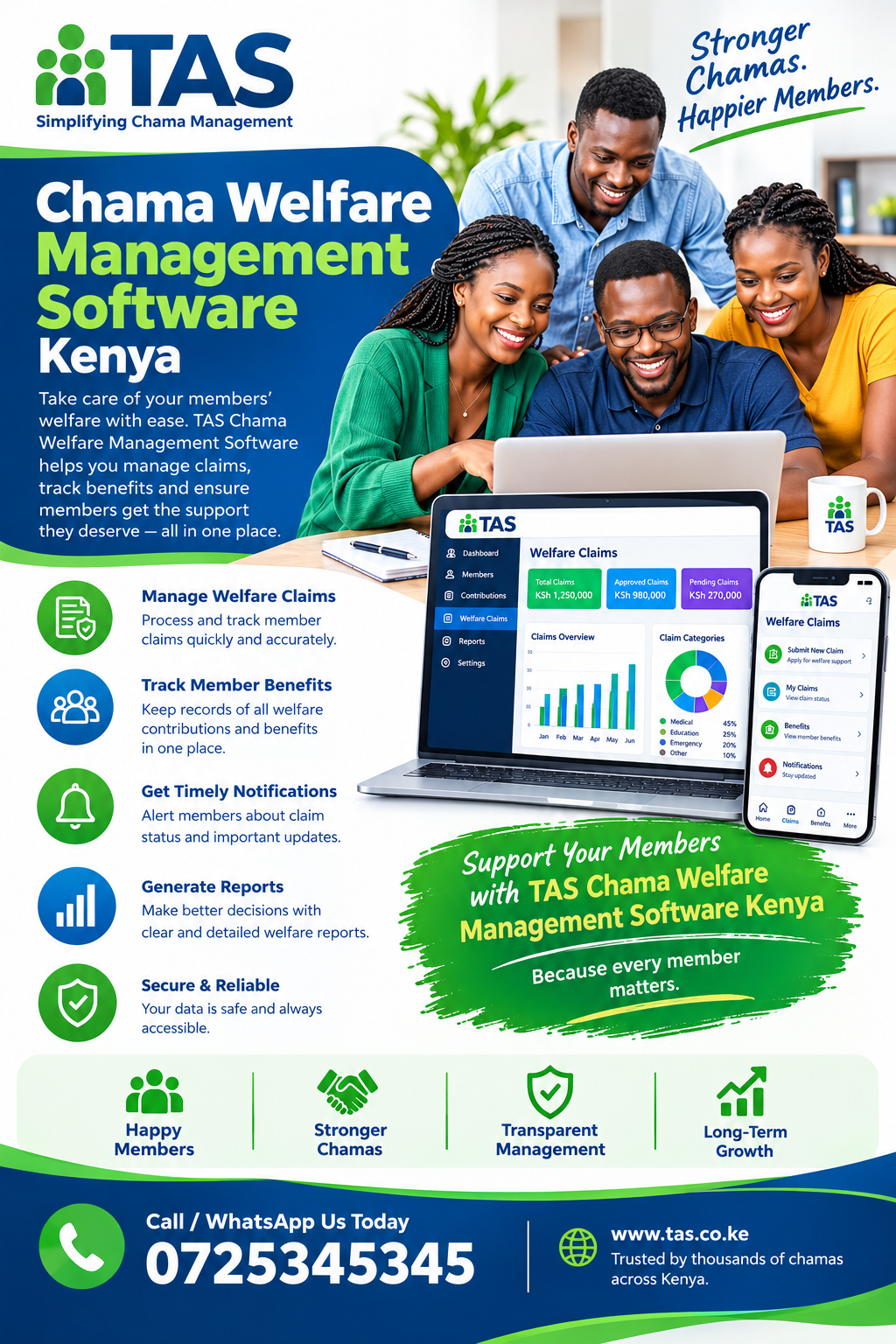
How Chamas Can Improve Welfare Administration With Digital Tools
Introduction
Welfare support is one of the most important responsibilities of a chama. Members contribute money because they want a group that can stand with them when life brings an emergency, a celebration, a bereavement, a medical need, or another approved welfare situation. As the group grows, however, managing those responsibilities with notebooks, spreadsheets, paper receipts, and scattered WhatsApp messages can become difficult. Chama Welfare Management Software Kenya gives chama officials a structured way to record welfare contributions, member information, claims, approvals, payments, and reports from one place.
This guide is written for chama leaders, treasurers, secretaries, welfare committees, and members who want a clearer understanding of how welfare administration can be organized. It explains the role of digital welfare management, the features to look for, practical Kenyan use cases, controls that improve accountability, implementation considerations, and questions to ask before adopting a system.
What Is Chama Welfare Management Software?
Chama welfare management software is a digital system designed to help a group organize the welfare side of its operations. Instead of keeping every welfare record in separate files, officials can use a central system to maintain member details, contribution records, welfare categories, claims, approvals, disbursements, and reports.
For a small group, a notebook may initially appear sufficient. The challenge usually starts when membership increases, contribution rules change, committees rotate, or several welfare cases occur at the same time. A digital record makes it easier to retrieve information and follow a case from the initial request through review and final payment.
Chama Welfare Management Software Kenya can help address these administrative challenges by bringing welfare information into a structured record. It does not replace the chama’s constitution, committee decisions, or financial controls. Instead, it can make those processes easier to document and follow.
Why Welfare Management Matters in a Chama
Welfare funds are different from ordinary group savings because they are often linked to specific events or needs. Members therefore need confidence that the money collected for welfare is being recorded and used according to agreed rules.
When records are incomplete, several problems can occur:
- A member may dispute whether a contribution was made.
- A treasurer may struggle to confirm the amount available for a claim.
- A welfare committee may lose track of pending requests.
- A secretary may spend hours preparing reports.
- Members may receive inconsistent information about eligibility.
- Previous welfare cases may be difficult to retrieve.
- Handover between outgoing and incoming officials may be complicated.
The Difference Between Welfare Management and General Chama Management
A chama may manage savings, loans, investments, meetings, penalties, and welfare at the same time. These activities are related, but they do not always follow the same rules.
Savings management focuses on how members contribute and build funds. Loan management tracks borrowing, repayments, balances, and related approvals. Investment management focuses on assets, projects, returns, and decisions. Welfare management focuses on support provided under the group’s welfare policy.
Chama Welfare Management Software Kenya is therefore most useful when welfare processes are treated as a distinct area within the broader chama operation.
For example, consider a group with 40 members. It may have monthly contributions for savings, a separate welfare contribution, a loan fund, and an investment account. A member could be fully up to date with savings but have an outstanding welfare contribution. If all records are kept in one informal spreadsheet, it may be difficult to distinguish the balances. A properly structured system can keep these categories clear.
Key Features to Look for
When evaluating Chama Welfare Management Software Kenya, focus on practical features rather than a long list of technical terms. The system should solve real administrative problems faced by your group.
1. Member Welfare Records
A welfare module should connect each welfare transaction to the correct member. Useful records can include:
- Member name and identification details
- Membership number
- Contact information
- Welfare contribution history
- Welfare eligibility status
- Previous claims
- Claim outcomes
- Relevant notes and supporting information
This creates a history that officials can review without searching through multiple notebooks.
2. Welfare Contribution Tracking
Contribution tracking is at the centre of welfare administration. The system should allow officials to record expected contributions and actual payments.
Chama Welfare Management Software Kenya can be used to organize contribution records so that officials can identify paid, unpaid, and outstanding amounts more easily.
A useful contribution screen should answer questions such as:
- How much was a member expected to contribute?
- How much has the member paid?
- What remains outstanding?
- Which period does the payment relate to?
- What is the total welfare fund balance according to recorded transactions?
3. Welfare Claim Registration
A welfare claim should have a clear trail from submission to resolution. Depending on the group’s rules, a claim may contain the member, claim type, date, requested amount, description, supporting documents, committee comments, approval status, and payment details.
Chama Welfare Management Software Kenya can support a more organized claim process by keeping those details together.
Instead of receiving a request in a message, writing it in a notebook, and later searching for the same conversation, officials can enter the claim into a central record. This reduces the chance of losing important administrative information.
4. Approval Workflows
Not every welfare request should automatically result in payment. Many chamas have committees that review requests against agreed rules.
Chama Welfare Management Software Kenya can help document approval stages such as:
- Claim submitted
- Claim reviewed
- Eligibility confirmed
- Amount approved
- Payment authorized
- Payment recorded
- Claim closed
The exact workflow should reflect the chama’s constitution and welfare policy.
5. Welfare Payment Records
After approval, the system should make it possible to record the actual payment. This is important because approval and disbursement are not necessarily the same event.
Chama Welfare Management Software Kenya can help separate the approved amount from the amount actually paid and the date of payment.
Where a chama uses M-Pesa or bank transfers, officials should retain appropriate transaction references. A digital record can make reconciliation easier when payment evidence is available.
Managing Different Types of Welfare Cases
Chamas do not all define welfare in the same way. One group may support bereavement cases, while another may cover medical emergencies, childbirth, weddings, or other events approved by members.
Chama Welfare Management Software Kenya can be adapted to a group’s categories if the system supports configurable welfare records.
Common categories may include:
- Bereavement assistance
- Medical support
- Emergency assistance
- Family-related welfare
- Approved celebrations
- Other constitutionally recognized cases
The important point is consistency. Each category should have clear rules on eligibility, limits, documentation, approval, and payment.
Welfare Rules and Eligibility
A digital system cannot decide what a group considers a valid welfare case unless those rules have been defined. Before implementation, the chama should document its welfare policy.
Chama Welfare Management Software Kenya becomes more effective when the group already knows its contribution requirements and claim conditions.
For example, a welfare policy might specify:
- Who qualifies for welfare assistance
- Minimum membership period, if applicable
- Required contribution status
- Types of qualifying events
- Maximum support per category
- Required supporting documents
- Approval authority
- Payment procedure
- Treatment of exceptional cases
These rules should be communicated to members. Software should then be configured or used in a way that helps officials apply them consistently.
How Digital Records Improve Accountability
Accountability does not come from software alone. It comes from clear rules, responsible officials, approvals, reconciliations, and transparent reporting. Software can support those controls by making transactions easier to trace.
With Chama Welfare Management Software Kenya, officials can maintain a more consistent trail of welfare activity.
For example, suppose a member submits a medical welfare claim. The record can show when the request was entered, what amount was requested, whether it was approved, and when payment was made. If the chama later needs to review the case, officials have a structured reference point.
This is particularly useful during committee changes. When a new treasurer takes over, the records should not depend entirely on the outgoing official’s memory.
Reports That Welfare Committees Need
Reporting turns transaction records into information that a committee can use.
Chama Welfare Management Software Kenya should be evaluated partly on the quality and usefulness of its reports.
Useful reports may include:
Contribution Report
Shows welfare contributions by member and period. This helps officials identify outstanding amounts and understand contribution patterns.
Claims Report
Lists claims submitted, their categories, dates, statuses, approved amounts, and payment information.
Welfare Fund Summary
Provides a high-level view of recorded contributions, approved assistance, payments, and the remaining balance according to the system’s records.
Member Welfare Statement
Shows an individual member’s welfare contribution and claim history.
Periodic Management Report
A monthly or quarterly report can help the committee review activity without rebuilding figures manually.
A Simple Example of a Welfare Workflow
Imagine a chama called Umoja Development Group with 30 members. The group has agreed that every member contributes a fixed welfare amount each month.
A member experiences an event covered by the group’s welfare policy. The member submits a request with the required information.
Using Chama Welfare Management Software Kenya, the welfare secretary records the request. The committee reviews it during the agreed approval process. Once approved, the treasurer records the payment and keeps the transaction reference.
At the next meeting, the committee can review a report showing the number of claims handled, amounts approved, amounts paid, and contribution status.
The benefit is not simply speed. It is continuity. A future official can understand what happened without relying on verbal explanations.
M-Pesa and Digital Payment Records
M-Pesa is widely used for payments in Kenya, and many groups use mobile money for member contributions or welfare disbursements. However, receiving a payment notification is not the same as maintaining an organized accounting record.
Chama Welfare Management Software Kenya can complement digital payment processes by giving officials a place to associate a transaction with the relevant member or welfare activity.
A good reconciliation process should still include checks such as:
- Confirming the transaction reference
- Matching the amount
- Identifying the correct member
- Confirming the relevant contribution period
- Recording the transaction in the chama’s books
- Resolving unmatched transactions
Where automation is available, it should be used carefully and checked against actual transaction evidence.
Reducing Manual Administrative Work
Manual administration often consumes time that committee members could spend on governance and member service.
Chama Welfare Management Software Kenya can reduce repetitive work when officials no longer need to calculate every total from scratch or search several files for the same information.
Consider a secretary preparing a welfare report. With paper records, the process might involve checking contribution receipts, reviewing claim notes, calculating totals, and preparing a summary. With structured digital records, much of the information can be retrieved from the same system.
Automation should not mean removing human oversight. Welfare decisions remain a responsibility of the authorized committee and members.
Improving Member Communication
Members are more likely to trust a welfare process when they understand how it works.
Chama Welfare Management Software Kenya can support better communication by giving officials accurate information to use when responding to member questions.
Common questions include:
- Has my welfare contribution been recorded?
- Do I have an outstanding amount?
- What is the status of my claim?
- How much was approved?
- When was the payment recorded?
- What are the requirements for a particular welfare category?
The system should not expose sensitive member information unnecessarily. Access should be based on roles and the group’s privacy practices.
Role-Based Access and Data Security
Welfare records can contain personal and sensitive information. That means security deserves attention during software selection.
Chama Welfare Management Software Kenya should be assessed for practical controls such as user accounts, passwords, role permissions, backups, audit trails, and appropriate access restrictions.
A treasurer may need access to financial records, while a general member may only need access to their own relevant information. A committee secretary may require different permissions from an administrator.
Ask vendors how data is stored, backed up, protected, and recovered. Also ask what happens if an official leaves the chama.
Choosing Software for a Kenyan Chama
There are many software products available, but the right choice depends on the group’s processes.
When assessing Chama Welfare Management Software Kenya, create a checklist based on your actual needs.
Consider:
| Requirement | Questions to Ask |
|---|---|
| Member records | Can the system maintain complete member profiles? |
| Contributions | Can expected and actual welfare payments be tracked? |
| Claims | Can claims be registered and followed through approval? |
| Payments | Can approved and paid amounts be distinguished? |
| Reports | Can officials generate useful welfare reports? |
| Access | Can permissions be assigned to different users? |
| Mobile use | Can officials work conveniently from phones or computers? |
| Data protection | What safeguards and backup arrangements exist? |
| Support | Is help available when users have problems? |
| Scalability | Can the system support the chama as it grows? |
A demonstration is useful because a feature list does not always show how easy a system is to use.
Questions to Ask During a Software Demonstration
Before purchasing or adopting a solution, ask the provider to demonstrate actual workflows.
For Chama Welfare Management Software Kenya, request a practical walkthrough rather than a generic presentation.
Ask the provider to show how to:
- Add a new member.
- Record a welfare contribution.
- Identify an outstanding contribution.
- Create a welfare claim.
- Upload or record supporting information where applicable.
- Review a pending claim.
- Approve or reject a claim according to the group’s process.
- Record a welfare payment.
- Generate a member statement.
- Produce a welfare fund report.
- Correct an erroneous entry while maintaining an audit trail.
- Back up and retrieve information.
If a provider cannot demonstrate a key process clearly, ask what alternative workflow is available.
Common Mistakes to Avoid
Buying software without first defining the process can create confusion.
Mistake 1: Digitizing Poor Records Without Cleaning Them
If old records contain duplicate members, missing payments, or inconsistent names, importing them without review can create problems.
Start by cleaning the member list and reconciling important balances.
Mistake 2: Giving Everyone Administrator Access
Too many unrestricted accounts increase the risk of accidental or unauthorized changes.
Use role-based access where available.
Mistake 3: Ignoring Reconciliation
Digital records still need to be checked against actual cash, bank, and mobile-money records.
Mistake 4: Failing to Train Officials
A good system can still produce poor records if users do not understand the correct procedures.
Mistake 5: Treating Software as a Substitute for Governance
Chama Welfare Management Software Kenya should support approved welfare rules, not replace them. The committee remains responsible for decisions and controls.
How to Implement a Welfare Management System
Implementation should be gradual and organized.
Step 1: Document Current Welfare Rules
Write down contribution amounts, eligibility requirements, claim categories, approval procedures, and payment rules.
Step 2: Clean Existing Data
Review member records and existing welfare transactions. Resolve obvious duplicates and discrepancies.
Step 3: Configure the System
Set up member profiles, contribution categories, claim types, users, permissions, and reports.
Step 4: Train Officials
The treasurer, secretary, welfare committee, and other users should understand their responsibilities.
Step 5: Test a Complete Case
Enter a sample contribution and welfare claim from start to finish. Check whether the resulting report matches expectations.
Step 6: Reconcile the Opening Balances
Do not assume that old balances are correct. Compare records with available supporting documents.
Step 7: Start Routine Use
Once the process has been tested, use the system consistently for new welfare activity.
Step 8: Review After the First Reporting Period
Ask users where delays or confusion remain and improve the workflow.
How the System Can Support Welfare Committees
A welfare committee needs information before making decisions.
Chama Welfare Management Software Kenya can give committee members a structured view of pending requests and historical records, depending on the permissions and reporting functions available.
For example, the committee may need to know whether a claim meets the group’s contribution requirements. Instead of searching multiple documents, authorized members can review the relevant contribution history and claim information.
The system can also make meetings more focused because the committee can discuss cases using the same record.
Supporting Better Financial Planning
Welfare funds need careful planning because claims can vary from one period to another.
Chama Welfare Management Software Kenya can help officials understand historical welfare activity, although historical records should not be treated as a guarantee of future claim levels.
A committee can review:
- Total contributions over a period
- Number of claims
- Categories of claims
- Total assistance approved
- Total assistance paid
- Outstanding contributions
- Closing balances
This information can support discussions about contribution levels and welfare policies.
Welfare Management for Small and Growing Chamas
A small chama may not need complex workflows at the beginning. However, it is useful to choose a system that can grow with the group.
Chama Welfare Management Software Kenya should be considered in relation to both current and future needs.
For a small group, the priority may be simple member and contribution tracking. As membership grows, the chama may need stronger reporting, multiple user roles, claim workflows, and better record history.
Scalability does not necessarily mean buying the most complicated system. It means selecting a solution that can accommodate reasonable growth without forcing the group to rebuild its records.
Supporting Transparent Member Statements
Members often want to understand their own financial relationship with the group.
Chama Welfare Management Software Kenya can be useful where the system provides clear member statements.
A statement might show:
- Opening balance where applicable
- Contributions
- Outstanding contributions
- Welfare-related transactions
- Approved support
- Payments
- Closing position
The exact format should match the chama’s accounting practices.
Handling Welfare Claims Fairly and Consistently
Consistency is one of the most important goals of a welfare process. Members should understand the same eligibility rules and documentation requirements.
Chama Welfare Management Software Kenya can help create a consistent administrative trail, but fairness still depends on the group’s constitution, committee decisions, and how rules are applied.
A useful claim process should record the same basic information for every case. It should also allow authorized officials to explain why a request was approved, declined, or returned for more information.
This is particularly important when different committees serve at different times. Clear records reduce dependence on individual memory.
Cost Considerations
Software pricing varies according to provider, features, user numbers, deployment model, support, and other commercial factors. Avoid choosing a system based only on the advertised monthly or annual fee.
When evaluating Chama Welfare Management Software Kenya, ask what is included in the quoted cost.
Possible cost areas include:
- Subscription or licence
- Initial setup
- Data migration
- Training
- Support
- Additional users
- Reporting features
- Integrations
- Future upgrades
- Backup or storage arrangements
Ask for a complete cost explanation before committing. This makes it easier to compare products based on the total cost of ownership rather than a single headline figure.
Measuring Success After Implementation
After adopting Chama Welfare Management Software Kenya, a chama should check whether administration has actually improved.
Useful measures may include:
- Time taken to prepare welfare reports
- Number of unresolved record discrepancies
- Time taken to locate member histories
- Number of duplicate or missing records
- Time spent processing claims
- Accuracy of contribution balances
- Timeliness of reconciliations
The purpose is not to create unnecessary bureaucracy. These checks help the committee determine whether the new process is solving the problems that led to the software purchase.
A Practical Monthly Welfare Routine
A simple monthly routine can keep records current.
Chama Welfare Management Software Kenya can fit into a process such as:
- Record all expected welfare contributions.
- Enter or reconcile payments received.
- Review outstanding contributions.
- Record new welfare requests.
- Update claim statuses.
- Record approved payments.
- Reconcile payment evidence.
- Review the welfare fund summary.
- Save or distribute approved reports.
- Back up records according to the organization’s procedure.
The exact routine should match the group’s constitution and financial controls.
The Role of the Treasurer
The treasurer is often responsible for financial records, but welfare administration may involve several other officials.
Chama Welfare Management Software Kenya can support the treasurer by organizing transaction information and making reports easier to retrieve.
The treasurer should still verify:
- Payment references
- Amounts
- Dates
- Member identities
- Approval evidence
- Reconciliation results
Software reduces repetitive work, but it does not eliminate the need for financial discipline.
The Role of the Secretary
The secretary may handle member communication, meeting records, and administrative documentation.
Chama Welfare Management Software Kenya can make it easier to retrieve welfare information needed for meetings or member communication.
For example, when the committee needs to review pending claims, the secretary can prepare a list of cases and supporting details before the meeting.
The Role of Members
Members should also understand the system’s role. Chama Welfare Management Software Kenya can help officials explain how welfare records are maintained.
A chama can communicate:
- How welfare contributions are calculated
- When payments are due
- What events qualify
- How claims are submitted
- Who approves requests
- How members can obtain their statements
Clear communication reduces avoidable misunderstandings.
Using Reports During Chama Meetings
Meetings are an important part of chama governance. Reports should help members understand what has happened since the previous meeting.
Chama Welfare Management Software Kenya can provide a basis for welfare discussions where the system supports suitable reports.
Instead of reading several pages of handwritten notes, the committee can review summarized figures and then discuss exceptions or important cases.
Reports should be presented in language members understand. Chama Welfare Management Software Kenya can help organize information into reports that answer practical questions, not simply fill pages with columns.
Managing Historical Records
A welfare record may remain relevant long after a claim has been closed.
Chama Welfare Management Software Kenya can help retain historical information in an organized format if the provider’s retention and backup arrangements are suitable.
Historical records can help officials:
- Confirm previous transactions
- Review past claims
- Understand member histories
- Prepare reports
- Support committee handovers
- Investigate discrepancies
The group should also establish how long different types of records should be retained and who may access them.
Data Backup and Continuity
Imagine a laptop containing years of welfare records is lost or damaged. Without a backup, recovery may be difficult.
Chama Welfare Management Software Kenya should therefore be assessed together with the provider’s backup and recovery arrangements.
Ask:
- How often is data backed up?
- Where are backups stored?
- Can information be restored after an incident?
- Who can initiate recovery?
- How are backups protected?
- What happens if an administrator loses access?
A provider should be able to explain these procedures clearly.
When a Chama Should Consider Moving Away From Spreadsheets
Spreadsheets are useful for many organizations, especially when processes are simple. Problems arise when a spreadsheet becomes the only system for a complex operation.
Chama Welfare Management Software Kenya may be worth considering when the group experiences signs such as:
- Multiple versions of the same file
- Frequent formula errors
- Difficulty tracking claim status
- Limited access control
- Slow report preparation
- Missing historical records
- Unclear responsibility for updates
- Growing membership
- Repeated reconciliation problems
The decision should be based on the group’s actual administrative needs.
Integrating Welfare With Other Chama Functions
Welfare does not operate in isolation. A member may participate in savings, loans, investments, meetings, and welfare.
Chama Welfare Management Software Kenya can be particularly useful when the wider chama management environment allows related records to be organized without losing the distinction between different funds.
For example, a member profile can serve as the common reference while welfare contributions remain separate from loan repayments and investment transactions.
Digital Transformation Without Losing Human Governance
Moving from paper to software should not change the purpose of a welfare group.
Chama Welfare Management Software Kenya should be viewed as an administrative tool. The people remain responsible for agreeing rules, reviewing cases, managing funds, and resolving disputes.
A strong implementation combines:
- Written policies
- Responsible committees
- Clear financial controls
- Trained users
- Reliable software
- Regular reconciliation
- Member communication
Technology works best when these elements support each other.
A Checklist Before Choosing a Provider
Use this checklist when reviewing a provider offering Chama Welfare Management Software Kenya:
Functionality
- Member records
- Contribution tracking
- Claim management
- Approval workflows
- Payment records
- Reports
- Statements
Security
- User authentication
- Role-based permissions
- Backups
- Audit trails
- Data recovery
Usability
- Easy navigation
- Mobile accessibility where needed
- Clear reports
- Simple data entry
- Search functionality
Support
- Training
- Documentation
- Customer support
- Issue resolution process
Commercial Terms
- Pricing
- Contract terms
- User limits
- Setup costs
- Support costs
- Data export options
How Welfare Software Can Improve Committee Handover
Leadership changes are normal in many chamas. A new treasurer or secretary should be able to understand the records without depending entirely on the previous office holder.
Chama Welfare Management Software Kenya can make handover more structured when records are maintained consistently.
A proper handover should cover:
- User access
- Member records
- Contribution balances
- Pending claims
- Approved but unpaid cases
- Recent reports
- Reconciliation status
- Supporting documents
- Outstanding issues
Access should be transferred according to the organization’s procedures, and former officials should not retain unnecessary administrative privileges.
Dealing With Errors
Data entry errors can happen in any system. What matters is how they are detected and corrected.
Chama Welfare Management Software Kenya should be assessed for its ability to maintain a clear history of changes.
If an incorrect amount is entered, officials should follow a documented correction process rather than simply deleting records without explanation. Depending on the system, corrections may involve adjustments, reversal transactions, or other audit-friendly methods.
The chosen approach should preserve enough information for authorized reviewers to understand what happened.
Why Reporting Should Be Easy to Understand
A report is only useful if the people reading it can interpret it correctly.
Chama Welfare Management Software Kenya should therefore produce reports that match the language and needs of the chama.
For example, a welfare committee may need a simple summary rather than a complex accounting report. A treasurer may need detailed transaction information for reconciliation. Different reports can serve different audiences.
Keep reports consistent from one period to another so that members can see changes clearly.
Privacy Considerations for Welfare Records
Welfare cases may involve personal circumstances that members do not want widely shared.
Chama Welfare Management Software Kenya should therefore be used within a privacy-conscious workflow.
Only authorized users should access information that they need for their roles. Reports distributed to the wider membership should avoid unnecessary personal details.
Officials should also think carefully about where they store downloaded reports, screenshots, printed documents, and supporting files.
Training Users for Successful Adoption
Training should focus on actual tasks rather than technical terminology.
Chama Welfare Management Software Kenya training can cover:
- Logging in securely
- Adding and updating members
- Recording contributions
- Creating claims
- Reviewing statuses
- Recording payments
- Generating reports
- Correcting errors
- Managing user access
- Following backup procedures
A short practical exercise can be more useful than a long presentation. Each user should understand what they are authorized to do.
What a Good Welfare Dashboard Can Show
A dashboard should provide a quick view of the information that matters most.
Chama Welfare Management Software Kenya may provide useful dashboard indicators such as:
- Total members
- Contributions recorded
- Outstanding contributions
- Pending claims
- Approved claims
- Paid claims
- Welfare fund activity for a selected period
The exact dashboard depends on the software. Chama Welfare Management Software Kenya should be judged by whether its information helps authorized users act on real welfare tasks.
Creating a Standard Operating Procedure
Software works better when the chama documents who does what.
Chama Welfare Management Software Kenya can be supported by a simple welfare SOP covering:
- Who receives a claim
- Who enters the claim
- Who checks eligibility
- Who approves the request
- Who authorizes payment
- Who records payment
- Who reconciles the transaction
- Who prepares reports
- Who reviews reports
- How exceptions are handled
The SOP should be reviewed when the group’s constitution or workflow changes.
A Sample Welfare Case Study
Consider a 50-member chama that previously used a notebook and spreadsheet. The welfare secretary recorded claims manually while the treasurer maintained payment details separately.
When a claim was raised, the committee sometimes needed to search several records before confirming the member’s contribution status.
After introducing Chama Welfare Management Software Kenya, the group could organize member profiles, contribution history, claims, approvals, and payment records in a more structured workflow.
The group still needed its committee and financial controls. The difference was that officials had a common administrative record.
During monthly meetings, the committee could focus on unresolved cases and reconciliation issues instead of spending most of the meeting reconstructing past transactions.
This example illustrates an important principle: software does not create good governance by itself. It creates a framework in which good procedures can be easier to follow.
Questions About Data Ownership
Before signing an agreement, ask what happens to the chama’s data if the group stops using the software.
Chama Welfare Management Software Kenya should be considered alongside questions about data export and account closure.
Ask whether the group can:
- Export member records
- Export transaction records
- Retrieve reports
- Download supporting documents where applicable
- Receive data in a usable format
- Understand the process for closing an account
These questions matter because the chama should know how its records will remain accessible over time.
Supporting Audit and Review
Periodic review can identify errors before they become larger problems.
Chama Welfare Management Software Kenya can assist by providing transaction histories and reports that authorized reviewers can examine.
An internal review might compare:
- Recorded contributions with payment evidence
- Recorded welfare payments with approvals
- Member balances with supporting records
- Claim statuses with committee minutes
- Report totals with transaction details
The depth of the review should match the group’s size and governance arrangements.
Handling Exceptional Welfare Cases
Not every situation will fit a standard category.
Chama Welfare Management Software Kenya can still be useful if the system allows officials to record notes and follow an approved exception process.
However, exceptions should not become an excuse for bypassing governance. If a case falls outside the normal policy, the authorized committee should document the decision and the reason for it.
A good record should make it clear when an exception was made and who approved it.
Making Welfare Administration More Consistent
Consistency becomes increasingly important as committees change.
Chama Welfare Management Software Kenya can help standardize how information is entered and reported.
For example, every claim can use the same basic fields. Every payment can be associated with a transaction record. Every monthly report can follow the same structure.
This reduces the risk that one official keeps records in a completely different format from another.
Benefits for Chama Members
From a member’s perspective, good welfare administration can mean clearer records and fewer avoidable delays.
Chama Welfare Management Software Kenya can contribute to a better member experience when officials use it consistently.
Members may benefit from:
- Easier confirmation of contributions
- Clearer claim status
- More organized statements
- Better communication
- Faster access to historical records
- Greater confidence in administrative processes
These benefits depend on accurate data and responsible use.
Signs That Your Current Process Needs Improvement
Your chama may need to review its welfare administration if members frequently ask for records that are difficult to find, reports take too long to prepare, or officials regularly disagree about balances.
Chama Welfare Management Software Kenya can be part of the solution when the underlying issue is record organization.
Start by identifying the actual bottleneck. Chama Welfare Management Software Kenya is most useful when the real problem is fragmented welfare administration and record keeping.
Building a Reliable Welfare Record From Day One
When starting with Chama Welfare Management Software Kenya, avoid entering new transactions while leaving old information unresolved.
Establish an opening date and opening balances. Document the source of those balances. Then record new activity consistently.
This makes later reporting easier because the committee knows where the digital history begins.
If historical records are important, consider migrating them after they have been reviewed rather than importing every old entry without validation.
Reviewing the System Regularly
A software implementation should not be treated as a one-time project.
Chama Welfare Management Software Kenya should be reviewed periodically to determine whether it still matches the chama’s needs.
Review:
- Features being used
- Features that are missing
- User access
- Report usefulness
- Data quality
- Member feedback
- Support experience
- Costs
- Changes in welfare policy
A quarterly or annual review can help the group identify improvements before administrative problems become serious.
Frequently Asked Questions
What does chama welfare management software do?
Chama Welfare Management Software Kenya refers to a digital solution used to organize welfare-related chama records and processes, including member welfare contributions, claims, approvals, payments, and reporting. The exact functions depend on the software provider.
Can welfare software track member contributions?
Yes. A suitable system can record expected contributions, payments, outstanding amounts, and contribution history. The group should confirm the exact contribution-tracking features before choosing a provider.
Can a chama manage welfare claims digitally?
Yes, where the selected system includes claim management. Officials can record the claim, supporting information, review status, approval, and payment details according to the group’s workflow.
Does welfare software replace a chama committee?
No. Software is an administrative tool. The committee remains responsible for applying the constitution, reviewing claims, approving payments, and overseeing the welfare fund.
Can the system work with M-Pesa records?
Some systems may support payment integrations or transaction recording, while others may require manual reconciliation. Ask the provider to demonstrate the exact M-Pesa workflow available.
Is welfare management software suitable for small groups?
Chama Welfare Management Software Kenya can be useful for a small group if its features, cost, usability, and implementation requirements match the group’s needs. A small chama should avoid paying for unnecessary complexity while ensuring that the system can handle expected growth.
Welfare is built on trust, clear rules, accurate records, and responsible decision-making. As a chama grows, managing those responsibilities through scattered paperwork can become increasingly difficult. A structured digital approach can bring contributions, claims, approvals, payments, member statements, and reports into a more organized workflow.
The most important step is not simply choosing software. It is first understanding how the welfare process should work. Define the rules, clean the records, assign responsibilities, establish approval controls, train users, and reconcile transactions regularly. Then select a system that supports those processes without making everyday work unnecessarily complicated.
For Kenyan chamas, practical considerations such as mobile payments, member communication, reporting, accessibility, data security, and support should be part of the evaluation. A successful implementation should make it easier for officials to maintain reliable records and for members to understand how the welfare fund is administered.
With the right process and disciplined use, digital welfare management can reduce repetitive administration, strengthen record keeping, and give chama leaders better information for day-to-day welfare administration.