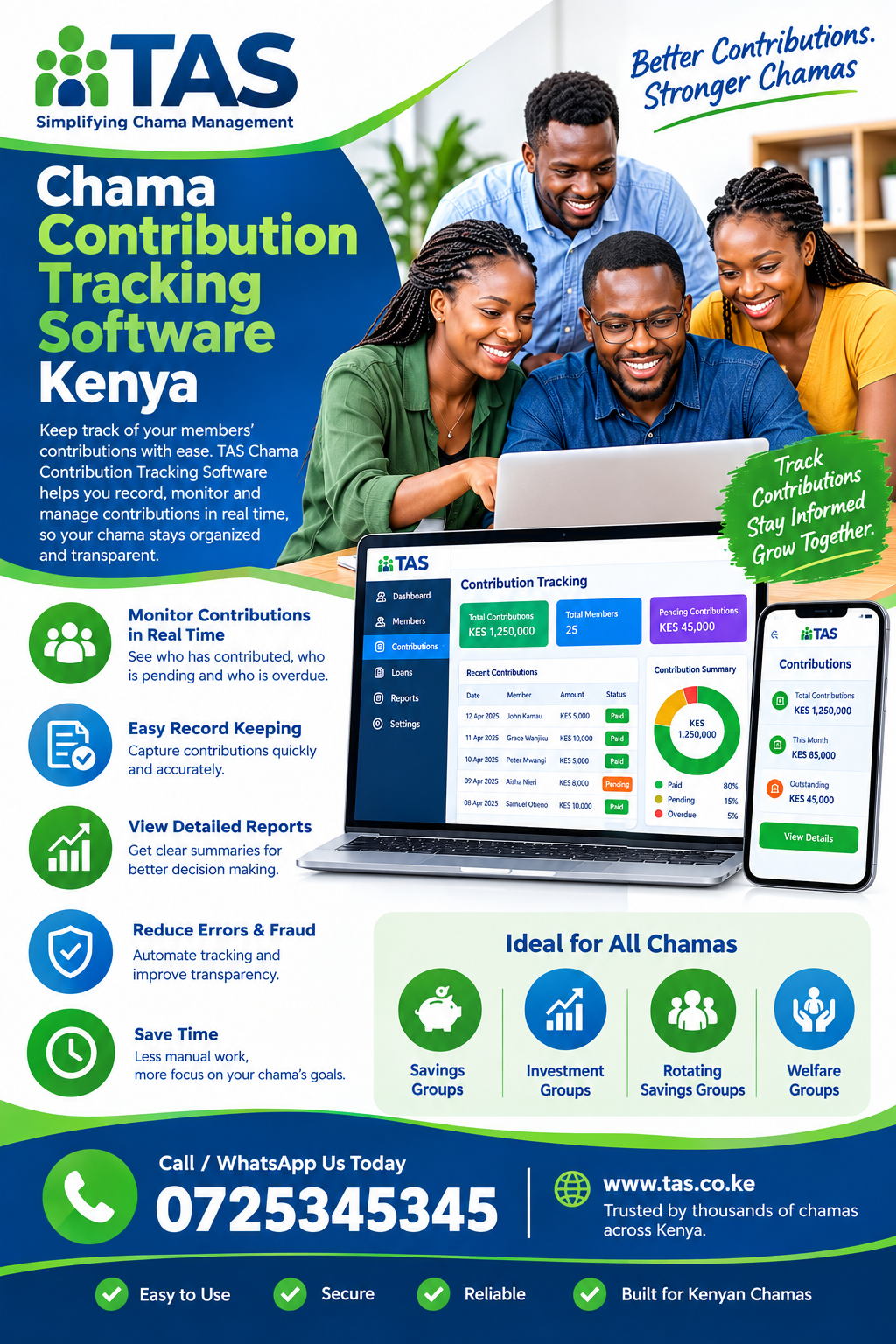
Chama Contribution Tracking Software Kenya: A Complete Guide for Chamas
Managing contributions sounds simple until a chama has dozens of members, different payment schedules, missed payments, partial contributions, welfare collections, investment funds, and several financial records to maintain. For groups that want accurate records and easier administration, Chama Contribution Tracking Software Kenya provides a structured way to record member payments, monitor outstanding contributions, maintain contribution histories, and generate useful financial reports.
A chama may begin with a notebook, spreadsheet, or WhatsApp group, but financial records become harder to manage as membership grows. Members want to know what they have paid, treasurers need accurate records, and officials need reliable information when making decisions. This guide explains how digital contribution tracking works, the features to look for, the benefits for Kenyan chamas, common implementation challenges, and practical ways to choose a suitable solution.
What Is Chama Contribution Tracking Software?
Chama Contribution Tracking Software Kenya is a digital system designed to help savings groups record, organize, monitor, and report member contributions. Instead of relying entirely on handwritten records or scattered spreadsheets, a chama can maintain contribution information in a centralized system.
The software can be configured around the contribution rules of a particular group. For example, a chama might require every member to contribute KSh 5,000 every month. Another group may collect weekly payments, while an investment chama may have different contribution levels depending on an agreed project.
A good system can help the group record:
- Member names and registration details
- Expected contribution amounts
- Actual amounts paid
- Payment dates
- Outstanding balances
- Arrears
- Partial payments
- Contribution history
- Payment references
- Contribution summaries
- Member statements
- Group-level financial reports
The main purpose is not simply to replace a notebook. It is to create a reliable financial record that officials and members can use when reviewing the group’s finances.
Why Contribution Tracking Matters for Kenyan Chamas
Chama Contribution Tracking Software Kenya becomes particularly useful when a group has grown beyond a small circle of members who personally remember every transaction. Financial administration becomes more demanding as the number of members, transactions, and financial activities increases.
Consider a chama with 40 members. If each member contributes monthly, the treasurer must account for hundreds of contribution records over a year. Some members may pay early, some late, and others in several installments. A few may skip a month and settle their balance later.
Without organized records, simple questions can take considerable time to answer.
A member may ask:
- How much have I contributed this year?
- Which months have I missed?
- Do I have an outstanding balance?
- Was my last payment recorded?
- How much have I contributed toward a particular project?
- What is my total contribution to the group?
The treasurer should be able to answer these questions from records rather than memory.
Moving Away From Manual Contribution Records
Chama Contribution Tracking Software Kenya can reduce the administrative workload created by manual recordkeeping. Traditional methods still have value for very small groups, but they can become difficult to maintain as transaction volumes increase.
Paper notebooks
A notebook is inexpensive and easy to start with. However, records can be damaged, misplaced, altered, or become difficult to interpret over time.
Spreadsheets
Spreadsheets provide more flexibility than paper records. They can calculate totals and balances, but they still depend heavily on proper data entry and spreadsheet management.
Common spreadsheet problems include:
- Accidental deletion
- Incorrect formulas
- Duplicate entries
- Multiple versions of the same file
- Difficulty controlling access
- Missing payment references
- Inconsistent member names
Digital contribution management
Chama Contribution Tracking Software Kenya provides a more structured environment. Instead of creating formulas and sheets manually, the system can be designed around the chama’s contribution rules.
This allows officials to spend less time maintaining spreadsheets and more time reviewing the financial position of the group.
Key Features to Look For
Not every financial application is designed specifically for chamas. When evaluating software, it is important to identify features that directly address group contribution management.
Chama Contribution Tracking Software Kenya should provide a clear member contribution structure that allows administrators to understand expected payments and actual payments.
1. Member contribution records
The foundation of contribution management is a reliable member record.
Each member should have a contribution history showing relevant transactions. This makes it easier to understand an individual’s participation without searching through multiple notebooks or spreadsheets.
2. Contribution schedules
Chama Contribution Tracking Software Kenya should support the contribution frequency used by the group.
Possible schedules include:
- Weekly contributions
- Biweekly contributions
- Monthly contributions
- Quarterly contributions
- Annual contributions
- Project-based contributions
A flexible schedule is important because chamas do not all operate in the same way.
3. Automatic balance calculations
Calculating balances manually creates opportunities for mistakes. A digital system can compare expected contributions with actual payments and show outstanding amounts.
For example, if a member is expected to contribute KSh 5,000 per month and has paid KSh 4,000, the system can show the remaining KSh 1,000 rather than requiring the treasurer to calculate it separately.
4. Payment history
Chama Contribution Tracking Software Kenya should maintain a chronological payment history. A detailed history helps officials investigate discrepancies and gives members greater visibility into their own financial records.
5. Member statements
A member statement can summarize payments over a selected period.
For example, a statement could show:
| Month | Expected | Paid | Balance |
|---|---|---|---|
| January | KSh 5,000 | KSh 5,000 | KSh 0 |
| February | KSh 5,000 | KSh 3,000 | KSh 2,000 |
| March | KSh 5,000 | KSh 5,000 | KSh 0 |
| April | KSh 5,000 | KSh 5,000 | KSh 0 |
Such a report is easier to understand than a long list of individual transactions.
Supporting M-Pesa Contribution Records
Chama Contribution Tracking Software Kenya is especially relevant in Kenya because mobile money is widely used for everyday payments and group transactions.
Many chamas receive contributions through M-Pesa. The challenge is not only receiving the money. The group must also identify who paid, how much was paid, when the payment was made, and what the payment was intended for.
A contribution system can help administrators organize payment information and reconcile it with member records.
Why payment references matter
A payment reference can help connect a financial transaction to a specific member or purpose.
For example:
Member contribution — March — KSh 5,000
is more useful to a treasurer than an unidentified transaction with no explanation.
Where payment integration is available, administrators should still establish clear procedures for verifying transactions before marking them as confirmed.
Tracking Partial Contributions
Chama Contribution Tracking Software Kenya becomes valuable when members do not always pay their full contribution at once.
Suppose the monthly contribution is KSh 10,000. A member may pay:
- KSh 4,000 on the first week
- KSh 3,000 later
- KSh 3,000 before the meeting
The member has eventually completed the KSh 10,000 contribution, but recording each payment separately helps preserve the transaction history.
A flexible system should distinguish between the individual transactions and the final contribution balance.
Managing Contribution Arrears
Chama Contribution Tracking Software Kenya can also help groups monitor arrears.
Arrears occur when a member has not met an expected contribution by the required deadline. If arrears are recorded manually, officials may have to review several months of records before identifying the outstanding amount.
A digital system can make this process clearer by showing:
- Members with unpaid contributions
- Total outstanding amounts
- Number of missed contribution periods
- Partial balances
- Payment dates
- Historical arrears
This information can support transparent discussions during chama meetings.
Contribution Tracking for Different Chama Structures
Chama Contribution Tracking Software Kenya can support different types of savings groups, provided the software is flexible enough for the group’s rules.
Savings chamas
A savings chama may focus primarily on regular member contributions and accumulated savings.
Investment chamas
An investment group may collect regular contributions and use them to finance property, businesses, securities, farming projects, or other investments.
Welfare groups
A welfare-oriented group may have ordinary contributions alongside special collections for emergencies or member support.
Table banking groups
Some groups combine contributions with loans and internal lending. In such cases, contribution records may need to work alongside loan and repayment records.
The important point is that contribution tracking should reflect the group’s actual financial structure rather than forcing every chama into one rigid model.
Improving Transparency Among Members
Chama Contribution Tracking Software Kenya can contribute to clearer financial administration when access and reporting are properly managed.
Trust is important in any group that handles members’ money. Members need confidence that their payments are recorded correctly and that financial decisions are based on reliable information.
Transparency does not mean every member should have unlimited access to every financial record. Instead, access should be based on clearly defined roles.
For example:
- A member can view their own contribution history.
- A treasurer can manage contribution transactions.
- An administrator can manage member records.
- Authorized officials can review group reports.
This structure helps balance transparency with privacy.
Reducing Contribution Disputes
Chama Contribution Tracking Software Kenya can help reduce disputes by providing a consistent transaction history.
Suppose a member believes they have paid KSh 30,000 during a quarter, while the treasurer’s spreadsheet shows KSh 25,000. Rather than relying on memory, officials can review the recorded transactions and payment references.
A good dispute-resolution process should still allow corrections where genuine errors are found.
Software does not automatically guarantee accurate records. The quality of the information depends on how transactions are entered, verified, and reviewed.
Contribution Reports for Chama Meetings
Chama Contribution Tracking Software Kenya can make regular meetings easier to prepare for because financial reports can be generated from stored transaction records.
A meeting report might include:
| Report | Purpose |
|---|---|
| Member contribution report | Shows individual payments |
| Arrears report | Identifies outstanding contributions |
| Monthly summary | Shows total collections |
| Contribution comparison | Compares expected and actual amounts |
| Member statement | Shows one member’s history |
| Project contribution report | Tracks funds collected for a specific purpose |
Instead of spending the first part of a meeting reconstructing records, officials can focus on interpreting the information and discussing group activities.
Monitoring Group Contribution Performance
Chama Contribution Tracking Software Kenya can help officials identify contribution patterns.
For example, administrators may notice that contribution completion is high in some months but lower during others. This information can help the group review whether contribution dates, payment procedures, or communication practices need improvement.
The purpose of such analysis should be to understand what is happening in the group.
Useful indicators may include:
- Total expected contributions
- Total collected
- Outstanding contributions
- Number of active contributors
- Number of members with arrears
- Average contribution completion
- Project-specific collections
Contribution Tracking and Financial Planning
Chama Contribution Tracking Software Kenya can support better financial planning by giving the group a clearer view of expected and actual cash inflows.
Suppose a chama expects to collect KSh 500,000 over several months to finance an investment. If contributions fall behind schedule, the group can identify the difference early.
This does not automatically solve the financial shortfall, but it gives decision-makers better information.
Accurate contribution data can be useful when discussing:
- Investment timelines
- Loan availability
- Emergency funds
- Project budgets
- Group expenses
- Cash reserves
Using Contribution Data for Budgeting
Chama Contribution Tracking Software Kenya can form part of a broader budgeting process.
A budget should distinguish between money the group expects to receive and money it actually receives.
For example:
Expected monthly contributions: KSh 300,000
Actual collections: KSh 275,000
Outstanding amount: KSh 25,000
This simple comparison helps officials understand the financial position before approving new commitments.
Supporting Better Recordkeeping
Chama Contribution Tracking Software Kenya can centralize information that might otherwise be spread across notebooks, Excel files, bank records, M-Pesa messages, and WhatsApp conversations.
Centralization makes it easier to establish one authoritative contribution record.
However, good recordkeeping still requires processes.
The chama should establish:
- Who records payments.
- Who verifies payments.
- When records are updated.
- How errors are corrected.
- Who can access financial reports.
- How records are backed up.
- How inactive members are handled.
Technology works best when these responsibilities are clearly defined.
How Contribution Tracking Can Help Treasurers
Chama Contribution Tracking Software Kenya can reduce repetitive administrative work for treasurers.
A treasurer often has several responsibilities beyond recording contributions. They may prepare reports, reconcile payments, communicate with members, maintain cash records, and support meeting preparation.
Automation can reduce some manual calculations and make information easier to retrieve.
Instead of asking:
Which members have not completed this month’s contribution?
the treasurer should be able to generate a relevant report.
That difference can save time during busy reporting periods.
How Members Benefit
Chama Contribution Tracking Software Kenya is not only useful for officials. Members can also benefit from having clearer access to their own financial information.
A member can use contribution records to understand:
- Total payments made
- Monthly payment history
- Outstanding balances
- Project contributions
- Welfare payments
- Payment dates
This can encourage members to identify discrepancies early instead of waiting until the end of the financial year.
Contribution Tracking for Growing Chamas
Chama Contribution Tracking Software Kenya becomes increasingly useful as the group grows.
A chama with ten members can often resolve recordkeeping issues through direct communication. A chama with 100 members has a much larger administrative challenge.
Growth can introduce:
- More transactions
- More payment references
- More reporting requirements
- More officials
- More contribution categories
- More opportunities for data-entry errors
A scalable system should accommodate additional members without requiring the group to redesign its records from scratch.
Security and Access Control
Chama Contribution Tracking Software Kenya should be evaluated for security features as carefully as its financial functions.
Contribution records are financial information. Access should therefore be controlled.
Look for features such as:
- User accounts
- Password protection
- Role-based access
- Secure data storage
- Audit trails
- Regular backups
- Controlled administrative privileges
The group should also create internal policies for password management and account access.
When an official leaves their role, their access should be reviewed or removed according to the group’s procedures.
Data Accuracy Is Still Essential
Chama Contribution Tracking Software Kenya can improve organization, but it cannot correct incorrect information automatically in every situation.
If KSh 5,000 is entered as KSh 50,000, the system will work with the incorrect amount unless there are validation controls or the mistake is identified during review.
For this reason, chamas should maintain a simple verification process.
A practical workflow is:
Payment received → payment verified → member identified → transaction recorded → contribution balance updated → report reviewed
This process reduces the chance of unexplained discrepancies.
How to Choose the Right Solution
Chama Contribution Tracking Software Kenya should be selected according to the actual needs of the group.
Do not choose software simply because it has a long feature list. A complicated system may be difficult for volunteers or officials who only need straightforward financial administration.
Before selecting a solution, ask:
Does it support the group’s contribution schedule?
If the group collects weekly contributions, monthly-only functionality may not be sufficient.
Can it handle multiple contribution categories?
Some chamas have ordinary savings, welfare funds, investment contributions, and project-specific collections.
Can members be managed individually?
Individual records are essential for accurate statements.
Can reports be generated?
Reports should be useful for meetings, reconciliation, and member communication.
Can payment records be reconciled?
The system should make it easier to connect received payments to the correct member.
Questions to Ask Before Implementation
Chama Contribution Tracking Software Kenya should fit the group’s operational environment.
Ask the provider:
- How are member records created?
- Can contribution amounts be changed?
- Can the system handle partial payments?
- Can administrators correct mistakes?
- Are corrections recorded?
- Can reports be exported?
- How are users assigned permissions?
- How are backups handled?
- Is training provided?
- What support is available?
The answers can reveal whether the software is appropriate for the chama’s day-to-day operations.
Cost Considerations
Chama Contribution Tracking Software Kenya should be evaluated based on total value rather than simply the initial price.
Potential costs may include:
- Subscription fees
- Setup fees
- Training
- Data migration
- Payment integration
- Additional users
- Support
- Reporting features
At the same time, manual recordkeeping has costs that are easy to overlook. Staff or volunteers spend time preparing reports, correcting errors, searching for records, and responding to contribution queries.
The right comparison is therefore between the overall cost of the software and the administrative value it provides.
Common Mistakes Chamas Should Avoid
Chama Contribution Tracking Software Kenya can be effective when implementation is handled carefully. Several common mistakes can reduce its value.
Entering old records without verification
Historical information should be reviewed before being imported into a new system.
Giving everyone administrator access
Administrative privileges should be limited to authorized officials.
Failing to reconcile payments
Recording a transaction is not the same as verifying that the payment was actually received.
Ignoring member communication
Members should understand how their contributions are recorded and how they can raise discrepancies.
Keeping multiple unofficial records
If officials continue maintaining several competing spreadsheets after implementing software, confusion may continue.
Failing to back up data
Important financial records should have appropriate backup arrangements.
A Practical Implementation Process
Chama Contribution Tracking Software Kenya can be introduced gradually rather than changing every process overnight.
Step 1: Review current records
Collect notebooks, spreadsheets, payment statements, and other relevant records.
Step 2: Clean the member list
Ensure names are consistent and duplicate member profiles are removed.
Step 3: Define contribution rules
Document the amount, frequency, due date, categories, and procedures for late or partial payments.
Step 4: Enter verified information
Only import records that have been checked.
Step 5: Train officials
Treasurers and administrators should know how to record payments, generate reports, and correct legitimate errors.
Step 6: Communicate with members
Explain how contribution records will be maintained and how members can verify their information.
Step 7: Review regularly
Monthly reconciliation can identify issues before they become difficult to resolve.
Creating a Contribution Policy
Chama Contribution Tracking Software Kenya works even better when supported by clear group rules.
A contribution policy can specify:
- Required contribution amount
- Payment deadline
- Accepted payment methods
- Treatment of partial payments
- Treatment of arrears
- Procedures for corrections
- Reporting frequency
- Member access to statements
- Responsibilities of officials
Having these rules in writing reduces uncertainty.
Handling Late Payments
Chama Contribution Tracking Software Kenya can help identify late payments, but the group should decide how late payments are treated.
Some chamas may charge a penalty. Others may simply record an outstanding balance. The system should reflect the rules that members have approved.
A useful report can distinguish between:
- Paid on time
- Paid late
- Partially paid
- Not paid
- Fully settled after arrears
This creates a clearer picture of contribution behavior without relying on informal memory.
Contribution Tracking for Projects
Chama Contribution Tracking Software Kenya can also be useful when a group is collecting money for a particular project.
For example, members may agree to contribute KSh 20,000 each toward a land purchase.
The group can track:
| Member | Target | Paid | Balance |
|---|---|---|---|
| Member A | KSh 20,000 | KSh 20,000 | KSh 0 |
| Member B | KSh 20,000 | KSh 15,000 | KSh 5,000 |
| Member C | KSh 20,000 | KSh 10,000 | KSh 10,000 |
This is different from ordinary monthly savings and demonstrates why contribution categories can be important.
Connecting Contributions With Other Chama Activities
Chama Contribution Tracking Software Kenya may form one component of a broader chama management system.
A mature group may need to manage:
- Members
- Contributions
- Loans
- Repayments
- Welfare claims
- Investments
- Expenses
- Meetings
- Minutes
- Financial reports
Keeping these activities connected can make financial administration more coherent.
For example, a member’s contribution history may be considered alongside their loan obligations, depending on the group’s rules.
Using Reports for Financial Reviews
Chama Contribution Tracking Software Kenya can support periodic financial reviews.
Officials can compare reports from different periods and investigate unusual changes.
For example:
Quarter 1 expected contributions: KSh 900,000
Quarter 1 actual contributions: KSh 875,000
The KSh 25,000 difference becomes something the group can investigate.
The software does not determine why the difference exists. Officials still need to examine the records and identify the underlying cause.
Preparing for Annual Reporting
Chama Contribution Tracking Software Kenya can simplify the process of preparing annual contribution summaries.
Instead of reconstructing twelve months of transactions manually, administrators can generate reports based on the stored data.
An annual report may show:
- Total contributions
- Contributions by member
- Outstanding balances
- Welfare collections
- Project contributions
- Payment trends
- Adjustments
- Reconciled transactions
These reports can become part of the chama’s broader financial documentation.
Frequently Asked Questions
1. What is Chama Contribution Tracking Software Kenya used for?
Chama Contribution Tracking Software Kenya is used to record and monitor member contributions, payment histories, balances, arrears, and related financial information. It can help chamas organize records and generate reports for administrators and members.
2. Can chama software track M-Pesa payments?
Chama Contribution Tracking Software Kenya can support the organization and reconciliation of mobile-money contribution records, depending on the payment integrations provided by the specific solution. Chamas should confirm the exact M-Pesa functionality before implementation.
3. Can the system track partial contributions?
Chama Contribution Tracking Software Kenya can be useful for recording partial payments where the software supports installment or transaction-level tracking. This allows the chama to see how much has been paid and what remains outstanding.
4. Can members view their contribution history?
Chama Contribution Tracking Software Kenya may provide member statements or other reporting functionality that allows individual contribution information to be reviewed. Access should be configured according to the group’s privacy and governance rules.
5. Is digital contribution tracking suitable for small chamas?
Chama Contribution Tracking Software Kenya can be useful for both small and growing groups, especially when the chama wants to establish organized financial records early. The appropriate solution depends on the group’s membership, transaction volume, budget, and administrative requirements.
6. Can contribution tracking software manage arrears?
Chama Contribution Tracking Software Kenya can help identify outstanding balances by comparing expected contributions with recorded payments. The chama should establish clear rules for how arrears are handled before configuring the system.
7. What should a chama check before buying software?
Chama Contribution Tracking Software Kenya should be evaluated based on contribution schedules, member management, reporting, payment reconciliation, security, user permissions, support, scalability, and cost.
8. Can the software support investment chamas?
Chama Contribution Tracking Software Kenya can support investment-oriented contribution records when it provides flexible categories and reporting. Groups should determine whether they need additional investment, accounting, or project-management functionality.
9. How does contribution tracking improve financial accountability?
Chama Contribution Tracking Software Kenya creates a structured record of transactions that authorized officials can review. Clear records can make it easier to reconcile payments, identify outstanding amounts, prepare reports, and resolve contribution questions.
10. Can a chama migrate from Excel to software?
Chama Contribution Tracking Software Kenya can be adopted by groups that previously used spreadsheets, provided their historical information can be cleaned and transferred appropriately. Before migration, the chama should verify its existing records and remove duplicates or obvious errors.
Final Checklist for Chamas
Before implementing a contribution management system, use this checklist:
- Create a complete member register.
- Define contribution amounts.
- Define payment deadlines.
- Identify all contribution categories.
- Establish procedures for partial payments.
- Establish procedures for arrears.
- Define who can enter transactions.
- Define who verifies transactions.
- Set user permissions.
- Establish correction procedures.
- Review available reports.
- Plan data backups.
- Train administrators.
- Explain the process to members.
- Reconcile records regularly.
The Future of Digital Chama Administration
Chama Contribution Tracking Software Kenya represents one part of a broader move toward organized digital administration for savings groups in Kenya.
As chamas grow, they often become more sophisticated financial organizations. A group may start by collecting regular savings and eventually manage loans, investments, welfare funds, assets, projects, and substantial financial records.
This growth increases the importance of reliable information.
A digital system can provide a foundation for better organization by bringing contribution records into one structured environment. The real benefit comes when technology is combined with sound financial controls, clear responsibilities, regular reconciliation, and transparent communication.
Conclusion
Chama Contribution Tracking Software Kenya can help Kenyan chamas move from fragmented contribution records toward a more organized approach to member payments and financial administration. By keeping contribution histories, expected payments, balances, arrears, project collections, and reports in a structured system, groups can make routine administration easier and improve access to useful financial information.
The right solution should fit the chama rather than forcing the chama to change every process unnecessarily. Before choosing software, assess contribution schedules, member numbers, payment methods, reporting needs, security requirements, and future growth.
Chama Contribution Tracking Software Kenya is most valuable when it becomes part of a consistent financial process: payments are verified, records are updated promptly, balances are reviewed, discrepancies are investigated, and reports are prepared regularly.
For a chama that wants to improve its contribution administration, the starting point is simple: understand how money currently moves through the group, identify where records become difficult to manage, and select a digital system that addresses those specific challenges.
With clear rules and disciplined recordkeeping, contribution tracking can become less of a monthly administrative burden and more of a reliable source of information for the group’s financial planning, accountability, and long-term activities.