Member Management in Kenya: A Practical Guide for Chamas and Member-Based Groups
Managing members is one of the most important responsibilities in any chama, savings group, welfare association, investment group, table-banking group or other member-based organisation. As the number of members grows, keeping accurate information becomes more difficult when records are spread across notebooks, spreadsheets, WhatsApp conversations and individual files.
A reliable member management process should make it easy to know who belongs to the group, when they joined, their membership status, their contributions and other information that the organisation is authorised to maintain. It should also make it easier for officials to update records when members join, leave or change their details.
For Kenyan groups that are becoming more organised and handling more financial activity, digital member administration can reduce repetitive work and make important information easier to access.
What Member Management Means for Kenyan Groups
Member management is not simply keeping a list of names. It involves maintaining an organised record of the people who belong to an organisation and connecting their membership information with activities such as contributions, savings, loans, meetings and statements.
For a small group, a paper register may initially be enough. However, as membership increases, the number of records increases as well. A group with 20 members has very different administrative requirements from a group with 100 or 200 members.
A digital system can provide a central place for authorised officials to maintain member information and connect it with the group’s other activities.
Why Member Records Matter
A reliable member register forms the foundation of many group activities. Contributions need to be assigned to the correct people. Loans need to be associated with the correct borrowers. Meeting attendance may need to be tracked. Reports may need to show information by member.
When member information is incomplete or duplicated, other records can also become difficult to manage. A spelling difference, duplicate profile or outdated phone number can cause unnecessary confusion.
This is why groups should treat member information as an important administrative asset rather than as a simple list stored in an old notebook.
60 Practical Areas to Consider
1. Creating a Central Member Register
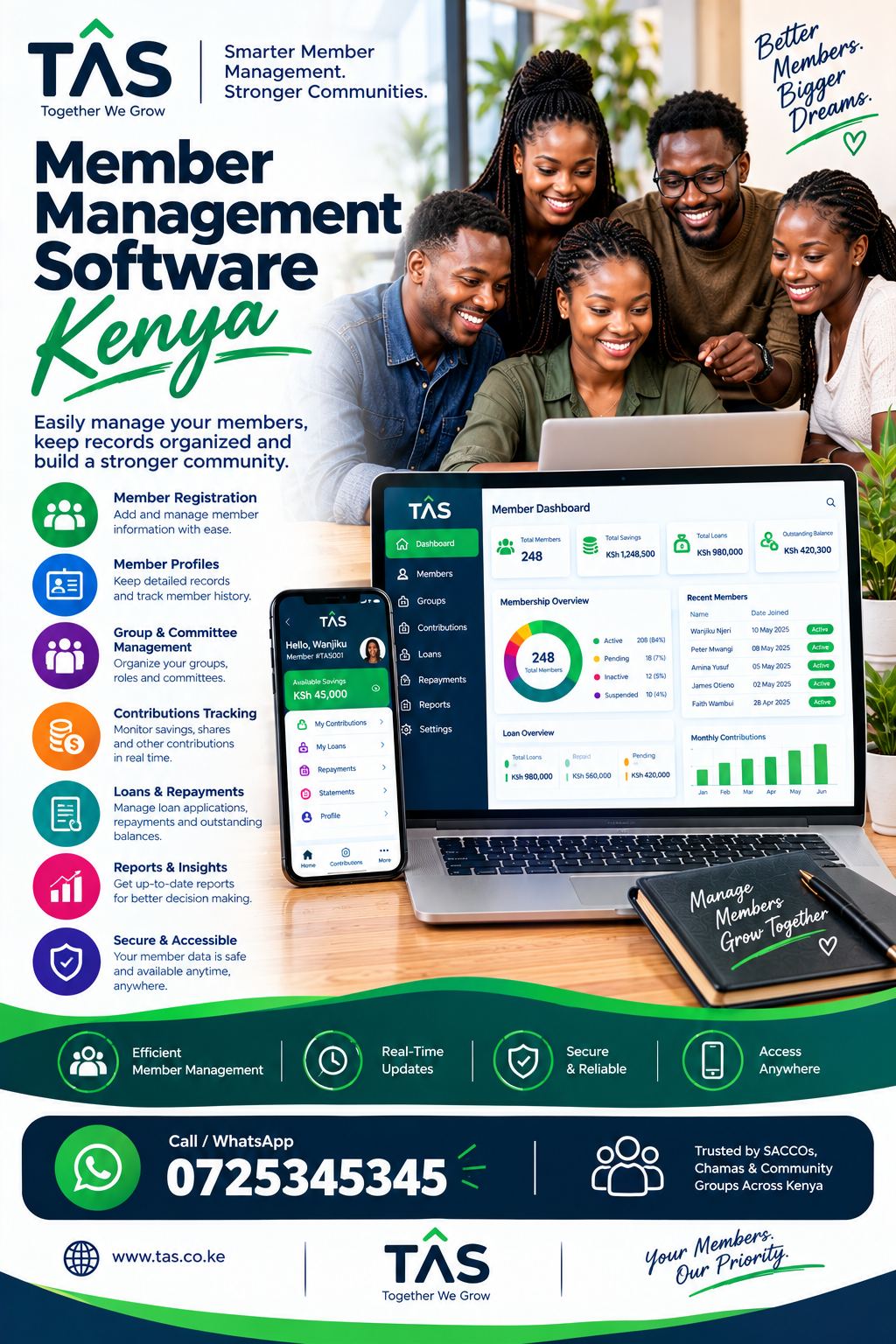
Using Member Management Software Kenya can give a chama or group a central place to maintain its member register. Instead of keeping names in one notebook and contact details in another spreadsheet, authorised officials can work from a more organised record.
A central register can make everyday administration easier because officials know where to look when they need member information. It can also provide better continuity when leadership changes and a new secretary or treasurer takes over responsibilities.
2. Recording Basic Member Information
Member Management Software Kenya can help organisations maintain basic information about their members. Depending on the group’s needs and privacy practices, records may include names, contact details, membership numbers, joining dates and membership status.
The group should only collect information that is necessary and appropriate for its activities. Keeping records organised is useful, but good administration also means treating member information responsibly.
3. Recording Membership Numbers
A unique membership number can make it easier to distinguish members with similar names. With Member Management Software Kenya, a group can organise member records around identifiers that help officials find the correct person.
This becomes increasingly useful as the membership grows. Instead of relying only on names, officials can use a member number when entering transactions or reviewing records, reducing the risk of confusing two people with similar names.
4. Tracking Joining Dates
Member Management Software Kenya can help officials record when members joined the organisation. Joining dates can be useful when the group has rules connected to membership duration.
For example, some groups may require a person to remain a member for a particular period before accessing certain benefits or services. Having a reliable joining date makes it easier for officials to review such requirements without searching through old documents.
5. Monitoring Membership Status
With Member Management Software Kenya, groups can maintain clearer records of whether members are active or have another status defined by the organisation.
Membership status can change over time. A person may join, become inactive, resign or leave the group. Updating the record ensures that current reports do not continue treating former members as active participants.
6. Managing New Members
Member Management Software Kenya can help make the process of adding new members more organised. Instead of writing a person’s information in several places, officials can establish one member record and use it as the starting point for future activities.
A consistent onboarding process also helps ensure that important information is not forgotten. The group can decide which fields are required before a new member becomes fully active.
7. Reducing Duplicate Member Records
Using Member Management Software Kenya can help reduce duplicate records when the group follows a consistent registration process.
Duplicate profiles can cause serious administrative problems. A member’s contributions could be divided between two records, making their total savings appear incorrect. Checking for existing records before creating new ones can help prevent this problem.
8. Keeping Contact Details Updated
Member Management Software Kenya can help officials maintain updated contact information where the group is authorised to collect it.
Phone numbers and other contact details can change over time. A good administrative process should provide a simple way for authorised officials to update records when members provide new information.
9. Recording Membership Changes
Groups using Member Management Software Kenya can maintain a clearer history of changes to membership information.
A member may change their contact details, status or other approved information. Keeping records updated means officials are less likely to rely on outdated spreadsheets or old paper forms when communicating with members.
10. Connecting Members to Contributions
Member Management Software Kenya can connect member records with contribution activity. This is important because a contribution only becomes useful information when the group knows which member made it and what type of contribution it represents.
A centralised approach can make it easier to review individual contribution histories and prepare reports for group meetings.
11. Tracking Savings
With Member Management Software Kenya, savings information can be organised alongside the relevant member record where the group’s system supports it.
This can give officials a clearer picture of individual and group savings activity. Members may also benefit from having their history maintained consistently instead of relying on several disconnected records.
12. Managing Welfare Contributions
Member Management Software Kenya can help groups maintain member information alongside welfare-related contributions where applicable.
Welfare groups and chamas may collect money for emergencies, support or other purposes agreed by members. Keeping the member record connected to the relevant financial activity can make administration easier and improve the clarity of reports.
13. Connecting Members to Loans
A group can use Member Management Software Kenya to associate loans with the correct member records. This makes it easier to identify which member has an active loan and review information related to that borrowing.
When member and loan information are disconnected, officials may have to search several documents before answering a simple question. A connected record can reduce that administrative burden.
14. Recording Guarantor Information
Member Management Software Kenya can support organisations that need to associate guarantor information with member or loan records.
Guarantors are common in some group lending arrangements. Keeping the relevant information organised helps officials understand who is connected to a particular loan without depending on loose paper forms.
15. Member Contribution History
Using Member Management Software Kenya can make it easier to review a member’s contribution history.
Historical information can help officials answer questions about previous payments, outstanding contributions and participation over time. It can also be useful when preparing reports or reviewing eligibility according to the group’s own rules.
16. Member Statements
Member Management Software Kenya can help organisations prepare clearer member statements where the selected system provides that functionality.
A statement can bring together relevant information such as contributions, savings, loans and repayments. Giving members access to understandable records can reduce confusion and make financial discussions more straightforward.
17. Supporting Transparency
Using Member Management Software Kenya can support transparency by giving authorised officials a consistent source of member information.
Transparency does not mean that every member should have unrestricted access to everybody else’s personal details. Instead, it means that the organisation maintains reliable records and applies clear access rules so members can understand the information relevant to them.
18. Improving Accountability
Member Management Software Kenya can support accountability by creating a more structured environment for maintaining member records.
When records are organised, officials can more easily identify who entered information, what information is current and where questions need to be investigated. This can be useful when responsibilities move from one committee to another.
19. Supporting the Secretary
A group secretary often has responsibility for maintaining member information. Using Member Management Software Kenya can reduce the amount of time spent maintaining several separate registers.
Instead of updating multiple documents whenever a member changes their information, the secretary can maintain the appropriate central record and use it for other administrative tasks.
20. Supporting the Treasurer
Member Management Software Kenya can also help the treasurer because financial transactions are often connected to members.
When recording contributions, loans or repayments, the treasurer needs to identify the correct member. A reliable member register can make these tasks easier and reduce the risk of entering transactions under the wrong person.
21. Supporting Committee Members
Using Member Management Software Kenya can give authorised committee members better access to information needed for group decisions.
Committee members may need to review membership numbers, contribution activity, loan information or other records before making decisions. Access should be based on responsibilities so sensitive information remains appropriately protected.
22. Making Leadership Handover Easier
Member Management Software Kenya can make leadership transitions more organised. When a new treasurer or secretary takes over, they need access to accurate records.
A central digital record can reduce dependence on one person’s personal spreadsheet or notebook. This can improve continuity and make it easier for new officials to understand the organisation’s current membership.
23. Managing Growing Membership
As a group grows, Member Management Software Kenya can become increasingly useful because the amount of member information grows with it.
A process that works well for 15 people may become difficult with 100 members. Digital records can provide more structure as the organisation expands, especially when member activity is connected to contributions, loans and meetings.
24. Searching Member Records
Member Management Software Kenya can make it easier to search for a specific member when officials need information quickly.
Instead of manually going through pages of a register, an authorised user can search for the appropriate record. This can save time during meetings, reporting periods and routine administration.
25. Filtering Member Information
Using Member Management Software Kenya can help officials organise member information using relevant filters where available.
For example, officials may need to distinguish active members from former members or review a particular category of members. Filtering can reduce the amount of information that officials need to examine at once.
26. Improving Data Accuracy
Member Management Software Kenya can support better data accuracy when officials follow consistent procedures.
Accurate information is especially important when member records are connected to financial transactions. A mistake in a member profile can affect contribution records, loan information and reports.
27. Supporting Contribution Reports
Using Member Management Software Kenya can help officials prepare reports based on member and contribution information.
Reports can help a committee understand how much has been contributed, which members have outstanding obligations and how contribution activity has changed over time. The exact reports available depend on the selected system.
28. Supporting Loan Reports
Member Management Software Kenya can connect member information with loan reporting.
A group may need to know which members have active loans, outstanding balances or repayment obligations. Connecting these records can make loan administration more organised and reduce manual cross-checking.
29. Recording Member Attendance
Some groups may want to track meeting participation. Where supported, Member Management Software Kenya can help associate attendance or meeting information with member records.
Attendance can be useful for groups whose own rules consider participation in meetings. It can also help officials understand member engagement without maintaining a completely separate attendance register.
30. Managing Meeting Information
Member Management Software Kenya can be useful when member records are connected to meetings, agendas or minutes.
Meetings are an important part of many chamas because members make financial and organisational decisions collectively. Keeping related records organised can make it easier to understand what decisions were made and when.
31. Recording Member Actions
Using Member Management Software Kenya can support better tracking of actions associated with members or group decisions where the system provides such functionality.
For example, a committee may agree that a particular administrative matter needs follow-up. Recording the action and its status can reduce the risk of decisions being forgotten after the meeting.
32. Managing Member Communication
Member Management Software Kenya can help officials maintain accurate information needed for communication.
A group may need to contact members about meetings, payments, changes or other approved matters. Up-to-date records make it easier to reach the appropriate people without repeatedly asking members for the same information.
33. Supporting Member Onboarding
A clear onboarding process supported by Member Management Software Kenya can help new members understand how the group operates.
Officials can ensure that required information is captured, membership rules are communicated and the new member is properly recorded. A structured process also reduces the possibility of incomplete records.
34. Managing Former Members
Member Management Software Kenya can help a group distinguish former members from current members.
Former members may still have historical transactions that the organisation needs to retain. Instead of deleting all information without considering its importance, the group can follow its own record-retention policies and maintain appropriate historical information.
35. Protecting Member Privacy
Using Member Management Software Kenya should go together with responsible handling of personal information.
Member records can contain contact information and financial history, so access should be limited to people who need the information for their responsibilities. Passwords, permissions and secure access should be considered when selecting a system.
36. Role-Based Access
Member Management Software Kenya can be particularly useful when different officials require different levels of access.
For example, a treasurer may need access to financial information while another official may only need to manage basic member records. Role-based access helps ensure that users see the information appropriate to their responsibilities.
37. Maintaining Audit History
Where supported, Member Management Software Kenya can provide a clearer history of activity around member records.
An audit history can help an organisation understand changes made within the system. This can be useful when investigating discrepancies or reviewing how administrative responsibilities have been handled.
38. Reducing Paperwork
Using Member Management Software Kenya can reduce dependence on paper registers and forms for routine member administration.
Paper can still have a place in an organisation, particularly for formal documents and records required by its policies. However, digital records can make everyday searching, updating and reporting considerably easier.
39. Moving Away From Scattered Spreadsheets
Member Management Software Kenya can provide an alternative when a group has multiple spreadsheets for different administrative tasks.
Several files can create version-control problems. One official may have an updated member list while another is using an older copy. A central system can reduce this confusion by providing one primary working record.
40. Improving Record Continuity
Using Member Management Software Kenya can help preserve continuity when officials change.
Chamas often operate for many years, while committee positions may change regularly. A structured record allows important membership information to remain with the organisation rather than with an individual official.
41. Connecting Member and Financial Records
Member Management Software Kenya can connect membership information with financial activities such as contributions and loans.
This connection can be valuable because officials often need to answer questions involving more than one type of record. A member’s financial history becomes easier to review when related information is organised together.
42. Supporting Member Eligibility
Using Member Management Software Kenya can help officials access information needed when applying the group’s eligibility rules.
Eligibility might depend on membership duration, contributions or other conditions established by the organisation. Software should not make decisions independently; rather, it should give authorised officials accurate information to use when applying the group’s rules.
43. Monitoring Membership Growth
Member Management Software Kenya can help officials understand how membership is changing over time.
Knowing whether the organisation is gaining or losing members can support planning. More members may require additional administrative capacity, while changes in membership may affect contribution expectations and group activities.
44. Supporting Financial Planning
With Member Management Software Kenya, membership information can contribute to wider financial planning.
For example, officials may need to estimate expected contributions based on active membership. Accurate member records can make such calculations more reliable, although financial decisions should always consider the group’s actual rules and circumstances.
45. Preparing Member Reports
Member Management Software Kenya can help officials generate member-related reports where such reports are available.
Reports may show active members, membership changes, contribution activity or other information. The exact content depends on the platform and the information the organisation chooses to maintain.
46. Supporting Member Statements
Using Member Management Software Kenya can help organisations provide members with clearer records of their activities.
A member statement can be particularly useful when someone wants to confirm their contributions, savings, loans or repayments. It gives the member something concrete to review rather than relying on verbal figures.
47. Making Meetings More Efficient
Member Management Software Kenya can reduce time spent searching for member information during meetings.
Before a meeting, officials can prepare relevant reports and records. This allows members to focus on decisions and discussions instead of spending most of the meeting reconstructing information from different documents.
48. Supporting Group Accountability
Using Member Management Software Kenya can strengthen administrative accountability when combined with proper group procedures.
A digital record is not a substitute for responsible leadership. Officials still need to follow approval processes, reconcile financial information and communicate important decisions to members.
49. Managing Member Categories
Member Management Software Kenya can help organisations organise members according to categories that are relevant to their operations.
For example, a group may distinguish active and inactive members or organise records based on approved membership categories. Categories should reflect the organisation’s actual rules rather than being created simply because the software allows them.
50. Supporting Different Types of Groups
A flexible approach to Member Management Software Kenya can benefit different kinds of member-based organisations.
Savings chamas, investment groups, welfare groups, table-banking organisations, business groups and cooperatives can all have different requirements. The most suitable system is one that can support the group’s actual workflow rather than forcing every organisation into exactly the same process.
51. Supporting Welfare Groups
Member Management Software Kenya can help welfare groups maintain member records alongside welfare contributions and other approved activities.
Because welfare groups often rely on regular member participation, accurate membership information can make it easier to determine who is active and maintain relevant financial records.
52. Supporting Investment Groups
Using Member Management Software Kenya can help investment groups maintain member information alongside contributions and other group activities.
Investment groups may need to track participation, contributions and financial decisions over longer periods. A central member record can support continuity as the group grows.
53. Supporting Table-Banking Groups
Member Management Software Kenya can be useful for table-banking groups because member information is often closely connected to contributions, savings and loans.
A central system can help officials connect these activities and make it easier to understand each member’s position within the group’s financial records.
54. Supporting Savings Chamas
Using Member Management Software Kenya can help savings chamas organise member records alongside regular contributions.
As monthly transactions accumulate, a clear member history becomes increasingly valuable. Officials can review records without depending entirely on individual notebooks or separate spreadsheets.
55. Supporting Saccos and Cooperatives
Member Management Software Kenya can also be relevant when considering member administration for larger member-based organisations.
Saccos and cooperatives may have more complex structures and requirements than small chamas, so officials should evaluate software carefully against their specific operational and regulatory needs.
56. Choosing the Right System
When comparing Member Management Software Kenya, organisations should look beyond a list of advertised features.
Important questions include whether the system is easy to use, whether member records can be searched, whether financial information can be connected to members, whether permissions are available and whether records can be exported or backed up.
57. Checking Data Security
Before adopting Member Management Software Kenya, officials should understand how member information is protected.
Questions about authentication, user permissions, backups and data access should be part of the evaluation process. A group should know who can view or change information and what happens when an official leaves their role.
58. Planning the Migration
Moving existing records into Member Management Software Kenya requires preparation.
Officials should review current spreadsheets, notebooks and member lists before transferring information. Active members, former members, duplicate records and incomplete information should be identified so that the new database begins with reliable information.
59. Training Group Officials
A successful implementation of Member Management Software Kenya depends partly on the people who use it.
Officials should understand how to add and update members, record transactions, search information and generate relevant reports. Training does not have to be complicated. It should focus on the actual tasks officials perform regularly.
60. Building a Long-Term Record System
Using Member Management Software Kenya can help a group build a more organised long-term approach to member administration.
The objective should be more than replacing a notebook with a computer screen. The organisation should create consistent procedures for registration, updates, access, reporting, backups and leadership handovers so that member information remains useful as the group develops.
What Information Should a Member Record Contain?
The exact information collected should depend on the group’s purpose and approved policies. Common fields can include:
- Full name
- Membership number
- Contact information
- Date of joining
- Membership status
- Contribution history
- Savings information
- Loan information
- Guarantor information where applicable
- Meeting participation where required
- Other information approved by the organisation
Groups should avoid collecting unnecessary personal information simply because a system has a field available. Good record keeping is about having useful information that serves a legitimate administrative purpose.
How Member Records Connect to Group Activities
One advantage of a centralised system is the ability to connect member information with other activities.
A typical workflow might look like:
Member → Contribution → Savings → Loan → Repayment → Meeting → Report
For example, when a member makes a contribution, the transaction should be associated with the correct member. If that member later takes a loan, the loan should also be connected to the same record. When repayment is made, the payment should affect the appropriate loan.
This connected approach reduces the need to repeatedly identify the same person across several independent files.
Why Manual Records Become Difficult
Manual records are not automatically bad. Many successful groups have used notebooks for years. The challenge appears when the amount of information becomes too large to manage comfortably.
Imagine a group with 100 members, each making monthly contributions. That can create 1,200 contribution records in a year before adding loans, repayments, welfare payments, expenses and other transactions.
If several spreadsheets are being used at the same time, officials may also have to deal with different versions of the same information.
Digital systems can help by providing a more structured environment for these records.
Member Management and Financial Accountability
Member administration and financial accountability are closely connected. When officials know exactly who belongs to the organisation, it becomes easier to connect financial activity to the correct people.
This is especially important for contributions and loans. A financial transaction without a clear member association can be difficult to verify later.
A good system should therefore make it straightforward to identify the member connected to each relevant transaction while also protecting sensitive information through appropriate permissions.
Managing Access to Member Information
Not every official needs access to every type of information.
A treasurer may need access to financial transactions. A secretary may need to manage membership information and meeting records. A committee member may mainly need access to reports.
Role-based access can help organisations create these distinctions. The exact permissions available depend on the software selected, but the principle is straightforward: users should have the access necessary for their responsibilities and no more than is appropriate.
Member Records During Leadership Changes
Leadership changes are normal in many groups. The problem occurs when important records are stored mainly with an individual official.
A treasurer may have a spreadsheet on a personal computer. A secretary may have the most recent member register. Another official may have copies of meeting records.
When these people leave their roles, the group may struggle to reconstruct its history.
A central record can make handover easier because important information remains associated with the organisation.
How to Introduce a Digital Member Register
A group moving from paper or spreadsheets can start with a simple process.
Step 1: Review existing records
Identify all current member lists and compare them.
Step 2: Remove obvious duplicates
Check whether the same person appears more than once.
Step 3: Confirm active members
Separate current members from people who have already left according to the group’s policies.
Step 4: Check important information
Confirm names, contact information and membership details.
Step 5: Establish responsibilities
Decide who can add, update, review and report on member information.
Step 6: Train officials
Make sure users understand the daily process.
Step 7: Review regularly
Member information should be updated whenever legitimate changes are reported.
Questions to Ask Before Choosing Software
Before adopting a digital member administration platform, a group should ask:
- Can we create and update member records easily?
- Can we search for members quickly?
- Can members be assigned unique identifiers?
- Can membership status be maintained?
- Can contribution records connect to members?
- Can loan records connect to members?
- Can authorised users have different permissions?
- Are reports available?
- Can information be exported?
- Are backups provided?
- How is data protected?
- What support is available?
- Does the pricing fit our group?
- Can the system handle our expected membership growth?
These questions help the group evaluate the actual usefulness of a system instead of choosing one based solely on marketing claims.
Frequently Asked Questions
What is digital member management?
Digital member management involves maintaining member records using software instead of relying entirely on paper registers or disconnected spreadsheets. It can include registration, membership status, contact information, contributions and other approved activities.
Why is a member register important?
The member register is the foundation for many group activities. Contributions, loans, meeting participation and reports often need to be connected to individual members.
Can a small Chama use digital member management?
Yes. A small group can use digital records if they provide value and fit the group’s budget and administrative needs. The system should be simple enough for the officials who will use it.
What happens when membership grows?
As membership grows, the number of records and transactions usually increases. A structured digital system can make searching, updating and reporting easier than maintaining several paper or spreadsheet files.
Can member records be connected to loans?
Many group management systems connect members to loans, repayments and other financial activities. This makes it easier to review an individual’s financial history in one place.
Can member records be connected to contributions?
Yes, contribution tracking is commonly connected to member records. This allows officials to review the contribution history associated with the correct member.
Should former members be deleted?
Not necessarily. The appropriate approach depends on the group’s record-retention practices and applicable requirements. Historical information may still be useful for understanding previous transactions.
Who should have access to member information?
Access should be based on the person’s responsibilities. Officials should only have access to information necessary for their role, especially when records contain personal or financial information.
How often should member information be updated?
It should be updated whenever legitimate changes are reported. Groups can also conduct periodic reviews to identify outdated contact details or other information that needs attention.
Can digital member management improve transparency?
It can support transparency by creating consistent records and making authorised information easier to review. However, transparency also depends on good governance, clear rules and responsible leadership.
Member Management for Growing Chamas
Growth is one of the strongest reasons to review record-keeping processes. A group may start with a few friends or colleagues and eventually grow into a much larger organisation.
At the beginning, everyone may know each other personally. As the group grows, officials cannot rely on memory alone.
A central member register becomes more valuable because it provides a consistent reference point. This can support contributions, loans, meeting administration and financial reporting.
Member Management for Welfare Groups
Welfare groups often depend on active membership and regular contributions. Members may contribute toward emergency support or other benefits defined by the group.
Accurate member records help officials understand who is currently participating and connect relevant contributions to the correct person.
Because welfare activities can involve sensitive circumstances, groups should also be careful about who can access information and how records are stored.
Member Management for Investment Groups
Investment groups may need to maintain records over many years. Members can contribute funds, participate in investment decisions and receive information about the group’s financial activities.
A structured member record can help preserve continuity as the group changes leadership. It can also make it easier to connect contributions and other financial activity to the appropriate members.
Member Management for Table Banking Groups
Table banking depends heavily on member participation. Members contribute money and may borrow from the pooled funds according to the group’s rules.
A central record can connect members with contributions, savings, loans, repayments and other relevant transactions. This gives officials a clearer view of individual and group financial activity.
Member Management and Meetings
Meetings are where many groups make important decisions. Member information can support meeting preparation by helping officials understand membership numbers, contribution activity and other relevant records.
Instead of spending the meeting searching for basic information, officials can prepare reports beforehand. This allows members to spend more time discussing decisions and less time reconstructing records.
Member Management and Reporting
Reports are most useful when the underlying member information is accurate.
A report showing contribution totals is only meaningful if the contributions are associated with the correct members. Similarly, a loan report needs accurate borrower information.
This is why member management should not be treated as a separate administrative task. It supports the accuracy of many other records within the organisation.
Building Better Administrative Habits
Technology can make administration easier, but the group still needs good habits.
Officials should update records promptly rather than waiting several weeks. Important transactions should be reviewed. Changes should be made by authorised users. Reports should be checked regularly.
These habits help ensure that the digital system reflects what is actually happening within the group.
A Practical Member Management Checklist
A group can periodically review the following:
- Are all active members recorded?
- Are duplicate records removed or resolved?
- Are membership numbers accurate?
- Are contact details current?
- Are former members handled according to group policy?
- Are contributions linked to the correct members?
- Are loans linked to the correct borrowers?
- Are guarantors recorded where necessary?
- Are user permissions appropriate?
- Are reports reviewed regularly?
- Are backups available?
- Can records be exported if necessary?
- Are new officials trained?
- Is there a clear handover process?
Regular checks can help prevent small record-keeping problems from becoming major administrative issues.
Final Practical Considerations
For a Kenyan chama or member-based organisation, good member administration starts with a reliable register and continues through every stage of the member’s relationship with the group. The record should remain useful when the member contributes, borrows, attends meetings, changes details or eventually leaves.
The most useful system is not necessarily the one with the longest feature list. It is the one that fits the group’s actual operations, is easy for officials to use and provides appropriate controls around information.
Groups should therefore evaluate software using their real workflows. Test adding a member. Test updating information. Test recording a contribution. Test checking a member’s history. Test generating a report. Test changing user permissions. Test exporting information.
This practical approach can help a group determine whether a digital member administration system will genuinely improve its daily work rather than simply adding another tool to manage.