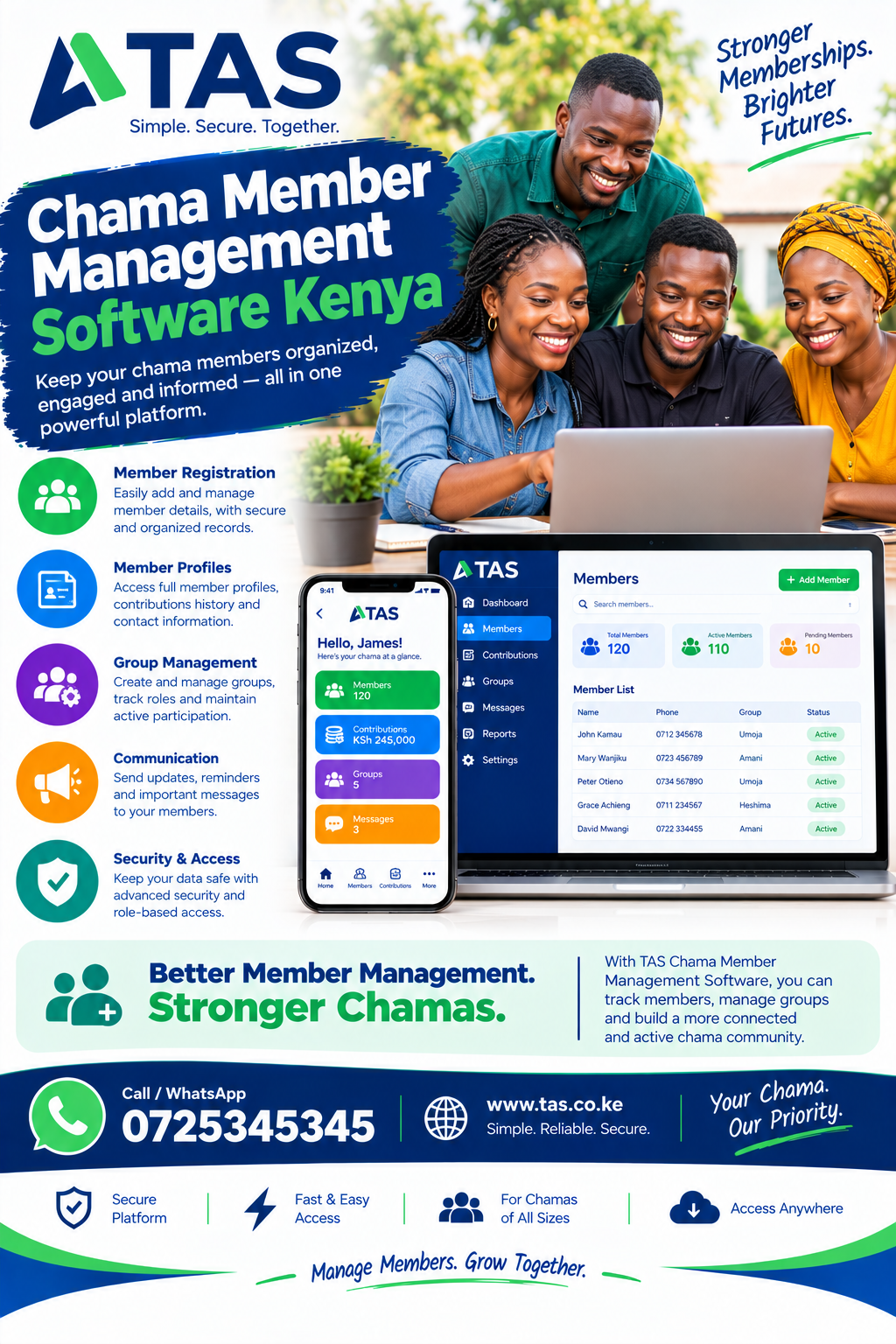
Chama Member Management Software Kenya: Complete Guide to Managing Chama Members
Managing members effectively is at the centre of running a successful chama. From registering new members and maintaining contact details to tracking contributions, loans, attendance and welfare activities, accurate member records affect almost every part of group administration. Chama Member Management Software Kenya provides a structured way for Kenyan chamas to organise this information and reduce the challenges that come with notebooks, scattered spreadsheets and disconnected records. This guide explains what member management software does, why it matters, the features to look for, how it can support everyday chama operations and what groups should consider before adopting a digital system.
What Is Chama Member Management Software?
At its most basic level, Chama Member Management Software Kenya is a digital solution designed to help groups create, organise and maintain member records. Instead of keeping names, telephone numbers, membership information and related records in different places, a chama can use one organised system.
Member management is much more than maintaining a list of names. A member can have a relationship with the chama that lasts for many years. During that period, the person may make regular savings, apply for loans, act as a guarantor, attend meetings, participate in welfare activities and take part in group decisions.
Chama Member Management Software Kenya can connect these different activities to the appropriate member profile, depending on the features provided by the selected platform.
For example, when a new member joins a savings group, the committee may need to record the person’s name, contact details, admission date and membership status. Later, contribution records and loan information may be associated with that same profile.
This creates a more organised member database and makes it easier for authorised officials to find information when required.
Why Member Management Matters to Kenyan Chamas
Many Kenyan chamas begin informally. Members may start with a notebook, a WhatsApp group and a spreadsheet maintained by the treasurer. This approach can work when the group is small and its activities are limited.
As the group grows, however, the amount of information increases.
Chama Member Management Software Kenya can help address this challenge by creating a central place for authorised officials to manage member information.
Consider a chama with 30 members. If each person makes a monthly contribution, attends meetings and occasionally borrows money, the committee will already be dealing with hundreds of individual records after a few years.
If the group grows to 80 or 100 members, manual administration becomes even more demanding.
A central member management system can make it easier to answer questions such as:
- Who is currently an active member?
- When did a member join?
- What contact details are recorded?
- Has a member’s information changed?
- What contributions are associated with the member?
- Does the member have an outstanding loan?
- Which meetings has the member attended?
- What welfare records relate to the member?
Chama Member Management Software Kenya gives groups a way to organise these questions around structured member profiles.
Problems With Manual Member Records
Manual records are familiar, affordable and easy to start with. They are not automatically wrong. The challenge is that they become increasingly difficult to manage as the group grows.
Chama Member Management Software Kenya can reduce dependence on scattered records by providing a central digital system.
Common challenges with manual member administration include:
- Lost paperwork
- Duplicate member entries
- Incorrect phone numbers
- Outdated membership lists
- Missing historical information
- Difficult searches
- Inconsistent spelling of names
- Multiple versions of spreadsheets
- Limited reporting
- Difficult committee handovers
- Unclear access to sensitive information
For example, a member might appear as “Mary Wanjiku” in a spreadsheet and “Mary W.” in a notebook. If the records are not connected, the committee may struggle to determine whether they refer to the same person.
Chama Member Management Software Kenya can help establish a standardised member database where each person has a defined record.
The purpose is not merely to replace paper with software. It is to improve how information is collected, maintained, accessed and reviewed.
Creating Centralised Member Profiles
A strong member management system should make it easy to create and maintain individual profiles.
Chama Member Management Software Kenya can provide a central reference point for authorised officials who need to work with member information.
Depending on the platform and the group’s requirements, a member profile may contain:
- Full name
- Phone number
- Email address
- Membership number
- Date joined
- Membership status
- Approved identification details
- Next-of-kin information
- Contribution information
- Loan information
- Meeting participation
- Welfare information
The chama should only collect information that is genuinely needed for its operations and governance requirements.
A central profile is especially useful when information changes.
Suppose a member changes their telephone number. The secretary can update the existing profile instead of creating a second record.
Chama Member Management Software Kenya can support this more structured approach to member administration.
Registering New Members
New member registration should follow a consistent process.
Chama Member Management Software Kenya can help groups establish a standard process for adding new members to their records.
Before creating a new profile, officials should search the existing database to make sure the person has not already been registered.
A simple registration process may involve:
- Confirming that membership has been approved.
- Searching existing member records.
- Creating a new profile if necessary.
- Entering approved information.
- Assigning the correct membership status.
- Confirming the information.
- Giving the appropriate user access where applicable.
Chama Member Management Software Kenya can make these steps easier to standardise across different committee members.
The group should also decide which information is mandatory. For example, requiring a member’s name and phone number can produce more consistent records than allowing every official to enter different information.
Managing Membership Status
Membership status is another important part of member administration.
A chama may have active members, inactive members, former members or members whose membership has ended according to the group’s constitution.
Chama Member Management Software Kenya can help keep membership status organised and easier to review.
Accurate membership status can affect several activities. For example, the group may have rules concerning who can vote, borrow, receive welfare support or participate in certain decisions.
The software should support these rules rather than replace them.
When a member leaves the group, the historical record may still be important. Past contributions, loans, repayments and decisions should not simply disappear because the membership is no longer active.
Chama Member Management Software Kenya can help maintain historical information while keeping the current membership list accurate.
Connecting Member Records With Contributions
Contributions are one of the most important activities in many Kenyan chamas.
A treasurer needs to know who has paid, how much has been paid and which member the transaction belongs to.
Chama Member Management Software Kenya can make this relationship between members and contributions easier to manage when the selected system supports contribution tracking.
A member profile can serve as the reference point for reviewing contribution activity.
For instance, if a member asks for their contribution history, the treasurer should not have to search through several notebooks and spreadsheets.
Instead, the authorised official should be able to locate the member and review the relevant information.
Chama Member Management Software Kenya can support this type of connected record keeping.
The exact contribution features vary by software provider, so groups should confirm whether the platform supports the contribution methods they use.
Supporting M-Pesa-Based Contributions
M-Pesa is widely used in Kenya, and many groups use mobile payments for contributions.
Chama Member Management Software Kenya can be useful where the selected platform supports payment recording or integration relevant to the group’s workflow.
However, committees should not assume that all software systems process payments in the same way.
Before selecting a solution, ask:
- Can M-Pesa transactions be recorded?
- Can payments be linked to members?
- How are unidentified payments handled?
- Can officials review transaction references?
- Can payment records be reconciled?
- Are reports available?
- Can errors be corrected appropriately?
A good member database makes payment reconciliation easier because officials have a reliable list of members against which transactions can be checked.
Chama Member Management Software Kenya can form part of a broader system where member information and financial activities are connected.
Managing Member Loans
Loans are another area where member records become particularly valuable.
A chama may need to track loan applications, approvals, repayments, balances and guarantors.
Chama Member Management Software Kenya can support the member side of these processes where loan functionality is available.
TAS describes its platform as supporting loan applications, approvals, repayments and balances.
A loan record should be associated with the correct member so that officials can understand the person’s current position without manually matching separate documents.
Before reviewing a loan application, a committee may need to consider:
- Membership status
- Existing loan balance
- Previous repayment history
- Contributions
- Guarantors
- Borrowing limits
- Group rules
Chama Member Management Software Kenya can help organise these records into a more connected administrative workflow.
The final decision should always remain with the authorised committee or members according to the chama’s rules.
Managing Guarantor Information
Some chamas require members to provide guarantors when borrowing.
Guarantor relationships can become difficult to track manually, especially when a member has guaranteed multiple loans.
Chama Member Management Software Kenya can help organise information associated with members and their related activities.
A system should make it possible for authorised officials to understand which member is involved in a loan and, where supported, which members are associated as guarantors.
This is important for responsible record keeping.
Instead of relying on memory or messages, the committee can use the system’s records when reviewing a member’s borrowing position.
Chama Member Management Software Kenya can support the broader principle of connecting related information to the correct member profile.
Member Meeting Attendance
Chamas frequently make important decisions through meetings.
The secretary may need to record attendance, minutes, decisions and actions arising from each meeting.
Chama Member Management Software Kenya can support member administration alongside meeting activities where the platform provides the required functionality.
Attendance records may be useful for understanding participation and maintaining a historical record of meetings.
A digital system can help answer questions such as:
- Who attended the meeting?
- Which members were absent?
- What decisions were recorded?
- Which actions were assigned?
- What issues remain pending?
The system should make meeting information easier to organise rather than create unnecessary administrative work.
Chama Member Management Software Kenya can form part of a connected approach where membership and meeting administration are handled systematically.
Managing Welfare Activities
Welfare groups have specific member management requirements.
Members may contribute to a welfare fund and receive assistance according to agreed rules.
Chama Member Management Software Kenya can provide an organised member reference for welfare-related administration where the platform supports those workflows.
A welfare committee may need to know whether a person is an active member, whether relevant contributions have been recorded and what support decisions have been approved.
Technology should not make welfare decisions automatically unless the system is specifically designed and configured to do so.
Instead, it should provide authorised officials with organised information.
Chama Member Management Software Kenya can help keep member information connected to relevant group activities while leaving decisions to the appropriate people.
Role-Based Access
Different committee members have different responsibilities.
The secretary may manage member profiles. The treasurer may handle financial records. The chairperson may need oversight access.
Chama Member Management Software Kenya should therefore be evaluated based on the user roles and permissions it provides.
Role-based access can help limit information according to responsibility.
For example:
| User | Possible responsibility |
|---|---|
| Secretary | Member records and meetings |
| Treasurer | Contributions and financial information |
| Chairperson | Oversight and approvals |
| Loan Committee | Loan-related reviews |
| Auditor | Reviewing records |
| Administrator | User and system management |
The exact roles depend on the chama.
Individual accounts are preferable to a single shared password because the group can better control who has access.
Chama Member Management Software Kenya can support a more organised access structure where appropriate permissions are available.
Protecting Member Information
Member databases can contain personal information and should therefore be handled carefully.
Chama Member Management Software Kenya should be evaluated not only for its features but also for how it handles authentication, permissions, backups and data access.
Before adopting software, a committee should ask:
- Who can view member information?
- Who can edit records?
- Can users have different permissions?
- How are former administrators removed?
- How are backups managed?
- Can information be exported?
- What happens if a password is compromised?
TAS describes secure authentication, role-based permissions and cloud-based access as features of its platform.
The chama should still establish internal procedures for handling member information responsibly.
Chama Member Management Software Kenya can support these processes, but technology alone does not guarantee good information governance.
Improving Committee Handover
Leadership changes are common in chamas.
A new secretary should be able to understand the group’s member records without relying entirely on the outgoing secretary.
Chama Member Management Software Kenya can make handover easier when records are maintained in a central system.
A proper handover can include:
- Current member register.
- Active and inactive members.
- Contribution information.
- Outstanding loans.
- Guarantor information.
- Meeting records.
- Welfare records.
- Pending actions.
- User accounts.
- Reporting procedures.
The incoming committee should review important records instead of accepting every figure without verification.
Chama Member Management Software Kenya can help preserve institutional knowledge when the group’s information is stored systematically.
Preventing Duplicate Member Profiles
Duplicate records are a common database problem.
A member may be registered twice because their name was entered differently or because a new official did not realise that the person already existed in the system.
Chama Member Management Software Kenya can help reduce duplicate records when the system allows officials to search and review existing profiles before creating new ones.
For example, before adding “Peter Kamau,” the secretary can search for “Peter Kamau,” a telephone number or another approved identifier.
If an existing record is found, the secretary can update it instead of creating another profile.
Duplicate records should be handled carefully because they may contain historical transactions.
Chama Member Management Software Kenya should therefore be used alongside a proper data-cleaning process.
Keeping Contact Details Current
Phone numbers and other contact details can change.
A member may move to another town, change their number or update their preferred communication channel.
Chama Member Management Software Kenya can provide a central place for authorised officials to update contact information.
The chama can also establish periodic member-data reviews.
For example, once or twice a year, members can be asked to confirm important details.
The review may cover:
- Phone number
- Email address
- Emergency contact
- Membership status
- Other approved information
Chama Member Management Software Kenya can make these updates easier to maintain because officials do not have to update several separate lists.
Member Reports
Member data becomes more useful when it can be converted into reports.
Chama Member Management Software Kenya can support reporting where the platform provides the necessary tools.
Possible reports include:
- Current members
- New members
- Former members
- Member contributions
- Loan balances
- Attendance
- Welfare activity
- Membership changes
Reports should be designed around actual questions.
For example, a committee may want to know how many members are active before preparing for an annual general meeting.
Another report might show members whose records are incomplete.
Chama Member Management Software Kenya can help officials use member information more efficiently when reporting is integrated into the system.
Using Member Information During Meetings
A well-prepared committee meeting should begin with reliable information.
Chama Member Management Software Kenya can help officials prepare member-related reports before meetings.
Instead of spending the first part of a meeting trying to reconcile different lists, officials can review organised information and focus on decisions.
For example, a monthly meeting may review:
- New membership applications
- Members who have left
- Contribution performance
- Loan applications
- Loan repayments
- Welfare requests
- Attendance
- Outstanding actions
This approach can improve meeting preparation and reduce unnecessary administrative delays.
Chama Member Management Software Kenya can become part of a wider administrative workflow where member information supports decision-making.
Supporting Different Types of Chamas
Not every chama has the same purpose.
Some are savings groups. Others are investment groups, welfare groups, business groups or cooperative-style organisations.
Chama Member Management Software Kenya can be useful when a system is flexible enough to support the group’s specific structure.
A savings chama may focus on contributions and loans.
An investment group may require stronger financial reporting.
A welfare group may focus on member contributions and approved support.
A business group may need member records alongside projects and financial activities.
The software should therefore be assessed against the group’s actual operating model.
Chama Member Management Software Kenya should not be selected merely because it has a long list of features.
Mobile Accessibility
Chama officials are not always sitting at a desk.
Meetings may take place in homes, offices, community spaces or other locations.
Chama Member Management Software Kenya can be useful when authorised users can access information through the devices they already use.
TAS states that its platform can be accessed on different devices.
Mobile accessibility can make administration more convenient, but security remains important.
Users should avoid sharing passwords and should follow the group’s access procedures.
Chama Member Management Software Kenya should therefore be assessed for both accessibility and security.
Cloud-Based Records
Cloud-based systems can reduce dependence on one computer.
If the secretary stores the only copy of a spreadsheet on a personal laptop, the chama may struggle to access it when that person is unavailable.
Chama Member Management Software Kenya can provide a central digital workspace where authorised users can access records.
Cloud systems may also support backups and easier access across devices, depending on the provider.
Before choosing a cloud platform, ask about:
- Data storage
- Backups
- Account security
- User permissions
- Data export
- Account recovery
- Support
Chama Member Management Software Kenya should be evaluated as part of the group’s broader information-management strategy.
Migrating From Spreadsheets
Moving from spreadsheets to software should be planned carefully.
Chama Member Management Software Kenya can be introduced after the chama reviews and cleans its existing data.
Before migration, identify:
- Duplicate members
- Missing phone numbers
- Former members
- Incorrect names
- Incomplete records
- Unclear balances
- Inconsistent dates
Do not assume that every old record is accurate simply because it is written down.
The committee should determine which records are authoritative and reconcile important information before using the new system.
Chama Member Management Software Kenya will be much more useful when the information entered into it is clean and reliable.
Training Chama Officials
Even a well-designed system can fail if users do not understand how to use it.
Chama Member Management Software Kenya should be accompanied by practical training for the people responsible for administration.
Training can cover:
- Logging in.
- Finding a member.
- Adding a member.
- Updating information.
- Recording transactions.
- Reviewing records.
- Creating reports.
- Managing permissions.
- Exporting information.
- Reporting technical problems.
Training should use real examples from the chama.
For example, the secretary can practise adding a new member while the treasurer practises reviewing a contribution record.
Chama Member Management Software Kenya becomes more valuable when users understand both the technical process and the administrative reason behind it.
Establishing Data Correction Procedures
Errors can occur in any record-keeping system.
A phone number can be entered incorrectly. A contribution can be assigned to the wrong member. A membership status may need to be corrected.
Chama Member Management Software Kenya should be assessed according to how easily authorised users can identify and correct errors.
The chama should establish rules covering:
- Who can make corrections?
- Which corrections require approval?
- What evidence is required?
- How are disputed records handled?
- How are important changes reviewed?
The answer depends on the group’s structure and the software’s functionality.
Chama Member Management Software Kenya should support accountability rather than allow important information to be changed without proper controls.
Improving Transparency
Transparency is important in member-based organisations.
Members should have appropriate visibility into information and decisions that affect them, while private information should remain restricted.
Chama Member Management Software Kenya can support this balance through defined user roles and access permissions.
For example, a member may need access to their own contribution information without needing access to another member’s personal details.
Similarly, a treasurer may need access to financial records while a general member may only need limited access.
Chama Member Management Software Kenya can help structure these access requirements where the platform supports them.
Accountability and User Responsibilities
Software works best when responsibilities are clearly defined.
Chama Member Management Software Kenya can help the chama organise administrative tasks according to different roles.
For example, the secretary can be responsible for membership information while the treasurer manages financial entries.
A committee can also designate someone to review records periodically.
This creates a separation between entering information and checking it.
A simple control structure might include:
- Data entry
- Review
- Approval
- Reporting
- Audit
Chama Member Management Software Kenya can support these processes when the software provides suitable permissions and reporting.
How to Choose the Right Software
Choosing a system should begin with the chama’s needs.
Chama Member Management Software Kenya should be assessed against the size, activities and administration style of the group.
Consider the following:
Number of Members
A system suitable for 15 members may not be suitable for 300.
Contribution Requirements
Determine whether the group needs simple contribution records or more detailed financial workflows.
Loan Management
If the chama provides loans, confirm whether the platform supports applications, approvals, repayments and balances.
Meetings
Check whether meeting attendance, minutes and actions can be managed.
Reporting
Review the reports available and determine whether they answer the committee’s actual questions.
Access Control
Check whether different users can have different permissions.
Data Export
Ask whether the chama can export its records when needed.
Chama Member Management Software Kenya should be tested against these requirements before a decision is made.
Questions to Ask a Software Provider
Before subscribing, committee members should ask direct questions.
Chama Member Management Software Kenya should be evaluated through practical demonstrations rather than marketing descriptions alone.
Ask:
- How are members added?
- Can duplicate records be identified?
- Can membership status be changed?
- Can members access their information?
- What roles are available?
- Can contributions be connected to members?
- Does the system support loans?
- What reports are available?
- How are backups handled?
- Can records be exported?
- What support is provided?
- Can the platform scale as the group grows?
A demonstration using the chama’s actual workflow can reveal whether the system is easy to use.
Chama Member Management Software Kenya should fit the group’s processes rather than force officials to create unnecessary workarounds.
Cost Considerations
Cost is naturally important for a chama.
However, the cheapest option is not necessarily the most suitable, and the most expensive option may contain features the group does not need.
Chama Member Management Software Kenya should be evaluated according to the value and functionality provided.
Consider:
- Subscription fees
- Number of users
- Number of members supported
- Available features
- Training
- Support
- Data migration
- Reporting
- Backups
- Data export
- Future growth
The committee should compare the total cost against the administrative time currently spent maintaining manual records.
Chama Member Management Software Kenya can be tested during a trial where available before the group makes a long-term commitment.
Why a Software Trial Matters
A trial provides an opportunity to test the system in realistic conditions.
Chama Member Management Software Kenya should be tested by the people who will actually use it.
During the trial, the chama can attempt to:
- Add members
- Search for members
- Update contact details
- Record sample contributions
- Review member history
- Test permissions
- Generate reports
- Export records
- Review the mobile experience
TAS advertises a 14-day trial on its website.
A trial should not be treated as a simple demonstration. It should be used to determine whether the software fits the group’s everyday workflow.
Chama Member Management Software Kenya can be assessed through real administrative scenarios before the committee decides whether to adopt it.
Implementation Plan for a Chama
A phased implementation can reduce confusion.
Chama Member Management Software Kenya can be introduced through a structured process.
Step 1: Review Current Records
Gather existing member registers, spreadsheets and other relevant records.
Step 2: Clean the Information
Identify duplicates, incomplete profiles and inconsistent information.
Step 3: Define Responsibilities
Decide who will manage membership records, financial information and user access.
Step 4: Configure the System
Set up the chama, users and appropriate permissions.
Step 5: Add Members
Enter verified member information.
Step 6: Test
Create sample records and run reports.
Step 7: Train Users
Make sure officials understand their responsibilities.
Step 8: Go Live
Begin using the system for normal operations.
Step 9: Review
After the first few weeks, identify problems and adjust procedures.
Chama Member Management Software Kenya becomes more useful when implementation is treated as an ongoing administrative improvement.
Member Data Review
Even after implementing software, member records need periodic review.
Chama Member Management Software Kenya can support ongoing administration, but officials should still check whether the information remains accurate.
A quarterly or annual review can help identify:
- Members who have changed contact details
- Former members still marked as active
- Duplicate records
- Missing information
- Unresolved discrepancies
Members can also be given an opportunity to confirm important personal details.
Chama Member Management Software Kenya can make these reviews easier when member information is stored centrally.
Supporting Growing Chamas
A system should be able to accommodate reasonable growth.
Chama Member Management Software Kenya should therefore be evaluated not only according to the current membership but also according to the group’s future plans.
A chama may grow from 20 members to 50, then 100 or more.
Growth can increase:
- Contribution transactions
- Loan activity
- Meeting attendance records
- Administrative users
- Reporting requirements
- Communication needs
A system that works well today but becomes difficult to use as membership grows may create another administrative problem.
Chama Member Management Software Kenya should therefore be assessed for scalability.
Member Communication
Good member management also involves communication.
Officials may need to contact members about meetings, contribution reminders, approved decisions or other group matters.
Chama Member Management Software Kenya can provide a reliable reference for current contact information where communication features are available.
The chama should still respect its own communication rules and avoid unnecessary messages.
Keeping member contacts current is particularly important.
A centralised database reduces the risk of the secretary using an outdated personal contact list.
Chama Member Management Software Kenya can support a more consistent communication process when contact records are properly maintained.
Common Mistakes to Avoid
Some groups adopt software but fail to change the underlying process.
Chama Member Management Software Kenya will not automatically solve problems caused by poor data entry or unclear responsibilities.
Common mistakes include:
- Giving every user administrator access
- Failing to clean old records
- Creating duplicate profiles
- Not reconciling financial information
- Ignoring user training
- Not reviewing reports
- Failing to remove former administrators
- Collecting unnecessary information
- Not testing data export
- Assuming software eliminates all errors
The solution is to establish clear procedures alongside the software.
Chama Member Management Software Kenya should be part of a controlled administrative process.
A Practical Chama Member Management Checklist
Before going live, the committee can use this checklist:
- Existing member records have been reviewed.
- Duplicate profiles have been identified.
- Membership statuses have been checked.
- Contact details have been reviewed.
- User roles have been defined.
- Administrator accounts are controlled.
- Financial records have been reconciled.
- Reports have been tested.
- Members understand the relevant processes.
- Data export has been tested.
- Handover procedures have been documented.
Chama Member Management Software Kenya is more effective when these basic administrative controls are already established.
Benefits of Moving to Digital Member Management
The biggest advantage of digital member management is organisation.
Chama Member Management Software Kenya can help bring member records into one structured environment.
Potential benefits include:
Faster Record Retrieval
Officials can find member information without searching through multiple notebooks.
Better Accuracy
Structured fields can reduce inconsistent data entry.
Easier Reporting
Member information can be turned into useful reports.
Improved Continuity
Incoming committee members can access the same system.
Better Access Control
Users can receive permissions based on responsibilities.
Easier Financial Administration
Member profiles can be connected with contributions and loans.
Reduced Administrative Work
Routine searches and record preparation can become more efficient.
Chama Member Management Software Kenya can therefore support several areas of chama administration at once.
Frequently Asked Questions
What is Chama Member Management Software Kenya?
Chama Member Management Software Kenya is software used to organise member records and, depending on the platform, connect them with activities such as contributions, loans, meetings, welfare and reporting.
Why should a chama use member management software?
Chama Member Management Software Kenya can reduce dependence on paper records and disconnected spreadsheets. It can help authorised officials maintain member profiles, search information and prepare reports more efficiently.
Can the software track member contributions?
Yes, where the selected platform supports contribution tracking. TAS describes its platform as supporting savings, welfare funds and member payments.
Chama Member Management Software Kenya can be useful for a group that wants member information connected with contribution records.
Can member management software support loans?
Some systems include loan-management functionality. TAS describes features for loan applications, approvals, repayments and balances.
Chama Member Management Software Kenya can be relevant to chamas where lending is an important part of group operations.
Can the software work with M-Pesa?
This depends on the specific software and its payment features. A chama should confirm whether the platform supports its preferred M-Pesa workflow and how transactions are matched to members.
Chama Member Management Software Kenya should therefore be evaluated for payment compatibility before adoption.
Can members access their own records?
Some systems support member access through role-based permissions. The chama should confirm what members can see and what they can change.
Chama Member Management Software Kenya can support this type of structured access where the feature is available.
Is member information secure?
Security depends on the provider’s controls and the chama’s own procedures. Groups should review authentication, permissions, backups and user management.
Chama Member Management Software Kenya should be assessed with these security considerations in mind.
Can the software help with leadership handovers?
Yes. A central system can make it easier for new committee members to access the group’s current records instead of relying entirely on files held by outgoing officials.
Chama Member Management Software Kenya can support continuity when the group maintains proper access and handover procedures.
Is member management software suitable for a small chama?
It can be, particularly if the group wants to establish organised records early. The important consideration is whether the system is affordable, simple to use and appropriate for the group’s needs.
Chama Member Management Software Kenya should be evaluated according to the group’s actual size and activities.
How should a chama choose the right system?
The committee should compare features, cost, ease of use, security, reporting, support, scalability and compatibility with existing processes.
Chama Member Management Software Kenya can be explored by groups that want a system covering member and wider chama administration.
The Role of Technology in Modern Chama Administration
Technology can change how a chama handles information without changing the purpose of the group.
Chama Member Management Software Kenya can help officials spend less time searching for records and more time focusing on group activities and decisions.
The strongest results usually come when technology is combined with clear governance.
The chama should know:
- Who is responsible for member records.
- Who approves changes.
- Who manages financial records.
- Who can access sensitive information.
- How records are reviewed.
- How leadership handovers happen.
Chama Member Management Software Kenya provides value when it supports these processes rather than operating separately from them.
Why Data Accuracy Should Remain a Priority
Digital records are only as useful as the information entered into them.
Chama Member Management Software Kenya cannot automatically determine whether a phone number, name or contribution amount has been entered correctly.
The committee should therefore maintain data-quality procedures.
These can include:
- Checking new records
- Reviewing duplicate profiles
- Confirming important changes
- Reconciling financial entries
- Reviewing inactive members
- Conducting periodic audits
Good data quality helps reports remain useful.
Chama Member Management Software Kenya should therefore be introduced together with clear rules for accurate data entry.
How TAS Fits Into Chama Member Administration
TAS provides a platform aimed at member-based organisations and describes features for member management, savings, welfare funds, loans, meetings, budgets and reporting.
Chama Member Management Software Kenya can therefore be viewed within the wider need for integrated chama administration rather than a standalone contact list.
TAS states that its platform is designed for groups including savings chamas, investment groups, welfare groups, business groups and SACCOs or cooperatives.
This type of connected system can be useful because member management rarely exists on its own.
A member may contribute money, attend meetings, borrow funds and participate in welfare activities.
Chama Member Management Software Kenya can support this connected approach where the required features are available.
What a Good Member Management Process Looks Like
A good process is simple enough for officials to follow consistently.
Chama Member Management Software Kenya should support a workflow where member information is created once, maintained carefully and used across relevant activities.
A practical process can look like this:
Member joins → Profile created → Information verified → Membership activated → Contributions recorded → Meetings tracked → Loans managed → Reports generated → Records reviewed.
This approach reduces unnecessary duplication.
It also makes it easier for a new committee to understand the history of the group.
Chama Member Management Software Kenya can help connect these stages where the selected platform provides integrated functionality.
Final Checklist Before Adoption
Before committing to a system, the committee should confirm that it can:
- Manage the current number of members.
- Support expected growth.
- Store relevant member information.
- Track membership status.
- Connect members with contributions.
- Support loan records if required.
- Support meeting information if required.
- Generate useful reports.
- Provide appropriate user permissions.
- Protect member information.
- Provide backups.
- Export records.
- Offer suitable support.
- Work on the devices used by officials.
Chama Member Management Software Kenya should meet the group’s actual requirements rather than simply looking impressive in a product demonstration.
Reliable member records form the foundation of effective chama administration. When information is spread across notebooks, spreadsheets, phones and messaging applications, routine tasks can consume more time than necessary.
Chama Member Management Software Kenya provides a structured approach to organising member information and connecting it with relevant chama activities.
For Kenyan groups, the value can go beyond maintaining a membership list. A suitable system can support contribution records, loans, meetings, welfare activities, reporting, user permissions and leadership handovers.
The important point is that software should support the chama’s existing governance structure.
Chama Member Management Software Kenya should not replace the group’s constitution, committee responsibilities or approved decision-making processes. Instead, it can help make those processes easier to administer and document.
A good implementation begins with clean data, clearly defined responsibilities and properly trained users.
The committee should first identify its current challenges. It can then compare systems based on member capacity, features, security, reporting, support, usability and cost.
Chama Member Management Software Kenya becomes more valuable when it solves actual administrative problems instead of being adopted simply because other groups are using software.
TAS describes its platform as providing tools for member records, savings, welfare funds, loans, meetings, budgets and reporting. It also provides a 14-day trial according to its website.
For a chama considering digital transformation, testing the platform with realistic scenarios can help determine whether it fits the group’s workflow.
Chama Member Management Software Kenya can be part of a broader move toward better record keeping and more organised group administration.
The objective is straightforward: make it easier to know who belongs to the chama, maintain accurate member information, connect relevant activities to the correct people and preserve reliable records as the group grows.
Chama Member Management Software Kenya can support that objective when it is combined with clear governance, accurate data and responsible user access.
Ultimately, successful digital member management is not about having the most complicated software. It is about having dependable information available to the right people at the right time.
Chama Member Management Software Kenya gives Kenyan chamas an opportunity to move from fragmented member administration toward a more organised and sustainable process.
For groups that are ready to improve how they manage their members, the next step is to review existing records, identify administrative gaps, define requirements and test a suitable solution.
Chama Member Management Software Kenya can then become a practical part of the chama’s daily operations, helping officials maintain member records while supporting the wider financial and administrative activities of the group.
A well-organised member database benefits everyone involved. Officials can find information faster, committees can prepare better reports, new leaders can take over more easily and members can have greater confidence that their records are being maintained systematically.
Chama Member Management Software Kenya therefore represents more than a digital member register. It can serve as the foundation for a connected approach to managing a modern chama in Kenya.
The key is to choose a solution that matches the group’s needs, introduce it carefully and keep the information accurate after implementation.
Chama Member Management Software Kenya can help make that process more structured, especially when the software is supported by clear responsibilities and consistent procedures.
For a chama looking to improve administration, the combination of accurate member records, organised financial information, controlled access and useful reporting can create a stronger operational foundation.
Chama Member Management Software Kenya is therefore most valuable when it becomes part of the chama’s normal way of working rather than an additional system that officials rarely use.
The final decision should be based on the group’s membership size, activities, budget, reporting requirements and future plans.
Chama Member Management Software Kenya can support groups seeking a more organised approach to membership administration, provided the selected system delivers the features and controls the chama actually needs.
With the right implementation, digital member management can reduce repetitive administrative work, improve record accessibility and make leadership transitions easier.
Chama Member Management Software Kenya can help turn member information into a structured resource that supports everyday chama operations.
That gives committees a clearer foundation for handling contributions, meetings, loans, welfare activities and other responsibilities while maintaining an accurate picture of the group’s membership.
Chama Member Management Software Kenya can be considered as part of this wider shift toward organised digital administration.
The most important step is to begin with the group’s actual needs and test the software against real situations.
Chama Member Management Software Kenya can be explored by Kenyan chamas that want to bring member administration and other group activities into a more connected digital environment.