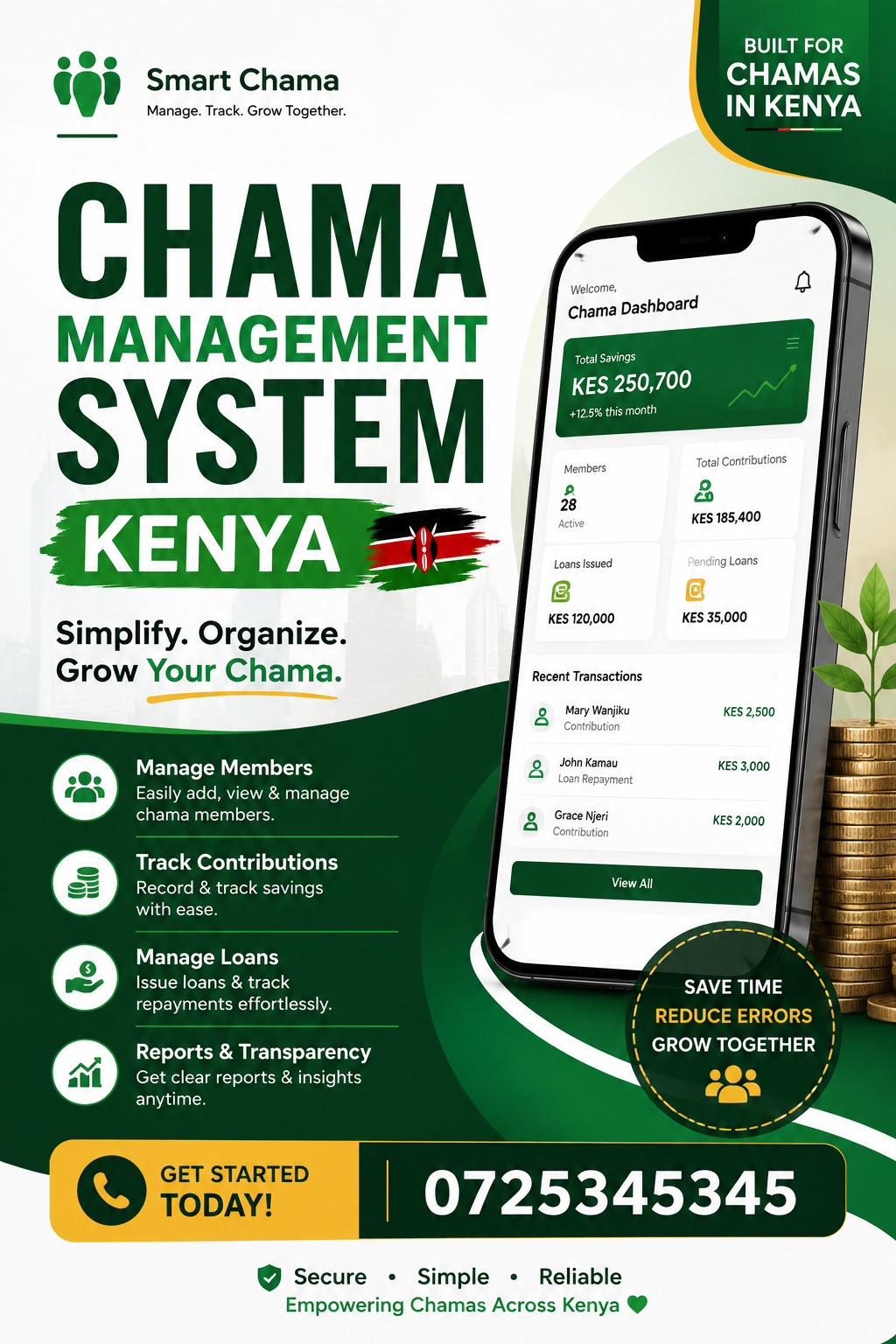
Chama Management System Kenya: A Complete Guide for Savings and Investment Groups
Managing a successful chama requires accurate records, transparent financial processes, reliable communication and clear accountability among members. As a group grows, relying entirely on notebooks, WhatsApp messages and separate spreadsheets can make contributions, loans, expenses and member balances increasingly difficult to manage. A Chama Management System Kenya provides a structured digital platform where Kenyan savings groups, investment groups, table-banking associations and welfare groups can organise important operations in one place. This guide explains the essential features, benefits, financial processes, security considerations and practical factors groups should examine before moving from manual administration to specialised chama software.
Kenyan chamas operate in different ways. Some concentrate on monthly savings, others provide loans to members, while investment groups may pool funds for property, businesses, shares or other projects. Because these groups have different structures, the right Chama Management System Kenya should be flexible enough to support the group’s constitution, contribution rules, loan policies and reporting requirements.
What Is a Chama Management System?
A Chama Management System Kenya is software designed to help chamas manage administrative and financial activities digitally. Instead of storing member information in one spreadsheet, contributions in another workbook and loan information in a notebook, authorised officials can manage these records from a central platform.
Typical functions include member registration, savings tracking, contribution management, loan administration, repayment monitoring, penalties, expenses, meeting records and financial reporting.
The purpose of a Chama Management System Kenya is not simply to replace paper with a computer screen. Its real value comes from creating consistent procedures for recording transactions, reviewing balances, producing reports and maintaining an organised history of the chama’s activities.
For example, when a member wants to confirm how much they have contributed, the treasurer should not have to search through months of WhatsApp messages and bank statements. A properly maintained system can provide the relevant transaction history much more efficiently.
Why Chamas Need Better Record Management
A small chama with five friends may initially manage its activities comfortably using a notebook or spreadsheet. Problems often begin when membership increases and the group starts handling larger amounts of money.
A Chama Management System Kenya becomes particularly useful when officials are managing several financial activities simultaneously.
These may include:
- Monthly member contributions
- Registration fees
- Welfare contributions
- Investment contributions
- Member loans
- Loan repayments
- Interest
- Fines and penalties
- Group expenses
- Investment income
- Special projects
Keeping all these records manually can consume valuable meeting time.
A Chama Management System Kenya can help officials organise each transaction under the correct member, account or activity. This improves the ability of the chairperson, treasurer, secretary and other authorised officials to understand the group’s financial position.
Better records also make questions easier to resolve. If a member believes a contribution is missing, the group can examine the transaction history rather than depending entirely on someone’s memory.
Centralised Member Management
Member information is one of the foundations of chama administration.
A Chama Management System Kenya should allow officials to create and maintain an organised member register.
Depending on the group’s requirements, a member profile may contain:
- Full name
- Telephone number
- Email address
- Membership number
- Joining date
- Membership status
- Contribution information
- Loan information
- Assigned roles
- Supporting documents
Centralising this information reduces duplication.
Without a Chama Management System Kenya, one official may have an old telephone number while another administrator has the updated contact details. Maintaining one authorised member record helps reduce such inconsistencies.
It can also simplify membership reporting. Officials can quickly determine how many members are active, inactive, suspended or newly registered.
Contribution Management
Contributions are central to most chamas.
A Chama Management System Kenya should provide an organised way of recording contributions against individual members.
Different groups may collect different types of contributions. These can include regular savings, welfare contributions, project contributions, investment funds and emergency collections.
The system should ideally allow these transactions to remain distinguishable.
For example, if a member pays KSh 10,000, the group may need to know whether the payment represents monthly savings, a loan repayment or a special project contribution.
Using a Chama Management System Kenya helps reduce the risk of treating all incoming money as one unexplained figure.
Detailed records also make member statements more meaningful because every transaction can be associated with a date, category and amount.
Tracking missed contributions
Many chamas have rules concerning late or missed contributions.
A Chama Management System Kenya can help authorised officials identify members who have not fulfilled their contribution obligations for a particular period.
Instead of manually checking every name against a spreadsheet, the system can provide structured records that make outstanding balances easier to identify.
The committee can then follow its constitution when deciding whether reminders, penalties or other measures apply.
Savings Management
Savings records should provide more than a single balance.
Members often want to understand how their balance developed over time.
A Chama Management System Kenya can maintain an individual transaction history showing contributions, adjustments and other relevant entries.
This level of detail supports transparency.
For example, two members may have identical balances but completely different transaction histories. One may have contributed consistently throughout the year, while another may have made several larger payments later.
Detailed records make those differences visible.
A Chama Management System Kenya can therefore become an important reference point when members review savings statements before an annual general meeting or major investment decision.
Loan Management for Kenyan Chamas
Many chamas provide loans to members from pooled savings.
Loan administration can become complicated because the group must track applications, approvals, disbursements, interest, repayment schedules, guarantors and outstanding balances.
A Chama Management System Kenya can organise these processes more clearly than maintaining separate loan books.
Loan applications
The software may allow officials to record:
- Applicant name
- Amount requested
- Application date
- Proposed repayment period
- Purpose
- Guarantors
- Approval status
This creates a structured history of each request.
A Chama Management System Kenya should also make it possible for authorised decision-makers to review relevant information before approving a loan.
Depending on the group’s policy, officials may examine existing loans, previous repayment behaviour and available member savings.
Software does not make the lending decision on behalf of the chama. It provides the information necessary for authorised people to make that decision.
Loan repayment tracking
Once money has been borrowed, repayment records become extremely important.
A Chama Management System Kenya can help distinguish principal repayments, interest and penalties where applicable.
For example, a member may repay KSh 15,000 in one month. Officials should be able to understand how the payment affects the outstanding loan balance.
Accurate repayment information also makes it easier to prepare statements and identify overdue loans.
Guarantor management
Guarantors are common in chama lending arrangements.
A Chama Management System Kenya can maintain records connecting borrowers with their guarantors.
This information may help a committee understand the commitments a member already has before allowing them to guarantee another loan.
Because guarantor policies differ between groups, the chama should test this functionality carefully before selecting software.
M-Pesa and Digital Payments
Mobile money has become a practical method of collecting contributions for many Kenyan groups.
A Chama Management System Kenya may support payment workflows that make M-Pesa transactions easier to identify and reconcile.
The exact functionality depends on the platform.
Groups should not assume that every system offering “M-Pesa integration” behaves in the same way.
Ask the provider to demonstrate how the Chama Management System Kenya handles an actual payment from beginning to end.
Important questions include:
- How does the system identify the member?
- What payment reference should members use?
- How is the transaction allocated?
- What happens when an incorrect reference is entered?
- Can officials correct an allocation?
- Can a receipt be generated?
- Is there an audit trail?
These practical demonstrations are more valuable than simply seeing M-Pesa listed on a features page.
Managing Income and Expenses
Chamas receive and spend money for many reasons beyond ordinary contributions.
A Chama Management System Kenya should allow financial transactions to be organised into meaningful categories.
Possible income categories include:
- Loan interest
- Investment returns
- Penalties
- Registration fees
- Project income
Possible expenses include:
- Meeting expenses
- Bank charges
- Administration
- Welfare payments
- Investment expenses
- Professional services
When a Chama Management System Kenya categorises transactions correctly, the committee can understand where money is coming from and where it is going.
This provides far more useful information than recording every outgoing payment under a general label such as “expenses.”
Financial Reporting
Good decision-making depends on reliable information.
A Chama Management System Kenya should provide reports that help officials understand the financial position of the group.
Depending on the software, reports may cover:
- Member contributions
- Savings
- Outstanding contributions
- Active loans
- Loan repayments
- Overdue loans
- Income
- Expenses
- Member statements
- Financial summaries
The objective of a Chama Management System Kenya is to reduce the amount of manual work required before the committee can access this information.
Instead of spending several evenings combining spreadsheets, officials should be able to retrieve structured reports from records already maintained in the system.
Member statements
Individual statements are particularly valuable.
A Chama Management System Kenya can help provide each member with a clear history of relevant transactions.
A statement may include contributions, loan activity, repayments and other balances depending on the group structure.
When statements are clear, members can raise questions early rather than discovering discrepancies after several years.
Meeting and Minutes Management
Chamas are governed through decisions made by members and committees.
A Chama Management System Kenya can help maintain administrative records alongside financial information.
Meeting-related records may include:
- Meeting date
- Attendance
- Agenda
- Minutes
- Resolutions
- Assigned responsibilities
- Follow-up actions
Keeping these records organised helps establish why particular financial or administrative decisions were made.
For instance, when a chama changes its monthly contribution amount, the relevant resolution can provide a clear historical reference.
User Roles and Access Permissions
Financial information should not be editable by everyone.
A Chama Management System Kenya should provide appropriate access controls so users only perform activities related to their responsibilities.
A typical group may have:
| Role | Typical Responsibility |
|---|---|
| Chairperson | Oversight and approvals |
| Treasurer | Financial transactions |
| Secretary | Membership and meetings |
| Loan committee | Loan review |
| Auditor | Financial review |
| Administrator | System configuration |
| Member | Personal information where available |
The exact permissions within a Chama Management System Kenya should reflect the chama’s governance structure.
A secretary, for example, may need permission to update member contacts but may not need permission to modify completed financial transactions.
This separation of responsibilities helps strengthen internal controls.
Audit Trails and Accountability
Mistakes can occur even when good software is used.
What matters is whether corrections are transparent.
A Chama Management System Kenya with audit capabilities can help authorised reviewers identify when records were created or changed.
Ideally, administrators should be able to understand:
- What changed
- When it changed
- Who made the change
- What the previous record contained
This can be especially useful when financial discrepancies are investigated.
An audit history within a Chama Management System Kenya does not eliminate the need for responsible leadership, regular financial reviews or independent audits where appropriate.
It simply provides better information for accountability.
Data Security and Backups
Chama records may contain financial and personal information.
Security should therefore be considered before purchasing any software.
A Chama Management System Kenya should have clear procedures around user authentication, access permissions, data storage and backups.
Questions worth asking include:
- How are user accounts protected?
- Are administrators able to revoke access?
- How frequently are backups performed?
- Can deleted or damaged information be recovered?
- Can the chama export its records?
- How are system changes recorded?
The committee should also remember that the security of a Chama Management System Kenya depends partly on how users behave.
Administrators should avoid sharing passwords, using easily guessed credentials or allowing former officials to retain access after leaving their positions.
Cloud-Based Chama Software
Cloud systems allow authorised users to access information through an internet connection rather than relying on a single office computer.
A Chama Management System Kenya delivered through the cloud can be useful for groups whose officials live or work in different places.
For example, a treasurer in Nairobi and a secretary in Nakuru may need access to different parts of the same group records.
Cloud access can support this type of collaboration.
However, a Chama Management System Kenya should still provide appropriate security controls. Being accessible online does not mean every user should see or change every record.
Chama Software for Investment Groups
Investment chamas may have more complex records than ordinary savings groups.
A Chama Management System Kenya for an investment group may need to accommodate contributions toward property, businesses, agriculture, shares or other projects.
The committee should determine how investments need to be recorded.
Relevant information could include:
- Investment name
- Amount invested
- Date
- Associated expenses
- Income received
- Ownership information
- Supporting documents
- Project status
Before purchasing a Chama Management System Kenya, investment groups should test whether the software can represent their actual investment structure.
If specialised investment accounting is required, the provider should explain clearly what the system can and cannot handle.
Welfare Groups and Benevolent Funds
Not every chama focuses exclusively on investments.
Some groups maintain welfare funds to assist members during specific events.
A Chama Management System Kenya can help separate welfare contributions from ordinary member savings where the group’s rules require them to be maintained independently.
This separation makes reporting clearer.
For example, members can understand how much has been collected for welfare without confusing that balance with money intended for investment.
A Chama Management System Kenya can also provide a record of approved welfare payments, helping the group maintain accountability around how the fund is used.
Table Banking
Table banking groups often collect contributions, issue loans and record repayments during regular meetings.
This means administration can become intensive within a short period.
A Chama Management System Kenya can help officials record these activities in an organised format instead of updating several paper records during the meeting.
Before implementation, the group should test its full table-banking workflow.
For example:
- Member attends meeting.
- Contribution is recorded.
- Existing loan repayment is entered.
- New loan application is reviewed.
- Approved loan is recorded.
- Updated balance is generated.
If a Chama Management System Kenya can handle this workflow effectively, it can reduce administrative work and improve the consistency of group records.
Merry-Go-Round Groups
Merry-go-round structures differ from conventional savings groups because members may receive pooled contributions according to an agreed schedule.
A Chama Management System Kenya intended for such a group should be evaluated against that specific process.
The group may need to record:
- Member contribution obligations
- Payment status
- Rotation order
- Recipient history
- Missed payments
- Penalties
Because software platforms differ, officials should not assume every feature will be available automatically.
The provider should demonstrate how the Chama Management System Kenya would handle the chama’s real rotation rules before the committee commits to using it.
How to Choose the Right Chama Software
Selecting software should begin with understanding the group’s own requirements.
Do not start by comparing hundreds of features.
Start by identifying what the chama actually does.
A Chama Management System Kenya should solve genuine administrative problems rather than introducing unnecessary complexity.
Step 1: Review your current records
List everything currently maintained.
This might include:
- Member register
- Contribution workbook
- Loan book
- Expense records
- Bank statements
- M-Pesa statements
- Meeting minutes
- Investment files
Then identify which records are hardest to maintain.
Step 2: Identify recurring challenges
Ask officials what consumes the most time.
A Chama Management System Kenya may be particularly valuable when the committee regularly struggles with reconciliation, loan balances, reporting or contribution tracking.
Document these problems before evaluating software.
Step 3: Define essential features
Separate essential requirements from optional features.
For example, a chama offering loans may consider loan and guarantor management essential, while another group may not need these features at all.
Step 4: Request a practical demonstration
Do not rely only on screenshots.
Ask the provider to demonstrate the Chama Management System Kenya using realistic scenarios.
A useful test could be:
“Register a new member, record their contribution, issue a loan, record a repayment and generate their statement.”
This quickly shows whether the system is practical.
Questions to Ask the Software Provider
The committee should prepare questions before selecting a Chama Management System Kenya.
Important questions include:
Contributions
- Can we configure different contribution types?
- Can we identify outstanding contributions?
- Can corrections be made with an audit history?
Loans
- Can we configure our loan rules?
- Can the system manage guarantors?
- Can repayments and balances be tracked?
Reporting
- Can we generate member statements?
- Can we export reports?
- Can reports be filtered by date?
Security
- What permissions can administrators receive?
- How are backups handled?
- Can former officials be removed immediately?
Support
- Is onboarding provided?
- Is training included?
- How are technical issues reported?
These questions help determine whether a Chama Management System Kenya fits the group’s needs rather than merely looking attractive during a sales presentation.
Pricing Considerations
Software pricing can vary depending on membership size, features, integrations, support arrangements and billing periods.
A chama should examine total value rather than choosing the lowest advertised price.
When evaluating a Chama Management System Kenya, ask whether the quoted cost includes:
- Initial setup
- Data migration
- Administrator accounts
- Member accounts
- Training
- Support
- M-Pesa integration
- Reports
- Backups
- Upgrades
A cheaper platform can become more expensive if important capabilities require separate charges.
Similarly, paying for a very complex Chama Management System Kenya may not make sense if the group uses only a small percentage of its features.
The goal is to find an appropriate balance between functionality, usability and cost.
Moving from Excel to a Chama Management Platform
Many groups already have years of information stored in spreadsheets.
Moving to a Chama Management System Kenya should therefore be planned carefully.
Clean the data first
Do not automatically import every existing record.
Review:
- Duplicate members
- Missing contact information
- Incorrect balances
- Old loans
- Duplicate transactions
- Unclear adjustments
Errors that already exist in Excel should not be carried into the new system.
Confirm opening balances
Before implementing the Chama Management System Kenya, the treasurer and committee should agree on verified opening balances.
Members may also be given an opportunity to review their information where appropriate.
Starting with trusted records improves confidence in the new system.
Train users
Training should reflect each person’s responsibilities.
The secretary may focus on membership and meetings, while the treasurer requires deeper training on financial transactions and reporting.
Avoiding Common Implementation Mistakes
Technology does not automatically improve administration.
A Chama Management System Kenya will only provide value if officials use it consistently.
Common mistakes include:
- Continuing to maintain several unofficial spreadsheets
- Sharing administrator passwords
- Failing to record transactions promptly
- Giving excessive permissions
- Importing incorrect data
- Skipping training
- Ignoring backup procedures
- Failing to reconcile balances
A successful Chama Management System Kenya implementation requires clear responsibilities.
The committee should decide who records transactions, who reviews them and who can authorise corrections.
Improving Transparency
Financial transparency is essential in any member-based organisation.
A Chama Management System Kenya can support transparency by making records easier to retrieve and review.
For example, a member questioning their savings balance can be shown the relevant transaction history.
Similarly, a committee discussing loan arrears can review outstanding balances without relying entirely on verbal reports.
A Chama Management System Kenya can therefore provide a shared source of structured information, although responsible governance remains necessary.
Software cannot compensate for weak leadership, unclear rules or deliberate misuse of funds.
Supporting Better Meetings
Some chama meetings spend significant time confirming contributions, correcting balances and discussing record discrepancies.
A Chama Management System Kenya can reduce this administrative burden when records are updated consistently.
Officials can prepare reports before the meeting and use meeting time for more valuable discussions such as investments, loan policies, member welfare and future plans.
This can make meetings more productive without removing the need for financial review.
Data Ownership and Export
A chama should understand what happens to its information if it stops using a particular provider.
Before adopting a Chama Management System Kenya, ask whether important records can be exported.
These may include:
- Member information
- Contribution records
- Loan records
- Repayments
- Expenses
- Reports
- Meeting information
The ability to export data provides practical flexibility.
A group should not discover only after cancelling a subscription that retrieving information from its Chama Management System Kenya is difficult.
Mobile Accessibility
Many chama officials conduct group activities using smartphones.
Mobile accessibility can therefore make software easier to use.
A Chama Management System Kenya that works properly on smartphones allows authorised officials to check records without always requiring a desktop computer.
Groups should test common tasks on the devices they actually use.
For example:
- Finding a member
- Checking a contribution
- Reviewing a loan
- Viewing a statement
- Opening a report
Mobile compatibility should be tested during the demonstration rather than assumed.
Measuring Success After Implementation
After adopting a Chama Management System Kenya, the committee should evaluate whether it has genuinely improved administration.
Possible indicators include:
- Faster report preparation
- Fewer unexplained balances
- Easier contribution reconciliation
- Better access to loan information
- Faster retrieval of member records
- More consistent statements
- Reduced dependence on spreadsheets
User adoption also matters.
If only one official uses the Chama Management System Kenya while everyone else continues maintaining separate records, the implementation has not achieved its full purpose.
The committee should investigate why users are avoiding the platform and address training, usability or workflow problems.
Frequently Asked Questions
What does chama management software do?
It helps Kenyan savings and investment groups organise members, contributions, loans, repayments, expenses, meetings and reports digitally. The exact capabilities depend on the provider and package selected.
Can the software manage different contribution types?
A suitable platform should support the contribution structure used by the group. Chamas should confirm this during a demonstration because requirements can differ considerably.
Can it handle chama loans?
Many platforms offer loan modules that record applications, approvals, repayments, interest and outstanding balances. Groups using guarantors should also verify that guarantor management is supported.
Does it automatically connect to M-Pesa?
That depends on the provider. Some solutions support M-Pesa workflows or integrations, while others may require different reconciliation methods. Always ask for a practical demonstration.
Can members view their balances?
Some systems provide member access or statements. The group should confirm exactly what information members can see and whether access permissions can be controlled.
Is chama software better than Excel?
Excel can work for simple groups, but dedicated software may provide structured member management, loan workflows, access permissions, reporting and audit history that become increasingly difficult to maintain across multiple spreadsheets.
Can a chama export its information?
This depends on the software. Data export should be discussed before purchase, especially for important financial and member records.
Does a digital system replace the chama constitution?
No. Software supports administration. The group’s constitution, policies, approvals and governance structures still determine how the chama operates.
How should a chama prepare before changing systems?
The group should clean existing records, verify balances, document its processes, establish administrator roles, test the system and train users before fully migrating.
What is the most important feature to look for?
There is no single feature that suits every group. The most important requirement is that the platform correctly supports the chama’s actual contribution, loan, payment and reporting processes.
Why a Digital Chama Platform Can Support Growth
As a chama grows, administrative complexity usually grows with it.
A group that initially handles only monthly contributions may eventually introduce loans, investments, welfare activities and specialised committees.
Organised technology allows records to develop alongside those activities.
The right system can help officials maintain a consistent member register, trace transactions, understand loan balances and prepare useful reports.
More importantly, digitisation can reduce dependence on individual officials.
When information is stored only in the treasurer’s personal spreadsheet, the chama becomes heavily dependent on that person.
A properly managed central platform provides greater organisational continuity.
Final Checklist Before Selecting a Platform
Before signing up, the committee should confirm the following:
- Member registration works correctly.
- Contribution categories match group rules.
- Loan calculations fit the chama’s policy.
- Guarantors can be recorded where required.
- Payments can be reconciled.
- Reports provide useful information.
- Administrators have appropriate permissions.
- Audit records are available where necessary.
- Backups are explained clearly.
- Data can be exported.
- Training is available.
- Pricing is understood.
- Support channels are clear.
- The system is usable on the devices officials rely on.
The committee should also request a realistic demonstration rather than making a decision from marketing material alone.
Conclusion
Running a successful Kenyan chama requires much more than collecting contributions. Officials must maintain accurate member information, track savings, administer loans, record repayments, manage expenses, document decisions and provide members with reliable financial information. When these activities are spread across notebooks, spreadsheets and chat messages, administration becomes harder as the organisation expands.
Specialised chama software provides a way to centralise those activities and create more consistent records. It can help officials retrieve information faster, prepare reports more efficiently, monitor loans, reconcile contributions and strengthen transparency.
The best platform is not necessarily the one with the longest feature list. It is the one that matches the chama’s constitution, workflows, financial activities and level of technical ability. Groups should therefore define their requirements, verify existing records, test important workflows, understand security arrangements and review data-export options before making a decision.
With appropriate implementation, clear administrator responsibilities and accurate data, digital chama management can support stronger organisation and give members better visibility into their group’s activities.