 Chama Software Kenya refers to digital software designed to help Kenyan savings groups, investment groups, welfare groups, table-banking groups and community organisations manage their daily activities more efficiently.
Instead of relying entirely on notebooks, Excel spreadsheets, WhatsApp conversations and manually calculated financial statements, Chama Software Kenya gives group officials a structured digital environment for managing important records.
A modern chama can have many responsibilities.
Members make regular contributions.
Some members may borrow money.
Loans need repayment schedules.
The group may collect penalties.
The committee may approve expenses.
Meetings need to be recorded.
Financial reports need to be prepared.
Members may want to understand their individual balances.
As these activities increase, administration can become complicated.
This is where Chama Software Kenya becomes useful.
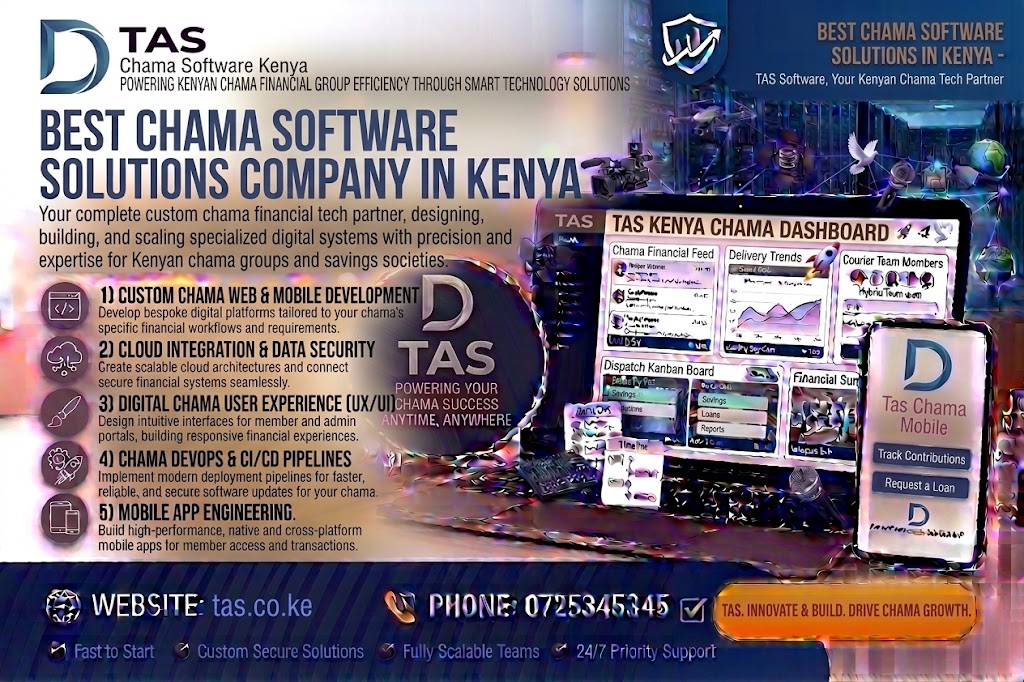
TAS provides digital tools designed around member administration, contributions, loans, income, expenses, meetings and reporting. Its published information also describes role-based access, cloud hosting, backups, audit history and data export capabilities.
For groups interested in learning more about chama management systems, TAS also provides a detailed chama management system guide.
Why Chamas Need Chama Software Kenya
Many chamas begin with simple administration.
A secretary writes member names in a notebook.
A treasurer records contributions in an Excel file.
Loan information is stored in another spreadsheet.
Meeting information may be kept in a notebook.
Payment confirmations may be stored in WhatsApp messages.
This approach can work when the group is very small.
However, the situation changes when membership increases.
Imagine a chama with 20 members.
It may be relatively easy to know who has contributed.
Now imagine the same group grows to 100 members.
The group may have hundreds of monthly transactions.
Some members may have loans.
Others may have outstanding contributions.
There may be welfare payments, expenses, investments and penalties.
At this stage, manual administration becomes increasingly difficult.
Chama Software Kenya helps bring these activities together.
Instead of asking several officials to search through different files, authorised users can work from a central digital record.
The result can be faster administration, easier reporting and improved visibility.
How Chama Software Kenya Works
The basic concept behind Chama Software Kenya is centralisation.
A chama creates its organisation account and configures its basic rules and administrative structure.
Members can then be recorded in the system.
Contributions can be entered against the appropriate members.
Loans can be recorded and monitored.
Expenses can be documented.
Meetings can be managed.
Reports can be generated from the available records.
A typical workflow can look like this:
Member → Contribution → Loan → Repayment → Expense → Meeting → Report
Rather than maintaining disconnected information, the system connects related activities.
For example, when a member contributes money, the contribution should be associated with the correct member and period.
When that member takes a loan, the loan record should be associated with the member.
When repayment occurs, the payment should affect the loan balance.
This connected approach is one of the main advantages of Chama Software Kenya.
Chama Software Kenya for Member Management
One of the most important functions of Chama Software Kenya is member management.
Every chama needs an accurate member register.
The register may include:
- Member name
- Phone number
- Membership status
- Joining date
- Contribution information
- Loan information
- Guarantor information
- Other approved member details
Without a reliable member register, other financial records can become difficult to manage.
For example, two members may have similar names.
A treasurer could accidentally record a contribution under the wrong person.
A spreadsheet may contain duplicate records.
A paper register may not be updated when a member leaves.
Chama Software Kenya can provide a central member record that authorised officials can update and review.
TAS also publishes information about its chama member management capabilities and explains how a central member record can reduce fragmented records.
For broader digital business systems, Zamacore develops custom software, SaaS platforms, dashboards and business systems for Kenyan organisations.
Chama Software Kenya for Contribution Tracking
Contributions are at the heart of many chamas.
Members may contribute weekly, monthly or according to rules established in the group’s constitution.
A group might have several contribution categories.
For example:
- Monthly savings
- Welfare contribution
- Investment contribution
- Emergency fund
- Development fund
- Special project contribution
Keeping track of all these manually can be difficult.
Chama Software Kenya can help officials organise contribution information according to the group’s approved structure.
A treasurer can determine:
- Who has paid?
- Who has not paid?
- How much has each member contributed?
- What is the total contribution?
- Which contribution period is outstanding?
- Which members have arrears?
This information can be particularly useful before chama meetings.
Instead of spending hours calculating figures, officials can use organised records to prepare reports.
TAS describes contribution tracking as one of its core chama-management workflows.
Chama Software Kenya for Loan Management
Many investment and savings groups provide loans to members.
Loan administration requires accuracy.
A typical loan process may involve:
- Member submits application.
- Loan request is reviewed.
- Guarantors are identified.
- Loan is approved.
- Repayment schedule is created.
- Member makes repayments.
- Balance is updated.
- Loan is eventually closed.
Doing this entirely through notebooks and spreadsheets can create problems.
Interest calculations may be incorrect.
Repayments may be forgotten.
Outstanding balances may be unclear.
Guarantor information may become difficult to trace.
Chama Software Kenya can provide a structured environment for managing the loan lifecycle.
TAS publishes a dedicated guide explaining its chama loan-management workflows, including applications, guarantors, repayment schedules and reporting.
A chama should nevertheless configure its loan processes according to its constitution and approved financial policies.
Software should support the group’s rules rather than replace them.
Chama Software Kenya for Financial Management
Financial management is another important reason groups consider Chama Software Kenya.
A chama may receive money from member contributions.
It may generate income from loans.
It may pay expenses.
It may purchase investments.
It may have administrative costs.
All these activities should be properly recorded.
A digital system can help create a clearer financial trail.
Common records may include:
- Income
- Expenses
- Contributions
- Loans
- Loan repayments
- Penalties
- Investments
- Cashbook entries
- Member balances
TAS’s published chama guides describe connected records covering contributions, income, expenses, loans, meetings and reports.
This makes Chama Software Kenya particularly useful for treasurers who need reliable information before preparing financial reports.
Chama Software Kenya for Meetings and Governance
Chamas are not only financial organisations.
They are also governed by meetings, committees and group decisions.
A typical chama may have:
- Chairperson
- Secretary
- Treasurer
- Credit committee
- Members
- Investment committee
Meetings may determine:
- Loan approvals
- New members
- Group investments
- Expenses
- Contribution changes
- Penalties
- Project decisions
Chama Software Kenya can help connect meetings with the operational records of the group.
Meeting minutes can document decisions.
Actions can be assigned.
Officials can later review what was agreed.
This creates better continuity when leadership changes.
For example, when a new treasurer takes over, they should not have to depend entirely on the previous treasurer’s personal files.
The organisation should retain its records.
Chama Software Kenya and Transparency
Transparency is one of the strongest reasons to digitise chama administration.
Members want to understand how group money is being managed.
They may ask:
How much have I contributed?
Do I have an outstanding loan?
How much have I repaid?
What expenses has the group incurred?
How much money is available?
What investments does the chama have?
Chama Software Kenya can help officials answer these questions using organised records.
The objective is not simply to create attractive dashboards.
The important objective is to make information understandable and traceable.
TAS’s published guidance highlights the importance of audit history, permissions and explainable records when evaluating chama software.
Chama Software Kenya Compared With Spreadsheets
Excel remains useful.
A spreadsheet can help a new chama begin recording information.
However, spreadsheets can become difficult to manage as complexity increases.
A chama might eventually have:
- Member spreadsheet
- Contribution spreadsheet
- Loan spreadsheet
- Expense spreadsheet
- Investment spreadsheet
- Meeting spreadsheet
The challenge is that these files may not automatically communicate with each other.
One officer may update one file.
Another officer may use an older version.
A formula may accidentally be changed.
A row may be deleted.
A password may be forgotten.
Chama Software Kenya is built around the idea of connected workflows.
Instead of adapting a general spreadsheet to every chama process, the organisation uses a system designed around member-based administration.
This can make administration more structured.
Benefits of Chama Software Kenya
There are many potential benefits of adopting Chama Software Kenya.
1. Centralised Records
Members, contributions, loans and other records can be organised within one environment.
2. Faster Reporting
Officials can spend less time manually combining information.
3. Better Accountability
Transactions can be connected to the appropriate records.
4. Easier Member Management
The group can maintain a structured membership register.
5. Improved Loan Tracking
Loans and repayments can be monitored more systematically.
6. Better Leadership Handover
Incoming officials can access the organisation’s approved records.
7. Reduced Manual Work
Routine administration can become more organised.
8. Better Financial Visibility
Treasurers can access relevant financial information more efficiently.
9. Improved Governance
Roles and permissions can help separate responsibilities.
10. Scalable Administration
A digital platform can support a chama as membership and transactions grow.
Who Can Use Chama Software Kenya?
Chama Software Kenya is not limited to one type of savings group.
Potential users include:
Investment Chamas
Investment groups can use digital systems to organise members, contributions, expenses and investment-related records.
Savings Groups
Groups that save money regularly can use software to track contributions and balances.
Welfare Groups
Welfare associations can use organised records to manage membership and approved welfare contributions.
Table Banking Groups
Table-banking organisations can benefit from structured contribution and lending records.
Women’s Groups
Women’s investment and savings groups can use digital systems to reduce manual administration.
Youth Groups
Youth groups can establish organised records from an early stage.
Family Investment Groups
Family-based investment organisations can use central records to improve visibility.
Community Organisations
Community savings groups can use digital systems to manage members and finances.
The right Chama Software Kenya solution should always be selected according to the organisation’s actual rules and requirements.
How to Choose Chama Software Kenya
Choosing Chama Software Kenya should not be based only on price.
A committee should evaluate the system using real workflows.
Consider the following.
Member Management
Can the platform maintain an accurate member register?
Contribution Tracking
Can the system record different contribution categories?
Loan Management
Can it manage loan applications, guarantors and repayments?
Financial Records
Can it record income and expenses?
Reporting
Can the committee generate useful reports?
User Permissions
Can different officials have appropriate access?
Data Export
Can the organisation retrieve its records when necessary?
Security
What controls protect member information?
Backups
How are records protected against data loss?
Support
Can users receive help when they experience problems?
Scalability
Can the system accommodate future growth?
TAS recommends testing actual workflows instead of choosing a system based only on a feature list.
Chama Software Kenya and Data Security
Financial and membership information should be handled carefully.
A chama may store:
- Names
- Phone numbers
- Contribution records
- Loan records
- Financial information
- Meeting records
- Member status
This means security should be part of the software-selection process.
Ask the provider about:
- User permissions
- Password security
- Backups
- Audit history
- Data export
- Access control
- Hosting
- Account recovery
Chama Software Kenya should not simply make records digital.
It should help authorised users manage those records responsibly.
TAS publishes role-based access, cloud hosting, backups and audit-history capabilities as part of its platform information.
For organisations that need additional technology infrastructure, security and IT solutions, ZES provides biometric attendance, access control, CCTV, networking and related technology solutions in Kenya.
Chama Software Kenya for Growing Groups
A small chama may have ten members.
Later it may have 50 members.
Eventually it may have 100, 200 or even more members.
Growth creates additional administrative requirements.
There may be more:
- Transactions
- Loans
- Repayments
- Reports
- Meetings
- Expenses
- Members
- Administrative users
Chama Software Kenya can provide a foundation for managing this growth.
TAS currently publishes different plans based on membership and administrative capacity. Its public pricing information lists Essential for up to 100 members and Growth for up to 500 members, subject to the provider’s current terms.
Groups should always verify current pricing before purchasing.
Chama Software Kenya for Treasurers
The treasurer often carries significant administrative responsibility.
They may be responsible for:
- Recording contributions
- Recording income
- Recording expenses
- Tracking loans
- Recording repayments
- Preparing reports
- Reconciling payments
- Presenting financial information
This can become overwhelming when everything is done manually.
Chama Software Kenya can help the treasurer work from a structured system.
A good workflow might be:
Payment → Member → Transaction → Balance → Report
The treasurer can then focus more on reviewing information rather than repeatedly rebuilding it.
TAS has also published dedicated guidance for chama treasurers covering financial records, payments, expenses and reporting.
Chama Software Kenya for Chama Officials
Different officials may need different information.
The chairperson may need governance information.
The secretary may need member and meeting information.
The treasurer may need financial information.
The credit committee may need loan information.
Ordinary members may need access to information relevant to their participation.
This is why role-based access can be important.
Chama Software Kenya can help organisations structure access around responsibilities.
The objective should be simple:
The right person should access the right information for the right purpose.
This can reduce unnecessary access to sensitive records.
Chama Software Kenya and Digital Transformation
Digital transformation does not simply mean buying software.
It means changing how an organisation manages information.
For a chama, digital transformation may involve replacing:
Notebook → Digital member register
Manual calculations → Automated records
Multiple spreadsheets → Centralised system
Scattered loan files → Structured loan workflow
Manual reports → Digital reports
Paper meeting records → Organised meeting records
The technology is only one part of the process.
The chama also needs clear rules.
Officials need training.
Opening balances need verification.
Members need communication.
The group should agree which system is the official source of operational records.
TAS as a Chama Software Kenya Solution
TAS is positioned around digital management for Kenyan chamas and member-based groups.
Its published platform information covers areas including:
- Members
- Contributions
- Loans
- Guarantors
- Income
- Expenses
- Meetings
- Minutes
- Reports
- User roles
- Audit history
- Cloud access
- Backups
- Data export
TAS also publishes a 14-day trial on its public plans.
Groups considering Chama Software Kenya can therefore evaluate TAS against their actual requirements.
The best approach is to test real workflows.
For example:
Test One: New Member
Create a test member.
Confirm that the record is stored correctly.
Test Two: Contribution
Record a contribution.
Check whether it appears correctly in the relevant records.
Test Three: Loan
Create a sample loan.
Add the relevant guarantors.
Record a repayment.
Check the balance.
Test Four: Expense
Record a sample approved expense.
Confirm that the financial records reflect it correctly.
Test Five: Report
Generate a report.
Check whether the information is understandable.
This practical approach is better than choosing software simply because its website lists many features.
Chama Software Kenya and Other Kenyan Digital Platforms
Kenya has a growing digital-business ecosystem.
Different platforms solve different operational problems.
For example, Vega can be relevant to retail businesses looking for point-of-sale and retail-management technology.
Prim is relevant to businesses managing salon, spa and barber operations.
Dexa focuses on driver and courier operations, including orders, riders, payments, parcel tracking and proof of delivery.
Dereva can be relevant to driver-related services.
Zama and Zamacore focus on software, websites, SaaS platforms and business technology.
Spacekits provides Starlink equipment, installation and support in Kenya.
KayaPro360 can be relevant to property and property-management workflows.
Wito can support event-management workflows.
FAMA focuses on farm-management workflows.
RentalDesk provides property-management workflows for landlords and property managers, including rent collection, tenant visibility and reporting.
Pawa can be relevant to Wi-Fi and connectivity-management workflows.
Zivo provides invoicing, expenses, M-Pesa and business-finance workflows.
ZES provides technology, security and IT infrastructure solutions.
Kenya Website Experts provides website design, development and digital experiences for Kenyan businesses.
These platforms have different purposes.
A chama should choose technology according to its actual operational needs rather than selecting software simply because another business uses it.
How Chama Software Kenya Can Improve Accountability
Accountability is essential for member-based organisations.
Members contribute their money with the expectation that it will be managed according to the group’s agreed rules.
A good digital workflow can make it easier to trace:
Who recorded a transaction?
When was it recorded?
Which member was involved?
What amount was involved?
What was the transaction category?
What is the resulting balance?
What report reflects the transaction?
This level of traceability can help committees investigate discrepancies.
It can also make leadership transitions easier.
When a new treasurer takes office, the organisation should not have to depend entirely on the outgoing treasurer’s personal records.
The records belong to the organisation.
Chama Software Kenya for Financial Reporting
Reporting is one of the most important activities in a chama.
Reports can help answer questions such as:
- How much money has been collected?
- What are the group’s expenses?
- Which members have outstanding balances?
- How much has been loaned?
- How much has been repaid?
- What income has been generated?
- What financial position does the group have?
Chama Software Kenya can help organise the information needed to prepare these reports.
TAS has published dedicated guidance on chama financial reporting, explaining how connected member, contribution, loan and expense records can support reporting.
The exact reports available will depend on the selected software and plan.
Chama Software Kenya for Leadership Handover
Leadership changes are common in many chamas.
A treasurer may leave.
A secretary may change.
A new chairperson may be elected.
When records are stored in one person’s notebook or laptop, the transition can become difficult.
Chama Software Kenya can provide a central organisational record.
The new official can learn:
- Current membership
- Previous contributions
- Outstanding loans
- Previous expenses
- Meeting decisions
- Financial reports
This creates continuity.
It also reduces the risk of institutional knowledge disappearing when an official leaves.
How to Implement Chama Software Kenya
Implementing Chama Software Kenya should be done carefully.
Step 1: Review Your Existing Records
Collect current member, contribution and loan records.
Step 2: Verify Information
Check names, balances and outstanding loans.
Step 3: Define Roles
Determine who should access each area.
Step 4: Configure the System
Set up the organisation according to its approved processes.
Step 5: Import or Enter Data
Move verified information into the platform.
Step 6: Test Transactions
Test contributions, loans, repayments and expenses.
Step 7: Train Officials
Make sure committee members understand their responsibilities.
Step 8: Communicate With Members
Explain the new process to members.
Step 9: Establish Review Procedures
Agree how records will be checked.
Step 10: Monitor Performance
Review the system regularly and correct problems early.
Common Mistakes When Choosing Chama Software Kenya
Not every software-selection decision produces the expected result.
Some common mistakes include:
Choosing Only Based on Price
The cheapest option may not support the workflows the group actually needs.
Ignoring Data Export
Ask how the organisation can retrieve its records.
Giving Everyone Administrator Access
Access should reflect responsibilities.
Failing to Test Loans
Loan management is often one of the more complicated workflows.
Ignoring Reports
A system may record transactions but still fail to produce useful reports.
Migrating Incorrect Data
Bad opening balances can create problems later.
Not Training Officials
Even good software requires users who understand the process.
Not Defining Responsibilities
The system cannot compensate for unclear organisational governance.
Frequently Asked Questions About Chama Software Kenya
What is Chama Software Kenya?
Chama Software Kenya is digital software designed to help Kenyan savings, investment, welfare and community groups manage members, contributions, loans, expenses, meetings and financial records.
Why should a chama use Chama Software Kenya?
A chama can use Chama Software Kenya to centralise records, reduce repetitive manual administration, improve reporting and create more structured workflows.
Can Chama Software Kenya manage contributions?
Yes. Contribution management is one of the core functions expected from modern chama-management platforms. Exact functionality depends on the provider.
Can Chama Software Kenya manage loans?
Yes. Many chama-management systems provide loan-related workflows. TAS publishes functionality around loan applications, guarantors, repayment schedules and loan reporting.
Can Chama Software Kenya manage expenses?
Yes. Financial-management functionality can allow approved income and expenses to be recorded and included in reports.
Can Chama Software Kenya manage members?
Yes. Member-management is one of the fundamental functions of chama software.
Is Chama Software Kenya suitable for small chamas?
Yes. Small chamas can use digital systems to establish organised records early.
Is Chama Software Kenya suitable for large chamas?
Yes, provided the selected plan supports the group’s membership, administrative users and transaction requirements.
Can Chama Software Kenya replace a chama constitution?
No.
The constitution defines the group’s rules.
Software should help officials apply and document those rules.
Is Chama Software Kenya better than Excel?
It depends on the organisation.
Excel can be useful for simple records.
However, dedicated Chama Software Kenya can provide structured workflows specifically designed for members, contributions, loans and financial administration.
How much does Chama Software Kenya cost?
Pricing varies by provider, membership capacity, features, support and billing period.
TAS currently publishes quarterly plans, including Essential and Growth, but groups should confirm the latest pricing directly before making a purchasing decision.
Can members access their records?
This depends on the platform and configuration.
Ask the provider what member-facing access is available.
Is Chama Software Kenya secure?
Security depends on the provider’s technology, processes and configuration.
Before choosing a platform, ask about access control, backups, authentication, audit trails, hosting and data export.
Can Chama Software Kenya help with transparency?
Yes.
A structured digital record can make transactions and balances easier for authorised officials and members to review.
What should a chama test before purchasing software?
Test at least:
- Member creation
- Contribution
- Loan application
- Guarantor assignment
- Loan repayment
- Expense
- Meeting record
- Report
- User permissions
- Data export
Chama Software Kenya: The Future of Digital Chama Management
The future of chama administration is increasingly digital.
As groups grow, their financial and administrative requirements become more complex.
A chama that once managed everything in one notebook may eventually need to manage hundreds of members and thousands of transactions.
That requires better organisation.
Chama Software Kenya provides a practical way to move from fragmented records toward a structured digital workflow.
The goal is not technology for its own sake.
The goal is better administration.
The goal is accurate records.
The goal is accountability.
The goal is easier reporting.
The goal is better visibility for authorised officials and members.
A successful chama-management platform should therefore connect the important parts of the organisation.
Members → Contributions → Loans → Repayments → Expenses → Meetings → Reports
When these records are connected, administration becomes easier to understand.
Conclusion: Choose Chama Software Kenya for Smarter Management
Chama Software Kenya can help Kenyan savings groups, investment groups, welfare groups and community organisations move beyond fragmented notebooks, spreadsheets and manual administration.
The right system can help manage:
- Members
- Contributions
- Loans
- Guarantors
- Repayments
- Income
- Expenses
- Meetings
- Reports
- Permissions
- Financial records
However, choosing Chama Software Kenya should not be based on marketing claims alone.
A chama should test the software using real workflows.
Test a member.
Test a contribution.
Test a loan.
Test a repayment.
Test an expense.
Test a report.
Test user permissions.
Test data export.
Then compare the results against the group’s constitution, budget and long-term requirements.
TAS provides a dedicated digital environment for chama administration, with published workflows covering members, contributions, loans, finance, meetings and reporting.
For a chama looking to improve organisation, transparency and financial administration, Chama Software Kenya can provide a strong foundation for modern digital management.
Start by defining your requirements, test the workflows, verify the data controls and choose the platform that best fits the way your chama actually operates.