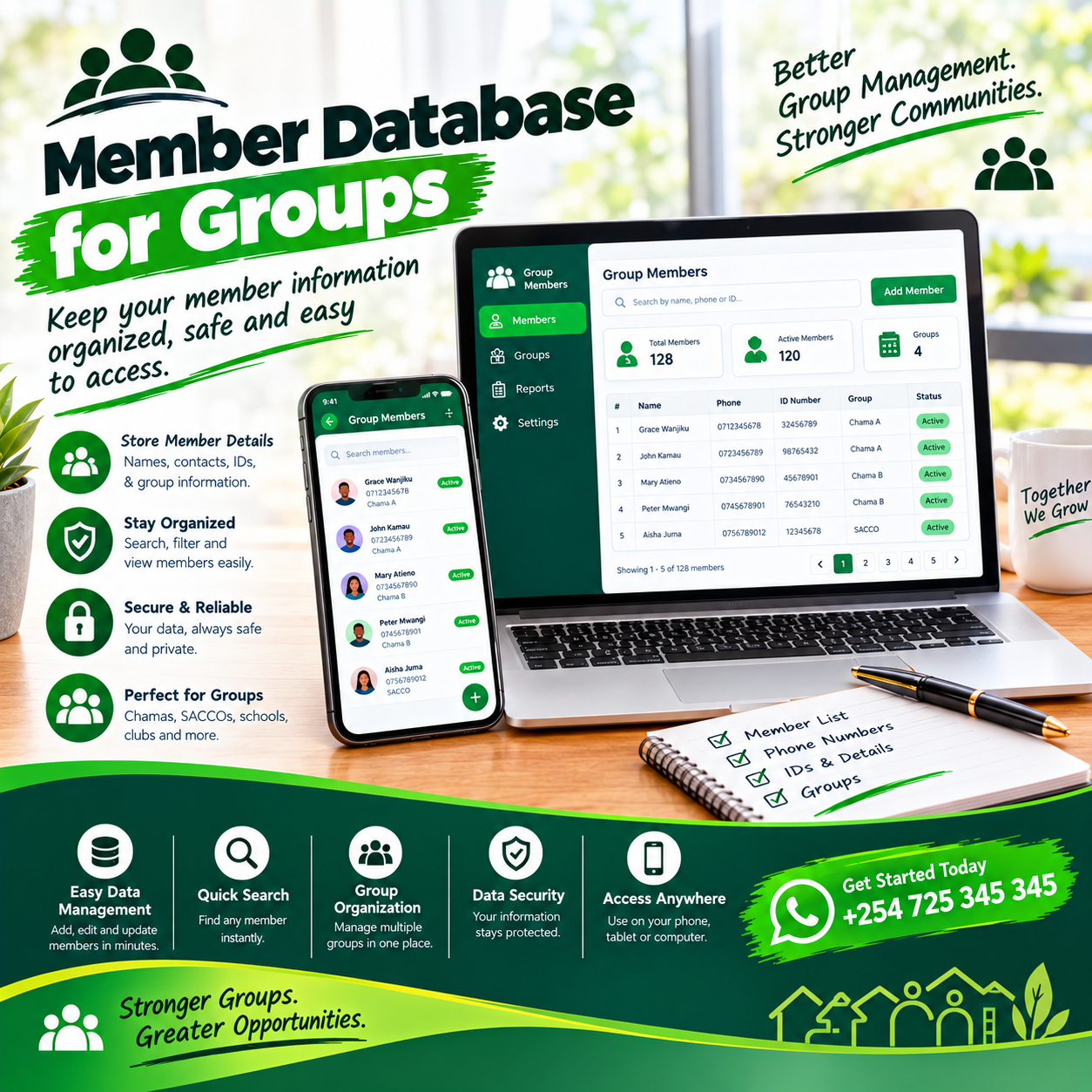
A member database for groups is the quiet foundation beneath every organized chama, SACCO, welfare circle, and investment club in Kenya today. While meetings and money grab the attention, it is the member records that keep everything running behind the scenes.
Groups that master their records move faster, argue less, and grow with confidence. Groups that neglect them eventually pay the price in confusion, disputes, and lost history. That single difference is why building a proper member database for groups deserves a place at the top of every group’s agenda. This guide walks the entire subject from the ground up.
You will learn what a member database really is, which details belong inside it, and how to keep those details accurate for years. By the final section, creating and managing a member database for groups will feel like a project you can start this weekend. The article is written for treasurers, secretaries, chairpersons, and founders alike.
It is equally written for the member who simply wants to know why officials keep asking for their details again. Everyone touched by group life benefits when a member database for groups is done properly.
One truth deserves stating right at the beginning. Groups rarely collapse because they lacked ambition — they collapse because they lacked organized information. A well-built member database for groups is how ambition survives its own success.
Consider what happens as a group grows. Five members are easy to track from memory, but fifty members spread across towns and countries are not. Growth without a member database for groups simply multiplies the confusion.
The good news is that this project costs almost nothing to start. A careful afternoon, a clear structure, and honest data are the only true requirements. Everything else about a member database for groups can be learned right here.
So read on with your group’s current records in front of you. Compare what exists today against the standards described in the coming sections. The gaps you find are exactly what a proper member database for groups is designed to close.
What Is a Member Database for Groups?
A member database for groups is a single, organized store of every member’s essential details and history.
It holds names, contacts, identification information, join dates, financial standing, and activity records in one place. Instead of facts scattered across notebooks, phones, and memories, everything lives in one searchable system. The word “database” sounds technical, but the concept is wonderfully simple.
Think of it as the group’s official memory — one that never forgets, never travels away, and never retires. That permanent memory is the entire purpose of a member database for groups.
A good database serves three audiences at once. Officials use it to run the group, members use it to verify their own standing, and successors use it to inherit clean records. Serving all three well is the design goal of every serious member database for groups.
It is worth separating a true database from casual record keeping. A chat group holds conversations, a notebook holds notes, and a database holds structured, retrievable facts. Structure and retrievability are what distinguish a genuine member database for groups from a pile of papers. The best databases are also living rather than frozen.
Details change, phones change, addresses change, and members join or exit over the years. A living member database for groups is updated deliberately, not reconstructed after the fact.
Finally, a database belongs to the group as an institution. It is not the treasurer’s private notebook or the chairperson’s personal file. Ownership by the group itself is the defining principle of a proper member database for groups.
Why Every Group Needs a Member Database
The first reason is continuity. When officials change, groups with organized records hand over in a week, while groups without them start from scratch. That continuity is the first great gift of a member database for groups.
The second reason is dispute prevention. Most group conflicts begin with two honest people remembering the same detail differently. Written, centralized records are the antidote, which is why a member database for groups is the cheapest peace treaty a group can sign.
The third reason is faster administration. Searching a database takes seconds, while searching memories takes meetings. That speed compounds across every contribution, loan, and query handled through a member database for groups.
The fourth reason is better decisions. Officials who can see membership trends, growth rates, and activity patterns make sharper choices than officials working from guesswork. Evidence-based leadership flows directly from a member database for groups.
The fifth reason is member trust. When members know their details are held safely and can be confirmed instantly, suspicion finds nowhere to grow. That confidence is the social return on a member database for groups.
The sixth reason is compliance readiness. Banks, registration bodies, and partners routinely ask for membership lists and standing records. Groups that maintain a member database for groups produce those documents in minutes rather than weeks.
The seventh reason is welfare delivery. When a member faces tragedy, the group’s response speed depends on having accurate next-of-kin and contact details on hand. Compassion delivered quickly is a deeply human benefit of a member database for groups.
The eighth reason is growth itself.Groups planning to expand beyond twenty members cannot rely on personal memory as a filing system. Scalable organization is exactly what a member database for groups provides.
The ninth reason is protection for officials. Honest leaders are shielded from accusations when every figure and detail can be traced to a record. That armor is a quiet feature of a well-kept member database for groups.
The tenth reason is succession of knowledge itself. Group history, milestones, and member journeys live in the records rather than in departing memories. Institutional memory preserved is the long-term value of a member database for groups.
What Belongs Inside Your Member Database
Building the database starts with deciding what to record. The fields below come from the real needs of Kenyan groups, tested across thousands of meetings. Use them as the skeleton for your own member database for groups. Basic identity comes first.
Every record needs the member’s full legal name, ID or passport number, and a unique member number assigned by the group. Consistent identity data is the anchor of any member database for groups. Contact details come next.
Record the phone number, an alternative number, an email address where available, and the member’s physical residence. Two contact routes per member is the resilience standard inside a member database for groups. Next-of-kin information deserves special care.
Record at least one emergency contact with their relationship to the member and their own phone number. Welfare readiness is built directly into a complete member database for groups.
Joining information belongs on every record. Capture the join date, the founding or induction meeting, and the member’s entry contribution details. Clean history begins at entry in a disciplined member database for groups. Financial standing fields follow.
These include share capital, contribution balances, arrears, loan balances, and guarantee exposure, updated regularly. Money and membership meet in this block of every member database for groups. Role and status fields keep governance clear.
Record each member’s current role, their eligibility status, and whether they are active, on leave, or exited. Governance clarity is a core output of a member database for groups. Attendance and participation records add valuable depth. Meeting attendance, votes cast, and project participation reveal engagement patterns over time.
Participation history is the leadership insight layer of a member database for groups. Documents complete the record. Scanned IDs, signed constitution copies, loan forms, and guarantee agreements should attach to each member’s profile.
Paperwork tied to people is the filing genius of a member database for groups. Finally, record personal preferences where relevant. Communication language, preferred channel, and special occasions help the group serve members with dignity.
Human details humanize a member database for groups beyond mere numbers. Resist the urge to record everything at once. Start with the essential fields above and grow the structure as the group’s needs mature. Gradual completeness is the practical path to a sustainable member database for groups.
Key Features of an Effective Member Database
An effective database is judged by how easily it serves real situations. The features below separate genuine systems from scattered spreadsheets and forgotten notebooks. Test every candidate for your member database for groups against each one. Searchability comes first.
Finding any member by name, number, or phone should take seconds, even as the group grows. Instant retrieval is the foundational feature of a member database for groups. Unique member numbers keep everything clean. Each person receives one permanent identifier that never changes and never gets reused.
Consistent keys are what make a member database for groups reliable for decades. Update history should be visible. When a phone number changes, the old and new entries with dates should both remain traceable. Change tracking is the accountability feature of a member database for groups.
Role-based access protects sensitive details. Officials see what their duties require, while ordinary members see only what concerns them. Controlled visibility is the privacy architecture of a member database for groups. Financial integration saves double work.
When the database connects to contribution and loan records, statements and standings update themselves. Connected data is the efficiency engine of a member database for groups.
Communication tools should live beside the records. Selecting a group of members and sending them a message should take one action. Built-in outreach is the convenience layer of a member database for groups.
Export and backup capability must be guaranteed. The group should download its complete records anytime, in usable formats, without asking permission. Data freedom is the ownership guarantee behind a proper member database for groups.
Reports should emerge without effort. Membership summaries, growth trends, and standing lists should print themselves when the AGM arrives. Effortless reporting is the leadership reward of a member database for groups.
Simplicity rounds out the feature list. The least tech-comfortable official must be able to find, view, and update records without training. Human-friendly design is the adoption secret of every successful member database for groups.
Building Your Database: Spreadsheet Versus Platform
The spreadsheet is where most groups begin, and that is perfectly sensible. A protected file with one row per member and clear columns can serve faithfully for years. Disciplined structure is what makes a spreadsheet-based member database for groups work at all. Build the spreadsheet with intention.
Use data validation for status fields, freeze the header row, and lock formulas so curious clicks cannot break anything. Careful construction is the survival kit of a spreadsheet member database for groups. Assign one owner and one backup keeper.
The secretary typically maintains the master file while the treasurer holds a synchronized copy. Dual custody is the redundancy rule for a spreadsheet member database for groups.
Save dated copies after every update session. Version history becomes the group’s audit trail when questions arise months later. Dated snapshots are the memory protection of a file-based member database for groups. Store the master file in a shared cloud folder. Cloud storage solves the lost-laptop problem and enables version history automatically.
Location discipline is the modern upgrade for any member database for groups. But recognize the spreadsheet’s ceiling honestly. Manual updates, single-device risks, and no member self-service eventually strain growing groups. Those limits are exactly why many groups graduate to a platform-based member database for groups.
Dedicated platforms transform the experience entirely. Members update their own details through portals, officials see live standings, and backups happen invisibly. Automation at that level is the defining upgrade of a platform-backed member database for groups. When evaluating any platform, bring real member details to the demo.
Watch a profile get created, updated, searched, and reported with your own information on screen. A live test with genuine data is the only honest preview of a member database for groups in action. Whichever tool you choose, migration should preserve history. Old records, past members, and previous years belong in the new system from day one. Complete migration is the respect-for-history standard of a serious member database for groups.
Keeping Your Data Clean: The Hygiene Discipline
A database is only as good as its accuracy. Dirty data quietly poisons every report, statement, and decision built upon it. Hygiene is therefore the ongoing duty behind every member database for groups.
Standardize names at the point of entry. Decide the format once — full legal names, no nicknames — and apply it to every record without exception. Uniform entry is the first commandment of a clean member database for groups. Verify contact details seasonally. Twice a year, the group confirms that every phone number and address still works. Scheduled verification keeps a member database for groups alive rather than fossilized.
Update within days, not months. When a member changes a number or moves house, the record should change before the next meeting. Prompt editing is the freshness habit of a living member database for groups. Mark exits without deleting history. Departed members stay in the database as inactive, preserving their story for audits and reunions alike. Preserving the past is the archival wisdom of a member database for groups.
Run a quarterly review with two officials. Open the database together, scan for gaps, duplicates, and inconsistencies, and fix them in one sitting. Paired review is the quality control of a disciplined member database for groups. Track completeness as a visible metric. Aim for every record showing one hundred percent of essential fields, and display the score at meetings.
Measured completeness is the motivator inside a maturing member database for groups. Never let one person hold the knowledge alone. The secretary updates, the treasurer verifies, and the chairperson audits on a rotating rhythm. Shared stewardship is the durability design of a member database for groups.
Privacy, Security, and Respect
Member details are personal property held in trust. Names, IDs, phone numbers, and finances deserve protection equal to any bank’s standards. That duty sits at the moral center of every member database for groups. Control access through roles, not through habit. Only officials who genuinely need a field for their duties should see it. Principle-driven permissions are the privacy backbone of a member database for groups.
Never circulate full lists casually. Screenshotting the membership table into the chat group exposes everyone’s details to forwarding risks. Discretion in sharing is the dignity rule of a member database for groups. Encrypt where the tool allows it. Password-protect files, enable two-factor authentication, and keep devices themselves locked. Layered security is the practical shield around a member database for groups.
Back up in more than one place. Follow the classic rule — copies in at least two locations, one of them away from the primary device. Redundancy is the disaster insurance of a member database for groups. Tell members what you hold and why.
Transparency about collected details builds cooperation instead of suspicion. Open communication is the trust culture surrounding a member database for groups. Honor corrections immediately. When a member disputes a detail, fix it with verification and date the change visibly. Responsive correction is the fairness practice of a member database for groups.
Using the Database in Daily Group Life
The database proves its worth in ordinary moments. A member calls about their balance, and the treasurer answers in thirty seconds instead of promising to “check and get back.” Instant answers are the daily dividend of a member database for groups. Meetings run smoother with records at hand.
Attendance is marked from the database, new members are registered on the spot, and queries are settled while everyone is present. Meeting integration is the rhythm that keeps a member database for groups alive.
Lending decisions improve with full pictures. Officials check standing, history, and guarantee exposure before approving any application. Informed approval is the risk protection built into a member database for groups. Welfare responses become swift and dignified. In difficult moments, next-of-kin details and welfare standing appear instantly, sparing the family repeated questions. Compassionate speed is the humane purpose of a member database for groups.
Renewals and follow-ups schedule themselves. Records flag expiring details, quiet members, and pending confirmations for gentle attention. Proactive care is the retention benefit of a member database for groups. The AGM becomes a formality instead of a battle. Printed lists, verified standings, and clean reports flow from the database in an afternoon. Prepared governance is the annual showcase of a member database for groups.
Common Mistakes to Avoid
The first classic mistake is collecting details and never using them. A database that opens only at the AGM decays into fiction between meetings. Regular use is what keeps a member database for groups truthful.
The second mistake is duplicated records. The same member entered twice under different spellings splits their history into two half-truths. Unique identifiers are the cure built into a proper member database for groups. The third mistake is storing data on one personal phone.
When that device is lost, the group’s memory leaves with it. Multi-location storage is the survival rule for any member database for groups. The fourth mistake is letting exited members vanish. Deleting records erases history that audits, disputes, and reunions may one day need. Archive-don’t-erase is the wisdom encoded in a thoughtful member database for groups.
Real Stories from Kenyan Groups
The Nakuru teachers’ chama rebuilt its records after a treasurer’s sudden relocation. Because they had centralized everything in a shared system, the successor took over within one week and no member noticed a gap. They credit that seamless handover to their disciplined member database for groups.
The Kitengela landlords’ group once needed an urgent membership verification for a land transaction. Their complete, current records satisfied the lawyer in a single day, and the purchase closed on schedule. Institutional readiness, they say, is the hidden value of a member database for groups. The Eldoret youth group uses its database for welfare response.
When a member’s family faced a hospital emergency, next-of-kin details and standing appeared in seconds, and support moved the same evening. That swift compassion is the proudest achievement of their member database for groups.
Frequently Asked Questions
How many fields should our database start with?
Begin with identity, contacts, next-of-kin, join date, and financial standing. Ten to fifteen well-chosen fields beat thirty neglected ones in any member database for groups.
Can we manage the database without buying software?
Yes — a protected, cloud-stored spreadsheet serves small groups well for years. The moment self-service and automation become priorities, a platform pays for itself. Match the tool to the size of your member database for groups workload.
Who should be allowed to edit records?
The secretary typically updates, the treasurer verifies, and access is limited by role. Editing rights should be written down and reviewed annually. Defined stewardship is the governance layer of a member database for groups.
How often should we back up?
After every update session at minimum, and automatically if the platform offers it. Two separate storage locations make the backup meaningful. Frequency and redundancy together are the safety net of a member database for groups.
What do we do with members who have left?
Mark them inactive rather than deleting, and keep their complete history attached. Old records prove ownership, settle disputes, and document the group’s journey. Archived continuity is the long-view design of a member database for groups.
How do we get members to share accurate details?
Explain clearly what is collected, why, and how it is protected — then make updates easy through quick confirmations at meetings. Cooperation follows respect in every member database for groups.
We also own rental units — should tenants go into the same database?
Keep the two stores separate, because members and tenants carry different obligations and privacy needs. The smartest groups run tenants, rent collection, and owner statements on Tas.co.ke while member records stay in the group’s own system. Clean separation across both fronts is the complete expression of a member database for groups.