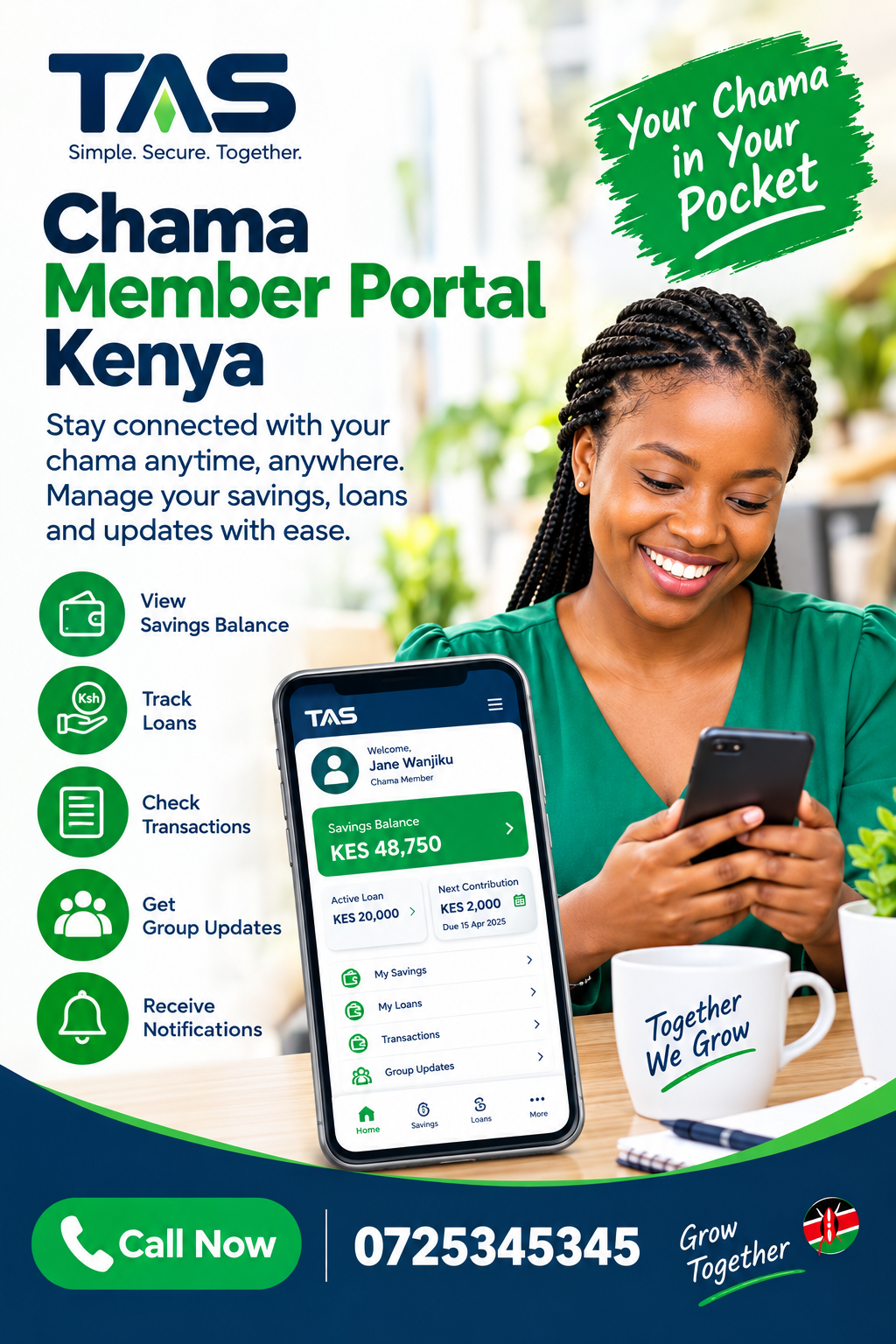
Chama Member Portal Kenya: Complete Guide to Better Member Management
Managing a growing chama requires more than keeping names in a notebook and posting contribution reminders in a WhatsApp group. A Chama Member Portal Kenya solution gives members and authorised officials a structured digital space for accessing relevant records, checking contributions, reviewing group information and staying connected to chama activities. This guide explains what a member portal is, why it matters, which features to look for, how it can improve transparency, and how Kenyan savings groups can introduce one without disrupting their existing operations.
For many groups, member administration becomes difficult long before the committee realises that the problem is the record-keeping process itself. A group may have a spreadsheet for members, another file for contributions, WhatsApp messages for announcements and paper documents for meetings. Each method may work independently, but combining them creates unnecessary work.
A well-designed portal brings the member-facing side of chama administration into a more organised environment. Instead of asking a treasurer or secretary for every piece of information, members can access information that the group has decided should be available to them.
This is especially useful for savings groups, investment chamas, welfare groups, table-banking groups, employee savings groups, community organisations and other member-based associations in Kenya.
What Is a Chama Member Portal?
A Chama Member Portal Kenya platform is a digital interface through which authorised chama members can interact with selected group information and services. Rather than giving every member access to administrative controls, the portal can provide each person with an appropriate view of their own information and other records the organisation has chosen to share.
The basic idea is straightforward.
A chama has information.
Officials manage that information.
Members need access to some of it.
A portal creates a controlled connection between the member and the organisation’s records.
Depending on the software, members may be able to view:
- Their profile
- Membership status
- Contribution history
- Savings information
- Loan balances
- Repayment records
- Welfare contributions
- Meeting information
- Announcements
- Statements
- Group notices
- Approved documents
- Other information permitted by the administrators
The portal should not be confused with a simple public website. A public website provides general information to visitors. A member portal is designed for authenticated users who belong to an organisation.
That distinction matters because chama records often contain financial and personal information.
Why Chamas Are Moving Beyond Paper Records
A small group can sometimes manage its activities using a notebook, calculator and WhatsApp group. The approach becomes less practical as the group grows.
Consider a chama with 15 members. The treasurer may know almost everyone personally and remember most contribution patterns.
Now consider a group with 80 or 100 members.
There may be different contribution amounts, loan balances, welfare payments, penalties, investment activities and membership changes. Members may also ask questions at different times.
A Chama Member Portal Kenya solution can reduce the pressure placed on committee members by allowing members to retrieve appropriate information themselves.
This does not mean technology replaces leadership.
The committee still approves policies, manages finances, handles disputes and makes decisions.
The difference is that routine information requests can become easier to handle.
For example, instead of receiving several messages asking, “How much have I contributed so far?”, a member could log into their account and review the available record.
That small change can save time every month.
The Relationship Between a Member Portal and Chama Management Software
A member portal is usually only one part of a broader chama management system.
The back-office system may be responsible for recording:
- Member registration
- Contributions
- Loans
- Repayments
- Income
- Expenses
- Budgets
- Meetings
- Reports
- Permissions
- Financial records
The portal provides a member-facing layer around selected information.
A Chama Member Portal Kenya solution therefore works best when it is connected to reliable underlying records. If the main records are inaccurate, the portal will simply display inaccurate information more conveniently.
This is why a chama should not evaluate a portal based only on appearance.
The committee should ask how information gets into the system, who can change it, how changes are tracked and what members can actually see.
A useful portal should support the group’s operational process rather than becoming another disconnected system.
Key Benefits of a Chama Member Portal
The value of a member portal goes beyond giving members a login page.
The right system can improve several areas of group administration.
1. Easier Access to Member Information
A Chama Member Portal Kenya solution can give members direct access to information that has been approved for viewing.
This can reduce dependency on individual committee members.
A member who wants to confirm their contribution history may not need to call the treasurer. A member checking a loan balance may not need to wait for the next meeting.
That creates a more self-service approach to administration.
The committee can spend more time handling matters that actually require human attention.
2. Better Transparency
Transparency is important in any organisation that collects money from members.
Members naturally want to understand how their own records are maintained.
A Chama Member Portal Kenya platform can make appropriate information easier for members to review.
For example, if members can access their contribution history, they have a clearer view of what has been recorded under their accounts.
Transparency does not mean every member should see every financial record.
Instead, access should be based on the group’s policies and user permissions.
A member may need access to their own transactions while administrators may require broader visibility.
3. Fewer Repetitive Questions
Chama officials often answer the same questions repeatedly.
Examples include:
- Did my contribution get recorded?
- What is my current balance?
- When is the next meeting?
- How much do I owe?
- What is my loan balance?
- What information is recorded under my membership profile?
A Chama Member Portal Kenya platform can turn many of these questions into self-service activities.
The result is not necessarily fewer conversations among members. Instead, conversations can focus on decisions, planning and issues that genuinely require discussion.
4. Improved Record Accessibility
Paper records are dependent on physical storage.
Spreadsheets may be dependent on a particular computer or administrator.
A properly implemented online portal can make approved records available through a controlled digital environment.
A Chama Member Portal Kenya solution can therefore help a group create a more accessible member experience, particularly when members live in different locations.
A member who works in Nairobi but belongs to a chama whose meetings take place elsewhere may still need to check their records between meetings.
Digital access can make that easier.
5. More Consistent Member Communication
Member communication is another important use case.
A chama may need to communicate:
- Meeting dates
- Contribution deadlines
- Important notices
- Policy updates
- Loan-related information
- Welfare announcements
- Administrative reminders
A Chama Member Portal Kenya can provide an additional channel through which members interact with the organisation.
The exact communication features depend on the software, but the principle is the same: important information should not depend entirely on one person’s WhatsApp account or phone.
What Information Should Members See?
One of the first questions a chama should answer is what information belongs in the member portal.
There is no single rule for every group.
Different organisations have different constitutions, privacy expectations and operating procedures.
A useful starting point is to divide information into categories.
Personal Information
Members may need to view or update selected information such as:
- Full name
- Phone number
- Email address
- Membership number
- Joining date
- Membership status
The organisation should only collect information it genuinely needs and should control who can access it.
Financial Information
Members may need access to their own:
- Contribution records
- Savings balances
- Loan balances
- Repayment history
- Welfare contributions
- Statements
Financial information should receive stronger access controls than general announcements.
Group Information
Some information can be useful to a wider membership base, including:
- Upcoming meetings
- Approved announcements
- Meeting schedules
- General notices
- Approved documents
- Group activities
A Chama Member Portal Kenya platform should allow the organisation to distinguish between information intended for an individual member and information intended for the wider group.
Member Profiles and Digital Registration
A member portal can also improve the registration process.
Traditionally, a secretary might collect details on a paper form and later enter them into a spreadsheet.
That creates opportunities for transcription errors.
A digital registration process can guide administrators through the required fields and help standardise member records.
A Chama Member Portal Kenya system can support a more structured member database when registration, updates and access are managed properly.
For example, the group may maintain fields for:
| Member information | Possible purpose |
|---|---|
| Full name | Member identification |
| Phone number | Communication |
| Digital notifications | |
| Membership number | Unique identification |
| Joining date | Membership history |
| Status | Active, inactive or other approved status |
| Contribution record | Savings tracking |
| Loan record | Borrowing information |
The exact fields should depend on the organisation.
A chama should avoid collecting unnecessary personal information simply because a software platform provides a field for it.
Contribution Tracking Through a Member Portal
Contributions are among the most important records in a chama.
Members want confidence that their payments have been recorded correctly.
Officials want an efficient way to reconcile payments and maintain accurate ledgers.
A Chama Member Portal Kenya solution can give members visibility into their own contribution information where the system supports that functionality.
For example, a member might be able to see:
- Contribution date
- Contribution type
- Amount
- Recorded status
- Running total
- Outstanding amount, where applicable
This can make monthly reconciliation easier to understand.
It also encourages members to check their records regularly instead of discovering discrepancies months later.
Why Contribution Visibility Matters
Suppose a member believes they contributed KSh 5,000 over a particular period, but the chama records only KSh 4,000.
Without accessible records, the disagreement may become a memory contest.
With a clear transaction history, the discussion can begin with the available record.
That does not automatically prove which side is correct.
It simply gives both parties a better starting point for reconciliation.
Loans and Member Access
Many chamas provide loans to members.
Loan administration can become complicated when there are multiple borrowers, guarantors, repayment dates, interest calculations and outstanding balances.
A Chama Member Portal Kenya system can give members access to appropriate loan information without requiring the treasurer to manually prepare every update.
Depending on the platform, a member may be able to review:
- Original loan amount
- Repayments
- Outstanding balance
- Loan status
- Due amounts
- Related records
The group should establish clear rules about what members can view.
For example, members may need access to their own loan records but not another member’s private financial details.
Welfare Contributions and Member Support
Many Kenyan groups combine savings activities with welfare support.
A member may contribute a regular amount toward welfare activities, emergency support or approved social programmes.
A Chama Member Portal Kenya platform can help organise these records alongside ordinary contributions where the software supports multiple contribution categories.
This can make it easier to distinguish between:
- Savings
- Investment contributions
- Welfare contributions
- Special collections
- Other approved payments
Keeping these categories separate is important because money collected for different purposes should not be treated as though it all represents the same type of contribution.
Clear records help both members and administrators understand the purpose of each transaction.
Meeting Management and Member Engagement
Chama meetings are where many decisions are made.
The group may discuss contributions, loans, investments, welfare cases, budgets and upcoming activities.
A Chama Member Portal Kenya platform can complement meeting administration by making selected meeting information available to members.
Possible information includes:
- Meeting dates
- Meeting notices
- Agendas
- Approved minutes
- Attendance information
- Decisions
- Action items
The portal should not eliminate the need for proper meetings.
Instead, it can help preserve information around those meetings.
That is especially useful when members need to remember what was agreed previously.
Notifications and Reminders
A member portal can become more useful when combined with reminders.
Chamas often have recurring responsibilities.
Members may need reminders about:
- Monthly contributions
- Loan repayments
- Meetings
- Registration updates
- Important deadlines
- Group activities
A Chama Member Portal Kenya platform can form part of a broader notification strategy.
The key is to avoid overwhelming members with messages.
Notifications should be useful, timely and connected to actual group activities.
For example, a reminder about a contribution deadline is more useful when it clearly explains what is due and when it is due.
M-Pesa and Digital Payments
Kenya’s widespread use of mobile money makes payment workflows particularly relevant to chama administration.
Members frequently use mobile payments in everyday transactions, and official financial-sector reporting continues to show the importance of mobile money in Kenya’s payment ecosystem.
A Chama Member Portal Kenya solution can be part of a wider digital workflow for recording member payments, although the exact payment integrations and reconciliation capabilities depend on the software being used.
The important point is that a payment channel and a record-keeping system are not necessarily the same thing.
A member may send money successfully, but the chama still needs an accurate record showing:
- Who made the payment
- How much was paid
- When it was paid
- What the payment was for
- Whether it has been reconciled
Good software should help connect those pieces.
Security and User Permissions
A portal contains information that should not be openly accessible.
Security should therefore be one of the first things a committee evaluates.
A Chama Member Portal Kenya platform should have appropriate authentication and permission controls.
At minimum, the group should understand:
- How members log in
- How administrators log in
- What each user can access
- How passwords are protected
- What happens when a member leaves
- How administrator access is controlled
- Whether activity can be audited
- How data is backed up
- How data can be exported
Security is not only a technical issue.
It is also an administrative issue.
If several people share one administrator password, even strong software controls can be undermined by poor internal practices.
Role-Based Access for Chamas
Not everyone in a chama needs the same level of access.
A treasurer may need financial functions.
A secretary may manage member records and meeting information.
A chairperson may need broader oversight.
Ordinary members may need access primarily to their own information and approved group notices.
A Chama Member Portal Kenya solution should therefore be assessed according to how well its permissions match the organisation’s structure.
A useful permissions model may separate:
- Member
- Treasurer
- Secretary
- Chairperson
- Administrator
- Other authorised roles
The exact roles should follow the chama’s actual governance structure.
Why Audit Trails Matter
An audit trail helps an organisation understand changes made to records.
Suppose a contribution amount changes.
The committee may need to know:
- What was changed
- When it was changed
- Who made the change
- What the previous value was, where supported
A Chama Member Portal Kenya system with appropriate audit functionality can help make administrative changes easier to review.
Audit records are particularly valuable when a chama has several administrators.
They create a history that can support reconciliation and internal accountability.
Member Statements
Members often need statements that summarise their activity.
A statement can bring several transactions into one readable record.
Depending on the software, it may include:
- Contributions
- Loans
- Repayments
- Welfare payments
- Adjustments
- Balances
A Chama Member Portal Kenya solution can make statements easier to access if the system provides member-facing reporting.
Statements are particularly useful before meetings because members can review their information ahead of time.
That can reduce the amount of time spent explaining basic balances during the meeting itself.
Supporting Remote and Busy Members
Not every member can attend every meeting.
People may work in different towns, travel frequently or have family and professional responsibilities.
A Chama Member Portal Kenya platform can give members a way to remain connected to relevant information between physical meetings.
This does not mean remote access should replace group participation.
A chama remains a community.
However, digital access can reduce the disadvantage faced by members who cannot physically access the secretary’s records whenever they have a question.
A Portal Can Improve Committee Efficiency
Committee members are usually members themselves.
They have limited time.
If the treasurer spends hours answering routine balance questions, that time could otherwise be spent on reconciliation, budgeting or financial planning.
A Chama Member Portal Kenya solution can shift some routine information access toward self-service.
This can be particularly helpful for groups that have grown beyond the point where informal administration remains comfortable.
The goal should not be to remove human interaction.
The goal is to use technology for repetitive tasks so that people can concentrate on decisions and relationships.
Choosing the Right Member Portal
Not every portal will suit every chama.
Before selecting one, the committee should define its actual needs.
A Chama Member Portal Kenya solution should be evaluated against real workflows rather than a long list of marketing features.
Start with these questions:
How Many Members Do You Have?
A system that works for 20 members may need different capacity considerations for 200 members.
Look at current membership and likely growth.
What Records Do Members Need?
Write down the information members ask for most frequently.
This may include:
- Contributions
- Savings
- Loans
- Repayments
- Welfare
- Statements
- Meeting information
Who Will Administer the System?
Technology still needs people.
Identify the administrators responsible for:
- Creating accounts
- Updating records
- Managing permissions
- Reconciling payments
- Supporting members
How Easy Is It to Use?
A technically powerful platform can still fail if members find it confusing.
Ask ordinary members to test it.
Do not let only technically confident committee members evaluate usability.
Mobile Accessibility Matters
Many Kenyan users access online services through mobile phones.
A portal should therefore provide a practical mobile experience.
A Chama Member Portal Kenya solution should be tested on the devices members actually use.
Check whether users can comfortably:
- Log in
- Read statements
- Navigate menus
- View transactions
- Access notices
- Update permitted information
- Log out securely
A portal that looks good on a large computer screen but is difficult to use on a phone may create unnecessary frustration.
How to Introduce a Member Portal
Moving from manual records to digital administration should be handled carefully.
A practical rollout can happen in stages.
Step 1: Review Existing Records
Before importing information, identify what currently exists.
You may have:
- Paper registers
- Excel files
- Contribution books
- Loan records
- Meeting records
- Payment confirmations
Do not automatically upload everything.
First determine which records are current.
Step 2: Clean the Member Register
Duplicate names and incorrect phone numbers should be corrected before accounts are created.
A member portal is only as useful as the information behind it.
Step 3: Agree on Access Rules
Decide what members should see.
For example:
| Information | Member access |
|---|---|
| Own profile | Usually appropriate |
| Own contribution history | Usually appropriate |
| Own loan record | Usually appropriate |
| General announcements | Appropriate where approved |
| Other members’ private financial information | Restricted |
| Administrative controls | Restricted |
| Committee-only records | Restricted |
The final rules should be based on the group’s constitution, policies and applicable obligations.
Step 4: Train Administrators
Administrators should understand how to:
- Add members
- Update records
- Handle corrections
- Manage permissions
- Generate reports
- Support members
- Respond to access problems
Step 5: Train Members
Members do not need technical training in software development.
They simply need to know how to:
- Access the portal
- Sign in
- Find their records
- Read statements
- Report discrepancies
- Protect their login details
Step 6: Start With a Pilot
A small pilot can reveal problems before the entire group moves to the system.
Choose several members with different levels of technical confidence.
Ask them to complete common tasks.
Their feedback can expose usability problems that administrators may miss.
Common Mistakes When Implementing a Member Portal
Buying software is not enough.
The following mistakes can undermine an otherwise useful portal.
Mistake 1: Uploading Unverified Data
Old spreadsheets may contain duplicate or outdated information.
Moving bad data into new software does not fix the underlying problem.
Mistake 2: Giving Everyone Administrator Access
Broad administrative access increases risk.
Give people the permissions required for their responsibilities rather than giving everyone full control.
Mistake 3: Ignoring Member Training
Some members may be comfortable with digital tools.
Others may need guidance.
A short training session can make adoption much easier.
Mistake 4: Treating the Portal as a Replacement for Governance
Software does not decide how a chama should operate.
The constitution, approved policies and committee decisions remain important.
A Chama Member Portal Kenya platform should support those processes rather than replace them.
Mistake 5: Failing to Define the Official Record
If some transactions are stored in the portal, others in WhatsApp messages and others in notebooks, confusion can continue.
The group should decide which system represents its official operational record and establish procedures for corrections.
How a Portal Can Improve Accountability
Accountability becomes easier when records are structured.
Imagine that a member questions a contribution entry.
Instead of relying entirely on memory, the committee can review the recorded transaction and the available supporting information.
A Chama Member Portal Kenya system can provide a clearer process for reviewing member records when it is properly configured.
This does not eliminate disputes.
No software can guarantee that.
It can, however, make it easier to investigate questions using documented information.
The Importance of Data Backups
A chama should understand how its records are protected against accidental loss.
Ask software providers about:
- Backup frequency
- Backup storage
- Data recovery
- Export options
- Account recovery
- Business continuity
A Chama Member Portal Kenya solution should not be evaluated only on the front-end interface.
The underlying data infrastructure matters just as much.
For a group that has spent years building its contribution and loan history, losing records can be extremely disruptive.
Data Export and Ownership
Before adopting any software, ask what happens to your data if the group changes systems.
A practical checklist includes:
- Can records be exported?
- In what format?
- Can member information be retrieved?
- Can transaction records be exported?
- Can reports be downloaded?
- What happens when a subscription ends?
A Chama Member Portal Kenya platform should be considered not only for what it does today but also for how the organisation can retain control of its records over time.
Cost Considerations
Price is important, but it should not be the only consideration.
A cheap system can become expensive if administrators spend many hours correcting records or supporting confused users.
Likewise, a feature-rich platform may be unnecessary for a small group.
When evaluating a Chama Member Portal Kenya solution, consider the full cost of ownership.
This may include:
- Subscription fees
- Setup
- Training
- Data migration
- Support
- Additional users
- Integrations
- Future upgrades
The right question is not simply, “How much does the software cost?”
It is, “What does the group receive for the total cost?”
Questions to Ask a Software Provider
Before subscribing, a chama committee should prepare questions.
Here are useful ones:
- How are member accounts created?
- Can members access their own contribution records?
- Can the system manage loans?
- Can administrators control permissions?
- Is there an audit trail?
- Can members access statements?
- Does the platform work on mobile devices?
- How is data backed up?
- Can records be exported?
- What support is available?
- Can the system accommodate future growth?
- What happens when an administrator leaves?
- How are inactive members handled?
- How are corrections made?
- What training is provided?
A Chama Member Portal Kenya provider should be able to explain these areas clearly rather than simply demonstrating a collection of attractive screens.
Member Portal vs WhatsApp Group
WhatsApp is useful for communication, but it is not a complete member-record system.
A WhatsApp group can be excellent for:
- Announcements
- Quick discussions
- Reminders
- Informal communication
It is less suitable as the primary place for structured financial records.
A Chama Member Portal Kenya platform can provide a more organised environment for member-specific information.
The two tools can therefore serve different purposes.
A chama may use WhatsApp for conversation and a portal for structured information.
That combination can work better than expecting one tool to handle every requirement.
Member Portal vs Spreadsheet
Spreadsheets remain useful for many organisations.
They can be flexible and inexpensive.
The challenge appears when several people need controlled access to the same records, members need self-service access and transaction histories become increasingly complex.
A Chama Member Portal Kenya system can provide workflows designed specifically around member administration.
A spreadsheet may require administrators to manually prepare information for each member.
A portal can make selected information available directly to the member.
That difference becomes increasingly important as the organisation grows.
Supporting Member Trust
Trust is one of the most important assets in a chama.
Members contribute their money because they expect agreed processes to be followed.
A digital system cannot create trust by itself.
However, a Chama Member Portal Kenya solution can support practices that make records easier to review and processes easier to understand.
Trust can be strengthened when:
- Records are consistent
- Members can review their own information
- Corrections follow a clear process
- Permissions are controlled
- Financial activity is documented
- Reports are available
- Committee responsibilities are defined
Technology should therefore be viewed as an accountability tool, not a substitute for responsible leadership.
Supporting Different Types of Chamas
A member portal can be useful across different group structures.
Savings Chamas
Members can review contributions, savings and relevant balances.
Investment Groups
Members may need access to approved investment information and their participation records.
Welfare Groups
Members can track appropriate welfare contributions and notices.
Table-Banking Groups
A structured portal can help organise recurring contributions and lending activities.
Employee Savings Groups
Members working in different departments or locations can benefit from centralised access.
Community Organisations
A portal can provide an organised way to manage member information and communication.
The precise features required will differ.
A group should choose technology according to its actual operating model.
What Members Expect From a Good Portal
Members generally want simplicity.
They should not have to navigate complicated administrative menus just to find a contribution statement.
A Chama Member Portal Kenya platform should make common tasks straightforward.
A good member experience usually includes:
- Simple login
- Clear navigation
- Understandable labels
- Readable statements
- Mobile compatibility
- Helpful notifications
- Secure access
- Reliable information
If a member can complete the most common task without assistance, the portal is serving its purpose.
What Administrators Expect
Administrators have different needs.
They need control and visibility.
A Chama Member Portal Kenya system should help authorised officials maintain records while enforcing appropriate access boundaries.
Administrators may need:
- Member management
- Contribution management
- Loan management
- Reporting
- User permissions
- Corrections
- Audit information
- Data exports
- Support tools
The best user experience therefore depends on two sides working together: a simple member interface and a capable administrative environment.
Measuring Whether the Portal Is Working
After implementation, the committee should evaluate results.
Useful measures can include:
- Number of active members
- Frequency of member logins
- Number of routine information requests
- Time spent preparing statements
- Number of record corrections
- Time required to prepare reports
- Member feedback
- Support requests
A Chama Member Portal Kenya solution should be judged by whether it improves actual administration rather than simply whether members have accounts.
The committee can review these measures after the first few months and identify where further training or process changes are needed.
Creating a Better Member Experience
A member portal should not become another source of frustration.
Keep the process simple.
For example, if a member wants to check their contribution history, they should not have to navigate through several unrelated menus.
If the member needs help, there should be a clear support process.
A Chama Member Portal Kenya platform becomes more valuable when its design reflects the questions members actually ask.
Start with real member journeys.
Ask:
“What does a member want to do when they log in?”
Then design the experience around those tasks.
The Role of the Chama Committee
Technology does not remove committee responsibility.
The committee still needs to:
- Define procedures
- Approve access rules
- Review records
- Reconcile transactions
- Handle disputes
- Train members
- Protect confidential information
- Monitor system use
A Chama Member Portal Kenya platform is a tool within that governance structure.
The committee should periodically review whether permissions remain appropriate.
For example, when a treasurer’s term ends, their access should be reviewed promptly.
When a member leaves, their account status should also be handled according to the group’s policy.
Preparing for Future Growth
A portal should be selected with growth in mind.
A group may start with 25 members and later reach 100 or more.
It may introduce new contribution categories, additional administrators or more sophisticated reporting requirements.
A Chama Member Portal Kenya system should therefore be evaluated for scalability.
Ask what happens when:
- Membership doubles
- More administrators are needed
- More transactions are recorded
- Additional branches or groups are created
- Reporting requirements become more detailed
Choosing a platform only for today’s needs can create another migration project later.
Building a Digital Culture in the Chama
Software adoption is partly a culture change.
Members must become comfortable checking their own records.
Officials must become comfortable maintaining digital records.
A Chama Member Portal Kenya solution works best when the organisation establishes simple rules around its use.
For example:
- Members should check their records regularly.
- Discrepancies should be reported promptly.
- Administrators should not share passwords.
- Changes should follow approved procedures.
- Official records should be maintained consistently.
These rules make the technology part of normal chama operations rather than an optional tool that only one committee member uses.
Handling Member Questions and Disputes
A portal can reduce confusion, but disputes may still occur.
Suppose two records appear different.
The group should have a defined correction process.
That process may include:
- Member submits the concern.
- Administrator checks the transaction.
- Supporting evidence is reviewed.
- The record is corrected if necessary.
- The correction is documented.
- The member is informed.
A Chama Member Portal Kenya platform can support this process when it provides suitable records and administrative controls.
The important point is to treat corrections as a formal process rather than silently changing figures.
Why Accurate Data Still Matters
No portal can compensate for poor data entry.
If administrators record the wrong amount, wrong member or wrong date, the portal may faithfully display that incorrect information.
That is why training remains essential.
A Chama Member Portal Kenya system should be accompanied by clear procedures for entering and reviewing information.
A simple quality-control checklist can help:
- Confirm member identity.
- Confirm transaction amount.
- Confirm transaction date.
- Confirm transaction type.
- Confirm payment reference where applicable.
- Reconcile records regularly.
Small controls can prevent larger problems.
Using Reports for Better Decision-Making
Member portals are often connected to reporting systems.
Reports can help committees understand patterns.
For example, the group may want to review:
- Contribution performance
- Loan balances
- Outstanding repayments
- Member activity
- Welfare collections
- Income
- Expenses
- Budget performance
A Chama Member Portal Kenya platform becomes more useful when the information collected through everyday activities can be converted into meaningful reports for authorised decision-makers.
Reports should be understandable.
A report filled with numbers but lacking clear context may not help the committee make better decisions.
Practical Example: A Growing Nairobi Chama
Consider a hypothetical investment chama with 60 members.
Initially, the treasurer records contributions in Excel and sends monthly balances to the group through WhatsApp.
As membership grows, several problems emerge.
Members ask for individual statements.
Loan records become more complicated.
The secretary spends significant time responding to requests.
The committee begins preparing reports manually before meetings.
Introducing a Chama Member Portal Kenya platform could allow the group to organise member-facing information while keeping administrative functions under controlled access.
Members could check available information without contacting the treasurer for every routine question.
The committee could then spend more time reviewing investment plans, budgets and outstanding obligations.
The example is hypothetical, but the administrative challenge is common to many growing member-based organisations.
Practical Example: A Welfare Group
Consider a welfare group with 35 members.
Each member contributes monthly.
The group also records support payments and maintains meeting information.
Previously, members relied on paper records and messages from the secretary.
A Chama Member Portal Kenya platform could give members a more structured way to view their own contribution information and receive approved notices.
The group would still need policies covering sensitive welfare information.
The portal should not expose confidential details unnecessarily.
This illustrates an important principle: digital access should increase convenience without weakening privacy.
Practical Example: A Table-Banking Group
A table-banking group may combine regular contributions with member lending.
Members need to know their contribution position, loan balances and repayment obligations.
A Chama Member Portal Kenya system can provide a central digital environment where appropriate records are easier to access.
The group should still reconcile payments and approve loans according to its existing rules.
Software supports the process.
It does not replace the process.
Practical Example: Members Living in Different Towns
A chama may have members living in Nairobi, Mombasa, Kisumu, Nakuru and other locations.
Physical access to records becomes difficult.
A Chama Member Portal Kenya solution can make selected information available remotely, provided members have appropriate internet access and the platform supports mobile use.
This can make participation easier for members who cannot visit the secretary’s office or attend every physical meeting.
A Simple Evaluation Checklist
Before choosing a platform, score it against your own requirements rather than relying on marketing language.
Ask whether the system provides:
- Member accounts
- Secure login
- Member profiles
- Contribution records
- Loan records
- Statements
- Notifications
- Meeting information
- Role-based access
- Audit information
- Data backups
- Data export
- Mobile accessibility
- Customer support
- Scalability
A Chama Member Portal Kenya solution should then be tested using real scenarios.
For example:
“Show me how a member checks their contribution history.”
Then:
“Show me how an administrator corrects a transaction.”
Then:
“Show me what happens when a member leaves.”
These practical demonstrations can reveal much more than a generic product presentation.
Questions Members May Ask
Can members check their contribution records online?
Yes, a member portal can be designed to provide members with access to their own contribution records where that functionality is supported and enabled by the organisation.
Can members access loan information?
A portal may provide loan balances, repayment history and related information to the relevant member. The exact information available depends on the system’s features and permissions.
Can a member portal replace WhatsApp?
It does not have to. WhatsApp can remain useful for conversation and announcements, while the portal provides structured access to official member information.
Is a member portal suitable for a small chama?
It can be. The key question is whether the group expects enough administrative activity to benefit from digital records and self-service access.
Does a member portal improve transparency?
It can support transparency by making approved records easier for members to access and review. Transparency also depends on accurate records, appropriate governance and clear procedures.
Can a portal work for welfare groups?
Yes. A suitable system can organise member information, contributions, welfare-related records and communications, subject to the group’s privacy requirements.
Frequently Asked Questions About Chama Member Portals
What is the purpose of a chama member portal?
A member portal provides an authenticated digital space where members can access information and services made available by their organisation. It can reduce reliance on manual information requests and improve access to member records.
What should a good member portal include?
A Chama Member Portal Kenya solution should ideally provide secure member access, profiles, contribution information, relevant financial records, statements, notifications and appropriate permission controls. The exact feature set should reflect the chama’s requirements.
Is a portal secure enough for financial information?
Security depends on the platform’s technical controls and the organisation’s own practices. The committee should ask about authentication, permissions, backups, audit trails, data protection and administrator access before subscribing.
Can members access the portal using phones?
A properly designed portal may support mobile access. Chamas should test the actual experience on common smartphones before deployment rather than assuming that every web platform is equally mobile-friendly.
How does a portal help the treasurer?
It can reduce repetitive requests for information by allowing members to access approved records themselves. This may give the treasurer more time for reconciliation, reporting and financial administration.
How does a portal help members?
Members can have easier access to their own information, including contribution and loan records where those features are available. They can also receive approved notices and review information without waiting for a physical meeting.
Should every member have the same access?
No. Access should normally depend on the member’s role and the sensitivity of the information. Ordinary members should not automatically receive administrator-level permissions.
What happens if a member leaves the chama?
The organisation should have a defined procedure for changing or disabling access according to its policies. The member’s historical records should also be handled according to the group’s record-retention and governance requirements.
Can a member portal eliminate record disputes?
No software can guarantee that. A portal can make records easier to access and review, but accurate data entry, reconciliation and clear correction procedures remain necessary.
How should a chama choose a portal?
Start with the group’s actual workflows. List the records members need, the tasks administrators perform, the number of users, security requirements, reporting needs, mobile requirements and budget. Then test shortlisted platforms using real scenarios.
Conclusion
A Chama Member Portal Kenya solution can become an important part of modern chama administration when it is implemented around real member needs. It gives organisations a way to move beyond scattered notebooks, spreadsheets and informal information requests toward a more structured member experience.
The biggest benefit is not simply having another digital tool.
The real value comes from making useful information easier to access while maintaining appropriate controls over sensitive records.
For members, that can mean easier access to contribution information, loan records, statements and announcements.
For committee members, it can mean fewer repetitive requests and a more organised way to maintain information.
For the organisation as a whole, it can support better record visibility, accountability and continuity.
A Chama Member Portal Kenya platform should therefore be evaluated as part of the chama’s broader management process. Look beyond attractive screens and ask practical questions about permissions, records, security, reporting, mobile access, support and data ownership.
The strongest implementation will also depend on the people using it. Administrators need clear procedures, members need basic training and the group needs agreement about which system contains its official records.
If a chama is still relying heavily on paper records, multiple spreadsheets and repeated manual requests for basic member information, a member portal can provide a practical path toward more organised administration.
The process should start with the group’s needs.
List the information members need most often.
Identify the tasks that consume the committee’s time.
Review the records that need better organisation.
Define who should access what.
Then test potential software against those real requirements.
That approach helps ensure that digital transformation serves the chama rather than creating another layer of administration.
For Kenyan savings groups, investment groups, welfare associations and other member-based organisations, the objective is simple: make member information easier to access, easier to manage and easier to understand while keeping the organisation’s financial and personal records appropriately controlled.
A carefully implemented Chama Member Portal Kenya solution can support that objective and provide a stronger foundation for organised, transparent and sustainable chama management.
Chama Member Portal Kenya
Chama Member Portal Kenya
Chama Member Portal Kenya
Chama Member Portal Kenya
Chama Member Portal Kenya
Chama Member Portal Kenya
Chama Member Portal Kenya
Chama Member Portal Kenya
Chama Member Portal Kenya
Chama Member Portal Kenya
Chama Member Portal Kenya
Chama Member Portal Kenya
Chama Member Portal Kenya
Chama Member Portal Kenya
Chama Member Portal Kenya
Chama Member Portal Kenya