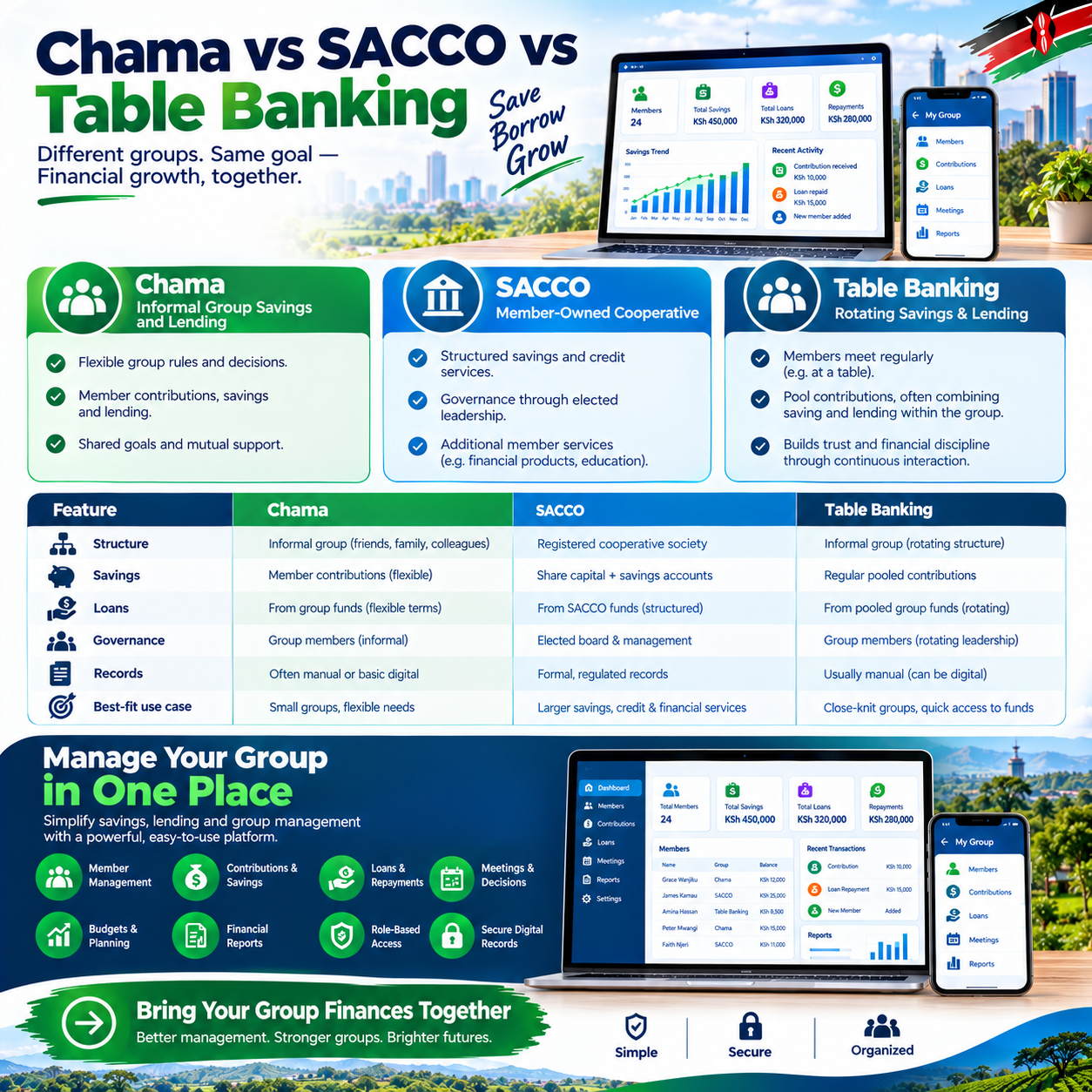
Chama vs SACCO vs table banking is the money conversation happening in living rooms, staffrooms, and church halls across Kenya right now. Millions of Kenyans pool their hard-earned shillings together every month, yet the rules, risks, and rewards differ dramatically between the three formats. Choosing wisely shapes everything from your returns to your friendships — and this guide settles the debate with total honesty.
Each model has created genuine wealth, funded apartment blocks, and paid school fees for generations of Kenyan families. Each has also collapsed painfully when run without discipline, records, or clear written rules. Understanding chama vs SACCO vs table banking properly is therefore one of the highest-value financial lessons any Kenyan can learn.
This guide compares the three formats side by side, honestly and completely. We examine their origins, membership, contributions, loans, returns, regulation, risk, and digital tools. By the final section, the puzzle of chama vs SACCO vs table banking will feel less like a mystery and more like a menu.
A word of encouragement before we begin. No format is embarrassing to belong to — table banking circles have funded dukas, chamas have raised towers, and SACCOs have put thousands through university. What matters is not which badge you carry but how well your chosen system is run.
One truth deserves to be said upfront: there is no single winner. The right answer in chama vs SACCO vs table banking depends on your goals, your group’s size, and your appetite for structure. Many of Kenya’s savviest investors eventually use all three formats at once.
The timing for this conversation has never been better. Kenya’s group-finance culture is going digital at remarkable speed, and purpose-built platforms now serve every format. That technology shift is quietly rewriting the answer to chama vs SACCO vs table banking for a whole new generation.
So bring your officials, your ambitions, and an open mind. The sections ahead give you every fact you need to decide with total confidence. Let the great national debate of chama vs SACCO vs table banking be settled — for your group — today.
By the time you finish reading, you will think about group money differently. You will know exactly which format fits your next five years, and which fits your next twenty. That clarity is the real gift hiding inside chama vs SACCO vs table banking.
What Is a Chama?
A chama is an informal investment group where friends, colleagues, or relatives pool money regularly toward shared goals. Most chamas meet monthly, contribute a fixed amount, lend to members, and invest collectively in land, rentals, or businesses. In the contest of chama vs SACCO vs table banking, the chama is the most flexible and personal of the three.
Chamas are governed by a constitution the members write and amend themselves. Elected officials — a chairperson, treasurer, and secretary — run daily affairs, while the big decisions go to a member vote. That self-governance is both the charm and the challenge when weighing chama vs SACCO vs table banking.
Kenyan chamas have funded some of the most impressive property portfolios in the country. Groups of teachers, nurses, and boda riders own rental blocks stretching from Kitengela to Kisumu. No honest analysis of chama vs SACCO vs table banking is complete without deep respect for that track record.
The best chamas share identifiable habits worth copying. They meet on time, record everything, lend cautiously, and review their investments at least once a year. Borrow those four habits and your group will already outperform most of the competition.
What Is a SACCO?
A SACCO — a savings and credit cooperative — is a formally registered financial institution owned entirely by its members. Members save shares and deposits, borrow at regulated rates, and earn annual dividends on their shareholding. In the matchup of chama vs SACCO vs table banking, the SACCO is the most formal and heavily regulated format.
Kenya’s cooperative movement is among the strongest in Africa, with deposit-taking SACCOs supervised by SASRA. Giant societies serve teachers, police officers, farmers, and investors with banking-grade products. That institutional muscle is a major factor in chama vs SACCO vs table banking.
SACCOs employ professional staff, keep audited books, and operate under cooperative law. Members receive ATM cards, FOSA accounts, and mobile banking much like ordinary bank customers. Professionalism, in short, is the SACCO’s defining weapon in chama vs SACCO vs table banking.
Joining a SACCO is also remarkably straightforward. Registration requires your ID, a small share purchase, and a membership form completed at any branch or online. Within weeks, most new members are saving and already qualifying for their first modest loan.
What Is Table Banking?
Table banking is the simplest format of all: members meet, pool money on the table, and lend it out immediately. One member typically takes the lump sum each month at an agreed interest, and the pot returns the following month. Within chama vs SACCO vs table banking, table banking is the fastest and most immediate format.
The format is beloved by women’s groups, market traders, and village welfare circles across the country. There are no lengthy applications — the group decides on the spot, face to face. Speed and simplicity are table banking’s signature strengths in chama vs SACCO vs table banking.
But the same simplicity carries real risks, as later sections will show. Cash handling, instant decisions, and rotating sums demand extraordinary honesty from everyone present. Every serious treatment of chama vs SACCO vs table banking must weigh that trade-off honestly.
Modern table banking is quietly upgrading itself too. Many circles now collect through M-Pesa, record rotations on phones, and photograph the day’s ledger before anyone leaves. The tradition remains, but the bookkeeping has entered the smartphone era.
Where the Three Formats Came From
All three formats grew from the same Kenyan root: the harambee spirit of communal effort and saving. Table banking is the oldest, echoing generations of village rotation circles where trust was the only contract. Knowing the shared origin adds real depth to chama vs SACCO vs table banking.
Chamas emerged as urban workers formalized village habits into serious investment clubs with written constitutions. SACCOs grew out of cooperative law into licensed institutions across five decades of steady expansion. History shows all three answering one need differently — the essential story of chama vs SACCO vs table banking.
Today the three formats coexist and even intermarry. A chama may keep its accounts at a SACCO, while a table banking circle serves as the chama’s welfare wing. Modern Kenya rarely forces a strict either-or choice between them.
Membership: Who Joins What
Membership is the first battleground in chama vs SACCO vs table banking. Chamas are closed clubs of trusted friends, usually numbering five to thirty members. Table banking groups are similar in size but often more open to neighbors and community acquaintances.
SACCOs welcome thousands of members, usually united by an employer, a profession, or a region. You can join a SACCO without knowing a single existing member personally. That scale difference is fundamental to chama vs SACCO vs table banking.
Group size also shapes the experience in practical ways. Small groups decide quickly but carry concentrated risk when one member struggles. Large institutions spread risk widely but move more slowly and formally.
Trust works differently in each format, and it matters more than most people expect. In chamas and table banking circles, trust is personal; in SACCOs, trust is institutional. Ask yourself which kind of trust you prefer when deciding chama vs SACCO vs table banking.
Contributions: How the Money Flows
Contributions set the rhythm of every group’s financial life. Chamas fix their own amounts and can raise them by vote as ambitions grow. That flexibility is a genuine chama advantage in chama vs SACCO vs table banking.
Table banking contributions are usually smaller and tied directly to the monthly pot. The sum collected is the sum available — no reserves, no long-term capital building. That immediacy shapes everything else in chama vs SACCO vs table banking.
SACCOs build permanent capital through non-withdrawable deposits and share capital. Savings there are designed to compound for years, powering large loans and annual dividends. Long-horizon wealth building is the SACCO’s edge in chama vs SACCO vs table banking.
Whatever the format, the golden rule is the same: contribute what you can sustain. A contribution you can maintain for five years beats an ambitious one you abandon in month three. Consistency, not size, is what builds serious group capital.
Loans: Who Borrows What
Lending is where the three formats diverge most sharply. Chamas lend member savings at agreed interest, with guarantors and constitutions governing every term. Loan sizes scale with group savings — a key consideration in chama vs SACCO vs table banking.
Table banking lends the monthly pot immediately, often on the very day it is collected. Interest is typically higher, and the repayment window is short. Speed over size is the classic table banking trade-off in chama vs SACCO vs table banking.
SACCOs lend multiples of a member’s deposits — often three times the savings or more. A teacher saving steadily for two years can borrow hundreds of thousands for land or a car. Borrowing power at scale is the decisive SACCO advantage in chama vs SACCO vs table banking.
Guarantors deserve special mention across all three formats. In chamas and table banking, guarantors are friends vouching with their own savings; in SACCOs, guarantees are documented against deposits. Either way, never guarantee more than you could comfortably repay yourself.
Returns: What You Actually Earn
Returns are the real scorecard in chama vs SACCO vs table banking. Chama members earn from loan interest and from asset appreciation — plots bought early can multiply several times over. The returns are uneven but occasionally spectacular.
Table banking returns are the interest members pay into the pot, either shared out or rotated forward. They are modest and immediate, rewarding discipline more than strategy. In the contest of chama vs SACCO vs table banking, table banking wins on speed rather than compounding.
SACCOs pay declared dividends on shares and interest on deposits every financial year. Well-run societies have historically paid double-digit dividends in strong years. Predictable, audited returns are the SACCO’s quiet contribution to chama vs SACCO vs table banking.
Remember that returns always mirror risk in group finance. The fastest returns usually carry the highest default risk, while the safest returns compound more slowly. Honest groups discuss this trade-off openly before the first shilling moves.
Regulation and Safety
Regulation is the starkest contrast in chama vs SACCO vs table banking. Chamas and table banking groups are self-regulated through their constitutions and member vigilance. Freedom and risk arrive together in the informal formats.
Deposit-taking SACCOs answer to SASRA, with capital rules, external audits, and strict reporting duties. Member savings enjoy protections that informal groups simply cannot offer. Safety-conscious savers weigh this heavily in chama vs SACCO vs table banking.
But regulation is not everything, and it does not guarantee good governance. A disciplined chama with clean records can outperform a sloppy SACCO on both trust and returns. Governance quality cuts across all three formats in chama vs SACCO vs table banking.
Registration is worth considering for successful informal groups. Registering as a self-help group, CBO, or cooperative unlocks bank accounts, contracts, and credibility. Many thriving chamas formalized precisely to buy land and sign leases in the group’s own name.
Risk: What Can Go Wrong
A clear-eyed risk review completes the safety picture in chama vs SACCO vs table banking. Chama risks include member default, fraud by officials, and collapse through unresolved disputes. Most can be prevented with records, transparency, and a firm constitution.
Table banking adds cash-handling risk, since sums move physically at every meeting. A stolen pot or a vanished collector can wipe out a cycle’s savings instantly. Digital payment adoption is steadily retiring that oldest risk in chama vs SACCO vs table banking.
SACCO risks are institutional: weak lending, mismanagement, or regulatory sanctions. They are rarer, but they affect thousands of members at once when they strike. Diversified savers often participate in both worlds after studying chama vs SACCO vs table banking.
The deepest protection in any format is culture. Groups that reward honesty, document decisions, and confront problems early rarely suffer catastrophic losses. Culture, once lost, is the hardest asset of all to rebuild.
Record Keeping: The Common Denominator
Records separate thriving groups from collapsing ones in every single format. Chamas need constitutions, minutes, contribution ledgers, and loan books kept faithfully. That discipline is the common thread running through chama vs SACCO vs table banking.
Table banking historically ran on memory and notebooks, which explains so many old disputes. Modern groups now track rotations, payouts, and welfare digitally. Clean records have transformed outcomes across chama vs SACCO vs table banking.
SACCOs maintain professional books with external audits and member statements. Members can verify their balances at any time, from anywhere. That assurance is part of what members gain in chama vs SACCO vs table banking.
Whichever format you join, inspect the records before contributing. Ask to see the ledger, the minutes, and the bank or M-Pesa statements. A group that hides its books from a prospective member is telling you everything you need to know.
Decision Time: Which One Is Right for You?
Now for the practical verdict in chama vs SACCO vs table banking. Choose a chama if your goal is collective investment — land, rentals, businesses — with friends who share your ambition. The chama rewards vision, patience, and strong governance above all.
Choose table banking if your priority is fast, small, rotating access to lump sums. Market traders, hustlers, and welfare circles thrive on its immediacy and face-to-face simplicity. Its niche is crystal clear within chama vs SACCO vs table banking.
Choose a SACCO if you want large personal loans, audited safety, and professional banking services. Salaried members building homes, buying cars, or educating children fit SACCOs perfectly. The institutional path holds obvious appeal in chama vs SACCO vs table banking.
One more lens helps: your own personality. If you love building with a team, the chama will feel like home; if you value structure, the SACCO will; if you live month to month, table banking will. Choose the format that matches your temperament, not just your calculator.
The Side-by-Side Verdict in Plain Words
Here is the entire comparison painted in plain words, format by format. A chama is a closed circle of trusted friends building permanent wealth together, flexible in contributions and bound only by its own constitution. It is the format for collective property dreams, patient saving, and compounding ambition — the richest long-term answer to chama vs SACCO vs table banking.
A SACCO is a professional institution where thousands save side by side, borrowing large multiples of their deposits under audited, regulated oversight. It is the format for salaried members who want banking-grade services, predictable dividends, and personal loans big enough to change a life. Structure and scale are its defining gifts within chama vs SACCO vs table banking.
Table banking is the immediate one: small sums pooled and rotated on the spot, serving welfare and working capital without paperwork or delay. It rewards month-to-month discipline rather than decade-long strategy. Its genius is speed, and its duty is careful records — the twin truths of chama vs SACCO vs table banking.
Read the three portraits together and the decision becomes almost intuitive. Match the format to the goal, the goal to the horizon, and the horizon to the people in the room. That simple matching exercise is the final art of chama vs SACCO vs table banking.
The Digital Revolution Across All Three
Technology is redrawing the entire map of chama vs SACCO vs table banking. Chamas now run on platforms with M-Pesa reconciliation, loan ledgers, and AGM-ready reports. Table banking groups track rotations digitally, while SACCOs offer full mobile banking.
For chamas, a dedicated system centralizes contributions, fines, loans, minutes, and statements. Members check balances on their phones and receive instant receipts for every payment. Digital discipline has become the modern edge in chama vs SACCO vs table banking.
Investment groups that own rental property go one step further. They run group finance on a chama platform while managing tenants, rent collection, and statements on Tas.co.ke. That pairing keeps every shilling visible, whatever your verdict in chama vs SACCO vs table banking.
Whichever platform a group chooses, demand three things before signing up. M-Pesa reconciliation that happens automatically, reports your members can read, and support that answers when contribution day goes wrong. Those three tests separate serious providers from pretty brochures.
Common Mistakes in Each Format
Every format has classic failure modes worth naming plainly. Chamas fail through weak constitutions, hidden records, and selective enforcement of rules. Prevention is cheaper than cure anywhere in chama vs SACCO vs table banking.
Table banking fails through cash losses and undocumented rotations. One missing notebook can erase nine months of accumulated trust. Digitization is the proven remedy across chama vs SACCO vs table banking.
SACCOs fail through member overborrowing and weak board oversight. Borrowing against future income is the personal risk every member must manage responsibly. Prudent borrowing completes the practical lessons of chama vs SACCO vs table banking.
Real Stories from Kenyan Groups
Stories make any comparison real, so here are three. A Nakuru teachers’ chama bought two plots, built eight rentals, and still meets monthly with clean digital records. Their verdict on chama vs SACCO vs table banking: the chama, powered by discipline, built their wealth.
A Kisumu market traders’ table banking circle rotated lump sums for a decade without losing a single pot. Their secret was digital records and same-day M-Pesa confirmation for every transaction. They prove the table banking branch of chama vs SACCO vs table banking can run with professional rigor.
A Machakos farmer borrowed against four years of SACCO deposits and put up a dairy unit. The loan was large, the rate was fair, and her dividend still arrives every year. Her story anchors the SACCO side of chama vs SACCO vs table banking.
The Smartest Move: Combining All Three
The most sophisticated Kenyan investors refuse to choose sides in chama vs SACCO vs table banking. They save in a SACCO for personal loans, invest through a chama for property, and keep a table banking circle for welfare. Each format does what it does best, and none competes with the others.
The combination works because the formats serve different time horizons. Table banking serves this month, SACCOs serve this decade, and chamas serve generations. Matching horizon to format is the deepest lesson of all.
Getting Started the Right Way
Whichever format you choose, begin with written rules. A constitution, elected officials, and transparent records cost little and prevent nearly everything. Strong foundations matter in every branch of chama vs SACCO vs table banking.
Digitize from day one rather than after the first dispute. Automated reminders, instant receipts, and arrears dashboards keep groups peaceful year after year. Purpose-built tools now exist for every format and every budget.
Then review the group’s health every quarter. Collection rates, loan performance, and member satisfaction reveal problems while they are still small. Regular reviews are the maintenance schedule of lasting group wealth.
Frequently Asked Questions
Which format makes the most money? History suggests chamas investing in land and rentals have produced the largest individual gains. SACCO dividends plus large, affordable loans have funded more ordinary family milestones. The definition of “most money” depends on your goals in chama vs SACCO vs table banking.
Which is safest for my savings? Deposit-taking SACCOs carry regulatory oversight, external audits, and protections informal groups cannot match. That said, a disciplined chama with transparent records is far safer than a poorly run institution anywhere. Safety follows governance more than format — the deeper truth of chama vs SACCO vs table banking.
Can I belong to all three at once? Absolutely, and thousands of Kenyans do exactly that. A SACCO for personal loans, a chama for property, and a table banking circle for welfare work beautifully together. Just budget honestly so no commitment is neglected — then chama vs SACCO vs table banking stops being a debate and becomes a strategy.
Which is best for beginners? A small table banking circle or a modest chama is the gentlest entry into group finance. You learn contributions, records, and lending with small sums before scaling upward. Start small, stay disciplined, and graduate when ready.
Can a chama grow into a SACCO? Yes — established chamas sometimes register formally as cooperatives as their savings and ambitions scale. The transition brings regulation, audits, and professional management. It is a natural evolution many successful groups have taken.
Is any of the three formats dying out? None of the three is dying — all are going digital instead. Records, reminders, and payments have moved to phones, while the human trust at the core remains untouched. The future belongs to whichever format your group runs with discipline and clean records.