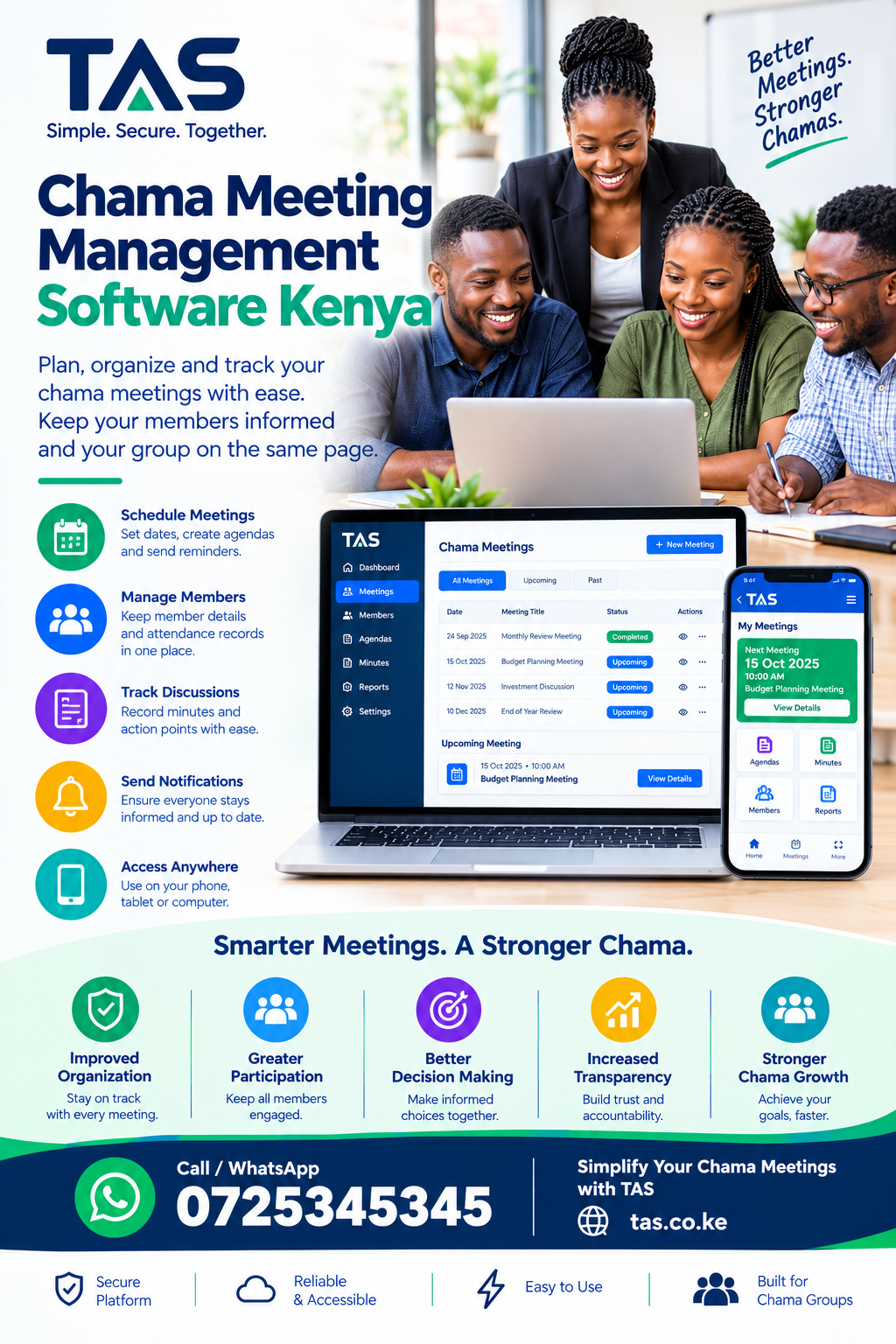
Chama Meetings Need More Than a Notebook
Chamas in Kenya depend on regular meetings to discuss contributions, investments, loans, projects, welfare matters, and member concerns. As membership grows, keeping everything organized becomes harder. Chama Meeting Management Software Kenya gives groups a structured way to organize meeting schedules, record attendance, capture minutes, assign responsibilities, and maintain reliable meeting records without depending entirely on notebooks, WhatsApp messages, or scattered spreadsheets.
For a small chama, a notebook may initially seem sufficient. The secretary records who attended, the treasurer gives a financial update, members discuss upcoming activities, and everyone leaves with an understanding of what should happen next. Problems often emerge later when someone asks what was agreed during a previous meeting, who was assigned a particular task, when a decision was approved, or whether a member attended a specific session.
Digital meeting management addresses these problems by putting important information in an organized system. Chama Meeting Management Software Kenya can help groups create a consistent meeting process that is easier to follow before, during, and after every meeting.
This guide explains how digital meeting management can support Kenyan chamas, the features groups should consider, practical ways to improve meeting administration, common implementation mistakes, and questions to ask before selecting a system.
What Is Chama Meeting Management Software?
Chama Meeting Management Software Kenya refers to a digital solution designed to help savings groups, investment chamas, welfare groups, table banking groups, and other member-based organizations coordinate their meetings and maintain related records.
Instead of treating a meeting as an isolated event, the software can connect several activities around the meeting. These may include:
- Scheduling upcoming meetings
- Sending meeting reminders
- Recording attendance
- Capturing agendas
- Recording minutes
- Documenting resolutions
- Assigning action items
- Tracking outstanding tasks
- Recording meeting notes
- Maintaining historical meeting records
- Managing member participation
- Supporting communication between members
A well-designed system can make meeting administration more consistent. Chama Meeting Management Software Kenya can also reduce the amount of time the secretary spends searching through old notebooks, spreadsheets, or chat conversations to find information.
The goal is not simply to replace paper with software. The bigger objective is to create a reliable meeting workflow where information is recorded once and can be accessed when needed.
Why Chama Meetings Matter
Meetings are central to how many Kenyan chamas operate. They provide a formal opportunity for members to review financial activities, discuss investment opportunities, evaluate group projects, make decisions, and address concerns.
A meeting also creates accountability.
For example, a group may agree that:
- The treasurer should prepare a financial report.
- Three members should inspect a potential investment property.
- The secretary should prepare documents for registration.
- Members should contribute a specified amount before the next meeting.
- A committee should compare quotations from suppliers.
If these decisions are not recorded properly, accountability can become difficult.
Chama Meeting Management Software Kenya helps turn meeting discussions into organized records. Instead of relying on someone’s memory, the group can maintain a documented history of what was discussed, what was decided, and what needs to happen next.
This becomes particularly valuable when a chama has operated for several years and has accumulated hundreds of meeting records.
Common Meeting Management Problems Faced by Chamas
Many groups experience similar administrative challenges.
1. Missing Meeting Records
Paper minutes can become damaged, misplaced, or difficult to retrieve. If the secretary changes, previous records may also become difficult to locate.
Chama Meeting Management Software Kenya provides a centralized approach to maintaining meeting information, making historical records easier to organize.
2. Incomplete Attendance Records
Attendance is important because it can help a group understand participation and maintain accountability.
A paper attendance sheet may be forgotten, incorrectly completed, or stored separately from the minutes.
3. Unclear Action Points
A meeting can produce several decisions, but unless responsibilities are assigned clearly, some actions may never be completed.
Chama Meeting Management Software Kenya can help connect decisions with assigned responsibilities and follow-up activities.
4. Difficult Minute Retrieval
A member may ask for minutes from a meeting held six months ago. Searching through multiple notebooks can take time.
A searchable digital record can make retrieval much easier.
5. Poor Follow-Up
Some meetings repeatedly discuss the same issue because previous action points were not tracked.
A structured system can help the secretary identify pending tasks before the next meeting.
How Digital Meeting Management Improves Organization
A digital meeting process creates a repeatable structure.
Before a meeting, administrators can prepare the agenda and communicate the schedule. During the meeting, attendance, discussions, decisions, and responsibilities can be recorded. Afterward, action points can be reviewed and followed up.
Chama Meeting Management Software Kenya supports this kind of workflow by making meeting administration part of a structured digital process rather than a collection of separate documents.
Consider a chama with 30 members that meets monthly. Over five years, the group could accumulate approximately 60 sets of minutes. If those records are stored across different notebooks, computers, and messaging groups, finding specific information can become difficult.
A centralized meeting system can organize records by date, meeting type, agenda, attendance, and decisions.
That makes historical information more useful.
Key Features to Look For
Not every meeting management system offers the same functionality. Chamas should identify the features that match their actual administrative needs.
Meeting Scheduling
Chama Meeting Management Software Kenya can help groups maintain a structured meeting calendar.
A useful scheduling feature should make it easy to record:
- Meeting date
- Start time
- Location
- Meeting type
- Agenda
- Organizer
- Expected participants
- Recurring meeting information
For groups that meet monthly, recurring schedules can reduce repetitive administrative work.
Meeting Reminders
Members may miss meetings simply because they forgot the date.
Automated reminders can help the group communicate upcoming sessions more consistently.
Chama Meeting Management Software Kenya can support reminder-based workflows where appropriate, reducing dependence on one person to manually remind every member.
Attendance Management
Attendance is one of the most useful meeting records.
A digital attendance feature can help capture who participated and preserve that information alongside the meeting record.
Over time, attendance data may help the group identify participation patterns and determine whether certain members are consistently absent.
Agenda Management
A meeting is easier to manage when members know what will be discussed.
Chama Meeting Management Software Kenya can help groups organize meeting agendas before the session begins.
An agenda could include:
- Opening remarks
- Confirmation of previous minutes
- Matters arising
- Financial report
- Investment updates
- Member contributions
- Welfare matters
- New business
- Action items
- Closing
The exact structure should reflect the chama’s constitution and operating procedures.
Managing Meeting Minutes Digitally
Minutes provide a formal record of what happened during a meeting.
They should generally capture important information without becoming an unnecessary transcript of every conversation.
A useful meeting record can include:
- Meeting date
- Meeting location or platform
- Members present
- Members absent
- Agenda items
- Key discussions
- Decisions
- Resolutions
- Assigned responsibilities
- Deadlines
- Next meeting date
Chama Meeting Management Software Kenya can help create a consistent approach to maintaining these records.
Consistency matters because different secretaries may have different writing styles. A structured digital template gives each secretary a common framework.
Tracking Resolutions and Decisions
A major weakness of traditional meeting administration is that decisions can become buried inside long minutes.
Suppose a chama agrees to investigate a property investment. The discussion may occupy several paragraphs in the minutes, but the actual decision could be summarized as:
Resolution: A three-member committee will inspect the property and provide a report before the next meeting.
The system should make the resolution easy to identify.
Chama Meeting Management Software Kenya can support better documentation by separating important decisions from general discussion.
This creates a clearer link between meetings and the work that follows them.
Assigning Action Items
A meeting is only useful if important decisions lead to action.
An action item should ideally identify:
- The task
- Responsible person
- Deadline
- Related meeting
- Current status
- Follow-up notes
For example:
| Action | Responsible Person | Deadline | Status |
|---|---|---|---|
| Obtain property quotation | Investment committee | 10 October | Pending |
| Prepare financial report | Treasurer | 15 October | In progress |
| Confirm venue | Secretary | 12 October | Completed |
| Review member contributions | Treasurer | 15 October | Pending |
Chama Meeting Management Software Kenya can make this information easier to manage than leaving action points buried in handwritten minutes.
Connecting Meetings With Chama Financial Activities
Meetings often involve financial discussions.
Members may review contributions, loan repayments, investment income, expenses, welfare funds, or upcoming financial commitments.
Although meeting management and accounting are separate functions, they often interact.
For example, a meeting may record that members approved a particular contribution or that the group decided to allocate funds to a project.
Chama Meeting Management Software Kenya can help preserve the meeting record surrounding such decisions, while financial records can be managed through the relevant financial functionality of the broader chama management system.
This separation can improve clarity. Members can distinguish between what was discussed and approved during a meeting and the actual financial transactions recorded elsewhere.
Supporting M-Pesa-Based Chama Operations
M-Pesa is widely used for payments and transfers in Kenya, including within many informal and formal group settings.
Meeting discussions may involve contributions, welfare payments, project funding, or loan matters that are eventually reflected in financial records.
Chama Meeting Management Software Kenya can support the administrative side of these activities by preserving the meeting context around financial decisions.
For example, a meeting record might document that members agreed to contribute toward a specific project. The financial system can then separately track actual payments.
Keeping those records distinct but connected helps reduce confusion.
Managing Different Types of Chama Meetings
Not every meeting serves the same purpose.
Regular Monthly Meetings
These are often used for routine financial updates, contributions, member concerns, and general business.
Annual General Meetings
An AGM may involve broader reporting, elections, strategic decisions, and review of the group’s performance.
Chama Meeting Management Software Kenya can help distinguish different meeting types so records remain easier to organize.
Emergency Meetings
Urgent issues sometimes require members to meet outside the normal schedule.
A flexible meeting system should allow administrators to create one-off meetings when necessary.
Committee Meetings
A chama may have investment, welfare, finance, or other committees.
Committee meetings can have separate participants and responsibilities from general membership meetings.
Chama Meeting Management Software Kenya can help create a structured record for each type of session.
Improving Member Accountability
Accountability becomes easier when responsibilities are documented.
Imagine a group agreeing that five members will compare investment options. If the decision is only mentioned verbally, it may be unclear who was responsible.
A digital action register can make the responsibility visible.
Chama Meeting Management Software Kenya can help the secretary record who was assigned a task and what follow-up is required.
This does not replace the group’s leadership or constitution. Instead, it provides an administrative mechanism for keeping agreed responsibilities visible.
Historical Records and Institutional Memory
Chamas can exist for many years. During that time, leadership changes are likely.
A new secretary or committee should not have to reconstruct the group’s history from memory.
Digital records can preserve institutional knowledge.
Chama Meeting Management Software Kenya can help organize historical meetings so future leaders can understand previous decisions, unresolved matters, and long-term projects.
For example, when evaluating an investment decision made several years earlier, the group may need to know:
- When the discussion started
- Who participated
- What options were considered
- What decision was approved
- What follow-up was assigned
- What later meetings reported
A properly organized meeting archive makes this information easier to retrieve.
Meeting Reports for Committee Leaders
Committee leaders often need concise information rather than complete minutes.
A meeting management system can help administrators review:
- Number of meetings held
- Attendance
- Outstanding actions
- Completed tasks
- Pending decisions
- Frequently discussed issues
Chama Meeting Management Software Kenya can support reporting-oriented workflows where meeting information needs to be summarized for leadership.
Reports can also help identify administrative gaps.
If action items remain pending across several meetings, leaders may need to investigate why. The issue may involve unclear responsibility, unrealistic deadlines, insufficient resources, or lack of follow-up.
Reducing Administrative Work for the Secretary
The secretary often carries much of the meeting administration burden.
Without a structured system, the secretary may have to:
- Send reminders
- Prepare agendas
- Record attendance
- Write minutes
- Store documents
- Track resolutions
- Follow up on assignments
- Search old records
- Prepare reports
Chama Meeting Management Software Kenya can reduce repetitive administrative tasks by placing several of these activities within one workflow.
The objective should not be to remove human oversight. Secretaries still need to verify minutes, correct errors, and ensure that records accurately reflect the group’s proceedings.
Automation simply reduces unnecessary manual work.
Meeting Management for Growing Chamas
A small group can sometimes operate informally because everyone knows one another and the number of records is limited.
Growth changes the situation.
When membership increases, the group may need stronger systems for:
- Meeting scheduling
- Member communication
- Attendance
- Documentation
- Task assignment
- Record retention
- Access control
Chama Meeting Management Software Kenya can provide a structured digital approach that becomes increasingly useful as administrative complexity increases.
The same principle applies when a chama expands from one investment activity into several projects.
More projects mean more decisions, more committees, and more follow-up.
Security and Access to Meeting Information
Meeting records may contain sensitive information.
Depending on the group, minutes could mention financial decisions, investment discussions, member concerns, internal disagreements, or confidential proposals.
Chama Meeting Management Software Kenya should therefore be evaluated not only for convenience but also for how it handles access and information security.
When assessing a platform, ask:
- Who can view meeting records?
- Can administrators control user access?
- Are different roles available?
- Can former officials lose access?
- How are records backed up?
- What happens if a device is lost?
- Can important information be exported?
The answers should align with the chama’s governance requirements.
Choosing a Meeting Management System in Kenya
Selecting software should begin with the group’s actual workflow.
Do not choose a platform simply because it has a long feature list.
Start by documenting how meetings currently work.
Ask:
- How often does the chama meet?
- Who prepares the agenda?
- Who records attendance?
- Who writes minutes?
- How are resolutions documented?
- How are action items followed up?
- Where are old records stored?
- Who needs access?
- Does the group use mobile devices?
- What other chama functions need to connect with meetings?
Chama Meeting Management Software Kenya becomes more valuable when it fits the group’s actual operating process instead of forcing members into an unnecessarily complicated workflow.
Mobile Accessibility for Kenyan Chamas
Many members manage group activities primarily through mobile phones.
A meeting management system should therefore be practical on devices that members already use.
A mobile-friendly system can make it easier to:
- Check meeting dates
- Review agendas
- Confirm attendance
- Access previous minutes
- Review assigned tasks
- Check announcements
Chama Meeting Management Software Kenya can support a more accessible approach when the system is designed around practical day-to-day usage.
This is particularly important for members who may not regularly use desktop computers.
Integrating Meeting Communication
Chama communication often takes place through messaging applications, phone calls, email, and face-to-face conversations.
Communication is useful, but chat history is not always an ideal permanent record.
Important decisions can become difficult to locate after hundreds of messages.
Chama Meeting Management Software Kenya can provide a more structured location for formal meeting information.
A practical approach is to use communication channels for reminders and informal coordination while keeping official agendas, minutes, resolutions, and action items in the group’s central system.
Improving Meeting Preparation
Good meetings begin before members arrive.
The secretary or chairperson can prepare a clear agenda in advance and identify reports that need to be presented.
For example, a monthly investment chama might prepare:
Agenda Item 1: Confirmation of previous minutes
Agenda Item 2: Review of outstanding action points
Agenda Item 3: Contribution status
Agenda Item 4: Investment performance
Agenda Item 5: New investment proposals
Agenda Item 6: Welfare matters
Agenda Item 7: Any other business
Chama Meeting Management Software Kenya can help turn this preparation into a repeatable process.
The benefit is consistency. Members know what information is expected and administrators have a clear structure to follow.
Using Templates to Standardize Meetings
Templates are useful when a group holds recurring meetings.
Instead of creating every agenda from scratch, a secretary can use a standard structure and modify only the items that change.
A minutes template can similarly include predefined fields for:
- Attendance
- Apologies
- Previous minutes
- Matters arising
- Discussions
- Decisions
- Resolutions
- Action items
- Next meeting
Chama Meeting Management Software Kenya can help standardize these processes where templates and structured records are supported.
Standardization becomes especially useful when leadership changes.
Handling Member Absences
Attendance records can provide useful context.
If an important decision was made, the record should make it clear which members were present and which were absent.
This does not automatically determine whether a decision was valid. The chama’s constitution, bylaws, and applicable rules should determine meeting requirements.
However, Chama Meeting Management Software Kenya can make attendance information easier to record and retrieve when the group needs to review its meeting history.
A good system should distinguish between present members, absent members, and apologies where the group’s procedures require such categories.
Monitoring Outstanding Decisions
Some decisions require multiple steps.
Suppose members approve an investment proposal. The process may involve obtaining documents, conducting due diligence, reviewing costs, consulting professionals, and returning to the members for final approval.
The original meeting decision should remain connected to subsequent follow-up.
Chama Meeting Management Software Kenya can support this process by keeping action points visible after the meeting has ended.
This reduces the risk of important decisions disappearing into archived minutes.
Using Meeting Data for Better Administration
Once meeting information is consistently recorded, it can become useful administrative data.
A chama may review:
- Meeting frequency
- Attendance rates
- Number of pending tasks
- Average task completion time
- Repeated agenda items
- Number of resolutions
- Committee activity
Chama Meeting Management Software Kenya can help make these records easier to organize when reporting functionality is available.
The purpose of reviewing this information is not to create unnecessary bureaucracy. It is to identify practical issues.
For example, if the same action item appears in three consecutive meetings, the committee can investigate what is preventing completion.
Practical Example: An Investment Chama
Consider a fictional chama called Umoja Investment Group with 25 members.
The group meets once a month and invests in property and other approved opportunities.
Before adopting a structured digital meeting process, the secretary records minutes in a notebook and sends reminders through a messaging group.
During one meeting, members approve an assignment for three members to evaluate a property.
The secretary records the decision, but there is no separate task tracker.
At the next meeting, members discover that the evaluation was not completed.
With Chama Meeting Management Software Kenya, the secretary could record the decision as an action item, assign it to the three members, set a deadline, and review its status before the next meeting.
The software does not perform the investment evaluation. It helps the group manage the administrative process around the decision.
That distinction is important.
Practical Example: A Welfare Chama
Consider a welfare group that meets every month to review member contributions and welfare requests.
The group may need to record attendance, discuss requests, approve support, and assign follow-up tasks.
Chama Meeting Management Software Kenya can help maintain the meeting trail around these activities.
For sensitive matters, access controls should be configured so that only authorized users can view relevant information.
The group’s leadership should also establish clear rules about what information should be included in minutes and what should remain confidential.
Practical Example: A Table Banking Group
Table banking groups often combine regular meetings with contributions, lending, repayment discussions, and member support.
Meetings can therefore generate many records.
Chama Meeting Management Software Kenya can help organize meeting information alongside the group’s broader administrative processes.
For instance, a meeting record could document that members reviewed loan repayments and agreed that certain members should submit additional documentation.
The financial transaction itself should remain in the appropriate financial record.
This approach creates a clear distinction between meeting governance and transaction processing.
Common Mistakes When Digitizing Chama Meetings
Buying software does not automatically improve meetings.
Several mistakes can reduce the value of a digital system.
Mistake 1: Recording Everything Without Structure
A digital system can become just as messy as a notebook if information is entered inconsistently.
Use clear templates and categories.
Mistake 2: Giving Everyone Administrative Access
Not every member needs permission to modify official records.
Use role-based access where available.
Mistake 3: Ignoring Previous Records
Digitization should consider historical records where practical.
Chama Meeting Management Software Kenya can be most useful when the group establishes a consistent archive rather than starting new records without considering existing documentation.
Mistake 4: Failing to Review Action Items
The system should support follow-up, but members still need to review outstanding tasks.
Mistake 5: Choosing Software Based Only on Price
Cost matters, but the cheapest option may not match the group’s requirements.
Consider usability, support, security, functionality, scalability, and integration requirements.
How Much Should a Chama Spend on Meeting Software?
There is no single appropriate price for every group.
A chama should consider its membership size, meeting frequency, administrative complexity, and the number of functions it needs.
A group that only needs basic meeting records may have different requirements from a large investment group that wants meetings connected to member management, contributions, financial records, reports, and communication.
Chama Meeting Management Software Kenya should therefore be evaluated based on total value rather than price alone.
Before subscribing, ask the provider about:
- Subscription structure
- Number of users
- Available features
- Data storage
- Support
- Training
- Setup costs
- Additional charges
- Data export options
- Upgrade policies
Clear pricing information makes budgeting easier.
Training Members to Use the System
Even good software can fail if members do not understand how to use it.
Training does not need to be complicated.
Start with the people responsible for administration:
- Chairperson
- Secretary
- Treasurer
- Committee leaders
- System administrator
Chama Meeting Management Software Kenya can support a structured meeting process, but the group should establish internal procedures explaining who records what and when.
For example, the secretary may be responsible for minutes while the chairperson verifies decisions.
Clear responsibility prevents duplicate entries and inconsistent records.
A Simple Chama Meeting Workflow
A practical digital meeting workflow can look like this:
Before the Meeting
- Schedule the meeting.
- Prepare the agenda.
- Review unresolved actions.
- Send reminders.
- Prepare required reports.
During the Meeting
- Record attendance.
- Follow the agenda.
- Capture important discussions.
- Record decisions.
- Assign action items.
- Confirm deadlines.
After the Meeting
- Review minutes.
- Confirm action items.
- Share approved information.
- Update task statuses.
- Prepare for the next meeting.
Chama Meeting Management Software Kenya can provide a digital structure around these stages.
Governance and Meeting Records
Chamas should establish clear governance procedures regardless of the technology they use.
The software should support the group’s rules rather than replace them.
For example, the group may have rules covering:
- Notice periods
- Quorum
- Voting
- Elections
- Approval procedures
- Financial authorization
- Minute confirmation
- Conflict management
Chama Meeting Management Software Kenya can help organize the administrative evidence of these processes, while the group’s constitution remains the primary source for its internal rules.
Members should also understand who is authorized to approve official records.
Data Backup and Continuity
Meeting records become more valuable as they accumulate.
Losing several years of minutes can create a significant administrative problem.
Ask software providers about backup practices and data recovery.
Chama Meeting Management Software Kenya should ideally form part of a broader record-management approach where important information is protected against accidental loss.
The group should also know how it can access its information if administrators change or if the subscription is discontinued.
Questions about data ownership and export should be addressed before adoption.
What Makes a Meeting Management System Easy to Use?
Usability is critical.
If entering a meeting record takes too many steps, secretaries may return to spreadsheets or paper.
A practical system should make common tasks straightforward.
Look for:
- Clear navigation
- Simple forms
- Mobile compatibility
- Search functionality
- Easy meeting creation
- Straightforward attendance entry
- Simple task assignment
- Easy record retrieval
Chama Meeting Management Software Kenya should fit naturally into the secretary’s routine rather than creating unnecessary administrative work.
Consider testing the system with a real meeting scenario before committing to long-term use.
Questions to Ask a Software Provider
Before selecting a platform, prepare specific questions.
About Meetings
- Can we create recurring meetings?
- Can we categorize meetings?
- Can we record attendance?
- Can we create agendas?
- Can we record minutes?
- Can we track resolutions?
About Action Items
- Can tasks be assigned to specific members?
- Can deadlines be recorded?
- Can pending actions be reviewed?
About Security
- Can users have different roles?
- Can access be restricted?
- How is data protected?
- Are backups maintained?
About Growth
- Can more members be added?
- Can additional committees be supported?
- Can the system support multiple activities?
Chama Meeting Management Software Kenya should be assessed against the answers to these questions rather than evaluated solely on marketing claims.
How Meeting Software Can Support Better Accountability
Accountability starts with clear documentation.
When members can review what was agreed, who was responsible, and what progress has been made, discussions can become more focused.
Chama Meeting Management Software Kenya can help maintain this administrative trail when meeting records, resolutions, and action items are properly used.
However, technology should not be treated as a substitute for leadership.
The chairperson still needs to guide discussions. Members still need to fulfill responsibilities. The secretary still needs to ensure that records accurately reflect proceedings.
Software provides structure around those responsibilities.
Making Meetings More Efficient
A well-managed meeting does not necessarily mean a shorter meeting.
Efficiency means that the group spends its time on decisions and productive discussion rather than searching for documents or trying to remember previous actions.
Before each meeting, the secretary can review pending tasks.
During the meeting, completed actions can be marked accordingly.
Afterward, newly approved tasks can be assigned immediately.
Chama Meeting Management Software Kenya can support this continuous cycle of preparation, documentation, and follow-up.
The result is a meeting process where each session connects logically to the next.
The Role of the Chairperson
The chairperson remains central to meeting effectiveness.
The chairperson can use meeting records to understand what remains unresolved and ensure that the agenda reflects current priorities.
For example, if a project committee was expected to provide an update, that item can appear on the agenda automatically or be added during preparation.
Chama Meeting Management Software Kenya can help provide the administrative information required for better preparation.
Technology supports the chairperson, but it does not determine what the group should decide.
Members retain responsibility for making decisions according to their rules.
The Role of the Secretary
The secretary is usually responsible for much of the meeting record.
A structured digital system can help the secretary maintain consistency across meetings.
Instead of creating separate documents each month, the secretary can follow the same workflow:
- Create meeting
- Prepare agenda
- Record attendance
- Capture minutes
- Record decisions
- Assign actions
- Review outstanding tasks
Chama Meeting Management Software Kenya can make this workflow easier when the relevant features are available.
This also makes handover easier when a new secretary takes over.
The Role of Members
Members also have responsibilities.
They should review meeting notices, attend when required, participate constructively, complete assigned actions, and review important records.
Chama Meeting Management Software Kenya can make information easier to access, but member participation remains essential.
A digital platform should therefore be introduced alongside clear expectations.
Members should understand:
- How they receive meeting information
- Where they access minutes
- How they view assigned tasks
- Who can modify official records
- How corrections are handled
Measuring Improvement After Implementation
A chama can assess whether its new meeting system is actually helping.
Useful indicators include:
- Time taken to prepare meeting minutes
- Time required to locate historical records
- Percentage of action items completed
- Attendance recording consistency
- Number of unresolved actions
- Time spent preparing agendas
- Member access to meeting information
Chama Meeting Management Software Kenya can become more valuable when the group uses measurable administrative improvements to evaluate the system.
The objective is continuous improvement rather than simply adopting technology because it is available.
Frequently Asked Questions
What does Chama Meeting Management Software Kenya do?
Chama Meeting Management Software Kenya can help a chama organize meeting schedules, agendas, attendance, minutes, resolutions, action items, and historical meeting records in a structured digital environment.
Can meeting software track attendance?
Yes. Many meeting management platforms can include attendance functionality. The group should confirm whether the system supports its preferred attendance process and whether records can be reviewed later.
Can a chama use software for both meetings and financial management?
Some platforms provide multiple modules that connect meeting administration with member, contribution, accounting, or investment functions. The exact capabilities vary by provider.
Is digital meeting management suitable for small chamas?
Yes. A small chama can benefit from structured records, especially if it expects membership, activities, or administrative responsibilities to grow over time.
Can members access meeting minutes online?
This depends on the software’s permissions and user-access features. A chama should choose access settings that match its governance procedures.
How can a chama keep old meeting records organized?
Historical records can be organized by meeting date, meeting type, agenda, committee, or other relevant categories. Digitizing important historical records can also make future searches easier.
Does meeting software replace a chama secretary?
No. Software supports administrative work, but the secretary remains responsible for ensuring records are accurate, complete, and properly maintained.
Can action points be tracked after a meeting?
A suitable system can allow action items to be assigned to individuals, given deadlines, and reviewed later. This helps connect meeting decisions with follow-up work.
What should a chama check before buying meeting software?
The group should consider ease of use, meeting features, attendance, minutes, action tracking, security, access controls, mobile compatibility, support, pricing, data backup, and the ability to export records.
Is mobile access important for Kenyan chamas?
For groups whose members primarily use smartphones, mobile accessibility can make it easier to review schedules, meeting information, minutes, and assigned responsibilities.
Getting Started With Digital Chama Meetings
A chama does not need to digitize every administrative process at once.
A practical starting point is to identify the most difficult part of the current meeting process.
If the problem is missing minutes, begin with digital minute storage.
If attendance is difficult to track, introduce structured attendance records.
If tasks are frequently forgotten, focus on action-item tracking.
If meetings are poorly coordinated, start with scheduling and reminders.
Chama Meeting Management Software Kenya can then become part of a broader administrative system as the group becomes comfortable with the workflow.
The transition should be gradual enough for members to understand the new process while still producing immediate administrative benefits.
Building a Reliable Digital Meeting Culture
The technology is only one part of successful implementation.
The group should establish simple internal rules such as:
- Every formal meeting must be created in the system.
- Attendance should be recorded during the meeting.
- Minutes should be reviewed before approval.
- Decisions should be clearly identified.
- Every action should have a responsible person.
- Deadlines should be recorded where relevant.
- Previous actions should be reviewed at the next meeting.
- Access permissions should be reviewed when leadership changes.
Chama Meeting Management Software Kenya works best when these practices become part of the group’s normal operating routine.
Over time, the system can become the central reference point for meeting administration rather than simply another place where information is stored.
A Practical Checklist Before Adoption
Use this checklist when evaluating a meeting management solution:
| Requirement | What to Check |
|---|---|
| Meeting scheduling | Can recurring and one-time meetings be created? |
| Attendance | Can member attendance be recorded easily? |
| Agenda | Can agendas be prepared and stored? |
| Minutes | Can formal minutes be maintained? |
| Resolutions | Can decisions be identified and tracked? |
| Tasks | Can responsibilities and deadlines be assigned? |
| Search | Can old meeting records be found quickly? |
| Security | Can access be controlled by role? |
| Mobile access | Can members use the system on smartphones? |
| Reporting | Can administrators generate useful reports? |
| Scalability | Can the platform support future growth? |
| Support | Is assistance available when users need it? |
A structured checklist makes it easier to compare software against actual requirements rather than choosing based on appearance alone.
Preparing for a Successful Implementation
Before implementation, appoint someone to coordinate the transition.
The person or committee should document the existing meeting process and identify which steps will change.
Start by creating a standard meeting template.
Then establish responsibilities for:
- Scheduling
- Agenda preparation
- Attendance
- Minute recording
- Resolution tracking
- Action assignment
- Follow-up
- Record approval
Chama Meeting Management Software Kenya can support the digital side of this workflow when configured around the group’s established procedures.
A short pilot period can also help identify problems before the system becomes the group’s primary meeting record.
Why Consistent Records Matter Over Time
The biggest benefit of organized meeting management may become visible several years after implementation.
A chama that maintains consistent records creates an institutional history.
Future leaders can see previous decisions. Members can review earlier discussions. Committees can understand why certain actions were approved. New officials can take over responsibilities without starting from scratch.
Chama Meeting Management Software Kenya supports this long-term recordkeeping approach by helping groups treat meetings as structured organizational information rather than temporary conversations.
For a group making investments, managing welfare activities, or coordinating member contributions, that history can be especially useful.
Making the Most of Chama Meeting Technology
The most effective approach is to keep the system aligned with the group’s real needs.
Avoid creating unnecessary administrative steps. Use templates where they save time. Give users only the access they require. Review pending actions regularly. Keep minutes accurate. Train new officials when leadership changes.
Chama Meeting Management Software Kenya can provide the foundation for a more organized meeting process when the software is selected and implemented carefully.
For Kenyan chamas, the practical value comes from turning meeting information into something that can be accessed, understood, followed up, and preserved over time.
A group that treats meetings as an ongoing management process rather than isolated monthly events can create stronger continuity between decisions and execution.
Chama Meeting Management Software Kenya
Chama Meeting Management Software Kenya
Chama Meeting Management Software Kenya
Chama Meeting Management Software Kenya
Chama Meeting Management Software Kenya