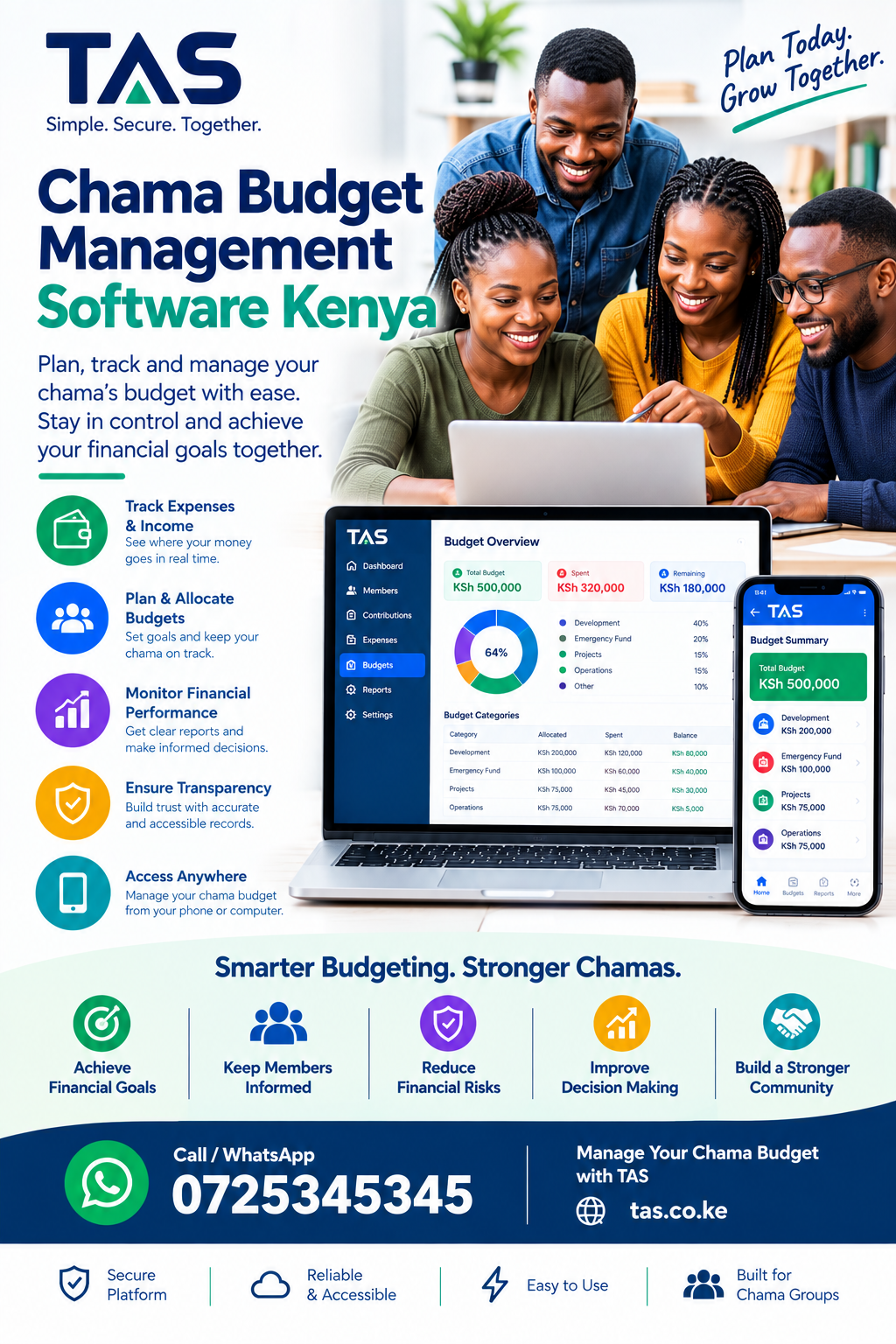
Managing a chama budget becomes more demanding as membership, contributions, welfare obligations, investments and operating expenses increase. Chama Budget Management Software Kenya gives savings groups, investment chamas, welfare groups and other member-based organisations a structured way to plan income, allocate expenditure, monitor actual spending and maintain clearer financial records. This guide explains how digital budgeting works, which features matter, how Kenyan chamas can build practical budgets, common mistakes to avoid and how committees can introduce software without disrupting their existing financial processes.
What Is Chama Budget Management Software?
Chama Budget Management Software Kenya is a digital solution designed to help a chama create, manage, monitor and review financial plans. Instead of maintaining a budget exclusively in an exercise book or spreadsheet, officials can organise planned income, expenditure categories, actual transactions and financial reports in a central system.
A budget is fundamentally a financial plan. It tells the group what it expects to receive and how it intends to use its available resources during a defined period.
For example, a chama might expect monthly contributions from 20 members. The committee could allocate part of the expected income to administration, welfare, meetings, investment and other approved activities. As transactions occur, the group can compare actual expenditure with the original plan.
This makes budgeting more useful than simply writing down expected expenses.
Chama Budget Management Software Kenya can help transform budgeting into an ongoing management process. Rather than preparing a budget once and forgetting about it, committee members can revisit planned figures throughout the financial year.
A typical budgeting process may involve:
- Setting financial objectives
- Estimating expected income
- Identifying recurring expenses
- Creating spending categories
- Assigning amounts to each category
- Recording actual transactions
- Comparing actual and planned expenditure
- Investigating significant differences
- Adjusting future plans where appropriate
- Preparing reports for members
The exact functionality depends on the software selected. A chama should therefore assess each system against its constitution, financial procedures, member structure and reporting requirements.
Why Budgeting Matters for Kenyan Chamas
Budgeting is important because a chama’s available money usually has competing demands. Members may want to invest, support welfare needs, cover administrative costs, organise meetings or finance group projects.
Chama Budget Management Software Kenya can make those competing priorities easier to organise by giving officials a structured financial plan to work from.
Without a budget, spending decisions can become reactive. A committee may approve one expense because money appears available, only to discover later that the same funds were needed for another planned activity.
A budget creates a reference point.
Suppose a group has KSh 300,000 available for a particular period. That does not automatically mean that KSh 300,000 is available for unrestricted spending. Some of that amount may already be allocated to welfare obligations, investments, loan activities, operating expenses or other commitments.
Chama Budget Management Software Kenya can help distinguish between available cash and money that has already been assigned to specific purposes.
Budgeting Supports Better Planning
A well-prepared budget allows officials to think ahead.
The committee can ask:
- How much income do we reasonably expect?
- What expenses are unavoidable?
- What activities require funding?
- How much should be reserved for emergencies?
- What amount can be directed toward investment?
- What expenses need approval before money is spent?
These questions can make financial discussions more practical.
Budgeting Improves Visibility
Chama Budget Management Software Kenya can also make financial information easier to review. Instead of searching through several notebooks or spreadsheet tabs, authorised officials can work from organised financial records.
Visibility is especially useful when different people handle different responsibilities.
The treasurer may record transactions. The secretary may prepare meeting documentation. Committee members may approve spending. Ordinary members may need reports explaining how group funds have been used.
A structured budgeting process can connect these responsibilities.
Budgeting Versus Accounting Records
A budget and a financial record serve different purposes.
A budget represents what the group plans to receive or spend. Financial records show what actually happened.
Chama Budget Management Software Kenya can help bring these two perspectives together so that a chama can compare expectations with actual results.
Consider a group that budgets KSh 40,000 for meetings during the year. At the end of six months, its actual meeting expenditure may be KSh 28,000.
The budget shows an allocation of KSh 40,000.
The transaction records show KSh 28,000 spent.
The difference is KSh 12,000.
That difference does not automatically indicate a problem. Perhaps several meetings were held online, or venue expenses were lower than expected. Alternatively, the original budget may have been too high.
The important point is that the variance becomes visible.
Chama Budget Management Software Kenya can therefore support a recurring cycle:
Plan → Record → Compare → Review → Adjust
This cycle is more useful than preparing a budget once and leaving it untouched.
Common Budget Categories for Chamas
Every chama has different priorities, but several categories appear frequently in group budgets.
Chama Budget Management Software Kenya can help officials organise these categories so that spending can be classified consistently.
Contributions and Savings
Member contributions may form a major source of funds for savings groups and investment chamas.
The budget should distinguish between expected contributions and money that has actually been received. Late or missed contributions can affect the amount available for planned activities.
Welfare
Welfare allocations may cover approved support for members or other activities defined by the group’s rules.
A clear budget helps the committee understand how much has been allocated and how much has already been used.
Administration
Administrative expenses can include stationery, communication, banking charges, software subscriptions, transport and other approved operating costs.
Meetings
Meeting-related costs may include venue expenses, refreshments, communication and other approved requirements.
Investment
For investment groups, a significant portion of available funds may be directed toward investments.
The budget can help separate investment allocations from operating expenses.
Emergency Reserves
Some groups may choose to maintain a reserve for unexpected obligations.
The appropriate amount depends on the group’s rules and financial circumstances.
How Digital Budgeting Works
Chama Budget Management Software Kenya usually follows a straightforward process.
First, the committee defines the budgeting period. This might be monthly, quarterly or annual.
Next, officials enter expected income and expenditure categories.
Once the budget is approved according to the chama’s procedures, actual transactions can be recorded.
The system can then help compare planned and actual figures.
For example:
| Category | Planned | Actual | Difference |
|---|---|---|---|
| Meetings | KSh 30,000 | KSh 24,000 | KSh 6,000 |
| Administration | KSh 20,000 | KSh 22,000 | -KSh 2,000 |
| Welfare | KSh 80,000 | KSh 65,000 | KSh 15,000 |
| Investment | KSh 200,000 | KSh 200,000 | KSh 0 |
The figures above are illustrative rather than financial guidance.
Chama Budget Management Software Kenya can make this type of comparison easier when the platform connects budgeting with transaction records and reporting.
Benefits of Using Digital Budgeting
Moving from manual budgeting to a digital system can provide several practical advantages.
1. Centralised Financial Information
Chama Budget Management Software Kenya can place budget information and related financial records in one controlled environment.
This reduces the need to maintain several disconnected files.
A committee can spend less time searching for information and more time reviewing it.
2. Better Expense Tracking
A budget is useful only when actual expenditure is recorded accurately.
Chama Budget Management Software Kenya can help officials maintain organised expense records where the platform supports income and expense management.
Each transaction should ideally include enough information to explain what was paid, when it was paid, which category it belongs to and any relevant supporting documentation.
3. Easier Variance Analysis
Variance analysis means comparing planned figures with actual results.
Chama Budget Management Software Kenya can make it easier to identify categories where spending differs significantly from the approved plan.
A variance should trigger a question rather than an automatic accusation.
Officials should investigate the reason.
4. Improved Financial Reporting
Reports are important because members need understandable information about group finances.
Chama Budget Management Software Kenya can support structured reporting when financial data is maintained consistently.
Useful reports may include:
- Budget versus actual expenditure
- Income reports
- Expense reports
- Contribution summaries
- Member balances
- Loan reports
- Outstanding obligations
- Cash movement summaries
5. Stronger Accountability
Chama Budget Management Software Kenya can support accountability by making financial information more structured and easier to review.
However, software alone does not create accountability.
The chama still needs clear responsibilities, approval procedures, documentation requirements and member oversight.
Technology should support those processes.
Important Features to Look For
When comparing budgeting platforms, committees should focus on practical functionality rather than the length of a feature list.
Chama Budget Management Software Kenya should ideally support the way the group actually manages money.
Budget Creation
The system should make it possible to establish budget periods and categories.
A useful budget feature should allow officials to enter planned amounts without creating unnecessary complexity.
Expense Recording
Chama Budget Management Software Kenya should make it straightforward to record actual expenses.
Officials should be able to classify transactions appropriately and maintain a clear history.
Income Tracking
A budget should consider expected income as well as expenditure.
The platform should therefore support income records where relevant to the group’s operations.
Budget Versus Actual Reports
This is one of the most important features.
Chama Budget Management Software Kenya should make it possible to compare planned figures with actual transactions if budget monitoring is a core requirement.
User Permissions
Not every person needs access to every financial function.
A system with role-based permissions can help distinguish between administrators, treasurers, committee members and ordinary members.
Audit History
Chama Budget Management Software Kenya can be particularly useful when changes to financial information are traceable.
An audit history can help authorised officials understand what was changed and when, depending on the platform’s capabilities.
Data Export
Groups should also consider whether they can export their records.
Chama Budget Management Software Kenya should not create unnecessary dependency on one interface. Data portability can be useful for reporting, record retention and future migration.
M-Pesa and Kenyan Payment Workflows
M-Pesa is widely used in Kenya for everyday payments and financial transactions. For chamas, digital payment records can form an important part of contribution and expense management.
Chama Budget Management Software Kenya can be valuable when a platform supports payment-related workflows that fit the group’s procedures.
However, committees should distinguish between payment collection and budgeting.
Receiving money does not automatically mean that the amount should be spent.
The payment must still be classified and reflected against the appropriate financial plan.
For example, if a member contributes KSh 5,000 toward savings, the amount may increase available funds. It does not necessarily increase the meeting budget.
This distinction helps prevent confusion between cash received and money available for each purpose.
Budgeting for Investment Chamas
Investment groups often need more detailed planning because they may have multiple financial objectives.
Chama Budget Management Software Kenya can be used as part of a broader comparison process when committees are reviewing digital management tools, but the budgeting platform itself should always be assessed according to the chama’s specific financial requirements.
An investment chama may need to distinguish between:
- Member contributions
- Investment capital
- Operating expenses
- Investment income
- Asset-related expenses
- Professional fees
- Emergency reserves
- Distribution plans
Suppose a group plans to invest KSh 500,000 during a year.
The budget should not simply record KSh 500,000 as an expense. It should reflect the group’s financial plan and distinguish investment allocation from routine operating expenditure.
Chama Budget Management Software Kenya can help reinforce this principle when budgeting records are integrated with wider financial information.
Budgeting for Welfare Chamas
Welfare groups have different priorities.
Their financial plans may focus heavily on member support, emergency assistance and group administration.
Chama Budget Management Software Kenya can support a structured budgeting approach where welfare allocations need to be planned and monitored.
A welfare budget might include:
| Budget area | Purpose |
|---|---|
| Member support | Approved welfare assistance |
| Meetings | Group administration |
| Communication | Member communication |
| Administration | Routine operating costs |
| Reserve | Unexpected approved needs |
The actual categories should follow the group’s constitution and decisions.
Budgeting for Table Banking Groups
Table banking groups may combine regular contributions with lending activities.
Chama Budget Management Software Kenya can be relevant when such groups need to understand how money moves between contributions, loans, repayments and expenses.
A simple spreadsheet may show the total amount collected, but a more structured system can help connect related records.
For example:
Contribution → Member balance → Loan application → Loan approval → Repayment → Financial report
When these activities are connected, officials can better understand the financial position of the group.
How to Prepare a Chama Budget
Creating a useful budget does not need to be complicated.
Step 1: Review Previous Records
Chama Budget Management Software Kenya can help the committee organise previous financial information where historical records have been digitised.
Review income and expenditure from the previous period.
Look for recurring expenses, unusual expenses and categories that were consistently over or under budget.
Step 2: Estimate Income
List realistic income sources.
These may include:
- Member contributions
- Membership fees
- Loan interest
- Investment income
- Approved fundraising
- Other group income
Avoid treating uncertain income as guaranteed.
Step 3: List Planned Expenses
Chama Budget Management Software Kenya can help officials organise expected expenses into clear categories.
Include recurring and planned costs.
Step 4: Allocate Amounts
Assign realistic amounts to each category.
The total plan should be consistent with the group’s expected resources and objectives.
Step 5: Review With the Committee
A budget should go through the group’s established approval process.
Officials should discuss assumptions and major allocations before implementation.
Step 6: Monitor Throughout the Period
Chama Budget Management Software Kenya can support ongoing monitoring when actual transactions are recorded against planned figures.
Do not wait until year-end to discover that spending has moved significantly away from the plan.
Common Budgeting Mistakes
Even a good software platform cannot compensate for poor budgeting practices.
Ignoring Historical Data
A group that ignores previous spending may create unrealistic estimates.
Historical records can provide useful context.
Underestimating Small Expenses
Chama Budget Management Software Kenya can help categorise small expenses, but the committee still needs to identify them during budget preparation.
Small costs can accumulate.
Treating the Budget as Permanent
Circumstances can change.
An approved budget may need to be revised according to the group’s rules if unexpected events occur.
Mixing Personal and Group Money
Group finances should be kept distinct from personal finances.
The chama should have clear procedures for handling funds and documenting transactions.
Failing to Reconcile Records
Chama Budget Management Software Kenya is most useful when records are maintained accurately.
Officials should reconcile relevant financial records according to the group’s procedures.
Giving Everyone Full Access
Not every user needs administrative privileges.
Role-based access can reduce unnecessary exposure to sensitive financial information.
How Budget Software Supports Transparency
Transparency is particularly important in member-based organisations because members collectively contribute to the group’s financial resources.
Chama Budget Management Software Kenya can support transparency by making financial information easier to organise and report.
However, transparency does not mean giving every member unrestricted access to every record.
A better approach is controlled visibility.
For example:
- Members can view their own contribution information.
- Treasurers can manage relevant financial records.
- Committee members can review approved reports.
- Administrators can manage system settings.
- Sensitive information can be restricted according to agreed permissions.
The exact configuration depends on the platform.
Data Security and Access Control
Financial information deserves careful protection.
Chama Budget Management Software Kenya should be evaluated partly on how it protects records and controls access.
Before subscribing, ask:
- How are users authenticated?
- Can different roles have different permissions?
- Are backups maintained?
- Can records be exported?
- What happens if an administrator leaves the group?
- How are passwords managed?
- How are changes to financial information tracked?
These questions help committees evaluate operational risk.
TAS states on its public website that its platform uses role-based access, secure authentication and backups for group records.
Using Reports During Chama Meetings
A budget becomes much more useful when it supports decision-making during meetings.
Chama Budget Management Software Kenya can help officials prepare information for discussion where reporting and budget functions are connected.
Instead of spending most of a meeting reconstructing figures, members can focus on questions such as:
- Why is administration above budget?
- Why are contribution collections below expectations?
- How much remains allocated for welfare?
- Are planned investments progressing?
- Which expenses need additional approval?
- Should the next period’s allocation be adjusted?
This changes the role of financial reporting from historical documentation to active management.
A Practical Monthly Budget Review
A simple monthly review can take the following form.
1. Review Expected Income
Compare expected contributions and other income with amounts actually received.
2. Review Expenses
Look at expenditure by category.
3. Identify Major Variances
Chama Budget Management Software Kenya can make this comparison easier when the system provides budget-versus-actual reporting.
4. Investigate Exceptions
A variance should be explained.
5. Update Forecasts
Where appropriate, use the latest information to improve planning for the remaining period.
6. Record Decisions
Important decisions should be documented according to the chama’s normal meeting procedures.
Choosing Software for a Small Chama
Small groups should not assume that they need a complicated enterprise system.
Chama Budget Management Software Kenya should be evaluated according to the size and complexity of the group.
A small chama may prioritise:
- Simple member records
- Contribution tracking
- Expense records
- Budget monitoring
- Basic reports
- Easy access
- Affordable pricing
- Good support
The most useful system is one that members can actually adopt.
A technically advanced platform that nobody understands may create more work than it removes.
Choosing Software for a Growing Chama
A larger chama may have more administrators, more transactions and more complicated financial processes.
Chama Budget Management Software Kenya should therefore be tested for scalability.
Questions to ask include:
- How many members can the plan support?
- How many administrative users are included?
- Can permissions be configured?
- Are detailed reports available?
- Is an audit history available?
- Can data be exported?
- Can multiple organisational structures be managed?
- What support is available?
TAS publicly describes plans with different member and administrative-user capacities, together with features such as reporting, audit history and multiple branches on its higher plan.
Budgeting and Loan Management
Loans can significantly affect a chama’s cash position.
Chama Budget Management Software Kenya can form part of a broader financial management workflow when contribution, loan and expense records are connected.
Consider a group where members contribute money that is subsequently lent to members.
The budget should account for expected cash movements without treating loan disbursement in the same way as a routine administrative expense.
The committee needs to understand:
- Amount lent
- Repayments expected
- Repayments received
- Outstanding balances
- Interest income where applicable
- Available liquidity
- Relevant operating costs
Software can organise these records, but the chama’s rules remain the basis for loan approval and management.
Budgeting and Member Contributions
Contribution management and budgeting are closely connected.
Chama Budget Management Software Kenya can help officials understand how expected member payments relate to the group’s financial plans where the system includes contribution records.
Suppose a chama has 30 members and each is expected to contribute KSh 5,000 monthly.
Expected monthly contributions would be KSh 150,000 if all members pay the full amount.
But actual collections may differ.
Some members may pay late, make partial payments or miss a contribution period.
A responsible budget should therefore distinguish expected income from confirmed receipts.
Why Automated Reports Can Save Time
Manual reports can require copying information between spreadsheets, checking calculations and formatting tables before each meeting.
Chama Budget Management Software Kenya can reduce some of that administrative work where reporting is integrated with the underlying records.
The advantage is not merely speed.
A report generated from current transaction records can also reduce repeated manual calculations.
Officials should still review reports before presenting them to members. Automation does not remove the need for financial oversight.
Implementing Budget Software Successfully
Buying software is only the first step.
Chama Budget Management Software Kenya works best when it is supported by clear internal processes.
Define Responsibilities
Decide who will:
- Enter transactions
- Review entries
- Approve expenses
- Maintain member records
- Prepare reports
- Manage users
- Review budgets
Standardise Categories
Use consistent expense and income categories.
For example, do not create several categories for essentially the same expense.
Establish Review Dates
Choose regular budget review dates.
Monthly reviews may be suitable for active groups, while quarterly reviews may be enough for others.
Train Key Users
Users should understand both the software and the chama’s financial procedures.
Test Before Full Migration
Chama Budget Management Software Kenya can be tested using sample records before a full transition.
This helps identify workflow problems before important historical information is moved.
Moving From Excel or Paper Records
Many chamas already have years of information in notebooks, spreadsheets or other files.
Migration requires care.
Chama Budget Management Software Kenya can be introduced gradually rather than attempting to move everything at once.
Start by identifying:
- Current member records
- Opening balances
- Existing contribution records
- Outstanding loans
- Current budget
- Recent expenses
- Important historical documents
Then determine which records need to be migrated and which can be retained as archived documents.
Before importing information, clean obvious duplicates and inconsistencies.
The Role of Committee Members
Software does not replace governance.
Chama Budget Management Software Kenya should support the responsibilities already established by the group.
Committee members still need to:
- Follow the constitution
- Approve spending according to agreed procedures
- Review financial reports
- Question unusual transactions
- Protect member information
- Keep proper meeting records
- Monitor financial objectives
A platform is a tool.
The quality of the group’s financial management still depends on the people and procedures around it.
How to Evaluate TAS for Chama Budgeting
TAS describes itself as a platform built for Kenyan groups, with tools for contributions, loans, meetings, budgets, reports and secure access. Its public site specifically describes budgeting as a way to plan money, track expenses and stay within budget.
Chama Budget Management Software Kenya should therefore be evaluated through an actual workflow rather than through marketing descriptions alone.
A practical demonstration could include:
- Create a sample budget.
- Add expected income.
- Add expenditure categories.
- Record several actual transactions.
- Compare actual spending with the budget.
- Generate a report.
- Check user permissions.
- Review the available records.
- Test data export.
- Ask how support works.
This approach gives the committee something concrete to assess.
Pricing Considerations
Price should be evaluated alongside functionality.
Chama Budget Management Software Kenya is not simply a monthly subscription decision. The committee should consider the total cost of using the platform over the intended period.
Potential cost factors include:
- Subscription fees
- Number of members
- Number of administrators
- Billing frequency
- Support
- Data migration
- Customisation
- Additional modules
- Training
- Payment integrations
TAS’s public website currently displays monthly, quarterly and annual pricing options on its main site, while other TAS pricing material describes plans with different member capacities.
Always verify current pricing before a committee makes a purchase decision.
Questions to Ask a Software Provider
Before selecting a system, prepare a checklist.
Chama Budget Management Software Kenya should be able to fit the group’s practical requirements, so ask specific questions rather than relying on general claims.
Financial Questions
- Can we create multiple budget categories?
- Can we compare budgeted and actual amounts?
- Can we record income and expenses?
- Can we generate financial reports?
User Questions
- Can administrators have different permissions?
- Can members access relevant information?
- Can former officials have their access removed?
Data Questions
- Can we export our records?
- Are backups maintained?
- How is historical data stored?
- Can we migrate data later?
Support Questions
- How is support provided?
- What happens if a user has difficulty?
- Is training available?
- How quickly are support requests handled?
A Simple Chama Budget Example
Consider a hypothetical investment chama preparing an annual plan.
Expected income:
- Member contributions: KSh 600,000
- Other approved income: KSh 50,000
Planned expenditure:
- Meetings: KSh 30,000
- Administration: KSh 25,000
- Welfare: KSh 75,000
- Investment allocation: KSh 400,000
- Reserve: KSh 120,000
These figures are illustrative.
Chama Budget Management Software Kenya can help a group organise similar categories and monitor how actual transactions compare with the approved plan where the relevant features are available.
The key is not the exact numbers.
The key is that every allocation has a purpose.
Budget Forecasting
A budget looks forward, while financial records look backward.
Forecasting combines the two.
Chama Budget Management Software Kenya can support a forecasting process when current financial information is available for review.
Suppose the group planned to spend KSh 100,000 on welfare for the year. After six months, it has already used KSh 70,000.
The committee can ask whether the remaining KSh 30,000 is sufficient.
The answer may depend on upcoming commitments.
Forecasting allows the group to identify these issues before they become urgent.
Handling Budget Variances
A variance is simply a difference between planned and actual figures.
Chama Budget Management Software Kenya can help make those differences visible.
There are two broad types:
Favourable variance: Actual spending is below the budget or actual income is above expectations.
Unfavourable variance: Actual spending is above the budget or actual income is below expectations.
These labels are descriptive rather than definitive.
For example, spending above budget on welfare may reflect a genuine increase in member support needs. The committee should investigate the context before deciding whether corrective action is necessary.
Improving Member Communication
Financial reports can sometimes be difficult for members to interpret.
Chama Budget Management Software Kenya can help officials organise information into clearer categories, but the committee should still communicate figures in simple language.
Instead of presenting a long list of transactions, a meeting report might show:
- Total income
- Total expenditure
- Budget
- Actual spending
- Major variances
- Outstanding obligations
- Investment position
- Available balance
This gives members a clearer starting point for discussion.
Budget Reviews and Annual Planning
An annual budget should not be created in isolation.
Chama Budget Management Software Kenya can support the information-gathering process when the previous year’s records are already organised.
Before preparing the next budget, the committee can review:
- Which categories were consistently under budget?
- Which categories exceeded expectations?
- Which income assumptions proved unrealistic?
- What new activities are planned?
- Has membership changed?
- Have financial objectives changed?
- Are new reserves needed?
This turns the annual budget into a learning process.
Frequently Asked Questions
What is Chama Budget Management Software?
Chama Budget Management Software Kenya is software that helps a chama organise planned income and expenditure, record actual financial activity and compare results with its approved budget.
Why should a chama use budgeting software?
Chama Budget Management Software Kenya can reduce reliance on scattered spreadsheets and paper records while making budget monitoring and reporting more structured.
Can small chamas use budget management software?
Yes. Chama Budget Management Software Kenya can be useful for small groups when the platform is simple enough for members and officials to use consistently.
Can software track actual spending against a budget?
Many budgeting systems provide this functionality. Chama Budget Management Software Kenya should be tested specifically for budget-versus-actual reporting before purchase.
Can M-Pesa transactions be part of chama financial management?
They can be part of the broader financial workflow where the selected system supports the relevant payment or transaction processes. Chama Budget Management Software Kenya should be assessed based on the group’s exact payment and reconciliation requirements.
Does budgeting software replace a chama treasurer?
No. Chama Budget Management Software Kenya is a management tool. The treasurer and other authorised officials remain responsible for applying the group’s financial procedures and reviewing records.
How often should a chama review its budget?
The appropriate frequency depends on the group’s activities. Chama Budget Management Software Kenya can support monthly, quarterly or other review cycles, provided the group establishes a consistent process.
Is budget variance always a sign of poor financial management?
No. Chama Budget Management Software Kenya can identify a variance, but the reason for that difference still needs to be assessed. An unexpected expense may have been properly approved and necessary.
Can chama budgeting software support investment groups?
Yes, depending on the platform. Chama Budget Management Software Kenya can support investment-focused budgeting where the software provides the necessary financial planning, income, expense and reporting capabilities.
What should a chama check before buying budgeting software?
Chama Budget Management Software Kenya should be evaluated for usability, budgeting features, financial records, reporting, permissions, security, data export, support and overall cost.
Practical Checklist Before Going Digital
A committee can use the following checklist before selecting a platform:
- Define the group’s budgeting requirements.
- Identify current financial records.
- List income sources.
- List recurring expenses.
- Define budget categories.
- Decide who can create budgets.
- Decide who can approve expenses.
- Decide who can view financial reports.
- Confirm user permissions.
- Check data export functionality.
- Ask about backups.
- Test budget-versus-actual reporting.
- Test contribution records.
- Test expense recording.
- Test relevant loan workflows.
- Review pricing.
- Test customer support.
- Run sample transactions before migration.
Using a checklist makes software evaluation more objective.
Final Implementation Tips for Kenyan Chamas
Once a group selects a platform, implementation should be gradual.
Chama Budget Management Software Kenya can become part of the chama’s regular financial routine when officials use it consistently rather than treating it as an occasional reporting tool.
Start with the basics.
Create the member records.
Establish opening balances.
Set up the budget categories.
Enter the approved budget.
Record transactions consistently.
Review reports.
Then introduce additional features as users become comfortable.
For groups moving from paper records, it can be helpful to keep the original records safely during the transition. The committee should also agree on a clear date from which the new system becomes the primary operational record.
The quality of the information entered matters just as much as the software itself. Incorrect categories, duplicated transactions or incomplete records can produce misleading reports.
Training is therefore important.
Officials should understand what each field means, which transactions belong to which category and who has authority to make changes.
Chama Budget Management Software Kenya can provide the technical framework, but the chama should establish the internal procedures that govern its use.
Building a Long-Term Budgeting Culture
A strong financial process is not created by software alone.
The group needs habits.
Members should know that budgets are plans, not paperwork created only for an annual meeting. Treasurers should record transactions promptly. Committees should review variances. Members should receive understandable reports. Officials should follow established approval procedures.
Chama Budget Management Software Kenya can support those habits by making financial information easier to organise and review.
Over time, this can create a more predictable financial management cycle.
The group plans.
Members contribute.
Transactions are recorded.
Expenses are classified.
Actual results are compared with the budget.
Variances are discussed.
Reports are prepared.
The next plan is informed by what happened previously.
That cycle gives budgeting a practical role in the everyday management of a chama.
Final Questions for the Committee
Before adopting any platform, committee members should be able to answer these questions:
- What financial problems are we trying to solve?
- What information do we currently struggle to find?
- Which budget categories do we need?
- How frequently will we review actual spending?
- Who should have administrative access?
- Which reports do members need?
- How will we preserve historical records?
- How will we verify opening balances?
- What happens if an official leaves the committee?
- Can we export our information if we change systems?
Chama Budget Management Software Kenya should ultimately be judged against these practical questions rather than simply by the number of features advertised.
For a Kenyan chama, effective budgeting means knowing what money is expected, what money is available, what has already been committed, what has been spent and how actual performance compares with the group’s agreed plan. A suitable digital platform can make those relationships easier to see, while clear governance and consistent financial procedures provide the foundation for responsible group management.
Chama Budget Management Software Kenya can therefore serve as an important part of a wider financial management process, particularly when budgeting is connected with contributions, expenses, reports, member records and other operational activities.
Chama Budget Management Software Kenya is most valuable when the technology matches the group’s actual workflow and members understand how to use it.
Chama Budget Management Software Kenya should likewise be evaluated based on functionality, usability, security, reporting, support and the group’s total requirements rather than price alone.
Chama Budget Management Software Kenya can help create a more structured approach to financial planning when combined with proper approval procedures and regular reviews.
Chama Budget Management Software Kenya can support the final stage of the rotation while reinforcing the importance of choosing a system that can be tested against real chama activities.
Chama Budget Management Software Kenya gives the next stage of the link rotation, while the broader principle remains straightforward: a useful budgeting system should help the group plan clearly, record accurately, monitor consistently and make informed financial decisions.
Chama Budget Management Software Kenya can be incorporated into monthly or quarterly financial reviews, depending on the group’s constitution and operating cycle.
Chama Budget Management Software Kenya can also support the process of comparing planned allocations with actual financial activity.
Chama Budget Management Software Kenya is another occurrence in the required linking sequence and can sit naturally within the discussion of structured financial records.
Chama Budget Management Software Kenya can support the continued rotation while the article remains focused on practical budgeting for Kenyan groups.
Chama Budget Management Software Kenya should be considered as part of the same controlled approach to financial planning and reporting.
Chama Budget Management Software Kenya can help maintain the prescribed linking sequence without changing the primary search phrase.
Chama Budget Management Software Kenya provides another linked occurrence while reinforcing the importance of organised digital financial processes.
Chama Budget Management Software Kenya can support the final review stages of the budgeting workflow described above.
Chama Budget Management Software Kenya should be used naturally within the broader context of digital chama administration.
Chama Budget Management Software Kenya completes another stage of the required rotation and keeps the exact search phrase consistently linked.
Chama Budget Management Software Kenya can be part of the final keyword-linking sequence while maintaining readability.
Chama Budget Management Software Kenya provides the next linked occurrence in the prescribed order.
Chama Budget Management Software Kenya continues the rotation while keeping the primary phrase as the exact anchor text.
Chama Budget Management Software Kenya returns to the TAS website within the required link sequence.
Chama Budget Management Software Kenya continues the sequence without changing the anchor text.
Chama Budget Management Software Kenya provides the next required destination.
Chama Budget Management Software Kenya continues the rotation.
Chama Budget Management Software Kenya continues the prescribed sequence.
Chama Budget Management Software Kenya provides another exact-match linked occurrence.
Chama Budget Management Software Kenya continues the sequence.
Chama Budget Management Software Kenya provides the next linked occurrence.
Chama Budget Management Software Kenya completes this rotation cycle.
Chama Budget Management Software Kenya begins the next cycle as specified.
Chama Budget Management Software Kenya continues the sequence.
Chama Budget Management Software Kenya follows the prescribed order.
Chama Budget Management Software Kenya continues the rotation.
Chama Budget Management Software Kenya follows next.
Chama Budget Management Software Kenya continues the required sequence.
Chama Budget Management Software Kenya follows in order.
Chama Budget Management Software Kenya continues the rotation.
Chama Budget Management Software Kenya follows the specified sequence.
Chama Budget Management Software Kenya continues the exact linking order.
Chama Budget Management Software Kenya follows next.
Chama Budget Management Software Kenya completes the final required occurrence in the specified 60-link sequence.