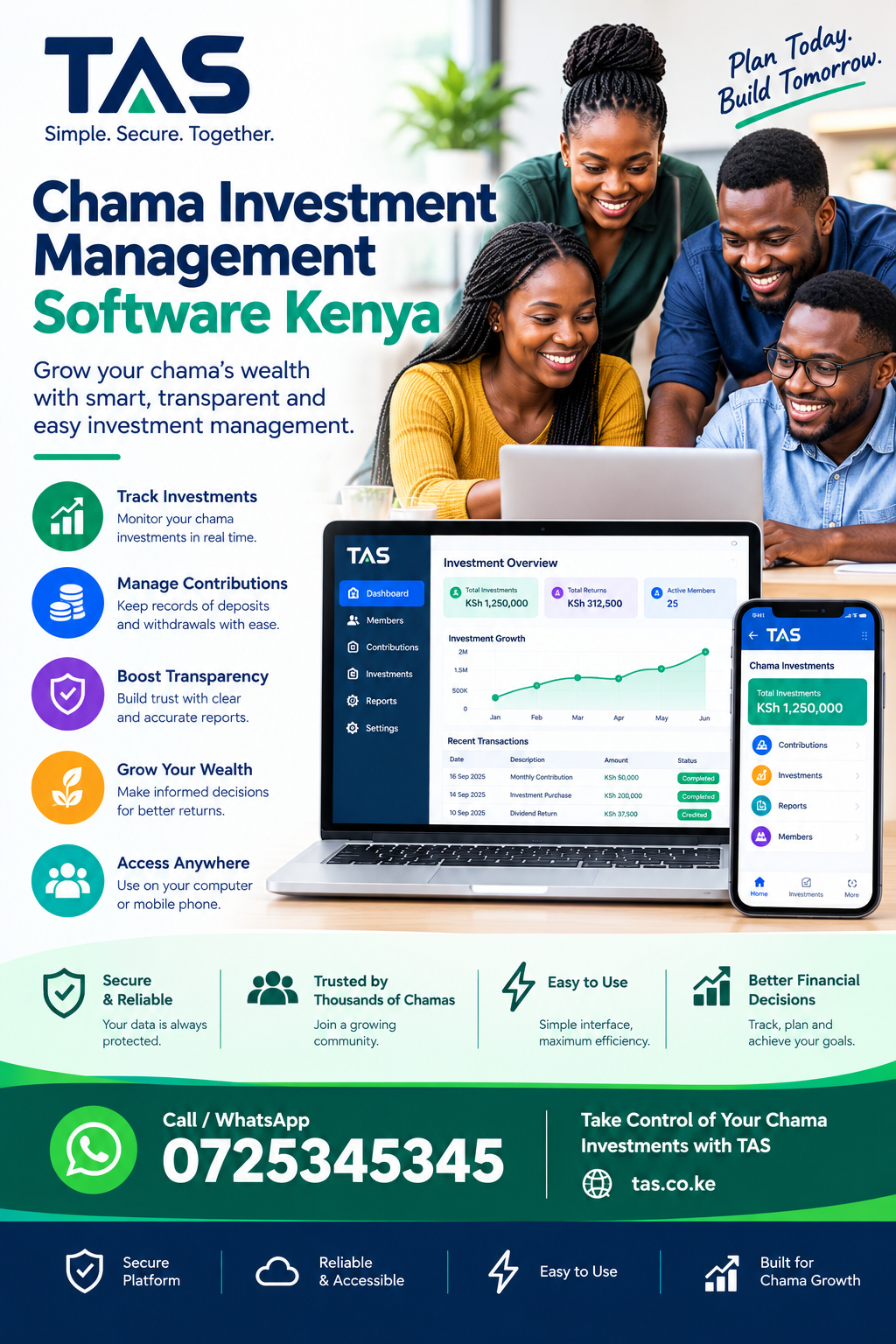
Chama Investment Management in Kenya: A Practical Guide for Smarter Group Investing
Introduction
For investment chamas, keeping track of contributions, portfolios, projects, dividends, member balances, and investment decisions can become difficult when records are spread across notebooks, spreadsheets, bank statements, and WhatsApp messages. Chama Investment Management Software Kenya gives chama officials a structured way to organize investment information, improve financial visibility, and keep members informed. This guide is written for chama officials, treasurers, investment committees, accountants, and members who want to understand how digital investment management can support better record keeping and more disciplined group investing.
A chama may begin with a simple monthly contribution arrangement, but its financial activity can become much more complex as the group grows. Members may contribute different amounts, the group may hold several investments, and the committee may need to track loans, property projects, securities, savings products, business interests, or other assets. Without a consistent system, it becomes harder to answer basic questions such as how much has been invested, what each member owns, which payments are outstanding, what returns have been received, and what decisions were approved.
A good investment management system brings those records into one organized environment. It does not replace the chama’s investment committee or make decisions for members. Instead, it gives the group better information for meetings, reporting, reconciliation, planning, and accountability.
This article explains the practical role of digital investment management for Kenyan chamas, the features to look for, how the system can support different investment activities, and how a group can prepare for implementation.
What Is Chama Investment Management Software?
Chama Investment Management Software Kenya is a digital solution designed to help investment groups record, organize, monitor, and report on financial and investment activities. Instead of maintaining separate files for contributions, assets, income, expenses, and member balances, a chama can use a central system to keep relevant information connected.
The purpose is not simply to replace paper. A useful system should make information easier to retrieve and understand. When a treasurer records a contribution, for example, the system should help connect that transaction with the correct member and reporting period. When an investment generates income, the group should be able to record the income against the appropriate investment and later include it in reports.
For a chama with several investment activities, this structure can be especially valuable. Members can have a clearer view of how pooled funds are being used, while officials can spend less time searching through disconnected records.
Why investment records need structure
Investment decisions depend on reliable records. A group may need to know:
- Total contributions received.
- Amount invested in each asset or project.
- Income generated by each investment.
- Investment-related expenses.
- Current member balances.
- Outstanding member obligations.
- Cash available for future investment.
- Historical performance of projects.
- Decisions approved at previous meetings.
- Documents supporting transactions.
When these details are stored consistently, the committee can prepare for meetings more efficiently and members can ask questions using the same underlying records.
Why Kenyan Chamas Are Moving Toward Digital Records
Many Kenyan chamas are built around trust, regular contributions, and collective decision-making. Those strengths remain important, but growing financial activity creates administrative pressure.
A group with ten members and one savings account may manage records manually without much difficulty. A larger chama with several investments, multiple accounts, regular income, expenses, and changing membership has a different administrative burden.
Chama Investment Management Software Kenya can help create a central record for those activities. The main benefit is visibility: officials can work from organized information instead of repeatedly reconstructing financial history from individual documents.
Digital records can also improve continuity. If a treasurer changes, the next treasurer should not have to rebuild the chama’s records from memory. A structured system gives the incoming official a starting point.
Common administrative challenges
Chamas may experience issues such as:
- Missing contribution entries.
- Duplicate records.
- Delayed reconciliation.
- Difficulty tracking investment income.
- Unclear member balances.
- Lost supporting documents.
- Slow preparation of meeting reports.
- Disagreements caused by inconsistent figures.
- Difficulty comparing investments.
- Limited visibility into historical transactions.
These problems do not necessarily mean that officials are careless. They often result from growth, limited administrative time, or reliance on tools that were not designed for group investment management.
Core Features to Look For
A chama should assess software according to its actual activities rather than choosing a system based only on the number of features listed on a website.
Chama Investment Management Software Kenya should ideally support the complete information cycle: recording money received, documenting money invested, monitoring returns, recording expenses, maintaining member information, and producing useful reports.
1. Member management
Member management provides the foundation for investment records. The system should allow the chama to maintain relevant member information and connect each person’s financial activity to their profile.
Useful member records may include:
- Name and contact information.
- Membership status.
- Joining date.
- Contribution history.
- Investment participation.
- Allocated returns.
- Outstanding balances.
- Relevant documents.
A well-organized member record reduces the need to search across multiple spreadsheets.
2. Contribution tracking
Contributions are often the primary source of pooled investment capital. The system should make it easy to record regular contributions and identify missed or incomplete payments.
Chama Investment Management Software Kenya can support contribution tracking by connecting transactions to members and periods. This gives officials a clearer view of expected versus received funds.
For example, suppose a chama expects each of 20 members to contribute KSh 5,000 monthly. The expected monthly pool is KSh 100,000. If only KSh 90,000 is received, the committee should be able to identify the outstanding KSh 10,000 without manually checking every member’s record.
3. Investment portfolio records
A group may have more than one investment. Its portfolio could include a property project, a business venture, a savings product, or another approved investment.
A digital portfolio record can show:
| Investment information | Why it matters |
|---|---|
| Investment name | Identifies the asset or project |
| Date started | Establishes the investment timeline |
| Amount invested | Shows capital committed |
| Income received | Tracks cash generated |
| Expenses | Captures related costs |
| Current status | Shows whether the investment is active |
| Supporting documents | Provides evidence for records |
The precise fields should reflect the chama’s investment policy and accounting practices.
4. Income tracking
Investment income needs to be recorded separately from ordinary member contributions. Income may arise from different activities, and mixing these amounts can make reports confusing.
Chama Investment Management Software Kenya can help a group categorize income so officials can see where money came from and how it relates to the chama’s activities.
Possible income categories include:
- Investment proceeds.
- Rental income from a group-owned property.
- Business profits allocated to the chama.
- Interest income.
- Other approved investment receipts.
The group should establish consistent categories before using them in reports.
5. Expense management
Investments also create expenses. Property projects may involve maintenance or professional services. Businesses may incur operating costs. Administrative activities may generate transaction charges.
Recording expenses alongside investment income helps the committee understand the financial position of each activity. It also gives members a clearer picture of why gross income and net returns may differ.
6. Document management
Important documents should not depend on one official’s phone or personal email account. A structured digital record can help the chama organize relevant documents such as agreements, receipts, approvals, statements, valuation records, meeting minutes, and investment correspondence.
Chama Investment Management Software Kenya can be particularly useful when a chama needs to connect documents to financial records. The exact document capabilities depend on the chosen platform, so committees should confirm storage, permissions, backup, and export options before implementation.
Supporting M-Pesa and Other Payment Records
M-Pesa is widely used for everyday payments in Kenya, and many groups receive member contributions through mobile money. That makes payment reconciliation an important part of chama administration.
A useful digital workflow should make it possible to match incoming payments with the correct member and contribution period. The group should also have a clear process for handling payments that cannot immediately be identified.
Chama Investment Management Software Kenya can form part of that workflow by providing an organized destination for payment records, provided the chosen system supports the relevant payment and reconciliation processes.
Why reconciliation matters
Suppose five members send contributions on the same day. If the treasurer records only the total amount, it may be difficult later to establish who paid what. If each payment is recorded against the appropriate member, the chama has a stronger audit trail.
A practical reconciliation routine can include:
- Collecting the payment records.
- Matching each payment to a member.
- Checking the expected amount.
- Investigating unidentified transactions.
- Confirming the total against the bank or mobile money statement.
- Recording adjustments with an explanation.
- Keeping supporting evidence.
This process becomes easier when transactions are stored consistently.
Managing Different Types of Chama Investments
Not every chama invests in the same way. The software should therefore be flexible enough to accommodate the group’s approved investment activities.
Chama Investment Management Software Kenya can support a more structured approach when a group needs to monitor several investments from one place, subject to the platform’s actual capabilities.
Property investments
A chama may pool funds to acquire land, develop property, purchase rental units, or participate in another real estate project.
Property-related records may include:
- Purchase costs.
- Development expenditure.
- Rental income.
- Maintenance costs.
- Professional fees.
- Ownership documentation.
- Property-related taxes and charges.
- Valuation records.
Separating these records from ordinary member contributions makes reporting easier.
Business investments
A group may invest in an existing business or establish a business venture. In that situation, officials need to distinguish capital contributed to the business from profits, operating expenses, and withdrawals.
The chama should also document how investment decisions are approved and how returns are distributed or reinvested.
Financial investments
Some groups may hold approved financial assets or savings products. These records can include purchase dates, amounts, income received, charges, and relevant statements.
Because investment products differ, a committee should define the fields and reporting categories it needs before configuring the system.
Investment Tracking and Member Ownership
One of the most important questions in a chama is how group investment activity relates to individual members.
A member may want to know:
- How much have I contributed?
- What is my current balance?
- What share of the group’s investment activity is attributable to my contributions?
- What returns have been allocated to me?
- Are there outstanding obligations?
- What records support the reported amount?
Chama Investment Management Software Kenya can help organize these records when the system is configured around the chama’s agreed rules.
The software should not be used to invent ownership rules. Those rules should come from the chama’s constitution, investment policy, resolutions, agreements, and applicable legal or accounting guidance.
Contribution-based allocation
Some groups may allocate benefits based on contribution levels. Others may have different arrangements. The important point is that the method should be documented and applied consistently.
For example, if a group decides that a particular investment return will be allocated according to member units, the system should record the units and the approved allocation method. Officials should be able to explain the resulting figures to members.
Financial Reporting for Chama Committees
A good report should answer practical questions without forcing members to interpret raw transaction data.
Chama Investment Management Software Kenya can make reporting more structured by bringing relevant financial records together.
Useful reports may include:
- Member contribution report.
- Investment register.
- Investment income report.
- Expense report.
- Cash position.
- Outstanding contributions.
- Member statement.
- Investment activity history.
- Periodic financial summary.
- Transaction report.
Reports for monthly meetings
Before a monthly meeting, the treasurer may need to present:
- Opening cash position.
- Contributions received.
- Outstanding contributions.
- Investment transactions.
- Income received.
- Expenses paid.
- Closing position.
- Proposed investment actions.
If the data is already organized, preparing the meeting pack becomes less dependent on manual calculations.
Reports for annual reviews
Annual reviews require a broader perspective. Members may want to understand how the group’s finances changed during the year, what investments were made, what income was generated, and what major expenses occurred.
Chama Investment Management Software Kenya can support this process by keeping historical information available for reporting and review.
Transparency and Member Communication
Investment groups rely heavily on member confidence. Clear records can support transparency because officials can provide consistent information when members ask questions.
Transparency does not mean every member should have unrestricted access to every administrative record. Access should be designed around roles and the chama’s governance rules.
For example:
- Members may receive their own statements.
- Treasurers may manage financial entries.
- Investment committee members may review portfolio information.
- Administrators may manage member records.
- Authorized officials may approve certain transactions.
Chama Investment Management Software Kenya can be evaluated partly on whether it supports appropriate user roles and permissions.
Reducing disputes
Many financial disputes begin with different versions of the same information. One spreadsheet may show one balance while a notebook shows another.
A centralized record creates a common reference point. It also makes it easier to investigate a disputed transaction by checking its date, amount, member, category, and supporting documentation.
Investment Decision-Making and Meeting Records
Software should support decision-making without replacing the people responsible for decisions.
A chama investment committee can use historical records to prepare questions such as:
- How much cash is currently available?
- What commitments are already outstanding?
- Which investments require additional funding?
- What income has each investment generated?
- What expenses have been incurred?
- What projects are under review?
- What documents need committee approval?
Chama Investment Management Software Kenya can provide the information layer that supports those discussions, depending on the selected platform.
The actual decision should still follow the group’s governance process.
Recording resolutions
Investment decisions should be documented. A strong administrative process can connect an approved resolution with the transaction that follows.
For example, if members approve an investment of KSh 500,000, the chama should retain the meeting record or resolution and then record the eventual payment against the relevant investment.
This creates a useful chain:
Decision → Approval → Payment → Investment record → Supporting documents → Reporting
Security and Access Control
Financial information should be handled carefully. When choosing software, a chama should ask practical questions about account security, passwords, user permissions, backups, data export, and access removal.
Chama Investment Management Software Kenya should be assessed not only for convenience but also for how it protects sensitive records.
Questions to ask a provider
Before implementation, ask:
- Who can access member financial information?
- Can user permissions be customized?
- What happens when an official leaves the committee?
- Are records backed up?
- Can data be exported?
- How are password resets handled?
- Is activity logged?
- How are documents protected?
- What support is available when records need correction?
- What happens if the subscription ends?
These questions help the committee evaluate operational risk before committing to a system.
Data Accuracy and Audit Trails
Digital software does not automatically create accurate records. The quality of the output depends on the quality of the information entered.
A chama should establish basic controls such as:
- Clear transaction categories.
- Consistent naming conventions.
- Regular reconciliation.
- Approval requirements for significant entries.
- Review of unusual transactions.
- Document attachment where appropriate.
- Periodic backups or exports.
- Controlled access.
Chama Investment Management Software Kenya can be useful as part of a controlled workflow, but officials should still review records regularly.
Correcting mistakes
A good accounting or investment record should preserve enough history to explain corrections. Instead of deleting an unexplained transaction, the group may need a documented adjustment or reversal, depending on its procedures.
The exact correction process should be defined by the chama’s financial controls and the software’s capabilities.
How Software Can Save Administrative Time
Manual record keeping often creates repeated work. A treasurer may calculate balances in a spreadsheet, copy totals into a report, then prepare another summary for a meeting.
Chama Investment Management Software Kenya can reduce some of that duplication by keeping information in a structured system and producing reports from recorded transactions.
The time saving can be especially useful for volunteer officials who manage chama responsibilities alongside work or business.
Example workflow
Consider a chama with 30 members:
- Members make monthly contributions.
- Payments are recorded against member accounts.
- The treasurer reconciles the received amount.
- The committee reviews available funds.
- An approved investment is recorded.
- The investment payment is linked to supporting documents.
- Income is recorded when received.
- Expenses are entered under the relevant category.
- Member and investment reports are generated for the next meeting.
The value is not the automation of every decision. It is the reduction of repetitive administrative work around those decisions.
Choosing the Right Chama Investment System
The right system depends on the chama’s size, investment activities, reporting requirements, governance structure, budget, and technical comfort.
Chama Investment Management Software Kenya should be assessed against real workflows rather than a generic feature checklist.
Create a requirements list
Before comparing providers, write down what the chama actually needs.
For example:
| Requirement | Priority |
|---|---|
| Member records | High |
| Contribution tracking | High |
| Investment register | High |
| Financial reporting | High |
| Expense tracking | High |
| Document storage | Medium |
| Mobile access | Medium |
| User permissions | High |
| Data export | High |
| Payment reconciliation | High |
This makes vendor discussions more focused.
Consider ease of use
A sophisticated system is less useful if officials struggle to use it. Ask for a demonstration and test common tasks.
Can a treasurer:
- Add a member?
- Record a contribution?
- Find a member statement?
- Record an investment?
- Enter income?
- Record an expense?
- Produce a report?
- Correct an error?
If these tasks require excessive effort, adoption may become difficult.
Cost Considerations
The cheapest software is not automatically the lowest-cost option, and an expensive system is not automatically better suited to a chama.
Chama Investment Management Software Kenya should be evaluated according to total value, including subscription costs, setup, training, support, migration, and the administrative time saved.
A committee should ask for clarity on:
- Subscription fees.
- Number of users.
- Number of members supported.
- Setup charges.
- Training costs.
- Data migration fees.
- Support arrangements.
- Additional modules.
- Payment-related charges.
- Contract terms.
The group should compare these costs with the current administrative burden and the importance of reliable records.
Implementing Software Without Disrupting the Chama
Implementation should be planned. Switching systems in the middle of a financial period without preparation can create confusion.
Chama Investment Management Software Kenya can be introduced in stages so officials have time to learn the workflow and validate records.
Step 1: Define the current process
Document how the chama currently handles:
- Contributions.
- Banking.
- Investments.
- Expenses.
- Reporting.
- Approvals.
- Member communication.
Step 2: Clean existing records
Before importing information, identify duplicate members, missing transactions, inconsistent names, and unexplained balances.
Step 3: Set roles
Decide who can create, review, approve, and view different records.
Step 4: Train officials
Training should focus on real chama tasks rather than only explaining menus.
Step 5: Test reports
Generate sample reports and compare them with the chama’s existing records.
Step 6: Go live
Once officials are comfortable, establish a date from which the system becomes the primary record.
Step 7: Review
After the first few reporting cycles, collect feedback and correct workflow problems.
Common Mistakes to Avoid
Buying software without changing the underlying process can limit its value.
Chama Investment Management Software Kenya can support organized administration, but the chama still needs clear policies and disciplined data entry.
Mistake 1: Choosing based only on price
A low subscription cost may not address important needs such as reporting, permissions, reconciliation, or support.
Mistake 2: Entering incomplete historical data
If historical balances are wrong, future reports will also be unreliable.
Mistake 3: Giving everyone the same access
Different roles should have appropriate permissions.
Mistake 4: Ignoring reconciliation
A system cannot compensate for unreconciled payment records.
Mistake 5: Failing to document approvals
Investment transactions should be traceable to the relevant decision or authorization.
Mistake 6: Not training new officials
Chama leadership changes over time. Training should therefore be part of the handover process.
Chama Investment Management Software Kenya for Growing Groups
Growth changes the administration of a chama. More members, more money, and more investments create more records.
Chama Investment Management Software Kenya can help a growing group maintain structure as transaction volume increases.
A small group may initially need only contribution tracking. Later it may need investment registers, detailed reports, document management, expense categorization, and role-based access.
This is why scalability matters. The system should accommodate a realistic growth path without forcing the chama to rebuild its records every time its activities expand.
Using Historical Data for Better Planning
Historical information can be useful when the committee prepares future budgets and investment plans.
Chama Investment Management Software Kenya can help organize historical records that show contribution patterns, investment income, recurring expenses, and previous transactions, depending on the system’s reporting capabilities.
Historical data can help officials ask better planning questions:
- How consistent have contributions been?
- Which expenses recur?
- How much cash is normally available after obligations?
- Which investments require ongoing funding?
- What income patterns have been observed?
- Which records need closer monitoring?
The data should inform discussion rather than be treated as a guarantee of future performance.
Managing Investment Documents
Investment administration involves more than numbers. Agreements, certificates, receipts, statements, approvals, correspondence, and other records may need to be retained.
Chama Investment Management Software Kenya can be considered where document organization is part of the group’s workflow.
A sensible document structure might separate:
- Member documents.
- Contribution evidence.
- Investment agreements.
- Property documents.
- Financial statements.
- Meeting resolutions.
- Expense receipts.
- Tax or compliance documents.
- Investment correspondence.
Clear naming and consistent storage make retrieval easier during reviews.
Preparing for Audits and Financial Reviews
Whether the chama undergoes a formal audit or an internal review, organized records make the process easier.
Chama Investment Management Software Kenya can help maintain a consistent history of transactions and reports when the system supports the required controls.
A review may require officials to explain:
- Where funds came from.
- Where funds went.
- Which investments were approved.
- How income was recorded.
- How expenses were classified.
- How member balances were calculated.
- Which documents support major transactions.
The goal is traceability. A reviewer should be able to move from a reported figure back to the relevant transactions and supporting evidence.
The Role of the Treasurer
The treasurer often carries a significant administrative responsibility within a chama. Software can make that role more structured, but it does not remove the need for review and accountability.
Chama Investment Management Software Kenya can help the treasurer maintain consistent records, generate reports, and identify outstanding items.
A practical treasurer routine may include:
Daily or as transactions occur
- Record payments.
- File supporting documents.
- Review unusual transactions.
Weekly
- Reconcile available payment records.
- Check pending entries.
- Follow up on unresolved transactions.
Monthly
- Prepare contribution reports.
- Review investment activity.
- Reconcile accounts.
- Prepare meeting reports.
Annually
- Review historical records.
- Confirm investment documentation.
- Support annual reporting.
- Prepare handover information where leadership changes.
The Role of the Investment Committee
The investment committee focuses on decisions and oversight rather than merely data entry.
Chama Investment Management Software Kenya can provide committee members with structured information for discussions about investment activity, available funds, income, expenses, and historical performance.
Before approving a transaction, the committee may review:
- Available funds.
- Existing commitments.
- Investment objective.
- Expected costs.
- Relevant documentation.
- Risk considerations.
- Member approval requirements.
- Reporting implications.
The software is an administrative tool; the committee remains responsible for following the chama’s agreed governance process.
Supporting Member Statements
Members often want a simple answer to the question: “What is my position in the chama?”
A useful statement can show contributions, adjustments, allocations, and other relevant entries in a way that is easier to understand than a raw transaction spreadsheet.
Chama Investment Management Software Kenya can support member reporting when configured with the chama’s approved rules.
A member statement should use clear labels and dates. If an amount represents an allocation, adjustment, or deduction, the description should be understandable.
How to Improve Data Quality
The value of a digital system depends heavily on accurate input.
Chama Investment Management Software Kenya can be supported by simple internal controls.
Use consistent names
Avoid recording the same member under different spellings. Standardized member records make reports more reliable.
Record transactions promptly
Delayed entries increase the chance of forgotten or duplicated transactions.
Attach evidence
Where appropriate, retain receipts, statements, approvals, or other supporting records.
Review before meetings
Officials should check major figures before presenting them to members.
Restrict editing rights
Not every user needs permission to change financial records.
Questions to Ask Before Buying
A committee should treat software selection as an operational decision.
Chama Investment Management Software Kenya should be tested against the group’s actual requirements.
Ask the provider:
- Does the system support chama member records?
- Can it track contributions?
- Can it separate investment income from contributions?
- Can it track expenses?
- Can it produce member statements?
- Can it maintain investment records?
- Can officials export data?
- What user roles are available?
- How is data backed up?
- What training is provided?
- What support is available?
- Can the system scale as membership grows?
- Can existing records be migrated?
- What happens if the chama changes administrators?
A demonstration using realistic sample data is often more useful than a generic product presentation.
Chama Investment Management Software Kenya and Governance
Good technology works best when paired with clear governance.
Chama Investment Management Software Kenya should support, rather than replace, the chama’s constitution, investment policy, approval procedures, and reporting practices.
A group should define:
- Who can authorize investments.
- Who can release funds.
- Who records transactions.
- Who reviews reports.
- How conflicts are disclosed.
- How member questions are handled.
- How records are handed over.
- How major decisions are documented.
These controls create a framework within which software can be useful.
Practical Example: A 25-Member Investment Chama
Consider a hypothetical chama with 25 members contributing KSh 4,000 per month. If every member contributes the full amount, the group expects KSh 100,000 for that month.
The group has an existing property investment and is considering another project. During the month, members make their contributions, the treasurer reconciles receipts, and the committee reviews the cash position.
Chama Investment Management Software Kenya can organize the records into member contributions, investment activity, income, expenses, and available balances.
The committee can then prepare a meeting report showing:
- Expected contributions: KSh 100,000.
- Actual contributions received.
- Outstanding member amounts.
- Property-related income or expenses.
- Other approved expenses.
- Cash available after commitments.
- Investment amounts already committed.
The figures in this example are illustrative rather than a recommendation for how a real chama should invest.
Practical Example: Managing an Investment Project
Suppose a chama approves a project that requires staged payments.
Instead of recording only the final amount, officials can maintain a project record showing each approved payment, date, amount, purpose, and supporting document.
Chama Investment Management Software Kenya can help organize those records if the selected system supports project or investment tracking.
A staged workflow might look like:
Approval → First payment → Supporting document → Progress review → Second payment → Updated project record → Periodic report
This makes it easier for the committee to understand how committed capital has been used.
What Good Reporting Looks Like
Good reports are not necessarily the longest reports. They are reports that answer the questions members and officials actually have.
Chama Investment Management Software Kenya should make important figures easy to locate.
A monthly investment report might include:
| Area | Information |
|---|---|
| Contributions | Amount expected and received |
| Investments | Amount committed and paid |
| Income | Income received by category |
| Expenses | Investment and administrative costs |
| Cash | Available balance |
| Members | Outstanding contributions |
| Documents | Key supporting records |
| Decisions | Approved investment actions |
The exact report format should be adapted to the chama’s governance and accounting requirements.
Mobile-Friendly Administration
Chama officials may not always work from a desktop computer. A system that is accessible through suitable devices can make routine administration more convenient.
Chama Investment Management Software Kenya can be considered alongside practical questions about device compatibility, connectivity, user experience, and data security.
Mobile access is useful when officials need to:
- Check a member record.
- Review a recent transaction.
- Confirm a meeting figure.
- Access a report.
- Follow up on an outstanding item.
Convenience should not come at the expense of access controls.
Training Members and Officials
Implementation should include training for the people who will actually use the system.
Chama Investment Management Software Kenya is more likely to deliver value when officials understand both the software and the chama’s data procedures.
Training can be divided into roles.
Treasurer training
Focus on transactions, reconciliation, reporting, and corrections.
Secretary training
Focus on member records, meetings, documents, and administrative information.
Investment committee training
Focus on portfolio records, investment reporting, approvals, and review.
Member orientation
Explain how statements are generated, how information is presented, and whom members should contact when a figure appears incorrect.
Measuring Whether the System Is Working
After implementation, the chama should review whether the software is actually improving administration.
Chama Investment Management Software Kenya can be evaluated against measurable operational improvements.
Useful indicators include:
- Time required to prepare monthly reports.
- Number of unresolved transactions.
- Time required to find supporting documents.
- Frequency of reconciliation differences.
- Accuracy of member statements.
- Percentage of transactions recorded promptly.
- Number of manual spreadsheets still required.
If the chama is still maintaining several disconnected records after implementation, it may need to simplify its workflow.
Chama Investment Management Software Kenya for Long-Term Record Keeping
Investment groups can operate for many years. Records should therefore be treated as an institutional asset rather than the personal property of the current treasurer.
Chama Investment Management Software Kenya can support continuity by keeping information organized beyond one official’s term.
When leadership changes, the handover should cover:
- Current member register.
- Contribution balances.
- Investment portfolio.
- Outstanding obligations.
- Bank and payment records.
- Important documents.
- Recent reports.
- Pending decisions.
- User access and permissions.
A structured handover reduces the risk of institutional memory disappearing when an official leaves.
Integrating Investment Management With Broader Chama Administration
Investment activity does not exist in isolation. A chama may also manage meetings, budgets, member communications, savings, loans, and other activities.
Chama Investment Management Software Kenya becomes more useful when the investment records fit into the broader administrative workflow.
For example, a meeting may approve a new investment. The resolution is recorded, the treasury team processes the payment, the investment register is updated, and the transaction appears in the next report.
The closer these steps are connected, the less manual duplication is required.
Handling Sensitive Member Information
Member information should be collected and handled responsibly.
Chama Investment Management Software Kenya should be reviewed for access controls and data handling practices that match the chama’s needs.
Officials should avoid unnecessary sharing of member financial information through informal channels. Where reports are shared electronically, recipients and permissions should be considered carefully.
The chama should also maintain a clear process for removing access when a committee member leaves office.
Preparing a Chama Software Policy
A short internal policy can make software use more consistent.
Chama Investment Management Software Kenya can be paired with rules covering:
- Who creates member records.
- Who records contributions.
- Who approves corrections.
- Who can view financial reports.
- How often accounts are reconciled.
- How documents are retained.
- How user access is reviewed.
- How leadership handovers are handled.
- How data is exported or backed up.
The policy does not need to be complicated. Its purpose is to remove uncertainty.
Future-Proofing the Chama’s Digital Records
A group should consider what it may need in two or three years, not only what it needs today.
Chama Investment Management Software Kenya should be assessed for scalability, reporting flexibility, data portability, and support.
Potential future needs may include:
- More members.
- More investment projects.
- More detailed reports.
- Additional administrators.
- New payment workflows.
- More documents.
- Stronger approval controls.
- More frequent financial reviews.
Choosing a system that can accommodate reasonable growth reduces the need for another disruptive migration.
Chama Investment Management Software Kenya: A Practical Selection Checklist
Before signing up, the committee can use the following checklist.
Chama Investment Management Software Kenya should:
- Support member management.
- Track contributions.
- Organize investment records.
- Record income and expenses.
- Provide useful reports.
- Support appropriate user permissions.
- Make records easy to retrieve.
- Allow suitable data export.
- Provide a clear support process.
- Fit the chama’s budget.
- Work with the devices officials use.
- Support an orderly leadership handover.
The committee should test the most important workflows rather than relying entirely on promotional descriptions.
Building a Reliable Investment Record From Day One
A strong record begins with a clear structure. Chama Investment Management Software Kenya should be configured around the information the group actually uses, rather than forcing officials to maintain parallel systems indefinitely.
Start by defining the master records:
- Members and membership status.
- Contribution categories.
- Investment categories.
- Income categories.
- Expense categories.
- Bank and payment accounts.
- Documents and resolutions.
- Reporting periods.
Once these foundations are agreed, transactions can be entered consistently. This is particularly useful when several officials share administrative responsibilities.
Budgeting for Future Investment Activities
Investment planning requires more than recording what has already happened. A chama may need to estimate how much money will be available for a future project after regular contributions, existing commitments, and operating expenses have been considered.
Chama Investment Management Software Kenya can provide historical figures that help officials prepare budgets and cash-flow discussions. The group can compare expected contributions with known obligations and identify funds that may be available for approved activities.
A practical budget can separate:
- Expected member contributions.
- Existing investment commitments.
- Recurring administrative expenses.
- Expected investment income.
- Planned capital requirements.
- Emergency or reserve amounts where the group’s policy provides for them.
Budget figures should remain clearly identified as estimates until actual transactions are recorded.
Reviewing Investment Performance
A chama may want to review how an investment has performed over time. The review should consider more than a single income figure.
Chama Investment Management Software Kenya can help assemble information such as capital committed, income received, expenses incurred, and relevant historical transactions. This gives the committee a more complete record for its review.
For each investment, officials can consider:
- Original amount committed.
- Additional capital contributed.
- Income received.
- Direct expenses.
- Outstanding commitments.
- Current status.
- Supporting documents.
- Approved next steps.
The appropriate performance measures will depend on the type of investment and the group’s accounting and governance practices.
Keeping the Chama Ready for Leadership Changes
Leadership changes are normal in member-based organizations. A new treasurer or investment committee should be able to understand the group’s records without depending on informal explanations from former officials.
Chama Investment Management Software Kenya can support continuity when records are kept consistently throughout the year.
A useful handover pack can contain:
- Current member list.
- Latest contribution report.
- Investment register.
- Recent financial reports.
- Outstanding items.
- Important resolutions.
- Key investment documents.
- User access information.
- Current reporting calendar.
This process turns financial administration into an organizational record rather than a personal file belonging to one official.
A Simple Monthly Investment Review
A monthly review does not need to be complicated. Chama Investment Management Software Kenya can be used to organize the figures before a committee meeting, after which officials can discuss the information and agree on actions through the chama’s normal governance process.
A simple agenda could cover:
- Contributions received.
- Unpaid or unidentified contributions.
- Investment transactions.
- Income received.
- Expenses paid.
- Current commitments.
- Documents requiring attention.
- Decisions pending member approval.
- Actions assigned to officials.
Consistent monthly reviews make it easier to identify small record-keeping problems before they become difficult to resolve.
Connecting Financial Records to Member Confidence
Members are more likely to understand collective investments when financial information is presented clearly. Chama Investment Management Software Kenya can help officials produce structured statements and summaries that explain where contributions have been recorded and how investment activity is reflected in group reports.
The objective is not to overwhelm members with raw data. A useful communication approach highlights relevant figures, dates, categories, and supporting information while keeping detailed records available for authorized review.
When a Spreadsheet May No Longer Be Enough
Spreadsheets can be useful for small groups, especially during early stages. Problems can arise when the number of members, investments, transactions, and documents increases.
Chama Investment Management Software Kenya becomes more relevant when officials spend significant time copying figures between sheets, reconciling separate records, or preparing reports manually.
Signs that a group may need a more structured system include:
- Multiple spreadsheets serving different purposes.
- Repeated manual calculations.
- Difficulty identifying the latest version of a record.
- Long delays in preparing reports.
- Frequent reconciliation differences.
- Missing supporting documents.
- Dependence on one official to explain historical records.
A software system should simplify these problems rather than add another layer of administration.
A Practical First-Year Implementation Plan
For a chama adopting a new system, the first year can be divided into manageable stages. Chama Investment Management Software Kenya can be introduced with a clear implementation calendar rather than attempting to digitize every historical record at once.
During the first month, define requirements and clean the member register. During the second month, establish contribution and transaction workflows. During the third month, organize investment records and documents. Later months can focus on reporting improvements, user training, and periodic reviews.
At each stage, compare the new records with trusted source documents before treating the system as the primary administrative record.
Frequently Asked Questions
1. What is Chama Investment Management Software Kenya?
Chama Investment Management Software Kenya refers to software designed to organize the financial and investment activities of a chama. Depending on the platform, it may include member management, contribution tracking, investment records, income and expense tracking, reporting, document management, and access controls.
2. Can software track chama member contributions?
Yes. A suitable system can record contributions against individual member accounts and periods. It can also help identify outstanding amounts and generate contribution reports.
3. Can a chama use software to manage multiple investments?
Chama Investment Management Software Kenya can support multiple investment records when the chosen platform provides portfolio or investment tracking features. Each investment can be organized with its relevant transactions, income, expenses, documents, and status.
4. Can the system help with M-Pesa reconciliation?
Some platforms support payment reconciliation workflows. A chama should confirm exactly which M-Pesa or payment features are supported before selecting a provider and establish a process for matching incoming transactions to members.
5. Is chama software suitable for small investment groups?
Yes, provided the system matches the group’s needs and budget. A small chama can benefit from consistent records even before its investment activity becomes complex.
6. How does software improve financial transparency?
Chama Investment Management Software Kenya can centralize transaction and member information, making it easier to generate consistent reports and trace figures back to recorded transactions. Transparency still depends on appropriate access, accurate data entry, and proper governance.
7. What reports should a chama expect?
Useful reports may include contribution summaries, member statements, investment registers, income reports, expense reports, cash summaries, outstanding contribution reports, and historical transaction reports.
8. How should a chama choose investment management software?
Start with the group’s actual workflows and requirements. Compare member management, contributions, investments, reporting, security, support, usability, scalability, data export, and total cost. A live demonstration using realistic scenarios can help the committee assess suitability.
9. Does software replace the chama’s investment committee?
No. Software is an administrative and reporting tool. The committee and members remain responsible for decisions according to the chama’s constitution, investment policy, and applicable requirements.
10. What should happen when a treasurer leaves?
The chama should complete a documented handover covering member records, balances, investments, documents, reports, pending transactions, and user access. A centralized system can make that handover more structured.
Getting Started With Digital Investment Management
The move from notebooks and scattered spreadsheets to a structured system does not need to happen all at once. A chama can begin by mapping its current processes, cleaning its records, defining user roles, selecting the information that must be tracked, and testing the most important workflows.
Chama Investment Management Software Kenya can form part of that transition when the selected platform matches the group’s requirements.
Start with the records that matter most: members, contributions, investments, income, expenses, documents, and reports. Once those foundations are reliable, the chama can improve more advanced workflows.
The strongest implementation is usually the one that makes everyday administration easier without making governance unnecessarily complicated. A treasurer should be able to reconcile transactions. An investment committee should be able to review the portfolio. Members should be able to understand their statements. Incoming officials should be able to continue from accurate historical records.
For Kenyan investment groups, that combination of organized records, practical reporting, disciplined reconciliation, and clear responsibility can provide a stronger administrative foundation for managing pooled funds and long-term chama activities.
Chama Investment Management Software Kenya
Chama Investment Management Software Kenya
Chama Investment Management Software Kenya
Chama Investment Management Software Kenya
Chama Investment Management Software Kenya
Chama Investment Management Software Kenya
Chama Investment Management Software Kenya
Chama Investment Management Software Kenya
Chama Investment Management Software Kenya