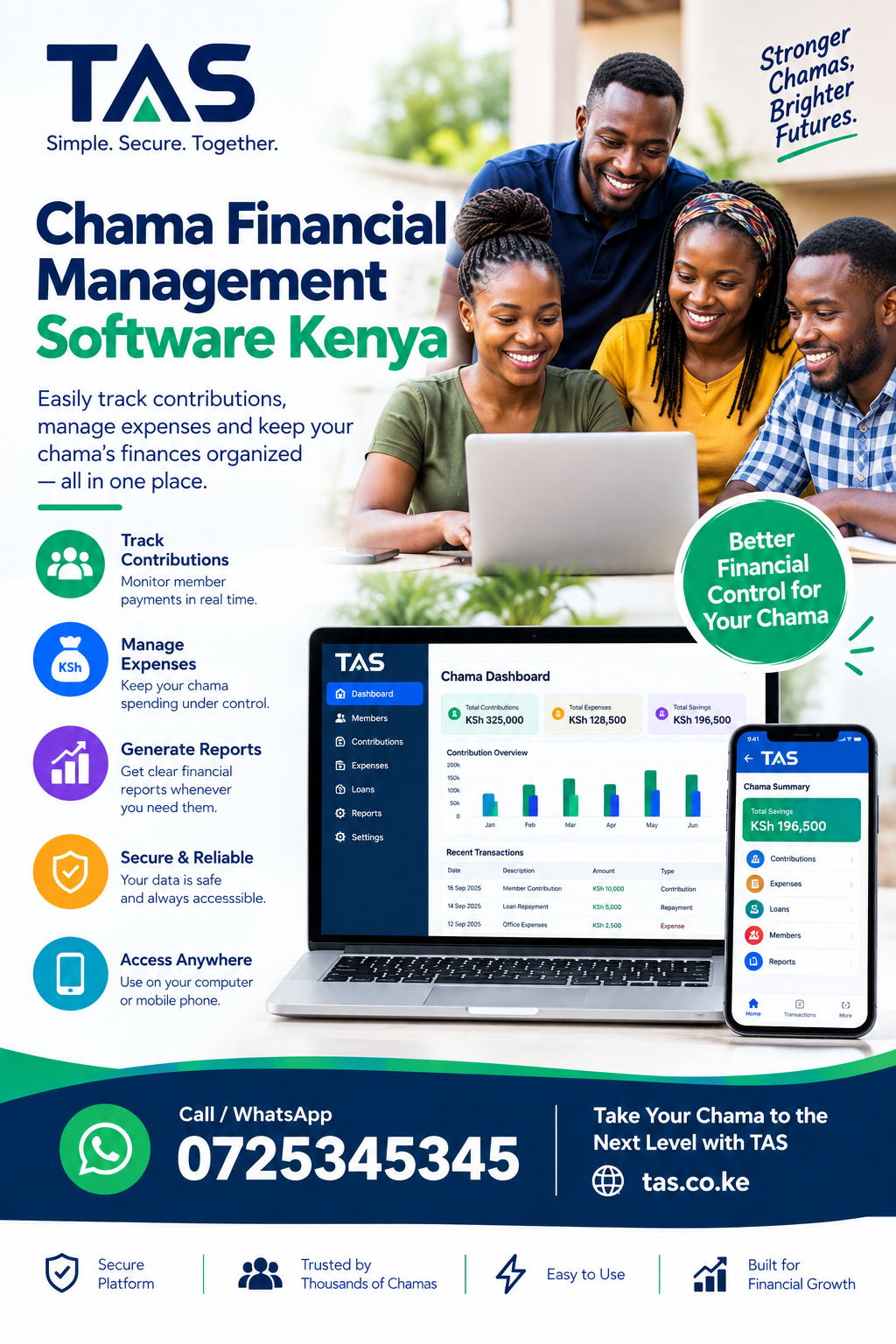
Chama Financial Management Software Kenya: Complete Guide for Savings Groups
Chamas play an important role in Kenya’s savings, investment, lending, and community development activities. As groups grow, managing member contributions, welfare funds, loans, investments, expenses, and financial reports with notebooks or scattered spreadsheets becomes difficult. Chama Financial Management Software Kenya gives groups a structured way to record transactions, monitor member balances, organize financial information, and make routine administration easier. Groups comparing digital options can use Chama Financial Management Software Kenya as a reference point when reviewing features, workflows, and reporting needs. This guide explains what the software does, the problems it can solve, the features a chama should look for, how digital records can improve accountability, and practical considerations for choosing a solution that fits a Kenyan group.
Understanding chama financial management
A chama is more than a savings table. Depending on its structure, a group may collect regular contributions, issue member loans, charge interest, maintain a welfare fund, purchase assets, invest collectively, and distribute returns. Each activity creates records that need to agree with one another.
Financial management therefore involves much more than entering amounts into a spreadsheet. A useful system should connect member information with contributions, receipts, loans, repayments, expenses, and reports. When the records are connected, a treasurer can answer common questions without rebuilding calculations every time.
For example, suppose a group has thirty members who contribute KSh 5,000 each month. The group may receive KSh 150,000 before considering penalties, welfare contributions, loan repayments, or other transactions. If a few members pay late and several have outstanding loans, a simple cash total does not show the full position of the group. Good financial records separate these transactions and make it easier to understand what has actually happened.
Chama Financial Management Software Kenya can support this process by keeping financial information in one organized environment. A practical implementation of Chama Financial Management Software Kenya should reflect the group’s constitution, transaction rules, and committee responsibilities.
Why manual chama records become difficult
Many groups begin with a notebook because it is inexpensive and familiar. That approach can work when membership and transaction volume are small. The challenge appears when the group adds more activities.
Common difficulties include:
- Missing contribution entries.
- Repeated calculations.
- Difficulty tracing old transactions.
- Confusion about loan balances.
- Delayed preparation of financial statements.
- Unclear expense approvals.
- Duplicate member records.
- Errors when transferring figures between notebooks and spreadsheets.
- Difficulty identifying arrears.
- Limited visibility for committee members.
Spreadsheets improve flexibility, but they can still create problems when several people edit copies of the same file. A formula may be overwritten, a row may be deleted, or an older version may be used during a meeting.
A digital system can reduce these operational risks by using structured records and predefined workflows. The objective is not to make chama administration complicated. It is to make routine work more consistent.
Chama Financial Management Software Kenya is particularly useful when a group has moved beyond simple savings and needs to manage several related financial activities. During a software review, Chama Financial Management Software Kenya should be assessed against the actual financial tasks performed by the chama.
Core features a chama should consider
A good chama platform should match the group’s actual activities rather than offer features that look impressive but are rarely used. Before selecting software, committee members should map the group’s regular financial processes.
Member contribution management
Contribution tracking should show what each member was expected to contribute, what has been received, and whether a balance remains outstanding. The system should make it possible to view individual and group-level contribution information.
This is useful during monthly meetings because the treasurer can work from current records rather than reconstructing the position from receipts and handwritten notes.
A contribution module may also support different contribution categories. For example, a chama can maintain ordinary savings separately from welfare contributions or a special investment fund.
Chama Financial Management Software Kenya can bring contributions and loans into the same member record, reducing the need to maintain separate lists. Reliable records are one of the main reasons groups consider Chama Financial Management Software Kenya when replacing manual registers.
Loan management
Many chamas lend money to members. A loan feature should record the application, approved amount, interest terms, repayment schedule, payments received, and remaining balance.
The system should make it easy to distinguish principal from interest and to identify overdue repayments. Clear loan records also help committees discuss requests using documented information.
Chama Financial Management Software Kenya can bring contributions and loans into the same member record, reducing the need to maintain separate lists. For a growing savings group, Chama Financial Management Software Kenya can bring related financial records into a more structured workflow.
Expense management
Chamas incur expenses for meetings, administration, bank charges, events, investment activities, and other approved purposes. Recording expenses consistently helps the group understand where money is going.
An expense workflow can capture the date, amount, category, description, supporting documentation, and person responsible for the transaction. Where approval controls are available, the system can also separate a request from a completed payment.
This creates a clearer audit trail than simply entering a final amount into a monthly spreadsheet.
Income and cashbook records
A digital cashbook should provide a chronological record of money received and money paid out. It can help the treasurer reconcile the group’s financial position and identify unexplained differences.
The cashbook is especially important when a group uses more than one account or holds money in different forms. A structured record makes it easier to understand which funds belong to which account or activity.
Financial reporting
Committee members need reports that answer practical questions. Examples include:
- How much has each member contributed?
- Which loans are outstanding?
- How much interest has been earned?
- What expenses were incurred this month?
- What is the current cash position?
- Which members have arrears?
- How much is held in a particular investment fund?
Chama Financial Management Software Kenya can generate structured reports from transaction data, reducing the amount of manual calculation required before meetings. Clear contribution records are a central requirement when implementing Chama Financial Management Software Kenya for a Kenyan savings group.
Member records and financial accountability
Strong financial management starts with accurate member records. A chama system should provide a clear profile for every member, including relevant membership details and their financial activity.
A useful member profile may show contributions, loans, repayments, penalties, welfare payments, dividends, and other balances. The exact fields should depend on the group’s constitution and operating rules.
This information supports accountability in two ways. First, members can understand how their individual transactions affect their balances. Second, the committee has a consistent record for managing the group as a whole.
Clear records are especially valuable when committee officials change. A new treasurer should not have to depend entirely on explanations from the previous office holder. Properly organized historical data gives the incoming committee a starting point.
Chama Financial Management Software Kenya can make handovers easier because records can be organized around members and transactions instead of being scattered across notebooks, personal phones, and different spreadsheet versions. Well-organized member records make Chama Financial Management Software Kenya more useful because financial activity can be reviewed in context.
Managing savings and contributions more efficiently
Savings are at the heart of many chamas, so contribution management deserves careful attention. The software should make it easy to define contribution rules and record payments accurately.
For example, a group may require monthly savings of KSh 3,000 and a separate welfare contribution of KSh 500. If a member pays KSh 3,500, the system should be able to classify the amount correctly rather than treating it as one unexplained deposit.
Some groups have flexible contribution arrangements. Others have fixed monthly dates, penalties, or special contributions for projects. The software should be configurable enough to reflect those rules without forcing the group into an unsuitable structure.
Automated calculations can also reduce arithmetic errors. When a payment is entered, the member balance can be updated according to the configured transaction type.
Chama Financial Management Software Kenya helps groups turn individual payment entries into a consistent contribution history that can be reviewed at member or group level. Consistent contribution records are a central requirement when implementing Chama Financial Management Software Kenya for a Kenyan savings group.
Loan tracking and repayment monitoring
Loan administration is one of the areas where a chama can quickly outgrow manual records. A loan register must often account for multiple active loans, different interest rates, partial repayments, late payments, and changing balances.
A useful loan workflow begins with an application. The committee can record the amount requested, relevant member information, supporting details, approval decision, and agreed repayment terms. Once approved, the loan becomes a financial obligation that should be tracked until it is fully settled.
Repayment tracking should show the amount paid and the balance remaining. If interest is calculated according to a defined rule, the system should clearly show how the figures are derived.
The committee can also use arrears reports to identify accounts that need attention. Instead of waiting until the next meeting to discover that a repayment is overdue, the responsible official can review the outstanding items earlier.
Chama Financial Management Software Kenya can make loan administration more transparent by keeping the application, approval, repayment, and balance history connected. Clear repayment histories make Chama Financial Management Software Kenya particularly relevant to chamas that manage several active member loans.
M-Pesa and digital payment considerations in Kenya
Mobile money is widely used by Kenyan groups, making payment reconciliation an important consideration when selecting financial software. A chama may receive contributions through mobile money, bank transfers, cash, or a combination of methods.
The system should help officials identify the source and purpose of each transaction. Where integrations are available, they should be evaluated carefully for compatibility, security, reconciliation workflows, and the group’s actual payment process.
An important principle is that a payment should not be considered reconciled merely because money arrived. The group also needs to know who paid, what the payment was for, when it was received, and whether the amount matches the expected transaction.
A good reconciliation workflow reduces the time spent comparing mobile money messages with member registers.
Chama Financial Management Software Kenya can support digital payment reconciliation when its transaction structure matches the group’s payment channels and operating procedures. Payment reconciliation should be tested carefully when a provider demonstrates Chama Financial Management Software Kenya to a Kenyan chama.
Budgeting for chama activities
Budgeting gives members a forward-looking view of how the group intends to use its money. A budget can cover administration, meetings, welfare activities, investments, loan operations, and planned projects.
The value of a budget increases when actual transactions can be compared against planned amounts. If a group planned to spend KSh 30,000 on an activity but has already spent KSh 26,000, the committee can see how much remains before approving another expense.
Budget categories should reflect the group’s constitution and financial policy. Avoid creating so many categories that ordinary users cannot maintain them consistently.
A digital budgeting feature can also support periodic reporting. Committee members can review planned versus actual spending before making new commitments.
Chama Financial Management Software Kenya can connect budgeting information with actual financial records, helping committees monitor how plans translate into transactions. Budget monitoring can help a committee get more value from Chama Financial Management Software Kenya because planned and actual spending can be compared.
Investment tracking for growing chamas
Some chamas eventually use pooled savings to acquire assets, invest in businesses, purchase property, or place funds in financial instruments. These activities create records beyond ordinary contributions and loans.
Investment tracking should capture the amount committed, date, investment type, returns where applicable, expenses, and current value according to the group’s chosen accounting approach.
The system should not replace professional financial or investment advice. Instead, it should provide an organized record of what the group has decided to do and the transactions that followed.
For asset purchases, the chama may also need supporting documents, ownership information, acquisition costs, and ongoing expenses. Keeping those details connected to the financial record makes later reporting easier.
Chama Financial Management Software Kenya can help organize investment-related transactions alongside everyday group finances, giving authorized officials a more complete record. Investment records can extend the usefulness of Chama Financial Management Software Kenya as a chama moves beyond basic monthly savings.
Welfare funds and special-purpose accounts
Welfare contributions are often treated differently from ordinary savings because they serve a specific purpose. A group may use a welfare fund for emergencies, bereavement support, medical assistance, or other activities defined by its rules.
Separating welfare transactions prevents confusion between money intended for general savings and money reserved for welfare purposes.
A system should allow the group to create appropriate transaction categories or funds. Each payment into or out of a fund should be traceable.
This also helps during financial reviews. Members can see how much was collected for a particular purpose and what has been disbursed, subject to the group’s privacy and reporting policies.
Chama Financial Management Software Kenya can support fund-level organization where the platform allows separate categories, accounts, or ledgers. Fund-level records can make Chama Financial Management Software Kenya more suitable for groups that maintain welfare or project-specific balances.
Reports that help committees make informed decisions
Reports are useful only when they answer questions clearly. A chama should identify the reports its committee actually needs before choosing software.
Useful reports may include:
- Member contribution statements.
- Loan balances and repayment schedules.
- Arrears reports.
- Income and expense summaries.
- Cashbook reports.
- Budget-versus-actual reports.
- Fund balances.
- Investment transaction summaries.
- Member activity histories.
- Periodic financial statements.
Reports should also be easy to export or share with authorized users when necessary. A report that requires technical expertise every time it is generated may become a burden.
Chama Financial Management Software Kenya can make reporting more practical when reports are generated from the same transaction records used for daily operations. Committee members should review sample reports before deciding whether Chama Financial Management Software Kenya meets their reporting requirements.
Security and access control
Financial records require careful protection. A chama should consider who can view, add, edit, approve, or export information.
Not every user needs the same permissions. For example, a treasurer may need broader transaction access than an ordinary member, while a chairperson may need approval visibility without changing accounting entries.
Strong access controls can reduce accidental changes and help establish responsibility for important actions. Where audit logs are available, the committee should understand what they record and how long those records are retained.
The group should also ask about backups, password policies, account recovery, data storage, and security updates before adopting a platform.
Chama Financial Management Software Kenya should therefore be evaluated as a financial information system, not simply as a digital spreadsheet. Access controls are an important part of evaluating Chama Financial Management Software Kenya because financial information should be available according to role.
How software improves transparency
Transparency does not mean giving every person unrestricted access to every record. It means having clear rules for what members should be able to see and reliable records that explain financial activity.
For example, a group may decide that members receive individual statements while committee officials access administrative reports. Another group may provide monthly summaries during meetings.
The software should support the group’s governance arrangements rather than determine them. The constitution, policies, and resolutions of the chama remain important.
A consistent digital record can make discussions more evidence-based. Instead of arguing over whether a contribution was received, the committee can check the transaction history and supporting records.
Chama Financial Management Software Kenya can contribute to this transparency when the group combines accurate data entry with clear financial policies and appropriate access controls. Transparency depends on good processes, and Chama Financial Management Software Kenya can support those processes when permissions and reporting rules are clearly defined.
Choosing software for a Kenyan chama
The right platform depends on the size and complexity of the group. A small chama may need contribution tracking, member records, loans, expenses, and basic reports. A larger organization may require multiple funds, stronger permissions, detailed reporting, integrations, and more advanced workflows.
Before choosing a solution, prepare a checklist.
1. List current financial activities
Write down every recurring activity: contributions, loans, repayments, penalties, welfare payments, investments, expenses, and distributions.
2. Identify current pain points
Ask what takes the most time today. Is it reconciling payments, calculating loan balances, preparing reports, or tracking arrears?
3. Define user roles
Determine who will enter transactions, approve requests, review reports, and manage member information.
4. Check reporting needs
Ask for demonstrations of the exact reports the chama uses instead of accepting generic claims about reporting.
5. Review mobile access
Committee officials may need to check information outside the office or during meetings. Confirm that the system works well on the devices the group actually uses.
Chama Financial Management Software Kenya should be selected based on real workflows, not simply on the number of features listed on a sales page. Choosing Chama Financial Management Software Kenya should start with the chama’s current activities rather than a generic list of software features.
Questions to ask a software provider
A demonstration should be practical. Ask the provider to show how the platform handles common scenarios.
For example:
- How is a new member added?
- How is a monthly contribution recorded?
- How is an incorrect transaction corrected?
- How is a loan approved?
- How is interest calculated?
- How are partial repayments handled?
- How are arrears identified?
- How are expenses categorized?
- How are reports generated?
- Can authorized users export records?
- What happens if a user forgets a password?
- How are backups handled?
- What support is available?
Also ask whether the displayed price covers all essential functionality. If there are charges for additional users, reports, integrations, setup, training, or support, request clear details before making a decision.
Chama Financial Management Software Kenya should be assessed against these practical questions so the committee understands how the platform will work after implementation. A live demonstration of Chama Financial Management Software Kenya should use realistic contribution, loan, expense, and reporting scenarios.
Implementation: moving from notebooks to software
Changing financial systems is a process. A chama should avoid entering years of information without first deciding which historical records are necessary.
Start by cleaning the current data. Confirm member names, membership numbers, contribution balances, outstanding loans, and cash or bank balances. Resolve obvious discrepancies before importing or entering information.
Next, define opening balances. These figures become the starting point for the digital system, so the committee should approve them and keep supporting documentation.
Then configure transaction categories and user roles. Train the officials who will use the platform regularly.
A sensible rollout can follow this sequence:
- Clean existing records.
- Confirm opening balances.
- Configure users and permissions.
- Enter or import member information.
- Set contribution rules.
- Set up loan rules.
- Test transactions.
- Generate sample reports.
- Reconcile the system with existing records.
- Begin live use after the committee is satisfied with the results.
Chama Financial Management Software Kenya becomes more useful when implementation is treated as a governance and data-quality project rather than simply a software installation. Successful migration to Chama Financial Management Software Kenya requires careful preparation of opening balances and historical records.
Training committee members
A system is only as useful as the people operating it. Treasurers, secretaries, chairpersons, and other authorized users should understand the workflows relevant to their roles.
Training should cover everyday tasks first. Users should know how to add or update member information, record transactions, review balances, correct errors according to policy, and generate reports.
The group should also document basic procedures. For example, it can specify who records a payment, who verifies it, when reconciliation happens, and who reviews the monthly report.
This reduces dependence on one technically confident person. If that person leaves the committee, the next team can follow the documented process.
Chama Financial Management Software Kenya can support continuity when training, permissions, and procedures are maintained alongside the technology. Training helps ensure that Chama Financial Management Software Kenya remains useful when committee responsibilities change.
Common mistakes to avoid
Buying software does not automatically solve weak financial processes. Several mistakes can reduce the value of a digital system.
Entering incomplete data
If member balances are wrong at the beginning, later reports may also be wrong. Verify opening figures carefully.
Giving everyone administrative access
Broad access can increase the risk of accidental changes. Assign permissions according to responsibilities.
Ignoring reconciliation
A digital entry is still an entry. The group should compare records with bank, mobile money, or other source records according to its procedures.
Failing to define correction procedures
Mistakes happen. The group should decide how incorrect transactions are reversed or corrected so that the history remains understandable.
Choosing features over usability
A system with dozens of features may still be unsuitable if ordinary committee members find it difficult to use.
Neglecting data backups
Ask how backups are handled and whether users can recover important information.
Chama Financial Management Software Kenya should simplify administration, so the implementation process should be designed around clarity and consistency. Good procedures matter as much as the technology when a chama introduces Chama Financial Management Software Kenya.
Pricing and total cost considerations
Cost should be evaluated beyond the advertised subscription. A chama should consider the total cost of ownership over the period it expects to use the platform.
Potential cost areas include:
- Subscription fees.
- Setup or onboarding.
- Training.
- Additional users.
- Payment integrations.
- Data migration.
- Premium reports.
- Support.
- Hardware or connectivity where relevant.
The cheapest option is not necessarily the least expensive over time if it requires extensive manual work or additional services. Conversely, a feature-rich system may be unnecessary for a small group.
A simple cost-benefit exercise can help. Estimate how many hours officials spend each month on contribution calculations, loan tracking, reconciliation, report preparation, and correcting errors. Then compare that workload with the cost and expected benefits of the software.
Chama Financial Management Software Kenya should fit the group’s budget while providing the financial controls and workflows it genuinely needs. Pricing for Chama Financial Management Software Kenya should be considered alongside implementation, support, integrations, and user requirements.
Supporting remote and distributed committees
Chamas may have members who live in different locations or committee members who cannot always meet in one place. Online access can make it easier for authorized officials to review records and complete routine tasks.
Mobile-friendly interfaces are particularly relevant in Kenya because committee work often happens outside traditional offices. A treasurer may need to confirm a balance during a meeting or review a repayment while away from a computer.
Remote access should still be balanced with security. Users should protect their credentials and avoid sharing accounts. Where possible, each official should have an individual account with permissions appropriate to their role.
Chama Financial Management Software Kenya can support distributed administration when it provides secure access and a user experience suitable for the devices the group relies on. Mobile access can make Chama Financial Management Software Kenya more practical for committee members who manage chama affairs away from a computer.
Using data for better financial planning
Once financial records are organized, the committee can examine trends instead of relying only on memory.
For example, contribution reports can show whether savings are consistent. Loan reports can show how much capital is currently tied up in member lending. Expense reports can reveal recurring administrative costs. Investment records can help the committee understand the history of a project.
These observations do not replace decisions by members. They give the group better information for discussions and planning.
A monthly review can be structured around a small set of questions:
- What came in?
- What went out?
- What remains outstanding?
- What changed from the previous period?
- Which items require committee attention?
- Are actual results consistent with the approved plan?
Chama Financial Management Software Kenya can make this review process faster because the information is organized in one place. Organized data allows Chama Financial Management Software Kenya to support more informed financial reviews without replacing member decision-making.
Data quality and record-keeping discipline
Digital tools reduce some types of errors, but they cannot correct poor information automatically. The chama should establish simple rules for entering transactions.
Use consistent member names and identifiers. Avoid creating duplicate profiles. Enter transactions promptly rather than waiting several weeks. Attach or reference supporting documents where the system allows it.
Reconciliation should happen on a defined schedule. Monthly reconciliation may be appropriate for many groups, while higher-volume organizations may need more frequent checks.
The committee should also review unusual transactions and unresolved balances. A report that shows an unexpected difference should trigger investigation rather than being ignored.
Chama Financial Management Software Kenya is most reliable when users maintain disciplined data-entry and reconciliation practices. Consistent data-entry rules improve the reliability of information stored in Chama Financial Management Software Kenya.
Financial governance and committee roles
Software should complement the chama’s governance structure. The constitution and resolutions should determine who has authority to approve spending, issue loans, change member records, or access sensitive reports.
A useful division of duties can reduce the risk of one person controlling every stage of a transaction. For example, one official may record a payment while another verifies the reconciliation.
Meeting minutes can also reference financial reports used during decisions. This creates a stronger connection between the transaction record and the group’s governance process.
When officials change, access should be reviewed promptly. Former committee members should no longer retain permissions they no longer need.
Chama Financial Management Software Kenya can provide the tools for these controls, but the group must decide how those controls are used. Clear separation of duties can make the controls available through Chama Financial Management Software Kenya more effective.
Frequently asked questions
What is chama financial management software?
It is a digital system designed to organize financial and membership activities for savings groups or chamas. Depending on the platform, it may cover contributions, loans, repayments, expenses, funds, investments, reporting, and member records.
Can a chama use software to track member contributions?
Yes. Contribution tracking is one of the common uses of financial management software. The system can record payments, update member balances, and produce contribution reports when those features are available.
Can software manage chama loans?
Many platforms include loan management features. These can record applications, approvals, repayment schedules, interest, payments, outstanding balances, and arrears.
Is M-Pesa support important for a Kenyan chama?
It can be important when the group receives contributions or repayments through mobile money. The exact integration and reconciliation capabilities should be checked with the provider.
How can a chama improve financial transparency?
Start with accurate records, clear approval rules, regular reconciliation, appropriate user permissions, and periodic reporting. Software can support these practices by organizing transactions and making reports easier to produce.
Should every chama use the same financial software?
No. Groups differ in membership size, financial activities, governance rules, and reporting needs. A small savings group may need a simpler system than a large investment-oriented organization.
How much does chama financial software cost in Kenya?
Pricing varies by provider, features, number of users, integrations, support, and other factors. A group should request current pricing and clarify what is included before subscribing.
Can software replace a chama treasurer?
Software does not replace the responsibilities of elected officials. It can reduce repetitive administrative work and improve record organization, while the treasurer and committee remain responsible for oversight and decisions.
What should be checked before buying a chama system?
Review contribution tracking, loan management, expense recording, reports, security, permissions, backups, support, usability, payment integration, data migration, and total cost.
How should a chama start using financial software?
Begin by documenting current processes, cleaning existing records, confirming opening balances, assigning user roles, configuring the system, testing common transactions, and training committee members before going live.
Chama Financial Management Software Kenya should support, rather than replace, the governance rules of the chama. Before subscribing, the committee should confirm that Chama Financial Management Software Kenya supports the payment channels it actually uses.