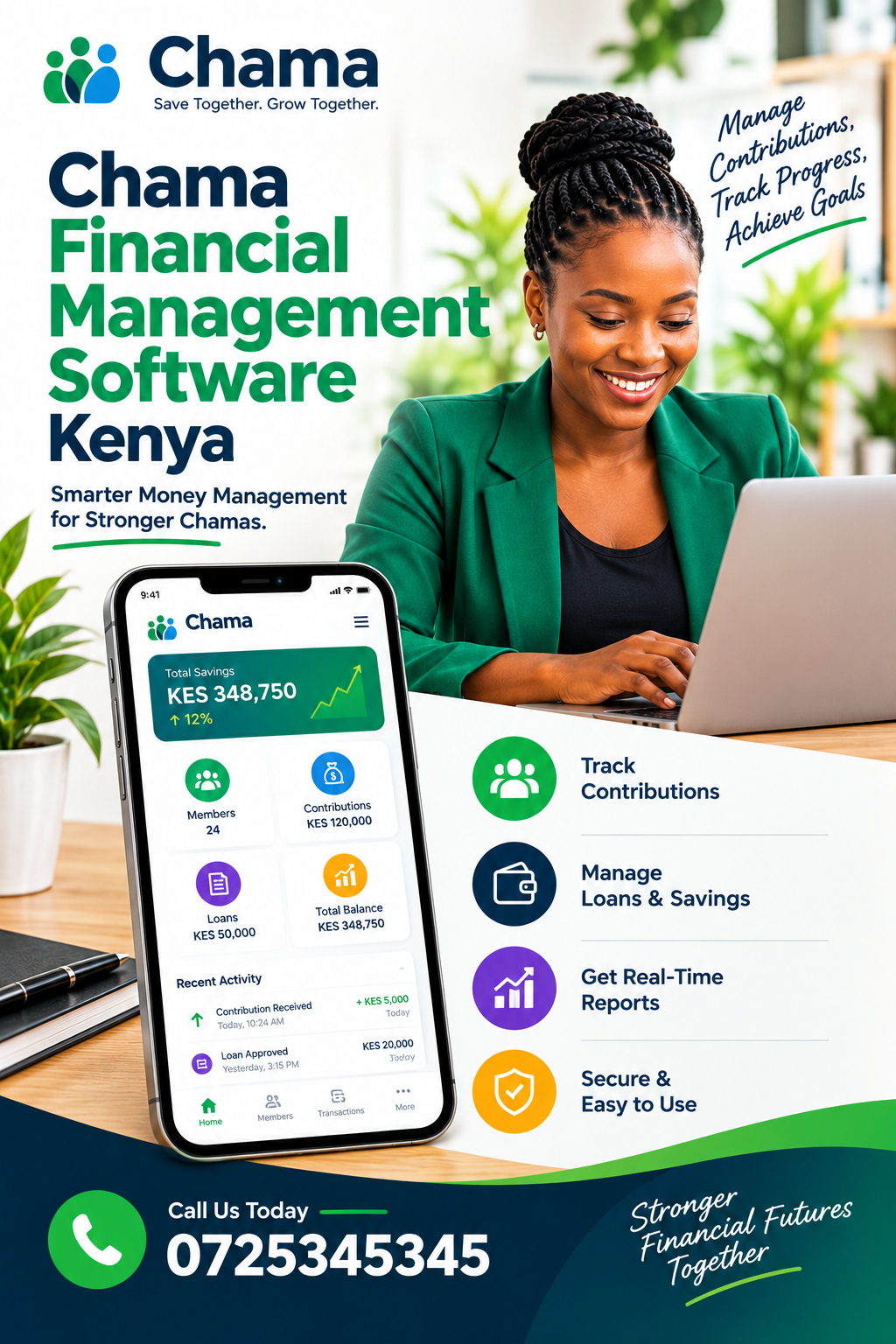
Chama Financial Management Software Kenya: Complete Guide for Smarter Chama Finance
Managing money in a chama requires more than collecting contributions and keeping a notebook. As a group grows, treasurers have to track member payments, savings, loans, repayments, expenses, investments, penalties, budgets and financial reports. Chama Financial Management Software Kenya provides a structured way to bring these financial activities into one organised system, making it easier for Kenyan savings groups and investment chamas to maintain reliable records, monitor their finances and prepare useful reports.
This guide explains how financial management software can support a chama, the features committees should consider, the problems associated with manual record keeping, and the practical steps a Kenyan group can take when moving from notebooks and spreadsheets to a digital platform.
What Is Chama Financial Management Software?
Chama Financial Management Software Kenya refers to a digital solution designed to help savings groups, investment groups, welfare groups, table-banking groups and other member-based organisations manage their financial activities.
A typical chama may have several financial processes happening at the same time. Members make regular contributions, some members borrow money, repayments come in at different times, the group pays administrative expenses, and the committee may invest pooled funds.
When these activities are recorded separately, it can become difficult to establish the true financial position of the group.
A dedicated system brings related information together. Depending on the platform and configuration, a chama may be able to manage:
- Member records
- Contributions
- Savings
- Welfare funds
- Loans
- Loan repayments
- Guarantors
- Interest
- Penalties
- Income
- Expenses
- Budgets
- Investments
- Meetings
- Member statements
- Financial reports
- User permissions
- Transaction histories
The objective is not simply to replace paper with a computer. The objective is to create a dependable record of the group’s financial activities.
For Kenyan chamas, this can be especially useful where contributions and other payments are made through different channels. A well-organised digital process can make it easier to reconcile information and prepare reports.
Why Financial Management Matters in a Chama
Chama Financial Management Software Kenya becomes valuable when a group starts treating financial records as an important part of its governance rather than simply an administrative task.
Consider a chama with 30 members. If each member contributes every month, the treasurer has to record hundreds of individual transactions during the year. If the group also provides loans, receives repayments, pays expenses and earns income, the number of records increases considerably.
A financial system helps officials answer practical questions such as:
- How much has each member contributed?
- Which members have outstanding contributions?
- How much has been lent to members?
- Which loans are still active?
- How much has been repaid?
- What income has the chama received?
- What expenses have been incurred?
- What is the current budget position?
- What amount is available for investment?
- What information should appear in the next member statement?
These questions are easier to answer when the underlying records are structured.
Chama Financial Management Software Kenya can therefore support both day-to-day administration and longer-term financial planning. The software does not replace the committee’s decisions or the group’s constitution. Instead, it provides a mechanism for recording and organising those decisions.
The Problems With Manual Chama Financial Records
Many Kenyan chamas begin with simple tools. A treasurer may use an exercise book, while another official maintains a spreadsheet. Payment confirmations may remain in an M-Pesa message history or WhatsApp conversation.
This approach may be manageable for a small group, but it creates challenges as activity increases.
1. Scattered Information
Financial information can end up in several places.
For example:
- Member details may be in Excel.
- Contributions may be in a notebook.
- Loan balances may be calculated separately.
- Expenses may be recorded in receipts.
- Payment confirmations may be stored on phones.
- Meeting decisions may remain in WhatsApp.
When information is fragmented, preparing a complete financial report takes more time.
2. Manual Calculations
A treasurer may need to calculate contribution totals, outstanding balances, loan repayments and expenses manually.
Manual calculations increase the possibility of arithmetic mistakes, especially when there are many transactions.
3. Difficult Handover
Leadership changes are normal in many chamas. A new treasurer should not have to depend entirely on the previous treasurer’s personal files or memory.
Chama Financial Management Software Kenya can help create a central record that authorised officials can access according to their assigned permissions.
4. Slow Reporting
Preparing reports manually can consume considerable time before monthly or annual meetings.
A structured system can make recurring reports easier to produce because the relevant information has already been recorded.
5. Limited Visibility
When records are scattered, committee members may find it difficult to obtain a clear view of the chama’s financial position.
A centralised system can provide a more organised view of contributions, loans, income, expenses and other financial information.
Core Features to Look For
When comparing Chama Financial Management Software Kenya, a committee should focus on practical requirements rather than impressive-sounding features.
The software should support the actual way the group operates.
Important features include:
Member Management
A reliable member register is the foundation of financial management.
The system should make it possible to maintain relevant information about members and connect each member with permitted financial records.
For example, a member profile may be associated with:
- Contributions
- Savings
- Loans
- Repayments
- Penalties
- Statements
- Meeting participation
The exact information collected should follow the chama’s needs and data-management policies.
Contribution Tracking
Contribution management is one of the most important requirements for a savings group.
Chama Financial Management Software Kenya can help officials record contributions against the appropriate member, date, fund and payment category.
A group may have different contribution types, such as:
- Regular savings
- Welfare contributions
- Investment contributions
- Emergency funds
- Special projects
Separating these categories helps the committee understand how money is being accumulated and used.
Savings Management
Savings should be distinguishable from other financial activities where the group’s rules require it.
A digital system can help track savings balances and provide historical information that supports member statements.
This can also help the committee identify trends in savings behaviour without relying on manually maintained spreadsheets.
Loan Management
Many Kenyan chamas lend money to members.
A loan process may involve:
- Application
- Review
- Approval
- Guarantor confirmation
- Disbursement
- Scheduled repayments
- Interest calculation
- Balance tracking
- Closure
Chama Financial Management Software Kenya can organise these stages and connect them to the relevant member record.
A good system should make it easier to understand which loans are active and how much remains outstanding.
Repayment Tracking
Loan repayments should be recorded accurately.
The system should allow officials to distinguish between expected repayments and actual payments where the workflow requires this.
This makes it easier to identify overdue amounts and follow up with members.
Expense Management
A chama’s financial activity is not limited to money coming in.
Groups may incur expenses for:
- Meetings
- Banking
- Administration
- Welfare activities
- Investment activities
- Professional services
- Communication
- Other approved activities
Chama Financial Management Software Kenya can help categorise these expenses and connect them with the appropriate records.
Expense categories make it easier to understand where group money is being spent.
Budget Management for Chamas
A budget provides a financial plan against which actual performance can be reviewed.
Chama Financial Management Software Kenya can support budget monitoring by helping officials organise planned income and expenses.
For example, a chama may create an annual budget containing expected:
- Member contributions
- Loan interest
- Investment income
- Meeting expenses
- Welfare expenses
- Administrative expenses
- Investment allocations
Once actual transactions are recorded, the committee can compare performance against the plan.
The purpose of a budget is not to predict every transaction perfectly. It provides a framework for making informed financial decisions.
Managing Income
Chamas can receive income from several sources.
Depending on the group’s activities and rules, income may include:
- Loan interest
- Penalties
- Investment returns
- Fees
- Other approved income
Chama Financial Management Software Kenya can help classify these transactions so the committee can distinguish different sources of income.
This becomes important when preparing financial reports.
Instead of presenting one large unexplained total, officials can provide more useful categories.
Managing Expenses
Expense management is equally important.
A group should be able to identify what was spent, when it was spent, why it was spent and, where applicable, who approved it.
Chama Financial Management Software Kenya can help create a structured expense record.
A useful expense entry may include:
- Date
- Category
- Amount
- Description
- Payment method
- Reference
- Supporting document
- Approval information
The exact fields will depend on the system and the group’s processes.
M-Pesa and Payment Records
Mobile money is an important part of the Kenyan financial environment, and many groups receive contributions through mobile payment channels.
Chama Financial Management Software Kenya can support a structured approach to payment recording and reconciliation when configured for the group’s workflow.
However, software should not be treated as a substitute for reconciliation.
Officials should still verify transactions against appropriate source records and investigate unmatched amounts, duplicates, reversals or unexplained entries.
A good process can look like this:
- Receive payment.
- Identify the member.
- Record the relevant transaction.
- Match the payment reference.
- Reconcile against the source record.
- Review exceptions.
- Include the transaction in the relevant report.
This approach creates a stronger financial control environment.
Financial Reporting
Reporting is one of the strongest reasons for digitising chama financial management.
Chama Financial Management Software Kenya can help turn transaction records into useful financial information.
Depending on the platform, reports may include:
- Contribution summaries
- Member statements
- Loan reports
- Repayment reports
- Arrears reports
- Income reports
- Expense reports
- Savings reports
- Budget reports
- Investment records
- Meeting reports
Reports can be useful during ordinary committee meetings as well as annual general meetings.
The important point is that reports should be based on properly maintained source records.
Member Statements
Members should be able to understand their individual financial position.
Chama Financial Management Software Kenya can make it easier for authorised officials to produce member-level information.
A statement may show:
- Contributions
- Savings
- Loans
- Repayments
- Interest
- Penalties
- Current balances
- Relevant transaction dates
Clear statements can reduce unnecessary disagreements because members have a structured record to review.
If a member believes that a payment has not been recorded, officials can investigate the relevant transaction rather than searching through multiple notebooks.
Transparency and Accountability
Financial transparency is closely connected to good chama governance.
Chama Financial Management Software Kenya can support transparency by keeping related records together and making information available to authorised users.
Transparency does not mean that every member should have unrestricted access to every record.
Instead, the group should establish appropriate permissions.
For example:
- A treasurer may manage financial records.
- A secretary may manage meetings.
- A chairperson may have oversight responsibilities.
- Ordinary members may access their own permitted statements.
- Administrators may manage system settings.
Role-based access can help balance transparency with privacy.
Role-Based Access and Security
Financial records contain sensitive information.
Chama Financial Management Software Kenya should therefore be evaluated partly on its access controls and security practices.
A group should ask:
- Who can access financial records?
- Who can create transactions?
- Who can edit information?
- Is there an activity history?
- Can former officials be deactivated?
- Are backups maintained?
- Can data be exported?
- How is account access protected?
TAS publicly describes role-based permissions and a connected workspace for contributions, loans, meetings, budgets, reports and member records.
These controls are particularly important when leadership changes.
Audit Trails and Financial History
An audit trail provides a history of activity within a system.
Chama Financial Management Software Kenya can be useful where officials need to understand how records have been created or changed.
For a chama, a useful history may help answer:
- When was a transaction entered?
- Which user entered it?
- What record was affected?
- Was information changed?
- When was the change made?
An audit history does not guarantee that every financial record is correct. It simply provides additional evidence for reviewing system activity.
The group should still maintain proper approval and reconciliation processes.
Managing Chama Investments
Some chamas use pooled contributions for investments.
These may include property, businesses, agriculture, shares or other activities depending on the group’s objectives and rules.
Chama Financial Management Software Kenya can support financial organisation around investment activities when the system provides the relevant records.
Investment management may require tracking:
- Amount invested
- Investment date
- Source of funds
- Investment category
- Income received
- Related expenses
- Current status
- Supporting documentation
Investment records should be kept separate enough to allow the committee to understand how group funds have been allocated.
Managing Welfare Funds
Welfare groups and chamas may collect money for emergencies or member support.
Chama Financial Management Software Kenya can help structure welfare-related transactions where the platform supports the group’s specific workflow.
A welfare fund may have its own:
- Contribution rules
- Eligibility requirements
- Payment categories
- Approval process
- Disbursement records
- Reporting requirements
Keeping welfare activity organised helps prevent it from being mixed with ordinary savings or investment funds.
Financial Planning for Growing Chamas
A small chama can sometimes operate successfully with simple records.
However, growth changes the administrative requirements.
Chama Financial Management Software Kenya becomes increasingly useful when a group has more members, more transactions, several loan products, multiple funds or more complex investment activities.
Growth can create additional questions:
- Can the existing spreadsheet handle the volume?
- Who owns the master records?
- How quickly can reports be prepared?
- What happens if the treasurer leaves?
- Can members access reliable statements?
- Are financial records backed up?
- Can transactions be reconciled efficiently?
These questions should be considered before a group reaches the point where manual systems become difficult to maintain.
Choosing the Right Software
Selecting Chama Financial Management Software Kenya should begin with the group’s requirements.
Do not choose a platform simply because it has a long list of features.
Instead, identify the actual processes that need improvement.
Step 1: Map Current Processes
Write down how the group currently handles:
- Registration
- Contributions
- Savings
- Loans
- Repayments
- Expenses
- Income
- Meetings
- Reports
This gives the committee a baseline.
Step 2: Identify Problems
List the biggest weaknesses.
For example:
- Reports take too long.
- Contributions are difficult to reconcile.
- Members frequently request balance clarification.
- Loan balances require manual calculation.
- Records depend on one official.
- Documents are scattered.
Step 3: Create a Requirements List
The committee can then identify the features that directly address these problems.
Step 4: Test the Workflow
Do not evaluate software only through screenshots.
Ask the provider to demonstrate a realistic transaction flow.
For example:
- Create a member.
- Record a contribution.
- Apply for a loan.
- Approve the loan.
- Record repayment.
- Record an expense.
- Generate a statement.
- Generate a financial report.
This provides a much better understanding of whether the platform fits the group.
Questions to Ask Before Buying
When comparing Chama Financial Management Software Kenya, the committee should ask practical questions.
Financial Questions
- What financial records can the system manage?
- Can contribution categories be configured?
- Can loan repayments be tracked?
- Can expenses be categorised?
- Can reports be exported?
Security Questions
- How are user accounts protected?
- Are permissions available?
- Are backups maintained?
- Is activity history available?
- What happens when an official leaves?
Support Questions
- Is training available?
- How can users obtain support?
- Are help resources available?
- How frequently is the system updated?
Data Questions
- Can the chama export its records?
- What happens if the group stops using the system?
- How is historical information handled?
- Who can access the group’s data?
These questions can prevent unpleasant surprises later.
How TAS Can Support Kenyan Chamas
Chama Financial Management Software Kenya should make financial administration easier rather than adding unnecessary complexity.
TAS is designed for Kenyan groups and publicly describes tools for contributions, loans, meetings, budgets, reports and member records.
Its published material also discusses connected financial records involving contributions, loans, income, expenses and reporting.
This type of connected approach can help a chama move away from scattered records.
The platform can be relevant to different types of member-based organisations, including savings groups, investment groups, welfare groups, table-banking groups and other community organisations.
The best approach is to test the actual workflows your group uses rather than assuming that every chama needs exactly the same configuration.
Moving From Excel to a Digital System
A group that has used Excel for years may worry about changing its processes.
Chama Financial Management Software Kenya can be introduced gradually.
A practical transition can involve the following stages.
Stage 1: Clean Existing Records
Before importing information, review the current files.
Look for:
- Duplicate members
- Missing transactions
- Incorrect balances
- Unclear loan records
- Unreconciled payments
- Old members
- Incomplete contact information
Digitising inaccurate records without reviewing them can simply move old problems into a new system.
Stage 2: Establish a Cut-Off Date
Choose a clear date from which the new system becomes the main operating record.
Stage 3: Verify Opening Balances
Opening balances should be reviewed carefully.
The committee should confirm contributions, savings, outstanding loans, expenses and other relevant balances.
Stage 4: Train Officials
Treasurers and administrators should understand the workflow before the system becomes the main source of information.
Stage 5: Reconcile
After the first reporting period, compare the system’s results against the relevant source records.
Stage 6: Review
Ask members and officials what is working and what needs adjustment.
Common Mistakes When Digitising a Chama
Buying software does not automatically create good financial management.
Chama Financial Management Software Kenya works best when supported by clear processes.
Mistake 1: Poor Data Entry
Incorrect member names, amounts or dates can affect later reports.
Mistake 2: No Reconciliation
Officials should not assume that a software balance is correct simply because it appears on screen.
Mistake 3: Shared Passwords
Users should have individual accounts where supported.
Mistake 4: No Handover Process
The group should document who is responsible for different areas.
Mistake 5: Ignoring Supporting Documents
Digital records should still be supported by appropriate evidence where required.
Mistake 6: Changing Records Without Explanation
Financial history should be handled carefully, especially when corrections are required.
A Practical Monthly Financial Routine
A monthly routine can make digital financial management more effective.
Chama Financial Management Software Kenya can form part of a process such as:
- Record all expected contributions.
- Post received payments.
- Reconcile payment records.
- Review outstanding contributions.
- Record loan repayments.
- Review overdue loans.
- Record income.
- Record approved expenses.
- Compare spending with the budget.
- Review member statements.
- Generate financial reports.
- Discuss exceptions during the meeting.
The exact process should reflect the group’s constitution and internal controls.
Preparing for Chama Meetings
Meetings are where financial information is often reviewed.
Chama Financial Management Software Kenya can make meeting preparation easier when financial reports are already available from the system.
Before a meeting, officials may prepare:
- Contribution summaries
- Loan reports
- Repayment information
- Income reports
- Expense reports
- Budget comparisons
- Member statements
- Investment updates
The committee can then spend more time discussing decisions rather than reconstructing historical records.
TAS also describes meeting tools for agendas, minutes and decisions, alongside financial functions.
Supporting Leadership Handover
Leadership transitions can expose weaknesses in manual record keeping.
Chama Financial Management Software Kenya can help provide a structured environment for the incoming team.
A handover should cover:
- Member records
- Financial records
- Active loans
- Outstanding contributions
- Budgets
- Investments
- Expenses
- Meeting records
- System users
- Reports
- Supporting documents
Former officials should not retain unnecessary access after their responsibilities end.
The new committee should review permissions and confirm that important records are accessible.
Benefits for Treasurers
The treasurer often carries much of the financial administration.
Chama Financial Management Software Kenya can reduce the amount of manual work required for routine record management.
Potential benefits include:
- Faster transaction recording
- Easier member statements
- More organised loan records
- Better expense categorisation
- Easier report preparation
- Improved visibility
- Better handover
The biggest benefit may simply be having a consistent process.
Benefits for Members
Members also benefit when financial information is easier to understand.
Chama Financial Management Software Kenya can help support clearer member-level records.
A member may want to know:
- How much have I contributed?
- What is my savings balance?
- How much do I owe?
- How much have I repaid?
- Are my payments correctly recorded?
When these questions can be answered from reliable records, discussions become more objective.
Benefits for Chama Committees
Committee members need a broader view.
Chama Financial Management Software Kenya can provide structured information that supports decision-making.
For example, a committee may need to determine whether the group can afford a planned expense or investment.
That decision should be based on reliable information about:
- Available funds
- Outstanding loans
- Expected contributions
- Existing expenses
- Budget commitments
- Investment obligations
A financial system does not make the decision for the committee. It helps provide the information used to make the decision.
Financial Controls Every Chama Should Consider
Technology should complement internal controls.
Chama Financial Management Software Kenya should therefore be evaluated alongside the group’s financial procedures.
Useful controls may include:
- Separation of duties
- Approval requirements
- Regular reconciliation
- Documented corrections
- Role-based access
- Periodic reporting
- Review of unusual transactions
- Leadership handover procedures
A group can have excellent software and still have weak controls if responsibilities are unclear.
Data Backup and Business Continuity
Financial records should not depend on one device.
Chama Financial Management Software Kenya can be part of a broader record-continuity strategy.
The committee should understand:
- How data is stored
- Whether backups exist
- How records can be exported
- Who can access them
- What happens if an administrator loses access
- How the group handles leadership changes
TAS describes its platform as a secure cloud workspace and publishes information about role-based access and record management.
The committee should nevertheless review the provider’s current terms and policies before adopting any system.
Cost Considerations
Price should not be the only factor when evaluating Chama Financial Management Software Kenya.
A cheaper system may become expensive if it creates additional administrative work or lacks important reporting capabilities.
Conversely, a feature-rich platform may not represent good value if the chama only needs a few basic functions.
Consider the total value, including:
- Subscription cost
- Setup
- Training
- Support
- Data migration
- Reporting
- Security
- Scalability
- Administrative time saved
TAS currently advertises a 14-day trial on its website, allowing groups to test the platform before committing.
Pricing and plan limits can change, so groups should confirm current terms directly with the provider.
How to Measure Success After Implementation
After adopting Chama Financial Management Software Kenya, the committee should establish measurable goals.
For example:
- Reduce time spent preparing reports.
- Improve contribution reconciliation.
- Reduce unexplained balance differences.
- Make member statements easier to produce.
- Improve loan tracking.
- Strengthen leadership handover.
- Improve access to current financial information.
The group should review these measures after the first few months.
If the system is not solving the original problems, the committee should identify why.
Sometimes the problem is not the software but inconsistent processes or incomplete data.
Example: A Growing Kenyan Investment Chama
Imagine a chama with 50 members.
Every member contributes monthly. The group also provides loans and invests part of its funds.
Before digitisation, the treasurer uses a spreadsheet while loan records are maintained separately.
At the end of the month, the treasurer has to:
- Collect payment information.
- Identify members who paid.
- Update the contribution sheet.
- Calculate loan repayments.
- Update loan balances.
- Record expenses.
- Calculate income.
- Prepare a report.
- Answer member balance questions.
This process can take considerable time.
With Chama Financial Management Software Kenya, the group can organise these records within a connected workflow.
The result is not necessarily that every task becomes automatic. Rather, the information becomes easier to organise and retrieve.
That distinction matters.
Good financial software supports disciplined processes; it does not eliminate the need for responsible financial management.
Why Kenyan Context Matters
Kenyan chamas operate within a distinctive environment.
Chama Financial Management Software Kenya should therefore be evaluated based on the payment methods, financial activities and operating practices relevant to Kenyan groups.
For many groups, this includes mobile money, member contributions, loans, welfare funds, investment activities and regular meetings.
A system designed around generic accounting alone may not provide the workflow a chama actually needs.
The committee should therefore look for a platform that understands member-based financial management.
Future-Proofing Your Chama
A group should think beyond its immediate requirements.
Chama Financial Management Software Kenya should be able to support the organisation as its membership and financial activity change.
Before selecting a system, ask:
- Can the group add members easily?
- Can new contribution categories be introduced?
- Can additional financial reports be produced?
- Can administrators change over time?
- Can records be exported?
- Can the platform support additional activities?
Scalability does not necessarily mean choosing the most complex product.
It means selecting a solution that can continue to support the group’s needs without creating unnecessary administration.
Frequently Asked Questions
What is Chama Financial Management Software Kenya?
Chama Financial Management Software Kenya is software designed to help Kenyan chamas organise financial activities such as contributions, savings, loans, repayments, income, expenses, budgets and reports.
Why should a chama use financial management software?
Chama Financial Management Software Kenya can help reduce fragmented record keeping, improve access to financial information and make recurring reporting easier.
Can chama software manage member contributions?
Yes. Chama Financial Management Software Kenya can support contribution tracking when the selected platform provides that feature. TAS, for example, describes a contributions tool for savings, welfare funds and member payments.
Can chama software manage loans?
Yes. Chama Financial Management Software Kenya can support loan workflows when loan management is included. TAS publicly describes loan applications, approvals, repayments and balances among its tools.
Can financial software track chama expenses?
Yes. Chama Financial Management Software Kenya can organise expense records and help groups produce expense reports when the relevant functionality is available.
Can the software help prepare member statements?
Yes. Chama Financial Management Software Kenya can support member statements where the platform includes that reporting function. Statements can bring together contributions, savings, loans, repayments and balances.
Is M-Pesa relevant to chama financial management?
Yes. Chama Financial Management Software Kenya can be relevant to groups that receive payments through mobile money, although transactions should still be reconciled against appropriate source records.
Should software replace a chama’s constitution?
No. Chama Financial Management Software Kenya should support the rules and approval procedures established by the group rather than replace them.
How should a chama choose financial software?
The committee should first document its current processes and problems. It can then compare systems based on member management, contributions, loans, expenses, reporting, security, support, data export and overall usability.
Can a chama test TAS before subscribing?
TAS currently advertises a 14-day trial on its website. Chama Financial Management Software Kenya can therefore be evaluated by testing real workflows before the committee makes a final decision.
Final Checklist for Choosing a Chama Financial System
Before adopting Chama Financial Management Software Kenya, the committee should confirm that the system can support the group’s real requirements.
Use this checklist:
- Member registration is organised.
- Contributions can be recorded accurately.
- Savings can be tracked.
- Loans can be managed.
- Repayments can be recorded.
- Expenses can be categorised.
- Income can be tracked.
- Budgets can be monitored.
- Reports are understandable.
- Member statements are available where required.
- User permissions are appropriate.
- Financial records can be reviewed.
- Data can be exported where necessary.
- Officials can be trained.
- Support is available.
- Leadership handover can be managed.
- Records can be reconciled against source information.
The committee should also test the software using realistic examples instead of relying only on a sales presentation.
Conclusion
Financial management is one of the most important responsibilities within a chama. As membership and financial activity increase, notebooks, spreadsheets and scattered payment records can become difficult to manage.
Chama Financial Management Software Kenya offers a structured approach to organising contributions, savings, loans, repayments, income, expenses, budgets and financial reports.
The most important consideration is not simply whether software has many features. It is whether the platform helps the group maintain accurate records, follow its approved processes, protect sensitive information and produce useful financial information when members and officials need it.
For Kenyan chamas, the transition to digital financial management can begin with a simple assessment: identify the group’s current processes, identify the biggest weaknesses, define the required features and test a system using real workflows.
TAS provides a connected workspace for Kenyan groups, with publicly described tools covering contributions, loans, meetings, budgets, reports and member records. Its published financial-management guidance also emphasises connected records and structured reporting.
A well-implemented system can give treasurers better visibility, committees better information and members clearer records.
The goal is straightforward: create a financial management process that the whole chama can understand, maintain and trust.