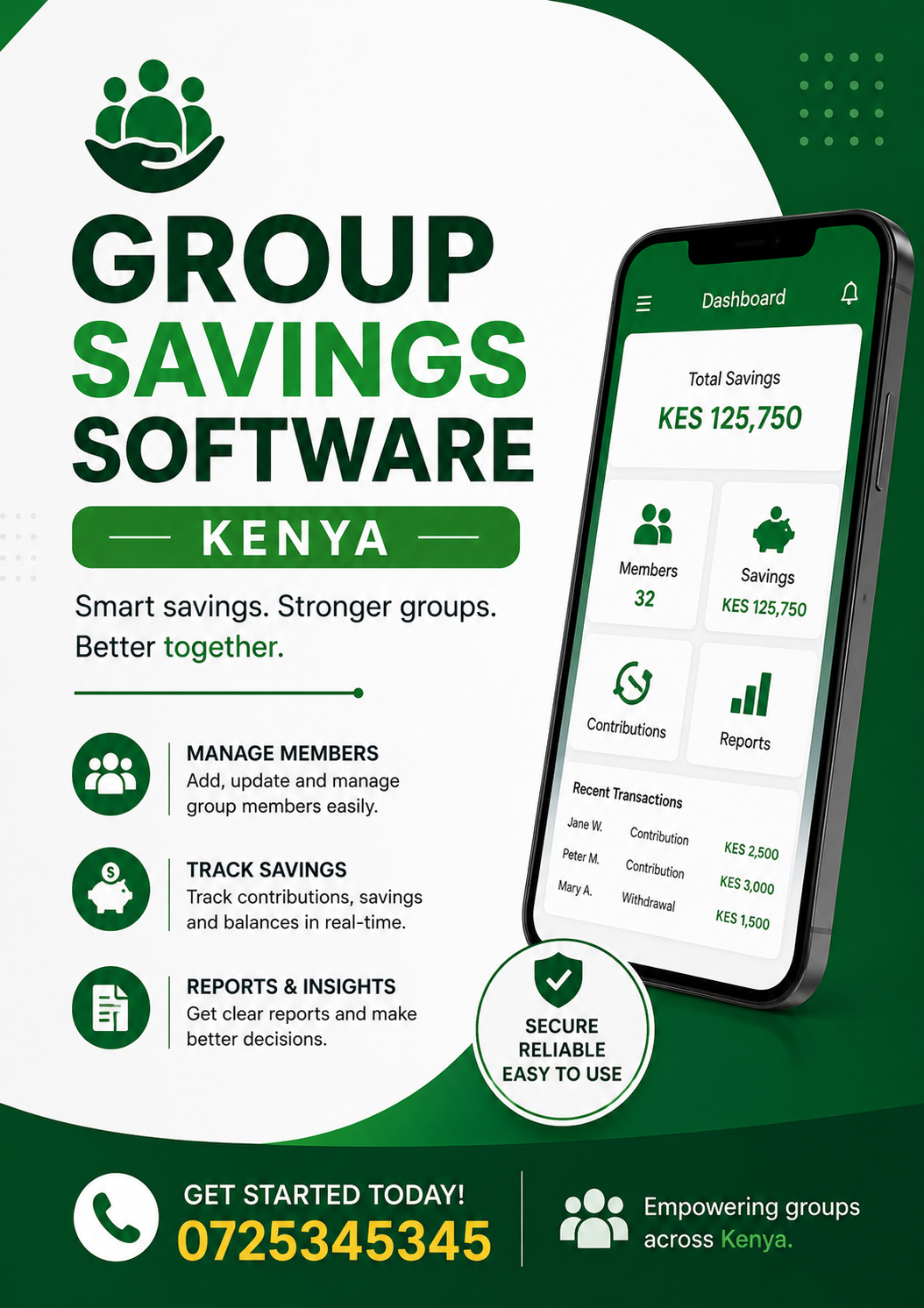
Savings Group Management Software Kenya: A Complete Guide for Modern Savings Groups
Savings groups have become an important way for friends, families, colleagues, women’s groups, welfare groups and community organisations to save money and support one another financially. As these groups grow, however, keeping track of members, contributions, loans, repayments, expenses and meetings can become increasingly difficult. The right Savings Group Management Software Kenya can bring these activities into one organised digital system and make everyday administration easier for group officials and members.
What Is Savings Group Management Software?
Savings group management software is a digital platform designed to help member-based groups organise their financial and administrative activities. Instead of depending entirely on exercise books, spreadsheets, WhatsApp messages and individual records, a group can maintain its important information in one structured environment.
A good Savings Group Management Software Kenya solution can support different types of groups, including savings groups, chamas, welfare groups, table-banking groups, investment clubs, community organisations and employee groups.
The exact features depend on the platform, but common functions include:
- Member registration
- Member profiles
- Savings and contributions
- Loan management
- Repayment tracking
- Guarantor management
- Income and expenses
- Budgets
- Meetings
- Minutes
- Reports
- Member statements
- User permissions
- Audit history
- Data backups
- Data exports
The purpose is not simply to replace a notebook with a computer screen. The bigger goal is to create a reliable record of what the group has collected, spent, borrowed, approved and decided.
Why Savings Groups Need Better Record Keeping
A small group with ten members may find it easy to remember who contributed during a particular month.
The situation changes when membership increases.
Imagine a group with 60 members. Every month, members make contributions. Some members may have loans, others may be guarantors, and the group may also collect welfare funds. There may be penalties for missed meetings, special contributions for emergencies and expenses approved during monthly meetings.
Trying to manage all this information manually can become challenging.
A properly configured Savings Group Management Software Kenya platform can bring these records together.
Instead of keeping contribution records in one spreadsheet and loan information in another, authorised officials can work from connected member records.
This can make it easier to answer questions such as:
- Who has contributed this month?
- How much has each member saved?
- Who has an outstanding loan?
- Which loans are overdue?
- How much money is available?
- What expenses has the group made?
- What decisions were approved at the last meeting?
Having these answers available from organised records can improve accountability.
Types of Groups That Can Use Savings Group Software
Savings groups are not all structured in the same way.
Some are informal groups formed by friends. Others are workplace savings groups, women’s groups, youth groups, welfare associations or investment clubs.
Some groups concentrate mainly on monthly contributions, while others lend money to members and invest pooled funds.
A flexible Savings Group Management Software Kenya platform should therefore be able to accommodate different group structures rather than forcing every organisation into one rigid model.
Chamas
Chamas are among the most common examples of groups that can benefit from digital administration.
A chama may collect monthly contributions, provide member loans, organise meetings and invest pooled funds.
As the number of transactions increases, software can make it easier to maintain consistent records.
Welfare groups
Welfare groups may collect regular contributions and provide financial assistance when members experience qualifying events.
The system can help officials track contributions and disbursements while maintaining member histories.
Table-banking groups
Table banking groups typically combine regular contributions with lending among members.
The group needs accurate information about savings, loans, repayments and available funds.
Investment groups
Investment groups may pool money to purchase property, invest in businesses or pursue other opportunities.
In addition to member contributions, these groups may need to track expenses, investment activity and financial reports.
Member Registration
A reliable member register is the foundation of any savings group.
Each member should have a clear profile containing the information the group actually needs.
Depending on the group’s requirements, this may include:
- Full name
- Phone number
- Membership number
- Registration date
- Membership status
- Next of kin
- Contribution information
- Loan information
- Other relevant records
A central member profile makes it easier to connect different activities to the same person.
When comparing Savings Group Management Software Kenya, group officials should check how simple it is to add members, search for existing members and update information.
Avoiding duplicate members
Duplicate records can cause problems.
If the same person is accidentally registered twice, their contribution history may be split between two accounts.
A structured system can help reduce this risk by using unique membership numbers and validation processes.
The group should still verify information before creating a new member account.
Managing Savings and Contributions
Contributions are usually at the centre of a savings group.
Members may contribute weekly, monthly or according to another schedule agreed by the group.
Manual records can become difficult when many payments are involved.
A digital Savings Group Management Software Kenya solution can help officials record contributions against individual member accounts.
The system can provide a clearer history of:
- Expected contributions
- Actual payments
- Outstanding contributions
- Previous payments
- Special contributions
- Welfare contributions
- Penalties where applicable
This can make reconciliation easier.
Contribution history
Members may want to know how much they have contributed over a particular period.
Instead of searching through several notebooks, officials can retrieve the member’s transaction history.
A clear contribution history also makes it easier to identify discrepancies.
If a member says they paid but the system does not show the payment, the group can investigate the transaction using the available payment reference or supporting evidence.
Loan Management for Savings Groups
Many savings groups lend money to their members.
Loan management can involve several stages:
- Application
- Assessment
- Approval
- Disbursement
- Repayment
- Monitoring
- Clearance
A digital workflow can help officials keep track of these stages.
A suitable Savings Group Management Software Kenya platform can organise loan applications and keep the related information connected to the member record.
Loan applications
A loan application may contain information such as:
- Member name
- Requested amount
- Loan purpose
- Repayment period
- Existing loans
- Savings balance
- Guarantors
- Approval status
Keeping this information together can reduce the need to search through separate documents.
Loan approvals
Different groups have different approval procedures.
Some may require committee approval while others may make decisions during group meetings.
Software should support the group’s established process rather than replacing its governance structure.
Loan Repayment Tracking
After a loan is approved, repayments need to be monitored.
Officials need to know how much the member has paid, how much remains outstanding and whether payments are being made on schedule.
A digital Savings Group Management Software Kenya system can make this information easier to review.
Monitoring overdue loans
Overdue loans require follow-up.
If officials rely on memory or manually check every account, some overdue payments may be missed.
A system can help identify accounts that need attention.
The group can then contact members according to its agreed procedures.
This creates a more structured approach to loan monitoring.
Guarantor Management
Some savings groups require members to guarantee loans for other members.
Guarantor relationships can become difficult to track when they are maintained manually.
A digital system can associate guarantors with relevant loan records.
This gives authorised officials a clearer view of which members are connected to particular loan obligations.
When reviewing Savings Group Management Software Kenya, groups that use guarantors should specifically ask how the platform records and displays these relationships.
Managing Group Expenses
Savings groups do not only receive money.
They also have expenses.
These may include:
- Meeting costs
- Transport
- Bank charges
- Administrative expenses
- Welfare payments
- Investment-related expenses
- Event costs
- Other approved expenditure
A digital Savings Group Management Software Kenya platform can help record these expenses in an organised manner.
Each expense should ideally have enough information for officials to understand what the money was used for.
Expense approvals
The group should have a clear procedure for approving expenditure.
Software can support the recording of approvals, but members still need to follow their constitution and agreed governance procedures.
A transaction should not be considered legitimate simply because it exists in the system.
The supporting approval process remains important.
Income Management
Groups may receive money from several sources.
Apart from member contributions, they may receive:
- Loan interest
- Investment income
- Penalties
- Fundraising proceeds
- Other approved income
A digital Savings Group Management Software Kenya platform can help categorise these transactions.
This allows the group to see where its funds are coming from and how they are being used.
Group Budgets
A budget helps a group plan how money will be used.
The group can estimate expected income and expenses and then compare actual performance against the plan.
For example, a group may budget for:
- Meeting expenses
- Welfare support
- Administrative costs
- Investment contributions
- Events
- Other planned activities
Budget tracking can give members and officials a clearer picture of financial performance.
Meeting Management
Savings groups often make important decisions during meetings.
These decisions may involve:
- Loans
- Investments
- Expenses
- Member admissions
- Penalties
- Welfare support
- Changes to contribution amounts
A digital meeting module can help keep these decisions organised.
A useful Savings Group Management Software Kenya system can provide tools for meeting schedules, agendas, attendance and minutes.
Meeting attendance
Attendance can be recorded digitally.
This is particularly useful for groups that impose penalties for missed meetings.
The attendance record can become part of the member’s history.
Meeting minutes
Minutes should provide a reliable record of what was discussed and decided.
Digital storage makes it easier to retrieve minutes later.
Instead of searching through physical files, officials can find the relevant meeting record.
Recording Group Decisions
Important decisions should be traceable.
Suppose members approve an investment during a meeting.
The decision should be documented.
If the investment later becomes the subject of a question, the group can refer to the meeting record.
This is one of the reasons Savings Group Management Software Kenya can be useful beyond basic financial record keeping.
It creates a connection between financial transactions and the decisions that authorised them.
Member Statements
Members may want statements showing their financial activity.
A statement could include:
- Contributions
- Savings
- Loans
- Repayments
- Interest
- Penalties
- Welfare payments
- Other transactions
A digital Savings Group Management Software Kenya platform can make statements easier to prepare.
Members can receive clearer information about their own accounts, while officials spend less time manually compiling figures.
Transparency and Member Trust
Trust is extremely important in savings groups.
Members contribute their money with the expectation that records will be properly maintained.
Poor record keeping can create disagreements.
For example, one member may believe they contributed more than the treasurer’s records show.
Another member may question why an expense was approved.
Digital records do not eliminate disagreements, but they can give the group a clearer source of information.
A transparent Savings Group Management Software Kenya system can help members and officials work from the same approved records.
User Roles and Permissions
Not every member needs access to every part of the system.
For example:
- The treasurer may manage financial records.
- The secretary may manage meetings and member records.
- The chairperson may approve selected activities.
- Ordinary members may only view their own information.
- An administrator may manage system settings.
Role-based permissions can help separate these responsibilities.
When evaluating Savings Group Management Software Kenya, ask how user permissions are configured.
Why access control matters
If everyone has administrator privileges, there is a greater risk of accidental or unauthorized changes.
Limiting access to sensitive functions provides an additional control.
User access should also be reviewed whenever an official changes role or leaves the group.
Audit Trails
An audit trail records important actions performed within a system.
Depending on the platform, it may show:
- Who made a change
- What was changed
- When the change occurred
This can be useful when investigating discrepancies.
If a contribution record changes unexpectedly, an audit history can help officials understand what happened.
A system with Savings Group Management Software Kenya capabilities should be assessed for the quality of its audit functionality, especially where several officials handle financial records.
Data Security
Savings groups collect personal and financial information.
This means security should be treated as a basic requirement.
A platform should have appropriate safeguards around:
- Authentication
- Passwords
- Permissions
- Data storage
- Backups
- Access controls
Officials should also understand their responsibilities when handling member information.
Data Backups
Important group records should not depend on one computer or one person’s notebook.
A technical failure or accidental deletion could result in the loss of information.
Regular backups can help reduce this risk.
When considering Savings Group Management Software Kenya, ask the provider:
- How often is data backed up?
- Where are backups stored?
- How is data restored?
- Who manages recovery?
- Can the group export its records?
These questions should be answered before implementation.
Cloud-Based Access
Cloud-based systems can allow authorised users to access records from different devices.
This can be useful for savings groups whose officials live or work in different locations.
Members may be able to access information without visiting the treasurer.
However, cloud access should be accompanied by appropriate authentication and security measures.
Mobile Access
Many Kenyan group members use smartphones as their main way of accessing digital services.
A mobile-friendly system should therefore be easy to use on smaller screens.
Important features should not require users to zoom constantly or navigate complicated menus.
A responsive Savings Group Management Software Kenya platform can make digital group management more convenient for members and officials who do not regularly use desktop computers.
Managing Different Savings Categories
Some groups have more than one type of contribution.
For example, members may have:
- Regular savings
- Welfare contributions
- Investment contributions
- Emergency funds
- Special project contributions
These funds may have different rules.
A flexible system should allow the group to distinguish between them.
This makes reporting easier because officials can see how much money belongs to each category.
Managing Fines and Penalties
Some groups charge penalties for:
- Missed meetings
- Late contributions
- Late loan repayments
- Other violations of group rules
A digital system can help record these charges.
However, the software should follow the rules approved by the group.
Officials should not introduce penalties simply because the software allows them.
Investment Tracking
Some savings groups use pooled funds for investments.
The investment may involve property, shares, businesses or other approved opportunities.
Investment records should be maintained separately enough to show:
- Amount invested
- Investment date
- Purpose
- Income generated
- Related expenses
- Current status
A suitable Savings Group Management Software Kenya system can help keep these records organised alongside member contributions.
Financial Reports
Reports allow group officials to turn transactions into useful information.
Possible reports include:
- Member contribution reports
- Loan reports
- Repayment reports
- Arrears reports
- Income reports
- Expense reports
- Budget reports
- Member statements
- Cash summaries
Reports should be easy to understand.
A report that contains many figures but does not answer a useful question is not necessarily a good report.
Member Contribution Reports
A contribution report can show how much each member has contributed during a selected period.
This can help officials identify outstanding contributions.
It can also support discussions during meetings.
Instead of reading through individual payment records, the treasurer can review a summarized report.
Loan Portfolio Reports
Loan reports can help officials understand the group’s outstanding lending activity.
They may show:
- Total loans
- Active loans
- Outstanding balances
- Repayments
- Overdue accounts
- Loan products
This information can support decisions about future lending.
Expense Reports
Expense reports show where group funds are being used.
This is particularly useful when members want greater transparency.
A report can help show whether spending is consistent with approved budgets and decisions.
Reducing Spreadsheet Dependence
Spreadsheets are useful tools, but they can become difficult to manage when several people are editing files.
Problems may include:
- Multiple versions
- Broken formulas
- Accidental deletions
- Inconsistent formatting
- Missing records
- Difficult reconciliation
A central Savings Group Management Software Kenya platform can reduce dependence on disconnected spreadsheets.
This does not mean spreadsheets become completely unnecessary.
Groups may still export information for analysis or reporting.
The difference is that the main operational records are maintained in a controlled system.
Moving From Paper Records to Digital Records
Some groups may have years of information stored in notebooks.
Moving everything into a digital system requires planning.
The group should first identify:
- Current members
- Former members
- Outstanding loans
- Current savings
- Contribution balances
- Important historical transactions
Data should be checked before it is entered.
Poor-quality historical information should not simply be transferred into the new system without review.
Data Migration
Data migration is the process of moving existing information into the new platform.
The process may involve:
- Reviewing old records
- Removing duplicates
- Checking member information
- Confirming balances
- Preparing data
- Importing information
- Testing the imported records
- Correcting errors
A good Savings Group Management Software Kenya implementation should include a clear migration plan where existing data needs to be transferred.
Staff and Official Training
The software may be easy to use, but officials still need training.
Training should cover real tasks.
For example, the treasurer can practice recording a contribution.
The secretary can practice creating a meeting and recording minutes.
The loan committee can practice processing an application.
Members can learn how to view their own information if self-service is available.
Practical training is more useful than simply showing users every feature.
Member Training
Members should also understand how the system affects them.
They may need to know how to:
- Access their account
- View contributions
- Check loan balances
- View statements
- Receive notifications
- Report incorrect information
Clear communication can make adoption easier.
Choosing the Right Provider
There are many software products available, but not every product is designed for the same type of organisation.
A group should begin by identifying its actual requirements.
Ask:
- How many members do we have?
- How often do we collect contributions?
- Do we provide loans?
- Do we use guarantors?
- Do we have welfare funds?
- Do we make investments?
- Do we need meeting management?
- Do members need self-service?
- What reports do we need?
These answers create a requirements list.
The group can then compare providers against that list.
What to Ask During a Software Demo
Do not rely only on a sales presentation.
Ask the provider to demonstrate actual scenarios.
For example:
Scenario one: Register a new member.
Scenario two: Record a monthly contribution.
Scenario three: Process a loan application.
Scenario four: Record a repayment.
Scenario five: Generate a member statement.
Scenario six: Create a meeting and record minutes.
Scenario seven: Produce a financial report.
Scenario eight: Restrict a user from accessing sensitive information.
A provider that can demonstrate these workflows clearly gives the group a better basis for evaluation.
Pricing Considerations
Cost is important, but the cheapest system may not always provide the best value.
A group should consider the full cost of using the platform.
Potential costs may include:
- Subscription
- Setup
- Training
- Data migration
- Support
- Integrations
- Additional users
- Customisation
- Future upgrades
When comparing Savings Group Management Software Kenya, look at total cost rather than only the advertised starting price.
Support and Maintenance
Support becomes important once the system is being used for real transactions.
Officials may have questions about:
- Correcting records
- Adding users
- Generating reports
- Managing permissions
- Importing data
- Resolving errors
Before signing up, ask how support is provided.
Find out whether assistance is available by phone, email, chat or another channel.
Scalability
A group may have 20 members today and 100 members in several years.
The software should be able to accommodate reasonable growth.
Management should ask about:
- Member limits
- User limits
- Storage
- Transaction volume
- Reporting
- Additional branches or groups
Scalability is especially important for organisations with plans to expand.
A scalable Savings Group Management Software Kenya solution can help the organisation avoid replacing its system as soon as membership grows.
Managing Multiple Groups
Some individuals manage more than one savings group.
A professional administrator may support several organisations, while an umbrella organisation may have multiple chapters.
If this applies, ask whether the platform can keep each group’s records separate while allowing appropriate administrative access.
Data separation is important because members of one group should not automatically have access to another group’s financial information.
Communication and Notifications
Notifications can help members remember important deadlines.
Possible notifications include:
- Contribution reminders
- Loan repayment reminders
- Meeting notices
- Application updates
- Approval notifications
- Important group announcements
Communication should be relevant.
Too many notifications can cause members to ignore them.
The group should establish sensible communication practices.
Member Self-Service
Self-service can reduce the number of routine questions directed to the treasurer or secretary.
For example, a member may be able to check their contribution history without asking an official.
A member may also be able to see their loan balance or download a statement.
A properly configured Savings Group Management Software Kenya platform can provide this convenience while maintaining role-based access.
Improving Accountability
Accountability is one of the biggest reasons groups move towards digital systems.
When financial information is stored in a central platform, authorised members can review records more easily.
This can help reduce confusion about:
- Contributions
- Loans
- Expenses
- Balances
- Decisions
However, technology should support accountability rather than replace good governance.
The group still needs clear rules and responsible officials.
Improving Decision-Making
Good decisions depend on good information.
If a committee wants to decide whether it can afford an investment, it needs to know its available funds and outstanding obligations.
If it wants to increase lending, it needs to understand existing loans and repayments.
A Savings Group Management Software Kenya platform can make relevant information easier to access.
This can allow meetings to focus more on decisions rather than spending the entire session reconstructing records.
Data Export
Groups should understand what happens to their data if they ever change software providers.
A good system should provide a practical way to export important records.
Possible formats include:
- Excel
- CSV
The exact export options vary.
Before subscribing, ask what information can be exported and whether there are restrictions.
Data Ownership
The group should understand who owns its records.
Member and financial information belongs to the organisation or is subject to the applicable legal and contractual arrangements.
The software provider is providing a service.
The agreement should clearly explain data ownership, access and export arrangements.
Security During Member Access
Member self-service creates convenience but also creates security responsibilities.
Users should authenticate themselves appropriately.
A member should not be able to view another member’s financial information simply by knowing their name or membership number.
Permissions should be tested before launch.
Testing Before Going Live
Testing should involve actual examples.
For example:
- Create a member
- Add a contribution
- Create a loan
- Approve the loan
- Record repayment
- Generate a statement
- Record an expense
- Produce a report
- Change a user permission
- Review the audit history
The group should verify that the results are correct.
When implementing Savings Group Management Software Kenya, testing should be completed before the system becomes the official source of records.
Creating a Digital Implementation Plan
A simple implementation can be divided into several stages.
Week One: Preparation
Identify requirements, users, records and existing processes.
Week Two: Data Setup
Clean member information and prepare opening balances.
Week Three: Training
Train officials and test workflows.
Week Four: Launch
Begin using the platform and monitor issues.
The timeline can be adjusted depending on the size and complexity of the group.
Common Implementation Mistakes
Keeping two official systems
If the group continues treating both the notebook and software as official records, confusion can continue.
Choose one primary system after the transition.
Giving everyone administrator access
This creates unnecessary risk.
Use role-based permissions.
Skipping data cleanup
Poor historical information can create problems in the new system.
Clean the data first.
Failing to train members
If members do not understand how to access their information, they may continue relying entirely on officials.
Ignoring backups
Confirm that backups are operating and understand the recovery process.
Benefits for Treasurers
The treasurer often carries a large administrative burden.
A digital system can reduce repetitive work involving:
- Contributions
- Loan balances
- Expenses
- Statements
- Reports
This can make the treasurer’s role more manageable.
Instead of spending a meeting searching through notebooks, the treasurer can focus on explaining the group’s financial position.
Benefits for Secretaries
Secretaries can benefit from digital member records and meeting management.
They can organise:
- Member lists
- Meeting dates
- Agendas
- Attendance
- Minutes
- Decisions
A centralized system can make it easier to retrieve old meeting information when members need clarification.
Benefits for Chairpersons
Chairpersons need visibility rather than necessarily performing every administrative task.
A digital dashboard can help them understand the group’s general position.
They may review reports before meetings and focus on decisions.
Benefits for Ordinary Members
Members can benefit from clearer access to their own information.
Instead of depending entirely on officials, they may be able to check:
- Contributions
- Savings
- Loans
- Repayments
- Statements
This can strengthen transparency.
Savings Groups and Digital Transformation
Digital transformation does not mean that a savings group needs to become complicated.
The best systems simplify everyday work.
A small group may only need member management, contributions, loans and reports.
A larger group may require meetings, permissions, investment tracking and more advanced reporting.
The system should grow with the group’s needs.
Practical Example
Consider a women’s savings group with 40 members.
Each member contributes every month.
The group also provides short-term loans.
The treasurer currently uses an exercise book while the secretary maintains member information in Excel.
Loan repayments are communicated through WhatsApp.
At the end of each month, the treasurer manually calculates balances.
This creates several opportunities for errors.
With Savings Group Management Software Kenya, the group could maintain member profiles, contributions, loans and repayments in one system.
The secretary could manage members and meetings.
The treasurer could record financial activity.
Members could review their own records if self-service is available.
Management could generate reports without manually combining several files.
Example of a Monthly Digital Workflow
At the beginning of the month, the system can show expected contributions.
As members make payments, officials record or reconcile them.
Outstanding contributions remain visible.
During the monthly meeting, the group can review financial reports.
Loan applications can be assessed according to the group’s rules.
Approved loans can be recorded.
Repayments can then be monitored during the following months.
This creates a repeatable workflow.
Using Software Without Losing the Human Side
Savings groups are built around relationships.
Members meet, discuss issues, support each other and make collective decisions.
Software should not replace that human element.
Instead, it should handle administrative work so members can spend more time discussing meaningful issues.
A digital platform should support the group rather than dictate how members interact.
Frequently Asked Questions
What is Savings Group Management Software?
It is software designed to help savings groups manage members, contributions, loans, repayments, expenses, meetings and reports in an organised digital environment.
Who can use savings group software?
Chamas, welfare groups, table-banking groups, investment clubs, workplace groups, community organisations and other member-based savings groups can use suitable software.
Can it track monthly contributions?
Yes. Contribution tracking is one of the main functions expected from a savings group platform. The group should be able to view individual payment histories and overall contribution activity.
Can it manage loans?
Many platforms support loan applications, approvals, disbursements, repayments and outstanding balances. The group should confirm that the system supports its particular loan rules.
Can members access their own records?
Some platforms provide member self-service features. Where available, access should be protected through appropriate authentication and permissions.
Can savings group software manage meetings?
Some systems include meeting scheduling, attendance, agendas and minutes. This can help connect governance records with financial decisions.
Is savings group software suitable for small groups?
Yes. Small groups can benefit from organised records and may find it easier to establish good processes before membership grows.
Can the system replace Excel?
It can reduce the need to use Excel as the primary operational record. However, groups may still export information to spreadsheets for additional analysis.
How secure is savings group software?
Security depends on the platform and its implementation. Groups should ask about authentication, permissions, encryption, backups, access monitoring and data recovery.
What should we check before buying?
Check member management, contributions, loans, reports, meetings, permissions, audit trails, backups, data export, support, pricing and scalability.
A Savings Group Software Checklist
Before choosing a platform, the committee can use the following checklist:
- Member registration
- Member profiles
- Contribution tracking
- Savings management
- Loan applications
- Loan approvals
- Loan repayment tracking
- Guarantor management
- Welfare funds
- Income management
- Expense management
- Budget tracking
- Meeting management
- Attendance records
- Minutes
- Member statements
- Reports
- User permissions
- Audit history
- Data backups
- Data export
- Mobile access
- Member self-service
- Notifications
- Technical support
- Training
- Scalability
The group should score each provider against its most important requirements rather than choosing based solely on the number of features advertised.
Making the Final Software Decision
The final decision should involve the people who will actually use the platform.
The treasurer should test financial workflows.
The secretary should test member and meeting functions.
The chairperson should review reports and approvals.
Ordinary members can test the member experience if self-service is available.
This approach gives the committee a more realistic understanding of whether the system will work.
When comparing Savings Group Management Software Kenya, the group should also consider the quality of support offered after implementation.
Measuring the Results
After implementation, the group should review whether the software is actually helping.
Useful measures could include:
- Time spent preparing reports
- Time spent preparing statements
- Number of record corrections
- Number of duplicate records
- Loan processing time
- Member access to records
- Number of unresolved financial discrepancies
The group can review these measures after the first few months.
Long-Term Use
Software becomes more useful when records remain accurate.
Officials should regularly review member information, user permissions and financial records.
New officials should receive training.
Former officials should have their access removed.
Backups should continue.
Reports should be reviewed regularly.
These simple practices help keep the system useful over time.
What a Modern Savings Group Needs
A modern savings group does not necessarily need complicated technology.
It needs dependable records.
It needs clear contribution information.
It needs understandable loan records.
It needs transparent expenses.
It needs documented decisions.
It needs appropriate access controls.
It needs reports that members and officials can understand.
It needs a system that supports the way the group actually works.
A well-selected Savings Group Management Software Kenya platform can bring these requirements together in one organised environment.
For Kenyan groups moving away from notebooks, scattered spreadsheets and informal records, digital management can provide a more structured way to handle the financial and administrative work that comes with growth.
The most important step is to start with the group’s actual needs, test realistic workflows, verify security and permissions, understand the total cost and train the people responsible for maintaining the records.
That approach gives the committee a stronger basis for choosing software that can support the group as its membership, savings activity and responsibilities increase.
Savings Group Management Software Kenya
Savings Group Management Software Kenya
Savings Group Management Software Kenya
Savings Group Management Software Kenya
Savings Group Management Software Kenya
Savings Group Management Software Kenya
Savings Group Management Software Kenya
Savings Group Management Software Kenya
Savings Group Management Software Kenya
Savings Group Management Software Kenya
Savings Group Management Software Kenya
Savings Group Management Software Kenya
Savings Group Management Software Kenya
Savings Group Management Software Kenya
Savings Group Management Software Kenya
Savings Group Management Software Kenya
Savings Group Management Software Kenya
Savings Group Management Software Kenya
Savings Group Management Software Kenya
Savings Group Management Software Kenya
Savings Group Management Software Kenya
Savings Group Management Software Kenya
Savings Group Management Software Kenya